

RADIOCARBON-BASED MODELING OF THE REIGN OF KING DEN (1ST DYNASTY, EGYPT) AND THE START OF THE OLD KINGDOM
Open accessThe DOI matches its Crossref record; 30 of the 30 references it cites were found in a registry or an index; none of the 17 sources its claims cite is checked for support yet.
Abstract
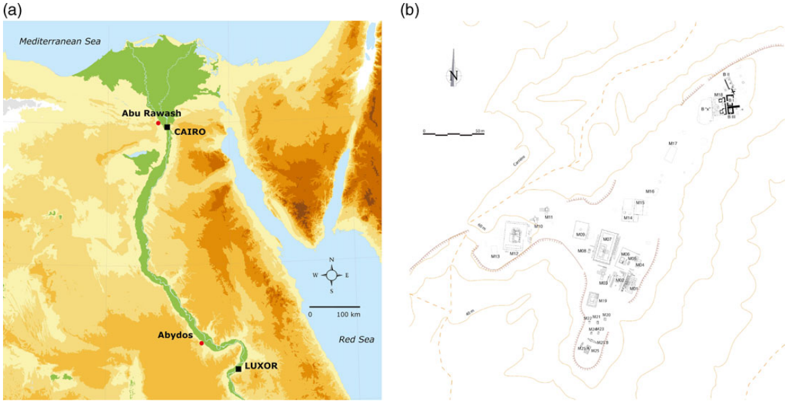
This study focuses on the chronology of King Den’s reign, the fifth ruler of the 1st Egyptian dynasty. A series of radiocarbon (14 C) dates were established on archaeological material from several tombs at the Abu Rawash site, near Cairo, which comprises a complex of 12 monumental mud-brick mastabas. Modeling the 14 C results enables us to estimate the date of King’s accession and to link this to the beginning of the 3rd Dynasty, i.e., to Egyptian state’s structuration. Through the application of OxCal software, sets of 14 C results obtained from the same archaeological context have been summarized and compared with the precise state of our knowledge on the historical duration of this reign. These results place King Den’s accession between 3104 and 2913 BCE (2σ), with the more likely date being 3011–2921 BCE (1σ). The modeled temporal density thus obtained is based both on new contextualized 14 C dates and on an updated reading of the historical information on his reign. This is a dynamic result, which can be refined as soon as we have more data to integrate into the model. Above all, this resulting model becomes a crucial chronological point to better determine the beginning of the Egyptian Old Kingdom.
Overview
CoChat Summary
TL;DR
New radiocarbon dates from Abu Rawash, modeled in OxCal with IntCal20 and historical priors, refine the accession date of King Den of Egypt’s 1st Dynasty. The final model places Den’s accession at 3104–2913 BCE (2σ), more likely 3011–2921 BCE (1σ), and offers a modeled estimate for the start of the 3rd Dynasty.
Key findings
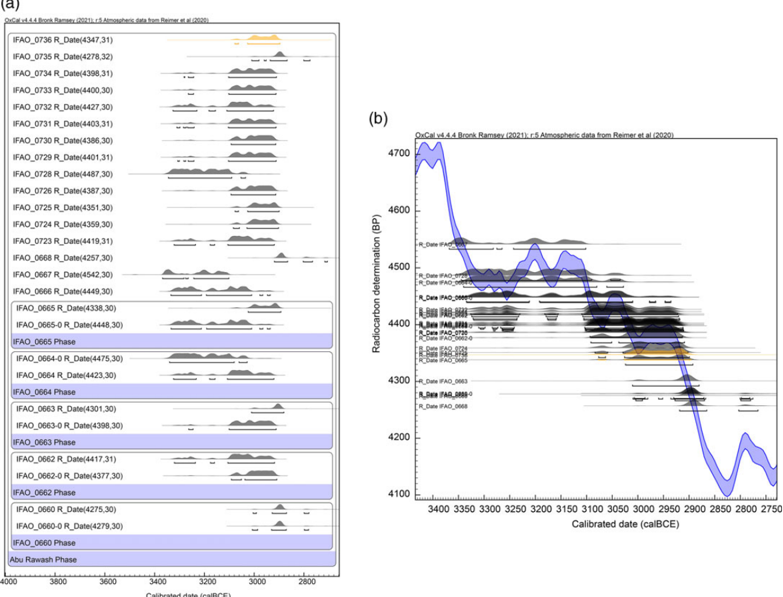
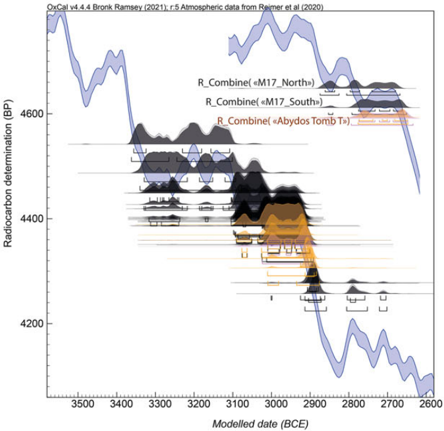
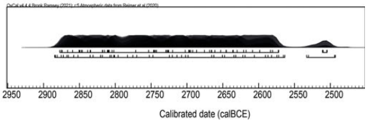
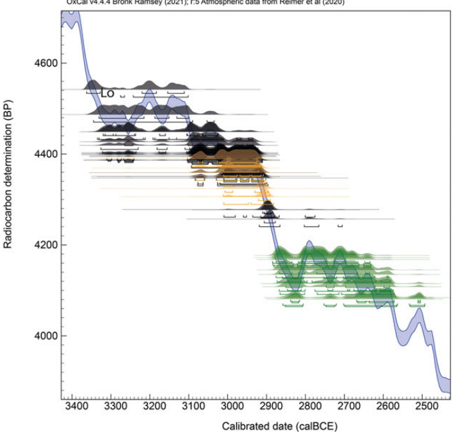
- Twenty-seven 14C analyses were carried out on 22 samples from Abu Rawash; 26 determinations were integrated into the Bayesian model. Results ranged from 4542 ± 30 BP to 4257 ± 30 BP, with calibrated densities from 3369 to 2706 cal BCE (2σ).
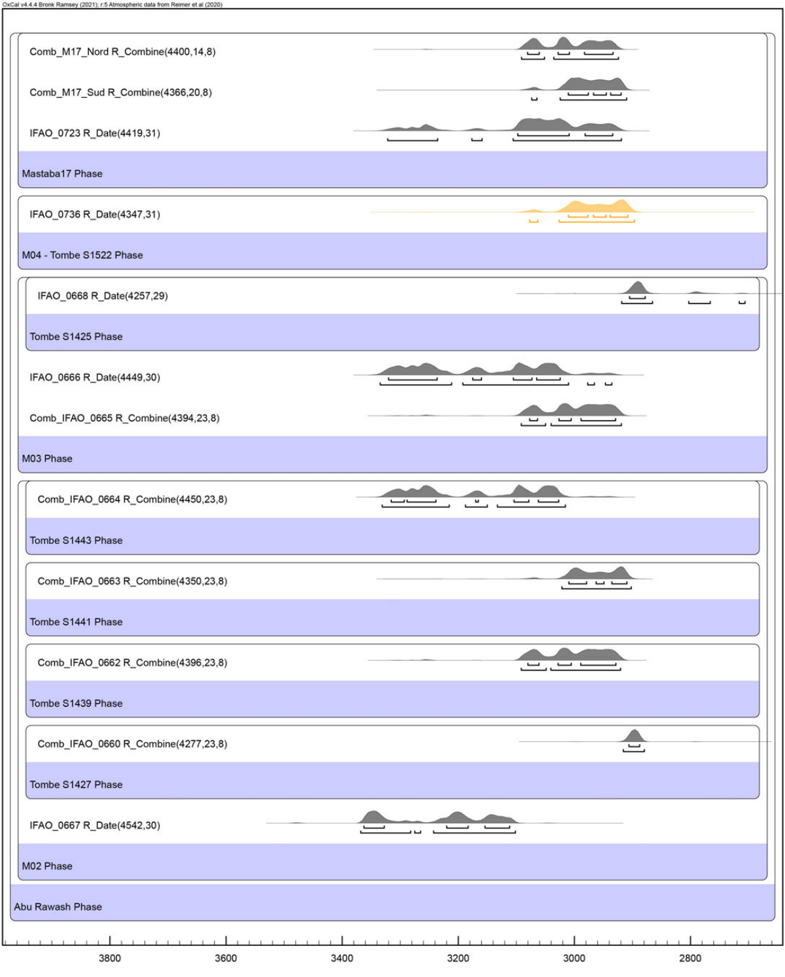
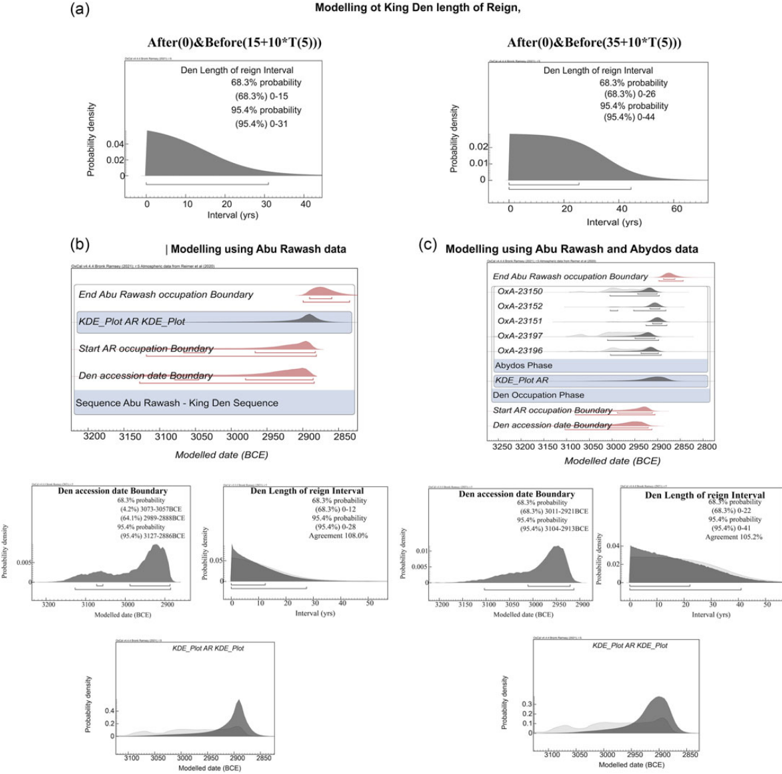
- An Abu Rawash-only model estimated Den’s accession at 3127–2886 BCE (2σ), more probably 2989–2888 BCE (64.1%), and the start of Abu Rawash occupation at 3116–2883 BCE (95.4%).
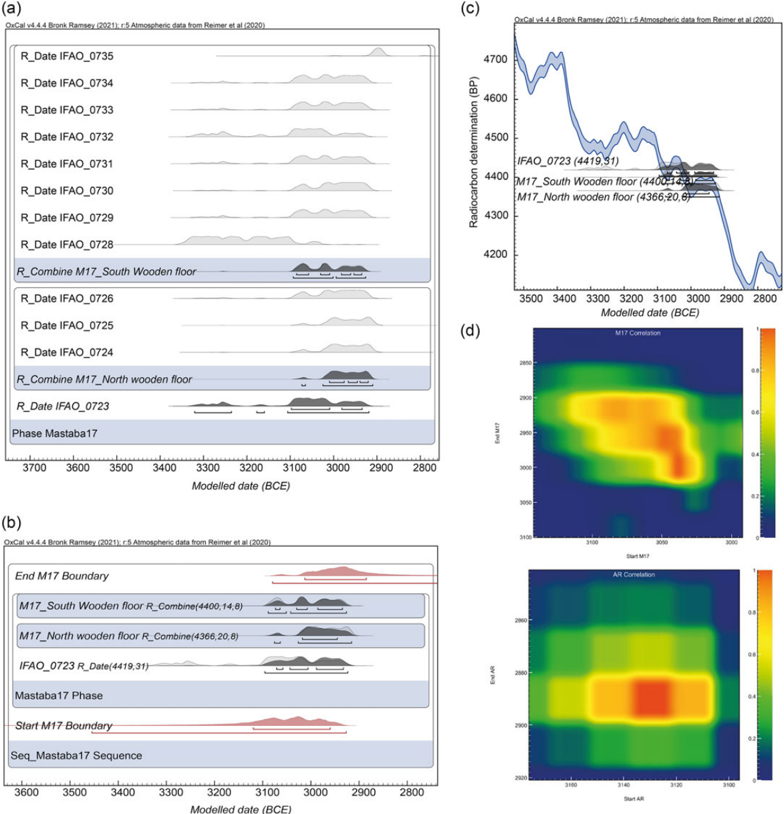
- The final model, combining Abu Rawash data with Abydos Umm el-Qaab Tomb T short-lived samples from Dee et al. (2013), places Den’s accession at 3104–2913 BCE (2σ), with the more likely date being 3011–2921 BCE (1σ).
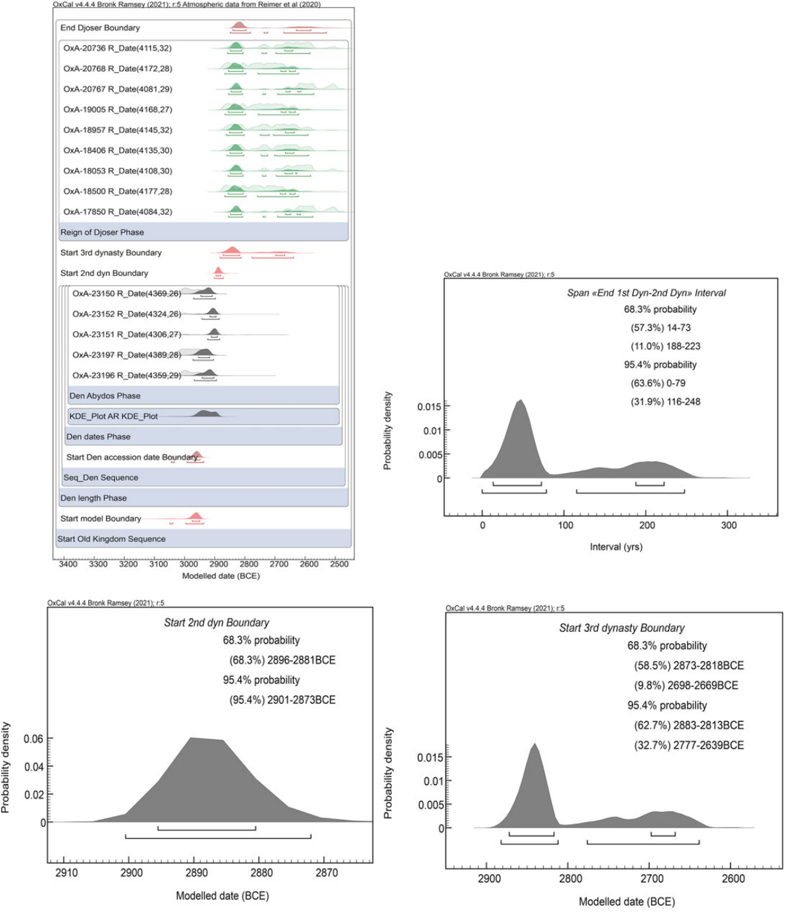
- The start of the 3rd Dynasty was modeled at 2883–2813 BCE (62.7%) or 2777–2639 BCE (32.7%), while the span between the end of the 1st Dynasty and the start of the 3rd Dynasty was 0–79 yr (63.6%) or 116–248 yr (31.9%).
Methods
- Samples came from Cemetery M at Abu Rawash, where 12 mud-brick mastabas are dated to the reign of King Den. The set comprised 22 samples: 8 wood samples from five tombs and a mastaba wooden floor, 13 charcoal samples from Mastaba 17, and 1 vegetal-fiber sample from tomb 1522.
- Radiocarbon dating used conventional liquid scintillation counting at the IFAO laboratory, with AAA pretreatment, benzene synthesis, δ13C measurement by IRMS, OxII standard, and Libby half-life. Five samples were replicated; IFAO_0727 was not validated due to bad combustion yield.
- Bayesian modeling used OxCal 4.4 with IntCal20, a Delta_R correction of 16 ± 4 14C yr, R_Combine densities, Phase/Sequence/Boundary tools, KDE_Plot/KDE_Model, and outlier models (Charcoal for long-lived samples; General for the single short-lived sample). Historical priors for Den’s reign length were based on sources including the Palermo Stone and Godron’s estimate of 33–65 years, more probably 35–40 years.
Limitations
- Stated: most objects dated to Den in museum collections were acquired over a century ago and lack documentation of their archaeological context, which the paper calls the principal limitation with museum collections.
- Stated: only one sample was short-lived; all others were wood or charcoal, so results should be considered a terminus to site frequentation and modeled with that restriction, including possible inbuilt-age effects.
- Stated: the dates for Den and Djoser fall in two distinct plateau-ages separated by only a few decades; because fewer 14C dates are associated with Djoser than with Den and no other constraints were built into the model, the model is slightly unbalanced and may favor probabilities closest to Den’s dates, so the two possible intervals for the start of the 3rd Dynasty cannot be resolved without more constraints. Evident from the text: statistics for each building are weak, and small discrepancies can be strongly enlarged by the plateau-age.
Model-written summary. Check it against the paper before relying on it.
Integrity signals
Registry
Cites
Statistics
Figures
Verification
Claims the paper makes
0 Valid · 1 Not valid · 12 Not checked · 67 Own results and interpretations
A result the paper reports from its own data — it cites no other source for it, so there is none to check. The quote shows it is in the paper.
In the paper
“Apart from a few residual sherds related to the nearby Cemetery F dated to the 4th Dynasty, the ceramic material is dated only to Naqada IIIC2 (mid-1st Dynasty) phase.”
§ RADIOCARBON-BASED MODELING OF THE REIGN OF KING DEN (1ST DYNASTY, EGYPT) AND THE START OF THE OLD KINGDOM > Abu Rawash Site-Archaeological Context
plain- Asserted: passes — The authors put it forward as true.
- Checkable: passes — It can be checked against evidence.
- Load-bearing: unclear — It is unclear whether the paper’s conclusions depend on it.
- Based: passes — The paper gives a reason why it holds.
A result the paper states — it cites no source for it, so there is none to check. The quote shows it is in the paper.
In the paper
“From a chronological perspective, the Cemetery M of Abu Rawash functioned for only a very short period of time at the beginning of the reign of King Den, fifth ruler of the 1st Dynasty.”
§ RADIOCARBON-BASED MODELING OF THE REIGN OF KING DEN (1ST DYNASTY, EGYPT) AND THE START OF THE OLD KINGDOM > Abu Rawash Site-Archaeological Context
plain- Asserted: passes — The authors put it forward as true.
- Checkable: passes — It can be checked against evidence.
- Load-bearing: passes — The paper’s conclusions depend on it.
- Based: passes — The paper gives a reason why it holds.
A result the paper reports from its own data — it cites no other source for it, so there is none to check. The quote shows it is in the paper.
In the paper
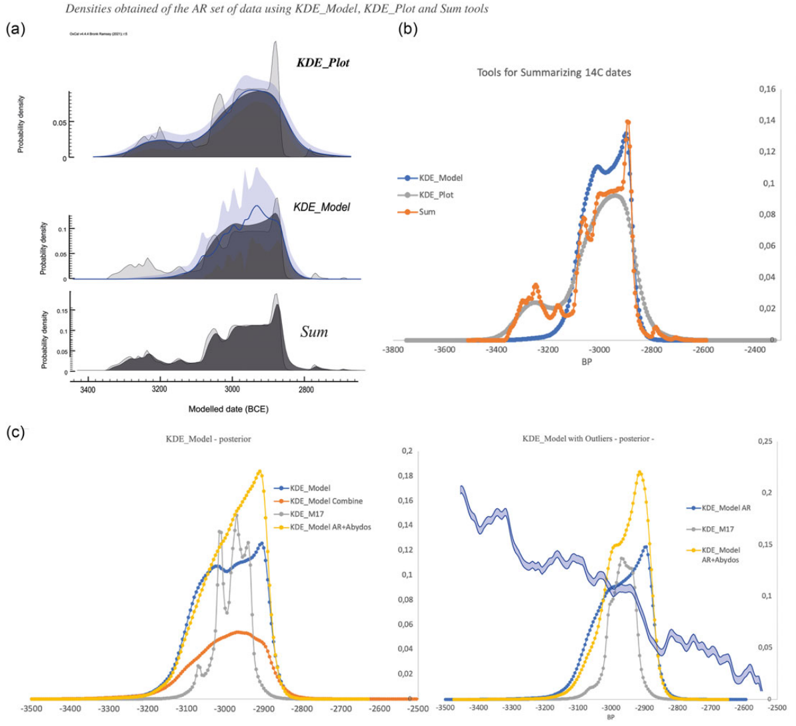
“The comparison of such temporal densities to the ones obtained from the Abu Rawash site are clearly consistent (Figure 7a, b).”
§ RADIOCARBON-BASED MODELING OF THE REIGN OF KING DEN (1ST DYNASTY, EGYPT) AND THE START OF THE OLD KINGDOM > King Den's Accession Date
boostedn = 5- Asserted: passes — The authors put it forward as true.
- Checkable: passes — It can be checked against evidence.
- Load-bearing: unclear — It is unclear whether the paper’s conclusions depend on it.
- Based: passes — The paper gives a reason why it holds.
A result the paper reports from its own data — it cites no other source for it, so there is none to check. The quote shows it is in the paper.
In the paper
“Den accession date | 3127-2886 | 3137-2888 | 3177-2892 | 3165-3039”
§ RADIOCARBON-BASED MODELING OF THE REIGN OF KING DEN (1ST DYNASTY, EGYPT) AND THE START OF THE OLD KINGDOM > CONCLUSION
plain- Asserted: passes — The authors put it forward as true.
- Checkable: passes — It can be checked against evidence.
- Load-bearing: passes — The paper’s conclusions depend on it.
- Based: passes — The paper gives a reason why it holds.
A check of a cited source is scheduled, or we don’t hold its full text yet; the claim is checked once it runs.
In the paper
“The modeled estimate for King Den's accession date (Table 2) is slightly wider than the first one suggested by Dee et al. (2013) of 2945-2904 BCE (2σ).”
§ RADIOCARBON-BASED MODELING OF THE REIGN OF KING DEN (1ST DYNASTY, EGYPT) AND THE START OF THE OLD KINGDOM > King Den's Accession Date
What the sources say
- Not checked yetcites Dee et al. (2013) matched to “An absolute chronology for early Egypt using radiocarbon dating and Bayesian statistical modelling” (2013) source
A check is scheduled.
plain- Asserted: passes — The authors put it forward as true.
- Checkable: passes — It can be checked against evidence.
- Load-bearing: unclear — It is unclear whether the paper’s conclusions depend on it.
- Based: passes — The paper gives a reason why it holds.
- Not checked yet
19 more claims
Create a free account to see all 80 claims and to verify the 11 references still open.
- Probably not a substantial claim. 26
- It may state two separate claims as one. 41
Self-check
Percentages, sums and reported differences re-computed from the paper’s own numbers.
Each contradiction between two passages listed here was confirmed by an independent check.
Rated minor: it would not touch a result — a value no result rests on, a p-value that stays on the same side of the significance level, or a conflict that is clerical, resolved elsewhere in the paper, or outside its own findings.
In the paper
§ RADIOCARBON-BASED MODELING OF THE REIGN OF KING DEN (1ST DYNASTY, EGYPT) AND THE START OF THE OLD KINGDOM > 14 C Modeling
“Except IFAO_0723, all are long-lived samples”
§ RADIOCARBON-BASED MODELING OF THE REIGN OF KING DEN (1ST DYNASTY, EGYPT) AND THE START OF THE OLD KINGDOM > CONCLUSION
“IFAO_0736 short lived sample which estimate is down-weighted using the "General" Outlier-Model.”
Rated minor: it would not touch a result — a value no result rests on, a p-value that stays on the same side of the significance level, or a conflict that is clerical, resolved elsewhere in the paper, or outside its own findings.
In the paper
§ RADIOCARBON-BASED MODELING OF THE REIGN OF KING DEN (1ST DYNASTY, EGYPT) AND THE START OF THE OLD KINGDOM > CONCLUSION
“Table 1 Results of the 26 14 C analyses carried out at the IFAO lab on 22 wood species.”
§ RADIOCARBON-BASED MODELING OF THE REIGN OF KING DEN (1ST DYNASTY, EGYPT) AND THE START OF THE OLD KINGDOM > CONCLUSION
“| IFAO_0736 | Vegetal fibers | -21.40 | 4347 | 31 | N°29, US 1522 | Tomb S1522 |”
Citations
Cites
Bayesian Analysis of Radiocarbon Dates
Bronk Ramsey, C. (2009) · Radiocarbon · doi:10.1017/s0033822200033865 · Cited by 8,725
The IntCal20 Northern Hemisphere Radiocarbon Age Calibration Curve (0–55 cal kBP)
Reimer, P. J., Austin, W. E. N., Bard, E., Bayliss, A., Blackwell, P. G., Bronk Ramsey, C., Butzin, M., Cheng, H., Edwards, R. L., Friedrich, M., et al. (2020) · Radiocarbon · doi:10.1017/rdc.2020.41 · Cited by 7,900 · cited 1×
“…the quantity of private elite tombs known for his reign at Saqqara—more than 30—Abusir, Helwan, and Abu Rawash, or the fact that the king had at least three different chancellors (Strudwick 1985; Tallet and Resk Ibrahim 2008:172; Moreno Garcia 2013), suggests that his reign was considerably long.”
BackgroundDiscussion Reporting of 14 C Data
Stuiver, M., & Polach, H. A. (1977) · Radiocarbon · doi:10.1017/s0033822200003672 · Cited by 5,640
Radiocarbon Calibration and Analysis of Stratigraphy: The OxCal Program
Bronk Ramsey, C. (1995) · Radiocarbon · doi:10.1017/s0033822200030903 · Cited by 2,409
Dealing with outliers and offsets in radiocarbon dating
Bronk Ramsey, C. (2009) · Radiocarbon · doi:10.1017/s0033822200034093 · Cited by 1,204 · cited 6×
“To take into account this possible offset, such 14C estimates were modeled using a Charcoal outlier density as defined in Bronk Ramsey (2009b), whereas the only short-lived sample was downweighted using a symmetric Student’s t-distribution with 5% probability (General Outlier model).”
MethodInfluentialMethods for Summarizing Radiocarbon Datasets
Ramsey, C. B. (2017) · Radiocarbon · doi:10.1017/rdc.2017.108 · Cited by 1,179
Reporting 14C Activities and Concentrations
Mook, W. G., & van der Plicht, J. (1999) · Radiocarbon · doi:10.1017/s0033822200057106 · Cited by 456
(2006) · doi:10.1163/9789047404002 · Cited by 365
Wilkinson, T. A. H. (1999) · doi:10.4324/9780203272510 · Cited by 329
Wilkinson, T. A. H. (2002) · Routledge eBooks · doi:10.4324/9780203024386 · Cited by 314
Radiocarbon-Based Chronology for Dynastic Egypt
Ramsey, C. B., Dee, M. W., Rowland, J. M., Higham, T. F. G., Harris, S. A., Brock, F., Quiles, A., Wild, E. M., Marcus, E. S., & Shortland, A. J. (2010) · Science · doi:10.1126/science.1189395 · Cited by 282 · cited 7×
“Nine previous analyses were based on samples from Saqqarah in the framework of the Oxford project (Bronk Ramsey et al. 2010): four seeds and short-lived plants associated with Khasekhemuwy/Djoser period and held at the Medlhabsmuseet in Stockolm, two short-lived plants from the Royal Botanic…”
BackgroundMethodInfluentialHigh-Precision Bayesian Modeling of Samples Susceptible to Inbuilt Age
Dee, M. W., & Ramsey, C. B. (2014) · Radiocarbon · doi:10.2458/56.16685 · Cited by 131
Book Review: The Administration of Egypt in the Old Kingdom: The Highest Titles and their Holders
Kanawati, N., & Strudwick, N. (1992) · The Journal of Egyptian Archaeology · doi:10.1177/030751339207800133 · Cited by 113
An absolute chronology for early Egypt using radiocarbon dating and Bayesian statistical modelling
Dee, M., Wengrow, D., Shortland, A., Stevenson, A., Brock, F., Girdland Flink, L., & Bronk Ramsey, C. (2013) · Proceedings of the Royal Society A: Mathematical, Physical and Engineering Sciences · doi:10.1098/rspa.2013.0395 · Cited by 93
Investigating the likelihood of a reservoir offset in the radiocarbon record for ancient Egypt
Dee, M. W., Brock, F., Harris, S. A., Ramsey, C. B., Shortland, A. J., Higham, T. F. G., & Rowland, J. M. (2010) · Journal of Archaeological Science · doi:10.1016/j.jas.2009.09.003 · Cited by 68 · cited 1×
“Dee et al. (2010) suggests a variation of 14C activity of 19 ± 5 14C yr to the IntCal04 curve for the Nile valley due to a seasonal effect, which has been revised byManning et al. (2020a, 2020b) to 16 ± 4 14C yr, using IntCal20 curve.”
MethodUmm el-Qaab : Nachuntersuchungen im frühzeitlichen Königsfriedhof - 9./10. Vorbericht
Dreyer, G. (1990) · Mitteilungen des Deutschen Archäologischen Instituts. Abteilung Kairo · Cited by 60
Mediterranean radiocarbon offsets and calendar dates for prehistory
Manning, S. W., Kromer, B., Cremaschi, M., Dee, M. W., Friedrich, R., Griggs, C., & Hadden, C. S. (2020) · Science Advances · doi:10.1126/sciadv.aaz1096 · Cited by 41
Manning, S. W., Wacker, L., Büntgen, U., Bronk Ramsey, C., Dee, M. W., Kromer, B., Lorentzen, B., & Tegel, W. (2020) · Scientific Reports · doi:10.1038/s41598-020-69287-2 · Cited by 37
Ancient Egyptian Administration
(2013) · doi:10.1163/9789004250086 · Cited by 29
Tallet (2008) · doi:10.2143/re.59.0.2036289 · Cited by 11
The IFAO Radiocarbon Laboratory: A Status Report
Quilès, A., Kamal, N. S., Fatah, M. A., & Mounir, N. (2017) · Radiocarbon · doi:10.1017/rdc.2017.35 · Cited by 9
INSCRIPTIONAL EVIDENCE FOR THE RELATIVE CHRONOLOGY OF DYNS. 0–2
Kahl, J. (2006) · Ancient Egyptian Chronology · doi:10.1163/9789047404002_009 · Cited by 7
Tristant, Y., Briois, F., Castel, G. T. A., & Onézime, O. (2014) · Macquarie University · Cited by 7
Self-citationClarifying the Radiocarbon Calibration Curve for Ancient Egypt: The Wager of Herbaria
Quiles, A., Invernón, V. R., Beck, L., D elque -K olic, E., Gaudeul, M., Muller, S., & Rouhan, G. (2021) · Natural History Collections in the Science of the 21st Century · doi:10.1002/9781119882237.ch12 · Cited by 5
Abu Rawash. New data from recent excavation of 1st Dynasty elite mastabas at the Cemetery M
Tristant, Y. (2017) · Cited by 5
Self-citationMeret-Neith: in the Footsteps of the First Woman Pharaoh in History
Pätznick, J.-P. (2017) · Archaeopress Publishing Ltd eBooks · doi:10.2307/j.ctv170x4dg.30 · Cited by 3
Tristant, Y. (2016) · Cited by 3
Self-citationTristant, Y., Rochecouste, O. P., Ardagna, Y., & Prouin, Y. (2021) · Peeters Publishers eBooks · doi:10.2307/j.ctv27vt57q.53 · Cited by 2
Self-citationTristant, Y. (2019) · Lirias · Cited by 1
Self-citation(2008) · Bulletin de l Institut français d archéologie orientale
Self-citation
Research works printed but not linked: 4
- Dreyer G. 1987. Ein Siegel der frühzeitlichen Königsnekropole von Abydos, Mitteilungen des Deutschen Archäologischen Instituts. Abteilung Kairo 43:33-44.
- Montet P. 1938. Tombeaux de la Ière et de la IVe dynasties à Abou-Roach. Kêmi 7:11-69.
- Godron G. 1990. Études sur l'Horus Den et quelques problèmes de l'Égypte archaïque, Cahier d'Orientalisme 19. Geneva: Patrick Cramer éditeur. 243 p.
- Montet P. 1946. Tombeaux de la Ière et de la IVe dynasties à Abou-Roach, deuxième partie : inventaire des objets. Kêmi 8 :157-227.
Cited by
DATING THE END OF THE EGYPTIAN OLD KINGDOM: NEW CONTEXTUALIZED DATES FROM THE REIGN OF KING PEPY II
Quiles, A., Sowada, K., & Kanawati, N. (2023) · Radiocarbon · doi:10.1017/rdc.2023.94 · Cited by 4
Dating the Egyptian Old Kingdom: The reign of Djedkare (5th dynasty)
Quiles, A., Vymazalová, H., Bárta, M., & Megahed, M. (2025) · Radiocarbon · doi:10.1017/rdc.2024.100 · Cited by 1
Wolff, L. M. (2025) · TSpace (University of Toronto)
Kelly, S., & Miller, C. (2026) · CU Digital Repository
Metadata
- Authors
- Quiles, A., & Tristant, Y.
- Affiliations
- Travaux et Recherches Archéologiques sur les Cultures, les Espaces et les Sociétés (FR)
- Venue
- Radiocarbon
- Publisher
- Cambridge University Press (CUP)
- Published
- 2023-03-21
- Volume
- 65
- Issue
- 2
- Pages
- 485-504
- ISSN
- 0033-8222 (ISSN-L)
- 1945-5755
- OpenAlex
- W4328120498
- Cited by
- 4
- References
- 29
- Citations by year
- 2026: 1 · 2025: 1 · 2024: 1 · 2023: 1
- FWCI
- 2.34
- Type
- journal article
- Language
- en
- Open access
- hybrid
- dx.doi.org
- Locations
- Radiocarbon (publishedVersion, cc-by)
- Lirias (publishedVersion, cc-by)
- HAL (submittedVersion, other-oa)
- Funders
- Macquarie University
- Agence Nationale de la Recherche (ANR-19-CE27-0010)
- Institut Français d’Archéologie Orientale
- Topics
- Social Sciences › Arts and Humanities › Archeology (arts and humanities) › Ancient Egypt and Archaeology
- Social Sciences › Archeology › Archaeology and ancient environmental studies
- Social Sciences › Arts and Humanities › Archeology (arts and humanities) › Ancient and Medieval Archaeology Studies
- Keywords
- First Dynasty of Egypt, Old Kingdom, Egyptian chronology, radiocarbon dating, Abu Rawash, mastaba, OxCal, state formation
About these checks
Registry, retraction, Cites and statistics results are computed, not judged, with one exception: a printed reference that no index lists is read once by a model before it counts as a citation error. Claims are extracted by a model and kept only when their quote appears verbatim in the text; each cited source is then checked, with a model’s help, for whether it says what the claim relies on. Those verdicts can be wrong — read the claim’s quote and the cited source before relying on one.
A language model drew the claims from the paper on 2026-11-23, under version 3 of the claim definition (model deepseek-v4.1-flash, prompt extract-v3).
A second model labelled each claim on 2026-11-23 (model jev-1.13-20260917, definition revision gold-guideline-v0.2).
Statistics and arithmetic are recomputed, not judged.
Confidence bands are shown only for fields calibrated on our annotated test set. None is calibrated yet, so no band is shown.
What counts as a claim ›How we measure confidence ›How we check this ›
Are you an author, or do you see a problem with this page? Request a review
Data sources
Bibliographic data: Semantic Scholar, OpenAlex, Crossref.
Contains information from the Semantic Scholar Academic Graph Datasets, made available under the ODC Attribution License (ODC-BY 1.0).
Semantic Scholar’s data is described in: Kinney, R., et al. (2023). The Semantic Scholar Open Data Platform. arXiv:2301.10140.
