

Mirror neurons: From origin to function
Open accessThe DOI matches its Crossref record; 544 of the 550 references it cites were found in a registry or an index, and 1 are not checked yet; 14 of the 73 sources its claims cite were checked for support.
Abstract
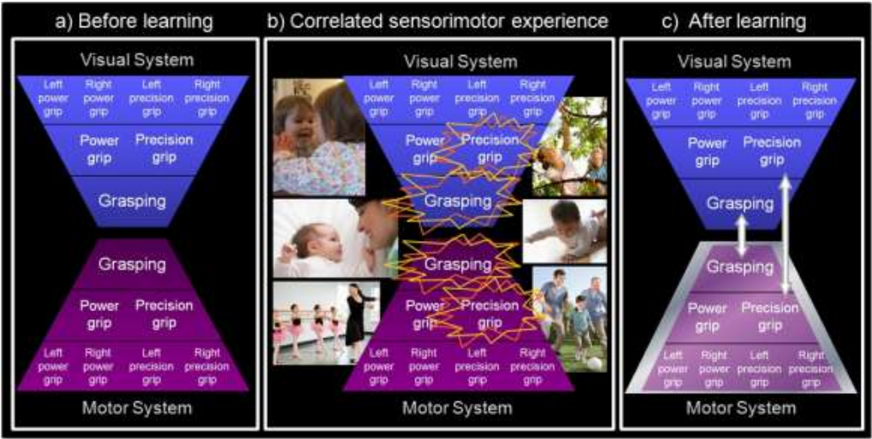
This article argues that mirror neurons originate in sensorimotor associative learning and therefore a new approach is needed to investigate their functions. Mirror neurons were discovered about 20 years ago in the monkey brain, and there is now evidence that they are also present in the human brain. The intriguing feature of many mirror neurons is that they fire not only when the animal is performing an action, such as grasping an object using a power grip, but also when the animal passively observes a similar action performed by another agent. It is widely believed that mirror neurons are a genetic adaptation for action understanding; that they were designed by evolution to fulfill a specific socio-cognitive function. In contrast, we argue that mirror neurons are forged by domain-general processes of associative learning in the course of individual development, and, although they may have psychological functions, they do not necessarily have a specific evolutionary purpose or adaptive function. The evidence supporting this view shows that (1) mirror neurons do not consistently encode action "goals"; (2) the contingency- and context-sensitive nature of associative learning explains the full range of mirror neuron properties; (3) human infants receive enough sensorimotor experience to support associative learning of mirror neurons ("wealth of the stimulus"); and (4) mirror neurons can be changed in radical ways by sensorimotor training. The associative account implies that reliable information about the function of mirror neurons can be obtained only by research based on developmental history, system-level theory, and careful experimentation.
Verified 2026-11-25 · 1 reference not checked yet
Overview
CoChat Summary
TL;DR
The paper argues that mirror neurons are forged by domain-general sensorimotor associative learning rather than being a genetic adaptation for action understanding. It reviews evidence that mirror neuron properties are contingency- and context-sensitive, that infants receive sufficient sensorimotor experience, and that mirror responses can be changed radically by training.
Key findings
- Mirror neurons do not consistently encode action “goals”: 73% of mirror-neuron responses modulated by observation of object-directed grasping also showed similar modulation for pantomimed grasping; many MNs show left/right-hand sensitivity (37.5%), direction sensitivity (64%), peripersonal/extrapersonal selectivity (53%), and view dependence (74%).
- Associative learning’s contingency sensitivity and contextual modulation can explain the full range of reported MN field properties, including strictly congruent, broadly congruent, logically-related, tool-use, and audiovisual MNs.
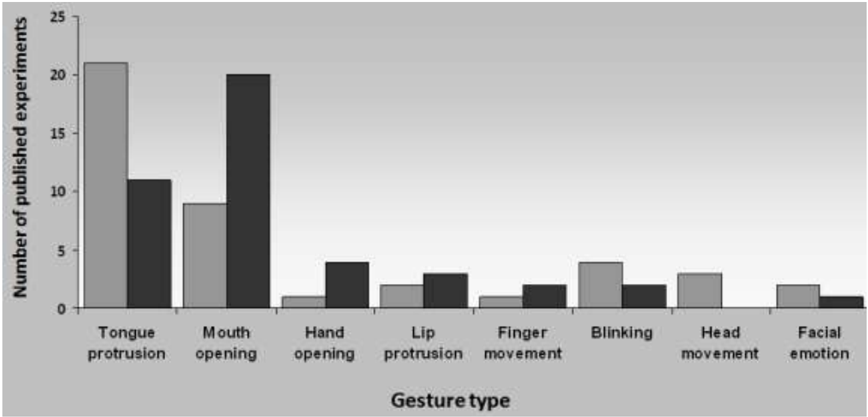
- Human infants receive a “wealth of the stimulus”: in face-to-face caregiver interaction they are imitated on average once per minute, and when contingency is high infants can learn action-effect associations in just a few trials.
- Brief sensorimotor training changes mirror mechanisms: approximately 50 minutes of pincer-hand training made automatic imitation for a robotic pincer as strong as for a human hand, and approximately 90 minutes of counter-mirror training reversed MEP mirror responses.
Methods
- Theoretical review/target article; no new empirical data or sample. It synthesizes monkey single-unit recording, human fMRI, TMS/MEP, automatic imitation, infant imitation/EEG, and adult sensorimotor-training studies.
- Main analysis is conceptual: it compares the genetic account and associative account, evaluates four kinds of evidence—goal coding, learning mechanisms, infant development, and adult sensorimotor plasticity—and discusses canalization/exaptation alternatives and methodological implications.
Limitations
- Stated: there is no consensus on what “action understanding” means or how it differs from action perception/recognition, making functional claims hard to test; human MN activity cannot be localized precisely, and many studies assume ventral PMC/IPL activity is MN activity even though fewer than 20% of neurons in classical mirror areas may be MNs.
- Stated: no studies systematically test effects of sensorimotor learning on MN responses in monkeys; the paper calls for research based on developmental history, system-level theory, and careful experimentation.
- Evident from the text: as a theoretical review, it does not provide new primary data, and much human evidence relies on indirect measures (fMRI, MEPs, automatic imitation) rather than single-unit recording.
Model-written summary. Check it against the paper before relying on it.
Integrity signals
Registry
Cites
Statistics
Figures
Verification
Claims the paper makes
11 Valid · 9 Not valid · 29 Not checked · 106 Own results and interpretations
Every source the paper cites for this claim was checked and supports it.
In the paper
“Only one study purports to offer direct evidence - from single cell recording - of MNs in the human brain (Mukamel et al., 2010).”
What the sources say
- Supportedcites Mukamel et al., 2010 matched to “Single-Neuron Responses in Humans during Execution and Observation of Actions” (2010) source
The Summary reports extracellular recordings from 1,177 cells in human patients and neurons that responded during both action observation and execution. The Discussion says the findings demonstrate mirror mechanisms in humans at the single-neuron level. The citation identifies Mukamel et al. as the study offering that direct evidence; the paper does not itself establish the citing authors’ broader 'only one study' framing. (LLM, conf=0.91)
hedged- Asserted: passes — The authors put it forward as true.
- Checkable: passes — It can be checked against evidence.
- Load-bearing: unclear — It is unclear whether the paper’s conclusions depend on it.
- Based: passes — The paper gives a reason why it holds.
- Supported
The cited sources support only part of this claim — read each source’s verdict below.
In the paper
“Even when action stimuli are presented, intention understanding does not necessarily recruit mirror areas”
What the sources say
- Supportedcites Brass, Schmitt, Spengler, & Gergely, 2007 matched to “Investigating Action Understanding: Inferential Processes versus Action Simulation” (2007) source
The Results (p. ~2, ROI analysis) report that with action stimuli presented, no differential activation was found in the mirror system (inferior frontal or inferior parietal cortex) even at an uncorrected p < .001, while intention/goal discrimination activated the STS, pSTS and aFMC; the Discussion states 'no differential activation was found in the mirror network as a function of context-based plausibility.' The Discussion further limits the mirror network's role to familiar actions in stereotypic contexts, i.e. mirror recruitment is not required for understanding the intention ('why') of an observed action — matching the hedged 'does not necessarily'. The paper's own caveat ('do not exclude the possibility that the mirror network is involved') is consistent with, not contrary to, a 'not necessarily' claim. (LLM, conf=0.85)
- Partly supportedcites de Lange, Spronk, Willems, Toni, & Bekkering, 2008 matched to “Complementary Systems for Understanding Action Intentions” (2008) sourceExperimental — accuracy not yet measured
The Results and Discussion (page not specified in our copy) show that reflecting on observed actions’ intentions engages mentalizing regions outside the mirror-neuron system. But the paper also reports that the inferior frontal gyrus, a mirror-system area, encodes observed actions’ intentionality automatically. It does not establish that intention understanding occurs without recruiting mirror areas. (LLM, conf=0.84)
plain- Asserted: passes — The authors put it forward as true.
- Checkable: passes — It can be checked against evidence.
- Load-bearing: passes — The paper’s conclusions depend on it.
- Based: passes — The paper gives a reason why it holds.
- Supported
Every source the paper cites for this claim was checked and supports it.
In the paper
“with rare exceptions (Mukamel et al., 2010), MN activity cannot be localized precisely within the human brain.”
What the sources say
- Supportedcites Mukamel et al., 2010 matched to “Single-Neuron Responses in Humans during Execution and Observation of Actions” (2010) source
The citation identifies Mukamel et al. as a rare exception, rather than attributing the general localization limit to them. The Results describe single-neuron recordings in named human brain regions and refer to the anatomical locations of the electrodes; the Discussion reports mirroring responses at the single-cell level in the medial frontal and temporal cortex. (LLM, conf=0.91)
plain- Asserted: passes — The authors put it forward as true.
- Checkable: passes — It can be checked against evidence.
- Load-bearing: passes — The paper’s conclusions depend on it.
- Based: passes — The paper gives a reason why it holds.
- Supported
The cited sources support only part of this claim — read each source’s verdict below.
In the paper
“there is no evidence that the tendency of infants to look at their own hands evolved to promote the development of MNs or action understanding rather than visuomotor control”
What the sources say
- Partly supportedcites Del Giudice et al., 2009 matched to “Programmed to learn? The ontogeny of mirror neurons” (2009) sourceExperimental — accuracy not yet measured
The Conclusions (page unavailable) say infants’ attention to their own moving hands may have evolved primarily to support visuomotor control, rather than for the adaptive value of a mirror system. But the paper presents this as a tentative evolutionary account compatible with different scenarios; it does not establish the claim’s categorical statement that there is no evidence for the alternative. (LLM, conf=0.82)
plain- Asserted: passes — The authors put it forward as true.
- Checkable: passes — It can be checked against evidence.
- Load-bearing: passes — The paper’s conclusions depend on it.
- Based: passes — The paper gives a reason why it holds.
- Partly supported
The cited sources support only part of this claim — read each source’s verdict below.
In the paper
“It has long been recognized that associative learning depends, not only on contiguity - events occurring close together in time - but also on contingency - the degree to which one event reliably predicts the other.”
What the sources say
- Not checked — no full text of the sourcecites Elsner & Hommel, 2004 matched to “Contiguity and contingency in action-effect learning” (2004) source
- Partly supportedcites Rescorla, 1968 matched to “Probability of shock in the presence and absence of cs in fear conditioning.” (1968) sourceExperimental — accuracy not yet measured
The opening passage defines contingency as the probability of the unconditioned stimulus in the presence versus absence of the conditioned stimulus, and the Discussion reports that pairings alone did not produce conditioning when that probability did not increase. This supports the contrast with contiguity for Pavlovian fear conditioning, but the paper does not establish the claim for associative learning generally. (LLM, conf=0.82)
- Not checked — no full text of the sourcecites Schultz & Dickinson, 2000 matched to “Neuronal Coding of Prediction Errors” (2000) source
boostedstates a cause- Asserted: passes — The authors put it forward as true.
- Checkable: passes — It can be checked against evidence.
- Load-bearing: passes — The paper’s conclusions depend on it.
- Based: passes — The paper gives a reason why it holds.
81 more claims · 5 with their cited sources checked
Create a free account to see all 155 claims and to verify the 6 references still open.
- It may state two separate claims as one. 26
- Probably not a substantial claim. 52
Citations
Cites
Wu, Y. (1999) · Technometrics · doi:10.1080/00401706.1999.10485951 · Cited by 27,221
James, W. (1913) · Henry Holt and Company eBooks · doi:10.1037/11059-000 · Cited by 25,226
Rudin, W. (1973) · Cited by 13,740
A feature-integration theory of attention.
Treisman, A. M., & Gelade, G. (1980) · Cognitive Psychology · doi:10.1016/0010-0285(80)90005-5 · Cited by 12,366
Rescorla, R. A. (1972) · Medical Entomology and Zoology · Cited by 9,661
Chomsky, N. (2014) · The MIT Press eBooks · doi:10.7551/mitpress/9780262527347.001.0001 · Cited by 8,244
Distributed hierarchical processing in the primate cerebral cortex
Felleman, D. J., & Van Essen, D. C. (1991) · Cerebral Cortex · doi:10.1093/cercor/1.1.1 · Cited by 7,783
Rizzolatti, G., & Craighero, L. (2004) · Annual Review of Neuroscience · doi:10.1146/annurev.neuro.27.070203.144230 · Cited by 7,433 · cited 4×
“…“the mirror neuron mechanism is a mechanism of great evolutionary importance through which primates understand actions done by their conspecifics” (Rizzolatti & Craighero, 2004, p.172) and that “in their basic properties, MNs constitute a relatively simple action-perception mechanism that could…”
BackgroundInfluentialCulture and the Evolutionary Process
Griesemer, J. R., Boyd, R., & Richerson, P. J. (1986) · The Condor · doi:10.2307/1367778 · Cited by 7,034
Whatever next? Predictive brains, situated agents, and the future of cognitive science
Clark, A. (2013) · Behavioral and Brain Sciences · doi:10.1017/s0140525x12000477 · Cited by 5,924
Research works printed but not linked: 3
- Press, C., Catmur, C., Cook, R., Widman, H., Heyes, C., & Bird, G. (2012). fMRI adaptation reveals geometric shape 'mirror neurons'. PLoS One, 7 (12), e51934.
- Elman, J. L., Bates, E., Johnson, M. H., Karmiloff-Smith, A., Parisi, D., & Plunkett, K. (1996). Rethinking innateness: Connectionism in a developmental framework: Cambridge, MA: MIT Press.
- Pawlby, S. J. (1977). Imitative interaction. In H. Schaffer (Ed.), Studies in mother-infant interaction (pp. 203-224). New York: Academic Press.
Cited by
Items 501–600 of 618
Multimodal Data Collection and Processing for Applied Affective Computing
Tian, L., Oviatt, S. L., Muszyński, M., Chamberlain, B. C., Healey, J., & Sano, A. (2022) · ACM eBooks · doi:10.1145/3502398.3502403
Tian, L., Oviatt, S. L., Muszyński, M., Chamberlain, B. C., Healey, J., & Sano, A. (2022) · ACM eBooks · doi:10.1145/3502398.3502399
Tian, L., Oviatt, S. L., Muszyński, M., Chamberlain, B. C., Healey, J., & Sano, A. (2022) · ACM eBooks · doi:10.1145/3502398.3502412
Tian, L., Oviatt, S. L., Muszyński, M., Chamberlain, B. C., Healey, J., & Sano, A. (2022) · ACM eBooks · doi:10.1145/3502398.3502413
Applied Affective Computing in Built Environments
Tian, L., Oviatt, S. L., Muszyński, M., Chamberlain, B. C., Healey, J., & Sano, A. (2022) · ACM eBooks · doi:10.1145/3502398.3502409 · Cited by 1
Machine Learning Approaches for Applied Affective Computing
Tian, L., Oviatt, S. L., Muszyński, M., Chamberlain, B. C., Healey, J., & Sano, A. (2022) · ACM eBooks · doi:10.1145/3502398.3502402
Affective Computing for Enhancing Well-Being
Tian, L., Oviatt, S. L., Muszyński, M., Chamberlain, B. C., Healey, J., & Sano, A. (2022) · ACM eBooks · doi:10.1145/3502398.3502408 · Cited by 1
Synthesizing Natural and Believable Emotional Expressions
Tian, L., Oviatt, S. L., Muszyński, M., Chamberlain, B. C., Healey, J., & Sano, A. (2022) · ACM eBooks · doi:10.1145/3502398.3502406
Addressing Ethical Issues of Affective Computing
Tian, L., Oviatt, S. L., Muszyński, M., Chamberlain, B. C., Healey, J., & Sano, A. (2022) · ACM eBooks · doi:10.1145/3502398.3502410
Emotions as Studied in Psychology and Cognitive Science
Tian, L., Oviatt, S. L., Muszyński, M., Chamberlain, B. C., Healey, J., & Sano, A. (2022) · ACM eBooks · doi:10.1145/3502398.3502401
How Social Coordination and Cooperation are Achieved
Kirmayer, L. J., Worthman, C. M., Kitayama, S., Lemelson, R., & Cummings, C. A. (2020) · Cambridge University Press eBooks · doi:10.1017/9781108695374.013
Bermúdez, J. L. (2019) · Cambridge University Press eBooks · doi:10.1017/9781108339216.001
Bermúdez, J. L. (2019) · Cambridge University Press eBooks · doi:10.1017/9781108339216.021
The Cognitive Science of Consciousness
Bermúdez, J. L. (2019) · Cambridge University Press eBooks · doi:10.1017/9781108339216.017
The Prehistory of Cognitive Science
Bermúdez, J. L. (2019) · Cambridge University Press eBooks · doi:10.1017/9781108339216.003
Aboitiz, F. (2017) · Palgrave Macmillan UK eBooks · doi:10.1057/978-1-137-54060-7_8
Kirmayer, L. J., Worthman, C. M., Kitayama, S., Lemelson, R., & Cummings, C. A. (2020) · Cambridge University Press eBooks · doi:10.1017/9781108695374.001
Physical Symbol Systems and the Language of Thought
Bermúdez, J. L. (2019) · Cambridge University Press eBooks · doi:10.1017/9781108339216.006 · Cited by 1
Applying Dynamical Systems Theory to Model the Mind
Bermúdez, J. L. (2019) · Cambridge University Press eBooks · doi:10.1017/9781108339216.008
The Co-emergence of Culture, Mind, and Brain
Kirmayer, L. J., Worthman, C. M., Kitayama, S., Lemelson, R., & Cummings, C. A. (2020) · Cambridge University Press eBooks · doi:10.1017/9781108695374.004
Bermúdez, J. L. (2019) · Cambridge University Press eBooks · doi:10.1017/9781108339216.005
Bermúdez, J. L. (2019) · Cambridge University Press eBooks · doi:10.1017/9781108339216.020
Bermúdez, J. L. (2019) · Cambridge University Press eBooks · doi:10.1017/9781108339216.011
Kirmayer, L. J., Worthman, C. M., Kitayama, S., Lemelson, R., & Cummings, C. A. (2020) · Cambridge University Press eBooks · doi:10.1017/9781108695374.008
Neural Networks and Distributed Information Processing
Bermúdez, J. L. (2019) · Cambridge University Press eBooks · doi:10.1017/9781108339216.007
Index for Cognitive Science (3rd edition)
Bermúdez, J. L. (2019) · Cambridge University Press eBooks · doi:10.1017/9781108339216.022
(2016) · Duke University Press eBooks · doi:10.1215/9780822374374-008
Bermúdez, J. L. (2019) · Cambridge University Press eBooks · doi:10.1017/9781108339216.015
Introduction: The Challenge of Cognitive Science
Bermúdez, J. L. (2019) · Cambridge University Press eBooks · doi:10.1017/9781108339216.002
Bermúdez, J. L. (2019) · Cambridge University Press eBooks · doi:10.1017/9781108339216.016
Kirmayer, L. J., Worthman, C. M., Kitayama, S., Lemelson, R., & Cummings, C. A. (2020) · Cambridge University Press eBooks · doi:10.1017/9781108695374.017
Versace, R., Brouillet, D., & Vallet, G. T. (2018) · Mardaga eBooks · doi:10.3917/mard.valle.2018.01.0179
Animacy and the prediction of behaviourPreprint
Schultz, J., & Frith, C. (2022) · doi:10.31234/osf.io/w8x59
Heyes, C. M. (2020) · Springer eBooks · doi:10.1007/978-3-319-47829-6_85-1
Self-citationKirmayer, L. J., Worthman, C. M., Kitayama, S., Lemelson, R., & Cummings, C. A. (2020) · Cambridge University Press eBooks · doi:10.1017/9781108695374.029
Pfaff, D. W. (2020) · Elsevier eBooks · doi:10.1016/b978-0-323-85861-8.00012-8
Gallagher, S. (2020) · Oxford University Press eBooks · doi:10.1093/oso/9780198846345.003.0003
Zheng, Y., Li, X., Huang, F., et al. (2022) · Research Square · doi:10.21203/rs.3.rs-1564390/v1
Heyes, C. M. (2022) · Springer eBooks · doi:10.1007/978-3-319-55065-7_85
Self-citationde Abreu, P. M. (2022) · CRC Press eBooks · doi:10.1201/9780429299070-31
ASPECTOS GENÉTICOS DO TRANSTORNO DO ESPECTRO AUTISTA (TEA)
de Andrade, M. D. F. C., Carvalho, E. D. F., & Carvalho, K. D. M. (2022) · Amplla Editora eBooks · doi:10.51859/amplla.tea2232-12
Porcino, J. M. A., & Vasconcelos, G. C. (2022) · Amplla Editora eBooks · doi:10.51859/amplla.tea2232-6
Moreira, M. D. S., & Aragão, G. F. (2022) · Amplla Editora eBooks · doi:10.51859/amplla.tea2232-1 · Cited by 31
Porcino, J. M. A., Pinheiro, N. M., Souza, T. M. D. S. F., Soares, C. C. A., de Lima, M. A., & Filho, V. D. D. S. (2022) · Amplla Editora eBooks · doi:10.51859/amplla.tea2232-24
TEA LEVE: ANTIGA SINDROME DE ASPERGER
de Carvalho, B. M. M., Ferreira, L. E. A., Simão, S. E., Ribeiro, L. D. S., Sousa, M. C., Los, M. E., Lobato, C. P., & de Carvalho, A. V. A. M. (2022) · Amplla Editora eBooks · doi:10.51859/amplla.tea2232-10
TRANSTORNO DO ESPECTRO AUTISTA E DIAGNÓSTICO POR IMAGEM
Morais, Y. B., Felix, L. D. C., & Oliveira, S. D. R. C. (2022) · Amplla Editora eBooks · doi:10.51859/amplla.tea2232-21
DIETAS ISENTAS DE GLÚTEN E CASEÍNA EM CRIANÇAS E ADOLESCENTES COM TEA
Vasconcelos, Q. D. J. S. (2022) · Amplla Editora eBooks · doi:10.51859/amplla.tea2232-30
METILAÇÃO DO DNA ENVOLVIDA NA EXPRESSÃO DO TRANSTORNO DO ESPECTRO AUTISTA
Maia, D. O., Alves, A. D. S., Guimarães, S. C. M., Rocha, I. G. B., ALBUQUERQUE, G. B. D., & Aragão, G. F. (2022) · Amplla Editora eBooks · doi:10.51859/amplla.tea2232-13
Ellis, R. (2018) · Cambridge University Press eBooks · doi:10.1017/9781107446809.006
Ellis, R. (2018) · Cambridge University Press eBooks · doi:10.1017/9781107446809.001
Ellis, R. (2018) · Cambridge University Press eBooks · doi:10.1017/9781107446809.009
Ellis, R. (2018) · Cambridge University Press eBooks · doi:10.1017/9781107446809.002
Ellis, R. (2018) · Cambridge University Press eBooks · doi:10.1017/9781107446809.007
Ellis, R. (2018) · Cambridge University Press eBooks · doi:10.1017/9781107446809.010
Hamamoto, Y., Takahara, Y., Kawata, K. H. D. S., Kikuchi, T., Suzuki, S., Kawashima, R., & Sugiura, M. (2022) · Scientific Reports · doi:10.1038/s41598-022-22278-x
Desenvolvimento infantil e fatores determinantes: do clínico ao cirúrgico
Tannus, L. D. O., de Lima, A. B., de Araújo, P. X., & Caldas, I. F. R. (2022) · Editora Pascal LTDA eBooks · doi:10.29327/580156
Bradford, B. (2022) · DUT Open Scholar (Durban University of Technology) · doi:10.51415/10321/4517
Mirror Neurons and Usage in Current Rehabilitation Approaches: Traditional Review
Köprülüoğlu, M., Hareket, S., Polat, K., & Kaya, D. Ö. (2022) · Turkiye Klinikleri Journal of Health Sciences · doi:10.5336/healthsci.2022-89179 · Cited by 1
ZRCALJENJE I TERAPIJSKI PROCES
KBC Rijeka, K. Z. P., & Rončević-Gržeta, I. (2023) · Psihoterapija · doi:10.24869/psihei.2022.86
حجازى, س. ن. ا., بشرى, ص. ت., & زید, خ. م. أ. (2022) · دراسات في الارشاد النفسي والتربوي · doi:10.21608/dapt.2022.285265
Rizzolatti, G., & Sinigaglia, C. (2023) · Oxford University Press eBooks · doi:10.1093/oso/9780198871705.003.0006
Rizzolatti, G., & Sinigaglia, C. (2023) · Oxford University Press eBooks · doi:10.1093/oso/9780198871705.003.0004
Rizzolatti, G., & Sinigaglia, C. (2023) · Oxford University Press eBooks · doi:10.1093/oso/9780198871705.003.0003
Rizzolatti, G., & Sinigaglia, C. (2023) · Oxford University Press eBooks · doi:10.1093/oso/9780198871705.002.0003
Rizzolatti, G., & Sinigaglia, C. (2023) · Oxford University Press eBooks · doi:10.1093/oso/9780198871705.003.0005
Rizzolatti, G., & Sinigaglia, C. (2023) · Oxford University Press eBooks · doi:10.1093/oso/9780198871705.003.0007
Rizzolatti, G., & Sinigaglia, C. (2023) · Oxford University Press eBooks · doi:10.1093/oso/9780198871705.002.0004
Rizzolatti, G., & Sinigaglia, C. (2023) · Oxford University Press eBooks · doi:10.1093/oso/9780198871705.003.0002
Rizzolatti, G., & Sinigaglia, C. (2023) · Oxford University Press eBooks · doi:10.1093/oso/9780198871705.002.0007
Rizzolatti, G., & Sinigaglia, C. (2023) · Oxford University Press eBooks · doi:10.1093/oso/9780198871705.003.0001
Normative Processing Needs Multiple Levels of Explanation: From Algorithm to ImplementationPreprint
Vogel, T. A., & Lockwood, P. L. (2023) · doi:10.31234/osf.io/64kq5
Covert and overt automatic imitation are correlatedPreprint
Cracco, E., Genschow, O., & Braß, M. (2023) · doi:10.31234/osf.io/2fyb4
Behavioural, Cognitive and Neural Mechanisms of Human Social InteractionPreprint
Hamilton, A. F. D. C. (2023) · doi:10.31234/osf.io/e5npf
Predicting and coding sound into action translation in spinal cord injured peoplePreprint
Grisoni, L., Piperno, G., Moreau, Q., et al. (2023) · doi:10.31234/osf.io/xste7
Uncovering mirror neurons’ molecular identity by single cell transcriptomics and microarray analysis
Zhou, Y., & Varty, S. (2023) · Journal of Emerging Investigators · doi:10.59720/22-080
“This is likely because the MN system was studied primarily using fMRI and EEG (3), whereas the Allen Brain Atlas identifies regions based on micro-dissection and staining methods.”
BackgroundMethodMotor Simulation and Ostensive-inferential communication: insights and clarifications
Delliponti, A. D. (2023) · Theoria et Historia Scientiarum · doi:10.12775/ths.2022.002
The Review of Progress in Embodied Cognition Research
陈, 思. (2024) · Advances in Psychology · doi:10.12677/ap.2024.141054
(2024) · Vandenhoeck & Ruprecht eBooks · doi:10.13109/9783666400353.225
DOES EXPERIENCE MODULATE AUTOMATIC IMITATION? A NEW LOOKPreprint
Genovese, F., Fanghella, M., Sinigaglia, C., et al. (2024) · bioRxiv (Cold Spring Harbor Laboratory) · doi:10.1101/2024.04.17.589868
Gallagher, S. (2020) · Oxford University Press eBooks · doi:10.1093/oso/9780198846345.002.0004
Gallagher, S. (2020) · Oxford University Press eBooks · doi:10.1093/oso/9780198846345.002.0003
Ghambari, S., Arsham, S., & Ramezanzade, H. (2024) · Perceptual and Motor Skills · doi:10.1177/00315125241252855 · Cited by 1
“Neurons of the motor cortex not only become active during performance of motor skills but also at the time of sensory stimulation involved in the coding of action-perception (Cook et al., 2014) (similar to what occurred during motionless interventions for our visual-auditory and auditory groups).”
TAKLİT VE KÜLTÜR: NELER OLUYOR?
Heyes, C. M., & BAKIR, G. (2024) · Türklük Araştırmaları Dergisi · doi:10.29228/inture.15
Self-citationBarker, L. A. (2024) · Springer eBooks · doi:10.1007/978-3-031-55297-7_7
Is that mine? Ownership in autism spectre disorderPreprint
Yuan, Y., & Tao, M. (2024) · Research Square · doi:10.21203/rs.3.rs-4525215/v1
Bunce, C., Press, C., Gray, K. L. H., et al. (2024) · Quarterly Journal of Experimental Psychology · doi:10.1177/17470218241275595
“…much is known about the perceptual mechanisms engaged by the faces (Duchaine & Yovel, 2015; Tsao & Livingstone, 2008), bodies (Peelen & Downing, 2007; Slaughter et al., 2004), facial expressions (Adolphs, 2002; Frith, 2009), and actions (Blake & Shiffrar, 2007; Cook et al., 2014) of lone actors.”
Self-citationSocial Cognition Is Grounded in Physical Reality
Cecutti, L., & Lee, S. W. S. (2024) · Oxford University Press eBooks · doi:10.1093/oxfordhb/9780197763414.013.10 · Cited by 1
The Neuroscientific Infrastructure of Second Autism Theories
Salvo, M. D. (2024) · Springer eBooks · doi:10.1007/978-3-031-68338-1_9
Braß, M. (2024) · Springer eBooks · doi:10.1007/978-3-031-62634-0_5 · Cited by 1
Automatic Imitation of Multiple Agents
Cracco, E. (2024) · Springer eBooks · doi:10.1007/978-3-031-62634-0_10 · Cited by 1
The enduring importance of the “fine cuts” approach to psychology: EPS Mid-Career Award Lecture 2024
Bird, G. (2024) · Quarterly Journal of Experimental Psychology · doi:10.1177/17470218241311291 · Cited by 1
“…of our ability to imitate the actions of others, and Celia had developed a model which specified exactly the types of psychological representations necessary for imitation, the type of experience necessary to develop this ability, and the formal rules governing that development (Cook et al., 2014).”
Self-citationHuettig, F. (2025) · Cambridge University Press eBooks · doi:10.1017/9781009245470.031
Huettig, F. (2025) · Cambridge University Press eBooks · doi:10.1017/9781009245470.022
Neuronal Overlap during Observation and Action
Huettig, F. (2025) · Cambridge University Press eBooks · doi:10.1017/9781009245470.024
Age-Related Changes in Automatic Imitation: ―A Cross-Sectional Study of Adults Aged 20-79 Years Old―
Mukai, K., Onagawa, R., & Watanabe, K. (2025) · Japanese Journal of Sport Psychology · doi:10.4146/jjspopsy.2024-2406
Involuntary feedback responses reflect a representation of partner actions
Sullivan, S. R., Buggeln, J. H., Calalo, J. A., Ngo, T. T., Semrau, J. A., Carter, M. J., & Cashaback, J. G. A. (2026) · eLife · doi:10.7554/elife.109734.3
Communicating Through Acting: Affording Communicative Intention in Pantomimes
Gong, S., Jiang, K., Li, J. G., Karadanaian, M., Meng, Z., & Gao, T. (2025) · Cognitive Science · doi:10.1111/cogs.70120
The enactive continuity between life, language and symbol: working within a paradox
Figueiredo, N. M., & Cuffari, E. C. (2025) · Phenomenology and the Cognitive Sciences · doi:10.1007/s11097-025-10116-0 · Cited by 2
Involuntary feedback responses reflect a representation of partner actionsPreprint
Sullivan, S. R., Buggeln, J. H., Calalo, J. A., Ngo, T. T., Semrau, J. A., Carter, M. J., & Cashaback, J. G. A. (2026) · eLife · doi:10.7554/elife.109734.1
Involuntary feedback responses reflect a representation of partner actionsPreprint
Sullivan, S. R., Buggeln, J. H., Calalo, J. A., Ngo, T. T., Semrau, J. A., Carter, M. J., & Cashaback, J. G. A. (2026) · eLife · doi:10.7554/elife.109734
Metadata
- Authors
- Cook, R., Bird, G., Catmur, C., Press, C., & Heyes, C.
- Affiliations
- City, University of London (GB)
- King's College London (GB)
- University of Surrey (GB)
- University of London (GB)
- University of Oxford (GB)
- Venue
- Behavioral and Brain Sciences
- Publisher
- Cambridge University Press (CUP)
- Published
- 2014-04
- Volume
- 37
- Issue
- 2
- Pages
- 177-192
- ISSN
- 0140-525X (ISSN-L)
- 1469-1825
- OpenAlex
- W2096117537
- Semantic Scholar
- 6bc7f93eb174e03ff59e789f9dcc514969c1737b
- Cited by
- 647
- References
- 550
- Citations by year
- 2026: 32 · 2025: 34 · 2024: 48 · 2023: 38 · 2022: 66 · 2021: 47 · 2020: 74 · 2019: 55 · 2018: 61 · 2017: 56 · 2016: 51 · 2015: 46 · 2014: 29
- FWCI
- 7.52
- Type
- journal article
- Language
- en
- Open access
- green
- kclpure.kcl.ac.uk
- Locations
- Behavioral and Brain Sciences (publishedVersion)
- PubMed (publishedVersion)
- Surrey Research Insight Open Access (The University of Surrey) (submittedVersion)
- Research Portal (King's College London) (submittedVersion)
- City Research Online (City University London) (submittedVersion)
- BIROn (Birkbeck, University of London) (submittedVersion)
- UCL Discovery (University College London) (submittedVersion)
- Iris (University of Trento) (submittedVersion)
- Funders
- Economic and Social Research Council (ES/K00140X/1)
- Topics
- Social Sciences › Psychology › Social Psychology › Action Observation and Synchronization
- Life Sciences › Neuroscience › Cognitive Neuroscience › Motor Control and Adaptation
- Life Sciences › Agricultural and Biological Sciences › Ecology, Evolution, Behavior and Systematics › Primate Behavior and Ecology
- Keywords
- mirror neurons, action understanding, action observation, evolutionary function, contingency learning, sensorimotor training, power grip, action goals
- MeSH terms
- Animals, Association Learning, Brain, Biological Evolution, Humans, Learning, Social Behavior, Social Perception, Mirror Neurons
About these checks
Registry, retraction, Cites and statistics results are computed, not judged, with one exception: a printed reference that no index lists is read once by a model before it counts as a citation error. Claims are extracted by a model and kept only when their quote appears verbatim in the text; each cited source is then checked, with a model’s help, for whether it says what the claim relies on. Those verdicts can be wrong — read the claim’s quote and the cited source before relying on one.
The claim verdicts this report counts are experimental: their accuracy is not yet measured.
A language model drew the claims from the paper on 2026-10-10, under version 3 of the claim definition (model deepseek-v4.1-flash, prompt extract-v3).
A second model labelled each claim on 2026-10-10 (model jev-1.13-20260917, definition revision gold-guideline-v0.2).
Cited sources are checked with a language model’s help (gpt-6-sol and qwen3.8-omni-flash).
Statistics and arithmetic are recomputed, not judged.
Confidence bands are shown only for fields calibrated on our annotated test set. None is calibrated yet, so no band is shown.
What counts as a claim ›How we measure confidence ›How we check this ›
Are you an author, or do you see a problem with this page? Request a review
Data sources
Bibliographic data: Semantic Scholar, OpenAlex, Crossref.
Contains information from the Semantic Scholar Academic Graph Datasets, made available under the ODC Attribution License (ODC-BY 1.0).
Semantic Scholar’s data is described in: Kinney, R., et al. (2023). The Semantic Scholar Open Data Platform. arXiv:2301.10140.
