

Mirror neurons: From origin to function
Open accessThe DOI matches its Crossref record; 544 of the 550 references it cites were found in a registry or an index, and 1 are not checked yet; 14 of the 73 sources its claims cite were checked for support.
Abstract
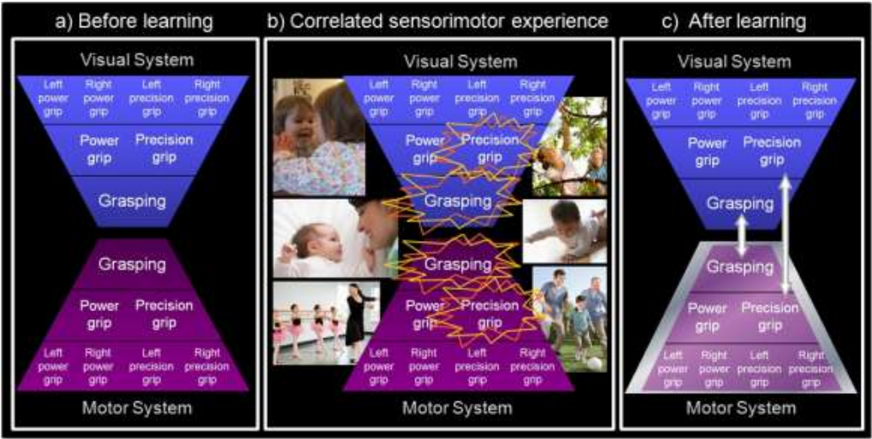
This article argues that mirror neurons originate in sensorimotor associative learning and therefore a new approach is needed to investigate their functions. Mirror neurons were discovered about 20 years ago in the monkey brain, and there is now evidence that they are also present in the human brain. The intriguing feature of many mirror neurons is that they fire not only when the animal is performing an action, such as grasping an object using a power grip, but also when the animal passively observes a similar action performed by another agent. It is widely believed that mirror neurons are a genetic adaptation for action understanding; that they were designed by evolution to fulfill a specific socio-cognitive function. In contrast, we argue that mirror neurons are forged by domain-general processes of associative learning in the course of individual development, and, although they may have psychological functions, they do not necessarily have a specific evolutionary purpose or adaptive function. The evidence supporting this view shows that (1) mirror neurons do not consistently encode action "goals"; (2) the contingency- and context-sensitive nature of associative learning explains the full range of mirror neuron properties; (3) human infants receive enough sensorimotor experience to support associative learning of mirror neurons ("wealth of the stimulus"); and (4) mirror neurons can be changed in radical ways by sensorimotor training. The associative account implies that reliable information about the function of mirror neurons can be obtained only by research based on developmental history, system-level theory, and careful experimentation.
Verified 2026-11-25 · 1 reference not checked yet
Overview
CoChat Summary
TL;DR
The paper argues that mirror neurons are forged by domain-general sensorimotor associative learning rather than being a genetic adaptation for action understanding. It reviews evidence that mirror neuron properties are contingency- and context-sensitive, that infants receive sufficient sensorimotor experience, and that mirror responses can be changed radically by training.
Key findings
- Mirror neurons do not consistently encode action “goals”: 73% of mirror-neuron responses modulated by observation of object-directed grasping also showed similar modulation for pantomimed grasping; many MNs show left/right-hand sensitivity (37.5%), direction sensitivity (64%), peripersonal/extrapersonal selectivity (53%), and view dependence (74%).
- Associative learning’s contingency sensitivity and contextual modulation can explain the full range of reported MN field properties, including strictly congruent, broadly congruent, logically-related, tool-use, and audiovisual MNs.
- Human infants receive a “wealth of the stimulus”: in face-to-face caregiver interaction they are imitated on average once per minute, and when contingency is high infants can learn action-effect associations in just a few trials.
- Brief sensorimotor training changes mirror mechanisms: approximately 50 minutes of pincer-hand training made automatic imitation for a robotic pincer as strong as for a human hand, and approximately 90 minutes of counter-mirror training reversed MEP mirror responses.
Methods
- Theoretical review/target article; no new empirical data or sample. It synthesizes monkey single-unit recording, human fMRI, TMS/MEP, automatic imitation, infant imitation/EEG, and adult sensorimotor-training studies.
- Main analysis is conceptual: it compares the genetic account and associative account, evaluates four kinds of evidence—goal coding, learning mechanisms, infant development, and adult sensorimotor plasticity—and discusses canalization/exaptation alternatives and methodological implications.
Limitations
- Stated: there is no consensus on what “action understanding” means or how it differs from action perception/recognition, making functional claims hard to test; human MN activity cannot be localized precisely, and many studies assume ventral PMC/IPL activity is MN activity even though fewer than 20% of neurons in classical mirror areas may be MNs.
- Stated: no studies systematically test effects of sensorimotor learning on MN responses in monkeys; the paper calls for research based on developmental history, system-level theory, and careful experimentation.
- Evident from the text: as a theoretical review, it does not provide new primary data, and much human evidence relies on indirect measures (fMRI, MEPs, automatic imitation) rather than single-unit recording.
Model-written summary. Check it against the paper before relying on it.
Integrity signals
Registry
Cites
Statistics
Figures
Verification
Claims the paper makes
11 Valid · 9 Not valid · 29 Not checked · 106 Own results and interpretations
Every source the paper cites for this claim was checked and supports it.
In the paper
“Only one study purports to offer direct evidence - from single cell recording - of MNs in the human brain (Mukamel et al., 2010).”
What the sources say
- Supportedcites Mukamel et al., 2010 matched to “Single-Neuron Responses in Humans during Execution and Observation of Actions” (2010) source
The Summary reports extracellular recordings from 1,177 cells in human patients and neurons that responded during both action observation and execution. The Discussion says the findings demonstrate mirror mechanisms in humans at the single-neuron level. The citation identifies Mukamel et al. as the study offering that direct evidence; the paper does not itself establish the citing authors’ broader 'only one study' framing. (LLM, conf=0.91)
hedged- Asserted: passes — The authors put it forward as true.
- Checkable: passes — It can be checked against evidence.
- Load-bearing: unclear — It is unclear whether the paper’s conclusions depend on it.
- Based: passes — The paper gives a reason why it holds.
- Supported
The cited sources support only part of this claim — read each source’s verdict below.
In the paper
“Even when action stimuli are presented, intention understanding does not necessarily recruit mirror areas”
What the sources say
- Supportedcites Brass, Schmitt, Spengler, & Gergely, 2007 matched to “Investigating Action Understanding: Inferential Processes versus Action Simulation” (2007) source
The Results (p. ~2, ROI analysis) report that with action stimuli presented, no differential activation was found in the mirror system (inferior frontal or inferior parietal cortex) even at an uncorrected p < .001, while intention/goal discrimination activated the STS, pSTS and aFMC; the Discussion states 'no differential activation was found in the mirror network as a function of context-based plausibility.' The Discussion further limits the mirror network's role to familiar actions in stereotypic contexts, i.e. mirror recruitment is not required for understanding the intention ('why') of an observed action — matching the hedged 'does not necessarily'. The paper's own caveat ('do not exclude the possibility that the mirror network is involved') is consistent with, not contrary to, a 'not necessarily' claim. (LLM, conf=0.85)
- Partly supportedcites de Lange, Spronk, Willems, Toni, & Bekkering, 2008 matched to “Complementary Systems for Understanding Action Intentions” (2008) sourceExperimental — accuracy not yet measured
The Results and Discussion (page not specified in our copy) show that reflecting on observed actions’ intentions engages mentalizing regions outside the mirror-neuron system. But the paper also reports that the inferior frontal gyrus, a mirror-system area, encodes observed actions’ intentionality automatically. It does not establish that intention understanding occurs without recruiting mirror areas. (LLM, conf=0.84)
plain- Asserted: passes — The authors put it forward as true.
- Checkable: passes — It can be checked against evidence.
- Load-bearing: passes — The paper’s conclusions depend on it.
- Based: passes — The paper gives a reason why it holds.
- Supported
Every source the paper cites for this claim was checked and supports it.
In the paper
“with rare exceptions (Mukamel et al., 2010), MN activity cannot be localized precisely within the human brain.”
What the sources say
- Supportedcites Mukamel et al., 2010 matched to “Single-Neuron Responses in Humans during Execution and Observation of Actions” (2010) source
The citation identifies Mukamel et al. as a rare exception, rather than attributing the general localization limit to them. The Results describe single-neuron recordings in named human brain regions and refer to the anatomical locations of the electrodes; the Discussion reports mirroring responses at the single-cell level in the medial frontal and temporal cortex. (LLM, conf=0.91)
plain- Asserted: passes — The authors put it forward as true.
- Checkable: passes — It can be checked against evidence.
- Load-bearing: passes — The paper’s conclusions depend on it.
- Based: passes — The paper gives a reason why it holds.
- Supported
The cited sources support only part of this claim — read each source’s verdict below.
In the paper
“there is no evidence that the tendency of infants to look at their own hands evolved to promote the development of MNs or action understanding rather than visuomotor control”
What the sources say
- Partly supportedcites Del Giudice et al., 2009 matched to “Programmed to learn? The ontogeny of mirror neurons” (2009) sourceExperimental — accuracy not yet measured
The Conclusions (page unavailable) say infants’ attention to their own moving hands may have evolved primarily to support visuomotor control, rather than for the adaptive value of a mirror system. But the paper presents this as a tentative evolutionary account compatible with different scenarios; it does not establish the claim’s categorical statement that there is no evidence for the alternative. (LLM, conf=0.82)
plain- Asserted: passes — The authors put it forward as true.
- Checkable: passes — It can be checked against evidence.
- Load-bearing: passes — The paper’s conclusions depend on it.
- Based: passes — The paper gives a reason why it holds.
- Partly supported
The cited sources support only part of this claim — read each source’s verdict below.
In the paper
“It has long been recognized that associative learning depends, not only on contiguity - events occurring close together in time - but also on contingency - the degree to which one event reliably predicts the other.”
What the sources say
- Not checked — no full text of the sourcecites Elsner & Hommel, 2004 matched to “Contiguity and contingency in action-effect learning” (2004) source
- Partly supportedcites Rescorla, 1968 matched to “Probability of shock in the presence and absence of cs in fear conditioning.” (1968) sourceExperimental — accuracy not yet measured
The opening passage defines contingency as the probability of the unconditioned stimulus in the presence versus absence of the conditioned stimulus, and the Discussion reports that pairings alone did not produce conditioning when that probability did not increase. This supports the contrast with contiguity for Pavlovian fear conditioning, but the paper does not establish the claim for associative learning generally. (LLM, conf=0.82)
- Not checked — no full text of the sourcecites Schultz & Dickinson, 2000 matched to “Neuronal Coding of Prediction Errors” (2000) source
boostedstates a cause- Asserted: passes — The authors put it forward as true.
- Checkable: passes — It can be checked against evidence.
- Load-bearing: passes — The paper’s conclusions depend on it.
- Based: passes — The paper gives a reason why it holds.
81 more claims · 5 with their cited sources checked
Create a free account to see all 155 claims and to verify the 6 references still open.
- It may state two separate claims as one. 26
- Probably not a substantial claim. 52
Citations
Cites
Wu, Y. (1999) · Technometrics · doi:10.1080/00401706.1999.10485951 · Cited by 27,221
James, W. (1913) · Henry Holt and Company eBooks · doi:10.1037/11059-000 · Cited by 25,226
Rudin, W. (1973) · Cited by 13,740
A feature-integration theory of attention.
Treisman, A. M., & Gelade, G. (1980) · Cognitive Psychology · doi:10.1016/0010-0285(80)90005-5 · Cited by 12,366
Rescorla, R. A. (1972) · Medical Entomology and Zoology · Cited by 9,661
Chomsky, N. (2014) · The MIT Press eBooks · doi:10.7551/mitpress/9780262527347.001.0001 · Cited by 8,244
Distributed hierarchical processing in the primate cerebral cortex
Felleman, D. J., & Van Essen, D. C. (1991) · Cerebral Cortex · doi:10.1093/cercor/1.1.1 · Cited by 7,783
Rizzolatti, G., & Craighero, L. (2004) · Annual Review of Neuroscience · doi:10.1146/annurev.neuro.27.070203.144230 · Cited by 7,433 · cited 4×
“…“the mirror neuron mechanism is a mechanism of great evolutionary importance through which primates understand actions done by their conspecifics” (Rizzolatti & Craighero, 2004, p.172) and that “in their basic properties, MNs constitute a relatively simple action-perception mechanism that could…”
BackgroundInfluentialCulture and the Evolutionary Process
Griesemer, J. R., Boyd, R., & Richerson, P. J. (1986) · The Condor · doi:10.2307/1367778 · Cited by 7,034
Whatever next? Predictive brains, situated agents, and the future of cognitive science
Clark, A. (2013) · Behavioral and Brain Sciences · doi:10.1017/s0140525x12000477 · Cited by 5,924
Research works printed but not linked: 3
- Press, C., Catmur, C., Cook, R., Widman, H., Heyes, C., & Bird, G. (2012). fMRI adaptation reveals geometric shape 'mirror neurons'. PLoS One, 7 (12), e51934.
- Elman, J. L., Bates, E., Johnson, M. H., Karmiloff-Smith, A., Parisi, D., & Plunkett, K. (1996). Rethinking innateness: Connectionism in a developmental framework: Cambridge, MA: MIT Press.
- Pawlby, S. J. (1977). Imitative interaction. In H. Schaffer (Ed.), Studies in mother-infant interaction (pp. 203-224). New York: Academic Press.
Cited by
Items 201–300 of 618
Chiappini, E., Turrini, S., Zanon, M., Marangon, M., Borgomaneri, S., & Avenanti, A. (2024) · Brain stimulation · doi:10.1016/j.brs.2024.02.011 · Cited by 19
Festante, F., Vanderwert, R. E., Sclafani, V., Paukner, A., Simpson, E. A., Suomi, S. J., Fox, N. A., & Ferrari, P. F. (2018) · Developmental Cognitive Neuroscience · doi:10.1016/j.dcn.2018.02.010 · Cited by 19
“…which support the idea that action observation might benefit from experience as a result of associative learning processes and maturational processes that are canalized during development (Cook et al., 2014; Del Giudice et al., 2009; Ferrari et al., 2013; Heyes, 2013, 2010; Tramacere et al., 2017).”
Automatic imitation does not predict levels of prosocial behaviour in a modified dictator game
Galang, C. M., & Obhi, S. S. (2020) · Acta Psychologica · doi:10.1016/j.actpsy.2020.103022 · Cited by 17
Vandervert, L. R., & American Nonlinear Systems, 1. W. C. A. S. (2020) · AIMS neuroscience · doi:10.3934/neuroscience.2020020 · Cited by 17
“This may be accomplished by linking the observed behavior with preexisting internal models [authors here are referring to models in the cerebral cortex, not in the cerebellum] of one’s own body and actions through associative learning and stimulus generalization [51,52].”
BackgroundOrigin and evolution of human speech: Emergence from a trimodal auditory, visual and vocal network
Michon, M., López, V., & Aboitiz, F. (2019) · Progress in brain research · doi:10.1016/bs.pbr.2019.01.005 · Cited by 19
Naro, A., Maggio, M. G., Latella, D., Rosa, G. L., Sciarrone, F., Manuli, A., & Calabrò, R. S. (2021) · Applied Neuropsychology Adult · doi:10.1080/23279095.2021.1890595 · Cited by 19
“…depends on sensorimotor (for basic sensorimotor integration processes) and non-sensorimotor (for advanced cognitive processes) neuronal populations that oversee both action production and understanding (Cattaneo et al., 2010; Cook et al., 2014; Rizzolatti & Sinigaglia, 2010; Umilt a et al., 2008).”
BackgroundM1 large-scale network dynamics support human motor resonance and its plastic reshaping
Guidali, G., Arrigoni, E., Bolognini, N., & Pisoni, A. (2025) · NeuroImage · doi:10.1016/j.neuroimage.2025.121082 · Cited by 21
Beauty as a factor of economic and social development
Baggio, R., & Moretti, V. (2018) · Tourism Review · doi:10.1108/tr-06-2017-0098 · Cited by 20
“These are elements that many researchers deem able to allow us to grasp on the fly what is happening around, to empathise with the emotions of others, and, above all, to learn by imitation (Cook et al., 2014).”
BackgroundBurgess, J. D., Arnold, S. L., Fitzgibbon, B. M., Fitzgerald, P. B., & Enticott, P. G. (2013) · Frontiers in Human Neuroscience · doi:10.3389/fnhum.2013.00679 · Cited by 21
Upshaw, M. B., Bernier, R., & Sommerville, J. A. (2015) · Developmental Science · doi:10.1111/desc.12308 · Cited by 20
The role of pantomime in gestural language evolution, its cognitive bases and an alternative
Abramova, E. (2018) · Journal of Language Evolution · doi:10.1093/jole/lzx021 · Cited by 18
Eddy, C. M., & Cook, J. L. (2018) · Progress in Neuro-Psychopharmacology and Biological Psychiatry · doi:10.1016/j.pnpbp.2018.05.021 · Cited by 19
“In section 4 we ask, why is it the case that socio-cognitive and motor difficulties are so commonly co-occurring? The relationship between motor and social function has received a great deal of attention within embodied cognition and mirror neuron frameworks (Aglioti et al., 2008; Cook et al., 2014; Cross, Hamilton an…”
BackgroundReal-time EMG based prosthetic hand controller realizing neuromuscular constraint
Kakoty, N. M., Gohain, L., Saikia, J. B., Kalita, A. J., & Borah, S. (2022) · International Journal of Intelligent Robotics and Applications · doi:10.1007/s41315-021-00221-z · Cited by 18
Lingnau, A., & Downing, P. E. (2024) · Cambridge University Press eBooks · doi:10.1017/9781009386630 · Cited by 17
Origins and development of mirroring mechanisms: A neuroconstructivist framework
Quadrelli, E., & Turati, C. (2015) · British Journal of Developmental Psychology · doi:10.1111/bjdp.12110 · Cited by 21
“The associative hypothesis implies that the perceptual-motor coupling properties of mirror mechanisms result from a domain-general associative learning process (Cook et al. , 2014).”
BackgroundJust Imagine! Learning to Emulate and Infer Actions with a Stochastic Generative Architecture
Schrodt, F., & Butz, M. V. (2016) · Frontiers in Robotics and AI · doi:10.3389/frobt.2016.00005 · Cited by 14
Sensorimotor training alters action understanding
Catmur, C., Thompson, E. L., Bairaktari, O., Lind, F., & Bird, G. (2017) · Cognition · doi:10.1016/j.cognition.2017.10.024 · Cited by 19
Self-citationOnose, G., Anghelescu, A., Blendea, C. D., Ciobanu, V., Daia, C. O., Firan, F. C., Munteanu, C., Oprea, M., Spînu, A., & Popescu, C. (2021) · Frontiers in Bioscience-Landmark · doi:10.52586/5020 · Cited by 22
Taschereau‐Dumouchel, V., Hétu, S., Michon, P., Vachon‐Presseau, É., Massicotte, E., Beaumont, L. D., Fecteau, S., Poirier, J., Mercier, C., Chagnon, Y. C., et al. (2016) · Scientific Reports · doi:10.1038/srep34907 · Cited by 16
“Interestingly, while genetic 12,15,16 and epigenetic 16 factors have been extensively discussed theoretically in the previous literature, no study has yet reported an actual association between a specific genetic variant and the MNs.”
InfluentialAction Observation Responses Are Influenced by Movement Kinematics and Target Identity
Savaki, H. E., Kavroulakis, E., Papadaki, E. Z., Maris, T. G., & Simos, P. G. (2021) · Cerebral Cortex · doi:10.1093/cercor/bhab225 · Cited by 16
Neurotoxins: Expanding Uses of Neuromodulators in Medicine—Major Depressive Disorder
Magid, M., Keeling, B. H., & Reichenberg, J. S. (2015) · Plastic & Reconstructive Surgery · doi:10.1097/prs.0000000000001733 · Cited by 19
Smith, B. H. (2016) · Common Knowledge · doi:10.1215/0961754x-3622212 · Cited by 15
Multistability of the Brain Network for Self-other Processing
Chen, Y., & Huang, T.-R. (2017) · Scientific Reports · doi:10.1038/srep43313 · Cited by 16
Individual differences in neonatal “imitation” fail to predict early social cognitive behaviour
Redshaw, J., Nielsen, M., Slaughter, V. P., Kennedy‐Costantini, S., Oostenbroek, J., Crimston, J., & Suddendorf, T. (2019) · Developmental Science · doi:10.1111/desc.12892 · Cited by 16
Genschow, O., Cracco, E., Verbeke, P., Westfal, M., & Crusius, J. (2021) · Cognition · doi:10.1016/j.cognition.2021.104824 · Cited by 16
Culture, Mind, and Brain: Emerging Concepts, Models, and Applications
Kirmayer, L. J., Worthman, C. M., Kitayama, S., Lemelson, R., & Cummings, C. A. (2020) · Cited by 37
Prediction error induced motor contagions in human behaviors
Ikegami, T., Ganesh, G., Takeuchi, T., & Nakamoto, H. (2018) · eLife · doi:10.7554/elife.33392 · Cited by 19
Cognition blindness and cognitive gadgets
Heyes, C. M. (2019) · Behavioral and Brain Sciences · doi:10.1017/s0140525x19001158 · Cited by 20
Self-citationToward a Universal Visual Language of LawPreprint
Murray, M. D. (2021) · SSRN Electronic Journal · doi:10.2139/ssrn.3784979 · Cited by 17
The perceptual prediction paradoxPreprint
Press, C., Kok, P., & Yon, D. (2019) · PsyArXiv (OSF Preprints) · doi:10.31234/osf.io/hdsmz · Cited by 16
“These predictions will typically be learnt through domain-general processes based upon contingencies and contiguities between sensory states and any predictive information [49] – e.g., actions performed [84] and other sensory states [2,3].”
Self-citationPain, Power, and Human Community: Empathy as a “Physical Problem” in Pseudo-Aristotle and Beyond
Holmes, B. (2021) · Springer eBooks · doi:10.1007/978-3-030-65806-9_2 · Cited by 16
Bodies and Other Objects: The Sensorimotor Foundations of Cognition
Ellis, R. (2018) · Cambridge University Press eBooks · doi:10.1017/9781107446809 · Cited by 24
Re-live and learn – Interlocutor-induced elicitation of phenomenal experiences in learning offline
Schilhab, T. S. S. (2015) · Progress in Biophysics and Molecular Biology · doi:10.1016/j.pbiomolbio.2015.08.006 · Cited by 15
The neurological basis of empathy and mimicry
Schuler, M., Mohnke, S., & Walter, H. (2016) · Cambridge University Press eBooks · doi:10.1017/cbo9781107587595.010 · Cited by 19
More Thumbs Than Rules: Is Rationality an Exaptation?
Mastrogiorgio, A., Felin, T., Kauffman, S. A., & Mastrogiorgio, M. (2022) · Frontiers in Psychology · doi:10.3389/fpsyg.2022.805743 · Cited by 18
Fuelscher, I., Caeyenberghs, K., Enticott, P. G., Kirkovski, M., Farquharson, S., Lum, J., & Hyde, C. (2019) · European Journal of Neuroscience · doi:10.1111/ejn.14370 · Cited by 13
Away from the herd: loneliness as a dysfunction of social alignment
Shamay‐Tsoory, S., & Kanterman, A. (2024) · Social Cognitive and Affective Neuroscience · doi:10.1093/scan/nsae005 · Cited by 19
“The observation-execution system as a whole was shown to support adaptive online interaction (Cook et al ., 2014).”
MethodLive vs video interaction: sensorimotor and visual cortical oscillations during action observation
Karimova, E., Ovakimian, A. S., & Katermin, N. S. (2024) · Cerebral Cortex · doi:10.1093/cercor/bhae168 · Cited by 19
Le, W. A. N. G., Li, Y., Liu, R., Li, H., Wang, L., Yongkang, Y. U. A. N., Li, W., Song, Y., & Zeng, X. (2024) · European Journal of Physical and Rehabilitation Medicine · doi:10.23736/s1973-9087.24.08471-5 · Cited by 15
The Development of Social Attention in Human Infants
Bertenthal, B. I., & Boyer, T. W. (2015) · Springer eBooks · doi:10.1007/978-3-319-21368-2_2 · Cited by 21
Audio and visual speech emotion activate the left pre-supplementary motor area
Rovetti, J., Copelli, F., & Russo, F. (2021) · Cognitive Affective & Behavioral Neuroscience · doi:10.3758/s13415-021-00961-2 · Cited by 11
“Although the precise nature of this network is debated (Cook et al., 2014; Hickok, 2009), the existence of a network with these properties is generally accepted (for meta-analyses, see Caspers et al.”
BackgroundManual action expectation and biomechanical ability in three species of New World monkey
Garcia‐Pelegrin, E., Miller, R., Wilkins, C., & Clayton, N. S. (2023) · Current Biology · doi:10.1016/j.cub.2023.03.023 · Cited by 16
Motion, identity and the bias toward agency
Fields, C. (2014) · Frontiers in Human Neuroscience · doi:10.3389/fnhum.2014.00597 · Cited by 17
Vandervert, L. R. (2019) · Cerebellum & Ataxias · doi:10.1186/s40673-019-0101-x · Cited by 14
Catmur, C. (2014) · Frontiers in Human Neuroscience · doi:10.3389/fnhum.2014.00553 · Cited by 13
“As we have recently discussed (Cook et al., 2014), the term “action understanding” has not been clearly defined, and has been used to refer to various different psychological processes, including action perception (Saygin et al., 2004); identification of the goal of an action (Rizzolatti and…”
BackgroundMethodSelf-citationMirror Neurons from Associative Learning
Catmur, C., Press, C., & Heyes, C. M. (2016) · Wiley eBooks · doi:10.1002/9781118650813.ch20 · Cited by 15
Self-citationGalang, C. M., Naish, K. R., Arbabi, K., & Obhi, S. S. (2017) · Experimental Brain Research · doi:10.1007/s00221-017-5070-9 · Cited by 12
Bisio, A., Biggio, M., Canepa, P., Faelli, E. L., Ruggeri, P., Avanzino, L., & Bove, M. (2021) · European Journal of Neuroscience · doi:10.1111/ejn.15140 · Cited by 13
“Regarding AO, the number of studies have shown increased motor cortex excitability as a result of the increased activity of the mirror neuron system that projects onto M1 (Bassolino et al., 2014; Cook et al., 2014; Iacoboni et al., 2009; Rizzolatti & Craighero, 2004), the effects of which appear as changes in movement…”
BackgroundTeaching and learning FNA biopsy: An update for the modern audience
Yang, S., & Ljung, B. (2019) · Cancer Cytopathology · doi:10.1002/cncy.22169 · Cited by 12
“Viewing another person perform a set of tasks activates “mirror neurons” in the learner, triggering the learning process.(7,8) For beginners, it will be nearly impossible to absorb all the details in the first viewing.”
BackgroundHeyes, C. M. (2014) · Philosophical Transactions of the Royal Society B Biological Sciences · doi:10.1098/rstb.2013.0180 · Cited by 16
Self-citationUnderstanding self and others: from origins to disorders
Catmur, C., Cross, E. S., & Over, H. (2015) · Philosophical Transactions of the Royal Society B Biological Sciences · doi:10.1098/rstb.2015.0066 · Cited by 16
Self-citationRecognition of Empathy from Synchronization between Brain Activity and Eye Movement
Zhang, J., Park, S. H., Cho, A., & Whang, M. (2023) · Sensors · doi:10.3390/s23115162 · Cited by 14
“Mirror neurons are located in the premotor cortex, parietal lobe, and the anterior insula of the temporal lobe [6].”
BackgroundZhao, M., Li, R., Xiang, S., & Liu, N. (2024) · Social Cognitive and Affective Neuroscience · doi:10.1093/scan/nsae068 · Cited by 18
“These associations are essential in establishing visuomotor information integration within the parietal–premotor network (Del Giudice et al. 2009, Casile et al. 2011, Ferrari et al. 2013, 2017, Cook et al. 2014, Tramacere and Ferrari 2016).”
BackgroundContextualizing predictive minds
Butz, M. V., Mittenbühler, M., Schwöbel, S., Achimova, A., Gumbsch, C., Otte, S., & Kiebel, S. J. (2024) · Neuroscience & Biobehavioral Reviews · doi:10.1016/j.neubiorev.2024.105948 · Cited by 22
“These characteristics are furthermore shaped via premotor and prefrontal interactions supporting both action selection and recognition (Cisek, 2006; Cook et al., 2014; Giese and Rizzolatti, 2015; Pulvermüller et al., 2014).”
Differences in working memory coding of biological motion attributed to oneself and others
Wozniak, M. M., Schmidt, T. T., Wu, Y., Blankenburg, F., & Hohwy, J. (2022) · Human Brain Mapping · doi:10.1002/hbm.25879 · Cited by 15
Egocentric biases are predicted by the precision of self-related predictions
Sevi, L., Stantić, M., Murphy, J., Coll, M., Catmur, C., & Bird, G. (2022) · Cortex · doi:10.1016/j.cortex.2022.04.021 · Cited by 15
Self-citationThe Mechanism of CP fandom Behaviors among Chinese Young Adults: A Grounded Theory Study
Zhou, W., Zhang, Y., Li, Y., Sun, Q., & Yang, Z. (2022) · Behavioral Sciences · doi:10.3390/bs13010030 · Cited by 18
“When they use network technology to search for CP information and consume traces of CP interaction, mirror neurons in the brain will be activated, releasing signals of pleasure [38].”
BackgroundA safety mechanism for observational learning
Badets, A., Boutin, A., & Michelet, T. (2017) · Psychonomic Bulletin & Review · doi:10.3758/s13423-017-1355-z · Cited by 13
Echoes on the motor network: how internal motor control structures afford sensory experience
Burgess, J. D., Lum, J. A. G., Hohwy, J., & Enticott, P. G. (2017) · Brain Structure and Function · doi:10.1007/s00429-017-1484-1 · Cited by 11
Are We “Motorically” Wired to Others? High-Level Motor Computations and Their Role in Autism
Casartelli, L., Federici, A., Biffi, E., Molteni, M., & Ronconi, L. (2017) · The Neuroscientist · doi:10.1177/1073858417750466 · Cited by 14
Fast social-like learning of complex behaviors based on motor motifs
Calvo, C., Tyukin, I., & Makarov, V. A. (2018) · Physical review. E · doi:10.1103/physreve.97.052308 · Cited by 11
“Electrophysiological studies suggest that the so-called mirror neurons take place in imitation learning [2, 3].”
BackgroundSerra, L., Scocchia, M., Meola, G., D’Amelio, M., Bruschini, M., Silvestri, G., Petrucci, A., Domenico, C. D., Caltagirone, C., Koch, G., et al. (2020) · Cortex · doi:10.1016/j.cortex.2020.03.022 · Cited by 12
Neural basis of multi-sensory communication in primates
Sliwa, J., Mallet, M., Christiaens, M., & Takahashi, D. Y. (2022) · Ethology Ecology & Evolution · doi:10.1080/03949370.2021.2024266 · Cited by 13
“They might also be active for motivating imitative, cooperative and competitive behavior and in representing communicative goals and predicting signaling (Rizzolatti & Craighero 2004; Cook et al. 2014; Fig.”
BackgroundNeural mechanisms of vocal imitation: The role of sleep replay in shaping mirror neurons
Giret, N., Edeline, J., & Negro, C. D. (2017) · Neuroscience & Biobehavioral Reviews · doi:10.1016/j.neubiorev.2017.01.051 · Cited by 12
The Mu Rhythm in Current Research: Theoretical and Methodological Aspects
Larionova, E. V., Валерьевна, Г. Ж., & Zaytseva, Y. S. (2022) · Neuroscience and Behavioral Physiology · doi:10.1007/s11055-022-01329-w · Cited by 14
“And although the authors themselves noted that analysis at the level of EEG channels lacks the spatial resolution required to demonstrate crossmodal classifi cation of weaker effects, nonetheless, the data obtained led to the suggestion that the mu rhythm, rather than MNS activity, indexes the somatosensory and not th…”
ResultObservational Learning in Surgical Skill Development
Rao, K. N., Arora, R. D., Singh, A., Dange, P., & Nagarkar, N. M. (2023) · Indian Journal of Surgical Oncology · doi:10.1007/s13193-023-01798-6 · Cited by 16
Guidali, G., & Bolognini, N. (2025) · Brain Sciences · doi:10.3390/brainsci15030257 · Cited by 14
“Associative sensorimotor learning plays a crucial role in shaping mirror properties of the human brain [1–3].”
Is Brain Activity during Action Observation Modulated by the Perceived Fairness of the Actor?
Etzel, J. A., Valchev, N. S., Gazzola, V., & Keysers, C. (2016) · PLoS ONE · doi:10.1371/journal.pone.0145350 · Cited by 9
“For example, the observer’s past experience, such as extensive training in a particular style of dance, can modulate activation strength [12–15], in line with the fact that action experience takes a central place in accounts of the development of the mirror neuron system (see [16] for the associative learning perspect…”
BackgroundFitzgibbon, B. M., Kirkovski, M., Fornito, A., Paton, B. K., Fitzgerald, P. B., & Enticott, P. G. (2016) · Neuropsychologia · doi:10.1016/j.neuropsychologia.2016.01.033 · Cited by 10
Eye movements may cause motor contagion effects
Constable, M., de Grosbois, J. P., Lung, T. S., Tremblay, L., Pratt, J., & Welsh, T. N. (2016) · Psychonomic Bulletin & Review · doi:10.3758/s13423-016-1177-4 · Cited by 12
“Dialogue related to the idea of an associative learning account stresses the importance of an adaptable, context specific network that retains a level of social speciality (see commentaries on Cook et al., 2014).”
BackgroundCross-modal decoding of emotional expressions in fMRI—Cross-session and cross-sample replication
Wallenwein, L. A., Schmidt, S. N. L., Haß, J., & Mier, D. U. (2024) · Imaging Neuroscience · doi:10.1162/imag_a_00289 · Cited by 9
“Despite the considerable amount of research and positive findings, the nature of involvement of MN in human social cognition is still a matter of debate ( Cook et al., 2014; Heyes & Catmur, 2022; Jacob & Jeannerod, 2005).”
BackgroundYuan, T., Chen, W., Shan, C., Rocha, N., Arias-Carrión, Ó., Paes, F., Filho, A. S. S., & Machado, S. E. D. C. (2015) · CNS & Neurological Disorders - Drug Targets · doi:10.2174/1871527315666151111130956 · Cited by 10
“[14] Cook R, Bird G, Catmur C, Press C, Heyes C.”
BackgroundInfluentialNeuroanthropological Perspectives on Culture, Mind, and Brain
Lende, D. H., & Downey, G. (2020) · Cambridge University Press eBooks · doi:10.1017/9781108695374.014 · Cited by 10
How Do We Motorically Resonate in Aging? A Compensatory Role of Prefrontal Cortex
Tella, S. D., Blasi, V., Cabinio, M., Bergsland, N., Buccino, G., & Baglio, F. (2021) · Frontiers in Aging Neuroscience · doi:10.3389/fnagi.2021.694676 · Cited by 10
“, 2007; Gallese, 2009), language, and empathy (Antonietti and Corradini, 2013; Oztop et al., 2013; Cook et al., 2014; Rizzolatti and Fogassi, 2014; Buccino et al., 2016).”
Kahl, S., & Kopp, S. (2023) · Philosophical Transactions of the Royal Society B Biological Sciences · doi:10.1098/rstb.2021.0474 · Cited by 15
“In humans, mirror neurons have been found in different parts of the brain [38,39] and a debate has arisen around whether their origin is either evolutionary or a form of associative learning [40].”
BackgroundCultural Recycling of Neural Substrates During Language Evolution and Development
Christiansen, M. H., & Müller, R. (2014) · The MIT Press eBooks · doi:10.7551/mitpress/9504.003.0074 · Cited by 15
Winkielman, P., Carr, E. W., Chakrabarti, B., Hofree, G., & Kavanagh, L. C. (2016) · Cambridge University Press eBooks · doi:10.1017/cbo9781107587595.009 · Cited by 12
Behavioral and TMS Markers of Action Observation Might Reflect Distinct Neuronal Processes
Hétu, S., Taschereau‐Dumouchel, V., Meziane, H. B., Jackson, P. L., & Mercier, C. (2016) · Frontiers in Human Neuroscience · doi:10.3389/fnhum.2016.00458 · Cited by 13
“The current results can be taken as evidence that the effects produced by action observation are more complex and variable then what has often been reported in previous reports.”
BackgroundResultAction biases perceptual decisions toward expected outcomes.Preprint
Yon, D., Zainzinger, V., de Lange, F. P., et al. (2019) · doi:10.31234/osf.io/3zp8n · Cited by 9
Self-citationEmbodied Semantics and the Mirror Neurons: Past Research and Some Proposals for the Future
Putta, P. A. D. (2018) · Studies in applied philosophy, epistemology and rational ethics · doi:10.1007/978-3-319-91277-6_2 · Cited by 12
Shaham, G., Mortillaro, M., & Aviezer, H. (2020) · Psychophysiology · doi:10.1111/psyp.13684 · Cited by 8
Group membership does not modulate goal- versus movement-based imitation
Genschow, O., Pauels, E., Krugmann, K., & Winter, A. (2022) · Quarterly Journal of Experimental Psychology · doi:10.1177/17470218221132842 · Cited by 10
“These theories suggest that imitative tendencies are learned responses that develop as a result of self-observation and interaction with other, often similar (Efferson et al., 2008) individuals (Brass & Heyes, 2005; Cook et al., 2014; Heyes, 2010; Ray & Heyes, 2011).”
BackgroundMutual Constitution of Culture and the Mind: Insights from Cultural Neuroscience
Kitayama, S., & Yu, Q. (2020) · Cambridge University Press eBooks · doi:10.1017/9781108695374.006 · Cited by 10
Examining cross-modal fMRI adaptation for observed and executed actions in the monkey brain
Cui, D., & Nelissen, K. (2021) · NeuroImage · doi:10.1016/j.neuroimage.2021.117988 · Cited by 7
Schuster, B. A., Fraser, D. S., van den Bosch, J. J. F., Sowden, S., Gordon, A. S., Huh, D., & Cook, J. L. (2021) · Scientific Reports · doi:10.1038/s41598-021-97660-2 · Cited by 10
The role of perceptual access in infants' third party evaluations of imitationPreprint
Powell, L. J., & Spelke, E. S. (2017) · PsyArXiv (OSF Preprints) · doi:10.31234/osf.io/63tyq · Cited by 10
Infants' Expectations for Helping in Imitators
Pepe, B., & Powell, L. J. (2024) · Infancy · doi:10.1111/infa.12642 · Cited by 15
Epilogue: Interdisciplinarity in the Study of Culture, Mind, and Brain
Kirmayer, L. J., Worthman, C. M., & Kitayama, S. (2020) · Cambridge University Press eBooks · doi:10.1017/9781108695374.028 · Cited by 10
Neurophenomenology and Intersubjectivity: An Interdisciplinary Approach
Bernardo, M. D. (2021) · Axiomathes · doi:10.1007/s10516-021-09590-3 · Cited by 12
Okawada, M., Inada, T., Matsuda, N., et al. (2022) · Neurocase · doi:10.1080/13554794.2022.2063747 · Cited by 7
“parietal lobule with intraparietal sulcus (Cook et al., 2014; Rizzolatti & Craighero, 2004).”
BackgroundThe Action Cycle Theory of Perception and Mental Imagery
Marks, D. F. (2023) · Vision · doi:10.3390/vision7010012 · Cited by 29
“This specific form of motor enactment suggests that type-A schemata are able to create or re-create motor repertoires that are transferrable between individuals, enabling motor regions of the brain to be retrained simply by observation [78,79].”
BackgroundEEG Signals based Brain Source Localization Approaches
Gaho, A. A., Hyder, S., Ali, M., & Shafiq, M. (2018) · International Journal of Advanced Computer Science and Applications · doi:10.14569/ijacsa.2018.090934 · Cited by 12
Neurodiversity as a Conceptual Lens and Topic of Cross-Cultural Study
Cascio, M. A. (2020) · Cambridge University Press eBooks · doi:10.1017/9781108695374.027 · Cited by 10
Syrov, N., Bredikhin, D., Yakovlev, L., Miroshnikov, A., & Kaplan, A. (2022) · Frontiers in Human Neuroscience · doi:10.3389/fnhum.2022.973229 · Cited by 8
“Thus, the “mirroring” ability of these networks is the result of correlated sensorimotor learning (Gillmeister et al., 2008; Heyes, 2011; Cooper et al., 2013; Cook et al., 2014).”
BackgroundFang, W., Hassan, A., & LePage, B. A. (2022) · Sustainable development goals series · doi:10.1007/978-981-19-4234-1_5 · Cited by 7
Sun, Y., Yu, N., Chen, G., Liu, T., Wen, S., & Chen, W. (2025) · Brain and Behavior · doi:10.1002/brb3.70486 · Cited by 11
Configuration of the action observation network depends on the goals of the observer
Zhou, X., Stehr, D. A., Pyles, J. A., & Grossman, E. D. (2023) · Neuropsychologia · doi:10.1016/j.neuropsychologia.2023.108704 · Cited by 7
“The AON also includes neurons in the inferior frontal cortex that represent action concepts and goals (Grafton and Tipper, 2012; Orban et al., 2021; Molenberghs et al., 2012; Cook et al., 2014).”
BackgroundRe-enchanting mirror neurons through lexical changes
Dong, D., Liu, T., & Chen, W. (2025) · New Ideas in Psychology · doi:10.1016/j.newideapsych.2025.101145 · Cited by 26
Culture, Self, and Agency: An Ecosocial View
Kirmayer, L. J., Gómez-Carrillo, A., Langlois‐Thérien, T., Ramstead, M. J. D., & Gold, I. (2020) · Cambridge University Press eBooks · doi:10.1017/9781108695374.012 · Cited by 7
Dynamic emotional expressions do not modulate responses to gestures
Farmer, H., Mahmood, R., Gregory, S. E. A., Tishina, P., & Hamilton, A. F. D. C. (2020) · Acta Psychologica · doi:10.1016/j.actpsy.2020.103226 · Cited by 6
Metadata
- Authors
- Cook, R., Bird, G., Catmur, C., Press, C., & Heyes, C.
- Affiliations
- City, University of London (GB)
- King's College London (GB)
- University of Surrey (GB)
- University of London (GB)
- University of Oxford (GB)
- Venue
- Behavioral and Brain Sciences
- Publisher
- Cambridge University Press (CUP)
- Published
- 2014-04
- Volume
- 37
- Issue
- 2
- Pages
- 177-192
- ISSN
- 0140-525X (ISSN-L)
- 1469-1825
- OpenAlex
- W2096117537
- Semantic Scholar
- 6bc7f93eb174e03ff59e789f9dcc514969c1737b
- Cited by
- 647
- References
- 550
- Citations by year
- 2026: 32 · 2025: 34 · 2024: 48 · 2023: 38 · 2022: 66 · 2021: 47 · 2020: 74 · 2019: 55 · 2018: 61 · 2017: 56 · 2016: 51 · 2015: 46 · 2014: 29
- FWCI
- 7.52
- Type
- journal article
- Language
- en
- Open access
- green
- kclpure.kcl.ac.uk
- Locations
- Behavioral and Brain Sciences (publishedVersion)
- PubMed (publishedVersion)
- Surrey Research Insight Open Access (The University of Surrey) (submittedVersion)
- Research Portal (King's College London) (submittedVersion)
- City Research Online (City University London) (submittedVersion)
- BIROn (Birkbeck, University of London) (submittedVersion)
- UCL Discovery (University College London) (submittedVersion)
- Iris (University of Trento) (submittedVersion)
- Funders
- Economic and Social Research Council (ES/K00140X/1)
- Topics
- Social Sciences › Psychology › Social Psychology › Action Observation and Synchronization
- Life Sciences › Neuroscience › Cognitive Neuroscience › Motor Control and Adaptation
- Life Sciences › Agricultural and Biological Sciences › Ecology, Evolution, Behavior and Systematics › Primate Behavior and Ecology
- Keywords
- mirror neurons, action understanding, action observation, evolutionary function, contingency learning, sensorimotor training, power grip, action goals
- MeSH terms
- Animals, Association Learning, Brain, Biological Evolution, Humans, Learning, Social Behavior, Social Perception, Mirror Neurons
About these checks
Registry, retraction, Cites and statistics results are computed, not judged, with one exception: a printed reference that no index lists is read once by a model before it counts as a citation error. Claims are extracted by a model and kept only when their quote appears verbatim in the text; each cited source is then checked, with a model’s help, for whether it says what the claim relies on. Those verdicts can be wrong — read the claim’s quote and the cited source before relying on one.
The claim verdicts this report counts are experimental: their accuracy is not yet measured.
A language model drew the claims from the paper on 2026-10-10, under version 3 of the claim definition (model deepseek-v4.1-flash, prompt extract-v3).
A second model labelled each claim on 2026-10-10 (model jev-1.13-20260917, definition revision gold-guideline-v0.2).
Cited sources are checked with a language model’s help (gpt-6-sol and qwen3.8-omni-flash).
Statistics and arithmetic are recomputed, not judged.
Confidence bands are shown only for fields calibrated on our annotated test set. None is calibrated yet, so no band is shown.
What counts as a claim ›How we measure confidence ›How we check this ›
Are you an author, or do you see a problem with this page? Request a review
Data sources
Bibliographic data: Semantic Scholar, OpenAlex, Crossref.
Contains information from the Semantic Scholar Academic Graph Datasets, made available under the ODC Attribution License (ODC-BY 1.0).
Semantic Scholar’s data is described in: Kinney, R., et al. (2023). The Semantic Scholar Open Data Platform. arXiv:2301.10140.
