

Measuring Democratic Backsliding
Open accessThe DOI matches its Crossref record; 49 of the 49 references it cites were found in a registry or an index; 3 of the 26 sources its claims cite were checked for support.
Abstract
Despite the general narrative that the world is in a period of democratic decline, there have been surprisingly few empirical studies that assess whether this is systematically true. Most existing studies of global backsliding are based largely if not entirely on subjective indicators that rely on expert coder judgment. Our study surveys objective indicators of democracy (e.g., incumbent performance in elections) and finds little evidence of global democratic decline during the past decade. To explain the discrepancy in trends between expert-coded and objective indicators, we consider the role of coder bias and leaders strategically using more subtle undemocratic action. Although we cannot rule out the possibility that the world is becoming less democratic exclusively in ways that require subjective judgment to detect, this claim is not justified by existing evidence.
Overview
CoChat Summary
TL;DR
The paper argues that common claims of global democratic decline are not clearly supported by objective indicators, which show little backsliding over the past decade, while expert-coded measures show only modest decline. It attributes the discrepancy partly to possible time-varying coder bias and strategic subtle backsliding, concluding that existing evidence does not justify alarmist claims.
Key findings
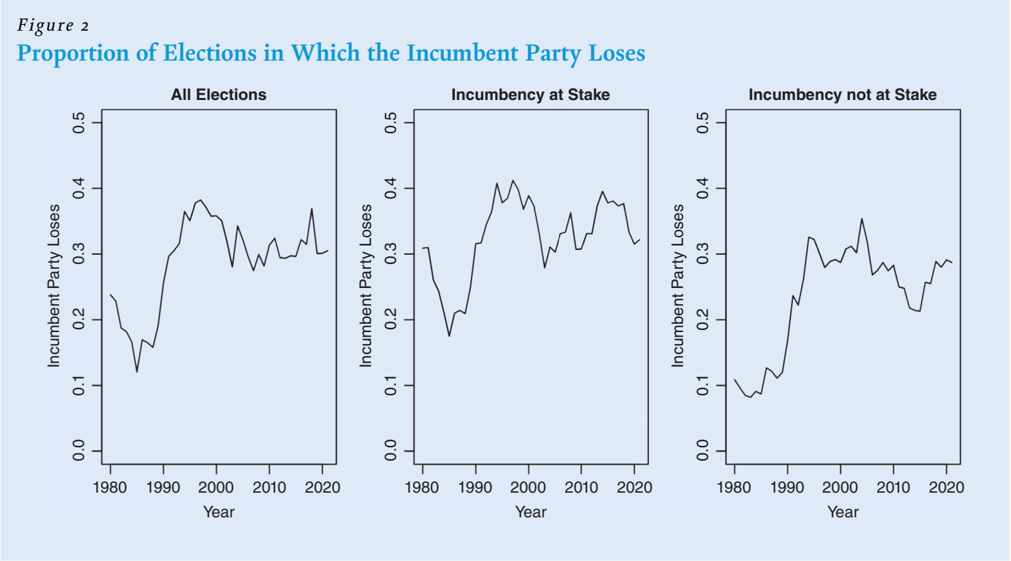
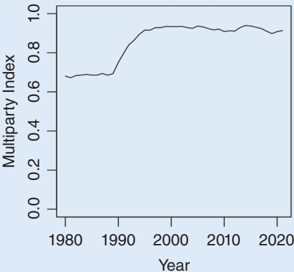
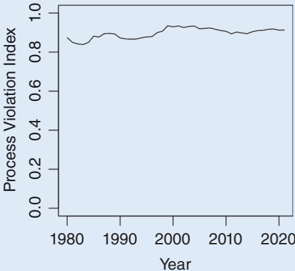
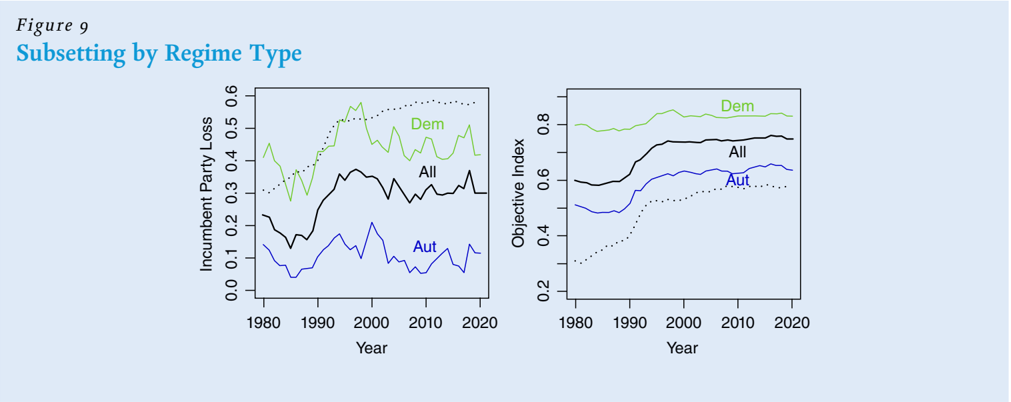
- On objective indicators, there is little evidence of global backsliding: incumbent-party loss rates remained fairly constant since the late 1990s; winner vote shares and winning-party legislative seat shares generally declined; the multiparty index rose from around 0.7 to 0.95 in the 1990s and then was stable; and the process-violations index was rare and stable for the past 20 years.
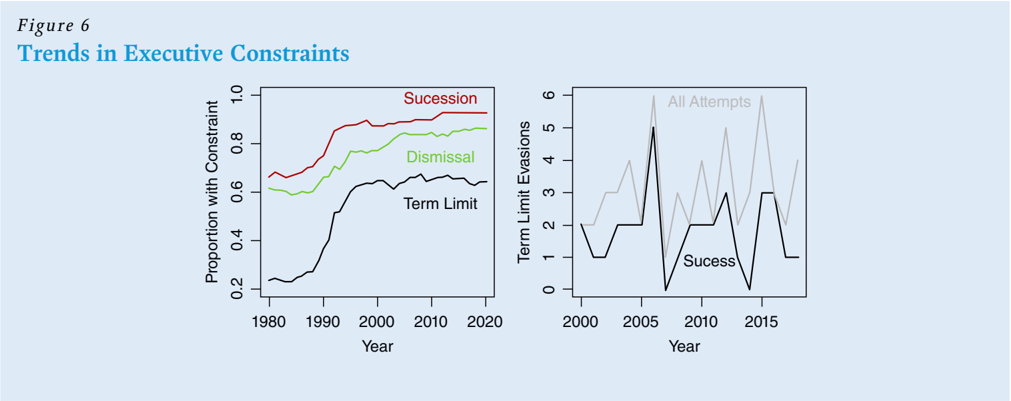
- Executive constraints show term limits flat, dismissal and succession rules slightly upward since the Cold War, and no clear trend in term-limit evasion. In Versteeg et al.’s data, there were 234 instances from 2000 to 2018 in which an incumbent reached the end of a term and was ineligible due to term limits; 60 were serious evasion attempts (26%), all from authoritarian or hybrid regimes, and 34 succeeded.
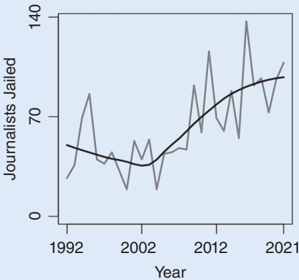
- Press freedom is mixed: journalists jailed increased beginning in the early 2000s, while journalists murdered decreased steadily since around 2008.
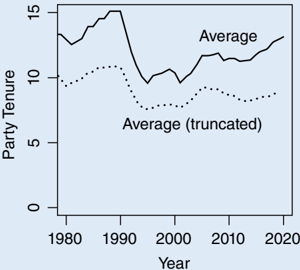
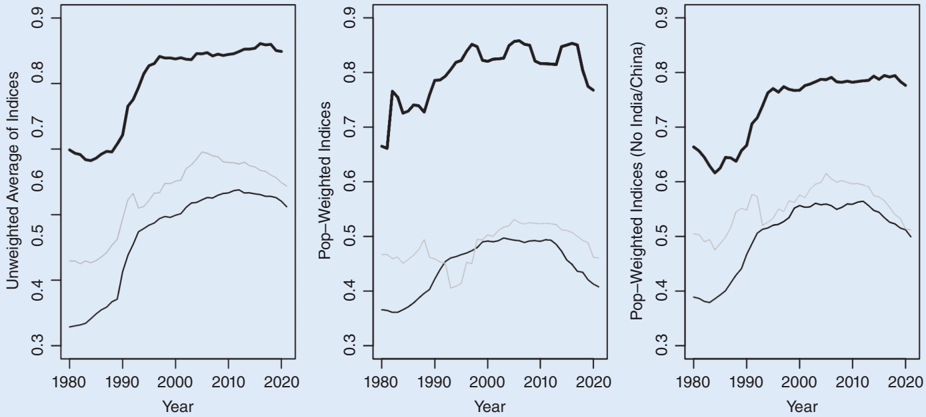
- The aggregate objective index generally continued to increase since 2000 and in 2020 was almost as high as it has ever been, whereas V-Dem and Freedom House scores modestly declined. Population weighting produces a notable decrease beginning around 2018 but a more volatile trend, sensitive to India and China.
Methods
- Design: The authors adopt a “quasi-minimalist” conception of democracy centered on free and fair elections in which losers accept results, and they survey objective indicators of electoral competitiveness, executive constraints, and media freedom, comparing them with expert-coded measures.
- Data: NELDA (1945–2020), the World Bank’s Database of Political Institutions, original executive-constraints data expanding Meng (2020), Versteeg et al. (2020) on term-limit evasion, and Committee to Protect Journalists data; the main graphs use a 1980–2021 window subject to availability and mostly unweighted country averages.
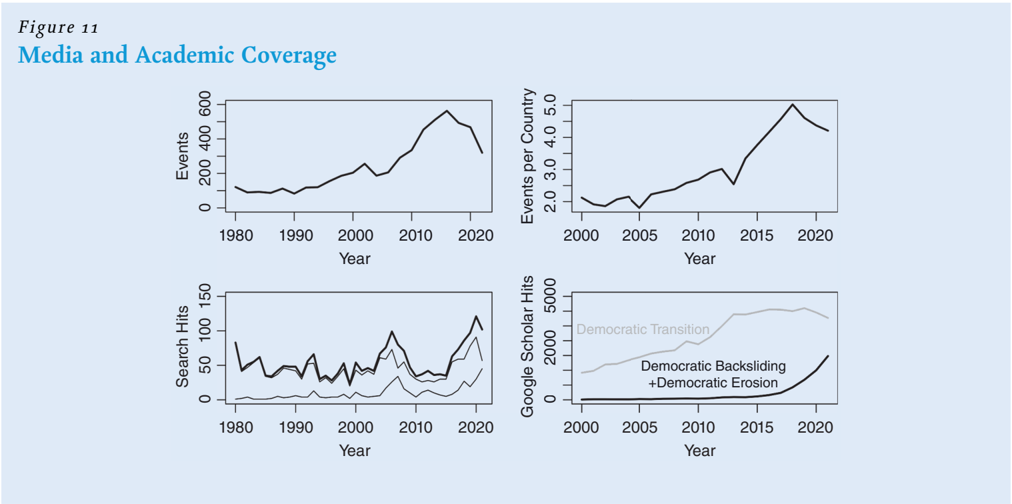
- Analysis: Trend comparisons and a simple aggregate objective index that normalizes individual variables between 0 and 1 and averages them by country-year; online appendix formal models examine coder bias and strategic attacks, and media-coverage trends are shown using Gottlieb et al. (2022), New York Times article counts, and Google Scholar hits.
Limitations
- The paper states that it cannot rule out the possibility that the world is becoming less democratic exclusively in ways that require subjective judgment to detect; it is not asserting that backsliding is not happening anywhere; objective measures focus on electoral institutions and outcomes and omit civil liberties; and the aggregate objective index is not an appropriate substitute for existing country-year democracy indices, with no clear substantive interpretation of its magnitude.
- The paper states that coder bias likely explains at least some of the discrepancy but is not definitively established; media coverage may reflect actual frequency of backsliding; and future research is needed on mechanisms.
- Evident from the text: several figures, tables, and online appendices are referenced but not included in the provided text, so some numerical trends cannot be verified from the excerpt alone.
Model-written summary. Check it against the paper before relying on it.
Integrity signals
Registry
Cites
Statistics
Figures





Verification
Claims the paper makes
3 Valid · 8 Not valid · 21 Not checked · 96 Own results and interpretations
The sources with a verdict support this claim; the rest weren’t checked yet, have no full text we could read, or their verdicts aren’t rated yet.
In the paper
“Even the types of subtle actions that many fear are the dominant mode of contemporary authoritarianism and backsliding (Guriev and Treisman 2020; Luo and Przeworski 2019; Przeworski 2019) typically are reflected in election results.”
What the sources say
- Supportedcites Guriev and Treisman 2020 source
The Conclusions (section 5; page unavailable) say that most of today’s non-democratic leaders rely on information manipulation rather than mass repression. The Introduction (section 1; page unavailable) describes leaders removing constraints on their power while pretending to be democratic. The citation follows the description of contemporary authoritarian tactics; the statement about election results is the citing authors’ subsequent point. (LLM, conf=0.88)
- Not checked — no full text of the sourcecites Luo and Przeworski 2019 source
- Not checked — no full text of the sourcecites Przeworski 2019 source
plainstates an association- Asserted: passes — The authors put it forward as true.
- Checkable: passes — It can be checked against evidence.
- Load-bearing: passes — The paper’s conclusions depend on it.
- Based: passes — The paper gives a reason why it holds.
- Supported
The cited sources support only part of this claim — read each source’s verdict below.
In the paper
“Unfortunately, fully adjusting for biases is a challenge even for extremely well-informed and sophisticated thinkers.”
What the sources say
- Not checked — no full text of the sourcecites Enke 2020 source
- Partly supportedcites Brundage, Little, and You 2022 sourceExperimental — accuracy not yet measured
Section 4, “Experimental Work on the Mechanism” (page unavailable), says people often fail to adjust for biased samples and that making the bias more obvious reduces but does not eliminate the error. The paper also mentions errors by people with statistical expertise, but does not establish that extremely well-informed and sophisticated thinkers struggle to fully adjust for the selection biases at issue. (LLM, conf=0.82)
plain- Asserted: passes — The authors put it forward as true.
- Checkable: unclear — It is unclear whether it could be checked against evidence.
- Load-bearing: passes — The paper’s conclusions depend on it.
- Based: passes — The paper gives a reason why it holds.
The sources with a verdict support this claim; the rest weren’t checked yet, have no full text we could read, or their verdicts aren’t rated yet.
In the paper
“There is strong evidence across a variety of topics and subject pools that people make substantial errors when faced with selection problems in the samples that they observe (see Enke 2020 for a prominent recent example and Brundage, Little, and You 2022 for a review).”
What the sources say
- Not checked — no full text of the sourcecites Enke 2020 source
- Supportedcites Brundage, Little, and You 2022 source
Section 4, “Experimental Work on the Mechanism” (page not available), describes experimental evidence of large, consistent deviations from rational benchmarks when people interpret selected samples as representative. It reviews examples involving numerical estimates, startup bets, and investment decisions, supporting the claim’s breadth. The paper is a review, as the citation indicates. (LLM, conf=0.88)
boosted- Asserted: passes — The authors put it forward as true.
- Checkable: passes — It can be checked against evidence.
- Load-bearing: passes — The paper’s conclusions depend on it.
- Based: passes — The paper gives a reason why it holds.
The paper states this without a source or data behind it here, so there is nothing to check it against. The quote shows it is in the paper.
In the paper
“despite recent prominent cases, there has been no uptick in the rate of leaders evading term limits.”
plain- Asserted: passes — The authors put it forward as true.
- Checkable: passes — It can be checked against evidence.
- Load-bearing: unclear — It is unclear whether the paper’s conclusions depend on it.
- Based: unclear — It is unclear why the paper says it holds.
The paper states this without a source or data behind it here, so there is nothing to check it against. The quote shows it is in the paper.
In the paper
“Constitutional rules that limit executive power have been fairly constant if not slightly increasing since the end of the Cold War.”
plain- Asserted: passes — The authors put it forward as true.
- Checkable: passes — It can be checked against evidence.
- Load-bearing: passes — The paper’s conclusions depend on it.
- Based: unclear — It is unclear why the paper says it holds.
54 more claims
Create a free account to see all 128 claims and to verify the 2 references still open.
- It may state two separate claims as one. 36
- The quote only partly states this claim. 1
- Probably not a substantial claim. 41
Self-check
Percentages, sums and reported differences re-computed from the paper’s own numbers.
Each contradiction between two passages listed here was confirmed by an independent check.
Rated minor: it would not touch a result — a value no result rests on, a p-value that stays on the same side of the significance level, or a conflict that is clerical, resolved elsewhere in the paper, or outside its own findings.
In the paper
§ Additional Measures of Winning/Incumbent Party Dominance · p. 6
“averaging the three variables gives a ' (lack of ) process violation ' index with three levels ranging from 0 to 1.”
§ Are Elections Competitive? · p. 6
“The second index captures various other electoral-process violations and includes the following variables: (1) were previous elections suspended, (2) had the current incumbent violated a term limit, and (3) did an opposition party boycott the election. In each case, we coded 1 for answering ' no ' and 0 otherwise;”
Citations
Cites
Democracy and the Market: Political and Economic Reforms in Eastern Europe and Latin America
Przeworski, A. (1991) · doi:10.1017/cbo9781139172493 · Cited by 3,494
Democracy and Development: Political Institutions and Well-Being in the World, 1950–1990
Przeworski, A., Alvarez, M. E., Cheibub, J. A., & Limongi, F. (2000) · doi:10.1017/cbo9780511804946 · Cited by 2,845
Democracy and dictatorship revisited
Cheibub, J. A., Gandhi, J., & Vreeland, J. R. (2010) · Public Choice · doi:10.1007/s11127-009-9491-2 · Cited by 2,481 · cited 2×
“This is a notoriously difficult problem (see, e.g., Boix, Miller, and Rosato 2013; Cheibub, Gandhi, and Vreeland 2010; Przeworski et al. 2000).”
BackgroundBermeo, N. (2016) · Journal of Democracy · doi:10.1353/jod.2016.0012 · Cited by 2,331
A third wave of autocratization is here: what is new about it?
Lührmann, A., & Lindberg, S. I. (2019) · Democratization · doi:10.1080/13510347.2019.1582029 · Cited by 1,528 · cited 2×
“Similarly, Lührmann and Lindberg (2019) contend that any country can “ autocratize, ” regardless of regime type.”
BackgroundFacing Up to the Democratic Recession
Diamond, L. (2015) · Journal of Democracy · doi:10.1353/jod.2015.0009 · Cited by 1,107 · cited 2×
“A substantial uptick in academic papers on democratic backsliding has emerged in recent years, which often raise alarm in the title: “ Democratic Regress in the Contemporary World ” (Haggard and Kaufman 2021) necessitates “ Facing up to the Democratic Recession ” (Diamond 2015) because “ A Third Wave of Autocratiza-ti…”
BackgroundA Complete Data Set of Political Regimes, 1800–2007
Boix, C., Miller, M., & Rosato, S. (2013) · Comparative Political Studies · doi:10.1177/0010414012463905 · Cited by 1,072
Unwelcome Change: Coming to Terms with Democratic Backsliding
Waldner, D., & Lust, E. (2018) · Annual Review of Political Science · doi:10.1146/annurev-polisci-050517-114628 · Cited by 889
Respect for Human Rights has Improved Over Time: Modeling the Changing Standard of Accountability
FARISS, C. J. (2014) · American Political Science Review · doi:10.1017/s0003055414000070 · Cited by 706
Hyde, S. D., & Marinov, N. (2012) · Political Analysis · doi:10.1093/pan/mpr040 · Cited by 643 · cited 1×
“Our data on elections and freedom of association are from the National Elections Across Democracy and Autocracy (NELDA) dataset, which contains several objective variables about all elections from 1945 to 2020 (Hyde and Marinov 2012).”
Method
Research works printed but not linked: 3
- Weitzel, 2023, Working Paper
- Anderson, 2021, Autocracy: A Substantive Approach
- Chiopris, 2021, Working Paper
Cited by
Megastudy testing 25 treatments to reduce antidemocratic attitudes and partisan animosity
Voelkel, J. G., Stagnaro, M. N., Chu, J. Y., Pink, S. L., Mernyk, J. S., Redekopp, C., Ghezae, I., Cashman, M., Adjodah, D., Allen, L. G., et al. (2024) · Science · doi:10.1126/science.adh4764 · Cited by 174
“INTRODUCTION: Scholars, practitioners, and politicians have raised concerns about deepening partisan divisions and the health of American democracy.”
Megastudy testing 25 treatments to reduce antidemocratic attitudes and partisan animosity
Voelkel, J. G., Stagnaro, M., Chu, J., Pink, S. L., Mernyk, J. S., Redekopp, C., Ghezae, I., Cashman, M., Adjodah, D., Allen, L., et al. (2023) · doi:10.31219/osf.io/y79u5 · Cited by 174
Conceptualizing and Measuring Support for Democracy: A New Approach
Claassen, C., Ackermann, K., Bertsou, E., Borba, L., Carlin, R. E., Cavari, A., Dahlum, S., Gherghina, S., Hawkins, D. G., Yphtach Lelkes, B., et al. (2024) · Comparative Political Studies · doi:10.1177/00104140241259458 · Cited by 106
Income inequality and the erosion of democracy in the twenty-first century
Rau, E. G., & Stokes, S. C. (2024) · Proceedings of the National Academy of Sciences · doi:10.1073/pnas.2422543121 · Cited by 90
Pathways of Democratic Backsliding, Resistance, and (Partial) Recoveries
Riedl, R. B., McCoy, J., Roberts, K., & Somer, M. (2024) · The Annals of the American Academy of Political and Social Science · doi:10.1177/00027162251319909 · Cited by 32
Metadata
- Authors
- Little, A. T., & Meng, A.
- Affiliations
- University of California, Berkeley (US)
- University of Virginia (US)
- Venue
- PS: Political Science & Politics
- Publisher
- Cambridge University Press (CUP)
- Published
- 2024-01-11
- Volume
- 57
- Issue
- 2
- Pages
- 149-161
- ISSN
- 0030-8269 (ISSN-L)
- 1049-0965
- 1537-5935
- OpenAlex
- W4390746191
- Cited by
- 121
- References
- 42
- Citations by year
- 2026: 40 · 2025: 56 · 2024: 24
- FWCI
- 85.79
- Type
- journal article
- Language
- en
- Open access
- hybrid
- doi.org
- Locations
- PS Political Science & Politics (publishedVersion, cc-by)
- Topics
- Social Sciences › Sociology and Political Science › Political Conflict and Governance
- Social Sciences › Political Science and International Relations › Political Theory and Democracy
- Social Sciences › Political Science and International Relations › Electoral Systems and Political Participation
- Keywords
- democratic backsliding, subjective indicators
About these checks
Registry, retraction, Cites and statistics results are computed, not judged, with one exception: a printed reference that no index lists is read once by a model before it counts as a citation error. Claims are extracted by a model and kept only when their quote appears verbatim in the text; each cited source is then checked, with a model’s help, for whether it says what the claim relies on. Those verdicts can be wrong — read the claim’s quote and the cited source before relying on one.
The claim verdicts this report counts are experimental: their accuracy is not yet measured.
A language model drew the claims from the paper on 2026-10-10, under version 3 of the claim definition (model deepseek-v4.1-flash, prompt extract-v3).
A second model labelled each claim on 2026-10-10 (model jev-1.13-20260917, definition revision gold-guideline-v0.2).
Cited sources are checked with a language model’s help (gpt-6-sol).
Statistics and arithmetic are recomputed, not judged.
Confidence bands are shown only for fields calibrated on our annotated test set. None is calibrated yet, so no band is shown.
What counts as a claim ›How we measure confidence ›How we check this ›
Are you an author, or do you see a problem with this page? Request a review
How to cite
Cite CoChat for the checks on this page, and the paper for its own findings.
- This page
- CoChat. (2026). Citation check: Measuring Democratic Backsliding. https://app.cochat.ai/papers/10.1017/s104909652300063x
- The paper
- Little, A. T., & Meng, A. (2024). Measuring Democratic Backsliding. PS: Political Science & Politics. https://doi.org/10.1017/s104909652300063x
Data sources
Bibliographic data: Semantic Scholar, OpenAlex, Crossref.
Contains information from the Semantic Scholar Academic Graph Datasets, made available under the ODC Attribution License (ODC-BY 1.0).
Semantic Scholar’s data is described in: Kinney, R., et al. (2023). The Semantic Scholar Open Data Platform. arXiv:2301.10140.
