

Meta-analytic Review of Memory Impairment in Behavioral Variant Frontotemporal Dementia
Open accessThe DOI matches its Crossref record; 90 of the 90 references it cites were found in a registry or an index.
Abstract
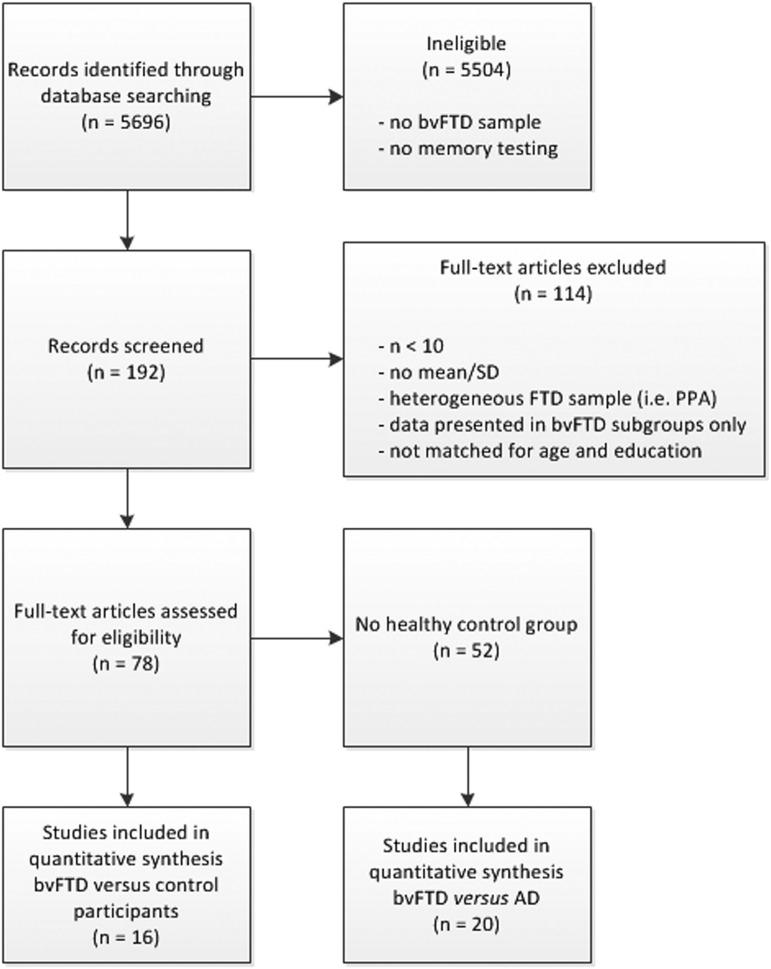
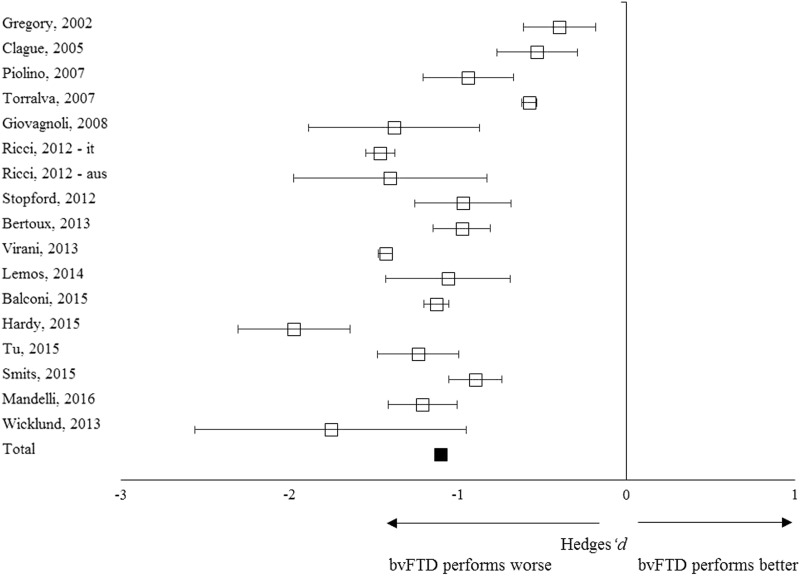
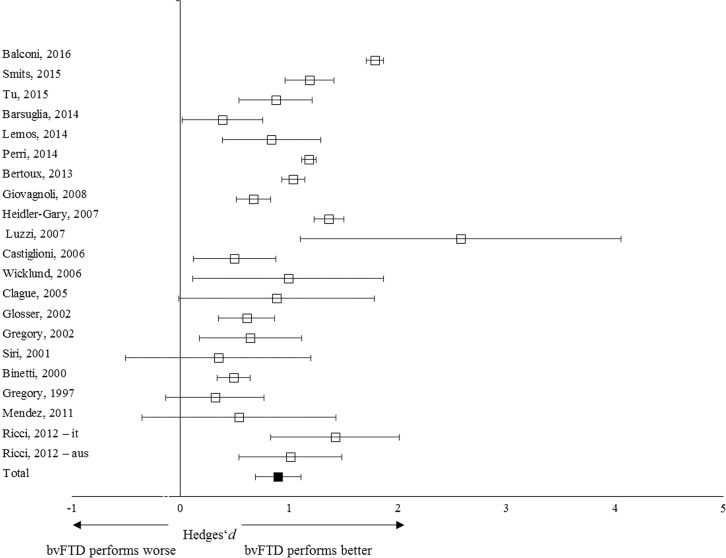
Objectives:A meta-analysis of the extent, nature and pattern of memory performance in behavioral variant frontotemporal dementia (bvFTD). Multiple observational studies have challenged the relative sparing of memory in bvFTD as stated in the current diagnostic criteria.Methods:We performed a meta-analytic review covering the period 1967 to February 2017 of case-control studies on episodic memory in bvFTD versus control participants (16 studies, 383 patients, 603 control participants), and patients with bvFTD versus those with Alzheimer’s disease (AD) (20 studies, 452 bvFTD, 874 AD). Differences between both verbal and non-verbal working memory, episodic memory learning and recall, and recognition memory were examined. Data were extracted from the papers and combined into a common metric measure of effect, Hedges’d.Results:Patients with bvFTD show large deficits in memory performance compared to controls (Hedges’d–1.10; 95% confidence interval [CI] [–1.23, –0.95]), but perform significantly better than patients with AD (Hedges’d 0.85; 95% CI [0.69, 1.03]). Learning and recall tests differentiate best between patients with bvFTD and AD (p<.01). There is 37–62% overlap in test scores between the two groups.Conclusions:This study points to memory disorders in patients with bvFTD, with performance at an intermediate level between controls and patients with AD. This indicates that, instead of being an exclusion criterion for bvFTD diagnosis, memory deficits should be regarded as a potential integral part of the clinical spectrum. (JINS, 2018,24, 593–605)
Overview
The claims and statistics of this paper haven’t been checked yet.
Free: it reads the open-access text and checks the first 5 claims that cite a source we can check. Create a free account to check every claim.
Integrity signals
Registry
Cites
Statistics
Figures
Verification
Claims the paper makes
The claims and statistics of this paper haven’t been checked yet.
Free: it reads the open-access text and checks the first 5 claims that cite a source we can check. Create a free account to check every claim.
Claims other papers make about this one
Each is checked against this paper’s own text: does it say what the citing paper says it does?
The cited source says what the claim attributes to it.
In the citing paper
“Episodic memory perfor mance is variable, with some people with behavioural variant frontotemporal dementia showing considerable memory deficits, albeit usually to a lesser extent than those seen in individuals with Alzheimer's disease.36”
From Advances and controversies in frontotemporal dementia: diagnosis, biomarkers, and therapeutic considerations (2022) · cites this paper as [36]
Self-check
Percentages, sums and reported differences re-computed from the paper’s own numbers.
The self-check needs the paper’s full text.
Citations
Cites
Statistical Power Analysis for the Behavioral Sciences
Muller, K. (1989) · Technometrics · doi:10.1080/00401706.1989.10488618 · Cited by 99,167
Preferred Reporting Items for Systematic Reviews and Meta-Analyses: the PRISMA statement
Moher, D., Liberati, A., Tetzlaff, J., Altman, D. G., & for the PRISMA Group (2009) · BMJ · doi:10.1136/bmj.b2535 · Cited by 83,823
Statistical power analysis for the behavioral sciences
(1990) · Computers, Environment and Urban Systems · doi:10.1016/0198-9715(90)90050-4 · Cited by 65,269
Preferred Reporting Items for Systematic Reviews and Meta-Analyses: The PRISMA Statement
Moher, D., Liberati, A., Tetzlaff, J., Altman, D. G., & The PRISMA Group (2009) · PLoS Medicine · doi:10.1371/journal.pmed.1000097 · Cited by 64,042
Statistical Power Analysis for the Behavioral Sciences (2nd ed.).
Lachenbruch, P. A., & Cohen, J. (1989) · Journal of the American Statistical Association · doi:10.2307/2290095 · Cited by 37,395 · cited 1×
“According to Cohen ’ s nomenclature (1988), d > 0.80 indicates a large difference.”
InfluentialWang, G., Ma, R., Qiao, G., Wada, K., Aizawa, Y., & Satoh, T. (2015) · Integrative Medicine International · doi:10.1159/000368408 · Cited by 18,657
Statistical Methods for Meta-Analysis
Wasserman, S., Hedges, L. V., & Olkin, I. (1988) · Journal of Educational Statistics · doi:10.2307/1164953 · Cited by 10,326
Sensitivity of revised diagnostic criteria for the behavioural variant of frontotemporal dementia
Rascovsky, K., Hodges, J. R., Knopman, D., Mendez, M. F., Kramer, J. H., Neuhaus, J., van Swieten, J. C., Seelaar, H., Dopper, E. G. P., Onyike, C. U., et al. (2011) · Brain · doi:10.1093/brain/awr179 · Cited by 5,221
Frontotemporal lobar degeneration: A consensus on clinical diagnostic criteria
Neary, D., Snowden, J. S., Gustafson, L., Passant, U., Stuss, D., Black, S., Freedman, M., Kertesz, A., Robert, P. H., Albert, M., et al. (1998) · Neurology · doi:10.1212/wnl.51.6.1546 · Cited by 5,047
Statistical Methods for Meta-Analysis.
Freeman, P. R., Hedges, L. V., & Olkin, I. (1986) · Biometrics · doi:10.2307/2531069 · Cited by 4,784
Appelhof, B., Bakker, C., Van Duinen-van den Ijssel, J. C. L., Zwijsen, S. A., Smalbrugge, M., Verhey, F. R. J., de Vugt, M. E., Zuidema, S. U., & Koopmans, R. T. C. M. (2017) · Dementia and Geriatric Cognitive Disorders · doi:10.1159/000477087 · Cited by 2,760
Qualitative Assessment of Verbal Fluency Performance in Frontotemporal Dementia
van den Berg, E., Jiskoot, L. C., Grosveld, M. J. H., van Swieten, J. C., & Papma, J. M. (2017) · Dementia and Geriatric Cognitive Disorders · doi:10.1159/000477538 · Cited by 2,046
Self-citationMeta-Analysis: Recent Developments in Quantitative Methods for Literature Reviews
Rosenthal, R., & DiMatteo, M. R. (2001) · Annual Review of Psychology · doi:10.1146/annurev.psych.52.1.59 · Cited by 1,780 · cited 1×
“The fail-safe number of studies N R provides an estimation of how many non-signi fi cant or missing studies would be needed to render the observed meta-analytical results non-signi fi cant (Rosenthal ’ s method: α < 0.05; Rosenthal & DiMatteo, 2001).”
InfluentialMcKhann, G. M. (2001) · Archives of Neurology · doi:10.1001/archneur.58.11.1803 · Cited by 1,472 · cited 2×
“Frontotemporal dementia (FTD) is an early-onset dementia characterized by a heterogeneous clinical presentation including behavioral changes, frontal-executive deficits, and/or language disorders (Seelaar, Rohrer, Pijnenburg, Fox, & van Swieten, 2011), caused by pathophysiological damage in the frontal and temporal lo…”
Clinical and neuropathological criteria for frontotemporal dementia. The Lund and Manchester Groups.
(1994) · Journal of Neurology, Neurosurgery & Psychiatry · doi:10.1136/jnnp.57.4.416 · Cited by 1,331 · cited 2×
“…imaging results are considered to be acceptably accurate in identifying a clinical syndrome predicting the pathologic features of FTD at autopsy (Englund et al., 1994; Neary & Snowden, 1996), there is still the possibility that some of the studies missed patients with bvFTD with memory…”
A brief cognitive test battery to differentiate Alzheimer's disease and frontotemporal dementia
Mathuranath, P. S., Nestor, P. J., Berrios, G. E., Rakowicz, W., & Hodges, J. R. (2000) · Neurology · doi:10.1212/01.wnl.0000434309.85312.19 · Cited by 1,029 · cited 1×
“…et al., 2001; Hodges et al., 1999; Kramer et al., 2003; Kertesz, Davidson, McCabe, & Munoz, 2003; Lee, Rahman, Hodges, Sahakian, & Graham, 2003; Mathuranath, Nestor, Berrios, Rakowicz, & Hodges, 2000; Pachana et al., 1996; Pasquier et al., 2001; Perry & Hodges, 2000; Souliez, Pasquier, Lebert,…”
Gregory, C., Lough, S., Stone, V., Erzinclioglu, S., Martin, L., Baron‐Cohen, S., & Hodges, J. R. (2002) · Brain · doi:10.1093/brain/awf079 · Cited by 815
Clinical, genetic and pathological heterogeneity of frontotemporal dementia: A review
Seelaar, H., Rohrer, J. D., Pijnenburg, Y. A. L., Fox, N. C., & van Swieten, J. C. (2011) · Journal of Neurology, Neurosurgery & Psychiatry · doi:10.1136/jnnp.2010.212225 · Cited by 609
Blumenfeld, R. S., & Ranganath, C. (2007) · The Neuroscientist · doi:10.1177/1073858407299290 · Cited by 598 · cited 1×
“…with bvFTD suggest poor organization and a lack of ef fi cient learning and retrieval strategies as causes (i.e., dysexecutive syndrome), rather than de fi cits in memory consolidation per se (Blumenfeld & Ranganath, 2007; Pasquier, Grymponprez, Lebert, & Van der Linden, 2001; Wang & Miller, 2007).”
Kramer, J. H., Jurik, J., Sha, S. J., Rankin, K. P., Rosen, H. J., Johnson, J. K., & Miller, B. L. (2003) · Cognitive and Behavioral Neurology · doi:10.1097/00146965-200312000-00002 · Cited by 502 · cited 2×
“, 2002), and those showing that patients with AD experience even greater memory problems (e.g., Frisoni et al., 1999; Galton et al., 2001; Hodges et al., 1999; Kramer et al., 2003; Kertesz, Davidson, McCabe, & Munoz, 2003; Lee, Rahman, Hodges, Sahakian, & Graham, 2003; Mathuranath, Nestor, Berrios, Rakowicz, & Hodges,…”
Mahoney, C. J., Beck, J., Rohrer, J. D., Lashley, T., Mok, K., Shakespeare, T., Yeatman, T., Warrington, E. K., Schott, J. M., Fox, N. C., et al. (2012) · Brain · doi:10.1093/brain/awr361 · Cited by 438
Le Ber, I., Camuzat, A., Hannequin, D., Pasquier, F., Guedj, E., Rovelet-Lecrux, A., Hahn-Barma, V., van der Zee, J., Clot, F., Bakchine, S., et al. (2008) · Brain · doi:10.1093/brain/awn012 · Cited by 352 · cited 1×
“Ber et al. (2008) found a high frequency of episodic memory disorders (89”
Zakzanis, K. K. (2001) · Archives of Clinical Neuropsychology · doi:10.1093/arclin/16.7.653 · Cited by 346 · cited 1×
“The percentage of overlap in test scores between groups was also reported according to Zakzanis ’ calculations (2001); d = 0 equates to 100% overlap, d = 1.0 equates to 45% overlap and d = 3.0 equates to less than 5% overlap in group scores.”
InfluentialCellular Localization of Gene Expression for Progranulin
Daniel, R., He, Z., Carmichael, K. P., Halper, J., & Bateman, A. (2000) · Journal of Histochemistry & Cytochemistry · doi:10.1177/002215540004800713 · Cited by 346 · cited 1×
“…and suggest an episodic memory disorder to be a distinctive characteristic of the GRN mutation, due to the high expression of GRN in the hippocampus in which marked atrophy and neuronal loss may be observed (Daniel, He, Carmichael, Halper, & Bateman, 2000; Boeve et al., 2006; Snowden et al., 2006).”
Hodges, J. R., Patterson, K., Ward, R., Garrard, P., Bak, T., Perry, R., & Gregory, C. (1999) · Neuropsychology · doi:10.1037/0894-4105.13.1.31 · Cited by 335 · cited 2×
“…studies revealing no differences between bvFTD and Alzheimer ’ s disease (AD) memory performance (e.g., Gregory, Orrell, Sahakian, & Hodges, 1997; Hodges et al., 1999; Walker, Meares, Sachdev, & Brodaty, 2005), and others demonstrating a relative sparing of memory performance in bvFTD compared…”
Primary Progressive Aphasia: Longitudinal Course, Neuropsychological Profile, and Language Features
Weintraub, S. (1990) · Archives of Neurology · doi:10.1001/archneur.1990.00530120075013 · Cited by 310
The Human Frontal Lobes: Functions and Disorders
Brust, J. C. M. (2007) · The Neurologist · doi:10.1097/nrl.0b013e318151f9e9 · Cited by 299
Working memory, attention, and executive function in Alzheimer’s disease and frontotemporal dementia
Stopford, C. L., Thompson, J. C., Neary, D., Richardson, A. M. T., & Snowden, J. S. (2012) · Cortex · doi:10.1016/j.cortex.2010.12.002 · Cited by 292
Hippocampal and entorhinal cortex atrophy in frontotemporal dementia and Alzheimer’s disease
Frisoni, G. B., Laakso, M. P., Beltramello, A., Geroldi, C., Bianchetti, A., Soininen, H., & Trabucchi, M. (1999) · Neurology · doi:10.1212/wnl.52.1.91 · Cited by 285 · cited 1×
“…Pennington, Hodges, & Hornberger, 2011; Simons et al., 2002), and those showing that patients with AD experience even greater memory problems (e.g., Frisoni et al., 1999; Galton et al., 2001; Hodges et al., 1999; Kramer et al., 2003; Kertesz, Davidson, McCabe, & Munoz, 2003; Lee, Rahman, Hodges,…”
Differentiating frontal and temporal variant frontotemporal dementia from Alzheimer’s disease
Perry, R. J., & Hodges, J. R. (2000) · Neurology · doi:10.1212/wnl.54.12.2277 · Cited by 284 · cited 1×
“…Lee, Rahman, Hodges, Sahakian, & Graham, 2003; Mathuranath, Nestor, Berrios, Rakowicz, & Hodges, 2000; Pachana et al., 1996; Pasquier et al., 2001; Perry & Hodges, 2000; Souliez, Pasquier, Lebert, Leconte, & Petite, 1996) with delayed memory testing being the most discriminative (e.g., Hutchinson…”
Thompson, J. C. (2005) · Journal of Neurology, Neurosurgery & Psychiatry · doi:10.1136/jnnp.2003.033779 · Cited by 251 · cited 1×
“…& Hodges, 1997; Hodges et al., 1999; Walker, Meares, Sachdev, & Brodaty, 2005), and others demonstrating a relative sparing of memory performance in bvFTD compared to AD (e.g., Frisoni et al., 1995; Pachana, Boone, Miller, Cummings, & Berman, 1996; Thompson, Stopford, Snowden, & Neary, 2005).”
Luzzi, S., Snowden, J. S., Neary, D., Coccia, M., Provinciali, L., & Lambon Ralph, M. A. (2007) · Neuropsychologia · doi:10.1016/j.neuropsychologia.2006.12.008 · Cited by 238
Episodic memory in frontotemporal dementia: a critical review
Hornberger, M., & Piguet, O. (2012) · Brain · doi:10.1093/brain/aws011 · Cited by 210 · cited 3×
“However, many patients with bvFTD have self-reported or caregiver reported memory problems (Hornberger & Piguet, 2012) and some patients even manifest severe episodic memory disorders, even at initial presentation (e.g., Hornberger, Piguet, Graham, Nestor, & Hodges, 2010; Shi et al., 2005).”
How preserved is episodic memory in behavioral variant frontotemporal dementia?
Hornberger, M., Piguet, O., Graham, A. J., Nestor, P. J., & Hodges, J. R. (2010) · Neurology · doi:10.1212/wnl.0b013e3181cef85d · Cited by 206 · cited 1×
“However, our results contrast with those of other studies reporting similar memory impairment in patients with bvFTD and AD (e.g., Hornberger et al., 2010; Pennington et al., 2011; Ranjith, Mathuranath, Sharma, & Alexander, 2010).”
Pathologically proven frontotemporal dementia presenting with severe amnesia
Graham, A. (2005) · Brain · doi:10.1093/brain/awh348 · Cited by 203 · cited 5×
“Those studies that have looked at memory disorder in pathological confirmed FTD show clear episodicmemory deficits (e.g., Bertoux et al., 2014; Graham et al., 2005; Hornberger et al., 2011).”
InfluentialSnowden, J. S., Pickering-Brown, S. M., Mackenzie, I. R., Richardson, A. M. T., Varma, A., Neary, D., & Mann, D. M. A. (2006) · Brain · doi:10.1093/brain/awl267 · Cited by 200 · cited 2×
“(2008) found a high frequency of episodic memory disorders (89%) in GRN mutation carriers and suggest an episodic memory disorder to be a distinctive characteristic of the GRNmutation, due to the high expression ofGRN in the hippocampus in which marked atrophy and neuronal loss may be observed (Daniel, He, Carmichael,…”
Bora, E., Walterfang, M., & Velakoulis, D. (2015) · Journal of Neurology, Neurosurgery & Psychiatry · doi:10.1136/jnnp-2014-309445 · Cited by 196
Tu, S., Wong, S., Hodges, J. R., Irish, M., Piguet, O., & Hornberger, M. (2015) · Cortex · doi:10.1016/j.cortex.2015.03.016 · Cited by 190
Temporal lobe rating scale: application to Alzheimer's disease and frontotemporal dementia
Galton, C. J. (2001) · Journal of Neurology, Neurosurgery & Psychiatry · doi:10.1136/jnnp.70.2.165 · Cited by 188 · cited 2×
“, 2002), and those showing that patients with AD experience even greater memory problems (e.g., Frisoni et al., 1999; Galton et al., 2001; Hodges et al., 1999; Kramer et al., 2003; Kertesz, Davidson, McCabe, & Munoz, 2003; Lee, Rahman, Hodges, Sahakian, & Graham, 2003; Mathuranath, Nestor, Berrios, Rakowicz, & Hodges,…”
Hutchinson, A. D., & Mathias, J. L. (2007) · Journal of Neurology, Neurosurgery & Psychiatry · doi:10.1136/jnnp.2006.100669 · Cited by 187 · cited 1×
“…2003; Mathuranath, Nestor, Berrios, Rakowicz, & Hodges, 2000; Pachana et al., 1996; Pasquier et al., 2001; Perry & Hodges, 2000; Souliez, Pasquier, Lebert, Leconte, & Petite, 1996) with delayed memory testing being the most discriminative (e.g., Hutchinson & Mathias, 2007; Pasquier et al., 2001).”
Utility of clinical criteria in differentiating frontotemporal lobar degeneration (FTLD) from AD
Rosen, H. J., Hartikainen, K. M., Jagust, W., Kramer, J. H., Reed, B. R., Cummings, J. L., Boone, K., Ellis, W., Miller, C., & Miller, B. L. (2002) · Neurology · doi:10.1212/wnl.58.11.1608 · Cited by 174 · cited 1×
“Day-to-day memory is thought to be relatively preserved in the early stage of the disease (Rascovsky et al., 2011; Rosen et al., 2002), with severe memory impairment as exclusion criterion.”
In vivo and post-mortem memory circuit integrity in frontotemporal dementia and Alzheimer’s disease
Hornberger, M., Wong, S., Tan, R., Irish, M., Piguet, O., Kril, J., Hodges, J. R., & Halliday, G. (2012) · Brain · doi:10.1093/brain/aws239 · Cited by 169 · cited 1×
“…structures, as found in neuroimaging studies of both FTD and AD, suggests that amnesia in bvFTD may be due to real defects in memory storage and consolidation processing (e.g., Hornberger et al., 2012; Lindberg et al., 2012; Munoz-Ruiz et al., 2012; Papma et al., 2013; de Souza et al., 2013).”
Memory Impairment Differs in Frontotemporal Dementia and Alzhemier?s Disease.
Pasquier, F., Grymonprez, L., Lebert, F., & Van der Linden, M. (2001) · Neurocase · doi:10.1076/neur.7.2.161.16263 · Cited by 162 · cited 4×
“, 2002), and those showing that patients with AD experience even greater memory problems (e.g., Frisoni et al., 1999; Galton et al., 2001; Hodges et al., 1999; Kramer et al., 2003; Kertesz, Davidson, McCabe, & Munoz, 2003; Lee, Rahman, Hodges, Sahakian, & Graham, 2003; Mathuranath, Nestor, Berrios, Rakowicz, & Hodges,…”
InfluentialShi, J., Shaw, C. L., du Plessis, D., Richardson, A. M. T., Bailey, K. L., Julien, C. L., Stopford, C. L., Thompson, J. C., Varma, A. R., Craufurd, D., et al. (2005) · Acta Neuropathologica · doi:10.1007/s00401-005-1079-4 · Cited by 156 · cited 1×
“However, many patients with bvFTD have self-reported or caregiver reported memory problems (Hornberger & Piguet, 2012) and some patients even manifest severe episodic memory disorders, even at initial presentation (e.g., Hornberger, Piguet, Graham, Nestor, & Hodges, 2010; Shi et al., 2005).”
Comparison of neuropsychological functioning in Alzheimer’s disease and frontotemporal dementia
Pachana, N. A., Boone, K. B., Miller, B. L., Cummings, J. L., & Berman, N. (1996) · Journal of the International Neuropsychological Society · doi:10.1017/s1355617700001673 · Cited by 154 · cited 2×
“, 2002), and those showing that patients with AD experience even greater memory problems (e.g., Frisoni et al., 1999; Galton et al., 2001; Hodges et al., 1999; Kramer et al., 2003; Kertesz, Davidson, McCabe, & Munoz, 2003; Lee, Rahman, Hodges, Sahakian, & Graham, 2003; Mathuranath, Nestor, Berrios, Rakowicz, & Hodges,…”
Barnes, J., Whitwell, J. L., Frost, C., Josephs, K. A., Rossor, M., & Fox, N. C. (2006) · Archives of Neurology · doi:10.1001/archneur.63.10.1434 · Cited by 152 · cited 1×
“Some of these authors argue for similar consolidation problems in patients with bvFTD and AD as damage to the hippocampal structures was visible in both groups (e.g., Barnes et al., 2006).”
Executive function in progressive and nonprogressive behavioral variant frontotemporal dementia
Hornberger, M., Piguet, O., Kipps, C., & Hodges, J. R. (2008) · Neurology · doi:10.1212/01.wnl.0000334299.72023.c8 · Cited by 151
Trajectories of cognitive decline in different types of dementia
Smits, L. L., van Harten, A. C., Pijnenburg, Y. A. L., Koedam, E. L. G. E., Bouwman, F. H., Sistermans, N., Reuling, I. E. W., Prins, N. D., Lemstra, A. W., Scheltens, P., et al. (2015) · Psychological Medicine · doi:10.1017/s0033291714002153 · Cited by 134
The Language Profile of Behavioral Variant Frontotemporal Dementia
Hardy, C. J. D., Buckley, A. H., Downey, L. E., Lehmann, M., Zimmerer, V. C., Varley, R. A., Crutch, S. J., Rohrer, J. D., Warrington, E. K., & Warren, J. D. (2016) · Journal of Alzheimer's Disease · doi:10.3233/jad-150806 · Cited by 123
Two Distinct Amnesic Profiles in Behavioral Variant Frontotemporal Dementia
Bertoux, M., de Souza, L. C., Corlier, F. W., Lamari, F., Bottlaender, M., Dubois, B., & Sarazin, M. (2013) · Biological Psychiatry · doi:10.1016/j.biopsych.2013.08.017 · Cited by 120 · cited 2×
“We would like to stress, however, that several studies included pathologically proven patients with bvFTD and still found signi fi cant memory de fi cits (e.g., Bertoux et al., 2014; Graham et al., 2005; Hornberger et al., 2011).”
Fronto-temporal Dementia: Nosology, Neuropsychology, and Neuropathology
Neary, D., & Snowden, J. S. (1996) · Brain and Cognition · doi:10.1006/brcg.1996.0041 · Cited by 115 · cited 1×
“…considered to be acceptably accurate in identifying a clinical syndrome predicting the pathologic features of FTD at autopsy (Englund et al., 1994; Neary & Snowden, 1996), there is still the possibility that some of the studies missed patients with bvFTD with memory impairment due to the current…”
Boeve, B. F., Baker, M., Dickson, D. W., Parisi, J. E., Giannini, C., Josephs, K. A., Hutton, M., Pickering-Brown, S. M., Rademakers, R., Tang-Wai, D., et al. (2006) · Brain · doi:10.1093/brain/awl268 · Cited by 110 · cited 2×
“(2008) found a high frequency of episodic memory disorders (89%) in GRN mutation carriers and suggest an episodic memory disorder to be a distinctive characteristic of the GRNmutation, due to the high expression ofGRN in the hippocampus in which marked atrophy and neuronal loss may be observed (Daniel, He, Carmichael,…”
Behavioral Quantitation Is More Sensitive Than Cognitive Testing in Frontotemporal Dementia
Kertesz, A., Davidson, W., McCabe, P., & Munoz, D. (2003) · Alzheimer Disease & Associated Disorders · doi:10.1097/00002093-200310000-00005 · Cited by 109 · cited 1×
“…patients with AD experience even greater memory problems (e.g., Frisoni et al., 1999; Galton et al., 2001; Hodges et al., 1999; Kramer et al., 2003; Kertesz, Davidson, McCabe, & Munoz, 2003; Lee, Rahman, Hodges, Sahakian, & Graham, 2003; Mathuranath, Nestor, Berrios, Rakowicz, & Hodges, 2000;…”
GREGORY, C. A., ORRELL, M., SAHAKIAN, B., & HODGES, J. R. (1997) · International Journal of Geriatric Psychiatry · doi:10.1002/(sici)1099-1166(199703)12:3<375::aid-gps518>3.0.co;2-# · Cited by 105 · cited 1×
“…& Piguet, 2012) and inconsistent, with some studies revealing no differences between bvFTD and Alzheimer ’ s disease (AD) memory performance (e.g., Gregory, Orrell, Sahakian, & Hodges, 1997; Hodges et al., 1999; Walker, Meares, Sachdev, & Brodaty, 2005), and others demonstrating a relative…”
Hippocampal shape analysis in Alzheimer's disease and frontotemporal lobar degeneration subtypes
Lindberg, O., Walterfang, M., Looi, J. C. L., Malykhin, N., Östberg, P., Zandbelt, B., Styner, M., Paniagua, B., Velakoulis, D., Örndahl, E., et al. (2012) · Journal of Alzheimer s Disease · doi:10.3233/jad-2012-112210 · Cited by 103
Neuroimaging in frontotemporal dementia
Rohrer, J. D., & Rosen, H. J. (2013) · International Review of Psychiatry · doi:10.3109/09540261.2013.778822 · Cited by 102 · cited 1×
“…by a heterogeneous clinical presentation including behavioral changes, frontal-executive de fi cits, and/or language disorders (Seelaar, Rohrer, Pijnenburg, Fox, & van Swieten, 2011), caused by pathophysiological damage in the frontal and temporal lobes (McKhann et al., 2001; Rohrer & Rosen, 2013).”
Neural Correlates of Episodic Memory in Behavioral Variant Frontotemporal Dementia
Pennington, C., Hodges, J. R., & Hornberger, M. (2011) · Journal of Alzheimer's Disease · doi:10.3233/jad-2011-101668 · Cited by 100 · cited 1×
“However, our results contrast with those of other studies reporting similar memory impairment in patients with bvFTD and AD (e.g., Hornberger et al., 2010; Pennington et al., 2011; Ranjith, Mathuranath, Sharma, & Alexander, 2010).”
Recollection-based memory in frontotemporal dementia: implications for theories of long-term memory
Simons, J. S. (2002) · Brain · doi:10.1093/brain/awf247 · Cited by 100 · cited 1×
“Our results are in line with previous studies reporting impaired memory in patients with bvFTD (e.g., Pennington, Hodges, & Hornberger, 2011; Simons et al., 2002), and those showing that patients with AD experience even greater memory problems (e.g., Frisoni et al., 1999; Galton et al., 2001;…”
Associative and recognition memory for novel objects in dementia: implications for diagnosis
Lee, A. C. H., Rahman, S., Hodges, J. R., Sahakian, B. J., & Graham, K. S. (2003) · European Journal of Neuroscience · doi:10.1046/j.1460-9568.2003.02883.x · Cited by 98 · cited 1×
“…problems (e.g., Frisoni et al., 1999; Galton et al., 2001; Hodges et al., 1999; Kramer et al., 2003; Kertesz, Davidson, McCabe, & Munoz, 2003; Lee, Rahman, Hodges, Sahakian, & Graham, 2003; Mathuranath, Nestor, Berrios, Rakowicz, & Hodges, 2000; Pachana et al., 1996; Pasquier et al., 2001;…”
Ricci, M., Graef, S., Blundo, C., & Miller, L. A. (2012) · The Clinical Neuropsychologist · doi:10.1080/13854046.2012.704073 · Cited by 96 · cited 1×
“Ricci, Graef, Blundo, and Miller (2012) included an Italian and Australian bvFTD patient sample; these were included as two separate studies.”
Binetti, G., Locascio, J. J., Corkin, S., Vonsattel, J. P., & Growdon, J. H. (2000) · Archives of Neurology · doi:10.1001/archneur.57.2.225 · Cited by 91
de Souza, L. C., Chupin, M., Bertoux, M., Lehéricy, S., Dubois, B., Lamari, F., Le Ber, I., Bottlaender, M., Colliot, O., & Sarazin, M. (2013) · Journal of Alzheimer's Disease · doi:10.3233/jad-122293 · Cited by 90 · cited 1×
“…structures, as found in neuroimaging studies of both FTD and AD, suggests that amnesia in bvFTD may be due to real defects in memory storage and consolidation processing (e.g., Hornberger et al., 2012; Lindberg et al., 2012; Munoz-Ruiz et al., 2012; Papma et al., 2013; de Souza et al., 2013).”
Piolino, P., Chételat, G., Matuszewski, V., Landeau, B., Mézenge, F., Viader, F., Sayette, V. D. L., Eustache, F., & Desgranges, B. (2007) · Neuropsychologia · doi:10.1016/j.neuropsychologia.2007.04.013 · Cited by 85
Womack, K. B., Diaz-Arrastia, R., Aizenstein, H. J., Arnold, S. E., Barbas, N. R., Boeve, B. F., Clark, C. M., DeCarli, C. S., Jagust, W. J., Leverenz, J. B., et al. (2011) · Archives of Neurology · doi:10.1001/archneurol.2010.295 · Cited by 85
Memory encoding and retrieval in frontotemporal dementia and Alzheimer's disease.
Glosser, G., Gallo, J. L., Clark, C. M., & Grossman, M. (2002) · Neuropsychology · doi:10.1037//0894-4105.16.2.190 · Cited by 84 · cited 5×
“The idea is that patients with bvFTD and AD do not differ in free recall measures, but that those with bvFTD would bene fi t from cued or recognition memory formats (Glosser et al., 2002).”
InfluentialCastiglioni, S., Pelati, O., Zuffi, M., Somalvico, F., Marino, L., Tentorio, T., & Franceschi, M. (2006) · Dementia and Geriatric Cognitive Disorders · doi:10.1159/000093665 · Cited by 83
Word List Versus Story Memory in Alzheimer Disease and Frontotemporal Dementia
Wicklund, A. H., Johnson, N., Rademaker, A., Weitner, B. B., & Weintraub, S. (2006) · Alzheimer Disease & Associated Disorders · doi:10.1097/01.wad.0000213811.97305.49 · Cited by 81 · cited 1×
“Wicklund, Johnson, Rademaker, Weitner, and Weintraub (2006) and Lemos, Duro, Simoes, and Santana (2014) reported standard errors instead of standard deviations.”
Loss of emotional insight in behavioral variant frontotemporal dementia or “frontal anosodiaphoria”
Mendez, M. F., & Shapira, J. S. (2011) · Consciousness and Cognition · doi:10.1016/j.concog.2011.09.005 · Cited by 77
Lemos, R., Duro, D., Simoes, M. R., & Santana, I. (2014) · Archives of Clinical Neuropsychology · doi:10.1093/arclin/acu031 · Cited by 73 · cited 1×
“Wicklund, Johnson, Rademaker, Weitner, and Weintraub (2006) and Lemos, Duro, Simoes, and Santana (2014) reported standard errors instead of standard deviations.”
Perri, R., Monaco, M., Fadda, L., Caltagirone, C., & Carlesimo, G. A. (2014) · Journal of Alzheimer's Disease · doi:10.3233/jad-131337 · Cited by 72
Gıovagnolı, A. R., Erbetta, A., Reati, F., & Bugiani, O. (2008) · Neuropsychologia · doi:10.1016/j.neuropsychologia.2007.12.023 · Cited by 72
Mandelli, M. L., Vitali, P., Santos, M., Henry, M., Gola, K., Rosenberg, L., Dronkers, N., Miller, B., Seeley, W. W., & Gorno-Tempini, M. L. (2016) · Cortex · doi:10.1016/j.cortex.2015.10.012 · Cited by 69
Dementia of the frontal type: neuropsychological and [99Tc]-HM-PAO SPET features.
Frisoni, G. B., Pizzolato, G., Geroldi, C., Rossato, A., Bianchetti, A., & Trabucchi, M. (1995) · PubMed · Cited by 67
Irish, M., Landin-Romero, R., Mothakunnel, A., Ramanan, S., Hsieh, S., Hodges, J. R., & Piguet, O. (2018) · Neuropsychologia · doi:10.1016/j.neuropsychologia.2017.03.014 · Cited by 65 · cited 1×
“Importantly, other memory processes such as autobiographical memory and future thinking have received increasing attention in recent years and seem to be valuable constructs to further address in future FTD research (e.g., Dermody, Hornberger, Piguet, Hodges, & Irish, 2016; Irish et al., 2018).”
Muñoz-Ruiz, M. Á., Hartikainen, P., Koikkalainen, J., Wolz, R., Julkunen, V., Niskanen, E., Herukka, S.-K., Kivipelto, M., Vanninen, R., Rueckert, D., et al. (2012) · PLoS ONE · doi:10.1371/journal.pone.0052531 · Cited by 63 · cited 2×
“…structures, as found in neuroimaging studies of both FTD and AD, suggests that amnesia in bvFTD may be due to real defects in memory storage and consolidation processing (e.g., Hornberger et al., 2012; Lindberg et al., 2012; Munoz-Ruiz et al., 2012; Papma et al., 2013; de Souza et al., 2013).”
Siri, S., Benaglio, I., Frigerio, A., Binetti, G., & Cappa, S. F. (2001) · European Journal of Neurology · doi:10.1046/j.1468-1331.2001.00179.x · Cited by 63
Walker, A. J., Meares, S., Sachdev, P. S., & Brodaty, H. (2005) · International Psychogeriatrics · doi:10.1017/s1041610204000778 · Cited by 62 · cited 1×
“…differences between bvFTD and Alzheimer ’ s disease (AD) memory performance (e.g., Gregory, Orrell, Sahakian, & Hodges, 1997; Hodges et al., 1999; Walker, Meares, Sachdev, & Brodaty, 2005), and others demonstrating a relative sparing of memory performance in bvFTD compared to AD (e.g., Frisoni…”
Dermody, N., Hornberger, M., Piguet, O., Hodges, J. R., & Irish, M. (2016) · Journal of Alzheimer s Disease · doi:10.3233/jad-150871 · Cited by 54 · cited 1×
“Importantly, other memory processes such as autobiographical memory and future thinking have received increasing attention in recent years and seem to be valuable constructs to further address in future FTD research (e.g., Dermody, Hornberger, Piguet, Hodges, & Irish, 2016; Irish et al., 2018).”
Torralva, T., Gleichgerrcht, E., Torres Ardila, M. J., Roca, M., & Manes, F. F. (2015) · Cognitive and Behavioral Neurology · doi:10.1097/wnn.0000000000000053 · Cited by 52
Presymptomatic cognitive decline in familial frontotemporal dementia: A longitudinal study
Jiskoot, L. C., Dopper, E. G. P., Heijer, T. D., Timman, R., van Minkelen, R., van Swieten, J. C., & Papma, J. M. (2016) · Neurology · doi:10.1212/wnl.0000000000002895 · Cited by 51 · cited 1×
“For example, Jiskoot et al. (2016) found speci fi c recall de fi cits in presymptomatic GRN mutation carriers, whereas MAPT mutation carriers showed more prominent recognition de fi cits.”
Self-citationHeidler-Gary, J., Gottesman, R., Newhart, M., Chang, S., Ken, L., & Hillis, A. E. (2007) · Dementia and Geriatric Cognitive Disorders · doi:10.1159/000098562 · Cited by 42
Clague, F., Dudas, R. B., Thompson, S., Graham, K. S., & Hodges, J. R. (2005) · Neuropsychologia · doi:10.1016/j.neuropsychologia.2004.11.023 · Cited by 42
Virani, K., Jesso, S., Kertesz, A., Mitchell, D., & Finger, E. (2013) · Journal of Psychiatry & Neuroscience · doi:10.1503/jpn.120008 · Cited by 38
Understanding Emotions in Frontotemporal Dementia: The Explicit and Implicit Emotional Cue Mismatch
Balconi, M., Cotelli, M., Brambilla, M., Manenti, R., Cosseddu, M., Premi, E., Gasparotti, R., Zanetti, O., Padovani, A., & Borroni, B. (2015) · Journal of Alzheimer's Disease · doi:10.3233/jad-142826 · Cited by 36
Soûliez, L., Pasquier, F., Lebert, F., Leconte, P., & Petite, H. (1996) · Cortex · doi:10.1016/s0010-9452(96)80056-6 · Cited by 36 · cited 1×
“…Sahakian, & Graham, 2003; Mathuranath, Nestor, Berrios, Rakowicz, & Hodges, 2000; Pachana et al., 1996; Pasquier et al., 2001; Perry & Hodges, 2000; Souliez, Pasquier, Lebert, Leconte, & Petite, 1996) with delayed memory testing being the most discriminative (e.g., Hutchinson & Mathias, 2007;…”
A Scale of Socioemotional Dysfunction in Frontotemporal Dementia
Barsuglia, J. P., Kaiser, N. C., Wilkins, S. S., Karve, S. J., Barrows, R. J., Paholpak, P., Panchal, H. V., Jimenez, E. E., Mather, M. J., & Mendez, M. F. (2014) · Archives of Clinical Neuropsychology · doi:10.1093/arclin/acu050 · Cited by 29
Qualitative aspects of learning, recall, and recognition in dementia
Mathuranath, P. S., Ranjith, N., Sharma, G., & Alexander, A. (2010) · Annals of Indian Academy of Neurology · doi:10.4103/0972-2327.64639 · Cited by 25 · cited 1×
“However, our results contrast with those of other studies reporting similar memory impairment in patients with bvFTD and AD (e.g., Hornberger et al., 2010; Pennington et al., 2011; Ranjith, Mathuranath, Sharma, & Alexander, 2010).”
Neurocognitive deficit in fronto-temporal dementia.
Zakzanis, K. K. (1998) · PubMed · Cited by 20
Klinische Aspekte der frontotemporalen Demenz
Greck, J., Lautenschlager, N. T., & Kurz, A. (2000) · Fortschritte der Neurologie · Psychiatrie · doi:10.1055/s-2000-7735 · Cited by 18
Episodic Memory Impairment in Frontotemporal Dementia; A 99mTc- HMPAO SPECT Study
Papma, J. M., Seelaar, H., de Koning, I., Hasan, D., Reijs, A. E. M., Valkema, R., Prins, N. D., & Swieten, J. C. V. (2013) · Current Alzheimer Research · doi:10.2174/1567205011310030013 · Cited by 15 · cited 3×
“…structures, as found in neuroimaging studies of both FTD and AD, suggests that amnesia in bvFTD may be due to real defects in memory storage and consolidation processing (e.g., Hornberger et al., 2012; Lindberg et al., 2012; Munoz-Ruiz et al., 2012; Papma et al., 2013; de Souza et al., 2013).”
Self-citation
Research works printed but not linked: 1
- Schmidt M. (1996). Rey auditory verbal learning test: A handbook (p. 1996). Los Angeles, CA: Western Psychological Services.
Cited by
Boeve, B. F., Boxer, A. L., Kumfor, F., Pijnenburg, Y., & Rohrer, J. D. (2022) · The Lancet Neurology · doi:10.1016/s1474-4422(21)00341-0 · Cited by 218
Johnen, A., & Bertoux, M. (2019) · Frontiers in Neurology · doi:10.3389/fneur.2019.00594 · Cited by 101
“A recent meta-analytic review confirmed a 37–62% overlap between bvFTD and AD in learning and recall test performance (171).”
Episodic and working memory function in Primary Progressive Aphasia: A meta-analysis
Eikelboom, W. S., Janssen, N., Jiskoot, L. C., van den Berg, E., Roelofs, A., & Kessels, R. P. C. (2018) · Neuroscience & Biobehavioral Reviews · doi:10.1016/j.neubiorev.2018.06.015 · Cited by 69
Self-citationClinical Guidelines for Cognitive Disorders in Elderly and Older Patients
Bogolepova, A. N., Васенина, Е. Е., Gomzyakova, N. A., Gusev, E. I., Dudchenko, N. G., Emelin, А. Y., Zalutskaya, N. M., Isaev, R. I., Kotovskaya, Y. V., Levin, O. S., et al. (2021) · S S Korsakov Journal of Neurology and Psychiatry · doi:10.17116/jnevro20211211036 · Cited by 81
Phenocopy syndrome of behavioral variant frontotemporal dementia: a systematic review
Valente, E. S., Caramelli, P., Gambogi, L. B., Mariano, L. I., Guimarães, H. C., Teixeira, A. L., & de Souza, L. C. (2019) · Alzheimer's Research & Therapy · doi:10.1186/s13195-019-0483-2 · Cited by 54
Metadata
- Authors
- Poos, J. M., Jiskoot, L. C., Papma, J. M., van Swieten, J. C., & van den Berg, E.
- Affiliations
- Erasmus MC (NL)
- Leiden University Medical Center (NL)
- Venue
- Journal of the International Neuropsychological Society
- Publisher
- Cambridge University Press (CUP)
- Published
- 2018-03-19
- Volume
- 24
- Issue
- 6
- Pages
- 593-605
- ISSN
- 1355-6177 (ISSN-L)
- 1469-7661
- PMC
- PMC7282860
- OpenAlex
- W2793573714
- Cited by
- 57
- References
- 90
- Citations by year
- 2026: 7 · 2025: 7 · 2024: 17 · 2023: 6 · 2022: 7 · 2021: 4 · 2020: 4 · 2019: 4 · 2018: 1
- FWCI
- 0.50
- Type
- journal article
- Language
- en
- Open access
- hybrid
- doi.org
- Locations
- Journal of the International Neuropsychological Society (publishedVersion, cc-by)
- PubMed Central (publishedVersion, cc-by)
- PubMed (publishedVersion)
- EUR Research Repository (Erasmus University Rotterdam) (publishedVersion, cc-by)
- Pure Amsterdam UMC (submittedVersion, other-oa)
- EUR Research Repository (Erasmus University Rotterdam) (submittedVersion, cc-by)
- Amsterdam UMC (VU Amsterdam) - Institutional Repository (submittedVersion)
- Data Archiving and Networked Services (DANS) (submittedVersion)
- Topics
- Health Sciences › Medicine › Psychiatry and Mental health › Dementia and Cognitive Impairment Research
- Life Sciences › Neuroscience › Cellular and Molecular Neuroscience › Alzheimer's disease research and treatments
- Social Sciences › Psychology › Clinical Psychology › Historical and Modern Theater Studies
- Keywords
- behavioral variant frontotemporal dementia, memory impairment, episodic memory, working memory, recognition memory, Alzheimer's disease comparison, diagnostic criteria, learning and recall
- MeSH terms
- Alzheimer Disease, Humans, Memory Disorders, Frontotemporal Dementia
About these checks
Registry, retraction, Cites and statistics results are computed, not judged, with one exception: a printed reference that no index lists is read once by a model before it counts as a citation error. Claims are extracted by a model and kept only when their quote appears verbatim in the text; each cited source is then checked, with a model’s help, for whether it says what the claim relies on. Those verdicts can be wrong — read the claim’s quote and the cited source before relying on one.
Statistics and arithmetic are recomputed, not judged.
Confidence bands are shown only for fields calibrated on our annotated test set. None is calibrated yet, so no band is shown.
What counts as a claim ›How we measure confidence ›How we check this ›
Are you an author, or do you see a problem with this page? Request a review
Data sources
Bibliographic data: Semantic Scholar, OpenAlex, Crossref.
Contains information from the Semantic Scholar Academic Graph Datasets, made available under the ODC Attribution License (ODC-BY 1.0).
Semantic Scholar’s data is described in: Kinney, R., et al. (2023). The Semantic Scholar Open Data Platform. arXiv:2301.10140.
