

Work, recovery activities, and individual well-being: A diary study.
Open accessThe DOI matches its Crossref record; 73 of the 77 references it cites were found in a registry or an index.
Abstract
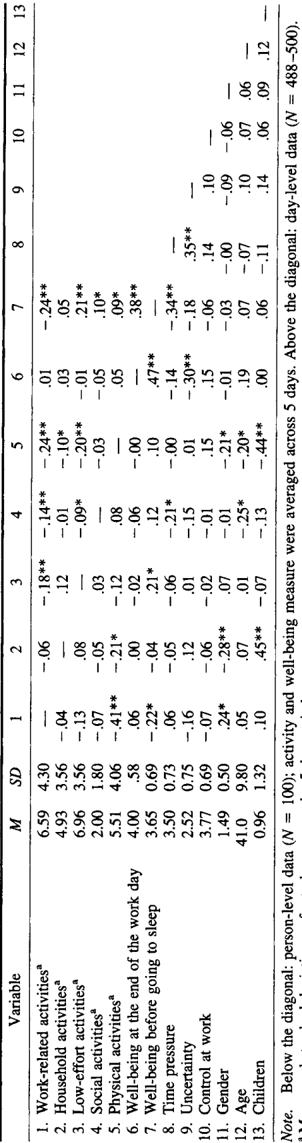
This study extends previous research on respite from work and addresses the question of how individuals use their leisure time to recover from work. It is hypothesized that time spent on work-related and household activities has a negative effect on well-being, whereas low-effort, social, and physical activities are assumed to have a positive effect. One hundred Dutch teachers completed a diary on leisure time activities and situational well-being for 5 days, and work situation variables were assessed with a questionnaire. Multilevel analyses in which preleisure well-being and work situation variables were entered as control variables supported 4 of the 5 hypotheses. Moreover, a lagged effect of high time pressure on poor situational well-being was found. The study showed that leisure time activities and a low-stress work situation contribute independently to an individual's well-being.
Overview
The claims and statistics of this paper haven’t been checked yet.
Free: it reads the open-access text and checks the first 5 claims that cite a source we can check. Create a free account to check every claim.
Integrity signals
Registry
Cites
Statistics
Figures
Verification
Claims the paper makes
The claims and statistics of this paper haven’t been checked yet.
Free: it reads the open-access text and checks the first 5 claims that cite a source we can check. Create a free account to check every claim.
Claims other papers make about this one
Each is checked against this paper’s own text: does it say what the citing paper says it does?
The cited source says what the claim attributes to it.
In the citing paper
“Research has shown that besides low-effort activities such as watching television, taking a bath, and social activities, physical activities in leisure time have a positive effect on work recovery (Sonnentag 2001).”
From Energy Management of People in Organizations: A Review and Research Agenda (2011) · cites this paper as Sonnentag 2001
Self-check
Percentages, sums and reported differences re-computed from the paper’s own numbers.
The self-check needs the paper’s full text.
Citations
Cites
Hierarchical Linear Models: Applications and Data Analysis Methods.
Longford, N. T., Bryk, A. S., & Raudenbush, S. W. (1993) · Contemporary Sociology · doi:10.2307/2075823 · Cited by 18,724
Subjective well-being: Three decades of progress.
Diener, E., Suh, E. M., Lucas, R. E., & Smith, H. L. (1999) · Psychological Bulletin · doi:10.1037/0033-2909.125.2.276 · Cited by 12,910
Handbook of Industrial and Organizational Psychology.
Hammer, T. H., Anderson, J., Gurdon, M., Jick, T., Petit, A., Stern, R., Schwartz, H., Vardi, Y., & Dunnette, M. D. (1977) · Administrative Science Quarterly · doi:10.2307/2391755 · Cited by 11,945
Healthy work: stress, productivity, and the reconstruction of working life
(1990) · Choice Reviews Online · doi:10.5860/choice.28-0381 · Cited by 8,220
Handbook of industrial and organizational psychology
(1993) · Choice Reviews Online · doi:10.5860/choice.30-5278 · Cited by 5,339
Emotional regulation in the workplace: A new way to conceptualize emotional labor.
Grandey, A. A. (2000) · Journal of Occupational Health Psychology · doi:10.1037//1076-8998.5.1.95 · Cited by 3,817
A meta-analytic examination of the correlates of the three dimensions of job burnout
Lee, R. T., & Ashforth, B. E. (1996) · Journal of Applied Psychology · doi:10.1037/0021-9010.81.2.123 · Cited by 3,262
Organizational Stress: Studies in Role Conflict and Ambiguity.
Roy, D. F., Kahn, R. L., Wolfe, D. M., Quinn, R. P., Snoek, J. D., & Rosenthal, R. A. (1965) · American Sociological Review · doi:10.2307/2091375 · Cited by 3,016
The functioning and well-being of depressed patients. Results from the Medical Outcomes Study
Wells, K. B. (1989) · JAMA · doi:10.1001/jama.262.7.914 · Cited by 2,808
International Review of Industrial and Organizational Psychology: Contents of Previous Volumes
(2003) · International Review of Industrial and Organizational Psychology 2004 · doi:10.1002/0470013311.oth1 · Cited by 2,762
Research works printed but not linked: 5
- Leitner, M. J., & Leitner, S. F. (1989). Leisure enhancement. Binghampton, NY: Howorth.
- Rasbash, J., & Woodhouse, G. (1996). MLn. London: University of London, Institute of Education.
- Semmer, N. (1984). Streβbezogene Tätigkeitsanalyse [Stress-oriented analysis of work: Psychological studies on the analysis of stress at work]. Weinheim, Germany: Beltz.
- Snijders, T. A. B., & Bosker, R. J. (1999). Multilevel analysis. An introduction to basic and advanced multilevel modeling. London: Sage.
- Sonnentag, S. (2000). Assessing daily recovery activities: First experiences with a diary method (Technical report). Konstanz, Germany, University of Konstanz.
Cited by
Sonnentag, S., & Fritz, C. (2007) · Journal of Occupational Health Psychology · doi:10.1037/1076-8998.12.3.204 · Cited by 2,133
Self-citationSonnentag, S. (2003) · Journal of Applied Psychology · doi:10.1037/0021-9010.88.3.518 · Cited by 1,851
“In addition, past research has shown that men experience lower work positive affect and higher work negative affect (Rothbard , 2001) and spend more time on work-related activities during leisure time (Sonnentag, 2001).”
BackgroundSelf-citationLeisure and Subjective Well-Being: A Model of Psychological Mechanisms as Mediating Factors
Newman, D. B., Tay, L., & Diener, E. (2014) · Journal of Happiness Studies · doi:10.1007/s10902-013-9435-x · Cited by 887
“For example, the various leisure activities occurring outside of work time in many studies by Sonnentag and colleagues (e.g., Mojza et al. 2010; Sonnentag 2001; Sonnentag and Bayer 2005; Sonnentag and Fritz 2007; Zijlstra and Sonnentag 2006) trigger the detachment-relaxation mechanism, referred to…”
InfluentialGeurts, S. A., & Sonnentag, S. (2006) · Scandinavian Journal of Work, Environment & Health · doi:10.5271/sjweh.1053 · Cited by 853
“Most studies on recovery have relied on cross-sectional designs or on designs with rather limited time frames [eg, 1 workweek (26, 51)].”
BackgroundInfluentialSelf-citationA Motivated Action Theory Account of Goal Orientation.
DeShon, R. P., & Gillespie, J. Z. (2005) · Journal of Applied Psychology · doi:10.1037/0021-9010.90.6.1096 · Cited by 786
Metadata
- Authors
- Sonnentag, S.
- Affiliations
- University of Konstanz (DE)
- Corresponding author
- Sonnentag, Sabine
- ORCID
- Sonnentag, Sabine
- Venue
- Journal of Occupational Health Psychology
- Published
- 2001
- Volume
- 6
- Issue
- 3
- Pages
- 196-210
- ISSN
- 1076-8998 (ISSN-L)
- 1939-1307
- OpenAlex
- W2095267132
- Cited by
- 731
- References
- 77
- Citations by year
- 2026: 24 · 2025: 34 · 2024: 33 · 2023: 34 · 2022: 45 · 2021: 46 · 2020: 53 · 2019: 41 · 2018: 39 · 2017: 43 · 2016: 33 · 2015: 31 · 2014: 46 · 2013: 32 · 2012: 41
- FWCI
- 9.31
- Type
- journal article
- Language
- en
- Open access
- green
- nbn-resolving.de
- Licence
- cc-by-nc-nd
- Locations
- Journal of Occupational Health Psychology (publishedVersion)
- PubMed (publishedVersion)
- KOPS (University of Konstanz) (submittedVersion, cc-by-nc-nd)
- Topics
- Social Sciences › Psychology › Social Psychology › Workaholism, burnout, and well-being
- Social Sciences › Business, Management and Accounting › Tourism, Leisure and Hospitality Management › Recreation, Leisure, Wilderness Management
- Health Sciences › Medicine › Public Health, Environmental and Occupational Health › Workplace Health and Well-being
- Keywords
- leisure-time activities, work recovery, teachers, time pressure, work situation, housework, work activities, social activity, physical activity, diary study
- MeSH terms
- Activities of Daily Living, Adaptation, Psychological, Faculty, Holistic Health, Humans, Leisure Activities, Netherlands, Psychometrics, Quality of Life, Surveys and Questionnaires, Stress, Psychological, Work, Occupational Health
About these checks
Registry, retraction, Cites and statistics results are computed, not judged, with one exception: a printed reference that no index lists is read once by a model before it counts as a citation error. Claims are extracted by a model and kept only when their quote appears verbatim in the text; each cited source is then checked, with a model’s help, for whether it says what the claim relies on. Those verdicts can be wrong — read the claim’s quote and the cited source before relying on one.
Statistics and arithmetic are recomputed, not judged.
Confidence bands are shown only for fields calibrated on our annotated test set. None is calibrated yet, so no band is shown.
What counts as a claim ›How we measure confidence ›How we check this ›
Are you an author, or do you see a problem with this page? Request a review
How to cite
Cite CoChat for the checks on this page, and the paper for its own findings.
- This page
- CoChat. (2026). Citation check: Work, recovery activities, and individual well-being: A diary study. https://app.cochat.ai/papers/10.1037/1076-8998.6.3.196
- The paper
- Sonnentag, S. (2001). Work, recovery activities, and individual well-being: A diary study. Journal of Occupational Health Psychology. https://doi.org/10.1037/1076-8998.6.3.196
Data sources
Bibliographic data: Semantic Scholar, OpenAlex, Crossref.
Contains information from the Semantic Scholar Academic Graph Datasets, made available under the ODC Attribution License (ODC-BY 1.0).
Semantic Scholar’s data is described in: Kinney, R., et al. (2023). The Semantic Scholar Open Data Platform. arXiv:2301.10140.
