

The intricate relationships between monitoring and control in metacognition: Lessons for the cause-and-effect relation between subjective experience and behavior.
The DOI matches its Crossref record; 168 of the 171 references it cites were found in a registry or an index.
Abstract
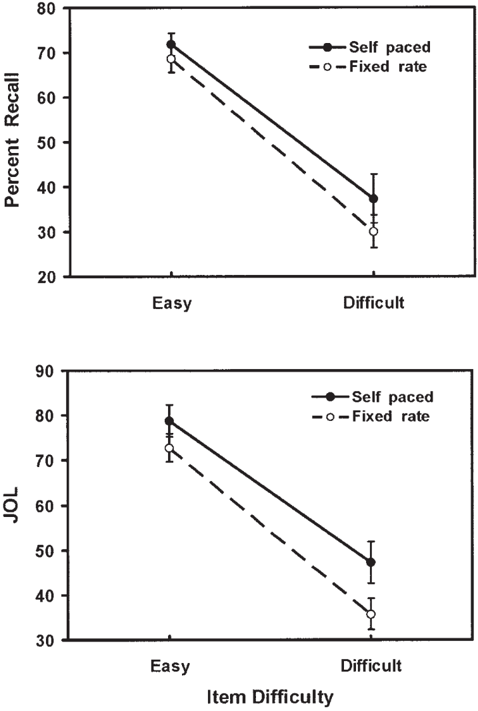
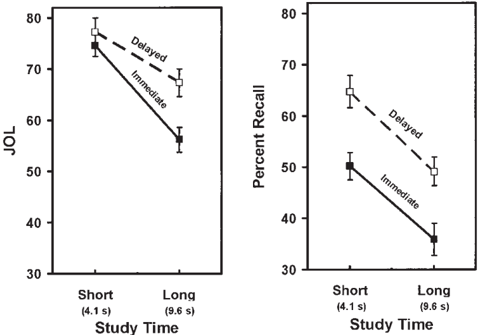
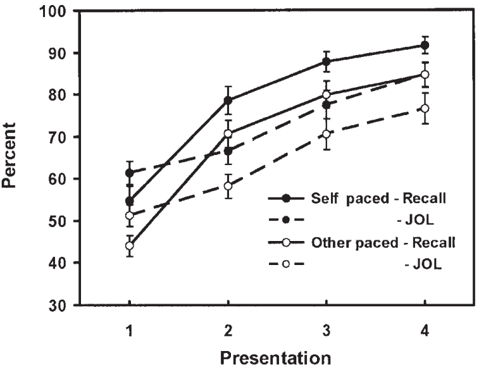
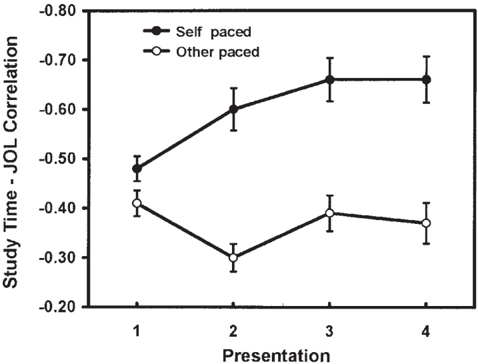
Do we run away because we are frightened, or are we frightened because we run away? The authors address this issue with respect to the relation between metacognitive monitoring and metacognitive control. When self-regulation is goal driven, monitoring effects control processes so that increased processing effort should enhance feelings of competence and feelings of knowing. In contrast, when self-regulation is data driven, such feelings may be based themselves on the feedback from control processes, in which case they should decrease with increasing effort. Evidence for both monitoring-based control and control-based monitoring occurring even in the same situation is presented. The results are discussed with regard to the issue of the cause-and-effect relation between subjective experience and behavior.
Overview
The claims and statistics of this paper haven’t been checked yet.
Free: it reads the open-access text and checks the first 5 claims that cite a source we can check. Create a free account to check every claim.
Integrity signals
Registry
Cites
Statistics
Figures
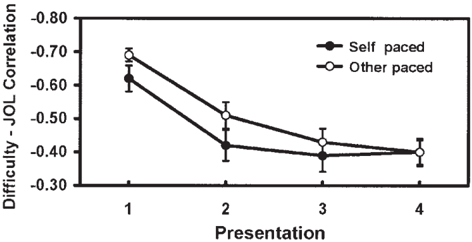
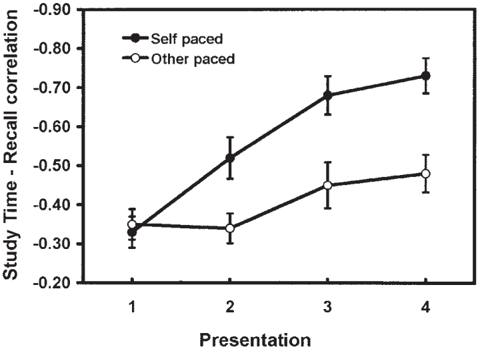
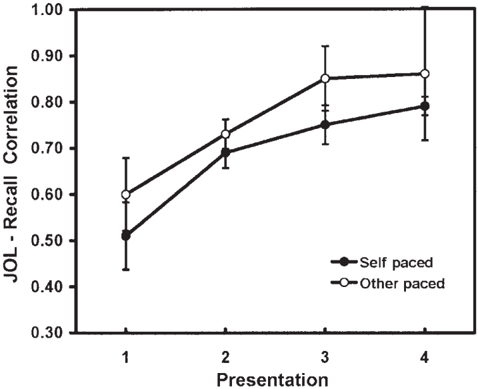
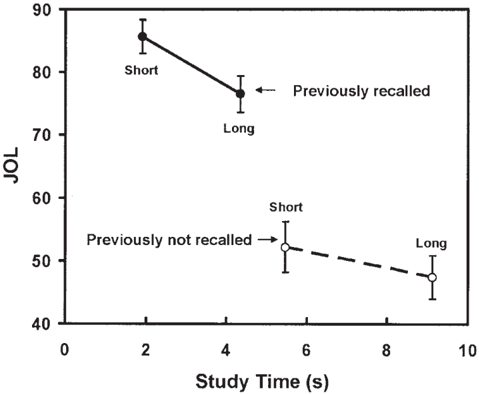
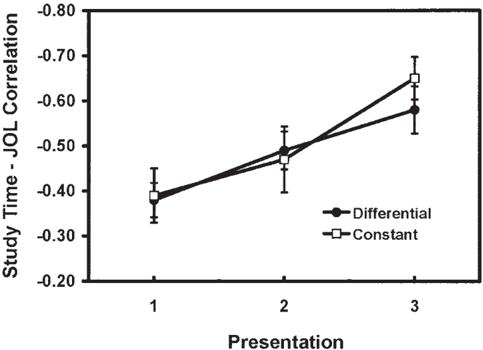
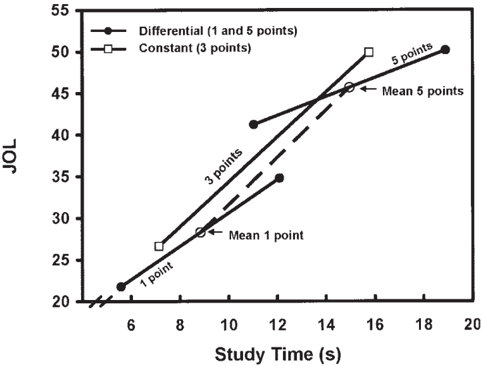
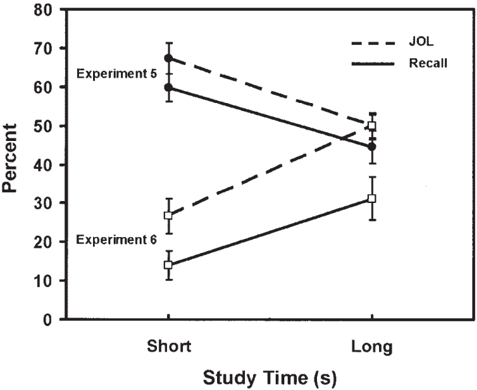
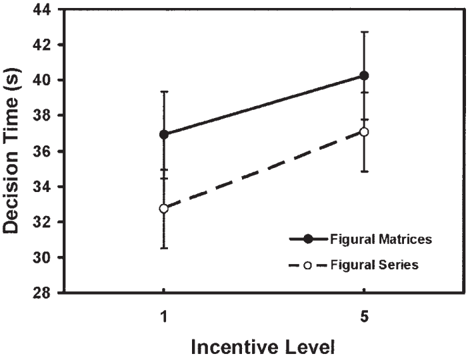
Verification
Claims the paper makes
The claims and statistics of this paper haven’t been checked yet.
Free: it reads the open-access text and checks the first 5 claims that cite a source we can check. Create a free account to check every claim.
Claims other papers make about this one
Each is checked against this paper’s own text: does it say what the citing paper says it does?
The cited source says what the claim attributes to it.
In the citing paper
“If learners prioritize, i.e., attach a particular value to learning an item or completing a learning task, the correlation between effort and monitoring judgments becomes positive.”
From The Relation Between Students’ Effort and Monitoring Judgments During Learning: A Meta-analysis (2020) · cites this paper as Koriat et al. 2006
In the citing paper
“Indeed, it has been observed that answers that come to mind faster are more likely to be correct than answers that are associated with longer latencies (cue validity; see Koriat, Ma'ayan, & Nussinson, 2006;Robinson, Johnson, & Herndon, 1997).”
From Easy comes, easy goes? The link between learning and remembering and its exploitation in metacognition (2008) · cites this paper as Koriat, Ma'ayan, & Nussinson, 2006
In the citing paper
“Kor iat, Ma'ayan, and Nussinson (2006) reported results suggesting the occurrence of data-driven and goal-driven effects within the same experimental task.”
From Easy comes, easy goes? The link between learning and remembering and its exploitation in metacognition (2008) · cites this paper as Koriat, Ma'ayan, and Nussinson (2006)
In the citing paper
“In contrast, Kor iat, Ma'ayan, and Nussinson (2006) obtained results consistent with the ELER principle, even when four months elapsed between study and test.”
From Easy comes, easy goes? The link between learning and remembering and its exploitation in metacognition (2008) · cites this paper as Koriat, Ma'ayan, and Nussinson (2006)
In the citing paper
“In that case, JOL and recall should correlate positively with study effort (see Kor iat, Ma'ayan, & Nussinson, 2006).”
From Easy comes, easy goes? The link between learning and remembering and its exploitation in metacognition (2008) · cites this paper as Koriat, Ma'ayan, & Nussinson, 2006
1 more claim about this paper
Create a free account to see every claim other papers make about this one.
Self-check
Percentages, sums and reported differences re-computed from the paper’s own numbers.
The self-check needs the paper’s full text.
Citations
Cites
(1985) · Medical Entomology and Zoology · Cited by 19,180
Telling more than we can know: Verbal reports on mental processes.
Nisbett, R. E., & Wilson, T. D. (1977) · Psychological Review · doi:10.1037/0033-295x.84.3.231 · Cited by 11,317
Confirmation Bias: A Ubiquitous Phenomenon in Many Guises
Nickerson, R. S. (1998) · Review of General Psychology · doi:10.1037/1089-2680.2.2.175 · Cited by 7,267
Psychological stress and the coping process
Lazarus, R. S. (1966) · Medical Entomology and Zoology · Cited by 7,164
Egeth, H., & Kahneman, D. (1975) · The American Journal of Psychology · doi:10.2307/1421603 · Cited by 6,972
Cognitive, social, and physiological determinants of emotional state.
Schachter, S., & Singer, J. (1962) · Psychological Review · doi:10.1037/h0046234 · Cited by 6,223
(1999) · Cited by 6,104
The Psychology of Learning and Motivation: Advances in Research and Theory
(2010) · Psychology of Learning and Motivation · doi:10.1016/c2009-0-62209-1 · Cited by 5,994
Social psychology: handbook of basic principles
(2008) · Choice Reviews Online · doi:10.5860/choice.45-3496 · Cited by 5,473
The Psychology of Learning and Motivation
(2021) · Psychology of Learning and Motivation · doi:10.1016/s0079-7421(21)x0002-3 · Cited by 5,027
Research works printed but not linked: 4
- Jacoby, L. L., Jennings, J. M., & Hay, J. F. (1996). Dissociating automatic and consciously controlled processes: Implications for diagnosis and rehabilitation of memory deficits. In D. J. Herrmann, C. McEvoy, C. Hertzog, P. Hertel, & M. K. Johnson (Eds.), Basic and applied memory research theory in context (Vol. 1, pp. 161-193). Mahwah, NJ: Erlbaum.
- Laird, J. D., & Bresler, C. (1992). The process of emotional feeling: A self-perception theory. In M. Clark (Ed.), Emotion: Review of personality and social psychology (Vol. 13, pp. 223-234). Newbury Park, CA: Sage.
- Sheffer, L. (2003). The reliability and structure of metacognitive skills and their relationship to cognitive performance. Unpublished doctoral thesis, University of Haifa, Haifa, Israel.
- Winkielman, 2003, The hedonic marking of processing fluency: Implications for evaluative judgment., 189
Cited by
Items 201–300 of 514
Engelbert, M., & Carruthers, P. (2010) · Wiley Interdisciplinary Reviews Cognitive Science · doi:10.1002/wcs.4 · Cited by 24
Metamemory for faces, names, and common nouns
Watier, N. N., & Collin, C. A. (2011) · Acta Psychologica · doi:10.1016/j.actpsy.2011.05.017 · Cited by 24
Exploring the informational sources of metaperception: The case of Change Blindness Blindness
Loussouarn, A., Gabriel, D., & Proust, J. (2011) · Consciousness and Cognition · doi:10.1016/j.concog.2011.07.001 · Cited by 23
Koriat, A., & Sorka, H. (2014) · Cognition · doi:10.1016/j.cognition.2014.09.009 · Cited by 23
Self-citationPieger, E., Mengelkamp, C., & Bannert, M. (2017) · Applied Cognitive Psychology · doi:10.1002/acp.3326 · Cited by 23
An active inference and epistemic value view of metacognition
Moulin, C. J. A., & Souchay, C. (2015) · Cognitive Neuroscience · doi:10.1080/17588928.2015.1051015 · Cited by 23
Ackerman, R., Yom‐Tov, E., & Torgovitsky, I. (2020) · Cognition · doi:10.1016/j.cognition.2020.104248 · Cited by 23
Jia, X., Xu, T., & Zhang, Y. (2022) · Journal of Intelligence · doi:10.3390/jintelligence10020035 · Cited by 23
Delozier, S., & Davalos, D. B. (2016) · American Journal of Alzheimer s Disease & Other Dementias® · doi:10.1177/1533317515618899 · Cited by 23
Understanding metacognitive confidence: Insights from judgment-of-learning justifications
Jersakova, R., Allen, R. J., Booth, J. H. H., Souchay, C., & O’Connor, A. R. (2017) · Journal of Memory and Language · doi:10.1016/j.jml.2017.08.002 · Cited by 23
Achievement goals affect metacognitive judgments.
Ikeda, K., Yue, C. L., Murayama, K., & Castel, A. D. (2016) · Motivation Science · doi:10.1037/mot0000047 · Cited by 23
Rhodes, M. G., & Tauber, S. K. (2011) · Memory · doi:10.1080/09658211.2011.613841 · Cited by 23
Molden, D. C., Hall, A., Hui, C. M., & Scholer, A. A. (2017) · Psychological Inquiry · doi:10.1080/1047840x.2017.1337402 · Cited by 22
Assigned value improves memory of proper names
Festini, S. B., Hartley, A. A., Tauber, S. K., & Rhodes, M. G. (2012) · Memory · doi:10.1080/09658211.2012.747613 · Cited by 22
Learning through clamor: The allocation and perception of study time in noise.
Hanczakowski, M., Beaman, C. P., & Jones, D. M. (2018) · Journal of Experimental Psychology General · doi:10.1037/xge0000449 · Cited by 22
Episodic remembering and affective metacognition
Dokic, J. (2022) · Achta Scientiarum Human Social Science · doi:10.4025/actascihumansoc.v43i3.61022 · Cited by 22
Thompson, T., & Dinnel, D. L. (2007) · Educational Psychology · doi:10.1080/01443410601159910 · Cited by 22
Can Learners Allocate Their Study Time Effectively? It Is Complicated
Tekin, E. (2021) · Educational Psychology Review · doi:10.1007/s10648-021-09645-2 · Cited by 21
Capitalising on intuition and reflection: Making sense of a composer’s creative process
Pohjannoro, U. (2016) · Musicae Scientiae · doi:10.1177/1029864915625727 · Cited by 21
Schäfer, S., Müller, P., & Ziegele, M. (2022) · New Media & Society · doi:10.1177/14614448211073059 · Cited by 21
Undorf, M., Amaefule, C. O., & Kamp, S. (2020) · Neurobiology of Learning and Memory · doi:10.1016/j.nlm.2020.107176 · Cited by 21
Age-related schema reliance of judgments of learning in predicting source memory
Shi, L., Tang, W., & Liu, X. (2011) · Aging Neuropsychology and Cognition · doi:10.1080/13825585.2011.632616 · Cited by 21
Gönül, G., Tsalas, N. R. H., & Paulus, M. (2021) · Metacognition and Learning · doi:10.1007/s11409-021-09262-y · Cited by 20
Resistance to Change: Unconscious Knowledge and the Challenge of Unlearning
Clark, R. E. (2014) · doi:10.4324/9780203868546-10 · Cited by 20
Cosnefroy, L., Fenouillet, F., Mazé, C., & Bonnefoy, B. (2018) · HAL · Cited by 19
Remind me of the context: Memory and metacognition at restudy
Zawadzka, K., Simkiss, N. J., & Hanczakowski, M. (2018) · Journal of Memory and Language · doi:10.1016/j.jml.2018.03.001 · Cited by 19
Don't look back on failure: spontaneous uncertainty monitoring in chimpanzees
Tomonaga, M., Kurosawa, Y., Kawaguchi, Y., & Takiyama, H. (2023) · Learning & Behavior · doi:10.3758/s13420-023-00581-5 · Cited by 19
Metacognitive control, serial position effects, and effective transfer to self-paced study
Murphy, D. H., Friedman, M. C., & Castel, A. D. (2021) · Memory & Cognition · doi:10.3758/s13421-021-01204-y · Cited by 19
Cigarette abstinence impairs memory and metacognition despite administration of 2 mg nicotine gum.
Kelemen, W. L., & Fulton, E. K. (2008) · Experimental and Clinical Psychopharmacology · doi:10.1037/a0014246 · Cited by 19
Explaining the forgetting bias effect on value judgments: The influence of memory for a past test
Rhodes, M. G., Witherby, A. E., Castel, A. D., & Murayama, K. (2016) · Memory & Cognition · doi:10.3758/s13421-016-0674-z · Cited by 19
Not always the best medicine: Why frequent smiling can reduce wellbeing
Labroo, A. A., Mukhopadhyay, A., & Dong, P. (2014) · Journal of Experimental Social Psychology · doi:10.1016/j.jesp.2014.03.001 · Cited by 18
Ball, B. H., Klein, K. N., & Brewer, G. A. (2014) · Journal of Experimental Psychology: Applied · doi:10.1037/xap0000023 · Cited by 18
Beyond the experience: Detection of metamemorial regularities
Geurten, M., Willems, S. J., & Meulemans, T. (2014) · Consciousness and Cognition · doi:10.1016/j.concog.2014.11.009 · Cited by 18
Controlled Processes in Voluntary Remembering
Koriat, A., Goldsmith, M., & Halamish, V. (2008) · Elsevier eBooks · doi:10.1016/b978-012370509-9.00140-6 · Cited by 18
Self-citationKnutsson, J., Allwood, C. M., & Johansson, M. (2011) · Metacognition and Learning · doi:10.1007/s11409-011-9071-y · Cited by 18
The Effects of Processing Multimodal Texts in Print and Digitally on Comprehension and Calibration
Singer, L. M., Alexander, P. A., & Sun, Y. (2022) · The Journal of Experimental Education · doi:10.1080/00220973.2022.2092831 · Cited by 18
The metamemory expectancy illusion in source monitoring affects metamemory control and memory
Schaper, M. L., & Bayen, U. J. (2020) · Cognition · doi:10.1016/j.cognition.2020.104468 · Cited by 18
Yu, Y., Jiang, Y., & Li, F. (2020) · Metacognition and Learning · doi:10.1007/s11409-020-09234-8 · Cited by 18
Correlates of metacognitive control in 10-year old children and adults
Tsalas, N. R. H., Sodian, B., & Paulus, M. (2017) · Metacognition and Learning · doi:10.1007/s11409-016-9168-4 · Cited by 17
Effects of learning item difficulty and value on cognitive offloading during middle childhood
Dong, X., Liu, Y., & Lu, H. J. (2022) · Metacognition and Learning · doi:10.1007/s11409-022-09309-8 · Cited by 17
Wahlheim, C. N., Richmond, L. L., Huff, M. J., & Dobbins, I. G. (2016) · Psychology and Aging · doi:10.1037/pag0000128 · Cited by 17
Krätzig, G. P., & Arbuthnott, K. D. (2009) · Metacognition and Learning · doi:10.1007/s11409-009-9039-3 · Cited by 17
Overlooking metacognitive experience
Proust, J. (2009) · Behavioral and Brain Sciences · doi:10.1017/s0140525x09000776 · Cited by 17
Fitzsimmons, C. J., & Thompson, C. A. (2022) · Cognitive Development · doi:10.1016/j.cogdev.2021.101148 · Cited by 16
Information–integration category learning and the human uncertainty response
Paul, E. J., Boomer, J. B., Smith, J. D., & Ashby, F. G. (2010) · Memory & Cognition · doi:10.3758/s13421-010-0041-4 · Cited by 16
Metamemory and Cognitive Aging
Hertzog, C. K., & Curley, T. M. (2018) · Oxford University Press eBooks · doi:10.1093/acrefore/9780190236557.013.377 · Cited by 16
On the proposed role of metacognition in environment learning: recommendations for research
Mason, L., Thomas, A. K., & Taylor, H. A. (2022) · Cognitive Research Principles and Implications · doi:10.1186/s41235-022-00454-x · Cited by 16
Illusion of explanatory depth and social desirability of historical knowledge
Martínez, C. D. G., & Corredor, J. (2021) · Metacognition and Learning · doi:10.1007/s11409-021-09267-7 · Cited by 16
Fritzsche, E. S., Kröner, S., Dresel, M., Kopp, B., & Martschinke, S. (2012) · Journal for Educational Research Online / Journal für Bildungsforschung Online · doi:10.25656/01:7485 · Cited by 16
Schematic support increases memory strategy use in young and older adults.
Kuhns, J. M., & Touron, D. R. (2020) · Psychology and Aging · doi:10.1037/pag0000433 · Cited by 16
Study preferences for exemplar variability in self-regulated category learning
Wahlheim, C. N., & DeSoto, K. A. (2016) · Memory · doi:10.1080/09658211.2016.1152378 · Cited by 15
Eyewitness metamemory predicts identification performance in biased and unbiased line‐ups
Saraiva, R. B., van Boeijen, I. M., Hope, L., Horselenberg, R., Sauerland, M., & Koppen, P. J. V. (2020) · Legal and Criminological Psychology · doi:10.1111/lcrp.12166 · Cited by 15
Influence of Domain Knowledge on Monitoring Performance Across the Life Span
Löffler, E., von der Linden, N., & Schneider, W. (2016) · Journal of Cognition and Development · doi:10.1080/15248372.2016.1208204 · Cited by 15
Boundaries of apologies: Children avoid transgressors who give the same apology for a repeat offence
Waddington, O. R., Jensen, K., & Köymen, B. (2022) · Cognitive Development · doi:10.1016/j.cogdev.2022.101264 · Cited by 15
More isn’t always better: when metacognitive prompts are misleading
Vangsness, L., & Young, M. E. (2020) · Metacognition and Learning · doi:10.1007/s11409-020-09241-9 · Cited by 14
Evidence of some strategic preservation of episodic learning in patients with schizophrenia
Thuaire, F., Izaute, M., & Bacon, É. (2011) · Psychiatry Research · doi:10.1016/j.psychres.2011.07.036 · Cited by 14
Metacognitive monitoring and control in distributed cognition
Moroshkina, N. V., Zverev, I., Nezdoimyshapko, L., & Тихонов, Р. (2023) · Vestnik of Saint Petersburg University Psychology · doi:10.21638/spbu16.2023.303 · Cited by 14
Murphy, D. H. (2024) · Psychonomic Bulletin & Review · doi:10.3758/s13423-024-02554-9 · Cited by 14
Folk Epistemology as Normative Social Cognition
Hardy‐Vallée, B., & Dubreuil, B. (2009) · Review of Philosophy and Psychology · doi:10.1007/s13164-009-0020-5 · Cited by 14
Central and Peripheral Cues to Difficulty in a Dynamic Task
Vangsness, L., & Young, M. E. (2018) · Human Factors The Journal of the Human Factors and Ergonomics Society · doi:10.1177/0018720818809877 · Cited by 14
Monitoring and meta-metacognition in the own-race bias
Arnold, M. M. (2013) · Acta Psychologica · doi:10.1016/j.actpsy.2013.07.007 · Cited by 14
The efficacy of self-paced study in multitrial learning.
de Jonge, M., Tabbers, H. K., Pecher, D., Jang, Y., & Zeelenberg, R. (2015) · Journal of Experimental Psychology Learning Memory and Cognition · doi:10.1037/xlm0000046 · Cited by 14
Examining the effect of list composition on monitoring and control processes in metamemory
Laursen, S. J., & Fiacconi, C. M. (2020) · Memory & Cognition · doi:10.3758/s13421-020-01107-4 · Cited by 14
Wahlheim, C. N. (2010) · Memory & Cognition · doi:10.3758/s13421-010-0065-9 · Cited by 14
Hoyndorf, A., & Haider, H. (2008) · Psychological Research · doi:10.1007/s00426-008-0180-4 · Cited by 14
Sävellyksen synty : Tapaustutkimus säveltäjän ajattelusta
Pohjannoro, U. (2013) · Taju (University of the Arts Helsinki) · Cited by 14
On the effectiveness of self-paced learning
Tullis, J. G., & Benjamin, A. S. (2009) · PsycEXTRA Dataset · doi:10.1037/e520562012-604 · Cited by 13
When to look at maps in navigation: metacognitive control in environment learning
Dai, R., Thomas, A. K., & Taylor, H. A. (2018) · Cognitive Research Principles and Implications · doi:10.1186/s41235-018-0130-7 · Cited by 13
Testa, I., Galano, S., & Tarallo, O. (2023) · International Journal of Science Education · doi:10.1080/09500693.2022.2162833 · Cited by 13
“You don't know what this means to me” – Uncovering idiosyncratic influences on metamemory judgments
Undorf, M., Navarro-Báez, S., & Bröder, A. (2022) · Cognition · doi:10.1016/j.cognition.2021.105011 · Cited by 13
Scholz, S., & Dutke, S. (2019) · Journal of Cognitive Psychology · doi:10.1080/20445911.2019.1622548 · Cited by 13
Individual differences in students’ effort source beliefs predict their judgments of ability.
Miele, D. B., Browman, A. S., & Vasilyeva, M. (2020) · Motivation Science · doi:10.1037/mot0000124 · Cited by 12
How beliefs explain the effect of achievement goals on judgments of learning
Ikeda, K. (2022) · Metacognition and Learning · doi:10.1007/s11409-022-09294-y · Cited by 12
Scheiter, K. (2025) · Educational Psychology Review · doi:10.1007/s10648-025-10037-z · Cited by 11
Metacognitive Development: Educational Implications
Schneider, W. (2015) · Elsevier eBooks · doi:10.1016/b978-0-08-097086-8.92011-7 · Cited by 11
Children’s confidence using incorrect strategies on mathematical equivalence problems
Grenell, A., Nelson, L. J., Gardner, B., & Fyfe, E. R. (2022) · Cognitive Development · doi:10.1016/j.cogdev.2022.101167 · Cited by 11
Metacognition in Second Language Speech Perception and Production
Kartushina, N., Soto, D., & Martin, C. D. (2022) · Language Learning · doi:10.1111/lang.12549 · Cited by 11
Motivation-based selective encoding and retrieval
Halamish, V., & Stern, P. (2021) · Memory & Cognition · doi:10.3758/s13421-021-01238-2 · Cited by 11
Quilès, C. (2014) · theses.fr (ABES) · doi:10.70675/99e1ae99zcf8cz4d2fzb11fz0cb7a426c429 · Cited by 11
DeCaro, R. E., & Thomas, A. K. (2019) · Journal of Memory and Language · doi:10.1016/j.jml.2019.04.002 · Cited by 10
Initial judgment of solvability: integrating prior expectations with experience-based heuristic cues
Lauterman, T., & Ackerman, R. (2023) · Thinking & Reasoning · doi:10.1080/13546783.2023.2214378 · Cited by 10
Léonard, C., Billet, M., Willems, S. J., & Geurten, M. (2023) · Journal of Applied Research in Memory and Cognition · doi:10.1037/mac0000097 · Cited by 10
Psychological and Philosophical Frameworks of Rationality—A Systematic Introduction
Knauff, M., & Spohn, W. (2021) · The MIT Press eBooks · doi:10.7551/mitpress/11252.003.0004 · Cited by 10
Koriat, A., Undorf, M., Newman, E. J., & Schwarz, N. (2020) · Frontiers in Psychology · doi:10.3389/fpsyg.2020.01250 · Cited by 9
Self-citationSinger, L. M., Alexander, P. A., & Fusenig, J. (2025) · Learning and Individual Differences · doi:10.1016/j.lindif.2025.102627 · Cited by 9
Implications of Changing the Delivery Mode on Reading Tests in Norway—A Gender Perspective
Jensen, R. E. (2020) · Springer eBooks · doi:10.1007/978-3-030-61648-9_13 · Cited by 9
THE STUDENT’S METACOGNITIVE SKILLS OF PROSPECTIVE PRIMARY SCHOOL TEACHERS
Maryani, I., Alhakim, M. A., & Gestiardi, R. (2021) · International Journal of Educational Management and Innovation · doi:10.12928/ijemi.v2i2.3432 · Cited by 9
Metacognitive Monitoring in Test-taking Situations: A Cross-cultural Comparison of College Students
Coutinho, M. V. C., Papanastasiou, E. C., Stylianou-Georgiou, A., Vasko, J. M., & Couchman, J. J. (2020) · International Journal of Instruction · doi:10.29333/iji.2020.13127a · Cited by 9
Essays on three price judgments: price fairness, price magnitude, and price expectation
Bhowmick, S. (2010) · Louisiana State University · doi:10.31390/gradschool_dissertations.1343 · Cited by 8
Bromley, E., Adams, G. F., & Brekke, J. S. (2012) · Journal of Neuropsychiatry · doi:10.1176/appi.neuropsych.11080201 · Cited by 8
Imperio, C. M., & Chua, E. F. (2023) · Brain Research · doi:10.1016/j.brainres.2023.148538 · Cited by 8
Judgements of effort as a function of post-trial versus post-task elicitation
Ashburner, M., & Risko, E. F. (2021) · Quarterly Journal of Experimental Psychology · doi:10.1177/17470218211005759 · Cited by 8
Kaya, S., & Mulligan, N. W. (2024) · Memory & Cognition · doi:10.3758/s13421-024-01638-0 · Cited by 8
Neugier und epistemisches Handeln
Schmid, S. (2008) · MADOC (University of Mannheim) · Cited by 10
Self-regulated learning strategies in L1 and L2 reading
Reyes, M., Morales, J., & Bajo, M. T. (2024) · Bilingualism Language and Cognition · doi:10.1017/s1366728924000683 · Cited by 7
Constraints on the use of the memorizing effort heuristic
Laursen, S. J., & Fiacconi, C. M. (2021) · Metacognition and Learning · doi:10.1007/s11409-021-09273-9 · Cited by 7
Fernandez, J. (2017) · theses.fr (ABES) · doi:10.70675/c7ad77ddz9976z4beeza5b9zd163df512099 · Cited by 7
Wang, X., Liu, X., Chen, L., Feng, K., Ye, Q., & Haoliang, Z. (2023) · Journal of Intelligence · doi:10.3390/jintelligence11060101 · Cited by 7
McAnally, K. I., Morris, A. P., & Best, C. J. (2017) · PLoS ONE · doi:10.1371/journal.pone.0176032 · Cited by 7
Hemodynamic Deconvolution Demystified: Sparsity-Driven Regularization at Work
Uruñuela, E., Bolton, T. A. W., Ville, D. V. D., & Caballero‐Gaudes, C. (2023) · Aperture Neuro · doi:10.52294/001c.87574 · Cited by 7
Metadata
- Authors
- Koriat, A., Ma'ayan, H., & Nussinson, R.
- Venue
- Journal of Experimental Psychology: General
- Published
- 2006-02
- Volume
- 135
- Issue
- 1
- Pages
- 36-69
- ISSN
- 0096-3445 (ISSN-L)
- 1939-2222
- OpenAlex
- W2064996814
- Cited by
- 422
- References
- 171
- FWCI
- 27.45
- Type
- journal article
- Language
- en
- Open access
- closed
About these checks
Registry, retraction, Cites and statistics results are computed, not judged, with one exception: a printed reference that no index lists is read once by a model before it counts as a citation error. Claims are extracted by a model and kept only when their quote appears verbatim in the text; each cited source is then checked, with a model’s help, for whether it says what the claim relies on. Those verdicts can be wrong — read the claim’s quote and the cited source before relying on one.
Statistics and arithmetic are recomputed, not judged.
Confidence bands are shown only for fields calibrated on our annotated test set. None is calibrated yet, so no band is shown.
What counts as a claim ›How we measure confidence ›How we check this ›
Are you an author, or do you see a problem with this page? Request a review
Data sources
Bibliographic data: Semantic Scholar, OpenAlex, Crossref.
Contains information from the Semantic Scholar Academic Graph Datasets, made available under the ODC Attribution License (ODC-BY 1.0).
Semantic Scholar’s data is described in: Kinney, R., et al. (2023). The Semantic Scholar Open Data Platform. arXiv:2301.10140.
