

The intricate relationships between monitoring and control in metacognition: Lessons for the cause-and-effect relation between subjective experience and behavior.
The DOI matches its Crossref record; 168 of the 171 references it cites were found in a registry or an index.
Abstract
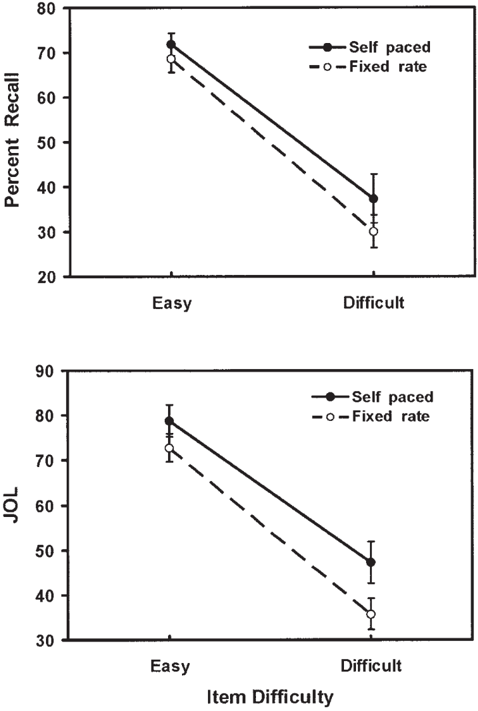
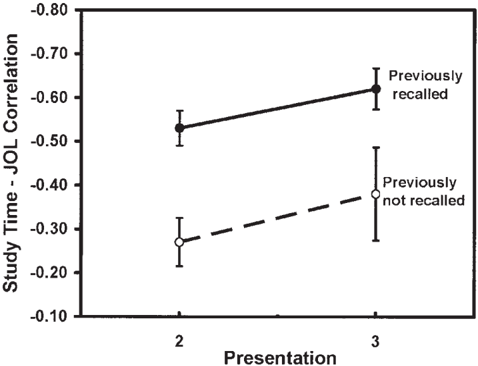
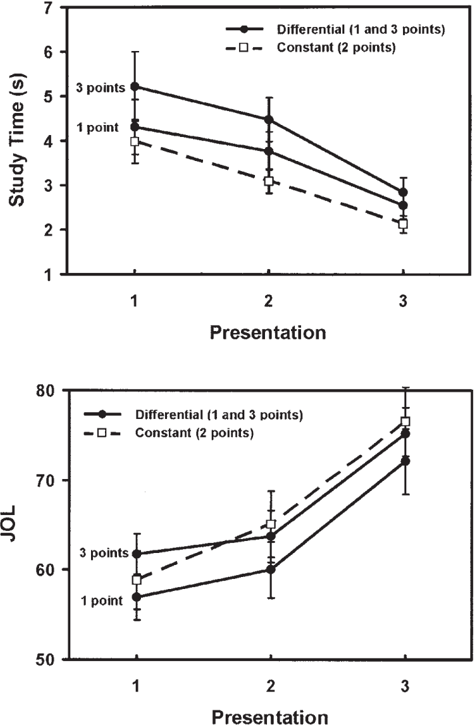
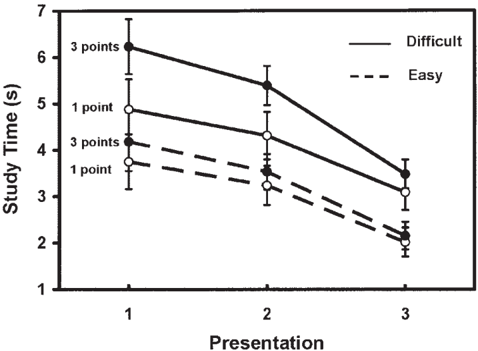
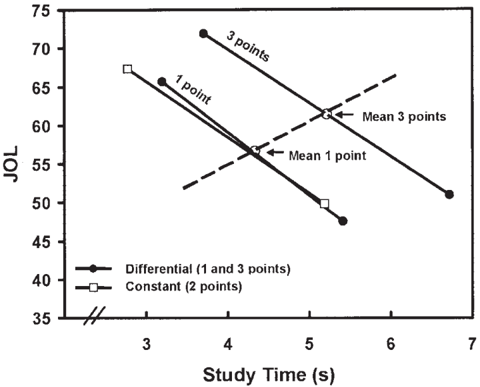
Do we run away because we are frightened, or are we frightened because we run away? The authors address this issue with respect to the relation between metacognitive monitoring and metacognitive control. When self-regulation is goal driven, monitoring effects control processes so that increased processing effort should enhance feelings of competence and feelings of knowing. In contrast, when self-regulation is data driven, such feelings may be based themselves on the feedback from control processes, in which case they should decrease with increasing effort. Evidence for both monitoring-based control and control-based monitoring occurring even in the same situation is presented. The results are discussed with regard to the issue of the cause-and-effect relation between subjective experience and behavior.
Overview
The claims and statistics of this paper haven’t been checked yet.
Free: it reads the open-access text and checks the first 5 claims that cite a source we can check. Create a free account to check every claim.
Integrity signals
Registry
Cites
Statistics
Figures
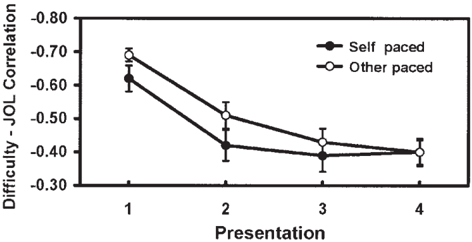
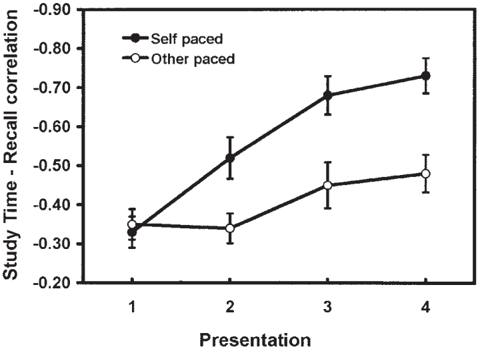
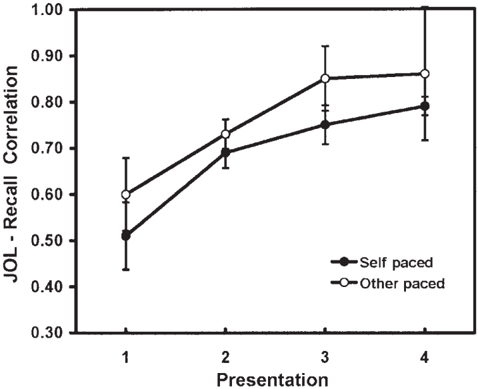
Verification
Claims the paper makes
The claims and statistics of this paper haven’t been checked yet.
Free: it reads the open-access text and checks the first 5 claims that cite a source we can check. Create a free account to check every claim.
Claims other papers make about this one
Each is checked against this paper’s own text: does it say what the citing paper says it does?
The cited source says what the claim attributes to it.
In the citing paper
“If learners prioritize, i.e., attach a particular value to learning an item or completing a learning task, the correlation between effort and monitoring judgments becomes positive.”
From The Relation Between Students’ Effort and Monitoring Judgments During Learning: A Meta-analysis (2020) · cites this paper as Koriat et al. 2006
In the citing paper
“Indeed, it has been observed that answers that come to mind faster are more likely to be correct than answers that are associated with longer latencies (cue validity; see Koriat, Ma'ayan, & Nussinson, 2006;Robinson, Johnson, & Herndon, 1997).”
From Easy comes, easy goes? The link between learning and remembering and its exploitation in metacognition (2008) · cites this paper as Koriat, Ma'ayan, & Nussinson, 2006
In the citing paper
“Kor iat, Ma'ayan, and Nussinson (2006) reported results suggesting the occurrence of data-driven and goal-driven effects within the same experimental task.”
From Easy comes, easy goes? The link between learning and remembering and its exploitation in metacognition (2008) · cites this paper as Koriat, Ma'ayan, and Nussinson (2006)
In the citing paper
“In contrast, Kor iat, Ma'ayan, and Nussinson (2006) obtained results consistent with the ELER principle, even when four months elapsed between study and test.”
From Easy comes, easy goes? The link between learning and remembering and its exploitation in metacognition (2008) · cites this paper as Koriat, Ma'ayan, and Nussinson (2006)
In the citing paper
“In that case, JOL and recall should correlate positively with study effort (see Kor iat, Ma'ayan, & Nussinson, 2006).”
From Easy comes, easy goes? The link between learning and remembering and its exploitation in metacognition (2008) · cites this paper as Koriat, Ma'ayan, & Nussinson, 2006
1 more claim about this paper
Create a free account to see every claim other papers make about this one.
Self-check
Percentages, sums and reported differences re-computed from the paper’s own numbers.
The self-check needs the paper’s full text.
Citations
Cites
(1985) · Medical Entomology and Zoology · Cited by 19,180
Telling more than we can know: Verbal reports on mental processes.
Nisbett, R. E., & Wilson, T. D. (1977) · Psychological Review · doi:10.1037/0033-295x.84.3.231 · Cited by 11,317
Confirmation Bias: A Ubiquitous Phenomenon in Many Guises
Nickerson, R. S. (1998) · Review of General Psychology · doi:10.1037/1089-2680.2.2.175 · Cited by 7,267
Psychological stress and the coping process
Lazarus, R. S. (1966) · Medical Entomology and Zoology · Cited by 7,164
Egeth, H., & Kahneman, D. (1975) · The American Journal of Psychology · doi:10.2307/1421603 · Cited by 6,972
Cognitive, social, and physiological determinants of emotional state.
Schachter, S., & Singer, J. (1962) · Psychological Review · doi:10.1037/h0046234 · Cited by 6,223
(1999) · Cited by 6,104
The Psychology of Learning and Motivation: Advances in Research and Theory
(2010) · Psychology of Learning and Motivation · doi:10.1016/c2009-0-62209-1 · Cited by 5,994
Social psychology: handbook of basic principles
(2008) · Choice Reviews Online · doi:10.5860/choice.45-3496 · Cited by 5,473
The Psychology of Learning and Motivation
(2021) · Psychology of Learning and Motivation · doi:10.1016/s0079-7421(21)x0002-3 · Cited by 5,027
Research works printed but not linked: 4
- Jacoby, L. L., Jennings, J. M., & Hay, J. F. (1996). Dissociating automatic and consciously controlled processes: Implications for diagnosis and rehabilitation of memory deficits. In D. J. Herrmann, C. McEvoy, C. Hertzog, P. Hertel, & M. K. Johnson (Eds.), Basic and applied memory research theory in context (Vol. 1, pp. 161-193). Mahwah, NJ: Erlbaum.
- Laird, J. D., & Bresler, C. (1992). The process of emotional feeling: A self-perception theory. In M. Clark (Ed.), Emotion: Review of personality and social psychology (Vol. 13, pp. 223-234). Newbury Park, CA: Sage.
- Sheffer, L. (2003). The reliability and structure of metacognitive skills and their relationship to cognitive performance. Unpublished doctoral thesis, University of Haifa, Haifa, Israel.
- Winkielman, 2003, The hedonic marking of processing fluency: Implications for evaluative judgment., 189
Cited by
Efklides, A. (2011) · Educational Psychologist · doi:10.1080/00461520.2011.538645 · Cited by 1,211
“Alternation of top-down with bottom-up self-regulation is mainly emphasized in research on metacognition ( Koriat, Ma’ayan, & Nussinson, 2006 ), but in that line of research there is no reference to motivation or other variables operating at the Person level.”
BackgroundDunning, D. (2011) · Advances in Experimental Social Psychology · doi:10.1016/b978-0-12-385522-0.00005-6 · Cited by 806
Dunlosky, J., & Rawson, K. A. (2012) · Learning and Instruction · doi:10.1016/j.learninstruc.2011.08.003 · Cited by 713
Intuition, reason, and metacognition
Thompson, V. A., Prowse Turner, J. A., & Pennycook, G. (2011) · Cognitive Psychology · doi:10.1016/j.cogpsych.2011.06.001 · Cited by 703
How we know our own minds: The relationship between mindreading and metacognition
Carruthers, P. (2009) · Behavioral and Brain Sciences · doi:10.1017/s0140525x09000545 · Cited by 610
“Koriat et al. (2006) review much of the extensive literature on metamemory, and experimentally contrast two competing models.”
BackgroundResultMetacognition and consciousness
Koriat, A. (2007) · The Cambridge Handbook of Consciousness · doi:10.1017/cbo9780511816789.012 · Cited by 554
Self-citationThe Metacognitive Demands and Opportunities of Generative AI
Tankelevitch, L., Kewenig, V., Simkute, A., Scott, A. E., Sarkar, A., Sellen, A., & Rintel, S. (2024) · Proceedings of the CHI Conference on Human Factors in Computing Systems · doi:10.1145/3613904.3642902 · Cited by 493
“Monitoring and control are interrelated [93, 95].”
Evidence that judgments of learning are causally related to study choice
METCALFE, J., & FINN, B. (2008) · Psychonomic Bulletin & Review · doi:10.3758/pbr.15.1.174 · Cited by 409
Meta-Reasoning: Monitoring and Control of Thinking and Reasoning
Ackerman, R., & Thompson, V. A. (2017) · Trends in Cognitive Sciences · doi:10.1016/j.tics.2017.05.004 · Cited by 400
“Participants are to choose, in a multiple-choice test format, the option that logically completes the matrix [50,71].”
The self-consistency model of subjective confidence.
Koriat, A. (2012) · Psychological Review · doi:10.1037/a0025648 · Cited by 320
Self-citationMetacognitive control and strategy selection: Deciding to practice retrieval during learning.
Karpicke, J. D. (2009) · Journal of Experimental Psychology: General · doi:10.1037/a0017341 · Cited by 310
“The result is consistent with the theory that JOLs are comparative in nature and tuned more to relative differences among items than to factors associated with overall levels of performance (cf. Koriat, 1997; Koriat et al., 2006).”
ResultOn the effectiveness of self-paced learning
Tullis, J. G., & Benjamin, A. S. (2011) · Journal of Memory and Language · doi:10.1016/j.jml.2010.11.002 · Cited by 286
Agenda-based regulation of study-time allocation: When agendas override item-based monitoring.
Ariel, R., Dunlosky, J., & Bailey, H. (2009) · Journal of Experimental Psychology: General · doi:10.1037/a0015928 · Cited by 249
The effects of encoding fluency and retrieval fluency on judgments of learning
Koriat, A., & Ma’ayan, H. (2005) · Journal of Memory and Language · doi:10.1016/j.jml.2005.01.001 · Cited by 235
Self-citationControlling uncertainty: A review of human behavior in complex dynamic environments.
Osman, M. (2010) · Psychological Bulletin · doi:10.1037/a0017815 · Cited by 233
The influence of delaying judgments of learning on metacognitive accuracy: a meta-analytic review
Rhodes, M. G., & Tauber, S. K. (2011) · Psychological Bulletin · doi:10.1037/a0021705 · Cited by 230
Motivation-Achievement Cycles in Learning: a Literature Review and Research Agenda
Vu, T., Magis-Weinberg, L., Jansen, B. R. J., van Atteveldt, N., Janssen, T. W. P., Lee, N. C., van der Maas, H. L. J., Raijmakers, M. E. J., Sachisthal, M. S. M., & Meeter, M. (2022) · Educational Psychology Review · doi:10.1007/s10648-021-09616-7 · Cited by 224
nStudy: Tracing and Supporting Self-Regulated Learning in the Internet
Winne, P. H., & Hadwin, A. F. (2013) · Springer international handbooks of education · doi:10.1007/978-1-4419-5546-3_20 · Cited by 219
Error awareness and the error-related negativity: evaluating the first decade of evidence
Wessel, J. R. (2012) · Frontiers in Human Neuroscience · doi:10.3389/fnhum.2012.00088 · Cited by 215
“Research on metacognitive feelings such as feeling of knowing (Koriat et al., 2006; Koriat, 2007) has shown that there are representations of stimuli/internal states that can be both accurate (i.”
BackgroundThompson, V. A., Turner, J. A. P., Pennycook, G., Ball, L. J., Brack, H., Ophir, Y., & Ackerman, R. (2013) · Cognition · doi:10.1016/j.cognition.2012.09.012 · Cited by 215
Winne, P. H., & Azevedo, R. (2014) · Cambridge University Press eBooks · doi:10.1017/cbo9781139519526.006 · Cited by 213
Learners’ choices and beliefs about self-testing
Kornell, N., & Son, L. K. (2009) · Memory · doi:10.1080/09658210902832915 · Cited by 190
Monitoring, metacognition, and executive function
Lyons, K. E., & Zelazo, P. D. (2011) · Advances in child development and behavior · doi:10.1016/b978-0-12-386491-8.00010-4 · Cited by 190
de Bruin, A. B. H., Thiede, K. W., Camp, G., & Redford, J. (2011) · Journal of Experimental Child Psychology · doi:10.1016/j.jecp.2011.02.005 · Cited by 187
Metacognitive illusions for auditory information: Effects on monitoring and control
Rhodes, M. G., & Castel, A. D. (2009) · Psychonomic Bulletin & Review · doi:10.3758/pbr.16.3.550 · Cited by 179
Self-Regulated Learning and the Allocation of Study Time
Dunlosky, J. T., & Ariel, R. (2011) · The Psychology of learning and motivation/The psychology of learning and motivation · doi:10.1016/b978-0-12-385527-5.00004-8 · Cited by 174
Masson, M. E. J., & Rotello, C. M. (2009) · Journal of Experimental Psychology: Learning, Memory, and Cognition · doi:10.1037/a0014876 · Cited by 173
Improving self-monitoring and self-regulation: From cognitive psychology to the classroom
de Bruin, A. B. H., & van Gog, T. (2012) · Learning and Instruction · doi:10.1016/j.learninstruc.2012.01.003 · Cited by 173
Subjective confidence in one's answers: The consensuality principle.
Koriat, A. (2008) · Journal of Experimental Psychology: Learning, Memory, and Cognition · doi:10.1037/0278-7393.34.4.945 · Cited by 170
“The methodology of this study followed the item-based logic underlying the work of Koriat and his associates (Koriat, 1995; Koriat & Lieblich, 1977 ) and Brewer and his associates (Brewer & Sampaio, 2006; Brewer et al., 2005).”
MethodSelf-citationA systematic framework of creative metacognition
Lebuda, I., & Benedek, M. (2023) · Physics of Life Reviews · doi:10.1016/j.plrev.2023.07.002 · Cited by 168
The Development of Uncertainty Monitoring in Early Childhood
Lyons, K. E., & Ghetti, S. (2011) · Child Development · doi:10.1111/j.1467-8624.2011.01649.x · Cited by 164
A New Concept of Unsupervised Learning: Directed Self-Guided Learning in the Health Professions
Brydges, R., Dubrowski, A., & Regehr, G. (2010) · Academic Medicine · doi:10.1097/acm.0b013e3181ed4c96 · Cited by 154
The diminishing criterion model for metacognitive regulation of time investment.
Ackerman, R. (2014) · Journal of Experimental Psychology: General · doi:10.1037/a0035098 · Cited by 152
When asking the question changes the ultimate answer: Metamemory judgments change memory
Mitchum, A. L., Kelley, C. M., & Fox, M. C. (2016) · Journal of Experimental Psychology: General · doi:10.1037/a0039923 · Cited by 148
Judgments of learning are influenced by memory for past test
Finn, B., & Metcalfe, J. (2007) · Journal of Memory and Language · doi:10.1016/j.jml.2007.03.006 · Cited by 144
Koriat, A. (2008) · Memory & Cognition · doi:10.3758/mc.36.2.416 · Cited by 143
Self-citationMetacognition and mindreading: Judgments of learning for Self and Other during self-paced study
Koriat, A., & Ackerman, R. (2010) · Consciousness and Cognition · doi:10.1016/j.concog.2009.12.010 · Cited by 130
Self-citationJacoby, L. L., Wahlheim, C. N., & Coane, J. H. (2010) · Journal of Experimental Psychology Learning Memory and Cognition · doi:10.1037/a0020636 · Cited by 127
Naive theories of intelligence and the role of processing fluency in perceived comprehension.
Miele, D. B., & Molden, D. C. (2010) · Journal of Experimental Psychology: General · doi:10.1037/a0019745 · Cited by 127
Introspection on uncertainty and judicious help‐seeking during the preschool years
Coughlin, C., Hembacher, E., Lyons, K. E., & Ghetti, S. (2015) · Developmental Science · doi:10.1111/desc.12271 · Cited by 123
Choice latency as a cue for children’s subjective confidence in the correctness of their answers
Koriat, A., & Ackerman, R. (2010) · Developmental Science · doi:10.1111/j.1467-7687.2009.00907.x · Cited by 120
Self-citationEffects of Processing Time on Comprehension and Calibration in Print and Digital Mediums
Singer, L. M., Alexander, P. A., & Berkowitz, L. E. (2017) · The Journal of Experimental Education · doi:10.1080/00220973.2017.1411877 · Cited by 113
Weisberg, J. (2020) · Philosopher's Imprint · Cited by 113
Metacognition and Self-Regulated Learning
Winne, P. H., & Azevedo, R. (2022) · Cambridge University Press eBooks · doi:10.1017/9781108888295.007 · Cited by 112
The memorizing effort heuristic in judgments of learning: A developmental perspective
Koriat, A., Ackerman, R., Lockl, K., & Schneider, W. (2008) · Journal of Experimental Child Psychology · doi:10.1016/j.jecp.2008.10.005 · Cited by 110
Self-citationProviding different types of group awareness information to guide collaborative learning
Schnaubert, L., & Bodemer, D. (2019) · International Journal of Computer-Supported Collaborative Learning · doi:10.1007/s11412-018-9293-y · Cited by 107
Beran, M. J., Smith, J. D., Coutinho, M. V. C., Couchman, J. J., & Boomer, J. (2009) · Journal of Experimental Psychology: Animal Behavior Processes · doi:10.1037/a0014626 · Cited by 106
The Strategic Regulation Of Memory Accuracy And Informativeness
(2007) · The Psychology of learning and motivation/The psychology of learning and motivation · doi:10.1016/s0079-7421(07)48001-x · Cited by 106
Frequent false hearing by older adults: The role of age differences in metacognition.
Rogers, C. S., Jacoby, L. L., & Sommers, M. S. (2012) · Psychology and Aging · doi:10.1037/a0026231 · Cited by 106
The relationships between monitoring, regulation and performance
Koriat, A. (2012) · Learning and Instruction · doi:10.1016/j.learninstruc.2012.01.002 · Cited by 104
Self-citationMuenks, K. M., & Miele, D. B. (2017) · Review of Educational Research · doi:10.3102/0034654316689328 · Cited by 104
Finn, B., & Tauber, S. K. (2015) · Educational Psychology Review · doi:10.1007/s10648-015-9313-7 · Cited by 102
The Relation Between Students’ Effort and Monitoring Judgments During Learning: A Meta-analysis
Baars, M., Wijnia, L., de Bruin, A., & Paas, F. (2020) · Educational Psychology Review · doi:10.1007/s10648-020-09569-3 · Cited by 101
The MAPS model of self-regulation: Integrating metacognition, agency, and possible selves
Frazier, L. D., Schwartz, B. L., & Metcalfe, J. (2021) · Metacognition and Learning · doi:10.1007/s11409-020-09255-3 · Cited by 101
Equity, Equality and Diversity in the Nordic Model of Education
Frønes, T. S., Pettersen, A., Radišić, J., & Buchholtz, N. F. (2020) · Springer eBooks · doi:10.1007/978-3-030-61648-9 · Cited by 101
Modirrousta, M., & Fellows, L. K. (2008) · Neuropsychologia · doi:10.1016/j.neuropsychologia.2008.06.011 · Cited by 100
Subjective confidence in perceptual judgments: A test of the self-consistency model.
Koriat, A. (2011) · Journal of Experimental Psychology: General · doi:10.1037/a0022171 · Cited by 98
Self-citationHines, J. C., Touron, D. R., & Hertzog, C. K. (2009) · Psychology and Aging · doi:10.1037/a0014417 · Cited by 97
How Does Cognitive Load Interact with Self-Regulated Learning? A Dynamic and Integrative Model
Wang, T., & Lajoie, S. P. (2023) · Educational Psychology Review · doi:10.1007/s10648-023-09794-6 · Cited by 95
A Conceptual Framework for Research on Self-Regulated Learning
Beishuizen, J., & Steffens, K. (2011) · Self-Regulated Learning in Technology Enhanced Learning Environments · doi:10.1007/978-94-6091-654-0_1 · Cited by 92
Does Easily Learned Mean Easily Remembered?: It Depends on Your Beliefs About Intelligence
Miele, D. B., Finn, B., & Molden, D. C. (2011) · Psychological Science · doi:10.1177/0956797610397954 · Cited by 92
Thomas, A. K., Bulevich, J. B., & Chan, J. C. K. (2010) · Journal of Memory and Language · doi:10.1016/j.jml.2010.04.004 · Cited by 89
The influence of making judgments of learning on memory performance: Positive, negative, or both?
Janes, J. L., Rivers, M. L., & Dunlosky, J. (2018) · Psychonomic Bulletin & Review · doi:10.3758/s13423-018-1463-4 · Cited by 88
Adult age differences in the effects of goals on self-regulated sentence processing.
Stine-Morrow, E. A. L., Shake, M. C., Miles, J. R., & Noh, S. R. (2006) · Psychology and Aging · doi:10.1037/0882-7974.21.4.790 · Cited by 88
Reber, R., & Greifeneder, R. (2017) · Educational Psychologist · doi:10.1080/00461520.2016.1258173 · Cited by 87
“Moreover, bonuses awarded to the recall of some items over other items strongly impacts study time (e.g., Koriat et al., 2006).”
BackgroundBoldt, A., Schiffer, A.-M., Waszak, F., & Yeung, N. (2019) · Scientific Reports · doi:10.1038/s41598-019-40681-9 · Cited by 86
Assessing Metacognitive Skills in Computerized Learning Environments
Veenman, M. V. J. (2013) · Springer international handbooks of education · doi:10.1007/978-1-4419-5546-3_11 · Cited by 86
Koriat, A., Ackerman, R., Adiv, S., Lockl, K., & Schneider, W. (2014) · Journal of Experimental Psychology: General · doi:10.1037/a0031768 · Cited by 85
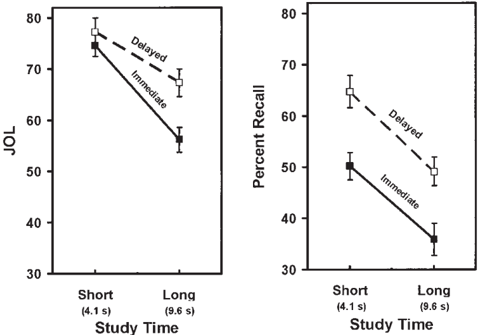
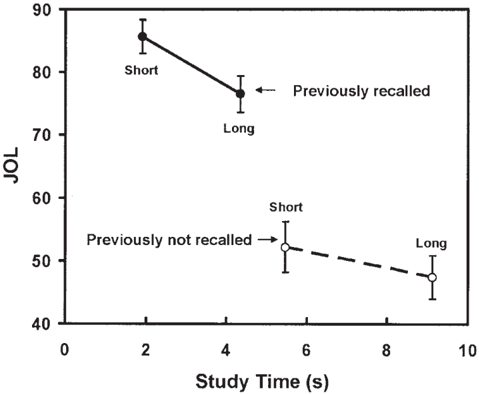
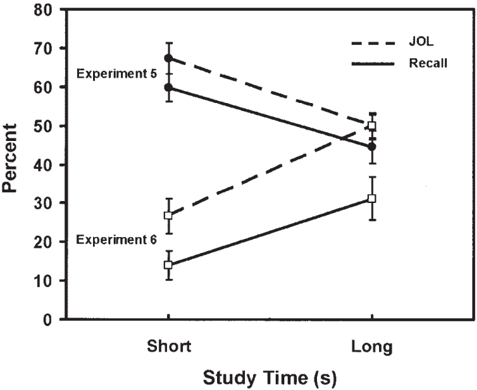
“The effects of data-driven regulation were examined by comparing JOLs and recall between short and long STs (see Figure 2), as was done in previous studies (Koriat et al., 2006; Koriat et al., 2009b).”
BackgroundResultInfluentialSelf-citationMindreading underlies metacognition
Carruthers, P. (2009) · Behavioral and Brain Sciences · doi:10.1017/s0140525x09000831 · Cited by 85
Assessing interpretations of experienced ease and difficulty as motivational constructs.
Fisher, O., & Oyserman, D. (2017) · Motivation Science · doi:10.1037/mot0000055 · Cited by 85
Answers at your fingertips: Access to the Internet influences willingness to answer questions
Ferguson, A. M., McLean, D., & Risko, E. F. (2015) · Consciousness and Cognition · doi:10.1016/j.concog.2015.08.008 · Cited by 82
Beyond stimulus cues and reinforcement signals: A new approach to animal metacognition.
Couchman, J. J., Coutinho, M. V. C., Beran, M. J., & Smith, J. D. (2010) · Journal of Comparative Psychology · doi:10.1037/a0020129 · Cited by 82
Half the Thrill Is in the Chase: Twisted Inferences from Embodied Cognitions and Brand Evaluation
Labroo, A. A., & Nielsen, J. H. (2010) · Journal of Consumer Research · doi:10.1086/649908 · Cited by 80
Making an Effort Versus Experiencing Load
Klepsch, M., & Seufert, T. (2021) · Frontiers in Education · doi:10.3389/feduc.2021.645284 · Cited by 79
“It would be particularly interesting to analyze the items in combination with other differentiated measures of cognitive load by Leppink et al. (2013) or by Krell (2017) to substantiate its validity.”
BackgroundMetacognitive Development in Early Childhood: New Questions about Old Assumptions
Lyons, K. E., & Ghetti, S. (2010) · Springer eBooks · doi:10.1007/978-1-4419-6546-2_12 · Cited by 78
Metacognitive evaluation in the avoidance of demand.
Dunn, T. L., Lutes, D. J. C., & Risko, E. F. (2016) · Journal of Experimental Psychology: Human Perception and Performance · doi:10.1037/xhp0000236 · Cited by 77
Undorf, M., & Erdfelder, E. (2015) · Memory & Cognition · doi:10.3758/s13421-014-0479-x · Cited by 77
Metacognitive Control of Learning and Remembering
Finley, J. R., Tullis, J. G., & Benjamin, A. S. (2010) · Springer eBooks · doi:10.1007/978-1-4419-5716-0_6 · Cited by 75
The Sense of Effort: a Cost-Benefit Theory of the Phenomenology of Mental Effort
Székely, M., & Michael, J. (2020) · Review of Philosophy and Psychology · doi:10.1007/s13164-020-00512-7 · Cited by 74
Pieger, E., Mengelkamp, C., & Bannert, M. (2016) · Learning and Instruction · doi:10.1016/j.learninstruc.2016.01.012 · Cited by 74
Embodiment meets metamemory: Weight as a cue for metacognitive judgments.
Alban, M. W., & Kelley, C. M. (2013) · Journal of Experimental Psychology Learning Memory and Cognition · doi:10.1037/a0032420 · Cited by 74
Judgments of learning depend on how learners interpret study effort.
Koriat, A., Nussinson, R., & Ackerman, R. (2014) · Journal of Experimental Psychology: Learning, Memory, and Cognition · doi:10.1037/xlm0000009 · Cited by 73
Self-citationRhesus monkeys (Macaca mulatta) adaptively monitor uncertainty while multi-tasking
Smith, J. D., Redford, J. S., Beran, M. J., & Washburn, D. A. (2009) · Animal Cognition · doi:10.1007/s10071-009-0249-5 · Cited by 73
Mitchum, A. L., & Kelley, C. M. (2010) · Journal of Experimental Psychology Learning Memory and Cognition · doi:10.1037/a0019182 · Cited by 73
Soderstrom, N. C., & McCabe, D. P. (2011) · Journal of Experimental Psychology: Learning, Memory, and Cognition · doi:10.1037/a0023548 · Cited by 71
Free recall dynamics in value-directed remembering
Stefanidi, A., Ellis, D. M., & Brewer, G. A. (2017) · Journal of Memory and Language · doi:10.1016/j.jml.2017.11.004 · Cited by 71
What does physiological synchrony reveal about metacognitive experiences and group performance?
Dindar, M., Järvelä, S., & Haataja, E. (2020) · British Journal of Educational Technology · doi:10.1111/bjet.12981 · Cited by 70
Animal Metacognition: Problems and Prospects
Smith, J. D., Beran, M. J., Couchman, J. J., Coutinho, M. V. C., & Boomer, J. B. (2009) · Comparative Cognition & Behavior Reviews · doi:10.3819/ccbr.2009.40004 · Cited by 69
Mending metacognitive illusions: A comparison of mnemonic-based and theory-based procedures.
Koriat, A., & Bjork, R. A. (2006) · Journal of Experimental Psychology: Learning, Memory, and Cognition · doi:10.1037/0278-7393.32.5.1133 · Cited by 69
Self-citationMihalca, L., Mengelkamp, C., & Schnotz, W. (2017) · Metacognition and Learning · doi:10.1007/s11409-017-9173-2 · Cited by 68
Grund, A., Fries, S., Nückles, M., Renkl, A., & Roelle, J. (2024) · Educational Psychology Review · doi:10.1007/s10648-024-09852-7 · Cited by 68
Mueller, M. L., Dunlosky, J., & Tauber, S. K. (2016) · Quarterly Journal of Experimental Psychology · doi:10.1080/17470218.2015.1058404 · Cited by 68
You may be more original than you think: Predictable biases in self-assessment of originality
Sidi, Y., Torgovitsky, I., Soibelman, D., Miron‐Spektor, E., & Ackerman, R. (2020) · Acta Psychologica · doi:10.1016/j.actpsy.2019.103002 · Cited by 68
Context affects feeling-of-knowing accuracy in younger and older adults.
Thomas, A. K., Bulevich, J. B., & Dubois, S. J. (2011) · Journal of Experimental Psychology Learning Memory and Cognition · doi:10.1037/a0021612 · Cited by 67
The easily learned, easily remembered heuristic in children
Koriat, A., Ackerman, R., Lockl, K., & Schneider, W. (2009) · Cognitive Development · doi:10.1016/j.cogdev.2009.01.001 · Cited by 66
Self-citationPaulus, M., Tsalas, N. R. H., Proust, J., & Sodian, B. (2014) · Journal of Experimental Child Psychology · doi:10.1016/j.jecp.2013.12.011 · Cited by 66
Interplay of metacognitive experiences and performance in collaborative problem solving
Dindar, M., Järvelä, S., & Järvenoja, H. (2020) · Computers & Education · doi:10.1016/j.compedu.2020.103922 · Cited by 65
Roderer, T., & Roebers, C. M. (2014) · Metacognition and Learning · doi:10.1007/s11409-013-9109-4 · Cited by 65
The Developmental Origin of Metacognition
Brinck, I., & Liljenfors, R. (2013) · Infant and Child Development · doi:10.1002/icd.1749 · Cited by 64
Li, W., Liu, C., & Tseng, J. C. R. (2023) · Education and Information Technologies · doi:10.1007/s10639-023-11671-2 · Cited by 64
Metadata
- Authors
- Koriat, A., Ma'ayan, H., & Nussinson, R.
- Venue
- Journal of Experimental Psychology: General
- Published
- 2006-02
- Volume
- 135
- Issue
- 1
- Pages
- 36-69
- ISSN
- 0096-3445 (ISSN-L)
- 1939-2222
- OpenAlex
- W2064996814
- Cited by
- 422
- References
- 171
- FWCI
- 27.45
- Type
- journal article
- Language
- en
- Open access
- closed
About these checks
Registry, retraction, Cites and statistics results are computed, not judged, with one exception: a printed reference that no index lists is read once by a model before it counts as a citation error. Claims are extracted by a model and kept only when their quote appears verbatim in the text; each cited source is then checked, with a model’s help, for whether it says what the claim relies on. Those verdicts can be wrong — read the claim’s quote and the cited source before relying on one.
Statistics and arithmetic are recomputed, not judged.
Confidence bands are shown only for fields calibrated on our annotated test set. None is calibrated yet, so no band is shown.
What counts as a claim ›How we measure confidence ›How we check this ›
Are you an author, or do you see a problem with this page? Request a review
Data sources
Bibliographic data: Semantic Scholar, OpenAlex, Crossref.
Contains information from the Semantic Scholar Academic Graph Datasets, made available under the ODC Attribution License (ODC-BY 1.0).
Semantic Scholar’s data is described in: Kinney, R., et al. (2023). The Semantic Scholar Open Data Platform. arXiv:2301.10140.
