

Algorithm aversion: People erroneously avoid algorithms after seeing them err.
Open accessThe DOI matches its Crossref record; 23 of the 23 references it cites were found in a registry or an index; none of the 22 sources its claims cite is checked for support yet.
Abstract
Research shows that evidence-based algorithms more accurately predict the future than do human forecasters. Yet when forecasters are deciding whether to use a human forecaster or a statistical algorithm, they often choose the human forecaster. This phenomenon, which we call algorithm aversion, is costly, and it is important to understand its causes. We show that people are especially averse to algorithmic forecasters after seeing them perform, even when they see them outperform a human forecaster. This is because people more quickly lose confidence in algorithmic than human forecasters after seeing them make the same mistake. In 5 studies, participants either saw an algorithm make forecasts, a human make forecasts, both, or neither. They then decided whether to tie their incentives to the future predictions of the algorithm or the human. Participants who saw the algorithm perform were less confident in it, and less likely to choose it over an inferior human forecaster. This was true even among those who saw the algorithm outperform the human.
Overview
CoChat Summary
TL;DR
People become less willing to use a statistical algorithm after seeing it perform and make mistakes, even when it outperforms a human forecaster. This “algorithm aversion” is driven partly by people losing confidence in algorithms more quickly than in humans after observing errors.
Key findings
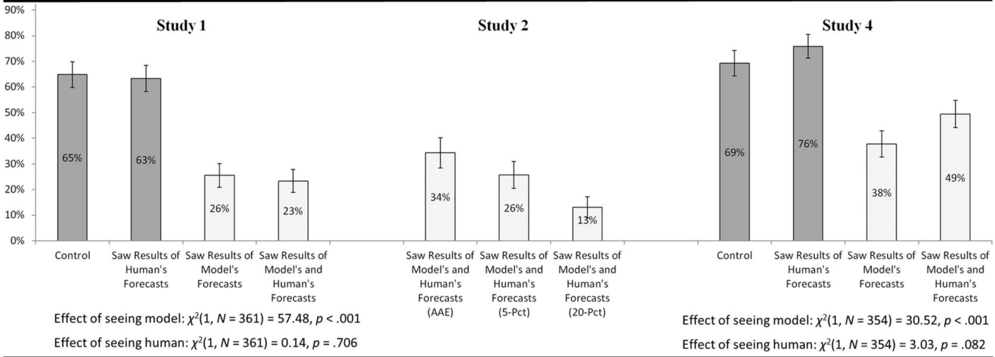
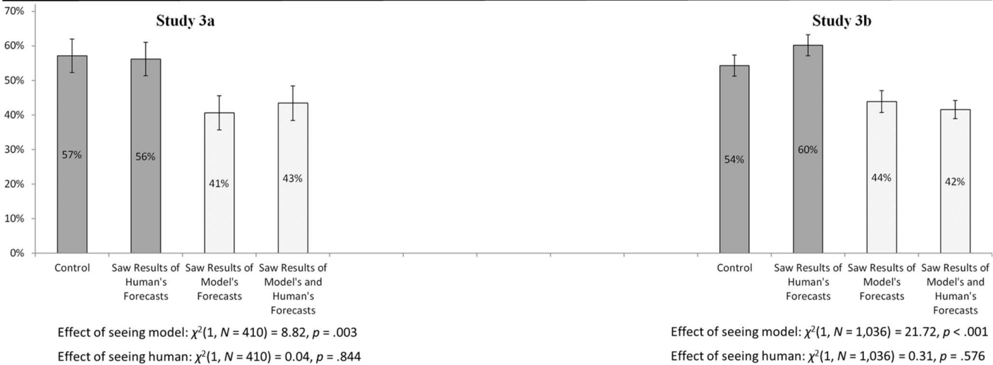
- Across five studies, seeing the algorithm perform reduced participants’ likelihood of choosing it over a human forecaster. In the model-and-human conditions, 610 of 741 participants (83%) saw the model outperform the human, yet these participants were among the least likely to choose the model.
- The model outperformed humans in all five studies. For example, bonuses if choosing model vs. human were Study 1: $1.78 vs. $1.38; Study 2: $1.77 vs. $1.09; Study 3a: $0.48 vs. $0.31; Study 3b: $0.49 vs. $0.30; Study 4: $1.79 vs. $1.38. Human forecasters produced 15–29% more error in the MBA task and 90–97% more error in the airline-passenger task.
- Seeing the model perform significantly decreased confidence in the model’s forecasts in all four studies where this was tested, whereas seeing the human perform significantly decreased confidence in the human only in Study 4. Confidence in the model’s forecasts significantly mediated the effect of seeing the model perform on choosing the model; confidence in the human did not.
- In Study 2, participants paid for forecasts within 20 percentiles were less likely to choose the model than those paid within 5 percentiles, χ²(1, N = 139) = 3.56, p = .059, and those paid by average absolute error, χ²(1, N = 136) = 8.56, p = .003; this effect was mediated by confidence in their own forecasts, not confidence in the model’s forecasts.
Methods
- Five studies had participants forecast real outcomes: MBA student success (Studies 1, 2, and 4) or U.S. state rank in airline passengers (Studies 3a and 3b). Participants were assigned to control, human, model, or model-and-human conditions, then chose whether to tie incentivized bonuses to the model or the human forecaster (themselves in Studies 1–3, another participant in Study 4).
- Final samples were Study 1: 361; Study 2: 206; Study 3a: 410; Study 3b: 1,036; Study 4: 354. Studies 1, 2, and 4 were run in the Wharton Behavioral Lab; Studies 3a and 3b used Amazon Mechanical Turk.
- Main analyses compared forecasting performance and choice rates, measured confidence and beliefs, and used binary mediation analyses with Preacher and Hayes’s bootstrapping procedure.
Limitations
- The paper states it did not explore all boundaries of the effect, including whether it would persist if algorithms were many times more accurate than humans, and whether results depend on features shared by the two forecasting tasks.
- The paper states it did not explore how algorithm variations—complexity, transparency, forecaster involvement in construction, and designer expertise—affect algorithm aversion.
- The paper states algorithm aversion is not entirely driven by seeing algorithms err, and it has little to say about how best to reduce aversion among those who have seen an algorithm err. The text also cautions that cross-experiment comparisons should be made cautiously.
Model-written summary. Check it against the paper before relying on it.
Integrity signals
Registry
Cites
Statistics
Figures
Verification
Claims the paper makes
0 Valid · 2 Not valid · 16 Not checked · 90 Own results and interpretations
A result the paper reports from its own data — it cites no other source for it, so there is none to check. The quote shows it is in the paper.
In the paper
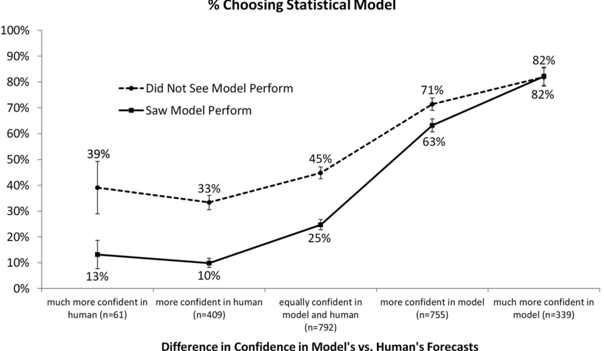
“the majority of people who were equally confident in the model's and human's forecasts chose to tie their bonuses to the human's forecasts, particularly when they had seen the model perform.”
plainstates an association- Asserted: passes — The authors put it forward as true.
- Checkable: passes — It can be checked against evidence.
- Load-bearing: passes — The paper’s conclusions depend on it.
- Based: passes — The paper gives a reason why it holds.
A result the paper reports from its own data — it cites no other source for it, so there is none to check. The quote shows it is in the paper.
In the paper
“Consistent with research on the adoption of decision aids (see Highhouse, 2008), participants thought that the human forecasters were better than the model at getting better with practice, learning from mistakes, and finding underappreciated candidates.”
plain- Asserted: passes — The authors put it forward as true.
- Checkable: passes — It can be checked against evidence.
- Load-bearing: passes — The paper’s conclusions depend on it.
- Based: passes — The paper gives a reason why it holds.
A result the paper reports from its own data — it cites no other source for it, so there is none to check. The quote shows it is in the paper.
In the paper
“Our studies show that this resistance at least partially arises from greater intolerance for error from algorithms than from humans.”
plainstates a possible cause- Asserted: passes — The authors put it forward as true.
- Checkable: passes — It can be checked against evidence.
- Load-bearing: passes — The paper’s conclusions depend on it.
- Based: passes — The paper gives a reason why it holds.
A result the paper reports from its own data — it cites no other source for it, so there is none to check. The quote shows it is in the paper.
In the paper
“Participants rightfully thought that the model was better than human forecasters at avoiding obvious mistakes, appropriately weighing various attributes, and consistently weighing information.”
plain- Asserted: passes — The authors put it forward as true.
- Checkable: passes — It can be checked against evidence.
- Load-bearing: unclear — It is unclear whether the paper’s conclusions depend on it.
- Based: passes — The paper gives a reason why it holds.
A result the paper reports from its own data — it cites no other source for it, so there is none to check. The quote shows it is in the paper.
In the paper
“This effect was evident in two distinct domains of judgment, including one in which the human forecasters produced nearly twice as much error as the algorithm.”
plain- Asserted: passes — The authors put it forward as true.
- Checkable: passes — It can be checked against evidence.
- Load-bearing: unclear — It is unclear whether the paper’s conclusions depend on it.
- Based: passes — The paper gives a reason why it holds.
75 more claims
Create a free account to see all 108 claims and to verify the 12 references still open.
- It may state two separate claims as one. 13
- Probably not a substantial claim. 16
Claims other papers make about this one
Each is checked against this paper’s own text: does it say what the citing paper says it does?
The source backs part of the claim, not all of it — or backs it for a different population, condition or comparison.
In the citing paper
“Traditional theorizing assumes trade-offs between trust and skepticism (Dietvorst et al., 2015), automation and engagement (Freeman et al., 2014), or efficiency and depth (Ishowo-Oloko et al., 2019)”
From Pedagogical partnerships with generative AI in higher education: how dual cognitive pathways paradoxically enable transformative learning (2026) · cites this paper as Dietvorst et al., 2015
Experimental — accuracy not yet measuredThe source backs part of the claim, not all of it — or backs it for a different population, condition or comparison.
In the citing paper
“Existing research typically examines trust versus skepticism in human-AI interactions as binary constructs (Dietvorst et al., 2015; Logg et al., 2019), missing the possibility that partnerships might simultaneously activate both vigilant and offloading behaviors.”
From Pedagogical partnerships with generative AI in higher education: how dual cognitive pathways paradoxically enable transformative learning (2026) · cites this paper as Dietvorst et al., 2015
Experimental — accuracy not yet measuredThe source backs part of the claim, not all of it — or backs it for a different population, condition or comparison.
In the citing paper
“It aligns with the theoretical rationale on algorithm aversion (Dietvorst et al. 2015;Hohensinn et al. 2024) and appreciation (Logg et al. 2019), which suggests that people are more likely to accept and trust AI systems when they produce desirable results but become skeptical when outcomes are unfavorable.”
From Holding AI Accountable Like Herding Cats: The Contingent Impact on the Legitimacy of Algorithmic Bureaucracy (2026) · cites this paper as Dietvorst et al. 2015
Experimental — accuracy not yet measuredThe source backs part of the claim, not all of it — or backs it for a different population, condition or comparison.
In the citing paper
“Research on algorithm appreciation and algorithm aversion further suggests that people may either defer to algorithms or reject them depending on prior experience, perceived expertise, and error visibility (Dietvorst et al., 2015; Logg et al., 2019).”
From College students' metacognitive awareness of generative-AI reliance: an experimental study of decision confidence and attribution bias (2026) · cites this paper as Dietvorst et al., 2015
Experimental — accuracy not yet measuredThe source backs part of the claim, not all of it — or backs it for a different population, condition or comparison.
In the citing paper
“Earlier research has mentioned gender, self-confidence, expertise, and general algorithm aversion or appreciation.15,28”
From Appropriate trust in artificial intelligence for the optical diagnosis of colorectal polyps: the role of human/artificial intelligence interaction (2024) · cites this paper as [28]
Experimental — accuracy not yet measured
22 more claims about this paper
Create a free account to see every claim other papers make about this one.
Statistics recomputed
Every reported test result, recomputed from its test statistic and degrees of freedom. A result shows as not adding up only once an independent check has confirmed it.
- Consistentt(360) = 4.98reported p < .001 · recomputed p < .001
“t (360) = 4.98, p < .001”
- Consistentt(204) = 6.26reported p < .001 · recomputed p < .001
“t (204) = 6.26, p < .001”
- Consistentt(405) = 7.73reported p < .001 · recomputed p < .001
“t (405) = 7.73, p < .001”
- Consistentt(353) = 5.11reported p < .001 · recomputed p < .001
“t (353) = 5.11, p < .001”
- Consistentχ²(1) = 39.94reported p < .001 · recomputed p < .001
“χ 2 (1, N = 271) = 39.94, p < .001”
19 more recomputed tests
Create a free account to see every test the Stats check recomputed.
Self-check
Percentages, sums and reported differences re-computed from the paper’s own numbers.
Self-check results appear here once an independent check has confirmed them.
Citations
Cites
Preacher, K. J., & Hayes, A. F. (2008) · Behavior Research Methods · doi:10.3758/brm.40.3.879 · Cited by 34,117 · cited 1×
“We then used Preacher and Hayes’s (2008) bootstrapping procedure to obtain unbiased 95% confidence intervals around the mediated effects.”
Method(2023) · doi:10.1126/science · Cited by 6,063
The trouble with overconfidence.
Moore, D. A., & Healy, P. J. (2008) · Psychological Review · doi:10.1037/0033-295x.115.2.502 · Cited by 2,358
“Clinical versus Actuarial Judgment.”
Dawes, R. M., Faust, D., & Meehl, P. E. (1989) · Science · doi:10.1126/science.2648573 · Cited by 2,298
The robust beauty of improper linear models in decision making.
Dawes, R. M. (1979) · American Psychologist · doi:10.1037/0003-066x.34.7.571 · Cited by 1,966
Preference and belief: Ambiguity and competence in choice under uncertainty
Heath, C., & Tversky, A. (1991) · Journal of Risk and Uncertainty · doi:10.1007/bf00057884 · Cited by 1,654
Clinical versus mechanical prediction: a meta-analysis
Grove, W. M., Zald, D. H., Lebow, B. S., Snitz, B. E., & Nelson, C. (2000) · Psychological Assessment · doi:10.1037/1040-3590.12.1.19 · Cited by 1,640
Grove, W. M., & Meehl, P. E. (1996) · Psychology, Public Policy, and Law · doi:10.1037/1076-8971.2.2.293 · Cited by 1,457 · cited 4×
“…1996), the notion that algorithms cannot properly consider individual targets (Grove & Meehl, 1996), concerns about the ethicality of relying on algorithms to make important decisions (Dawes, 1979), and the presumed inability of algorithms to incorporate qualitative data (Grove & Meehl, 1996).”
BackgroundMethodInfluential(2007) · Cited by 1,133
Competing on analytics: the new science of winning
(2007) · Choice Reviews Online · doi:10.5860/choice.44-6322 · Cited by 941
Research works printed but not linked: 1
- Clark, D. (2012, November 7). How Nate Silver won the 2012 presidential election. Harvard Business Review Blog . Retrieved from http://blogs .hbr.org/cs/2012/11/how\_nate\_silver\_won\_the\_2012\_p.html
Cited by
Items 3,201–3,300 of 3,918
The Contextual Autonomy Principle: When and Why Social Service Robots Are Perceived as Ethical
Meyer‐Waarden, L., & Cloarec, J. (2026) · Psychology and Marketing · doi:10.1002/mar.70222
Judgment Cost Theory: The Accountable Bearing of Judgment in an Age of Cheap PredictionPreprint
West, J. (2026) · SSRN Electronic Journal · doi:10.2139/ssrn.6992679 · Cited by 2
Fischer, P. M. (2026) · Springer eBooks · doi:10.1007/978-3-031-75316-9_111-1
Workforce 2.0: When HR Meets AI—Managing Humans, Robots, and Algorithms in a Human–AI Enterprise
Tuzovic, S., & Paluch, S. (2026) · Springer eBooks · doi:10.1007/978-3-031-75316-9_113-1
Бурганова, А. Р. (2026) · Economics and Management · doi:10.35854/1998-1627-2026-6-748-759
Financial Literacy in an AI/XAI-Driven World: A Systematic Review and Bibliometric Mapping
Nogueira, M. C., Vieira, E. F. S., Madaleno, M., & Filipe, S. (2026) · Lecture notes in networks and systems · doi:10.1007/978-3-032-32035-3_29
Ma, T., Du, Y., Wang, Y., & Zhou, L. (2026) · Journal of theoretical and applied electronic commerce research · doi:10.3390/jtaer21070232
Zhang, Z., Geng, J., & Qi, C. (2026) · Behavioral Sciences · doi:10.3390/bs16071221
Johnson, D. S., Chun, S. Y., Pandey, S., & Ahmed, G. (2026) · Informatics · doi:10.3390/informatics13070116
Yue, M. (2026) · Frontiers in Psychology · doi:10.3389/fpsyg.2026.1875355 · Cited by 2
The Two Wings AI FrameworkPreprint
Tayara, S. (2026) · SSRN Electronic Journal · doi:10.2139/ssrn.7011760
When AI Service Fails: The Role of Procedural Fairness in Shaping Citizens’ Usage Intentions
Chang, Y., Chen, X., Toyoda, A., & Liu, L. (2026) · Communications in computer and information science · doi:10.1007/978-981-92-3734-0_22
Жданова, Л. А., & Sveinbjornson, E. (2025) · Организационная психология · doi:10.17323/2312-5942-2025-15-1-86-103
Zhu, Y., & Zheng, L. (2026) · SSRN Electronic Journal · doi:10.2139/ssrn.7152576
Jenks, C. (2026) · Artificial intelligence · doi:10.5772/intechopen.1015699
Zhu, Y., & Zheng, L. (2026) · SSRN Electronic Journal · doi:10.2139/ssrn.7163834
Czernietzki, C., Westmattelmann, D., & Foege, J. N. (2026) · Computers in Human Behavior Reports · doi:10.1016/j.chbr.2026.101216
benchek, E. (2026) · SSRN Electronic Journal · doi:10.2139/ssrn.7170928
GEORGESCU, C. R., & MILITARU, I. A. (2026) · Proceedings of the ... International Conference on Business Excellence · doi:10.2478/picbe-2026-0141
Petrenko, Y., Kosíková, R., SÁRI, A., & VERGEINER, A. (2026) · Proceedings of the ... International Conference on Business Excellence · doi:10.2478/picbe-2026-0049
Are You Trying to be Funny? When Humor Builds and Erodes Trust in Conversational AgentsPreprint
Rose, S., Weinmann, M., Demir, S., & Fügener, A. (2026) · SSRN Electronic Journal · doi:10.2139/ssrn.7040718
Hari, S. (2026) · SSRN Electronic Journal · doi:10.2139/ssrn.7047459 · Cited by 1
Long, Y., Zhou, Y., Luo, D., & Chang, M. (2026) · Frontiers in Psychology · doi:10.3389/fpsyg.2026.1851183
From Resource-Based View to Agent-Based Capability: A Theory of AI-Enabled Solo EntrepreneurshipPreprint
Sun, Y. (2026) · SSRN Electronic Journal · doi:10.2139/ssrn.7170774
Selected Evidence, Omitted Information, and Belief Updating in Large Language Model Decision SupportPreprint
Deng, Z., & Yan, J. (2026) · SSRN Electronic Journal · doi:10.2139/ssrn.7066638
AI “nationality”, policy types, and public support for embedding AI in policymaking
Xia, S. (2026) · Policy Sciences · doi:10.1007/s11077-026-09618-8
Why parents of children aged 4–6 use generative AI: a qualitative interview study
Güngör, B. Ş., & Güngör, A. (2026) · Children and Youth Services Review · doi:10.1016/j.childyouth.2026.109196
Yin, Q., & Ma, X. (2026) · Journal of Health Communication · doi:10.1080/10810730.2026.2706638
IMPACT OF AI-POWERED FINANCIAL ADVISORY SERVICES ON RETAIL INVESTOR RETURNS
Qadir, S. M. M. (2026) · Center for Management Science Research · doi:10.5281/zenodo.21531146
Shuyuan, Z. H. A. O., Li, W., & Wen, G. (2026) · Research Square · doi:10.21203/rs.3.rs-10397210/v1
Jagemann, I., Baudisch, J., Jungeblut, T., Maier, G. W., & Hirschfeld, G. H. F. (2026) · JMIR AI · doi:10.2196/94589
AI aversion in retailer–manufacturer bargaining: contracts and pricing
Liu, J., Sun, R., Chen, S., Mao, B., & Wunsch, D. C. (2026) · Operational Research · doi:10.1007/s12351-026-01078-5
How experience moderates the impact of AI suggestions on researchers' perceptions of their ideas
Troebinger, M., Doshi, A. R., & Chai, S. (2026) · Research Policy · doi:10.1016/j.respol.2026.105575 · Cited by 1
Gen AI or Human? Impact of the Agent Type on Consumers’ Adoption of Alternative Customized Itinerary
Hong, A., Xu, Y., & Wang, Y. (2026) · Journal of Travel Research · doi:10.1177/00472875261472437
Akhmetova, M. (2026) · Universum Technical sciences · doi:10.32743/unitech.2026.147.6.22884
Harada, Y. (2026) · Cureus Journal of AI-Augmented Research · doi:10.7759/s44568-026-00185-3
Chatbots no atendimento ao cliente: implicações para a experiência do consumidor
Duarte, T. F. H. (2026) · The Trends Hub, Revista de Tendências em Comunicação e Ciências Empresariais · doi:10.34630/tth.v6i1.7282
Wang, S., Zhang, Y., & Liang, Z. (2026) · International Public Management Journal · doi:10.1080/10967494.2026.2706796
Wang, H., & Zhu, S. (2026) · Frontiers in Psychology · doi:10.3389/fpsyg.2026.1860895 · Cited by 1
Raman, Not Varelse — Why Acceptably Controllable AGI Policies Cluster Around Human-Like Stacks
Buteau, T., & Kommrusch, S. (2026) · Lecture notes in computer science · doi:10.1007/978-3-032-33010-9_9
ARTIFICIAL INTELLIGENCE IN PUBLIC WELFARE POLICIES: ADOPTIONS, PERCEPTIONS AND TRUST
Pavolini, E., Guerci, M., & Prelle, G. (2026) · Archivio Istituzionale della Ricerca (Universita Degli Studi Di Milano)
The intelligence loop and value creation in the age of AI agents
Li, Y., Zeng, M., & Li, A. (2026) · Strategic Entrepreneurship Journal · doi:10.2139/ssrn.6508698 · Cited by 8
Lim, T. (2026) · SSRN Electronic Journal · doi:10.2139/ssrn.6877758 · Cited by 1
Dyląg, A., & Jacko, J. F. (2026) · Nowoczesne Systemy Zarządzania · doi:10.37055/nsz/226439
Kimura, D. (2026) · SSRN Electronic Journal · doi:10.2139/ssrn.7010279
Zang, X., Li, H., Zhang, Z., & Yoo, B. (2026) · SSRN Electronic Journal · doi:10.2139/ssrn.7199728
Joy, R. B. (2026) · International Journal of Research and Innovation in Social Science · doi:10.47772/ijriss.2026.100700165
Ptaszek, G., & Metzger, M. J. (2026) · International journal of communication · doi:10.65476/karyzt10
Algorithmic Third-Party Advice in Markets with Complex GoodsPreprint
Bao, L., Kalaycı, K., & Sun, R. (2026) · SSRN Electronic Journal · doi:10.2139/ssrn.7107878
AI-Powered AnalystsPreprint
Subasi, M., Liu, L. Y., & Kimbrough, M. D. (2026) · SSRN Electronic Journal · doi:10.2139/ssrn.7176461
Pyae, A. (2026) · National Conference on Technical Education and International Conference on Technical Education (NCTechEd & ICTechEd) · doi:10.1109/icteched69022.2026.11682826
Kopka, M., Aboueldahab, A., & Feufel, M. A. (2026) · Research Square · doi:10.21203/rs.3.rs-10348224/v1
Misperceiving the Frontier: Managerial Beliefs and the Allocation of AIPreprint
Hauser, O., Li, S., & Xu, Y. (2026) · SSRN Electronic Journal · doi:10.2139/ssrn.7031019
Bedmutha, K. S., & Jagdale, R. S. (2026) · Advances in computational intelligence and robotics book series · doi:10.4018/979-8-3373-9325-4.ch004
Satisfaction and dissatisfaction among elderly consumers: a systematic review and research agenda
Guido, G., Prete, M. I., Pichierri, M., & Palmi, P. (2026) · Management Review Quarterly · doi:10.1007/s11301-026-00614-z
Salam, M. A., Leong, V. S., Muhamad, N., & Rayun, S. M. N. (2026) · Advances in computational intelligence and robotics book series · doi:10.4018/979-8-2600-2977-0.ch008
Evolutionary Dynamics of AI, Politicization, Contestation, and Trust in Science FundingPreprint
Ray, A. (2026) · SSRN Electronic Journal · doi:10.2139/ssrn.7435215
What video review controversies in sports reveal about AI and human decision-making
Tabesh, P. (2026) · The Conversation · doi:10.64628/aai.qe4stpxqy
Valdez-Rondinel, J. P. (2026) · Revista Jurídica de la Universidad de San Andrés · doi:10.64928/jsf6d480
КОГНИТИВНО-ИНФОРМАЦИОННАЯ КОНЦЕПЦИЯ ПРИНЯТИЯ УПРАВЛЕНЧЕСКИХ РЕШЕНИЙ В ЦИФРОВОЙ СРЕДЕ
Барабицкий, И. А., & Сеньшова, Е. А. (2026) · Прогрессивная экономика · doi:10.54861/27131211_2026_7_459
ARTIFICIAL INTELLIGENCE IN MANAGERIAL DECISION-MAKING
(2026) · International Journal of Progressive Research in Engineering Management and Science · doi:10.58257/ijprems53255
Agentic AI, Price Discovery, and Endogenous Human Innovation in FinancePreprint
Warin, T. (2026) · SSRN Electronic Journal · doi:10.2139/ssrn.7120280
Does distrust priming reduce AI stereotypes? Testing applicability to AI acceptance
Dan, K., & Hoshino, T. (2026) · Computers in Human Behavior Reports · doi:10.1016/j.chbr.2026.101232
Evolutionary Dynamics of AI, Politicization, Contestation, and Trust in Science FundingPreprint
Ray, A. (2026) · bioRxiv (Cold Spring Harbor Laboratory) · doi:10.64898/2026.07.28.741134
AI Aversion: Do People Trust and Accept Artificial Intelligence Risk Calculator Recommendations?
Ramasubramanian, M., & Zikmund‐Fisher, B. J. (2026) · Medical Decision Making · doi:10.1177/0272989x261467775
When AI Authorship Disclosure Helps and Hurts: Competing Pathways in Video Evaluation UpdatingPreprint
cao, R., Yu, D., & Zhi, H. (2026) · SSRN Electronic Journal · doi:10.2139/ssrn.7365627
General AI in Higher Learning: Knowledge, Information Use, and Security Bacterial Awareness
Nguyen, Q. H., Vu, Q. M., Dinh, S. H. Q., Tran, T. N., & Phan, L. N. L. (2026) · Lecture notes in networks and systems · doi:10.1007/978-3-032-25631-7_44
Do Customers Exhibit Algorithm Aversion in Bank Loan Approvals?
Xu, W., & Qi, D. (2026) · Australian Economic Papers · doi:10.1111/1467-8454.70034
Li, Q., & Peng, X. (2026) · International Journal of Human-Computer Interaction · doi:10.1080/10447318.2026.2706922
Do People Like Investing Nudges? Evidence on the Perceived Legitimacy of Financial InterventionsPreprint
van den Akker, M. M. L. H., & Sunstein, C. R. (2026) · SSRN Electronic Journal · doi:10.2139/ssrn.7224813
Mandal, S., & Banerjee, S. (2026) · Discover Sustainability · doi:10.1007/s43621-026-04267-6
Liang, Q., & Jiang, Q. (2026) · Acta Psychologica · doi:10.1016/j.actpsy.2026.107562
From AI Adoption to AI Transformation: The AX-5R Framework for Socio-Technical Work System Redesign
Shin, K. S., Kang, I. S., & Lee, M. (2026) · Systems · doi:10.3390/systems14080912
Trusting AI in Competitive MarketsPreprint
Keppo, J., Li, Y., Tsoukalas, G., & Yuan, N. (2026) · SSRN Electronic Journal · doi:10.2139/ssrn.7174698
Jay, D., Kuruva, R., & Ramachandran, R. (2026) · SSRN Electronic Journal · doi:10.2139/ssrn.7230710
Understanding Consumer Resistance to AI-Powered Marketing in Indonesia
Wulandari, T. A., Purwaningwulan, M. M., & Anggaswari, N. A. (2025) · Proceeding of International Student Conference on Earth and Environmental Research · doi:10.34010/incitest.v1i.827
Kim, J.-M., & Jeong, S. H. (2026) · Psychiatry Investigation · doi:10.30773/pi.2025.0330
Bhuiyan, M. (2026) · American Journal of Interdisciplinary Studies · doi:10.63125/c8s2n394
From Uncomfortable Trust to Successful Collaboration: Leading AI Adoption in Knowledge Work
Honkonen, V. (2026) · Aaltodoc (Aalto University)
Pato, I., Carrasco, J., Grobusch, M. P., & Hänscheid, T. (2026) · Clinical Microbiology and Infection · doi:10.1016/j.cmi.2026.07.054
Cheng, C., Dai, J., & Yan, L. (2026) · Risk Analysis · doi:10.1111/risa.70324 · Cited by 1
Algorithmic imaginaries: Definition and critical questions
Schellewald, A., Firth, E., & Lin, H. (2026) · New Media & Society · doi:10.1177/14614448261475816
The Human-AI Substitution Principle: When will you be Replaced by AI in your Organization?Preprint
Banerjee, B., & Singh, S. (2026) · SSRN Electronic Journal · doi:10.2139/ssrn.7170998
AI helps until you say it does
Niu, X., Wang, Y., Cao, Q., & Li, J. (2026) · Scandinavian Journal of Economics · doi:10.1111/sjoe.70044
Threats or supports? The dual mediating process from AI technology adoption to bootleg innovation
Li, S., Tang, C., Yang, X., Luo, J., & Zhang, Z. (2026) · The International Journal of Human Resource Management · doi:10.1080/09585192.2026.2711898
Imo, I., Agyare-Kwabi, K., Adesoji, A. D., Odukoya, D., & Sarfo, I. (2026) · SSRN Electronic Journal · doi:10.2139/ssrn.7176278
Hari, S. (2026) · SSRN Electronic Journal · doi:10.2139/ssrn.7166378
Rosbach, E., Ammeling, J., Bertram, C., Riener, A., & Aubreville, M. (2026) · Veterinary Pathology · doi:10.1177/03009858261472493
Tian, H.-C., & Xiao-hui, L. (2026) · Frontiers in Psychology · doi:10.3389/fpsyg.2026.1828685
The Effect of Source Disclosure on Trust in an AI-Based Knowledge Management System
Schiedermair, I., Baumgartner, M., Kick, E., Kopp, T., & Kinkel, S. (2026) · International Journal of Human-Computer Interaction · doi:10.1080/10447318.2026.2708454
Imo, I., Agyare-Kwabi, K., Adesoji, A. D., Odukoya, D., & Sarfo, I. (2026) · SSRN Electronic Journal · doi:10.2139/ssrn.7200860
AI-Driven Hyper-Personalisation and Consumer Usage Behaviour in Food Delivery Applications
James, K. J., & Praveena, K. (2026) · Management Journal for Advanced Research · doi:10.54741/mjar/6.3.2026.319
Does AI Disclosure Cost Brands Trust in Emerging Markets?Preprint
Eniola, F. (2026) · SSRN Electronic Journal · doi:10.2139/ssrn.7183058
The Scaling Paradox in Human-AI CollaborationPreprint
Qi, A., & Wang, M. (2026) · SSRN Electronic Journal · doi:10.2139/ssrn.7207559
al Aboudi, S. (2026) · Osuva (University of Vaasa)
“My Wife Is My Excel”: The Limits Of AI Adoption In Finnish Clothing Retail
Muhaimeen, W. (2026) · Jyväskylä University Digital Archive (University of Jyväskylä)
Moghaddam, N. M. (2026) · Osuva (University of Vaasa)
Gupta, K. (2026) · Research Square · doi:10.21203/rs.3.rs-10516581/v1
Metadata
- Authors
- Dietvorst, B. J., Simmons, J. P., & Massey, C.
- Affiliations
- University of Pennsylvania (US)
- Venue
- Journal of Experimental Psychology: General
- Published
- 2015
- Volume
- 144
- Issue
- 1
- Pages
- 114-126
- ISSN
- 0096-3445 (ISSN-L)
- 1939-2222
- OpenAlex
- W3125633690
- Cited by
- 3,232
- References
- 22
- Citations by year
- 2026: 1025 · 2025: 563 · 2024: 445 · 2023: 404 · 2022: 266 · 2021: 216 · 2020: 137 · 2019: 88 · 2018: 41 · 2017: 26 · 2016: 14 · 2015: 5
- FWCI
- 13.96
- Type
- journal article
- Language
- en
- Open access
- green
- doi.org
- Locations
- Journal of Experimental Psychology General (publishedVersion)
- SSRN Electronic Journal (publishedVersion)
- PubMed (publishedVersion)
- ScholarlyCommons (University of Pennsylvania) (submittedVersion)
- Funders
- Wharton Behavioral Laboratory
- Wharton Risk Center Ackoff Doctoral Student Fellowship
- Topics
- Social Sciences › Decision Sciences › General Decision Sciences › Decision-Making and Behavioral Economics
- Social Sciences › Decision Sciences › Management Science and Operations Research › Forecasting Techniques and Applications
- Social Sciences › Human Factors and Ergonomics › Human-Automation Interaction and Safety
- Keywords
- algorithm aversion, trust in algorithms, prediction confidence, evidence-based algorithm, decision-making
- MeSH terms
- Algorithms, Avoidance Learning, Culture, Decision Making, Female, Forecasting, Humans, Male, Motivation, Comprehension, Young Adult
About these checks
Registry, retraction, Cites and statistics results are computed, not judged, with one exception: a printed reference that no index lists is read once by a model before it counts as a citation error. Claims are extracted by a model and kept only when their quote appears verbatim in the text; each cited source is then checked, with a model’s help, for whether it says what the claim relies on. Those verdicts can be wrong — read the claim’s quote and the cited source before relying on one.
A language model drew the claims from the paper on 2026-11-14, under version 3 of the claim definition (model deepseek-v4.1-flash, prompt extract-v3).
A second model labelled each claim on 2026-11-14 (model jev-1.13-20260917, definition revision gold-guideline-v0.2).
Statistics and arithmetic are recomputed, not judged.
Confidence bands are shown only for fields calibrated on our annotated test set. None is calibrated yet, so no band is shown.
What counts as a claim ›How we measure confidence ›How we check this ›
Are you an author, or do you see a problem with this page? Request a review
Data sources
Bibliographic data: Semantic Scholar, OpenAlex, Crossref.
Contains information from the Semantic Scholar Academic Graph Datasets, made available under the ODC Attribution License (ODC-BY 1.0).
Semantic Scholar’s data is described in: Kinney, R., et al. (2023). The Semantic Scholar Open Data Platform. arXiv:2301.10140.
