

Algorithm aversion: People erroneously avoid algorithms after seeing them err.
Open accessThe DOI matches its Crossref record; 23 of the 23 references it cites were found in a registry or an index; none of the 22 sources its claims cite is checked for support yet.
Abstract
Research shows that evidence-based algorithms more accurately predict the future than do human forecasters. Yet when forecasters are deciding whether to use a human forecaster or a statistical algorithm, they often choose the human forecaster. This phenomenon, which we call algorithm aversion, is costly, and it is important to understand its causes. We show that people are especially averse to algorithmic forecasters after seeing them perform, even when they see them outperform a human forecaster. This is because people more quickly lose confidence in algorithmic than human forecasters after seeing them make the same mistake. In 5 studies, participants either saw an algorithm make forecasts, a human make forecasts, both, or neither. They then decided whether to tie their incentives to the future predictions of the algorithm or the human. Participants who saw the algorithm perform were less confident in it, and less likely to choose it over an inferior human forecaster. This was true even among those who saw the algorithm outperform the human.
Overview
CoChat Summary
TL;DR
People become less willing to use a statistical algorithm after seeing it perform and make mistakes, even when it outperforms a human forecaster. This “algorithm aversion” is driven partly by people losing confidence in algorithms more quickly than in humans after observing errors.
Key findings
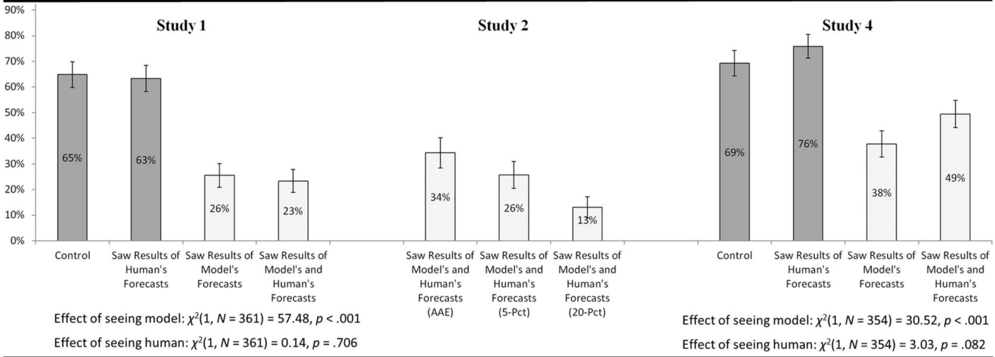
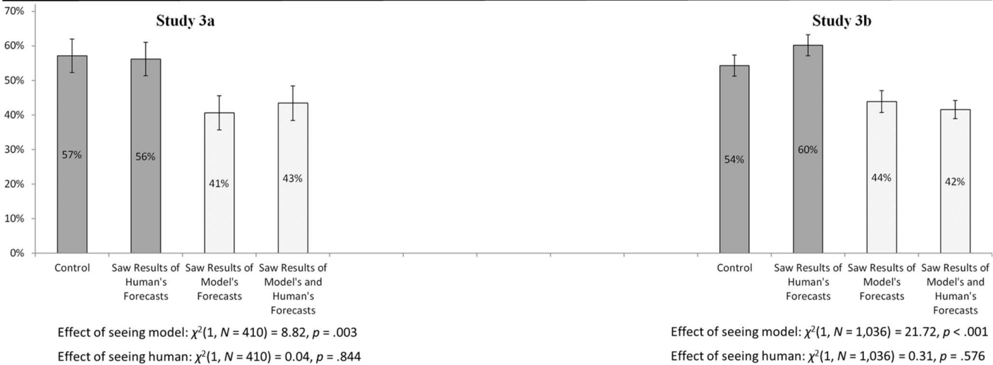
- Across five studies, seeing the algorithm perform reduced participants’ likelihood of choosing it over a human forecaster. In the model-and-human conditions, 610 of 741 participants (83%) saw the model outperform the human, yet these participants were among the least likely to choose the model.
- The model outperformed humans in all five studies. For example, bonuses if choosing model vs. human were Study 1: $1.78 vs. $1.38; Study 2: $1.77 vs. $1.09; Study 3a: $0.48 vs. $0.31; Study 3b: $0.49 vs. $0.30; Study 4: $1.79 vs. $1.38. Human forecasters produced 15–29% more error in the MBA task and 90–97% more error in the airline-passenger task.
- Seeing the model perform significantly decreased confidence in the model’s forecasts in all four studies where this was tested, whereas seeing the human perform significantly decreased confidence in the human only in Study 4. Confidence in the model’s forecasts significantly mediated the effect of seeing the model perform on choosing the model; confidence in the human did not.
- In Study 2, participants paid for forecasts within 20 percentiles were less likely to choose the model than those paid within 5 percentiles, χ²(1, N = 139) = 3.56, p = .059, and those paid by average absolute error, χ²(1, N = 136) = 8.56, p = .003; this effect was mediated by confidence in their own forecasts, not confidence in the model’s forecasts.
Methods
- Five studies had participants forecast real outcomes: MBA student success (Studies 1, 2, and 4) or U.S. state rank in airline passengers (Studies 3a and 3b). Participants were assigned to control, human, model, or model-and-human conditions, then chose whether to tie incentivized bonuses to the model or the human forecaster (themselves in Studies 1–3, another participant in Study 4).
- Final samples were Study 1: 361; Study 2: 206; Study 3a: 410; Study 3b: 1,036; Study 4: 354. Studies 1, 2, and 4 were run in the Wharton Behavioral Lab; Studies 3a and 3b used Amazon Mechanical Turk.
- Main analyses compared forecasting performance and choice rates, measured confidence and beliefs, and used binary mediation analyses with Preacher and Hayes’s bootstrapping procedure.
Limitations
- The paper states it did not explore all boundaries of the effect, including whether it would persist if algorithms were many times more accurate than humans, and whether results depend on features shared by the two forecasting tasks.
- The paper states it did not explore how algorithm variations—complexity, transparency, forecaster involvement in construction, and designer expertise—affect algorithm aversion.
- The paper states algorithm aversion is not entirely driven by seeing algorithms err, and it has little to say about how best to reduce aversion among those who have seen an algorithm err. The text also cautions that cross-experiment comparisons should be made cautiously.
Model-written summary. Check it against the paper before relying on it.
Integrity signals
Registry
Cites
Statistics
Figures
Verification
Claims the paper makes
0 Valid · 2 Not valid · 16 Not checked · 90 Own results and interpretations
A result the paper reports from its own data — it cites no other source for it, so there is none to check. The quote shows it is in the paper.
In the paper
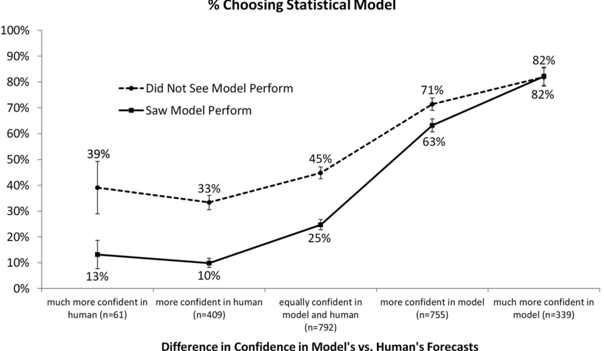
“the majority of people who were equally confident in the model's and human's forecasts chose to tie their bonuses to the human's forecasts, particularly when they had seen the model perform.”
plainstates an association- Asserted: passes — The authors put it forward as true.
- Checkable: passes — It can be checked against evidence.
- Load-bearing: passes — The paper’s conclusions depend on it.
- Based: passes — The paper gives a reason why it holds.
A result the paper reports from its own data — it cites no other source for it, so there is none to check. The quote shows it is in the paper.
In the paper
“Consistent with research on the adoption of decision aids (see Highhouse, 2008), participants thought that the human forecasters were better than the model at getting better with practice, learning from mistakes, and finding underappreciated candidates.”
plain- Asserted: passes — The authors put it forward as true.
- Checkable: passes — It can be checked against evidence.
- Load-bearing: passes — The paper’s conclusions depend on it.
- Based: passes — The paper gives a reason why it holds.
A result the paper reports from its own data — it cites no other source for it, so there is none to check. The quote shows it is in the paper.
In the paper
“Our studies show that this resistance at least partially arises from greater intolerance for error from algorithms than from humans.”
plainstates a possible cause- Asserted: passes — The authors put it forward as true.
- Checkable: passes — It can be checked against evidence.
- Load-bearing: passes — The paper’s conclusions depend on it.
- Based: passes — The paper gives a reason why it holds.
A result the paper reports from its own data — it cites no other source for it, so there is none to check. The quote shows it is in the paper.
In the paper
“Participants rightfully thought that the model was better than human forecasters at avoiding obvious mistakes, appropriately weighing various attributes, and consistently weighing information.”
plain- Asserted: passes — The authors put it forward as true.
- Checkable: passes — It can be checked against evidence.
- Load-bearing: unclear — It is unclear whether the paper’s conclusions depend on it.
- Based: passes — The paper gives a reason why it holds.
A result the paper reports from its own data — it cites no other source for it, so there is none to check. The quote shows it is in the paper.
In the paper
“This effect was evident in two distinct domains of judgment, including one in which the human forecasters produced nearly twice as much error as the algorithm.”
plain- Asserted: passes — The authors put it forward as true.
- Checkable: passes — It can be checked against evidence.
- Load-bearing: unclear — It is unclear whether the paper’s conclusions depend on it.
- Based: passes — The paper gives a reason why it holds.
75 more claims
Create a free account to see all 108 claims and to verify the 12 references still open.
- It may state two separate claims as one. 13
- Probably not a substantial claim. 16
Claims other papers make about this one
Each is checked against this paper’s own text: does it say what the citing paper says it does?
The source backs part of the claim, not all of it — or backs it for a different population, condition or comparison.
In the citing paper
“Traditional theorizing assumes trade-offs between trust and skepticism (Dietvorst et al., 2015), automation and engagement (Freeman et al., 2014), or efficiency and depth (Ishowo-Oloko et al., 2019)”
From Pedagogical partnerships with generative AI in higher education: how dual cognitive pathways paradoxically enable transformative learning (2026) · cites this paper as Dietvorst et al., 2015
Experimental — accuracy not yet measuredThe source backs part of the claim, not all of it — or backs it for a different population, condition or comparison.
In the citing paper
“Existing research typically examines trust versus skepticism in human-AI interactions as binary constructs (Dietvorst et al., 2015; Logg et al., 2019), missing the possibility that partnerships might simultaneously activate both vigilant and offloading behaviors.”
From Pedagogical partnerships with generative AI in higher education: how dual cognitive pathways paradoxically enable transformative learning (2026) · cites this paper as Dietvorst et al., 2015
Experimental — accuracy not yet measuredThe source backs part of the claim, not all of it — or backs it for a different population, condition or comparison.
In the citing paper
“It aligns with the theoretical rationale on algorithm aversion (Dietvorst et al. 2015;Hohensinn et al. 2024) and appreciation (Logg et al. 2019), which suggests that people are more likely to accept and trust AI systems when they produce desirable results but become skeptical when outcomes are unfavorable.”
From Holding AI Accountable Like Herding Cats: The Contingent Impact on the Legitimacy of Algorithmic Bureaucracy (2026) · cites this paper as Dietvorst et al. 2015
Experimental — accuracy not yet measuredThe source backs part of the claim, not all of it — or backs it for a different population, condition or comparison.
In the citing paper
“Research on algorithm appreciation and algorithm aversion further suggests that people may either defer to algorithms or reject them depending on prior experience, perceived expertise, and error visibility (Dietvorst et al., 2015; Logg et al., 2019).”
From College students' metacognitive awareness of generative-AI reliance: an experimental study of decision confidence and attribution bias (2026) · cites this paper as Dietvorst et al., 2015
Experimental — accuracy not yet measuredThe source backs part of the claim, not all of it — or backs it for a different population, condition or comparison.
In the citing paper
“Earlier research has mentioned gender, self-confidence, expertise, and general algorithm aversion or appreciation.15,28”
From Appropriate trust in artificial intelligence for the optical diagnosis of colorectal polyps: the role of human/artificial intelligence interaction (2024) · cites this paper as [28]
Experimental — accuracy not yet measured
22 more claims about this paper
Create a free account to see every claim other papers make about this one.
Statistics recomputed
Every reported test result, recomputed from its test statistic and degrees of freedom. A result shows as not adding up only once an independent check has confirmed it.
- Consistentt(360) = 4.98reported p < .001 · recomputed p < .001
“t (360) = 4.98, p < .001”
- Consistentt(204) = 6.26reported p < .001 · recomputed p < .001
“t (204) = 6.26, p < .001”
- Consistentt(405) = 7.73reported p < .001 · recomputed p < .001
“t (405) = 7.73, p < .001”
- Consistentt(353) = 5.11reported p < .001 · recomputed p < .001
“t (353) = 5.11, p < .001”
- Consistentχ²(1) = 39.94reported p < .001 · recomputed p < .001
“χ 2 (1, N = 271) = 39.94, p < .001”
19 more recomputed tests
Create a free account to see every test the Stats check recomputed.
Self-check
Percentages, sums and reported differences re-computed from the paper’s own numbers.
Self-check results appear here once an independent check has confirmed them.
Citations
Cites
Preacher, K. J., & Hayes, A. F. (2008) · Behavior Research Methods · doi:10.3758/brm.40.3.879 · Cited by 34,117 · cited 1×
“We then used Preacher and Hayes’s (2008) bootstrapping procedure to obtain unbiased 95% confidence intervals around the mediated effects.”
Method(2023) · doi:10.1126/science · Cited by 6,063
The trouble with overconfidence.
Moore, D. A., & Healy, P. J. (2008) · Psychological Review · doi:10.1037/0033-295x.115.2.502 · Cited by 2,358
“Clinical versus Actuarial Judgment.”
Dawes, R. M., Faust, D., & Meehl, P. E. (1989) · Science · doi:10.1126/science.2648573 · Cited by 2,298
The robust beauty of improper linear models in decision making.
Dawes, R. M. (1979) · American Psychologist · doi:10.1037/0003-066x.34.7.571 · Cited by 1,966
Preference and belief: Ambiguity and competence in choice under uncertainty
Heath, C., & Tversky, A. (1991) · Journal of Risk and Uncertainty · doi:10.1007/bf00057884 · Cited by 1,654
Clinical versus mechanical prediction: a meta-analysis
Grove, W. M., Zald, D. H., Lebow, B. S., Snitz, B. E., & Nelson, C. (2000) · Psychological Assessment · doi:10.1037/1040-3590.12.1.19 · Cited by 1,640
Grove, W. M., & Meehl, P. E. (1996) · Psychology, Public Policy, and Law · doi:10.1037/1076-8971.2.2.293 · Cited by 1,457 · cited 4×
“…1996), the notion that algorithms cannot properly consider individual targets (Grove & Meehl, 1996), concerns about the ethicality of relying on algorithms to make important decisions (Dawes, 1979), and the presumed inability of algorithms to incorporate qualitative data (Grove & Meehl, 1996).”
BackgroundMethodInfluential(2007) · Cited by 1,133
Competing on analytics: the new science of winning
(2007) · Choice Reviews Online · doi:10.5860/choice.44-6322 · Cited by 941
Research works printed but not linked: 1
- Clark, D. (2012, November 7). How Nate Silver won the 2012 presidential election. Harvard Business Review Blog . Retrieved from http://blogs .hbr.org/cs/2012/11/how\_nate\_silver\_won\_the\_2012\_p.html
Cited by
Items 3,501–3,600 of 3,918
Tiwari, N., & Jain, V. (2026) · Journal of Global Marketing · doi:10.1080/08911762.2026.2733411 · Cited by 1
Effects of proactivity, autonomy, and transparency on user perception in human-AI agent interactions
Liu, N., & Zuo, Y. (2026) · International Journal of Industrial Ergonomics · doi:10.1016/j.ergon.2026.104058
Rasheed, M. (2026) · Kybernetes · doi:10.1108/k-05-2026-1124
Boros, A. M., & Bartczak, A. M. (2026) · Working Papers. · doi:10.33138/2957-0506.2026.33.527
Kim, H., Choi, S., & Shin, H. H. (2026) · Journal of Business Research · doi:10.1016/j.jbusres.2026.116556
Human and AI in Decision Making: A Systematic Review of Trust, Fairness, and Empathy
Arora, A., & Arora, A. (2026) · Advances in computational intelligence and robotics book series · doi:10.4018/979-8-3373-9599-9.ch015
Seeing AI in the Byline: Disclosure Labels, Visual Scrutiny, and Trust in AI‐Attributed News
Zheng, K., Wang, Y., & Sun, Z. (2026) · Journal of Applied Social Psychology · doi:10.1111/jasp.70084 · Cited by 1
When AI says who made it: A meta-analysis of AI disclosure effects on consumer responses
Kim, M. (2026) · Computers in Human Behavior Reports · doi:10.1016/j.chbr.2026.101345
Sreejesh, S., & Ajaykumar, A. (2026) · International Journal of Hospitality Management · doi:10.1016/j.ijhm.2026.104906
Kim, M. (2026) · Frontiers in Psychology · doi:10.3389/fpsyg.2026.1892326
Alsamerraie, M. (2026) · European Journal of Prosthodontics and Restorative Dentistry · doi:10.1922/ejprd.v34i9s.2029
Explanation Transparency and Trust Perception After Generative AI Failure: A Dual-Path Model
Yang, Q., & Dong, H. (2026) · International Journal of Human-Computer Interaction · doi:10.1080/10447318.2026.2734323
Fortuna, P. (2026) · Wiley eBooks · doi:10.1002/9781394399680.refs
Are farmers algorithm-averse? The case of decision support tools in crop management
Massfeller, A., Hermann, D., Leyens, A., & Storm, H. (2026) · Food Policy · doi:10.1016/j.foodpol.2026.103193 · Cited by 1
Chu, K., & Chan, H.-C. (2026) · Journal of Behavioral Decision Making · doi:10.1002/bdm.70095
Badawy, W., & Shaban, M. (2026) · Applied Nursing Research · doi:10.1016/j.apnr.2026.152147
Lysdahlgaard, S., Jensen, J., Pedersen, M. R. V., & Kusk, M. W. (2026) · Radiography · doi:10.1016/j.radi.2026.103577
Coordination and leadership: The impact of artificial intelligence
Bigoni, M., & Paoli, D. (2026) · Journal of Economic Behavior & Organization · doi:10.1016/j.jebo.2026.107767
The effect of error acknowledgment on consumer responses to human and AI influencers
YILDIZ, S. Y. (2026) · Business And Management Studies An International Journal · doi:10.15295/bmij.v14i3.2844
Reader perceptions and willingness to pay for AI-translated literary fiction
Al‐Batineh, M., Al-Sharafi, A. G., Radwan, A. A., & Dagamseh, A. M. (2026) · Cogent Arts and Humanities · doi:10.1080/23311983.2026.2736338 · Cited by 1
Ramírez, R. R., González, M. J. S., & Leal‐Solís, A. (2026) · International Journal of Ethics and Systems · doi:10.1108/ijoes-04-2026-0297
Klepacz, J., Swędrak, R., & Dobrakowska, Z. (2026) · International Journal of Innovative Technologies in Social Science · doi:10.31435/ijitss.3(51).2026.6625
Klepacz, J., Swędrak, R., & Dobrakowska, Z. (2026) · International Journal of Innovative Technologies in Social Science · doi:10.31435/ijitss.3(51).2026.6621
IMPACTS OF THE RESERVOIR ROCK AND FLUID ON MISCIBLE CO2 INJECTION
Arslan, U. E., & Doğan, M. O. (2026) · OpenMETU (Middle East Technical University)
Putra, K. W. S. P., & Awwaliyah, I. N. (2026) · Analisis · doi:10.37478/als.v16i02.8639
MARLETTA, V. (2026) · Electronic Theses and Dissertations Repository (University of Pisa)
Acting Like or Thinking Like Human: Doctors and Deep Learning Algorithms Behavioral Comparison
Altuntaş, Y., ZEREN, M. T., & Özdemir, Ş. (2026) · Computing and Informatics · doi:10.31577/cai_2026_4_800
Weng, Z., Mi, Y., Chen, X., & Li, Q. (2026) · Frontiers in Psychology · doi:10.3389/fpsyg.2026.1747252
Do “AI-assisted” labels reduce perceived quality of scenarios? An exploratory experimental study
Malekifar, F. (2026) · European Journal of Futures Research · doi:10.1186/s40309-026-00301-y
Confident, Not Wiser: The Dunning-Kruger Effect in Human-AI InteractionPreprint
Fernandes, D., Rausch, M., Kloft, A. M., Buschek, D., & Welsch, R. (2026) · arXiv (Cornell University) · doi:10.48550/arxiv.2609.31095
Trust in LLM-Supported Engineering Work: The Role of Downstream DependencyPreprint
Herath, M., & Palmquist, A. (2026) · Research Square · doi:10.21203/rs.3.rs-11038705/v1
Inclusive Leadership in Multicultural Teams: Innovations, Challenges and Solutions
(2026) · Frontiers research topics · doi:10.3389/978-2-8325-8750-8
James, R., Elangovan, N., Ganesh, L., & Dheepa, T. (2026) · Advances in computational intelligence and robotics book series · doi:10.4018/979-8-3373-9589-0.ch007
Dual-Channel Salience: Rethinking Brand Strategy in AI-Mediated Decision Systems
Nausalya, S. (2026) · Advances in computational intelligence and robotics book series · doi:10.4018/979-8-3373-9589-0.ch010
Rothschild, D. B. D. (2026) · SSRN Electronic Journal · doi:10.2139/ssrn.7534518
Jang, J., & Choi, J. (2026) · Journal of the Korean society for quality management · doi:10.7469/jksqm.2026.54.3.477
Epistemic resilience in AI-driven innovation
Ryan, J. C., Cappuccio, M. L., Georgiadou, E., & Lanteri, A. (2026) · Journal of Innovation & Knowledge · doi:10.1016/j.jik.2026.101169
Psychological Reactions to Subordinates’ LLM Use at Work
Meyers, S., Briker, R., & Bigman, Y. (2026) · The Leadership Quarterly · doi:10.1016/j.leaqua.2026.102004 · Cited by 1
Gao, C., & Riccucci, N. M. (2026) · Public Administration Review · doi:10.1111/puar.70214
Emikönel, S., & TÜRKMEN, İ. (2026) · Acibadem Universitesi Saglik Bilimleri Dergisi · doi:10.31067/acusaglik.1990872
Using machine learning effectively in marine benthic ecology: a question-driven toolkit
Clippele, L. H. D., Balsa, J., Beckmann, L., Boolukos, C. M. B., Burgués, I., Diez, A. D. L. T., Easton, B. A. A., Ferreira, T. C., Guzzi, A., Harris, L. M., et al. (2026) · Royal Society Open Science · doi:10.1098/rsos.251833
Seralieva, A. M., & Baimagambetova, Z. (2026) · Frontiers in Education · doi:10.3389/feduc.2026.1967393
Wu, H., Liu, Q., Shi, Y., Yang, M., Zhang, J., & Zhang, Y. (2026) · BMC Psychology · doi:10.1186/s40359-026-05676-y
Sha, H., Song, Y., Hao, X., & Jin, G. (2026) · Information Processing & Management · doi:10.1016/j.ipm.2026.105200
Reimagining roles and identity in the era of human - AI collaboration, volume II
(2026) · Frontiers research topics · doi:10.3389/978-2-8325-8785-0
Bello, R. (2026) · Marketing Education Review · doi:10.1080/10528008.2026.2740715
Vinh, V. M., & Long, N. T. (2026) · Journal of Economics Finance and Management Studies · doi:10.47191/jefms/v9-i9-50
Bensch, D. (2026) · International Journal of Applied Artificial Intelligence in Business · doi:10.51137/wrp.ijaaib.1062
BEYOND TECHNOLOGY ACCEPTANCE: UNDERSTANDING HOW CONSUMPTION VALUES DRIVE AI ADOPTION IN RETAIL
HABİBOĞLU, Ö. (2026) · Pazarlama ve Pazarlama Araştırmaları Dergisi · doi:10.63556/ppad.19.2.1830807
Tao, Y., Zheng, C., & Song, J. (2026) · Electronic Commerce Research and Applications · doi:10.1016/j.elerap.2026.101644
Aksoy, F. (2026) · Gümüşhane Üniversitesi İletişim Fakültesi Elektronik Dergisi · doi:10.19145/e-gifder.1930270
The Role of Experience Design in Shaping Outdoor Delivery Robot User Acceptance
Nogales, M. J., Tuomi, A., & Kares, E. M. (2026) · Springer proceedings in business and economics · doi:10.1007/978-3-032-23925-9_20
Bettenworth, F. (2026) · International Journal of Applied Artificial Intelligence in Business · doi:10.51137/wrp.ijaaib.1063
Kaya, A., & İşçioğlu, T. E. (2026) · Pazarlama ve Pazarlama Araştırmaları Dergisi · doi:10.63556/ppad.19.1.1811603 · Cited by 2
Generative, Agentic, and Explainable AI: Evolution and Future in Tourism
Carballido, A. (2026) · Springer proceedings in business and economics · doi:10.1007/978-3-032-23925-9_1
Chu, K., & Chan, H.-C. (2026) · Technology Analysis and Strategic Management · doi:10.1080/09537325.2026.2714147
Learning‐by‐twinning: Organizational digital twins and the future of search
Choudhury, P., Du, Y., & Lawrence, M. L. (2026) · Strategic Entrepreneurship Journal · doi:10.1002/sej.70061 · Cited by 3
Keberkesanan Interaksi Manusia-AI dalam Membuat Keputusan di Tempat Kerja: Satu Kajian Empirikal
Tajuddin, A. R. B. A., Mohammad, N. E. B., & Musa, N. N. B. (2025) · Prosiding Seminar Nasional Teknologi Komputer dan Sains
Exploring the Dynamics of Artificial Intelligence in Higher Education
Frazier, A. (2024) · Research Issues in Contemporary Education · Cited by 5
Rahim, F. A., Idris, N. H., Nor, A. M., Kamis, R., Bakar, M. H., & Othman, F. (2026) · International Journal of Accounting, Finance and Business
Building or Breaking Brand Equity: The Role of Trust in AI Intermediaries
Ramakrishnan, R., & Ahmed, Z. (2026) · Advances in computational intelligence and robotics book series · doi:10.4018/979-8-2600-4594-7.ch004
Advertising with HAART: Introducing Human–AI Asymmetric Relationship Theory
Thomas, V. L., Shoenberger, H., Gvirtz, A., Sands, S., & Willemsen, L. M. (2026) · Journal of Advertising · doi:10.1080/00913367.2026.2735425
Balakrishnan, S. K. (2026) · Advances in computational intelligence and robotics book series · doi:10.4018/979-8-2600-4594-7.ch005
Ruilova, J. J. C., & Matute-Petroche, J. (2025) · Sinergia Académica · doi:10.51736/sa826
Laupichler, M. C., & Rother, J. F. (2026) · SSRN Electronic Journal · doi:10.2139/ssrn.7552578
Кочнева, А. Ю. (2026) · Психолого-педагогический поиск · doi:10.37724/rsu.2026.3.79.015
Zaidi, H. R., & Sheraz, F. (2026) · Journal of Management & Social Science · doi:10.63075/b08ssb30
Zhou, C., & Yu, Z. (2026) · Journal of Retailing and Consumer Services · doi:10.1016/j.jretconser.2026.105134
Kumar, A. (2026) · Advances in computational intelligence and robotics book series · doi:10.4018/979-8-2600-4594-7.ch002
Febrianto, A. R., Palangan, B. I., Susanto, A. I. F., Pratama, R., & Wibowo, R. A. (2026) · International Journal of English and Applied Linguistics (IJEAL) · doi:10.47709/ijeal.v6i2.9414
Legitimacy Debt: The Erosion of Professional Judgment in Human-AI Accounting
Antonio, G. R. (2026) · ESENSI Jurnal Manajemen Bisnis · doi:10.56943/esensi.v29i1.490
Case, H. R. (2025) · K-State Research Exchange (Kansas State University)
Oktaviani, E. N., & Erawati, N. M. A. (2025) · Tennessee Research International of Social Sciences
do Carmo, M. S. A. L. (2025) · Portuguese National Funding Agency for Science, Research and Technology (RCAAP Project by FCT)
Liu, J., Zhong, C., Meng, F., Shank, D. B., & Wunsch, D. C. (2026) · International Journal of Information Management · doi:10.1016/j.ijinfomgt.2026.103140
Eteng, S. (2024) · International Journal of Humanities and Information Technology · doi:10.21590/ijhit.06.4.314
Türk, G. D. (2026) · Opus uluslararası toplum araştırmaları dergisi · doi:10.26466/opusjsr.1959141
Judgment Formation in AI-Mediated Inquiry: A Preliminary Generative Relational Account
Huang, W. (2026) · PhilPapers (PhilPapers Foundation) · doi:10.5281/zenodo.23119400
AI-generated content in marketing: A bibliometric and future research agenda
Anh, T. D., & Duong, P. T. (2026) · Multidisciplinary Reviews · doi:10.31893/multirev.2027193
Goudhaman, S. (2026) · Journal of International DBA Studies - GGU
Panyadilok, T., & หงส์วรนันท์, ก. (2026) · Journal of Media and Communication Inquiry
HUMAN AI INTERACTION THROUGH A PSYCHOLOGICAL LENS: EMOTIONS, COGNITION, AND BEHAVIOUR
Khan, M. I., Khan, Z., Arslan, M., & Naseem, A. (2026) · Liberal Journal of Language & Literature Review
Berbache, D. E., Berra, D. E. R., & Zazi, R. (2026) · Revista Infoacceso
ADOPCIÓN DE INTELIGENCIA ARTIFICIAL EN LOS PROCESOS CONTABLES DE LAS EMPRESAS PARAGUAYAS
Villafañe, E. P. C. (2026) · Revista Internacional de Investigación Empresarial · doi:10.65740/50zzdd52
Porwol, P., Peters, T. M., & Scharlau, I. (2026) · Computers in Human Behavior Reports · doi:10.1016/j.chbr.2026.101351
HUMAN-CENTERED EXPLAINABLE AI FOR CYBERSECURITY: A DESIGN SCIENCE RESEARCH APPROACH
(2026) · Issues in Information Systems · doi:10.48009/2_iis_2026_145
Yao, N., Yang, X., & Xiao, F. (2026) · Information · doi:10.3390/info17100981
Rosenbaum, G. M., Goren, A., Shermohammed, M., Wolk, D. M., Tice, A. M., Doyle, J. J., Meyer, M. N., & Chabris, C. F. (2026) · Nature Human Behaviour · doi:10.1038/s41562-026-02603-4
Living with Risk: Folk Theories of AI Hallucinations Among Young Chinese Users
Liu, H., & Zhang, Y. (2026) · International Journal of Human-Computer Interaction · doi:10.1080/10447318.2026.2738104
Two Timescales, Two Calibers: Auditing Consumer Adaptation in Algorithmically Mediated Environments
鲁丹, Liu, H., Yu, X., & Shi, D. (2026) · Information · doi:10.3390/info17100985
Husnain, H. (2026) · Center for Management Science Research · doi:10.5281/zenodo.23186657
Zimber, F., & Tausch, A. (2026) · Journal of Psychology and AI · doi:10.1080/29974100.2026.2739717
Nieminen, S. (2026) · UTUPub (University of Turku)
Digitaaliset sijoitussovellukset sijoituspäätösten tukijärjestelminä
Laine, J. (2026) · UTUPub (University of Turku)
Sharma, R. (2026) · Employee Relations · doi:10.1108/er-10-2025-0901
Li, Z., & Xiao, J. (2026) · International Conference on Traffic and Logistic Engineering (ICTLE) · doi:10.1109/ictle71139.2026.11717877
Agency Perceptions and Trust in Generative AI: A Longitudinal Study on Software Engineers
Curcio, V., & Van, O. L. (2026) · Lecture notes in business information processing · doi:10.1007/978-3-032-38498-0_9
GÜMÜŞ, G., & GÜMÜŞ, B. (2026) · SAGE Open · doi:10.1177/21582440261495260
Metadata
- Authors
- Dietvorst, B. J., Simmons, J. P., & Massey, C.
- Affiliations
- University of Pennsylvania (US)
- Venue
- Journal of Experimental Psychology: General
- Published
- 2015
- Volume
- 144
- Issue
- 1
- Pages
- 114-126
- ISSN
- 0096-3445 (ISSN-L)
- 1939-2222
- OpenAlex
- W3125633690
- Cited by
- 3,232
- References
- 22
- Citations by year
- 2026: 1025 · 2025: 563 · 2024: 445 · 2023: 404 · 2022: 266 · 2021: 216 · 2020: 137 · 2019: 88 · 2018: 41 · 2017: 26 · 2016: 14 · 2015: 5
- FWCI
- 13.96
- Type
- journal article
- Language
- en
- Open access
- green
- doi.org
- Locations
- Journal of Experimental Psychology General (publishedVersion)
- SSRN Electronic Journal (publishedVersion)
- PubMed (publishedVersion)
- ScholarlyCommons (University of Pennsylvania) (submittedVersion)
- Funders
- Wharton Behavioral Laboratory
- Wharton Risk Center Ackoff Doctoral Student Fellowship
- Topics
- Social Sciences › Decision Sciences › General Decision Sciences › Decision-Making and Behavioral Economics
- Social Sciences › Decision Sciences › Management Science and Operations Research › Forecasting Techniques and Applications
- Social Sciences › Human Factors and Ergonomics › Human-Automation Interaction and Safety
- Keywords
- algorithm aversion, trust in algorithms, prediction confidence, evidence-based algorithm, decision-making
- MeSH terms
- Algorithms, Avoidance Learning, Culture, Decision Making, Female, Forecasting, Humans, Male, Motivation, Comprehension, Young Adult
About these checks
Registry, retraction, Cites and statistics results are computed, not judged, with one exception: a printed reference that no index lists is read once by a model before it counts as a citation error. Claims are extracted by a model and kept only when their quote appears verbatim in the text; each cited source is then checked, with a model’s help, for whether it says what the claim relies on. Those verdicts can be wrong — read the claim’s quote and the cited source before relying on one.
A language model drew the claims from the paper on 2026-11-14, under version 3 of the claim definition (model deepseek-v4.1-flash, prompt extract-v3).
A second model labelled each claim on 2026-11-14 (model jev-1.13-20260917, definition revision gold-guideline-v0.2).
Statistics and arithmetic are recomputed, not judged.
Confidence bands are shown only for fields calibrated on our annotated test set. None is calibrated yet, so no band is shown.
What counts as a claim ›How we measure confidence ›How we check this ›
Are you an author, or do you see a problem with this page? Request a review
Data sources
Bibliographic data: Semantic Scholar, OpenAlex, Crossref.
Contains information from the Semantic Scholar Academic Graph Datasets, made available under the ODC Attribution License (ODC-BY 1.0).
Semantic Scholar’s data is described in: Kinney, R., et al. (2023). The Semantic Scholar Open Data Platform. arXiv:2301.10140.
