

Algorithm aversion: People erroneously avoid algorithms after seeing them err.
Open accessThe DOI matches its Crossref record; 23 of the 23 references it cites were found in a registry or an index; none of the 22 sources its claims cite is checked for support yet.
Abstract
Research shows that evidence-based algorithms more accurately predict the future than do human forecasters. Yet when forecasters are deciding whether to use a human forecaster or a statistical algorithm, they often choose the human forecaster. This phenomenon, which we call algorithm aversion, is costly, and it is important to understand its causes. We show that people are especially averse to algorithmic forecasters after seeing them perform, even when they see them outperform a human forecaster. This is because people more quickly lose confidence in algorithmic than human forecasters after seeing them make the same mistake. In 5 studies, participants either saw an algorithm make forecasts, a human make forecasts, both, or neither. They then decided whether to tie their incentives to the future predictions of the algorithm or the human. Participants who saw the algorithm perform were less confident in it, and less likely to choose it over an inferior human forecaster. This was true even among those who saw the algorithm outperform the human.
Overview
CoChat Summary
TL;DR
People become less willing to use a statistical algorithm after seeing it perform and make mistakes, even when it outperforms a human forecaster. This “algorithm aversion” is driven partly by people losing confidence in algorithms more quickly than in humans after observing errors.
Key findings
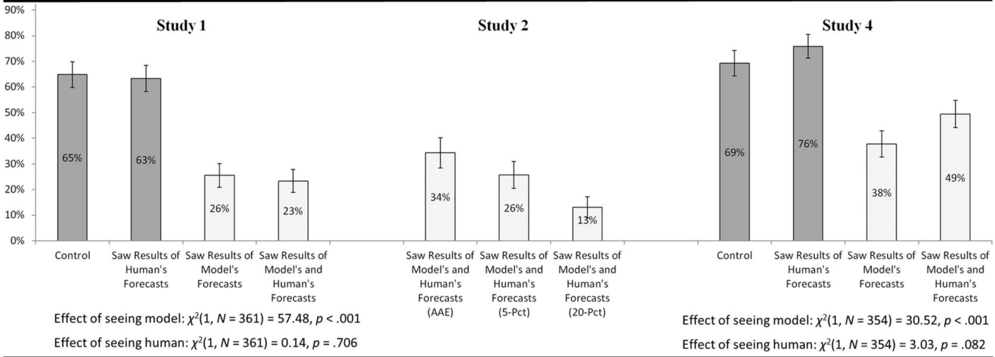
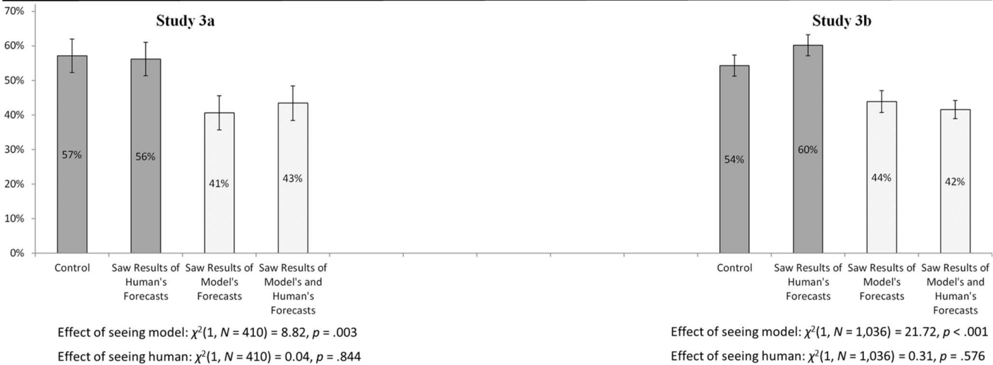
- Across five studies, seeing the algorithm perform reduced participants’ likelihood of choosing it over a human forecaster. In the model-and-human conditions, 610 of 741 participants (83%) saw the model outperform the human, yet these participants were among the least likely to choose the model.
- The model outperformed humans in all five studies. For example, bonuses if choosing model vs. human were Study 1: $1.78 vs. $1.38; Study 2: $1.77 vs. $1.09; Study 3a: $0.48 vs. $0.31; Study 3b: $0.49 vs. $0.30; Study 4: $1.79 vs. $1.38. Human forecasters produced 15–29% more error in the MBA task and 90–97% more error in the airline-passenger task.
- Seeing the model perform significantly decreased confidence in the model’s forecasts in all four studies where this was tested, whereas seeing the human perform significantly decreased confidence in the human only in Study 4. Confidence in the model’s forecasts significantly mediated the effect of seeing the model perform on choosing the model; confidence in the human did not.
- In Study 2, participants paid for forecasts within 20 percentiles were less likely to choose the model than those paid within 5 percentiles, χ²(1, N = 139) = 3.56, p = .059, and those paid by average absolute error, χ²(1, N = 136) = 8.56, p = .003; this effect was mediated by confidence in their own forecasts, not confidence in the model’s forecasts.
Methods
- Five studies had participants forecast real outcomes: MBA student success (Studies 1, 2, and 4) or U.S. state rank in airline passengers (Studies 3a and 3b). Participants were assigned to control, human, model, or model-and-human conditions, then chose whether to tie incentivized bonuses to the model or the human forecaster (themselves in Studies 1–3, another participant in Study 4).
- Final samples were Study 1: 361; Study 2: 206; Study 3a: 410; Study 3b: 1,036; Study 4: 354. Studies 1, 2, and 4 were run in the Wharton Behavioral Lab; Studies 3a and 3b used Amazon Mechanical Turk.
- Main analyses compared forecasting performance and choice rates, measured confidence and beliefs, and used binary mediation analyses with Preacher and Hayes’s bootstrapping procedure.
Limitations
- The paper states it did not explore all boundaries of the effect, including whether it would persist if algorithms were many times more accurate than humans, and whether results depend on features shared by the two forecasting tasks.
- The paper states it did not explore how algorithm variations—complexity, transparency, forecaster involvement in construction, and designer expertise—affect algorithm aversion.
- The paper states algorithm aversion is not entirely driven by seeing algorithms err, and it has little to say about how best to reduce aversion among those who have seen an algorithm err. The text also cautions that cross-experiment comparisons should be made cautiously.
Model-written summary. Check it against the paper before relying on it.
Integrity signals
Registry
Cites
Statistics
Figures
Verification
Claims the paper makes
0 Valid · 2 Not valid · 16 Not checked · 90 Own results and interpretations
A result the paper reports from its own data — it cites no other source for it, so there is none to check. The quote shows it is in the paper.
In the paper
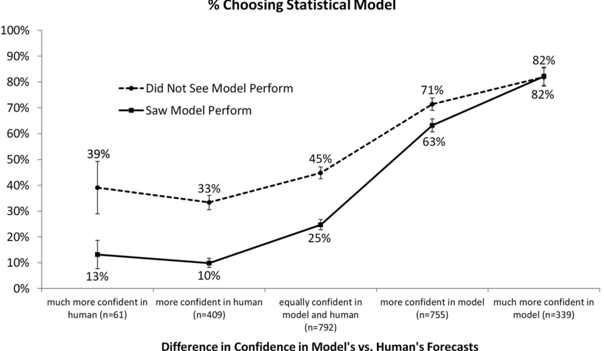
“the majority of people who were equally confident in the model's and human's forecasts chose to tie their bonuses to the human's forecasts, particularly when they had seen the model perform.”
plainstates an association- Asserted: passes — The authors put it forward as true.
- Checkable: passes — It can be checked against evidence.
- Load-bearing: passes — The paper’s conclusions depend on it.
- Based: passes — The paper gives a reason why it holds.
A result the paper reports from its own data — it cites no other source for it, so there is none to check. The quote shows it is in the paper.
In the paper
“Consistent with research on the adoption of decision aids (see Highhouse, 2008), participants thought that the human forecasters were better than the model at getting better with practice, learning from mistakes, and finding underappreciated candidates.”
plain- Asserted: passes — The authors put it forward as true.
- Checkable: passes — It can be checked against evidence.
- Load-bearing: passes — The paper’s conclusions depend on it.
- Based: passes — The paper gives a reason why it holds.
A result the paper reports from its own data — it cites no other source for it, so there is none to check. The quote shows it is in the paper.
In the paper
“Our studies show that this resistance at least partially arises from greater intolerance for error from algorithms than from humans.”
plainstates a possible cause- Asserted: passes — The authors put it forward as true.
- Checkable: passes — It can be checked against evidence.
- Load-bearing: passes — The paper’s conclusions depend on it.
- Based: passes — The paper gives a reason why it holds.
A result the paper reports from its own data — it cites no other source for it, so there is none to check. The quote shows it is in the paper.
In the paper
“Participants rightfully thought that the model was better than human forecasters at avoiding obvious mistakes, appropriately weighing various attributes, and consistently weighing information.”
plain- Asserted: passes — The authors put it forward as true.
- Checkable: passes — It can be checked against evidence.
- Load-bearing: unclear — It is unclear whether the paper’s conclusions depend on it.
- Based: passes — The paper gives a reason why it holds.
A result the paper reports from its own data — it cites no other source for it, so there is none to check. The quote shows it is in the paper.
In the paper
“This effect was evident in two distinct domains of judgment, including one in which the human forecasters produced nearly twice as much error as the algorithm.”
plain- Asserted: passes — The authors put it forward as true.
- Checkable: passes — It can be checked against evidence.
- Load-bearing: unclear — It is unclear whether the paper’s conclusions depend on it.
- Based: passes — The paper gives a reason why it holds.
75 more claims
Create a free account to see all 108 claims and to verify the 12 references still open.
- It may state two separate claims as one. 13
- Probably not a substantial claim. 16
Claims other papers make about this one
Each is checked against this paper’s own text: does it say what the citing paper says it does?
The source backs part of the claim, not all of it — or backs it for a different population, condition or comparison.
In the citing paper
“Traditional theorizing assumes trade-offs between trust and skepticism (Dietvorst et al., 2015), automation and engagement (Freeman et al., 2014), or efficiency and depth (Ishowo-Oloko et al., 2019)”
From Pedagogical partnerships with generative AI in higher education: how dual cognitive pathways paradoxically enable transformative learning (2026) · cites this paper as Dietvorst et al., 2015
Experimental — accuracy not yet measuredThe source backs part of the claim, not all of it — or backs it for a different population, condition or comparison.
In the citing paper
“Existing research typically examines trust versus skepticism in human-AI interactions as binary constructs (Dietvorst et al., 2015; Logg et al., 2019), missing the possibility that partnerships might simultaneously activate both vigilant and offloading behaviors.”
From Pedagogical partnerships with generative AI in higher education: how dual cognitive pathways paradoxically enable transformative learning (2026) · cites this paper as Dietvorst et al., 2015
Experimental — accuracy not yet measuredThe source backs part of the claim, not all of it — or backs it for a different population, condition or comparison.
In the citing paper
“It aligns with the theoretical rationale on algorithm aversion (Dietvorst et al. 2015;Hohensinn et al. 2024) and appreciation (Logg et al. 2019), which suggests that people are more likely to accept and trust AI systems when they produce desirable results but become skeptical when outcomes are unfavorable.”
From Holding AI Accountable Like Herding Cats: The Contingent Impact on the Legitimacy of Algorithmic Bureaucracy (2026) · cites this paper as Dietvorst et al. 2015
Experimental — accuracy not yet measuredThe source backs part of the claim, not all of it — or backs it for a different population, condition or comparison.
In the citing paper
“Research on algorithm appreciation and algorithm aversion further suggests that people may either defer to algorithms or reject them depending on prior experience, perceived expertise, and error visibility (Dietvorst et al., 2015; Logg et al., 2019).”
From College students' metacognitive awareness of generative-AI reliance: an experimental study of decision confidence and attribution bias (2026) · cites this paper as Dietvorst et al., 2015
Experimental — accuracy not yet measuredThe source backs part of the claim, not all of it — or backs it for a different population, condition or comparison.
In the citing paper
“Earlier research has mentioned gender, self-confidence, expertise, and general algorithm aversion or appreciation.15,28”
From Appropriate trust in artificial intelligence for the optical diagnosis of colorectal polyps: the role of human/artificial intelligence interaction (2024) · cites this paper as [28]
Experimental — accuracy not yet measured
22 more claims about this paper
Create a free account to see every claim other papers make about this one.
Statistics recomputed
Every reported test result, recomputed from its test statistic and degrees of freedom. A result shows as not adding up only once an independent check has confirmed it.
- Consistentt(360) = 4.98reported p < .001 · recomputed p < .001
“t (360) = 4.98, p < .001”
- Consistentt(204) = 6.26reported p < .001 · recomputed p < .001
“t (204) = 6.26, p < .001”
- Consistentt(405) = 7.73reported p < .001 · recomputed p < .001
“t (405) = 7.73, p < .001”
- Consistentt(353) = 5.11reported p < .001 · recomputed p < .001
“t (353) = 5.11, p < .001”
- Consistentχ²(1) = 39.94reported p < .001 · recomputed p < .001
“χ 2 (1, N = 271) = 39.94, p < .001”
19 more recomputed tests
Create a free account to see every test the Stats check recomputed.
Self-check
Percentages, sums and reported differences re-computed from the paper’s own numbers.
Self-check results appear here once an independent check has confirmed them.
Citations
Cites
Preacher, K. J., & Hayes, A. F. (2008) · Behavior Research Methods · doi:10.3758/brm.40.3.879 · Cited by 34,117 · cited 1×
“We then used Preacher and Hayes’s (2008) bootstrapping procedure to obtain unbiased 95% confidence intervals around the mediated effects.”
Method(2023) · doi:10.1126/science · Cited by 6,063
The trouble with overconfidence.
Moore, D. A., & Healy, P. J. (2008) · Psychological Review · doi:10.1037/0033-295x.115.2.502 · Cited by 2,358
“Clinical versus Actuarial Judgment.”
Dawes, R. M., Faust, D., & Meehl, P. E. (1989) · Science · doi:10.1126/science.2648573 · Cited by 2,298
The robust beauty of improper linear models in decision making.
Dawes, R. M. (1979) · American Psychologist · doi:10.1037/0003-066x.34.7.571 · Cited by 1,966
Preference and belief: Ambiguity and competence in choice under uncertainty
Heath, C., & Tversky, A. (1991) · Journal of Risk and Uncertainty · doi:10.1007/bf00057884 · Cited by 1,654
Clinical versus mechanical prediction: a meta-analysis
Grove, W. M., Zald, D. H., Lebow, B. S., Snitz, B. E., & Nelson, C. (2000) · Psychological Assessment · doi:10.1037/1040-3590.12.1.19 · Cited by 1,640
Grove, W. M., & Meehl, P. E. (1996) · Psychology, Public Policy, and Law · doi:10.1037/1076-8971.2.2.293 · Cited by 1,457 · cited 4×
“…1996), the notion that algorithms cannot properly consider individual targets (Grove & Meehl, 1996), concerns about the ethicality of relying on algorithms to make important decisions (Dawes, 1979), and the presumed inability of algorithms to incorporate qualitative data (Grove & Meehl, 1996).”
BackgroundMethodInfluential(2007) · Cited by 1,133
Competing on analytics: the new science of winning
(2007) · Choice Reviews Online · doi:10.5860/choice.44-6322 · Cited by 941
Research works printed but not linked: 1
- Clark, D. (2012, November 7). How Nate Silver won the 2012 presidential election. Harvard Business Review Blog . Retrieved from http://blogs .hbr.org/cs/2012/11/how\_nate\_silver\_won\_the\_2012\_p.html
Cited by
Items 3,601–3,700 of 3,918
Rosalika, I., Akil, I., Harun, M., Indrarti, W., & Zakaria, L. K. (2026) · SABER Jurnal Teknik Informatika Sains dan Ilmu Komunikasi · doi:10.59841/saber.v4i4.4129
Dio, C. D., Manzi, F., Peretti, G., Longoni, F., Gallese, V., Massaro, D., Gilli, G., & Marchetti, A. (2026) · Computers in Human Behavior Reports · doi:10.1016/j.chbr.2026.101364
AI-coaching and well-being in sales: a theory of tools perspective
Childs, D. R. N., Good, V., Fehl, A. G., Tanner, E., & Lee, N. J. (2026) · Journal of Personal Selling and Sales Management · doi:10.1080/08853134.2026.2738649
Tang, G. (2026) · International Journal of Human-Computer Interaction · doi:10.1080/10447318.2026.2739765
Ira: utilizar la inteligencia artificial para dañar
Polanía, L. R. (2026) · doi:10.62486/978-9915-9928-6-0.ch06
Mızrak, F., Kırgız, A. C., & Demirel, H. G. (2026) · Journal of Intelligence · doi:10.3390/jintelligence14100248
Intelligent Leadership in the Age of AI: Navigating Paradox, Uncertainty, and Hybrid Decision-Making
Truong, N., Kumar, V., & Hasan, M. (2026) · Advances in computational intelligence and robotics book series · doi:10.4018/979-8-2600-1488-2.ch010
AI–teacher collaboration: professional capital, cultural values and identity grafting
Lee, D. H. L., Huang, R., & Chiu, M. M. (2026) · Journal of Professional Capital and Community · doi:10.1108/jpcc-02-2026-0060
Soberbia: creer que la inteligencia artificial lo sabe todo
de la Cruz, J. E. H., Polanía, L. R., & Castillo, V. S. (2026) · doi:10.62486/978-9915-9928-6-0.ch01
The Epistemic Leader: Developing Epistemic Evaluation Capability in AI Leadership
Nguyen, V. M. H., Attanayake, C., & Le, Q. K. (2026) · Advances in computational intelligence and robotics book series · doi:10.4018/979-8-2600-1488-2.ch011
Pereza: delegar aquello que deberíamos aprender, pensar o decidir
Cano, C. A. G., & Pérez, J. E. P. (2026) · doi:10.62486/978-9915-9928-6-0.ch07
Trust in AI-mediated electronic commerce: a systematic review and integrative framework
Jadhav, K. (2026) · Digital Enterprise Studies · doi:10.68217/c2qss455
Ortegón, A. D. P. B., Hernandez, P. R. J., & Ricaurte, G. F. M. (2026) · Advances in computational intelligence and robotics book series · doi:10.4018/979-8-2600-1488-2.ch002
Dang, C. T., & Nguyen, A. (2026) · arXiv (Cornell University) · doi:10.48550/arxiv.2610.07097
When the Buyer Is a Machine: Marketing to AI Purchasing Agents in Business-to-Business MarketsPreprint
Maneesha (2026) · SSRN Electronic Journal · doi:10.2139/ssrn.7571839
Lujuria: la fascinación desbordada por lo artificial
Gamboa, A. J. P. (2026) · doi:10.62486/978-9915-9928-6-0.ch03
The Invisible Executive: Decision Authority and Accountable AI in Credit Union Commercial LendingPreprint
anon, P. (2026) · SSRN Electronic Journal · doi:10.2139/ssrn.7585718
Arisantoso, A., Mutiara, A. B., Alkalbani, A. S., Anwar, S., & Mulya, M. F. (2026) · Applied Information System and Management (AISM) · doi:10.15408/aism.v9i2.53455 · Cited by 1
The next frontier in healthcare simulation is human-AI teaming
Shaikh, S. J., & Eppich, W. (2026) · Advances in Simulation · doi:10.1186/s41077-026-00479-y
(2026) · Scientific Papers of Silesian University of Technology Organization and Management Series · doi:10.29119/1641-3466.2026.251.4
Wei, C. (2026) · Unveiling seven continents yearbook journal · doi:10.65326/u7y10032
Research Progress in Usability Engineering for Artificial Intelligence Medical Device
付, 若. (2026) · Instrumentation and Equipments · doi:10.12677/iae.2026.144052
People change their decisions when an AI system contradicts them, given a counterfactual explanation
Dai, X., Keane, M. T., Shalloo, L., Ruelle, E., & Byrne, R. M. J. (2026) · Journal of Psychology and AI · doi:10.1080/29974100.2026.2730738
Human-in-the-Loop AI for Exposure Detection in Loan Portfolio Monitoring
Mehra, A. (2026) · Journal of Computer Science and Technology Studies · doi:10.32996/jcsts.2026.8.10.8
Shane, S. A., Sheremeta, R. M., Wang, S., & Xiong, H. (2026) · SSRN Electronic Journal · doi:10.2139/ssrn.7597401
Abdallah, M. W. M. L. (2026) · Digital Commons - University of South Florida (University of South Florida)
Sepasgozar, S. M. E. (2026) · Encyclopedia · doi:10.3390/encyclopedia6100225
Sadiq, B., Rawoof, H. A., & Ramay, M. I. (2026) · Qlantic journal of social sciences. · doi:10.55737/qjss.vii-v.26601
From algorithm performance to clinical value in AI-assisted skin cancer diagnostics
Ocker, L., Livingstone, E., Lodde, G. C., Stockfleth, E., Rached, N. A., Schadendorf, D., & Nüesch, S. (2026) · Frontiers in Digital Health · doi:10.3389/fdgth.2026.1896521
Logic or Emotion? The Impact of Persuasion Strategies on Human-AI Trust
Li, T., & Yue, Q. I. (2026) · International Journal of Human-Computer Interaction · doi:10.1080/10447318.2026.2740322
Ahmed, D. S. A. (2026) · British Journal of Contemporary Research · doi:10.67693/bjcr-pyrrlvri
Prasad, K., Singh, S., Pathak, A., Srinivas, V., & Kothari, H. (2026) · Work · doi:10.1177/10519815261491278
Using AI, Doubting AI: Developer Mental Models and Trust in AI-Assisted Software Work
DSILVA, N. (2026) · International Journal of Human-Computer Interaction · doi:10.1080/10447318.2026.2743445
Endüstri 6.0’a Doğru Algoritmik Yönetişim: Operasyon Kararlarında Yetki, Güven ve Kontrol
Destebaşi, M. İ. (2026) · Özgür Yayınları eBooks · doi:10.58830/ozgur.pub1487.c5927
Artificial Intelligence and Employee Innovation: A Literature Review
Cun, X., Zhang, L., & Ren, J. (2026) · Behavioral Sciences · doi:10.3390/bs16101890
Longmire, J. N. (2026) · Routledge eBooks · doi:10.4324/9781003662914
Converse, E., Louie, R., Safer, D. L., Pacheco, J. P., Fang, W., Kent, J., Arnow, B. A., & Yang, D. (2026) · Interactive Journal of Medical Research · doi:10.2196/93199
Lv, D., Sun, R., Jiang, X., Zhu, Q., & Cheng, Y. (2026) · International Journal of Consumer Studies · doi:10.1111/ijcs.70270
Elmadag, A. B., & Ghimire, A. (2026) · Marketing Education Review · doi:10.1080/10528008.2026.2705297
AI Transparency And Consumer Judgments: A Meta-Analysis Of Disclosure And Explainability
DAS, A., Chandra, B., & Mondal, K. (2026) · doi:10.65677/rlr.v34i2.364
Kumar, A., & Mahto, U. K. (2024) · ShodhKosh Journal of Visual and Performing Arts · doi:10.29121/shodhkosh.v5.i5.2024.9302
Raheemah, S. H. (2026) · Acta Innovations · doi:10.62441/actainnovations.v63i1s.1689
Holm, R., Konagurthu, S., Ahmed, T., Louit, G., Griffin, B. T., Holm, S., Jansook, P., Wu, W., Lü, Y., Allen, C., et al. (2026) · European Journal of Pharmaceutical Sciences · doi:10.1016/j.ejps.2026.107688
Expected reciprocity and cooperative trust in interactions,with algorithms versus humansPreprint
Zhang, Y., Mulder, M., Kenemans, J. L., Aarts, H., Somai, M., & Liefooghe, B. (2026) · SSRN Electronic Journal · doi:10.2139/ssrn.7610121
Zipperling, D., Deck, L., Lanzl, J., & Kühl, N. (2026) · ACM Transactions on Interactive Intelligent Systems · doi:10.1145/3858913
When Source Disclosure Matters: User Perceptions of Generative AI Authorship in Landing Page Content
Mirza, H. (2026) · Tuwhera (Auckland University of Technology)
Heartly, L. (2026) · Octopus · doi:10.57874/xbpm-zf45
Do Financing and Investment- Based Courses Influence the Gen-Z Investment?
Hasanah, E. N., Wiryono, S. K., & Koesrindartoto, D. P. (2026) · Finance: Theory and Practice · doi:10.26794/2587-5671-2026-30-5-249-259
Feeling or thinking? User aversion to AI customer service in online education
He, Y., & Huang, L. (2026) · Frontiers in Psychology · doi:10.3389/fpsyg.2026.1956842
Dijital Rönesans: Pazarlamada Yeni Teknolojik Paradigmalar
(2026) · Özgür Yayınları eBooks · doi:10.58830/ozgur.pub1494
Namkoong, J., & Burnham, T. A. (2026) · Education Sciences · doi:10.3390/educsci16101718
Kim, N., Chung, M., Jones-Jang, S. M., Lee, S., & Choi, J. (2026) · International Journal of Human-Computer Interaction · doi:10.1080/10447318.2026.2744841
Yapay Zekâ Aracılı Alışverişte Pazarlamanın Dönüşümü: Tüketici Karar Sürecinden Marka Stratejilerine
Akdeniz, M. (2026) · Özgür Yayınları eBooks · doi:10.58830/ozgur.pub1494.c5967
Understanding Human-AI Trust in Military AI Applications: A Multistage Human Factors Framework
Kim, K. (2026) · International journal of industrial engineering
Wang, Z., & Tang, C. (2026) · PLoS ONE · doi:10.1371/journal.pone.0360731
Song, X., Liu, M. T., Mo, Z., Lo, F., Lee, V., & Tian, A. D. (2026) · Journal of Research in Interactive Marketing · doi:10.1108/jrim-02-2026-0103
Baig, U., Sair, S. A., & Lodhi, R. N. (2026) · Insights (Bhalwal) International Journal of Humanities Management and Social Sciences · doi:10.68156/cgfvez22
Closed-Loop Order Risk Monitoring Using Statistical Learning and Operational Write-Back
Kakarla, V. G. (2026) · International Journal of Artificial Intelligence and Machine Learning · doi:10.51483/ijaiml.2852
Demydova, A. A. (2026) · American Journal of Business and Management Innovation · doi:10.54536/ajbmi.v1i1.8718
The AI Trust Gap: Consumer Perceptions of AI-Powered Digital Marketing
Holt, J. W., & Nguyen, L. (2026) · Marketing Management Journal · doi:10.63963/001c.172170
Algorithmic Provenance: When and Why Consumers Discount Products Made With AI ‐Involved Processes
Sreejesh, S., & Singha, S. (2026) · Journal of Consumer Behaviour · doi:10.1002/cb.70262
When AI Sets the Price: How Consumers Interpret Price Formats and Intent
Chacon, A., & Limongi, R. (2026) · Journal of Consumer Affairs · doi:10.1111/joca.70080
Liu, S., & Liu, T. (2026) · Frontiers in Psychology · doi:10.3389/fpsyg.2026.1946487
Hlynsson, J. I., Andersson, G., & Carlbring, P. (2026) · Internet Interventions · doi:10.1016/j.invent.2026.101012
Who embraces, who uses, who questions? the global reception of ChatGPT across six continents
Awais, M. (2026) · Technology in Society · doi:10.1016/j.techsoc.2026.103541
A task-instance level investigation of the determinants of AI utilization in augmentation settings
Beljon, L. (n.d.) · TU/e Research Portal
When AI shops for me: How agentic retail representation turns assistance into purchase delegation
Alyahya, M. A., Agag, G., & Shehawy, Y. M. (2026) · Journal of Retailing and Consumer Services · doi:10.1016/j.jretconser.2026.105174
Mapping Generative AI, Consumer Behavior, and Digital Trust in Global Marketing
Petroccione, G., & Asady, S. (2026) · Journal of Global Marketing · doi:10.1080/08911762.2026.2747193
Pradityatma, M., & Nugroho, A. (2026) · Data Journal of Information Systems and Management · doi:10.61978/data.v4i3.2005
From hype to hesitation: Negative effects of AI incidents in crowdfunding
Han, Y. X., Hu, W., & Wang, H. E. (2026) · The British Accounting Review · doi:10.1016/j.bar.2026.101987
Role of Emotional Intelligence in the Adoption of Artificial Intelligence by EntrepreneursPreprint
Pathak, S., & Muralidharan, E. K. (2026) · SSRN Electronic Journal · doi:10.2139/ssrn.7625231
Risky-choice framing sensitivity in LLMs and impact on human decisions
Babin, J. J., & Chauhan, H. S. (2026) · Computers in Human Behavior Reports · doi:10.1016/j.chbr.2026.101384
Quem faz cada etapa? A IA generativa como executora de tarefas e a mudança na rotina de trabalho
Hayoshi, D. (2026) · Revista fisio&terapia. · doi:10.69849/cpd6h006
Intelligent Audit Risk Assessment Using Machine Learning and Explainable Artificial Intelligence
Qarni, E. M. A., Škoda, M., Vochоzka, M., SALAMEH, M. A. A., Смайлов, Н., & Jaramillo, S. A. V. (2026) · Computer and decision making. · doi:10.1922/comdem.v3i2s.18734
Lee, C., & Jin, K. (2026) · Information & Management · doi:10.1016/j.im.2026.104454
Sürdürülebilir Tüketimde Yapay Zekâ
(2026) · Özgür Yayınları eBooks · doi:10.58830/ozgur.pub1526
Bradford, B., Kyprianides, A., Wells, H., Aston, E., O’Neill, M., & Clayton, E. (2026) · Police Practice and Research · doi:10.1080/15614263.2026.2741740
Yapay Zekâ Destekli Yeşil Dürtme ve Sürdürülebilir Tüketici Kararları: Kavramsal Bir Model
TAFLAN, A., & İPÇİOĞLU, İ. (2026) · Özgür Yayınları eBooks · doi:10.58830/ozgur.pub1526.c6160
Synthetic corroboration: when AI interpretation looks like independent evidence
Du, Y. (2026) · Journal of Psychology and AI · doi:10.1080/29974100.2026.2750743
Yönetim Bilişim Sistemlerinde Güncel Yaklaşımlar
Sinap, V. (2026) · Özgür Yayınları eBooks · doi:10.58830/ozgur.pub1539
Altan, S. (2026) · Özgür Yayınları eBooks · doi:10.58830/ozgur.pub1539.c6225
Cultural Bias in Generative AI Negotiation Advice: Evidence from a Large-Scale Audit
Tsekouras, D., Küçükyılmaz, T., & Gladys, M. (n.d.) · AIS Electronic Library (AISeL)
Who Really Decides? Delegation Regimes and Reorganization of Human Control under Agentic AI
Kim, T., Lee, O.-K. D., & 강주영 (n.d.) · AIS Electronic Library (AISeL)
Who Decided My Claim? Disclosed versus Attributed Decision Authority in AI-Assisted Insurance ClaimsPreprint
Lim, T., Koh, W. S., Guan, C., Wang, Z., & Shi, J. (2026) · SSRN Electronic Journal · doi:10.2139/ssrn.7623218
From curiosity to churn: A longitudinal analysis of user engagement with an LLM-powered social bot
Lin, C., Wang, W., & Jiang, Z. (2026) · Telematics and Informatics · doi:10.1016/j.tele.2026.102473
To Trust or Not to Trust AI Translation: The Case of Disaster Messages
Uesugi, S., & Morita, M. (2026) · Lecture notes in computer science · doi:10.1007/978-981-92-6910-5_25
Selvi, Ö., Yılmaz, A., Yalman, S., Korkmaz, Ö., & Altun, H. (2026) · Healthcare · doi:10.3390/healthcare14203520
When Humans Become the Risk: Strategic Dehumanization in AI Decision Delegation
Yang, Y., Tong, S., Gu, X., & Peng, K. (2026) · Lecture notes in computer science · doi:10.1007/978-981-92-6913-6_37
van Ooijen, I., Schaap, G., van Bekkum, M., & Borgesius, F. Z. (2026) · Computers in Human Behavior Reports · doi:10.1016/j.chbr.2026.101395
Waqar, S. (2026) · SSRN Electronic Journal · doi:10.2139/ssrn.7621661
Kanakamedala, V. R. (2026) · SSRN Electronic Journal · doi:10.2139/ssrn.7635485
Jordan, S., Friess, M., Dannenmann, B., Westphal, J., Rangarajan, D., & Kracklauer, A. H. (2026) · The Journal of Marketing Theory and Practice · doi:10.1080/10696679.2026.2743750
When Less is Worse Than More: AI Assistance Intensity and the Disengagement Zone in Writing
Siemon, D., de Vreede, T., & de Vreede, G. (n.d.) · AIS Electronic Library (AISeL)
Chen, Z., Burtch, G., Gu, B., & Liu, Y. (n.d.) · AIS Electronic Library (AISeL)
Blame the Prompt: How Experts Attribute AI Errors in Hybrid Teams
Govorusic, A., Wunderlich, P., & Steininger, D. M. (2026) · AIS Electronic Library (AISeL)
Baum, L., Hering, F., Oprée, S., & Hinz, O. F. (n.d.) · AIS Electronic Library (AISeL)
Metadata
- Authors
- Dietvorst, B. J., Simmons, J. P., & Massey, C.
- Affiliations
- University of Pennsylvania (US)
- Venue
- Journal of Experimental Psychology: General
- Published
- 2015
- Volume
- 144
- Issue
- 1
- Pages
- 114-126
- ISSN
- 0096-3445 (ISSN-L)
- 1939-2222
- OpenAlex
- W3125633690
- Cited by
- 3,232
- References
- 22
- Citations by year
- 2026: 1025 · 2025: 563 · 2024: 445 · 2023: 404 · 2022: 266 · 2021: 216 · 2020: 137 · 2019: 88 · 2018: 41 · 2017: 26 · 2016: 14 · 2015: 5
- FWCI
- 13.96
- Type
- journal article
- Language
- en
- Open access
- green
- doi.org
- Locations
- Journal of Experimental Psychology General (publishedVersion)
- SSRN Electronic Journal (publishedVersion)
- PubMed (publishedVersion)
- ScholarlyCommons (University of Pennsylvania) (submittedVersion)
- Funders
- Wharton Behavioral Laboratory
- Wharton Risk Center Ackoff Doctoral Student Fellowship
- Topics
- Social Sciences › Decision Sciences › General Decision Sciences › Decision-Making and Behavioral Economics
- Social Sciences › Decision Sciences › Management Science and Operations Research › Forecasting Techniques and Applications
- Social Sciences › Human Factors and Ergonomics › Human-Automation Interaction and Safety
- Keywords
- algorithm aversion, trust in algorithms, prediction confidence, evidence-based algorithm, decision-making
- MeSH terms
- Algorithms, Avoidance Learning, Culture, Decision Making, Female, Forecasting, Humans, Male, Motivation, Comprehension, Young Adult
About these checks
Registry, retraction, Cites and statistics results are computed, not judged, with one exception: a printed reference that no index lists is read once by a model before it counts as a citation error. Claims are extracted by a model and kept only when their quote appears verbatim in the text; each cited source is then checked, with a model’s help, for whether it says what the claim relies on. Those verdicts can be wrong — read the claim’s quote and the cited source before relying on one.
A language model drew the claims from the paper on 2026-11-14, under version 3 of the claim definition (model deepseek-v4.1-flash, prompt extract-v3).
A second model labelled each claim on 2026-11-14 (model jev-1.13-20260917, definition revision gold-guideline-v0.2).
Statistics and arithmetic are recomputed, not judged.
Confidence bands are shown only for fields calibrated on our annotated test set. None is calibrated yet, so no band is shown.
What counts as a claim ›How we measure confidence ›How we check this ›
Are you an author, or do you see a problem with this page? Request a review
Data sources
Bibliographic data: Semantic Scholar, OpenAlex, Crossref.
Contains information from the Semantic Scholar Academic Graph Datasets, made available under the ODC Attribution License (ODC-BY 1.0).
Semantic Scholar’s data is described in: Kinney, R., et al. (2023). The Semantic Scholar Open Data Platform. arXiv:2301.10140.
