

A variational eigenvalue solver on a photonic quantum processor
Open accessThe DOI matches its Crossref record; 47 of the 48 references it cites were found in a registry or an index; 14 of the 31 sources its claims cite were checked for support.
Abstract
Quantum computers promise to efficiently solve important problems that are intractable on a conventional computer. For quantum systems, where the physical dimension grows exponentially, finding the eigenvalues of certain operators is one such intractable problem and remains a fundamental challenge. The quantum phase estimation algorithm efficiently finds the eigenvalue of a given eigenvector but requires fully coherent evolution. Here we present an alternative approach that greatly reduces the requirements for coherent evolution and combine this method with a new approach to state preparation based on ansätze and classical optimization. We implement the algorithm by combining a highly reconfigurable photonic quantum processor with a conventional computer. We experimentally demonstrate the feasibility of this approach with an example from quantum chemistry—calculating the ground-state molecular energy for He–H+. The proposed approach drastically reduces the coherence time requirements, enhancing the potential of quantum resources available today and in the near future. Quantum computers promise to efficiently solve problems that would be practically impossible with a normal computer. Peruzzo et al. develop a variational computation approach that uses any available quantum resources and, with a photonic quantum processing unit, find the ground-state molecular energy of He–H+.
Overview
CoChat Summary
## TL;DR
The paper introduces a variational alternative to quantum phase estimation for finding eigenvalues, combining short coherent quantum measurements with classical optimization. It experimentally demonstrates the approach on a photonic processor by estimating the ground-state energy curve of He–H\(^+\).
## Key findings
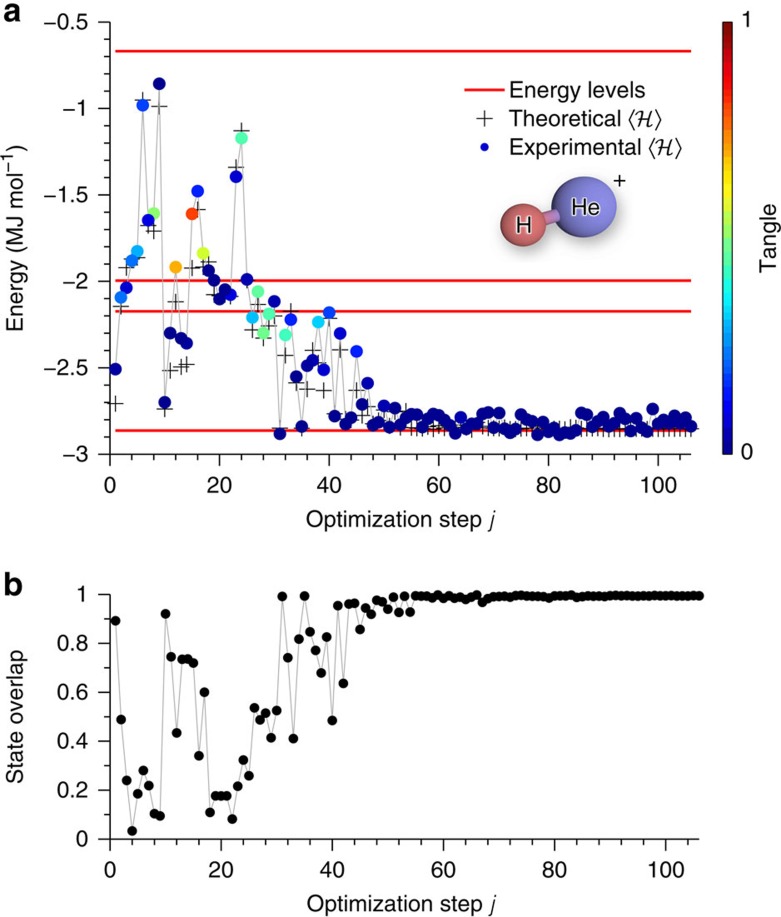
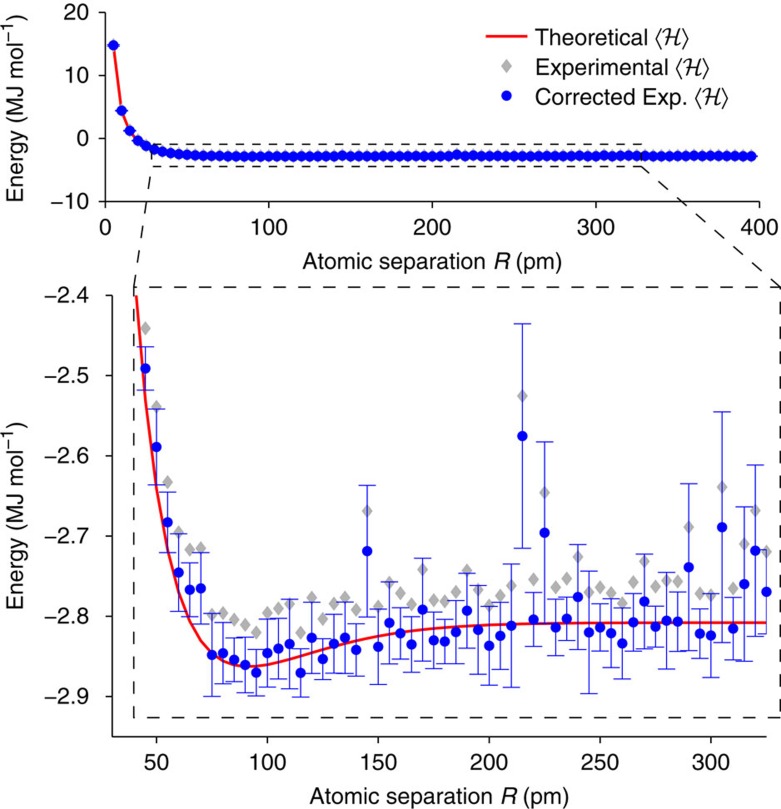
- The authors report an experimental ground-state result for He–H\(^+\): after correcting for experimental errors, they estimate the equilibrium bond length as \(R = 92.3 \pm 0.1\) pm and the ground-state electronic energy as \(E = -2.865 \pm 0.008\) MJ mol\(^{-1}\).
- For the bond dissociation curve, more than 96% of the experimental data are within chemical accuracy of the theoretical values.
- In the discussion, they state that for a 4 × 4 Hamiltonian like the one demonstrated, the QPE circuit would require at least 12 CNOT gates, whereas their method requires one.
- The full experiment was performed in about 158 h, and the bond dissociation curve was obtained by finding the ground states of 79 Hamiltonians.
## Methods
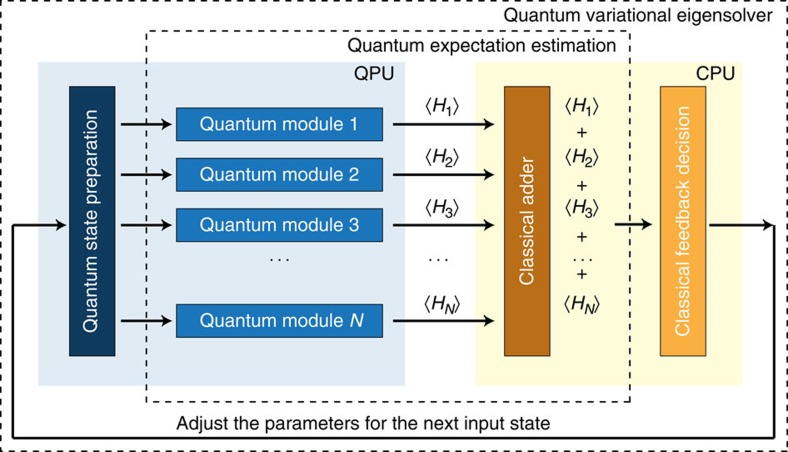
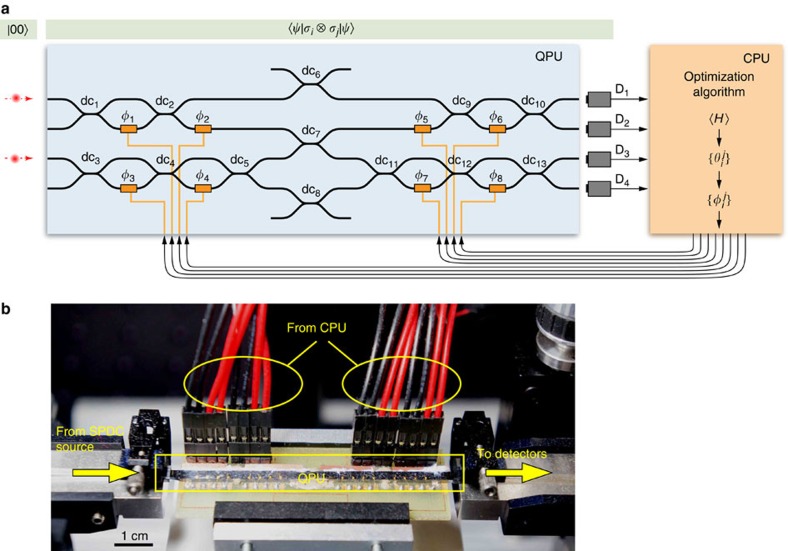
- The paper combines a reconfigurable integrated photonic quantum processor with a classical optimization algorithm: the quantum device estimates Hamiltonian expectation values, and the classical processor updates the state parameters variationally.
- The photonic chip prepares and measures arbitrary two-qubit pure states using single-qubit rotations and one two-qubit entangling gate; the experimental demonstration uses the He–H\(^+\) molecule in a minimal basis.
- For the classical optimization, they use the Nelder–Mead algorithm; expectation values are reconstructed from four two-qubit Pauli measurements at each point.
## Limitations
- The paper states that the method still requires a good approximation to the ground state as input/initialization, and the reliance on multiple separate measurements makes it sensitive to variations in state preparation between calculations.
- The authors report a constant systematic shift of \(\varepsilon = 50\) kJ mol\(^{-1}\) in the measured expectation values; they attribute this to photon-source impurity/distinguishability, circuit imperfections, and unbalanced coupling efficiencies.
- Evident from the text: the demonstration is limited to a two-qubit / 4 × 4 Hamiltonian prototype, so the scalability claim is not experimentally validated here.
Model-written summary. Check it against the paper before relying on it.
Integrity signals
Registry
Cites
Statistics
Figures
Verification
Claims the paper makes
7 Valid · 4 Not valid · 11 Not checked · 59 Own results and interpretations
The cited sources support only part of this claim — read each source’s verdict below.
In the paper
“Recent developments in the field of quantum computation offer a way forward for determining efficient solutions of many instances of large eigenvalue problems that are classically intractable6789101112”
§ A variational eigenvalue solver on a photonic quantum processor > Abstract
What the sources say
- Not matchedcites [6] Nielsen, M. A. & Chuang, I. L. Quantum Computation and Quantum Information Cambridge University Press (2000).
Couldn’t be matched to a paper in Crossref, so it can’t be checked.
- Could not verifycites [7] Kitaev, A. Quantum measurements and the Abelian stabilizer problem. Electronic Colloquium on Computational Complexity (ECCC) 3 (1996). sourceExperimental — accuracy not yet measured
Our copy under this DOI is the ISAAC 2021 paper 'Effective Resistance and Capacitance in Simplicial Complexes and a Quantum Algorithm' (Kitaev's 1995 work appears only as reference [9] in its bibliography), and it nowhere asserts that quantum computation gives efficient solutions to classically intractable large eigenvalue problems. Eigenvalues enter only as complexity parameters — λ, the smallest eigenvalue of the normalized up-Laplacian, in Lemma 31 and Theorem 26 (Section 6.3, 'Time efficient implementations') and in the phase-estimation machinery of Appendix A — and Section 1.1 ('Our Contributions') actually reports the opposite direction for its own problem: 'the quantum algorithm is slower than the classical algorithm in the worst case'. Searched: 'eigenvalue problems classically intractable', 'quantum speedup / exponential advantage', 'phase estimation', 'faster than classical'; no passage addresses the claim's point. (LLM, conf=0.70)
- Partly supportedcites [8] Griffiths, R. B. & Niu, C.-S. Semiclassical fourier transform for quantum computation. Phys. Rev. Lett. 76, 3228–3231 (1996). sourceExperimental — accuracy not yet measured
On p. 1, the paper says a quantum computer, if built, could solve certain problems such as factoring long numbers much faster than conventional algorithms. It also describes a simpler Fourier transform for Shor’s factorization and discrete-logarithm algorithms (p. 1). The copy does not support the claim about efficient solutions to many large eigenvalue problems. (LLM, conf=0.84)
plainstates a cause- Asserted: passes — The authors put it forward as true.
- Checkable: passes — It can be checked against evidence.
- Load-bearing: passes — The paper’s conclusions depend on it.
- Based: passes — The paper gives a reason why it holds.
- Not matched
Every source the paper cites for this claim was checked and supports it.
In the paper
“this would suffer from the N-representability problem, which is known to be intractable for both classical and quantum computers (it is in the quantum complexity class QMA-Hard24).”
§ A variational eigenvalue solver on a photonic quantum processor > Results > Quantum expectation estimation
What the sources say
- Supportedcites [24] Liu, Y.-K., Christandl, M. & Verstraete, F. Quantum computational complexity of the n-representability problem: Qma complete. Phys. Rev. Lett. 98, 110503 (2007). source
The paper states that N-representability is QMA-complete and hence QMA-hard and NP-hard (Abstract). Its discussion of quantum-chemistry relevance says the problem is intractable in the worst case even on a quantum computer, while allowing that particular physical systems may be easier. (LLM, conf=0.93)
boosted- Asserted: passes — The authors put it forward as true.
- Checkable: passes — It can be checked against evidence.
- Load-bearing: passes — The paper’s conclusions depend on it.
- Based: passes — The paper gives a reason why it holds.
- Supported
Every source the paper cites for this claim was checked and supports it.
In the paper
“We have implemented the QPU using integrated quantum photonics technology30.”
§ A variational eigenvalue solver on a photonic quantum processor > Results > Prototype demonstration
What the sources say
- Supportedcites [30] O'Brien, J. L., Furusawa, A. & Vuckovic, J. Photonic quantum technologies. Nat. Photon. 3, 687–695 (2009). source
The citation identifies integrated quantum photonics as the technology used, rather than attributing the citing authors’ QPU implementation to this review. The “Integrated quantum optical circuits” section (p. 6) describes on-chip waveguide circuits performing quantum logic gates and a compiled quantum factoring algorithm. (LLM, conf=0.87)
plain- Asserted: passes — The authors put it forward as true.
- Checkable: passes — It can be checked against evidence.
- Load-bearing: passes — The paper’s conclusions depend on it.
- Based: passes — The paper gives a reason why it holds.
- Supported
The cited sources support only part of this claim — read each source’s verdict below.
In the paper
“The time the quantum computer must remain coherent is determined by the necessity of O(p−1) successive applications of , each of which can require on the order of millions or billions of quantum gates for practical applications1719, as compared to the tens to hundreds of gates achievable in the short term.”
§ A variational eigenvalue solver on a photonic quantum processor > Abstract
What the sources say
- Partly supportedcites [17] Whitfield, J. D., Biamonte, J. & Aspuru-Guzik, A. Simulation of electronic structure hamiltonians using quantum computers. Mol. Phys. 109, 735–750 (2011). sourceExperimental — accuracy not yet measured
Split into 2 atoms — 1 confirmed, 1 partially supported, 0 disputed, 0 misattributed, 0 unverifiable. Expand the claim to see per-atom verdicts.
- Partly supportedcites [19] Jones, N. C. et al. Faster quantum chemistry simulation on fault-tolerant quantum computers. New J. Phys. 14, 115023 (2012). sourceExperimental — accuracy not yet measured
Split into 2 atoms — 0 confirmed, 2 partially supported, 0 disputed, 0 misattributed, 0 unverifiable. Expand the claim to see per-atom verdicts.
plainstates a cause- Asserted: passes — The authors put it forward as true.
- Checkable: passes — It can be checked against evidence.
- Load-bearing: passes — The paper’s conclusions depend on it.
- Based: passes — The paper gives a reason why it holds.
- Partly supported
A result the paper reports from its own data — it cites no other source for it, so there is none to check. The quote shows it is in the paper.
In the paper
“We experimentally demonstrate the feasibility of this approach with an example from quantum chemistry—calculating the ground-state molecular energy for He–H+.”
§ A variational eigenvalue solver on a photonic quantum processor > Abstract
boostedstates a causeSingle case- Asserted: passes — The authors put it forward as true.
- Checkable: passes — It can be checked against evidence.
- Load-bearing: passes — The paper’s conclusions depend on it.
- Based: passes — The paper gives a reason why it holds.
31 more claims
Create a free account to see all 81 claims and to verify the 4 references still open.
- It may state two separate claims as one. 28
- Probably not a substantial claim. 24
Claims other papers make about this one
Each is checked against this paper’s own text: does it say what the citing paper says it does?
The cited source doesn’t support the claim as written.
In the citing paper
“Leveraging quantum resources, the UCC ansatz was instead realized as a PQC on a photonic processor (Peruzzo et al. , 2014).”
From Noisy intermediate-scale quantum algorithms (2022) · cites this paper as Peruzzo et al., 2014
Checked by a reasoning model — may be wrong.
Experimental — accuracy not yet measuredThe cited source doesn’t support the claim as written.
In the citing paper
“The first on-chip GMM of four-qubit cluster state was realised in a laser-writing chip ( Fig.4e ), by manipulating both the polarisation and path DoFs of two photons [85].”
From Integrated photonic quantum technologies (2020) · cites this paper as [85]
Checked by a reasoning model — may be wrong.
Experimental — accuracy not yet measuredThe cited source doesn’t support the claim as written.
In the citing paper
“four-qubit linear- and box-cluster states are generated in a laser-writing photonic chip. This is enabled by on-chip manipulating the two-photon four-qubit hyperentangled state and cluster state, that are encoded in photon's path and polarisation DoFs. The Grover's search algorithm on a four-element database was implemented by controlling the device.”
From Integrated photonic quantum technologies (2020) · cites this paper as [85]
Checked by a reasoning model — may be wrong.
Experimental — accuracy not yet measuredThe source backs part of the claim, not all of it — or backs it for a different population, condition or comparison.
In the citing paper
“Due to its versatility, the variational Hamiltonian ansatz has been implemented for quantum chemistry [21, 29], optimization [24], and for quantum simulation problems [30].”
From Variational quantum algorithms (2021) · cites this paper as [29]
Experimental — accuracy not yet measuredThe source backs part of the claim, not all of it — or backs it for a different population, condition or comparison.
In the citing paper
“For the original VQE (Peruzzo et al. , 2014) and QAOA (Farhi et al. , 2014) it can, for example, be described as a single expectation value min θ ⟨ H ⟩ U ( θ ) , where the differences solely appear in the specific form and construction of the qubit Hamiltonian.”
From Noisy intermediate-scale quantum algorithms (2022) · cites this paper as Peruzzo et al., 2014
Experimental — accuracy not yet measured
12 more claims about this paper
Create a free account to see every claim other papers make about this one.
Citations
Cites
A Simplex Method for Function Minimization
Nelder, J. A., & Mead, R. (1965) · The Computer Journal · doi:10.1093/comjnl/7.4.308 · Cited by 28,905
Quantum computation and quantum information
Law, J. (2001) · ACM SIGSOFT Software Engineering Notes · doi:10.1145/505482.505499 · Cited by 18,842
(1999) · Cited by 12,854
Practical Methods of Optimization
Fletcher, R. (2000) · Wiley eBooks · doi:10.1002/9781118723203 · Cited by 7,605 · cited 3×
“[12] S.”
BackgroundMethodPractical methods of optimization
(1988) · Mathematics and Computers in Simulation · doi:10.1016/0378-4754(88)90129-2 · Cited by 5,818
Quantum Algorithm for Linear Systems of Equations
Harrow, A. W., Hassidim, A., & Lloyd, S. (2009) · Physical Review Letters · doi:10.1103/physrevlett.103.150502 · Cited by 3,325
Conn, A. R., Gould, N. I. M., & Toint, P. L. (2000) · Society for Industrial and Applied Mathematics eBooks · doi:10.1137/1.9780898719857 · Cited by 2,981 · cited 3×
“[14] D.”
MethodInfluential�ber das Paulische �quivalenzverbot
Jordan, P., & Wigner, E. (1928) · Zeitschrift f�r Physik · doi:10.1007/bf01331938 · Cited by 2,597
Molecular Electronic‐Structure Theory
Helgaker, T., Jørgensen, P., & Olsen, J. (2000) · doi:10.1002/9781119019572 · Cited by 2,594
O'Brien, J. L., Furusawa, A., & Vučković, J. (2009) · Nature Photonics · doi:10.1038/nphoton.2009.229 · Cited by 2,388
Self-citation
Research works printed but not linked: 3
- Helgaker, T., Jorgensen, P. & Olsen, J. Mol. Electronic Struct. Theory Wiley, Sussex (2002).
- Saad, Y. Numerical Methods for Large Eigenvalue Problems Vol. 158, (SIAM (1992).
- Rayleigh, J. W. In finding the correction for the open end of an organ-pipe. Phil. Trans. 161, 77 (1870).
Cited by
Items 1,001–1,100 of 4,572
Non-trivial symmetries in quantum landscapes and their resilience to quantum noise
Fontana, E., Cerezo, M., Arrasmith, A., Rungger, I., & Coles, P. J. (2020) · arXiv · doi:10.48550/arxiv.2011.08763 · Cited by 32
Dallaire-Demers, P.-L., & Wilhelm, F. K. (2016) · Physical Review A · doi:10.1103/physreva.93.032303 · Cited by 31
Quantum computation of reactions on surfaces using local embedding
Gujarati, T. P., Motta, M., Friedhoff, T., Rice, J. E., Nguyen, N., Barkoutsos, P. K., Thompson, R. J., Smith, T., Kagele, M., Brei, M., et al. (2023) · npj Quantum Information · doi:10.1038/s41534-023-00753-1 · Cited by 47
Noisy intermediate-scale quantum algorithm for semidefinite programming
Bharti, K., Haug, T., Vedral, V., & Kwek, L. C. (2022) · Physical Review A · doi:10.1103/physreva.105.052445 · Cited by 46
Kang, M., Nuomin, H., Chowdhury, S. N., Yuly, J. L., Sun, K., Whitlow, J., Valdiviezo, J., Zhang, Z., Zhang, P., Beratan, D. N., et al. (2024) · Nature Reviews Chemistry · doi:10.1038/s41570-024-00595-1 · Cited by 49
Solving various NP-hard problems using exponentially fewer qubits on a quantum computer
Chatterjee, Y., Bourreau, E., & Rančić, M. J. (2024) · Physical Review A · doi:10.1103/physreva.109.052441 · Cited by 57
Simulating Noisy Variational Quantum Algorithms: A Polynomial Approach
Shao, Y., Wei, F., Cheng, S., & Liu, Z. (2024) · Physical Review Letters · doi:10.1103/physrevlett.133.120603 · Cited by 99
“…Quantum (NISQ) era [1–3], Variational Quantum Algorithms (VQAs) [4–6] play a significant role in diverse fields like combinatorial optimization [7, 8], quantum chemistry [9– 11], quantum machine learning [12–15], quantum circuit compilation [16], and quantum error correction [17, 18], etc.”
BackgroundMethodWiersema, R., Kökcü, E., Kemper, A. F., & Bakalov, B. (2024) · npj Quantum Information · doi:10.1038/s41534-024-00900-2 · Cited by 118
Bootstrapping quantum process tomography via a perturbative ansatz
Govia, L. C. G., Ribeill, G. J., Ristè, D., Ware, M., & Krovi, H. (2020) · Nature Communications · doi:10.1038/s41467-020-14873-1 · Cited by 46
Algorithmic Error Mitigation Scheme for Current Quantum Processors
Suchsland, P., Tacchino, F., Fischer, M. H., Neupert, T., Barkoutsos, P. K., & Tavernelli, I. (2021) · Quantum · doi:10.22331/q-2021-07-01-492 · Cited by 45
“[5] Alberto Peruzzo, Jarrod McClean, Peter Shadbolt, Man-Hong Yung, Xiao-Qi Zhou, Peter J.”
Fock state-enhanced expressivity of quantum machine learning models
Gan, B. Y., Leykam, D., & Angelakis, D. G. (2022) · EPJ Quantum Technology · doi:10.1140/epjqt/s40507-022-00135-0 · Cited by 57
Quantum Computing at an Inflection Point: Are we Ready for a New Paradigm
Bhasin, A., & Tripathi, M. (2021) · IEEE Transactions on Engineering Management · doi:10.1109/tem.2021.3103904 · Cited by 43
“They have suggested overcoming such hurdles and demonstrating a hybrid model in algorithms like Quantum Approximate Optimization Algorithm [30] and Quantum Eigensolver [31].”
MethodBosse, J. L., & Montanaro, A. (2022) · Physical review. B./Physical review. B · doi:10.1103/physrevb.105.094409 · Cited by 49
Improving Quantum Measurements by Introducing “Ghost” Pauli Products
Choi, S., Yen, T.-C., & Izmaylov, A. F. (2022) · Journal of Chemical Theory and Computation · doi:10.1021/acs.jctc.2c00837 · Cited by 47
Pulse based Variational Quantum Optimal Control for hybrid quantum computing
de Keijzer, R., Tse, O. T. C., & Kokkelmans, S. J. J. M. F. (2023) · Quantum · doi:10.22331/q-2023-01-26-908 · Cited by 51
Quantum Algorithms for Scientific Computing and Approximate OptimizationPreprint
Hadfield, S. (2018) · arXiv (Cornell University) · doi:10.7916/d8x650c9 · Cited by 106
“Unfortunately, the combination of the size of m and the degree of the polynomial makes the algorithms impractical in many cases of interest [167, 189, 224, 240, 246].”
BackgroundInfluentialMolecule‐Specific Uncertainty Quantification in Quantum Chemical Studies
Reiher, M. (2022) · Israel Journal of Chemistry · doi:10.1002/ijch.202100101 · Cited by 29
Quantum Graph Neural Network Models for Materials Search
Ryu, J.-Y., Elala, E., & Rhee, J. K. (2023) · Materials · doi:10.3390/ma16124300 · Cited by 47
“These algorithms can be divided into pure quantum algorithms such as quantum phase estimation [4] and classical–quantum hybrid algorithms such as the variational quantum eigensolver [5].”
MethodAli, M., & Kabel, M. (2023) · Physical Review Applied · doi:10.1103/physrevapplied.20.014054 · Cited by 53
Quantum Machine Learning in Materials Prediction: A Case Study on ABO3 Perovskite Structures
Naseri, M., Gusarov, S., & Salahub, D. R. (2023) · The Journal of Physical Chemistry Letters · doi:10.1021/acs.jpclett.3c01703 · Cited by 34
Quantum Computing Techniques for Multi-knapsack Problems
Awasthi, A., Bär, F., Doetsch, J. A., Ehm, H., Erdmann, M., Hess, M., Klepsch, J., Limacher, P. A., Luckow, A., Niedermeier, C. A., et al. (2023) · Lecture notes in networks and systems · doi:10.1007/978-3-031-37963-5_19 · Cited by 56
Hybrid quantum neural network structures for image multi-classification
Shi, M., Situ, H., & Zhang, C. (2024) · Physica Scripta · doi:10.1088/1402-4896/ad3e3d · Cited by 42
Recent Advances in Deep Learning for Channel Coding: A Survey
Matsumine, T., & Ochiai, H. (2024) · IEEE Open Journal of the Communications Society · doi:10.1109/ojcoms.2024.3472094 · Cited by 44
“…noisy intermediate-scale quantum (NISQ) era [445], where the fidelity of quantum gates is limited by noise and decoherence, hybrid quantum-classical algorithms such as variational quantum eigensolver (VQE) [446] and quantum approximate optimization algorithm (QAOA) [447] are promising [448], [449].”
Scalable photonic quantum technologies
Wang, H., Ralph, T. C., Renema, J. J., Lu, C., & Pan, J.-W. (2025) · Nature Materials · doi:10.1038/s41563-025-02306-7 · Cited by 92
“Optics was one of the first physical systems to demonstrate quantum algorithms 102–104 and a universal set of quantum gates 14 , and it continues to be a leading contender as a platform for universal fault-tolerant quantum computation.”
Quantum Computing: Codebreaking and Beyond
Roetteler, M., & Svore, K. M. (2018) · IEEE Security & Privacy · doi:10.1109/msp.2018.3761710 · Cited by 33
Sugisaki, K., Yamamoto, S., Nakazawa, S., Toyota, K., Sato, K., Shiomi, D., & Takui, T. (2018) · Chemical Physics Letters · doi:10.1016/j.cpletx.2018.100002 · Cited by 36
Quantum Pure State Tomography via Variational Hybrid Quantum-Classical Method
Xin, T., Nie, X., Kong, X., Wen, J., Lu, D., & Li, J. (2020) · Physical Review Applied · doi:10.1103/physrevapplied.13.024013 · Cited by 32
Quantum computation of silicon electronic band structure
Cerasoli, F. T., Sherbert, K., Sławińska, J., & Nardelli, M. B. (2020) · Physical Chemistry Chemical Physics · doi:10.1039/d0cp04008h · Cited by 41
A quantum-computing advantage for chemistry
Yuan, X. (2020) · Science · doi:10.1126/science.abd3880 · Cited by 35
Mitarai, K., Suzuki, Y., Mizukami, W., Nakagawa, Y. O., & Fujii, K. (2022) · Physical Review Research · doi:10.1103/physrevresearch.4.033012 · Cited by 39
Accelerated Quantum Monte Carlo with Mitigated Error on Noisy Quantum Computer
Yang, Y., Lu, B.-N., & Li, Y. (2021) · PRX Quantum · doi:10.1103/prxquantum.2.040361 · Cited by 41
Simulating excited states of the Lipkin model on a quantum computer
Hlatshwayo, M. Q., Zhang, Y., Wibowo, H., LaRose, R., Lacroix, D., & Литвинова, Е. (2022) · Physical Review C · doi:10.1103/physrevc.106.024319 · Cited by 38
“First, we use the VQE algorithm [45] to compute the ground state and its energy for the LMG Hamiltonian.”
MethodA GNN-based predictor for quantum architecture search
He, Z., Zhang, X., Chen, C., Huang, Z., Zhou, Y., & Situ, H. (2023) · Quantum Information Processing · doi:10.1007/s11128-023-03881-x · Cited by 45
“Variational quantum algorithms (VQAs) [2, 3] have been the leading strategy to obtain quantum advantage in the NISQ era due to their resilience to errors and high flexibility with respect to quantum resource requirements including circuit depth and the number of qubits [2, 4–7].”
BackgroundPulse variational quantum eigensolver on cross-resonance-based hardware
Egger, D. J., Capecci, C., Pokharel, B., Barkoutsos, P. K., Fischer, L. E., Guidoni, L., & Tavernelli, I. (2023) · Physical Review Research · doi:10.1103/physrevresearch.5.033159 · Cited by 43
“Pulse-level control of cloud-based quantum computers [42, 43] enables a direct opti-a mization of the pulse parameters in the variational quantum eigensolver (VQE) [44].”
BackgroundBootstrapping quantum process tomography via a perturbative ansatz
Govia, L. C. G., Ribeill, G. J., Ristè, D., Ware, M., & Krovi, H. (2020) · RePEc: Research Papers in Economics · Cited by 32
Optimal quantum reservoir computing for the noisy intermediate-scale quantum era
Domingo, L., Carlo, G. G., & Borondo, F. (2022) · Physical review. E · doi:10.1103/physreve.106.l043301 · Cited by 48
Quantum architecture search via truly proximal policy optimization
Zhu, X., & Hou, X. (2023) · Scientific Reports · doi:10.1038/s41598-023-32349-2 · Cited by 42
Variational Quantum Simulators Based on Waveguide QED
Tabares, C., Heras, A. M. D. L., Tagliacozzo, L., Porras, D., & González-Tudela, A. (2023) · Physical Review Letters · doi:10.1103/physrevlett.131.073602 · Cited by 43
Zhang, Z., Mi, X., Yang, J., Wei, X., Liu, Y., Yan, J., Liu, P., Gu, X., & Yu, T. (2023) · Sensors · doi:10.3390/s23188010 · Cited by 32
“To bypass this strict requirement of hardware, classical–quantum hybrid algorithms containing a low–depth quantum circuit, for instance, the variational quantum eigensolver (VQE) and the quantum approximate optimization algorithm (QAOA) have been suggested [26,27].”
MethodScientometric analysis of quantum-inspired metaheuristic algorithms
Pooja, & Sood, S. K. (2024) · Artificial Intelligence Review · doi:10.1007/s10462-023-10659-1 · Cited by 45
“Additionally, the variational quantum eigensolver (VQE) algorithm is a hybrid quantum-classical algorithm for simulating the behavior of molecules, which is important for drug discovery and materials science (Peruzzo et al. 2014).”
Variational quantum simulation of U(1) lattice gauge theories with qudit systems
Popov, P. P., Meth, M., Lewenstein, M., Hauke, P., Ringbauer, M., Zohar, E., & Kasper, V. (2024) · Physical Review Research · doi:10.1103/physrevresearch.6.013202 · Cited by 46
Variational quantum algorithm for experimental photonic multiparameter estimation
Cimini, V., Valeri, M., Piacentini, S., Ceccarelli, F., Corrielli, G., Osellame, R., Spagnolo, N., & Sciarrino, F. (2024) · npj Quantum Information · doi:10.1038/s41534-024-00821-0 · Cited by 53
“These algorithms have been employedforsolvingawiderangeoftasksindifferentframeworks 2 fromthe estimate of the ground state of a given Hamiltonian 3 – 5 , solving all those problems that undergo the name of variational quantum eigensolver 6 – 8 , for simulating the dynamics of quantum systems 9,10 ,…”
Folded Spectrum VQE: A Quantum Computing Method for the Calculation of Molecular Excited States
Tazi, L. C., & Thom, A. J. W. (2024) · Journal of Chemical Theory and Computation · doi:10.1021/acs.jctc.3c01378 · Cited by 57
“The Variational Quantum Eigensolver [2] is a hybrid quantum-classical algorithm (see figure 1).”
MethodDiscrete-time quantum walk algorithm for ranking nodes on a network
Chawla, P., Mangal, R., & Chandrashekar, C. M. (2020) · Quantum Information Processing · doi:10.1007/s11128-020-02650-4 · Cited by 37
Quantum Computer Systems: Research for Noisy Intermediate-Scale Quantum Computers
Ding, Y., & Chong, F. T. (2020) · Synthesis lectures on computer architecture · doi:10.2200/s01014ed1v01y202005cac051 · Cited by 73
A stochastic approach to unitary coupled cluster.
Filip, M.-A., & Thom, A. J. W. (2020) · Apollo (University of Cambridge) · doi:10.17863/cam.60181 · Cited by 29
Quantum Technology for Economists
Hull, I., Sattath, O., Diamanti, E., & Wendin, G. P. (2024) · Contributions to economics · doi:10.1007/978-3-031-50780-9 · Cited by 36
Predicting quantum dynamical cost landscapes with deep learning
Dalgaard, M., Motzoi, F., & Sherson, J. F. (2022) · Physical Review A · doi:10.1103/physreva.105.012402 · Cited by 28
Sugisaki, K., Sakai, C., Toyota, K., Sato, K., Shiomi, D., & Takui, T. (2021) · Physical Chemistry Chemical Physics · doi:10.1039/d1cp03156b · Cited by 36
Funcke, L., Hartung, T., Jansen, K., Kühn, S., Schneider, M., Stornati, P., & Wang, X. (2021) · Philosophical Transactions of the Royal Society A Mathematical Physical and Engineering Sciences · doi:10.1098/rsta.2021.0062 · Cited by 46
“The VQE algorithm has already found numerous applications for studying benchmark models of particle physics in lower dimensions [46–48].”
MethodInfluentialQuantum information scrambling: from holography to quantum simulators
Bhattacharyya, A., Joshi, L. K., & Sundar, B. (2022) · The European Physical Journal C · doi:10.1140/epjc/s10052-022-10377-y · Cited by 38
Quantum expectation-value estimation by computational basis sampling
Kohda, M., Imai, R., Kanno, K., Mitarai, K., Mizukami, W., & Nakagawa, Y. O. (2022) · Physical Review Research · doi:10.1103/physrevresearch.4.033173 · Cited by 50
Sugisaki, K., Kato, T., Minato, Y., Okuwaki, K., & Mochizuki, Y. (2022) · Physical Chemistry Chemical Physics · doi:10.1039/d1cp04318h · Cited by 35
Intractability of Electronic Structure in a Fixed Basis
O’Gorman, B., Irani, S., Whitfield, J. D., & Fefferman, B. (2022) · PRX Quantum · doi:10.1103/prxquantum.3.020322 · Cited by 59
Hybrid quantum-classical algorithm for computing imaginary-time correlation functions
Sakurai, R., Mizukami, W., & Shinaoka, H. (2022) · Physical Review Research · doi:10.1103/physrevresearch.4.023219 · Cited by 37
Bauman, N. P., & Kowalski, K. (2022) · Materials Theory · doi:10.1186/s41313-022-00046-8 · Cited by 38
Tamiya, S., & Yamasaki, H. (2022) · npj Quantum Information · doi:10.1038/s41534-022-00592-6 · Cited by 57
“The VQE is an algorithm to calculate the ground state energy of a given Hamiltonian, where the cost function is defined as the expectation value of the Hamiltonian.”
BackgroundMethodInfluentialProbing many-body localization by excited-state variational quantum eigensolver
Liu, S., Zhang, S., Hsieh, C., Zhang, S., & Yao, H. (2023) · Physical review. B./Physical review. B · doi:10.1103/physrevb.107.024204 · Cited by 44
Variational Quantum Algorithms for Chemical Simulation and Drug Discovery
Mustafa, H., Morapakula, S. N., Jain, P., & Ganguly, S. (2022) · International Conference on Trends in Quantum Computing and Emerging Business Technologies (TQCEBT) · doi:10.1109/tqcebt54229.2022.10041453 · Cited by 53
“The ansatz state might be chosen based on the physical properties of the system [7].”
MethodIndependent Operation of Two Waveguide-Integrated Quantum Emitters
Papon, C., Wang, Y., Uppu, R., Scholz, S., Wieck, A. D., Ludwig, A., Lodahl, P., & Midolo, L. (2023) · Physical Review Applied · doi:10.1103/physrevapplied.19.l061003 · Cited by 41
Quantum Flow Algorithms for Simulating Many-Body Systems on Quantum Computers
Kowalski, K., & Bauman, N. P. (2023) · Physical Review Letters · doi:10.1103/physrevlett.131.200601 · Cited by 30
Linear and Logarithmic Time Compositions of Quantum Many-Body Operators
Motzoi, F., Kaicher, M. P., & Wilhelm, F. K. (2017) · Physical Review Letters · doi:10.1103/physrevlett.119.160503 · Cited by 29
Probabilistic Modeling with Matrix Product States
STOKES, J. M., & Terilla, J. (2019) · Entropy · doi:10.3390/e21121236 · Cited by 46
“Hybrid quantum-classical algorithms have been found to solve difficult eigenvalue problems [15] and to perform hard combinatorial optimization [7].”
MethodcQASM v1.0: Towards a Common Quantum Assembly LanguagePreprint
Khammassi, N., Guerreschi, G. G., Ashraf, I., Hogaboam, J., Almudéver, C. G., & Bertels, K. (2018) · arXiv (Cornell University) · doi:10.48550/arxiv.1805.09607 · Cited by 84
Learning Unitaries by Gradient DescentPreprint
Kiani, B. T., Lloyd, S., & Maity, R. (2020) · arXiv (Cornell University) · doi:10.48550/arxiv.2001.11897 · Cited by 83
“Note that this problem formulation lies in the domain of quantum optimization algorithms such as the Quantum Approximate Optimization Algorithm [16– 19], the Variational Quantum Eigensolver [20–23], and the Variational Quantum Unsampling [24] in which one varies the classical parameters in a quantum circuit to minimiz…”
MethodTeplukhin, A., Kendrick, B. K., & Babikov, D. (2020) · Physical Chemistry Chemical Physics · doi:10.1039/d0cp04272b · Cited by 28
Triviño, J. Á. D. G., Delcey, M. G., & Wendin, G. P. (2023) · Journal of Chemical Theory and Computation · doi:10.1021/acs.jctc.3c00123 · Cited by 31
“13 On the other hand, VQAs and, particularly, the variational quantum eigensolver (VQE) 15 reduce significantly the requirements for coherent times in the quantum device.”
Quantum machine learning for drowsiness detection with EEG signals
Lins, I. D., Araújo, L. M. M., Maior, C. B. S., Ramos, P. M. D. S., Moura, M. J. D. C., Ferreira–Martins, A. J., Chaves, R., & Canabarro, A. (2024) · Process Safety and Environmental Protection · doi:10.1016/j.psep.2024.04.032 · Cited by 37
Quantum algorithm for solving the advection equation using Hamiltonian simulation
Brearley, P., & Laizet, S. (2024) · Physical Review A · doi:10.1103/physreva.110.012430 · Cited by 50
“On the other hand, variational quantum algorithms (VQAs) [19] for solving optimisation problems have been used as the basis for hybrid algorithms that have demonstrated a greater capability of tackling non-linear PDEs [20–22].”
BackgroundMethodTight and Efficient Gradient Bounds for Parameterized Quantum Circuits
Letcher, A., Woerner, S., & Zoufal, C. (2024) · Quantum · doi:10.22331/q-2024-09-25-1484 · Cited by 53
“…positive guarantees in a number of settings [9, 10, 11, 12, 13, 14, 15, 16], these results naturally beckon a finer understanding of the conditions under which VQAs are scalable to intermediate-and large-scale problems ranging across optimization [17, 18], machine learning [19], and chemistry [20].”
BackgroundInfluentialImproving the Solving of Optimization Problems: A Comprehensive Review of Quantum Approaches
Volpe, D., Orlandi, G., & Turvani, G. (2025) · Quantum Reports · doi:10.3390/quantum7010003 · Cited by 50
“The Variational Quantum Eigensolver (VQE), introduced in [55,62], was originally conceived for finding the lowest eigenvalue of any type of Hamiltonian, in particular focusing on quantum chemistry applications, but it is also applicable for optimization problems in general.”
Evolutionary Algorithms and Quantum Computing: Recent Advances, Opportunities, and Challenges
Rehman, J. U., Ulum, M. S., Shaffar, A. W., Hakim, A. A., Mujirin, Abdullah, Z., Al-Hraishawi, H., Chatzinotas, S., & Shin, H. (2025) · IEEE Access · doi:10.1109/access.2025.3530952 · Cited by 40
“VQE aims to minimize this expected value and the trial state that minimize the expected value is seen as the approximation of the lowest energy eigenstate [80].”
A Simple Quantum Neural Net with a Periodic Activation Function
Daskin, A. (2018) · Conference proceedings/Conference proceedings - IEEE International Conference on Systems, Man, and Cybernetics · doi:10.1109/smc.2018.00491 · Cited by 33
“Various quantum learning algorithms and subroutines are proposed(see the review articles [8], [9], [10] and the survey [13] on general quantum learning theory): While many of the recent algorithms are based on variational quantum circuits[14], [15], [16], [17], [18], some of them employ quantum algorithms: For instanc…”
BackgroundZhang, T., Li, C., & Evangelista, F. A. (2019) · Journal of Chemical Theory and Computation · doi:10.1021/acs.jctc.9b00353 · Cited by 31
Verma, P., Huntington, L. M. J., Coons, M. P., Kawashima, Y., Yamazaki, T., & Zaribafiyan, A. (2021) · The Journal of Chemical Physics · doi:10.1063/5.0054647 · Cited by 35
Wang, Q., Li, M., Monroe, C. R., & Nam, Y. (2021) · Quantum · doi:10.22331/q-2021-07-26-509 · Cited by 42
“In the case where we consider a quantum-classical hybrid approach more suitable for the pre-FT regime, we consider the widely-adopted technique of the variational quantum eigensolver (VQE) [37].”
BackgroundMethodMax-independent set and the quantum alternating operator ansatz
Saleem, Z. H. (2020) · International Journal of Quantum Information · doi:10.1142/s0219749920500112 · Cited by 28
Hamiltonian Operator Approximation for Energy Measurement and Ground-State Preparation
Bespalova, T. A., & Kyriienko, O. (2021) · PRX Quantum · doi:10.1103/prxquantum.2.030318 · Cited by 55
Quantum State Discrimination Using Noisy Quantum Neural Networks
Patterson, A., Chen, H., Wossnig, L., Simone Severini, B., Browne, D. E., & Rungger, I. (2021) · UCL Discovery (University College London) · Cited by 28
Optimal control for quantum metrology via Pontryagin's principle
Lin, C., Ma, Y., & Sels, D. (2021) · Physical Review A · doi:10.1103/physreva.103.052607 · Cited by 28
Software-Hardware Co-Optimization for Computational Chemistry on Superconducting Quantum Processors
Li, G., Shi, Y., & Javadi-Abhari, A. (2021) · Proceedings - International Symposium on Computer Architecture/Proceedings · doi:10.1109/isca52012.2021.00070 · Cited by 51
Benchmarking variational quantum eigensolvers for the square-octagon-lattice Kitaev model
Li, A. C. Y., Alam, M. S., Iadecola, T., Jahin, A., Job, J., Kürkçüog̃lu, D. M., Li, R., Orth, P. P., Özgüler, A. B., Perdue, G., et al. (2023) · Physical Review Research · doi:10.1103/physrevresearch.5.033071 · Cited by 39
A brief introduction to quantum algorithms
Zhang, S., & Li, L. (2022) · CCF Transactions on High Performance Computing · doi:10.1007/s42514-022-00090-3 · Cited by 35
“…brought a wide range of applications with both theoretical progress and experimental demonstrations, such as aiding quantum chemistry simulation (Peruzzo et al. 2014; Kandala et al. 2017; Moll et al. 2018), solving general machine learning problems (Mitarai et al. 2018; Benedetti et al. 2019;…”
BackgroundMethodInfluentialQuantum multi-programming for Grover’s search
Park, G., Zhang, K., Yu, K., & Korepin, V. E. (2023) · Quantum Information Processing · doi:10.1007/s11128-022-03793-2 · Cited by 34
CNOT-Efficient Circuits for Arbitrary Rank Many-Body Fermionic and Qubit Excitations
Magoulas, I., & Evangelista, F. A. (2023) · Journal of Chemical Theory and Computation · doi:10.1021/acs.jctc.2c01016 · Cited by 38
Molecular Energy Landscapes of Hardware-Efficient Ansätze in Quantum Computing
Boy, C., & Wales, D. J. (2023) · Journal of Chemical Theory and Computation · doi:10.1021/acs.jctc.2c01057 · Cited by 31
Challenges in the Use of Quantum Computing Hardware-Efficient Ansätze in Electronic Structure Theory
D’Cunha, R., Crawford, T. D., Motta, M., & Rice, J. E. (2023) · The Journal of Physical Chemistry A · doi:10.1021/acs.jpca.2c08430 · Cited by 39
Çalıkyılmaz, U., Groppe, S., Groppe, J., Winker, T., Prestel, S., Shagieva, F., Arya, D., Preis, F., & Gruenwald, L. (2023) · Proceedings of the VLDB Endowment · doi:10.14778/3598581.3598603 · Cited by 46
“QAOA [43], VQE [109], VarQITE [92], and FVQE[4] all try to find the ground state of a given Hamiltonian.”
BackgroundPredicting Good Quantum Circuit Compilation Options
Quetschlich, N., Burgholzer, L., & Wille, R. (2023) · IEEE International Conference on Quantum Software (QSW) · doi:10.1109/qsw59989.2023.00015 · Cited by 50
“, ground state estimation of molecules [6], • finance, e.”
BackgroundQuantum simulation of generic spin-exchange models in Floquet-engineered Rydberg-atom arrays
Nishad, N., Keselman, A., Lahaye, T., Browaeys, A., & Tsesses, S. (2023) · Physical Review A · doi:10.1103/physreva.108.053318 · Cited by 42
Quantum Kitchen Sinks: An algorithm for machine learning on near-term quantum computersPreprint
Wilson, C. M., Otterbach, J., Tezak, N., Smith, R., Polloreno, A., Karalekas, P. J., Heidel, S., Alam, M., Crooks, G. E., & Silva, M. P. D. (2018) · arXiv (Cornell University) · doi:10.48550/arxiv.1806.08321 · Cited by 79
“In particular, many of these proposals use a variational approach, where parameters of a small quantum circuit are optimized using classical optimization algorithms which use measurement outcomes to compute a cost function [11, 16–21].”
MethodDu, Y., Huang, T., You, S., Hsieh, M.-H., & Tao, D. (2020) · arXiv (Cornell University) · Cited by 39
Long-time simulations with high fidelity on quantum hardware
Gibbs, J., Gili, K., Holmes, Z., Commeau, B., Arrasmith, A., Cincio, L., Coles, P. J., & Sornborger, A. (2021) · arXiv · doi:10.48550/arxiv.2102.04313 · Cited by 28
“Subsequently, a generalization of the variational quantum eigensolver [10] was developed for simulations in low lying energy subspaces [20].”
MethodError mitigation with Clifford quantum-circuit data
Czarnik, P., Arrasmith, A., Coles, P. J., & Cincio, L. (2021) · Quantum · doi:10.22331/q-2021-11-26-592 · Cited by 27
A Distributed Learning Scheme for Variational Quantum Algorithms
Du, Y., Qian, Y., Wu, X., & Tao, D. (2022) · IEEE Transactions on Quantum Engineering · doi:10.1109/tqe.2022.3175267 · Cited by 37
Configured quantum reservoir computing for multi-task machine learning
Xia, W., Zou, J., Qiu, X., Chen, F., Zhu, B., Li, C., Deng, D.-L., & Li, X. (2023) · 中国科学通报:英文版 · doi:10.1016/j.scib.2023.08.040 · Cited by 46
Holographic Quantum Simulation of Entanglement Renormalization Circuits
Anand, S., Hauschild, J., Zhang, Y., Potter, A. C., & Zaletel, M. P. (2023) · PRX Quantum · doi:10.1103/prxquantum.4.030334 · Cited by 43
Lim, H., Kang, D. H., Kim, J., Pellow-Jarman, A., McFarthing, S., Pellow-Jarman, R., Jeon, H.-N., Oh, B., Rhee, J. K., & No, K. T. (2024) · Scientific Reports · doi:10.1038/s41598-024-52926-3 · Cited by 52
“The VQE has been applied to studying the potential energy surfaces of small molecules and bimolecular nucleophilic substitution reactions 16,26–28 .”
BackgroundMethodFrom GPUs to AI and quantum: three waves of acceleration in bioinformatics
Schmidt, B., & Hildebrandt, A. (2024) · Drug Discovery Today · doi:10.1016/j.drudis.2024.103990 · Cited by 35
Accurate and gate-efficient quantum Ansätze for electronic states without adaptive optimization
Burton, H. G. A. (2024) · Physical Review Research · doi:10.1103/physrevresearch.6.023300 · Cited by 55
“[2] However, traditional wave function approximations cannot be easily translated into quantum circuits, and no consensus has been reached on the best ansatz for practical quantum computation .”
Background
Metadata
- Authors
- Peruzzo, A., McClean, J., Shadbolt, P., Yung, M.-H., Zhou, X.-Q., Love, P. J., Aspuru-Guzik, A., & O’Brien, J. L.
- Affiliations
- The University of Sydney (AU)
- Harvard University (US)
- University of Bristol (GB)
- Haverford College (US)
- Corresponding author
- Peruzzo, Alberto
- O’Brien, Jeremy L.
- Venue
- Nature Communications
- Published
- 2014-07-23
- Volume
- 5
- Issue
- 1
- Pages
- 4213-4213
- ISSN
- 2041-1723 (ISSN-L)
- PMC
- PMC4124861
- OpenAlex
- W2161685427
- Cited by
- 4,552
- References
- 48
- Citations by year
- 2026: 591 · 2025: 765 · 2024: 722 · 2023: 658 · 2022: 564 · 2021: 561 · 2020: 346 · 2019: 191 · 2018: 83 · 2017: 29 · 2016: 18 · 2015: 16 · 2014: 4
- FWCI
- 22.24
- Type
- journal article
- Language
- en
- Open access
- hybrid
- doi.org
- Licence
- cc-by-nc-nd
- creativecommons.org/licenses/by-nc-nd/4.0 (tdm)
- creativecommons.org/licenses/by-nc-nd/4.0 (vor)
- Locations
- Nature Communications (publishedVersion, cc-by-nc-nd)
- Europe PMC (PubMed Central) (publishedVersion, cc-by-nc-nd)
- PubMed Central (publishedVersion, cc-by-nc-nd)
- PubMed (publishedVersion)
- arXiv (Cornell University) (submittedVersion)
- OSTI OAI (U.S. Department of Energy Office of Scientific and Technical Information) (submittedVersion, cc-by-nc-nd)
- Digital Access to Scholarship at Harvard (DASH) (Harvard University) (submittedVersion, cc-by)
- RePEc: Research Papers in Economics (submittedVersion)
- RMIT Research Repository (RMIT University Library) (submittedVersion, cc-by-nc-nd)
- Figshare (submittedVersion, cc-by-nc-nd)
- UWA Profiles and Research Repository (UWA) (submittedVersion, cc-by-nc-nd)
- Bristol Research (University of Bristol) (submittedVersion)
- arXiv (Cornell University)
- Funders
- National Science Foundation (DE-FG02-97ER25308, 0955518, 1037992)
- U.S. Department of Energy (DEFG0297ER25308, DE‐FG02‐, FG02-97ER25308)
- Alfred P. Sloan Foundation
- John Templeton Foundation
- Camille and Henry Dreyfus Foundation
- Royal Academy of Engineering
- National Natural Science Foundation of China (61033001, 61361136003)
- Engineering and Physical Sciences Research Council (EP/J017175/1, EP/L024020/1, EP/K021931/1)
- Australian Research Council (DE140101700)
- National Key Research and Development Program of China (61033001, 2011CBA00301, 61361136003, 2011CBA00300)
- Division of Chemistry (CHE-1037992)
- Air Force Office of Scientific Research (FA 9550-12-1-0046, FA9550-, FA9550-12, FA9550‐12‐1)
- Topics
- Physical Sciences › Computer Science › Artificial Intelligence › Quantum Computing Algorithms and Architecture
- Physical Sciences › Physics and Astronomy › Atomic and Molecular Physics, and Optics › Quantum Information and Cryptography
- Physical Sciences › Physics and Astronomy › Atomic and Molecular Physics, and Optics › Quantum many-body systems
- Keywords
- variational quantum eigensolver, photonic quantum processors, quantum chemistry, classical optimization, hybrid quantum-classical computation
About these checks
Registry, retraction, Cites and statistics results are computed, not judged, with one exception: a printed reference that no index lists is read once by a model before it counts as a citation error. Claims are extracted by a model and kept only when their quote appears verbatim in the text; each cited source is then checked, with a model’s help, for whether it says what the claim relies on. Those verdicts can be wrong — read the claim’s quote and the cited source before relying on one.
The claim verdicts this report counts are experimental: their accuracy is not yet measured.
A language model drew the claims from the paper on 2026-10-10, under version 3 of the claim definition (model deepseek-v4.1-flash, prompt extract-v3).
A second model labelled each claim on 2026-10-10 (model jev-1.13-20260917, definition revision gold-guideline-v0.2).
Cited sources are checked with a language model’s help (qwen3.8-omni-flash and gpt-6-sol).
Statistics and arithmetic are recomputed, not judged.
Confidence bands are shown only for fields calibrated on our annotated test set. None is calibrated yet, so no band is shown.
What counts as a claim ›How we measure confidence ›How we check this ›
Are you an author, or do you see a problem with this page? Request a review
Data sources
Bibliographic data: Semantic Scholar, OpenAlex, Crossref.
Contains information from the Semantic Scholar Academic Graph Datasets, made available under the ODC Attribution License (ODC-BY 1.0).
Semantic Scholar’s data is described in: Kinney, R., et al. (2023). The Semantic Scholar Open Data Platform. arXiv:2301.10140.
