

A variational eigenvalue solver on a photonic quantum processor
Open accessThe DOI matches its Crossref record; 47 of the 48 references it cites were found in a registry or an index; 14 of the 31 sources its claims cite were checked for support.
Abstract
Quantum computers promise to efficiently solve important problems that are intractable on a conventional computer. For quantum systems, where the physical dimension grows exponentially, finding the eigenvalues of certain operators is one such intractable problem and remains a fundamental challenge. The quantum phase estimation algorithm efficiently finds the eigenvalue of a given eigenvector but requires fully coherent evolution. Here we present an alternative approach that greatly reduces the requirements for coherent evolution and combine this method with a new approach to state preparation based on ansätze and classical optimization. We implement the algorithm by combining a highly reconfigurable photonic quantum processor with a conventional computer. We experimentally demonstrate the feasibility of this approach with an example from quantum chemistry—calculating the ground-state molecular energy for He–H+. The proposed approach drastically reduces the coherence time requirements, enhancing the potential of quantum resources available today and in the near future. Quantum computers promise to efficiently solve problems that would be practically impossible with a normal computer. Peruzzo et al. develop a variational computation approach that uses any available quantum resources and, with a photonic quantum processing unit, find the ground-state molecular energy of He–H+.
Overview
CoChat Summary
## TL;DR
The paper introduces a variational alternative to quantum phase estimation for finding eigenvalues, combining short coherent quantum measurements with classical optimization. It experimentally demonstrates the approach on a photonic processor by estimating the ground-state energy curve of He–H\(^+\).
## Key findings
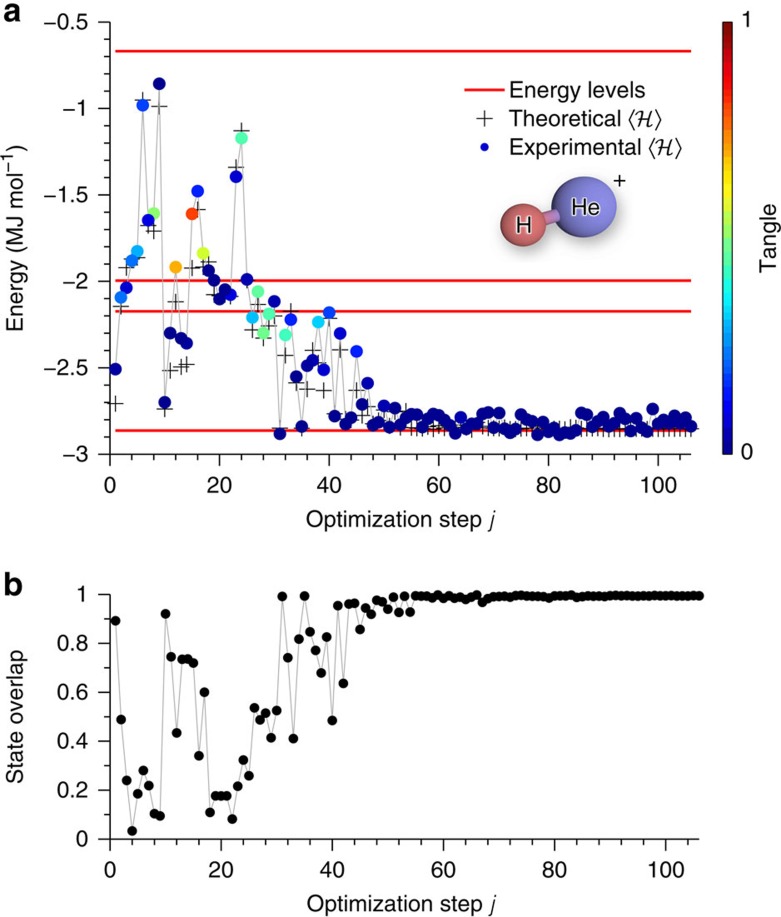
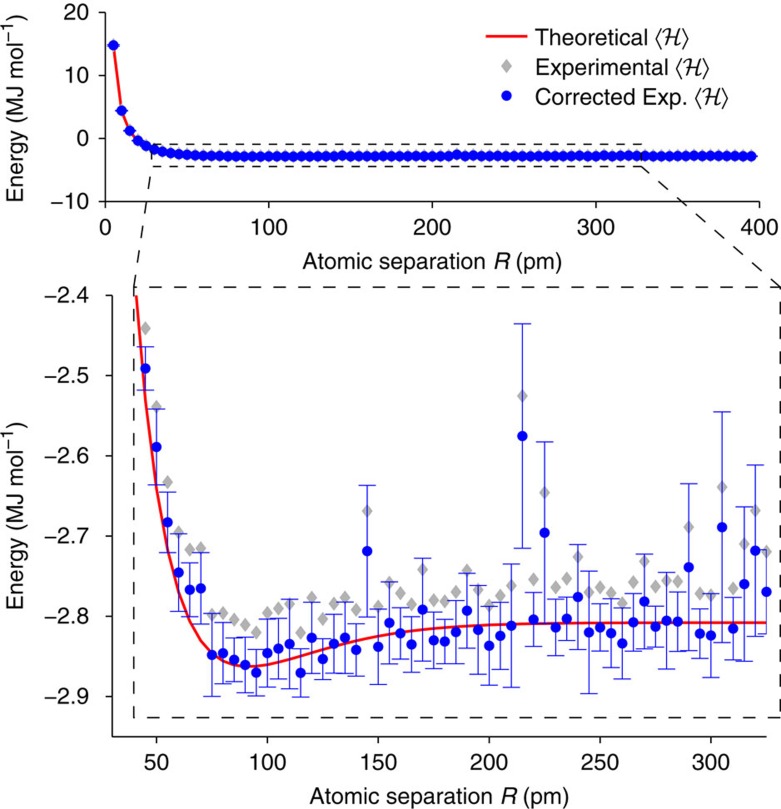
- The authors report an experimental ground-state result for He–H\(^+\): after correcting for experimental errors, they estimate the equilibrium bond length as \(R = 92.3 \pm 0.1\) pm and the ground-state electronic energy as \(E = -2.865 \pm 0.008\) MJ mol\(^{-1}\).
- For the bond dissociation curve, more than 96% of the experimental data are within chemical accuracy of the theoretical values.
- In the discussion, they state that for a 4 × 4 Hamiltonian like the one demonstrated, the QPE circuit would require at least 12 CNOT gates, whereas their method requires one.
- The full experiment was performed in about 158 h, and the bond dissociation curve was obtained by finding the ground states of 79 Hamiltonians.
## Methods
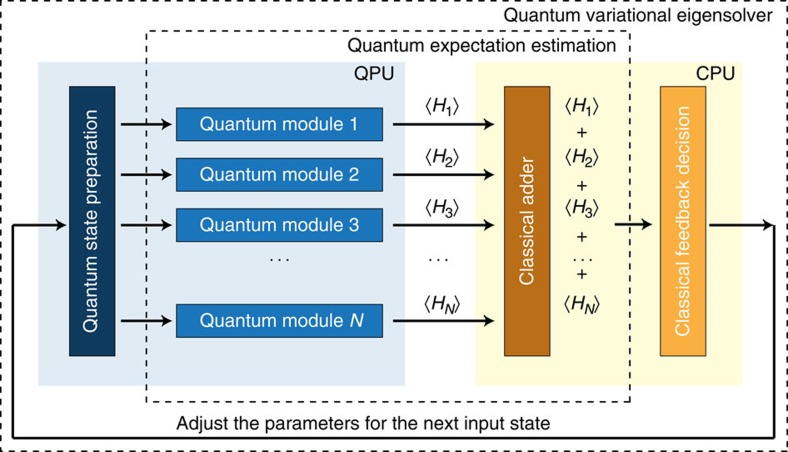
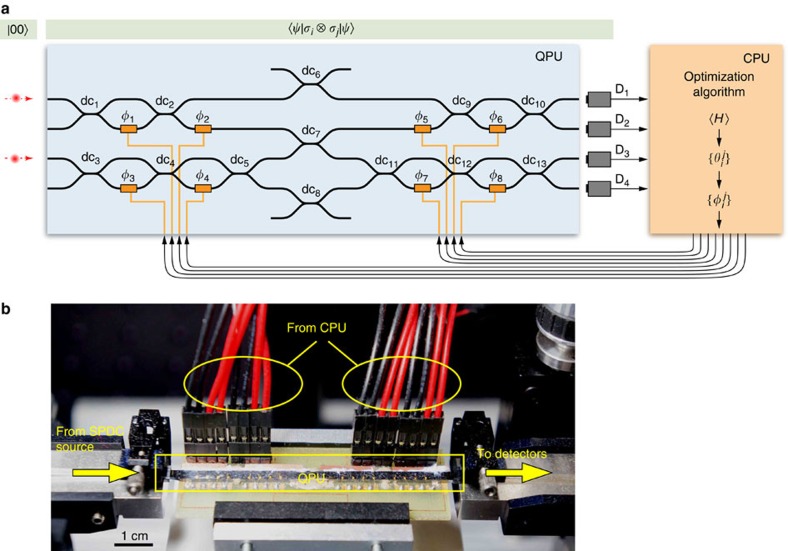
- The paper combines a reconfigurable integrated photonic quantum processor with a classical optimization algorithm: the quantum device estimates Hamiltonian expectation values, and the classical processor updates the state parameters variationally.
- The photonic chip prepares and measures arbitrary two-qubit pure states using single-qubit rotations and one two-qubit entangling gate; the experimental demonstration uses the He–H\(^+\) molecule in a minimal basis.
- For the classical optimization, they use the Nelder–Mead algorithm; expectation values are reconstructed from four two-qubit Pauli measurements at each point.
## Limitations
- The paper states that the method still requires a good approximation to the ground state as input/initialization, and the reliance on multiple separate measurements makes it sensitive to variations in state preparation between calculations.
- The authors report a constant systematic shift of \(\varepsilon = 50\) kJ mol\(^{-1}\) in the measured expectation values; they attribute this to photon-source impurity/distinguishability, circuit imperfections, and unbalanced coupling efficiencies.
- Evident from the text: the demonstration is limited to a two-qubit / 4 × 4 Hamiltonian prototype, so the scalability claim is not experimentally validated here.
Model-written summary. Check it against the paper before relying on it.
Integrity signals
Registry
Cites
Statistics
Figures
Verification
Claims the paper makes
7 Valid · 4 Not valid · 11 Not checked · 59 Own results and interpretations
The cited sources support only part of this claim — read each source’s verdict below.
In the paper
“Recent developments in the field of quantum computation offer a way forward for determining efficient solutions of many instances of large eigenvalue problems that are classically intractable6789101112”
§ A variational eigenvalue solver on a photonic quantum processor > Abstract
What the sources say
- Not matchedcites [6] Nielsen, M. A. & Chuang, I. L. Quantum Computation and Quantum Information Cambridge University Press (2000).
Couldn’t be matched to a paper in Crossref, so it can’t be checked.
- Could not verifycites [7] Kitaev, A. Quantum measurements and the Abelian stabilizer problem. Electronic Colloquium on Computational Complexity (ECCC) 3 (1996). sourceExperimental — accuracy not yet measured
Our copy under this DOI is the ISAAC 2021 paper 'Effective Resistance and Capacitance in Simplicial Complexes and a Quantum Algorithm' (Kitaev's 1995 work appears only as reference [9] in its bibliography), and it nowhere asserts that quantum computation gives efficient solutions to classically intractable large eigenvalue problems. Eigenvalues enter only as complexity parameters — λ, the smallest eigenvalue of the normalized up-Laplacian, in Lemma 31 and Theorem 26 (Section 6.3, 'Time efficient implementations') and in the phase-estimation machinery of Appendix A — and Section 1.1 ('Our Contributions') actually reports the opposite direction for its own problem: 'the quantum algorithm is slower than the classical algorithm in the worst case'. Searched: 'eigenvalue problems classically intractable', 'quantum speedup / exponential advantage', 'phase estimation', 'faster than classical'; no passage addresses the claim's point. (LLM, conf=0.70)
- Partly supportedcites [8] Griffiths, R. B. & Niu, C.-S. Semiclassical fourier transform for quantum computation. Phys. Rev. Lett. 76, 3228–3231 (1996). sourceExperimental — accuracy not yet measured
On p. 1, the paper says a quantum computer, if built, could solve certain problems such as factoring long numbers much faster than conventional algorithms. It also describes a simpler Fourier transform for Shor’s factorization and discrete-logarithm algorithms (p. 1). The copy does not support the claim about efficient solutions to many large eigenvalue problems. (LLM, conf=0.84)
plainstates a cause- Asserted: passes — The authors put it forward as true.
- Checkable: passes — It can be checked against evidence.
- Load-bearing: passes — The paper’s conclusions depend on it.
- Based: passes — The paper gives a reason why it holds.
- Not matched
Every source the paper cites for this claim was checked and supports it.
In the paper
“this would suffer from the N-representability problem, which is known to be intractable for both classical and quantum computers (it is in the quantum complexity class QMA-Hard24).”
§ A variational eigenvalue solver on a photonic quantum processor > Results > Quantum expectation estimation
What the sources say
- Supportedcites [24] Liu, Y.-K., Christandl, M. & Verstraete, F. Quantum computational complexity of the n-representability problem: Qma complete. Phys. Rev. Lett. 98, 110503 (2007). source
The paper states that N-representability is QMA-complete and hence QMA-hard and NP-hard (Abstract). Its discussion of quantum-chemistry relevance says the problem is intractable in the worst case even on a quantum computer, while allowing that particular physical systems may be easier. (LLM, conf=0.93)
boosted- Asserted: passes — The authors put it forward as true.
- Checkable: passes — It can be checked against evidence.
- Load-bearing: passes — The paper’s conclusions depend on it.
- Based: passes — The paper gives a reason why it holds.
- Supported
Every source the paper cites for this claim was checked and supports it.
In the paper
“We have implemented the QPU using integrated quantum photonics technology30.”
§ A variational eigenvalue solver on a photonic quantum processor > Results > Prototype demonstration
What the sources say
- Supportedcites [30] O'Brien, J. L., Furusawa, A. & Vuckovic, J. Photonic quantum technologies. Nat. Photon. 3, 687–695 (2009). source
The citation identifies integrated quantum photonics as the technology used, rather than attributing the citing authors’ QPU implementation to this review. The “Integrated quantum optical circuits” section (p. 6) describes on-chip waveguide circuits performing quantum logic gates and a compiled quantum factoring algorithm. (LLM, conf=0.87)
plain- Asserted: passes — The authors put it forward as true.
- Checkable: passes — It can be checked against evidence.
- Load-bearing: passes — The paper’s conclusions depend on it.
- Based: passes — The paper gives a reason why it holds.
- Supported
The cited sources support only part of this claim — read each source’s verdict below.
In the paper
“The time the quantum computer must remain coherent is determined by the necessity of O(p−1) successive applications of , each of which can require on the order of millions or billions of quantum gates for practical applications1719, as compared to the tens to hundreds of gates achievable in the short term.”
§ A variational eigenvalue solver on a photonic quantum processor > Abstract
What the sources say
- Partly supportedcites [17] Whitfield, J. D., Biamonte, J. & Aspuru-Guzik, A. Simulation of electronic structure hamiltonians using quantum computers. Mol. Phys. 109, 735–750 (2011). sourceExperimental — accuracy not yet measured
Split into 2 atoms — 1 confirmed, 1 partially supported, 0 disputed, 0 misattributed, 0 unverifiable. Expand the claim to see per-atom verdicts.
- Partly supportedcites [19] Jones, N. C. et al. Faster quantum chemistry simulation on fault-tolerant quantum computers. New J. Phys. 14, 115023 (2012). sourceExperimental — accuracy not yet measured
Split into 2 atoms — 0 confirmed, 2 partially supported, 0 disputed, 0 misattributed, 0 unverifiable. Expand the claim to see per-atom verdicts.
plainstates a cause- Asserted: passes — The authors put it forward as true.
- Checkable: passes — It can be checked against evidence.
- Load-bearing: passes — The paper’s conclusions depend on it.
- Based: passes — The paper gives a reason why it holds.
- Partly supported
A result the paper reports from its own data — it cites no other source for it, so there is none to check. The quote shows it is in the paper.
In the paper
“We experimentally demonstrate the feasibility of this approach with an example from quantum chemistry—calculating the ground-state molecular energy for He–H+.”
§ A variational eigenvalue solver on a photonic quantum processor > Abstract
boostedstates a causeSingle case- Asserted: passes — The authors put it forward as true.
- Checkable: passes — It can be checked against evidence.
- Load-bearing: passes — The paper’s conclusions depend on it.
- Based: passes — The paper gives a reason why it holds.
31 more claims
Create a free account to see all 81 claims and to verify the 4 references still open.
- It may state two separate claims as one. 28
- Probably not a substantial claim. 24
Claims other papers make about this one
Each is checked against this paper’s own text: does it say what the citing paper says it does?
The cited source doesn’t support the claim as written.
In the citing paper
“Leveraging quantum resources, the UCC ansatz was instead realized as a PQC on a photonic processor (Peruzzo et al. , 2014).”
From Noisy intermediate-scale quantum algorithms (2022) · cites this paper as Peruzzo et al., 2014
Checked by a reasoning model — may be wrong.
Experimental — accuracy not yet measuredThe cited source doesn’t support the claim as written.
In the citing paper
“The first on-chip GMM of four-qubit cluster state was realised in a laser-writing chip ( Fig.4e ), by manipulating both the polarisation and path DoFs of two photons [85].”
From Integrated photonic quantum technologies (2020) · cites this paper as [85]
Checked by a reasoning model — may be wrong.
Experimental — accuracy not yet measuredThe cited source doesn’t support the claim as written.
In the citing paper
“four-qubit linear- and box-cluster states are generated in a laser-writing photonic chip. This is enabled by on-chip manipulating the two-photon four-qubit hyperentangled state and cluster state, that are encoded in photon's path and polarisation DoFs. The Grover's search algorithm on a four-element database was implemented by controlling the device.”
From Integrated photonic quantum technologies (2020) · cites this paper as [85]
Checked by a reasoning model — may be wrong.
Experimental — accuracy not yet measuredThe source backs part of the claim, not all of it — or backs it for a different population, condition or comparison.
In the citing paper
“Due to its versatility, the variational Hamiltonian ansatz has been implemented for quantum chemistry [21, 29], optimization [24], and for quantum simulation problems [30].”
From Variational quantum algorithms (2021) · cites this paper as [29]
Experimental — accuracy not yet measuredThe source backs part of the claim, not all of it — or backs it for a different population, condition or comparison.
In the citing paper
“For the original VQE (Peruzzo et al. , 2014) and QAOA (Farhi et al. , 2014) it can, for example, be described as a single expectation value min θ ⟨ H ⟩ U ( θ ) , where the differences solely appear in the specific form and construction of the qubit Hamiltonian.”
From Noisy intermediate-scale quantum algorithms (2022) · cites this paper as Peruzzo et al., 2014
Experimental — accuracy not yet measured
12 more claims about this paper
Create a free account to see every claim other papers make about this one.
Citations
Cites
A Simplex Method for Function Minimization
Nelder, J. A., & Mead, R. (1965) · The Computer Journal · doi:10.1093/comjnl/7.4.308 · Cited by 28,905
Quantum computation and quantum information
Law, J. (2001) · ACM SIGSOFT Software Engineering Notes · doi:10.1145/505482.505499 · Cited by 18,842
(1999) · Cited by 12,854
Practical Methods of Optimization
Fletcher, R. (2000) · Wiley eBooks · doi:10.1002/9781118723203 · Cited by 7,605 · cited 3×
“[12] S.”
BackgroundMethodPractical methods of optimization
(1988) · Mathematics and Computers in Simulation · doi:10.1016/0378-4754(88)90129-2 · Cited by 5,818
Quantum Algorithm for Linear Systems of Equations
Harrow, A. W., Hassidim, A., & Lloyd, S. (2009) · Physical Review Letters · doi:10.1103/physrevlett.103.150502 · Cited by 3,325
Conn, A. R., Gould, N. I. M., & Toint, P. L. (2000) · Society for Industrial and Applied Mathematics eBooks · doi:10.1137/1.9780898719857 · Cited by 2,981 · cited 3×
“[14] D.”
MethodInfluential�ber das Paulische �quivalenzverbot
Jordan, P., & Wigner, E. (1928) · Zeitschrift f�r Physik · doi:10.1007/bf01331938 · Cited by 2,597
Molecular Electronic‐Structure Theory
Helgaker, T., Jørgensen, P., & Olsen, J. (2000) · doi:10.1002/9781119019572 · Cited by 2,594
O'Brien, J. L., Furusawa, A., & Vučković, J. (2009) · Nature Photonics · doi:10.1038/nphoton.2009.229 · Cited by 2,388
Self-citation
Research works printed but not linked: 3
- Helgaker, T., Jorgensen, P. & Olsen, J. Mol. Electronic Struct. Theory Wiley, Sussex (2002).
- Saad, Y. Numerical Methods for Large Eigenvalue Problems Vol. 158, (SIAM (1992).
- Rayleigh, J. W. In finding the correction for the open end of an organ-pipe. Phil. Trans. 161, 77 (1870).
Cited by
Items 501–600 of 4,572
A feasible approach for automatically differentiable unitary coupled-cluster on quantum computers
Kottmann, J. S., Anand, A., & Aspuru‐Guzik, A. (2021) · Chemical Science · doi:10.1039/d0sc06627c · Cited by 106
Self-citationNearly Optimal Measurement Scheduling for Partial Tomography of Quantum States
Bonet-Monroig, X., Babbush, R., & O’Brien, T. E. (2020) · Leiden Repository (Leiden University) · Cited by 74
Photonic simulation of entanglement growth and engineering after a spin chain quench
Pitsios, I., Banchi, L., Rab, A. S., Bentivegna, M., Caprara, D., Crespi, A., Spagnolo, N., Bose, S., Mataloni, P., Osellame, R., et al. (2017) · Nature Communications · doi:10.1038/s41467-017-01589-y · Cited by 56
Quantum Algorithm for Calculating Molecular Vibronic Spectra
Sawaya, N. P. D., & Huh, J. (2019) · The Journal of Physical Chemistry Letters · doi:10.1021/acs.jpclett.9b01117 · Cited by 73
“Many quantum algorithms have been proposed for practical problems in chemistry, chiefly for solving the fermionic problem of determining the lowest-energy configuration of Ne electrons, given the presence of a set of clamped atomic nuclei [15, 16, 17, 18, 19, 20, 21, 22, 23].”
BackgroundHigh-Dimensional Two-Photon Interference Effects in Spatial Modes
Hiekkamäki, M., & Fickler, R. (2021) · Physical Review Letters · doi:10.1103/physrevlett.126.123601 · Cited by 80
“The well-controlled twophoton interference can further be applied in generating custom-tailored NOON states of spatial modes, studying complex quantum walks within the spatial-mode set [41], simplifying fundamental research endeavours such a high-dimensional multi-partite entanglement [42], or applying spatial modes i…”
BackgroundVariational quantum eigensolver with reduced circuit complexity
Zhang, Y., Cincio, Ł., Negre, C. F. A., Czarnik, P., Coles, P. J., Anisimov, P. M., Mniszewski, S. M., Tretiak, S., & Dub, P. A. (2022) · npj Quantum Information · doi:10.1038/s41534-022-00599-z · Cited by 112
Zhang, C., Hayes, A. B., Qiu, L., Jin, Y., Chen, Y., & Zhang, E. Z. (2021) · Proceedings of the 26th ACM International Conference on Architectural Support for Programming Languages and Operating Systems · doi:10.1145/3445814.3446706 · Cited by 74
“The problems in the first abstraction layer have been extensively [5, 12, 14] studied by theoreticians.”
BackgroundOrbital-optimized pair-correlated electron simulations on trapped-ion quantum computers
Zhao, L., Goings, J., Shin, K., Kyoung, W., Fuks, J. I., Kevin Rhee, J.-K., Rhee, Y. M., Wright, K., Nguyen, J., Kim, J., et al. (2023) · npj Quantum Information · doi:10.1038/s41534-023-00730-8 · Cited by 73
“Forging [33] H2O 5 3 Yes Yes IBM 2021 HEA [3] LiH (dipole moment) 4 16 Yes Yes IBM 2021 HEA [25] TADF 2 4 Yes Yes IBM 2021 qubit CC [34] H10 2 3 No Yes IonQ 2021 HEA [35] Li2O4 model 2 4 Yes Yes IBM 2020 Hartree-Fock [14] H12 12 36 Yes Yes Google 2020 upCCD [15] H2O 3 3 Yes No IonQ 2019 HEA [24] LiH 4 20 Yes Yes IBM 2…”
BackgroundMethodTkachenko, N. V., Sud, J., Zhang, Y., Tretiak, S., Anisimov, P. M., Arrasmith, A. T., Coles, P. J., Cincio, L., & Dub, P. A. (2021) · PRX Quantum · doi:10.1103/prxquantum.2.020337 · Cited by 73
“The Variational Quantum Eigensolver (VQE) has emerged as a viable algorithm [3] to find asymptotically exact lowest eigenvalues for solutions to the Schrödinger equation on Noisy Intermediate-Scale Quantum (NISQ) devices.”
MethodMitigating algorithmic errors in a Hamiltonian simulation
Endo, S., Zhao, Q., Li, Y., Benjamin, S., & Yuan, X. (2019) · Physical Review A · doi:10.1103/physreva.99.012334 · Cited by 72
Cervera-Lierta, A., Kottmann, J. S., & Aspuru‐Guzik, A. (2021) · PRX Quantum · doi:10.1103/prxquantum.2.020329 · Cited by 106
“The first VQA proposed was the variational quantum eigensolver (VQE) [4,5].”
MethodSelf-citationBharti, K., & Haug, T. (2021) · Physical Review A · doi:10.1103/physreva.104.042418 · Cited by 73
Purification-based quantum error mitigation of pair-correlated electron simulations
O’Brien, T. E., Anselmetti, G.-L., Gkritsis, F., Elfving, V. E., Polla, S., Huggins, W. J., Oumarou, O., Kechedzhi, K., Abanin, D. A., Acharya, R., et al. (2023) · Nature Physics · doi:10.1038/s41567-023-02240-y · Cited by 125
Synergistic pretraining of parametrized quantum circuits via tensor networks
Rudolph, M. S., Miller, J., Motlagh, D., Chen, J., Acharya, A., & Perdomo‐Ortiz, A. (2023) · Nature Communications · doi:10.1038/s41467-023-43908-6 · Cited by 175
Efficient Discrete Feature Encoding for Variational Quantum Classifier
Yano, H., Suzuki, Y., Itoh, K. M., Raymond, R., & Yamamoto, N. (2020) · IEEE Transactions on Quantum Engineering · doi:10.1109/qce49297.2020.00012 · Cited by 95
“Much of the quantum-enhanced machine learning techniques, especially for classification, are derived from the variational methods [9], [10], which are also popular in optimization [11]–[13]; those methods are hoped can be used in tandem with noisy quantum devices [14] and classical computing devices.”
BackgroundPolaritonic Unitary Coupled Cluster for Quantum Computations
Pavošević, F., & Flick, J. (2021) · The Journal of Physical Chemistry Letters · doi:10.1021/acs.jpclett.1c02659 · Cited by 77
“Analogously to the electronic case, the solution of the truncated and Trotterized QED-UCC method in conjunction with the VQE algorithm can be achieved at the polynomial cost on a quantum computer [32].”
BackgroundMethodCao, C., Hu, J., Zhang, W., Xu, X., Chen, D., Yu, F., Li, J., Hu, H., Lv, D., & Yung, M. (2022) · Physical Review A · doi:10.1103/physreva.105.062452 · Cited by 89
Self-citationSupply chain logistics with quantum and classical annealing algorithms
Weinberg, S. J., Sanches, F., Ide, T., Kamiya, K., & Correll, R. (2023) · Scientific Reports · doi:10.1038/s41598-023-31765-8 · Cited by 133
“(8) f I nonredundant(x) = Anonredundant ∑”
BackgroundAutomatic spin-chain learning to explore the quantum speed limit
Zhang, X., Cui, Z.-W., Wang, X., & Yung, M. (2018) · Physical Review A · doi:10.1103/physreva.97.052333 · Cited by 80
Self-citationPulsed Reset Protocol for Fixed-Frequency Superconducting Qubits
Egger, D. J., Werninghaus, M., Ganzhorn, M., Salis, G., Fuhrer, A., Müller, P., & Filipp, S. (2018) · Physical Review Applied · doi:10.1103/physrevapplied.10.044030 · Cited by 72
Characterizing the loss landscape of variational quantum circuits
Huembeli, P., & Dauphin, A. (2021) · Quantum Science and Technology · doi:10.1088/2058-9565/abdbc9 · Cited by 71
Bukov, M. (2018) · Physical review. B./Physical review. B · doi:10.1103/physrevb.98.224305 · Cited by 89
Motta, M., Gujarati, T. P., Rice, J. E., Kumar, A., Masteran, C., Latone, J. A., Lee, E., Valeev, E. F., & Takeshita, T. Y. (2020) · Physical Chemistry Chemical Physics · doi:10.1039/d0cp04106h · Cited by 71
Distributed Quantum Computing and Network Control for Accelerated VQE
DiAdamo, S., Ghibaudi, M., & Cruise, J. R. (2021) · IEEE Transactions on Quantum Engineering · doi:10.1109/tqe.2021.3057908 · Cited by 117
“1) Takes user specified Ansatz preparation circuit and decomposed Hamiltonian, and confirms execution parameters.”
BackgroundMethodInfluentialPreparation of the SU(3) lattice Yang-Mills vacuum with variational quantum methods
Ciavarella, A. N., & Chernyshev, I. A. (2022) · Physical review. D/Physical review. D. · doi:10.1103/physrevd.105.074504 · Cited by 131
Subtleties in the trainability of quantum machine learning models
Thanasilp, S., Wang, S., Nghiem, N. A., Coles, P. J., & Cerezo, M. (2023) · Quantum Machine Intelligence · doi:10.1007/s42484-023-00103-6 · Cited by 142
“[24] Alberto Peruzzo, Jarrod McClean, Peter Shadbolt, ManHong Yung, Xiao-Qi Zhou, Peter J Love, Alán AspuruGuzik, and Jeremy L O’brien, “A variational eigenvalue solver on a photonic quantum processor,” Nature communications 5, 1–7 (2014).”
BackgroundMethodExperimental quantum computational chemistry with optimized unitary coupled cluster ansatz
Guo, S., Sun, J., Qian, H., Gong, M., Zhang, Y., Chen, F., Ye, Y., Wu, Y., Cao, S., Liu, K., et al. (2024) · Nature Physics · doi:10.1038/s41567-024-02530-z · Cited by 115
“Among the various approaches explored, variational quantum algorithms 8–10 emerge as a promising near-term solution with their potential for executing the task using shallow circuits.”
Variational Quantum Singular Value Decomposition
Wang, X., Song, Z., & Wang, Y. (2021) · Quantum · doi:10.22331/q-2021-06-29-483 · Cited by 106
“In this subsection, we discuss the connection between our VQSVD algorithm and the variational quantum eigensolver (VQE) [25], which estimates the ground-state energy given a molecular electronic-structure Hamiltonian H .”
MethodQuantum Error Mitigation With Artificial Neural Network
Kim, C., Park, D. K., & Rhee, J. K. (2020) · IEEE Access · doi:10.1109/access.2020.3031607 · Cited by 101
One qubit as a universal approximant
Pérez-Salinas, A., López-Núñez, D., García-Sáez, A., Forn-Díaz, P., & Latorre, J. I. (2021) · Physical Review A · doi:10.1103/physreva.104.012405 · Cited by 130
A hybrid classical-quantum approach for multi-class classification
Chalumuri, A., Kune, R., & Manoj, B. S. (2021) · Quantum Information Processing · doi:10.1007/s11128-021-03029-9 · Cited by 89
Barren plateaus in quantum tensor network optimization
Cervero-Martín, E., Plekhanov, K., & Lubasch, M. (2023) · Quantum · doi:10.22331/q-2023-04-13-974 · Cited by 104
“A comprehensive review article on VQE is [8].”
BackgroundMethodInfluentialEquivariant quantum circuits for learning on weighted graphs
Skolik, A., Cattelan, M., Yarkoni, S., Bäck, T., & Dunjko, V. (2023) · npj Quantum Information · doi:10.1038/s41534-023-00710-y · Cited by 116
Optimizing quantum heuristics with meta-learning
Wilson, M., Stromswold, R., Wudarski, F., Hadfield, S., Tubman, N. M., & Rieffel, E. G. (2021) · Quantum Machine Intelligence · doi:10.1007/s42484-020-00022-w · Cited by 79
“Second, VQE [19] is used for estimating the ground-state of Fermi-Hubbard models [45].”
BackgroundMethodInfluentialEfficient evaluation of quantum observables using entangled measurements
Hamamura, I., & Imamichi, T. (2020) · npj Quantum Information · doi:10.1038/s41534-020-0284-2 · Cited by 103
Xia, R., & Kais, S. (2020) · Quantum Science and Technology · doi:10.1088/2058-9565/abbc74 · Cited by 97
Quantum computing of the Li6 nucleus via ordered unitary coupled clusters
Kiss, O., Grossi, M., Lougovski, P., Sánchez, F. A., Vallecorsa, S., & Papenbrock, T. (2022) · Physical Review C · doi:10.1103/physrevc.106.034325 · Cited by 84
Hybrid Quantum-Classical Computing for Future Network Optimization
Fan, L., & Han, Z. (2022) · IEEE Network · doi:10.1109/mnet.001.2200150 · Cited by 73
“Following that two alternative quantum computing techniques Quantum parallelism exemplifi es quantum computers’ high-performance computing capabilities”
MethodPerceval: A Software Platform for Discrete Variable Photonic Quantum Computing
Heurtel, N., Fyrillas, A., de Gliniasty, G., Bihan, R. L., Malherbe, S., Pailhas, M., Bertasi, E., Bourdoncle, B., Emeriau, P.-E., Mezher, R., et al. (2023) · Quantum · doi:10.22331/q-2023-02-21-931 · Cited by 141
“The Variational Quantum Eigensolver (VQE) introduced by [12] is an algorithm for finding eigenvalues of an operator.”
BackgroundMethodInfluentialLearning to Predict Arbitrary Quantum Processes
Huang, H.-Y., Chen, S., & Preskill, J. P. (2023) · PRX Quantum · doi:10.1103/prxquantum.4.040337 · Cited by 158
Hamiltonian variational ansatz without barren plateaus
Park, C.-Y., & Killoran, N. (2024) · Quantum · doi:10.22331/q-2024-02-01-1239 · Cited by 139
“…parameter optimization techniques from machine learning (ML), VQAs are relevant for many important problems, including combinatorial optimizations [5], finding the ground state of a many-body Hamiltonian [6, 7, 8, 9], and learning probability distributions [10, 11, 12, 13] (see Ref.”
BackgroundCan Error Mitigation Improve Trainability of Noisy Variational Quantum Algorithms?
Wang, S., Czarnik, P., Arrasmith, A., Cerezo, M., Cincio, Ł., & Coles, P. J. (2024) · Quantum · doi:10.22331/q-2024-03-14-1287 · Cited by 130
“Hence, there has been hope that one can simply train the VQA in the presence of noise, and then after training, one can apply an EM method to extract the correct cost value (e.g., the ground state energy in the case of the variational quantum eigensolver [21]).”
BackgroundMethodMachine learning phase transitions with a quantum processor
Uvarov, A. V., Kardashin, A. S., & Biamonte, J. D. (2020) · Physical Review A · doi:10.1103/physreva.102.012415 · Cited by 69
“We also replace the standard unitary coupled cluster ansatz found in implementations of the variational quantum eigen-solver [23] with families of tensor network ansatz states.”
BackgroundMethodToward scalable simulations of lattice gauge theories on quantum computers
Mathis, S. V., Mazzola, G., & Tavernelli, I. (2020) · Physical review. D/Physical review. D. · doi:10.1103/physrevd.102.094501 · Cited by 85
“This number plays a fundamental role in determining the run times of various quantum simulation algorithms, such as real-time dynamics, where it affects the time-complexity of the Trotter decomposition, or the Variational Quantum Eigensolver (VQE) method [82], where instead it determines the number of independent meas…”
BackgroundTEQUILA: a platform for rapid development of quantum algorithms
Kottmann, J. S., Alperin-Lea, S., Tamayo-Mendoza, T., Cervera-Lierta, A., Lavigne, C., Yen, T.-C., Verteletskyi, V., Schleich, P., Anand, A., Degroote, M., et al. (2021) · Quantum Science and Technology · doi:10.1088/2058-9565/abe567 · Cited by 115
“Algorithms like the variational quantum eigensolver (VQE) [3] and the quantum approximate optimization algorithm (QAOA) [4] have shown great promise in solving difficult problems in a variety of fields, including quantum chemistry, materials science, finance and quantum machine learning [5].”
InfluentialSelf-citationNear-term quantum algorithms for linear systems of equations with regression loss functions
Huang, H.-Y., Bharti, K., & Rebentrost, P. (2021) · New Journal of Physics · doi:10.1088/1367-2630/ac325f · Cited by 214
Fast quantum circuit cutting with randomized measurements
Lowe, A., Medvidović, M., Hayes, A., Riordan, L. J. O. A., Bromley, T. R., Arrazola, J. M., & Killoran, N. (2023) · Quantum · doi:10.22331/q-2023-03-02-934 · Cited by 140
“Computing such expectation values is a key step in many proposals for quantum algorithms such as the QAOA [23, 25, 30], VQE [48], or in the estimation of output probabilities, for example, for quantum clas-sifiers [52, 36].”
MethodClassical-to-quantum convolutional neural network transfer learning
Kim, J., Huh, J., & Park, D. K. (2023) · Neurocomputing · doi:10.1016/j.neucom.2023.126643 · Cited by 99
“Such hybrid ML models are particularly advantageous when cost function minimization is difficult to perform classically [4, 10, 11].”
BackgroundJiang, Z., Kalev, A., Mruczkiewicz, W., & Neven, H. (2020) · Quantum · doi:10.22331/q-2020-06-04-276 · Cited by 162
“, the variational quantum eigensolver (VQE) [12, 13].”
Riemannian optimization of isometric tensor networks
Hauru, M., Damme, M. V., & Haegeman, J. (2021) · SciPost Physics · doi:10.21468/scipostphys.10.2.040 · Cited by 107
Learning temporal data with a variational quantum recurrent neural network
Takaki, Y., Mitarai, K., Negoro, M., Fujii, K., & Kitagawa, M. (2021) · Physical Review A · doi:10.1103/physreva.103.052414 · Cited by 108
“Many researchers have developed a wide range of algorithms [9] using parametrized circuits, including quantum chemistry simulations [15], combinational optimization problems [16], and machine learning [6–8 , 17 ].”
BackgroundMicroscale Imaging of Thermal Conductivity Suppression at Grain Boundaries
Isotta, E., Jiang, S., Moller, G. J., Zevalkink, A., Snyder, G. J., & Balogun, O. O. (2023) · Advanced Materials · doi:10.1002/adma.202302777 · Cited by 70
The Shape of Full Configuration Interaction to Come
Eriksen, J. J. (2021) · The Journal of Physical Chemistry Letters · doi:10.1021/acs.jpclett.0c03225 · Cited by 66
Scaling of variational quantum circuit depth for condensed matter systems
Bravo-Prieto, C., Lumbreras-Zarapico, J., Tagliacozzo, L., & Latorre, J. I. (2020) · Quantum · doi:10.22331/q-2020-05-28-272 · Cited by 66
Quantum computation of dominant products in lithium–sulfur batteries
Rice, J. E., Gujarati, T. P., Motta, M., Takeshita, T. Y., Lee, E., Latone, J. A., & Garcia, J. M. (2021) · The Journal of Chemical Physics · doi:10.1063/5.0044068 · Cited by 97
A single inverse-designed photonic structure that performs parallel computing
Camacho, M., Edwards, B. E., & Engheta, N. (2021) · Nature Communications · doi:10.1038/s41467-021-21664-9 · Cited by 82
Representation Learning via Quantum Neural Tangent Kernels
Liu, J., Tacchino, F., Glick, J. R., Jiang, L., & Mezzacapo, A. (2022) · PRX Quantum · doi:10.1103/prxquantum.3.030323 · Cited by 108
Exact and efficient Lanczos method on a quantum computer
Kirby, W., Motta, M., & Mezzacapo, A. (2023) · Quantum · doi:10.22331/q-2023-05-23-1018 · Cited by 66
“It also avoids the typical pitfalls of parametric optimization that appear in variational quantum eigensolvers [2], such as local minima and barren plateaus [53–57], and admits rigorous error bounds (Section IV).”
BackgroundCharacterizing barren plateaus in quantum ansätze with the adjoint representation
Fontana, E., Herman, D., Chakrabarti, S., Kumar, N., Yalovetzky, R., Heredge, J., Sureshbabu, S. H., & Pistoia, M. (2024) · Nature Communications · doi:10.1038/s41467-024-49910-w · Cited by 232
Using models to improve optimizers for variational quantum algorithms
Sung, K. J., Yao, J., Harrigan, M. P., Rubin, N. C., Jiang, Z., Lin, L., Babbush, R., & McClean, J. R. (2020) · Quantum Science and Technology · doi:10.1088/2058-9565/abb6d9 · Cited by 66
“For example, at least two experimental implementations of variational algorithms [2, 5] used the Nelder–Mead simplex algorithm [6] to optimize the objective function.”
BackgroundMethodSelf-citationFujii, K., Mizuta, K., Ueda, H., Mitarai, K., Mizukami, W., & Nakagawa, Y. O. (2020) · arXiv · doi:10.48550/arxiv.2007.10917 · Cited by 66
Variational consistent histories as a hybrid algorithm for quantum foundations
Arrasmith, A., Cincio, L., Sornborger, A. T., Zurek, W. H., & Coles, P. J. (2019) · Nature Communications · doi:10.1038/s41467-019-11417-0 · Cited by 66
“VHQCAs have now been demonstrated for a myriad of tasks ranging from factoring to finding ground states, among others [19–26].”
BackgroundCartan Subalgebra Approach to Efficient Measurements of Quantum Observables
Yen, T.-C., & Izmaylov, A. F. (2021) · PRX Quantum · doi:10.1103/prxquantum.2.040320 · Cited by 99
Single-particle digitization strategy for quantum computation of a ϕ4 scalar field theory
Barata, J., Mueller, N., Tarasov, A., & Venugopalan, R. (2021) · Physical Review A · doi:10.1103/physreva.103.042410 · Cited by 89
Unconstrained binary models of the travelling salesman problem variants for quantum optimization
Salehi, Ö., Glos, A., & Miszczak, J. A. (2022) · Quantum Information Processing · doi:10.1007/s11128-021-03405-5 · Cited by 96
Variational quantum algorithm based on the minimum potential energy for solving the Poisson equation
Sato, Y., Kondo, R., Koide, S., Takamatsu, H., & Imoto, N. (2021) · Physical Review A · doi:10.1103/physreva.104.052409 · Cited by 95
Space-efficient binary optimization for variational quantum computing
Glos, A., Krawiec, A., & Zimborás, Z. (2022) · npj Quantum Information · doi:10.1038/s41534-022-00546-y · Cited by 65
“Variational Quantum Eigensolver (VQE) is a heuristic algorithm in which the quantum circuit is optimized using classical procedure.”
BackgroundInfluentialJARVIS-Leaderboard: a large scale benchmark of materials design methods
Choudhary, K. K., Wines, D., Li, K., Garrity, K. F., Gupta, V., Romero, A. H., Krogel, J. T., Saritas, K., Fuhr, A., Ganesh, P., et al. (2024) · npj Computational Materials · doi:10.1038/s41524-024-01259-w · Cited by 105
“For example, we use the tight-binding Hamiltonians for electrons and phonons in JARVIS-DFT and evaluate the electron bandstructures using quantum algorithms (such as variational quantum eigen solver (VQE) 153 and variational quantum de fl ation (VQD) 154 ) and with different quantum circuits (such as PauliTwo design 96…”
Lappala, A. (2024) · Current Opinion in Structural Biology · doi:10.1016/j.sbi.2024.102919 · Cited by 70
Unitary and Nonunitary Quantum Cellular Automata with Rydberg Arrays
Wintermantel, T. M., Wang, Y., Lochead, G., Shevate, S., Brennen, G. K., & Whitlock, S. (2020) · Physical Review Letters · doi:10.1103/physrevlett.124.070503 · Cited by 83
“While this variational approach has been power-4 fully demonstrated for finding ground states of unitary quantum systems [51–54], we show it can also apply to non-unitary quantum evolution and stationary states.”
BackgroundGeometry of learning neural quantum states
Park, C.-Y., & Kastoryano, M. J. (2020) · Physical Review Research · doi:10.1103/physrevresearch.2.023232 · Cited by 64
Analog quantum simulation of chemical dynamics
MacDonell, R. J., Dickerson, C. E., Birch, C. J. T., Kumar, A., Edmunds, C., Biercuk, M. J., Hempel, C., & Kassal, I. (2021) · Chemical Science · doi:10.1039/d1sc02142g · Cited by 94
TEQUILA: a platform for rapid development of quantum algorithms
Kottmann, J. S., Alperin-Lea, S., Chaney, S., Kesibi, M., Curnow, N. G., Solo, B., Tsilimigkounakis, G., Zendejas-Morales, C., Izmaylov, A. F., Aspuru‐Guzik, A., et al. (2021) · RWTH Publications (RWTH Aachen) · Cited by 68
Self-citationUniversal quantum circuits for quantum chemistry
Arrazola, J. M., Matteo, O. D., Quesada, N., Jahangiri, S., Delgado, A., & Killoran, N. (2022) · Quantum · doi:10.22331/q-2022-06-20-742 · Cited by 138
“These can correspond to ground and excited states of molecular Hamiltonians, which can then be employed to compute properties of the molecule [4, 5, 6, 7, 8, 9].”
BackgroundQuantum embedding theories to simulate condensed systems on quantum computers
Vorwerk, C., Sheng, N., Govoni, M., Huang, B., & Galli, G. (2022) · Nature Computational Science · doi:10.1038/s43588-022-00279-0 · Cited by 89
Penalty methods for a variational quantum eigensolver
Kuroiwa, K., & Nakagawa, Y. O. (2021) · Physical Review Research · doi:10.1103/physrevresearch.3.013197 · Cited by 77
Experimental Quantum State Measurement with Classical Shadows
Zhang, T., Sun, J., Fang, X.-X., Zhang, X.-M., Yuan, X., & Lu, H. (2021) · Physical Review Letters · doi:10.1103/physrevlett.127.200501 · Cited by 105
Kawashima, Y., Lloyd, E., Coons, M. P., Nam, Y., Matsuura, S., Garza, A. J., Johri, S., Huntington, L. M. J., Senicourt, V., Maksymov, A., et al. (2021) · Communications Physics · doi:10.1038/s42005-021-00751-9 · Cited by 83
Computational Investigations of the Lithium Superoxide Dimer Rearrangement on Noisy Quantum Devices
Gao, Q., Nakamura, H., Gujarati, T. P., Jones, G. O., Rice, J. E., Wood, S. P., Pistoia, M., Garcia, J. M., & Yamamoto, N. (2021) · The Journal of Physical Chemistry A · doi:10.1021/acs.jpca.0c09530 · Cited by 60
Rossmannek, M., Barkoutsos, P. K., Ollitrault, P. J., & Tavernelli, I. (2021) · The Journal of Chemical Physics · doi:10.1063/5.0029536 · Cited by 74
Quantum entanglement on photonic chips: a review
Chen, X., Fu, Z., Gong, Q., & Wang, J. (2021) · Advanced Photonics · doi:10.1117/1.ap.3.6.064002 · Cited by 78
Solving nuclear structure problems with the adaptive variational quantum algorithm
Romero, A. M., Engel, J., Tang, H. L., & Economou, S. E. (2022) · Physical Review C · doi:10.1103/physrevc.105.064317 · Cited by 83
Novel Resolution of Unit Commitment Problems Through Quantum Surrogate Lagrangian Relaxation
Feng, F., Zhang, P., Bragin, M. A., & Zhou, Y. (2022) · IEEE Transactions on Power Systems · doi:10.1109/tpwrs.2022.3181221 · Cited by 82
“An improved VQE-type algorithm is devised to find the minimum objective, meanwhile, reducing the initial state preparation [20].”
MethodDemonstration of Adiabatic Variational Quantum Computing with a Superconducting Quantum Coprocessor
Chen, M.-C., Gong, M., Xu, X., Yuan, X., Wang, J., Wang, C., Ying, C., Lin, J., Xu, Y., Wu, Y., et al. (2020) · Physical Review Letters · doi:10.1103/physrevlett.125.180501 · Cited by 80
“In this context the recent quantum-classical hybrid algorithms, such as quantum approximate optimisation algorithm (QAOA) [18] and the variational quantum eigensolver (VQE) [19], are a promising route toward useful exploitation of smalland medium-scale quantum computers.”
MethodVariational quantum eigensolver for frustrated quantum systems
Uvarov, A., Biamonte, J. D., & Yudin, D. (2020) · Physical Review B · doi:10.1103/physrevb.102.075104 · Cited by 61
Fujii, K., Mizuta, K., Ueda, H., Mitarai, K., Mizukami, W., & Nakagawa, Y. O. (2022) · PRX Quantum · doi:10.1103/prxquantum.3.010346 · Cited by 109
Li, W., Huang, Z., Cao, C., Huang, Y., Shuai, Z., Sun, X., Sun, J., Yuan, X., & Lv, D. (2022) · Chemical Science · doi:10.1039/d2sc01492k · Cited by 60
“…quantum (NISQ) era [12], the variational quantum eigensolver (VQE), as one of the most popular quantum-classical algorithms [4, 13–27], has been exploited to experimentally study molecules from H 2 (2 qubits) [14], BeH 2 (6 qubits) [15], H 2 O (8 qubits) [26], to H 12 (12 qubits) [16].”
Yen, T.-C., Ganeshram, A., & Izmaylov, A. F. (2023) · npj Quantum Information · doi:10.1038/s41534-023-00683-y · Cited by 114
Wang, G., França, D. S., Zhang, R., Zhu, S., & Johnson, P. D. (2023) · Quantum · doi:10.22331/q-2023-11-06-1167 · Cited by 117
“The most popular approach has been the variational quantum eigensolver (VQE) algorithm [12].”
MethodDistributed Implementation of Full Configuration Interaction for One Trillion Determinants
Gao, H. M., Imamura, S., Kasagi, A., & Yoshida, E. (2024) · Journal of Chemical Theory and Computation · doi:10.1021/acs.jctc.3c01190 · Cited by 123
Scalar quantum field theories as a benchmark for near-term quantum computers
Aydeniz, K. Y., Dumitrescu, E., McCaskey, A., Bennink, R. S., Pooser, R. C., & Siopsis, G. (2019) · Physical Review A · doi:10.1103/physreva.99.032306 · Cited by 74
Reformulation of the No-Free-Lunch Theorem for Entangled Datasets
Sharma, K., Cerezo, M., Holmes, Z., Cincio, Ł., Sornborger, A. T., & Coles, P. J. (2022) · Physical Review Letters · doi:10.1103/physrevlett.128.070501 · Cited by 91
“tional quantum algorithms [39–51].”
Quantum computational quantification of protein–ligand interactions
Kirsopp, J. J. M., Di Paola, C., Manrique, D. Z., Krompiec, M., Greene‐Diniz, G., Guba, W., Meyder, A., Wolf, D., Strahm, M., & Muñoz Ramo, D. (2022) · International Journal of Quantum Chemistry · doi:10.1002/qua.26975 · Cited by 59
RetractedExperimental Quantum Principal Component Analysis via Parametrized Quantum Circuits
Xin, T., Che, L., Cheng, X., Singh, A., Nie, X., Li, J., Dong, Y., & Lu, D. (2021) · Physical Review Letters · doi:10.1103/physrevlett.126.110502 · Cited by 80
QuCloud: A New Qubit Mapping Mechanism for Multi-programming Quantum Computing in Cloud Environment
Liu, L., & Dou, X. (2021) · IEEE International Symposium on High-Performance Computer Architecture (HPCA) · doi:10.1109/hpca51647.2021.00024 · Cited by 82
“Due to its potential in various critical applications, such as machine learning [5], [19], database search [11] and chemistry simulation [14], [25], many companies, universities and institutes are actively working to develop prototypes of quantum computer systems.”
BackgroundPaulihedral: a generalized block-wise compiler optimization framework for Quantum simulation kernels
Li, G., Wu, A., Shi, Y., Javadi-Abhari, A., Ding, Y., & Xie, Y. (2022) · International Conference on Architectural Support for Programming Languages and Operating Systems (ASPLOS) · doi:10.1145/3503222.3507715 · Cited by 131
“Some algorithms [2–6] are designed for faulttolerant quantum computers with quantum error correction while others [7, 8] target near-term noisy quantum computers.”
BackgroundMethodInfluentialAsthana, A., Kumar, A., Abraham, V., Grimsley, H. R., Zhang, Y., Cincio, Ł., Tretiak, S., Dub, P. A., Economou, S. E., Barnes, E., et al. (2023) · Chemical Science · doi:10.1039/d2sc05371c · Cited by 90
Feature selection on quantum computers
Mücke, S., Heese, R., Müller, S., Wolter, M., & Piatkowski, N. (2023) · Quantum Machine Intelligence · doi:10.1007/s42484-023-00099-z · Cited by 86
“For this reason, we also only consider the synth 10 data set for the VQE al-gorithm.”
BackgroundMethodInfluentialQuantum recurrent neural networks for sequential learning
Li, Y., Wang, Z., Han, R., Shi, S., Li, J., Shang, R., Zheng, H., Zhong, G., & Gu, Y. (2023) · Neural Networks · doi:10.1016/j.neunet.2023.07.003 · Cited by 111
Ab initio methods for polariton chemistry
Foley, J. J., McTague, J., & DePrince, A. E. (2023) · Chemical Physics Reviews · doi:10.1063/5.0167243 · Cited by 66
Metadata
- Authors
- Peruzzo, A., McClean, J., Shadbolt, P., Yung, M.-H., Zhou, X.-Q., Love, P. J., Aspuru-Guzik, A., & O’Brien, J. L.
- Affiliations
- The University of Sydney (AU)
- Harvard University (US)
- University of Bristol (GB)
- Haverford College (US)
- Corresponding author
- Peruzzo, Alberto
- O’Brien, Jeremy L.
- Venue
- Nature Communications
- Published
- 2014-07-23
- Volume
- 5
- Issue
- 1
- Pages
- 4213-4213
- ISSN
- 2041-1723 (ISSN-L)
- PMC
- PMC4124861
- OpenAlex
- W2161685427
- Cited by
- 4,552
- References
- 48
- Citations by year
- 2026: 591 · 2025: 765 · 2024: 722 · 2023: 658 · 2022: 564 · 2021: 561 · 2020: 346 · 2019: 191 · 2018: 83 · 2017: 29 · 2016: 18 · 2015: 16 · 2014: 4
- FWCI
- 22.24
- Type
- journal article
- Language
- en
- Open access
- hybrid
- doi.org
- Licence
- cc-by-nc-nd
- creativecommons.org/licenses/by-nc-nd/4.0 (tdm)
- creativecommons.org/licenses/by-nc-nd/4.0 (vor)
- Locations
- Nature Communications (publishedVersion, cc-by-nc-nd)
- Europe PMC (PubMed Central) (publishedVersion, cc-by-nc-nd)
- PubMed Central (publishedVersion, cc-by-nc-nd)
- PubMed (publishedVersion)
- arXiv (Cornell University) (submittedVersion)
- OSTI OAI (U.S. Department of Energy Office of Scientific and Technical Information) (submittedVersion, cc-by-nc-nd)
- Digital Access to Scholarship at Harvard (DASH) (Harvard University) (submittedVersion, cc-by)
- RePEc: Research Papers in Economics (submittedVersion)
- RMIT Research Repository (RMIT University Library) (submittedVersion, cc-by-nc-nd)
- Figshare (submittedVersion, cc-by-nc-nd)
- UWA Profiles and Research Repository (UWA) (submittedVersion, cc-by-nc-nd)
- Bristol Research (University of Bristol) (submittedVersion)
- arXiv (Cornell University)
- Funders
- National Science Foundation (DE-FG02-97ER25308, 0955518, 1037992)
- U.S. Department of Energy (DEFG0297ER25308, DE‐FG02‐, FG02-97ER25308)
- Alfred P. Sloan Foundation
- John Templeton Foundation
- Camille and Henry Dreyfus Foundation
- Royal Academy of Engineering
- National Natural Science Foundation of China (61033001, 61361136003)
- Engineering and Physical Sciences Research Council (EP/J017175/1, EP/L024020/1, EP/K021931/1)
- Australian Research Council (DE140101700)
- National Key Research and Development Program of China (61033001, 2011CBA00301, 61361136003, 2011CBA00300)
- Division of Chemistry (CHE-1037992)
- Air Force Office of Scientific Research (FA 9550-12-1-0046, FA9550-, FA9550-12, FA9550‐12‐1)
- Topics
- Physical Sciences › Computer Science › Artificial Intelligence › Quantum Computing Algorithms and Architecture
- Physical Sciences › Physics and Astronomy › Atomic and Molecular Physics, and Optics › Quantum Information and Cryptography
- Physical Sciences › Physics and Astronomy › Atomic and Molecular Physics, and Optics › Quantum many-body systems
- Keywords
- variational quantum eigensolver, photonic quantum processors, quantum chemistry, classical optimization, hybrid quantum-classical computation
About these checks
Registry, retraction, Cites and statistics results are computed, not judged, with one exception: a printed reference that no index lists is read once by a model before it counts as a citation error. Claims are extracted by a model and kept only when their quote appears verbatim in the text; each cited source is then checked, with a model’s help, for whether it says what the claim relies on. Those verdicts can be wrong — read the claim’s quote and the cited source before relying on one.
The claim verdicts this report counts are experimental: their accuracy is not yet measured.
A language model drew the claims from the paper on 2026-10-10, under version 3 of the claim definition (model deepseek-v4.1-flash, prompt extract-v3).
A second model labelled each claim on 2026-10-10 (model jev-1.13-20260917, definition revision gold-guideline-v0.2).
Cited sources are checked with a language model’s help (qwen3.8-omni-flash and gpt-6-sol).
Statistics and arithmetic are recomputed, not judged.
Confidence bands are shown only for fields calibrated on our annotated test set. None is calibrated yet, so no band is shown.
What counts as a claim ›How we measure confidence ›How we check this ›
Are you an author, or do you see a problem with this page? Request a review
Data sources
Bibliographic data: Semantic Scholar, OpenAlex, Crossref.
Contains information from the Semantic Scholar Academic Graph Datasets, made available under the ODC Attribution License (ODC-BY 1.0).
Semantic Scholar’s data is described in: Kinney, R., et al. (2023). The Semantic Scholar Open Data Platform. arXiv:2301.10140.
