

A variational eigenvalue solver on a photonic quantum processor
Open accessThe DOI matches its Crossref record; 47 of the 48 references it cites were found in a registry or an index; 14 of the 31 sources its claims cite were checked for support.
Abstract
Quantum computers promise to efficiently solve important problems that are intractable on a conventional computer. For quantum systems, where the physical dimension grows exponentially, finding the eigenvalues of certain operators is one such intractable problem and remains a fundamental challenge. The quantum phase estimation algorithm efficiently finds the eigenvalue of a given eigenvector but requires fully coherent evolution. Here we present an alternative approach that greatly reduces the requirements for coherent evolution and combine this method with a new approach to state preparation based on ansätze and classical optimization. We implement the algorithm by combining a highly reconfigurable photonic quantum processor with a conventional computer. We experimentally demonstrate the feasibility of this approach with an example from quantum chemistry—calculating the ground-state molecular energy for He–H+. The proposed approach drastically reduces the coherence time requirements, enhancing the potential of quantum resources available today and in the near future. Quantum computers promise to efficiently solve problems that would be practically impossible with a normal computer. Peruzzo et al. develop a variational computation approach that uses any available quantum resources and, with a photonic quantum processing unit, find the ground-state molecular energy of He–H+.
Overview
CoChat Summary
## TL;DR
The paper introduces a variational alternative to quantum phase estimation for finding eigenvalues, combining short coherent quantum measurements with classical optimization. It experimentally demonstrates the approach on a photonic processor by estimating the ground-state energy curve of He–H\(^+\).
## Key findings
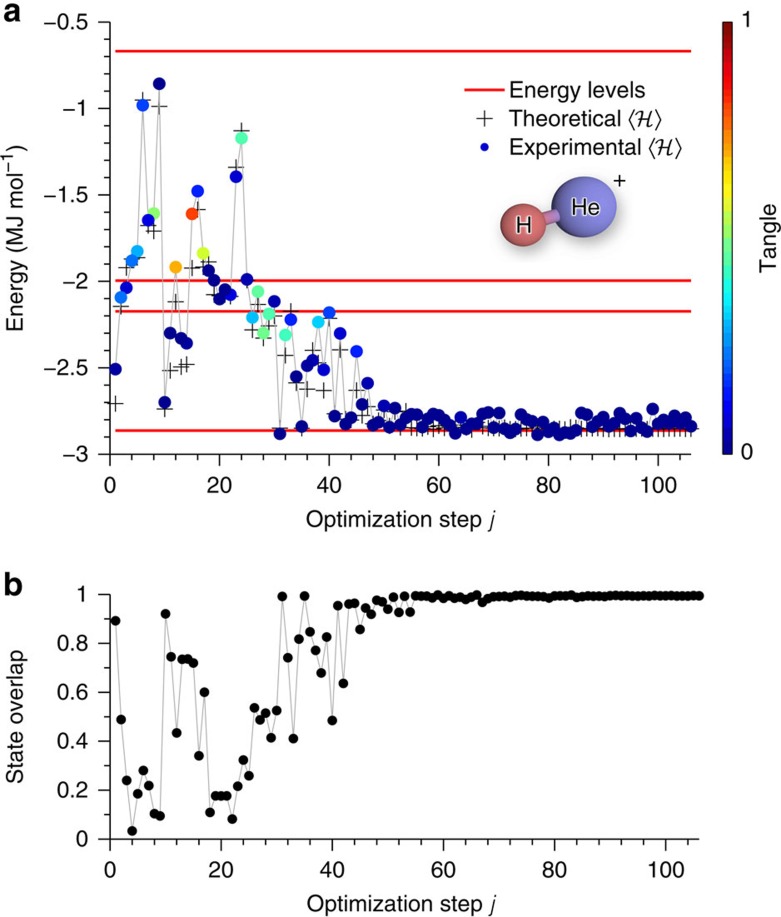
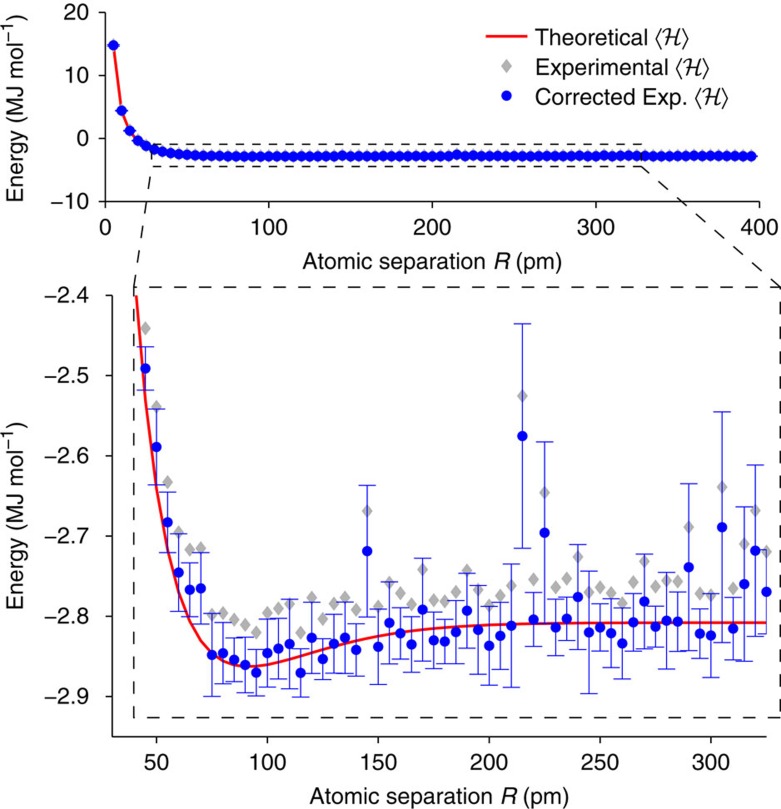
- The authors report an experimental ground-state result for He–H\(^+\): after correcting for experimental errors, they estimate the equilibrium bond length as \(R = 92.3 \pm 0.1\) pm and the ground-state electronic energy as \(E = -2.865 \pm 0.008\) MJ mol\(^{-1}\).
- For the bond dissociation curve, more than 96% of the experimental data are within chemical accuracy of the theoretical values.
- In the discussion, they state that for a 4 × 4 Hamiltonian like the one demonstrated, the QPE circuit would require at least 12 CNOT gates, whereas their method requires one.
- The full experiment was performed in about 158 h, and the bond dissociation curve was obtained by finding the ground states of 79 Hamiltonians.
## Methods
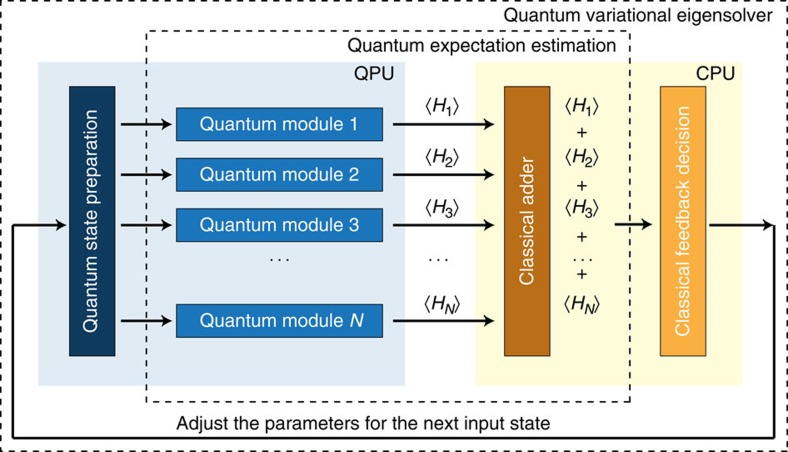
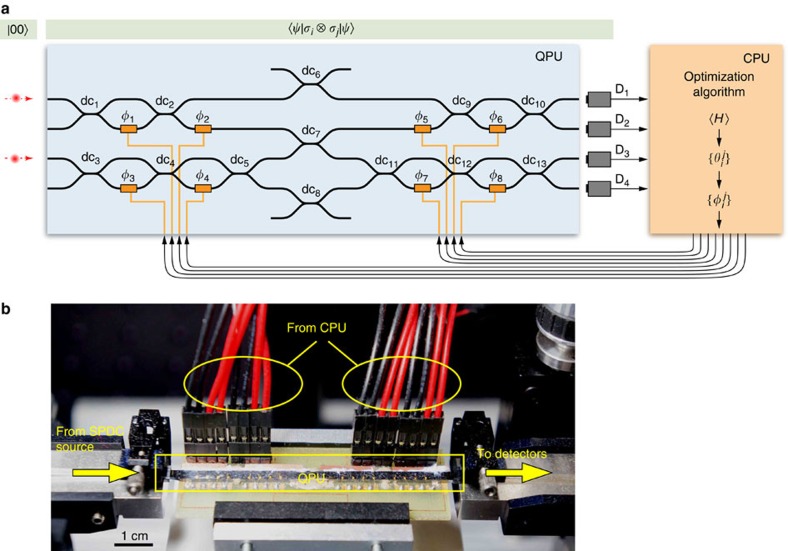
- The paper combines a reconfigurable integrated photonic quantum processor with a classical optimization algorithm: the quantum device estimates Hamiltonian expectation values, and the classical processor updates the state parameters variationally.
- The photonic chip prepares and measures arbitrary two-qubit pure states using single-qubit rotations and one two-qubit entangling gate; the experimental demonstration uses the He–H\(^+\) molecule in a minimal basis.
- For the classical optimization, they use the Nelder–Mead algorithm; expectation values are reconstructed from four two-qubit Pauli measurements at each point.
## Limitations
- The paper states that the method still requires a good approximation to the ground state as input/initialization, and the reliance on multiple separate measurements makes it sensitive to variations in state preparation between calculations.
- The authors report a constant systematic shift of \(\varepsilon = 50\) kJ mol\(^{-1}\) in the measured expectation values; they attribute this to photon-source impurity/distinguishability, circuit imperfections, and unbalanced coupling efficiencies.
- Evident from the text: the demonstration is limited to a two-qubit / 4 × 4 Hamiltonian prototype, so the scalability claim is not experimentally validated here.
Model-written summary. Check it against the paper before relying on it.
Integrity signals
Registry
Cites
Statistics
Figures
Verification
Claims the paper makes
7 Valid · 4 Not valid · 11 Not checked · 59 Own results and interpretations
The cited sources support only part of this claim — read each source’s verdict below.
In the paper
“Recent developments in the field of quantum computation offer a way forward for determining efficient solutions of many instances of large eigenvalue problems that are classically intractable6789101112”
§ A variational eigenvalue solver on a photonic quantum processor > Abstract
What the sources say
- Not matchedcites [6] Nielsen, M. A. & Chuang, I. L. Quantum Computation and Quantum Information Cambridge University Press (2000).
Couldn’t be matched to a paper in Crossref, so it can’t be checked.
- Could not verifycites [7] Kitaev, A. Quantum measurements and the Abelian stabilizer problem. Electronic Colloquium on Computational Complexity (ECCC) 3 (1996). sourceExperimental — accuracy not yet measured
Our copy under this DOI is the ISAAC 2021 paper 'Effective Resistance and Capacitance in Simplicial Complexes and a Quantum Algorithm' (Kitaev's 1995 work appears only as reference [9] in its bibliography), and it nowhere asserts that quantum computation gives efficient solutions to classically intractable large eigenvalue problems. Eigenvalues enter only as complexity parameters — λ, the smallest eigenvalue of the normalized up-Laplacian, in Lemma 31 and Theorem 26 (Section 6.3, 'Time efficient implementations') and in the phase-estimation machinery of Appendix A — and Section 1.1 ('Our Contributions') actually reports the opposite direction for its own problem: 'the quantum algorithm is slower than the classical algorithm in the worst case'. Searched: 'eigenvalue problems classically intractable', 'quantum speedup / exponential advantage', 'phase estimation', 'faster than classical'; no passage addresses the claim's point. (LLM, conf=0.70)
- Partly supportedcites [8] Griffiths, R. B. & Niu, C.-S. Semiclassical fourier transform for quantum computation. Phys. Rev. Lett. 76, 3228–3231 (1996). sourceExperimental — accuracy not yet measured
On p. 1, the paper says a quantum computer, if built, could solve certain problems such as factoring long numbers much faster than conventional algorithms. It also describes a simpler Fourier transform for Shor’s factorization and discrete-logarithm algorithms (p. 1). The copy does not support the claim about efficient solutions to many large eigenvalue problems. (LLM, conf=0.84)
plainstates a cause- Asserted: passes — The authors put it forward as true.
- Checkable: passes — It can be checked against evidence.
- Load-bearing: passes — The paper’s conclusions depend on it.
- Based: passes — The paper gives a reason why it holds.
- Not matched
Every source the paper cites for this claim was checked and supports it.
In the paper
“this would suffer from the N-representability problem, which is known to be intractable for both classical and quantum computers (it is in the quantum complexity class QMA-Hard24).”
§ A variational eigenvalue solver on a photonic quantum processor > Results > Quantum expectation estimation
What the sources say
- Supportedcites [24] Liu, Y.-K., Christandl, M. & Verstraete, F. Quantum computational complexity of the n-representability problem: Qma complete. Phys. Rev. Lett. 98, 110503 (2007). source
The paper states that N-representability is QMA-complete and hence QMA-hard and NP-hard (Abstract). Its discussion of quantum-chemistry relevance says the problem is intractable in the worst case even on a quantum computer, while allowing that particular physical systems may be easier. (LLM, conf=0.93)
boosted- Asserted: passes — The authors put it forward as true.
- Checkable: passes — It can be checked against evidence.
- Load-bearing: passes — The paper’s conclusions depend on it.
- Based: passes — The paper gives a reason why it holds.
- Supported
Every source the paper cites for this claim was checked and supports it.
In the paper
“We have implemented the QPU using integrated quantum photonics technology30.”
§ A variational eigenvalue solver on a photonic quantum processor > Results > Prototype demonstration
What the sources say
- Supportedcites [30] O'Brien, J. L., Furusawa, A. & Vuckovic, J. Photonic quantum technologies. Nat. Photon. 3, 687–695 (2009). source
The citation identifies integrated quantum photonics as the technology used, rather than attributing the citing authors’ QPU implementation to this review. The “Integrated quantum optical circuits” section (p. 6) describes on-chip waveguide circuits performing quantum logic gates and a compiled quantum factoring algorithm. (LLM, conf=0.87)
plain- Asserted: passes — The authors put it forward as true.
- Checkable: passes — It can be checked against evidence.
- Load-bearing: passes — The paper’s conclusions depend on it.
- Based: passes — The paper gives a reason why it holds.
- Supported
The cited sources support only part of this claim — read each source’s verdict below.
In the paper
“The time the quantum computer must remain coherent is determined by the necessity of O(p−1) successive applications of , each of which can require on the order of millions or billions of quantum gates for practical applications1719, as compared to the tens to hundreds of gates achievable in the short term.”
§ A variational eigenvalue solver on a photonic quantum processor > Abstract
What the sources say
- Partly supportedcites [17] Whitfield, J. D., Biamonte, J. & Aspuru-Guzik, A. Simulation of electronic structure hamiltonians using quantum computers. Mol. Phys. 109, 735–750 (2011). sourceExperimental — accuracy not yet measured
Split into 2 atoms — 1 confirmed, 1 partially supported, 0 disputed, 0 misattributed, 0 unverifiable. Expand the claim to see per-atom verdicts.
- Partly supportedcites [19] Jones, N. C. et al. Faster quantum chemistry simulation on fault-tolerant quantum computers. New J. Phys. 14, 115023 (2012). sourceExperimental — accuracy not yet measured
Split into 2 atoms — 0 confirmed, 2 partially supported, 0 disputed, 0 misattributed, 0 unverifiable. Expand the claim to see per-atom verdicts.
plainstates a cause- Asserted: passes — The authors put it forward as true.
- Checkable: passes — It can be checked against evidence.
- Load-bearing: passes — The paper’s conclusions depend on it.
- Based: passes — The paper gives a reason why it holds.
- Partly supported
A result the paper reports from its own data — it cites no other source for it, so there is none to check. The quote shows it is in the paper.
In the paper
“We experimentally demonstrate the feasibility of this approach with an example from quantum chemistry—calculating the ground-state molecular energy for He–H+.”
§ A variational eigenvalue solver on a photonic quantum processor > Abstract
boostedstates a causeSingle case- Asserted: passes — The authors put it forward as true.
- Checkable: passes — It can be checked against evidence.
- Load-bearing: passes — The paper’s conclusions depend on it.
- Based: passes — The paper gives a reason why it holds.
31 more claims
Create a free account to see all 81 claims and to verify the 4 references still open.
- It may state two separate claims as one. 28
- Probably not a substantial claim. 24
Claims other papers make about this one
Each is checked against this paper’s own text: does it say what the citing paper says it does?
The cited source doesn’t support the claim as written.
In the citing paper
“Leveraging quantum resources, the UCC ansatz was instead realized as a PQC on a photonic processor (Peruzzo et al. , 2014).”
From Noisy intermediate-scale quantum algorithms (2022) · cites this paper as Peruzzo et al., 2014
Checked by a reasoning model — may be wrong.
Experimental — accuracy not yet measuredThe cited source doesn’t support the claim as written.
In the citing paper
“The first on-chip GMM of four-qubit cluster state was realised in a laser-writing chip ( Fig.4e ), by manipulating both the polarisation and path DoFs of two photons [85].”
From Integrated photonic quantum technologies (2020) · cites this paper as [85]
Checked by a reasoning model — may be wrong.
Experimental — accuracy not yet measuredThe cited source doesn’t support the claim as written.
In the citing paper
“four-qubit linear- and box-cluster states are generated in a laser-writing photonic chip. This is enabled by on-chip manipulating the two-photon four-qubit hyperentangled state and cluster state, that are encoded in photon's path and polarisation DoFs. The Grover's search algorithm on a four-element database was implemented by controlling the device.”
From Integrated photonic quantum technologies (2020) · cites this paper as [85]
Checked by a reasoning model — may be wrong.
Experimental — accuracy not yet measuredThe source backs part of the claim, not all of it — or backs it for a different population, condition or comparison.
In the citing paper
“Due to its versatility, the variational Hamiltonian ansatz has been implemented for quantum chemistry [21, 29], optimization [24], and for quantum simulation problems [30].”
From Variational quantum algorithms (2021) · cites this paper as [29]
Experimental — accuracy not yet measuredThe source backs part of the claim, not all of it — or backs it for a different population, condition or comparison.
In the citing paper
“For the original VQE (Peruzzo et al. , 2014) and QAOA (Farhi et al. , 2014) it can, for example, be described as a single expectation value min θ ⟨ H ⟩ U ( θ ) , where the differences solely appear in the specific form and construction of the qubit Hamiltonian.”
From Noisy intermediate-scale quantum algorithms (2022) · cites this paper as Peruzzo et al., 2014
Experimental — accuracy not yet measured
12 more claims about this paper
Create a free account to see every claim other papers make about this one.
Citations
Cites
A Simplex Method for Function Minimization
Nelder, J. A., & Mead, R. (1965) · The Computer Journal · doi:10.1093/comjnl/7.4.308 · Cited by 28,905
Quantum computation and quantum information
Law, J. (2001) · ACM SIGSOFT Software Engineering Notes · doi:10.1145/505482.505499 · Cited by 18,842
(1999) · Cited by 12,854
Practical Methods of Optimization
Fletcher, R. (2000) · Wiley eBooks · doi:10.1002/9781118723203 · Cited by 7,605 · cited 3×
“[12] S.”
BackgroundMethodPractical methods of optimization
(1988) · Mathematics and Computers in Simulation · doi:10.1016/0378-4754(88)90129-2 · Cited by 5,818
Quantum Algorithm for Linear Systems of Equations
Harrow, A. W., Hassidim, A., & Lloyd, S. (2009) · Physical Review Letters · doi:10.1103/physrevlett.103.150502 · Cited by 3,325
Conn, A. R., Gould, N. I. M., & Toint, P. L. (2000) · Society for Industrial and Applied Mathematics eBooks · doi:10.1137/1.9780898719857 · Cited by 2,981 · cited 3×
“[14] D.”
MethodInfluential�ber das Paulische �quivalenzverbot
Jordan, P., & Wigner, E. (1928) · Zeitschrift f�r Physik · doi:10.1007/bf01331938 · Cited by 2,597
Molecular Electronic‐Structure Theory
Helgaker, T., Jørgensen, P., & Olsen, J. (2000) · doi:10.1002/9781119019572 · Cited by 2,594
O'Brien, J. L., Furusawa, A., & Vučković, J. (2009) · Nature Photonics · doi:10.1038/nphoton.2009.229 · Cited by 2,388
Self-citation
Research works printed but not linked: 3
- Helgaker, T., Jorgensen, P. & Olsen, J. Mol. Electronic Struct. Theory Wiley, Sussex (2002).
- Saad, Y. Numerical Methods for Large Eigenvalue Problems Vol. 158, (SIAM (1992).
- Rayleigh, J. W. In finding the correction for the open end of an organ-pipe. Phil. Trans. 161, 77 (1870).
Cited by
Items 701–800 of 4,572
Wang, K., Shi, Y., Xiao, L., Wang, J. B., Joglekar, Y. N., & Xue, P. (2020) · Optica · doi:10.1364/optica.396228 · Cited by 56
Determining the proton content with a quantum computer
Pérez-Salinas, A., Cruz-Martinez, J. M., Alhajri, A., & Carrazza, S. (2021) · Physical review. D/Physical review. D. · doi:10.1103/physrevd.103.034027 · Cited by 66
Silicon photonic quantum computing with spin qubits
Yan, X., Gitt, S., Lin, B., Witt, D. M., Abdolahi, M., Afifi, A. E., Azem, A., Darcie, A., Wu, J., Awan, K. M., et al. (2021) · APL Photonics · doi:10.1063/5.0049372 · Cited by 56
Matrix-Model Simulations Using Quantum Computing, Deep Learning, and Lattice Monte Carlo
Rinaldi, E., Han, X., Hassan, M., Feng, Y., Nori, F., McGuigan, M., & Hanada, M. (2022) · PRX Quantum · doi:10.1103/prxquantum.3.010324 · Cited by 89
Schut, M., Tilly, J., Marshman, R. J., Bose, S., & Mazumdar, A. (2022) · Physical Review A · doi:10.1103/physreva.105.032411 · Cited by 73
“These techniques are widely used in the context of early-stage quantum computation to reduce the number of measurements required to perform methods such as the Variational Quantum Eigensolver, see [59].”
MethodQVECTOR: an algorithm for device-tailored quantum error correction
Johnson, P. D., Romero, J., Olson, J., Cao, Y., & Aspuru-Guzik, A. (2017) · arXiv · doi:10.48550/arxiv.1711.02249 · Cited by 50
“Two representative variational HQC algorithms are the variational quantum eigensolver (VQE) [29] and the quantum approximate optimization algorithm (QAOA) [30].”
Self-citationQuantum Algorithms for Mixed Binary Optimization Applied to Transaction Settlement
Braine, L., Egger, D. J., Glick, J., & Woerner, S. (2021) · IEEE Transactions on Quantum Engineering · doi:10.1109/tqe.2021.3063635 · Cited by 51
“Adiabatic quantum computing [13], [14] and variational algorithms, such as the variational quantum eigensolver (VQE) [9] and the quantum approximate optimization algorithm (QAOA) [10], are designed to tackle quadratic unconstrained binary optimization (QUBO) problems.”
BackgroundMethodInfluentialOverhead for simulating a non-local channel with local channels by quasiprobability sampling
Mitarai, K., & Fujii, K. (2021) · Quantum · doi:10.22331/q-2021-01-28-388 · Cited by 85
Adaptive variational quantum eigensolvers for highly excited states
Zhang, F., Gomes, N., Yao, Y., Orth, P. P., & Iadecola, T. (2021) · Physical review. B./Physical review. B · doi:10.1103/physrevb.104.075159 · Cited by 64
Robust resource-efficient quantum variational ansatz through an evolutionary algorithm
Huang, Y., Li, Q., Hou, X., Wu, R.-B., Yung, M., Bayat, A., & Wang, X. (2022) · Physical Review A · doi:10.1103/physreva.105.052414 · Cited by 66
Self-citationAn Image Classification Algorithm Based on Hybrid Quantum Classical Convolutional Neural Network
Li, W., Chu, P.-C., Liu, G.-Z., Tian, Y., Qiu, T., & Wang, S. (2022) · Quantum Engineering · doi:10.1155/2022/5701479 · Cited by 77
“[10] proposed a variational quantum eigensolver (VQE) and realized it with a photon quantum processor and a classical computer.”
MethodHuang, K., Cai, X., Li, H., Ge, Z.-Y., Hou, R., Li, H., Liu, T., Shi, Y., Chen, C.-T., Zheng, D. N., et al. (2022) · The Journal of Physical Chemistry Letters · doi:10.1021/acs.jpclett.2c02381 · Cited by 64
QUARK: A Framework for Quantum Computing Application Benchmarking
Finžgar, J. R., Ross, P., Hölscher, L., Klepsch, J., & Luckow, A. (2022) · IEEE International Conference on Quantum Computing and Engineering (QCE) · doi:10.1109/qce53715.2022.00042 · Cited by 99
“Various algorithms for solving QUBO problems exist, e. g., quantum annealing as provided by D-Wave machines, QAOA [62] and VQE [63] for NISQ devices, and Grover Adaptive Search for fault-tolerant hardware [64].”
MethodThe NISQ Analyzer: Automating the Selection of Quantum Computers for Quantum Algorithms
Salm, M., Barzen, J., Breitenbücher, U., Leymann, F., Weder, B., & Wild, K. (2020) · Communications in computer and information science · doi:10.1007/978-3-030-64846-6_5 · Cited by 82
“We also want to support variational quantum algorithms [23,28].”
MethodKottmann, J. S., Schleich, P., Tamayo-Mendoza, T., & Aspuru‐Guzik, A. (2021) · The Journal of Physical Chemistry Letters · doi:10.1021/acs.jpclett.0c03410 · Cited by 58
Self-citationLight-Front Field Theory on Current Quantum Computers
Kreshchuk, M., Jia, S., Kirby, W., Goldstein, G. R., Vary, J. P., & Love, P. (2021) · Entropy · doi:10.3390/e23050597 · Cited by 77
Self-citationQuantum algorithms for quantum dynamics: A performance study on the spin-boson model
Miessen, A., Ollitrault, P. J., & Tavernelli, I. (2021) · Physical Review Research · doi:10.1103/physrevresearch.3.043212 · Cited by 59
Quantum Computing: An Overview Across the System StackPreprint
Resch, S., & Karpuzcu, U. R. (2019) · arXiv (Cornell University) · doi:10.48550/arxiv.1905.07240 · Cited by 105
“mbination of classical optimization techniques and quantum subroutines. Prominent algorithms such as the Quantum Approximate Optimization Algorithm (QAOA) [29] and the Variational Quantum Eigensolver [30] make use of this approach. For these algorithms, the measured results are approximations. The algorithms switch be…”
BackgroundMethodInfluentialQuantum computation of molecular response properties
Cai, X., Fang, W., Fan, H., & Li, Z. (2020) · Physical Review Research · doi:10.1103/physrevresearch.2.033324 · Cited by 53
“:3) in the same way as obtaining the energy in VQE [28,29], while the second term | (cid:4) Z ( ω ) | (cid:5) 0 | 2 can be computed from | (cid:4) x | (cid:5) 0 | 2 by the SWAP test [53,54] or simply from | (cid:4) (cid:5) 0 | ˆ z | (cid:5) 0 (cid”
BackgroundMethodInfluentialMarkovian Quantum Neuroevolution for Machine Learning
Lu, Z., Shen, P.-X., & Deng, D.-L. (2021) · Physical Review Applied · doi:10.1103/physrevapplied.16.044039 · Cited by 54
Dual-state purification for practical quantum error mitigation
Huo, M., & Li, Y. (2022) · Physical Review A · doi:10.1103/physreva.105.022427 · Cited by 71
Computing Ground State Properties with Early Fault-Tolerant Quantum Computers
Zhang, R., Wang, G., & Johnson, P. D. (2022) · Quantum · doi:10.22331/q-2022-07-11-761 · Cited by 79
“In practice, our algorithm can solve many important tasks by combining with some initial state preparation methods (e.g., VQE or QAOA).”
MethodGraph neural network initialisation of quantum approximate optimisation
Jain, N., Coyle, B., Kashefi, E., & Kumar, N. (2022) · Quantum · doi:10.22331/q-2022-11-17-861 · Cited by 76
“solver [2] and the quantum approximate optimisation algorithm (QAOA) [3].”
MethodCarollo, F., & Alba, V. (2022) · Physical review. B./Physical review. B · doi:10.1103/physrevb.106.l220304 · Cited by 63
Quantum computing with and for many-body physics
Ayral, T., Besserve, P., Lacroix, D., & Guzman, E. A. R. (2023) · The European Physical Journal A · doi:10.1140/epja/s10050-023-01141-1 · Cited by 84
“The VQE algorithm, first introduced in [180], aims at finding the approximate ground-state energy and wavefunction of a Hamiltonian H by minimizing the energy over a parameterized trial space (also called ansatz), i.”
MethodChallenges of variational quantum optimization with measurement shot noise
Scriva, G., Astrakhantsev, N., Pilati, S., & Mazzola, G. (2024) · Physical Review A · doi:10.1103/physreva.109.032408 · Cited by 81
“For the typically optimal shot numbers ˜ M ∈ [2 , 16], the error is minimized for increments close to ε = 0 .”
BackgroundMethodInfluentialHarnessing Quantum Molecular Simulation for Accelerated Cancer Drug Screening
Atalor, S. I., Ijiga, O. M., & Enyejo, J. O. (2023) · International Journal of Scientific Research and Modern Technology. · doi:10.38124/ijsrmt.v2i1.502 · Cited by 105
Machine Learning-Based Computational Design Methods for High-Entropy Alloys
Zhao, Y. M., Zhang, J. Y., Liaw, P. K., & Yang, T. (2025) · High Entropy Alloys & Materials · doi:10.1007/s44210-025-00055-5 · Cited by 74
Quantum unary approach to option pricing
Ramos-Calderer, S., Pérez-Salinas, A., García-Martín, D., Bravo-Prieto, C., Cortada, J., Planagumà, J., & Latorre, J. I. (2021) · Physical Review A · doi:10.1103/physreva.103.032414 · Cited by 67
Simulating quantum chemistry in the seniority-zero space on qubit-based quantum computers
Elfving, V. E., Millaruelo, M., Gámez, J. A., & Gogolin, C. (2021) · Physical Review A · doi:10.1103/physreva.103.032605 · Cited by 65
Analyzing the performance of variational quantum factoring on a superconducting quantum processor
Karamlou, A. H., Simon, W. A., Katabarwa, A., Scholten, T. L., Peropadre, B., & Cao, Y. (2021) · npj Quantum Information · doi:10.1038/s41534-021-00478-z · Cited by 51
The dominant eigenvector of a noisy quantum state
Koczor, B. (2021) · New Journal of Physics · doi:10.1088/1367-2630/ac37ae · Cited by 74
Reinforcement learning for optimization of variational quantum circuit architecturesPreprint
Ostaszewski, M., Trenkwalder, L. M., Masarczyk, W., Scerri, E., & Dunjko, V. (2021) · arXiv (Cornell University) · doi:10.48550/arxiv.2103.16089 · Cited by 215
“the unitary coupled-cluster ansatz [2, 10]) and hardware-inspired (e.”
BackgroundQuantum computation: Algorithms and Applications
Cho, C., Chen, C.-Y., Chen, K.-C., Huang, T., Hsu, M.-C., Cao, N., Zeng, B., Tan, S.-G., & Chang, C. (2021) · Chinese Journal of Physics · doi:10.1016/j.cjph.2021.05.001 · Cited by 63
Towards the simulation of large scale protein–ligand interactions on NISQ-era quantum computers
Malone, F. D., Parrish, R. M., Welden, A. R., Fox, T., Degroote, M., Kyoseva, E., Moll, N., Santagati, R., & Streif, M. (2022) · Chemical Science · doi:10.1039/d1sc05691c · Cited by 48
Ajagekar, A., Hamoud, K. A., & You, F. (2022) · IEEE Transactions on Quantum Engineering · doi:10.1109/tqe.2022.3187367 · Cited by 50
Quantum computing algorithms: getting closer to critical problems in computational biology
Marchetti, L., Nifosì, R., Martelli, P. L., Da Pozzo, E., Cappello, V., Banterle, F., Trincavelli, M. L., Martini, C., & D’Elia, M. (2022) · Briefings in Bioinformatics · doi:10.1093/bib/bbac437 · Cited by 47
“In this work, another solution is proposed based on the Quantum Approximate Optimization Algorithm (QAOA, [146]), which is an instance of the VQE algorithm (discussed in the previous section and in Figure 3B) with the following prescription for the ansatz circuit.”
MethodInfluentialQuantum phase detection generalization from marginal quantum neural network models
Monaco, S., Kiss, O., Mandarino, A., Vallecorsa, S., & Grossi, M. (2023) · Physical review. B./Physical review. B · doi:10.1103/physrevb.107.l081105 · Cited by 61
Speeding Up Learning Quantum States Through Group Equivariant Convolutional Quantum Ansätze
Zheng, H., Li, Z., Liu, J., Strelchuk, S., & Kondor, R. (2023) · PRX Quantum · doi:10.1103/prxquantum.4.020327 · Cited by 91
Building spatial symmetries into parameterized quantum circuits for faster training
Sauvage, F., Larocca, M., Coles, P. J., & Cerezo, M. (2023) · Quantum Science and Technology · doi:10.1088/2058-9565/ad152e · Cited by 76
Quantum Machine Learning in Drug Discovery: Applications in Academia and Pharmaceutical Industries
Smaldone, A. M., Shee, Y., Kyro, G. W., Xu, C., Vu, N. P., Dutta, R., Farag, M. H., Galda, A., Kumar, S., Kyoseva, E. S., et al. (2025) · Chemical Reviews · doi:10.1021/acs.chemrev.4c00678 · Cited by 89
Chemistry on Quantum Computers with Virtual Quantum Subspace Expansion
Urbánek, M., Camps, D., Beeumen, R. V., & de Jong, W. A. (2020) · Journal of Chemical Theory and Computation · doi:10.1021/acs.jctc.0c00447 · Cited by 68
Variational quantum simulation for periodic materials
Yoshioka, N., Sato, T., Nakagawa, Y. O., Ohnishi, Y.-Y., & Mizukami, W. (2022) · Physical Review Research · doi:10.1103/physrevresearch.4.013052 · Cited by 62
Quantum variational optimization: The role of entanglement and problem hardness
Díez-Valle, P., Porras, D., & García-Ripoll, J. J. (2021) · Physical Review A · doi:10.1103/physreva.104.062426 · Cited by 47
“In our research we address these questions with a focus on the Variational Quantum Eigensolver (VQE) method [32].”
MethodSolving quasiparticle band spectra of real solids using neural-network quantum states
Yoshioka, N., Mizukami, W., & Nori, F. (2021) · Communications Physics · doi:10.1038/s42005-021-00609-0 · Cited by 46
Noise-resilient variational hybrid quantum-classical optimization
Gentini, L., Cuccoli, A., Pirandola, S., Verrucchi, P., & Banchi, L. (2020) · Physical Review A · doi:10.1103/physreva.102.052414 · Cited by 46
Abrupt transitions in variational quantum circuit training
Campos, E., Nasrallah, A., & Biamonte, J. (2021) · Physical Review A · doi:10.1103/physreva.103.032607 · Cited by 46
Perspectives of quantum computing for chemical engineering
Bernal, D. E., Ajagekar, A., Harwood, S. M., Stober, S. T., Trenev, D., & You, F. (2022) · AIChE Journal · doi:10.1002/aic.17651 · Cited by 57
Advancing hybrid quantum–classical computation with real-time execution
Lubinski, T., Granade, C., Anderson, A., Geller, A., Roetteler, M., Petrenko, A., & Heim, B. (2022) · Frontiers in Physics · doi:10.3389/fphy.2022.940293 · Cited by 75
“Approximating this expectation from measurements of a quantum device yields the variational quantum eigensolver (VQE) algorithm [13] described in section II A.”
MethodInfluentialError Propagation in NISQ Devices for Solving Classical Optimization Problems
González-García, G., Trivedi, R., & Cirac, J. I. (2022) · PRX Quantum · doi:10.1103/prxquantum.3.040326 · Cited by 75
“[13] Alberto Peruzzo, Jarrod McClean, Peter Shadbolt, ManHong Yung, Xiao-Qi Zhou, Peter J Love, Alán AspuruGuzik, and Jeremy L O’brien.”
BackgroundNuclear shell-model simulation in digital quantum computers
Pérez-Obiol, A., Romero, A. M., Menéndez, J., Rios, A., García-Sáez, A., & Juliá-Díaz, B. (2023) · Scientific Reports · doi:10.1038/s41598-023-39263-7 · Cited by 67
Quantum simulation of quantum field theories as quantum chemistry
Liu, J., & Xin, Y. (2020) · Journal of High Energy Physics · doi:10.1007/jhep12(2020)011 · Cited by 75
“The variational quantum eigensolver (VQE) [102–104] is based on the variational principle of quantum mechanics.”
BackgroundConceptual Understanding through Efficient Automated Design of Quantum Optical Experiments
Krenn, M., Kottmann, J. S., Tischler, N., & Aspuru‐Guzik, A. (2021) · Physical Review X · doi:10.1103/physrevx.11.031044 · Cited by 95
Self-citationOn the order problem in construction of unitary operators for the variational quantum eigensolver
Izmaylov, A. F., Díaz-Tinoco, M., & Lang, R. A. (2020) · Physical Chemistry Chemical Physics · doi:10.1039/d0cp01707h · Cited by 46
A language and hardware independent approach to quantum–classical computing
McCaskey, A. J., Dumitrescu, E. F., Liakh, D., Chen, M., Feng, W., & Humble, T. S. (2018) · SoftwareX · doi:10.1016/j.softx.2018.07.007 · Cited by 46
“Importantly, the InstructionParameter concept allows a natural representation of instructions in variational quantumalgorithms [26], which are among some of the most promising candidates for near-term speedups.”
BackgroundAncilla-free implementation of generalized measurements for qubits embedded in a qudit space
Fischer, L. E., Miller, D., Tacchino, F., Barkoutsos, P. K., Egger, D. J., & Tavernelli, I. (2022) · Physical Review Research · doi:10.1103/physrevresearch.4.033027 · Cited by 62
“For example, the variational quantum eigensolver (VQE) can be used, among other applications, to obtain the ground state energy of molecules [19].”
MethodHybrid superconducting photonic-phononic chip for quantum information processing
Xu, X., Wang, W., Sun, L., & Zou, C. (2022) · Chip · doi:10.1016/j.chip.2022.100016 · Cited by 54
Quantum Error Mitigation via Matrix Product Operators
Guo, Y., & Yang, S. (2022) · PRX Quantum · doi:10.1103/prxquantum.3.040313 · Cited by 64
Towards practical and massively parallel quantum computing emulation for quantum chemistry
Shang, H., Fan, Y., Li, S., Guo, C., Liu, J., Duan, X., Li, F., & Li, Z. (2023) · npj Quantum Information · doi:10.1038/s41534-023-00696-7 · Cited by 67
“Besides, the variational quantum eigen-solver (VQE) is an appealing candidate for solving quantum chemistry problems on NISQ devices [8], which has a great flexibility in choosing quantum circuit ansatzes and mitigating errors [9].”
MethodSimulating Open Quantum System Dynamics on NISQ Computers with Generalized Quantum Master Equations
Wang, Y., Mulvihill, E., Hu, Z., Lyu, N., Shivpuje, S., Liu, Y., Soley, M. B., Geva, E., Batista, V. S., & Kais, S. (2023) · Journal of Chemical Theory and Computation · doi:10.1021/acs.jctc.3c00316 · Cited by 69
Simulating Z 2 lattice gauge theory on a quantum computer
Charles, C., Gustafson, E., Hardt, E., Herren, F., Hogan, N., Lamm, H., Starecheski, S., de Water, R. S. V., & Wagman, M. L. (2024) · Physical review. E · doi:10.1103/physreve.109.015307 · Cited by 88
Local Readout and Control of Current and Kinetic Energy Operators in Optical Lattices
Impertro, A., Karch, S., Wienand, J. F., Huh, S., Schweizer, C., Bloch, I., & Aidelsburger, M. (2024) · Physical Review Letters · doi:10.1103/physrevlett.133.063401 · Cited by 61
Quantum reinforcement learning in continuous action space
Wu, S., Jin, S., Wen, D., Han, D., & Wang, X. (2025) · Quantum · doi:10.22331/q-2025-03-12-1660 · Cited by 99
“Essentially, this problem is an eigenvalue problem for a given physical Hamiltonian, and one way of solving it on a quantum computer is to use the variational quantum eigensolver (VQE) algorithm [57].”
Solving Quantum Chemistry Problems with a D-Wave Quantum Annealer
Streif, M., Neukart, F., & Leib, M. (2019) · Lecture notes in computer science · doi:10.1007/978-3-030-14082-3_10 · Cited by 85
Contextuality Test of the Nonclassicality of Variational Quantum Eigensolvers
Kirby, W. M., & Love, P. J. (2019) · Physical Review Letters · doi:10.1103/physrevlett.123.200501 · Cited by 56
Self-citationPan, D., Li, K., Ruan, D., Ng, S. X., & Hanzo, L. (2020) · IEEE Access · doi:10.1109/access.2020.3006136 · Cited by 55
Quantum-Inspired Algorithm for the Factorized Form of Unitary Coupled Cluster Theory
Chen, J., Cheng, H., & Freericks, J. K. (2021) · Journal of Chemical Theory and Computation · doi:10.1021/acs.jctc.0c01052 · Cited by 50
Low depth mechanisms for quantum optimization
McClean, J. R., Harrigan, M. P., Mohseni, M., Rubin, N. C., Jiang, Z., Boixo, S., Smelyanskiy, V. N., Babbush, R., & Neven, H. (2020) · arXiv · doi:10.48550/arxiv.2008.08615 · Cited by 45
Self-citationQuantum Computing: Vision and Challenges
Gill, S. S., Cetinkaya, O., Marrone, S., Claudino, D., Haunschild, D., Schlote, L., Wu, H., Ottaviani, C., Liu, X., Machupalli, S. P., et al. (2025) · Quantum Computing · doi:10.1016/b978-0-443-29096-1.00008-8 · Cited by 44
Detecting and quantifying entanglement on near-term quantum devices
Wang, K., Song, Z., Zhao, X., Wang, Z., & Wang, X. (2022) · npj Quantum Information · doi:10.1038/s41534-022-00556-w · Cited by 58
“and obtain the states σ, σ((1)), σ((2)), σ((3)), respectively.”
Qubit-efficient encoding scheme for quantum simulations of electronic structure
Shee, Y., Tsai, P.-K., Hong, C.-L., Cheng, H., & Goan, H. (2022) · Physical Review Research · doi:10.1103/physrevresearch.4.023154 · Cited by 62
Learning to Learn Variational Quantum Algorithm
Huang, R., Tan, X., & Xu, Q. (2022) · IEEE Transactions on Neural Networks and Learning Systems · doi:10.1109/tnnls.2022.3151127 · Cited by 52
“We note that the variational algorithm includes variational quantum eigensolver (VQE) [15], quantum approximate optimization algorithm (QAOA) [16], and variational quantum tensor networks [17].”
MethodKumar, A., Asthana, A., Masteran, C., Valeev, E. F., Zhang, Y., Cincio, Ł., Tretiak, S., & Dub, P. A. (2022) · Journal of Chemical Theory and Computation · doi:10.1021/acs.jctc.2c00520 · Cited by 60
Artificial intelligence for quantum computing
Alexeev, Y., Farag, M. H., Patti, T. L., Wolf, M. E., Ares, N., Aspuru‐Guzik, A., Benjamin, S. C., Cai, Z., Cao, S., Chamberland, C., et al. (2025) · Nature Communications · doi:10.1038/s41467-025-65836-3 · Cited by 137
“Compared to previously considered ‘ brute-force ’ approaches to quantum circuit generation 84 , generative AI models have demonstrated promise in generating more compact circuits 85 .”
Self-citationMinimum hardware requirements for hybrid quantum–classical DMFT
Jaderberg, B., Agarwal, A., Leonhardt, K., Kiffner, M., & Jaksch, D. (2020) · Quantum Science and Technology · doi:10.1088/2058-9565/ab972b · Cited by 56
The Quantum Approximate Algorithm for Solving Traveling Salesman Problem
Ruan, Y., Marsh, S., Xue, X., Liu, Z., & Wang, J. B. (2020) · Computers, materials & continua/Computers, materials & continua (Print) · doi:10.32604/cmc.2020.010001 · Cited by 71
Application-Motivated, Holistic Benchmarking of a Full Quantum Computing Stack
Mills, D., Sivarajah, S., Scholten, T. L., & Duncan, R. (2021) · Quantum · doi:10.22331/q-2021-03-22-415 · Cited by 73
“Deep: Inspired by product formula circuits, including state preparation circuits used in the variational quantum eigensolver (VQE) algorithm for quantum chemistry [32–34].”
MethodAmplitude estimation via maximum likelihood on noisy quantum computer
Tanaka, T., Suzuki, Y., Uno, S., Raymond, R., Onodera, T., & Yamamoto, N. (2021) · Quantum Information Processing · doi:10.1007/s11128-021-03215-9 · Cited by 71
Low-Depth Mechanisms for Quantum Optimization
McClean, J. R., Harrigan, M. P., Mohseni, M., Rubin, N. C., Zhang, J., Boixo, S., Smelyanskiy, V., Babbush, R., & Neven, H. (2021) · PRX Quantum · doi:10.1103/prxquantum.2.030312 · Cited by 62
Self-citationUniversal effectiveness of high-depth circuits in variational eigenproblems
Kim, J., Kim, J., & Rosa, D. (2021) · Physical Review Research · doi:10.1103/physrevresearch.3.023203 · Cited by 56
Liu, J., Li, Z., & Yang, J. (2021) · The Journal of Chemical Physics · doi:10.1063/5.0054822 · Cited by 59
On the Expressibility and Overfitting of Quantum Circuit Learning
Chen, C.-C., Watabe, M., Shiba, K., Sogabe, M., Sakamoto, K., & Sogabe, T. (2021) · ACM Transactions on Quantum Computing · doi:10.1145/3466797 · Cited by 67
Resolving correlated states of benzyne with an error-mitigated contracted quantum eigensolver
Smart, S. E., Boyn, J.-N., & Mazziotti, D. A. (2022) · Physical Review A · doi:10.1103/physreva.105.022405 · Cited by 50
Nonunitary Operations for Ground-State Calculations in Near-Term Quantum Computers
Mazzola, G., Ollitrault, P. J., Barkoutsos, P. K., & Tavernelli, I. (2019) · Physical Review Letters · doi:10.1103/physrevlett.123.130501 · Cited by 43
“In this context, variational approaches have been proposed as near-term strategy to solve the electronic structure problem[9–12].”
Qubit-efficient encoding schemes for binary optimisation problems
Tan, B., Lemonde, M.-A., Thanasilp, S., Tangpanitanon, J., & Angelakis, D. G. (2021) · Quantum · doi:10.22331/q-2021-05-04-454 · Cited by 68
Multiscale quantum algorithms for quantum chemistry
Ma, H., Liu, J., Shang, H., Fan, Y., Li, Z., & Yang, J. (2023) · Chemical Science · doi:10.1039/d2sc06875c · Cited by 55
Say NO to Optimization: A Nonorthogonal Quantum Eigensolver
Baek, U., Hait, D., Shee, J., Leimkuhler, O., Huggins, W. J., Stetina, T. F., Head‐Gordon, M., & Whaley, K. B. (2023) · PRX Quantum · doi:10.1103/prxquantum.4.030307 · Cited by 66
“Another major computational advantage of NOQE over the conventional variational approach embodied by VQE is that our “one-shot” method built on a multireference set of configuration interaction states, focuses on a chemistry-specific ansatz with significant input from classical quantum chemistry.”
BackgroundMethodInfluentialQuantum Architecture Search: A Survey
Martyniuk, D., Jung, J., & Paschke, A. (2024) · IEEE International Conference on Quantum Computing and Engineering (QCE) · doi:10.1109/qce60285.2024.00198 · Cited by 91
“A PQC is a crucial component of variational quantum algorithms (VQAs), which have gained great interest in the community and have been successfully applied to various domains, such as chemical simulation [2], combinatorial optimization [3], and ML [4], [5].”
Validating quantum-classical programming models with tensor network simulations
McCaskey, A., Dumitrescu, E., Chen, M., Lyakh, D. I., & Humble, T. S. (2018) · PLoS ONE · doi:10.1371/journal.pone.0206704 · Cited by 63
An open-source, industrial-strength optimizing compiler for quantum programs
Smith, R., Peterson, E., Skilbeck, M. G., & Davis, E. (2020) · Quantum Science and Technology · doi:10.1088/2058-9565/ab9acb · Cited by 64
“This program may be used as part of a hybrid classical/quantum variational algorithm such as described in [14].”
MethodVariational quantum simulations of stochastic differential equations
Kubo, K., Nakagawa, Y. O., Endo, S., & Nagayama, S. (2021) · Physical Review A · doi:10.1103/physreva.103.052425 · Cited by 68
Equation-of-Motion Theory to Calculate Accurate Band Structures with a Quantum Computer
Fan, Y., Liu, J., Li, Z., & Yang, J. (2021) · The Journal of Physical Chemistry Letters · doi:10.1021/acs.jpclett.1c02153 · Cited by 46
Quantifying the effect of gate errors on variational quantum eigensolvers for quantum chemistry
Dalton, K., Long, C. K., Yordanov, Y. S., Smith, C. G., Barnes, C. H. W., Mertig, N., & Arvidsson-Shukur, D. R. M. (2024) · npj Quantum Information · doi:10.1038/s41534-024-00808-x · Cited by 43
“Toreduce the qubit number and gate-error requirements, the variational quantum eigensolver (VQE) was proposed 12 .”
BackgroundMethodInfluentialYalouz, S., Koridon, E., Senjean, B., Lasorne, B., Buda, F., & Visscher, L. (2022) · Journal of Chemical Theory and Computation · doi:10.1021/acs.jctc.1c00995 · Cited by 64
Subspace methods for electronic structure simulations on quantum computers
Motta, M., Kirby, W., Liepuoniute, I., Sung, K. J., Cohn, J. F., Mezzacapo, A., Klymko, K., Nguyen, N., Yoshioka, N., & Rice, J. E. (2024) · Electronic Structure · doi:10.1088/2516-1075/ad3592 · Cited by 104
Quantum computing and chemistry
Weidman, J. D., Sajjan, M., Mikolas, C. A., Stewart, Z. J., Pollanen, J., Kais, S., & Wilson, A. K. (2024) · Cell Reports Physical Science · doi:10.1016/j.xcrp.2024.102105 · Cited by 70
“This method was first developed for finding the ground state electronic energies of molecules, 44 and it has since been adapted to other areas such as linear sys-tem solvers, 45 matrix decomposition and numerical linear algebra, 46,47 and even non-linear analysis.”
MethodPhysical-Layer Supervised Learning Assisted by an Entangled Sensor Network
Zhuang, Q., & Zhang, Z. (2019) · Physical Review X · doi:10.1103/physrevx.9.041023 · Cited by 80
Greene‐Diniz, G., & Ramo, D. M. (2020) · International Journal of Quantum Chemistry · doi:10.1002/qua.26352 · Cited by 57
Tangpanitanon, J., Thanasilp, S., Dangniam, N., Lemonde, M.-A., & Angelakis, D. G. (2020) · Physical Review Research · doi:10.1103/physrevresearch.2.043364 · Cited by 62
“[11] A.”
BackgroundQuantum Speedup for Aeroscience and Engineering
Givi, P., Daley, A. J., Mavriplis, D. J., & Malik, M. R. (2020) · AIAA Journal · doi:10.2514/1.j059183 · Cited by 56
Metadata
- Authors
- Peruzzo, A., McClean, J., Shadbolt, P., Yung, M.-H., Zhou, X.-Q., Love, P. J., Aspuru-Guzik, A., & O’Brien, J. L.
- Affiliations
- The University of Sydney (AU)
- Harvard University (US)
- University of Bristol (GB)
- Haverford College (US)
- Corresponding author
- Peruzzo, Alberto
- O’Brien, Jeremy L.
- Venue
- Nature Communications
- Published
- 2014-07-23
- Volume
- 5
- Issue
- 1
- Pages
- 4213-4213
- ISSN
- 2041-1723 (ISSN-L)
- PMC
- PMC4124861
- OpenAlex
- W2161685427
- Cited by
- 4,552
- References
- 48
- Citations by year
- 2026: 591 · 2025: 765 · 2024: 722 · 2023: 658 · 2022: 564 · 2021: 561 · 2020: 346 · 2019: 191 · 2018: 83 · 2017: 29 · 2016: 18 · 2015: 16 · 2014: 4
- FWCI
- 22.24
- Type
- journal article
- Language
- en
- Open access
- hybrid
- doi.org
- Licence
- cc-by-nc-nd
- creativecommons.org/licenses/by-nc-nd/4.0 (tdm)
- creativecommons.org/licenses/by-nc-nd/4.0 (vor)
- Locations
- Nature Communications (publishedVersion, cc-by-nc-nd)
- Europe PMC (PubMed Central) (publishedVersion, cc-by-nc-nd)
- PubMed Central (publishedVersion, cc-by-nc-nd)
- PubMed (publishedVersion)
- arXiv (Cornell University) (submittedVersion)
- OSTI OAI (U.S. Department of Energy Office of Scientific and Technical Information) (submittedVersion, cc-by-nc-nd)
- Digital Access to Scholarship at Harvard (DASH) (Harvard University) (submittedVersion, cc-by)
- RePEc: Research Papers in Economics (submittedVersion)
- RMIT Research Repository (RMIT University Library) (submittedVersion, cc-by-nc-nd)
- Figshare (submittedVersion, cc-by-nc-nd)
- UWA Profiles and Research Repository (UWA) (submittedVersion, cc-by-nc-nd)
- Bristol Research (University of Bristol) (submittedVersion)
- arXiv (Cornell University)
- Funders
- National Science Foundation (DE-FG02-97ER25308, 0955518, 1037992)
- U.S. Department of Energy (DEFG0297ER25308, DE‐FG02‐, FG02-97ER25308)
- Alfred P. Sloan Foundation
- John Templeton Foundation
- Camille and Henry Dreyfus Foundation
- Royal Academy of Engineering
- National Natural Science Foundation of China (61033001, 61361136003)
- Engineering and Physical Sciences Research Council (EP/J017175/1, EP/L024020/1, EP/K021931/1)
- Australian Research Council (DE140101700)
- National Key Research and Development Program of China (61033001, 2011CBA00301, 61361136003, 2011CBA00300)
- Division of Chemistry (CHE-1037992)
- Air Force Office of Scientific Research (FA 9550-12-1-0046, FA9550-, FA9550-12, FA9550‐12‐1)
- Topics
- Physical Sciences › Computer Science › Artificial Intelligence › Quantum Computing Algorithms and Architecture
- Physical Sciences › Physics and Astronomy › Atomic and Molecular Physics, and Optics › Quantum Information and Cryptography
- Physical Sciences › Physics and Astronomy › Atomic and Molecular Physics, and Optics › Quantum many-body systems
- Keywords
- variational quantum eigensolver, photonic quantum processors, quantum chemistry, classical optimization, hybrid quantum-classical computation
About these checks
Registry, retraction, Cites and statistics results are computed, not judged, with one exception: a printed reference that no index lists is read once by a model before it counts as a citation error. Claims are extracted by a model and kept only when their quote appears verbatim in the text; each cited source is then checked, with a model’s help, for whether it says what the claim relies on. Those verdicts can be wrong — read the claim’s quote and the cited source before relying on one.
The claim verdicts this report counts are experimental: their accuracy is not yet measured.
A language model drew the claims from the paper on 2026-10-10, under version 3 of the claim definition (model deepseek-v4.1-flash, prompt extract-v3).
A second model labelled each claim on 2026-10-10 (model jev-1.13-20260917, definition revision gold-guideline-v0.2).
Cited sources are checked with a language model’s help (qwen3.8-omni-flash and gpt-6-sol).
Statistics and arithmetic are recomputed, not judged.
Confidence bands are shown only for fields calibrated on our annotated test set. None is calibrated yet, so no band is shown.
What counts as a claim ›How we measure confidence ›How we check this ›
Are you an author, or do you see a problem with this page? Request a review
Data sources
Bibliographic data: Semantic Scholar, OpenAlex, Crossref.
Contains information from the Semantic Scholar Academic Graph Datasets, made available under the ODC Attribution License (ODC-BY 1.0).
Semantic Scholar’s data is described in: Kinney, R., et al. (2023). The Semantic Scholar Open Data Platform. arXiv:2301.10140.
