

A variational eigenvalue solver on a photonic quantum processor
Open accessThe DOI matches its Crossref record; 47 of the 48 references it cites were found in a registry or an index; 14 of the 31 sources its claims cite were checked for support.
Abstract
Quantum computers promise to efficiently solve important problems that are intractable on a conventional computer. For quantum systems, where the physical dimension grows exponentially, finding the eigenvalues of certain operators is one such intractable problem and remains a fundamental challenge. The quantum phase estimation algorithm efficiently finds the eigenvalue of a given eigenvector but requires fully coherent evolution. Here we present an alternative approach that greatly reduces the requirements for coherent evolution and combine this method with a new approach to state preparation based on ansätze and classical optimization. We implement the algorithm by combining a highly reconfigurable photonic quantum processor with a conventional computer. We experimentally demonstrate the feasibility of this approach with an example from quantum chemistry—calculating the ground-state molecular energy for He–H+. The proposed approach drastically reduces the coherence time requirements, enhancing the potential of quantum resources available today and in the near future. Quantum computers promise to efficiently solve problems that would be practically impossible with a normal computer. Peruzzo et al. develop a variational computation approach that uses any available quantum resources and, with a photonic quantum processing unit, find the ground-state molecular energy of He–H+.
Overview
CoChat Summary
## TL;DR
The paper introduces a variational alternative to quantum phase estimation for finding eigenvalues, combining short coherent quantum measurements with classical optimization. It experimentally demonstrates the approach on a photonic processor by estimating the ground-state energy curve of He–H\(^+\).
## Key findings
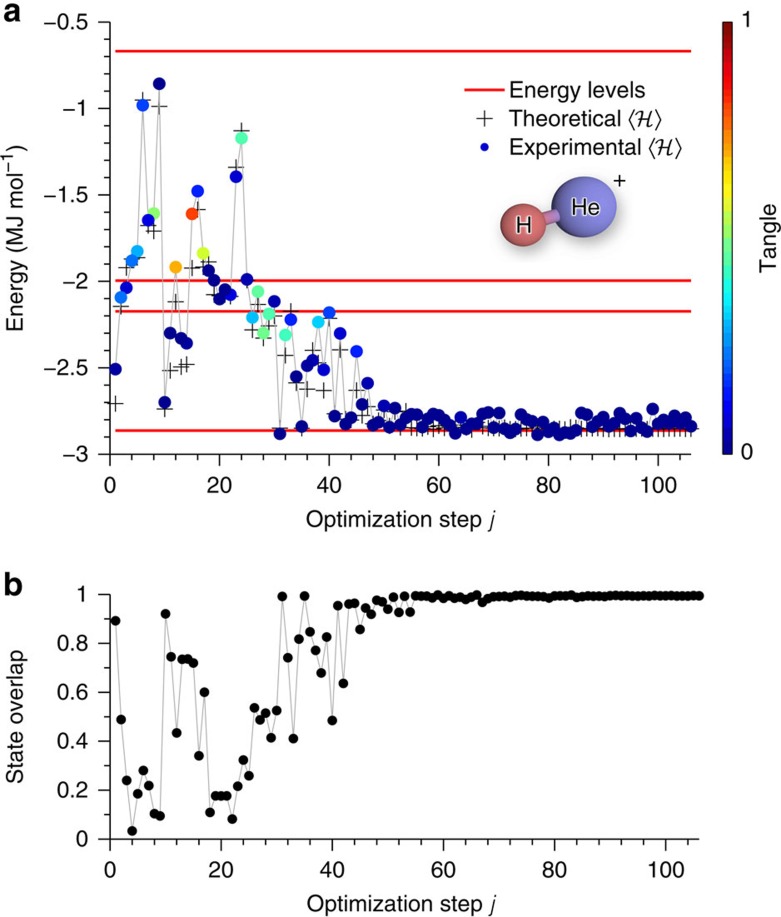
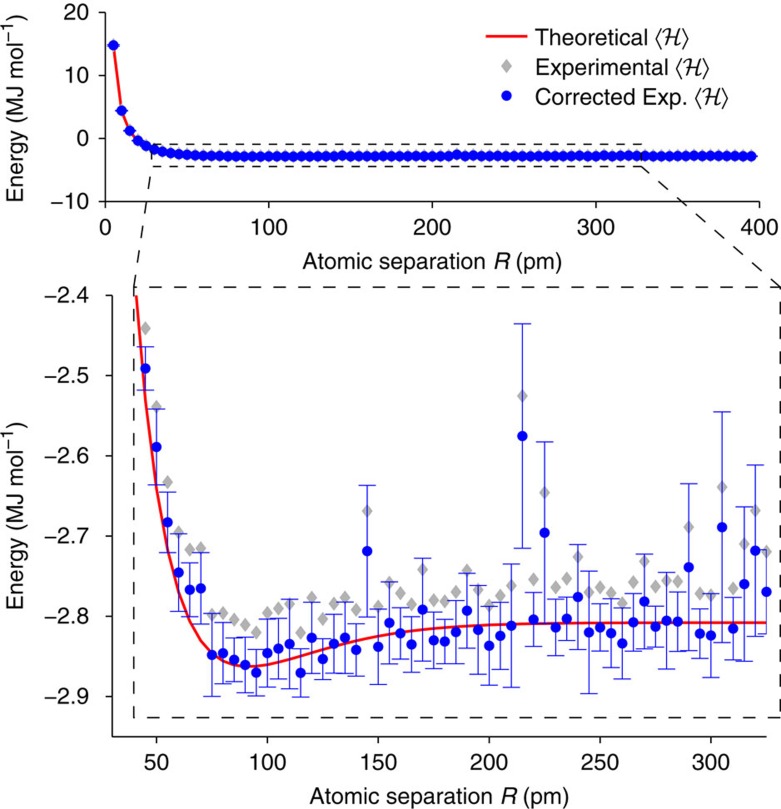
- The authors report an experimental ground-state result for He–H\(^+\): after correcting for experimental errors, they estimate the equilibrium bond length as \(R = 92.3 \pm 0.1\) pm and the ground-state electronic energy as \(E = -2.865 \pm 0.008\) MJ mol\(^{-1}\).
- For the bond dissociation curve, more than 96% of the experimental data are within chemical accuracy of the theoretical values.
- In the discussion, they state that for a 4 × 4 Hamiltonian like the one demonstrated, the QPE circuit would require at least 12 CNOT gates, whereas their method requires one.
- The full experiment was performed in about 158 h, and the bond dissociation curve was obtained by finding the ground states of 79 Hamiltonians.
## Methods
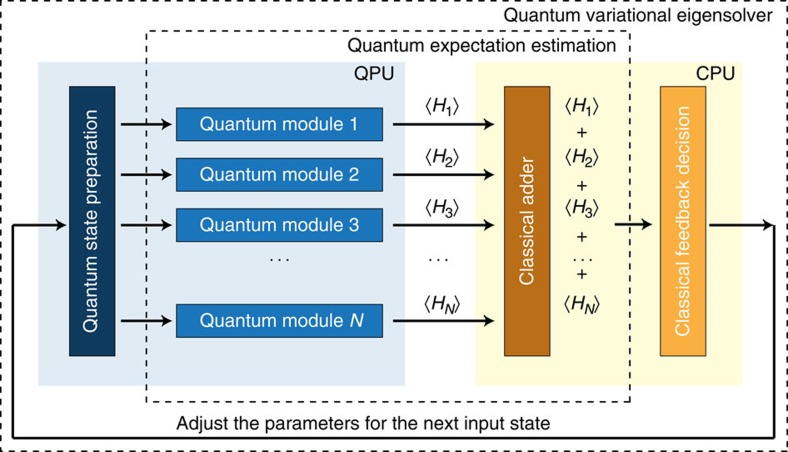
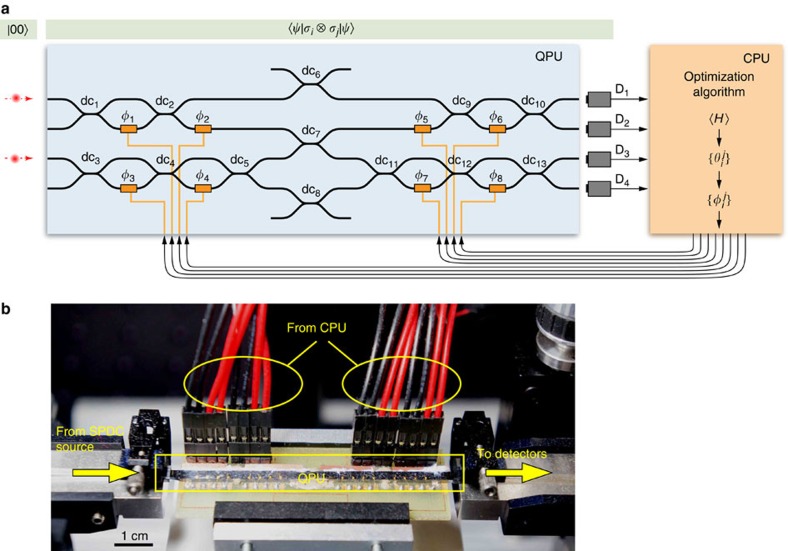
- The paper combines a reconfigurable integrated photonic quantum processor with a classical optimization algorithm: the quantum device estimates Hamiltonian expectation values, and the classical processor updates the state parameters variationally.
- The photonic chip prepares and measures arbitrary two-qubit pure states using single-qubit rotations and one two-qubit entangling gate; the experimental demonstration uses the He–H\(^+\) molecule in a minimal basis.
- For the classical optimization, they use the Nelder–Mead algorithm; expectation values are reconstructed from four two-qubit Pauli measurements at each point.
## Limitations
- The paper states that the method still requires a good approximation to the ground state as input/initialization, and the reliance on multiple separate measurements makes it sensitive to variations in state preparation between calculations.
- The authors report a constant systematic shift of \(\varepsilon = 50\) kJ mol\(^{-1}\) in the measured expectation values; they attribute this to photon-source impurity/distinguishability, circuit imperfections, and unbalanced coupling efficiencies.
- Evident from the text: the demonstration is limited to a two-qubit / 4 × 4 Hamiltonian prototype, so the scalability claim is not experimentally validated here.
Model-written summary. Check it against the paper before relying on it.
Integrity signals
Registry
Cites
Statistics
Figures
Verification
Claims the paper makes
7 Valid · 4 Not valid · 11 Not checked · 59 Own results and interpretations
The cited sources support only part of this claim — read each source’s verdict below.
In the paper
“Recent developments in the field of quantum computation offer a way forward for determining efficient solutions of many instances of large eigenvalue problems that are classically intractable6789101112”
§ A variational eigenvalue solver on a photonic quantum processor > Abstract
What the sources say
- Not matchedcites [6] Nielsen, M. A. & Chuang, I. L. Quantum Computation and Quantum Information Cambridge University Press (2000).
Couldn’t be matched to a paper in Crossref, so it can’t be checked.
- Could not verifycites [7] Kitaev, A. Quantum measurements and the Abelian stabilizer problem. Electronic Colloquium on Computational Complexity (ECCC) 3 (1996). sourceExperimental — accuracy not yet measured
Our copy under this DOI is the ISAAC 2021 paper 'Effective Resistance and Capacitance in Simplicial Complexes and a Quantum Algorithm' (Kitaev's 1995 work appears only as reference [9] in its bibliography), and it nowhere asserts that quantum computation gives efficient solutions to classically intractable large eigenvalue problems. Eigenvalues enter only as complexity parameters — λ, the smallest eigenvalue of the normalized up-Laplacian, in Lemma 31 and Theorem 26 (Section 6.3, 'Time efficient implementations') and in the phase-estimation machinery of Appendix A — and Section 1.1 ('Our Contributions') actually reports the opposite direction for its own problem: 'the quantum algorithm is slower than the classical algorithm in the worst case'. Searched: 'eigenvalue problems classically intractable', 'quantum speedup / exponential advantage', 'phase estimation', 'faster than classical'; no passage addresses the claim's point. (LLM, conf=0.70)
- Partly supportedcites [8] Griffiths, R. B. & Niu, C.-S. Semiclassical fourier transform for quantum computation. Phys. Rev. Lett. 76, 3228–3231 (1996). sourceExperimental — accuracy not yet measured
On p. 1, the paper says a quantum computer, if built, could solve certain problems such as factoring long numbers much faster than conventional algorithms. It also describes a simpler Fourier transform for Shor’s factorization and discrete-logarithm algorithms (p. 1). The copy does not support the claim about efficient solutions to many large eigenvalue problems. (LLM, conf=0.84)
plainstates a cause- Asserted: passes — The authors put it forward as true.
- Checkable: passes — It can be checked against evidence.
- Load-bearing: passes — The paper’s conclusions depend on it.
- Based: passes — The paper gives a reason why it holds.
- Not matched
Every source the paper cites for this claim was checked and supports it.
In the paper
“this would suffer from the N-representability problem, which is known to be intractable for both classical and quantum computers (it is in the quantum complexity class QMA-Hard24).”
§ A variational eigenvalue solver on a photonic quantum processor > Results > Quantum expectation estimation
What the sources say
- Supportedcites [24] Liu, Y.-K., Christandl, M. & Verstraete, F. Quantum computational complexity of the n-representability problem: Qma complete. Phys. Rev. Lett. 98, 110503 (2007). source
The paper states that N-representability is QMA-complete and hence QMA-hard and NP-hard (Abstract). Its discussion of quantum-chemistry relevance says the problem is intractable in the worst case even on a quantum computer, while allowing that particular physical systems may be easier. (LLM, conf=0.93)
boosted- Asserted: passes — The authors put it forward as true.
- Checkable: passes — It can be checked against evidence.
- Load-bearing: passes — The paper’s conclusions depend on it.
- Based: passes — The paper gives a reason why it holds.
- Supported
Every source the paper cites for this claim was checked and supports it.
In the paper
“We have implemented the QPU using integrated quantum photonics technology30.”
§ A variational eigenvalue solver on a photonic quantum processor > Results > Prototype demonstration
What the sources say
- Supportedcites [30] O'Brien, J. L., Furusawa, A. & Vuckovic, J. Photonic quantum technologies. Nat. Photon. 3, 687–695 (2009). source
The citation identifies integrated quantum photonics as the technology used, rather than attributing the citing authors’ QPU implementation to this review. The “Integrated quantum optical circuits” section (p. 6) describes on-chip waveguide circuits performing quantum logic gates and a compiled quantum factoring algorithm. (LLM, conf=0.87)
plain- Asserted: passes — The authors put it forward as true.
- Checkable: passes — It can be checked against evidence.
- Load-bearing: passes — The paper’s conclusions depend on it.
- Based: passes — The paper gives a reason why it holds.
- Supported
The cited sources support only part of this claim — read each source’s verdict below.
In the paper
“The time the quantum computer must remain coherent is determined by the necessity of O(p−1) successive applications of , each of which can require on the order of millions or billions of quantum gates for practical applications1719, as compared to the tens to hundreds of gates achievable in the short term.”
§ A variational eigenvalue solver on a photonic quantum processor > Abstract
What the sources say
- Partly supportedcites [17] Whitfield, J. D., Biamonte, J. & Aspuru-Guzik, A. Simulation of electronic structure hamiltonians using quantum computers. Mol. Phys. 109, 735–750 (2011). sourceExperimental — accuracy not yet measured
Split into 2 atoms — 1 confirmed, 1 partially supported, 0 disputed, 0 misattributed, 0 unverifiable. Expand the claim to see per-atom verdicts.
- Partly supportedcites [19] Jones, N. C. et al. Faster quantum chemistry simulation on fault-tolerant quantum computers. New J. Phys. 14, 115023 (2012). sourceExperimental — accuracy not yet measured
Split into 2 atoms — 0 confirmed, 2 partially supported, 0 disputed, 0 misattributed, 0 unverifiable. Expand the claim to see per-atom verdicts.
plainstates a cause- Asserted: passes — The authors put it forward as true.
- Checkable: passes — It can be checked against evidence.
- Load-bearing: passes — The paper’s conclusions depend on it.
- Based: passes — The paper gives a reason why it holds.
- Partly supported
A result the paper reports from its own data — it cites no other source for it, so there is none to check. The quote shows it is in the paper.
In the paper
“We experimentally demonstrate the feasibility of this approach with an example from quantum chemistry—calculating the ground-state molecular energy for He–H+.”
§ A variational eigenvalue solver on a photonic quantum processor > Abstract
boostedstates a causeSingle case- Asserted: passes — The authors put it forward as true.
- Checkable: passes — It can be checked against evidence.
- Load-bearing: passes — The paper’s conclusions depend on it.
- Based: passes — The paper gives a reason why it holds.
31 more claims
Create a free account to see all 81 claims and to verify the 4 references still open.
- It may state two separate claims as one. 28
- Probably not a substantial claim. 24
Claims other papers make about this one
Each is checked against this paper’s own text: does it say what the citing paper says it does?
The cited source doesn’t support the claim as written.
In the citing paper
“Leveraging quantum resources, the UCC ansatz was instead realized as a PQC on a photonic processor (Peruzzo et al. , 2014).”
From Noisy intermediate-scale quantum algorithms (2022) · cites this paper as Peruzzo et al., 2014
Checked by a reasoning model — may be wrong.
Experimental — accuracy not yet measuredThe cited source doesn’t support the claim as written.
In the citing paper
“The first on-chip GMM of four-qubit cluster state was realised in a laser-writing chip ( Fig.4e ), by manipulating both the polarisation and path DoFs of two photons [85].”
From Integrated photonic quantum technologies (2020) · cites this paper as [85]
Checked by a reasoning model — may be wrong.
Experimental — accuracy not yet measuredThe cited source doesn’t support the claim as written.
In the citing paper
“four-qubit linear- and box-cluster states are generated in a laser-writing photonic chip. This is enabled by on-chip manipulating the two-photon four-qubit hyperentangled state and cluster state, that are encoded in photon's path and polarisation DoFs. The Grover's search algorithm on a four-element database was implemented by controlling the device.”
From Integrated photonic quantum technologies (2020) · cites this paper as [85]
Checked by a reasoning model — may be wrong.
Experimental — accuracy not yet measuredThe source backs part of the claim, not all of it — or backs it for a different population, condition or comparison.
In the citing paper
“Due to its versatility, the variational Hamiltonian ansatz has been implemented for quantum chemistry [21, 29], optimization [24], and for quantum simulation problems [30].”
From Variational quantum algorithms (2021) · cites this paper as [29]
Experimental — accuracy not yet measuredThe source backs part of the claim, not all of it — or backs it for a different population, condition or comparison.
In the citing paper
“For the original VQE (Peruzzo et al. , 2014) and QAOA (Farhi et al. , 2014) it can, for example, be described as a single expectation value min θ ⟨ H ⟩ U ( θ ) , where the differences solely appear in the specific form and construction of the qubit Hamiltonian.”
From Noisy intermediate-scale quantum algorithms (2022) · cites this paper as Peruzzo et al., 2014
Experimental — accuracy not yet measured
12 more claims about this paper
Create a free account to see every claim other papers make about this one.
Citations
Cites
A Simplex Method for Function Minimization
Nelder, J. A., & Mead, R. (1965) · The Computer Journal · doi:10.1093/comjnl/7.4.308 · Cited by 28,905
Quantum computation and quantum information
Law, J. (2001) · ACM SIGSOFT Software Engineering Notes · doi:10.1145/505482.505499 · Cited by 18,842
(1999) · Cited by 12,854
Practical Methods of Optimization
Fletcher, R. (2000) · Wiley eBooks · doi:10.1002/9781118723203 · Cited by 7,605 · cited 3×
“[12] S.”
BackgroundMethodPractical methods of optimization
(1988) · Mathematics and Computers in Simulation · doi:10.1016/0378-4754(88)90129-2 · Cited by 5,818
Quantum Algorithm for Linear Systems of Equations
Harrow, A. W., Hassidim, A., & Lloyd, S. (2009) · Physical Review Letters · doi:10.1103/physrevlett.103.150502 · Cited by 3,325
Conn, A. R., Gould, N. I. M., & Toint, P. L. (2000) · Society for Industrial and Applied Mathematics eBooks · doi:10.1137/1.9780898719857 · Cited by 2,981 · cited 3×
“[14] D.”
MethodInfluential�ber das Paulische �quivalenzverbot
Jordan, P., & Wigner, E. (1928) · Zeitschrift f�r Physik · doi:10.1007/bf01331938 · Cited by 2,597
Molecular Electronic‐Structure Theory
Helgaker, T., Jørgensen, P., & Olsen, J. (2000) · doi:10.1002/9781119019572 · Cited by 2,594
O'Brien, J. L., Furusawa, A., & Vučković, J. (2009) · Nature Photonics · doi:10.1038/nphoton.2009.229 · Cited by 2,388
Self-citation
Research works printed but not linked: 3
- Helgaker, T., Jorgensen, P. & Olsen, J. Mol. Electronic Struct. Theory Wiley, Sussex (2002).
- Saad, Y. Numerical Methods for Large Eigenvalue Problems Vol. 158, (SIAM (1992).
- Rayleigh, J. W. In finding the correction for the open end of an organ-pipe. Phil. Trans. 161, 77 (1870).
Cited by
Items 1,301–1,400 of 4,572
Optimal Trotterization in universal quantum simulators under faulty control
Knee, G. C., & Munro, W. J. (2015) · Physical Review A · doi:10.1103/physreva.91.052327 · Cited by 40
Quantum Algorithms for Quantum Chemistry based on the sparsity of the CI-matrixPreprint
Toloui, B., & Love, P. J. (2013) · arXiv (Cornell University) · doi:10.48550/arxiv.1312.2579 · Cited by 76
Self-citationHybrid Quantum-Classical Graph Convolutional NetworkPreprint
Chen, S. Y.-C., Wei, T.-C., Zhang, C., Yu, H., & Yoo, S. (2021) · arXiv (Cornell University) · doi:10.48550/arxiv.2101.06189 · Cited by 64
“Indeed, a family of algorithms called variational quantum algorithms [20], which have been successful in calculating chemical ground states [20, 21], have achieved promising results in quantum machine learning (QML) [22–47].”
BackgroundMethodOptimal training of variational quantum algorithms without barren plateausPreprint
Haug, T., & Kim, M. S. (2021) · arXiv (Cornell University) · doi:10.48550/arxiv.2104.14543 · Cited by 71
“These VQAs solve tasks by iteratively updating a parameterized quantum circuit (PQC) with a classical optimization routine in a feedback loop [3– 6].”
BackgroundMethodApproximating the quantum approximate optimization algorithm with digital-analog interactions
Headley, D., Müller, T., Martin, A., Solano, E., Sanz, M., & Wilhelm, F. K. (2020) · arXiv · doi:10.48550/arxiv.2002.12215 · Cited by 21
Spiers Memorial Lecture: Quantum chemistry, classical heuristics, and quantum advantage
Chan, G. K.-L. (2024) · Faraday Discussions · doi:10.1039/d4fd00141a · Cited by 20
Quantum Combinatorial Optimization in the NISQ Era: A Systematic Mapping Study
Gemeinhardt, F., Garmendia, A., Wimmer, M., Weder, B., & Leymann, F. (2024) · ACM Computing Surveys · doi:10.1145/3620668 · Cited by 22
“Therefore, the Variational Quantum Eigensolver (VQE) [206] and Quantum Approximate Optimization Algorithm (QAOA) [177] are introduced subsequently as prominent examples of VQAs for the domain of CO.”
BackgroundMethodEntanglement production and convergence properties of the variational quantum eigensolver
Woitzik, A. J. C., Barkoutsos, P. K., Wudarski, F., Buchleitner, A., & Tavernelli, I. (2020) · Physical Review A · doi:10.1103/physreva.102.042402 · Cited by 20
Scalable quantum simulations of scattering in scalar field theory on 120 qubits
Zemlevskiy, N. A. (2025) · Physical review. D/Physical review. D. · doi:10.1103/qr72-51v1 · Cited by 88
“It has a two-qubit gate depth of 25, making it shallow enough to save circuit depth for wavepacket preparation and time evolution.”
BackgroundMethodA systematic variational approach to band theory in a quantum computer
Sherbert, K., Cerasoli, F., & Nardelli, M. B. (2021) · RSC Advances · doi:10.1039/d1ra07451b · Cited by 27
Quantum computing critical exponents
Dreyer, H., Bejan, M., & Granet, E. (2021) · Physical Review A · doi:10.1103/physreva.104.062614 · Cited by 22
Approximate Solutions of Combinatorial Problems via Quantum Relaxations
Fuller, B., Hadfield, C. F., Glick, J. R., Imamichi, T., Itoko, T., Thompson, R. J., Jiao, Y., Kagele, M., Blom, A. W., Raymond, R., et al. (2024) · IEEE Transactions on Quantum Engineering · doi:10.1109/tqe.2024.3421294 · Cited by 67
“Once a relaxed Hamiltonian is constructed, a candidate ground state can be obtained with variational eigen-solvers [11], quantum phase estimation [12], approximation algorithms for quantum Hamiltonians [13], or quantum imaginary time evolution [14].”
MethodMartin, B. A., Simon, P., & Rančić, M. J. (2022) · Physical Review Research · doi:10.1103/physrevresearch.4.023190 · Cited by 38
“[8], VQE offers a method to obtain approximate groundstates of electronic systems described by an Hamiltonian H.”
MethodInfluentialStair, N. H., & Evangelista, F. A. (2022) · Journal of Chemical Theory and Computation · doi:10.1021/acs.jctc.1c01155 · Cited by 34
Mitigating depolarizing noise on quantum computers with noise-estimation circuits
Urbánek, M., Nachman, B. P., Pascuzzi, V. R., He, A., Bauer, C., & de Jong, W. A. (2021) · eScholarship (California Digital Library) · Cited by 19
Benavides-Riveros, C. L., Chen, L., Schilling, C., Mantilla, S., & Pittalis, S. (2022) · Physical Review Letters · doi:10.1103/physrevlett.129.066401 · Cited by 29
“Although its “unitary” flavor is impractical on classical computers, it recently became clear that UCC wavefunction can efficiently be handled on hybrid quantumclassical hardware like the variational eigensolvers [65, 66].”
BackgroundA Quantum-Inspired Tensor Network Algorithm for Constrained Combinatorial Optimization Problems
Hao, T., Huang, X.-X., Jia, C., & Peng, C. (2022) · Frontiers in Physics · doi:10.3389/fphy.2022.906590 · Cited by 43
Sugisaki, K., Toyota, K., Sato, K., Shiomi, D., & Takui, T. (2022) · Communications Chemistry · doi:10.1038/s42004-022-00701-8 · Cited by 30
Variational quantum optimization with multibasis encodings
Patti, T. L., Kossaifi, J., Anandkumar, A., & Yelin, S. F. (2022) · Physical Review Research · doi:10.1103/physrevresearch.4.033142 · Cited by 34
Proietti, M., Cerocchi, F., & Dispenza, M. (2022) · Physical Review A · doi:10.1103/physreva.106.022437 · Cited by 24
“Examples of near-term algorithms included in this category are variational quantum eigensolvers (VQEs) [15], variational quantum simulators (VQSs) [16] and quantum approximate optimization algorithms (QAOA) [17, 18].”
BackgroundAdvances in Quantum Computation and Quantum Technologies: A Design Automation Perspective
Micheli, G. D., Jiang, J.-H. R., Rand, R. W., Smith, K. N., & Soeken, M. (2022) · IEEE Journal on Emerging and Selected Topics in Circuits and Systems · doi:10.1109/jetcas.2022.3205174 · Cited by 27
“For example, in the near-term, variational algorithms [51], [52] will require classical subroutines for optimizing quantum algorithm parameters and moving closer to desired solutions.”
BackgroundState Preparation Boosters for Early Fault-Tolerant Quantum Computation
Wang, G., Sim, S., & Johnson, P. D. (2022) · Quantum · doi:10.22331/q-2022-10-06-829 · Cited by 38
“More “near-term” quantum algorithms, such as the variational quantum eigensolver (VQE), aim to estimate the ground state energy by directly preparing an approximation to the ground state; the quality of the energy estimate is limited by the quality of the ground state preparation [7, 8].”
BackgroundHalder, D., Prasannaa, V. S., & Maitra, R. (2022) · The Journal of Chemical Physics · doi:10.1063/5.0114688 · Cited by 24
Bootstrap Embedding on a Quantum Computer
Liu, Y., Meitei, O. R., Chin, Z. E., Dutt, A., Tao, M., Chuang, I. L., & Voorhis, T. V. (2023) · Journal of Chemical Theory and Computation · doi:10.1021/acs.jctc.3c00012 · Cited by 35
Automated Quantum Circuit Design With Nested Monte Carlo Tree Search
Wang, P., Usman, M., Parampalli, U., Hollenberg, L. C. L., & Myers, C. R. (2023) · IEEE Transactions on Quantum Engineering · doi:10.1109/tqe.2023.3265709 · Cited by 41
“Recently, there has been a lot of progress made in finding the ground state energy of simple molecules on near-term quantum computers with the variational circuit, both on the theoretical [39], [40], [41] and experimental [1], [7], [42], [43], [44], [45] front.”
BackgroundSack, S. H., Medina, R. A., Kueng, R., & Serbyn, M. (2023) · Physical Review A · doi:10.1103/physreva.107.062404 · Cited by 28
Quantum dropout: On and over the hardness of quantum approximate optimization algorithm
Wang, Z., Zheng, P.-L., Wu, B., & Zhang, Y. (2023) · Physical Review Research · doi:10.1103/physrevresearch.5.023171 · Cited by 26
Classification of Hybrid Quantum-Classical Computing
Phillipson, F., Neumann, N. M. P., & Wezeman, R. S. (2023) · Lecture notes in computer science · doi:10.1007/978-3-031-36030-5_2 · Cited by 41
“The first VQA, the variational quantum eigensolver (VQE) algorithm of [19], appeared in 2014.”
An introduction to variational quantum algorithms for combinatorial optimization problems
Grange, C., Poss, M., & Bourreau, E. (2023) · 4OR · doi:10.1007/s10288-023-00549-1 · Cited by 30
“VQAs are studied today because they represent an alternative approach that reduces the quality and quantity of the quantum resources needed [55].”
Cryogenic Embedded System to Support Quantum Computing: From 5-nm FinFET to Full Processor
Genßler, P. R., Klemme, F., Parihar, S. S., Brandhofer, S., Pahwa, G., Polian, I., Chauhan, Y. S., & Amrouch, H. (2023) · IEEE Transactions on Quantum Engineering · doi:10.1109/tqe.2023.3300833 · Cited by 21
“A general-purpose processor with its high flexibility is required to enable crucial tasks, such as running calibration protocols, loading the next quantum computation, and improve the runtime of popular quantum computing paradigms relying on classical processing, such as dynamic circuits [7] or variational quantum alg…”
MethodTraining variational quantum algorithms with random gate activation
Liu, S., Zhang, S., Jian, S.-K., & Yao, H. (2023) · Physical Review Research · doi:10.1103/physrevresearch.5.l032040 · Cited by 22
Robustness of quantum algorithms against coherent control errors
Berberich, J., Fink, D., & Holm, C. (2024) · Physical Review A · doi:10.1103/physreva.109.012417 · Cited by 36
Kanno, S., Nakamura, H., Kobayashi, T., Gocho, S., Hatanaka, M., Yamamoto, N., & Gao, Q. (2024) · npj Quantum Information · doi:10.1038/s41534-024-00851-8 · Cited by 28
“One of the most popular algorithms is the variational quantum eigensolver (VQE) 10 , which is used to obtain the ground state energy by minimizing energy cost function using a variational quantum circuit, where its parameters are updated by a classical computer.”
Quantum Algorithms Using Infeasible Solution Constraints for Collision-Avoidance Route Planning
Li, Q., Huang, Z., Jiang, W., Tang, Z., & Song, M. (2024) · IEEE Transactions on Consumer Electronics · doi:10.1109/tce.2024.3476156 · Cited by 30
“In recent years, Variational Quantum Algorithm (VQA) has been applied in many fields [27], including quantum chemistry [28], combinatorial optimization [21] and artificial intelligence [29].”
Quantum chemistry and charge transport in biomolecules with superconducting circuits
García-Álvarez, L., Las Heras, U., Mezzacapo, A., Sanz, M., Solano, E., & Lamata, L. (2016) · Scientific Reports · doi:10.1038/srep27836 · Cited by 20
Cohn, J., Yang, F., Najafi, K., Jones, B., & Freericks, J. K. (2020) · Physical Review A · doi:10.1103/physreva.102.022622 · Cited by 29
A diagrammatic approach to variational quantum ansatz construction
Herasymenko, Y., & O’Brien, T. E. (2021) · Quantum · doi:10.22331/q-2021-12-02-596 · Cited by 30
“As an example of symmetry-induced compression, let us construct the Trotterized unitary coupled cluster ansatz [3, 4] on a fermionic system.”
BackgroundMethodProjected cooling algorithm for quantum computation
Lee, D., Bonitati, J., Given, G., Hicks, C., Li, N., Lu, B.-N., Rai, A., Sarkar, A., & Watkins, J. (2020) · Physics Letters B · doi:10.1016/j.physletb.2020.135536 · Cited by 24
Quantum approximate Bayesian computation for NMR model inference
Sels, D., Dashti, H., Mora, S., Demler, O., & Demler, E. (2020) · Nature Machine Intelligence · doi:10.1038/s42256-020-0198-x · Cited by 41
Discontinuous Galerkin discretization for quantum simulation of chemistry
McClean, J. R., Faulstich, F. M., Zhu, Q., O’Gorman, B., Qiu, Y., White, S. R., Babbush, R., & Lin, L. (2020) · New Journal of Physics · doi:10.1088/1367-2630/ab9d9f · Cited by 29
“[18] A.”
BackgroundSelf-citationExploring Quantum Reversibility with Young Learners
Franklin, D. M., Palmer, J., Jang, W., Lehman, E., Marckwordt, J., Landsberg, R. H., Muller, A., & Harlow, D. B. (2020) · ACM Conference on International Computing Education Research (ICER) · doi:10.1145/3372782.3406255 · Cited by 21
“, to unlock the mysteries of nitrogen fixation to boost world food production) [15, 16].”
BackgroundSolving quantum master equations with deep quantum neural networks
Liu, Z., Duan, L., & Deng, D.-L. (2022) · Physical Review Research · doi:10.1103/physrevresearch.4.013097 · Cited by 34
“Along this line, a variety of hybrid quantum-classical approaches have been pushed forward, including variational quantum eigen-solver (VQE) [9–12], and quantum approximate optimization algorithm (QAOA) [13–15], quantum classifiers [16–18], and quantum generative adversarial networks [19–21], etc.”
BackgroundSampling Overhead Analysis of Quantum Error Mitigation: Uncoded vs. Coded Systems
Xiong, Y., Chandra, D., Ng, S. X., & Hanzo, L. (2020) · IEEE Access · doi:10.1109/access.2020.3045016 · Cited by 36
“Popular designs include the alternating operator circuit used in the quantum approximate optimization algorithm [14], the “unitary coupled-cluster ansatz” circuit applied in the computation of molecular energy based on variational eigensolver [16]–[18], as well as other heuristic designs aiming for quantum machine lea…”
BackgroundMethodQuantum Algorithm for the Direct Calculations of Vertical Ionization Energies
Sugisaki, K., Toyota, K., Sato, K., Shiomi, D., & Takui, T. (2021) · The Journal of Physical Chemistry Letters · doi:10.1021/acs.jpclett.1c00283 · Cited by 24
Improving readout in quantum simulations with repetition codes
Günther, J., Tacchino, F., Wootton, J. R., Tavernelli, I., & Barkoutsos, P. K. (2021) · Quantum Science and Technology · doi:10.1088/2058-9565/ac3386 · Cited by 29
“Notice that this essentially corresponds to a UCCSD ansatz [42, 51], which we use here as an approximation to the reference HF dissociation curve for different interatomic distances.”
MethodNatural parametrized quantum circuit
Haug, T., & Kim, M. S. (2022) · Physical Review A · doi:10.1103/physreva.106.052611 · Cited by 30
“We optimize the parameters iteratively with gradient ascent [3] via θ′ = θ + α∇Kt(θ), where α is the learning rate and ∇Kt(θ) is the gradient, which points in the direction of steepest change of the cost function.”
MethodRecurrent Quantum Neural NetworksPreprint
Bausch, J. (2020) · arXiv (Cornell University) · doi:10.48550/arxiv.2006.14619 · Cited by 261
Quantum Approximate Optimization Algorithm (QAOA)
Fakhimi, R., & Validi, H. (2023) · Springer eBooks · doi:10.1007/978-3-030-54621-2_854-1 · Cited by 37
Manenti, R., & Motta, M. (2023) · Oxford University Press eBooks · doi:10.1093/oso/9780198787488.005.0002 · Cited by 20
Error mitigation on a near-term quantum photonic device
Su, D., Israel, R., Sharma, K., Qi, H., Dhand, I., & Brádler, K. (2021) · Quantum · doi:10.22331/q-2021-05-04-452 · Cited by 19
Modeling Heterogeneous Catalysis Using Quantum Computers: An Academic and Industry Perspective
Hariharan, S., Kinge, S., & Visscher, L. (2024) · Journal of Chemical Information and Modeling · doi:10.1021/acs.jcim.4c01212 · Cited by 30
Quantum Algorithms for Quantum Molecular Systems: A Survey
Zhang, Y., Zhang, X., Sun, J., Lin, H., Huang, Y., Lv, D., & Yuan, X. (2025) · Wiley Interdisciplinary Reviews Computational Molecular Science · doi:10.1002/wcms.70020 · Cited by 36
“For a quantum state | ψ ⟩ , the expectation value of the Hamiltonian is given by ⟨ H ⟩ = =1 α p ⟨ ψ | ˆ σ p | ψ ⟩ [61, 62].”
Calculating nonadiabatic couplings and Berry's phase by variational quantum eigensolvers
Tamiya, S., Koh, S., & Nakagawa, Y. O. (2021) · Physical Review Research · doi:10.1103/physrevresearch.3.023244 · Cited by 31
“In particular, investigating quantum many-body systems with the variational quantum eigensolver (VQE) [15] is believed to be one of the most promising applications for NISQ devices.”
BackgroundMethodInfluentialExtended flag gadgets for low-overhead circuit verification
Debroy, D. M., & Brown, K. R. (2020) · Physical Review A · doi:10.1103/physreva.102.052409 · Cited by 36
Quantum circuit design methodology for multiple linear regression
Dutta, S., Suau, A., Dutta, S., Roy, S., Behera, B. K., & Panigrahi, P. K. (2020) · IET Quantum Communication · doi:10.1049/iet-qtc.2020.0013 · Cited by 40
“Quantum algorithms running on quantum computers aim at quickly and efficiently solving several important computational problems faster than classical algorithms running on classical computers [1–11].”
Efficient 2D Tensor Network Simulation of Quantum Systems
Pang, Y., Hao, T., Dugad, A., Zhou, Y., & Solomonik, E. (2020) · International Conference for High Performance Computing, Networking, Storage and Analysis (SC) · doi:10.1109/sc41405.2020.00018 · Cited by 35
“2) Variational Quantum Eigensolver Simulation: We benchmark VQE with the spin- 12 J1-J2 Heisenberg Model (see Equation (7)).”
BackgroundInfluentialNISQ Algorithm for Hamiltonian simulation via truncated Taylor series
Lau, J. W. Z., Haug, T., Kwek, L. C., & Bharti, K. (2022) · SciPost Physics · doi:10.21468/scipostphys.12.4.122 · Cited by 35
Practical Verification of Quantum Properties in Quantum-Approximate-Optimization Runs
Alam, M. S., Wudarski, F., Reagor, M. J., Sud, J., Grabbe, S. R., Wang, Z., Hodson, M. J., Lott, P. A., Rieffel, E. G., & Venturelli, D. (2022) · Physical Review Applied · doi:10.1103/physrevapplied.17.024026 · Cited by 20
Lötstedt, E., Yamanouchi, K., 土屋, 敬., & Tachikawa, Y. (2021) · Physical Review A · doi:10.1103/physreva.103.062609 · Cited by 23
Quantum Verification and Estimation with Few Copies
Morris, J., Saggio, V., Gočanin, A., & Dakić, B. (2022) · Advanced Quantum Technologies · doi:10.1002/qute.202100118 · Cited by 24
Liu, J., Matthews, D. A., & Cheng, L. (2022) · Journal of Chemical Theory and Computation · doi:10.1021/acs.jctc.1c01210 · Cited by 19
Spatial, spin, and charge symmetry projections for a Fermi-Hubbard model on a quantum computer
Seki, K., & Yunoki, S. (2022) · Physical Review A · doi:10.1103/physreva.105.032419 · Cited by 29
Zhang, J. H., & Iyengar, S. S. (2022) · Journal of Chemical Theory and Computation · doi:10.1021/acs.jctc.1c01303 · Cited by 21
Symmetry Breaking Slows Convergence of the ADAPT Variational Quantum Eigensolver
Bertels, L. W., Grimsley, H. R., Economou, S. E., Barnes, E., & Mayhall, N. J. (2022) · Journal of Chemical Theory and Computation · doi:10.1021/acs.jctc.2c00709 · Cited by 38
Recompilation-enhanced simulation of electron–phonon dynamics on IBM quantum computers
Jaderberg, B., Eisfeld, A., Jaksch, D., & Mostame, S. (2022) · New Journal of Physics · doi:10.1088/1367-2630/ac8a69 · Cited by 21
Evaluation of Parameterized Quantum Circuits With Cross-Resonance Pulse-Driven Entanglers
Ibrahim, M. M. A., Mohammadbagherpoor, H., Rios, C., Bronn, N. T., & Byrd, G. T. (2022) · IEEE Transactions on Quantum Engineering · doi:10.1109/tqe.2022.3231124 · Cited by 32
“We compare the performance of the three PQC configura-tions with two sets of VQE applications from chemistry and optimization.”
BackgroundMethodInfluentialAugmenting QAOA Ansatz with Multiparameter Problem-Independent Layer
Chalupnik, M., Melo, H., Alexeev, Y., & Galda, A. (2022) · IEEE International Conference on Quantum Computing and Engineering (QCE) · doi:10.1109/qce53715.2022.00028 · Cited by 41
A Tool For Debugging Quantum Circuits
Metwalli, S. A., & Meter, R. V. (2022) · IEEE International Conference on Quantum Computing and Engineering (QCE) · doi:10.1109/qce53715.2022.00085 · Cited by 34
Applications of Quantum Computing in Health Sector
Arshad, M. W., Murtza, I., & Arshad, M. A. (2023) · Journal of Data Science and Intelligent Systems · doi:10.47852/bonviewjdsis3202656 · Cited by 33
Quantum Simulations of Fermionic Hamiltonians with Efficient Encoding and Ansatz Schemes
Huang, B., Sheng, N., Govoni, M., & Galli, G. (2023) · Journal of Chemical Theory and Computation · doi:10.1021/acs.jctc.2c01119 · Cited by 27
Haidar, M., Rančić, M. J., Ayral, T., Maday, Y., & Piquemal, J. (2023) · Wiley Interdisciplinary Reviews Computational Molecular Science · doi:10.1002/wcms.1664 · Cited by 34
Latency considerations for stochastic optimizers in variational quantum algorithms
Menickelly, M., Ha, Y., & Otten, M. (2023) · Quantum · doi:10.22331/q-2023-03-16-949 · Cited by 29
“We utilize a Trotterized, unitary coupled cluster, singles doubles (UCCSD) ansatz [42, 43] for this work, which is defined as”
MethodRančić, M. J. (2023) · Physical Review Research · doi:10.1103/physrevresearch.5.l012021 · Cited by 28
“In the rapidly expanding field of Noisy Intermediate-Scale Quantum Computing (NISQ) [6, 7] two algorithms stand out in prospect: the Variational Quantum Eigensolver (VQE)[8, 9] and the aforementioned Quantum Approximate Optimization Algorithm (QAOA) [10–12].”
MethodTan, A. T. K., Sun, S.-N., Tazhigulov, R. N., Chan, G. K., & Minnich, A. J. (2023) · Physical Review A · doi:10.1103/physreva.107.032614 · Cited by 24
Two-qubit quantum photonic processor manufactured by femtosecond laser writing
Skryabin, N. N., Kondratyev, I. V., Dyakonov, I. V., Borzenkova, O. V., Kulik, S. P., & Straupe, S. S. (2023) · Applied Physics Letters · doi:10.1063/5.0137728 · Cited by 19
Choi, S., & Izmaylov, A. F. (2023) · Journal of Chemical Theory and Computation · doi:10.1021/acs.jctc.3c00218 · Cited by 24
Computing the Many-Body Green’s Function with Adaptive Variational Quantum Dynamics
Gomes, N., Williams‐Young, D. B., & de Jong, W. A. (2023) · Journal of Chemical Theory and Computation · doi:10.1021/acs.jctc.3c00150 · Cited by 29
isQ: An Integrated Software Stack for Quantum Programming
Guo, J., Lou, H., Yu, J., Li, R., Fang, W. S., Liu, J., Long, P., Ying, S., & Ying, M. (2023) · IEEE Transactions on Quantum Engineering · doi:10.1109/tqe.2023.3275868 · Cited by 28
“Examples of such hybrid quantum algorithms in the NISQ era include VQE [33] and QAOA [34].”
MethodMolecular Quantum Circuit Design: A Graph-Based Approach
Kottmann, J. S. (2023) · Quantum · doi:10.22331/q-2023-08-03-1073 · Cited by 31
“The hydrogen molecule was used prominently in the pioneering work on variational quantum algorithms [34] and has since then served as a toy model for a myriad of approaches in variational quantum computing.”
Variational quantum and quantum-inspired clustering
Bermejo, P., & Orús, R. (2023) · Scientific Reports · doi:10.1038/s41598-023-39771-6 · Cited by 28
“(7).”
Pavošević, F., Tavernelli, I., & Rubio, Á. (2023) · The Journal of Physical Chemistry Letters · doi:10.1021/acs.jpclett.3c01935 · Cited by 21
Hybrid Gate-Pulse Model for Variational Quantum Algorithms
Liang, Z., Song, Z., Cheng, J., He, Z., Liu, J., Wang, H., Qin, R., Wang, Y., Han, S., Qian, X., et al. (2023) · ACM/IEEE Design Automation Conference (DAC) · doi:10.1109/dac56929.2023.10247923 · Cited by 44
Kurita, T., Qassim, H., Ishii, M., Oshima, H., Sato, S., & Emerson, J. (2023) · Quantum · doi:10.22331/q-2023-11-20-1184 · Cited by 38
“The variational quantum eigensolver (VQE) algorithm was proposed as a near-term alternative [5, 6].”
BackgroundMethodInnan, N., Khan, M. A.-Z., & Bennai, M. (2023) · Materials Today Communications · doi:10.1016/j.mtcomm.2023.107760 · Cited by 36
A General Approach to Dropout in Quantum Neural Networks
Scala, F., Ceschini, A., Panella, M., & Gerace, D. (2023) · Advanced Quantum Technologies · doi:10.1002/qute.202300220 · Cited by 32
“…a particular QML approach that demonstrated to be very efficient in dealing with such noisy hardware by exploiting the combination of Parametrized Quantum Circuits (PQC), often referred also as Quantum Neural Networks (QNNs) [15–18], and an optimization process run on a classical computer [19–27].”
MethodQuantum-probabilistic Hamiltonian learning for generative modeling and anomaly detection
Araz, J. Y., & Spannowsky, M. (2023) · Physical Review A · doi:10.1103/physreva.108.062422 · Cited by 25
Quantum Metrology Assisted by Machine Learning
Huang, J., Zhuang, M., Zhou, J., Shen, Y., & Lee, C. (2024) · Advanced Quantum Technologies · doi:10.1002/qute.202300329 · Cited by 24
Transition role of entangled data in quantum machine learning
Wang, X., Du, Y., Tu, Z., Luo, Y., Yuan, X., & Tao, D. (2024) · Nature Communications · doi:10.1038/s41467-024-47983-1 · Cited by 46
“Motivated by the exceptional abilities of quantum computers and the astonishing success in machine learning, a nascent frontier known as quantum machine learning (QML) has emerged [9–15], seeking to outperform classical models in specific learning tasks [16–25].”
BackgroundCombining matrix product states and noisy quantum computers for quantum simulation
Martin, B. A., Ayral, T., Jamet, F., Rančić, M. J., & Simon, P. (2024) · Physical Review A · doi:10.1103/physreva.109.062437 · Cited by 39
Quantum computing and quantum-inspired techniques for feature subset selection: a review
Mandal, A. K., & Chakraborty, B. (2024) · Knowledge and Information Systems · doi:10.1007/s10115-024-02282-5 · Cited by 29
“The VQE [84] is used for optimization problems, particularly in quantum chemistry and materials science.”
Design and fabrication of reconfigurable laser-written waveguide circuits
Chaboyer, Z. J., Stokes, A., Downes, J. E., Steel, M. J., & Withford, M. J. (2017) · Optics Express · doi:10.1364/oe.25.033056 · Cited by 18
Short-depth circuits for efficient expectation-value estimation
Roggero, A., & Baroni, A. (2020) · Physical Review A · doi:10.1103/physreva.101.022328 · Cited by 20
Classical simulation of noncontextual Pauli Hamiltonians
Kirby, W. M., & Love, P. J. (2020) · Physical Review A · doi:10.1103/physreva.102.032418 · Cited by 21
Self-citationKosugi, T., & Matsushita, Y. (2020) · Physical Review Research · doi:10.1103/physrevresearch.2.033043 · Cited by 30
“This approach was first realized [7] by using a quantum photonic device, after which the realizations by superconducting [8,9] and ion trap [10] quantum computers have been reported.”
MethodImplementation of measurement reduction for the variational quantum eigensolver
Ralli, A., Love, P. J., Tranter, A., & Coveney, P. V. (2021) · Physical Review Research · doi:10.1103/physrevresearch.3.033195 · Cited by 27
Self-citationSampling, rates, and reaction currents through reverse stochastic quantization on quantum computers
Mazzola, G. (2021) · Physical Review A · doi:10.1103/physreva.104.022431 · Cited by 25
Comparative study of adaptive variational quantum eigensolvers for multi-orbital impurity models
Mukherjee, A., Berthusen, N., Getelina, J. C., Orth, P. P., & Yao, Y. (2023) · Communications Physics · doi:10.1038/s42005-022-01089-6 · Cited by 30
“Here we present qubit-ADAPT VQE calculations of the (2, 2)eg model including shot noise.”
MethodInfluentialReoptimization of Quantum Circuits via Hierarchical Synthesis
Wu, X.-C., Davis, M. G., Chong, F. T., & Iancu, C. (2021) · IEEE International Conference on Rebooting Computing (ICRC) · doi:10.1109/icrc53822.2021.00016 · Cited by 28
McGinley, M., Leontica, S., Garratt, S. J., Jovanović, J., & Simon, S. H. (2022) · Physical Review A · doi:10.1103/physreva.106.012441 · Cited by 28
Quantum circuits synthesis using Householder transformations
de Brugière, T. G., Baboulin, M., Valiron, B., & Allouche, C. (2019) · Computer Physics Communications · doi:10.1016/j.cpc.2019.107001 · Cited by 25
Metadata
- Authors
- Peruzzo, A., McClean, J., Shadbolt, P., Yung, M.-H., Zhou, X.-Q., Love, P. J., Aspuru-Guzik, A., & O’Brien, J. L.
- Affiliations
- The University of Sydney (AU)
- Harvard University (US)
- University of Bristol (GB)
- Haverford College (US)
- Corresponding author
- Peruzzo, Alberto
- O’Brien, Jeremy L.
- Venue
- Nature Communications
- Published
- 2014-07-23
- Volume
- 5
- Issue
- 1
- Pages
- 4213-4213
- ISSN
- 2041-1723 (ISSN-L)
- PMC
- PMC4124861
- OpenAlex
- W2161685427
- Cited by
- 4,552
- References
- 48
- Citations by year
- 2026: 591 · 2025: 765 · 2024: 722 · 2023: 658 · 2022: 564 · 2021: 561 · 2020: 346 · 2019: 191 · 2018: 83 · 2017: 29 · 2016: 18 · 2015: 16 · 2014: 4
- FWCI
- 22.24
- Type
- journal article
- Language
- en
- Open access
- hybrid
- doi.org
- Licence
- cc-by-nc-nd
- creativecommons.org/licenses/by-nc-nd/4.0 (tdm)
- creativecommons.org/licenses/by-nc-nd/4.0 (vor)
- Locations
- Nature Communications (publishedVersion, cc-by-nc-nd)
- Europe PMC (PubMed Central) (publishedVersion, cc-by-nc-nd)
- PubMed Central (publishedVersion, cc-by-nc-nd)
- PubMed (publishedVersion)
- arXiv (Cornell University) (submittedVersion)
- OSTI OAI (U.S. Department of Energy Office of Scientific and Technical Information) (submittedVersion, cc-by-nc-nd)
- Digital Access to Scholarship at Harvard (DASH) (Harvard University) (submittedVersion, cc-by)
- RePEc: Research Papers in Economics (submittedVersion)
- RMIT Research Repository (RMIT University Library) (submittedVersion, cc-by-nc-nd)
- Figshare (submittedVersion, cc-by-nc-nd)
- UWA Profiles and Research Repository (UWA) (submittedVersion, cc-by-nc-nd)
- Bristol Research (University of Bristol) (submittedVersion)
- arXiv (Cornell University)
- Funders
- National Science Foundation (DE-FG02-97ER25308, 0955518, 1037992)
- U.S. Department of Energy (DEFG0297ER25308, DE‐FG02‐, FG02-97ER25308)
- Alfred P. Sloan Foundation
- John Templeton Foundation
- Camille and Henry Dreyfus Foundation
- Royal Academy of Engineering
- National Natural Science Foundation of China (61033001, 61361136003)
- Engineering and Physical Sciences Research Council (EP/J017175/1, EP/L024020/1, EP/K021931/1)
- Australian Research Council (DE140101700)
- National Key Research and Development Program of China (61033001, 2011CBA00301, 61361136003, 2011CBA00300)
- Division of Chemistry (CHE-1037992)
- Air Force Office of Scientific Research (FA 9550-12-1-0046, FA9550-, FA9550-12, FA9550‐12‐1)
- Topics
- Physical Sciences › Computer Science › Artificial Intelligence › Quantum Computing Algorithms and Architecture
- Physical Sciences › Physics and Astronomy › Atomic and Molecular Physics, and Optics › Quantum Information and Cryptography
- Physical Sciences › Physics and Astronomy › Atomic and Molecular Physics, and Optics › Quantum many-body systems
- Keywords
- variational quantum eigensolver, photonic quantum processors, quantum chemistry, classical optimization, hybrid quantum-classical computation
About these checks
Registry, retraction, Cites and statistics results are computed, not judged, with one exception: a printed reference that no index lists is read once by a model before it counts as a citation error. Claims are extracted by a model and kept only when their quote appears verbatim in the text; each cited source is then checked, with a model’s help, for whether it says what the claim relies on. Those verdicts can be wrong — read the claim’s quote and the cited source before relying on one.
The claim verdicts this report counts are experimental: their accuracy is not yet measured.
A language model drew the claims from the paper on 2026-10-10, under version 3 of the claim definition (model deepseek-v4.1-flash, prompt extract-v3).
A second model labelled each claim on 2026-10-10 (model jev-1.13-20260917, definition revision gold-guideline-v0.2).
Cited sources are checked with a language model’s help (qwen3.8-omni-flash and gpt-6-sol).
Statistics and arithmetic are recomputed, not judged.
Confidence bands are shown only for fields calibrated on our annotated test set. None is calibrated yet, so no band is shown.
What counts as a claim ›How we measure confidence ›How we check this ›
Are you an author, or do you see a problem with this page? Request a review
Data sources
Bibliographic data: Semantic Scholar, OpenAlex, Crossref.
Contains information from the Semantic Scholar Academic Graph Datasets, made available under the ODC Attribution License (ODC-BY 1.0).
Semantic Scholar’s data is described in: Kinney, R., et al. (2023). The Semantic Scholar Open Data Platform. arXiv:2301.10140.
