

A variational eigenvalue solver on a photonic quantum processor
Open accessThe DOI matches its Crossref record; 47 of the 48 references it cites were found in a registry or an index; 14 of the 31 sources its claims cite were checked for support.
Abstract
Quantum computers promise to efficiently solve important problems that are intractable on a conventional computer. For quantum systems, where the physical dimension grows exponentially, finding the eigenvalues of certain operators is one such intractable problem and remains a fundamental challenge. The quantum phase estimation algorithm efficiently finds the eigenvalue of a given eigenvector but requires fully coherent evolution. Here we present an alternative approach that greatly reduces the requirements for coherent evolution and combine this method with a new approach to state preparation based on ansätze and classical optimization. We implement the algorithm by combining a highly reconfigurable photonic quantum processor with a conventional computer. We experimentally demonstrate the feasibility of this approach with an example from quantum chemistry—calculating the ground-state molecular energy for He–H+. The proposed approach drastically reduces the coherence time requirements, enhancing the potential of quantum resources available today and in the near future. Quantum computers promise to efficiently solve problems that would be practically impossible with a normal computer. Peruzzo et al. develop a variational computation approach that uses any available quantum resources and, with a photonic quantum processing unit, find the ground-state molecular energy of He–H+.
Overview
CoChat Summary
## TL;DR
The paper introduces a variational alternative to quantum phase estimation for finding eigenvalues, combining short coherent quantum measurements with classical optimization. It experimentally demonstrates the approach on a photonic processor by estimating the ground-state energy curve of He–H\(^+\).
## Key findings
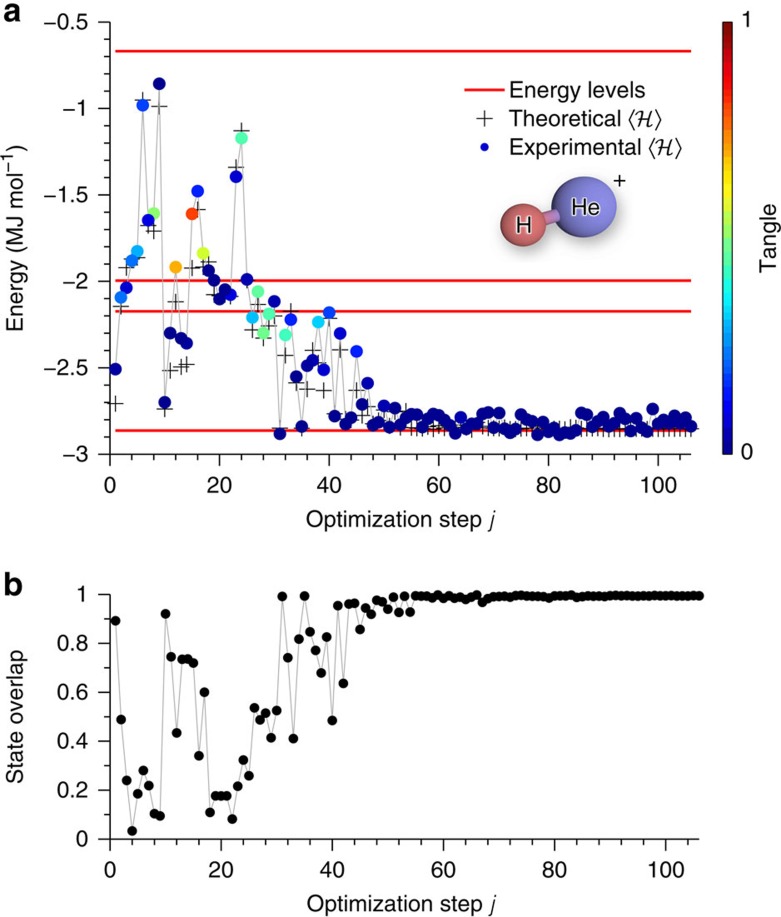
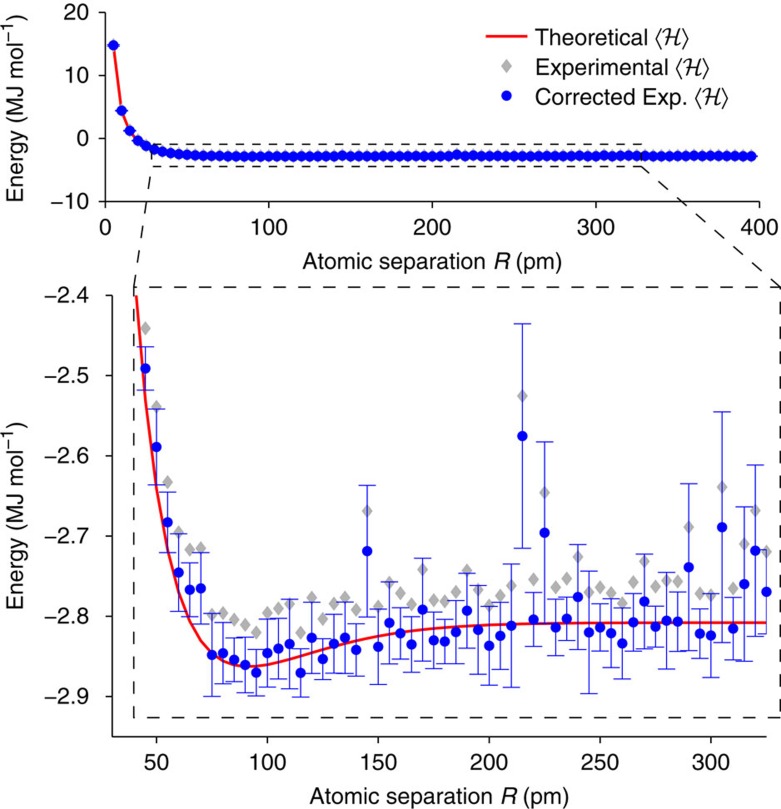
- The authors report an experimental ground-state result for He–H\(^+\): after correcting for experimental errors, they estimate the equilibrium bond length as \(R = 92.3 \pm 0.1\) pm and the ground-state electronic energy as \(E = -2.865 \pm 0.008\) MJ mol\(^{-1}\).
- For the bond dissociation curve, more than 96% of the experimental data are within chemical accuracy of the theoretical values.
- In the discussion, they state that for a 4 × 4 Hamiltonian like the one demonstrated, the QPE circuit would require at least 12 CNOT gates, whereas their method requires one.
- The full experiment was performed in about 158 h, and the bond dissociation curve was obtained by finding the ground states of 79 Hamiltonians.
## Methods
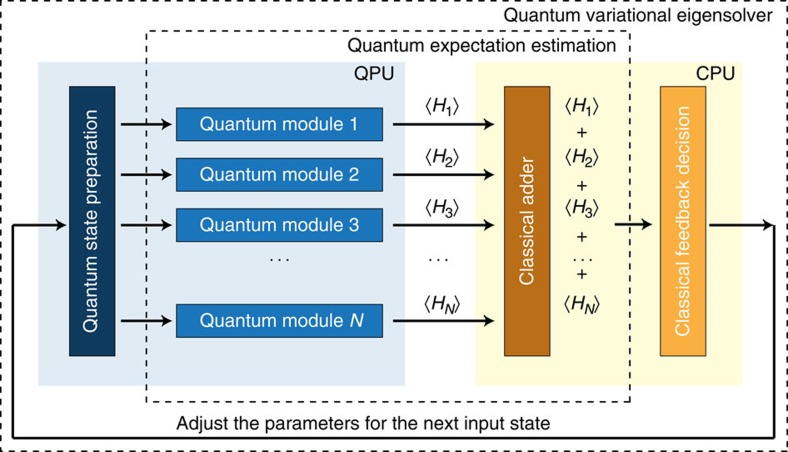
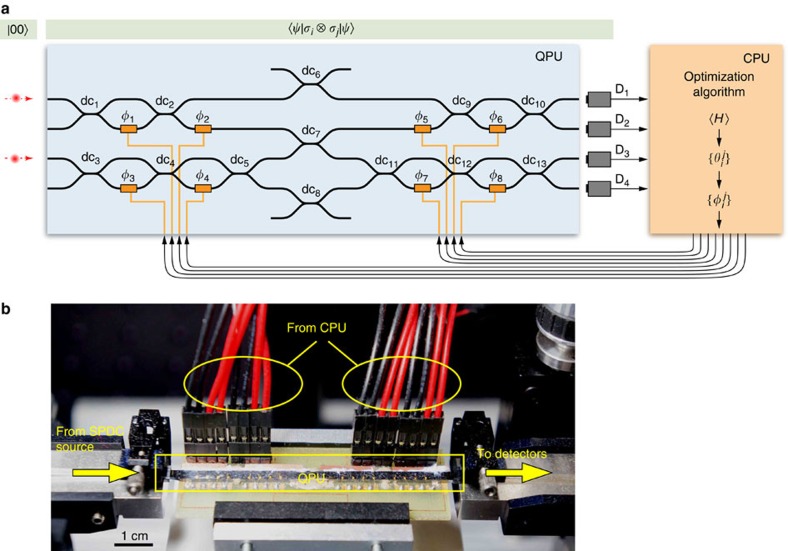
- The paper combines a reconfigurable integrated photonic quantum processor with a classical optimization algorithm: the quantum device estimates Hamiltonian expectation values, and the classical processor updates the state parameters variationally.
- The photonic chip prepares and measures arbitrary two-qubit pure states using single-qubit rotations and one two-qubit entangling gate; the experimental demonstration uses the He–H\(^+\) molecule in a minimal basis.
- For the classical optimization, they use the Nelder–Mead algorithm; expectation values are reconstructed from four two-qubit Pauli measurements at each point.
## Limitations
- The paper states that the method still requires a good approximation to the ground state as input/initialization, and the reliance on multiple separate measurements makes it sensitive to variations in state preparation between calculations.
- The authors report a constant systematic shift of \(\varepsilon = 50\) kJ mol\(^{-1}\) in the measured expectation values; they attribute this to photon-source impurity/distinguishability, circuit imperfections, and unbalanced coupling efficiencies.
- Evident from the text: the demonstration is limited to a two-qubit / 4 × 4 Hamiltonian prototype, so the scalability claim is not experimentally validated here.
Model-written summary. Check it against the paper before relying on it.
Integrity signals
Registry
Cites
Statistics
Figures
Verification
Claims the paper makes
7 Valid · 4 Not valid · 11 Not checked · 59 Own results and interpretations
The cited sources support only part of this claim — read each source’s verdict below.
In the paper
“Recent developments in the field of quantum computation offer a way forward for determining efficient solutions of many instances of large eigenvalue problems that are classically intractable6789101112”
§ A variational eigenvalue solver on a photonic quantum processor > Abstract
What the sources say
- Not matchedcites [6] Nielsen, M. A. & Chuang, I. L. Quantum Computation and Quantum Information Cambridge University Press (2000).
Couldn’t be matched to a paper in Crossref, so it can’t be checked.
- Could not verifycites [7] Kitaev, A. Quantum measurements and the Abelian stabilizer problem. Electronic Colloquium on Computational Complexity (ECCC) 3 (1996). sourceExperimental — accuracy not yet measured
Our copy under this DOI is the ISAAC 2021 paper 'Effective Resistance and Capacitance in Simplicial Complexes and a Quantum Algorithm' (Kitaev's 1995 work appears only as reference [9] in its bibliography), and it nowhere asserts that quantum computation gives efficient solutions to classically intractable large eigenvalue problems. Eigenvalues enter only as complexity parameters — λ, the smallest eigenvalue of the normalized up-Laplacian, in Lemma 31 and Theorem 26 (Section 6.3, 'Time efficient implementations') and in the phase-estimation machinery of Appendix A — and Section 1.1 ('Our Contributions') actually reports the opposite direction for its own problem: 'the quantum algorithm is slower than the classical algorithm in the worst case'. Searched: 'eigenvalue problems classically intractable', 'quantum speedup / exponential advantage', 'phase estimation', 'faster than classical'; no passage addresses the claim's point. (LLM, conf=0.70)
- Partly supportedcites [8] Griffiths, R. B. & Niu, C.-S. Semiclassical fourier transform for quantum computation. Phys. Rev. Lett. 76, 3228–3231 (1996). sourceExperimental — accuracy not yet measured
On p. 1, the paper says a quantum computer, if built, could solve certain problems such as factoring long numbers much faster than conventional algorithms. It also describes a simpler Fourier transform for Shor’s factorization and discrete-logarithm algorithms (p. 1). The copy does not support the claim about efficient solutions to many large eigenvalue problems. (LLM, conf=0.84)
plainstates a cause- Asserted: passes — The authors put it forward as true.
- Checkable: passes — It can be checked against evidence.
- Load-bearing: passes — The paper’s conclusions depend on it.
- Based: passes — The paper gives a reason why it holds.
- Not matched
Every source the paper cites for this claim was checked and supports it.
In the paper
“this would suffer from the N-representability problem, which is known to be intractable for both classical and quantum computers (it is in the quantum complexity class QMA-Hard24).”
§ A variational eigenvalue solver on a photonic quantum processor > Results > Quantum expectation estimation
What the sources say
- Supportedcites [24] Liu, Y.-K., Christandl, M. & Verstraete, F. Quantum computational complexity of the n-representability problem: Qma complete. Phys. Rev. Lett. 98, 110503 (2007). source
The paper states that N-representability is QMA-complete and hence QMA-hard and NP-hard (Abstract). Its discussion of quantum-chemistry relevance says the problem is intractable in the worst case even on a quantum computer, while allowing that particular physical systems may be easier. (LLM, conf=0.93)
boosted- Asserted: passes — The authors put it forward as true.
- Checkable: passes — It can be checked against evidence.
- Load-bearing: passes — The paper’s conclusions depend on it.
- Based: passes — The paper gives a reason why it holds.
- Supported
Every source the paper cites for this claim was checked and supports it.
In the paper
“We have implemented the QPU using integrated quantum photonics technology30.”
§ A variational eigenvalue solver on a photonic quantum processor > Results > Prototype demonstration
What the sources say
- Supportedcites [30] O'Brien, J. L., Furusawa, A. & Vuckovic, J. Photonic quantum technologies. Nat. Photon. 3, 687–695 (2009). source
The citation identifies integrated quantum photonics as the technology used, rather than attributing the citing authors’ QPU implementation to this review. The “Integrated quantum optical circuits” section (p. 6) describes on-chip waveguide circuits performing quantum logic gates and a compiled quantum factoring algorithm. (LLM, conf=0.87)
plain- Asserted: passes — The authors put it forward as true.
- Checkable: passes — It can be checked against evidence.
- Load-bearing: passes — The paper’s conclusions depend on it.
- Based: passes — The paper gives a reason why it holds.
- Supported
The cited sources support only part of this claim — read each source’s verdict below.
In the paper
“The time the quantum computer must remain coherent is determined by the necessity of O(p−1) successive applications of , each of which can require on the order of millions or billions of quantum gates for practical applications1719, as compared to the tens to hundreds of gates achievable in the short term.”
§ A variational eigenvalue solver on a photonic quantum processor > Abstract
What the sources say
- Partly supportedcites [17] Whitfield, J. D., Biamonte, J. & Aspuru-Guzik, A. Simulation of electronic structure hamiltonians using quantum computers. Mol. Phys. 109, 735–750 (2011). sourceExperimental — accuracy not yet measured
Split into 2 atoms — 1 confirmed, 1 partially supported, 0 disputed, 0 misattributed, 0 unverifiable. Expand the claim to see per-atom verdicts.
- Partly supportedcites [19] Jones, N. C. et al. Faster quantum chemistry simulation on fault-tolerant quantum computers. New J. Phys. 14, 115023 (2012). sourceExperimental — accuracy not yet measured
Split into 2 atoms — 0 confirmed, 2 partially supported, 0 disputed, 0 misattributed, 0 unverifiable. Expand the claim to see per-atom verdicts.
plainstates a cause- Asserted: passes — The authors put it forward as true.
- Checkable: passes — It can be checked against evidence.
- Load-bearing: passes — The paper’s conclusions depend on it.
- Based: passes — The paper gives a reason why it holds.
- Partly supported
A result the paper reports from its own data — it cites no other source for it, so there is none to check. The quote shows it is in the paper.
In the paper
“We experimentally demonstrate the feasibility of this approach with an example from quantum chemistry—calculating the ground-state molecular energy for He–H+.”
§ A variational eigenvalue solver on a photonic quantum processor > Abstract
boostedstates a causeSingle case- Asserted: passes — The authors put it forward as true.
- Checkable: passes — It can be checked against evidence.
- Load-bearing: passes — The paper’s conclusions depend on it.
- Based: passes — The paper gives a reason why it holds.
31 more claims
Create a free account to see all 81 claims and to verify the 4 references still open.
- It may state two separate claims as one. 28
- Probably not a substantial claim. 24
Claims other papers make about this one
Each is checked against this paper’s own text: does it say what the citing paper says it does?
The cited source doesn’t support the claim as written.
In the citing paper
“Leveraging quantum resources, the UCC ansatz was instead realized as a PQC on a photonic processor (Peruzzo et al. , 2014).”
From Noisy intermediate-scale quantum algorithms (2022) · cites this paper as Peruzzo et al., 2014
Checked by a reasoning model — may be wrong.
Experimental — accuracy not yet measuredThe cited source doesn’t support the claim as written.
In the citing paper
“The first on-chip GMM of four-qubit cluster state was realised in a laser-writing chip ( Fig.4e ), by manipulating both the polarisation and path DoFs of two photons [85].”
From Integrated photonic quantum technologies (2020) · cites this paper as [85]
Checked by a reasoning model — may be wrong.
Experimental — accuracy not yet measuredThe cited source doesn’t support the claim as written.
In the citing paper
“four-qubit linear- and box-cluster states are generated in a laser-writing photonic chip. This is enabled by on-chip manipulating the two-photon four-qubit hyperentangled state and cluster state, that are encoded in photon's path and polarisation DoFs. The Grover's search algorithm on a four-element database was implemented by controlling the device.”
From Integrated photonic quantum technologies (2020) · cites this paper as [85]
Checked by a reasoning model — may be wrong.
Experimental — accuracy not yet measuredThe source backs part of the claim, not all of it — or backs it for a different population, condition or comparison.
In the citing paper
“Due to its versatility, the variational Hamiltonian ansatz has been implemented for quantum chemistry [21, 29], optimization [24], and for quantum simulation problems [30].”
From Variational quantum algorithms (2021) · cites this paper as [29]
Experimental — accuracy not yet measuredThe source backs part of the claim, not all of it — or backs it for a different population, condition or comparison.
In the citing paper
“For the original VQE (Peruzzo et al. , 2014) and QAOA (Farhi et al. , 2014) it can, for example, be described as a single expectation value min θ ⟨ H ⟩ U ( θ ) , where the differences solely appear in the specific form and construction of the qubit Hamiltonian.”
From Noisy intermediate-scale quantum algorithms (2022) · cites this paper as Peruzzo et al., 2014
Experimental — accuracy not yet measured
12 more claims about this paper
Create a free account to see every claim other papers make about this one.
Citations
Cites
A Simplex Method for Function Minimization
Nelder, J. A., & Mead, R. (1965) · The Computer Journal · doi:10.1093/comjnl/7.4.308 · Cited by 28,905
Quantum computation and quantum information
Law, J. (2001) · ACM SIGSOFT Software Engineering Notes · doi:10.1145/505482.505499 · Cited by 18,842
(1999) · Cited by 12,854
Practical Methods of Optimization
Fletcher, R. (2000) · Wiley eBooks · doi:10.1002/9781118723203 · Cited by 7,605 · cited 3×
“[12] S.”
BackgroundMethodPractical methods of optimization
(1988) · Mathematics and Computers in Simulation · doi:10.1016/0378-4754(88)90129-2 · Cited by 5,818
Quantum Algorithm for Linear Systems of Equations
Harrow, A. W., Hassidim, A., & Lloyd, S. (2009) · Physical Review Letters · doi:10.1103/physrevlett.103.150502 · Cited by 3,325
Conn, A. R., Gould, N. I. M., & Toint, P. L. (2000) · Society for Industrial and Applied Mathematics eBooks · doi:10.1137/1.9780898719857 · Cited by 2,981 · cited 3×
“[14] D.”
MethodInfluential�ber das Paulische �quivalenzverbot
Jordan, P., & Wigner, E. (1928) · Zeitschrift f�r Physik · doi:10.1007/bf01331938 · Cited by 2,597
Molecular Electronic‐Structure Theory
Helgaker, T., Jørgensen, P., & Olsen, J. (2000) · doi:10.1002/9781119019572 · Cited by 2,594
O'Brien, J. L., Furusawa, A., & Vučković, J. (2009) · Nature Photonics · doi:10.1038/nphoton.2009.229 · Cited by 2,388
Self-citation
Research works printed but not linked: 3
- Helgaker, T., Jorgensen, P. & Olsen, J. Mol. Electronic Struct. Theory Wiley, Sussex (2002).
- Saad, Y. Numerical Methods for Large Eigenvalue Problems Vol. 158, (SIAM (1992).
- Rayleigh, J. W. In finding the correction for the open end of an organ-pipe. Phil. Trans. 161, 77 (1870).
Cited by
Items 1,401–1,500 of 4,573
Quantum circuits synthesis using Householder transformations
de Brugière, T. G., Baboulin, M., Valiron, B., & Allouche, C. (2019) · Computer Physics Communications · doi:10.1016/j.cpc.2019.107001 · Cited by 25
Proving Quantum Programs Correct
Hietala, K., Rand, R., Hung, S.-H., Li, L., & Hicks, M. (2020) · DROPS (Schloss Dagstuhl – Leibniz Center for Informatics) · doi:10.4230/lipics.itp.2021.21 · Cited by 61
“As an example, the variational quantum eigensolver (VQE) uses this approach to approximate the smallest eigenvalue of a Hamiltonian [27].”
MethodQuantum Computing for High-Energy Physics: State of the Art and ChallengesPreprint
Meglio, A. D., Jansen, K., Tavernelli, I., Alexandrou, C., Arunachalam, S., Bauer, C., Borras, K., Carrazza, S., Crippa, A., Croft, V. A., et al. (2023) · arXiv (Cornell University) · doi:10.3204/pubdb-2023-04595 · Cited by 24
Liu, Y., Liu, J., Raney, J. R., & Wang, P. (2023) · Extreme Mechanics Letters · doi:10.1016/j.eml.2023.102117 · Cited by 30
A Perspective on Quantum Computing Applications in Quantum Chemistry Using 25–100 Logical Qubits
Alexeev, Y., Batista, V. S., Bauman, N. P., Bertels, L. W., Claudino, D., Dutta, R., Gagliardi, L., Godwin, S., Govind, N., Head‐Gordon, M., et al. (2025) · Journal of Chemical Theory and Computation · doi:10.1021/acs.jctc.5c01038 · Cited by 53
“…extend beyond the reach of brute-force classical methods. black Development efforts are therefore increasingly centered around hybrid algorithms [29], embedding techniques [53– 64], and variational methods [65] that operate with shallow circuits or make optimal use of limited logical qubit counts.”
Magic state distillation and gate compilation in quantum algorithms for quantum chemistry
Trout, C. J., & Brown, K. R. (2015) · International Journal of Quantum Chemistry · doi:10.1002/qua.24856 · Cited by 17
Fast optimization of parametrized quantum optical circuits
Miatto, F. M., & Quesada, N. (2020) · Quantum · doi:10.22331/q-2020-11-30-366 · Cited by 37
“Parametrized quantum circuits are information processing devices whose elements depend on one or more parameters, and therefore one can think of them as a particular class of neural networks [13–18].”
BackgroundEffect of chaos on the simulation of quantum critical phenomena in analog quantum simulators
Chinni, K., Poggi, P. M., & Deutsch, I. H. (2021) · Physical Review Research · doi:10.1103/physrevresearch.3.033145 · Cited by 20
Low-rank density-matrix evolution for noisy quantum circuits
Chen, Y.-T., Farquhar, C., & Parrish, R. M. (2021) · npj Quantum Information · doi:10.1038/s41534-021-00392-4 · Cited by 32
Quantum deep transfer learning
Wang, L., Sun, Y., & Zhang, X. (2021) · New Journal of Physics · doi:10.1088/1367-2630/ac2a5e · Cited by 25
“Proven by series of recent works [21–27], tasks of ML are also on the list and the corresponding solutions are termed quantum machine learning (QML) algorithms.”
BackgroundExperimental Demonstration of Gaussian Boson Sampling with Displacement
Thekkadath, G., Sempere-Llagostera, S., Bell, B. A., Patel, R. B., Kim, M. S., & Walmsley, I. A. (2022) · PRX Quantum · doi:10.1103/prxquantum.3.020336 · Cited by 22
AGP-based unitary coupled cluster theory for quantum computers
Khamoshi, A., Chen, G. P., Evangelista, F. A., & Scuseria, G. E. (2022) · Quantum Science and Technology · doi:10.1088/2058-9565/ac93ae · Cited by 25
Quantum energy landscape and circuit optimization
Kim, J., & Oz, Y. (2022) · Physical Review A · doi:10.1103/physreva.106.052424 · Cited by 31
“The variational quantum algorithm (VQA) is arguably the most promising framework to achieve the near-term quantum advantage [1, 2].”
BackgroundSynthesizing efficient circuits for Hamiltonian simulation
Mukhopadhyay, P., Wiebe, N., & Zhang, H. T. (2023) · npj Quantum Information · doi:10.1038/s41534-023-00697-6 · Cited by 32
“Phase estimation can be combined with quantum simulation to find the ground state energy [17] and excited state energies [18, 19, 20] of the Hamiltonian.”
BackgroundTenCirChem: An Efficient Quantum Computational Chemistry Package for the NISQ Era
Li, W., Allcock, J., Cheng, L., Zhang, S., Chen, Y., Mailoa, J. P., Shuai, Z., & Zhang, S. (2023) · Journal of Chemical Theory and Computation · doi:10.1021/acs.jctc.3c00319 · Cited by 30
Huang, Y., Shao, Y., Ren, W., Sun, J., & Lv, D. (2023) · Journal of Chemical Theory and Computation · doi:10.1021/acs.jctc.3c00071 · Cited by 29
Leong, F. Y., Koh, D. E., Ewe, W.-B., & Kong, J. F. (2023) · International Journal of Numerical Methods for Heat & Fluid Flow · doi:10.1108/hff-05-2023-0265 · Cited by 32
Classical splitting of parametrized quantum circuits
Tüysüz, C., Clemente, G., Crippa, A., Hartung, T., Kühn, S., & Jansen, K. (2023) · Quantum Machine Intelligence · doi:10.1007/s42484-023-00118-z · Cited by 36
GSQAS: Graph Self-supervised Quantum Architecture Search
He, Z., Deng, M., Zheng, S., Li, L., & Situ, H. (2023) · Physica A Statistical Mechanics and its Applications · doi:10.1016/j.physa.2023.129286 · Cited by 27
Variational quantum eigensolvers in the era of distributed quantum computers
Khait, I., Tham, E., Segal, D., & Brodutch, A. (2023) · Physical Review A · doi:10.1103/physreva.108.l050401 · Cited by 22
Quantum simulations of SO(5) many-fermion systems using qudits
Illa, M., Robin, C., & Savage, M. J. (2023) · Physical Review C · doi:10.1103/physrevc.108.064306 · Cited by 27
Variational quantum algorithm for ergotropy estimation in quantum many-body batteries
Hoang, D. T., Metz, F., Thomasen, A. M. D., Anh-Tai, T. D., Busch, T., & Fogarty, T. (2024) · Physical Review Research · doi:10.1103/physrevresearch.6.013038 · Cited by 29
“A famous example is the variational quantum eigensolver (VQE) [61] which is used to determine the ground state of a Hamiltonian through repeated sampling of an ansatz wave-function in the eigenbases of a set of observables.”
BackgroundMethodBuonaiuto, G., Gargiulo, F., Pietro, G. D., Esposito, M., & Pota, M. (2024) · Quantum Machine Intelligence · doi:10.1007/s42484-024-00144-5 · Cited by 30
“Other types of quantum hardware will have different characteristics (Peruzzo et al. 2014; Zhao et al. 2023), i.e. more or less limitations depending on the specific feature under investigation.”
Optimizing Shot Assignment in Variational Quantum Eigensolver Measurement
Zhu, L., Liang, S., Yang, C., & Li, X. (2024) · Journal of Chemical Theory and Computation · doi:10.1021/acs.jctc.3c01113 · Cited by 40
Simulating $Z_{2}$ lattice gauge theory with the variational quantum thermalizer
Fromm, M., Philipsen, O., Spannowsky, M., & Winterowd, C. (2024) · EPJ Quantum Technology · doi:10.1140/epjqt/s40507-024-00232-2 · Cited by 32
Jensen, P. W. K., Kjellgren, E. R., Reinholdt, P., Ziems, K. M., Coriani, S., Kongsted, J., & Sauer, S. P. A. (2024) · Journal of Chemical Theory and Computation · doi:10.1021/acs.jctc.4c00069 · Cited by 26
“18,19 Yet, there is widespread interest in calculating the energy spectrum of a Hamiltonian, for example, to understand optical spectra in quantum chemistry.”
BackgroundAtomic Quantum Technologies for Quantum Matter and Fundamental Physics Applications
Malo, J. Y., Lepori, L., Gentini, L., & Chiofalo, M. L. (2024) · Technologies · doi:10.3390/technologies12050064 · Cited by 31
Toward Real Chemical Accuracy on Current Quantum Hardware Through the Transcorrelated Method
Dobrautz, W., Sokolov, I. O., Liao, K., Ríos, P. L., Rahm, M., Alavi, A., & Tavernelli, I. (2024) · Journal of Chemical Theory and Computation · doi:10.1021/acs.jctc.4c00070 · Cited by 49
Feedback-based quantum algorithms for ground state preparation
Larsen, J. B., Grace, M., Baczewski, A., & Magann, A. B. (2024) · Physical Review Research · doi:10.1103/physrevresearch.6.033336 · Cited by 29
“To this end, the Variational Quantum Eigensolver (VQE) [11] has been developed as a hybrid quantum-classical algorithm for this task that may hold promise in the near-term.”
BackgroundMethodEvaluating a quantum-classical quantum Monte Carlo algorithm with Matchgate shadows
Huang, B., Chen, Y.-T., Gupt, B., Suchara, M., Tran, A., McArdle, S., & Galli, G. (2024) · Physical Review Research · doi:10.1103/physrevresearch.6.043063 · Cited by 33
“[17] is that on a quantum computer, one may efficiently compute overlaps between Slater determinant walker states and a much wider range of trial states, e.g., the unitary coupled cluster (UCC) state [10,36].”
Ground and Excited States from Ensemble Variational Principles
Ding, L., Hong, C.-L., & Schilling, C. (2024) · Quantum · doi:10.22331/q-2024-11-14-1525 · Cited by 32
“We have provided a sound basis for the ensemble variational principle[21] which has been proposed by Gross, Oliveira and Kohn as a seminal extension of the famous Rayleigh-Ritz variational principle.”
Gyöngyösi, L., & Imre, S. (2025) · Quantum Information and Computation · doi:10.2478/qic-2025-0006 · Cited by 40
One-dimensional quantum computing with a ‘segmented chain’ is feasible with today’s gate fidelities
Li, Y., & Benjamin, S. C. (2018) · npj Quantum Information · doi:10.1038/s41534-018-0074-2 · Cited by 22
Bylaska, E. J., Song, D., Bauman, N. P., Kowalski, K., Claudino, D., & Humble, T. S. (2021) · Frontiers in Chemistry · doi:10.3389/fchem.2021.603019 · Cited by 19
Implementation of a quantum transfer learning approach to image splicing detection
Gokhale, A., Pande, M. B., & Pramod, D. (2020) · International Journal of Quantum Information · doi:10.1142/s0219749920500240 · Cited by 18
Variational simulation of Schwinger's Hamiltonian with polarization qubits
Borzenkova, O. V., Struchalin, G. I., Kardashin, A. S., Krasnikov, V. V., Skryabin, N. N., Straupe, S. S., Kulik, S. P., & Biamonte, J. (2021) · Applied Physics Letters · doi:10.1063/5.0043322 · Cited by 19
Simulating noisy variational quantum eigensolver with local noise models
Zeng, J., Wu, Z., Cao, C., Zhang, C., Hou, S., Xu, P., & Zeng, B. (2021) · Quantum Engineering · doi:10.1002/que2.77 · Cited by 31
Post-Hartree–Fock method in quantum chemistry for quantum computer
Shikano, Y., Watanabe, H. C., Nakanishi, K. M., & Ohnishi, Y. (2021) · The European Physical Journal Special Topics · doi:10.1140/epjs/s11734-021-00087-z · Cited by 28
Entanglement-Free Parameter Estimation of Generalized Pauli Channels
Rehman, J. U., & Shin, H. (2021) · Quantum · doi:10.22331/q-2021-07-01-490 · Cited by 23
“Examples include the current protocol, quantum state tomography tasks [42, 43], variational quantum algorithms [44], and other quantum information processing tasks [45], where Pauli measurements have the central role.”
BackgroundMany-body calculations for periodic materials via restricted Boltzmann machine-based VQE
Kanno, S., & Tada, T. (2021) · Quantum Science and Technology · doi:10.1088/2058-9565/abe139 · Cited by 19
“One of the most actively studied quantum algorithms for electronic structure calculations is the variational quantum eigensolver (VQE) [5].”
Parity Quantum Optimization: Benchmarks
FELLNER, M. J., Ender, K., ter Hoeven, R., & Lechner, W. (2023) · Quantum · doi:10.22331/q-2023-03-17-952 · Cited by 34
“Although applying approaches like the variational quantum eigensolver [47] directly to the Hamiltonian H might require fewer resources as there is no need for replicating the Hilbert space, we use the mapping described above to synthetically benchmark QAOA in the parity architecture.”
MethodQuantum Circuit Learning with Error Backpropagation Algorithm and Experimental Implementation
Watabe, M., Shiba, K., Chen, C.-C., Sogabe, M., Sakamoto, K., & Sogabe, T. (2021) · Quantum Reports · doi:10.3390/quantum3020021 · Cited by 22
“In QAOA, VQE, or other hybrid NISQ algorithms, the task of optimizing the model parameter is challenging.”
MethodA Quantum Interpretation of Bunched Logic & Quantum Separation Logic
Zhou, L., Barthe, G., Hsu, J., Ying, M., & Yu, N. (2021) · ACM/IEEE Symposium on Logic in Computer Science (LICS) · doi:10.1109/lics52264.2021.9470673 · Cited by 38
“Variational quantum algorithms (VQA) are a class of hybrid quantum/classical algorithms solving a fundamental problem in quantum chemistry – determine the ground state of a quantum system [14], [15].”
BackgroundSmart, S. E., & Mazziotti, D. A. (2022) · Physical Review A · doi:10.1103/physreva.105.062424 · Cited by 18
Sennane, W., Piquemal, J., & Rančić, M. J. (2023) · Physical Review A · doi:10.1103/physreva.107.012416 · Cited by 27
Quantum simulations of molecular systems with intrinsic atomic orbitals
Barison, S., Galli, D. E., & Motta, M. (2022) · Physical Review A · doi:10.1103/physreva.106.022404 · Cited by 25
Lowering qubit requirements for quantum simulations of fermionic systemsPreprint
Steudtner, M., & Wehner, S. (2017) · arXiv (Cornell University) · doi:10.48550/arxiv.1712.07067 · Cited by 29
Noise-Adaptive Compiler Mappings for Noisy Intermediate-Scale Quantum ComputersPreprint
Murali, P., Baker, J. M., Abhari, A. J., et al. (2019) · arXiv (Cornell University) · doi:10.48550/arxiv.1901.11054 · Cited by 18
On the learnability of quantum neural networksPreprint
Du, Y., Hsieh, M.-H., Liu, T., You, S., & Tao, D. (2020) · Research Square · doi:10.21203/rs.3.rs-80242/v1 · Cited by 18
“[52] Alberto Peruzzo, Jarrod McClean, Peter Shadbolt, Man-Hong Yung, Xiao-Qi Zhou, Peter J Love, Alán Aspuru-Guzik, and Jeremy L O’brien.”
BackgroundEfficient calculation of gradients in classical simulations of variational quantum algorithmsPreprint
Jones, T., & Gacon, J. (2020) · arXiv (Cornell University) · doi:10.48550/arxiv.2009.02823 · Cited by 90
Towards simulating 2D effects in lattice gauge theories on a quantum computer
Paulson, D., Dellantonio, L., Haase, J. F., et al. (2020) · UWSpace (University of Waterloo) · doi:10.48550/arxiv.2008.09252 · Cited by 18
On-premises superconducting quantum computer for education and research
Rönkkö, J., Ahonen, O., Bergholm, V., Calzona, A., Geresdi, A., Heimonen, H., Heinsoo, J., Milchakov, V., Pogorzalek, S., Sarsby, M., et al. (2024) · EPJ Quantum Technology · doi:10.1140/epjqt/s40507-024-00243-z · Cited by 36
“The variational quantum eigensolver (VQE) [80–82] is another quantum algorithm designed for finding the ground state energy, which is a fundamental quantity for quantum systems of interest in condensed matter physics and quantum chemistry.”
BackgroundBeyond unital noise in variational quantum algorithms: noise-induced barren plateaus and limit sets
Singkanipa, P., & Lidar, D. A. (2025) · Quantum · doi:10.22331/q-2025-01-30-1617 · Cited by 45
“…] ≠ 0 , the Unitary Coupled Cluster (UCC) ansatz [51], where the h lmj are coefficients derived from one-and two-electron integrals, which is used in the Variational Quantum Eigensolver (VQE) algorithm [20] with applications in quantum chemistry [52], and the Hardware Efficient VQE Ansatz, which…”
Quantum Computer-Aided Design: Digital Quantum Simulation of Quantum Processors
Kyaw, T. H., Menke, T., Sim, S., Anand, A., Sawaya, N. P. D., Oliver, W. D., Guerreschi, G. G., & Aspuru‐Guzik, A. (2021) · Physical Review Applied · doi:10.1103/physrevapplied.16.044042 · Cited by 35
Self-citationExtended vibrational coupled cluster: Stationary states and dynamics
Hansen, M. B., Madsen, N. K., & Christiansen, O. (2020) · The Journal of Chemical Physics · doi:10.1063/5.0015413 · Cited by 17
Simulating Energy Transfer in Molecular Systems with Digital Quantum Computers
Lee, C., Lau, J. W. Z., Shi, L., & Kwek, L. C. (2022) · Journal of Chemical Theory and Computation · doi:10.1021/acs.jctc.1c01296 · Cited by 23
A report on teaching a series of online lectures on quantum computing from CERN
Combarro, E. F., Vallecorsa, S., Rodríguez-Muñiz, L. J., Aguilar-González, Á., Ranilla, J., & Meglio, A. D. (2021) · The Journal of Supercomputing · doi:10.1007/s11227-021-03847-9 · Cited by 20
Simulation of Condensed-Phase Spectroscopy with Near-Term Digital Quantum Computers
Lee, C., Hsieh, C., Zhang, S., & Shi, L. (2021) · Journal of Chemical Theory and Computation · doi:10.1021/acs.jctc.1c00849 · Cited by 21
Liu, J., & Cheng, L. (2021) · The Journal of Chemical Physics · doi:10.1063/5.0062090 · Cited by 20
Quantum Circuits for the Preparation of Spin Eigenfunctions on Quantum Computers
Carbone, A., Galli, D. E., Motta, M., & Jones, B. (2022) · Symmetry · doi:10.3390/sym14030624 · Cited by 20
Tao, Y., Zeng, X., Fan, Y., Liu, J., Li, Z., & Yang, J. (2022) · The Journal of Physical Chemistry Letters · doi:10.1021/acs.jpclett.2c01738 · Cited by 19
“9,27 The VQE adapts to available qubit counts, coherence time, and gate fidelity for a feasible evaluation of the target function on contemporary quantum hardware, while the nonlinear optimization of circuit parameters towards a global minimum of the target function remarkably complicates this…”
Smart, S. E., & Mazziotti, D. A. (2022) · Journal of Chemical Theory and Computation · doi:10.1021/acs.jctc.2c00446 · Cited by 26
Quantum Circuit Evolution on NISQ Devices
Franken, L., Georgiev, B., Mücke, S., Wolter, M., Heese, R., Bauckhage, C., & Piatkowski, N. (2022) · IEEE Congress on Evolutionary Computation (CEC) · doi:10.1109/cec55065.2022.9870269 · Cited by 39
“Applications include, among others, ground state approximation [4], [5], simulation of imaginary-time evolution [6] and quantum machine learning [7].”
BackgroundYordanov, Y. S., Barnes, C. H. W., & Arvidsson-Shukur, D. R. M. (2022) · Physical Review A · doi:10.1103/physreva.106.032434 · Cited by 28
Universal compilation for quantum state tomography
Hai, V. T., & Ho, L. B. (2023) · Scientific Reports · doi:10.1038/s41598-023-30983-4 · Cited by 21
“(13) ž = Tr(Zρ̌), that obeys E[ž] = Tr(Zρ).”
Enhanced Estimation of Quantum Properties with Common Randomized Measurements
Vermersch, B., Rath, A., Sundar, B., Branciard, C., Preskill, J. P., & Elben, A. (2024) · PRX Quantum · doi:10.1103/prxquantum.5.010352 · Cited by 43
“This is particularly important for the variational quantum eigensolver algorithm, which typically requires the measurement of a local Hamiltonian [14,15].”
BackgroundSolution of SAT problems with the adaptive-bias quantum approximate optimization algorithm
Yu, Y., Cao, C., Wang, X., Shannon, N., & Joynt, R. (2023) · Physical Review Research · doi:10.1103/physrevresearch.5.023147 · Cited by 27
Kashif, M., & Al-Kuwari, S. M. (2023) · International Journal of Parallel Emergent and Distributed Systems · doi:10.1080/17445760.2023.2231163 · Cited by 29
“The VQAs have been studied for a wide range of applications, including quantumchemistry [7], state diagonalization [8], factorization [9], quantumoptimization [10], and quantum field theory simulation [11,12].”
BackgroundMartínez-Martínez, L. Á., Yen, T.-C., & Izmaylov, A. F. (2023) · Quantum · doi:10.22331/q-2023-08-16-1086 · Cited by 27
“Optimizing parameters f (l)p was performed successfully for the measurement problem in the VQE framework,29 yet similar optimization for the Trotter error runs into computational challenges associated with accurate prediction of fragment spectral range dependence on f (l)p .”
MethodInfluentialThe Future of Drug Development with Quantum Computing
Bonde, B. K., Patil, P., & Choubey, B. (2023) · Methods in molecular biology · doi:10.1007/978-1-0716-3449-3_7 · Cited by 29
Li, H., Wang, Z., & Fei, S.-M. (2023) · Physical Review A · doi:10.1103/physreva.108.032418 · Cited by 19
Multiple Query Optimization Using a Gate-Based Quantum Computer
Fankhauser, T., Solèr, M. E., Füchslin, R. M., & Stockinger, K. (2023) · IEEE Access · doi:10.1109/access.2023.3324253 · Cited by 46
“[4], [7], [13], [32], [38], whereas previously, the quantum computing community was mainly concerned with more theoretical studies due to the lack of practical quantum devices [30].”
BackgroundBayesian Optimization for QAOA
Tibaldi, S., Vodola, D., Tignone, E., & Ercolessi, E. (2023) · IEEE Transactions on Quantum Engineering · doi:10.1109/tqe.2023.3325167 · Cited by 38
Zhang, J., Ferguson, R., Kühn, S., Haase, J. F., Wilson, C. M., Jansen, K., & Muschik, C. A. (2023) · Quantum · doi:10.22331/q-2023-10-23-1148 · Cited by 37
“[2] and the initial demonstrations in [87].”
Quantum-inspired encoding enhances stochastic sampling of soft matter systems
Slongo, F., Hauke, P., Faccioli, P., & Micheletti, C. (2023) · Science Advances · doi:10.1126/sciadv.adi0204 · Cited by 22
Iterative quantum algorithm for combinatorial optimization based on quantum gradient descent
Yi, X., Huo, J., Gao, Y., Fan, L., Zhang, R., & Cao, C. (2023) · Results in Physics · doi:10.1016/j.rinp.2023.107204 · Cited by 20
Optimal Flight-Gate Assignment on a Digital Quantum Computer
Chai, Y., Funcke, L., Hartung, T., Jansen, K., Kühn, S., Stornati, P., & Stollenwerk, T. (2023) · Physical Review Applied · doi:10.1103/physrevapplied.20.064025 · Cited by 26
“[1] Alberto Peruzzo, Jarrod McClean, Peter Shadbolt, ManHong Yung, Xiao-Qi Zhou, Peter J Love, Alán AspuruGuzik, and Jeremy L O’brien, “A variational eigenvalue solver on a photonic quantum processor,” Nat.”
BackgroundNew advances for quantum‐inspired optimization
Du, Y., Wang, H., Hennig, R., Hulandageri, A., Kochenberger, G. A., & Glover, F. (2023) · International Transactions in Operational Research · doi:10.1111/itor.13420 · Cited by 19
Ensemble-learning error mitigation for variational quantum shallow-circuit classifiers
Li, Q., Huang, Y., Hou, X., Li, Y., Wang, X., & Bayat, A. (2024) · Physical Review Research · doi:10.1103/physrevresearch.6.013027 · Cited by 32
Verifiably exact solution of the electronic Schrödinger equation on quantum devices
Smart, S. E., & Mazziotti, D. A. (2024) · Physical Review A · doi:10.1103/physreva.109.022802 · Cited by 21
“In contrast to the variational quantum eigensolver (VQE) [25, 27] which generally has an approximate wave function ansatz and relies upon variational improvement, the CQE based on the CSE has a scalable wave function ansatz that by definition converges to the exact solution of the Schr¨odinger…”
MethodAccelerated variational quantum eigensolver with joint Bell measurement
Cao, C., Yano, H., & Nakagawa, Y. O. (2024) · Physical Review Research · doi:10.1103/physrevresearch.6.013205 · Cited by 19
Testing and Debugging Quantum Circuits
Metwalli, S. A., & Meter, R. V. (2024) · IEEE Transactions on Quantum Engineering · doi:10.1109/tqe.2024.3374879 · Cited by 33
“…tools mainly focus on the current generation of hardware, small programs, and the critical problems of optimization and mapping to specific processors [27], [28], [29], [30], [31], as well as on designing and implementing programs for hybrid or adaptive algorithms [32], [33], [34], [35], [36].”
Halder, D., Mondal, D., & Maitra, R. (2024) · The Journal of Chemical Physics · doi:10.1063/5.0198277 · Cited by 20
Quantum Optimization Methods for Satellite Mission Planning
Makarov, A., Pérez-Herradón, C., Franceschetto, G., Taddei, M. M., Osaba, E., del Barrio, P., Villar-Rodríguez, E., & Oregi, I. (2024) · IEEE Access · doi:10.1109/access.2024.3402990 · Cited by 27
“On another note, in [25] variational quantum algorithms such as the variational quantum eigensolver [26] and QAOA are used to solve several simple instances of the SMPP with and without simulated noise.”
MethodA Novel Hybrid Quantum Architecture for Path Planning in Quantum-Enabled Autonomous Mobile Robots
Sarkar, M., Pradhan, J., Singh, A. K., & Nenavath, H. (2024) · IEEE Transactions on Consumer Electronics · doi:10.1109/tce.2024.3423416 · Cited by 18
“…employing a quantum-classical hybrid approach in solving problems rather than employing quantum hardware solely, such as Variational Quantum Eigensolver (VQE) [51] and Quantum Approximation Optimization Algorithm (QAOA) [52], have made immediate impact in this NISQ era of quantum computation.”
Shedding Light on the Future: Exploring Quantum Neural Networks through Optics
Yu, S., Jia, Z., Zhang, A., Mer, E., Li, Z., Crescimanna, V., Chen, K., Patel, R. B., Walmsley, I. A., & Kaszlikowski, D. (2024) · Advanced Quantum Technologies · doi:10.1002/qute.202400074 · Cited by 24
“Variational quantum algorithms (VQAs) [19–23] and, more specifically, quantum neural networks (QNNs) [24– 30], stand out as some of the most promising applications in this area.”
BackgroundSelf-supervised representation learning for Bayesian quantum architecture search
He, Z., Chen, H., Zhou, Y., Situ, H., Li, Y., & Li, L. (2025) · Physical Review A · doi:10.1103/physreva.111.032403 · Cited by 25
Algorithmic Shadow Spectroscopy
Chan, H. H. S., Meister, R., Goh, M. L., & Koczor, B. (2025) · PRX Quantum · doi:10.1103/prxquantum.6.010352 · Cited by 53
A probabilistic quantum algorithm for imaginary-time evolution based on Taylor expansion
Yi, X., Huo, J., Liu, G., Fan, L., Zhang, R., & Cao, C. (2025) · EPJ Quantum Technology · doi:10.1140/epjqt/s40507-025-00347-0 · Cited by 23
“Subsequently, the parameters within the ansatz circuit are refined to generate a converged state, approximating the actual ground state [36].”
Berry phase estimation in gate-based adiabatic quantum simulation
Murta, B., Catarina, G., & Fernández-Rossier, J. (2020) · Physical Review A · doi:10.1103/physreva.101.020302 · Cited by 24
Unitary-coupled restricted Boltzmann machine ansatz for quantum simulations
Hsieh, C., Sun, Q., Zhang, S., & Lee, C. (2021) · npj Quantum Information · doi:10.1038/s41534-020-00347-1 · Cited by 23
Efficient two-electron ansatz for benchmarking quantum chemistry on a quantum computer
Smart, S. E., & Mazziotti, D. A. (2020) · Physical Review Research · doi:10.1103/physrevresearch.2.023048 · Cited by 20
Using quantum annealers to calculate ground state properties of molecules
Copenhaver, J., Wasserman, A., & Wehefritz-Kaufmann, B. (2021) · The Journal of Chemical Physics · doi:10.1063/5.0030397 · Cited by 24
Zeta-regularized vacuum expectation values
Hartung, T., & Jansen, K. (2019) · DESY Publication Database (PUBDB) (Deutsches Elektronen-Synchrotron) · Cited by 17
Variational learning for quantum artificial neural networks
Tacchino, F., Barkoutsos, P. K., Macchiavello, C., Gerace, D., Tavernelli, I., & Bajoni, D. (2020) · IEEE International Conference on Quantum Computing and Engineering (QCE) · doi:10.1109/qce49297.2020.00026 · Cited by 23
“Inspired by the well known variational quantum eigensolver (VQE) algorithm [39], and in line with a recently introduced unsampling protocol [40], we define the following optimization problem: given access to independent copies of | ψ w (cid:4) and to a variational quantum circuit, characterized by a…”
MethodQuantum simulation of second-quantized Hamiltonians in compact encoding
Kirby, W. M., Hadi, S., Kreshchuk, M., & Love, P. J. (2021) · Physical Review A · doi:10.1103/physreva.104.042607 · Cited by 31
“[6] Alberto Peruzzo, Jarrod McClean, Peter Shadbolt, Man-Hong Yung, Xiao-Qi Zhou, Peter J.”
MethodSelf-citationConnecting geometry and performance of two-qubit parameterized quantum circuits
Katabarwa, A., Sim, S., Koh, D. E., & Dallaire-Demers, P.-L. (2022) · Quantum · doi:10.22331/q-2022-08-23-782 · Cited by 24
What the foundations of quantum computer science teach us about chemistry
McClean, J. R., Rubin, N. C., Lee, J., Harrigan, M. P., O’Brien, T. E., Babbush, R., Huggins, W. J., & Huang, H.-Y. (2021) · The Journal of Chemical Physics · doi:10.1063/5.0060367 · Cited by 24
“These approaches have also included exploring ansatz for electronic systems that are inaccessible to classical computers [13, 28].”
BackgroundSelf-citationExploiting fermion number in factorized decompositions of the electronic structure Hamiltonian
McArdle, S., Campbell, E. T., & Su, Y. (2022) · Physical Review A · doi:10.1103/physreva.105.012403 · Cited by 26
Conceptual Understanding through Efficient Automated Design of Quantum Optical Experiments
Krenn, M., Kottmann, J. S., Tischler, N., & Aspuru‐Guzik, A. (2021) · Refubium (Universitätsbibliothek der Freien Universität Berlin) · doi:10.17169/refubium-32186 · Cited by 17
Self-citation
Metadata
- Authors
- Peruzzo, A., McClean, J., Shadbolt, P., Yung, M.-H., Zhou, X.-Q., Love, P. J., Aspuru-Guzik, A., & O’Brien, J. L.
- Affiliations
- The University of Sydney (AU)
- Harvard University (US)
- University of Bristol (GB)
- Haverford College (US)
- Corresponding author
- Peruzzo, Alberto
- O’Brien, Jeremy L.
- Venue
- Nature Communications
- Published
- 2014-07-23
- Volume
- 5
- Issue
- 1
- Pages
- 4213-4213
- ISSN
- 2041-1723 (ISSN-L)
- PMC
- PMC4124861
- OpenAlex
- W2161685427
- Cited by
- 4,552
- References
- 48
- Citations by year
- 2026: 591 · 2025: 765 · 2024: 722 · 2023: 658 · 2022: 564 · 2021: 561 · 2020: 346 · 2019: 191 · 2018: 83 · 2017: 29 · 2016: 18 · 2015: 16 · 2014: 4
- FWCI
- 22.24
- Type
- journal article
- Language
- en
- Open access
- hybrid
- doi.org
- Licence
- cc-by-nc-nd
- creativecommons.org/licenses/by-nc-nd/4.0 (tdm)
- creativecommons.org/licenses/by-nc-nd/4.0 (vor)
- Locations
- Nature Communications (publishedVersion, cc-by-nc-nd)
- Europe PMC (PubMed Central) (publishedVersion, cc-by-nc-nd)
- PubMed Central (publishedVersion, cc-by-nc-nd)
- PubMed (publishedVersion)
- arXiv (Cornell University) (submittedVersion)
- OSTI OAI (U.S. Department of Energy Office of Scientific and Technical Information) (submittedVersion, cc-by-nc-nd)
- Digital Access to Scholarship at Harvard (DASH) (Harvard University) (submittedVersion, cc-by)
- RePEc: Research Papers in Economics (submittedVersion)
- RMIT Research Repository (RMIT University Library) (submittedVersion, cc-by-nc-nd)
- Figshare (submittedVersion, cc-by-nc-nd)
- UWA Profiles and Research Repository (UWA) (submittedVersion, cc-by-nc-nd)
- Bristol Research (University of Bristol) (submittedVersion)
- arXiv (Cornell University)
- Funders
- National Science Foundation (DE-FG02-97ER25308, 0955518, 1037992)
- U.S. Department of Energy (DEFG0297ER25308, DE‐FG02‐, FG02-97ER25308)
- Alfred P. Sloan Foundation
- John Templeton Foundation
- Camille and Henry Dreyfus Foundation
- Royal Academy of Engineering
- National Natural Science Foundation of China (61033001, 61361136003)
- Engineering and Physical Sciences Research Council (EP/J017175/1, EP/L024020/1, EP/K021931/1)
- Australian Research Council (DE140101700)
- National Key Research and Development Program of China (61033001, 2011CBA00301, 61361136003, 2011CBA00300)
- Division of Chemistry (CHE-1037992)
- Air Force Office of Scientific Research (FA 9550-12-1-0046, FA9550-, FA9550-12, FA9550‐12‐1)
- Topics
- Physical Sciences › Computer Science › Artificial Intelligence › Quantum Computing Algorithms and Architecture
- Physical Sciences › Physics and Astronomy › Atomic and Molecular Physics, and Optics › Quantum Information and Cryptography
- Physical Sciences › Physics and Astronomy › Atomic and Molecular Physics, and Optics › Quantum many-body systems
- Keywords
- variational quantum eigensolver, photonic quantum processors, quantum chemistry, classical optimization, hybrid quantum-classical computation
About these checks
Registry, retraction, Cites and statistics results are computed, not judged, with one exception: a printed reference that no index lists is read once by a model before it counts as a citation error. Claims are extracted by a model and kept only when their quote appears verbatim in the text; each cited source is then checked, with a model’s help, for whether it says what the claim relies on. Those verdicts can be wrong — read the claim’s quote and the cited source before relying on one.
The claim verdicts this report counts are experimental: their accuracy is not yet measured.
A language model drew the claims from the paper on 2026-10-10, under version 3 of the claim definition (model deepseek-v4.1-flash, prompt extract-v3).
A second model labelled each claim on 2026-10-10 (model jev-1.13-20260917, definition revision gold-guideline-v0.2).
Cited sources are checked with a language model’s help (qwen3.8-omni-flash and gpt-6-sol).
Statistics and arithmetic are recomputed, not judged.
Confidence bands are shown only for fields calibrated on our annotated test set. None is calibrated yet, so no band is shown.
What counts as a claim ›How we measure confidence ›How we check this ›
Are you an author, or do you see a problem with this page? Request a review
Data sources
Bibliographic data: Semantic Scholar, OpenAlex, Crossref.
Contains information from the Semantic Scholar Academic Graph Datasets, made available under the ODC Attribution License (ODC-BY 1.0).
Semantic Scholar’s data is described in: Kinney, R., et al. (2023). The Semantic Scholar Open Data Platform. arXiv:2301.10140.
