

A variational eigenvalue solver on a photonic quantum processor
Open accessThe DOI matches its Crossref record; 47 of the 48 references it cites were found in a registry or an index; 14 of the 31 sources its claims cite were checked for support.
Abstract
Quantum computers promise to efficiently solve important problems that are intractable on a conventional computer. For quantum systems, where the physical dimension grows exponentially, finding the eigenvalues of certain operators is one such intractable problem and remains a fundamental challenge. The quantum phase estimation algorithm efficiently finds the eigenvalue of a given eigenvector but requires fully coherent evolution. Here we present an alternative approach that greatly reduces the requirements for coherent evolution and combine this method with a new approach to state preparation based on ansätze and classical optimization. We implement the algorithm by combining a highly reconfigurable photonic quantum processor with a conventional computer. We experimentally demonstrate the feasibility of this approach with an example from quantum chemistry—calculating the ground-state molecular energy for He–H+. The proposed approach drastically reduces the coherence time requirements, enhancing the potential of quantum resources available today and in the near future. Quantum computers promise to efficiently solve problems that would be practically impossible with a normal computer. Peruzzo et al. develop a variational computation approach that uses any available quantum resources and, with a photonic quantum processing unit, find the ground-state molecular energy of He–H+.
Overview
CoChat Summary
## TL;DR
The paper introduces a variational alternative to quantum phase estimation for finding eigenvalues, combining short coherent quantum measurements with classical optimization. It experimentally demonstrates the approach on a photonic processor by estimating the ground-state energy curve of He–H\(^+\).
## Key findings
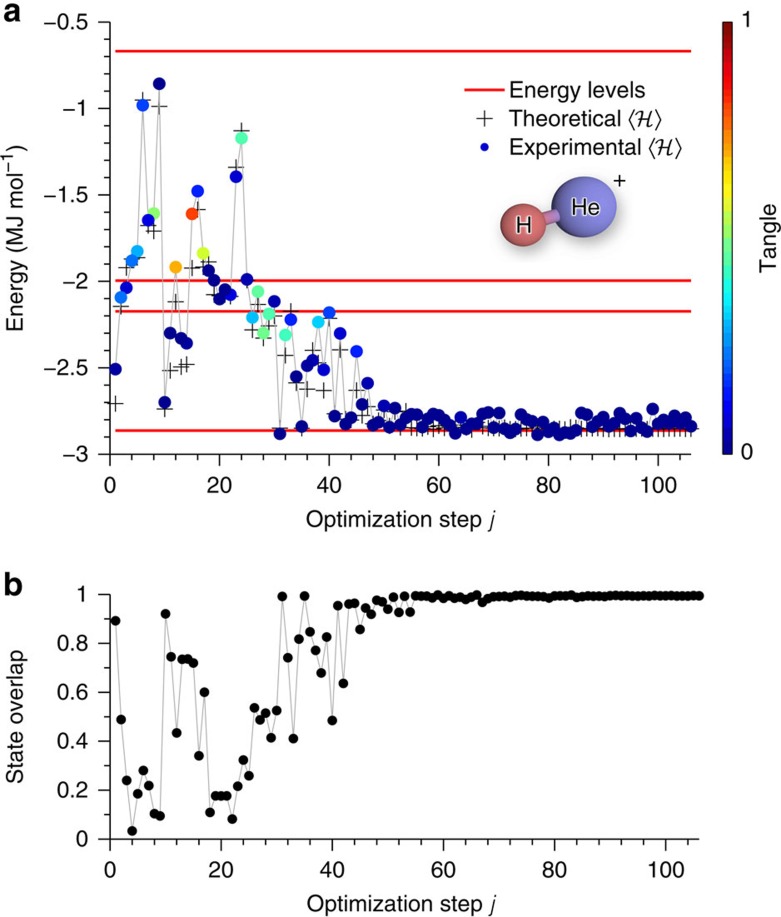
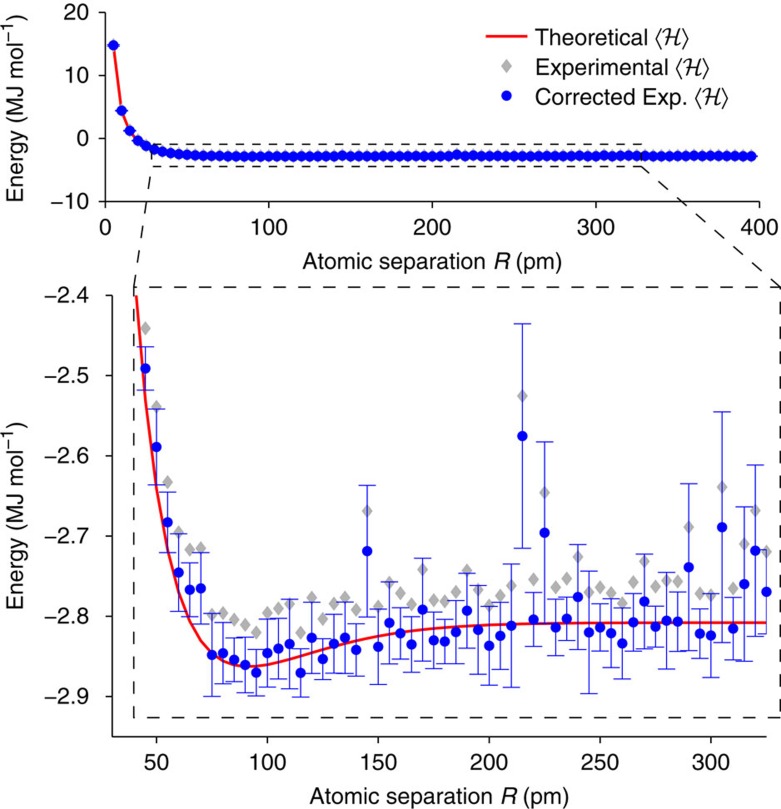
- The authors report an experimental ground-state result for He–H\(^+\): after correcting for experimental errors, they estimate the equilibrium bond length as \(R = 92.3 \pm 0.1\) pm and the ground-state electronic energy as \(E = -2.865 \pm 0.008\) MJ mol\(^{-1}\).
- For the bond dissociation curve, more than 96% of the experimental data are within chemical accuracy of the theoretical values.
- In the discussion, they state that for a 4 × 4 Hamiltonian like the one demonstrated, the QPE circuit would require at least 12 CNOT gates, whereas their method requires one.
- The full experiment was performed in about 158 h, and the bond dissociation curve was obtained by finding the ground states of 79 Hamiltonians.
## Methods
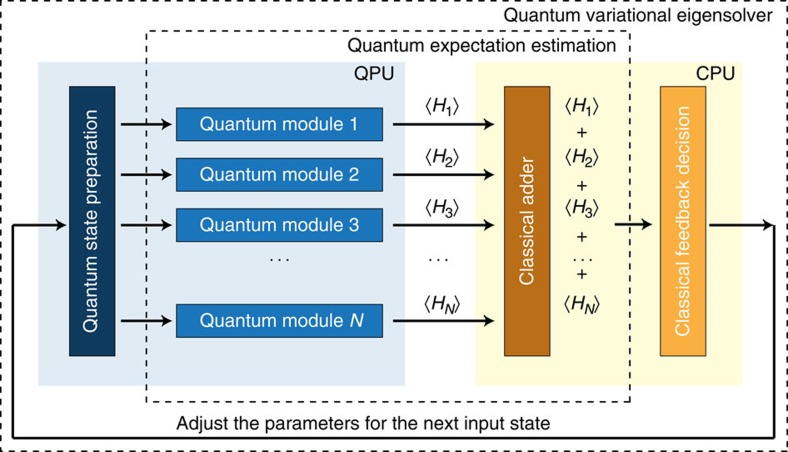
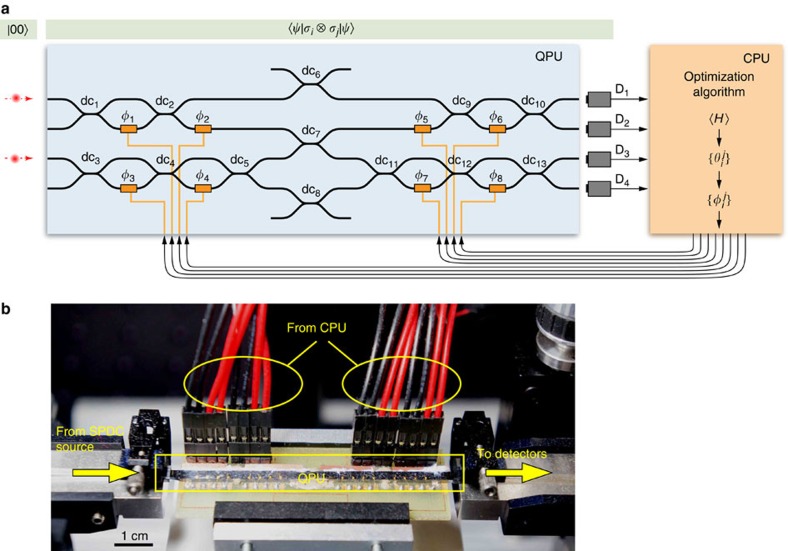
- The paper combines a reconfigurable integrated photonic quantum processor with a classical optimization algorithm: the quantum device estimates Hamiltonian expectation values, and the classical processor updates the state parameters variationally.
- The photonic chip prepares and measures arbitrary two-qubit pure states using single-qubit rotations and one two-qubit entangling gate; the experimental demonstration uses the He–H\(^+\) molecule in a minimal basis.
- For the classical optimization, they use the Nelder–Mead algorithm; expectation values are reconstructed from four two-qubit Pauli measurements at each point.
## Limitations
- The paper states that the method still requires a good approximation to the ground state as input/initialization, and the reliance on multiple separate measurements makes it sensitive to variations in state preparation between calculations.
- The authors report a constant systematic shift of \(\varepsilon = 50\) kJ mol\(^{-1}\) in the measured expectation values; they attribute this to photon-source impurity/distinguishability, circuit imperfections, and unbalanced coupling efficiencies.
- Evident from the text: the demonstration is limited to a two-qubit / 4 × 4 Hamiltonian prototype, so the scalability claim is not experimentally validated here.
Model-written summary. Check it against the paper before relying on it.
Integrity signals
Registry
Cites
Statistics
Figures
Verification
Claims the paper makes
7 Valid · 4 Not valid · 11 Not checked · 59 Own results and interpretations
The cited sources support only part of this claim — read each source’s verdict below.
In the paper
“Recent developments in the field of quantum computation offer a way forward for determining efficient solutions of many instances of large eigenvalue problems that are classically intractable6789101112”
§ A variational eigenvalue solver on a photonic quantum processor > Abstract
What the sources say
- Not matchedcites [6] Nielsen, M. A. & Chuang, I. L. Quantum Computation and Quantum Information Cambridge University Press (2000).
Couldn’t be matched to a paper in Crossref, so it can’t be checked.
- Could not verifycites [7] Kitaev, A. Quantum measurements and the Abelian stabilizer problem. Electronic Colloquium on Computational Complexity (ECCC) 3 (1996). sourceExperimental — accuracy not yet measured
Our copy under this DOI is the ISAAC 2021 paper 'Effective Resistance and Capacitance in Simplicial Complexes and a Quantum Algorithm' (Kitaev's 1995 work appears only as reference [9] in its bibliography), and it nowhere asserts that quantum computation gives efficient solutions to classically intractable large eigenvalue problems. Eigenvalues enter only as complexity parameters — λ, the smallest eigenvalue of the normalized up-Laplacian, in Lemma 31 and Theorem 26 (Section 6.3, 'Time efficient implementations') and in the phase-estimation machinery of Appendix A — and Section 1.1 ('Our Contributions') actually reports the opposite direction for its own problem: 'the quantum algorithm is slower than the classical algorithm in the worst case'. Searched: 'eigenvalue problems classically intractable', 'quantum speedup / exponential advantage', 'phase estimation', 'faster than classical'; no passage addresses the claim's point. (LLM, conf=0.70)
- Partly supportedcites [8] Griffiths, R. B. & Niu, C.-S. Semiclassical fourier transform for quantum computation. Phys. Rev. Lett. 76, 3228–3231 (1996). sourceExperimental — accuracy not yet measured
On p. 1, the paper says a quantum computer, if built, could solve certain problems such as factoring long numbers much faster than conventional algorithms. It also describes a simpler Fourier transform for Shor’s factorization and discrete-logarithm algorithms (p. 1). The copy does not support the claim about efficient solutions to many large eigenvalue problems. (LLM, conf=0.84)
plainstates a cause- Asserted: passes — The authors put it forward as true.
- Checkable: passes — It can be checked against evidence.
- Load-bearing: passes — The paper’s conclusions depend on it.
- Based: passes — The paper gives a reason why it holds.
- Not matched
Every source the paper cites for this claim was checked and supports it.
In the paper
“this would suffer from the N-representability problem, which is known to be intractable for both classical and quantum computers (it is in the quantum complexity class QMA-Hard24).”
§ A variational eigenvalue solver on a photonic quantum processor > Results > Quantum expectation estimation
What the sources say
- Supportedcites [24] Liu, Y.-K., Christandl, M. & Verstraete, F. Quantum computational complexity of the n-representability problem: Qma complete. Phys. Rev. Lett. 98, 110503 (2007). source
The paper states that N-representability is QMA-complete and hence QMA-hard and NP-hard (Abstract). Its discussion of quantum-chemistry relevance says the problem is intractable in the worst case even on a quantum computer, while allowing that particular physical systems may be easier. (LLM, conf=0.93)
boosted- Asserted: passes — The authors put it forward as true.
- Checkable: passes — It can be checked against evidence.
- Load-bearing: passes — The paper’s conclusions depend on it.
- Based: passes — The paper gives a reason why it holds.
- Supported
Every source the paper cites for this claim was checked and supports it.
In the paper
“We have implemented the QPU using integrated quantum photonics technology30.”
§ A variational eigenvalue solver on a photonic quantum processor > Results > Prototype demonstration
What the sources say
- Supportedcites [30] O'Brien, J. L., Furusawa, A. & Vuckovic, J. Photonic quantum technologies. Nat. Photon. 3, 687–695 (2009). source
The citation identifies integrated quantum photonics as the technology used, rather than attributing the citing authors’ QPU implementation to this review. The “Integrated quantum optical circuits” section (p. 6) describes on-chip waveguide circuits performing quantum logic gates and a compiled quantum factoring algorithm. (LLM, conf=0.87)
plain- Asserted: passes — The authors put it forward as true.
- Checkable: passes — It can be checked against evidence.
- Load-bearing: passes — The paper’s conclusions depend on it.
- Based: passes — The paper gives a reason why it holds.
- Supported
The cited sources support only part of this claim — read each source’s verdict below.
In the paper
“The time the quantum computer must remain coherent is determined by the necessity of O(p−1) successive applications of , each of which can require on the order of millions or billions of quantum gates for practical applications1719, as compared to the tens to hundreds of gates achievable in the short term.”
§ A variational eigenvalue solver on a photonic quantum processor > Abstract
What the sources say
- Partly supportedcites [17] Whitfield, J. D., Biamonte, J. & Aspuru-Guzik, A. Simulation of electronic structure hamiltonians using quantum computers. Mol. Phys. 109, 735–750 (2011). sourceExperimental — accuracy not yet measured
Split into 2 atoms — 1 confirmed, 1 partially supported, 0 disputed, 0 misattributed, 0 unverifiable. Expand the claim to see per-atom verdicts.
- Partly supportedcites [19] Jones, N. C. et al. Faster quantum chemistry simulation on fault-tolerant quantum computers. New J. Phys. 14, 115023 (2012). sourceExperimental — accuracy not yet measured
Split into 2 atoms — 0 confirmed, 2 partially supported, 0 disputed, 0 misattributed, 0 unverifiable. Expand the claim to see per-atom verdicts.
plainstates a cause- Asserted: passes — The authors put it forward as true.
- Checkable: passes — It can be checked against evidence.
- Load-bearing: passes — The paper’s conclusions depend on it.
- Based: passes — The paper gives a reason why it holds.
- Partly supported
A result the paper reports from its own data — it cites no other source for it, so there is none to check. The quote shows it is in the paper.
In the paper
“We experimentally demonstrate the feasibility of this approach with an example from quantum chemistry—calculating the ground-state molecular energy for He–H+.”
§ A variational eigenvalue solver on a photonic quantum processor > Abstract
boostedstates a causeSingle case- Asserted: passes — The authors put it forward as true.
- Checkable: passes — It can be checked against evidence.
- Load-bearing: passes — The paper’s conclusions depend on it.
- Based: passes — The paper gives a reason why it holds.
31 more claims
Create a free account to see all 81 claims and to verify the 4 references still open.
- It may state two separate claims as one. 28
- Probably not a substantial claim. 24
Claims other papers make about this one
Each is checked against this paper’s own text: does it say what the citing paper says it does?
The cited source doesn’t support the claim as written.
In the citing paper
“Leveraging quantum resources, the UCC ansatz was instead realized as a PQC on a photonic processor (Peruzzo et al. , 2014).”
From Noisy intermediate-scale quantum algorithms (2022) · cites this paper as Peruzzo et al., 2014
Checked by a reasoning model — may be wrong.
Experimental — accuracy not yet measuredThe cited source doesn’t support the claim as written.
In the citing paper
“The first on-chip GMM of four-qubit cluster state was realised in a laser-writing chip ( Fig.4e ), by manipulating both the polarisation and path DoFs of two photons [85].”
From Integrated photonic quantum technologies (2020) · cites this paper as [85]
Checked by a reasoning model — may be wrong.
Experimental — accuracy not yet measuredThe cited source doesn’t support the claim as written.
In the citing paper
“four-qubit linear- and box-cluster states are generated in a laser-writing photonic chip. This is enabled by on-chip manipulating the two-photon four-qubit hyperentangled state and cluster state, that are encoded in photon's path and polarisation DoFs. The Grover's search algorithm on a four-element database was implemented by controlling the device.”
From Integrated photonic quantum technologies (2020) · cites this paper as [85]
Checked by a reasoning model — may be wrong.
Experimental — accuracy not yet measuredThe source backs part of the claim, not all of it — or backs it for a different population, condition or comparison.
In the citing paper
“Due to its versatility, the variational Hamiltonian ansatz has been implemented for quantum chemistry [21, 29], optimization [24], and for quantum simulation problems [30].”
From Variational quantum algorithms (2021) · cites this paper as [29]
Experimental — accuracy not yet measuredThe source backs part of the claim, not all of it — or backs it for a different population, condition or comparison.
In the citing paper
“For the original VQE (Peruzzo et al. , 2014) and QAOA (Farhi et al. , 2014) it can, for example, be described as a single expectation value min θ ⟨ H ⟩ U ( θ ) , where the differences solely appear in the specific form and construction of the qubit Hamiltonian.”
From Noisy intermediate-scale quantum algorithms (2022) · cites this paper as Peruzzo et al., 2014
Experimental — accuracy not yet measured
12 more claims about this paper
Create a free account to see every claim other papers make about this one.
Citations
Cites
A Simplex Method for Function Minimization
Nelder, J. A., & Mead, R. (1965) · The Computer Journal · doi:10.1093/comjnl/7.4.308 · Cited by 28,905
Quantum computation and quantum information
Law, J. (2001) · ACM SIGSOFT Software Engineering Notes · doi:10.1145/505482.505499 · Cited by 18,842
(1999) · Cited by 12,854
Practical Methods of Optimization
Fletcher, R. (2000) · Wiley eBooks · doi:10.1002/9781118723203 · Cited by 7,605 · cited 3×
“[12] S.”
BackgroundMethodPractical methods of optimization
(1988) · Mathematics and Computers in Simulation · doi:10.1016/0378-4754(88)90129-2 · Cited by 5,818
Quantum Algorithm for Linear Systems of Equations
Harrow, A. W., Hassidim, A., & Lloyd, S. (2009) · Physical Review Letters · doi:10.1103/physrevlett.103.150502 · Cited by 3,325
Conn, A. R., Gould, N. I. M., & Toint, P. L. (2000) · Society for Industrial and Applied Mathematics eBooks · doi:10.1137/1.9780898719857 · Cited by 2,981 · cited 3×
“[14] D.”
MethodInfluential�ber das Paulische �quivalenzverbot
Jordan, P., & Wigner, E. (1928) · Zeitschrift f�r Physik · doi:10.1007/bf01331938 · Cited by 2,597
Molecular Electronic‐Structure Theory
Helgaker, T., Jørgensen, P., & Olsen, J. (2000) · doi:10.1002/9781119019572 · Cited by 2,594
O'Brien, J. L., Furusawa, A., & Vučković, J. (2009) · Nature Photonics · doi:10.1038/nphoton.2009.229 · Cited by 2,388
Self-citation
Research works printed but not linked: 3
- Helgaker, T., Jorgensen, P. & Olsen, J. Mol. Electronic Struct. Theory Wiley, Sussex (2002).
- Saad, Y. Numerical Methods for Large Eigenvalue Problems Vol. 158, (SIAM (1992).
- Rayleigh, J. W. In finding the correction for the open end of an organ-pipe. Phil. Trans. 161, 77 (1870).
Cited by
Items 4,501–4,572 of 4,572
Hybrid HPC and Quantum Computing Framework for Multiscale Modeling of Chemical Systems
Thacker, J. C. R., Meller, M., Popescu, A., Patterson, A., Izsák, R., Szeremi, V., & Keal, T. W. (2026) · Journal of Chemical Theory and Computation · doi:10.1021/acs.jctc.6c00542 · Cited by 1
Entropy density benchmarking of near-term quantum circuits
Anonymous, Mills, J. K., Hammam, K., & García−Patrón, R. (2026) · Physical Review A · doi:10.1103/swvt-3pkh · Cited by 5
“Solving combinatorial optimization problems [13] or finding the ground-state energy of a Hamiltonian [14] are examples among an extensive literature on the topic [12].”
Distributed variational quantum computing with deterministic entanglement tuning
Anonymous, Kim, Y., Lee, K. J., Kwon, H., Kim, Y., & Lim, H. (2026) · Physical Review Applied · doi:10.1103/9pj6-prlz
“We then implement a DVQE to estimate ground state energies of two benchmark Hamiltonians: the He-H + molecular system [21] and the two-qubit Schwinger model [57].”
A Quantum Annealing Approach for Solving Optimal Feature Selection and Next Release Problems
Zhang, Y., Wang, S., & Yang, W. (2026) · Entropy · doi:10.3390/e28080886
QCutSim: Accelerating Quantum Circuit Cutting Simulation on Consumer-Grade Classical Systems
Huang, P.-H., Tai, C.-Y., Tu, C.-H., & Hung, S. (2026) · ACM Transactions on Design Automation of Electronic Systems · doi:10.1145/3833423
Bhatt, A., Bhosale, P. N. P., & Mehan, V. (2026) · Research Square · doi:10.21203/rs.3.rs-10565365/v1
Qiu, R., Tian, T., Dong, W., Wang, E., Zhao, L., & Xue, B. (2026) · International Symposium on Advances in Electrical, Electronics and Computer Engineering (ISAEECE) · doi:10.1109/isaeece70502.2026.11635375
“…engineering implementation of heuristic quantum algorithms like the Variational Quantum Eigensolver (VQE) no longer relies solely on simple qubit operations, but is highly dependent on the synergistic efficiency of "high-level interface encapsulation" and "classical-quantum hybrid scheduling"[12].”
Quantum-Aware Cloud Data Centers: A New Paradigm for Resource Optimization
Kishore, R., Jha, A., Soni, N., Kumar, V., & Mittal, P. (2026) · 2026 5th OPJU International Technology Conference (OTCON) on Smart Computing for Innovation and Advancement in Industry 5.0 · doi:10.1109/otcon69332.2026.11629699
“The Variational Quantum Eigensolver (VQE), introduced by Peruzzo et al. [8], blends quantum state preparation with classical optimization to find ground states of Hamiltonians.”
InfluentialQuantum Mechanical Studies of Photodissociation Dynamics on Quantum Computers
Zhuang, Z., Yang, C., Wang, Y., Zhang, D. H., & Zhao, B. (2026) · The Journal of Physical Chemistry Letters · doi:10.1021/acs.jpclett.6c01867 · Cited by 1
“29,30 31–33 In contrast, application to reaction dynamics remains relatively unexplored.”
Improving fermionic variational quantum eigensolvers with Majorana swap networks
Fisher, D. E., Fldzhyan, S. A., Minaev, D. V., Straupe, S. S., & Saygin, M. Y. (2026) · Physical Review A · doi:10.1103/kpcf-b3q7 · Cited by 2
Classical Algorithms for Estimating Expectation Values in Linear Optical Circuits
Anonymous, & Oh, C. (2026) · Physical Review Letters · doi:10.1103/bl9r-2gyb · Cited by 20
Determining d -dimensional quantum states using only d + 1 measurement bases: Theory and experiment
Anonymous, Wang, Y., Xia, Y., Li, Z., Li, J., & Zhou, X. (2026) · Physical Review A · doi:10.1103/qj9y-wk92 · Cited by 1
Self-citationDesign and Implementation of NISQ-Compatible Quantum Machine Learning Models for Hardware Security
Kalyan, B. S., & Shahi, A. (2026) · IEEE Guwahati Subsection Conference (GCON) · doi:10.1109/gcon69192.2026.11649049
“That's the core idea behind Variational Quantum Algorithms — parameterized circuits that stay within what the hardware can actually handle, with a classical feedback loop tuning the parameters until the result converges [5].”
Keta, O. D., Chatzipapas, K., & Dordevic, M. (2026) · Applied Sciences · doi:10.3390/app16168158
Hybrid Classical-Quantum Systems: The Unsung Heroes of the NISQ EraPreprint
Amiri, S. M. H., & Zahan, A. (2026) · SSRN Electronic Journal · doi:10.20944/preprints202608.1044.v1
Lithium Niobate Electro‐Optic Photonic Processor for Variational Quantum Eigensolver
Lee, J., Park, U. J., Choi, M., Jang, H., Moon, S., Hwang, H., Seo, M., Ahn, D., Han, S.-W., Kim, Y., et al. (2026) · Advanced Science · doi:10.1002/advs.76876
“Silicon (2014) [ 51 ] Thermo-optic No (off-chip SPDC) Yes (corrected for experimental errors) Silicon (2023) [ 3 ] Thermo-optic Yes (on-chip SFWM) Yes (bias-corrected) Silicon (2025) [ 2 ] Thermo-optic Yes (on-chip SFWM) Near ( ∼ 0.003 Ha) Silica (2023) [ 65 ] Thermo-optic No (off-chip SPDC) —…”
InfluentialQuantum Fusion Learning for 6G Networks With Kolmogorov–Arnold Networks
Paracha, U. I., Khalid, U., Rizvi, S. M. A., Duong, T. Q., Win, M. Z., & Shin, H. (2026) · IEEE Transactions on Network Science and Engineering · doi:10.1109/tnse.2026.3725065
“These algorithms employ PQCs to learn optimal parameters on noisy intermediate-scale quantum (NISQ) devices, thereby establishing the methodological backbone for optimization on current hardware [43], [44].”
Nonadiabatic Molecular Dynamics with Quantum Algorithms
Riera-Villapún, S., Scharfhausen-Curiel, J., Toural, J. L. S., González‐Vázquez, J., & Palacios, A. (2026) · The Journal of Physical Chemistry A · doi:10.1021/acs.jpca.6c01628
Programmable Quantum-Ready Cloud Platforms for Next-Generation Hybrid Computing
Mogatadakala, J. H., Samanasa, D., Dommeti, N., et al. (2026) · Advances in computational intelligence and robotics book series · doi:10.4018/979-8-2600-0021-2.ch002
Rao, X., Ouyang, X., & Liu, Y. (2026) · Advanced Quantum Technologies · doi:10.1002/qute.70409
“In Noisy Intermediate-Scale Quantum (NISQ) era, variational quantum algorithms have become a research hotspot, including the Variational Quantum Eigensolver (VQE), Variational Quantum Linear Solver (VQLS), and others [ 25, 26 ].”
Symmetry Speeds Up Quantum Measurements
Chen, H., Wu, B., Zhang, Q.-X., Ding, Q.-M., 吳顥照, Su, M.-S., Mao, Y.-L., Yuan, X., & Li, Z.-D. (2026) · Physical Review Letters · doi:10.1103/q9lf-cp11 · Cited by 1
Xu, Y., & Hu, H. (2026) · International Journal for Numerical Methods in Engineering · doi:10.1002/nme.70412
“Among the existing quantum approaches, the variational quantum eig ensolver (VQE), proposed by Peruzzo et al. [ 31], is well suited for near-term quantum hardware.”
Expediting Model Convergence in Federated Quantum LSTM Networks
Tsao, C.-Y., & Yang, S. (2026) · IEEE International Conference on Consumer Electronics - Taiwan (ICCE-Taiwan) · doi:10.1109/icce-taiwan71481.2026.11652605
“In our VQC [4] design (Fig.”
Anonymous, Stenger, J., & Gunlycke, D. (2026) · APS Open Science · doi:10.1103/1ljr-8zrf
New AI for Quantum Computing: From Quantum Optimization to Quantum Intelligence
Tian, Y., Liu, X., Lin, F., Li, L., Na, X., Werbos, P. J., & Wendin, S. N. (2026) · IEEE/CAA Journal of Automatica Sinica · doi:10.1109/jas.2026.125765
Solanki, C., Somaiya, P., & Varangaonkar, P. (2026) · 2026 International Conference on Intelligent and Sustainable Electronics & Computing Technologies (INSECT) · doi:10.1109/insect68872.2026.11663827
“…as a Quadratic Unconstrained Binary Optimization (QUBO) problem [10], techniques such as the Quantum Approximate Optimization Algorithm (QAOA) [4], Quantum Annealing [5], and Variational Quantum Eigen-solver (VQE) [11] have shown improved solution quality in constrained-qubit environments.”
Quantum simulation of Pairing HamiltonianPreprint
Salim, N., & Arumugam, P. (2026) · SSRN Electronic Journal · doi:10.2139/ssrn.7385479
Hernández-Romero, I. M., Oliva-González, I., Lara‐Montaño, O. D., Hernández-Romero, K., Esquivel-Patiño, G. G., Kharissova, O. V., Orozco, A. I. R., & González, L. T. (2026) · Springer eBooks · doi:10.1007/978-3-031-87501-4_60-1
Circuit-Aware Hyperparameter Prediction for MPS Quantum Simulators
Leonteva, A. O., Outteryck, M., & Masella, G. (2026) · Lecture notes in computer science · doi:10.1007/978-3-032-36226-1_17
Quantum Generator Coordinate Method for Nuclear Shell-Model CalculationsPreprint
Pandey, D., Singh, A., Das, A. K., et al. (2026) · SSRN Electronic Journal · doi:10.2139/ssrn.7385481
Sree, K. C. S., & Vijayalakshmi, S. P. (2026) · ACS Omega · doi:10.1021/acsomega.6c04374
Quantum computing in drug discovery
Gadbail, H. N., Rewatkar, R. M., Jumde, N. R., Manker, M., Nagre, P., & Zade, S. (2026) · Frontiers in Drug Discovery · doi:10.3389/fddsv.2026.1815176
Use of Mathematica Algorithms in Quantum Computing
Kulkarni, K. (2026) · Udyam-The Journal of Business Insights · doi:10.64881/udyam.v1i2.14
Real-Time Simulation of Low-Energy Quantum Scattering with Quantum Circuits
Courtney, J. M., & Stancil, P. C. (2026) · The Journal of Physical Chemistry Letters · doi:10.1021/acs.jpclett.6c02134
Ground-state preparation via nonlinear quantum dissipation
Ataei, A., Eriksson, O., & Mousolou, V. A. (2026) · Physical review. B./Physical review. B · doi:10.1103/nsdt-mntf · Cited by 2
“Variational quantum eigensolvers (VQEs) replace long coherent evolutions with hybrid quantum-classical optimization [6– 8].”
VQRC: Variational Quantum Residual Compensation for Deep Neural Network Compression
Jiang, Z., Chen, N., Yuan, X., & Sun, C. (2026) · IEEE International Conference on Smart Internet of Things (SmartIoT) · doi:10.1109/smartiot70864.2026.00028
“By reformulating singular-vector learning into a variational optimization problem via parameterized quantum circuits, VQSVD achieves conceptual compatibility with noisy intermediate-scale quantum (NISQ) devices [8], [9], [11], [12].”
Anonymous, Wilde, M. M., & Kekatos, V. (2026) · Physical Review A · doi:10.1103/wp8q-lc5k · Cited by 6
Foundations of Quantum Theory and Quantum Computing for Predictive Electronics
Bandyopadhyay, S. (2026) · Wiley eBooks · doi:10.1002/9781394389582.ch5
Anonymous, Sasada, K., Usuki, R., Nakano, Y., & Fujii, K. (2026) · Physical Review Applied · doi:10.1103/568y-4264 · Cited by 2
“Variational quantum algorithms have emerged as a flexible framework for tackling combinatorial optimization problems on near-term quantum devices [1–5].”
Twin-QNN: Two-View Fusion with Variational Quantum Circuits for Sentiment Classification
Altarazi, A. M., & Awajan, A. (2026) · Lecture notes in networks and systems · doi:10.1007/978-3-032-32732-1_44
Hellstern, G. (2026) · The European Physical Journal A · doi:10.1140/epja/s10050-026-01957-7
“…(QC) offers a fundamentally different approach to eigenvalue problems in QFT. Variational Quantum Eigensolvers (VQE) [16–18] can encode exponentially large Hilbert spaces in polynomial qubit registers, and tensor-network backends [19,20] further reduce circuit costs by exploiting…”
Formalising the incremental execution of static quantum circuits
Bocci, A., Bisicchia, G., Pimentel, E., & Antonio Brogi, A. (2026) · Journal of Logical and Algebraic Methods in Programming · doi:10.1016/j.jlamp.2026.101174 · Cited by 1
QUBO/QAOA-compatible inference for reproducible rate-resolved electrochemical analysis of MoS2
Yu, S.-L., Wu, Y.-E., Ramam, K., Hsu, T.-E., Ho, M.-K., Li, T.-Y., Hsieh, S., Manjunatha, K., & Wu, S. Y. (2026) · Journal of Energy Storage · doi:10.1016/j.est.2026.124552
Hybrid AI Quantum HPC Framework for Accelerated Breast Cancer Drug Discovery
Thopate, K., Ghatmale, A. A., Goel, M. S., Ghulaxe, V. R., & Gawande, Y. K. (2026) · International Conference on Trends in Quantum Computing and Emerging Business Technologies (TQCEBT) · doi:10.1109/tqcebt67648.2026.11681731
“Hence, using a hybrid approach that combines VQE and classical high-performance computing algorithms will be a more feasible approach to computational drug discovery [4].”
Nadh, A. G., Sharma, D. K., & Solium, R. (2026) · 2026 International Conference on Trends in Quantum Computing and Emerging Business Technologies (TQCEBT) · doi:10.1109/tqcebt67648.2026.11681042
“Carrascal et al. [9] further contributed a systematic backtesting study comparing classical methods with quantum algorithms such as QAOA and the Variational Quantum Eigensolver (VQE) [10], showing that quantum approaches can match or even outperform classical counterparts.”
Low-Depth Fixed-Layer Variational Quantum Eigensolver for Small Transverse-Field Ising Ground States
Wang, F., Song, X., & Zhang, Z. (2026) · International Journal of Theoretical Physics · doi:10.1007/s10773-026-06487-y
“Stochastic methods, such as Quantum Monte Carlo, offer alternative strategies for estimating ground state energies and thermal properties, although they are often limited by the signproblem in frustrated or fermionic systems [16] [17,18].”
Hybrid method for quantum dynamics simulation
Anonymous, Yin, J., Niu, S., Yang, C., & de Jong, W. A. (2026) · Physical Review A · doi:10.1103/33rs-gfqh
Găiceanu, M., Buhosu, R., Marin, G., et al. (2026) · Electronics · doi:10.3390/electronics15184288
Zhang, X., & Chen, C. (2026) · Future Generation Computer Systems · doi:10.1016/j.future.2026.108829
A Quantum-Classical Analysis of Variability in Peptide Energies and Conformations
Ayushi, & Shakya, M. (2026) · The Protein Journal · doi:10.1007/s10930-026-10352-6
Soufyani, M. H. (2026) · SSRN Electronic Journal · doi:10.2139/ssrn.7517986
HyQ-Guard AI-Driven Runtime Anomaly Monitoring and Mitigation for Hybrid Quantum Workflows
Ahmed, E., & Mäkitalo, M. (2026) · Communications in computer and information science · doi:10.1007/978-3-032-39766-9_6
Lelong, B. (2026) · Annales des Mines - Réalités industrielles · doi:10.3917/rindu1.263.0061
de Lima, A. M., Silva, E. D. R. D. A., Teixeira, E. S., & Longo, R. L. (2026) · Journal of Molecular Modeling · doi:10.1007/s00894-026-06951-w
Chaiyatho, T., Li, Z., Xu, J., Xu, X.-Y., & Sukmas, W. (2026) · Journal of Chemical Theory and Computation · doi:10.1021/acs.jctc.6c01171
Memory-Efficient State-Vector Simulation of Quantum Computer in Massively Parallel Supercomputers
Yoshioka, N., & Ito, N. (2026) · Springer proceedings in physics · doi:10.1007/978-981-92-0844-9_21
Rao, X., Liu, Y., & Ouyang, X. (2026) · doi:10.2118/232030-ms
Gummadi, V. (2026) · Tic · doi:10.1109/tic68483.2026.11702861
“Hybrid quantum-classical workflows, including variational algorithms such as QAOA [1], VQE [2], and quantum kernel methods [3], execute on a heterogeneous fabric of cloud-hosted quantum processors.”
Quantum Machine Learning for Enhanced Qubit Stability and Gate Efficiency: A Qiskit-based Framework
Parameswaran, S. S., Surya, M. A. R., Geetha, K., K.Madhavan, & Siva, V. (2026) · International Conference on Secure Information Systems and Technologies (ICSIST) · doi:10.1109/icsist70215.2026.11705835
“Among the first of these algorithms is the Variational Quantum Eigensolver (VQE) introduced by Peruzzo et al. [14] which shows the feasibility of using a photonic quantum processor to estimate the ground state energy through the variational approach.”
Stenger, J., Hellberg, C. S., & Gunlycke, D. (2026) · APS Open Science · doi:10.1103/tk2w-hwzh
Scaling strategies for photonic neural networks
Zhang, H., Ma, Y., Wang, Z., Cheng, X., Laing, A., & Liu, A. Q. (2026) · Nature Reviews Physics · doi:10.1038/s42254-026-00984-z · Cited by 1
Shahnawaj, M., Rahman, M. L., -, M. S. J. S., Rafi, M. A., Arif, S. B., & Hellol, H. I. (2026) · Technology and Innovation Conference (TIC) · doi:10.1109/tic68483.2026.11701775
“Fault-tolerant quantum linear algebra, requiring millions of physical qubits, is still a decade or more away, but small-scale eigenproblems can already be studied by variational quantum eigensolver (VQE) methods on NISQ machines [22].”
Recoverable quantum computation: An information-centric paradigm for quantum computing with errors
Du, S. (2026) · AVS Quantum Science · doi:10.1116/5.0353214
“Recent developments in NISQ computing [12], quantum error mitigation [27–30], variational quantum algorithms [13, 31], quantum machine learning [14, 32, 33], and quantum sensing have already hinted at this possibility.”
chunming, Z., tiandong, S., weidan, G., Ziwei, C., & Yi, Y. (2026) · npj Heritage Science · doi:10.1038/s40494-026-02863-3
HERO: Modelling Cost-Energy-Latency Trade-Offs in Hybrid Quantum-Classical Cloud Workloads
Dagli, N., Koçak, T., Lin, R., Shah, K., & Marimekala, S. (2026) · Communications in computer and information science · doi:10.1007/978-3-032-39763-8_20
Veervalli, P. M., Aryan, S., Muriyankandathil, A., Tiwari, A. K., & Gupta, N. (2026) · International Conference on Emerging Techniques in Computational Intelligence (ICETCI) · doi:10.1109/icetci71772.2026.11710776
“…not reduce its scientific value; rather, it makes the model a controlled and physically meaningful benchmark for variational quantum algorithms [4]–[7], allowing ansatz performance, excited-state resolution, and scaling behavior to be assessed against a topological system whose spectral and…”
Wang, Y., Wang, X., & Xu, L. (2026) · Thin-Walled Structures · doi:10.1016/j.tws.2026.115768
Hybrid Quantum–Classical Variational Reconstruction of CFD Fields Using VQAs
Sharma, S., Bhardwaj, R., & Datta, D. (2026) · Boletim da Sociedade Paranaense de Matemática · doi:10.5269/bspm.81302
Guru, R. R., Vinothini, T., Jemin, V. M., Nithin, A. A., & Kumar, B. P. (2026) · International Conference on Emerging Techniques in Computational Intelligence (ICETCI) · doi:10.1109/icetci71772.2026.11710293
Nallamothula, L., & Prybutok, V. R. (2026) · Advanced Quantum Technologies · doi:10.1002/qute.70493
Metadata
- Authors
- Peruzzo, A., McClean, J., Shadbolt, P., Yung, M.-H., Zhou, X.-Q., Love, P. J., Aspuru-Guzik, A., & O’Brien, J. L.
- Affiliations
- The University of Sydney (AU)
- Harvard University (US)
- University of Bristol (GB)
- Haverford College (US)
- Corresponding author
- Peruzzo, Alberto
- O’Brien, Jeremy L.
- Venue
- Nature Communications
- Published
- 2014-07-23
- Volume
- 5
- Issue
- 1
- Pages
- 4213-4213
- ISSN
- 2041-1723 (ISSN-L)
- PMC
- PMC4124861
- OpenAlex
- W2161685427
- Cited by
- 4,552
- References
- 48
- Citations by year
- 2026: 591 · 2025: 765 · 2024: 722 · 2023: 658 · 2022: 564 · 2021: 561 · 2020: 346 · 2019: 191 · 2018: 83 · 2017: 29 · 2016: 18 · 2015: 16 · 2014: 4
- FWCI
- 22.24
- Type
- journal article
- Language
- en
- Open access
- hybrid
- doi.org
- Licence
- cc-by-nc-nd
- creativecommons.org/licenses/by-nc-nd/4.0 (tdm)
- creativecommons.org/licenses/by-nc-nd/4.0 (vor)
- Locations
- Nature Communications (publishedVersion, cc-by-nc-nd)
- Europe PMC (PubMed Central) (publishedVersion, cc-by-nc-nd)
- PubMed Central (publishedVersion, cc-by-nc-nd)
- PubMed (publishedVersion)
- arXiv (Cornell University) (submittedVersion)
- OSTI OAI (U.S. Department of Energy Office of Scientific and Technical Information) (submittedVersion, cc-by-nc-nd)
- Digital Access to Scholarship at Harvard (DASH) (Harvard University) (submittedVersion, cc-by)
- RePEc: Research Papers in Economics (submittedVersion)
- RMIT Research Repository (RMIT University Library) (submittedVersion, cc-by-nc-nd)
- Figshare (submittedVersion, cc-by-nc-nd)
- UWA Profiles and Research Repository (UWA) (submittedVersion, cc-by-nc-nd)
- Bristol Research (University of Bristol) (submittedVersion)
- arXiv (Cornell University)
- Funders
- National Science Foundation (DE-FG02-97ER25308, 0955518, 1037992)
- U.S. Department of Energy (DEFG0297ER25308, DE‐FG02‐, FG02-97ER25308)
- Alfred P. Sloan Foundation
- John Templeton Foundation
- Camille and Henry Dreyfus Foundation
- Royal Academy of Engineering
- National Natural Science Foundation of China (61033001, 61361136003)
- Engineering and Physical Sciences Research Council (EP/J017175/1, EP/L024020/1, EP/K021931/1)
- Australian Research Council (DE140101700)
- National Key Research and Development Program of China (61033001, 2011CBA00301, 61361136003, 2011CBA00300)
- Division of Chemistry (CHE-1037992)
- Air Force Office of Scientific Research (FA 9550-12-1-0046, FA9550-, FA9550-12, FA9550‐12‐1)
- Topics
- Physical Sciences › Computer Science › Artificial Intelligence › Quantum Computing Algorithms and Architecture
- Physical Sciences › Physics and Astronomy › Atomic and Molecular Physics, and Optics › Quantum Information and Cryptography
- Physical Sciences › Physics and Astronomy › Atomic and Molecular Physics, and Optics › Quantum many-body systems
- Keywords
- variational quantum eigensolver, photonic quantum processors, quantum chemistry, classical optimization, hybrid quantum-classical computation
About these checks
Registry, retraction, Cites and statistics results are computed, not judged, with one exception: a printed reference that no index lists is read once by a model before it counts as a citation error. Claims are extracted by a model and kept only when their quote appears verbatim in the text; each cited source is then checked, with a model’s help, for whether it says what the claim relies on. Those verdicts can be wrong — read the claim’s quote and the cited source before relying on one.
The claim verdicts this report counts are experimental: their accuracy is not yet measured.
A language model drew the claims from the paper on 2026-10-10, under version 3 of the claim definition (model deepseek-v4.1-flash, prompt extract-v3).
A second model labelled each claim on 2026-10-10 (model jev-1.13-20260917, definition revision gold-guideline-v0.2).
Cited sources are checked with a language model’s help (qwen3.8-omni-flash and gpt-6-sol).
Statistics and arithmetic are recomputed, not judged.
Confidence bands are shown only for fields calibrated on our annotated test set. None is calibrated yet, so no band is shown.
What counts as a claim ›How we measure confidence ›How we check this ›
Are you an author, or do you see a problem with this page? Request a review
Data sources
Bibliographic data: Semantic Scholar, OpenAlex, Crossref.
Contains information from the Semantic Scholar Academic Graph Datasets, made available under the ODC Attribution License (ODC-BY 1.0).
Semantic Scholar’s data is described in: Kinney, R., et al. (2023). The Semantic Scholar Open Data Platform. arXiv:2301.10140.
