

A variational eigenvalue solver on a photonic quantum processor
Open accessThe DOI matches its Crossref record; 47 of the 48 references it cites were found in a registry or an index; 14 of the 31 sources its claims cite were checked for support.
Abstract
Quantum computers promise to efficiently solve important problems that are intractable on a conventional computer. For quantum systems, where the physical dimension grows exponentially, finding the eigenvalues of certain operators is one such intractable problem and remains a fundamental challenge. The quantum phase estimation algorithm efficiently finds the eigenvalue of a given eigenvector but requires fully coherent evolution. Here we present an alternative approach that greatly reduces the requirements for coherent evolution and combine this method with a new approach to state preparation based on ansätze and classical optimization. We implement the algorithm by combining a highly reconfigurable photonic quantum processor with a conventional computer. We experimentally demonstrate the feasibility of this approach with an example from quantum chemistry—calculating the ground-state molecular energy for He–H+. The proposed approach drastically reduces the coherence time requirements, enhancing the potential of quantum resources available today and in the near future. Quantum computers promise to efficiently solve problems that would be practically impossible with a normal computer. Peruzzo et al. develop a variational computation approach that uses any available quantum resources and, with a photonic quantum processing unit, find the ground-state molecular energy of He–H+.
Overview
CoChat Summary
## TL;DR
The paper introduces a variational alternative to quantum phase estimation for finding eigenvalues, combining short coherent quantum measurements with classical optimization. It experimentally demonstrates the approach on a photonic processor by estimating the ground-state energy curve of He–H\(^+\).
## Key findings
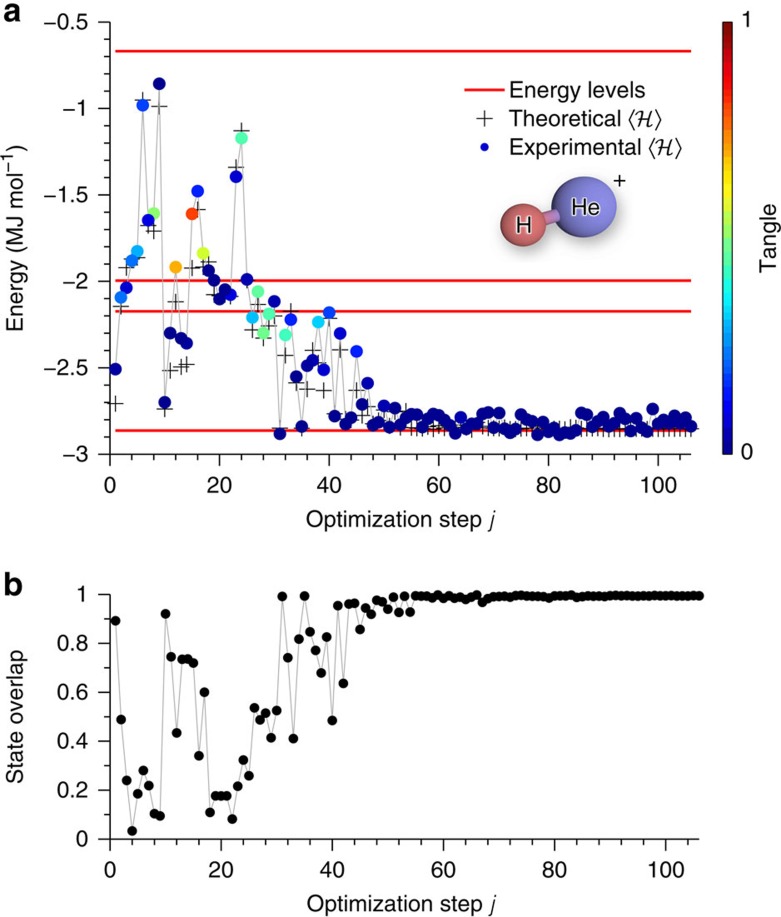
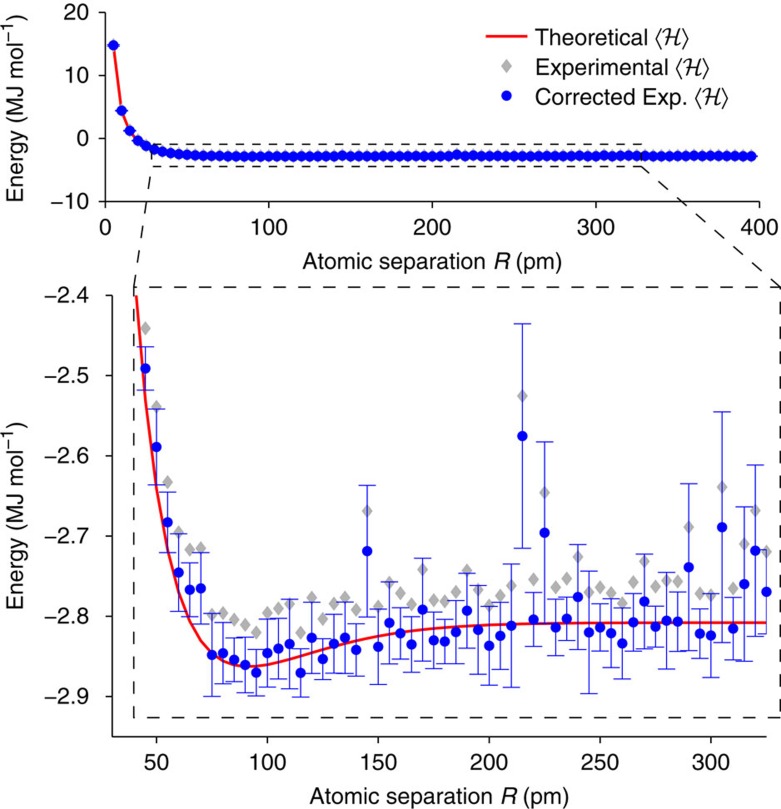
- The authors report an experimental ground-state result for He–H\(^+\): after correcting for experimental errors, they estimate the equilibrium bond length as \(R = 92.3 \pm 0.1\) pm and the ground-state electronic energy as \(E = -2.865 \pm 0.008\) MJ mol\(^{-1}\).
- For the bond dissociation curve, more than 96% of the experimental data are within chemical accuracy of the theoretical values.
- In the discussion, they state that for a 4 × 4 Hamiltonian like the one demonstrated, the QPE circuit would require at least 12 CNOT gates, whereas their method requires one.
- The full experiment was performed in about 158 h, and the bond dissociation curve was obtained by finding the ground states of 79 Hamiltonians.
## Methods
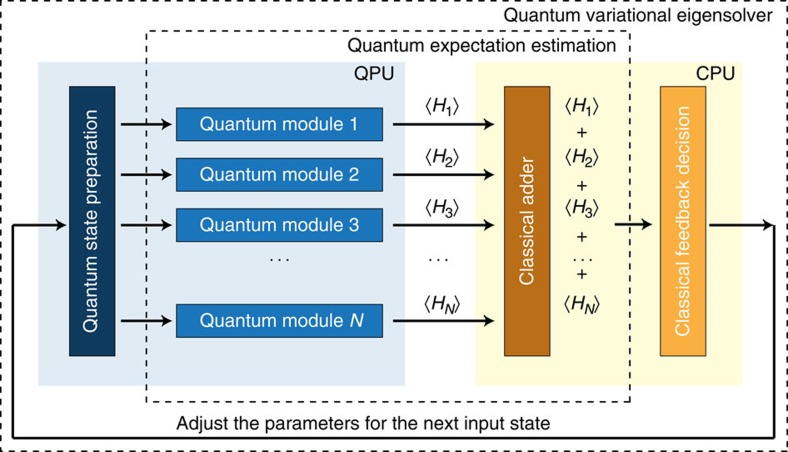
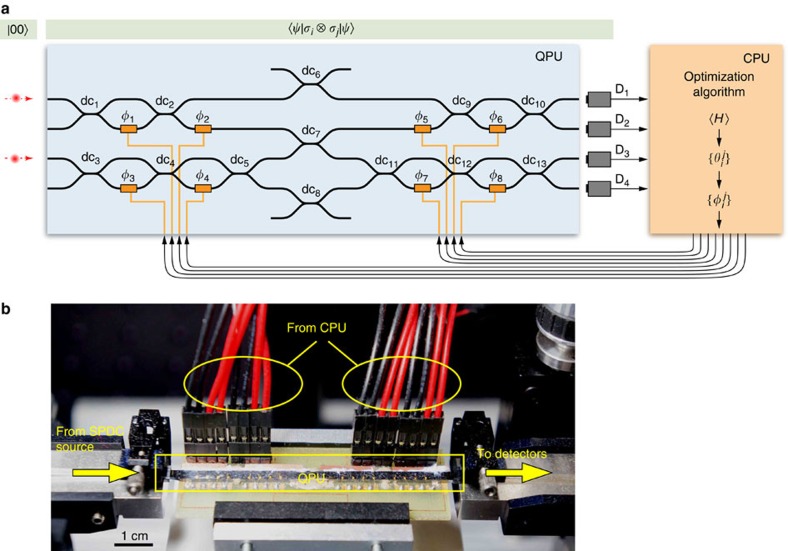
- The paper combines a reconfigurable integrated photonic quantum processor with a classical optimization algorithm: the quantum device estimates Hamiltonian expectation values, and the classical processor updates the state parameters variationally.
- The photonic chip prepares and measures arbitrary two-qubit pure states using single-qubit rotations and one two-qubit entangling gate; the experimental demonstration uses the He–H\(^+\) molecule in a minimal basis.
- For the classical optimization, they use the Nelder–Mead algorithm; expectation values are reconstructed from four two-qubit Pauli measurements at each point.
## Limitations
- The paper states that the method still requires a good approximation to the ground state as input/initialization, and the reliance on multiple separate measurements makes it sensitive to variations in state preparation between calculations.
- The authors report a constant systematic shift of \(\varepsilon = 50\) kJ mol\(^{-1}\) in the measured expectation values; they attribute this to photon-source impurity/distinguishability, circuit imperfections, and unbalanced coupling efficiencies.
- Evident from the text: the demonstration is limited to a two-qubit / 4 × 4 Hamiltonian prototype, so the scalability claim is not experimentally validated here.
Model-written summary. Check it against the paper before relying on it.
Integrity signals
Registry
Cites
Statistics
Figures
Verification
Claims the paper makes
7 Valid · 4 Not valid · 11 Not checked · 59 Own results and interpretations
The cited sources support only part of this claim — read each source’s verdict below.
In the paper
“Recent developments in the field of quantum computation offer a way forward for determining efficient solutions of many instances of large eigenvalue problems that are classically intractable6789101112”
§ A variational eigenvalue solver on a photonic quantum processor > Abstract
What the sources say
- Not matchedcites [6] Nielsen, M. A. & Chuang, I. L. Quantum Computation and Quantum Information Cambridge University Press (2000).
Couldn’t be matched to a paper in Crossref, so it can’t be checked.
- Could not verifycites [7] Kitaev, A. Quantum measurements and the Abelian stabilizer problem. Electronic Colloquium on Computational Complexity (ECCC) 3 (1996). sourceExperimental — accuracy not yet measured
Our copy under this DOI is the ISAAC 2021 paper 'Effective Resistance and Capacitance in Simplicial Complexes and a Quantum Algorithm' (Kitaev's 1995 work appears only as reference [9] in its bibliography), and it nowhere asserts that quantum computation gives efficient solutions to classically intractable large eigenvalue problems. Eigenvalues enter only as complexity parameters — λ, the smallest eigenvalue of the normalized up-Laplacian, in Lemma 31 and Theorem 26 (Section 6.3, 'Time efficient implementations') and in the phase-estimation machinery of Appendix A — and Section 1.1 ('Our Contributions') actually reports the opposite direction for its own problem: 'the quantum algorithm is slower than the classical algorithm in the worst case'. Searched: 'eigenvalue problems classically intractable', 'quantum speedup / exponential advantage', 'phase estimation', 'faster than classical'; no passage addresses the claim's point. (LLM, conf=0.70)
- Partly supportedcites [8] Griffiths, R. B. & Niu, C.-S. Semiclassical fourier transform for quantum computation. Phys. Rev. Lett. 76, 3228–3231 (1996). sourceExperimental — accuracy not yet measured
On p. 1, the paper says a quantum computer, if built, could solve certain problems such as factoring long numbers much faster than conventional algorithms. It also describes a simpler Fourier transform for Shor’s factorization and discrete-logarithm algorithms (p. 1). The copy does not support the claim about efficient solutions to many large eigenvalue problems. (LLM, conf=0.84)
plainstates a cause- Asserted: passes — The authors put it forward as true.
- Checkable: passes — It can be checked against evidence.
- Load-bearing: passes — The paper’s conclusions depend on it.
- Based: passes — The paper gives a reason why it holds.
- Not matched
Every source the paper cites for this claim was checked and supports it.
In the paper
“this would suffer from the N-representability problem, which is known to be intractable for both classical and quantum computers (it is in the quantum complexity class QMA-Hard24).”
§ A variational eigenvalue solver on a photonic quantum processor > Results > Quantum expectation estimation
What the sources say
- Supportedcites [24] Liu, Y.-K., Christandl, M. & Verstraete, F. Quantum computational complexity of the n-representability problem: Qma complete. Phys. Rev. Lett. 98, 110503 (2007). source
The paper states that N-representability is QMA-complete and hence QMA-hard and NP-hard (Abstract). Its discussion of quantum-chemistry relevance says the problem is intractable in the worst case even on a quantum computer, while allowing that particular physical systems may be easier. (LLM, conf=0.93)
boosted- Asserted: passes — The authors put it forward as true.
- Checkable: passes — It can be checked against evidence.
- Load-bearing: passes — The paper’s conclusions depend on it.
- Based: passes — The paper gives a reason why it holds.
- Supported
Every source the paper cites for this claim was checked and supports it.
In the paper
“We have implemented the QPU using integrated quantum photonics technology30.”
§ A variational eigenvalue solver on a photonic quantum processor > Results > Prototype demonstration
What the sources say
- Supportedcites [30] O'Brien, J. L., Furusawa, A. & Vuckovic, J. Photonic quantum technologies. Nat. Photon. 3, 687–695 (2009). source
The citation identifies integrated quantum photonics as the technology used, rather than attributing the citing authors’ QPU implementation to this review. The “Integrated quantum optical circuits” section (p. 6) describes on-chip waveguide circuits performing quantum logic gates and a compiled quantum factoring algorithm. (LLM, conf=0.87)
plain- Asserted: passes — The authors put it forward as true.
- Checkable: passes — It can be checked against evidence.
- Load-bearing: passes — The paper’s conclusions depend on it.
- Based: passes — The paper gives a reason why it holds.
- Supported
The cited sources support only part of this claim — read each source’s verdict below.
In the paper
“The time the quantum computer must remain coherent is determined by the necessity of O(p−1) successive applications of , each of which can require on the order of millions or billions of quantum gates for practical applications1719, as compared to the tens to hundreds of gates achievable in the short term.”
§ A variational eigenvalue solver on a photonic quantum processor > Abstract
What the sources say
- Partly supportedcites [17] Whitfield, J. D., Biamonte, J. & Aspuru-Guzik, A. Simulation of electronic structure hamiltonians using quantum computers. Mol. Phys. 109, 735–750 (2011). sourceExperimental — accuracy not yet measured
Split into 2 atoms — 1 confirmed, 1 partially supported, 0 disputed, 0 misattributed, 0 unverifiable. Expand the claim to see per-atom verdicts.
- Partly supportedcites [19] Jones, N. C. et al. Faster quantum chemistry simulation on fault-tolerant quantum computers. New J. Phys. 14, 115023 (2012). sourceExperimental — accuracy not yet measured
Split into 2 atoms — 0 confirmed, 2 partially supported, 0 disputed, 0 misattributed, 0 unverifiable. Expand the claim to see per-atom verdicts.
plainstates a cause- Asserted: passes — The authors put it forward as true.
- Checkable: passes — It can be checked against evidence.
- Load-bearing: passes — The paper’s conclusions depend on it.
- Based: passes — The paper gives a reason why it holds.
- Partly supported
A result the paper reports from its own data — it cites no other source for it, so there is none to check. The quote shows it is in the paper.
In the paper
“We experimentally demonstrate the feasibility of this approach with an example from quantum chemistry—calculating the ground-state molecular energy for He–H+.”
§ A variational eigenvalue solver on a photonic quantum processor > Abstract
boostedstates a causeSingle case- Asserted: passes — The authors put it forward as true.
- Checkable: passes — It can be checked against evidence.
- Load-bearing: passes — The paper’s conclusions depend on it.
- Based: passes — The paper gives a reason why it holds.
31 more claims
Create a free account to see all 81 claims and to verify the 4 references still open.
- It may state two separate claims as one. 28
- Probably not a substantial claim. 24
Claims other papers make about this one
Each is checked against this paper’s own text: does it say what the citing paper says it does?
The cited source doesn’t support the claim as written.
In the citing paper
“Leveraging quantum resources, the UCC ansatz was instead realized as a PQC on a photonic processor (Peruzzo et al. , 2014).”
From Noisy intermediate-scale quantum algorithms (2022) · cites this paper as Peruzzo et al., 2014
Checked by a reasoning model — may be wrong.
Experimental — accuracy not yet measuredThe cited source doesn’t support the claim as written.
In the citing paper
“The first on-chip GMM of four-qubit cluster state was realised in a laser-writing chip ( Fig.4e ), by manipulating both the polarisation and path DoFs of two photons [85].”
From Integrated photonic quantum technologies (2020) · cites this paper as [85]
Checked by a reasoning model — may be wrong.
Experimental — accuracy not yet measuredThe cited source doesn’t support the claim as written.
In the citing paper
“four-qubit linear- and box-cluster states are generated in a laser-writing photonic chip. This is enabled by on-chip manipulating the two-photon four-qubit hyperentangled state and cluster state, that are encoded in photon's path and polarisation DoFs. The Grover's search algorithm on a four-element database was implemented by controlling the device.”
From Integrated photonic quantum technologies (2020) · cites this paper as [85]
Checked by a reasoning model — may be wrong.
Experimental — accuracy not yet measuredThe source backs part of the claim, not all of it — or backs it for a different population, condition or comparison.
In the citing paper
“Due to its versatility, the variational Hamiltonian ansatz has been implemented for quantum chemistry [21, 29], optimization [24], and for quantum simulation problems [30].”
From Variational quantum algorithms (2021) · cites this paper as [29]
Experimental — accuracy not yet measuredThe source backs part of the claim, not all of it — or backs it for a different population, condition or comparison.
In the citing paper
“For the original VQE (Peruzzo et al. , 2014) and QAOA (Farhi et al. , 2014) it can, for example, be described as a single expectation value min θ ⟨ H ⟩ U ( θ ) , where the differences solely appear in the specific form and construction of the qubit Hamiltonian.”
From Noisy intermediate-scale quantum algorithms (2022) · cites this paper as Peruzzo et al., 2014
Experimental — accuracy not yet measured
12 more claims about this paper
Create a free account to see every claim other papers make about this one.
Citations
Cites
A Simplex Method for Function Minimization
Nelder, J. A., & Mead, R. (1965) · The Computer Journal · doi:10.1093/comjnl/7.4.308 · Cited by 28,905
Quantum computation and quantum information
Law, J. (2001) · ACM SIGSOFT Software Engineering Notes · doi:10.1145/505482.505499 · Cited by 18,842
(1999) · Cited by 12,854
Practical Methods of Optimization
Fletcher, R. (2000) · Wiley eBooks · doi:10.1002/9781118723203 · Cited by 7,605 · cited 3×
“[12] S.”
BackgroundMethodPractical methods of optimization
(1988) · Mathematics and Computers in Simulation · doi:10.1016/0378-4754(88)90129-2 · Cited by 5,818
Quantum Algorithm for Linear Systems of Equations
Harrow, A. W., Hassidim, A., & Lloyd, S. (2009) · Physical Review Letters · doi:10.1103/physrevlett.103.150502 · Cited by 3,325
Conn, A. R., Gould, N. I. M., & Toint, P. L. (2000) · Society for Industrial and Applied Mathematics eBooks · doi:10.1137/1.9780898719857 · Cited by 2,981 · cited 3×
“[14] D.”
MethodInfluential�ber das Paulische �quivalenzverbot
Jordan, P., & Wigner, E. (1928) · Zeitschrift f�r Physik · doi:10.1007/bf01331938 · Cited by 2,597
Molecular Electronic‐Structure Theory
Helgaker, T., Jørgensen, P., & Olsen, J. (2000) · doi:10.1002/9781119019572 · Cited by 2,594
O'Brien, J. L., Furusawa, A., & Vučković, J. (2009) · Nature Photonics · doi:10.1038/nphoton.2009.229 · Cited by 2,388
Self-citation
Research works printed but not linked: 3
- Helgaker, T., Jorgensen, P. & Olsen, J. Mol. Electronic Struct. Theory Wiley, Sussex (2002).
- Saad, Y. Numerical Methods for Large Eigenvalue Problems Vol. 158, (SIAM (1992).
- Rayleigh, J. W. In finding the correction for the open end of an organ-pipe. Phil. Trans. 161, 77 (1870).
Cited by
Items 1,701–1,800 of 4,572
A quantum leaky integrate-and-fire spiking neuron and network
Brand, D., & Petruccione, F. (2024) · npj Quantum Information · doi:10.1038/s41534-024-00921-x · Cited by 27
“The most promising models for QML on classical data are based on variational quantum circuits [6, 7], which encode data into quantum systems to utilise the natu-ral tendency of these systems to find optimal energetic states.”
Toward density functional theory on quantum computers?
Senjean, B., Yalouz, S., & Saubanère, M. (2023) · SciPost Physics · doi:10.21468/scipostphys.14.3.055 · Cited by 28
HyQSAT: A Hybrid Approach for 3-SAT Problems by Integrating Quantum Annealer with CDCL
Tan, S., Yu, M., Python, A., Shang, Y., Li, T., Lu, L., & Yin, J. (2023) · IEEE International Symposium on High-Performance Computer Architecture (HPCA) · doi:10.1109/hpca56546.2023.10071022 · Cited by 15
“For example, both Grover algorithm [30] and Variational Quantum Eigen-solver (VQE) [60] can be used to solve 3-SAT problems.”
MethodMajland, M., Jensen, R. B., Højlund, M. G., Zinner, N. T., & Christiansen, O. (2023) · Chemical Science · doi:10.1039/d3sc01984e · Cited by 14
Quantum Circuit Matrix Product State Ansatz for Large-Scale Simulations of Molecules
Fan, Y., Liu, J., Li, Z., & Yang, J. (2023) · Journal of Chemical Theory and Computation · doi:10.1021/acs.jctc.3c00068 · Cited by 21
Halder, S., Shrikhande, C., & Maitra, R. (2023) · The Journal of Chemical Physics · doi:10.1063/5.0166433 · Cited by 14
Phenomenological theory of variational quantum ground-state preparation
Astrakhantsev, N., Mazzola, G., Tavernelli, I., & Carleo, G. (2023) · Physical Review Research · doi:10.1103/physrevresearch.5.033225 · Cited by 24
Quantum simulation of preferred tautomeric state prediction
Shee, Y., Yeh, T.-L., Hsiao, J.-Y., Yang, A., Lin, Y., & Hsieh, M.-H. (2023) · npj Quantum Information · doi:10.1038/s41534-023-00767-9 · Cited by 15
Deep Neural Network Assisted Quantum Chemistry Calculations on Quantum Computers
Ghosh, K., Kumar, S., Nirmal, M. R., & Yamijala, S. S. R. K. C. (2023) · ACS Omega · doi:10.1021/acsomega.3c07364 · Cited by 16
Zeng, X., Fan, Y., Liu, J., Li, Z., & Yang, J. (2023) · Journal of Chemical Theory and Computation · doi:10.1021/acs.jctc.3c00527 · Cited by 18
Enhancing variational quantum state diagonalization using reinforcement learning techniques
Kundu, A., Bedełek, P., Ostaszewski, M., Danaci, O., Patel, Y. J., Dunjko, V., & Miszczak, J. A. (2024) · New Journal of Physics · doi:10.1088/1367-2630/ad1b7f · Cited by 14
“…an agent’s performance is given by the return and takes the form of a discounted sum as follows where τ = ( s 0 , a 0 , r 0 ,... , s T − 1 , a T − 1 , r T − 1 ) ∈ ( S × A × R ) T is the interaction sequence, T is a fixed length called horizon, and γ is an environment-specific discount factor.”
BackgroundQuantum computing with subwavelength atomic arrays
Shah, F., Patti, T. L., Rubies-Bigordà, O., & Yelin, S. F. (2024) · Physical Review A · doi:10.1103/physreva.109.012613 · Cited by 21
Role of Quantum Computing in the Era of Artificial Intelligence (AI)
Eswaran, U., Khang, A., & Eswaran, V. (2024) · Advances in computer and electrical engineering book series · doi:10.4018/979-8-3693-1168-4.ch003 · Cited by 14
Xiao, X., Zhao, H., Ren, J., Fang, W., & Li, Z. (2024) · Journal of Chemical Theory and Computation · doi:10.1021/acs.jctc.3c00966 · Cited by 25
“The chemistry-inspired unitary coupled cluster (UCC) ansatz 27 is the first ansatz proposed for determining molecular ground states on quantum computers, 20 which is motivated by the great success of the traditional coupled cluster theory on classical computers.”
BackgroundKiser, M., Schroeder, A. K., Anselmetti, G.-L., Kumar, C., Moll, N., Streif, M., & Vodola, D. (2024) · New Journal of Physics · doi:10.1088/1367-2630/ad2f67 · Cited by 24
“In this work, we use a variational quantum eigensolver (VQE) [7, 26, 27] to obtain approximate ground states; subsequently used as trial wavefunctions in AFQMC.”
MethodHigh-fidelity transmon-coupler-activated CCZ gate on fluxonium qubits
Simakov, I. A., Mazhorin, G. S., Moskalenko, I. N., Seidov, S. S., & Besedin, I. S. (2024) · Physical Review Applied · doi:10.1103/physrevapplied.21.044035 · Cited by 16
Continuous-variable quantum computation of the O(3) model in 1 + 1 dimensions
Jha, R. G., Ringer, F., Siopsis, G., & Thompson, S. (2024) · Physical Review A · doi:10.1103/physreva.109.052412 · Cited by 19
“More detailed discussions about CV gates can be found in Appendix A.”
BackgroundMethodInfluentialOver, P., Bengoechea, S., Rung, T., Clerici, F., Scandurra, L., de Villiers, E., & Jaksch, D. (2024) · Computers & Fluids · doi:10.1016/j.compfluid.2024.106508 · Cited by 32
“VQAs are used in many applications such as the identification of ground states [15], or solving LSE [16].”
BackgroundMethodTailored and Externally Corrected Coupled Cluster with Quantum Inputs
Scheurer, M., Anselmetti, G.-L., Oumarou, O., Gogolin, C., & Rubin, N. C. (2024) · Journal of Chemical Theory and Computation · doi:10.1021/acs.jctc.4c00037 · Cited by 26
“…of chemistry, e.g., virtual quantum subspace expansion (VQSE), 4 second-order perturbation theory using the variational quantum eigensolver (VQE) 1,5,6 together with quantum subspace expansion (QSE), named NEVPT2(VQE,QSE), 7 non-orthogonal configuration interaction approaches, 8 and NEVPT2 based…”
MethodWindom, Z. W., Claudino, D., & Bartlett, R. J. (2024) · The Journal of Chemical Physics · doi:10.1063/5.0202567 · Cited by 16
Non-unitary Trotter circuits for imaginary time evolution
Leadbeater, C., Fitzpatrick, N., Ramo, D. M., & Thom, A. J. W. (2024) · Quantum Science and Technology · doi:10.1088/2058-9565/ad53fb · Cited by 39
“Indeed, the variational quantum eigensolver [14, 15], which is among the most promising and widely-used examples of variational algorithms, requires gate errors significantly lower than the error thresholds of fault-tolerant hardware in order to achieve chemical accuracy [16].”
Solving the vehicle routing problem via quantum support vector machines
Mohanty, N., Behera, B. K., & Ferrie, C. (2024) · Quantum Machine Intelligence · doi:10.1007/s42484-024-00161-4 · Cited by 27
“We encode classical information (Paddle Quantum 2024) where r is the depth of the circuit, indicating the repeating times of U Z ( x ) H ⊗ n .”
Designing complex concentrated alloys with quantum machine learning and language modeling
Pei, Z., Gong, Y., Liu, X., & Yin, J. (2024) · Matter · doi:10.1016/j.matt.2024.05.035 · Cited by 14
Coulomb Interaction-Driven Entanglement of Electrons on Helium
Beysengulov, N. R., Schøyen, Ø. S., Bilek, S. D., Flaten, J. B., Leinonen, O., Hjorth-Jensen, M., Pollanen, J., Kristiansen, H. E., Stewart, Z. J., Weidman, J. D., et al. (2024) · PRX Quantum · doi:10.1103/prxquantum.5.030324 · Cited by 21
“…and evolution of entanglement in quantum many-body systems is also important for quantum simulations [12– 15], having the potential to advance the fundamental understanding of dense nuclear matter or high-energy physics [16–20], correlated electron systems [21–23], and quantum chemistry [24–26].”
BackgroundNa, N., Hsu, C.-Y., Chen, E., & Soref, R. A. (2024) · APL Quantum · doi:10.1063/5.0219035 · Cited by 13
“In the literature, there is a large body of PQC works, both theoretical and experimental, on operating at a cryogenic temperature usually 4 K mainly because of the essential need to employ on-chip superconducting nanowire single-photon detectors (SNSPDs).”
BackgroundMao, R., Tian, G., & Sun, X. (2024) · Communications Physics · doi:10.1038/s42005-024-01798-0 · Cited by 25
“While VQE has been successfully demonstrated for various small molecules 3 – 7 , it faces several challenges.”
InfluentialOptimal Tradeoffs for Estimating Pauli Observables
Chen, S., Gong, W., & Ye, Q. (2024) · Annual Symposium on Foundations of Computer Science · doi:10.1109/focs61266.2024.00072 · Cited by 77
“This problem first arose with the introduction of the variational quantum eigensolver [66], where a key step is to estimate expectation values Tr( Hρ ) for a given Hamiltonian H and trial SC was supported in part by NSF Award 2103300.”
Qoncord: A Multi-Device Job Scheduling Framework for Variational Quantum Algorithms
Wang, M., Das, P., & Nair, P. J. (2024) · IEEE/ACM International Symposium on Microarchitecture (MICRO) · doi:10.1109/micro61859.2024.00060 · Cited by 35
“We assess Qoncord using two prominent VQAs: Quantum Approximated Optimization Algorithm (QAOA) [4] and Variational Quantum Eigensolver (VQE) [28].”
Solving an industrially relevant quantum chemistry problem on quantum hardware
Nützel, L., Gresch, A., Hehn, L., Marti, L., Freund, R., Steiner, A., Marciniak, C. D., Eckstein, T., Stockinger, N., Wolf, S., et al. (2024) · Quantum Science and Technology · doi:10.1088/2058-9565/ad9ed3 · Cited by 29
A general framework for active space embedding methods with applications in quantum computing
Battaglia, S., Rossmannek, M., Rybkin, V. V., Tavernelli, I., & Hutter, J. (2024) · npj Computational Materials · doi:10.1038/s41524-024-01477-2 · Cited by 30
Fermionic wave packet scattering: a quantum computing approach
Chai, Y., Crippa, A., Jansen, K., Kühn, S., Pascuzzi, V. R., Tacchino, F., & Tavernelli, I. (2025) · Quantum · doi:10.22331/q-2025-02-19-1638 · Cited by 68
“In order to be able to simulate scattering processes, the following steps have to be accomplished.”
Marti-Dafcik, D., Burton, H. G. A., & Tew, D. P. (2025) · Physical Review Research · doi:10.1103/physrevresearch.7.013191 · Cited by 27
“[9] On fault-tolerant quantum hardware, quantum heuristics— such as the variational quantum eigensolver (VQE),[10– 27] adiabatic state preparation (ASP),[28–35] and quantum subspace diagonalization (QSD)[14, 36–48] —could be used to prepare initial states for quantum phase estimation, a method for…”
Mandal, A. K., Nadim, M., Roy, C. K., Roy, B., & Schneider, K. A. (2025) · Automated Software Engineering · doi:10.1007/s10515-025-00493-w · Cited by 35
Benchmarking Quantum Gates and Circuits
Tripathi, V., Kowsari, D., Saurav, K., Zhang, H., Levenson-Falk, E. M., & Lidar, D. A. (2025) · Chemical Reviews · doi:10.1021/acs.chemrev.4c00870 · Cited by 40
Baker, T. E., & Poulin, D. (2020) · Physical Review Research · doi:10.1103/physrevresearch.2.043238 · Cited by 27
Quantum verification of NP problems with single photons and linear optics
Zhang, A., Zhan, H., Liao, J., Zheng, K., Jiang, T., Mi, M., Yao, P., & Zhang, L. (2021) · Light Science & Applications · doi:10.1038/s41377-021-00608-4 · Cited by 20
“[26] Peruzzo, A.”
MethodComputing Eigenvalues of Diagonalizable Matrices on a Quantum Computer
Shao, C. (2022) · ACM Transactions on Quantum Computing · doi:10.1145/3527845 · Cited by 24
“Currently, the eigenvalue problems for Hermitian and unitary matrices are well-studied in near-and long-term quantum computing (e.g., see References [1, 15, 24, 27, 31]).”
BackgroundVariational Quantum Algorithms for the Steady States of Open Quantum Systems
Liu, H.-Y., Sun, T.-P., Wu, Y.-C., & Guo, G.-P. (2021) · Chinese Physics Letters · doi:10.1088/0256-307x/38/8/080301 · Cited by 22
Numerical hardware-efficient variational quantum simulation of a soliton solution
Kardashin, A., Pervishko, A. A., Biamonte, J., & Yudin, D. I. (2021) · Physical Review A · doi:10.1103/physreva.104.l020402 · Cited by 16
Hernández, O., & Liberal, I. (2022) · Optics Express · doi:10.1364/oe.456495 · Cited by 13
“In essence, combining nonclassical light states with a linear optical device enables quantum state transformation and entanglement generation, which are the basis for quantum metrology [1–3], communication [4–6], simulation [7, 8], and computing [9, 10] systems.”
BackgroundMeasurement-based time evolution for quantum simulation of fermionic systems
Lee, W., Qin, Z., Raussendorf, R., Sela, E., & Scarola, V. W. (2022) · Physical Review Research · doi:10.1103/physrevresearch.4.l032013 · Cited by 16
“Long runtimes can be prohibitive [11, 12, 28] if, for N g gates per time step, the qubits cannot be kept coherent for long execution times, T C ∼ MN g δt g .”
BackgroundSW_Qsim: a minimize-memory quantum simulator with high-performance on a new Sunway supercomputer
Li, F., Liu, X., Liu, Y., Zhao, P., Yang, Y., Shang, H., Sun, W., Wang, Z., Dong, E., & Chen, D. (2021) · International Conference for High Performance Computing, Networking, Storage and Analysis (SC) · doi:10.1145/3458817.3476161 · Cited by 21
Scalable two- and four-qubit parity measurement with a threshold photon counter
Govia, L. C. G., Pritchett, E., Plourde, B. L. T., Vavilov, M., McDermott, R., & Wilhelm, F. K. (2015) · Physical Review A · doi:10.1103/physreva.92.022335 · Cited by 13
Jafarizadeh, M. A., Ghapanvari, M., & Amiri, N. (2022) · Physical Review C · doi:10.1103/physrevc.105.014307 · Cited by 17
Wave Function Adapted Hamiltonians for Quantum Computing
Ratini, L., Capecci, C., Benfenati, F., & Guidoni, L. (2022) · Journal of Chemical Theory and Computation · doi:10.1021/acs.jctc.1c01170 · Cited by 17
Entanglement diagnostics for efficient VQA optimization
Kim, J., & Oz, Y. (2022) · Journal of Statistical Mechanics Theory and Experiment · doi:10.1088/1742-5468/ac7791 · Cited by 26
“The variational quantum algorithms (VQA) consist of two elements [4].”
MethodModel-Free Deep Recurrent Q-Network Reinforcement Learning for Quantum Circuit Architectures Design
Sogabe, T., Kimura, T., Chen, C.-C., Shiba, K., Kasahara, N., Sogabe, M., & Sakamoto, K. (2022) · Quantum Reports · doi:10.3390/quantum4040027 · Cited by 20
“It would also be Future research and development are required to improve the quality of the state-generation task. desirable to explore other applications, for example, the energy minimization task [26,34,60–62].”
BackgroundContinuous Quantum Gate Sets and Pulse-Class Meta-Optimization
Preti, F., Calarco, T., & Motzoi, F. (2022) · PRX Quantum · doi:10.1103/prxquantum.3.040311 · Cited by 19
“[13] Alberto Peruzzo, Jarrod McClean, Peter Shadbolt, ManHong Yung, Xiao-Qi Zhou, Peter J Love, Alán AspuruGuzik, and Jeremy L O’brien.”
BackgroundVariational dynamics as a ground-state problem on a quantum computer
Barison, S., Vicentini, F., Cirac, J. I., & Carleo, G. (2022) · Physical Review Research · doi:10.1103/physrevresearch.4.043161 · Cited by 22
Loipersberger, M., Malone, F. D., Welden, A. R., Parrish, R. M., Fox, T., Degroote, M., Kyoseva, E. S., Moll, N., Santagati, R., & Streif, M. (2023) · Chemical Science · doi:10.1039/d2sc05896k · Cited by 20
Variational Quantum‐Neural Hybrid Error Mitigation
Zhang, S., Wan, Z., Hsieh, C., Yao, H., & Zhang, S. (2023) · Advanced Quantum Technologies · doi:10.1002/qute.202300147 · Cited by 21
“[6] VQE is one of the most representative VQAs where the ground state is approximated by variational optimization [7–13] with parameterized quantum circuits.”
BackgroundMethodContinuous-variable quantum approximate optimization on a programmable photonic quantum processor
Enomoto, Y., Anai, K., Udagawa, K., & Takeda, S. (2023) · Physical Review Research · doi:10.1103/physrevresearch.5.043005 · Cited by 24
Beaujeault-Taudière, Y., & Lacroix, D. (2024) · Physical Review C · doi:10.1103/physrevc.109.024327 · Cited by 18
“Quantum computers offer the perspective to (i) explore a wide class of quantum ans¨atz and (ii) within the context of noisy quantum computers, great progress is being made in optimizing these ans¨atze, using, for instance, Variational Quantum Eigensolver (VQE)-based techniques [44] (see also Ref.”
MethodSampling and Scrambling on a Chain of Superconducting Qubits
Geller, M. R. (2018) · Physical Review Applied · doi:10.1103/physrevapplied.10.024052 · Cited by 19
Reinforcement Learning with Deep Quantum Neural Networks
Hu, W., & Hu, J. L. (2019) · Journal of Quantum Information Science · doi:10.4236/jqis.2019.91001 · Cited by 15
“In recent years, researchers have investigated different ways of applying quantum computing to improve classical machine learning algorithms [8]-[24].”
BackgroundRobustness to spontaneous emission of a variational quantum algorithm
Henriet, L. (2020) · Physical Review A · doi:10.1103/physreva.101.012335 · Cited by 13
Projective cooling for the transverse Ising model
Gustafson, E. (2020) · Physical review. D/Physical review. D. · doi:10.1103/physrevd.101.071504 · Cited by 16
Simulation of memristive synapses and neuromorphic computing on a quantum computer
Li, Y. (2021) · Physical Review Research · doi:10.1103/physrevresearch.3.023146 · Cited by 16
Quantum Algorithms for Nonlinear Equations in Fluid Mechanics
Steijl, R. (2020) · IntechOpen eBooks · doi:10.5772/intechopen.95023 · Cited by 21
“Recently, Variational Quantum Computing (VQC) was introduced as an effective hybrid classical-quantum approach [22, 23], firstly for applications in quantum chemistry and more recently for a wider range of linear and nonlinear problems [24].”
MethodFrom Digital Humanities to Quantum Humanities: Potentials and Applications
Barzen, J. (2022) · Springer eBooks · doi:10.1007/978-3-030-95538-0_1 · Cited by 24
Quantum chemistry calculations using energy derivatives on quantum computers
Azad, U., & Singh, H. (2022) · Chemical Physics · doi:10.1016/j.chemphys.2022.111506 · Cited by 19
VQE Method: A Short Survey and Recent DevelopmentsPreprint
Fedorov, D. A., Peng, B., Govind, N., et al. (2021) · arXiv (Cornell University) · doi:10.48550/arxiv.2103.08505 · Cited by 13
Variational Quanvolutional Neural Networks with enhanced image encodingPreprint
Mattern, D., Martyniuk, D., Willems, H., Bergmann, F., & Paschke, A. (2021) · arXiv (Cornell University) · doi:10.48550/arxiv.2106.07327 · Cited by 41
Fast Universal Entangling Gate for Superconducting Quantum ComputersPreprint
AbuGhanem, M., Homid, A. H., Hendy, A. S., Obada, A. ‐. F., & Eleuch, H. (2024) · SSRN Electronic Journal · doi:10.2139/ssrn.4726035 · Cited by 14
Four-qubit variational algorithms in silicon photonics with integrated entangled photon sources
Baldazzi, A., Sanna, M., Borghi, M., Azzini, S., & Pavesi, L. (2025) · npj Quantum Information · doi:10.1038/s41534-025-01061-6 · Cited by 21
“The fi rst experimental implementation of a variational quantum eigensolver (VQE) has been realized on a photonic integrated circuit (PIC) withanexternalphotonpairsource 23 .”
Measurement-induced entanglement phase transitions in variational quantum circuits
Wiersema, R., Zhou, C., Carrasquilla, J., & Kim, Y. B. (2023) · SciPost Physics · doi:10.21468/scipostphys.14.6.147 · Cited by 30
“[15] Alberto Peruzzo, Jarrod McClean, Peter Shadbolt, ManHong Yung, Xiao-Qi Zhou, Peter J.”
MethodInfluentialDiscriminating Quantum States with Quantum Machine Learning
Quiroga, D., Date, P., & Pooser, R. C. (2021) · IEEE International Conference on Rebooting Computing (ICRC) · doi:10.1109/icrc53822.2021.00018 · Cited by 17
“Particularly, feeding input by encoding classical data into quantum computers and obtaining the output from calculations performed constitutes some overhead [34], which can be alleviated to some extent using qRAM and operating directly on quantum data in a manner similar to variational methods [35].”
MethodAdaptive variational preparation of the Fermi-Hubbard eigenstates
Gyawali, G., & Lawler, M. J. (2022) · Physical Review A · doi:10.1103/physreva.105.012413 · Cited by 19
“These Hamiltonians are chosen such that they are spin conserving.”
MethodInfluentialA quantum walks assisted algorithm for peptide and protein folding prediction
Varsamis, G. D., & Karafyllidis, I. G. (2022) · Biosystems · doi:10.1016/j.biosystems.2022.104822 · Cited by 16
Tierkreis: a Dataflow Framework for Hybrid Quantum-Classical Computing
Sivarajah, S., Heidemann, L., Lawrence, A. J., & Duncan, R. (2022) · IEEE/ACM International Workshop on Quantum Computing Software (QCS) · doi:10.1109/qcs56647.2022.00007 · Cited by 18
“The VQE algorithm [1] is typical: a classical driver program generates a set of quantum circuits; these circuits are submitted via a web API to a remote quantum computer; after waiting in a queue, the circuits are executed, and the results of these circuits are returned to the driver; when all the circuits complete, t…”
MethodUnitary partitioning and the contextual subspace variational quantum eigensolver
Ralli, A., Weaving, T., Tranter, A., Kirby, W. M., Love, P. J., & Coveney, P. V. (2023) · Physical Review Research · doi:10.1103/physrevresearch.5.013095 · Cited by 16
Self-citationKovyrshin, A., Skogh, M., Broo, A., Mensa, S., Sahin, E., Crain, J. N., & Tavernelli, I. (2023) · The Journal of Chemical Physics · doi:10.1063/5.0150291 · Cited by 15
A Hybrid Quantum-Classical Algorithm for Multichannel Quantum Scattering of Atoms and Molecules
Xing, X., Cadavid, A. G., Izmaylov, A. F., & Tscherbul, T. V. (2023) · The Journal of Physical Chemistry Letters · doi:10.1021/acs.jpclett.3c00985 · Cited by 18
Partitioning Quantum Chemistry Simulations with Clifford Circuits
Schleich, P., Boen, J., Cincio, Ł., Anand, A., Kottmann, J. S., Tretiak, S., Dub, P. A., & Aspuru‐Guzik, A. (2023) · Journal of Chemical Theory and Computation · doi:10.1021/acs.jctc.3c00335 · Cited by 23
Self-citationBoosting quantum amplitude exponentially in variational quantum algorithms
Kyaw, T. H., Soley, M. B., Allen, B., Bergold, P., Sun, C., Batista, V. S., & Aspuru‐Guzik, A. (2023) · Quantum Science and Technology · doi:10.1088/2058-9565/acf4ba · Cited by 21
Self-citationSingle-shot error mitigation by coherent Pauli checks
van den Berg, E., Bravyi, S. B., Gambetta, J., Jurcevic, P., Maslov, D., & Temme, K. (2023) · Physical Review Research · doi:10.1103/physrevresearch.5.033193 · Cited by 32
ERASER: Towards Adaptive Leakage Suppression for Fault-Tolerant Quantum Computing
Vittal, S., Das, P., & Qureshi, M. K. (2023) · IEEE/ACM International Symposium on Microarchitecture (MICRO) · doi:10.1145/3613424.3614251 · Cited by 17
“Noisy quantum hardware and imperfect operations limit us from running most promising quantum applications [10, 13, 23, 28, 32, 40, 44, 45, 55, 57, 58].”
BackgroundManenti, R., & Motta, M. (2023) · doi:10.1093/oso/9780198787488.001.0001 · Cited by 29
The Role of Entanglement in Quantum-Relaxation Based Optimization Algorithms
Teramoto, K., Raymond, R., & Imai, H. (2023) · IEEE International Conference on Quantum Computing and Engineering (QCE) · doi:10.1109/qce57702.2023.00068 · Cited by 23
“Among them, QAOA (Quantum Approximate Optimization Algorithm) [9], which generalizes adiabatic quantum computation [10] to optimization problems proposed by Farhi, Goldstone, and Gutmann, and VQE (Variational Quantum Eigensolver) [23] proposed by Peruzzo, et al.”
MethodHybrid Quantum-Classical Multilevel Approach for Maximum Cuts on Graphs
Angone, A., Liu, X., Shaydulin, R., & Safro, I. (2023) · IEEE High Performance Extreme Computing Conference · doi:10.1109/hpec58863.2023.10363584 · Cited by 26
“Notable hybrid algorithms are variational algorithms such as the Quantum Approximate Optimization Algorithm (QAOA) [10] and the Variational Quantum Eigensolver (VQE) [24].”
MethodHighly optimized quantum circuits synthesized via data-flow engines
Rakyta, P., Morse, G., Nádori, J., Majnay-Takács, Z., Mencer, O., & Zimborás, Z. (2024) · Journal of Computational Physics · doi:10.1016/j.jcp.2024.112756 · Cited by 18
Quantum Computing and Machine Learning on an Integrated Photonics Platform
Zhu, H., Lin, H., Wu, S., Luo, W., Zhang, H., Zhan, Y., Wang, X., Liu, A. Q., & Kwek, L. C. (2024) · Information · doi:10.3390/info15020095 · Cited by 24
“Currently, silicon-based photonic quantum computing has been widely applied in areas such as quantum neural networks [96], variational algorithms [97] and coherent Ising machines [98].”
MethodScalable approach to quantum simulation via projection-based embedding
Ralli, A., de la Bastida, M. W., & Coveney, P. V. (2024) · Physical Review A · doi:10.1103/physreva.109.022418 · Cited by 25
“NISQ-friendly approaches such as the VQE algorithm can therefore be used, but also fault-tolerant methods such as QPE [12,17].”
Multiobjective Optimization and Network Routing With Near-Term Quantum Computers
Chiew, S.-H., Poirier, K., Mishra, R., Bornheimer, U., Munro, E., Foon, S. H., Chen, C. W., Lim, W. S., & Nga, C. W. (2024) · IEEE Transactions on Quantum Engineering · doi:10.1109/tqe.2024.3386753 · Cited by 21
“On the other hand, it is known that n rep = O ( L / 2 ) measurements are needed to compute expectation values up to an error tolerance of (cid:6) by operator averaging [48], where L is equal to the number of Pauli terms in the operator (which is the cost Hamiltonian in our case).”
BackgroundNatural Orbitals and Sparsity of Quantum Mutual Information
Ratini, L., Capecci, C., & Guidoni, L. (2024) · Journal of Chemical Theory and Computation · doi:10.1021/acs.jctc.3c01325 · Cited by 18
“One of the most widely used algorithms is the variational quantum eigensolver (VQE) [15, 16, 17], which has the advantage to be suited for the implementation on noisy intermediate-scale quantum (NISQ) devices [18, 19, 20].”
Physically Motivated Improvements of Variational Quantum Eigensolvers
Vaquero-Sabater, N., Carreras, A., Orús, R., Mayhall, N. J., & Casanova, D. (2024) · Journal of Chemical Theory and Computation · doi:10.1021/acs.jctc.4c00329 · Cited by 12
Schuster, S., Kühn, S., Funcke, L., Hartung, T., Pleinert, M.-O., von Zanthier, J., & Jansen, K. (2024) · Physical review. D/Physical review. D. · doi:10.1103/physrevd.109.114508 · Cited by 24
“The VQE has proven itself to be particularly suited for NISQ devices [23, 24].”
MethodNonadiabatic Molecular Dynamics with Fermionic Subspace-Expansion Algorithms on Quantum Computers
Gandon, A., Baiardi, A., Ollitrault, P. J., & Tavernelli, I. (2024) · Journal of Chemical Theory and Computation · doi:10.1021/acs.jctc.4c00233 · Cited by 16
Encoding optimization for quantum machine learning demonstrated on a superconducting transmon qutrit
Cao, S., Zhang, W., Tilly, J., Agarwal, A., Bakr, M. S., Campanaro, G., Fasciati, S. D., Wills, J., Shteynas, B., Chidambaram, V., et al. (2024) · Quantum Science and Technology · doi:10.1088/2058-9565/ad7315 · Cited by 18
Optimizing quantum tomography via shadow inversion
Caprotti, A., Morris, J., & Dakić, B. (2024) · Physical Review Research · doi:10.1103/physrevresearch.6.033301 · Cited by 20
“Let us now discuss the estimation of product observables type E This case is particularly interesting for near-term applications, such as the VQE algorithm [21, 22].”
BackgroundProgrammable adiabatic demagnetization for systems with trivial and topological excitations
Matthies, A., Rudner, M. S., Rosch, A., & Berg, E. (2024) · Quantum · doi:10.22331/q-2024-10-23-1505 · Cited by 35
“Many approaches of ground state preparation have been proposed, including variational quantum simulation [8, 9, 10, 11, 12] and adiabatic state preparation [13, 14, 15, 16, 17].”
BackgroundThe role of data embedding in equivariant quantum convolutional neural networks
Das, S., Martina, S., & Caruso, F. (2024) · Quantum Machine Intelligence · doi:10.1007/s42484-024-00215-7 · Cited by 18
“The latter is called parametric quantum circuit (PQC) or variational quantum circuit (VQC) (Peruzzo et al. 2014; McClean et al. 2016; Romero et al. 2017; Mitarai et al. 2018; Schuld et al. 2020).”
Iterative quantum algorithms for maximum independent set
Brady, L. T., & Hadfield, S. (2024) · Physical Review A · doi:10.1103/physreva.110.052435 · Cited by 51
“…of both classical and quantum algorithms is often challenging, but in the case of hybrid quantum algorithms where a quantum processor is tied in with a classical computer that work together in a nontrivial way to solve a problem [3, 5–7], some illuminating reasoning and analysis can be done.”
Dissipative Variational Quantum Algorithms for Gibbs State Preparation
Ilin, Y., & Arad, I. (2024) · IEEE Transactions on Quantum Engineering · doi:10.1109/tqe.2024.3511419 · Cited by 27
“A typical VQA involves preparing a trial state on a quantum computer and calculating a cost function based on measurements taken from that state [1, 10–13].”
PO-QA: A Framework for Portfolio Optimization using Quantum Algorithms
Zaman, K., Marchisio, A., Kashif, M., & Shafique, M. (2024) · IEEE International Conference on Quantum Computing and Engineering (QCE) · doi:10.1109/qce60285.2024.00166 · Cited by 12
“Among different optimization algorithms for PO, frequently used state-of-the-art quantum algorithms are VQE [10] and QAOA [11].”
MethodUtilizing Resource Estimation for the Development of Quantum Computing Applications
Quetschlich, N., Soeken, M., Murali, P., & Wille, R. (2024) · IEEE International Conference on Quantum Computing and Engineering (QCE) · doi:10.1109/qce60285.2024.00036 · Cited by 22
“Developing such solutions is an active area of research in domains such as finance [5], chemistry [6], machine learning [7], and optimization [8].”
Reinforcement learning-based architecture search for quantum machine learning
Rapp, F., Kreplin, D. A., Huber, M. F., & Roth, M. (2025) · Machine Learning Science and Technology · doi:10.1088/2632-2153/adaf75 · Cited by 16
“…with the quantum approximate optimization algorithm (QAOA) [16] or quantum simulations using the variational quantum eigen-solver (VQE) [17, 18], the circuits used in QML offer a high degree of flexibility, allowing for adaptation to specific hardware configurations, such as connectivity…”
MethodHybrid Tree Tensor Networks for Quantum Simulation
Schuhmacher, J., Ballarin, M., Baiardi, A., Magnifico, G., Tacchino, F., Montangero, S., & Tavernelli, I. (2025) · PRX Quantum · doi:10.1103/prxquantum.6.010320 · Cited by 40
Quantum frontiers in high energy physics
Fang, Y., Gao, C., Li, Y.-Y., Shu, J., Wu, Y., Xing, H., Xu, B., Xu, L., & Zhou, C. L. (2025) · Science China Physics Mechanics and Astronomy · doi:10.1007/s11433-024-2635-4 · Cited by 32
“[283].”
Quantum computing for space applications: a selective review and perspectives
Torta, P., Casati, R., Bruni, S., Mandarino, A., & Prati, E. (2025) · EPJ Quantum Technology · doi:10.1140/epjqt/s40507-025-00369-8 · Cited by 20
Metadata
- Authors
- Peruzzo, A., McClean, J., Shadbolt, P., Yung, M.-H., Zhou, X.-Q., Love, P. J., Aspuru-Guzik, A., & O’Brien, J. L.
- Affiliations
- The University of Sydney (AU)
- Harvard University (US)
- University of Bristol (GB)
- Haverford College (US)
- Corresponding author
- Peruzzo, Alberto
- O’Brien, Jeremy L.
- Venue
- Nature Communications
- Published
- 2014-07-23
- Volume
- 5
- Issue
- 1
- Pages
- 4213-4213
- ISSN
- 2041-1723 (ISSN-L)
- PMC
- PMC4124861
- OpenAlex
- W2161685427
- Cited by
- 4,552
- References
- 48
- Citations by year
- 2026: 591 · 2025: 765 · 2024: 722 · 2023: 658 · 2022: 564 · 2021: 561 · 2020: 346 · 2019: 191 · 2018: 83 · 2017: 29 · 2016: 18 · 2015: 16 · 2014: 4
- FWCI
- 22.24
- Type
- journal article
- Language
- en
- Open access
- hybrid
- doi.org
- Licence
- cc-by-nc-nd
- creativecommons.org/licenses/by-nc-nd/4.0 (tdm)
- creativecommons.org/licenses/by-nc-nd/4.0 (vor)
- Locations
- Nature Communications (publishedVersion, cc-by-nc-nd)
- Europe PMC (PubMed Central) (publishedVersion, cc-by-nc-nd)
- PubMed Central (publishedVersion, cc-by-nc-nd)
- PubMed (publishedVersion)
- arXiv (Cornell University) (submittedVersion)
- OSTI OAI (U.S. Department of Energy Office of Scientific and Technical Information) (submittedVersion, cc-by-nc-nd)
- Digital Access to Scholarship at Harvard (DASH) (Harvard University) (submittedVersion, cc-by)
- RePEc: Research Papers in Economics (submittedVersion)
- RMIT Research Repository (RMIT University Library) (submittedVersion, cc-by-nc-nd)
- Figshare (submittedVersion, cc-by-nc-nd)
- UWA Profiles and Research Repository (UWA) (submittedVersion, cc-by-nc-nd)
- Bristol Research (University of Bristol) (submittedVersion)
- arXiv (Cornell University)
- Funders
- National Science Foundation (DE-FG02-97ER25308, 0955518, 1037992)
- U.S. Department of Energy (DEFG0297ER25308, DE‐FG02‐, FG02-97ER25308)
- Alfred P. Sloan Foundation
- John Templeton Foundation
- Camille and Henry Dreyfus Foundation
- Royal Academy of Engineering
- National Natural Science Foundation of China (61033001, 61361136003)
- Engineering and Physical Sciences Research Council (EP/J017175/1, EP/L024020/1, EP/K021931/1)
- Australian Research Council (DE140101700)
- National Key Research and Development Program of China (61033001, 2011CBA00301, 61361136003, 2011CBA00300)
- Division of Chemistry (CHE-1037992)
- Air Force Office of Scientific Research (FA 9550-12-1-0046, FA9550-, FA9550-12, FA9550‐12‐1)
- Topics
- Physical Sciences › Computer Science › Artificial Intelligence › Quantum Computing Algorithms and Architecture
- Physical Sciences › Physics and Astronomy › Atomic and Molecular Physics, and Optics › Quantum Information and Cryptography
- Physical Sciences › Physics and Astronomy › Atomic and Molecular Physics, and Optics › Quantum many-body systems
- Keywords
- variational quantum eigensolver, photonic quantum processors, quantum chemistry, classical optimization, hybrid quantum-classical computation
About these checks
Registry, retraction, Cites and statistics results are computed, not judged, with one exception: a printed reference that no index lists is read once by a model before it counts as a citation error. Claims are extracted by a model and kept only when their quote appears verbatim in the text; each cited source is then checked, with a model’s help, for whether it says what the claim relies on. Those verdicts can be wrong — read the claim’s quote and the cited source before relying on one.
The claim verdicts this report counts are experimental: their accuracy is not yet measured.
A language model drew the claims from the paper on 2026-10-10, under version 3 of the claim definition (model deepseek-v4.1-flash, prompt extract-v3).
A second model labelled each claim on 2026-10-10 (model jev-1.13-20260917, definition revision gold-guideline-v0.2).
Cited sources are checked with a language model’s help (qwen3.8-omni-flash and gpt-6-sol).
Statistics and arithmetic are recomputed, not judged.
Confidence bands are shown only for fields calibrated on our annotated test set. None is calibrated yet, so no band is shown.
What counts as a claim ›How we measure confidence ›How we check this ›
Are you an author, or do you see a problem with this page? Request a review
Data sources
Bibliographic data: Semantic Scholar, OpenAlex, Crossref.
Contains information from the Semantic Scholar Academic Graph Datasets, made available under the ODC Attribution License (ODC-BY 1.0).
Semantic Scholar’s data is described in: Kinney, R., et al. (2023). The Semantic Scholar Open Data Platform. arXiv:2301.10140.
