

A variational eigenvalue solver on a photonic quantum processor
Open accessThe DOI matches its Crossref record; 47 of the 48 references it cites were found in a registry or an index; 14 of the 31 sources its claims cite were checked for support.
Abstract
Quantum computers promise to efficiently solve important problems that are intractable on a conventional computer. For quantum systems, where the physical dimension grows exponentially, finding the eigenvalues of certain operators is one such intractable problem and remains a fundamental challenge. The quantum phase estimation algorithm efficiently finds the eigenvalue of a given eigenvector but requires fully coherent evolution. Here we present an alternative approach that greatly reduces the requirements for coherent evolution and combine this method with a new approach to state preparation based on ansätze and classical optimization. We implement the algorithm by combining a highly reconfigurable photonic quantum processor with a conventional computer. We experimentally demonstrate the feasibility of this approach with an example from quantum chemistry—calculating the ground-state molecular energy for He–H+. The proposed approach drastically reduces the coherence time requirements, enhancing the potential of quantum resources available today and in the near future. Quantum computers promise to efficiently solve problems that would be practically impossible with a normal computer. Peruzzo et al. develop a variational computation approach that uses any available quantum resources and, with a photonic quantum processing unit, find the ground-state molecular energy of He–H+.
Overview
CoChat Summary
## TL;DR
The paper introduces a variational alternative to quantum phase estimation for finding eigenvalues, combining short coherent quantum measurements with classical optimization. It experimentally demonstrates the approach on a photonic processor by estimating the ground-state energy curve of He–H\(^+\).
## Key findings
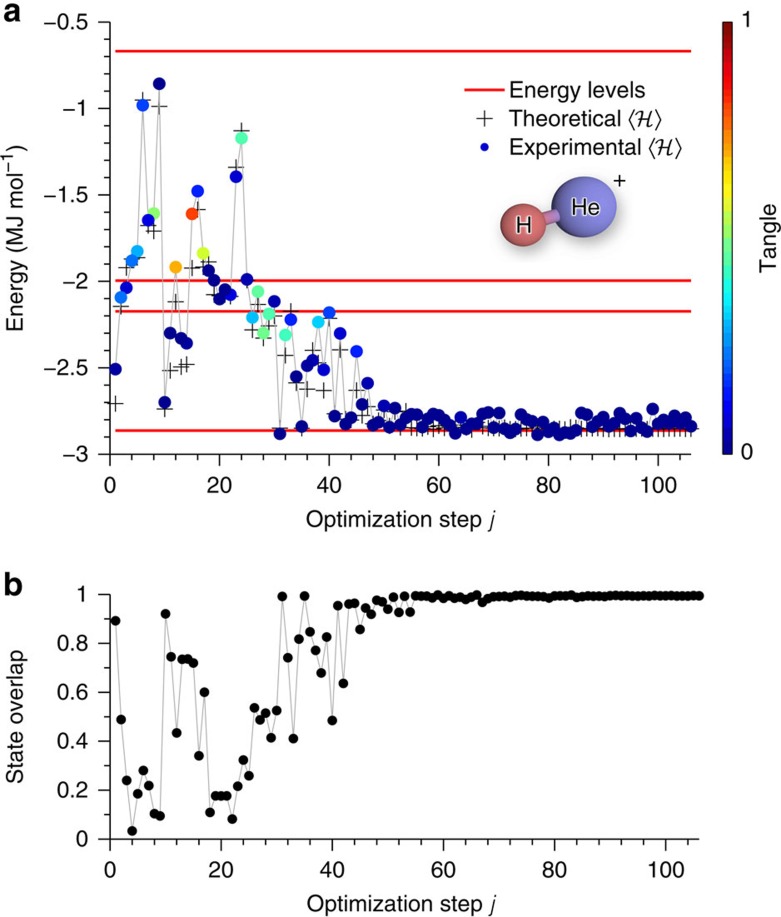
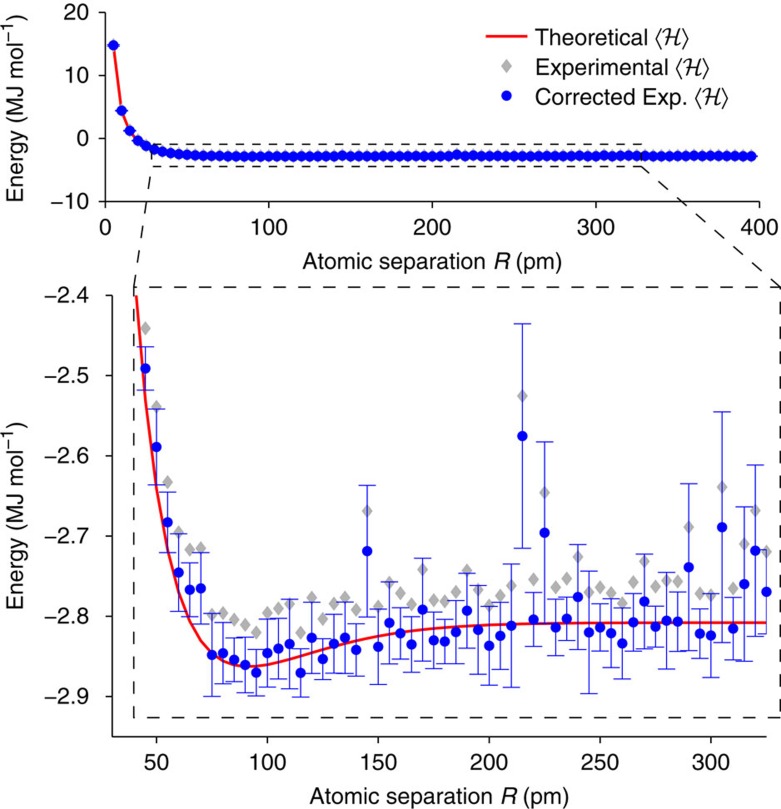
- The authors report an experimental ground-state result for He–H\(^+\): after correcting for experimental errors, they estimate the equilibrium bond length as \(R = 92.3 \pm 0.1\) pm and the ground-state electronic energy as \(E = -2.865 \pm 0.008\) MJ mol\(^{-1}\).
- For the bond dissociation curve, more than 96% of the experimental data are within chemical accuracy of the theoretical values.
- In the discussion, they state that for a 4 × 4 Hamiltonian like the one demonstrated, the QPE circuit would require at least 12 CNOT gates, whereas their method requires one.
- The full experiment was performed in about 158 h, and the bond dissociation curve was obtained by finding the ground states of 79 Hamiltonians.
## Methods
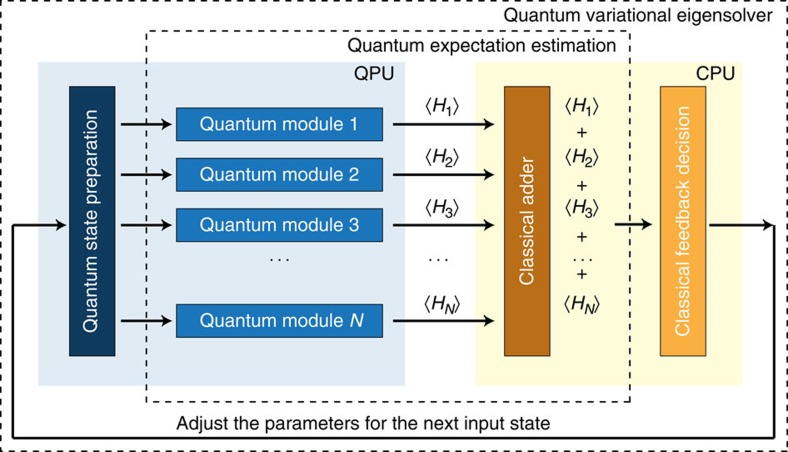
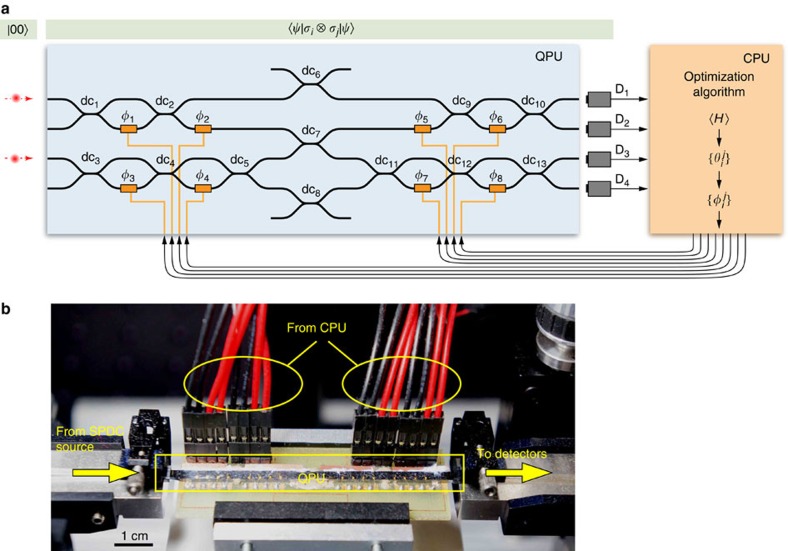
- The paper combines a reconfigurable integrated photonic quantum processor with a classical optimization algorithm: the quantum device estimates Hamiltonian expectation values, and the classical processor updates the state parameters variationally.
- The photonic chip prepares and measures arbitrary two-qubit pure states using single-qubit rotations and one two-qubit entangling gate; the experimental demonstration uses the He–H\(^+\) molecule in a minimal basis.
- For the classical optimization, they use the Nelder–Mead algorithm; expectation values are reconstructed from four two-qubit Pauli measurements at each point.
## Limitations
- The paper states that the method still requires a good approximation to the ground state as input/initialization, and the reliance on multiple separate measurements makes it sensitive to variations in state preparation between calculations.
- The authors report a constant systematic shift of \(\varepsilon = 50\) kJ mol\(^{-1}\) in the measured expectation values; they attribute this to photon-source impurity/distinguishability, circuit imperfections, and unbalanced coupling efficiencies.
- Evident from the text: the demonstration is limited to a two-qubit / 4 × 4 Hamiltonian prototype, so the scalability claim is not experimentally validated here.
Model-written summary. Check it against the paper before relying on it.
Integrity signals
Registry
Cites
Statistics
Figures
Verification
Claims the paper makes
7 Valid · 4 Not valid · 11 Not checked · 59 Own results and interpretations
The cited sources support only part of this claim — read each source’s verdict below.
In the paper
“Recent developments in the field of quantum computation offer a way forward for determining efficient solutions of many instances of large eigenvalue problems that are classically intractable6789101112”
§ A variational eigenvalue solver on a photonic quantum processor > Abstract
What the sources say
- Not matchedcites [6] Nielsen, M. A. & Chuang, I. L. Quantum Computation and Quantum Information Cambridge University Press (2000).
Couldn’t be matched to a paper in Crossref, so it can’t be checked.
- Could not verifycites [7] Kitaev, A. Quantum measurements and the Abelian stabilizer problem. Electronic Colloquium on Computational Complexity (ECCC) 3 (1996). sourceExperimental — accuracy not yet measured
Our copy under this DOI is the ISAAC 2021 paper 'Effective Resistance and Capacitance in Simplicial Complexes and a Quantum Algorithm' (Kitaev's 1995 work appears only as reference [9] in its bibliography), and it nowhere asserts that quantum computation gives efficient solutions to classically intractable large eigenvalue problems. Eigenvalues enter only as complexity parameters — λ, the smallest eigenvalue of the normalized up-Laplacian, in Lemma 31 and Theorem 26 (Section 6.3, 'Time efficient implementations') and in the phase-estimation machinery of Appendix A — and Section 1.1 ('Our Contributions') actually reports the opposite direction for its own problem: 'the quantum algorithm is slower than the classical algorithm in the worst case'. Searched: 'eigenvalue problems classically intractable', 'quantum speedup / exponential advantage', 'phase estimation', 'faster than classical'; no passage addresses the claim's point. (LLM, conf=0.70)
- Partly supportedcites [8] Griffiths, R. B. & Niu, C.-S. Semiclassical fourier transform for quantum computation. Phys. Rev. Lett. 76, 3228–3231 (1996). sourceExperimental — accuracy not yet measured
On p. 1, the paper says a quantum computer, if built, could solve certain problems such as factoring long numbers much faster than conventional algorithms. It also describes a simpler Fourier transform for Shor’s factorization and discrete-logarithm algorithms (p. 1). The copy does not support the claim about efficient solutions to many large eigenvalue problems. (LLM, conf=0.84)
plainstates a cause- Asserted: passes — The authors put it forward as true.
- Checkable: passes — It can be checked against evidence.
- Load-bearing: passes — The paper’s conclusions depend on it.
- Based: passes — The paper gives a reason why it holds.
- Not matched
Every source the paper cites for this claim was checked and supports it.
In the paper
“this would suffer from the N-representability problem, which is known to be intractable for both classical and quantum computers (it is in the quantum complexity class QMA-Hard24).”
§ A variational eigenvalue solver on a photonic quantum processor > Results > Quantum expectation estimation
What the sources say
- Supportedcites [24] Liu, Y.-K., Christandl, M. & Verstraete, F. Quantum computational complexity of the n-representability problem: Qma complete. Phys. Rev. Lett. 98, 110503 (2007). source
The paper states that N-representability is QMA-complete and hence QMA-hard and NP-hard (Abstract). Its discussion of quantum-chemistry relevance says the problem is intractable in the worst case even on a quantum computer, while allowing that particular physical systems may be easier. (LLM, conf=0.93)
boosted- Asserted: passes — The authors put it forward as true.
- Checkable: passes — It can be checked against evidence.
- Load-bearing: passes — The paper’s conclusions depend on it.
- Based: passes — The paper gives a reason why it holds.
- Supported
Every source the paper cites for this claim was checked and supports it.
In the paper
“We have implemented the QPU using integrated quantum photonics technology30.”
§ A variational eigenvalue solver on a photonic quantum processor > Results > Prototype demonstration
What the sources say
- Supportedcites [30] O'Brien, J. L., Furusawa, A. & Vuckovic, J. Photonic quantum technologies. Nat. Photon. 3, 687–695 (2009). source
The citation identifies integrated quantum photonics as the technology used, rather than attributing the citing authors’ QPU implementation to this review. The “Integrated quantum optical circuits” section (p. 6) describes on-chip waveguide circuits performing quantum logic gates and a compiled quantum factoring algorithm. (LLM, conf=0.87)
plain- Asserted: passes — The authors put it forward as true.
- Checkable: passes — It can be checked against evidence.
- Load-bearing: passes — The paper’s conclusions depend on it.
- Based: passes — The paper gives a reason why it holds.
- Supported
The cited sources support only part of this claim — read each source’s verdict below.
In the paper
“The time the quantum computer must remain coherent is determined by the necessity of O(p−1) successive applications of , each of which can require on the order of millions or billions of quantum gates for practical applications1719, as compared to the tens to hundreds of gates achievable in the short term.”
§ A variational eigenvalue solver on a photonic quantum processor > Abstract
What the sources say
- Partly supportedcites [17] Whitfield, J. D., Biamonte, J. & Aspuru-Guzik, A. Simulation of electronic structure hamiltonians using quantum computers. Mol. Phys. 109, 735–750 (2011). sourceExperimental — accuracy not yet measured
Split into 2 atoms — 1 confirmed, 1 partially supported, 0 disputed, 0 misattributed, 0 unverifiable. Expand the claim to see per-atom verdicts.
- Partly supportedcites [19] Jones, N. C. et al. Faster quantum chemistry simulation on fault-tolerant quantum computers. New J. Phys. 14, 115023 (2012). sourceExperimental — accuracy not yet measured
Split into 2 atoms — 0 confirmed, 2 partially supported, 0 disputed, 0 misattributed, 0 unverifiable. Expand the claim to see per-atom verdicts.
plainstates a cause- Asserted: passes — The authors put it forward as true.
- Checkable: passes — It can be checked against evidence.
- Load-bearing: passes — The paper’s conclusions depend on it.
- Based: passes — The paper gives a reason why it holds.
- Partly supported
A result the paper reports from its own data — it cites no other source for it, so there is none to check. The quote shows it is in the paper.
In the paper
“We experimentally demonstrate the feasibility of this approach with an example from quantum chemistry—calculating the ground-state molecular energy for He–H+.”
§ A variational eigenvalue solver on a photonic quantum processor > Abstract
boostedstates a causeSingle case- Asserted: passes — The authors put it forward as true.
- Checkable: passes — It can be checked against evidence.
- Load-bearing: passes — The paper’s conclusions depend on it.
- Based: passes — The paper gives a reason why it holds.
31 more claims
Create a free account to see all 81 claims and to verify the 4 references still open.
- It may state two separate claims as one. 28
- Probably not a substantial claim. 24
Claims other papers make about this one
Each is checked against this paper’s own text: does it say what the citing paper says it does?
The cited source doesn’t support the claim as written.
In the citing paper
“Leveraging quantum resources, the UCC ansatz was instead realized as a PQC on a photonic processor (Peruzzo et al. , 2014).”
From Noisy intermediate-scale quantum algorithms (2022) · cites this paper as Peruzzo et al., 2014
Checked by a reasoning model — may be wrong.
Experimental — accuracy not yet measuredThe cited source doesn’t support the claim as written.
In the citing paper
“The first on-chip GMM of four-qubit cluster state was realised in a laser-writing chip ( Fig.4e ), by manipulating both the polarisation and path DoFs of two photons [85].”
From Integrated photonic quantum technologies (2020) · cites this paper as [85]
Checked by a reasoning model — may be wrong.
Experimental — accuracy not yet measuredThe cited source doesn’t support the claim as written.
In the citing paper
“four-qubit linear- and box-cluster states are generated in a laser-writing photonic chip. This is enabled by on-chip manipulating the two-photon four-qubit hyperentangled state and cluster state, that are encoded in photon's path and polarisation DoFs. The Grover's search algorithm on a four-element database was implemented by controlling the device.”
From Integrated photonic quantum technologies (2020) · cites this paper as [85]
Checked by a reasoning model — may be wrong.
Experimental — accuracy not yet measuredThe source backs part of the claim, not all of it — or backs it for a different population, condition or comparison.
In the citing paper
“Due to its versatility, the variational Hamiltonian ansatz has been implemented for quantum chemistry [21, 29], optimization [24], and for quantum simulation problems [30].”
From Variational quantum algorithms (2021) · cites this paper as [29]
Experimental — accuracy not yet measuredThe source backs part of the claim, not all of it — or backs it for a different population, condition or comparison.
In the citing paper
“For the original VQE (Peruzzo et al. , 2014) and QAOA (Farhi et al. , 2014) it can, for example, be described as a single expectation value min θ ⟨ H ⟩ U ( θ ) , where the differences solely appear in the specific form and construction of the qubit Hamiltonian.”
From Noisy intermediate-scale quantum algorithms (2022) · cites this paper as Peruzzo et al., 2014
Experimental — accuracy not yet measured
12 more claims about this paper
Create a free account to see every claim other papers make about this one.
Citations
Cites
A Simplex Method for Function Minimization
Nelder, J. A., & Mead, R. (1965) · The Computer Journal · doi:10.1093/comjnl/7.4.308 · Cited by 28,905
Quantum computation and quantum information
Law, J. (2001) · ACM SIGSOFT Software Engineering Notes · doi:10.1145/505482.505499 · Cited by 18,842
(1999) · Cited by 12,854
Practical Methods of Optimization
Fletcher, R. (2000) · Wiley eBooks · doi:10.1002/9781118723203 · Cited by 7,605 · cited 3×
“[12] S.”
BackgroundMethodPractical methods of optimization
(1988) · Mathematics and Computers in Simulation · doi:10.1016/0378-4754(88)90129-2 · Cited by 5,818
Quantum Algorithm for Linear Systems of Equations
Harrow, A. W., Hassidim, A., & Lloyd, S. (2009) · Physical Review Letters · doi:10.1103/physrevlett.103.150502 · Cited by 3,325
Conn, A. R., Gould, N. I. M., & Toint, P. L. (2000) · Society for Industrial and Applied Mathematics eBooks · doi:10.1137/1.9780898719857 · Cited by 2,981 · cited 3×
“[14] D.”
MethodInfluential�ber das Paulische �quivalenzverbot
Jordan, P., & Wigner, E. (1928) · Zeitschrift f�r Physik · doi:10.1007/bf01331938 · Cited by 2,597
Molecular Electronic‐Structure Theory
Helgaker, T., Jørgensen, P., & Olsen, J. (2000) · doi:10.1002/9781119019572 · Cited by 2,594
O'Brien, J. L., Furusawa, A., & Vučković, J. (2009) · Nature Photonics · doi:10.1038/nphoton.2009.229 · Cited by 2,388
Self-citation
Research works printed but not linked: 3
- Helgaker, T., Jorgensen, P. & Olsen, J. Mol. Electronic Struct. Theory Wiley, Sussex (2002).
- Saad, Y. Numerical Methods for Large Eigenvalue Problems Vol. 158, (SIAM (1992).
- Rayleigh, J. W. In finding the correction for the open end of an organ-pipe. Phil. Trans. 161, 77 (1870).
Cited by
Items 1,601–1,700 of 4,572
Guaranteed efficient energy estimation of quantum many-body Hamiltonians using ShadowGrouping
Gresch, A., & Kliesch, M. (2025) · Nature Communications · doi:10.1038/s41467-024-54859-x · Cited by 45
Prog-QAOA: Framework for resource-efficient quantum optimization through classical programs
Bakó, B., Glos, A., Salehi, Ö., & Zimborás, Z. (2025) · Quantum · doi:10.22331/q-2025-03-20-1663 · Cited by 44
“This started the Noisy Intermediate-Scale Quantum era [38], in which a huge effort is underway in order to use these devices for real or realistic problems, which include optimization [1, 21, 37], machine learning [7], and quantum simulation [54].”
Quantum computing for energy correlators
Lee, K., Turro, F., & Yao, X. (2025) · Physical review. D/Physical review. D. · doi:10.1103/physrevd.111.054514 · Cited by 55
Wang, S., Wang, P., Li, G., Zhao, S., Zhao, D., Wang, J., Yuan, F., Dou, M., Gu, Y., Wu, Y.-C., et al. (2025) · Science China Information Sciences · doi:10.1007/s11432-024-4185-1 · Cited by 34
“These advantages have garnered much attention, resulting in a flurry of promising results on solving small-scale problems of interest [11,13,27], and the current combinatorial optimization investments are mainly focusing on this type of ansatz.”
Importance of the Spectral gap in Estimating Ground-State Energies
Deshpande, A., Gorshkov, A. V., & Fefferman, B. (2022) · PRX Quantum · doi:10.1103/prxquantum.3.040327 · Cited by 35
Lolur, P., Rahm, M., Skogh, M., García-Álvarez, L., & Wendin, G. P. (2021) · AIP conference proceedings · doi:10.1063/5.0054915 · Cited by 31
Multilevel Combinatorial Optimization Across Quantum Architectures
Ushijima‐Mwesigwa, H., Shaydulin, R., Negre, C. F. A., Mniszewski, S. M., Alexeev, Y., & Safro, I. (2019) · TigerPrints (Clemson University) · Cited by 15
Digital-Analog Quantum Simulation of Fermionic Models
Céleri, L. C., Huerga, D., Albarrán-Arriagada, F., Solano, E., de Andoin, M. G., & Sanz, M. (2023) · Physical Review Applied · doi:10.1103/physrevapplied.19.064086 · Cited by 20
Fast-forwarding with NISQ processors without feedback loop
Lim, K. H., Haug, T., Kwek, L. C., & Bharti, K. (2021) · Quantum Science and Technology · doi:10.1088/2058-9565/ac2e52 · Cited by 23
Variational quantum eigensolver for SU( N ) fermions
Consiglio, M., Chetcuti, W. J., Bravo-Prieto, C., Ramos-Calderer, S., Minguzzi, A., Latorre, J. I., Luigi Amico, A., & Apollaro, T. J. G. (2022) · Journal of Physics A Mathematical and Theoretical · doi:10.1088/1751-8121/ac7016 · Cited by 25
Mapping Quantum Chemical Dynamics Problems to Spin-Lattice Simulators
Saha, D., Iyengar, S. S., Richerme, P., Smith, J. M., & Sabry, A. (2021) · Journal of Chemical Theory and Computation · doi:10.1021/acs.jctc.1c00688 · Cited by 17
Genin, S. N., Ryabinkin, I. G., Paisley, N. R., Whelan, S. O., Helander, M. G., & Hudson, Z. M. (2022) · Angewandte Chemie International Edition · doi:10.1002/anie.202116175 · Cited by 20
Assessment of the Variational Quantum Eigensolver: Application to the Heisenberg Model
Jattana, M. S., Jin, F., Raedt, H. A. D., & Michielsen, K. F. L. (2022) · Frontiers in Physics · doi:10.3389/fphy.2022.907160 · Cited by 23
“Variational methods, in particular the variational quantum eigensolver (VQE) [1, 2], have recently been successful in demonstrating to solve proof-of-concept problems on current quantum computing devices [3–5].”
MethodInfluentialA unified framework of transformations based on the Jordan–Wigner transformation
Li, Q.-S., Liu, H., Wang, Q., Wu, Y.-C., & Guo, G. (2022) · The Journal of Chemical Physics · doi:10.1063/5.0107546 · Cited by 22
Randomized adaptive quantum state preparation
Magann, A. B., Economou, S. E., & Arenz, C. (2023) · Physical Review Research · doi:10.1103/physrevresearch.5.033227 · Cited by 29
“In particular, the growing availability of noisy, intermediate-scale quantum [6] devices has inspired immense interest in variational methods for preparing desired quantum states [7– 10].”
BackgroundQuantum correlation alignment for unsupervised domain adaptation
He, X. (2020) · Physical Review A · doi:10.1103/physreva.102.032410 · Cited by 15
What do QAOA energies reveal about graphs?Preprint
Szegedy, M. (2019) · arXiv (Cornell University) · doi:10.48550/arxiv.1912.12277 · Cited by 25
Quantum Information and Computation for Chemistry
Olson, J., Cao, Y., Romero, J., Johnson, P., Dallaire-Demers, P.-L., Sawaya, N., Narang, P., Kivlichan, I., Wasielewski, M., & Aspuru-Guzik, A. (2017) · arXiv · doi:10.48550/arxiv.1706.05413 · Cited by 15
“More recently, experimental efforts have been focused on the quantum variational eigensolver (VQE) algorithm (see next section), the first demonstration of which was performed in 2014 (Peruzzo et al., 2014).”
BackgroundSelf-citationFast-Forwarding with NISQ Processors without Feedback Loop
Lim, K. H., Haug, T., Kwek, L. C., & Bharti, K. (2021) · arXiv · doi:10.48550/arxiv.2104.01931 · Cited by 15
Ramôa, M., Anastasiou, P. G., Santos, L. P., Mayhall, N. J., Barnes, E., & Economou, S. E. (2025) · npj Quantum Information · doi:10.1038/s41534-025-01039-4 · Cited by 76
“This section provides the theoretical background that is fundamental to understand the paper.”
InfluentialSalgado-Gomes-Sagaz, F., Zorrilla-Muñoz, V., & García-Aracil, N. (2024) · Sensors · doi:10.3390/s24237765 · Cited by 17
“On the other hand, VQE is employed to find the minimum eigenvalues of matrices associated with physical systems, making it particularly useful for quantum simulations [52].”
Efficient Finite-Resource Formulation of Non-Abelian Lattice Gauge Theories beyond One Dimension
Fontana, P., Miranda-Riaza, M., & Celi, A. (2025) · Physical Review X · doi:10.1103/k9p6-c649 · Cited by 52
“Furthermore, in our proposal, the preparation of the ground state could be practically realized through a variational quantum eigensolver [103, 104], with additional variational parameters related to the local basis optimizations.”
Variational preparation of the thermofield double state of the Sachdev-Ye-Kitaev model
Su, V. P. (2021) · Physical Review A · doi:10.1103/physreva.104.012427 · Cited by 28
Progress toward practical quantum cryptanalysis by variational quantum cloning
Coyle, B., Doosti, M., Kashefi, E., & Kumar, N. (2022) · Physical Review A · doi:10.1103/physreva.105.042604 · Cited by 21
Quantum Variational Multi-class Classifier for the Iris Data Set
Piatrenka, I., & Rusek, M. (2022) · Lecture notes in computer science · doi:10.1007/978-3-031-08760-8_21 · Cited by 24
Ishiyama, Y., Nagai, R., Mieda, S., Takei, Y., Minato, Y., & Natsume, Y. (2022) · Scientific Reports · doi:10.1038/s41598-022-22940-4 · Cited by 22
“Quantum chemical calculation is an application of quantum computers in the field of chemistry, and the variational quantum eigensolver (VQE) 17 is a typical algorithm used in this field.”
MethodQuantum Circuit Implementation of Multi-Dimensional Non-Linear Lattice Models
Steijl, R. (2022) · Applied Sciences · doi:10.3390/app13010529 · Cited by 21
“For machines with limited quantum volume, a hybrid quantum-classical computing approach termed the Variational Quantum approach [18,19] has been widely used.”
Restoring broken symmetries using quantum search “oracles”
Guzman, E. A. R., & Lacroix, D. (2023) · Physical Review C · doi:10.1103/physrevc.107.034310 · Cited by 17
Blueprint for a digital-analog variational quantum eigensolver using Rydberg atom arrays
Michel, A., Grijalva, S., Henriet, L., Domain, C., & Browaeys, A. (2023) · Physical Review A · doi:10.1103/physreva.107.042602 · Cited by 26
Efficient quantum simulation of electron-phonon systems by variational basis state encoder
Li, W., Ren, J., Huai, S., Cai, T., Shuai, Z., & Zhang, S. (2023) · Physical Review Research · doi:10.1103/physrevresearch.5.023046 · Cited by 19
Recommending Solution Paths for Solving Optimization Problems with Quantum Computing
Poggel, B., Quetschlich, N., Burgholzer, L., Wille, R., & Lorenz, J. M. (2023) · IEEE International Conference on Quantum Software (QSW) · doi:10.1109/qsw59989.2023.00017 · Cited by 22
An Empirical Study of Bugs in Quantum Machine Learning Frameworks
Zhao, P., Wu, X., Luo, J., Li, Z., & Zhao, J. (2023) · IEEE International Conference on Quantum Software (QSW) · doi:10.1109/qsw59989.2023.00018 · Cited by 37
“Although there is still a lack of sufficiently powerful quantum computer hardware to support practical applications of quantum machine learning algorithms, some quantum machine learning ideas have been proposed and validated, such as the quantum algorithm for linear systems of equations (also called the HHL algorithm)…”
BackgroundDetecting Violations of Differential Privacy for Quantum Algorithms
Guan, J., Fang, W. S., Huang, M., & Ying, M. (2023) · ACM SIGSAC Conference on Computer and Communications Security (CCS) · doi:10.1145/3576915.3623108 · Cited by 18
Accurate and efficient calculations of Hellmann–Feynman forces for quantum computation
Lai, J., Fan, Y., Fu, Q., Li, Z., & Yang, J. (2023) · The Journal of Chemical Physics · doi:10.1063/5.0167444 · Cited by 15
Quantum circuit compilation and hybrid computation using Pauli-based computation
Peres, F. C. R., & Galvão, E. F. (2023) · Quantum · doi:10.22331/q-2023-10-03-1126 · Cited by 33
Weaving, T., Ralli, A., Kirby, W. M., Love, P. J., Succi, S., & Coveney, P. V. (2023) · Physical Review Research · doi:10.1103/physrevresearch.5.043054 · Cited by 20
Self-citationOptimal scheduling in probabilistic imaginary-time evolution on a quantum computer
Nishi, H., Hamada, K., Nishiya, Y., Kosugi, T., & Matsushita, Y. (2023) · Physical Review Research · doi:10.1103/physrevresearch.5.043048 · Cited by 33
Adapting the Harrow-Hassidim-Lloyd algorithm to quantum many-body theory
Baskaran, N., Rawat, A. S., Jayashankar, A., Chakravarti, D., Sugisaki, K., Roy, S., Mandal, S. B., Mukherjee, D., & Prasannaa, V. S. (2023) · Physical Review Research · doi:10.1103/physrevresearch.5.043113 · Cited by 26
Restoring symmetries in quantum computing using Classical Shadows
Guzman, E. A. R., & Denis Lacroix, A. (2024) · The European Physical Journal A · doi:10.1140/epja/s10050-024-01314-6 · Cited by 18
“Then the technique can be considered as a practical method to implement the SB-SR approach into the conventional Variational Quantum Eigensolver (VQE) [7,8,24,25].”
Designing quantum blockchain system integrated with 6G network
Saini, R. K., Bera, A., Behera, B. K., Ahmed, E. A., Jamjoom, M. M., & Farouk, A. (2023) · Journal of King Saud University - Computer and Information Sciences · doi:10.1016/j.jksuci.2023.101847 · Cited by 21
“However, nowadays, the variational quantum algorithms and hybrid quantum–classical algorithms are promising methods to realize quantum advantage using NISQ devices (Peruzzo et al., 2014; Farhi et al., 2014).”
Time series quantum classifiers with amplitude embedding
Cuéllar, M. P., Cano, C., Ruiz, L. G. B., & Servadei, L. (2023) · Quantum Machine Intelligence · doi:10.1007/s42484-023-00133-0 · Cited by 19
“Essential tools in QML are the Variational Quantum Eigensolver (Peruzzo et al. 2014) to find the eigenvalues of a matrix effi-ciently, the methods of quantum unconstrained optimization with algorithm QAOA (Farhi et al. 2014), or methods to compute gradients on quantum computer hardware such as the parameter-shift rule (…”
Variational quantum algorithms for simulation of Lindblad dynamics
Watad, T., & Lindner, N. H. (2023) · Quantum Science and Technology · doi:10.1088/2058-9565/ad17d8 · Cited by 24
Multilevel variational spectroscopy using a programmable quantum simulator
Han, Z., Lyu, C., Zhou, Y., Yuan, J., Chu, J., Nuerbolati, W., Jia, H. W., Nie, L., Wei, W., Yang, Z., et al. (2024) · Physical Review Research · doi:10.1103/physrevresearch.6.013015 · Cited by 18
“Variational quantum algorithms, such as the Variational Quantum Eigensolver (VQE) [23], present a promising avenue for exploring practical quantum applications using nearterm quantum simulators.”
MethodCounterdiabatic optimized driving in quantum phase sensitive models
Barone, F. P., Kiss, O., Grossi, M., Vallecorsa, S., & Mandarino, A. (2024) · New Journal of Physics · doi:10.1088/1367-2630/ad313e · Cited by 21
“For this reason, we instead propose to minimize the energy loss function as often used in the context of the variational quantum eigensolver [34–37].”
MethodOverhead-constrained circuit knitting for variational quantum dynamics
Gentinetta, G., Metz, F., & Carleo, G. (2024) · Quantum · doi:10.22331/q-2024-03-21-1296 · Cited by 35
“As such, it could, for example, be applied to simulate ground states using circuit knitting and VQE [56, 57] while keeping the sampling overhead controlled.”
Entanglement-variational hardware-efficient ansatz for eigensolvers
Wang, X., Qi, B., Wang, Y., & Dong, D. (2024) · Physical Review Applied · doi:10.1103/physrevapplied.21.034059 · Cited by 22
“In the current noisy intermediate-scale quantum (NISQ) era [12–14], variational quantum eigensolvers (VQEs) [15–19] have been proposed to solve this problem with the hope that approximate solutions could be found for large systems which are intractable with classical computers.”
BackgroundRao, X. (2024) · Physics of Fluids · doi:10.1063/5.0201739 · Cited by 24
Quantum Davidson algorithm for excited states
Tkachenko, N. V., Cincio, Ł., Boldyrev, A. I., Tretiak, S., Dub, P. A., & Zhang, Y. (2024) · Quantum Science and Technology · doi:10.1088/2058-9565/ad3a97 · Cited by 58
Secure Delegated Variational Quantum Algorithms
Li, Q., Quan, J., Shi, J., Zhang, S., & Li, X. (2024) · IEEE Transactions on Computer-Aided Design of Integrated Circuits and Systems · doi:10.1109/tcad.2024.3391690 · Cited by 23
“For example, VQE as one of typical VQAs has been demonstrated in different quantum systems, such as superconducting [12], [13], optical quantum [14], [15], and ion traps [16].”
BackgroundPromatch: Extending the Reach of Real-Time Quantum Error Correction with Adaptive Predecoding
Alavisamani, N., Vittal, S., Ayanzadeh, R., Das, P., & Qureshi, M. K. (2024) · International Conference on Architectural Support for Programming Languages and Operating Systems (ASPLOS) · doi:10.1145/3620666.3651339 · Cited by 42
“The inherent noisiness of quantum computers limits the execution of many promising applications in quantum chemistry, cryptanalysis, and machine learning [3, 14, 25, 33, 34, 37, 42, 47, 50, 54, 68].”
BackgroundSubspace Methods for the Simulation of Molecular Response Properties on a Quantum Computer
Reinholdt, P., Kjellgren, E. R., Fuglsbjerg, J. H., Ziems, K. M., Coriani, S., Sauer, S. P. A., & Kongsted, J. (2024) · Journal of Chemical Theory and Computation · doi:10.1021/acs.jctc.4c00211 · Cited by 21
“4,5 The variational quantum eigensolver (VQE) approach 6,7 attempts to circumvent this problem with a hybrid quantum-classical workflow in which quantum and classical processors cooperate.”
MethodNuclear Physics in the Era of Quantum Computing and Quantum Machine Learning
García-Ramos, J. E., Sáiz, Á., Arias, J. M., Lamata, L., & Pérez-Fernández, P. (2024) · Advanced Quantum Technologies · doi:10.1002/qute.202300219 · Cited by 33
Scattering phase shifts from a quantum computer
Sharma, S. K., Papenbrock, T., & Platter, L. (2024) · Physical Review C · doi:10.1103/physrevc.109.l061001 · Cited by 25
“One important algorithm is the variational quantum eigensolver (VQE) [40, 41].”
Retrieving past quantum features with deep hybrid classical-quantum reservoir computing
Nokkala, J., Giorgi, G. L., & Zambrini, R. (2024) · Machine Learning Science and Technology · doi:10.1088/2632-2153/ad5f12 · Cited by 28
“Examples are quantum variational eigensolvers [4, 12], quantum approximate optimization algorithms [3], generative models [6], and classifiers [13].”
BackgroundAdiabatic quantum imaginary time evolution
Hejazi, K., Motta, M., & Chan, G. K. (2024) · Physical Review Research · doi:10.1103/physrevresearch.6.033084 · Cited by 19
Demonstration of the rodeo algorithm on a quantum computer
Qian, Z., Watkins, J., Given, G., Bonitati, J., Choi, K., & Lee, D. (2024) · The European Physical Journal A · doi:10.1140/epja/s10050-024-01373-9 · Cited by 33
“This straightforward calculation can also be viewed as an upper bound on the accuracy of the variational quantum eigensolver method for the same problem [43].”
MethodSolving Nonnative Combinatorial Optimization Problems Using Hybrid Quantum–Classical Algorithms
Wurtz, J., Sack, S. H., & Wang, S.-T. (2024) · IEEE Transactions on Quantum Engineering · doi:10.1109/tqe.2024.3443660 · Cited by 43
“A local classical algorithm can strictly outperform p = 2 QAOA [7], and a simple 1-local greedy heuristic can outperform even p ∼ 6 base QAOA [8], as seen in Fig.”
MethodGate-Based Variational Quantum Algorithm for Truss Structure Size Optimization Problem
Xu, Y., Wang, X., & Wang, Z. (2024) · AIAA Journal · doi:10.2514/1.j064518 · Cited by 13
Wulff, A., Chen, B., Steinberg, M., Tang, Y., Möller, M., & Feld, S. (2024) · Computer Methods in Applied Mechanics and Engineering · doi:10.1016/j.cma.2024.117380 · Cited by 22
“This is especially true for variational quantum algorithms (VQA) [64–67, 88] and quantum annealing [ 68–”
BackgroundMethodFeedback-based quantum algorithm inspired by counterdiabatic driving
Malla, R. K., Sukeno, H., Yu, H., Wei, T.-C., Weichselbaum, A., & Konik, R. (2024) · Physical Review Research · doi:10.1103/physrevresearch.6.043068 · Cited by 24
“These algorithms have demonstrated superior performance compared to classical counterparts, particularly in addressing combinatorial problems [27, 28] and challenges in quantum chemistry [23, 29].”
BackgroundMethodQuantum Computing Through the Lens of Control: A Tutorial Introduction
Berberich, J., & Fink, D. (2024) · IEEE Control Systems · doi:10.1109/mcs.2024.3466448 · Cited by 28
“One of the earliest VQAs was the VQE proposed by [32].”
BackgroundOptimum-preserving QUBO parameter compression
Mücke, S., Gerlach, T., & Piatkowski, N. (2024) · Quantum Machine Intelligence · doi:10.1007/s42484-024-00219-3 · Cited by 15
“Over the past decades, intensive research has been conducted on the exploitation of quantum effects for problem solving and faster computing (Grover 1996; Shor 1997; Kadowaki and Nishimori 1998; Farhi et al. 2000; van Dam et al. 2001; Farhi et al. 2014; Peruzzo et al. 2014).”
Ollitrault, P. J., Cortes, C. L., Gonthier, J. F., Parrish, R. M., Rocca, D., Anselmetti, G.-L., Degroote, M., Moll, N., Santagati, R., & Streif, M. (2024) · Physical Review Letters · doi:10.1103/physrevlett.133.250601 · Cited by 33
“[15, 16] Alternatively, adiabatic [17] or low-depth state preparation methods, such as the variational quantum eigensolver [18] or imaginary time evolution [19, 20], are considered as possible candidates for preparing a reasonable initial state.”
Quantum Artificial Intelligence Scalability in the NISQ Era: Pathways to Quantum Utility
Moreau, G. S., Pisani, L., Profir, M., Podda, C., Leoni, L., & Cao, G. (2025) · Advanced Quantum Technologies · doi:10.1002/qute.202400716 · Cited by 27
Terry, J. P., Akrobotu, P. D., Negre, C. F. A., & Mniszewski, S. M. (2020) · PLoS ONE · doi:10.1371/journal.pone.0226787 · Cited by 15
“Because the expectation value of all of these terms must be taken when a technique August 7, 2019 15/20 such as VQE is used, this will likely result in a runtime that scales closer to quadratic than linear.”
MethodZeta-regularized vacuum expectation values
Hartung, T., & Jansen, K. (2019) · Journal of Mathematical Physics · doi:10.1063/1.5085866 · Cited by 19
Quantum-Enhanced Simulation-Based Optimization
Gacon, J., Zoufal, C., & Woerner, S. (2020) · IEEE International Conference on Quantum Computing and Engineering (QCE) · doi:10.1109/qce49297.2020.00017 · Cited by 55
“This is true for all variational algorithms, also such as VQE or QAOA.”
InfluentialA query‐based quantum eigensolver
Jin, S., Wu, S., Zhou, G., Li, Y., Li, L., Li, B., & Wang, X. (2020) · Quantum Engineering · doi:10.1002/que2.49 · Cited by 15
Hybrid quantum variational algorithm for simulating open quantum systems with near-term devices
Mahdian, M., & Yeganeh, H. D. (2020) · Journal of Physics A Mathematical and Theoretical · doi:10.1088/1751-8121/abad76 · Cited by 14
“We use the basis of harmonic oscillator eigenstates, as these can be easily mapped to qubits [Somma et al.(2003) and the annihilation operator can be obtained by taking the Hermitian conjugate of a † .”
MethodA quantum algorithm for the direct estimation of the steady state of open quantum systems
Ramusat, N., & Savona, V. (2021) · Quantum · doi:10.22331/q-2021-02-22-399 · Cited by 21
Exploring the Potential Benefits of Alternative Quantum Computing Architectures
Deb, A., Dueck, G. W., & Wille, R. (2020) · IEEE Transactions on Computer-Aided Design of Integrated Circuits and Systems · doi:10.1109/tcad.2020.3032072 · Cited by 16
How to enhance quantum generative adversarial learning of noisy information
Braccia, P., Caruso, F., & Banchi, L. (2021) · New Journal of Physics · doi:10.1088/1367-2630/abf798 · Cited by 24
Efficient Trainability of Linear Optical Modules in Quantum Optical Neural Networks
Volkoff, T. J. (2021) · Journal of Russian Laser Research · doi:10.1007/s10946-021-09958-1 · Cited by 16
Sample-Efficient Adaptive Calibration of Quantum Networks Using Bayesian Optimization
Cortes, C. L., Lefebvre, P., Lauk, N., Davis, M. J., Sinclair, N. E., Gray, S. K., & Oblak, D. (2022) · Physical Review Applied · doi:10.1103/physrevapplied.17.034067 · Cited by 22
“[6] Gardner, Jacob R and Pleiss, Geoff and Bindel, David and Weinberger, Kilian Q and Wilson, Andrew Gordon, ”GPyTorch: Blackbox Matrix-Matrix Gaussian Process”
BackgroundMethodInfluentialComputationally Efficient Quantum Expectation with Extended Bell Measurements
Kondo, R., Sato, Y., Koide, S., Kajita, S., & Takamatsu, H. (2022) · Quantum · doi:10.22331/q-2022-04-13-688 · Cited by 18
“Variational quantum algorithms (VQAs) [1, 2] have attracted attention in recent years because they are suitable for so-called Noisy Intermediate-Scale Quantum (NISQ) computers [3], which do not have a fault-tolerant mechanism and have only tens or hundreds of qubits.”
MethodFast, high precision dynamics in quantum optimal control theory
Dalgaard, M., & Motzoi, F. (2022) · Journal of Physics B Atomic Molecular and Optical Physics · doi:10.1088/1361-6455/ac6366 · Cited by 17
Besserve, P., & Ayral, T. (2022) · Physical review. B./Physical review. B · doi:10.1103/physrevb.105.115108 · Cited by 27
Reducing Circuit Depth in Adaptive Variational Quantum Algorithms via Effective Hamiltonian Theories
Liu, J., Li, Z., & Yang, J. (2022) · Journal of Chemical Theory and Computation · doi:10.1021/acs.jctc.2c00341 · Cited by 19
Markov chain Monte Carlo enhanced variational quantum algorithms
Patti, T. L., Shehab, O., Najafi, K., & Yelin, S. F. (2022) · Quantum Science and Technology · doi:10.1088/2058-9565/aca821 · Cited by 24
“Although in this work we focus on VQE [3], our techniques are readily applicable to a wide array of quantum machine learning applications.”
BackgroundMethodKöhn, A., & Olsen, J. (2022) · The Journal of Chemical Physics · doi:10.1063/5.0104815 · Cited by 16
Quantum-machine-learning channel discrimination
Kardashin, A., Vlasova, A. V., Pervishko, A. A., Yudin, D., & Biamonte, J. (2022) · Physical Review A · doi:10.1103/physreva.106.032409 · Cited by 16
TimeStitch: Exploiting Slack to Mitigate Decoherence in Quantum Circuits
Smith, K. N., Ravi, G. S., Murali, P., Baker, J. M., Earnest, N., Javadi-Abhari, A., & Chong, F. T. (2022) · ACM Transactions on Quantum Computing · doi:10.1145/3548778 · Cited by 62
“We implement VQE on a hardware-efficient SU2 ansatz [2] and use one instance as the benchmark.”
MethodMuñoz-Moller, A. D., Pereira, L., Zambrano, L., Cortés-Vega, J., & Delgado, A. (2022) · Physical Review Applied · doi:10.1103/physrevapplied.18.024048 · Cited by 19
Iterative quantum phase estimation with variationally prepared reference state
Halder, D., Prasannaa, V. S., Agarawal, V., & Maitra, R. (2022) · International Journal of Quantum Chemistry · doi:10.1002/qua.27021 · Cited by 15
Variational approach to quantum state tomography based on maximal entropy formalism
Gupta, R., Sajjan, M., Levine, R. D., & Kais, S. (2022) · Physical Chemistry Chemical Physics · doi:10.1039/d2cp04493e · Cited by 19
Quantum approximate optimization algorithm for Bayesian network structure learning
Soloviev, V. P., Bielza, C., & Larrañaga, P. (2022) · Quantum Information Processing · doi:10.1007/s11128-022-03769-2 · Cited by 20
“VQAs, such as the variational quantum eigensolver [20] and the quantum approximate optimization algorithm (QAOA) [21], are widely used for different combinatorial optimization problems [22–26].”
MethodDynamical mean-field theory for the Hubbard-Holstein model on a quantum device
Backes, S., Murakami, Y., 酒井, 志., & Arita, R. (2023) · Physical review. B./Physical review. B · doi:10.1103/physrevb.107.165155 · Cited by 26
Mehendale, S. G., Peng, B., Govind, N., & Alexeev, Y. (2023) · The Journal of Physical Chemistry A · doi:10.1021/acs.jpca.3c00550 · Cited by 16
Optimizing Parameterized Quantum Circuits With Free-Axis Single-Qubit Gates
Watanabe, H. C., Raymond, R., Ohnishi, Y., Kaminishi, E., & Sugawara, M. (2023) · IEEE Transactions on Quantum Engineering · doi:10.1109/tqe.2023.3286411 · Cited by 20
“For example, in a variational quantum eigensolver (VQE) [4], which treats fermionic or spin Hamiltonian of physics and chemistry, the cost function is the energy, and the PQC represents its wavefunction.”
BackgroundQuantum Algorithms for Charged Particle Track Reconstruction in the LUXE Experiment
Crippa, A., Funcke, L., Hartung, T., Heinemann, B., Jansen, K., Kropf, A., Kühn, S., Meloni, F., Spataro, D., Tüysüz, C., et al. (2023) · Computing and Software for Big Science · doi:10.1007/s41781-023-00109-6 · Cited by 15
Adiabatic quantum simulations with driven superconducting qubits
Roth, M., Moll, N., Salis, G., Ganzhorn, M., Egger, D. J., Filipp, S., & Schmidt, S. (2019) · Physical Review A · doi:10.1103/physreva.99.022323 · Cited by 16
Sugisaki, K., Nakazawa, S., Toyota, K., Sato, K., Shiomi, D., & Takui, T. (2019) · Physical Chemistry Chemical Physics · doi:10.1039/c9cp02546d · Cited by 13
Computational chemistry on quantum computers: Ground state estimation
Armaos, V., Badounas, D. A., Deligiannis, P., & Lianos, K. (2020) · Applied Physics A · doi:10.1007/s00339-020-03755-4 · Cited by 19
Complexity of Quantum State Verification in the Quantum Linear Systems Problem
Somma, R. D., & Subaşı, Y. (2021) · PRX Quantum · doi:10.1103/prxquantum.2.010315 · Cited by 21
Wang, H., Zhao, J., Wang, B., & Tong, L. (2021) · Mathematical Problems in Engineering · doi:10.1155/2021/6655455 · Cited by 24
Gutzwiller wave function on a digital quantum computer
Murta, B., & Fernández-Rossier, J. (2021) · Physical review. B./Physical review. B · doi:10.1103/physrevb.103.l241113 · Cited by 19
Optimizing Parameterized Quantum Circuits with Free-Axis Selection
Watanabe, H. C., Raymond, R., Ohnishi, Y., Kaminishi, E., & Sugawara, M. (2021) · IEEE International Conference on Quantum Computing and Engineering (QCE) · doi:10.1109/qce52317.2021.00026 · Cited by 27
Gutzwiller wave function on a quantum computer using a discrete Hubbard-Stratonovich transformation
Seki, K., Otsuka, Y., & Yunoki, S. (2022) · Physical review. B./Physical review. B · doi:10.1103/physrevb.105.155119 · Cited by 16
“[14] Alberto Peruzzo, Jarrod McClean, Peter Shadbolt, Man-Hong Yung, Xiao-Qi Zhou, Peter J.”
A Tutorial on Quantum Convolutional Neural Networks (QCNN)Preprint
Oh, S., Choi, J., & Kim, J. (2020) · arXiv (Cornell University) · doi:10.48550/arxiv.2009.09423 · Cited by 14
“There are Variational Quantum Eigen-solver (VQE) [2], [3] and Quantum Approximate Optimization Algorithm (QAOA) [4], [5], which provide new ways to solve the problems of physics and chemistry in complex structures or NP-hard algorithm problems.”
MethodFederated Quantum Machine Learning
Chen, S. Y.-C., & Yoo, S. (2021) · Entropy · doi:10.3390/e23040460 · Cited by 267
“The most notable progress is the development of variational algorithms [17–19] which enable the quantum machine learning on NISQ devices [20].”
Background
Metadata
- Authors
- Peruzzo, A., McClean, J., Shadbolt, P., Yung, M.-H., Zhou, X.-Q., Love, P. J., Aspuru-Guzik, A., & O’Brien, J. L.
- Affiliations
- The University of Sydney (AU)
- Harvard University (US)
- University of Bristol (GB)
- Haverford College (US)
- Corresponding author
- Peruzzo, Alberto
- O’Brien, Jeremy L.
- Venue
- Nature Communications
- Published
- 2014-07-23
- Volume
- 5
- Issue
- 1
- Pages
- 4213-4213
- ISSN
- 2041-1723 (ISSN-L)
- PMC
- PMC4124861
- OpenAlex
- W2161685427
- Cited by
- 4,552
- References
- 48
- Citations by year
- 2026: 591 · 2025: 765 · 2024: 722 · 2023: 658 · 2022: 564 · 2021: 561 · 2020: 346 · 2019: 191 · 2018: 83 · 2017: 29 · 2016: 18 · 2015: 16 · 2014: 4
- FWCI
- 22.24
- Type
- journal article
- Language
- en
- Open access
- hybrid
- doi.org
- Licence
- cc-by-nc-nd
- creativecommons.org/licenses/by-nc-nd/4.0 (tdm)
- creativecommons.org/licenses/by-nc-nd/4.0 (vor)
- Locations
- Nature Communications (publishedVersion, cc-by-nc-nd)
- Europe PMC (PubMed Central) (publishedVersion, cc-by-nc-nd)
- PubMed Central (publishedVersion, cc-by-nc-nd)
- PubMed (publishedVersion)
- arXiv (Cornell University) (submittedVersion)
- OSTI OAI (U.S. Department of Energy Office of Scientific and Technical Information) (submittedVersion, cc-by-nc-nd)
- Digital Access to Scholarship at Harvard (DASH) (Harvard University) (submittedVersion, cc-by)
- RePEc: Research Papers in Economics (submittedVersion)
- RMIT Research Repository (RMIT University Library) (submittedVersion, cc-by-nc-nd)
- Figshare (submittedVersion, cc-by-nc-nd)
- UWA Profiles and Research Repository (UWA) (submittedVersion, cc-by-nc-nd)
- Bristol Research (University of Bristol) (submittedVersion)
- arXiv (Cornell University)
- Funders
- National Science Foundation (DE-FG02-97ER25308, 0955518, 1037992)
- U.S. Department of Energy (DEFG0297ER25308, DE‐FG02‐, FG02-97ER25308)
- Alfred P. Sloan Foundation
- John Templeton Foundation
- Camille and Henry Dreyfus Foundation
- Royal Academy of Engineering
- National Natural Science Foundation of China (61033001, 61361136003)
- Engineering and Physical Sciences Research Council (EP/J017175/1, EP/L024020/1, EP/K021931/1)
- Australian Research Council (DE140101700)
- National Key Research and Development Program of China (61033001, 2011CBA00301, 61361136003, 2011CBA00300)
- Division of Chemistry (CHE-1037992)
- Air Force Office of Scientific Research (FA 9550-12-1-0046, FA9550-, FA9550-12, FA9550‐12‐1)
- Topics
- Physical Sciences › Computer Science › Artificial Intelligence › Quantum Computing Algorithms and Architecture
- Physical Sciences › Physics and Astronomy › Atomic and Molecular Physics, and Optics › Quantum Information and Cryptography
- Physical Sciences › Physics and Astronomy › Atomic and Molecular Physics, and Optics › Quantum many-body systems
- Keywords
- variational quantum eigensolver, photonic quantum processors, quantum chemistry, classical optimization, hybrid quantum-classical computation
About these checks
Registry, retraction, Cites and statistics results are computed, not judged, with one exception: a printed reference that no index lists is read once by a model before it counts as a citation error. Claims are extracted by a model and kept only when their quote appears verbatim in the text; each cited source is then checked, with a model’s help, for whether it says what the claim relies on. Those verdicts can be wrong — read the claim’s quote and the cited source before relying on one.
The claim verdicts this report counts are experimental: their accuracy is not yet measured.
A language model drew the claims from the paper on 2026-10-10, under version 3 of the claim definition (model deepseek-v4.1-flash, prompt extract-v3).
A second model labelled each claim on 2026-10-10 (model jev-1.13-20260917, definition revision gold-guideline-v0.2).
Cited sources are checked with a language model’s help (qwen3.8-omni-flash and gpt-6-sol).
Statistics and arithmetic are recomputed, not judged.
Confidence bands are shown only for fields calibrated on our annotated test set. None is calibrated yet, so no band is shown.
What counts as a claim ›How we measure confidence ›How we check this ›
Are you an author, or do you see a problem with this page? Request a review
Data sources
Bibliographic data: Semantic Scholar, OpenAlex, Crossref.
Contains information from the Semantic Scholar Academic Graph Datasets, made available under the ODC Attribution License (ODC-BY 1.0).
Semantic Scholar’s data is described in: Kinney, R., et al. (2023). The Semantic Scholar Open Data Platform. arXiv:2301.10140.
