

A variational eigenvalue solver on a photonic quantum processor
Open accessThe DOI matches its Crossref record; 47 of the 48 references it cites were found in a registry or an index; 14 of the 31 sources its claims cite were checked for support.
Abstract
Quantum computers promise to efficiently solve important problems that are intractable on a conventional computer. For quantum systems, where the physical dimension grows exponentially, finding the eigenvalues of certain operators is one such intractable problem and remains a fundamental challenge. The quantum phase estimation algorithm efficiently finds the eigenvalue of a given eigenvector but requires fully coherent evolution. Here we present an alternative approach that greatly reduces the requirements for coherent evolution and combine this method with a new approach to state preparation based on ansätze and classical optimization. We implement the algorithm by combining a highly reconfigurable photonic quantum processor with a conventional computer. We experimentally demonstrate the feasibility of this approach with an example from quantum chemistry—calculating the ground-state molecular energy for He–H+. The proposed approach drastically reduces the coherence time requirements, enhancing the potential of quantum resources available today and in the near future. Quantum computers promise to efficiently solve problems that would be practically impossible with a normal computer. Peruzzo et al. develop a variational computation approach that uses any available quantum resources and, with a photonic quantum processing unit, find the ground-state molecular energy of He–H+.
Overview
CoChat Summary
## TL;DR
The paper introduces a variational alternative to quantum phase estimation for finding eigenvalues, combining short coherent quantum measurements with classical optimization. It experimentally demonstrates the approach on a photonic processor by estimating the ground-state energy curve of He–H\(^+\).
## Key findings
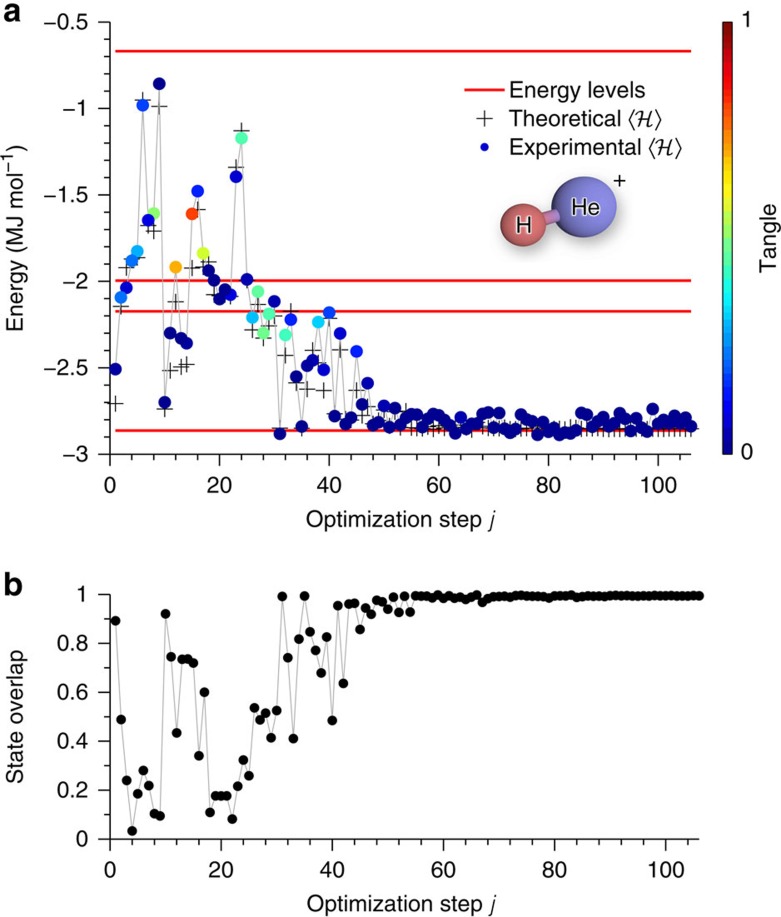
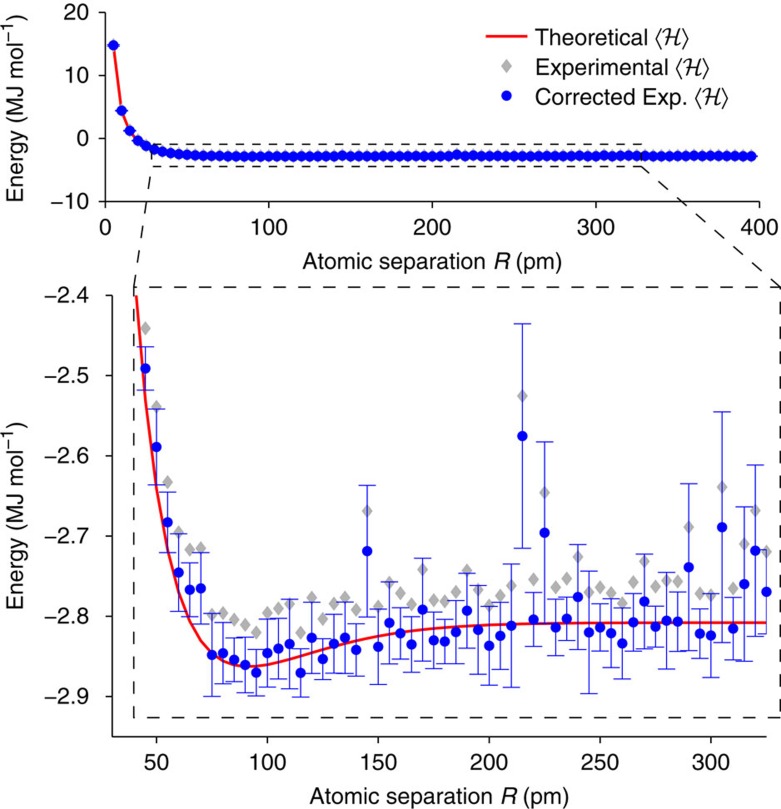
- The authors report an experimental ground-state result for He–H\(^+\): after correcting for experimental errors, they estimate the equilibrium bond length as \(R = 92.3 \pm 0.1\) pm and the ground-state electronic energy as \(E = -2.865 \pm 0.008\) MJ mol\(^{-1}\).
- For the bond dissociation curve, more than 96% of the experimental data are within chemical accuracy of the theoretical values.
- In the discussion, they state that for a 4 × 4 Hamiltonian like the one demonstrated, the QPE circuit would require at least 12 CNOT gates, whereas their method requires one.
- The full experiment was performed in about 158 h, and the bond dissociation curve was obtained by finding the ground states of 79 Hamiltonians.
## Methods
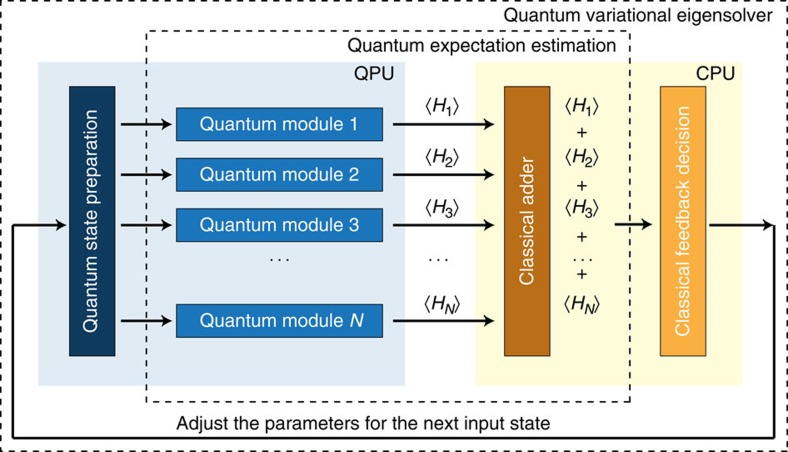
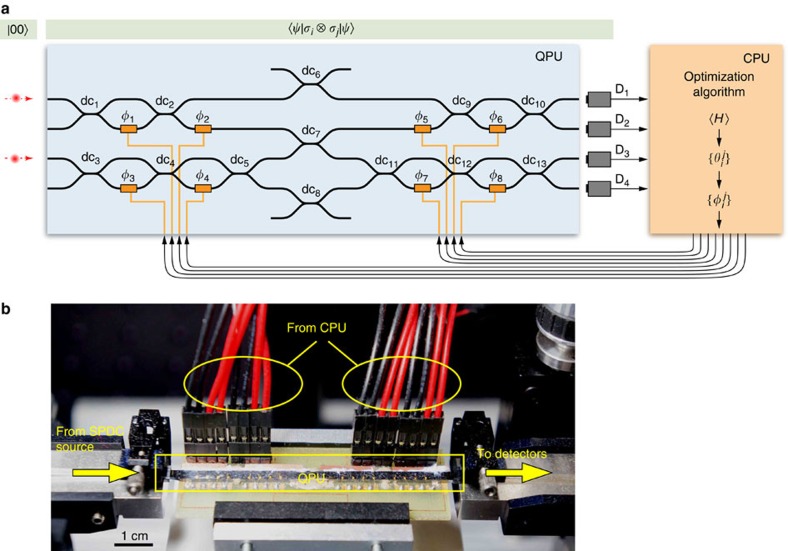
- The paper combines a reconfigurable integrated photonic quantum processor with a classical optimization algorithm: the quantum device estimates Hamiltonian expectation values, and the classical processor updates the state parameters variationally.
- The photonic chip prepares and measures arbitrary two-qubit pure states using single-qubit rotations and one two-qubit entangling gate; the experimental demonstration uses the He–H\(^+\) molecule in a minimal basis.
- For the classical optimization, they use the Nelder–Mead algorithm; expectation values are reconstructed from four two-qubit Pauli measurements at each point.
## Limitations
- The paper states that the method still requires a good approximation to the ground state as input/initialization, and the reliance on multiple separate measurements makes it sensitive to variations in state preparation between calculations.
- The authors report a constant systematic shift of \(\varepsilon = 50\) kJ mol\(^{-1}\) in the measured expectation values; they attribute this to photon-source impurity/distinguishability, circuit imperfections, and unbalanced coupling efficiencies.
- Evident from the text: the demonstration is limited to a two-qubit / 4 × 4 Hamiltonian prototype, so the scalability claim is not experimentally validated here.
Model-written summary. Check it against the paper before relying on it.
Integrity signals
Registry
Cites
Statistics
Figures
Verification
Claims the paper makes
7 Valid · 4 Not valid · 11 Not checked · 59 Own results and interpretations
The cited sources support only part of this claim — read each source’s verdict below.
In the paper
“Recent developments in the field of quantum computation offer a way forward for determining efficient solutions of many instances of large eigenvalue problems that are classically intractable6789101112”
§ A variational eigenvalue solver on a photonic quantum processor > Abstract
What the sources say
- Not matchedcites [6] Nielsen, M. A. & Chuang, I. L. Quantum Computation and Quantum Information Cambridge University Press (2000).
Couldn’t be matched to a paper in Crossref, so it can’t be checked.
- Could not verifycites [7] Kitaev, A. Quantum measurements and the Abelian stabilizer problem. Electronic Colloquium on Computational Complexity (ECCC) 3 (1996). sourceExperimental — accuracy not yet measured
Our copy under this DOI is the ISAAC 2021 paper 'Effective Resistance and Capacitance in Simplicial Complexes and a Quantum Algorithm' (Kitaev's 1995 work appears only as reference [9] in its bibliography), and it nowhere asserts that quantum computation gives efficient solutions to classically intractable large eigenvalue problems. Eigenvalues enter only as complexity parameters — λ, the smallest eigenvalue of the normalized up-Laplacian, in Lemma 31 and Theorem 26 (Section 6.3, 'Time efficient implementations') and in the phase-estimation machinery of Appendix A — and Section 1.1 ('Our Contributions') actually reports the opposite direction for its own problem: 'the quantum algorithm is slower than the classical algorithm in the worst case'. Searched: 'eigenvalue problems classically intractable', 'quantum speedup / exponential advantage', 'phase estimation', 'faster than classical'; no passage addresses the claim's point. (LLM, conf=0.70)
- Partly supportedcites [8] Griffiths, R. B. & Niu, C.-S. Semiclassical fourier transform for quantum computation. Phys. Rev. Lett. 76, 3228–3231 (1996). sourceExperimental — accuracy not yet measured
On p. 1, the paper says a quantum computer, if built, could solve certain problems such as factoring long numbers much faster than conventional algorithms. It also describes a simpler Fourier transform for Shor’s factorization and discrete-logarithm algorithms (p. 1). The copy does not support the claim about efficient solutions to many large eigenvalue problems. (LLM, conf=0.84)
plainstates a cause- Asserted: passes — The authors put it forward as true.
- Checkable: passes — It can be checked against evidence.
- Load-bearing: passes — The paper’s conclusions depend on it.
- Based: passes — The paper gives a reason why it holds.
- Not matched
Every source the paper cites for this claim was checked and supports it.
In the paper
“this would suffer from the N-representability problem, which is known to be intractable for both classical and quantum computers (it is in the quantum complexity class QMA-Hard24).”
§ A variational eigenvalue solver on a photonic quantum processor > Results > Quantum expectation estimation
What the sources say
- Supportedcites [24] Liu, Y.-K., Christandl, M. & Verstraete, F. Quantum computational complexity of the n-representability problem: Qma complete. Phys. Rev. Lett. 98, 110503 (2007). source
The paper states that N-representability is QMA-complete and hence QMA-hard and NP-hard (Abstract). Its discussion of quantum-chemistry relevance says the problem is intractable in the worst case even on a quantum computer, while allowing that particular physical systems may be easier. (LLM, conf=0.93)
boosted- Asserted: passes — The authors put it forward as true.
- Checkable: passes — It can be checked against evidence.
- Load-bearing: passes — The paper’s conclusions depend on it.
- Based: passes — The paper gives a reason why it holds.
- Supported
Every source the paper cites for this claim was checked and supports it.
In the paper
“We have implemented the QPU using integrated quantum photonics technology30.”
§ A variational eigenvalue solver on a photonic quantum processor > Results > Prototype demonstration
What the sources say
- Supportedcites [30] O'Brien, J. L., Furusawa, A. & Vuckovic, J. Photonic quantum technologies. Nat. Photon. 3, 687–695 (2009). source
The citation identifies integrated quantum photonics as the technology used, rather than attributing the citing authors’ QPU implementation to this review. The “Integrated quantum optical circuits” section (p. 6) describes on-chip waveguide circuits performing quantum logic gates and a compiled quantum factoring algorithm. (LLM, conf=0.87)
plain- Asserted: passes — The authors put it forward as true.
- Checkable: passes — It can be checked against evidence.
- Load-bearing: passes — The paper’s conclusions depend on it.
- Based: passes — The paper gives a reason why it holds.
- Supported
The cited sources support only part of this claim — read each source’s verdict below.
In the paper
“The time the quantum computer must remain coherent is determined by the necessity of O(p−1) successive applications of , each of which can require on the order of millions or billions of quantum gates for practical applications1719, as compared to the tens to hundreds of gates achievable in the short term.”
§ A variational eigenvalue solver on a photonic quantum processor > Abstract
What the sources say
- Partly supportedcites [17] Whitfield, J. D., Biamonte, J. & Aspuru-Guzik, A. Simulation of electronic structure hamiltonians using quantum computers. Mol. Phys. 109, 735–750 (2011). sourceExperimental — accuracy not yet measured
Split into 2 atoms — 1 confirmed, 1 partially supported, 0 disputed, 0 misattributed, 0 unverifiable. Expand the claim to see per-atom verdicts.
- Partly supportedcites [19] Jones, N. C. et al. Faster quantum chemistry simulation on fault-tolerant quantum computers. New J. Phys. 14, 115023 (2012). sourceExperimental — accuracy not yet measured
Split into 2 atoms — 0 confirmed, 2 partially supported, 0 disputed, 0 misattributed, 0 unverifiable. Expand the claim to see per-atom verdicts.
plainstates a cause- Asserted: passes — The authors put it forward as true.
- Checkable: passes — It can be checked against evidence.
- Load-bearing: passes — The paper’s conclusions depend on it.
- Based: passes — The paper gives a reason why it holds.
- Partly supported
A result the paper reports from its own data — it cites no other source for it, so there is none to check. The quote shows it is in the paper.
In the paper
“We experimentally demonstrate the feasibility of this approach with an example from quantum chemistry—calculating the ground-state molecular energy for He–H+.”
§ A variational eigenvalue solver on a photonic quantum processor > Abstract
boostedstates a causeSingle case- Asserted: passes — The authors put it forward as true.
- Checkable: passes — It can be checked against evidence.
- Load-bearing: passes — The paper’s conclusions depend on it.
- Based: passes — The paper gives a reason why it holds.
31 more claims
Create a free account to see all 81 claims and to verify the 4 references still open.
- It may state two separate claims as one. 28
- Probably not a substantial claim. 24
Claims other papers make about this one
Each is checked against this paper’s own text: does it say what the citing paper says it does?
The cited source doesn’t support the claim as written.
In the citing paper
“Leveraging quantum resources, the UCC ansatz was instead realized as a PQC on a photonic processor (Peruzzo et al. , 2014).”
From Noisy intermediate-scale quantum algorithms (2022) · cites this paper as Peruzzo et al., 2014
Checked by a reasoning model — may be wrong.
Experimental — accuracy not yet measuredThe cited source doesn’t support the claim as written.
In the citing paper
“The first on-chip GMM of four-qubit cluster state was realised in a laser-writing chip ( Fig.4e ), by manipulating both the polarisation and path DoFs of two photons [85].”
From Integrated photonic quantum technologies (2020) · cites this paper as [85]
Checked by a reasoning model — may be wrong.
Experimental — accuracy not yet measuredThe cited source doesn’t support the claim as written.
In the citing paper
“four-qubit linear- and box-cluster states are generated in a laser-writing photonic chip. This is enabled by on-chip manipulating the two-photon four-qubit hyperentangled state and cluster state, that are encoded in photon's path and polarisation DoFs. The Grover's search algorithm on a four-element database was implemented by controlling the device.”
From Integrated photonic quantum technologies (2020) · cites this paper as [85]
Checked by a reasoning model — may be wrong.
Experimental — accuracy not yet measuredThe source backs part of the claim, not all of it — or backs it for a different population, condition or comparison.
In the citing paper
“Due to its versatility, the variational Hamiltonian ansatz has been implemented for quantum chemistry [21, 29], optimization [24], and for quantum simulation problems [30].”
From Variational quantum algorithms (2021) · cites this paper as [29]
Experimental — accuracy not yet measuredThe source backs part of the claim, not all of it — or backs it for a different population, condition or comparison.
In the citing paper
“For the original VQE (Peruzzo et al. , 2014) and QAOA (Farhi et al. , 2014) it can, for example, be described as a single expectation value min θ ⟨ H ⟩ U ( θ ) , where the differences solely appear in the specific form and construction of the qubit Hamiltonian.”
From Noisy intermediate-scale quantum algorithms (2022) · cites this paper as Peruzzo et al., 2014
Experimental — accuracy not yet measured
12 more claims about this paper
Create a free account to see every claim other papers make about this one.
Citations
Cites
A Simplex Method for Function Minimization
Nelder, J. A., & Mead, R. (1965) · The Computer Journal · doi:10.1093/comjnl/7.4.308 · Cited by 28,905
Quantum computation and quantum information
Law, J. (2001) · ACM SIGSOFT Software Engineering Notes · doi:10.1145/505482.505499 · Cited by 18,842
(1999) · Cited by 12,854
Practical Methods of Optimization
Fletcher, R. (2000) · Wiley eBooks · doi:10.1002/9781118723203 · Cited by 7,605 · cited 3×
“[12] S.”
BackgroundMethodPractical methods of optimization
(1988) · Mathematics and Computers in Simulation · doi:10.1016/0378-4754(88)90129-2 · Cited by 5,818
Quantum Algorithm for Linear Systems of Equations
Harrow, A. W., Hassidim, A., & Lloyd, S. (2009) · Physical Review Letters · doi:10.1103/physrevlett.103.150502 · Cited by 3,325
Conn, A. R., Gould, N. I. M., & Toint, P. L. (2000) · Society for Industrial and Applied Mathematics eBooks · doi:10.1137/1.9780898719857 · Cited by 2,981 · cited 3×
“[14] D.”
MethodInfluential�ber das Paulische �quivalenzverbot
Jordan, P., & Wigner, E. (1928) · Zeitschrift f�r Physik · doi:10.1007/bf01331938 · Cited by 2,597
Molecular Electronic‐Structure Theory
Helgaker, T., Jørgensen, P., & Olsen, J. (2000) · doi:10.1002/9781119019572 · Cited by 2,594
O'Brien, J. L., Furusawa, A., & Vučković, J. (2009) · Nature Photonics · doi:10.1038/nphoton.2009.229 · Cited by 2,388
Self-citation
Research works printed but not linked: 3
- Helgaker, T., Jorgensen, P. & Olsen, J. Mol. Electronic Struct. Theory Wiley, Sussex (2002).
- Saad, Y. Numerical Methods for Large Eigenvalue Problems Vol. 158, (SIAM (1992).
- Rayleigh, J. W. In finding the correction for the open end of an organ-pipe. Phil. Trans. 161, 77 (1870).
Cited by
Items 2,001–2,100 of 4,573
Variational quantum eigensolver ansatz for the J1−J2 -model
Feulner, V., & Hartmann, M. J. (2022) · Physical review. B./Physical review. B · doi:10.1103/physrevb.106.144426 · Cited by 12
State Preparation of Antisymmetrized Geminal Power on a Quantum Computer without Number Projection
Khamoshi, A., Dutta, R., & Scuseria, G. E. (2023) · The Journal of Physical Chemistry A · doi:10.1021/acs.jpca.3c00525 · Cited by 14
Liu, H., Wan, L., Yu, C., Pan, S., Qin, S., Gao, F., & Wen, Q. (2023) · Advanced Quantum Technologies · doi:10.1002/qute.202300031 · Cited by 15
Linear-Scaling Quantum Circuits for Computational Chemistry
Magoulas, I., & Evangelista, F. A. (2023) · Journal of Chemical Theory and Computation · doi:10.1021/acs.jctc.3c00376 · Cited by 13
Unitary Coupled Cluster: Seizing the Quantum Moment
Magoulas, I., & Evangelista, F. A. (2023) · The Journal of Physical Chemistry A · doi:10.1021/acs.jpca.3c02781 · Cited by 18
“To pave the way toward practical and robust computations on actual quantum devices, various schemes have been devised to reduce the circuit depth of hybrid quantum − classical algorithms even further.”
A hybrid quantum-classical method for electron-phonon systems
Denner, M. M., Miessen, A., Yan, H., Tavernelli, I., Neupert, T., Demler, E., & Wang, Y. (2023) · Communications Physics · doi:10.1038/s42005-023-01353-3 · Cited by 12
Unfolding measurement distributions via quantum annealing
Cormier, K. J. R., Sipio, R. D., & Wittek, P. (2019) · Journal of High Energy Physics · doi:10.1007/jhep11(2019)128 · Cited by 13
QGo: Scalable Quantum Circuit Optimization Using Automated SynthesisPreprint
Wu, X.-C., Davis, M. G., Chong, F. T., & Iancu, C. (2020) · arXiv (Cornell University) · doi:10.48550/arxiv.2012.09835 · Cited by 55
“QC algorithms might have significant impact on areas such as quantum chemistry [41,55], cryptography [61], and machine learning [11].”
BackgroundCatterall, S. M., Harnik, R., Hubeny, V. E., Bauer, C., Berlin, A., Davoudi, Z., Faulkner, T., Hartman, T., Headrick, M., Kahn, Y. F., et al. (1900) · OSTI OAI (U.S. Department of Energy Office of Scientific and Technical Information) · doi:10.2172/1892238 · Cited by 10
QuEst: Graph Transformer for Quantum Circuit Reliability EstimationPreprint
Wang, H., Liu, P., Cheng, J., Liang, Z., Gu, J., Li, Z., Ding, Y., Jiang, W., Shi, Y., Qian, X., et al. (2022) · arXiv (Cornell University) · doi:10.48550/arxiv.2210.16724 · Cited by 57
Halder, D., Halder, S., Mondal, D., Patra, C., Chakraborty, A., & Maitra, R. (2023) · Journal of Chemical Sciences · doi:10.1007/s12039-023-02161-6 · Cited by 11
“tum classical approach, the Variational Quantum Eigensolver (VQE) algorithm.(8) Since VQE’s inception, the algorithm has been experimentally realized on various leading quantum platforms including *For correspondence Dedicated to Professor S.”
BackgroundMethodPosition Papers for the ASCR Workshop on Basic Research Needs in Quantum Computing and Networking
Lougovski, P., Parekh, O., Broz, J., Byrd, M., Chembo, Y. K., de Jong, W. A., Figueroa, E. V., Humble, T. S., Larson, J. M., Quiroz, G., et al. (2023) · OSTI OAI (U.S. Department of Energy Office of Scientific and Technical Information) · doi:10.2172/2283320 · Cited by 11
Holographic quantum simulation
Kim, I. H. (2017) · arXiv · doi:10.48550/arxiv.1702.02093 · Cited by 10
Quantum generative adversarial networks: architectures, use cases, and real-world implementations
Islam, M., Türkeli, S., & Özaydin, F. (2026) · Quantum Information Processing · doi:10.1007/s11128-025-05044-6 · Cited by 18
“The theoretical foundations of QGANs draw from quantum circuit theory, quantum information theory, and variational quantum algorithms, particularly the Variational Quantum Eigensolver (VQE) [6] and Quantum Approximate Optimization Algorithm (QAOA) [7].”
Toward scalable fault-tolerant photonic quantum computers
AbuGhanem, M. (2026) · The Journal of Supercomputing · doi:10.1007/s11227-025-08132-7 · Cited by 17
Hybrid quantum-classical unsupervised data clustering based on the self-organizing feature map
Lazarev, I. D., Narożniak, M., Byrnes, T., & Pyrkov, A. N. (2025) · Physical Review A · doi:10.1103/physreva.111.012416 · Cited by 11
“Another example of a well-known hybrid quantum classical al-gorithm is the Variational Quantum Eigensolver (VQE) for applications in quantum simulations [73–76].”
Unified multivariate trace estimation and quantum error mitigation
Liang, J., Lv, Q.-Q., Wang, Z., & Fei, S.-M. (2023) · Physical Review A · doi:10.1103/physreva.107.012606 · Cited by 14
Sun, Z., Wang, Y., Cui, J., & Fan, H. (2023) · New Journal of Physics · doi:10.1088/1367-2630/acb22c · Cited by 13
Chen, Y., & Stade, Y. (2023) · Lecture notes in computer science · doi:10.1007/978-3-031-44245-2_9 · Cited by 14
“There are applications where quantum computers promise an advantage over classical machines [19,8,10,23].”
BackgroundNykänen, A., Miller, A., Talarico, N. W., Knecht, S., Kovyrshin, A., Skogh, M., Tornberg, L., Broo, A., Mensa, S., Symons, B. C. B., et al. (2023) · Journal of Chemical Theory and Computation · doi:10.1021/acs.jctc.3c01091 · Cited by 14
“38 By contrast, the hybrid variational quantum eigensolver (VQE) 39 (utilizing a quantum device for wave function preparation and ground-state energy estimation, and a classical computer for the variational optimization of wave function parameters) is well suited for current noisy quantum devices…”
BackgroundQuantum Computing in Finance: The Intesa Sanpaolo Experience
Sotelo, R., Corbelletto, D., Dri, E., Giusto, E., & Montrucchio, B. (2024) · IEEE Engineering Management Review · doi:10.1109/emr.2024.3373796 · Cited by 16
Quantum error mitigation via quantum-noise-effect circuit groups
Hama, Y., & Nishi, H. (2024) · Scientific Reports · doi:10.1038/s41598-024-52485-7 · Cited by 14
Quantum Join Ordering by Splitting the Search Space of QUBO Problems
Nayak, N., Winker, T., Çalıkyılmaz, U., Groppe, S., & Groppe, J. (2024) · Datenbank-Spektrum · doi:10.1007/s13222-024-00468-3 · Cited by 15
Probabilistic imaginary-time evolution algorithm based on nonunitary quantum circuits
Xie, H.-N., Wei, S.-J., Yang, F., Wang, Z., Chen, C.-T., Fan, H., & Long, G. (2024) · Physical Review A · doi:10.1103/physreva.109.052414 · Cited by 25
Singh, H., Majumder, S., & Mishra, S. (2024) · The Journal of Chemical Physics · doi:10.1063/5.0210597 · Cited by 9
“These algorithms have been experimentally tested on different quantum computing architectures like photonic processors [21] and trapped-ion processors [22].”
MethodTowards Optimizations of Quantum Circuit Simulation for Solving Max-Cut Problems with QAOA
Lin, Y.-C., Wang, C.-C., Tu, C.-H., & Hung, S. (2024) · ACM Symposium on Applied Computing · doi:10.1145/3605098.3635897 · Cited by 16
Ji, Y., & Polian, I. (2024) · Entropy · doi:10.3390/e26070586 · Cited by 16
“Our findings hold broad applicability across various quantum algorithms, including the variational quantum eigensolver (VQE) [52,53].”
BackgroundTetris: A Compilation Framework for VQA Applications in Quantum Computing
Jin, Y., Li, Z., Hua, F., Hao, T., Zhou, H., Huang, Y., & Zhang, E. Z. (2024) · Proceedings - International Symposium on Computer Architecture/Proceedings · doi:10.1109/isca59077.2024.00029 · Cited by 44
“For VQE, several studies aim to optimize the circuit size from both the initial Hamiltonian construction stage [20], [23], [31], the fermionic to spin operator encoding stage [4], [18], [37], the circuit synthesis stage [7], [25], [46], the hardware mapping stage [16], [24], [25], measurement…”
BackgroundMethodInfluentialContinuous evolution for efficient quantum architecture search
Ma, Q., Hao, C., Yang, X., Qian, L., Zhang, H., Si, N., Xu, M., & Qu, D. (2024) · EPJ Quantum Technology · doi:10.1140/epjqt/s40507-024-00265-7 · Cited by 16
“The variational quantum algorithms [2, 3] including quantum neural networks [4, 5] and variational quantum eigensolvers (VQEs) [6–8], are a class of promising candidates to use noisy intermediate-scale quantum (NISQ) devices to solve practical tasks that are beyond the reach of classical computers…”
Overview of Applications of Artificial Intelligence (AI) in Diverse Fields
Kuhar, N., Kumria, P., & Rani, S. (2024) · Springer eBooks · doi:10.1007/978-3-031-69433-2_2 · Cited by 14
Quantum Generative Adversarial Networks in a Silicon Photonic Chip with Maximum Expressibility
Ma, H., Ye, L., Guo, X., Ruan, F., Zhao, Z., Li, M., Wang, Y., & Yang, J. (2024) · Advanced Quantum Technologies · doi:10.1002/qute.202400171 · Cited by 10
Hybrid quantum simulations with qubits and qumodes on trapped-ion platforms
Araz, J. Y., Grau, M., Montgomery, J., & Ringer, F. (2025) · Physical Review A · doi:10.1103/kbv4-jj51 · Cited by 36
“The performance of VQAs is known to degrade for Hamiltonians with a small value of the energy gap [144].”
Patra, C., Mukherjee, D., Halder, S., Mondal, D., & Maitra, R. (2024) · The Journal of Chemical Physics · doi:10.1063/5.0229137 · Cited by 12
Dastagir, M. B. A., & Han, D. (2024) · IEEE Signal Processing Letters · doi:10.1109/lsp.2024.3480043 · Cited by 13
“This hybrid approach addresses the challenges of noise and decoherence while improving computational efficiency [37].”
BackgroundHybrid quantum-classical algorithm for the transverse-field Ising model in the thermodynamic limit
Sumeet, Hörmann, M., & Schmidt, K. P. (2024) · Physical review. B./Physical review. B · doi:10.1103/physrevb.110.155128 · Cited by 11
“As a consequence, hybrid quantum-classical algorithms such as variational quantum eigensolver (VQE)[6], quantum adiabatic optimization algorithm (QAOA)[7], CQE (contracted quantum eigensolver) [8], etc are gaining popularity in promising to solve the problem of exponential Hilbert space growth with…”
MethodA Hybrid Quantum Solver for the Lorenz System
Hafshejani, S. F., Gaur, D. R., Dasgupta, A., Benkoczi, R. R., Gosala, N. R., & Iorio, A. (2024) · Entropy · doi:10.3390/e26121009 · Cited by 13
“This energy estimation is subsequently fed into a classical optimization process that iteratively adjusts the circuit’s parameters to minimize the energy, ultimately converging on the ground state [28].”
Quantum phase transition detection via quantum support vector machine
Wang, Y., & Cao, L. (2024) · Quantum Science and Technology · doi:10.1088/2058-9565/ad985f · Cited by 14
Zheng, M., Peng, B., Li, A., Yang, X., & Kowalski, K. (2024) · npj Quantum Information · doi:10.1038/s41534-024-00916-8 · Cited by 24
“…fi cantstrideshavebeenmade towards promising near-term hybrid quantum-classical strategies, which includes variational quantum algorithm 5 – 19 , quantum approximate opti-mizationalgorithm 20,21 , quantumannealing 22,23 , Gaussianbosonsampling 24 , analog quantum simulation 25,26 ,…”
Quantum computing for extracting nuclear resonances
Zhang, H., Bai, D., & Ren, Z. (2024) · Physics Letters B · doi:10.1016/j.physletb.2024.139187 · Cited by 13
Pexe, G. E. L., Rattighieri, L. A. M., Malvezzi, A. L., & Fanchini, F. F. (2024) · Physical review. B./Physical review. B · doi:10.1103/physrevb.110.224422 · Cited by 16
Neutron-proton pairing correlations described on quantum computers
Zhang, J., Lacroix, D., & Beaujeault-Taudière, Y. (2024) · Physical Review C · doi:10.1103/physrevc.110.064320 · Cited by 16
“Most studies today use variational techniques like the Variational Quantum Eigensolver (VQE) [6, 15–17], which are more robust to noisy devices.”
Ziems, K. M., Kjellgren, E. R., Sauer, S. P. A., Kongsted, J., & Coriani, S. (2025) · Chemical Science · doi:10.1039/d4sc05839a · Cited by 15
Mullinax, J. W., & Tubman, N. M. (2025) · The Journal of Chemical Physics · doi:10.1063/5.0251601 · Cited by 29
Peng, B., Su, Y., Claudino, D., Kowalski, K., Low, G. H., & Roetteler, M. (2025) · Quantum Science and Technology · doi:10.1088/2058-9565/adbf42 · Cited by 31
Ma, Y., Wang, W., Mu, X., Cai, W., Hua, Z., Pan, X., Deng, D., Wu, R.-B., Zou, C., Wang, L., et al. (2025) · Science China Physics Mechanics and Astronomy · doi:10.1007/s11433-025-2620-6 · Cited by 10
“Among the algorithms designed for these NISQ devices, the variational quantum eigensolver (VQE) stands out due to its hybrid quantum-classical approach, which has proven effective in finding the ground state energies of quantum systems [8–10].”
Gustafson, E., Sherbert, K., Florio, A., Shirali, K., Chen, Y., Lamm, H., Valgushev, S. N., Weichselbaum, A., Economou, S. E., Pisarski, R. D., et al. (2025) · Physical Review Applied · doi:10.1103/physrevapplied.23.064002 · Cited by 32
Variational Simulation of the Lipkin-Meshkov-Glick Model on a Neutral Atom Quantum Computer
Chinnarasu, R., Poole, C., Phuttitarn, L., Noori, A., Graham, T., Coppersmith, S. N., Balantekin, A. B., & Saffman, M. E. (2025) · PRX Quantum · doi:10.1103/prxquantum.6.020350 · Cited by 23
“The VQE algorithm[20] leverages the variational principle to estimate the ground-state energy of a Hamiltonian.”
Tensor-based quantum phase difference estimation for large-scale demonstration
Kanno, S., Sugisaki, K., Nakamura, H., Yamauchi, H., Sakuma, R., Kobayashi, T., Gao, Q., & Yamamoto, N. (2025) · Proceedings of the National Academy of Sciences · doi:10.1073/pnas.2425026122 · Cited by 20
“See SI Appendix , section S1 for”
Pruned-ADAPT-VQE: Compacting Molecular Ansätze by Removing Irrelevant Operators
Vaquero-Sabater, N., Carreras, A., & Casanova, D. (2025) · Journal of Chemical Theory and Computation · doi:10.1021/acs.jctc.5c00535 · Cited by 26
“As an alternative, the Variational Quantum Eigensolver (VQE) 4,5 was introduced, better suited for the Noisy Intermediate-Scale Quantum (NISQ) era.”
Learning adiabatic quantum algorithms over optimization problems
Pastorello, D., Blanzieri, E., & Cavecchia, V. (2021) · Quantum Machine Intelligence · doi:10.1007/s42484-020-00030-w · Cited by 12
Certificates of quantum many-body properties assisted by machine learning
Requena, B., Muñoz-Gil, G., Lewenstein, M., Dunjko, V., & Tura, J. (2023) · Physical Review Research · doi:10.1103/physrevresearch.5.013097 · Cited by 18
GraphStateVis: Interactive Visual Analysis of Qubit Graph States and their Stabilizer Groups
Miller, M., & Miller, D. (2021) · IEEE International Conference on Quantum Computing and Engineering (QCE) · doi:10.1109/qce52317.2021.00057 · Cited by 16
“The variational quantum eigensolver (VQE) algorithm is a new quantum algorithm that is hoped will outperform the best classical simulation algorithms in the near future by exploiting noisy intermediate-scale quantum computers [27], [28].”
MethodOptical vortices in nanophotonics
Li, C., Maier, S. A., & Haoran, R. (2021) · Chinese Optics · doi:10.37188/co.2021-0066 · Cited by 17
“In this context, nanophotonic multiplexing of light opens the possibility of miniaturizing high-capacity optical devices and systems for on-chip applications, such as multiprocessor system-on-chip[1-4] and integrated photonic quantum technologies[5-11].”
BackgroundQuantum annealing with twisted fields
Imoto, T., Seki, Y., Matsuzaki, Y., & Kawabata, S. (2022) · New Journal of Physics · doi:10.1088/1367-2630/ac9155 · Cited by 14
Ezawa, M. (2022) · Scientific Reports · doi:10.1038/s41598-022-10677-z · Cited by 11
“(28) t = n t, (29) |ψ̃ in ((n+ 1)�t)� = ψ̃ (p) in (n�t)�p + η(t)δ (), (30) E cost((n+ 1)�t) ≡ 1− ∣”
Quantum variational learning for entanglement witnessing
Scala, F., Mangini, S., Macchiavello, C., Bajoni, D., & Gerace, D. (2022) · International Joint Conference on Neural Networks (IJCNN) · doi:10.1109/ijcnn55064.2022.9892080 · Cited by 17
Quantum Fourier Convolutional Network
Shen, F., & Liu, J. (2022) · ACM Transactions on Multimedia Computing Communications and Applications · doi:10.1145/3514249 · Cited by 25
“To handle this problem, some quantum algorithms [40] connected with classical computers were designed, which are often called hybrid quantum-classical algorithms.”
BackgroundMethodYoshikawa, T., Takanashi, T., & Nakai, H. (2022) · Journal of Chemical Theory and Computation · doi:10.1021/acs.jctc.2c00602 · Cited by 14
Computing graph edit distance on quantum devices
Incudini, M., Tarocco, F., Mengoni, R., Pierro, A. D., & Mandarino, A. (2022) · Quantum Machine Intelligence · doi:10.1007/s42484-022-00077-x · Cited by 12
Using Variational Quantum Algorithm to Solve the LWE Problem
Lv, L., Yan, B., Wang, H., Ma, Z., Fei, Y., Meng, X., & Duan, Q. (2022) · Entropy · doi:10.3390/e24101428 · Cited by 10
“At the same time, VQA, such as QAOA [16], VQE [17], and FQE [18], has become the most suitable technology to achieve quantum advantage using noisy intermediate-scale quantum (NISQ) devices.”
MethodParameterized Two‐Qubit Gates for Enhanced Variational Quantum Eigensolver
Rasmussen, S. E., & Zinner, N. T. (2022) · Annalen der Physik · doi:10.1002/andp.202200338 · Cited by 12
Simulating Majorana zero modes on a noisy quantum processor
Sung, K. J., Rančić, M. J., Lanes, O., & Bronn, N. T. (2023) · Quantum Science and Technology · doi:10.1088/2058-9565/acb796 · Cited by 17
Kawase, Y., & Fujii, K. (2023) · Computer Physics Communications · doi:10.1016/j.cpc.2023.108720 · Cited by 10
Characterization of variational quantum algorithms using free fermions
Matos, G., Self, C. N., Papić, Z., Meichanetzidis, K., & Dreyer, H. (2023) · Quantum · doi:10.22331/q-2023-03-30-966 · Cited by 25
Trimmed sampling algorithm for the noisy generalized eigenvalue problem
Hicks, C., & Lee, D. (2023) · Physical Review Research · doi:10.1103/physrevresearch.5.l022001 · Cited by 12
“[23] Alberto Peruzzo, Jarrod McClean, Peter Shadbolt, Man-Hong Yung, Xiao-Qi Zhou, Peter J.”
Information recoverability of noisy quantum states
Zhao, X., Zhao, B., Xia, Z., & Wang, X. (2023) · Quantum · doi:10.22331/q-2023-04-13-978 · Cited by 16
“The expectation value of some chosen observable, also known as shadow information, characterizes physical properties of the quantum system, making estimating expectation values the main goal of many quantum algorithms [2, 9], such as variational quantum eigensolver (VQE) [10].”
BackgroundInfluentialVariational Amplitude Amplification for Solving QUBO Problems
Koch, D., Cutugno, M., Patel, S., Wessing, L., & Alsing, P. M. (2023) · Quantum Reports · doi:10.3390/quantum5040041 · Cited by 12
“The results of this section are then used to motivate section VI., in which we discuss how amplitude amplification can be used in a hybrid classical-quantum model of computing, similar to other successful variational approaches [41, 42, 51].”
MethodA fault-tolerant variational quantum algorithm with limited T-depth
Sayginel, H., Jamet, F., Agarwal, A., Browne, D. E., & Rungger, I. (2023) · Quantum Science and Technology · doi:10.1088/2058-9565/ad0571 · Cited by 20
Unitary coupled-cluster for quantum computation of molecular properties in a strong magnetic field
Culpitt, T., Tellgren, E. I., & Pavošević, F. (2023) · The Journal of Chemical Physics · doi:10.1063/5.0177417 · Cited by 10
Parallelizing Quantum-Classical Workloads: Profiling the Impact of Splitting Techniques
Khare, T., Majumdar, R., Sangle, R., Ray, A., Seshadri, P. V., & Simmhan, Y. L. (2023) · IEEE International Conference on Quantum Computing and Engineering (QCE) · doi:10.1109/qce57702.2023.00113 · Cited by 21
“These parameters are initialized either based on some domain knowledge or randomly, and then updated on each iteration by a classical optimizer to minimize the energy of the system given by the expectation value (cid:104) ψ ( (cid:126)θ ) | H | ψ ( (cid:126)θ ) (cid:105) [27].”
MethodA full circuit-based quantum algorithm for excited-states in quantum chemistry
Wen, J., Wang, Z., Chen, C.-T., Xiao, J., Li, H., Qian, L., Huang, Z., Fan, H., Wei, S., & Long, G. (2024) · Quantum · doi:10.22331/q-2024-01-04-1219 · Cited by 19
A Fusion of Supervised Contrastive Learning and Variational Quantum Classifiers
Don, A. K. K., Khalil, I., & Atiquzzaman, M. (2024) · IEEE Transactions on Consumer Electronics · doi:10.1109/tce.2024.3351649 · Cited by 23
“Their successful applications span various domains, including quantum chemistry, optimization, and supervised learning tasks [8], [22].”
BackgroundQuantum annealing with error mitigation
Shingu, Y., Nikuni, T., Kawabata, S., & Matsuzaki, Y. (2024) · Physical Review A · doi:10.1103/physreva.109.042606 · Cited by 15
Hybrid ground-state quantum algorithms based on neural Schrödinger forging
de Schoulepnikoff, P., Kiss, O., Vallecorsa, S., Carleo, G., & Grossi, M. (2024) · Physical Review Research · doi:10.1103/physrevresearch.6.023021 · Cited by 17
“The ansatz can take the form of e.g. a neural network [4] or a quantum circuit [11], while the variational parameters are usually optimized with e.g. gradient-based methods.”
BackgroundMethodSun, S., Marinelli, B., Koh, J. M., Kim, Y., Nguyen, L. B., Chen, L., Kreikebaum, J. M., Santiago, D., Siddiqi, I. A., & Minnich, A. J. (2024) · npj Quantum Information · doi:10.1038/s41534-024-00850-9 · Cited by 20
“Early experimental demonstrations of quantum simulation algorithms have focused on computing ground-and excited-state energies of small molecules or few-site spin and fermionic models 4 – 8 .”
Nykänen, A., Thiessen, L., Borrelli, E.-M., Krishna, V. B., Knecht, S., & Pavošević, F. (2024) · The Journal of Physical Chemistry Letters · doi:10.1021/acs.jpclett.4c01301 · Cited by 18
Qin, Z., Li, X., Zhou, Y., Zhang, S., Li, R., Du, C., & Xiao, Z. (2024) · New Journal of Physics · doi:10.1088/1367-2630/ad634a · Cited by 14
“Famous examples of VQA include the variational quantum eigensolver (VQE) [4] and the quantum approximate optimization algorithm (QAOA) [5, 6].”
Recursive Quantum Relaxation for Combinatorial Optimization Problems
Kondo, R., Sato, Y., Raymond, R., & Yamamoto, N. (2025) · Quantum · doi:10.22331/q-2025-01-15-1594 · Cited by 22
Trenev, D., Ollitrault, P. J., Harwood, S. M., Gujarati, T. P., Raman, S., Mezzacapo, A., & Mostame, S. (2025) · Quantum · doi:10.22331/q-2025-02-11-1630 · Cited by 20
“Significant advances have been made in the past two decades in the development of quantum algorithms to harness the capabilities of currently available noisy quantum devices, particularly for addressing electronic-structure problems [23, 20, 34, 8].”
BackgroundFeniou, C., Hassan, M., Claudon, B., Courtat, A., Adjoua, O., Maday, Y., & Piquemal, J. (2025) · Scientific Reports · doi:10.1038/s41598-025-99962-1 · Cited by 33
“…development of hybrid quantum-classical algorithms such as the Variational Quantum Eigensolver (VQE) which incorporates a quantum subroutine within a classical optimization loop thereby reducing the quantum computer workload and mitigating the effects of hardware noise and measurement errors 4 .”
Quantum algorithms for computational nuclear physics
Višňák, J. (2015) · EPJ Web of Conferences · doi:10.1051/epjconf/201510001008 · Cited by 10
Training a Quantum Neural Network to Solve the Contextual Multi-Armed Bandit Problem
Hu, W., & Hu, J. L. (2019) · Natural Science · doi:10.4236/ns.2019.111003 · Cited by 9
“To fully take advantage of the quantum and classical computing, a hybrid quantum-classical technique to create quantum circuits with a variational approach has been proposed [17].”
MethodQuantum Generative Model with Variable-depth Circuit
Huang, Y., Lei, H., Li, X., Qing-sheng, Z., Ren, W., & Liu, X. (2020) · Computers, materials & continua/Computers, materials & continua (Print) · doi:10.32604/cmc.2020.010390 · Cited by 10
Nanosciences fostering cross domain engineering applications
Bale, A. S., Khatokar, J. A., Singh, S., Bharath, G., Mohan, M. S. K., Reddy, S. V., Satheesha, T. Y., & Huddar, S. A. (2020) · Materials Today Proceedings · doi:10.1016/j.matpr.2020.09.076 · Cited by 9
Application of Quantum Machine Learning to VLSI Placement
Turtletaub, I., Li, G., Ibrahim, M. M. A., & Franzon, P. D. (2020) · ACM/IEEE Workshop on Machine Learning for CAD (MLCAD) · doi:10.1145/3380446.3430644 · Cited by 17
“Two of the most popular algorithms, the Variational Quantum Eigensolver (VQE) [10] and Quantum Approximate Optimization Algorithm (QAOA) [3], have shown promise for solving problems on near term quantum hardware.”
MethodDeterministic algorithms for compiling quantum circuits with recurrent patterns
Ferrari, D., Tavernelli, I., & Amoretti, M. (2021) · Quantum Information Processing · doi:10.1007/s11128-021-03150-9 · Cited by 12
Preparing ground states with a broken symmetry with variational quantum algorithms
Vogt, N., Zanker, S., Reiner, J.-M., Marthaler, M., Eckl, T., & Marusczyk, A. (2021) · Quantum Science and Technology · doi:10.1088/2058-9565/abe568 · Cited by 22
Quantum computation for predicting electron and phonon properties of solids
Choudhary, K. K. (2021) · Journal of Physics Condensed Matter · doi:10.1088/1361-648x/ac1154 · Cited by 18
“However,their applications are mainly limited to molecular systems such as H 2 , LiH, BeH 2 [6, 14–16] molecules and there is a lack of research to apply and evaluate these algorithms for solid-state materials.”
Measurement Crosstalk Errors in Cloud-Based Quantum Computing
Seo, S., & Bae, J. (2021) · IEEE Internet Computing · doi:10.1109/mic.2021.3133437 · Cited by 16
Parallel quantum chemistry on noisy intermediate-scale quantum computers
Schade, R., Bauer, C., Tamoev, K., Mazur, L., Plessl, C., & Kühne, T. D. (2022) · Physical Review Research · doi:10.1103/physrevresearch.4.033160 · Cited by 12
OPTIC: A Practical Quantum Binary Classifier for Near-Term Quantum Computers
Patel, T., Silver, D., & Tiwari, D. (2022) · Design, Automation, and Test in Europe · doi:10.23919/date54114.2022.9774707 · Cited by 14
Reducing unitary coupled cluster circuit depth by classical stochastic amplitude prescreening
Filip, M.-A., Fitzpatrick, N., Ramo, D. M., & Thom, A. J. W. (2022) · Physical Review Research · doi:10.1103/physrevresearch.4.023243 · Cited by 11
Improved Iterative Quantum Algorithm for Ground‐State Preparation
Liang, J., Lv, Q.-Q., Shen, S., Li, M., Wang, Z., & Fei, S.-M. (2022) · Advanced Quantum Technologies · doi:10.1002/qute.202200090 · Cited by 9
Adiabatic quantum algorithm for artificial graphene
Pérez-Obiol, A., Pérez-Salinas, A., Sanchez, S., Araújo, B. G. M., & García-Sáez, A. (2022) · Physical Review A · doi:10.1103/physreva.106.052408 · Cited by 13
Peng, B., & Kowalski, K. (2022) · Physical Review Research · doi:10.1103/physrevresearch.4.043172 · Cited by 11
Calibration-Aware Transpilation for Variational Quantum Optimization
Ji, Y., Brandhofer, S., & Polian, I. (2022) · IEEE International Conference on Quantum Computing and Engineering (QCE) · doi:10.1109/qce53715.2022.00040 · Cited by 24
Pauli String Partitioning Algorithm with the Ising Model for Simultaneous Measurements
Kurita, T., Morita, M., Oshima, H., & Sato, S. (2023) · The Journal of Physical Chemistry A · doi:10.1021/acs.jpca.2c06453 · Cited by 18
“In the current noisy intermediate-scale quantum computing [3], variational quantum eigensolver (VQE) algorithms are extensively studied for quantum chemistry to calculate ground- and excited-state energies of chemicals [4,5], including small molecules [6,7], catalysts, and battery materials [8,9].”
Evolution of Quantum Machine Learning and an Attempt of Its Application for SDN Intrusion Detection
Shinde, A. R., & Bendale, S. P. (2023) · Studies in computational intelligence · doi:10.1007/978-981-19-9530-9_22 · Cited by 11
Sugisaki, K., Prasannaa, V. S., Ohshima, S., Katagiri, T., Mochizuki, Y., Sahoo, B. K., & Das, B. P. (2023) · Electronic Structure · doi:10.1088/2516-1075/acf909 · Cited by 14
“The variational quantum eigensolver (VQE) [7, 8] is one of the most extensively studied algorithms for quantum chemical calculations on near-term quantum devices, but its ability to predict energies of heavier systems with a sufficiently small standard deviation is limited by a massive increase in the measurement cost.”
BackgroundWhat determines the ultimate precision of a quantum computer
Waintal, X. (2019) · Physical Review A · doi:10.1103/physreva.99.042318 · Cited by 12
Metadata
- Authors
- Peruzzo, A., McClean, J., Shadbolt, P., Yung, M.-H., Zhou, X.-Q., Love, P. J., Aspuru-Guzik, A., & O’Brien, J. L.
- Affiliations
- The University of Sydney (AU)
- Harvard University (US)
- University of Bristol (GB)
- Haverford College (US)
- Corresponding author
- Peruzzo, Alberto
- O’Brien, Jeremy L.
- Venue
- Nature Communications
- Published
- 2014-07-23
- Volume
- 5
- Issue
- 1
- Pages
- 4213-4213
- ISSN
- 2041-1723 (ISSN-L)
- PMC
- PMC4124861
- OpenAlex
- W2161685427
- Cited by
- 4,552
- References
- 48
- Citations by year
- 2026: 591 · 2025: 765 · 2024: 722 · 2023: 658 · 2022: 564 · 2021: 561 · 2020: 346 · 2019: 191 · 2018: 83 · 2017: 29 · 2016: 18 · 2015: 16 · 2014: 4
- FWCI
- 22.24
- Type
- journal article
- Language
- en
- Open access
- hybrid
- doi.org
- Licence
- cc-by-nc-nd
- creativecommons.org/licenses/by-nc-nd/4.0 (tdm)
- creativecommons.org/licenses/by-nc-nd/4.0 (vor)
- Locations
- Nature Communications (publishedVersion, cc-by-nc-nd)
- Europe PMC (PubMed Central) (publishedVersion, cc-by-nc-nd)
- PubMed Central (publishedVersion, cc-by-nc-nd)
- PubMed (publishedVersion)
- arXiv (Cornell University) (submittedVersion)
- OSTI OAI (U.S. Department of Energy Office of Scientific and Technical Information) (submittedVersion, cc-by-nc-nd)
- Digital Access to Scholarship at Harvard (DASH) (Harvard University) (submittedVersion, cc-by)
- RePEc: Research Papers in Economics (submittedVersion)
- RMIT Research Repository (RMIT University Library) (submittedVersion, cc-by-nc-nd)
- Figshare (submittedVersion, cc-by-nc-nd)
- UWA Profiles and Research Repository (UWA) (submittedVersion, cc-by-nc-nd)
- Bristol Research (University of Bristol) (submittedVersion)
- arXiv (Cornell University)
- Funders
- National Science Foundation (DE-FG02-97ER25308, 0955518, 1037992)
- U.S. Department of Energy (DEFG0297ER25308, DE‐FG02‐, FG02-97ER25308)
- Alfred P. Sloan Foundation
- John Templeton Foundation
- Camille and Henry Dreyfus Foundation
- Royal Academy of Engineering
- National Natural Science Foundation of China (61033001, 61361136003)
- Engineering and Physical Sciences Research Council (EP/J017175/1, EP/L024020/1, EP/K021931/1)
- Australian Research Council (DE140101700)
- National Key Research and Development Program of China (61033001, 2011CBA00301, 61361136003, 2011CBA00300)
- Division of Chemistry (CHE-1037992)
- Air Force Office of Scientific Research (FA 9550-12-1-0046, FA9550-, FA9550-12, FA9550‐12‐1)
- Topics
- Physical Sciences › Computer Science › Artificial Intelligence › Quantum Computing Algorithms and Architecture
- Physical Sciences › Physics and Astronomy › Atomic and Molecular Physics, and Optics › Quantum Information and Cryptography
- Physical Sciences › Physics and Astronomy › Atomic and Molecular Physics, and Optics › Quantum many-body systems
- Keywords
- variational quantum eigensolver, photonic quantum processors, quantum chemistry, classical optimization, hybrid quantum-classical computation
About these checks
Registry, retraction, Cites and statistics results are computed, not judged, with one exception: a printed reference that no index lists is read once by a model before it counts as a citation error. Claims are extracted by a model and kept only when their quote appears verbatim in the text; each cited source is then checked, with a model’s help, for whether it says what the claim relies on. Those verdicts can be wrong — read the claim’s quote and the cited source before relying on one.
The claim verdicts this report counts are experimental: their accuracy is not yet measured.
A language model drew the claims from the paper on 2026-10-10, under version 3 of the claim definition (model deepseek-v4.1-flash, prompt extract-v3).
A second model labelled each claim on 2026-10-10 (model jev-1.13-20260917, definition revision gold-guideline-v0.2).
Cited sources are checked with a language model’s help (qwen3.8-omni-flash and gpt-6-sol).
Statistics and arithmetic are recomputed, not judged.
Confidence bands are shown only for fields calibrated on our annotated test set. None is calibrated yet, so no band is shown.
What counts as a claim ›How we measure confidence ›How we check this ›
Are you an author, or do you see a problem with this page? Request a review
Data sources
Bibliographic data: Semantic Scholar, OpenAlex, Crossref.
Contains information from the Semantic Scholar Academic Graph Datasets, made available under the ODC Attribution License (ODC-BY 1.0).
Semantic Scholar’s data is described in: Kinney, R., et al. (2023). The Semantic Scholar Open Data Platform. arXiv:2301.10140.
