

A variational eigenvalue solver on a photonic quantum processor
Open accessThe DOI matches its Crossref record; 47 of the 48 references it cites were found in a registry or an index; 14 of the 31 sources its claims cite were checked for support.
Abstract
Quantum computers promise to efficiently solve important problems that are intractable on a conventional computer. For quantum systems, where the physical dimension grows exponentially, finding the eigenvalues of certain operators is one such intractable problem and remains a fundamental challenge. The quantum phase estimation algorithm efficiently finds the eigenvalue of a given eigenvector but requires fully coherent evolution. Here we present an alternative approach that greatly reduces the requirements for coherent evolution and combine this method with a new approach to state preparation based on ansätze and classical optimization. We implement the algorithm by combining a highly reconfigurable photonic quantum processor with a conventional computer. We experimentally demonstrate the feasibility of this approach with an example from quantum chemistry—calculating the ground-state molecular energy for He–H+. The proposed approach drastically reduces the coherence time requirements, enhancing the potential of quantum resources available today and in the near future. Quantum computers promise to efficiently solve problems that would be practically impossible with a normal computer. Peruzzo et al. develop a variational computation approach that uses any available quantum resources and, with a photonic quantum processing unit, find the ground-state molecular energy of He–H+.
Overview
CoChat Summary
## TL;DR
The paper introduces a variational alternative to quantum phase estimation for finding eigenvalues, combining short coherent quantum measurements with classical optimization. It experimentally demonstrates the approach on a photonic processor by estimating the ground-state energy curve of He–H\(^+\).
## Key findings
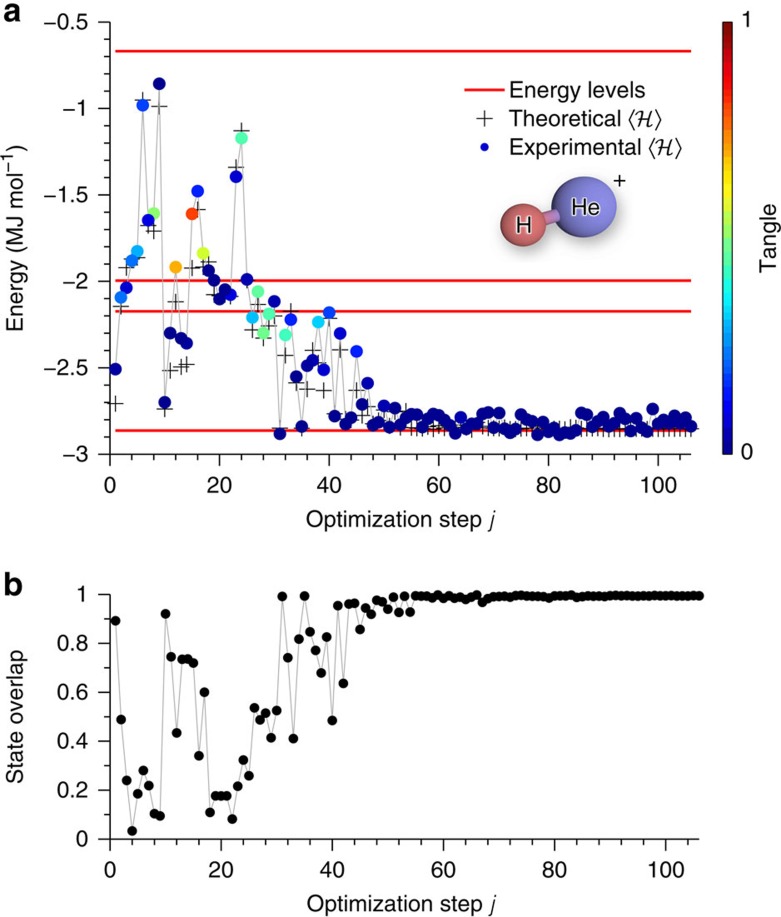
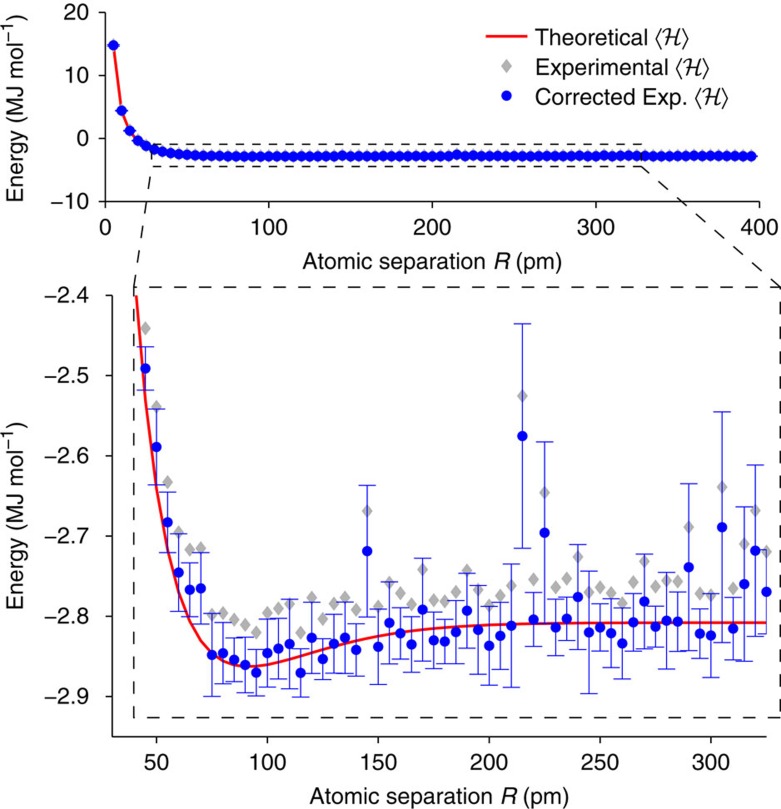
- The authors report an experimental ground-state result for He–H\(^+\): after correcting for experimental errors, they estimate the equilibrium bond length as \(R = 92.3 \pm 0.1\) pm and the ground-state electronic energy as \(E = -2.865 \pm 0.008\) MJ mol\(^{-1}\).
- For the bond dissociation curve, more than 96% of the experimental data are within chemical accuracy of the theoretical values.
- In the discussion, they state that for a 4 × 4 Hamiltonian like the one demonstrated, the QPE circuit would require at least 12 CNOT gates, whereas their method requires one.
- The full experiment was performed in about 158 h, and the bond dissociation curve was obtained by finding the ground states of 79 Hamiltonians.
## Methods
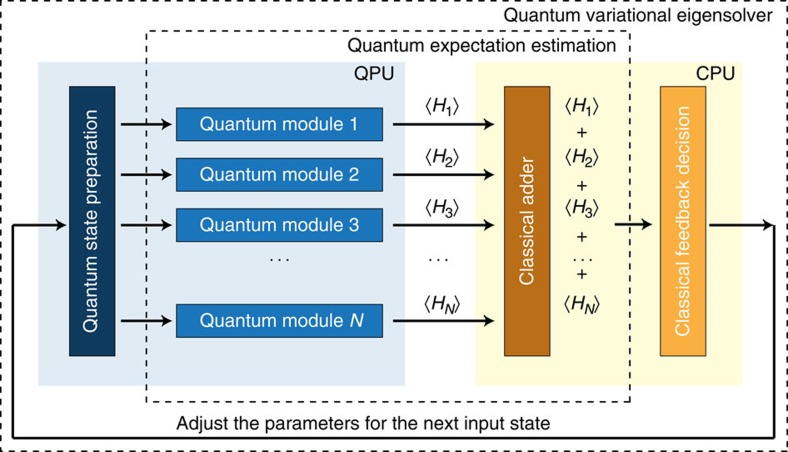
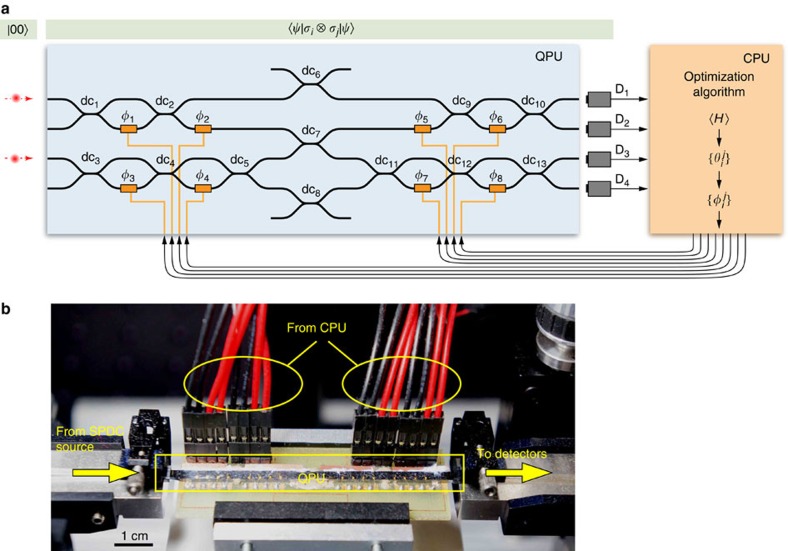
- The paper combines a reconfigurable integrated photonic quantum processor with a classical optimization algorithm: the quantum device estimates Hamiltonian expectation values, and the classical processor updates the state parameters variationally.
- The photonic chip prepares and measures arbitrary two-qubit pure states using single-qubit rotations and one two-qubit entangling gate; the experimental demonstration uses the He–H\(^+\) molecule in a minimal basis.
- For the classical optimization, they use the Nelder–Mead algorithm; expectation values are reconstructed from four two-qubit Pauli measurements at each point.
## Limitations
- The paper states that the method still requires a good approximation to the ground state as input/initialization, and the reliance on multiple separate measurements makes it sensitive to variations in state preparation between calculations.
- The authors report a constant systematic shift of \(\varepsilon = 50\) kJ mol\(^{-1}\) in the measured expectation values; they attribute this to photon-source impurity/distinguishability, circuit imperfections, and unbalanced coupling efficiencies.
- Evident from the text: the demonstration is limited to a two-qubit / 4 × 4 Hamiltonian prototype, so the scalability claim is not experimentally validated here.
Model-written summary. Check it against the paper before relying on it.
Integrity signals
Registry
Cites
Statistics
Figures
Verification
Claims the paper makes
7 Valid · 4 Not valid · 11 Not checked · 59 Own results and interpretations
The cited sources support only part of this claim — read each source’s verdict below.
In the paper
“Recent developments in the field of quantum computation offer a way forward for determining efficient solutions of many instances of large eigenvalue problems that are classically intractable6789101112”
§ A variational eigenvalue solver on a photonic quantum processor > Abstract
What the sources say
- Not matchedcites [6] Nielsen, M. A. & Chuang, I. L. Quantum Computation and Quantum Information Cambridge University Press (2000).
Couldn’t be matched to a paper in Crossref, so it can’t be checked.
- Could not verifycites [7] Kitaev, A. Quantum measurements and the Abelian stabilizer problem. Electronic Colloquium on Computational Complexity (ECCC) 3 (1996). sourceExperimental — accuracy not yet measured
Our copy under this DOI is the ISAAC 2021 paper 'Effective Resistance and Capacitance in Simplicial Complexes and a Quantum Algorithm' (Kitaev's 1995 work appears only as reference [9] in its bibliography), and it nowhere asserts that quantum computation gives efficient solutions to classically intractable large eigenvalue problems. Eigenvalues enter only as complexity parameters — λ, the smallest eigenvalue of the normalized up-Laplacian, in Lemma 31 and Theorem 26 (Section 6.3, 'Time efficient implementations') and in the phase-estimation machinery of Appendix A — and Section 1.1 ('Our Contributions') actually reports the opposite direction for its own problem: 'the quantum algorithm is slower than the classical algorithm in the worst case'. Searched: 'eigenvalue problems classically intractable', 'quantum speedup / exponential advantage', 'phase estimation', 'faster than classical'; no passage addresses the claim's point. (LLM, conf=0.70)
- Partly supportedcites [8] Griffiths, R. B. & Niu, C.-S. Semiclassical fourier transform for quantum computation. Phys. Rev. Lett. 76, 3228–3231 (1996). sourceExperimental — accuracy not yet measured
On p. 1, the paper says a quantum computer, if built, could solve certain problems such as factoring long numbers much faster than conventional algorithms. It also describes a simpler Fourier transform for Shor’s factorization and discrete-logarithm algorithms (p. 1). The copy does not support the claim about efficient solutions to many large eigenvalue problems. (LLM, conf=0.84)
plainstates a cause- Asserted: passes — The authors put it forward as true.
- Checkable: passes — It can be checked against evidence.
- Load-bearing: passes — The paper’s conclusions depend on it.
- Based: passes — The paper gives a reason why it holds.
- Not matched
Every source the paper cites for this claim was checked and supports it.
In the paper
“this would suffer from the N-representability problem, which is known to be intractable for both classical and quantum computers (it is in the quantum complexity class QMA-Hard24).”
§ A variational eigenvalue solver on a photonic quantum processor > Results > Quantum expectation estimation
What the sources say
- Supportedcites [24] Liu, Y.-K., Christandl, M. & Verstraete, F. Quantum computational complexity of the n-representability problem: Qma complete. Phys. Rev. Lett. 98, 110503 (2007). source
The paper states that N-representability is QMA-complete and hence QMA-hard and NP-hard (Abstract). Its discussion of quantum-chemistry relevance says the problem is intractable in the worst case even on a quantum computer, while allowing that particular physical systems may be easier. (LLM, conf=0.93)
boosted- Asserted: passes — The authors put it forward as true.
- Checkable: passes — It can be checked against evidence.
- Load-bearing: passes — The paper’s conclusions depend on it.
- Based: passes — The paper gives a reason why it holds.
- Supported
Every source the paper cites for this claim was checked and supports it.
In the paper
“We have implemented the QPU using integrated quantum photonics technology30.”
§ A variational eigenvalue solver on a photonic quantum processor > Results > Prototype demonstration
What the sources say
- Supportedcites [30] O'Brien, J. L., Furusawa, A. & Vuckovic, J. Photonic quantum technologies. Nat. Photon. 3, 687–695 (2009). source
The citation identifies integrated quantum photonics as the technology used, rather than attributing the citing authors’ QPU implementation to this review. The “Integrated quantum optical circuits” section (p. 6) describes on-chip waveguide circuits performing quantum logic gates and a compiled quantum factoring algorithm. (LLM, conf=0.87)
plain- Asserted: passes — The authors put it forward as true.
- Checkable: passes — It can be checked against evidence.
- Load-bearing: passes — The paper’s conclusions depend on it.
- Based: passes — The paper gives a reason why it holds.
- Supported
The cited sources support only part of this claim — read each source’s verdict below.
In the paper
“The time the quantum computer must remain coherent is determined by the necessity of O(p−1) successive applications of , each of which can require on the order of millions or billions of quantum gates for practical applications1719, as compared to the tens to hundreds of gates achievable in the short term.”
§ A variational eigenvalue solver on a photonic quantum processor > Abstract
What the sources say
- Partly supportedcites [17] Whitfield, J. D., Biamonte, J. & Aspuru-Guzik, A. Simulation of electronic structure hamiltonians using quantum computers. Mol. Phys. 109, 735–750 (2011). sourceExperimental — accuracy not yet measured
Split into 2 atoms — 1 confirmed, 1 partially supported, 0 disputed, 0 misattributed, 0 unverifiable. Expand the claim to see per-atom verdicts.
- Partly supportedcites [19] Jones, N. C. et al. Faster quantum chemistry simulation on fault-tolerant quantum computers. New J. Phys. 14, 115023 (2012). sourceExperimental — accuracy not yet measured
Split into 2 atoms — 0 confirmed, 2 partially supported, 0 disputed, 0 misattributed, 0 unverifiable. Expand the claim to see per-atom verdicts.
plainstates a cause- Asserted: passes — The authors put it forward as true.
- Checkable: passes — It can be checked against evidence.
- Load-bearing: passes — The paper’s conclusions depend on it.
- Based: passes — The paper gives a reason why it holds.
- Partly supported
A result the paper reports from its own data — it cites no other source for it, so there is none to check. The quote shows it is in the paper.
In the paper
“We experimentally demonstrate the feasibility of this approach with an example from quantum chemistry—calculating the ground-state molecular energy for He–H+.”
§ A variational eigenvalue solver on a photonic quantum processor > Abstract
boostedstates a causeSingle case- Asserted: passes — The authors put it forward as true.
- Checkable: passes — It can be checked against evidence.
- Load-bearing: passes — The paper’s conclusions depend on it.
- Based: passes — The paper gives a reason why it holds.
31 more claims
Create a free account to see all 81 claims and to verify the 4 references still open.
- It may state two separate claims as one. 28
- Probably not a substantial claim. 24
Claims other papers make about this one
Each is checked against this paper’s own text: does it say what the citing paper says it does?
The cited source doesn’t support the claim as written.
In the citing paper
“Leveraging quantum resources, the UCC ansatz was instead realized as a PQC on a photonic processor (Peruzzo et al. , 2014).”
From Noisy intermediate-scale quantum algorithms (2022) · cites this paper as Peruzzo et al., 2014
Checked by a reasoning model — may be wrong.
Experimental — accuracy not yet measuredThe cited source doesn’t support the claim as written.
In the citing paper
“The first on-chip GMM of four-qubit cluster state was realised in a laser-writing chip ( Fig.4e ), by manipulating both the polarisation and path DoFs of two photons [85].”
From Integrated photonic quantum technologies (2020) · cites this paper as [85]
Checked by a reasoning model — may be wrong.
Experimental — accuracy not yet measuredThe cited source doesn’t support the claim as written.
In the citing paper
“four-qubit linear- and box-cluster states are generated in a laser-writing photonic chip. This is enabled by on-chip manipulating the two-photon four-qubit hyperentangled state and cluster state, that are encoded in photon's path and polarisation DoFs. The Grover's search algorithm on a four-element database was implemented by controlling the device.”
From Integrated photonic quantum technologies (2020) · cites this paper as [85]
Checked by a reasoning model — may be wrong.
Experimental — accuracy not yet measuredThe source backs part of the claim, not all of it — or backs it for a different population, condition or comparison.
In the citing paper
“Due to its versatility, the variational Hamiltonian ansatz has been implemented for quantum chemistry [21, 29], optimization [24], and for quantum simulation problems [30].”
From Variational quantum algorithms (2021) · cites this paper as [29]
Experimental — accuracy not yet measuredThe source backs part of the claim, not all of it — or backs it for a different population, condition or comparison.
In the citing paper
“For the original VQE (Peruzzo et al. , 2014) and QAOA (Farhi et al. , 2014) it can, for example, be described as a single expectation value min θ ⟨ H ⟩ U ( θ ) , where the differences solely appear in the specific form and construction of the qubit Hamiltonian.”
From Noisy intermediate-scale quantum algorithms (2022) · cites this paper as Peruzzo et al., 2014
Experimental — accuracy not yet measured
12 more claims about this paper
Create a free account to see every claim other papers make about this one.
Citations
Cites
A Simplex Method for Function Minimization
Nelder, J. A., & Mead, R. (1965) · The Computer Journal · doi:10.1093/comjnl/7.4.308 · Cited by 28,905
Quantum computation and quantum information
Law, J. (2001) · ACM SIGSOFT Software Engineering Notes · doi:10.1145/505482.505499 · Cited by 18,842
(1999) · Cited by 12,854
Practical Methods of Optimization
Fletcher, R. (2000) · Wiley eBooks · doi:10.1002/9781118723203 · Cited by 7,605 · cited 3×
“[12] S.”
BackgroundMethodPractical methods of optimization
(1988) · Mathematics and Computers in Simulation · doi:10.1016/0378-4754(88)90129-2 · Cited by 5,818
Quantum Algorithm for Linear Systems of Equations
Harrow, A. W., Hassidim, A., & Lloyd, S. (2009) · Physical Review Letters · doi:10.1103/physrevlett.103.150502 · Cited by 3,325
Conn, A. R., Gould, N. I. M., & Toint, P. L. (2000) · Society for Industrial and Applied Mathematics eBooks · doi:10.1137/1.9780898719857 · Cited by 2,981 · cited 3×
“[14] D.”
MethodInfluential�ber das Paulische �quivalenzverbot
Jordan, P., & Wigner, E. (1928) · Zeitschrift f�r Physik · doi:10.1007/bf01331938 · Cited by 2,597
Molecular Electronic‐Structure Theory
Helgaker, T., Jørgensen, P., & Olsen, J. (2000) · doi:10.1002/9781119019572 · Cited by 2,594
O'Brien, J. L., Furusawa, A., & Vučković, J. (2009) · Nature Photonics · doi:10.1038/nphoton.2009.229 · Cited by 2,388
Self-citation
Research works printed but not linked: 3
- Helgaker, T., Jorgensen, P. & Olsen, J. Mol. Electronic Struct. Theory Wiley, Sussex (2002).
- Saad, Y. Numerical Methods for Large Eigenvalue Problems Vol. 158, (SIAM (1992).
- Rayleigh, J. W. In finding the correction for the open end of an organ-pipe. Phil. Trans. 161, 77 (1870).
Cited by
Items 2,301–2,400 of 4,573
Predicting molecular vibronic spectra using time-domain analog quantum simulation
MacDonell, R. J., Navickas, T., Wohlers-Reichel, T. F., Valahu, C. H., Rao, A. D., Millican, M. J., Currington, M. A., Biercuk, M. J., Tan, T. R., Hempel, C., et al. (2022) · PubMed Central · doi:10.3929/ethz-b-000628448 · Cited by 7
Quantum chaos and circuit parameter optimization
Kim, J., Oz, Y., & Rosa, D. (2023) · Journal of Statistical Mechanics Theory and Experiment · doi:10.1088/1742-5468/acb52d · Cited by 13
Hamiltonian Learning from Time Dynamics Using Variational Algorithms
Gupta, R., Selvarajan, R., Sajjan, M., Levine, R. D., & Kais, S. (2023) · The Journal of Physical Chemistry A · doi:10.1021/acs.jpca.2c08993 · Cited by 16
Stenger, J., Hellberg, C. S., & Gunlycke, D. (2023) · Physical Review A · doi:10.1103/physreva.107.062606 · Cited by 8
Quantum optimisation for continuous multivariable functions by a structured search
Matwiejew, E., Pye, J., & Wang, J. B. (2023) · Quantum Science and Technology · doi:10.1088/2058-9565/ace6cc · Cited by 21
“These algorithms have a flexible structure and are inherently resilient to error [9, 10].”
Accelerating variational quantum eigensolver convergence using parameter transfer
Skogh, M., Leinonen, O., Lolur, P., & Rahm, M. (2023) · Electronic Structure · doi:10.1088/2516-1075/ace86d · Cited by 17
“The VQE algorithm is briefly summarized below, and in more detail in, e.g. [3, 19, 23, 24].”
MethodYoshikura, T., Ten‐no, S., & Tsuchimochi, T. (2023) · The Journal of Physical Chemistry A · doi:10.1021/acs.jpca.3c02800 · Cited by 13
Hardware-Efficient Entangled Measurements for Variational Quantum Algorithms
Escudero, F., Fernández-Fernández, D., Jaumà, G., Peñas, G. F., & Pereira, L. (2023) · Physical Review Applied · doi:10.1103/physrevapplied.20.034044 · Cited by 11
Variational quantum circuit learning of entanglement purification in multiple degrees of freedom
Zhang, H., Xu, X., Zhang, C., Yung, M., Huang, T., & Liu, Y. (2023) · Physical Review A · doi:10.1103/physreva.108.042611 · Cited by 11
Self-citationGraph-|Q⟩⟨C|: A Quantum Algorithm with Reduced Quantum Circuit Depth for Electronic Structure
Iyengar, S. S., Zhang, J. H., Saha, D., & Ricard, T. C. (2023) · The Journal of Physical Chemistry A · doi:10.1021/acs.jpca.3c04261 · Cited by 9
Multi-state quantum simulations via model-space quantum imaginary time evolution
Tsuchimochi, T., Ryo, Y., Tsang, S. C., & Ten‐no, S. (2023) · npj Quantum Information · doi:10.1038/s41534-023-00780-y · Cited by 7
Optimal parameter configurations for sequential optimization of the variational quantum eigensolver
Endo, K., Sato, Y., Raymond, R., Wada, K., Yamamoto, N., & Watanabe, H. C. (2023) · Physical Review Research · doi:10.1103/physrevresearch.5.043136 · Cited by 8
Enabling Scalable VQE Simulation on Leading HPC Systems
Wang, M., Hua, F., Liu, C., Bauman, N. P., Kowalski, K., Claudino, D., Humble, T. S., Nair, P. J., & Li, A. (2023) · International Conference for High Performance Computing, Networking, Storage and Analysis (SC) · doi:10.1145/3624062.3624221 · Cited by 12
“Among the myriad of quantum algorithms, the Variational Quantum Eigensolver (VQE) stands out as a pivotal hybrid quantum-classical method, showing promise in unraveling the complexities of the electronic structure problem in quantum chemistry [10].”
BackgroundScalable quantum measurement error mitigation via conditional independence and transfer learning
Lee, C., & Park, D. K. (2023) · Machine Learning Science and Technology · doi:10.1088/2632-2153/ad1007 · Cited by 15
“[3] Alberto Peruzzo, Jarrod McClean, Peter Shadbolt, Man-Hong Yung, Xiao-Qi Zhou, Peter J.”
Error-mitigated quantum simulation of interacting fermions with trapped ions
Chen, W., Zhang, S., Zhang, J., Su, X., Lu, Y., Zhang, K., Qiao, M., Li, Y., Zhang, J.-N., & Kim, K. (2023) · npj Quantum Information · doi:10.1038/s41534-023-00784-8 · Cited by 14
A universal variational quantum eigensolver for non-Hermitian systems
Zhao, H., Zhang, P., & Wei, T.-C. (2023) · Scientific Reports · doi:10.1038/s41598-023-49662-5 · Cited by 14
“The aforementioned problems are partially overcome by the variational quantum eigensolver (VQE) method proposed by Peruzzo et al. 15 .”
MethodInfluentialShallow quantum circuits for deeper problems
Pérez-Salinas, A., Draškić, R., Tura, J., & Dunjko, V. (2023) · Physical Review A · doi:10.1103/physreva.108.062423 · Cited by 19
Simulating chemical reaction dynamics on quantum computer
Gong, Q., Man, Q., Zhao, J., Li, Y., Dou, M., Wang, Q., Wu, Y.-C., & Guo, G. (2024) · The Journal of Chemical Physics · doi:10.1063/5.0192036 · Cited by 11
Physics-informed neural networks for an optimal counterdiabatic quantum computation
Ferrer-Sánchez, A., Flores-Garrigós, C., Hernani‐Morales, C., Orquín-Marqués, J. J., Hegade, N. N., Cadavid, A. G., Montalban, I., Solano, E., Vives‐Gilabert, Y., & Martín‐Guerrero, J. D. (2024) · Machine Learning Science and Technology · doi:10.1088/2632-2153/ad450f · Cited by 12
Energy landscapes for the quantum approximate optimization algorithm
Boy, C., & Wales, D. J. (2024) · Physical Review A · doi:10.1103/physreva.109.062602 · Cited by 18
Simulator Demonstration of Large Scale Variational Quantum Algorithm on HPC Cluster
Morita, M., Tomita, Y., Koyama, J., & Kimura, K. (2024) · IEEE Access · doi:10.1109/access.2024.3415168 · Cited by 11
“For each purpose, they are defined in the form of variational quantum eigensolver (VQE) [8]– [11], quantum approximate optimization algorithm (QAOA) [12], and quantum machine learning (QML) [13], [14].”
MethodNykänen, A., Rossi, M. A. C., Borrelli, E.-M., Maniscalco, S., García-Pérez, G., & Glos, A. (2025) · Physical Review Research · doi:10.1103/t1hr-y7c8 · Cited by 21
Nondestructive classification of quantum states using an algorithmic quantum computer
Валерьевич, Б. Д., Zhukov, A. A., & Pogosov, W. V. (2019) · Quantum Machine Intelligence · doi:10.1007/s42484-019-00010-9 · Cited by 8
Robust preparation of many-body ground states in Jaynes–Cummings lattices
Cai, K., Parajuli, P., Long, G., Wong, C. W., & Tian, L. (2021) · npj Quantum Information · doi:10.1038/s41534-021-00433-y · Cited by 12
Streif, M., & Leib, M. (2020) · Physical Review A · doi:10.1103/physreva.102.042416 · Cited by 9
“[6] Alberto Peruzzo, Jarrod McClean, Peter Shadbolt, ManHong Yung, Xiao-Qi Zhou, Peter J Love, Alán AspuruGuzik, and Jeremy L Obrien.”
BackgroundMethodQuantum integrated photonic circuits
Bounouar, S., Davanço, M., & Reitzenstein, S. (2020) · Semiconductors and semimetals · doi:10.1016/bs.semsem.2020.09.003 · Cited by 7
Quantum case-based reasoning (qCBR)
Atchade-Adelomou, P., Casado-Faulí, D., Golobardes-Ribé, E., & Vilasis-Cardona, X. (2022) · Artificial Intelligence Review · doi:10.1007/s10462-022-10238-w · Cited by 16
“The second would be changing the classical synthesis technique for the Variational Quantum Eigensolver (VQE) [57–59] with Initial point [60].”
MethodA universal quantum circuit design for periodical functions
Li, J., & Kais, S. (2021) · New Journal of Physics · doi:10.1088/1367-2630/ac2cb4 · Cited by 11
Detecting Qubit-coupling Faults in Ion-trap Quantum Computers
Maksymov, A., Nguyen, J., Chaplin, V. L., Nam, Y., & Markov, I. L. (2022) · IEEE International Symposium on High-Performance Computer Architecture (HPCA) · doi:10.1109/hpca53966.2022.00036 · Cited by 13
“Quantum computation [30] promises to extend the capabilities of conventional computers in science applications [16, 18, 27], for hard optimization problems [9, 32], and for sensitive cryptography tasks [28, 37].”
BackgroundHirai, H., & Koh, S. (2022) · Chemical Physics · doi:10.1016/j.chemphys.2022.111460 · Cited by 8
“Against FTQC, the variational eigenvalue solver (VQE) algorithm [11, 12] has been reported in recent years to utilize current noisy intermediate-scale quantum (NISQ) devices [13] that consist of a small number of noisy qubits and allow only shallow quantum circuits.”
MethodHamiltonian reconstruction as metric for variational studies
Zhang, K., Lederer, S., Choo, K., Neupert, T., Carleo, G., & Kim, E.-A. (2022) · SciPost Physics · doi:10.21468/scipostphys.13.3.063 · Cited by 10
( 3+1 )-dimensional Schwinger pair production with quantum computers
Xu, B., & Wei Xue, B. (2022) · Physical review. D/Physical review. D. · doi:10.1103/physrevd.106.116007 · Cited by 7
Quantum Computer Simulates Excited States of Molecule
Sim, S., Romero, J., Johnson, P. D., & Aspuru‐Guzik, A. (2018) · Physics · doi:10.1103/physics.11.14 · Cited by 6
Self-citationExtreme-Scale Programming Model for Quantum Acceleration within High Performance ComputingPreprint
McCaskey, A., Dumitrescu, E., Liakh, D., Chen, M., Feng, W.-C., & Humble, T. S. (2017) · arXiv (Cornell University) · Cited by 9
PHOENICS: A universal deep Bayesian optimizerPreprint
Häse, F., Roch, L. M., Kreisbeck, C., & Aspuru‐Guzik, A. (2018) · arXiv (Cornell University) · doi:10.48550/arxiv.1801.01469 · Cited by 6
“We believe that PHOENICS has the potential to be applied to a wide range of applications, from optimization of reaction conditions and material properties, over control of robotics systems, to circuit design for quantum computing.(61,62)”
Self-citationComputational Chemistry on Quantum Computers: Ground state estimationPreprint
Armaos, V., Badounas, D. A., & Deligiannis, P. (2019) · arXiv (Cornell University) · doi:10.48550/arxiv.1907.00362 · Cited by 7
Quantum Machine Learning using Gaussian Processes with Performant Quantum KernelsPreprint
Otten, M., Goumiri, I. R., Priest, B. W., Chapline, G., & Schneider, M. D. (2020) · arXiv (Cornell University) · doi:10.48550/arxiv.2004.11280 · Cited by 29
“(2) and use a Trotter decomposition [3] of three steps to generate the finite-dimensional coherent kernel on qubits, labeled CQ-4-t3-HW.”
MethodFundamentals In Quantum Algorithms: A Tutorial Series Using Qiskit ContinuedPreprint
Koch, D., Patel, S., Wessing, L., & Alsing, P. M. (2020) · arXiv (Cornell University) · doi:10.48550/arxiv.2008.10647 · Cited by 18
Noise-Robust End-to-End Quantum Control using Deep Autoregressive Policy NetworksPreprint
Yao, J., Köttering, P., Gundlach, H., Lin, L., & Bukov, M. (2020) · arXiv (Cornell University) · doi:10.48550/arxiv.2012.06701 · Cited by 14
“Over the years, the physics community has also developed a number of successful quantum control algorithms (Khaneja et al., 2005; Caneva et al., 2011; Peruzzo et al., 2014; Dalgaard et al., 2020a; Magann et al., 2020b,a), including GRAPE, CRAB, and VQE.”
BackgroundLearning to measure: adaptive informationally complete POVMs for near-term quantum algorithmsPreprint
García-Pérez, G., Rossi, M. A. C., Sokolov, B., Tacchino, F., Barkoutsos, P. K., Mazzola, G., Tavernelli, I., & Maniscalco, S. (2021) · arXiv (Cornell University) · Cited by 7
The dilemma of quantum neural networksPreprint
Qian, Y., Wang, X., Du, Y., et al. (2021) · arXiv (Cornell University) · doi:10.48550/arxiv.2106.04975 · Cited by 7
“…experimental studies have implemented QNNs on different NISQ platforms to accomplish various learning tasks such as data classification [24], [29], [30], image generation [31], [32], [33], and electronic-structure problems in material science and condensed matter physics [34], [35], [36], [37].”
BackgroundQuantum technologies for climate change: Preliminary assessmentPreprint
Berger, C., Paolo, A. D., Forrest, T., Hadfield, S., Sawaya, N. P. D., Stęchły, M., & Thibault, K. (2021) · arXiv (Cornell University) · doi:10.48550/arxiv.2107.05362 · Cited by 70
Towards Efficient Ansatz Architecture for Variational Quantum AlgorithmsPreprint
Wu, A., Li, G., Wang, Y., Feng, B., Ding, Y., & Xie, Y. (2021) · arXiv (Cornell University) · doi:10.48550/arxiv.2111.13730 · Cited by 31
“The first four benchmarks are the ground state energy simulation of four molecules (H2, LiH, BeH2, HF) using the variational quantum eigensolver (VQE) [33].”
MethodInfluentialQuantum-Machine-Assisted Drug Discovery: Survey and PerspectivePreprint
Zhou, Y., Karemore, G., Li, W., Liang, Z., Žitnik, M., Chong, F. T., Liu, J., & Fu, T. (2024) · Preprints.org · doi:10.20944/preprints202408.1950.v1 · Cited by 11
Quantum Computing in Civil Engineering: Potentials and Limitations
Ploennigs, J., Berger, M., Mevissen, M., & Smarsly, K. (2025) · Lecture Notes in Civil Engineering · doi:10.1007/978-3-031-87364-5_2 · Cited by 7
Quantum approximate optimization for hard problems in linear algebra
Borle, A., Elfving, V. E., & Lomonaco, S. J. (2021) · SciPost Physics Core · doi:10.21468/scipostphyscore.4.4.031 · Cited by 41
Exploiting many-body localization for scalable variational quantum simulation
Cao, C., Zhou, Y., Tannu, S., Shannon, N., & Joynt, R. (2025) · Quantum · doi:10.22331/q-2025-12-12-1942 · Cited by 30
“…classical optimizers to mitigate hardware limits like coherence times and connectivity, tackling tasks like ground-state preparation via the Variational Quantum Eigen-solver (VQE) for molecules [1, 2] or combinatorial optimization with the Quantum Approximate Optimization Algorithm (QAOA) [3, 4].”
Reduced-order modeling on a near-term quantum computer
Asztalos, K. J., Steijl, R., & Maulik, R. (2024) · Journal of Computational Physics · doi:10.1016/j.jcp.2024.113070 · Cited by 13
Quantum classifiers with a trainable kernel
Xu, L., Zhang, X., Li, M., & Shen, S.-Q. (2024) · Physical Review Applied · doi:10.1103/physrevapplied.21.054056 · Cited by 17
Yao, Q., Ji, Q., Li, X., Zhang, Y., Chen, X., Ju, M., Liu, J., & Wang, J. (2024) · The Journal of Physical Chemistry Letters · doi:10.1021/acs.jpclett.4c01445 · Cited by 7
Ciaramelletti, C., Beseda, M., Consiglio, M., Lepori, L., Apollaro, T. J. G., & Paganelli, S. (2025) · Physical Review A · doi:10.1103/physreva.111.022437 · Cited by 17
Ďuriška, M., Miháliková, I., & Friák, M. (2025) · Physica Scripta · doi:10.1088/1402-4896/adbb29 · Cited by 9
Zhang, S., Zhou, Y., Qin, Z., Li, R., Du, C., Xiao, Z., & Zhang, Y. (2025) · Physical Review A · doi:10.1103/physreva.111.052403 · Cited by 11
“Reported VQAs include variational quantum eigensolver [5–11], quantum approximate optimization algorithm [12–14], variational quantum machine learning [15–17] and so on.”
Kumar, S. S., Prasad, S., Wani, O. A., El-Hendawy, S., Mattar, M. A., & Salem, A. (2025) · Scientific Reports · doi:10.1038/s41598-025-02527-5 · Cited by 11
Slack-variable approach for variational quantum semidefinite programming
Chen, J., Westerheim, H., Holmes, Z., Luo, I., Nuradha, T., Patel, D., Rethinasamy, S., Wang, K., & Wilde, M. M. (2025) · Physical Review A · doi:10.1103/lwxq-4myj · Cited by 12
Patra, C., & Maitra, R. (2025) · The Journal of Chemical Physics · doi:10.1063/5.0276415 · Cited by 10
BenchQC: A Benchmarking Toolkit for Quantum Computation
Pollard, N., & Choudhary, K. K. (2025) · Journal of Computational Chemistry · doi:10.1002/jcc.70202 · Cited by 10
“17 It utilizes a classical optimizer to minimize the energy of a quantum system, represented as a parameterized quantum circuit.”
Dell’Anna, F., Gómez-Lurbe, R., Pérez, A., & Ercolessi, E. (2025) · Physical Review A · doi:10.1103/62wx-tvk5 · Cited by 12
“The results indicate that Quantum Natural Gradient consistently outperforms Vanilla Gradient Descent, exhibiting both faster average convergence and greater robustness to random initializations, as demonstrated by reduced variance in the number of optimization steps.”
InfluentialShirai, S., Tseng, S.-Y., Iwakiri, H., Horiba, T., Hirai, H., & Koh, S. (2025) · ACS Omega · doi:10.1021/acsomega.5c03371 · Cited by 10
“Present-day quantum computers, known as noisy intermediate-scale quantum (NISQ) devices, do not implement error correction for qubits, 7 − 9 and so calculations performed on NISQ devices are greatly affected by noise, limiting the ability of such calculations to handle deep circuits.”
Scalability challenges in variational quantum optimization under stochastic noise
Bärligea, A., Poggel, B., & Lorenz, J. M. (2025) · Physical Review A · doi:10.1103/rgyh-8xw8 · Cited by 17
“Two of the most widely studied VQAs are the Variational Quantum Eigensolver (VQE) [58], initially developed for quantum chemistry, and the Quantum Approximate Optimization Algorithm (QAOA) [59], a VQE variant explicitly designed for the field of combinatorial optimization.”
Exponential Quantum Advantages for Practical Non-Hermitian Eigenproblems
Zhang, X., Zhang, Y., He, W., & Yuan, X. (2025) · Physical Review Letters · doi:10.1103/3n8f-k8pl · Cited by 23
“In the Hermitian case, typical problems involve determining the ground-state energy (i.e., the smallest eigenvalue) or the energy gap between adjacent eigenvalues [25, 28, 31], as illustrated in Fig.”
Task-Driven Device Fingerprinting for Quantum Cloud Platforms via Modeling QNN Outcomes Under Noise
Li, T., Zhao, Z., & Yin, J. (2025) · IEEE Transactions on Information Forensics and Security · doi:10.1109/tifs.2025.3620985 · Cited by 11
“In the chemistry realm, quantum computers can simulate molecular structures and chemical reactions with unprecedented accuracy [7], which has significant implications for drug discovery and materials science [8], [9].”
Efficient quantum state preparation through seniority driven operator selection
Halder, D., Mondal, D., & Maitra, R. (2025) · The Journal of Chemical Physics · doi:10.1063/5.0281112 · Cited by 8
“Among the earliest and most notable approaches is the unitary coupled cluster singles and doubles (UCCSD) method 3,7 , which had set a foundational framework for further advancements in the field.”
Realizing a Continuous Set of Two-Qubit Gates Parameterized by an Idle Time
Scarato, C., Hanke, K., Remm, A., Lazar, S., Lacroix, N., Zanuz, D. C., Flasby, A., Wallraff, A. J., & Hellings, C. (2025) · PRX Quantum · doi:10.1103/h7cv-xgw2 · Cited by 10
Danilov, D., Moreno, J. R., Sung, K. J., Motta, M., & Shee, J. (2025) · Journal of Chemical Theory and Computation · doi:10.1021/acs.jctc.5c01407 · Cited by 29
“Similarly to VQE, 18 QSCI uses a circuit ansatz whose parameters can be optimized to minimize energy.”
Quantum computing: foundations, algorithms, and emerging applications
Raseena, V. (2025) · Frontiers in Quantum Science and Technology · doi:10.3389/frqst.2025.1723319 · Cited by 13
Recent progress towards large-scale integrated photonic quantum computation
zhu, H., Chen, T., Ma, H., Zhao, Z., Jia, G. U. O., Liang, Q., Tu, Y., He, T., Luo, W., Wang, B., et al. (2026) · npj Nanophotonics · doi:10.1038/s44310-026-00114-8 · Cited by 22
Optimizing Variational Circuits for Higher-Order Binary Optimization
Verchère, Z., Elloumi, S., & Simonetto, A. (2023) · IEEE International Conference on Quantum Computing and Engineering (QCE) · doi:10.1109/qce57702.2023.00011 · Cited by 16
“An example of such algorithms is QAOA [1], [2].”
MethodContinuous Variational Quantum Algorithms for Time Series
Guo, M., Weng, Y., Lili, Y., & Lai, Y. C. (2023) · International Joint Conference on Neural Networks (IJCNN) · doi:10.1109/ijcnn54540.2023.10191609 · Cited by 9
“For example, the quantum variational solver (QVE) [25], [26] and the quantum approximate optimization algorithm [27]–[29] (QAOA).”
MethodA progressive predictor-based quantum architecture search with active learning
Deng, M., He, Z., Zheng, S., Zhou, Y., Zhang, F., & Situ, H. (2023) · The European Physical Journal Plus · doi:10.1140/epjp/s13360-023-04537-6 · Cited by 8
“Variational Quantum Algorithms (VQAs) [2, 3] are the leading proposal for obtaining quantum advantage in the NISQ era due to their resilience to errors and high flexibility concerning quantum resource requirements [2, 4–7].”
BackgroundUnderstanding Logical-Shift Error Propagation in Quanvolutional Neural Networks
Vallero, M., Dri, E., Giusto, E., Montrucchio, B., & Rech, P. (2024) · IEEE Transactions on Quantum Engineering · doi:10.1109/tqe.2024.3372880 · Cited by 8
“With the current widespread access to simulators and quantum devices over the cloud, researchers have been able to quickly expand QC’s reach to fields such as finance [1], chemistry [2], biomechanics [3], machine learning [4], [5], and many others.”
BackgroundVariational Phase Estimation with Variational Fast Forwarding
Filip, M.-A., Ramo, D. M., & Fitzpatrick, N. (2024) · Quantum · doi:10.22331/q-2024-03-13-1278 · Cited by 10
“[2] In this approach a cost function is calculated on a quantum computer and then minimised using a classical optimisation procedure, with the aim of reduc-Nathan Fitzpatrick: nathan.fitzpatrick@quantinuum.com ing the amount of quantum computation to a level manageable on current architectures,…”
MethodInformation flow in parameterized quantum circuits
Anand, A., Kristensen, L. B., Frohnert, F., Sim, S., & Aspuru‐Guzik, A. (2024) · Quantum Science and Technology · doi:10.1088/2058-9565/ad3eab · Cited by 14
Self-citationMaximizing quantum-computing expressive power through randomized circuits
Yang, Y., Zhang, Z., Wang, A., Xu, X., Wang, X., & Li, Y. (2024) · Physical Review Research · doi:10.1103/physrevresearch.6.023098 · Cited by 11
“For those familiar with conventional deterministic-circuit VQAs, U ( θ ) could be one of the prominent ansatz circuits, e.g. unitary coupled cluster ansatz [3], hardware-efficient ansatz [4], Hamiltonian ansatz [58], ADAPT-VQE [69], etc.”
BackgroundCalibration and Performance Evaluation of a Superconducting Quantum Processor in an HPC Center
Deng, X., Pogorzalek, S., Vigneau, F., Yang, P., Schulz, M., & Schulz, L. B. (2024) · ISC High Performance (ISC) · doi:10.23919/isc.2024.10528924 · Cited by 6
Quantum-Enhanced Convolutional Neural Networks for Image Classification
Qayyum, T., Tariq, A., Haseeb, M. W., Lakas, A., Serhani, M. A., & Trabelsi, Z. (2023) · IEEE Future Networks World Forum (FNWF) · doi:10.1109/fnwf58287.2023.10520509 · Cited by 8
“Another approach is the Variational Quantum Eigensolver (VQE) [10], which has been applied to QCNNs by Chen et al. [11].”
MethodShuffle-QUDIO: accelerate distributed VQE with trainability enhancement and measurement reduction
Qian, Y., Du, Y., & Tao, D. (2024) · Quantum Machine Intelligence · doi:10.1007/s42484-024-00167-y · Cited by 10
“One canonical instance is the variational quantum eigensolver (VQE) (Peruzzo et al. 2014), which is developed to estimate the low-lying energies and corresponding eigenstates of molecular systems.”
Parametrization and optimizability of pulse-level variational quantum eigensolvers
Sherbert, K., Amer, H., Economou, S. E., Barnes, E., & Mayhall, N. J. (2025) · Physical Review Applied · doi:10.1103/physrevapplied.23.024036 · Cited by 16
“While the original formulation of VQE utilized an ansatz inspired by the underlying chemistry [7], many novel ans¨atze have been proposed which balance chemical intuition with information about which parametric and entangling operations are most easily implemented on the device [8–14].”
Parameter shift rule with optimal phase selection
Markovich, L. A., Malikis, S., Polla, S., & Tura, J. (2024) · Physical Review A · doi:10.1103/physreva.109.062429 · Cited by 12
Near-term quantum algorithm for solving the MaxCut problem with fewer quantum resources
Xiumei, Z., Li, Y., Li, J., Wang, S., Wang, S., Qin, S., & Gao, F. (2024) · Physica A Statistical Mechanics and its Applications · doi:10.1016/j.physa.2024.129951 · Cited by 9
QuTracer: Mitigating Quantum Gate and Measurement Errors by Tracing Subsets of Qubits
Li, P., Liu, J., Gonzales, A., Saleem, Z. H., Zhou, H., & Hovland, P. (2024) · Proceedings - International Symposium on Computer Architecture/Proceedings · doi:10.1109/isca59077.2024.00018 · Cited by 19
“As we measure the expectation values, the number of shots [36] scales polynomially with the number of qubits: k ∼ O ( n r / 2 ) , where r is a constant determined by the quantum circuit and is greater than one, and (cid:4) is the output error rate.”
BackgroundQuantum Architecture Search with Neural Predictor Based on Graph Measures
He, Z., Li, Z., Deng, M., Zheng, S., Situ, H., & Li, L. (2024) · Advanced Quantum Technologies · doi:10.1002/qute.202400223 · Cited by 11
Enhancing the electron pair approximation with measurements on trapped-ion quantum computers
Zhao, L., Wang, Q., Goings, J. J., Shin, K., Kyoung, W., Noh, S., Rhee, Y. M., & Kim, K. (2024) · npj Quantum Information · doi:10.1038/s41534-024-00871-4 · Cited by 12
“The potential quantum advantage of VQE is that it allows the ef fi cient utilization of ansatze that are inef fi cient to compute classically, such as the unitary coupled cluster (UCC) ansatz 18,19,24 – 26 .”
Ab initio extended Hubbard model of short polyenes for efficient quantum computing
Yoshida, Y., Takemori, N., & Mizukami, W. (2024) · The Journal of Chemical Physics · doi:10.1063/5.0213525 · Cited by 8
Quantum Mini-Apps: A Framework for Developing and Benchmarking Quantum-HPC Applications
Saurabh, N., Mantha, P. K., Kiwit, F. J., Jha, S., & Luckow, A. (2024) · doi:10.1145/3659996.3660036 · Cited by 13
“(v) Variational Quantum Algorithms (VQA) , such as the Variational Quantum Eigensolver (VQE) [36] and the Quantum Approximate Optimization Algorithm (QAOA) [19], interleave (and potentially concurrently execute) quantum and classical components to solve optimization, machine learning, linear…”
Learning Quantum Phase Estimation by Variational Quantum Circuits
Liu, C.-Y., Chen, K., & Lin, C.-H. A. (2024) · International Joint Conference on Neural Networks (IJCNN) · doi:10.1109/ijcnn60899.2024.10651206 · Cited by 21
“This latter capability, in particular, opens the door to wide practical applications, extending to the combinatorial optimization problems, and the simulation of quantum chemistry [19]–[27].”
BackgroundError mitigation, optimization, and extrapolation on a trapped-ion testbed
Maupin, O. G., Burch, A. D., Ruzic, B., Yale, C. G., Russo, A., Lobser, D., Revelle, M., Chow, M. N. H., Clark, S., Landahl, A. J., et al. (2024) · Physical Review A · doi:10.1103/physreva.110.032416 · Cited by 10
“[18] Alberto Peruzzo, Jarrod McClean, Peter Shadbolt, ManHong Yung, Xiao-Qi Zhou, Peter J Love, Alán AspuruGuzik, and Jeremy L O’brien.”
BackgroundMethodInfluentialSelf-citationDivergences in classical and quantum linear response and equation of motion formulations
Kjellgren, E. R., Reinholdt, P., Ziems, K. M., Sauer, S. P. A., Coriani, S., & Kongsted, J. (2024) · The Journal of Chemical Physics · doi:10.1063/5.0225409 · Cited by 6
Correr, G. I., Medina, I., Azado, P. C., Drinko, A., & Soares-Pinto, D. O. (2024) · Quantum Science and Technology · doi:10.1088/2058-9565/ad80be · Cited by 17
Exploring the Versatility of QAOA: A Comprehensive Review
Kashapogu, R., Hasib, S., & Rasool, A. (2024) · International Conference on Computing, Communication and Networking Technologies (ICCCNT) · doi:10.1109/icccnt61001.2024.10725610 · Cited by 9
“[21], [25]”
BackgroundA quantum annealing protocol to solve the nuclear shell model
Costa, E., Pérez-Obiol, A., Menéndez, J., Rios, A., García-Sáez, A., & Juliá-Díaz, B. (2025) · SciPost Physics · doi:10.21468/scipostphys.19.2.062 · Cited by 14
“On the one hand, variational quantum eigensolvers (VQEs) [11–13] should provide an advantage in the Noisy Intermediate-Scale Quantum era.”
FragPT2: Multifragment Wave Function Embedding with Perturbative Interactions
Koridon, E., Sen, S., Visscher, L., & Polla, S. (2025) · Journal of Chemical Theory and Computation · doi:10.1021/acs.jctc.4c01221 · Cited by 6
“…produce states which can be hard to represent on a classical computer, enabling the implementation of ans¨atze such as unitary coupled cluster [75, 76] and other heuristic constructions [77–79]; however, sampling the energy and other properties from the quantum state incurs in a large sampling…”
Quantum Computer Fault Injection Attacks
Xu, C., Erata, F., & Szefer, J. M. (2024) · IEEE International Conference on Quantum Computing and Engineering (QCE) · doi:10.1109/qce60285.2024.00047 · Cited by 7
Exploiting symmetries in nuclear Hamiltonians for ground state preparation
Gibbs, J., Holmes, Z., & Stevenson, P. D. (2025) · Quantum Machine Intelligence · doi:10.1007/s42484-025-00242-y · Cited by 17
“One recently proposed method for finding ground states for nuclear problems is the variational quantum eigen-solver (VQE) (Peruzzo et al. 2014).”
Geometric quantum machine learning with horizontal quantum gates
Wiersema, R., Kemper, A. F., Bakalov, B., & Killoran, N. (2025) · Physical Review Research · doi:10.1103/physrevresearch.7.013148 · Cited by 15
Optimized quantum circuit partitioning across multiple quantum processors
Kaur, E., Shapourian, H., Zhao, J., Kilzer, M., Kompella, R. R., & Nejabati, R. (2025) · Quantum Computing, Communication, and Simulation · doi:10.1117/12.3042502 · Cited by 15
Adaptive variational quantum dynamics simulations with compressed circuits and fewer measurements
Zhang, F., Wang, C., Iadecola, T., Orth, P. P., & Yao, Y. (2025) · Physical review. B./Physical review. B · doi:10.1103/physrevb.111.094310 · Cited by 10
“A typical example of such resource-efficient algorithms is the variational quantum eigensolver (VQE), which was introduced to solve static quantum problems such as finding the ground and excited states of a Hamiltonian by employing the variational principle [16–21].”
A near-term quantum simulation of the transverse field Ising model hints at glassy dynamics
Mohtashim, S. I., Das, A., Chatterjee, T., & Chowdhury, F. T. (2025) · The European Physical Journal Special Topics · doi:10.1140/epjs/s11734-025-01630-y · Cited by 12
“We choose this technique since it was developed taking into account the low-circuit depths and relatively high noise rates of existing quantum hardware platforms [15, 18–23].”
Choi, M., & Ryu, H. (2025) · New Journal of Physics · doi:10.1088/1367-2630/add8b4 · Cited by 10
Trade-off between gradient measurement efficiency and expressivity in deep quantum neural networks
Chinzei, K., Yamano, S., Tran, Q. H., Endo, Y., & Oshima, H. (2025) · npj Quantum Information · doi:10.1038/s41534-025-01036-7 · Cited by 26
“In analogy to deep learning, variational quantum algorithms (VQAs) have emerged as a promising technology for solving classically intractable problems, e.g., in quantum chemistry and physics 8 , optimization 9 , and machine learning 10 – 14 .”
Metadata
- Authors
- Peruzzo, A., McClean, J., Shadbolt, P., Yung, M.-H., Zhou, X.-Q., Love, P. J., Aspuru-Guzik, A., & O’Brien, J. L.
- Affiliations
- The University of Sydney (AU)
- Harvard University (US)
- University of Bristol (GB)
- Haverford College (US)
- Corresponding author
- Peruzzo, Alberto
- O’Brien, Jeremy L.
- Venue
- Nature Communications
- Published
- 2014-07-23
- Volume
- 5
- Issue
- 1
- Pages
- 4213-4213
- ISSN
- 2041-1723 (ISSN-L)
- PMC
- PMC4124861
- OpenAlex
- W2161685427
- Cited by
- 4,552
- References
- 48
- Citations by year
- 2026: 591 · 2025: 765 · 2024: 722 · 2023: 658 · 2022: 564 · 2021: 561 · 2020: 346 · 2019: 191 · 2018: 83 · 2017: 29 · 2016: 18 · 2015: 16 · 2014: 4
- FWCI
- 22.24
- Type
- journal article
- Language
- en
- Open access
- hybrid
- doi.org
- Licence
- cc-by-nc-nd
- creativecommons.org/licenses/by-nc-nd/4.0 (tdm)
- creativecommons.org/licenses/by-nc-nd/4.0 (vor)
- Locations
- Nature Communications (publishedVersion, cc-by-nc-nd)
- Europe PMC (PubMed Central) (publishedVersion, cc-by-nc-nd)
- PubMed Central (publishedVersion, cc-by-nc-nd)
- PubMed (publishedVersion)
- arXiv (Cornell University) (submittedVersion)
- OSTI OAI (U.S. Department of Energy Office of Scientific and Technical Information) (submittedVersion, cc-by-nc-nd)
- Digital Access to Scholarship at Harvard (DASH) (Harvard University) (submittedVersion, cc-by)
- RePEc: Research Papers in Economics (submittedVersion)
- RMIT Research Repository (RMIT University Library) (submittedVersion, cc-by-nc-nd)
- Figshare (submittedVersion, cc-by-nc-nd)
- UWA Profiles and Research Repository (UWA) (submittedVersion, cc-by-nc-nd)
- Bristol Research (University of Bristol) (submittedVersion)
- arXiv (Cornell University)
- Funders
- National Science Foundation (DE-FG02-97ER25308, 0955518, 1037992)
- U.S. Department of Energy (DEFG0297ER25308, DE‐FG02‐, FG02-97ER25308)
- Alfred P. Sloan Foundation
- John Templeton Foundation
- Camille and Henry Dreyfus Foundation
- Royal Academy of Engineering
- National Natural Science Foundation of China (61033001, 61361136003)
- Engineering and Physical Sciences Research Council (EP/J017175/1, EP/L024020/1, EP/K021931/1)
- Australian Research Council (DE140101700)
- National Key Research and Development Program of China (61033001, 2011CBA00301, 61361136003, 2011CBA00300)
- Division of Chemistry (CHE-1037992)
- Air Force Office of Scientific Research (FA 9550-12-1-0046, FA9550-, FA9550-12, FA9550‐12‐1)
- Topics
- Physical Sciences › Computer Science › Artificial Intelligence › Quantum Computing Algorithms and Architecture
- Physical Sciences › Physics and Astronomy › Atomic and Molecular Physics, and Optics › Quantum Information and Cryptography
- Physical Sciences › Physics and Astronomy › Atomic and Molecular Physics, and Optics › Quantum many-body systems
- Keywords
- variational quantum eigensolver, photonic quantum processors, quantum chemistry, classical optimization, hybrid quantum-classical computation
About these checks
Registry, retraction, Cites and statistics results are computed, not judged, with one exception: a printed reference that no index lists is read once by a model before it counts as a citation error. Claims are extracted by a model and kept only when their quote appears verbatim in the text; each cited source is then checked, with a model’s help, for whether it says what the claim relies on. Those verdicts can be wrong — read the claim’s quote and the cited source before relying on one.
The claim verdicts this report counts are experimental: their accuracy is not yet measured.
A language model drew the claims from the paper on 2026-10-10, under version 3 of the claim definition (model deepseek-v4.1-flash, prompt extract-v3).
A second model labelled each claim on 2026-10-10 (model jev-1.13-20260917, definition revision gold-guideline-v0.2).
Cited sources are checked with a language model’s help (qwen3.8-omni-flash and gpt-6-sol).
Statistics and arithmetic are recomputed, not judged.
Confidence bands are shown only for fields calibrated on our annotated test set. None is calibrated yet, so no band is shown.
What counts as a claim ›How we measure confidence ›How we check this ›
Are you an author, or do you see a problem with this page? Request a review
Data sources
Bibliographic data: Semantic Scholar, OpenAlex, Crossref.
Contains information from the Semantic Scholar Academic Graph Datasets, made available under the ODC Attribution License (ODC-BY 1.0).
Semantic Scholar’s data is described in: Kinney, R., et al. (2023). The Semantic Scholar Open Data Platform. arXiv:2301.10140.
