

A variational eigenvalue solver on a photonic quantum processor
Open accessThe DOI matches its Crossref record; 47 of the 48 references it cites were found in a registry or an index; 14 of the 31 sources its claims cite were checked for support.
Abstract
Quantum computers promise to efficiently solve important problems that are intractable on a conventional computer. For quantum systems, where the physical dimension grows exponentially, finding the eigenvalues of certain operators is one such intractable problem and remains a fundamental challenge. The quantum phase estimation algorithm efficiently finds the eigenvalue of a given eigenvector but requires fully coherent evolution. Here we present an alternative approach that greatly reduces the requirements for coherent evolution and combine this method with a new approach to state preparation based on ansätze and classical optimization. We implement the algorithm by combining a highly reconfigurable photonic quantum processor with a conventional computer. We experimentally demonstrate the feasibility of this approach with an example from quantum chemistry—calculating the ground-state molecular energy for He–H+. The proposed approach drastically reduces the coherence time requirements, enhancing the potential of quantum resources available today and in the near future. Quantum computers promise to efficiently solve problems that would be practically impossible with a normal computer. Peruzzo et al. develop a variational computation approach that uses any available quantum resources and, with a photonic quantum processing unit, find the ground-state molecular energy of He–H+.
Overview
CoChat Summary
## TL;DR
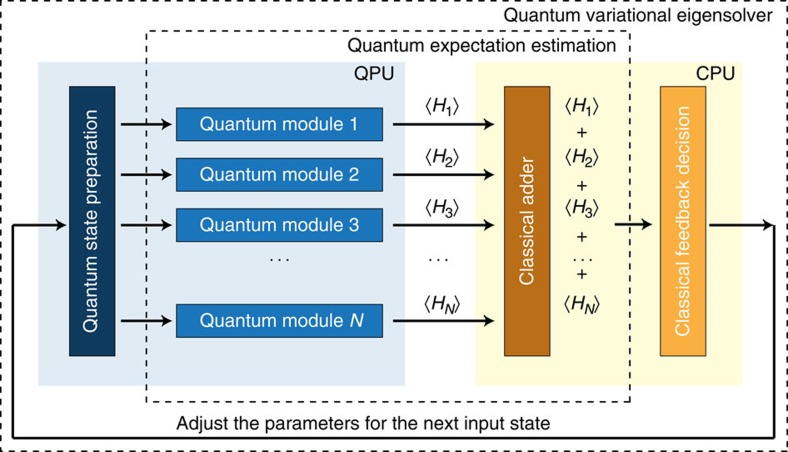
The paper introduces a variational alternative to quantum phase estimation for finding eigenvalues, combining short coherent quantum measurements with classical optimization. It experimentally demonstrates the approach on a photonic processor by estimating the ground-state energy curve of He–H\(^+\).
## Key findings
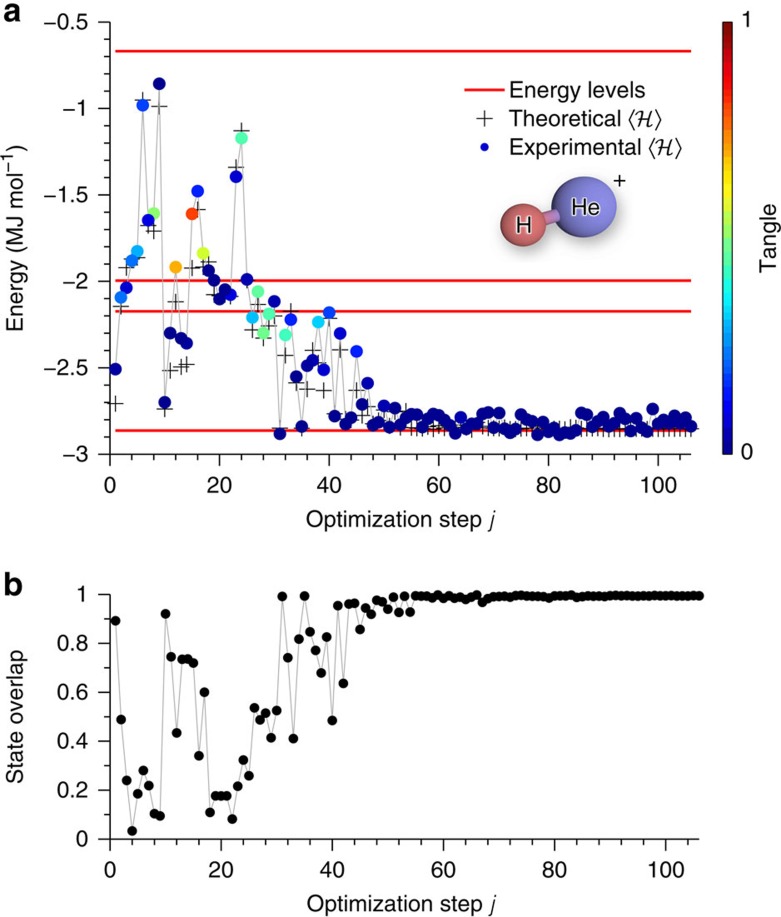
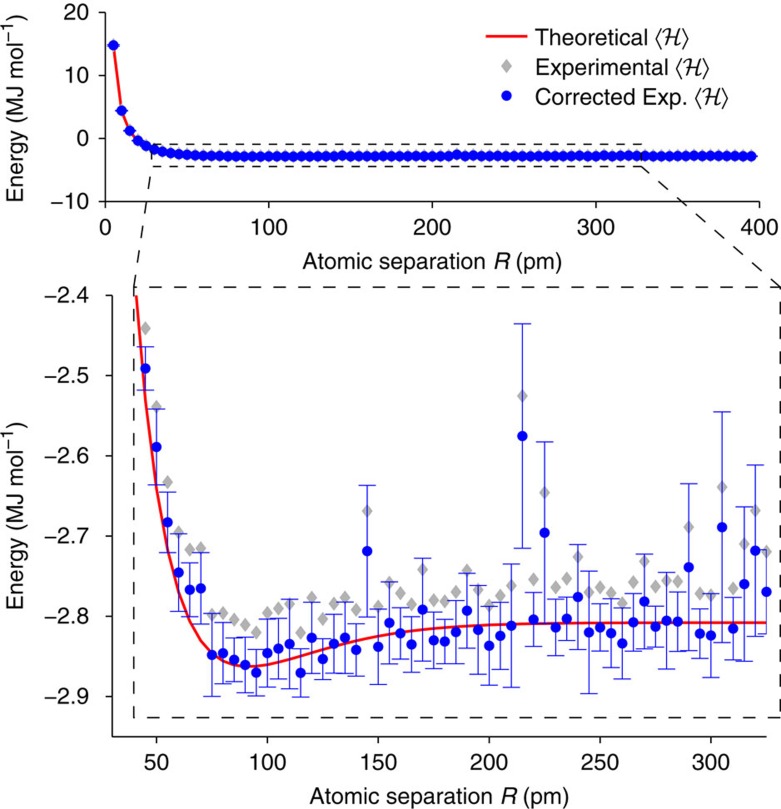
- The authors report an experimental ground-state result for He–H\(^+\): after correcting for experimental errors, they estimate the equilibrium bond length as \(R = 92.3 \pm 0.1\) pm and the ground-state electronic energy as \(E = -2.865 \pm 0.008\) MJ mol\(^{-1}\).
- For the bond dissociation curve, more than 96% of the experimental data are within chemical accuracy of the theoretical values.
- In the discussion, they state that for a 4 × 4 Hamiltonian like the one demonstrated, the QPE circuit would require at least 12 CNOT gates, whereas their method requires one.
- The full experiment was performed in about 158 h, and the bond dissociation curve was obtained by finding the ground states of 79 Hamiltonians.
## Methods
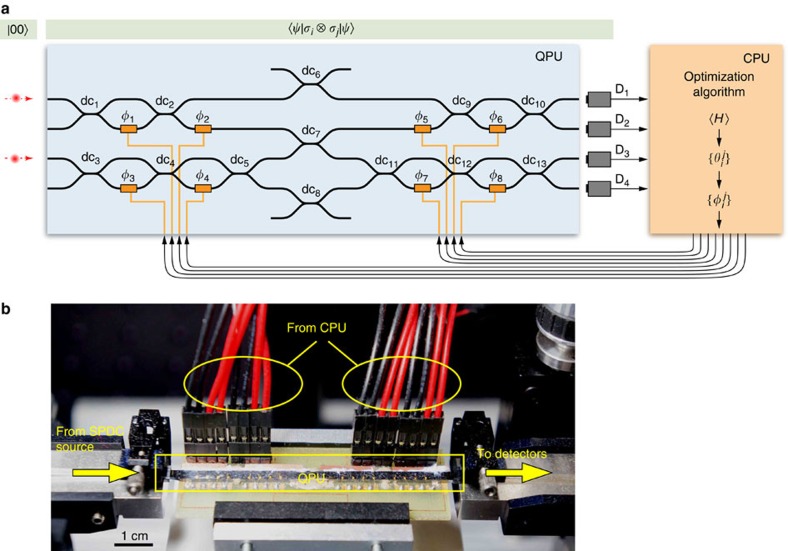
- The paper combines a reconfigurable integrated photonic quantum processor with a classical optimization algorithm: the quantum device estimates Hamiltonian expectation values, and the classical processor updates the state parameters variationally.
- The photonic chip prepares and measures arbitrary two-qubit pure states using single-qubit rotations and one two-qubit entangling gate; the experimental demonstration uses the He–H\(^+\) molecule in a minimal basis.
- For the classical optimization, they use the Nelder–Mead algorithm; expectation values are reconstructed from four two-qubit Pauli measurements at each point.
## Limitations
- The paper states that the method still requires a good approximation to the ground state as input/initialization, and the reliance on multiple separate measurements makes it sensitive to variations in state preparation between calculations.
- The authors report a constant systematic shift of \(\varepsilon = 50\) kJ mol\(^{-1}\) in the measured expectation values; they attribute this to photon-source impurity/distinguishability, circuit imperfections, and unbalanced coupling efficiencies.
- Evident from the text: the demonstration is limited to a two-qubit / 4 × 4 Hamiltonian prototype, so the scalability claim is not experimentally validated here.
Model-written summary. Check it against the paper before relying on it.
Integrity signals
Registry
Cites
Statistics
Figures
Verification
Claims the paper makes
7 Valid · 4 Not valid · 11 Not checked · 59 Own results and interpretations
The cited sources support only part of this claim — read each source’s verdict below.
In the paper
“Recent developments in the field of quantum computation offer a way forward for determining efficient solutions of many instances of large eigenvalue problems that are classically intractable6789101112”
§ A variational eigenvalue solver on a photonic quantum processor > Abstract
What the sources say
- Not matchedcites [6] Nielsen, M. A. & Chuang, I. L. Quantum Computation and Quantum Information Cambridge University Press (2000).
Couldn’t be matched to a paper in Crossref, so it can’t be checked.
- Could not verifycites [7] Kitaev, A. Quantum measurements and the Abelian stabilizer problem. Electronic Colloquium on Computational Complexity (ECCC) 3 (1996). sourceExperimental — accuracy not yet measured
Our copy under this DOI is the ISAAC 2021 paper 'Effective Resistance and Capacitance in Simplicial Complexes and a Quantum Algorithm' (Kitaev's 1995 work appears only as reference [9] in its bibliography), and it nowhere asserts that quantum computation gives efficient solutions to classically intractable large eigenvalue problems. Eigenvalues enter only as complexity parameters — λ, the smallest eigenvalue of the normalized up-Laplacian, in Lemma 31 and Theorem 26 (Section 6.3, 'Time efficient implementations') and in the phase-estimation machinery of Appendix A — and Section 1.1 ('Our Contributions') actually reports the opposite direction for its own problem: 'the quantum algorithm is slower than the classical algorithm in the worst case'. Searched: 'eigenvalue problems classically intractable', 'quantum speedup / exponential advantage', 'phase estimation', 'faster than classical'; no passage addresses the claim's point. (LLM, conf=0.70)
- Partly supportedcites [8] Griffiths, R. B. & Niu, C.-S. Semiclassical fourier transform for quantum computation. Phys. Rev. Lett. 76, 3228–3231 (1996). sourceExperimental — accuracy not yet measured
On p. 1, the paper says a quantum computer, if built, could solve certain problems such as factoring long numbers much faster than conventional algorithms. It also describes a simpler Fourier transform for Shor’s factorization and discrete-logarithm algorithms (p. 1). The copy does not support the claim about efficient solutions to many large eigenvalue problems. (LLM, conf=0.84)
plainstates a cause- Asserted: passes — The authors put it forward as true.
- Checkable: passes — It can be checked against evidence.
- Load-bearing: passes — The paper’s conclusions depend on it.
- Based: passes — The paper gives a reason why it holds.
- Not matched
Every source the paper cites for this claim was checked and supports it.
In the paper
“this would suffer from the N-representability problem, which is known to be intractable for both classical and quantum computers (it is in the quantum complexity class QMA-Hard24).”
§ A variational eigenvalue solver on a photonic quantum processor > Results > Quantum expectation estimation
What the sources say
- Supportedcites [24] Liu, Y.-K., Christandl, M. & Verstraete, F. Quantum computational complexity of the n-representability problem: Qma complete. Phys. Rev. Lett. 98, 110503 (2007). source
The paper states that N-representability is QMA-complete and hence QMA-hard and NP-hard (Abstract). Its discussion of quantum-chemistry relevance says the problem is intractable in the worst case even on a quantum computer, while allowing that particular physical systems may be easier. (LLM, conf=0.93)
boosted- Asserted: passes — The authors put it forward as true.
- Checkable: passes — It can be checked against evidence.
- Load-bearing: passes — The paper’s conclusions depend on it.
- Based: passes — The paper gives a reason why it holds.
- Supported
Every source the paper cites for this claim was checked and supports it.
In the paper
“We have implemented the QPU using integrated quantum photonics technology30.”
§ A variational eigenvalue solver on a photonic quantum processor > Results > Prototype demonstration
What the sources say
- Supportedcites [30] O'Brien, J. L., Furusawa, A. & Vuckovic, J. Photonic quantum technologies. Nat. Photon. 3, 687–695 (2009). source
The citation identifies integrated quantum photonics as the technology used, rather than attributing the citing authors’ QPU implementation to this review. The “Integrated quantum optical circuits” section (p. 6) describes on-chip waveguide circuits performing quantum logic gates and a compiled quantum factoring algorithm. (LLM, conf=0.87)
plain- Asserted: passes — The authors put it forward as true.
- Checkable: passes — It can be checked against evidence.
- Load-bearing: passes — The paper’s conclusions depend on it.
- Based: passes — The paper gives a reason why it holds.
- Supported
The cited sources support only part of this claim — read each source’s verdict below.
In the paper
“The time the quantum computer must remain coherent is determined by the necessity of O(p−1) successive applications of , each of which can require on the order of millions or billions of quantum gates for practical applications1719, as compared to the tens to hundreds of gates achievable in the short term.”
§ A variational eigenvalue solver on a photonic quantum processor > Abstract
What the sources say
- Partly supportedcites [17] Whitfield, J. D., Biamonte, J. & Aspuru-Guzik, A. Simulation of electronic structure hamiltonians using quantum computers. Mol. Phys. 109, 735–750 (2011). sourceExperimental — accuracy not yet measured
Split into 2 atoms — 1 confirmed, 1 partially supported, 0 disputed, 0 misattributed, 0 unverifiable. Expand the claim to see per-atom verdicts.
- Partly supportedcites [19] Jones, N. C. et al. Faster quantum chemistry simulation on fault-tolerant quantum computers. New J. Phys. 14, 115023 (2012). sourceExperimental — accuracy not yet measured
Split into 2 atoms — 0 confirmed, 2 partially supported, 0 disputed, 0 misattributed, 0 unverifiable. Expand the claim to see per-atom verdicts.
plainstates a cause- Asserted: passes — The authors put it forward as true.
- Checkable: passes — It can be checked against evidence.
- Load-bearing: passes — The paper’s conclusions depend on it.
- Based: passes — The paper gives a reason why it holds.
- Partly supported
A result the paper reports from its own data — it cites no other source for it, so there is none to check. The quote shows it is in the paper.
In the paper
“We experimentally demonstrate the feasibility of this approach with an example from quantum chemistry—calculating the ground-state molecular energy for He–H+.”
§ A variational eigenvalue solver on a photonic quantum processor > Abstract
boostedstates a causeSingle case- Asserted: passes — The authors put it forward as true.
- Checkable: passes — It can be checked against evidence.
- Load-bearing: passes — The paper’s conclusions depend on it.
- Based: passes — The paper gives a reason why it holds.
31 more claims
Create a free account to see all 81 claims and to verify the 4 references still open.
- It may state two separate claims as one. 28
- Probably not a substantial claim. 24
Claims other papers make about this one
Each is checked against this paper’s own text: does it say what the citing paper says it does?
The cited source doesn’t support the claim as written.
In the citing paper
“Leveraging quantum resources, the UCC ansatz was instead realized as a PQC on a photonic processor (Peruzzo et al. , 2014).”
From Noisy intermediate-scale quantum algorithms (2022) · cites this paper as Peruzzo et al., 2014
Checked by a reasoning model — may be wrong.
Experimental — accuracy not yet measuredThe cited source doesn’t support the claim as written.
In the citing paper
“The first on-chip GMM of four-qubit cluster state was realised in a laser-writing chip ( Fig.4e ), by manipulating both the polarisation and path DoFs of two photons [85].”
From Integrated photonic quantum technologies (2020) · cites this paper as [85]
Checked by a reasoning model — may be wrong.
Experimental — accuracy not yet measuredThe cited source doesn’t support the claim as written.
In the citing paper
“four-qubit linear- and box-cluster states are generated in a laser-writing photonic chip. This is enabled by on-chip manipulating the two-photon four-qubit hyperentangled state and cluster state, that are encoded in photon's path and polarisation DoFs. The Grover's search algorithm on a four-element database was implemented by controlling the device.”
From Integrated photonic quantum technologies (2020) · cites this paper as [85]
Checked by a reasoning model — may be wrong.
Experimental — accuracy not yet measuredThe source backs part of the claim, not all of it — or backs it for a different population, condition or comparison.
In the citing paper
“Due to its versatility, the variational Hamiltonian ansatz has been implemented for quantum chemistry [21, 29], optimization [24], and for quantum simulation problems [30].”
From Variational quantum algorithms (2021) · cites this paper as [29]
Experimental — accuracy not yet measuredThe source backs part of the claim, not all of it — or backs it for a different population, condition or comparison.
In the citing paper
“For the original VQE (Peruzzo et al. , 2014) and QAOA (Farhi et al. , 2014) it can, for example, be described as a single expectation value min θ ⟨ H ⟩ U ( θ ) , where the differences solely appear in the specific form and construction of the qubit Hamiltonian.”
From Noisy intermediate-scale quantum algorithms (2022) · cites this paper as Peruzzo et al., 2014
Experimental — accuracy not yet measured
12 more claims about this paper
Create a free account to see every claim other papers make about this one.
Citations
Cites
A Simplex Method for Function Minimization
Nelder, J. A., & Mead, R. (1965) · The Computer Journal · doi:10.1093/comjnl/7.4.308 · Cited by 28,905
Quantum computation and quantum information
Law, J. (2001) · ACM SIGSOFT Software Engineering Notes · doi:10.1145/505482.505499 · Cited by 18,842
(1999) · Cited by 12,854
Practical Methods of Optimization
Fletcher, R. (2000) · Wiley eBooks · doi:10.1002/9781118723203 · Cited by 7,605 · cited 3×
“[12] S.”
BackgroundMethodPractical methods of optimization
(1988) · Mathematics and Computers in Simulation · doi:10.1016/0378-4754(88)90129-2 · Cited by 5,818
Quantum Algorithm for Linear Systems of Equations
Harrow, A. W., Hassidim, A., & Lloyd, S. (2009) · Physical Review Letters · doi:10.1103/physrevlett.103.150502 · Cited by 3,325
Conn, A. R., Gould, N. I. M., & Toint, P. L. (2000) · Society for Industrial and Applied Mathematics eBooks · doi:10.1137/1.9780898719857 · Cited by 2,981 · cited 3×
“[14] D.”
MethodInfluential�ber das Paulische �quivalenzverbot
Jordan, P., & Wigner, E. (1928) · Zeitschrift f�r Physik · doi:10.1007/bf01331938 · Cited by 2,597
Molecular Electronic‐Structure Theory
Helgaker, T., Jørgensen, P., & Olsen, J. (2000) · doi:10.1002/9781119019572 · Cited by 2,594
O'Brien, J. L., Furusawa, A., & Vučković, J. (2009) · Nature Photonics · doi:10.1038/nphoton.2009.229 · Cited by 2,388
Self-citation
Research works printed but not linked: 3
- Helgaker, T., Jorgensen, P. & Olsen, J. Mol. Electronic Struct. Theory Wiley, Sussex (2002).
- Saad, Y. Numerical Methods for Large Eigenvalue Problems Vol. 158, (SIAM (1992).
- Rayleigh, J. W. In finding the correction for the open end of an organ-pipe. Phil. Trans. 161, 77 (1870).
Cited by
Items 2,201–2,300 of 4,573
Learning quantum phases via single-qubit disentanglement
An, Z., Cao, C., Xu, C.-Q., & Zhou, D. L. (2024) · Quantum · doi:10.22331/q-2024-07-22-1421 · Cited by 12
“In this analysis, we simplify the variational quantum classifier method; the original version necessitates the use of a variational quantum eigensolver (VQE) [30, 57–60] to simulate the ground state, while our focus lies solely on the classifier’s performance.”
BackgroundMethodIteration Complexity of Variational Quantum Algorithms
Kungurtsev, V., Korpas, G., Mareček, J., & Zhu, E. Y. (2024) · Quantum · doi:10.22331/q-2024-10-10-1495 · Cited by 24
“On the other hand, one of their attractive features is that they provide a general framework that fits a range of problems, from quantum simulation [45] to solving differential equations [34] and to designing quantum autoencoders [49], to name a few.”
Pang, Y., Elsbernd, L. R., Block, M. S., & Markovic, S. N. (2018) · ImmunoHorizons · doi:10.4049/immunohorizons.1800048 · Cited by 7
The Prime state and its quantum relatives
García-Martín, D., Ribas, E., Carrazza, S., Latorre, J. I., & Sierra, G. (2020) · Quantum · doi:10.22331/q-2020-12-11-371 · Cited by 15
Miyagawa, K., Shoji, M., Isobe, H., Yamanaka, S., Kawakami, T., Okumura, M., & Yamaguchi, K. (2020) · Molecular Physics · doi:10.1080/00268976.2020.1760388 · Cited by 9
Application of the Diamond Gate in Quantum Fourier Transformations and Quantum Machine Learning
Bahnsen, E., Rasmussen, S. E., Loft, N. J. S., & Zinner, N. T. (2022) · Physical Review Applied · doi:10.1103/physrevapplied.17.024053 · Cited by 8
Exploring quantum perceptron and quantum neural network structures with a teacher-student scheme
Gratsea, A., & Huembeli, P. (2022) · Quantum Machine Intelligence · doi:10.1007/s42484-021-00058-6 · Cited by 16
“VQCs are strong candidates for many general classical and quantum optimization applications (Farhi et al. 2014; Peruzzo et al. 2014; Farhi and Neven 2018), but also for the contruction of quantum perceptrons or neurons (Tacchino et al.”
BackgroundCasares, P. A. M., Campos, R., & Martin-Delgado, M. A. (2022) · Quantum · doi:10.22331/q-2022-07-20-768 · Cited by 18
“[54] Alberto Peruzzo, Jarrod R McClean, Peter Shadbolt, Man-Hong Yung, Xiao-Qi Zhou, Peter J Love, Alán Aspuru-Guzik, and Jeremy L O’brien.”
BackgroundMethodOn Post-processing the Results of Quantum Optimizers
Borle, A., & McCarter, J. (2019) · Lecture notes in computer science · doi:10.1007/978-3-030-34500-6_16 · Cited by 7
“However, applications such as quantum chemistry [32], sampling [3] and optimization [11,25] among others, are the first to make use of such devices.”
BackgroundDemonstration of a Quantum Circuit Design Methodology for Multiple RegressionPreprint
Dutta, S., Suau, A., Dutta, S., et al. (2018) · arXiv (Cornell University) · doi:10.13140/rg.2.2.20753.68960 · Cited by 8
A Depth-Aware Swap Insertion Scheme for the Qubit Mapping ProblemPreprint
Zhang, C., Chen, Y., Jin, Y., Ahn, W., Zhang, Y., & Zhang, E. Z. (2020) · arXiv (Cornell University) · doi:10.48550/arxiv.2002.07289 · Cited by 20
(2021) · arXiv (Cornell University) · Cited by 8
Towards near-term quantum simulation of materialsPreprint
Clinton, L., Cubitt, T. S., Flynn, B., Gambetta, F. M., Klassen, J., Montanaro, A., Piddock, S., Santos, R. A., & Sheridan, E. (2022) · arXiv (Cornell University) · doi:10.48550/arxiv.2205.15256 · Cited by 16
Understanding polaritonic chemistry from ab initio quantum electrodynamicsPreprint
Ruggenthaler, M., Sidler, D., & Rubio, Á. (2022) · Zürcher Hochschule für Angewandte Wissenschaften digital collection (Zurich University of Applied Sciences) · doi:10.48550/arxiv.2211.04241 · Cited by 31
Schuld, M., & Petruccione, F. (2023) · Springer eBooks · doi:10.1007/978-1-4899-7502-7_913-2 · Cited by 10
Local, expressive, quantum-number-preserving VQE ansätze for fermionic systems
Anselmetti, G.-L. R., Wierichs, D., Gogolin, C., & Parrish, R. M. (2021) · New Journal of Physics · doi:10.1088/1367-2630/ac2cb3 · Cited by 96
Near term algorithms for linear systems of equations
Pellow-Jarman, A., Sinayskiy, I., Pillay, A. W., & Petruccione, F. (2023) · Quantum Information Processing · doi:10.1007/s11128-023-04020-2 · Cited by 11
Ground-state-energy calculation for the water molecule on a superconducting quantum processor
Jones, M. A., Vallury, H. J., & Hollenberg, L. C. L. (2024) · Physical Review Applied · doi:10.1103/physrevapplied.21.064017 · Cited by 14
“…quantities such as the ground-state energy, E 0 , of molecular systems defined by a Hamiltonian, H , are hybrid quantum-classical algorithms [4,5] based on the variational principle: The expectation is that, as the problem size scales, the preparation and measurement of the (parameterised)…”
BackgroundMethodInfluentialError-tolerant quantum convolutional neural networks for symmetry-protected topological phases
Zapletal, P., McMahon, N. A., & Hartmann, M. J. (2024) · Physical Review Research · doi:10.1103/physrevresearch.6.033111 · Cited by 17
“A prominent example is the variational quantum eigensolver for quantum chemistry problems which involves many repetitions of demanding measurements of molecular Hamiltonians [57, 58].”
BackgroundCui, Z., Jin, S., Sone, A., & Wang, X. (2024) · Science China Physics Mechanics and Astronomy · doi:10.1007/s11433-024-2391-8 · Cited by 11
Hou, Y., Li, J., Xu, T., & Liu, X.-Y. (2024) · Scientific Reports · doi:10.1038/s41598-024-69384-6 · Cited by 10
“Circuit (4) is implemented by H , CNOT, and R X gates , and it has the lowest expressibility.”
BackgroundEfficient Encodings of the Travelling Salesperson Problem for Variational Quantum Algorithms
Schnaus, M., Palackal, L., Poggel, B., Runge, X., Ehm, H., Lorenz, J. M., & Mendl, C. B. (2024) · IEEE International Conference on Quantum Software (QSW) · doi:10.1109/qsw62656.2024.00022 · Cited by 20
“In this work, we investigate different encodings for the TSP and compare their scaling and performance for the QAOA and the Variational Quantum Eigensolver (VQE) [7].”
MethodSubspace-Search Quantum Imaginary Time Evolution for Excited State Computations
Cianci, C., dos Santos, L. F., & Batista, V. S. (2024) · Journal of Chemical Theory and Computation · doi:10.1021/acs.jctc.4c00915 · Cited by 13
“7 − 15 Beyond ground state energies, excited states are equally important for numerous applications, 16 − 21 such as charge and energy transfer in photovoltaic materials, photodissociation, 22 luminescence, 7 intermediate states in chemical reactions, 23 and mechanistic studies of catalytic systems.”
BackgroundProtein Structure Prediction with High Degrees of Freedom in a Gate-Based Quantum Computer
Pamidimukkala, J. V., Bopardikar, S., Dakshinamoorthy, A., Kannan, A., Dasgupta, K., & Senapati, S. (2024) · Journal of Chemical Theory and Computation · doi:10.1021/acs.jctc.4c00848 · Cited by 21
Quantum machine learning via continuous-variable cluster states and teleportation
García‐Beni, J., Paparelle, I., Parigi, V., Giorgi, G. L., Soriano, M. C., & Zambrini, R. (2025) · EPJ Quantum Technology · doi:10.1140/epjqt/s40507-025-00352-3 · Cited by 18
“Variational eigensolvers executed on photonic quantum processors [11] have demonstrated a more efficient utilization of quantum resources compared to other algorithms, such as quantum phase estimation.”
Universal Multiport Interferometers for Post‐Selected Multi‐Photon Gates
Baldazzi, A., & Pavesi, L. (2024) · Advanced Quantum Technologies · doi:10.1002/qute.202400418 · Cited by 11
Hardware-efficient variational quantum algorithm in a trapped-ion quantum computer
Zhuang, J.-Z., Wu, Y., & Duan, L.-M. (2024) · Physical Review A · doi:10.1103/physreva.110.062414 · Cited by 11
“Among them, the VQA is specifically designed to reduce the requirements on quantum devices by integrating quantum computing with classical optimization [27, 28].”
Noise-agnostic quantum error mitigation with data augmented neural models
Liao, M., Zhu, Y., Chiribella, G., & Yang, Y. (2025) · npj Quantum Information · doi:10.1038/s41534-025-00960-y · Cited by 25
“To demonstrate these features, we test our model on a series of paradigmatic quantum algorithms, such as variational quantum eigensolvers [41] and quantum approximate optimization [42], and quantum dynamics, such as the many-body dynamics of the Ising model and the Kerr Hamiltonian [43] for…”
Simulating Quantum Circuits with Arbitrary Local Noise Using Pauli Propagation
Angrisani, A., Mele, A. A., Rudolph, M. S., Cerezo, M., & Holmes, Z. (2026) · PRX Quantum · doi:10.1103/fb28-wlv2 · Cited by 99
Umer, M., Mastorakis, E., Evangelou, S., & Angelakis, D. G. (2025) · Physical Review A · doi:10.1103/physreva.111.012626 · Cited by 16
Quantum next-generation reservoir computing and its quantum optical implementation
Wang, L., Sun, P., Kong, L., Sun, Y., & Zhang, X. (2025) · Physical Review A · doi:10.1103/physreva.111.022609 · Cited by 15
Practicality of a quantum adiabatic algorithm for chemistry applications
Granet, E., Ghanem, K., & Dreyer, H. (2025) · Physical Review A · doi:10.1103/physreva.111.022428 · Cited by 13
A hybrid qubit encoding: splitting Fock space into Fermionic and Bosonic subspaces
Santos, F. J. D. A., & Kottmann, J. S. (2025) · Quantum Science and Technology · doi:10.1088/2058-9565/adbdee · Cited by 12
Delgado, A., & Date, P. (2025) · Frontiers in Computer Science · doi:10.3389/fcomp.2025.1528985 · Cited by 12
Chatterjee, A., Rappaport, S., Giri, A., Johri, S., Proctor, T. J., Neira, D. E. B., Sathe, P., & Lubinski, T. (2025) · IEEE Transactions on Quantum Engineering · doi:10.1109/tqe.2025.3558090 · Cited by 21
“This suite supports both single circuit runs and iterative algorithms like QAOA [7] and VQE [52], using the normalized Hellinger fidelity to assess circuit quality, accounting for noise [39].”
Modeling and Performance Evaluation of Hybrid Classical–Quantum Serverless Computing Platforms
Cicconetti, C. (2025) · IEEE Transactions on Quantum Engineering · doi:10.1109/tqe.2025.3567322 · Cited by 8
“This technique can be used in many fields, including quantum machine learning (QML) [5], operations research [6], and chemistry [7].”
Nonvariational ADAPT algorithm for quantum simulations
Tang, H. L., Chen, Y., Biswas, P., Magann, A. B., Arenz, C., & Economou, S. E. (2025) · Physical Review Research · doi:10.1103/x8g1-7h1k · Cited by 16
Critical Limitations in Quantum-Selected Configuration Interaction Methods
Reinholdt, P., Ziems, K. M., Kjellgren, E. R., Coriani, S., Sauer, S. P. A., & Kongsted, J. (2025) · Journal of Chemical Theory and Computation · doi:10.1021/acs.jctc.5c00375 · Cited by 65
Quantum Computing in Drug Discovery: Revolutionizing Pharmaceutical Research
Muniasamy, A. (2025) · IGI Global eBooks · doi:10.4018/979-8-3373-2043-4.ch003 · Cited by 9
Quantum simulations of nuclear resonances with variational methods
Singh, A., Siwach, P., & Arumugam, P. (2025) · Physical Review C · doi:10.1103/x8vx-y5mh · Cited by 12
Revythi, M., & Κούκιου, Γ. (2025) · Machine Learning and Knowledge Extraction · doi:10.3390/make7030075 · Cited by 16
Crippa, A., Romiti, S., Funcke, L., Jansen, K., Kühn, S., Stornati, P., & Urbach, C. (2025) · Communications Physics · doi:10.1038/s42005-025-02243-6 · Cited by 24
Quantum computing for faster enzyme discovery and engineering
Damborský, J., Kouba, P., Šivic, J., Vasina, M., Bednář, D., & Mazurenko, S. (2025) · Nature Catalysis · doi:10.1038/s41929-025-01410-w · Cited by 11
“Although NISQ computers can execute quantum algorithms, such as the variational quantum eigensolver (VQE) and quantum approximate optimization algorithm (QAOA), their performance is constrained by noise.”
InfluentialUnlocking early fault-tolerant quantum computing with mitigated magic dilution
Luthra, S., Moylett, A. E., Browne, D. E., & Campbell, E. T. (2025) · Quantum Science and Technology · doi:10.1088/2058-9565/ae0aef · Cited by 14
“Quantum error mitigation (QEM) is generally considered in the context of estimating the expectation value of an observable using a quantum circuit, for example in variational quantum eigensolvers [19] and statistical versions of phase estimation [20–24].”
Jonnalagadda, A. K., Acharya, S., Pasam, V. R., & Shahane, R. (2025) · International Conference on Intelligent Technologies (CONIT) · doi:10.1109/conit65521.2025.11166726 · Cited by 7
“In the fields of optimization, algorithms such as QAOA and VQE have proved to be more effective [5] and [6].”
Fast gradient-free optimization of excitations in variational quantum eigensolvers
Jäger, J., Kaldenbach, T. N., Haas, M., & Schultheis, E. (2025) · Communications Physics · doi:10.1038/s42005-025-02375-9 · Cited by 25
“Thisappliestofermionicexcitations 1 , qubitexcitations 5,6 ,and Givens rotations 33 — not limited to single and double excitations.”
Quantum Computing for Genomics: Conceptual Challenges and Practical Perspectives
Maurizio, A., & Mazzola, G. (2025) · PRX Life · doi:10.1103/h49j-bsc6 · Cited by 23
“…two main strategies: quantum annealing (QA)[40, 130], implemented on analog quantum hardware, and the Quantum Approximate Optimization Algorithm (QAOA)[131, 132] or similar approaches based on parameterized circuits, like the Variational Quantum Eigensolver (VQE)[133], executed on digital hardware.”
Li, Y., Ma, C., Li, Y., Li, S., Chen, Y., & Dong, Z. Y. (2025) · Applied Energy · doi:10.1016/j.apenergy.2025.127196 · Cited by 11
Crippa, A., Jansen, K., & Rinaldi, E. (2026) · Communications Physics · doi:10.1038/s42005-025-02465-8 · Cited by 12
“We fi rst consider a noiseless analysis with the Variational Quantum Eigensolver (VQE) 36 .”
InfluentialEfficient two-qubit pulse sequences beyond CNOT
Zeuch, D., & Bonesteel, N. E. (2020) · Physical review. B./Physical review. B · doi:10.1103/physrevb.102.075311 · Cited by 8
Direct and efficient verification of entanglement between two multimode–multiphoton systems
Kiyohara, T., Yamashiro, N., Okamoto, R., Araki, H., Wu, J.-Y., Hofmann, H. F., & Takeuchi, S. (2020) · Optica · doi:10.1364/optica.397943 · Cited by 12
Sumeet, Prasannaa, V. S., Das, B. P., & Sahoo, B. K. (2022) · Quantum Reports · doi:10.3390/quantum4020012 · Cited by 9
“It has been experimentally realized in platforms such as photonic processors [17], superconducting qubits [18], ion traps [19], and so forth.”
BackgroundMethodError-Divisible Two-Qubit Gates
Pérez, D. R., Varosy, P., Li, Z., Roy, T., Kapit, E., & Schuster, D. (2023) · Physical Review Applied · doi:10.1103/physrevapplied.19.024043 · Cited by 14
Quantifying fermionic nonlinearity of quantum circuits
Hakkaku, S., Tashima, Y., Mitarai, K., Mizukami, W., & Fujii, K. (2022) · Physical Review Research · doi:10.1103/physrevresearch.4.043100 · Cited by 14
Chen, Y.-H., Cho, C., Yuan, W., Ma, Y., Wen, K., & Chang, C. (2022) · IEEE Nanotechnology Magazine · doi:10.1109/mnano.2022.3175382 · Cited by 7
BQ-Bank: A Quantum Software for Finance and Banking
Li, H., Xing, T., Wei, S., Liu, Z., Zhang, J., & Long, G. (2023) · Quantum Engineering · doi:10.1155/2023/7810974 · Cited by 7
Quantum Powered Employee Transport and Agri-Logistics Optimization
Rana, R., Thingbaijam, R., Seshadri, J., et al. (2022) · International Conference on Trends in Quantum Computing and Emerging Business Technologies (TQCEBT) · doi:10.1109/tqcebt54229.2022.10041701 · Cited by 7
“Due to the hardware limitation of the quantum gate-based model, we had to simplify the problem and run a small instance of a problem on IBM Qiskit’s [6] gate-based variational algorithms like variational quantum eigensolver (VQE) [7] and quantum approximate optimization algorithm (QAOA) [8].”
MethodEfficient variational quantum circuit structure for correlated topological phases
Sun, R.-Y., Shirakawa, T., & Yunoki, S. (2023) · Physical review. B./Physical review. B · doi:10.1103/physrevb.108.075127 · Cited by 17
QREChem: quantum resource estimation software for chemistry applications
Otten, M., Kang, B., Fedorov, D. A., Lee, J., Benali, A., Habib, S., Gray, S. K., & Alexeev, Y. (2023) · Frontiers in Quantum Science and Technology · doi:10.3389/frqst.2023.1232624 · Cited by 13
Wolf, M.-O., Ewen, T., & Turkalj, I. (2023) · IEEE International Conference on Quantum Computing and Engineering (QCE) · doi:10.1109/qce57702.2023.00070 · Cited by 10
“…U is trained by minimizing over θ while averaging the distance between the quantum model of the data point and the corresponding labels over X , We refer to the whole process of constructing U ( x , θ ) and finding a minimizing set of parameters as a Variational Quantum Algorithm (VQA) [19], [20].”
MethodFull State Quantum Circuit Simulation Beyond Memory Limit
Zhao, Y., Chen, Y., Li, H., Wang, Y., Chang, K., Wang, B., Li, B., & Han, Y. (2023) · doi:10.1109/iccad57390.2023.10323666 · Cited by 8
“…Setups 1) Benchmarks: In this work, we primarily focus on two types of quantum circuits: random quantum circuit (RQC) [32], [33] and variational quantum circuit (VQC) [34], [35] to demonstrate the universal effectiveness of QDAO, both are widely studied and play important roles in NISQ era.”
BackgroundPerturbative variational quantum algorithms for material simulations
Liu, J., Li, Z., & Yang, J. (2024) · Electronic Structure · doi:10.1088/2516-1075/ad2277 · Cited by 9
“For example, in contrast to the chemically inspired unitary coupled cluster (UCC) ansatz [3, 12, 16, 18], adaptive variational quantum algorithms, such as adaptive derivative-assembled pseudo-trotter (ADAPT) [15, 19] and iterative qubit coupled cluster VQE [20], were recently proposed to…”
Quantum density estimation with density matrices: Application to quantum anomaly detection
Useche, D. H., Bustos-Brinez, O. A., Gallego-Mejia, J. A., & Gonzalez, F. A. (2024) · Physical Review A · doi:10.1103/physreva.109.032418 · Cited by 12
“In addition, it is possible to build a density matrix in the Pauli basis, like in the variational quantum eigensolver [37], and quantum state tomography [31, 38, 39], and using the density matrix exponentiation method [21], which pre-pares an exponential form of the density matrix by a unitary…”
MethodDivide-and-Conquer Quantum Algorithm for Hybrid de novo Genome Assembly of Short and Long Reads
Fang, J.-K., Lin, Y., Huang, J.-H., Chen, Y., Fan, G.-M., Sun, Y., Feng, G., Guo, C., Meng, T., Zhang, Y., et al. (2024) · PRX Life · doi:10.1103/prxlife.2.023006 · Cited by 16
Extension of Exactly-Solvable Hamiltonians Using Symmetries of Lie Algebras
Patel, S., Yen, T.-C., & Izmaylov, A. F. (2024) · The Journal of Physical Chemistry A · doi:10.1021/acs.jpca.4c00993 · Cited by 8
Experimental Direct Quantum Fidelity Learning via a Data-Driven Approach
Qin, H., Che, L., Wei, C., Xu, F., Huang, Y., & Xin, T. (2024) · Physical Review Letters · doi:10.1103/physrevlett.132.190801 · Cited by 17
Hardware-efficient and fast three-qubit gate in superconducting quantum circuits
Li, X., Tao, Z., Yi, K., Luo, K., Zhang, L., Zhou, Y., Liu, S., Yan, T., Chen, Y., & Yu, D. (2024) · Frontiers of Physics · doi:10.1007/s11467-024-1405-8 · Cited by 6
Bettaque, V., & Swingle, B. G. (2024) · Quantum · doi:10.22331/q-2024-05-27-1362 · Cited by 17
“Nevertheless, they provide a number of conceptual advantages and can still form the basis for variational quantum algorithms, e.g. [ 24, 25].”
BackgroundPatra, C., Halder, S., & Maitra, R. (2024) · The Journal of Chemical Physics · doi:10.1063/5.0210854 · Cited by 11
Exponential qubit reduction in optimization for financial transaction settlement
Huber, E. X., Tan, B. Y. L., Griffin, P., & Angelakis, D. G. (2024) · EPJ Quantum Technology · doi:10.1140/epjqt/s40507-024-00262-w · Cited by 19
State preparation of lattice field theories using quantum optimal control
Araz, J. Y., Bhowmick, S., Grau, M., McEntire, T. J., & Ringer, F. (2025) · Physical review. D/Physical review. D. · doi:10.1103/physrevd.111.034506 · Cited by 15
“[ 4– 50 ] for To address these challenges, Variational Quantum Algorithms (VQA) have been proposed [51–54], which allow for relatively shallow circuits.”
Mapping quantum circuits to shallow-depth measurement patterns based on graph states
Kaldenbach, T. N., & Heller, M. (2024) · Quantum Science and Technology · doi:10.1088/2058-9565/ad802b · Cited by 23
“…are often discussed as near-term applications for noisy intermediate-scale quantum (NISQ) devices [24]: the Variational Quantum Eigensolver (VQE) [25, 26] in the context of molecular simulations and the Quantum Approximate Optimization Algorithm (QAOA) [27, 28] in the context of binary…”
Motta, M., Sung, K. J., & Shee, J. (2024) · The Journal of Physical Chemistry A · doi:10.1021/acs.jpca.4c02847 · Cited by 15
“A leading strategy to use near-term devices for quantum chemistry is the Variational Quantum Eigensolver (VQE) [1].”
MethodQuantum Equation-of-Motion Method with Single, Double, and Triple Excitations
Zheng, Y., Sun, Z., Liu, J., Fan, Y., Li, Z., & Yang, J. (2024) · Journal of Chemical Theory and Computation · doi:10.1021/acs.jctc.4c01071 · Cited by 11
“Given near-term quantum devices limited by the coherence time and the fidelity of quantum gates, 19,20 variational quantum eigensolver (VQE), 6 known as a hybrid quantum-classical algorithm that has features of low circuit depth and robust noise resilience, is one of the most widely used algorithms…”
BackgroundMethodSivakumar, A., Nair, H. K., Joshi, A., Kenson Wesley, R., Videsh, A. P., & Reena Monica, P. (2024) · EPJ Quantum Technology · doi:10.1140/epjqt/s40507-024-00280-8 · Cited by 14
“A key strength of VQE lies in its hybrid nature, strategically integrating classical and quantum components [11, 33, 38].”
BackgroundEmulating quantum computing with optical matrix multiplication
Koni, M., Bezuidenhout, H., & Nape, I. M. (2024) · APL Photonics · doi:10.1063/5.0230335 · Cited by 10
Surf-Deformer: Mitigating Dynamic Defects on Surface Code via Adaptive Deformation
Yin, K., Fang, X., Humble, T. S., Li, A., Shi, Y., & Ding, Y. (2024) · IEEE/ACM International Symposium on Microarchitecture (MICRO) · doi:10.1109/micro61859.2024.00061 · Cited by 18
“Device errors significantly hinder the advancement of quantum computing [3], obstructing its capability to fulfill its vast potential [4]–[6].”
Efficient quantum algorithm for lattice protein folding
Wang, Y., & Zhou, X. (2024) · Quantum Science and Technology · doi:10.1088/2058-9565/ada08e · Cited by 13
“Existing methods for protein folding applications have been developed along two main tracks, including analog quantum annealers [28–30] and gate-based quantum processors [31].”
Self-citationArai, D., Okada, K. N., Nakano, Y., Mitarai, K., & Fujii, K. (2025) · Physical Review Research · doi:10.1103/physrevresearch.7.013035 · Cited by 18
“QAOA is a hybrid quantum-classical algorithm [9, 10], where one prepares states on quantum circuits with variational parameters and optimizes the parameters on a classical computer through minimization of a cost function obtained by measurement [11, 12].”
Tsukayama, D., Shirakashi, J., Shibuya, T., & Imai, H. (2025) · AIP Advances · doi:10.1063/5.0236028 · Cited by 9
Teleporting two-qubit entanglement across 19 qubits on a superconducting quantum computer
Kang, H., Kam, J. F., Mooney, G. J., & Hollenberg, L. C. L. (2025) · Physical Review Applied · doi:10.1103/physrevapplied.23.014057 · Cited by 12
Simulating Electronic Structure on Bosonic Quantum Computers
Dutta, R., Vu, N. P., Xu, C. F., Cabral, D. G. A., Lyu, N., Soudackov, A. V., Dan, X., Li, H., Wang, C., & Batista, V. S. (2025) · Journal of Chemical Theory and Computation · doi:10.1021/acs.jctc.4c01400 · Cited by 19
He, Z., Shaydulin, R., Herman, D., Li, C., Raymond, R., Sureshbabu, S. H., & Pistoia, M. (2024) · doi:10.1145/3676536.3697128 · Cited by 27
Phase estimation algorithm for the multibeam optical metrology
Zemlyanov, V. V., Kirsanov, N. S., Perelshtein, M. R., Lykov, D., Misochko, O. V., Lebedev, M. V., Vinokur, V. M., & Lesovik, G. B. (2020) · Scientific Reports · doi:10.1038/s41598-020-65466-3 · Cited by 7
Verifying the output of quantum optimizers with ground-state energy lower bounds
Baccari, F., Gogolin, C., Wittek, P., & Acin, A. (2020) · MPG.PuRe (Max Planck Society) · Cited by 7
Engineering analog quantum chemistry Hamiltonians using cold atoms in optical lattices
Argüello-Luengo, J., Shi, T., & González-Tudela, A. (2021) · Physical Review A · doi:10.1103/physreva.103.043318 · Cited by 8
“Since these algorithms typically assume fault-tolerant quantum computers that will not be available in the near future, in recent years there has also been an intense effort on hybrid variational approaches more suitable for current noisy quantum computers [27–29].”
Chieza, H. A., Khumalo, M. T., Prag, K., & Woolway, M. (2020) · International Conference on Soft Computing & Machine Intelligence (ISCMI) · doi:10.1109/iscmi51676.2020.9311605 · Cited by 7
“Peruzzo (2014) et al. [21] introduced the VQE, a hybrid quantum-classical algorithm.”
BackgroundNoise-robust exploration of many-body quantum states on near-term quantum devices
Borregaard, J., Christandl, M., & França, D. S. (2021) · npj Quantum Information · doi:10.1038/s41534-021-00363-9 · Cited by 18
Calculating the Green’s function of two-site fermionic Hubbard model in a photonic system
Zhu, J., Nakagawa, Y. O., Zhang, Y.-S., Li, C., & Guo, G. (2022) · New Journal of Physics · doi:10.1088/1367-2630/ac61d1 · Cited by 10
“We first search the ground state |GS〉 and the excited state |ES〉 of the system (3) by using the variational quantum eigensolver (VQE) [12].”
MethodVariational quantum algorithms for trace norms and their applications
Li, S., Liang, J., Shen, S., & Li, M. (2021) · Communications in Theoretical Physics · doi:10.1088/1572-9494/ac1938 · Cited by 8
Annealing in the Noisy Intermediate-Scale Quantum Era: Key concepts and approaches
Yu, L.-P., Chen, C.-Y., Lai, C., Sheu, B. J., Kao, S., & Chang, C. (2021) · IEEE Nanotechnology Magazine · doi:10.1109/mnano.2021.3113217 · Cited by 7
Polykratis, G., Alexandrou, C., Funcke, L., et al. (2022) · International Symposium on Lattice Field Theory (LATTICE) · doi:10.22323/1.396.0243 · Cited by 7
“With appropriate post-rotations applied to |ψ〉, we can always consider O to be diagonal in the computational basis [16], i.”
MethodLow-Depth Unitary Coupled Cluster Theory for Quantum Computation
Chen, J., Cheng, H., & Freericks, J. K. (2022) · Journal of Chemical Theory and Computation · doi:10.1021/acs.jctc.1c01026 · Cited by 11
Finite-depth scaling of infinite quantum circuits for quantum critical points
Jobst, B., Smith, A., & Pollmann, F. (2022) · Physical Review Research · doi:10.1103/physrevresearch.4.033118 · Cited by 11
“[28] Alberto Peruzzo, Jarrod McClean, Peter Shadbolt, ManHong Yung, Xiao-Qi Zhou, Peter J.”
Fast decay of classification error in variational quantum circuits
Zhang, B., & Zhuang, Q. (2022) · Quantum Science and Technology · doi:10.1088/2058-9565/ac70f5 · Cited by 10
“…hybrid systems applicable to various tasks, including optimization [3], state preparation [4, 5], auto-encoding [6, 7], eigen-solvers [8–14], unsampling and state approximation [15, 16], state classification [17–20], state tomography [21], sensor networks [22, 23], solving…”
Greedy algorithm based circuit optimization for near-term quantum simulation
Hu, Y., Meng, F., Wang, X., Luan, T., Fu, Y., Zhang, Z., Zhang, X., & Yu, X. (2022) · Quantum Science and Technology · doi:10.1088/2058-9565/ac796b · Cited by 10
Complete Physical Characterization of Quantum Nondemolition Measurements via Tomography
Pereira, L., García‐Ripoll, J. J., & Ramos, T. (2022) · Physical Review Letters · doi:10.1103/physrevlett.129.010402 · Cited by 12
Parameterized Quantum Circuits for Learning Cooperative Quantum Teleportation
Feng, Y., Zhou, J., Zhang, D., & Shi, J. (2022) · Advanced Quantum Technologies · doi:10.1002/qute.202200040 · Cited by 10
Hamiltonian-based data loading with shallow quantum circuits
Duan, B., & Hsieh, C. (2022) · Physical Review A · doi:10.1103/physreva.106.052422 · Cited by 8
Warm Starting Variational Quantum Algorithms with Near Clifford Circuits
Niu, Y.-F., Zhang, S., & Bao, W. (2023) · Electronics · doi:10.3390/electronics12020347 · Cited by 12
Metadata
- Authors
- Peruzzo, A., McClean, J., Shadbolt, P., Yung, M.-H., Zhou, X.-Q., Love, P. J., Aspuru-Guzik, A., & O’Brien, J. L.
- Affiliations
- The University of Sydney (AU)
- Harvard University (US)
- University of Bristol (GB)
- Haverford College (US)
- Corresponding author
- Peruzzo, Alberto
- O’Brien, Jeremy L.
- Venue
- Nature Communications
- Published
- 2014-07-23
- Volume
- 5
- Issue
- 1
- Pages
- 4213-4213
- ISSN
- 2041-1723 (ISSN-L)
- PMC
- PMC4124861
- OpenAlex
- W2161685427
- Cited by
- 4,552
- References
- 48
- Citations by year
- 2026: 591 · 2025: 765 · 2024: 722 · 2023: 658 · 2022: 564 · 2021: 561 · 2020: 346 · 2019: 191 · 2018: 83 · 2017: 29 · 2016: 18 · 2015: 16 · 2014: 4
- FWCI
- 22.24
- Type
- journal article
- Language
- en
- Open access
- hybrid
- doi.org
- Licence
- cc-by-nc-nd
- creativecommons.org/licenses/by-nc-nd/4.0 (tdm)
- creativecommons.org/licenses/by-nc-nd/4.0 (vor)
- Locations
- Nature Communications (publishedVersion, cc-by-nc-nd)
- Europe PMC (PubMed Central) (publishedVersion, cc-by-nc-nd)
- PubMed Central (publishedVersion, cc-by-nc-nd)
- PubMed (publishedVersion)
- arXiv (Cornell University) (submittedVersion)
- OSTI OAI (U.S. Department of Energy Office of Scientific and Technical Information) (submittedVersion, cc-by-nc-nd)
- Digital Access to Scholarship at Harvard (DASH) (Harvard University) (submittedVersion, cc-by)
- RePEc: Research Papers in Economics (submittedVersion)
- RMIT Research Repository (RMIT University Library) (submittedVersion, cc-by-nc-nd)
- Figshare (submittedVersion, cc-by-nc-nd)
- UWA Profiles and Research Repository (UWA) (submittedVersion, cc-by-nc-nd)
- Bristol Research (University of Bristol) (submittedVersion)
- arXiv (Cornell University)
- Funders
- National Science Foundation (DE-FG02-97ER25308, 0955518, 1037992)
- U.S. Department of Energy (DEFG0297ER25308, DE‐FG02‐, FG02-97ER25308)
- Alfred P. Sloan Foundation
- John Templeton Foundation
- Camille and Henry Dreyfus Foundation
- Royal Academy of Engineering
- National Natural Science Foundation of China (61033001, 61361136003)
- Engineering and Physical Sciences Research Council (EP/J017175/1, EP/L024020/1, EP/K021931/1)
- Australian Research Council (DE140101700)
- National Key Research and Development Program of China (61033001, 2011CBA00301, 61361136003, 2011CBA00300)
- Division of Chemistry (CHE-1037992)
- Air Force Office of Scientific Research (FA 9550-12-1-0046, FA9550-, FA9550-12, FA9550‐12‐1)
- Topics
- Physical Sciences › Computer Science › Artificial Intelligence › Quantum Computing Algorithms and Architecture
- Physical Sciences › Physics and Astronomy › Atomic and Molecular Physics, and Optics › Quantum Information and Cryptography
- Physical Sciences › Physics and Astronomy › Atomic and Molecular Physics, and Optics › Quantum many-body systems
- Keywords
- variational quantum eigensolver, photonic quantum processors, quantum chemistry, classical optimization, hybrid quantum-classical computation
About these checks
Registry, retraction, Cites and statistics results are computed, not judged, with one exception: a printed reference that no index lists is read once by a model before it counts as a citation error. Claims are extracted by a model and kept only when their quote appears verbatim in the text; each cited source is then checked, with a model’s help, for whether it says what the claim relies on. Those verdicts can be wrong — read the claim’s quote and the cited source before relying on one.
The claim verdicts this report counts are experimental: their accuracy is not yet measured.
A language model drew the claims from the paper on 2026-10-10, under version 3 of the claim definition (model deepseek-v4.1-flash, prompt extract-v3).
A second model labelled each claim on 2026-10-10 (model jev-1.13-20260917, definition revision gold-guideline-v0.2).
Cited sources are checked with a language model’s help (qwen3.8-omni-flash and gpt-6-sol).
Statistics and arithmetic are recomputed, not judged.
Confidence bands are shown only for fields calibrated on our annotated test set. None is calibrated yet, so no band is shown.
What counts as a claim ›How we measure confidence ›How we check this ›
Are you an author, or do you see a problem with this page? Request a review
Data sources
Bibliographic data: Semantic Scholar, OpenAlex, Crossref.
Contains information from the Semantic Scholar Academic Graph Datasets, made available under the ODC Attribution License (ODC-BY 1.0).
Semantic Scholar’s data is described in: Kinney, R., et al. (2023). The Semantic Scholar Open Data Platform. arXiv:2301.10140.
