

Prospective biomarkers of major depressive disorder: a systematic review and meta-analysis
Open accessThe DOI matches its Crossref record; 123 of the 123 references it cites were found in a registry or an index; 5 of the 77 sources its claims cite were checked for support.
Abstract
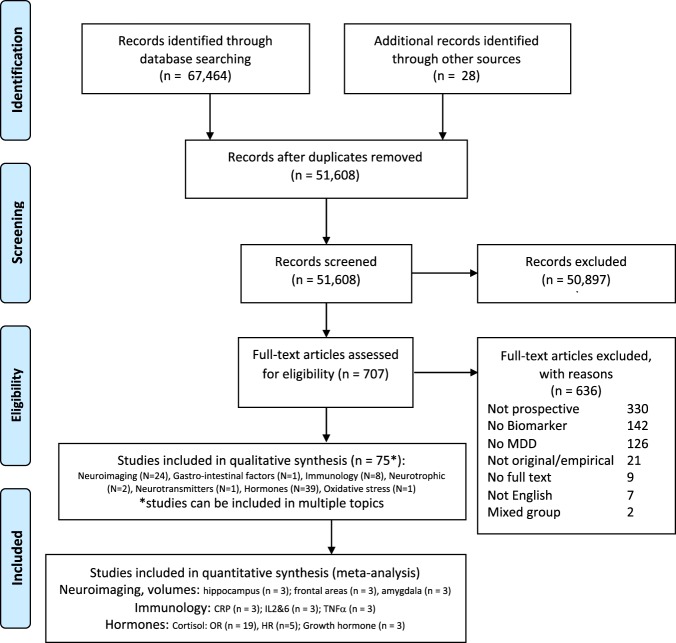
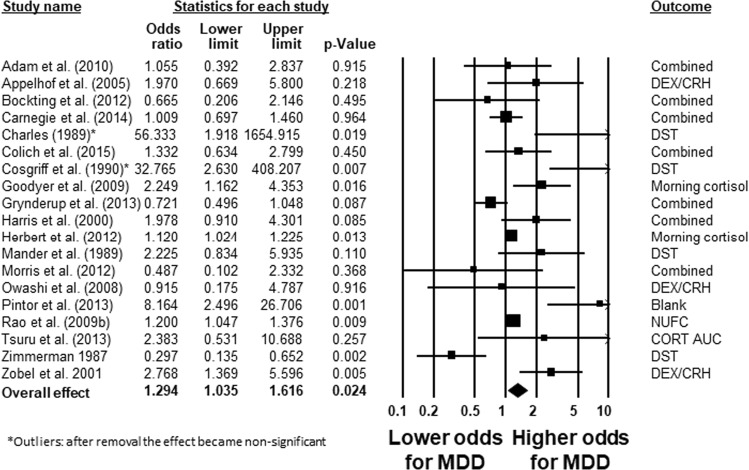
Leading biological hypotheses propose that biological changes may underlie major depressive disorder onset and relapse/recurrence. Here, we investigate if there is prospective evidence for biomarkers derived from leading theories. We focus on neuroimaging, gastrointestinal factors, immunology, neurotrophic factors, neurotransmitters, hormones, and oxidative stress. Searches were performed in Pubmed, Embase and PsychInfo for articles published up to 06/2019. References and citations of included articles were screened to identify additional articles. Inclusion criteria were having an MDD diagnosis as outcome, a biomarker as predictor, and prospective design search terms were formulated accordingly. PRISMA guidelines were applied. Meta-analyses were performed using a random effect model when three or more comparable studies were identified, using a random effect model. Our search resulted in 67,464 articles, of which 75 prospective articles were identified on: Neuroimaging (N = 24), Gastrointestinal factors (N = 1), Immunology (N = 8), Neurotrophic (N = 2), Neurotransmitters (N = 1), Hormones (N = 39), Oxidative stress (N = 1). Meta-analyses on brain volumes and immunology markers were not significant. Only cortisol (N = 19, OR = 1.294,p = 0.024) showed a predictive effect on onset/relapse/recurrence of MDD, but not on time until MDD onset/relapse/recurrence. However, this effect disappeared when studies including participants with a baseline clinical diagnosis were removed from the analyses. Other studies were too heterogeneous to compare. Thus, there is a lack of evidence for leading biological theories for onset and maintenance of depression. Only cortisol was identified as potential predictor for MDD, but results are influenced by the disease state. High-quality (prospective) studies on MDD are needed to disentangle the etiology and maintenance of MDD.
Overview
CoChat Summary
TL;DR
This systematic review and meta-analysis found scarce prospective evidence that leading biological biomarkers predict major depressive disorder onset, relapse, or recurrence. Only cortisol showed a small predictive effect, but it was confounded by baseline clinical depression, study quality, and possible publication bias.
Key findings
- From 67,464 screened articles, 75 prospective studies were identified: neuroimaging (N = 24), gastrointestinal factors (N = 1), immunology (N = 8), neurotrophic factors (N = 2), neurotransmitters (N = 1), hormones (N = 39), and oxidative stress (N = 1).
- Meta-analyses on brain volumes and immunology markers were not significant. Cortisol was the only significant predictor across comparable studies (N = 19, OR = 1.294, 95% CI [1.035–1.616], p = 0.024), but not for time until MDD onset/relapse/recurrence (HR = 1.011, 95% CI [0.963–1.040], p = 0.447).
- The cortisol effect disappeared when studies including participants with a baseline clinical MDD diagnosis were removed; it also became nonsignificant after removing outliers or low-quality studies, and publication-bias correction led to a nonsignificant effect.
- Only 38 studies excluded participants with baseline clinical MDD diagnosis, and most other biomarker findings were too heterogeneous or incidental to meta-analyze.
Methods
- Systematic review and meta-analysis following PRISMA, with searches in PubMed, Embase, and PsychInfo up to June 2019; inclusion required a prospective design, MDD diagnosis as outcome, and a biomarker from leading biological models as predictor.
- Random-effects meta-analyses were performed when three or more comparable studies were available, using odds ratio or risk ratio as summary effects; heterogeneity was assessed with Q-test and I², with sensitivity analyses, moderator analyses, and publication-bias assessment.
- The review included 75 prospective studies; 3,267 participants developed MDD over follow-up (median 3 years), and mean study quality score was 6.3 (median 6, range 3–9).
Limitations
- The paper states that included studies were often of poor quality, had small numbers of MDD cases at follow-up, and that neuroimaging studies used smaller samples than immunology and hormone studies.
- The authors did not correct for multiple testing; they note that such a correction would eliminate the cortisol effect, suggesting it may be a false positive.
- The paper states that heterogeneity was marked, many nonsignificant studies did not report sufficient data for meta-analysis, and this may have inflated odds ratios; results should be interpreted with caution.
- Evident from the text: many biomarker domains had fewer than three comparable studies or highly heterogeneous methods, precluding meta-analysis and limiting conclusions about most proposed biomarkers.
Model-written summary. Check it against the paper before relying on it.
Integrity signals
Registry
Cites
Statistics
Figures
Verification
Claims the paper makes
3 Valid · 4 Not valid · 41 Not checked · 86 Own results and interpretations
The cited sources support only part of this claim — read each source’s verdict below.
In the paper
“Incidental structural MRI studies reported that both smaller and larger insula volume was significantly related to MDD development in two studies [51,91].”
§ Prospective biomarkers of major depressive disorder: a systematic review and meta-analysis > Neuroimaging
What the sources say
- Partly supportedcites [51] 51. Foland-Ross LC, Sacchet MD, Prasad G, Gilbert B, Thompson PM, Gotlib IH. Cortical thickness predicts the first onset of major depression in adolescence. Int J Dev Neurosci. 2015;46:125-31.* sourceExperimental — accuracy not yet measured
Our copy supports the 'larger insula' side of the claim: Results > Neuroanatomic Classification reports that gray matter of the left insula was significantly thicker in girls who converted to depression (3.09 vs 2.94 mm, uncorrected p = 0.015), and the Discussion states that 'increased insula thickness predicted the onset of depression'. The Discussion also notes the opposing direction from other work (Belden et al., 2015, smaller insula volumes associated with subsequent depression in preschool children; Koolschijn et al., 2009, MDD-associated reductions in insula volume), so the two-directional framing is present. However, this study's own measure is cortical gray matter thickness, not insula volume — the Methods state thickness was chosen precisely because it is less influenced by surface area than volume and list volume as an alternative measure not used here — and its finding is an exploratory, uncorrected post-hoc test in a small sample of at-risk adolescent girls, so attributing 'insula volume' to this source overstates it. (LLM, conf=0.72)
- Could not verifycites [91] 91. Rao U, Chen L-A, Bidesi AS, Shad MU, Thomas MA, Hammen CL. Hippocampal changes associated with early-life adversity and vulnerability to depression. Biol Psychiatry. 2010;67:357-64.* sourceExperimental — accuracy not yet measured
Our copy of Rao et al. (2010) is entirely about hippocampal volume (and total brain volume) measured by manual tracing on 1.5T structural MRI in at-risk and depressed adolescents; the Methods (MRI section) state only left hippocampus, right hippocampus and TBV were traced, and the Results/Discussion report only hippocampal findings. No passage in the prompt or returned by searches for 'insula volume major depressive disorder' and 'insula insular cortex gray matter brain region volume' mentions the insula or insular volume at all, so this paper neither supports nor contradicts the attributed claim about smaller and larger insula volume relating to MDD development. (LLM, conf=0.70)
plainstates an association- Asserted: passes — The authors put it forward as true.
- Checkable: passes — It can be checked against evidence.
- Load-bearing: unclear — It is unclear whether the paper’s conclusions depend on it.
- Based: passes — The paper gives a reason why it holds.
- Partly supported
The sources with a verdict support this claim; the rest weren’t checked yet, have no full text we could read, or their verdicts aren’t rated yet.
In the paper
“No significant predictive value of the amygdala volume was found in three studies investigating two unique samples [53,54,74].”
§ Prospective biomarkers of major depressive disorder: a systematic review and meta-analysis > Neuroimaging
What the sources say
- Not checked yetcites [53] 53. Frodl T, Meisenzahl EM, Zetzsche T, Höhne T, Banac S, Schorr C, et al. Hippocampal and amygdala changes in patients with major depressive disorder and healthy controls during a 1-year follow-up. J Clin Psychiatry. 2004;65:492-9.* source
- Supportedcites [54] 54. Frodl T, Jäger M, Smajstrlova I, Born C, Bottlender R, Palladino T, et al. Effect of hippocampal and amygdala volumes on clinical outcomes in major depression: a 3-year prospective magnetic resonance imaging study. J Psychiatry Neurosci. 2008;33:423-30.* source
Our copy of Frodl et al. (2008) reports exactly the null predictive finding attributed to it: in the Results section (p. 426) 'Amygdala volume was not affected by remission status (F1–26 = 0.16, p = 0.69)' and patients with larger baseline amygdala volumes 'did not have significantly lower HDRS scores at 1, 2 and 3 years (F1–25 = 0.74, p = 0.40)', with no significant correlation between HDRS scores and amygdala volumes at baseline, discharge or 3-year follow-up. The aggregation into 'three studies investigating two unique samples' is the citing authors' synthesis across references 53, 54 and 74 and is not something this single source is asked to carry; the part attributed to this paper — a study showing no significant predictive value of amygdala volume for clinical outcome in major depression — is stated here. (LLM, conf=0.88)
- Supportedcites [74] 74. Little K, Olsson CA, Whittle S, Youssef GJ, Byrne ML, Sim- mons JG, et al. Association between serotonin transporter genotype, brain structure and adolescent-onset major depressive disorder: a longitudinal prospective study. Transl Psychiatry. 2014;4:e445.* source
Our copy of Little et al. (2014) reports exactly this null finding: the Results state that '5-HTTLPR did not predict left or right amygdala volume ... nor were these volumes related to risk for MDD onset' (Results, mediation/ROI section), and the Discussion opens by noting 'the lack of evidence supporting amygdala volume as an intermediate phenotype between serotonin transporter gene and depression onset' (Discussion). The 'three studies investigating two unique samples' aggregation spans the other two citations in the sentence and is the citing authors' framing, not something this source must state; the part attributed to this paper — a prospective adolescent study finding no significant predictive value of amygdala volume for depression onset — is fully supported. (LLM, conf=0.85)
plainn = 2- Asserted: passes — The authors put it forward as true.
- Checkable: passes — It can be checked against evidence.
- Load-bearing: unclear — It is unclear whether the paper’s conclusions depend on it.
- Based: passes — The paper gives a reason why it holds.
The cited sources support only part of this claim — read each source’s verdict below.
In the paper
“These studies showed that MDD development was predicted by: lower activity in the frontal lobe in various contexts ( [39] reward task lossgain contrast [83]; rest [71,82]; go/nogo task, errors; [31] pre-vs posttryptophan depletion), higher activity in the insula ( [99] sentence completion increasing in difficulty), higher subgenual anterior cingulate cortex (ACC) temporal and striatal connectivity”
§ Prospective biomarkers of major depressive disorder: a systematic review and meta-analysis > Neuroimaging
What the sources say
- Not checked yetcites [39] 39. Bress JN, Foti D, Kotov R, Klein DN, Hajcak G. Blunted neural response to rewards prospectively predicts depression in ado- lescent girls. Psychophysiology. 2013;50:74-81.* source
- Not checked yetcites [83] 83. Nusslock R, Shackman AJ, Harmon-Jones E, Alloy LB, Coan JA, Abramson LY. Cognitive vulnerability and frontal brain asymmetry: common predictors of first prospective depressive episode. J Abnorm Psychol. 2011;120:497-503.* source
- Partly supportedcites [71] 71. Langenecker SA, Jenkins LM, Stange JP, Chang Y-S, DelDonno SR, Bessette KL, et al. Cognitive control neuroimaging measures differentiate between those with and without future recurrence of depression. Neuroimage Clin. 2018;20:1001-9.* sourceExperimental — accuracy not yet measured
Our copy is a Parametric Go/No-Go fMRI study and it does support the frontal-activation part of the attributed point: in Results > Failed regulation (commission errors of No-Go lures), 'hMDD-Recurrence had lower activation of bilateral MFG for Commissions compared to the Healthy Comparison group and the hMDD-Resilience group,' echoed in the Abstract (Results) as 'less bilateral middle frontal gyrus activation during commission errors' in the recurrence group. What it does not support is the claim's framing of 'MDD development was predicted': the sample is remitted young adults (18-23) with existing history of MDD followed for future recurrence, not first-onset/development of MDD (Introduction; Methods > Participants), and the paper reports cross-sectional group differentiation rather than a tested predictor — the Discussion states the CCN metrics 'could be tested in models in the future, even if these models are now at the initial development stage,' and the Conclusion only says markers 'could identify those with early course MD who are at risk for depression recurrence,' with future validation needed. So the go/nogo-errors frontal finding is in the source; the developmental-onset prediction framing is not. (LLM, conf=0.78)
plainstates an association- Asserted: passes — The authors put it forward as true.
- Checkable: passes — It can be checked against evidence.
- Load-bearing: passes — The paper’s conclusions depend on it.
- Based: passes — The paper gives a reason why it holds.
A result the paper states — it cites no source for it, so there is none to check. The quote shows it is in the paper.
In the paper
“However, due to overlap in study samples and heterogeneity in methods applied (e.g.tasks, regions of interest), meta-analysis could only be performed on some hippocampus, amygdala and frontal brain area volumes (see Table 1 and Supplementary Fig. 2).”
§ Prospective biomarkers of major depressive disorder: a systematic review and meta-analysis > Neuroimaging
hedgedstates a cause- Asserted: passes — The authors put it forward as true.
- Checkable: passes — It can be checked against evidence.
- Load-bearing: passes — The paper’s conclusions depend on it.
- Based: passes — The paper gives a reason why it holds.
A result the paper reports from its own data — it cites no other source for it, so there is none to check. The quote shows it is in the paper.
In the paper
“Overall, 75 prospective articles were identified on: Neuroimaging (N = 24), Gastrointestinal factors (N = 1), Immunology/inflammation (N = 8), Neurotrophic (N = 2), Neurotransmitters (N = 1), Hormones (N = 39), and Oxidative stress (N = 1).”
§ Prospective biomarkers of major depressive disorder: a systematic review and meta-analysis > Search results and quality assessment
plain- Asserted: passes — The authors put it forward as true.
- Checkable: passes — It can be checked against evidence.
- Load-bearing: unclear — It is unclear whether the paper’s conclusions depend on it.
- Based: passes — The paper gives a reason why it holds.
62 more claims
Create a free account to see all 134 claims and to verify the 72 references still open.
- It may state two separate claims as one. 42
- Probably not a substantial claim. 31
- The quote only partly states this claim. 2
Claims other papers make about this one
Each is checked against this paper’s own text: does it say what the citing paper says it does?
The source backs part of the claim, not all of it — or backs it for a different population, condition or comparison.
In the citing paper
“Recent research has shown a link between decreased hippocampal neurogenesis and low levels of BDNF and glial-derived neurotrophic factor (GDNF) in the brains of depressed individuals. 145”
From Major depressive disorder: hypothesis, mechanism, prevention and treatment (2024) · cites this paper as [145]
Experimental — accuracy not yet measuredThe source backs part of the claim, not all of it — or backs it for a different population, condition or comparison.
In the citing paper
“These concerns include overreliance on cross-sectional methodologies, a lack of consensus on what constitutes recurrence, and grouping all individuals with MDD together instead of differentiating subgroups using key characteristics of the disorder (e.g., single verse recurrent episodes) [3, 6–8].”
From Fear of depression recurrence among individuals with remitted depression: a qualitative interview study (2024) · cites this paper as [6]
Experimental — accuracy not yet measuredThe cited source says what the claim attributes to it.
In the citing paper
“The dataset used in this study comes from a systematic review-based meta-analysis focusing on the evidence for leading psychological and biological theories on the onset, maintenance, and relapse of depressive disorders (Brouwer et al., 2019; Kennis et al., 2020; Fu et al., 2021).”
From Active learning-based systematic reviewing using switching classification models: the case of the onset, maintenance, and relapse of depressive disorders (2023) · cites this paper as Kennis et al., 2020
The cited source says what the claim attributes to it.
In the citing paper
“A review exploring prospective biomarkers (e.g., hormones, oxidative stress) in MDD recurrence found that cortisol significantly increased odds for MDD onset and relapse [6].”
From Fear of depression recurrence among individuals with remitted depression: a qualitative interview study (2024) · cites this paper as [6]
The cited source says what the claim attributes to it.
In the citing paper
“It is crucial to highlight the results in a recent meta-analysis, which found that cortisol was the only biological marker that increased the odds for both the onset and relapse/recurrence of MDD [35].”
From Stress and serum cortisol levels in major depressive disorder: a cross-sectional study (2020) · cites this paper as [35]
6 more claims about this paper
Create a free account to see every claim other papers make about this one.
Self-check
Percentages, sums and reported differences re-computed from the paper’s own numbers.
Each contradiction between two passages listed here was confirmed by an independent check.
Rated major: it would touch a result — a value a result rests on, reported and recomputed p-values on opposite sides of the significance level, two passages that conflict with no sign which is right, or a cited work retracted before this paper was published.
In the paper
§ Prospective biomarkers of major depressive disorder: a systematic review and meta-analysis > Immunology
“↑ heat-shock protein 70, 3nitrotyrosine, protein carbonyl, and lipid peroxidation ↓BDNF”
§ Prospective biomarkers of major depressive disorder: a systematic review and meta-analysis > Oxidative stress
“No significant differences between these groups were found for protein carbon and thiol content.”
Rated major: it would touch a result — a value a result rests on, reported and recomputed p-values on opposite sides of the significance level, two passages that conflict with no sign which is right, or a cited work retracted before this paper was published.
In the paper
§ Prospective biomarkers of major depressive disorder: a systematic review and meta-analysis > HPA axis
“OR = 1.919”
§ Prospective biomarkers of major depressive disorder: a systematic review and meta-analysis > HPA axis
“95% CI [1.072 1.231]”
Rated minor: it would not touch a result — a value no result rests on, a p-value that stays on the same side of the significance level, or a conflict that is clerical, resolved elsewhere in the paper, or outside its own findings.
In the paper
“19 studies had a very low risk of bias (>6 quality score), 26 studies had some risk of bias (5-6 quality score), and 8 studies had high risk of bias (4 or lower quality score).”
§ Prospective biomarkers of major depressive disorder: a systematic review and meta-analysis > Search results and quality assessment
Reported 75 · recomputed 53
Citations
Cites
Preferred Reporting Items for Systematic Reviews and Meta-Analyses: the PRISMA statement
Moher, D., Liberati, A., Tetzlaff, J., Altman, D. G., & for the PRISMA Group (2009) · BMJ · doi:10.1136/bmj.b2535 · Cited by 83,823
Preferred Reporting Items for Systematic Reviews and Meta-Analyses: The PRISMA Statement
Moher, D., Liberati, A., Tetzlaff, J., Altman, D. G., & The PRISMA Group (2009) · PLoS Medicine · doi:10.1371/journal.pmed.1000097 · Cited by 64,042 · cited 2×
“Methods Search process and study selection The study was performed according to Preferred Reporting Items for Systematic Reviews and Meta-Analyses statement (PRISMA [24]; see Appendices A and B for search terms and flow charts and Appendix C for PRISMA checklist).”
Bias in meta-analysis detected by a simple, graphical test
Egger, M., Smith, G. D., Schneider, M., & Minder, C. (1997) · BMJ · doi:10.1136/bmj.315.7109.629 · Cited by 56,722 · cited 1×
“Publication bias was also assessed using Egger’s test for asymmetry [28] of the funnel plot and Duval and Tweedie’s trim and fill procedure [29].”
MethodPreferred reporting items for systematic reviews and meta-analyses: the PRISMA Statement.
(2009) · PubMed Central · Cited by 44,859
Preferred reporting items for systematic reviews and meta-analyses: The PRISMA statement
Moher, D., Liberati, A., Tetzlaff, J., Altman, D. G., & the PRISMA Group* (2009) · Annals of Internal Medicine · doi:10.7326/0003-4819-151-4-200908180-00135 · Cited by 37,554
Quantifying heterogeneity in a meta‐analysis
Higgins, J. P. T., & Thompson, S. G. (2002) · Statistics in Medicine · doi:10.1002/sim.1186 · Cited by 36,763 · cited 1×
“Heterogeneity was assessed with the Qtest and I(2) statistic [27].”
MethodDuval, S., & Tweedie, R. (2000) · Biometrics · doi:10.1111/j.0006-341x.2000.00455.x · Cited by 14,099 · cited 1×
“Publication bias was also assessed using Egger’s test for asymmetry [28] of the funnel plot and Duval and Tweedie’s trim and fill procedure [29].”
MethodKessler, R. C., Chiu, W. T., Demler, O., & Walters, E. E. (2005) · Archives of General Psychiatry · doi:10.1001/archpsyc.62.6.617 · Cited by 12,052 · cited 1×
“Introduction Major depressive disorder (MDD) is a disabling disorder that is amongst the most prevalent mental health disorders worldwide [1, 2] and is highly recurrent [3–5].”
BackgroundGRADE guidelines: 1. Introduction—GRADE evidence profiles and summary of findings tables
Guyatt, G., Oxman, A. D., Akl, E. A., Kunz, R., Vist, G., Brozek, J., Norris, S., Falck-Ytter, Y., Glasziou, P., & deBeer, H. (2011) · Journal of Clinical Epidemiology · doi:10.1016/j.jclinepi.2010.04.026 · Cited by 10,681 · cited 1×
“The quality of included studies was assessed by two team members according to a minimally adjusted version of the GRADE guidelines on study level [25].”
MethodDepression, chronic diseases, and decrements in health: results from the World Health Surveys
Moussavi, S., Chatterji, S., Verdes, E., Tandon, A., Patel, V., & Ustun, B. (2007) · The Lancet · doi:10.1016/s0140-6736(07)61415-9 · Cited by 4,070 · cited 1×
“Introduction Major depressive disorder (MDD) is a disabling disorder that is amongst the most prevalent mental health disorders worldwide [1, 2] and is highly recurrent [3–5].”
Background
Cited by
Items 101–200 of 518
Liu, R., Sun, D., Xing, X., Chen, Q., Lu, B., Meng, B., Yuan, H., Mo, L., Zheng, J., Zheng, J., et al. (2023) · Neuropharmacology · doi:10.1016/j.neuropharm.2023.109769 · Cited by 24
Demchenko, I., Swiderski, A., Liu, H., Jung, H. J., Lou, W. Y. W., & Bhat, V. (2024) · Toxins · doi:10.3390/toxins16040191 · Cited by 24
Lüno, M., Dobrowolny, H., Gescher, D. M., Gbaoui, L., Meyer-Lotz, G., Hoeschen, C., & Frodl, T. (2022) · Frontiers in Psychiatry · doi:10.3389/fpsyt.2022.819607 · Cited by 23
“In a recent meta-analysis on prospective studies that aimed to predict MDD onset, relapse and recurrence by imaging, genetic information, inflammation markers, and hormone markers, only cortisol was detected to be a significant predictor (6).”
BackgroundCohen, S. E., Zantvoord, J. B., Wezenberg, B. N., Daams, J. G., Bockting, C., Denys, D. A. J. P., & van Wingen, G. A. (2022) · Journal of Affective Disorders · doi:10.1016/j.jad.2022.10.042 · Cited by 24
Self-citationExercise as Treatment for “Stress-Related” Mental Disorders
Bendau, A., Petzold, M. B., Kaminski, J., Plag, J., & Ströhle, A. (2023) · Current Neuropharmacology · doi:10.2174/1570159x22666230927103308 · Cited by 23
“Further, it is crucial to consider the baseline level of activity, knowledge, and experience to foster realistic goals and to increase physical activity gradually to avoid physical overstraining and psychological frustration [2-4, 25, 53].”
BackgroundPharmacogenetic‐based management of depression: Role of traditional Persian medicine
Jalali, A., Firouzabadi, N., & Zarshenas, M. M. (2021) · Phytotherapy Research · doi:10.1002/ptr.7134 · Cited by 23
Broeks, C. W., Molenaar, N. M., Brouwer, M. E., van den Akker, E. L. T., van Rossum, E. F. C., Van, R., van den Berg, S. A. A., Hillegers, M. H. J., Hoogendijk, W. J. G., Burger, H., et al. (2023) · Comprehensive Psychoneuroendocrinology · doi:10.1016/j.cpnec.2023.100167 · Cited by 23
Self-citationEstablishing a research agenda for the study and assessment of opioid withdrawal
Dunn, K. E., & Strain, E. C. (2024) · The Lancet Psychiatry · doi:10.1016/s2215-0366(24)00068-3 · Cited by 22
Chronic mild stress disrupts mitophagy and mitochondrial status in rat frontal cortex
Ulecia-Morón, C., Bris, Á. G., MacDowell, K. S., Madrigal, J. L. M., García‐Bueno, B., Leza, J. C., & Caso, J. R. (2025) · Journal of Translational Medicine · doi:10.1186/s12967-025-06604-1 · Cited by 22
“A meta-analysis study found that patients with major depressive disorder (MDD) had elevated levels of cortisol, the stress hormone, in response to psychosocial stress in comparison to healthy controls [17, 18].”
Hill, K., Gardus, J. D., Bartlett, E. A., Perlman, G., Parsey, R. V., & DeLorenzo, C. (2021) · NeuroImage Clinical · doi:10.1016/j.nicl.2021.102858 · Cited by 21
Association of circulating let-7b-5p with major depressive disorder: a nested case-control study
Roumans, S., Sundquist, K., Memon, A. A., Hedelius, A., Sundquist, J., & Wang, X. (2021) · BMC Psychiatry · doi:10.1186/s12888-021-03621-4 · Cited by 22
“As of today, clinical suspicion is still the key for the diagnosis of MDD [3] as the underlying pathophysiology and aetiology of depression remain poorly understood [4].”
BackgroundYılmaz, N. S., Şen, B., Karadag, R. F., Aslan, S., Ertek, İ. E., Bozkurt, A., Çiçek, S., Bolu, A., Ucar, H., Koçak, C., et al. (2022) · Journal of Neural Transmission · doi:10.1007/s00702-022-02553-x · Cited by 21
“Several biomarkers have been investigated regarding neurotrophic factors, neurotransmitters, gut microbiome, hormones, oxidative stress, neuroimaging, microRNAs, immune system, and cytokines (Kennis et al. 2020; Williams et al. 2021).”
BackgroundZhang, W., Liu, W., Liu, S., Su, F., Kang, X., Ke, Y., & Ming, D. (2022) · Clinical Neurophysiology · doi:10.1016/j.clinph.2022.11.013 · Cited by 21
“, 2020), leading to low rates of diagnosis and treatment (Kennis et al., 2020).”
BackgroundThe connexin hemichannel inhibitor D4 produces rapid antidepressant-like effects in mice
Li, H., Guo, A., Salgado, M., Sáez, J. C., & Lau, C. G. (2023) · Journal of Neuroinflammation · doi:10.1186/s12974-023-02873-z · Cited by 21
“The pathogenesis of depression is highly heterogeneous and is associated with intricate interplays across multiple neurotransmitter systems, neuroimmune systems, neural circuity, and brain networks [70–72].”
BackgroundGao, J., Chen, M., Xiao, D., Li, Y., Zhu, S., Li, Y., Dai, X., Lu, F., Wang, Z., Cai, S., et al. (2022) · Cerebral Cortex · doi:10.1093/cercor/bhac217 · Cited by 21
Moshfeghinia, R., Kavari, K., Mostafavi, S., Sanaei, E., Farjadian, S., & Javanbakht, A. (2025) · Journal of Affective Disorders · doi:10.1016/j.jad.2025.05.031 · Cited by 20
The neuroendocrine modulation of global DNA methylation in neuropsychiatric disorders
Müller, D., Grevet, E. H., da Silva, B. S., Charão, M. F., Rovaris, D. L., & Bau, C. H. D. (2020) · Molecular Psychiatry · doi:10.1038/s41380-020-00924-y · Cited by 20
Hu, H., Zarate, C. A., & Verbalis, J. G. (2024) · Psychiatry and Clinical Neurosciences · doi:10.1111/pcn.13703 · Cited by 20
Zhang, G., Xu, S., Yuan, Z., & Shen, L. (2020) · Neuropsychiatric Disease and Treatment · doi:10.2147/ndt.s244452 · Cited by 21
“mood, lack of motivation, retraction from social interaction, altered patterns of sleep and appetite, cognitive difficulties and, at its worst, suicidal tendency.(1,2) Correspondence: Guangyin Zhang Department of Psychosomatic Medicine, First Teaching Hospital of Tianjin University of Traditional Chinese Medicine, No.”
BackgroundCholewinski, T., Pereira, D., Moerland, M., & Jacobs, G. E. (2021) · Therapeutic Advances in Psychopharmacology · doi:10.1177/20451253211036814 · Cited by 20
Buchmann, A., Ritter, C. J., Müller, S. T., Haynes, M., Ghisleni, C., Tuura, R., & Hasler, G. (2022) · Journal of Affective Disorders · doi:10.1016/j.jad.2022.02.017 · Cited by 20
Feeney, J. C., & Kenny, R. A. (2022) · Psychoneuroendocrinology · doi:10.1016/j.psyneuen.2022.105847 · Cited by 21
Milic, J., Jovic, S., & Sapic, R. (2025) · Genes · doi:10.3390/genes16050487 · Cited by 19
“Here is a refined version that clearly states that while the area has been well-studied, the evidence so far has not been robust or conclusive, and highlights the direction future research should take [95].”
Xie, Y., Xiao, L., Chen, L., Zheng, Y., Zhang, C., & Wang, G. (2021) · Genes · doi:10.3390/genes12020178 · Cited by 19
Systematic reviews and meta-analyses on major depressive disorder: a bibliometric perspective
Chen, P., Feng, Y., Li, X.-H., Li, J., Wang, Y., Zheng, W.-Y., Su, Z., Cheung, T. C. C., Ungvari, G. S., Ng, C. H., et al. (2023) · Frontiers in Psychiatry · doi:10.3389/fpsyt.2023.1136125 · Cited by 19
Zhang, S., She, S., Qiu, Y., Li, Z., Wu, X., Hu, H., Zheng, W., Huang, R., & Wu, H. (2023) · NeuroImage Clinical · doi:10.1016/j.nicl.2023.103468 · Cited by 19
“Several hypotheses involving the monoamine, hypothalamic–pituitary–adrenal axis, inflammation, neuroplasticity, genes, and brain structural/functional changes have been proposed to understand the pathophysiology of depression (Jeon & Kim, 2016; Kennis et al., 2020; Kupfer et al., 2012; Malhi & Mann, 2018; Miller & Rai…”
Backgroundvan Os, J., & Köhne, A. C. J. (2021) · Psychological Medicine · doi:10.1017/s0033291721000167 · Cited by 19
“However, the scientific basis for this is lacking, both conceptually and meta-analytically (e.g. Kennis et al., 2020).”
BackgroundKim, J., Kang, H., Kim, J., Jhon, M., Choi, W., Lee, J., Kim, S., Shin, I., Kim, M., & Stewart, R. J. (2022) · Brain Behavior and Immunity · doi:10.1016/j.bbi.2022.05.012 · Cited by 19
Karl, M., Huth, V., Schälicke, S., Müller-Stark, C., Weise, V., Mack, J. T., Kirschbaum, C., Weidner, K., Garthus‐Niegel, S., & Steudte‐Schmiedgen, S. (2022) · Psychoneuroendocrinology · doi:10.1016/j.psyneuen.2022.105952 · Cited by 19
Biomarker innovations in precision psychiatry diagnostics and treatment strategies
Kas, M. J., Kim, Q., Sand, M. S., Kozak, R., Tunbridge, E. M., Oquendo, M. A., Tamminga, C. A., Koutsouleris, N., Knudsen, G. M., Penninx, B. W. J. H., et al. (2026) · European Neuropsychopharmacology · doi:10.1016/j.euroneuro.2026.112762 · Cited by 20
More, S. M., Kaleem, M., Kharwade, R., Almutairy, A. F., Shahzad, N., Mujtaba, M. A., Taha, M., Pise, A. G., Zafar, A., & Mahmood, D. (2024) · Brain Research · doi:10.1016/j.brainres.2024.149313 · Cited by 18
Clair, D. S., MacLennan, G., Beedie, S. A., Nouzová, E., Lemmon, H. A., Rujescu, D., Benson, P. J., McIntosh, A. M., & Nath, M. (2021) · Schizophrenia Bulletin Open · doi:10.1093/schizbullopen/sgac032 · Cited by 18
Yang, L., Yang, X., Yang, T., Wu, X., Sun, P., Zhu, Y., Su, Y., Gu, W., Qiu, H. X., Wang, J., et al. (2021) · Psychiatry Research · doi:10.1016/j.psychres.2021.114205 · Cited by 17
Adeno-Associated Viruses for Modeling Neurological Diseases in Animals: Achievements and Prospects
Lunev, E. A., Karan, A. A., Egorova, T. V., & Bardina, M. V. (2022) · Biomedicines · doi:10.3390/biomedicines10051140 · Cited by 17
Longitudinal hair cortisol in bipolar disorder and a mechanism based on HPA dynamics
Milo, T., Maimon, L., Cohen, B., Haran, D., Segman, D., Danon, T., Bren, A., Mayo, A., Rappaport, G. C., McInnis, M. G., et al. (2024) · iScience · doi:10.1016/j.isci.2024.109234 · Cited by 17
“37,60 We recently applied the HPA gland-mass model to understand the timescale of weeks of MDD.”
MethodTowards a consensus roadmap for a new diagnostic framework for mental disorders
Kas, M. J., Hyman, S. E., Williams, L. M., Hidalgo‐Mazzei, D., Huys, Q. J. M., Hotopf, M. H., Cuthbert, B. N., Lewis, C. M., Picker, L. D., Lalousis, P. A., et al. (2024) · European Neuropsychopharmacology · doi:10.1016/j.euroneuro.2024.08.515 · Cited by 17
“Despite the extensive research in biological biomarkers during the last decades, there are no available objective tools in clinical settings for diagnosing, monitoring illness activity or response to treatment assessment in mood disorders (Kennis et al., 2020).”
BackgroundSun, L., Wang, P., Zheng, Y., Wang, J., Wang, J., & Xue, S. (2025) · Journal of Affective Disorders · doi:10.1016/j.jad.2025.02.033 · Cited by 17
Parsing Clinical and Neurobiological Sources of Heterogeneity in Depression
Hannon, K., Easley, T. O., Zhang, W., Lew, D., Sotiras, A., Sheline, Y. I., Marquand, A. F., Barch, D. M., & Bijsterbosch, J. D. (2025) · Biological Psychiatry · doi:10.1016/j.biopsych.2025.04.025 · Cited by 17
“However, these fi ndings have suffered from inconsistencies in the reported results (5,7) and/or small magnitude of effects (8).”
MDD-LLM: Towards accuracy large language models for major depressive disorder diagnosis
Sha, Y., Pan, H., Xu, W., Meng, W., Luo, G., Du, X., Zhai, X., Tong, H. H. Y., Shi, C., & Li, K. (2025) · Journal of Affective Disorders · doi:10.1016/j.jad.2025.119774 · Cited by 17
Sun, S., Liu, L., Shao, X., Yan, C., Li, X., & Hu, B. (2022) · IEEE Transactions on Neural Systems and Rehabilitation Engineering · doi:10.1109/tnsre.2022.3181690 · Cited by 17
“Depression includes a variety of symptoms and signs, physical aspects mainly include sleep disturbance, appetite changes, fatigue, slow psychomotor and agitation, while psychological aspects mostly contain loss of self-esteem, feelings of guilt, inability to concentrate, and thoughts of suicide and self-harm, etc [2].”
BackgroundAlnsasra, H., Khalil, F. M., Perue, R. K., & Azab, A. N. (2023) · International Journal of Molecular Sciences · doi:10.3390/ijms241411270 · Cited by 17
“The etiology and pathophysiological mechanisms underlying depression are not fully understood [8,9].”
BackgroundCan Molecular Biology Propose Reliable Biomarkers for Diagnosing Major Depression?
Ivanets, N. N., Svistunov, A. А., Chubarev, V. N., Kinkulkina, M. A., Tikhonova, Y. G., Syzrantsev, N. S., Sologova, S. S., Ignatyeva, N. V., Mutig, K., & Tarasov, V. V. (2020) · Current Pharmaceutical Design · doi:10.2174/1381612826666201124110437 · Cited by 18
Difficult lives explain depression better than broken brains
Moncrieff, J., Cooper, R. E., Stockmann, T., Amendola, S., Hengartner, M. P., & Horowitz, M. A. (2024) · Molecular Psychiatry · doi:10.1038/s41380-024-02462-3 · Cited by 17
“…another biological cause for depression will be found, studies from neuro-imaging [8], research on speci fi c genes [9, 10] and hypothesised markers of depression from existing neurochemical and hormonal theories [11] have not returned convincing or consistent evidence of a biological abnormality.”
Farb, N. A. S., Desormeau, P., Anderson, A. K., & Segal, Z. V. (2022) · NeuroImage: Clinical · doi:10.1016/j.nicl.2022.102969 · Cited by 16
“In contrast to the literature on acute phase treatment, where promising response indicators have been identified (4–6), efforts to improve clinical prognosis following MDD episode have yielded few indicators of sustained remission (7).”
Pathogenesis and therapeutic strategies for cancer-related depression
Liu, M. (2024) · American Journal of Cancer Research · doi:10.62347/wvvg5364 · Cited by 16
Harlev, D., Singer, S., Goldshalger, M., Wolpe, N., & Bergmann, E. (2025) · Alzheimer s & Dementia Diagnosis Assessment & Disease Monitoring · doi:10.1002/dad2.70055 · Cited by 16
Dagher, M., Cahill, C. M., & Andrews, A. M. (2025) · Pharmacological Reviews · doi:10.1016/j.pharmr.2025.100046 · Cited by 16
“Increased neu-roin fl ammation and dysfunctional HPA axis signaling could be used as biomarkers, which would allow for tangible monitoring of mood and anxiety disorders, although more research is needed (Kennis et al, 2020).”
The nature of the relation between mental well-being and ill-being
Tamnes, C. K., Bekkhus, M., Eilertsen, M., Nes, R. B., Prydz, M. B., Ystrøm, E., Aksnes, E. R., Andersen, S. N., Ask, H., Ayorech, Z., et al. (2025) · Nature Human Behaviour · doi:10.1038/s41562-025-02319-x · Cited by 16
“The directions of these associations were the inverse of what has been found for these markers in depression 56,57 , suggesting shared biological mechanisms underlying ill-being and well-being.”
Teijema, J. J., Hofstee, L., Brouwer, M., de Bruin, J., Ferdinands, G., de Boer, J., Siso, P. V., van den Brand, S. A. G. E., Bockting, C., van de Schoot, R., et al. (2022) · doi:10.31234/osf.io/t7bpd · Cited by 14
Self-citationLi, Y., Qian, L., Li, G., & Zhang, Z. (2023) · Frontiers in Neuroscience · doi:10.3389/fnins.2023.1200029 · Cited by 15
“A decreased causal influence from the CEN to the SN might suggest an impaired top-down regulation of emotional processing in MDD patients, potentially contributing to the affective symptom characteristic of the disorder (Kennis et al., 2020).”
BackgroundFreichel, R., Lenartowicz, A., Douw, L., Kruschwitz, J., Banaschewski, T., Barker, G. J., Bokde, A. L. W., Desrivières, S., Flor, H., Grigis, A., et al. (2024) · Journal of Affective Disorders · doi:10.1016/j.jad.2024.05.060 · Cited by 16
Bodnaruc, A. M., Roberge, M., Giroux, I., & Aguer, C. (2024) · Endocrines · doi:10.3390/endocrines5040035 · Cited by 16
“More specifically, one meta-analysis has shown that higher morning cortisol levels specifically are associated with a higher prospective risk of MDD in adult populations [40].”
Yu, H., Li, R., Liang, X., Yang, W., Guo, L., Liu, L., Tan, Q., & Peng, Z. (2024) · BMC Psychiatry · doi:10.1186/s12888-024-06277-y · Cited by 15
Shi, H., Huang, L., Wang, Q., Zhang, N., Lv, C., Lin, C., Shao, L., Xia, D., Zhao, Z., Yang, G., et al. (2025) · International Journal of Surgery · doi:10.1097/js9.0000000000003030 · Cited by 15
Hong, X., Zhang, L., & Zha, J. (2022) · Environmental Pollution · doi:10.1016/j.envpol.2022.119175 · Cited by 15
Medina-Rodriguez, E. M., Rice, K. C., Beurel, E., & Jope, R. S. (2020) · Brain Behavior and Immunity · doi:10.1016/j.bbi.2020.08.022 · Cited by 15
Functional neuroimaging biomarkers of resilience in major depressive disorder
Fischer, A. S., Hagan, K. E., & Gotlib, I. H. (2021) · Current Opinion in Psychiatry · doi:10.1097/yco.0000000000000662 · Cited by 15
“[9]); rarely do they focus on resilience to MDD.”
BackgroundBattini, V., Carnovale, C., Clementi, E., & Sessa, M. (2023) · Expert Opinion on Drug Safety · doi:10.1080/14740338.2023.2223958 · Cited by 14
“CGRP is therefore hypothesized to regulate hypothalamic– pituitary tract functions, whose alteration is suggested to be implicated in the pathophysiology of major depressive disorders [18,19].”
BackgroundLevchuk, L. A., Roschina, O. V., Викторовна, М. Е., Epimakhova, E. V., Simutkin, G. G., Bokhan, N. A., & Ivanova, S. А. (2023) · Journal of Personalized Medicine · doi:10.3390/jpm13091423 · Cited by 14
“Depressive Disorders (DD) are a diverse group of disabling disorders that are the most common psychiatric pathology worldwide and highly recurrent [1].”
BackgroundBranchi, I. (2024) · European Journal of Neuroscience · doi:10.1111/ejn.16331 · Cited by 14
“Accordingly, biological markers predictive of mental disorders, such as major depression, have not yet been identified and current results are not yet useful for clinical practice (Carvalho et al., 2020; Kennis et al., 2020; Stein et al., 2022).”
The Iatrogenic Consequences of Medicalising Grief: Resetting the Research Agenda
Gurley-Green, S., Cosgrove, L., Kostic, M. V., Koa, L., & McPherson, S. (2024) · Sociology of Health & Illness · doi:10.1111/1467-9566.13866 · Cited by 14
Preventive strategies for adolescent depression: What are we missing? A focus on biomarkers
Zonca, V. (2021) · Brain Behavior & Immunity - Health · doi:10.1016/j.bbih.2021.100385 · Cited by 14
“Recently, other areas of interest have been explored to identify other possible mechanisms underpinning the onset of depression, from childhood to adulthood (Kennis et al., 2020; Mariani et al., 2021).”
BackgroundManzanares, J., Sala, F., García‐Gutiérrez, M. S., & Rueda, F. N. (2021) · Elsevier eBooks · doi:10.1016/b978-0-12-820472-6.00060-8 · Cited by 14
Circulating microRNA associated with future relapse status in major depressive disorder
Li, Q. S., Galbraith, D., Morrison, R. L., Trivedi, M. H., & Drevets, W. C. (2022) · Frontiers in Psychiatry · doi:10.3389/fpsyt.2022.937360 · Cited by 14
“A recent meta-analysis examining the role of cortisol in predicting future depressive episodes with a small effect size, however, sensitivity analysis revealed that the results became insignificant once applying outlier removal and/or exclusion of low-quality studies (5).”
Optimizing the predictive power of depression screenings using machine learning
Terhorst, Y., Sander, L., Ebert, D. D., & Baumeister, H. (2023) · Digital Health · doi:10.1177/20552076231194939 · Cited by 16
Frid, L. M., Keßler, U., Ousdal, O. T., Hammar, Å., Haavik, J., Riemer, F., Hirnstein, M., Ersland, L., Erchinger, V. J., Ronold, E. H., et al. (2023) · BMC Psychiatry · doi:10.1186/s12888-023-05239-0 · Cited by 15
“Several treatment-response predictors for MDD have been proposed in recent years, but there are currently no blood-based disease progression or therapy-response biomarkers in clinical use [114].”
BackgroundEpigenetic aging in major depressive disorder: Clocks, mechanisms and therapeutic perspectives
Shaikh, M., & Doshi, G. (2024) · European Journal of Pharmacology · doi:10.1016/j.ejphar.2024.176757 · Cited by 13
Dam, V. H., Köhler‐Forsberg, K., Ozenne, B., Larsen, S. V., Ip, C.-T., Jorgensen, A., Stenbæk, D. S., Madsen, J., Svarer, C., Jørgensen, M. B., et al. (2024) · Biological Psychiatry · doi:10.1016/j.biopsych.2024.08.009 · Cited by 13
Choi, K., Hwang, H.-H., Yang, C., Jung, B., Im, C., & Lee, S. (2025) · Psychological Medicine · doi:10.1017/s0033291724003477 · Cited by 14
“…of biomarkers for predicting pharmacological treatment responsiveness to minimize unnecessary side effects and reduce treatment duration due to the suboptimal therapy in patients with treatment-resistant MDD (trMDD) (Al-Harbi, 2012; Iseger et al., 2017; Kennis et al., 2020; Wu et al., 2022).”
Tagliaferri, S. D., Han, L. K. M., Khetan, M., Nguyen, J., Markulev, C., Rice, S., Cotton, S., Berk, M., Byrne, E. M., Rickwood, D., et al. (2025) · Journal of the American Academy of Child & Adolescent Psychiatry · doi:10.1016/j.jaac.2025.03.019 · Cited by 15
He, L., Duan, N., Wang, C., Shan, R., Li, J., Wang, L., Liu, Q., Tao, J., Liu, L., Ma, X., et al. (2025) · BMC Psychiatry · doi:10.1186/s12888-025-07191-7 · Cited by 13
“The authors highlighted cortisol as a potential indicator for MDD [7].”
The adrenal steroid profile in adolescent depression: a valuable bio-readout?
Hirtz, R., Libuda, L., Hinney, A., Föcker, M., Bühlmeier, J., Holterhus, P., Kulle, A. E., Kiewert, C., Hauffa, B. P., Hebebrand, J., et al. (2022) · Translational Psychiatry · doi:10.1038/s41398-022-01966-2 · Cited by 13
From Connectivity to Controllability: Unraveling the Brain Biomarkers of Major Depressive Disorder
Pan, C., Ma, Y., Wang, L., Zhang, Y., Wang, F., & Zhang, X. (2024) · Brain Sciences · doi:10.3390/brainsci14050509 · Cited by 13
“For instance, Lai et al. reported that a single neuroimaging index is an unreliable predictor of MDD treatment response [60], whereas Kennis et al. found that cortisol is a more accurate predictor of depressive episodes and relapses than neuroimaging markers alone [61].”
BackgroundInvestigating EEG biomarkers of clinical response to low frequency rTMS in depression
Voetterl, H., Miron, J., Mansouri, F., Fox, L., Hyde, M., Blumberger, D. M., Daskalakis, Z. J., Vila‐Rodriguez, F., Sack, A. T., & Downar, J. H. (2021) · Journal of Affective Disorders Reports · doi:10.1016/j.jadr.2021.100250 · Cited by 14
(2023) · doi:10.1038/s44184-023-00024-z · Cited by 12
“In particular, there are extensive studies and meta-analysis regarding longitudinal associations between in fl amma-tory biomarkers such as CRP (C-reactive protein)/IL-6 (interleukin-6) and UPD 36 – 38 , and between blood-based protein biomarkers and BPD 39 .”
BackgroundAdiponectin predicts poor response to antidepressant drugs in major depressive disorder
Benedetti, F., Branchi, I., Poletti, S., Lorenzi, C., Bigai, G., Colombo, C., & Zanardi, R. (2021) · Human Psychopharmacology Clinical and Experimental · doi:10.1002/hup.2793 · Cited by 12
Major depressive disorder and bistability in an HPA-CNS toggle switch
Mizrachi, B. R., Tendler, A., Karin, O., Milo, T., Haran, D., Mayo, A., & Alon, U. S. (2023) · PLoS Computational Biology · doi:10.1371/journal.pcbi.1011645 · Cited by 13
“Among the endocrine, inflammatory, metabolic and neuronal factors that have been explored, the stress hormone cortisol is one of the most significant correlates of MDD [9].”
BackgroundPsychological distress over 12 months post-diagnosis in an early inflammatory arthritis cohort
Zhao, L., Galloway, J. B., Ledingham, J., Gallagher, S., Garnavos, G., Amlani-Hatcher, P., Wilson, N., Carpenter, L., Bannister, K., & Norton, S. (2024) · Rheumatology · doi:10.1093/rheumatology/keae276 · Cited by 12
Music therapy for depression: A narrative review
Wang, X., Huang, W., Liu, S., He, C., Wu, H. Y., Cheng, L., & Deng, S. (2024) · Brain‐X · doi:10.1002/brx2.72 · Cited by 13
Sun, Y., Li, J., Wang, L., Cong, T., Zhai, X., Li, L., Wu, H., Li, S., & Xiao, Z. (2022) · Frontiers in Genetics · doi:10.3389/fgene.2022.702366 · Cited by 13
“Inhibits adenylate cyclase activity, leading to decreased intracellular cAMP levels Kimple et al. (2009).”
BackgroundBrouwer, M., Hofstee, L., van den Brand, S. A. G. E., Teijema, J. J., Ferdinands, G., de Boer, J., Weijdema, F., Kramer, B., Wiers, R., Bockting, C., et al. (2022) · doi:10.31234/osf.io/j6nqz · Cited by 11
Self-citationRethinking the studies of diagnostic biomarkers for mental disorders
Liu, J., Wang, H., & Li, L. (2025) · Meta-Radiology · doi:10.1016/j.metrad.2025.100135 · Cited by 13
Hannon, K., Jarukasemkit, S., Balogh, L., Ahmad, F., Lenzini, P. A., Sotiras, A., & Bijsterbosch, J. D. (2025) · Biological Psychiatry Global Open Science · doi:10.1016/j.bpsgos.2025.100473 · Cited by 11
“A major barrier to understanding the neural basis of depression is the heterogeneity within the depressed population (2).”
van Essen, K., Akse, M., Pelgrim, T. C., Prick, A.-E. J. C., & Aalbers, S. (2025) · The Arts in Psychotherapy · doi:10.1016/j.aip.2025.102289 · Cited by 11
Mahler, R., & Reichenbach, A. (2025) · Frontiers in Neuroscience · doi:10.3389/fnins.2025.1595221 · Cited by 11
“Many more demographic, genetic, psychological, social, and behavioral factors influence MDD course (Marx et al., 2023) and treatment response (Kennis et al., 2020).”
Liang, W., Hou, L., Wang, W., Wang, B., Sun, C., Zhang, Y., Li, Z., Shi, R. J., Zhou, W., Tang, Y., et al. (2025) · Molecular Psychiatry · doi:10.1038/s41380-025-03102-0 · Cited by 11
Blecker, M. K., Klusmann, H., Engel, S., Haering, S., Meyer, C., Skoluda, N., Nater, U. M., Knaevelsrud, C., & Schumacher, S. (2025) · Journal of Affective Disorders · doi:10.1016/j.jad.2025.119914 · Cited by 11
Glucocorticoids unmask silent non-coding genetic risk variants for common diseases
Nguyen, T. T. L., Gao, H., Liu, D., Philips, T. J., Ye, Z., Lee, J., Shi, G., Copenhaver, K. M., Zhang, L., Wei, L., et al. (2022) · Nucleic Acids Research · doi:10.1093/nar/gkac1045 · Cited by 11
Wang, L., Ma, Q., Sun, X., Xu, Z., Zhang, J., Liao, X., Wang, X., Wei, D., Chen, Y., Liu, B., et al. (2023) · Journal of Affective Disorders · doi:10.1016/j.jad.2023.01.104 · Cited by 12
Norris, M. L. (2024) · European Eating Disorders Review · doi:10.1002/erv.3114 · Cited by 11
Association of statin use with risk of depression and anxiety: A prospective large cohort study
Yang, Q., Yang, Z., Zeng, B., Jia, J., & Sun, F. (2024) · General Hospital Psychiatry · doi:10.1016/j.genhosppsych.2024.07.015 · Cited by 12
Psychophysiological responses to group cognitive-behavioral therapy in depressive patients
Varela, Y. M., de Almeida, R. N., Galvão, A. C. D. M., de Sousa, G. M., de Lima, A. C. L., da Silva, N. G., Leocádio-Miguel, M. A., Soares, B. L., Hallak, J. E. C., Maia‐de‐Oliveira, J. P., et al. (2021) · Current Psychology · doi:10.1007/s12144-020-01324-9 · Cited by 11
Neuropeptides as the Shared Genetic Crosstalks Linking Periodontitis and Major Depression Disorder
Sun, C., Han, J., Bai, Y., Zhong, Z., Song, Y., & Sun, Y. (2021) · Disease Markers · doi:10.1155/2021/3683189 · Cited by 11
“In this context, an increased understanding of the etiopathogenesis of MDD and related cofactors is of high clinical interest to reveal potential therapeutic strategies in the future [3]; however, it is difficult to reveal any causalities between other diseases, biomarkers, and MDD in the clinical context [5].”
BackgroundLin, L., Kelliny, S., Liu, L. C., Al‐Hawwas, M., Zhou, X., & Bobrovskaya, L. (2020) · Neurotoxicity Research · doi:10.1007/s12640-020-00256-3 · Cited by 11
Shumake, J., Mallard, T., McGeary, J., & Beevers, C. (2021) · Scientific Reports · doi:10.1038/s41598-021-83338-2 · Cited by 9
Mental stress objective screening for workers using urinary neurotransmitters
Tanabe, K., & Yokota, A. (2023) · PLoS ONE · doi:10.1371/journal.pone.0287613 · Cited by 10
“Yet, the evidence supporting the use of these biomarkers for diagnosis remains insufficient [5].”
Backgroundvan Baalen, M., van der Velden, L., van der Gronde, T., & Pieters, T. (2025) · Frontiers in Psychiatry · doi:10.3389/fpsyt.2024.1463929 · Cited by 12
Chen, X., Zhou, Q., He, Y., Wang, Y., Jiang, Y., Ren, Y., Ren, Y., Cai, J., Yu, H., Chen, C., et al. (2025) · Translational Psychiatry · doi:10.1038/s41398-025-03599-7 · Cited by 10
“There is currently no consensus about the cause of depression, but many hypotheses exist regarding the mechanism of its pathogenesis, including hypothalamic ‒ pituitary ‒ adrenal axis hyperactivity [3, 4], neuroin fl ammation [5], microbiome perturbation [6] and genetic abnormalities [7].”
Tan, G., Chen, H., & Leuthardt, E. C. (2025) · Neuromodulation Technology at the Neural Interface · doi:10.1016/j.neurom.2025.08.001 · Cited by 10
“Structural and functional neuroimaging have been investigated as potential ways to obtain shorter-term feedback, although no definitive biomarkers have yet been established 82 .”
Landau, E. R., Raniti, M. B., Blake, M. J., Waloszek, J. M., Blake, L. M., Simmons, J. G., Schwartz, O., Murray, G., Trinder, J. C., Allen, N. B., et al. (2021) · Social Science & Medicine · doi:10.1016/j.socscimed.2021.114098 · Cited by 10
Metadata
- Authors
- Kennis, M., Gerritsen, L., van Dalen, M., Williams, A., Cuijpers, P., & Bockting, C.
- Affiliations
- Utrecht University (NL)
- Amsterdam Public Health (NL)
- Amsterdam UMC Location University of Amsterdam (NL)
- Corresponding author
- Bockting, Claudi
- Venue
- Molecular Psychiatry
- Published
- 2019-11-19
- Volume
- 25
- Issue
- 2
- Pages
- 321-338
- ISSN
- 1359-4184 (ISSN-L)
- 1476-5578
- PMC
- PMC6974432
- OpenAlex
- W2990461417
- Semantic Scholar
- d1f9cb4cbfa3b5f569fe2d5103c60226685b23b2
- Cited by
- 435
- References
- 122
- Citations by year
- 2026: 50 · 2025: 75 · 2024: 74 · 2023: 76 · 2022: 69 · 2021: 66 · 2020: 24 · 2019: 1
- FWCI
- 5.13
- Type
- journal article
- Language
- en
- Open access
- hybrid
- doi.org
- Licence
- cc-by
- creativecommons.org/licenses/by/4.0 (tdm)
- creativecommons.org/licenses/by/4.0 (vor)
- Locations
- Molecular Psychiatry (publishedVersion, cc-by)
- Europe PMC (PubMed Central) (publishedVersion, cc-by)
- PubMed Central (publishedVersion, cc-by)
- PubMed (publishedVersion)
- Pure Amsterdam UMC (submittedVersion, cc-by)
- Data Archiving and Networked Services (DANS) (submittedVersion, other-oa)
- Utrecht University Repository (Utrecht University) (submittedVersion, other-oa)
- Funders
- Netherlands Institute for Advanced Study in the Humanities and Social Sciences
- Topics
- Health Sciences › Medicine › Pharmacology (medical) › Treatment of Major Depression
- Life Sciences › Neuroscience › Biological Psychiatry › Tryptophan and brain disorders
- Life Sciences › Neuroscience › Behavioral Neuroscience › Stress Responses and Cortisol
- Keywords
- major depressive disorder, biomarkers, depression onset, relapse and recurrence, cortisol, neuroimaging, neurotrophic factors, neurotransmitters, hormones, oxidative stress, brain volume, etiology of depression
- MeSH terms
- Major Depressive Disorder, Humans, Hydrocortisone, Prospective Studies, Biomarkers
About these checks
Registry, retraction, Cites and statistics results are computed, not judged, with one exception: a printed reference that no index lists is read once by a model before it counts as a citation error. Claims are extracted by a model and kept only when their quote appears verbatim in the text; each cited source is then checked, with a model’s help, for whether it says what the claim relies on. Those verdicts can be wrong — read the claim’s quote and the cited source before relying on one.
The claim verdicts this report counts are experimental: their accuracy is not yet measured.
A language model drew the claims from the paper on 2026-11-19, under version 3 of the claim definition (model deepseek-v4.1-flash, prompt extract-v3).
A second model labelled each claim on 2026-11-19 (model jev-1.13-20260917, definition revision gold-guideline-v0.2).
Cited sources are checked with a language model’s help (qwen3.8-omni-flash).
Statistics and arithmetic are recomputed, not judged.
Confidence bands are shown only for fields calibrated on our annotated test set. None is calibrated yet, so no band is shown.
What counts as a claim ›How we measure confidence ›How we check this ›
Are you an author, or do you see a problem with this page? Request a review
Data sources
Bibliographic data: Semantic Scholar, OpenAlex, Crossref.
Contains information from the Semantic Scholar Academic Graph Datasets, made available under the ODC Attribution License (ODC-BY 1.0).
Semantic Scholar’s data is described in: Kinney, R., et al. (2023). The Semantic Scholar Open Data Platform. arXiv:2301.10140.
