

Prospective biomarkers of major depressive disorder: a systematic review and meta-analysis
Open accessThe DOI matches its Crossref record; 123 of the 123 references it cites were found in a registry or an index; 5 of the 77 sources its claims cite were checked for support.
Abstract
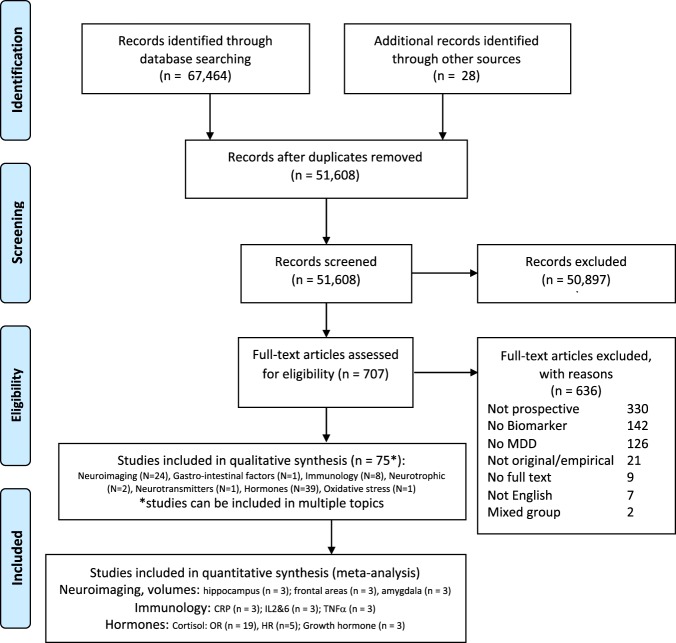
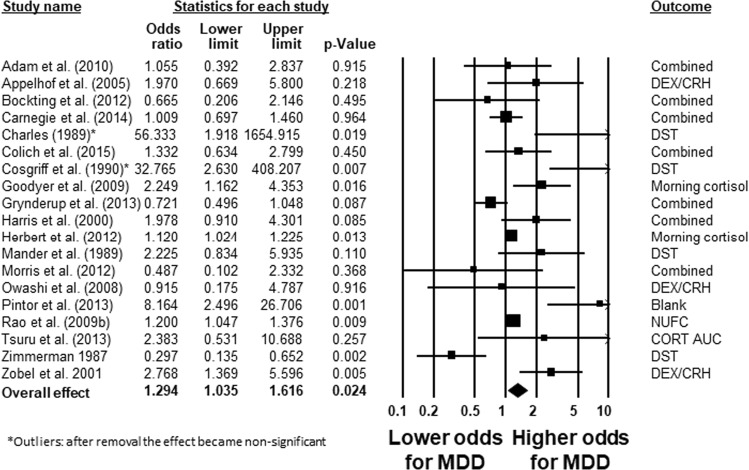
Leading biological hypotheses propose that biological changes may underlie major depressive disorder onset and relapse/recurrence. Here, we investigate if there is prospective evidence for biomarkers derived from leading theories. We focus on neuroimaging, gastrointestinal factors, immunology, neurotrophic factors, neurotransmitters, hormones, and oxidative stress. Searches were performed in Pubmed, Embase and PsychInfo for articles published up to 06/2019. References and citations of included articles were screened to identify additional articles. Inclusion criteria were having an MDD diagnosis as outcome, a biomarker as predictor, and prospective design search terms were formulated accordingly. PRISMA guidelines were applied. Meta-analyses were performed using a random effect model when three or more comparable studies were identified, using a random effect model. Our search resulted in 67,464 articles, of which 75 prospective articles were identified on: Neuroimaging (N = 24), Gastrointestinal factors (N = 1), Immunology (N = 8), Neurotrophic (N = 2), Neurotransmitters (N = 1), Hormones (N = 39), Oxidative stress (N = 1). Meta-analyses on brain volumes and immunology markers were not significant. Only cortisol (N = 19, OR = 1.294,p = 0.024) showed a predictive effect on onset/relapse/recurrence of MDD, but not on time until MDD onset/relapse/recurrence. However, this effect disappeared when studies including participants with a baseline clinical diagnosis were removed from the analyses. Other studies were too heterogeneous to compare. Thus, there is a lack of evidence for leading biological theories for onset and maintenance of depression. Only cortisol was identified as potential predictor for MDD, but results are influenced by the disease state. High-quality (prospective) studies on MDD are needed to disentangle the etiology and maintenance of MDD.
Overview
CoChat Summary
TL;DR
This systematic review and meta-analysis found scarce prospective evidence that leading biological biomarkers predict major depressive disorder onset, relapse, or recurrence. Only cortisol showed a small predictive effect, but it was confounded by baseline clinical depression, study quality, and possible publication bias.
Key findings
- From 67,464 screened articles, 75 prospective studies were identified: neuroimaging (N = 24), gastrointestinal factors (N = 1), immunology (N = 8), neurotrophic factors (N = 2), neurotransmitters (N = 1), hormones (N = 39), and oxidative stress (N = 1).
- Meta-analyses on brain volumes and immunology markers were not significant. Cortisol was the only significant predictor across comparable studies (N = 19, OR = 1.294, 95% CI [1.035–1.616], p = 0.024), but not for time until MDD onset/relapse/recurrence (HR = 1.011, 95% CI [0.963–1.040], p = 0.447).
- The cortisol effect disappeared when studies including participants with a baseline clinical MDD diagnosis were removed; it also became nonsignificant after removing outliers or low-quality studies, and publication-bias correction led to a nonsignificant effect.
- Only 38 studies excluded participants with baseline clinical MDD diagnosis, and most other biomarker findings were too heterogeneous or incidental to meta-analyze.
Methods
- Systematic review and meta-analysis following PRISMA, with searches in PubMed, Embase, and PsychInfo up to June 2019; inclusion required a prospective design, MDD diagnosis as outcome, and a biomarker from leading biological models as predictor.
- Random-effects meta-analyses were performed when three or more comparable studies were available, using odds ratio or risk ratio as summary effects; heterogeneity was assessed with Q-test and I², with sensitivity analyses, moderator analyses, and publication-bias assessment.
- The review included 75 prospective studies; 3,267 participants developed MDD over follow-up (median 3 years), and mean study quality score was 6.3 (median 6, range 3–9).
Limitations
- The paper states that included studies were often of poor quality, had small numbers of MDD cases at follow-up, and that neuroimaging studies used smaller samples than immunology and hormone studies.
- The authors did not correct for multiple testing; they note that such a correction would eliminate the cortisol effect, suggesting it may be a false positive.
- The paper states that heterogeneity was marked, many nonsignificant studies did not report sufficient data for meta-analysis, and this may have inflated odds ratios; results should be interpreted with caution.
- Evident from the text: many biomarker domains had fewer than three comparable studies or highly heterogeneous methods, precluding meta-analysis and limiting conclusions about most proposed biomarkers.
Model-written summary. Check it against the paper before relying on it.
Integrity signals
Registry
Cites
Statistics
Figures
Verification
Claims the paper makes
3 Valid · 4 Not valid · 41 Not checked · 86 Own results and interpretations
The cited sources support only part of this claim — read each source’s verdict below.
In the paper
“Incidental structural MRI studies reported that both smaller and larger insula volume was significantly related to MDD development in two studies [51,91].”
§ Prospective biomarkers of major depressive disorder: a systematic review and meta-analysis > Neuroimaging
What the sources say
- Partly supportedcites [51] 51. Foland-Ross LC, Sacchet MD, Prasad G, Gilbert B, Thompson PM, Gotlib IH. Cortical thickness predicts the first onset of major depression in adolescence. Int J Dev Neurosci. 2015;46:125-31.* sourceExperimental — accuracy not yet measured
Our copy supports the 'larger insula' side of the claim: Results > Neuroanatomic Classification reports that gray matter of the left insula was significantly thicker in girls who converted to depression (3.09 vs 2.94 mm, uncorrected p = 0.015), and the Discussion states that 'increased insula thickness predicted the onset of depression'. The Discussion also notes the opposing direction from other work (Belden et al., 2015, smaller insula volumes associated with subsequent depression in preschool children; Koolschijn et al., 2009, MDD-associated reductions in insula volume), so the two-directional framing is present. However, this study's own measure is cortical gray matter thickness, not insula volume — the Methods state thickness was chosen precisely because it is less influenced by surface area than volume and list volume as an alternative measure not used here — and its finding is an exploratory, uncorrected post-hoc test in a small sample of at-risk adolescent girls, so attributing 'insula volume' to this source overstates it. (LLM, conf=0.72)
- Could not verifycites [91] 91. Rao U, Chen L-A, Bidesi AS, Shad MU, Thomas MA, Hammen CL. Hippocampal changes associated with early-life adversity and vulnerability to depression. Biol Psychiatry. 2010;67:357-64.* sourceExperimental — accuracy not yet measured
Our copy of Rao et al. (2010) is entirely about hippocampal volume (and total brain volume) measured by manual tracing on 1.5T structural MRI in at-risk and depressed adolescents; the Methods (MRI section) state only left hippocampus, right hippocampus and TBV were traced, and the Results/Discussion report only hippocampal findings. No passage in the prompt or returned by searches for 'insula volume major depressive disorder' and 'insula insular cortex gray matter brain region volume' mentions the insula or insular volume at all, so this paper neither supports nor contradicts the attributed claim about smaller and larger insula volume relating to MDD development. (LLM, conf=0.70)
plainstates an association- Asserted: passes — The authors put it forward as true.
- Checkable: passes — It can be checked against evidence.
- Load-bearing: unclear — It is unclear whether the paper’s conclusions depend on it.
- Based: passes — The paper gives a reason why it holds.
- Partly supported
The sources with a verdict support this claim; the rest weren’t checked yet, have no full text we could read, or their verdicts aren’t rated yet.
In the paper
“No significant predictive value of the amygdala volume was found in three studies investigating two unique samples [53,54,74].”
§ Prospective biomarkers of major depressive disorder: a systematic review and meta-analysis > Neuroimaging
What the sources say
- Not checked yetcites [53] 53. Frodl T, Meisenzahl EM, Zetzsche T, Höhne T, Banac S, Schorr C, et al. Hippocampal and amygdala changes in patients with major depressive disorder and healthy controls during a 1-year follow-up. J Clin Psychiatry. 2004;65:492-9.* source
- Supportedcites [54] 54. Frodl T, Jäger M, Smajstrlova I, Born C, Bottlender R, Palladino T, et al. Effect of hippocampal and amygdala volumes on clinical outcomes in major depression: a 3-year prospective magnetic resonance imaging study. J Psychiatry Neurosci. 2008;33:423-30.* source
Our copy of Frodl et al. (2008) reports exactly the null predictive finding attributed to it: in the Results section (p. 426) 'Amygdala volume was not affected by remission status (F1–26 = 0.16, p = 0.69)' and patients with larger baseline amygdala volumes 'did not have significantly lower HDRS scores at 1, 2 and 3 years (F1–25 = 0.74, p = 0.40)', with no significant correlation between HDRS scores and amygdala volumes at baseline, discharge or 3-year follow-up. The aggregation into 'three studies investigating two unique samples' is the citing authors' synthesis across references 53, 54 and 74 and is not something this single source is asked to carry; the part attributed to this paper — a study showing no significant predictive value of amygdala volume for clinical outcome in major depression — is stated here. (LLM, conf=0.88)
- Supportedcites [74] 74. Little K, Olsson CA, Whittle S, Youssef GJ, Byrne ML, Sim- mons JG, et al. Association between serotonin transporter genotype, brain structure and adolescent-onset major depressive disorder: a longitudinal prospective study. Transl Psychiatry. 2014;4:e445.* source
Our copy of Little et al. (2014) reports exactly this null finding: the Results state that '5-HTTLPR did not predict left or right amygdala volume ... nor were these volumes related to risk for MDD onset' (Results, mediation/ROI section), and the Discussion opens by noting 'the lack of evidence supporting amygdala volume as an intermediate phenotype between serotonin transporter gene and depression onset' (Discussion). The 'three studies investigating two unique samples' aggregation spans the other two citations in the sentence and is the citing authors' framing, not something this source must state; the part attributed to this paper — a prospective adolescent study finding no significant predictive value of amygdala volume for depression onset — is fully supported. (LLM, conf=0.85)
plainn = 2- Asserted: passes — The authors put it forward as true.
- Checkable: passes — It can be checked against evidence.
- Load-bearing: unclear — It is unclear whether the paper’s conclusions depend on it.
- Based: passes — The paper gives a reason why it holds.
The cited sources support only part of this claim — read each source’s verdict below.
In the paper
“These studies showed that MDD development was predicted by: lower activity in the frontal lobe in various contexts ( [39] reward task lossgain contrast [83]; rest [71,82]; go/nogo task, errors; [31] pre-vs posttryptophan depletion), higher activity in the insula ( [99] sentence completion increasing in difficulty), higher subgenual anterior cingulate cortex (ACC) temporal and striatal connectivity”
§ Prospective biomarkers of major depressive disorder: a systematic review and meta-analysis > Neuroimaging
What the sources say
- Not checked yetcites [39] 39. Bress JN, Foti D, Kotov R, Klein DN, Hajcak G. Blunted neural response to rewards prospectively predicts depression in ado- lescent girls. Psychophysiology. 2013;50:74-81.* source
- Not checked yetcites [83] 83. Nusslock R, Shackman AJ, Harmon-Jones E, Alloy LB, Coan JA, Abramson LY. Cognitive vulnerability and frontal brain asymmetry: common predictors of first prospective depressive episode. J Abnorm Psychol. 2011;120:497-503.* source
- Partly supportedcites [71] 71. Langenecker SA, Jenkins LM, Stange JP, Chang Y-S, DelDonno SR, Bessette KL, et al. Cognitive control neuroimaging measures differentiate between those with and without future recurrence of depression. Neuroimage Clin. 2018;20:1001-9.* sourceExperimental — accuracy not yet measured
Our copy is a Parametric Go/No-Go fMRI study and it does support the frontal-activation part of the attributed point: in Results > Failed regulation (commission errors of No-Go lures), 'hMDD-Recurrence had lower activation of bilateral MFG for Commissions compared to the Healthy Comparison group and the hMDD-Resilience group,' echoed in the Abstract (Results) as 'less bilateral middle frontal gyrus activation during commission errors' in the recurrence group. What it does not support is the claim's framing of 'MDD development was predicted': the sample is remitted young adults (18-23) with existing history of MDD followed for future recurrence, not first-onset/development of MDD (Introduction; Methods > Participants), and the paper reports cross-sectional group differentiation rather than a tested predictor — the Discussion states the CCN metrics 'could be tested in models in the future, even if these models are now at the initial development stage,' and the Conclusion only says markers 'could identify those with early course MD who are at risk for depression recurrence,' with future validation needed. So the go/nogo-errors frontal finding is in the source; the developmental-onset prediction framing is not. (LLM, conf=0.78)
plainstates an association- Asserted: passes — The authors put it forward as true.
- Checkable: passes — It can be checked against evidence.
- Load-bearing: passes — The paper’s conclusions depend on it.
- Based: passes — The paper gives a reason why it holds.
A result the paper states — it cites no source for it, so there is none to check. The quote shows it is in the paper.
In the paper
“However, due to overlap in study samples and heterogeneity in methods applied (e.g.tasks, regions of interest), meta-analysis could only be performed on some hippocampus, amygdala and frontal brain area volumes (see Table 1 and Supplementary Fig. 2).”
§ Prospective biomarkers of major depressive disorder: a systematic review and meta-analysis > Neuroimaging
hedgedstates a cause- Asserted: passes — The authors put it forward as true.
- Checkable: passes — It can be checked against evidence.
- Load-bearing: passes — The paper’s conclusions depend on it.
- Based: passes — The paper gives a reason why it holds.
A result the paper reports from its own data — it cites no other source for it, so there is none to check. The quote shows it is in the paper.
In the paper
“Overall, 75 prospective articles were identified on: Neuroimaging (N = 24), Gastrointestinal factors (N = 1), Immunology/inflammation (N = 8), Neurotrophic (N = 2), Neurotransmitters (N = 1), Hormones (N = 39), and Oxidative stress (N = 1).”
§ Prospective biomarkers of major depressive disorder: a systematic review and meta-analysis > Search results and quality assessment
plain- Asserted: passes — The authors put it forward as true.
- Checkable: passes — It can be checked against evidence.
- Load-bearing: unclear — It is unclear whether the paper’s conclusions depend on it.
- Based: passes — The paper gives a reason why it holds.
62 more claims
Create a free account to see all 134 claims and to verify the 72 references still open.
- It may state two separate claims as one. 42
- Probably not a substantial claim. 31
- The quote only partly states this claim. 2
Claims other papers make about this one
Each is checked against this paper’s own text: does it say what the citing paper says it does?
The source backs part of the claim, not all of it — or backs it for a different population, condition or comparison.
In the citing paper
“Recent research has shown a link between decreased hippocampal neurogenesis and low levels of BDNF and glial-derived neurotrophic factor (GDNF) in the brains of depressed individuals. 145”
From Major depressive disorder: hypothesis, mechanism, prevention and treatment (2024) · cites this paper as [145]
Experimental — accuracy not yet measuredThe source backs part of the claim, not all of it — or backs it for a different population, condition or comparison.
In the citing paper
“These concerns include overreliance on cross-sectional methodologies, a lack of consensus on what constitutes recurrence, and grouping all individuals with MDD together instead of differentiating subgroups using key characteristics of the disorder (e.g., single verse recurrent episodes) [3, 6–8].”
From Fear of depression recurrence among individuals with remitted depression: a qualitative interview study (2024) · cites this paper as [6]
Experimental — accuracy not yet measuredThe cited source says what the claim attributes to it.
In the citing paper
“The dataset used in this study comes from a systematic review-based meta-analysis focusing on the evidence for leading psychological and biological theories on the onset, maintenance, and relapse of depressive disorders (Brouwer et al., 2019; Kennis et al., 2020; Fu et al., 2021).”
From Active learning-based systematic reviewing using switching classification models: the case of the onset, maintenance, and relapse of depressive disorders (2023) · cites this paper as Kennis et al., 2020
The cited source says what the claim attributes to it.
In the citing paper
“A review exploring prospective biomarkers (e.g., hormones, oxidative stress) in MDD recurrence found that cortisol significantly increased odds for MDD onset and relapse [6].”
From Fear of depression recurrence among individuals with remitted depression: a qualitative interview study (2024) · cites this paper as [6]
The cited source says what the claim attributes to it.
In the citing paper
“It is crucial to highlight the results in a recent meta-analysis, which found that cortisol was the only biological marker that increased the odds for both the onset and relapse/recurrence of MDD [35].”
From Stress and serum cortisol levels in major depressive disorder: a cross-sectional study (2020) · cites this paper as [35]
6 more claims about this paper
Create a free account to see every claim other papers make about this one.
Self-check
Percentages, sums and reported differences re-computed from the paper’s own numbers.
Each contradiction between two passages listed here was confirmed by an independent check.
Rated major: it would touch a result — a value a result rests on, reported and recomputed p-values on opposite sides of the significance level, two passages that conflict with no sign which is right, or a cited work retracted before this paper was published.
In the paper
§ Prospective biomarkers of major depressive disorder: a systematic review and meta-analysis > Immunology
“↑ heat-shock protein 70, 3nitrotyrosine, protein carbonyl, and lipid peroxidation ↓BDNF”
§ Prospective biomarkers of major depressive disorder: a systematic review and meta-analysis > Oxidative stress
“No significant differences between these groups were found for protein carbon and thiol content.”
Rated major: it would touch a result — a value a result rests on, reported and recomputed p-values on opposite sides of the significance level, two passages that conflict with no sign which is right, or a cited work retracted before this paper was published.
In the paper
§ Prospective biomarkers of major depressive disorder: a systematic review and meta-analysis > HPA axis
“OR = 1.919”
§ Prospective biomarkers of major depressive disorder: a systematic review and meta-analysis > HPA axis
“95% CI [1.072 1.231]”
Rated minor: it would not touch a result — a value no result rests on, a p-value that stays on the same side of the significance level, or a conflict that is clerical, resolved elsewhere in the paper, or outside its own findings.
In the paper
“19 studies had a very low risk of bias (>6 quality score), 26 studies had some risk of bias (5-6 quality score), and 8 studies had high risk of bias (4 or lower quality score).”
§ Prospective biomarkers of major depressive disorder: a systematic review and meta-analysis > Search results and quality assessment
Reported 75 · recomputed 53
Citations
Cites
Preferred Reporting Items for Systematic Reviews and Meta-Analyses: the PRISMA statement
Moher, D., Liberati, A., Tetzlaff, J., Altman, D. G., & for the PRISMA Group (2009) · BMJ · doi:10.1136/bmj.b2535 · Cited by 83,823
Preferred Reporting Items for Systematic Reviews and Meta-Analyses: The PRISMA Statement
Moher, D., Liberati, A., Tetzlaff, J., Altman, D. G., & The PRISMA Group (2009) · PLoS Medicine · doi:10.1371/journal.pmed.1000097 · Cited by 64,042 · cited 2×
“Methods Search process and study selection The study was performed according to Preferred Reporting Items for Systematic Reviews and Meta-Analyses statement (PRISMA [24]; see Appendices A and B for search terms and flow charts and Appendix C for PRISMA checklist).”
Bias in meta-analysis detected by a simple, graphical test
Egger, M., Smith, G. D., Schneider, M., & Minder, C. (1997) · BMJ · doi:10.1136/bmj.315.7109.629 · Cited by 56,722 · cited 1×
“Publication bias was also assessed using Egger’s test for asymmetry [28] of the funnel plot and Duval and Tweedie’s trim and fill procedure [29].”
MethodPreferred reporting items for systematic reviews and meta-analyses: the PRISMA Statement.
(2009) · PubMed Central · Cited by 44,859
Preferred reporting items for systematic reviews and meta-analyses: The PRISMA statement
Moher, D., Liberati, A., Tetzlaff, J., Altman, D. G., & the PRISMA Group* (2009) · Annals of Internal Medicine · doi:10.7326/0003-4819-151-4-200908180-00135 · Cited by 37,554
Quantifying heterogeneity in a meta‐analysis
Higgins, J. P. T., & Thompson, S. G. (2002) · Statistics in Medicine · doi:10.1002/sim.1186 · Cited by 36,763 · cited 1×
“Heterogeneity was assessed with the Qtest and I(2) statistic [27].”
MethodDuval, S., & Tweedie, R. (2000) · Biometrics · doi:10.1111/j.0006-341x.2000.00455.x · Cited by 14,099 · cited 1×
“Publication bias was also assessed using Egger’s test for asymmetry [28] of the funnel plot and Duval and Tweedie’s trim and fill procedure [29].”
MethodKessler, R. C., Chiu, W. T., Demler, O., & Walters, E. E. (2005) · Archives of General Psychiatry · doi:10.1001/archpsyc.62.6.617 · Cited by 12,052 · cited 1×
“Introduction Major depressive disorder (MDD) is a disabling disorder that is amongst the most prevalent mental health disorders worldwide [1, 2] and is highly recurrent [3–5].”
BackgroundGRADE guidelines: 1. Introduction—GRADE evidence profiles and summary of findings tables
Guyatt, G., Oxman, A. D., Akl, E. A., Kunz, R., Vist, G., Brozek, J., Norris, S., Falck-Ytter, Y., Glasziou, P., & deBeer, H. (2011) · Journal of Clinical Epidemiology · doi:10.1016/j.jclinepi.2010.04.026 · Cited by 10,681 · cited 1×
“The quality of included studies was assessed by two team members according to a minimally adjusted version of the GRADE guidelines on study level [25].”
MethodDepression, chronic diseases, and decrements in health: results from the World Health Surveys
Moussavi, S., Chatterji, S., Verdes, E., Tandon, A., Patel, V., & Ustun, B. (2007) · The Lancet · doi:10.1016/s0140-6736(07)61415-9 · Cited by 4,070 · cited 1×
“Introduction Major depressive disorder (MDD) is a disabling disorder that is amongst the most prevalent mental health disorders worldwide [1, 2] and is highly recurrent [3–5].”
Background
Cited by
Items 301–400 of 518
More, S. M., Rashid, M. A., Tiwari, P. K., Kharwade, R., Alhamhoom, Y., Asar, T. O., Kaleem, M., Mahajan, N. M., Pise, A. G., Danao, K. R., et al. (2025) · Frontiers in Pharmacology · doi:10.3389/fphar.2025.1577080 · Cited by 3
“Depression has a multifaceted etiology, and in fl ammatory mediators have played a crucial role in the etiology of depression (Kennis et al., 2020).”
Levchuk, L. A., Рощина, О. В., Simutkin, G. G., Bokhan, N. A., & Ivanova, S. А. (2020) · European Neuropsychopharmacology · doi:10.1016/j.euroneuro.2020.09.176 · Cited by 3
Ferreira, V. G., Rossini, E. L., Araújo, L. X., Almeida, M. B., & Carrilho, E. (2024) · Elsevier eBooks · doi:10.1016/b978-0-443-15380-8.00001-1 · Cited by 4
Yun, M., Jeon, M., & Yang, H. (2024) · PLoS ONE · doi:10.1371/journal.pone.0303889 · Cited by 3
Abnormal network homogeneity in patients with bipolar disorder in attention network
Tan, M., Guo, Y., Liu, S., Liu, W., Cheng, L., Gao, Y., & Ren, Z. (2025) · Brain Imaging and Behavior · doi:10.1007/s11682-025-00974-2 · Cited by 3
Romo‐Nava, F., Awosika, O. O., Basu, I., Blom, T. J., Welge, J. A., Datta, A., Guillen, A. R., Guerdjikova, A. I., Fleck, D. E., Georgiev, G. P., et al. (2023) · Molecular Psychiatry · doi:10.1038/s41380-023-02349-9 · Cited by 3
“The current concept of MDD is that of a heterogeneous syndrome with multiple possible neurobiological components (e.g., hyperactive HPA axis and increased sympathetic tone), as well as contributing external factors (e.g., exposure to chronic stress) [34].”
BackgroundSee, R. E., Eusebio, B., Agnew, D., & Heatwole, M. (2021) · Psychiatry Research · doi:10.1016/j.psychres.2021.114053 · Cited by 3
Association between genetic variants and depression in a Romanian cohort
Costache, A. C., Riza, A. L., Popescu, M., Streaţă, I., Dincă, M. E., Glăvan, D. G., Vladu, I. M., Udriştoiu, I., & Ioana, M. (2022) · Romanian Journal of Morphology and Embryology · doi:10.47162/rjme.62.2.15 · Cited by 3
“To strengthen our case, out of a wide range of predictors, strong prospective evidence was found only for cortisol, as potential biomarker for MDD [13].”
BackgroundMitchell, B. L., Gilroy, D., Wallace, L. M., Kiewa, J., Parker, R., Nunn, L., Walker, A., Lin, T., Ziser, L., English, G., et al. (2025) · medRxiv · doi:10.1101/2025.09.16.25335873 · Cited by 3
Koizumi, K., Hamaguchi, T., Tayama, J., & Fukudo, S. (2022) · Frontiers in Bioscience-Landmark · doi:10.31083/j.fbl2706187 · Cited by 2
“EEG has been used as a biomarker of depressive symptoms [67], and has been proposed as a predictive tool based on the constant changes caused by treatment with selective serotonin reuptake inhibitors [68].”
MethodThe Potential Clinical Utility of Auditory P3b Amplitude for Clinical High Risk
Liu, X., Zhou, H., Hu, C., Yu, H., Chu, J., & Zhou, B. (2022) · Frontiers in Psychology · doi:10.3389/fpsyg.2022.876092 · Cited by 2
“Biological changes may underlie disorder onset and recurrence (Kennis et al., 2020).”
BackgroundWang, W.-L., Liu, J.-K., Sun, Y., Liu, X., Ma, Y., Gao, X.-Z., Chen, L.-M., Zhou, Z., & Zhou, H. (2024) · World Journal of Psychiatry · doi:10.5498/wjp.v14.i10.1484 · Cited by 2
Richter, L., Bergunde, L., Karl, M., Jaramillo, I., Weise, V., Mack, J. T., Weidner, K., Gao, W., von Soest, T., Garthus‐Niegel, S., et al. (2025) · Progress in Neuro-Psychopharmacology and Biological Psychiatry · doi:10.1016/j.pnpbp.2024.111245 · Cited by 2
“However, it would also be possible that alteration in long-term cortisol secretion contributes to the development of paternal PPDS (Kennis et al., 2020).”
Kim, J., Kang, H., Kim, J.-W., Jhon, M., Lee, J., Kim, S., Kim, M., & Shin, I. (2025) · Progress in Neuro-Psychopharmacology and Biological Psychiatry · doi:10.1016/j.pnpbp.2025.111360 · Cited by 2
Kiguchi, R., Hata, A., Fujita, S., Yoshida, Y., Kitanishi, Y., Yoshimoto, J., Tajika, A., & Furukawa, T. A. (2025) · Journal of Affective Disorders · doi:10.1016/j.jad.2025.119703 · Cited by 3
Echoes of stress: From molecular whispers to social thunderstorms
López, J. P. (2025) · Neurobiology of Stress · doi:10.1016/j.ynstr.2025.100766 · Cited by 2
“Future research must prioritize identifying biomarkers that predict antidepressant response (Kennis et al., 2020).”
Wang, Y., Liang, W., Duan, Y., Lau, W.-M. B., Chan, N.-M. J., Yang, S., & Baker, J. S. (2026) · Frontiers in Public Health · doi:10.3389/fpubh.2026.1697763 · Cited by 2
“Previous studies have suggested that the cortisol awakening response (CAR) can be a potential biomarker of depressive symptoms in older adults (10, 13, 65).”
Schmiedl, S. J. C., Ortega, B. A., Sosa-Moscoso, B., de Armas, G. G., Galarza, J. I. M., Rodas, J. A., & León-Rojas, J. E. (2026) · International Journal of Molecular Sciences · doi:10.3390/ijms27031267 · Cited by 2
“…multiple PET domains suggest that effective therapies restore network-level balance rather than targeting a single molecular abnormality [2,5,8,26,67]; however, more studies looking into these two groups are necessary to further elucidate their metabolic differences as most studies have not…”
Cortisol and C-reactive protein interact to predict depressive symptoms
Doan, S. N., Hoell, D. J., & Fuller‐Rowell, T. E. (2026) · Psychoneuroendocrinology · doi:10.1016/j.psyneuen.2026.107780 · Cited by 2
“Elevated basal cortisol is linked with current and future depression (Stetler and Miller, 2011; Kennis et al., 2020), and depressed individuals tend to show blunted cortisol reactivity to psychosocial stress (Burke et al., 2005; Harkness et al., 2011).”
Fang, J., Li, X., Zhu, S., Hu, Q., Wang, T., Yu, J., Qin, X., & Zhu, D. (2026) · Frontiers in Psychiatry · doi:10.3389/fpsyt.2026.1743465 · Cited by 2
“Compelling evidence indicates that dysregulation of the HPA axis plays a signi fi cant role in the pathophysiology of depression during adulthood (13, 14).”
Samardžija, B., Renner, É., Palkovits, M., & Bradshaw, N. J. (2026) · Scientific Reports · doi:10.1038/s41598-026-35767-0 · Cited by 2
“The hippocampus, critical for memory and stress regulation, shows abnormalities such as elevated glucocorticoids from hypothalamic-pituitary-adrenal axis dysfunction, reduced volume, and altered BDNF signalling 25–27 .”
Guidetti, C., Papakostas, G. I., Stahl, S., Pani, L., Martin, S. D., Mattarei, A., Comai, S., Kröger, C., Champasa, P., Gorodetzky, C. W., et al. (2026) · International Clinical Psychopharmacology · doi:10.1097/yic.0000000000000618 · Cited by 3
Neurochemical biomarkers in major depressive disorder
Khatami, S. H., Chamardani, T. M., Motamedzadeh, A., Nateghi, M., & Dadgostar, E. (2026) · Clinica Chimica Acta · doi:10.1016/j.cca.2026.120936 · Cited by 2
Rae, R. J., Alberhasky, J. M. H., Baillet, M., Bangasser, D. A., Belloy, M. E., Berry, A. S., Berteotti, C., Bow, H., Buckley, R. F., Caldwell, J. K., et al. (2026) · Alzheimer s & Dementia · doi:10.1002/alz.71291 · Cited by 2
Lindley, C. L., Gigic, B., Peoples, A. R., Han, C. J., Lin, T., Himbert, C., Warby, C. A., Boehm, J., Hardikar, S. S., Ashworth, A., et al. (2023) · Cancer Epidemiology Biomarkers & Prevention · doi:10.1158/1055-9965.epi-22-0882 · Cited by 2
Sex Determines Anterior Cingulate Cortex Cortical Thickness in the Course of Depression
Wu, G., & Baeken, C. (2023) · Biological Psychiatry Global Open Science · doi:10.1016/j.bpsgos.2023.08.003 · Cited by 2
“No clear structural (or functional) brain biomarkers have been found to date that predict the occurrence of a depressive episode, treatment outcome, or relapse (10,11).”
Biomarkers of human viral infections and their role in the diagnosis
Radhakrishnan, A., Kashyap, M., Sinharay, A., Jyotshna, S., & Rajagopal, S. (2024) · Elsevier eBooks · doi:10.1016/b978-0-443-18574-8.00006-6 · Cited by 2
Parra, L. A., Helm, J. L., & Hastings, P. D. (2025) · Psychoneuroendocrinology · doi:10.1016/j.psyneuen.2025.107476 · Cited by 2
Muskat, M., Pappa, S., Weber, J., Scholtz, S., & Stokes, N. (2022) · Neuroscience Applied · doi:10.1016/j.nsa.2022.100663 · Cited by 2
Steinholtz, L., Thörnblom, E., Bodén, R., Wall, A., Axelson, H. W., Lubberink, M., Fällmar, D., & Persson, J. (2022) · Neuroscience Applied · doi:10.1016/j.nsa.2022.100195 · Cited by 2
The impact of COVID-19 pandemic on mental health in Slovak population
Králová, M., Izáková, Ľ., & Bražinová, A. (2022) · Neuroscience Applied · doi:10.1016/j.nsa.2022.100666 · Cited by 2
Tan, Q., & Miao, M. (2024) · IFIP advances in information and communication technology · doi:10.1007/978-3-031-71253-1_3 · Cited by 2
“Depression is a common mental disorder that causes persistent sadness, feelings of hopelessness, and low self-esteem [4].”
Affektive Störungen: Depressive Episoden, rezidivierende depressive Störungen, Dysthymie
Haun, M. W. (2024) · Springer eBooks · doi:10.1007/978-3-662-64728-8_16 · Cited by 2
Euthanasia and Assisted Suicide in Psychiatry: An Overview of the Field
Nicolini, M. (2025) · The International Library of Bioethics · doi:10.1007/978-94-024-2274-0_31 · Cited by 2
Corticosteroids as Selective and Effective Modulators of Glycine Receptors
Solntseva, E. I., Bukanova, J. V., Kondratenko, R. V., & Kudová, E. (2023) · ACS Chemical Neuroscience · doi:10.1021/acschemneuro.3c00287 · Cited by 2
Why it is important to discuss what antidepressants do
Moncrieff, J., & Horowitz, M. A. (2022) · BMJ · doi:10.1136/bmj.o2350 · Cited by 2
Köhne, A. C. J. (2022) · Utrecht University Repository (Utrecht University) · doi:10.33540/1591 · Cited by 2
Grasso‐Cladera, A., Boehm, S., Schied, L., & Parada, F. J. (2023) · PsyArXiv (OSF Preprints) · doi:10.31234/osf.io/anfjh · Cited by 2
A Formal Model of Mood Disorders Based on the Neural Circuit Dynamics of the Triple Network ModelPreprint
Rubin, A. L., & Walth, M. (2024) · medRxiv · doi:10.1101/2024.06.16.24309000 · Cited by 2
Nguyen, T. T. L., Liu, D., Gao, H., Ye, Z., Lee, J., Wei, L., Yu, J., Zhang, L., Wang, L., Ördög, T., et al. (2022) · Clinical and Translational Science · doi:10.1111/cts.13402 · Cited by 1
Trevarthen, A. C., Davy, R., Finnegan, E. M., Railton, R.-L., Paul, E. S., Mendl, M., Smulders, T. V., & Fureix, C. (2025) · Royal Society Open Science · doi:10.1098/rsos.251069 · Cited by 1
“…investigating the covariation of IBA behaviour with a range of other potential biomarkers of depression, such as hormones (e.g. cortisol [69]) and inflammatory biomarkers (e.g. cytokines [45]) would be useful. r o y a l s o c i e t y p u b l i s h i n g . o r g / j o u r n a l / r s o s…”
Cao, Y., Li, P.-F., Zhu, L., Li, K., & He, K. (2026) · World Journal of Psychiatry · doi:10.5498/wjp.v16.i2.113037 · Cited by 1
Ren, X., Luo, Y., Xiao, Q., Li, J., Zhou, Y., Deng, Y., Wu, X., Luo, H., Li, Y., Jiang, L., et al. (2026) · Cells · doi:10.3390/cells15080693 · Cited by 1
(2024) · Frontiers research topics · doi:10.3389/978-2-8325-3786-2 · Cited by 1
What are blood cortisol levels in anxious, depressive, mixed, and healthy controls in high altitude?
Farfan, C. H. V., Virto, C., & Tafet, G. E. (2024) · Psiquiatría Biológica · doi:10.1016/j.psiq.2024.100485 · Cited by 1
Psicanálise, saúde mental e a indústria das evidências
Leite, M. C., & Couto, R. (2024) · Revista Latinoamericana de Psicopatologia Fundamental · doi:10.1590/1415-4714.e230858 · Cited by 1
Navigating the Intersection of Technology and Depression Precision Medicine
Irmak-Yazicioglu, M. B., & Arslan, A. (2024) · Advances in experimental medicine and biology · doi:10.1007/978-981-97-4402-2_20 · Cited by 1
Chen, D., Zhang, Y., Zhou, Y. F., & Liang, Z. (2025) · International Journal of Environmental Research · doi:10.1007/s41742-025-00747-1 · Cited by 1
“…biological mechanism may explained the association between ambient air pollution and NPM. Air pollutants can induce depression or anxiety through neuroinflammation or oxidative stress (Zundel et al. 2022), while these conditions can elevate cortisol levels (Kennis et al. 2020; Shapero et al. 2019).”
Jiang, X., Hu, Y., Lin, C., Li, J., Dong, Z., Yang, X., Lü, W., Zhang, N., Xu, H., Huang, X., et al. (2025) · Journal of Affective Disorders · doi:10.1016/j.jad.2025.120072 · Cited by 1
Zhang, G., Xu, D., Bu, S., Li, L., Jiao, J., Shi, Y., Xu, Y., Kong, Y., & Zhang, Z. (2025) · NeuroMarkers. · doi:10.1016/j.neumar.2025.100114 · Cited by 1
Huber, M., Weitgasser, L., Reuter, L., Pletzer, B. A., & Illg, A. (2025) · Ear and Hearing · doi:10.1097/aud.0000000000001719 · Cited by 1
Kawamura, N., Nakata, A., Harada, T., Ohashi, Y., Sato, H., Sasaki, K., & Tsugane, S. (2025) · International Journal of Methods in Psychiatric Research · doi:10.1002/mpr.70041 · Cited by 1
“In 2020, an international review article concluded that major depressive disorder (MDD) is a complex psychiatric disorder and that cortisol levels alone has been able to predict the diagnosis of MDD (Kennis et al. 2020).”
Association between atherogenic index of plasma and depression risk: a meta-analysis
Chen, G., Chen, G.-X., & Wan, W. (2025) · Frontiers in Psychiatry · doi:10.3389/fpsyt.2025.1665118 · Cited by 1
Depression diagnosis based on Deep Learning Using Time-series Sleep Quality Data
Lee, S. M., Kim, Y., Lee, S. H., Kang, S., Jin, K. N., & Kim, K. G. (2025) · Annual International Conference of the IEEE Engineering in Medicine and Biology Society (EMBC) · doi:10.1109/embc58623.2025.11251615 · Cited by 1
“However, EEG measurements require expensive equipment and necessitate a dedicated physical space and time for patient visits [1, 5].”
Application of Treatment Response Biomarkers from Major Depression to Perinatal Depression
Kwok, W. Y., Wagner-Schuman, M. L., Eisenlohr-Moul, T. A., & Hage, B. (2025) · Journal of Personalized Medicine · doi:10.3390/jpm15120607 · Cited by 1
“One meta-analysis of depression biomarkers found that increased baseline cortisol showed a modest predictive effect on onset, relapse, and recurrence of MDD [77].”
Kim, J.-M., Kang, H.-J., Kim, J.-W., Jhon, M., Lee, J.-Y., Kim, S.-W., & Shin, I.-S. (2026) · Frontiers in Psychiatry · doi:10.3389/fpsyt.2025.1662993 · Cited by 1
Song, X., Yi, L., Wang, S., & Zhang, X. (2026) · Frontiers in Psychiatry · doi:10.3389/fpsyt.2025.1742901 · Cited by 1
Brain causality alterations in major depressive disorder treatment
Bhattacharjee, M., VLACHOS, I. K., Kathpalia, A., Hlinka, J., Brunovský, M., Bareš, M., & Paluš, M. (2026) · Frontiers in Psychiatry · doi:10.3389/fpsyt.2025.1718216 · Cited by 1
“This prolonged period of treatment uncertainty stems from the absence of reliable early biomarkers to predict which patients will respond to speci fi c treatment modalities and to monitor early therapeutic effects before clinical symptom changes manifest (2, 3).”
McNaughton, N., Shadli, S. M., Beaglehole, B., & Glue, P. (2026) · Journal of the Royal Society of New Zealand · doi:10.1002/snz2.70002 · Cited by 1
“Only cortisol was identified as potential predictor for MDD, but results are influenced by the disease state ” (Kennis et al. 2020).”
Владимировна, К. Н., Tsyrlin, V. A., Плисс, М. Г., & Galagudza, М. М. (2026) · Journal of Evolutionary Biochemistry and Physiology · doi:10.1134/s002209302601014x · Cited by 1
Yuan, X., & Wang, T. (2026) · BMC Psychiatry · doi:10.1186/s12888-026-07956-8 · Cited by 1
“However, these methods remain confined to phenomenological descriptions and lack specific biomarkers to assist in objective diagnosis [6].”
Liu, W., Wang, R., Yan, C., Xuying, X. U., Wang, Y., Pan, X., Song, Y., Zhang, B. X., & Liu, Z. (2026) · Cognitive Neurodynamics · doi:10.1007/s11571-026-10416-4 · Cited by 1
Yang, X., Li, Y., Sui, X., Li, N., & Gao, Z. (2026) · Chemical Engineering Journal · doi:10.1016/j.cej.2026.176704 · Cited by 1
Tyra, A. T., Griffin, S. M., Garner, S.-B., Muldoon, O. T., Brindle, R. C., Williams, S. E., Fergus, T. A., & Ginty, A. T. (2026) · Psychological Bulletin · doi:10.1037/bul0000529 · Cited by 1
Key challenges in advancing research on depression phenotyping
Repple, J., Chevance, A., Fried, E. I., Elsaeßer, M., Hahn, T., Ruhé, H. G., Opel, N., Bockting, C., McIntyre, R. S., Young, A. H., et al. (2026) · Nature Mental Health · doi:10.1038/s44220-026-00629-1 · Cited by 2
Self-citationColli, C. D., Viglione, A., Poggini, S., & Branchi, I. (2026) · Journal of Affective Disorders · doi:10.1016/j.jad.2026.122129 · Cited by 1
Wang, H., Liu, W., Zhao, X., Zhang, X., Zhang, Y., Ma, C., Zhu, Y., Wang, P., Peng, Z., Dong, H., et al. (2026) · Translational Psychiatry · doi:10.1038/s41398-026-04251-8 · Cited by 1
“Among these, only cortisol demonstrated some predictive value for the onset or recurrence of MDD, though its effectiveness was heavily in fl uenced by baseline clinical conditions [14].”
Westhoff, M. S., Toto, S., Bleich, S., Grohmann, R., & Seifert, J. (2026) · Journal of Affective Disorders · doi:10.1016/j.jad.2026.122322 · Cited by 1
Guidetti, C., Giorgi, R. D., Huneke, N. T. M., Crescenzo, F. D., Zippi, C., Papakostas, G. I., & Fava, M. (2026) · American Journal of Psychiatry · doi:10.1176/appi.ajp.20251233 · Cited by 1
Biomarkers for the psychology of aging
Steptoe, A., & Bloomberg, M. (2026) · Elsevier eBooks · doi:10.1016/b978-0-443-27490-9.00009-9 · Cited by 1
Hou, Z., Li, T., He, X., Zhang, Y., Chen, H., Jiang, W., Yin, Y., & Yuan, Y. (2022) · Frontiers in Psychiatry · doi:10.3389/fpsyt.2021.788398 · Cited by 1
Zhao, F. F., Jin, Y., & Chen, X. L. (2024) · Neurochemical Journal · doi:10.1134/s181971242402017x · Cited by 1
Role of oral-gut-brain axis in psychiatric and neurological disorders
Duan, Z.-M., & Wu, L.-F. (2024) · World Chinese Journal of Digestology · doi:10.11569/wcjd.v32.i12.878 · Cited by 1
Muijeen, K., Soonthornchaiya, R., & Butcher, H. K. (2021) · Current Psychiatry Research and Reviews · doi:10.2174/2666082217666211210101653 · Cited by 1
Genetic and Epigenetic Determinants of Depression: From Basic Research to Translational Medicine
Salazar, L. A., & Zambrano, T. (2021) · Depression and personality · doi:10.1007/978-3-030-77329-8_7 · Cited by 1
Moncrieff, J., & Read, J. (2022) · Psychological Medicine · doi:10.1017/s0033291722001088 · Cited by 1
“A systematic review and meta-analysis found no evidence that any proposed biomarker, including neuroimaging findings, neurotrophic factors, neurotransmitters or hormones, reliably predicted the onset or maintenance of depression (Kennis et al., 2020).”
BackgroundToll, A., Portella, M. J., Robledo, P., Conde, M. B., de la Torre, R., Gines, J. M., Diez-Aja, C., Soria, V., García, P. L., Pérez, V., et al. (2022) · Neuroscience Applied · doi:10.1016/j.nsa.2022.100664 · Cited by 1
Major depression disorder - etiology and treatment
CZUCHRYTA, P., BABIAK, R., BAJAK, K., Domańska, A., Gawęda, A., Grabek, A., RUTKOWSKA, J., RZĘSA-TOKARCZYK, Ż., SKOREK, K., & URBAŃCZYK, A. (2023) · Journal of Education Health and Sport · doi:10.12775/jehs.2023.37.01.008 · Cited by 1
“[12] Kennis M, Gerritsen L, van Dalen M, Williams A, Cuijpers P, Bockting C.”
BackgroundPsychoanalysis and evidence-based practice in mental health
Leite, M. C., & Couto, R. (2023) · Journal of Psychology & Clinical Psychiatry · doi:10.15406/jpcpy.2023.14.00741 · Cited by 1
Densil, A., George, M. E., Mahdi, H., Chami, A., Mark, A., Luo, C., Wang, Y., Ali, A., Tang, P., Dong, A., et al. (2023) · Frontiers in Systems Biology · doi:10.3389/fsysb.2023.1274184 · Cited by 1
“At the same time, inducer concentrations will vary less drastically between groups, especially when investigating mood-disorder related biomarkers which often have small effect sizes that render many results non-signi fi cant (Kennis et al., 2020).”
Longitudinal Assessment of Hair Cortisol as a Predictor of Psychological Symptoms During COVID-19
Schmalbach, I., Steudte‐Schmiedgen, S., Osmers, A., Witthöft, M., Drees, P., & Petrowski, K. (2024) · Psychoneuroendocrinology · doi:10.1016/j.psyneuen.2024.106991 · Cited by 1
“The link between cortisol dysregulation and mental disorders has been observed in several studies (e.g., depression; Halligan et al., 2007, Kennis et al., 2020, Schuler et al., 2017).”
BackgroundExamining Potential Biomarkers for Depression Diagnosis: A Literature Review
Dhillon, G. K., & Gangaram, S. C. (2024) · Undergraduate Research in Natural and Clinical Science and Technology (URNCST) Journal · doi:10.26685/urncst.621 · Cited by 1
High rates of mood disorders in patients with chronic idiopathic eosinopenia
Magen, E., Geishin, A., Weizman, A., Merzon, E., Green, I., Magen, I., Yakov, A., Manor, I., Ashkenazi, S., Vinker, S., et al. (2024) · Brain Behavior & Immunity - Health · doi:10.1016/j.bbih.2024.100847 · Cited by 1
“Therefore, increased cortisol secretion is considered a biological marker for MD, both in terms of presence and severity (Dziurkowska and Wesolowski, 2021; Kennis et al., 2020).”
BackgroundO envolvimento da Vitamina D e marcadores inflamatórios em indivíduos com quadro tipo depressivo
Olivier, G. P. F., de Mello, F. C. D. S., Sarmento, S. M. D. M., Berro, L. F., Albuquerque, I. C., Rubio, D. A. V., dos Santos, L. S., de Oliveira, C. P., Schreiner, G. E., Pereira, C. B., et al. (2024) · doi:10.22533/at.ed.046112426096 · Cited by 1
Zeng, Y., Peng, L., Zhang, M., Zhong, R., Nie, K., & Huang, W. (2025) · Asian Pacific Journal of Tropical Biomedicine · doi:10.4103/apjtb.apjtb_750_24 · Cited by 1
Special Issue on Interpersonal Psychotherapy: Looking Back, Looking Ahead
Peeters, F. P. M. L. (2020) · American Journal of Psychotherapy · doi:10.1176/appi.psychotherapy.20200002 · Cited by 1
Zanuy, F., & Ariadna, E. (2021) · UCrea (University of Cantabria) · Cited by 1
δEPCD: the electrophysiologic coefficient of depressiveness
Khalil, R. B., & Khoury, R. E. (2021) · Biomarkers · doi:10.1080/1354750x.2021.1995497 · Cited by 1
Lorenzo‐Luaces, L. (2022) · PsyArXiv (OSF Preprints) · doi:10.31234/osf.io/tzpd2 · Cited by 1
Borges, P. V. (2021) · Digital Library of Theses and Dissertations (Universidade de São Paulo) · doi:10.11606/d.22.2021.tde-22032022-155125 · Cited by 2
Hair cortisol as a biomarker for mood in bipolar disorder: a pilot studyPreprint
Maimon, L., Milo, T., Haran, D., Cohen, B., Danon, T., Bren, A., Mayo, A., Rappaport, G. C., & Alon, U. S. (2023) · Research Square · doi:10.21203/rs.3.rs-2484487/v1 · Cited by 1
Παχυσαρκία και κατάθλιψη στην παιδική και στην εφηβική ηλικία
Μούρτου, Σ. (2023) · Institutional Repository Hellanicus · doi:10.26215/heal.uoa.2625 · Cited by 1
de Souza, C. A. C. (2024) · LA Referencia (Red Federada de Repositorios Institucionales de Publicaciones Científicas) · Cited by 1
Hutchinson-Wong, N. (2023) · Otago University Research Archive (University of Otago) · Cited by 1
McDonnell, C. (2020) · Arrow@dit (Dublin Institute of Technology)
Lee, A. (2020) · UWA Profiles and Research Repository (UWA) · doi:10.26182/5f472cc6620d5
Identification of Statin’s Action in a Small Cohort of Patients with Major Depression
Thakkar, I., Massardo, T., Pereira, J. I., Quintana, J. C., Risco, L., Sáez, C. G., Corral, S. A., Villa, C., Spuler, J., Olivares, N., et al. (2021) · Applied Sciences · doi:10.3390/app11062827
Ambient ozone exposure and depression
Zhao, T. (2021) · Elektronische Hochschulschriften der LMU München (Ludwig-Maximilians-Universität München) · doi:10.5282/edoc.27526
A cura em psicanálise: efeitos orgânicos e subjetivos de uma análise
de Sousa, F. S., & Leite, M. C. (2021) · Revista Psicologia Diversidade e Saúde · doi:10.17267/2317-3394rpds.v10i3.3809
Arıcıoğlu, F., & Leonard, B. E. (2022) · Neuromethods · doi:10.1007/978-1-0716-2083-0_5
Metadata
- Authors
- Kennis, M., Gerritsen, L., van Dalen, M., Williams, A., Cuijpers, P., & Bockting, C.
- Affiliations
- Utrecht University (NL)
- Amsterdam Public Health (NL)
- Amsterdam UMC Location University of Amsterdam (NL)
- Corresponding author
- Bockting, Claudi
- Venue
- Molecular Psychiatry
- Published
- 2019-11-19
- Volume
- 25
- Issue
- 2
- Pages
- 321-338
- ISSN
- 1359-4184 (ISSN-L)
- 1476-5578
- PMC
- PMC6974432
- OpenAlex
- W2990461417
- Semantic Scholar
- d1f9cb4cbfa3b5f569fe2d5103c60226685b23b2
- Cited by
- 435
- References
- 122
- Citations by year
- 2026: 50 · 2025: 75 · 2024: 74 · 2023: 76 · 2022: 69 · 2021: 66 · 2020: 24 · 2019: 1
- FWCI
- 5.13
- Type
- journal article
- Language
- en
- Open access
- hybrid
- doi.org
- Licence
- cc-by
- creativecommons.org/licenses/by/4.0 (tdm)
- creativecommons.org/licenses/by/4.0 (vor)
- Locations
- Molecular Psychiatry (publishedVersion, cc-by)
- Europe PMC (PubMed Central) (publishedVersion, cc-by)
- PubMed Central (publishedVersion, cc-by)
- PubMed (publishedVersion)
- Pure Amsterdam UMC (submittedVersion, cc-by)
- Data Archiving and Networked Services (DANS) (submittedVersion, other-oa)
- Utrecht University Repository (Utrecht University) (submittedVersion, other-oa)
- Funders
- Netherlands Institute for Advanced Study in the Humanities and Social Sciences
- Topics
- Health Sciences › Medicine › Pharmacology (medical) › Treatment of Major Depression
- Life Sciences › Neuroscience › Biological Psychiatry › Tryptophan and brain disorders
- Life Sciences › Neuroscience › Behavioral Neuroscience › Stress Responses and Cortisol
- Keywords
- major depressive disorder, biomarkers, depression onset, relapse and recurrence, cortisol, neuroimaging, neurotrophic factors, neurotransmitters, hormones, oxidative stress, brain volume, etiology of depression
- MeSH terms
- Major Depressive Disorder, Humans, Hydrocortisone, Prospective Studies, Biomarkers
About these checks
Registry, retraction, Cites and statistics results are computed, not judged, with one exception: a printed reference that no index lists is read once by a model before it counts as a citation error. Claims are extracted by a model and kept only when their quote appears verbatim in the text; each cited source is then checked, with a model’s help, for whether it says what the claim relies on. Those verdicts can be wrong — read the claim’s quote and the cited source before relying on one.
The claim verdicts this report counts are experimental: their accuracy is not yet measured.
A language model drew the claims from the paper on 2026-11-19, under version 3 of the claim definition (model deepseek-v4.1-flash, prompt extract-v3).
A second model labelled each claim on 2026-11-19 (model jev-1.13-20260917, definition revision gold-guideline-v0.2).
Cited sources are checked with a language model’s help (qwen3.8-omni-flash).
Statistics and arithmetic are recomputed, not judged.
Confidence bands are shown only for fields calibrated on our annotated test set. None is calibrated yet, so no band is shown.
What counts as a claim ›How we measure confidence ›How we check this ›
Are you an author, or do you see a problem with this page? Request a review
Data sources
Bibliographic data: Semantic Scholar, OpenAlex, Crossref.
Contains information from the Semantic Scholar Academic Graph Datasets, made available under the ODC Attribution License (ODC-BY 1.0).
Semantic Scholar’s data is described in: Kinney, R., et al. (2023). The Semantic Scholar Open Data Platform. arXiv:2301.10140.
