

Protective effects of Akkermansia muciniphila on cognitive deficits and amyloid pathology in a mouse model of Alzheimer's disease
Open accessThe DOI matches its Crossref record; 47 of the 47 references it cites were found in a registry or an index.
Abstract
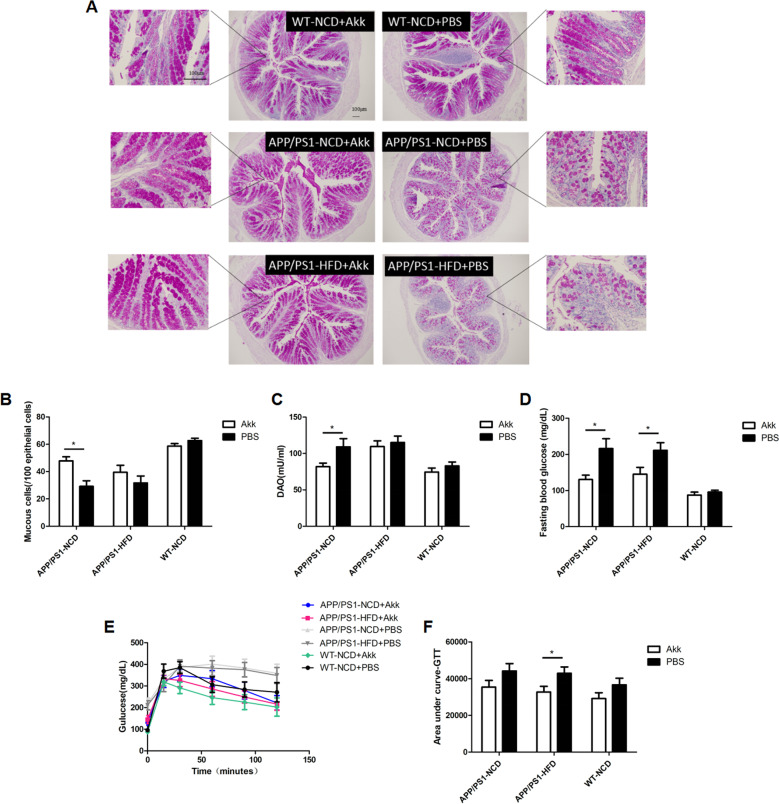
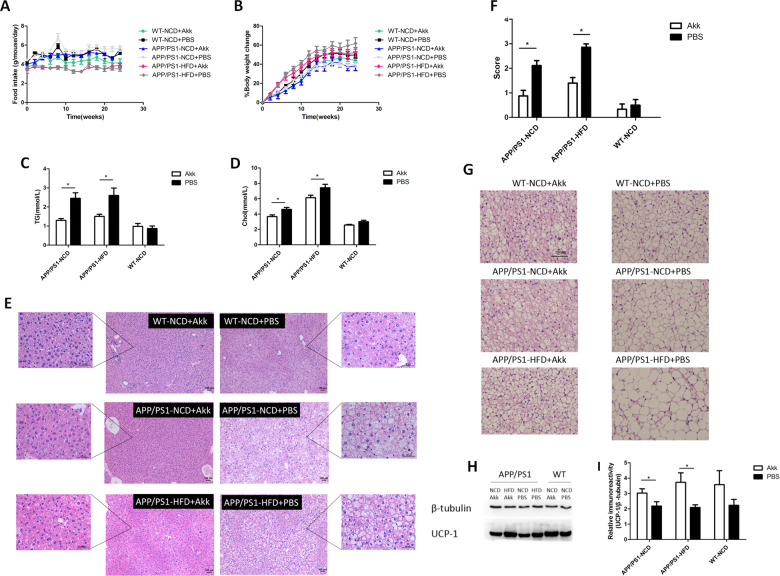
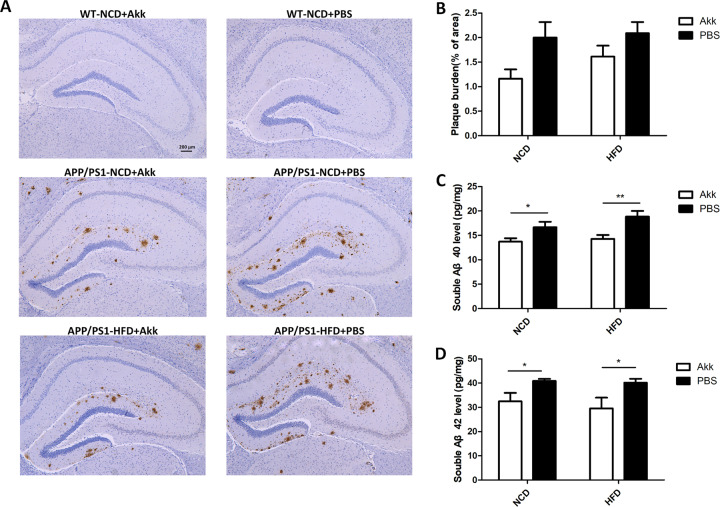
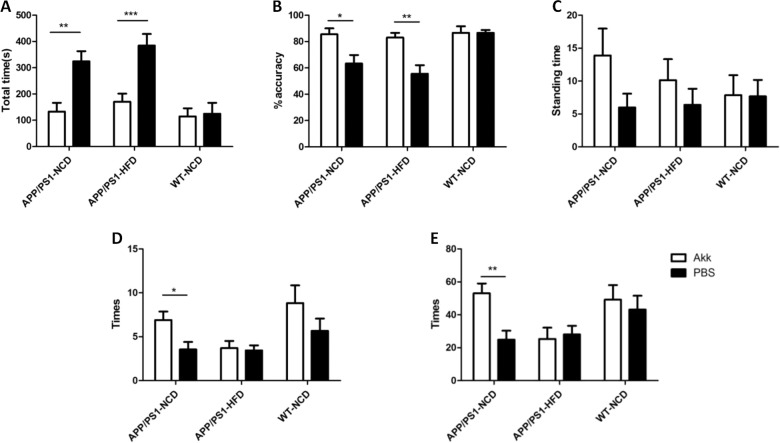
Objective: Alzheimer’s disease (AD) is a global health problem without effective methods to alleviate the disease progression. Amyloid β-protein (Aβ) is widely accepted as a key biomarker for AD. Metabolic syndromes, including obesity and insulin resistance, are key high risk factors for AD. Akkermansia muciniphila (Akk), the only representative human gut microbe in the genus Verrucomicrobia, can prevent the weight gain caused by a high-fat diet, repair the damaged integrity of the intestinal epithelium barrier, reduce endotoxin levels in blood and improve insulin resistance. The aim of this study is to explore the impact of Akk administration in AD model mice in different diets. Methods: APP/PS1 mice were fed either a normal chow diet or a high-fat diet and were treated with Akk by gavage each day for 6 months. The impacts of Akk on glucose metabolism, intestinal barrier and lipid metabolism in the mouse model of AD were determined. Changes in brain pathology and neuroethology were also analyzed. Results: Akk effectively reduced the fasting blood glucose and serum diamine oxidase levels, and alleviated the reduction of colonic mucus cells in APP/PS1 mice. After treatment with Akk, the APP/PS1 mice showed obviously reduced blood lipid levels, improved hepatic steatosis and scapular brown fat whitening. Moreover, Akk promoted the reduction of Aβ 40–42 levels in the cerebral cortex of APP/PS1 mice, shortened the study time and improved the completion rate in Y-maze tests. Conclusion: Akk effectively improved glucose tolerance, intestine barrier dysfunction and dyslipidemia in AD model mice. Our study results suggested that Akk could delay the pathological changes in the brain and relieve impairment of spatial learning and memory in AD model mice, which provides a new strategy for prevention and treatment of AD.
Overview
The claims and statistics of this paper haven’t been checked yet.
Free: it reads the open-access text and checks the first 5 claims that cite a source we can check. Create a free account to check every claim.
Integrity signals
Registry
Cites
Statistics
Figures
Verification
Claims the paper makes
The claims and statistics of this paper haven’t been checked yet.
Free: it reads the open-access text and checks the first 5 claims that cite a source we can check. Create a free account to check every claim.
Claims other papers make about this one
Each is checked against this paper’s own text: does it say what the citing paper says it does?
The cited source says what the claim attributes to it.
In the citing paper
“Recently, Ou et al. 47 suggested that A. muciniphila may improve the insulin resistance of Alzheimer's disease mice, reduce the decrease in colonic mucous cells, improve intestinal barrier dysfunction and dyslipidaemia, and delay pathological changes in the brain”
From The role of gut dysbiosis in Parkinson’s disease: mechanistic insights and therapeutic options (2021) · cites this paper as [47]
The cited source says what the claim attributes to it.
In the citing paper
“therefore, microbial intervention could provide a novel strategy for the prevention and treatment of Alzheimer's disease.47”
From The role of gut dysbiosis in Parkinson’s disease: mechanistic insights and therapeutic options (2021) · cites this paper as [47]
The cited source says what the claim attributes to it.
In the citing paper
“indicating that there is a close connection between gut microbiota and neurological disorders; therefore, microbial intervention could provide a novel strategy for the prevention and treatment of Alzheimer's disease.47”
From The role of gut dysbiosis in Parkinson’s disease: mechanistic insights and therapeutic options (2021) · cites this paper as [47]
Self-check
Percentages, sums and reported differences re-computed from the paper’s own numbers.
The self-check needs the paper’s full text.
Citations
Cites
Cross-talk between Akkermansia muciniphila and intestinal epithelium controls diet-induced obesity
Everard, A., Belzer, C., Geurts, L., Ouwerkerk, J. P., Druart, C., Bindels, L. B., Guiot, Y., Derrien, M., Muccioli, G. G., Delzenne, N. M., et al. (2013) · Proceedings of the National Academy of Sciences · doi:10.1073/pnas.1219451110 · Cited by 4,511
Forecasting the global burden of Alzheimer's disease
Brookmeyer, R., Johnson, E., Ziegler‐Graham, K., & Arrighi, H. M. (2007) · Alzheimer's & Dementia · doi:10.1016/j.jalz.2007.04.381 · Cited by 3,370
Plovier, H., Everard, A., Druart, C., Depommier, C., Van Hul, M., Geurts, L., Chilloux, J., Ottman, N., Duparc, T., Lichtenstein, L., et al. (2017) · Nature Medicine · doi:10.1038/nm.4236 · Cited by 2,204
Dao, M. C., Everard, A., Aron-Wisnewsky, J., Sokolovska, N., Prifti, E., Verger, E. O., Kayser, B. D., Levenez, F., Chilloux, J., Hoyles, L., et al. (2016) · Gut · doi:10.1136/gutjnl-2014-308778 · Cited by 1,931
Talbot, K., Wang, H.-Y., Kazi, H., Han, L.-Y., Bakshi, K. P., Stucky, A., Fuino, R. L., Kawaguchi, K. R., Samoyedny, A. J., Wilson, R. S., et al. (2012) · Journal of Clinical Investigation · doi:10.1172/jci59903 · Cited by 1,871
Shin, N.-R., Lee, J.-C., Lee, H.-Y., Kim, M.-S., Whon, T. W., Lee, M.-S., & Bae, J.-W. (2014) · Gut · doi:10.1136/gutjnl-2012-303839 · Cited by 1,550
Cattaneo, A., Cattane, N., Galluzzi, S., Provasi, S., Lopizzo, N., Festari, C., Ferrari, C., Guerra, U. P., Paghera, B., Muscio, C., et al. (2017) · Neurobiology of Aging · doi:10.1016/j.neurobiolaging.2016.08.019 · Cited by 1,382
The first 1000 cultured species of the human gastrointestinal microbiota
Rajilić-Stojanović, M., & de Vos, W. M. (2014) · FEMS Microbiology Reviews · doi:10.1111/1574-6976.12075 · Cited by 1,182
Reduction of Abeta amyloid pathology in APPPS1 transgenic mice in the absence of gut microbiota
Harach, T., Marungruang, N., Duthilleul, N., Cheatham, V., Mc Coy, K. D., Frisoni, G., Neher, J. J., Fåk, F., Jucker, M., Lasser, T., et al. (2017) · Scientific Reports · doi:10.1038/srep41802 · Cited by 901
Moloney, A. M., Griffin, R. J., Timmons, S., O’Connor, R., Ravid, R., & O’Neill, C. (2010) · Neurobiology of Aging · doi:10.1016/j.neurobiolaging.2008.04.002 · Cited by 764
Cited by
Items 301–329 of 329
Cox, L. M., Calcagno, N., Gauthier, C. D., Madore, C., Butovsky, O., & Weiner, H. L. (2022) · Figshare · doi:10.6084/m9.figshare.19343143
Cuisiniere, T., Calvé, A., Fragoso, G., Oliero, M., Hajjar, R., Gonzalez, E., & Santos, M. M. (2021) · Figshare · doi:10.6084/m9.figshare.16696296
Liu, Y., Li, H., Wang, X., Huang, J., Zhao, D., Tan, Y., Zhang, Z., Zhang, Z., Zhu, L., Wu, B., et al. (2024) · Figshare · doi:10.6084/m9.figshare.26584395
Cox, L. M., Calcagno, N., Gauthier, C. D., Madore, C., Butovsky, O., & Weiner, H. L. (2022) · Figshare · doi:10.6084/m9.figshare.19343155
Cox, L. M., Calcagno, N., Gauthier, C. D., Madore, C., Butovsky, O., & Weiner, H. L. (2022) · Figshare · doi:10.6084/m9.figshare.19343152
Cox, L. M., Calcagno, N., Gauthier, C. D., Madore, C., Butovsky, O., & Weiner, H. L. (2022) · Figshare · doi:10.6084/m9.figshare.19343140
Cox, L. M., Calcagno, N., Gauthier, C. D., Madore, C., Butovsky, O., & Weiner, H. L. (2022) · Figshare · doi:10.6084/m9.figshare.19343146
Cox, L. M., Calcagno, N., Gauthier, C. D., Madore, C., Butovsky, O., & Weiner, H. L. (2022) · Figshare · doi:10.6084/m9.figshare.19343137
Wang, M., Qin, S., Wu, C., Li, H., Li, H., & Yu, J. (2025) · Journal of Agricultural and Food Chemistry · doi:10.1021/acs.jafc.5c11706
Gut Microbiome and Risk of Dementia –a Prospective, Population-Based StudyPreprint
Tynkkynen, J., Kambur, O., Niiranen, T., Lahti, L., Ruuskanen, M. O., McDonald, D. T., Jousilahti, P., Volpiano, C. G., Méric, G., Inouye, M., et al. (2026) · medRxiv · doi:10.64898/2026.02.15.26345196
Zhu, M., Hu, Y., Chang, Y., Wang, Z., & Yu, S. (2026) · Food Research International · doi:10.1016/j.foodres.2026.118992
The role of the microbiota in neurological diseases
Leal-Martínez, F., & Coronado, I. A. B. (2026) · Exploration of Neuroprotective Therapy · doi:10.37349/ent.2026.1004150
Therapeutic Interventions: Modulating the Microbiome to Combat Neurodegeneration
Anandan, A., Unais, A. M., Prabhu, A. V., Saju, M. K., Sonaimuthu, K., Murugesan, H., Danielraj, F., Marimuthu, D., Shibu, M. A., & Viswanadha, V. P. (2026) · Springer eBooks · doi:10.1007/978-981-95-7494-0_8
Akkermansia muciniphila and Alzheimer’s Disease: Mechanisms, Evidence and Translational Potential
Li, J., Long, Q., & Zhu, B. (2026) · Biomolecules · doi:10.3390/biom16050726 · Cited by 1
“Further supporting a potential protective role, research showed that supplementing with A. muciniphila reduced hippocampal plaque load and improved recognition memory in an AD mouse model [59].”
Stein, R. A., Ganesh, A., Rianom, N. A., & Paratore, A. W. (2026) · Physiological Genomics · doi:10.1152/physiolgenomics.00230.2025
Zi, Y., Zhang, J., Lu, C., Pan, B., Zhao, X., & Xiao, X. (2026) · Food Bioscience · doi:10.1016/j.fbio.2026.109395
Next Generation Probiotics Challenges: A Road to use as Live Bio-Therapeutics
and, H. R., Zaidi, A., & Rashid, H. (2026) · Current Microbiology · doi:10.1007/s00284-026-05044-4 · Cited by 1
The characteristics of gut microbiota in colorectal cancer with different microsatellite states
Yao, Y., BingBing, R., Shan, J., Hao, W., Xinyu, L., & Sun, Y. (2026) · Frontiers in Cellular and Infection Microbiology · doi:10.3389/fcimb.2026.1729343
“…diseases, the number of AKK bacteria is descending, so the imbalance of intestinal fl ora may be closely related to the pathogenesis of the above diseases (Cani and De Vos, 2017; Vogt et al., 2017; Depommier et al., 2019; Ou et al., 2020; Qian et al., 2020; Ling et al., 2021; Cani et al., 2022).”
Jiang, Q., & Yan-Jiang, W. A. N. G. (2026) · Shengming kexue · doi:10.3724/cbls.2026100
Shaohui, Z., Chen, Y., Wang, J., Zheng, K., Ruan, Y., Guan, Q., & (287683), T. X. (2026) · Journal of Functional Foods · doi:10.1016/j.jff.2026.107436
Zhang, X., Li, J., An, Y., Zheng, J., Xu, G., Wang, J., Chen, L., & Lu, Y. (2026) · Progress in Neuro-Psychopharmacology and Biological Psychiatry · doi:10.1016/j.pnpbp.2026.111861
Gao, S., Wang, Z., Xie, A.-H., Wu, J.-X., Li-yun, Q., Chen, T., & Chen, X. (2026) · Frontiers in Nutrition · doi:10.3389/fnut.2026.1907570
Chen, Y., Ho, C., & Zhang, X. (2026) · Food Research International · doi:10.1016/j.foodres.2026.120579 · Cited by 1
Bian, X., Cao, J., He, A., Jian, W., Wang, W., & Zha, X. (2026) · International Journal of Molecular Sciences · doi:10.3390/ijms27198771
“Previous preclinical studies have reported the neuroprotective effects of Akk in aged mice and Alzheimer’s disease models [32,33], but its role in midlife obesity-associated cognitive impairment remained largely unexplored.”
Xuan, Z., Rahman, M. U., Ilyas, M., Alioui, Y., Xin, Y., Cao, X., & Ullah, H. (2026) · Brain Research · doi:10.1016/j.brainres.2026.150569
Wu, D., Nie, M., Lin, J., Liu, Y., Wang, Y., Chu, M., Zheng, L., & Zhao, J. (2026) · British Journal of Pharmacology · doi:10.1111/bph.70643
Tao, C., Wan, K., Song, Y., Xu, X., She, M., Sun, Z., Zhu, J., & Yu, Y. (2026) · Brain Behavior and Immunity · doi:10.1016/j.bbi.2026.107067
Asif, H. M., Fujisaka, S., Zahid, R., Aslam, M. R., Bilal, M., Yokoyama, M., & Tobe, K. (2026) · Natural Product Communications · doi:10.1177/1934578x261499940
The role of Akkermansia muciniphila in human disease: a friend or a foe?
HUANG, C., Zhang, Y., Xie, H., & Shi, G. (2026) · Frontiers in Microbiology · doi:10.3389/fmicb.2026.1974213
Metadata
- Authors
- Ou, Z., Deng, L., Lu, Z., Wu, F., Liu, W., Huang, D., & Peng, Y.
- Affiliations
- Zhujiang Hospital (CN)
- Sun Yat-sen University (CN)
- Corresponding author
- Peng, Yongzheng
- Venue
- Nutrition & Diabetes
- Published
- 2020-04-22
- Volume
- 10
- Issue
- 1
- Pages
- 12-12
- ISSN
- 2044-4052 (ISSN-L)
- PMC
- PMC7176648
- OpenAlex
- W3019588555
- Semantic Scholar
- 912ef0e93ba13afcb00cdfbe9bc3cac5e89f82d9
- Cited by
- 328
- References
- 47
- Citations by year
- 2026: 38 · 2025: 65 · 2024: 71 · 2023: 55 · 2022: 64 · 2021: 29 · 2020: 6
- FWCI
- 23.16
- Type
- journal article
- Language
- en
- Open access
- gold
- doi.org
- Licence
- cc-by
- creativecommons.org/licenses/by/4.0 (tdm)
- creativecommons.org/licenses/by/4.0 (vor)
- Locations
- Nutrition and Diabetes (publishedVersion, cc-by)
- PubMed Central (publishedVersion, cc-by)
- PubMed (publishedVersion)
- Funders
- Medical Science and Technology Foundation of Guangdong Province (2015A020213002)
- Topics
- Life Sciences › Neuroscience › Cellular and Molecular Neuroscience › Alzheimer's disease research and treatments
- Life Sciences › Biochemistry, Genetics and Molecular Biology › Molecular Biology › Gut microbiota and health
- Life Sciences › Neuroscience › Neurology › Neuroinflammation and Neurodegeneration Mechanisms
- Keywords
- Akkermansia muciniphila, Alzheimer's disease, amyloid-beta, APP/PS1 mice, high-fat diet, gut microbiota, intestinal barrier, glucose tolerance, dyslipidemia, hepatic steatosis, brown adipose tissue, spatial learning and memory, cognitive impairment, obesity, insulin resistance, endotoxin
- MeSH terms
- Gastrointestinal Microbiome, Akkermansia, Alzheimer Disease, Animals, Blood Glucose, Disease Models, Animal, Glucose, Amine Oxidase (Copper-Containing), Humans, Insulin Resistance, Mice, Transgenic, Peptide Fragments, Amyloid beta-Peptides, Maze Learning, Probiotics, Lipid Metabolism, Mice, Cognitive Dysfunction
About these checks
Registry, retraction, Cites and statistics results are computed, not judged, with one exception: a printed reference that no index lists is read once by a model before it counts as a citation error. Claims are extracted by a model and kept only when their quote appears verbatim in the text; each cited source is then checked, with a model’s help, for whether it says what the claim relies on. Those verdicts can be wrong — read the claim’s quote and the cited source before relying on one.
Statistics and arithmetic are recomputed, not judged.
Confidence bands are shown only for fields calibrated on our annotated test set. None is calibrated yet, so no band is shown.
What counts as a claim ›How we measure confidence ›How we check this ›
Are you an author, or do you see a problem with this page? Request a review
Data sources
Bibliographic data: Semantic Scholar, OpenAlex, Crossref.
Contains information from the Semantic Scholar Academic Graph Datasets, made available under the ODC Attribution License (ODC-BY 1.0).
Semantic Scholar’s data is described in: Kinney, R., et al. (2023). The Semantic Scholar Open Data Platform. arXiv:2301.10140.
