

Protective effects of Akkermansia muciniphila on cognitive deficits and amyloid pathology in a mouse model of Alzheimer's disease
Open accessThe DOI matches its Crossref record; 47 of the 47 references it cites were found in a registry or an index.
Abstract
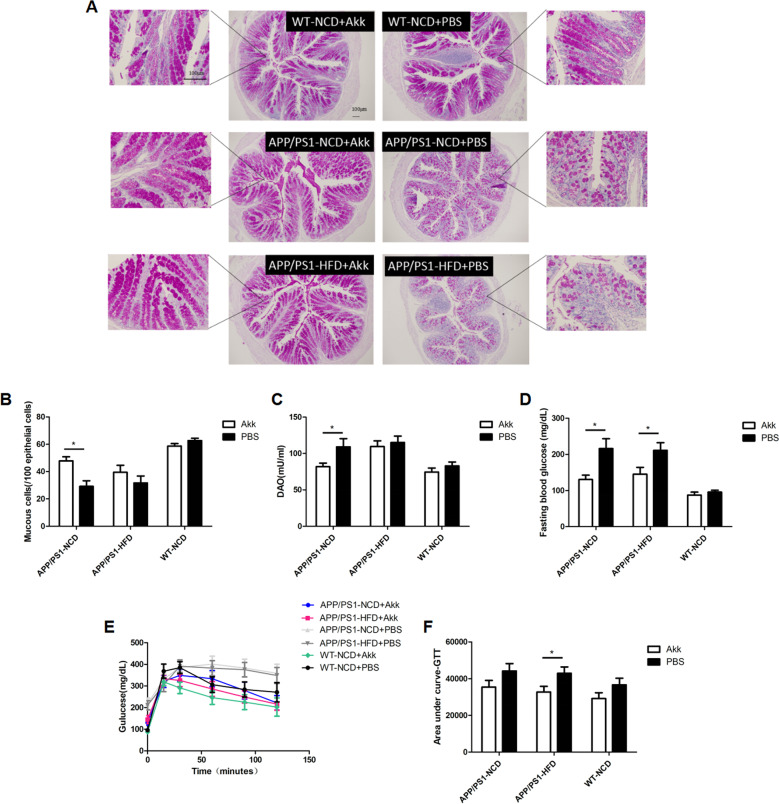
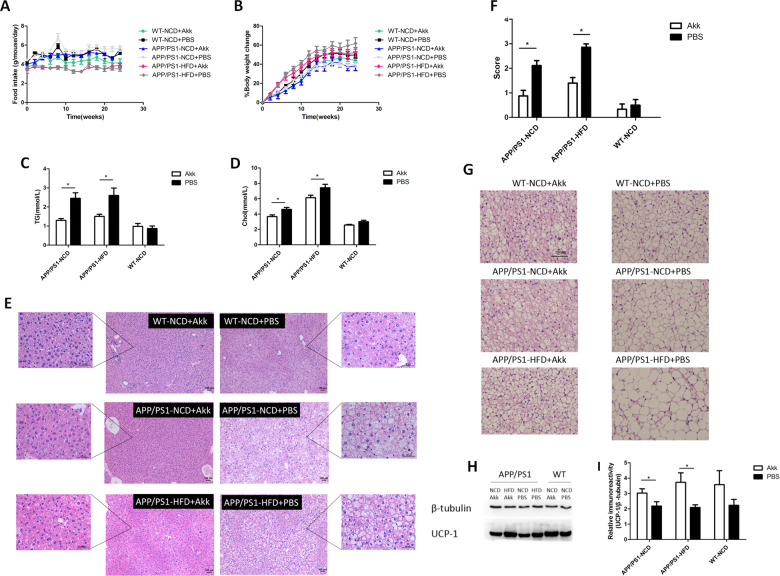
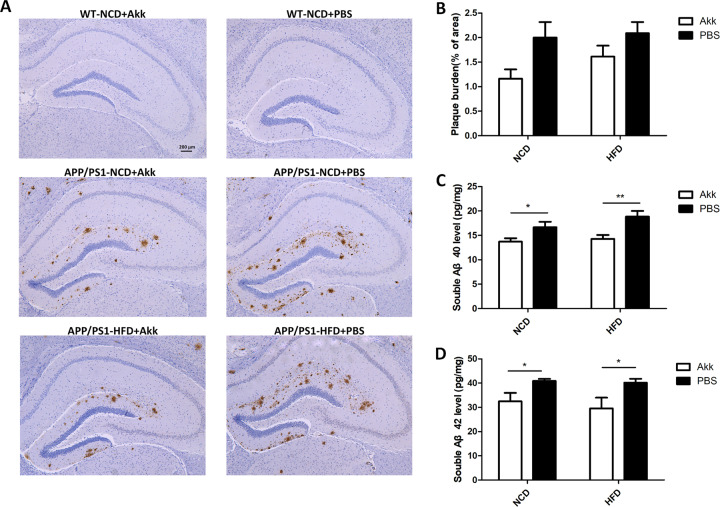
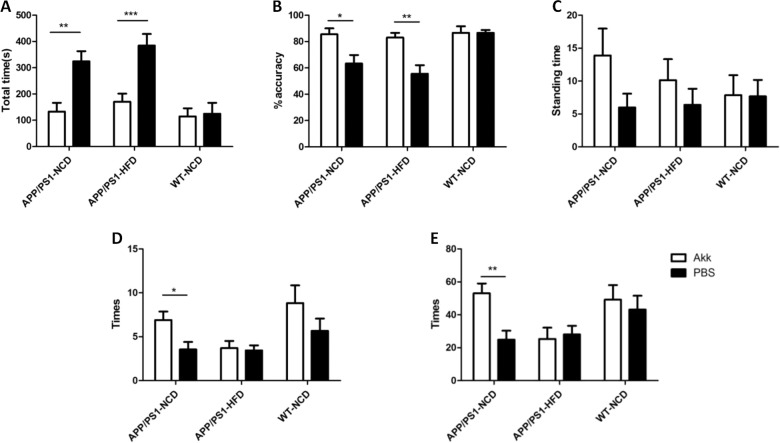
Objective: Alzheimer’s disease (AD) is a global health problem without effective methods to alleviate the disease progression. Amyloid β-protein (Aβ) is widely accepted as a key biomarker for AD. Metabolic syndromes, including obesity and insulin resistance, are key high risk factors for AD. Akkermansia muciniphila (Akk), the only representative human gut microbe in the genus Verrucomicrobia, can prevent the weight gain caused by a high-fat diet, repair the damaged integrity of the intestinal epithelium barrier, reduce endotoxin levels in blood and improve insulin resistance. The aim of this study is to explore the impact of Akk administration in AD model mice in different diets. Methods: APP/PS1 mice were fed either a normal chow diet or a high-fat diet and were treated with Akk by gavage each day for 6 months. The impacts of Akk on glucose metabolism, intestinal barrier and lipid metabolism in the mouse model of AD were determined. Changes in brain pathology and neuroethology were also analyzed. Results: Akk effectively reduced the fasting blood glucose and serum diamine oxidase levels, and alleviated the reduction of colonic mucus cells in APP/PS1 mice. After treatment with Akk, the APP/PS1 mice showed obviously reduced blood lipid levels, improved hepatic steatosis and scapular brown fat whitening. Moreover, Akk promoted the reduction of Aβ 40–42 levels in the cerebral cortex of APP/PS1 mice, shortened the study time and improved the completion rate in Y-maze tests. Conclusion: Akk effectively improved glucose tolerance, intestine barrier dysfunction and dyslipidemia in AD model mice. Our study results suggested that Akk could delay the pathological changes in the brain and relieve impairment of spatial learning and memory in AD model mice, which provides a new strategy for prevention and treatment of AD.
Overview
The claims and statistics of this paper haven’t been checked yet.
Free: it reads the open-access text and checks the first 5 claims that cite a source we can check. Create a free account to check every claim.
Integrity signals
Registry
Cites
Statistics
Figures
Verification
Claims the paper makes
The claims and statistics of this paper haven’t been checked yet.
Free: it reads the open-access text and checks the first 5 claims that cite a source we can check. Create a free account to check every claim.
Claims other papers make about this one
Each is checked against this paper’s own text: does it say what the citing paper says it does?
The cited source says what the claim attributes to it.
In the citing paper
“Recently, Ou et al. 47 suggested that A. muciniphila may improve the insulin resistance of Alzheimer's disease mice, reduce the decrease in colonic mucous cells, improve intestinal barrier dysfunction and dyslipidaemia, and delay pathological changes in the brain”
From The role of gut dysbiosis in Parkinson’s disease: mechanistic insights and therapeutic options (2021) · cites this paper as [47]
The cited source says what the claim attributes to it.
In the citing paper
“therefore, microbial intervention could provide a novel strategy for the prevention and treatment of Alzheimer's disease.47”
From The role of gut dysbiosis in Parkinson’s disease: mechanistic insights and therapeutic options (2021) · cites this paper as [47]
The cited source says what the claim attributes to it.
In the citing paper
“indicating that there is a close connection between gut microbiota and neurological disorders; therefore, microbial intervention could provide a novel strategy for the prevention and treatment of Alzheimer's disease.47”
From The role of gut dysbiosis in Parkinson’s disease: mechanistic insights and therapeutic options (2021) · cites this paper as [47]
Self-check
Percentages, sums and reported differences re-computed from the paper’s own numbers.
The self-check needs the paper’s full text.
Citations
Cites
Cross-talk between Akkermansia muciniphila and intestinal epithelium controls diet-induced obesity
Everard, A., Belzer, C., Geurts, L., Ouwerkerk, J. P., Druart, C., Bindels, L. B., Guiot, Y., Derrien, M., Muccioli, G. G., Delzenne, N. M., et al. (2013) · Proceedings of the National Academy of Sciences · doi:10.1073/pnas.1219451110 · Cited by 4,511
Forecasting the global burden of Alzheimer's disease
Brookmeyer, R., Johnson, E., Ziegler‐Graham, K., & Arrighi, H. M. (2007) · Alzheimer's & Dementia · doi:10.1016/j.jalz.2007.04.381 · Cited by 3,370
Plovier, H., Everard, A., Druart, C., Depommier, C., Van Hul, M., Geurts, L., Chilloux, J., Ottman, N., Duparc, T., Lichtenstein, L., et al. (2017) · Nature Medicine · doi:10.1038/nm.4236 · Cited by 2,204
Dao, M. C., Everard, A., Aron-Wisnewsky, J., Sokolovska, N., Prifti, E., Verger, E. O., Kayser, B. D., Levenez, F., Chilloux, J., Hoyles, L., et al. (2016) · Gut · doi:10.1136/gutjnl-2014-308778 · Cited by 1,931
Talbot, K., Wang, H.-Y., Kazi, H., Han, L.-Y., Bakshi, K. P., Stucky, A., Fuino, R. L., Kawaguchi, K. R., Samoyedny, A. J., Wilson, R. S., et al. (2012) · Journal of Clinical Investigation · doi:10.1172/jci59903 · Cited by 1,871
Shin, N.-R., Lee, J.-C., Lee, H.-Y., Kim, M.-S., Whon, T. W., Lee, M.-S., & Bae, J.-W. (2014) · Gut · doi:10.1136/gutjnl-2012-303839 · Cited by 1,550
Cattaneo, A., Cattane, N., Galluzzi, S., Provasi, S., Lopizzo, N., Festari, C., Ferrari, C., Guerra, U. P., Paghera, B., Muscio, C., et al. (2017) · Neurobiology of Aging · doi:10.1016/j.neurobiolaging.2016.08.019 · Cited by 1,382
The first 1000 cultured species of the human gastrointestinal microbiota
Rajilić-Stojanović, M., & de Vos, W. M. (2014) · FEMS Microbiology Reviews · doi:10.1111/1574-6976.12075 · Cited by 1,182
Reduction of Abeta amyloid pathology in APPPS1 transgenic mice in the absence of gut microbiota
Harach, T., Marungruang, N., Duthilleul, N., Cheatham, V., Mc Coy, K. D., Frisoni, G., Neher, J. J., Fåk, F., Jucker, M., Lasser, T., et al. (2017) · Scientific Reports · doi:10.1038/srep41802 · Cited by 901
Moloney, A. M., Griffin, R. J., Timmons, S., O’Connor, R., Ravid, R., & O’Neill, C. (2010) · Neurobiology of Aging · doi:10.1016/j.neurobiolaging.2008.04.002 · Cited by 764
Ho, L., Qin, W., Pompl, P. N., Xiang, Z., Wang, J., Zhao, Z., Peng, Y., Cambareri, G., Rocher, A., Mobbs, C. V., et al. (2004) · The FASEB Journal · doi:10.1096/fj.03-0978fje · Cited by 630
Self-citationRecovery of ethanol-induced Akkermansia muciniphila depletion ameliorates alcoholic liver disease
Grander, C., Adolph, T. E., Wieser, V., Lowe, P., Wrzosek, L., Gyongyosi, B., Ward, D. V., Grabherr, F., Gerner, R. R., Pfister, A., et al. (2018) · Gut · doi:10.1136/gutjnl-2016-313432 · Cited by 618
Neurological consequences of obesity
O'Brien, P. D., Hinder, L. M., Callaghan, B. C., & Feldman, E. L. (2017) · The Lancet Neurology · doi:10.1016/s1474-4422(17)30084-4 · Cited by 533
AD dementia risk in late MCI, in early MCI, and in subjective memory impairment.
Jessen, F., Wolfsgruber, S., Wiese, B., Bickel, H., Mösch, E., Kaduszkiewicz, H., Pentzek, M., Riedel‐Heller, S. G., Luck, T., Fuchs, A., et al. (2014) · Alzheimer's & Dementia · doi:10.1016/j.jalz.2012.09.017 · Cited by 511
NSAIDs and Alzheimer disease: Epidemiological, animal model and clinical studies
McGeer, P. L., & McGeer, E. G. (2007) · Neurobiology of Aging · doi:10.1016/j.neurobiolaging.2006.03.013 · Cited by 498
Role of gut microbiota and nutrients in amyloid formation and pathogenesis of Alzheimer disease
Pistollato, F., Sumalla Cano, S., Elio, I., Masias Vergara, M., Giampieri, F., & Battino, M. (2016) · Nutrition Reviews · doi:10.1093/nutrit/nuw023 · Cited by 496
How does diabetes accelerate Alzheimer disease pathology?
Sims-Robinson, C., Kim, B., Rosko, A., & Feldman, E. L. (2010) · Nature Reviews Neurology · doi:10.1038/nrneurol.2010.130 · Cited by 492
Craft, S. (2007) · Current Alzheimer Research · doi:10.2174/156720507780362137 · Cited by 487
Inflammation, defective insulin signaling, and neuronal dysfunction in Alzheimer's disease
Ferreira, S. T., Clarke, J. R., Bomfim, T. R., & De Felice, F. G. (2014) · Alzheimer's & Dementia · doi:10.1016/j.jalz.2013.12.010 · Cited by 356
Craft, S. (2005) · Neurobiology of Aging · doi:10.1016/j.neurobiolaging.2005.08.021 · Cited by 348
Alzheimer’s disease and insulin resistance: translating basic science into clinical applications
De Felice, F. G. (2013) · Journal of Clinical Investigation · doi:10.1172/jci64595 · Cited by 330
Type 2 diabetes mellitus and Alzheimer’s disease
Barbagallo, M. (2014) · World Journal of Diabetes · doi:10.4239/wjd.v5.i6.889 · Cited by 313
Microbiota-gut-brain axis and the central nervous system
Zhu, X., Han, Y., Du, J., Liu, R., Jin, K., & Yi, W. (2017) · Oncotarget · doi:10.18632/oncotarget.17754 · Cited by 308
Specific gut microbiota features and metabolic markers in postmenopausal women with obesity
Brahe, L. K., Le Chatelier, E., Prifti, E., Pons, N., Kennedy, S., Hansen, T., Pedersen, O., Astrup, A., Ehrlich, S. D., & Larsen, L. H. (2015) · Nutrition & Diabetes · doi:10.1038/nutd.2015.9 · Cited by 303
Zhang, J., Ke, K.-F., Liu, Z., Qiu, Y.-H., & Peng, Y.-P. (2013) · PLoS ONE · doi:10.1371/journal.pone.0075786 · Cited by 233
Self-citationCrosstalk between Akkermansia muciniphila and intestinal epithelium controls diet-induced obesity
Everard, A., Belzer, C., Geurts, L., Ouwerkerk, J. P., Druart, C., Bindels, L. B., Guiot, Y., Derrien, M., Muccioli, G., Delzenne, N. M., et al. (2013) · Digital Access to Libraries (Université catholique de Louvain (UCL), l'Université de Namur (UNamur) and the Université Saint-Louis (USL-B)) · Cited by 218
Yaffe, K., Haan, M., Blackwell, T., Cherkasova, E., Whitmer, R. A., & West, N. (2007) · Journal of the American Geriatrics Society · doi:10.1111/j.1532-5415.2007.01139.x · Cited by 210
Towards understanding brain-gut-microbiome connections in Alzheimer’s disease
Xu, R., & Wang, Q. (2016) · BMC Systems Biology · doi:10.1186/s12918-016-0307-y · Cited by 175
Microbial-generated amyloids and Alzheimer's disease (AD)
Hill, J. M., & Lukiw, W. J. (2015) · Frontiers in Aging Neuroscience · doi:10.3389/fnagi.2015.00009 · Cited by 173
Carvalho, C., Cardoso, S., Correia, S. C., Santos, R. X., Santos, M. S., Baldeiras, I., Oliveira, C. R., & Moreira, P. I. (2012) · Diabetes · doi:10.2337/db11-1186 · Cited by 152
A role for insulin in the diet-induced thermogenesis of cafeteria-fed rats
Rothwell, N. J., & Stock, M. J. (1981) · Metabolism · doi:10.1016/0026-0495(81)90082-2 · Cited by 148
CSF Aβ1–42 – an excellent but complicated Alzheimer's biomarker – a route to standardisation
Kuhlmann, J., Andréasson, U., Pannee, J., Bjerke, M., Portelius, E., Leinenbach, A., Bittner, T., Korecka, M., Jenkins, R. G., Vanderstichele, H., et al. (2016) · Clinica Chimica Acta · doi:10.1016/j.cca.2016.05.014 · Cited by 148
Progress in Alzheimer’s disease
Galimberti, D., & Scarpini, E. A. (2011) · Journal of Neurology · doi:10.1007/s00415-011-6145-3 · Cited by 139
De Felice, F. G., & Lourenco, M. V. (2015) · Frontiers in Aging Neuroscience · doi:10.3389/fnagi.2015.00094 · Cited by 121
Is Alzheimer's disease related to metabolic syndrome? A Wnt signaling conundrum
Ríos, J. A., Cisternas, P., Arrese, M. A., Salesa Barja, Y., & Inestrosa, N. C. (2014) · Progress in Neurobiology · doi:10.1016/j.pneurobio.2014.07.004 · Cited by 110
Mao, Y., Guo, Z., Zheng, T., Jiang, Y., Yan, Y., Yin, X., Chen, Y., & Zhang, B. (2016) · Aging Cell · doi:10.1111/acel.12498 · Cited by 110
Brown adipose tissue: Updates in cellular and molecular biology
Bargut, T. C. L., Águila, M. B., & Mandarim‐de‐Lacerda, C. A. (2016) · Tissue and Cell · doi:10.1016/j.tice.2016.08.001 · Cited by 108
Mechanisms of Aging-Related Impairment of Brown Adipocyte Development and Function
Graja, A., & Schulz, T. J. (2015) · Gerontology · doi:10.1159/000366557 · Cited by 102
Mitochondrial function in ageing: coordination with signalling and transcriptional pathways
Yin, F., Sancheti, H., Liu, Z., & Cadenas, E. (2016) · The Journal of Physiology · doi:10.1113/jp270541 · Cited by 90
Carvalho, C., Machado, N., Mota, P. C., Correia, S. C., Cardoso, S., Santos, R. X., Santos, M. S., Oliveira, C. R., & Moreira, P. I. (2013) · Journal of Alzheimer's Disease · doi:10.3233/jad-130005 · Cited by 84
Progress of Alzheimer‚s disease
Lawrence, W. S. (2009) · Docs.school Publications · Cited by 68
Different subtype strains of Akkermansia muciniphila abundantly colonize in southern China
Guo, X., Zhang, J., Wu, F., Zhang, M., Yi, M., & Peng, Y. (2016) · Journal of Applied Microbiology · doi:10.1111/jam.13022 · Cited by 65
Self-citationMartins, F. F., Bargut, T. C. L., Águila, M. B., & Mandarim‐de‐Lacerda, C. A. (2016) · Annals of Anatomy - Anatomischer Anzeiger · doi:10.1016/j.aanat.2016.11.013 · Cited by 62
Campos-Peña, V., Toral-Rios, D., Becerril-Pérez, F., Sánchez-Torres, C., Delgado-Namorado, Y., Torres-Ossorio, E., Franco-Bocanegra, D., & Carvajal, K. (2017) · Antioxidants & Redox Signaling · doi:10.1089/ars.2016.6768 · Cited by 58
Frontiers in Alzheimer’s disease therapeutics
Stone, J. G., Casadesús, G., Rothenberg, K. G., Siedlak, S. L., Wang, X., Zhu, X., Perry, G. L., Castellani, R. J., & Smith, M. A. (2010) · Therapeutic Advances in Chronic Disease · doi:10.1177/2040622310382817 · Cited by 35
Immunity-Based Evolutionary Interpretation of Diet-Induced Thermogenesis
Liao, W.-H., Henneberg, M., & Langhans, W. (2016) · Cell Metabolism · doi:10.1016/j.cmet.2016.05.002 · Cited by 19
Connecting Type 2 diabetes to Alzheimer’s disease
Felice, F. G. D. (2013) · Expert Review of Neurotherapeutics · doi:10.1586/14737175.2013.864824 · Cited by 18
Cited by
Microbiota–gut–brain axis and its therapeutic applications in neurodegenerative diseases
Loh, J. S., Mak, W. Q., Tan, L. K. S., Ng, C. X., Chan, H. H., Yeow, S. H., Foo, J. B., Ong, Y. S., How, C. W., & Khaw, K. Y. (2024) · Signal Transduction and Targeted Therapy · doi:10.1038/s41392-024-01743-1 · Cited by 1,193
Akkermansia muciniphila: paradigm for next-generation beneficial microorganisms
Cani, P. D., Depommier, C., Derrien, M., Everard, A., & de Vos, W. M. (2022) · Nature Reviews Gastroenterology & Hepatology · doi:10.1038/s41575-022-00631-9 · Cited by 1,192
The intestinal barrier: a pivotal role in health, inflammation, and cancer
Neurath, M. F., Artis, D., & Becker, C. (2025) · The Lancet Gastroenterology & Hepatology · doi:10.1016/s2468-1253(24)00390-x · Cited by 487
Suganya, K., & Koo, B.-S. (2020) · International Journal of Molecular Sciences · doi:10.3390/ijms21207551 · Cited by 368
The role of gut dysbiosis in Parkinson’s disease: mechanistic insights and therapeutic options
Wang, Q., Luo, Y., Ray Chaudhuri, K., Reynolds, R., Tan, E.-K., & Pettersson, S. (2021) · Brain · doi:10.1093/brain/awab156 · Cited by 281
Metadata
- Authors
- Ou, Z., Deng, L., Lu, Z., Wu, F., Liu, W., Huang, D., & Peng, Y.
- Affiliations
- Zhujiang Hospital (CN)
- Sun Yat-sen University (CN)
- Corresponding author
- Peng, Yongzheng
- Venue
- Nutrition & Diabetes
- Published
- 2020-04-22
- Volume
- 10
- Issue
- 1
- Pages
- 12-12
- ISSN
- 2044-4052 (ISSN-L)
- PMC
- PMC7176648
- OpenAlex
- W3019588555
- Semantic Scholar
- 912ef0e93ba13afcb00cdfbe9bc3cac5e89f82d9
- Cited by
- 328
- References
- 47
- Citations by year
- 2026: 38 · 2025: 65 · 2024: 71 · 2023: 55 · 2022: 64 · 2021: 29 · 2020: 6
- FWCI
- 23.16
- Type
- journal article
- Language
- en
- Open access
- gold
- doi.org
- Licence
- cc-by
- creativecommons.org/licenses/by/4.0 (tdm)
- creativecommons.org/licenses/by/4.0 (vor)
- Locations
- Nutrition and Diabetes (publishedVersion, cc-by)
- PubMed Central (publishedVersion, cc-by)
- PubMed (publishedVersion)
- Funders
- Medical Science and Technology Foundation of Guangdong Province (2015A020213002)
- Topics
- Life Sciences › Neuroscience › Cellular and Molecular Neuroscience › Alzheimer's disease research and treatments
- Life Sciences › Biochemistry, Genetics and Molecular Biology › Molecular Biology › Gut microbiota and health
- Life Sciences › Neuroscience › Neurology › Neuroinflammation and Neurodegeneration Mechanisms
- Keywords
- Akkermansia muciniphila, Alzheimer's disease, amyloid-beta, APP/PS1 mice, high-fat diet, gut microbiota, intestinal barrier, glucose tolerance, dyslipidemia, hepatic steatosis, brown adipose tissue, spatial learning and memory, cognitive impairment, obesity, insulin resistance, endotoxin
- MeSH terms
- Gastrointestinal Microbiome, Akkermansia, Alzheimer Disease, Animals, Blood Glucose, Disease Models, Animal, Glucose, Amine Oxidase (Copper-Containing), Humans, Insulin Resistance, Mice, Transgenic, Peptide Fragments, Amyloid beta-Peptides, Maze Learning, Probiotics, Lipid Metabolism, Mice, Cognitive Dysfunction
About these checks
Registry, retraction, Cites and statistics results are computed, not judged, with one exception: a printed reference that no index lists is read once by a model before it counts as a citation error. Claims are extracted by a model and kept only when their quote appears verbatim in the text; each cited source is then checked, with a model’s help, for whether it says what the claim relies on. Those verdicts can be wrong — read the claim’s quote and the cited source before relying on one.
Statistics and arithmetic are recomputed, not judged.
Confidence bands are shown only for fields calibrated on our annotated test set. None is calibrated yet, so no band is shown.
What counts as a claim ›How we measure confidence ›How we check this ›
Are you an author, or do you see a problem with this page? Request a review
Data sources
Bibliographic data: Semantic Scholar, OpenAlex, Crossref.
Contains information from the Semantic Scholar Academic Graph Datasets, made available under the ODC Attribution License (ODC-BY 1.0).
Semantic Scholar’s data is described in: Kinney, R., et al. (2023). The Semantic Scholar Open Data Platform. arXiv:2301.10140.
