

Inflammation and aging: signaling pathways and intervention therapies
Open accessThe DOI matches its Crossref record; 476 of the 479 references it cites were found in a registry or an index; 215 of the 287 sources its claims cite were checked for support.
Abstract
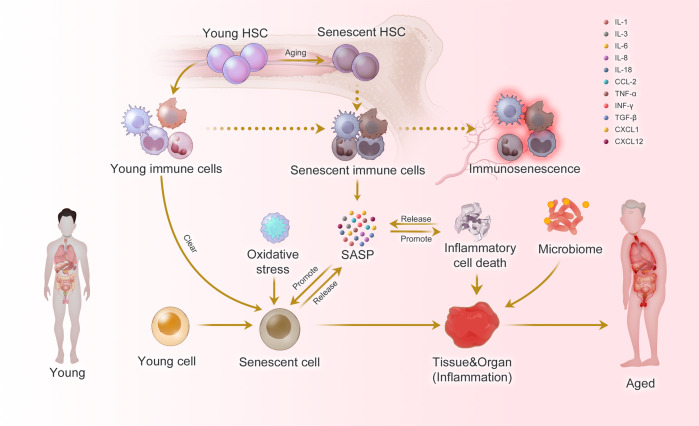
Aging is characterized by systemic chronic inflammation, which is accompanied by cellular senescence, immunosenescence, organ dysfunction, and age-related diseases. Given the multidimensional complexity of aging, there is an urgent need for a systematic organization of inflammaging through dimensionality reduction. Factors secreted by senescent cells, known as the senescence-associated secretory phenotype (SASP), promote chronic inflammation and can induce senescence in normal cells. At the same time, chronic inflammation accelerates the senescence of immune cells, resulting in weakened immune function and an inability to clear senescent cells and inflammatory factors, which creates a vicious cycle of inflammation and senescence. Persistently elevated inflammation levels in organs such as the bone marrow, liver, and lungs cannot be eliminated in time, leading to organ damage and aging-related diseases. Therefore, inflammation has been recognized as an endogenous factor in aging, and the elimination of inflammation could be a potential strategy for anti-aging. Here we discuss inflammaging at the molecular, cellular, organ, and disease levels, and review current aging models, the implications of cutting-edge single cell technologies, as well as anti-aging strategies. Since preventing and alleviating aging-related diseases and improving the overall quality of life are the ultimate goals of aging research, our review highlights the critical features and potential mechanisms of inflammation and aging, along with the latest developments and future directions in aging research, providing a theoretical foundation for novel and practical anti-aging strategies.
Overview
CoChat Summary
## TL;DR
This review argues that inflammaging—a chronic, systemic inflammatory state—is tightly intertwined with cellular senescence, immunosenescence, organ dysfunction, and age-related disease. It synthesizes signaling pathways, aging models, single-cell technologies, and intervention strategies, emphasizing anti-inflammatory approaches, senolytics, stem cell therapy, and organ transplantation.
## Key findings
- The paper describes a “vicious cycle” in which senescent cells secrete SASP factors that promote chronic inflammation, while chronic inflammation accelerates immune-cell senescence and weakens clearance of senescent cells and inflammatory factors.
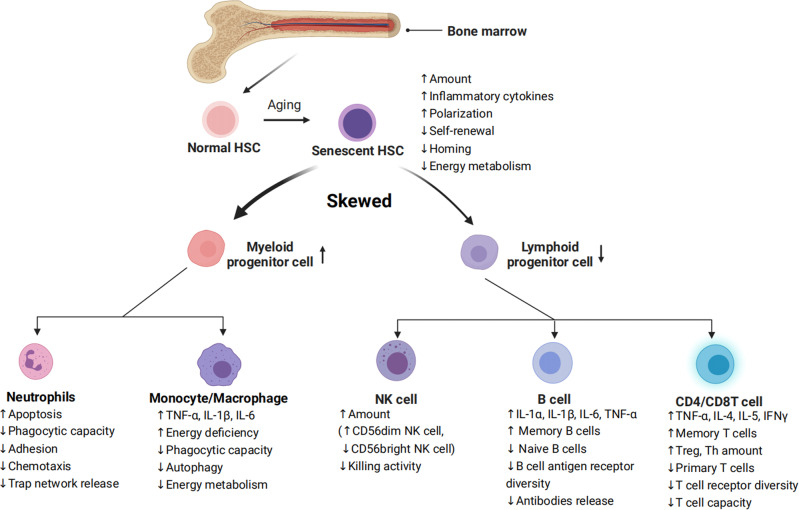
- It highlights reported age-related immune changes across cell types, including decreased circulating naive CD8 T cells as a consistent marker of immunosenescence in healthy older adults, reduced NK-cell cytotoxicity, and age-associated shifts in HSC differentiation toward myeloid lineages.
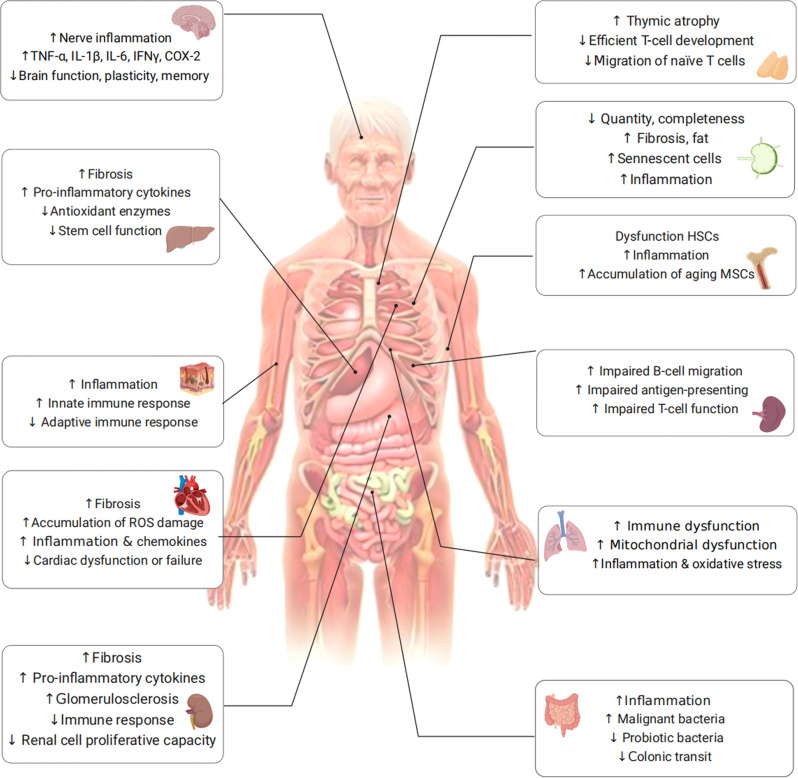
- The review links inflammaging to organ-level decline in the bone marrow, thymus, spleen, lymph nodes, brain, heart, kidney, liver, skin, lung, and gut, with examples such as age-related thymic degeneration reducing new T-cell output and aged bone marrow impairing HSC function.
- For intervention, it notes that the first senolytic combination, dasatinib plus quercetin, increased 6-minute walking distance by an average of 21.5 meters in the first human trial, but other outcomes did not change significantly and long-term efficacy remains insufficiently supported.
## Methods
- Narrative review of inflammaging across molecular, cellular, organ, and disease levels, with sections on signaling pathways, classical aging models, single-cell technology, and intervention strategies.
- No new experimental sample or cohort is reported in the paper itself; instead, it synthesizes findings from prior mouse, human, and cell-line studies cited throughout the text.
- The main approach is qualitative integration of published evidence, including examples from in vitro senescence models, in vivo mouse models, centenarian studies, and emerging single-cell/multi-omics work.
## Limitations
- The paper explicitly notes that the exact causality between inflammation and aging remains unresolved and “deserves further studies” for effective intervention.
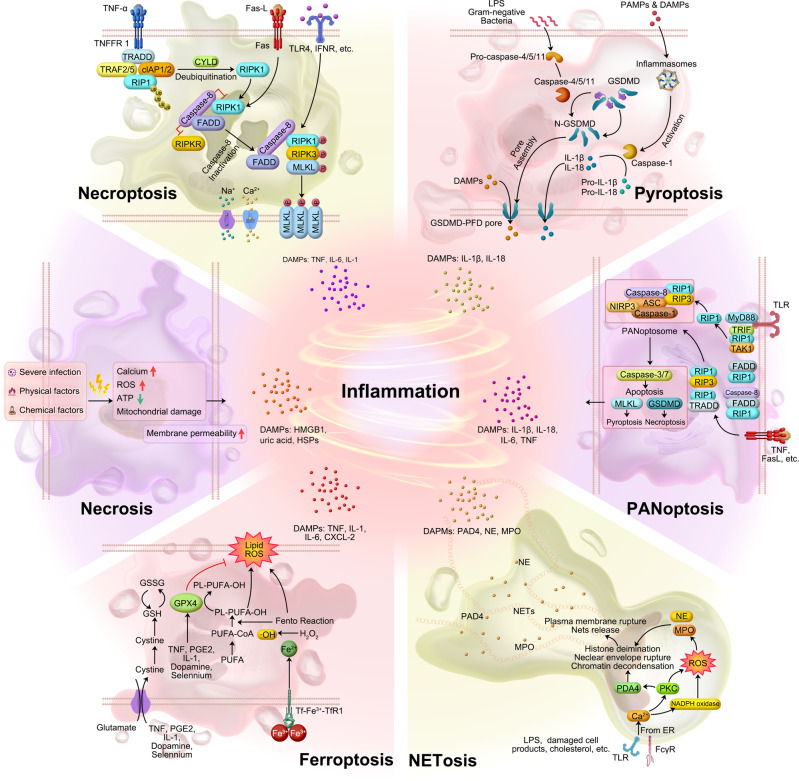
- It also states that PANoptosis has no direct evidence yet linking it to aging, so any connection is speculative.
- Evident from the text: this is a broad review rather than a primary study, so many conclusions are synthesized from heterogeneous prior studies rather than tested in one unified dataset.
Model-written summary. Check it against the paper before relying on it.
Integrity signals
Registry
Cites
Statistics
Figures
Verification
Claims the paper makes
140 Valid · 17 Not valid · 39 Not checked · 40 Own results and interpretations
Some cited sources support this claim and some don’t — read each source’s verdict below.
In the paper
“At the same time, inflammation promotes oxidation through inflammatory mediators.205,206”
§ Inflammation and aging: signaling pathways and intervention therapies > Mechanisms of inflammaging > Triggers of inflammaging
What the sources say
- Disputedcites [205] Furman D Expression of specific inflammasome gene modules stratifies older individuals into two extreme clinical and immunological states Nat. Med. 2017 23 174 184 10.1038/nm.4267 28092664 PMC5320935 sourceExperimental — accuracy not yet measured
The Discussion describes the opposite causal direction: oxidative stress triggers an inflammatory response, including production of inflammatory cytokines. The Results attribute chronic oxidative stress to possible mitochondrial metabolic reprogramming, not to inflammatory mediators. Page numbers are unavailable in our copy. (LLM, conf=0.82)
Checked by a reasoning model — may be wrong.
- Partly supportedcites [206] Furman D Chronic inflammation in the etiology of disease across the life span Nat. Med. 2019 25 1822 1832 10.1038/s41591-019-0675-0 31806905 PMC7147972 sourceExperimental — accuracy not yet measured
The ‘Systemic chronic inflammation and non-communicable disease risk’ section says systemic chronic inflammation can damage tissues by inducing oxidative stress. That supports the inflammation-to-oxidation link, but the passage does not say that inflammatory mediators are the mechanism. (LLM, conf=0.85)
plainstates a cause- Asserted: passes — The authors put it forward as true.
- Checkable: passes — It can be checked against evidence.
- Load-bearing: passes — The paper’s conclusions depend on it.
- Based: passes — The paper gives a reason why it holds.
- Disputed
At least one cited source doesn’t support this claim or points to a different paper, and none confirmed it — see the verdicts below.
In the paper
“Senescent neutrophils exhibit several distinct characteristics during NETosis, including a reduced capacity to release NETs, instability in the quality of formed NETs, and decreased activity of DNA degrading enzymes (DNases) within NETs.”
§ Inflammation and aging: signaling pathways and intervention therapies > Mechanisms of inflammaging > Inflammatory cell death
What the sources say
- Disputedcites [269] Sabbatini M Aging hampers neutrophil extracellular traps (NETs) efficacy Aging Clin. Exp. Res. 2022 34 2345 2353 10.1007/s40520-022-02201-0 35920993 PMC9637667 sourceExperimental — accuracy not yet measured
The Results and Discussion report that neutrophils from elderly subjects produced more NETs than those from adults after LPS stimulation, contrary to the unqualified claim of reduced release. The Introduction and Discussion note reduced NET production in other studies using different stimulation conditions, but distinguish those findings from this paper’s results. (LLM, conf=0.87)
Checked by a reasoning model — may be wrong.
plainstates a cause- Asserted: passes — The authors put it forward as true.
- Checkable: passes — It can be checked against evidence.
- Load-bearing: unclear — It is unclear whether the paper’s conclusions depend on it.
- Based: passes — The paper gives a reason why it holds.
- Disputed
The cited sources support only part of this claim — read each source’s verdict below.
In the paper
“However, in the aging heart, macrophages recruited to the site of infarction exhibit a pro-inflammatory M1 phenotype initially, but subsequently transition to an anti-inflammatory M2 phenotype after myocardial infarction (MI).”
§ Inflammation and aging: signaling pathways and intervention therapies > Inflammaging at the organ level > Sterile organs
What the sources say
- Partly supportedcites [143] Ma Y Mouton AJ Lindsey ML Cardiac macrophage biology in the steady-state heart, the aging heart, and following myocardial infarction Transl. Res. 2018 191 15 28 10.1016/j.trsl.2017.10.001 29106912 PMC5846093 sourceExperimental — accuracy not yet measured
The Abstract and “Macrophages in the MI Heart—Macrophage phenotypes” describe an early M1 and later M2 pattern after infarction. But the paper treats aging-heart macrophages separately and does not establish that this post-MI pattern occurs specifically in aging hearts. Its “Macrophage polarization mechanisms” section also says whether individual macrophages convert in vivo remains uncertain. Page numbers are unavailable in our copy. (LLM, conf=0.88)
plainstates a cause- Asserted: passes — The authors put it forward as true.
- Checkable: passes — It can be checked against evidence.
- Load-bearing: unclear — It is unclear whether the paper’s conclusions depend on it.
- Based: passes — The paper gives a reason why it holds.
- Partly supported
Every source the paper cites for this claim was checked and supports it.
In the paper
“This phenotypic switch promotes angiogenesis and scar formation, aiding in the recovery process.143”
§ Inflammation and aging: signaling pathways and intervention therapies > Inflammaging at the organ level > Sterile organs
What the sources say
- Supportedcites [143] Ma Y Mouton AJ Lindsey ML Cardiac macrophage biology in the steady-state heart, the aging heart, and following myocardial infarction Transl. Res. 2018 191 15 28 10.1016/j.trsl.2017.10.001 29106912 PMC5846093 source
The “Macrophage phenotypes” section says that M2 macrophages facilitate neoangiogenesis and scar repair, and that shifting the M1/M2 balance improves myocardial repair and function after MI. This supports the cited sentence’s account of angiogenesis, scar formation, and recovery. (LLM, conf=0.92)
plainstates a cause- Asserted: passes — The authors put it forward as true.
- Checkable: passes — It can be checked against evidence.
- Load-bearing: unclear — It is unclear whether the paper’s conclusions depend on it.
- Based: passes — The paper gives a reason why it holds.
- Supported
The cited sources that could be checked couldn’t confirm or dispute this claim.
In the paper
“Senescence of HSCs is the basis of immunosenescence. Senescent HSC differentiate into various types of dysfunctional immune cells, driving immunosenescence.16”
§ Inflammation and aging: signaling pathways and intervention therapies > Inflammaging at the cellular level > Hematopoietic stem cells (HSCs)
What the sources say
- Could not verifycites [16] Liggett LA Sankaran VG Unraveling Hematopoiesis through the Lens of Genomics Cell 2020 182 1384 1400 10.1016/j.cell.2020.08.030 32946781 PMC7508400 sourceExperimental — accuracy not yet measured
The Clonal hematopoiesis section describes age-related changes in HSC numbers and clonal expansion, but does not link HSC senescence to immunosenescence. A search for immunosenescence and dysfunctional immune cells found no passage establishing that proposed mechanism; the Outstanding Questions section also notes that some older people retain ostensibly normal hematopoiesis. (LLM, conf=0.72)
plainstates a cause- Asserted: passes — The authors put it forward as true.
- Checkable: passes — It can be checked against evidence.
- Load-bearing: unclear — It is unclear whether the paper’s conclusions depend on it.
- Based: passes — The paper gives a reason why it holds.
- Could not verify
95 more claims · 66 with their cited sources checked
Create a free account to see all 236 claims and every source verdict.
- It may state two separate claims as one. 111
- Probably not a substantial claim. 41
- Borderline: one of the tests for a substantial claim is unclear. 1
Claims other papers make about this one
Each is checked against this paper’s own text: does it say what the citing paper says it does?
The cited source says what the claim attributes to it.
In the citing paper
“Inflammation is implicated in various pathways and processes associated with ageing, including immunosenescence, oxidative stress, metabolic dysregulation, cellular senescence, and other critical events of the ageing process.37”
From Antiageing strategy for neurodegenerative diseases: from mechanisms to clinical advances (2025) · cites this paper as [37]
In the citing paper
“These frameworks suggest that the pathophysiology of AD is characterized by phosphorylated tau accumulation and propagation,31 heightened inflammatory responses, dysregulation of oxidative stress (related to mitochondrial dysfunction),37 alongside a gradual decline in cholinergic function.38”
From Antiageing strategy for neurodegenerative diseases: from mechanisms to clinical advances (2025) · cites this paper as [37]
In the citing paper
“exercise can reduce inflammation levels, which is a contributing factor to the ageing process.37”
From Antiageing strategy for neurodegenerative diseases: from mechanisms to clinical advances (2025) · cites this paper as [37]
Citations
Cites
Reduction in the incidence of type 2 diabetes with lifestyle intervention or metformin
(2002) · New England Journal of Medicine · doi:10.1056/nejmoa012512 · Cited by 19,011
Diversity of the Human Intestinal Microbial Flora
Eckburg, P. B., Bik, E. M., Bernstein, C. N., Purdom, E., Dethlefsen, L., Sargent, M., Gill, S. R., Nelson, K. E., & Relman, D. A. (2005) · Science · doi:10.1126/science.1110591 · Cited by 7,913
Mizgerd, J. P., Kubo, H., Kutkoski, G. J., Bhagwan, S. D., Scharffetter-Kochanek, K., Beaudet, A. L., & Doerschuk, C. M. (1997) · The Journal of Experimental Medicine · doi:10.1084/jem.186.8.1357 · Cited by 7,306
Chronic inflammation in the etiology of disease across the life span
Furman, D., Campisi, J., Verdin, E., Carrera-Bastos, P., Targ, S., Franceschi, C., Ferrucci, L., Gilroy, D. W., Fasano, A., Miller, G. W., et al. (2019) · Nature Medicine · doi:10.1038/s41591-019-0675-0 · Cited by 4,915
NLRP3 inflammasomes are required for atherogenesis and activated by cholesterol crystals
Duewell, P., Kono, H., Rayner, K. J., Sirois, C. M., Vladimer, G., Bauernfeind, F. G., Abela, G. S., Franchi, L., Nuñez, G., Schnurr, M., et al. (2010) · Nature · doi:10.1038/nature08938 · Cited by 4,026
Mortality Associated With Influenza and Respiratory Syncytial Virus in the United States
Thompson, W. W., Shay, D. K., Weintraub, E., Brammer, L., Cox, N., Anderson, L. J., & Fukuda, K. (2003) · JAMA · doi:10.1001/jama.289.2.179 · Cited by 3,673
Inflammaging: a new immune–metabolic viewpoint for age-related diseases
Franceschi, C., Garagnani, P., Parini, P., Giuliani, C., & Santoro, A. (2018) · Nature Reviews Endocrinology · doi:10.1038/s41574-018-0059-4 · Cited by 3,586
Sies, H., Berndt, C., & Jones, D. P. (2017) · Annual Review of Biochemistry · doi:10.1146/annurev-biochem-061516-045037 · Cited by 3,520
Gut microbiota composition correlates with diet and health in the elderly
Claesson, M. J., Jeffery, I. B., Conde, S., Power, S. E., O’Connor, E. M., Cusack, S., Harris, H. M. B., Coakley, M., Lakshminarayanan, B., O’Sullivan, O., et al. (2012) · Nature · doi:10.1038/nature11319 · Cited by 3,314 · cited 1×
“Older adults (>65 years) exhibit reduced microbiota diversity compared to adults, along with greater inter-individual variation in microbiota composition.(182) This is characterized by diminished populations of beneficial bacteria such as Bifidobacterium, Bacillus, E.”
BackgroundCellular Senescence: Defining a Path Forward
Gorgoulis, V., Adams, P. D., Alimonti, A., Bennett, D. C., Bischof, O., Bishop, C., Campisi, J., Collado, M., Evangelou, K., Ferbeyre, G., et al. (2019) · Cell · doi:10.1016/j.cell.2019.10.005 · Cited by 3,225 · cited 1×
“net).(371) On the other hand, other technologies, such as machine learning which integrates multi-modal and multidimensional big data, are also important to address the complexity of aging problems (Table 4).”
Background
Cited by
Items 301–400 of 1,410
IL-33 is associated with alveolar dysfunction in patients with viral lower respiratory tract disease
Scott, I. C., van Zuydam, N. R., Cann, J. A., Negri, V. A., Tsafou, K., Killick, H., Liu, Z., McCrae, C., Rees, D. G., England, E., et al. (2024) · Mucosal Immunology · doi:10.1016/j.mucimm.2024.12.001 · Cited by 16
Immune senescence: A key player in cancer biology
Yang, Y., Fan, L., Li, M., & Wang, Z. (2024) · Seminars in Cancer Biology · doi:10.1016/j.semcancer.2024.12.001 · Cited by 16
From Embryogenesis to Senescence: The Role of Mammary Gland Physiology in Breast Cancer Risk
Lue, J. C., & Radisky, D. C. (2025) · Cancers · doi:10.3390/cancers17050787 · Cited by 19
“VEGF, for example, is primarily associated with angiogenesis but also promotes epithelial cell survival through anti-apoptotic pathways [118].”
Environmental Health Is Overlooked in Longevity Research
Mesnage, R. (2025) · Antioxidants · doi:10.3390/antiox14040421 · Cited by 15
“Aging is characterized by systemic chronic inflammation [70].”
Govindarasu, M., Joy, J. G., Sharma, G., & Kim, J. (2025) · Nano Today · doi:10.1016/j.nantod.2025.102747 · Cited by 15
Janani, K. V., Saberian, P., Patel, H. B., Keetha, N. R., Etemadzadeh, A., Patel, A., Hashemi, S. M., Amini‐Salehi, E., & Gurram, A. (2025) · Journal of Health Population and Nutrition · doi:10.1186/s41043-025-00860-z · Cited by 20
“This aligns with well-established metabolic principles, as aging is inherently linked to insulin resistance, adiposity redistribution, and increased systemic inflammation—all of which predispose individuals to MetS [96–98].”
Ding, F., Yu, Y., Zhao, J., Wei, S., Zhang, Y., Han, J. H., Li, Z., Jiang, H., Ryu, D., Cho, M., et al. (2025) · Frontiers in Cell and Developmental Biology · doi:10.3389/fcell.2025.1593096 · Cited by 19
Epigenetic clocks and inflammaging: pitfalls caused by ignoring cell-type heterogeneity
Guo, X.-L., & Teschendorff, A. (2025) · bioRxiv · doi:10.1007/s11357-025-01677-8 · Cited by 12
“…changes in immune-cell composition and DNAm changes in individual immune cell types, but it is also of a more systemic nature, involving the accumulation of senescent cells and changes in metabolism [44, 63], which current clocks or cell-type deconvolution algorithms may not be able to capture.”
Wang, Y., Liang, X., Andrikopoulos, N., Zheng, S., Li, Y., & Ke, P. C. (2025) · Environment & Health · doi:10.1021/envhealth.5c00160 · Cited by 17
Self-citationLi, S., Lv, H., Zhang, R., Li, J., Chen, Z., Yang, N., & Dai, S. (2025) · Frontiers in Aging · doi:10.3389/fragi.2025.1575862 · Cited by 14
Wang, X., Guo, D. H., He, C., Wang, X., Yi, W., Zhang, F., Wang, L., & Yang, Y. (2025) · Stem Cell Research & Therapy · doi:10.1186/s13287-025-04360-z · Cited by 14
“Thus, aging, as an inherent biological process, exerts profound effects on multiple physiological systems within the body, particularly the immune system, underscoring its complexity and significance as a societal and medical challenge [14, 15].”
Citri Reticulatae Pericarpium modulates gut microbiota: Impacts on human health
Cai, Y., Ma, W., Hou, Y., Nisar, M. F., Long, Y., Chen, B., Zhang, X., Huang, L. T., Zheng, G., Yan, T., et al. (2025) · Food Research International · doi:10.1016/j.foodres.2025.116745 · Cited by 18
Wang, E., Wang, Y., Zhang, Z., Jiang, Y., & Zhao, C. (2025) · Biogerontology · doi:10.1007/s10522-025-10270-7 · Cited by 11
“The SASP factors encompass diverse pro-inflammatory cytokines, chemokines, growth factors, and proteases, which exert paracrine effects on the surrounding tissue microenvironment (Li et al. 2023).”
Self-citationAdvances in Longevity: The Intersection of Regenerative Medicine and Cosmetic Dermatology
Haykal, D., Flament, F., Shadev, M., Mora, P., Puyat, C., Dréno, B., Zheng, Q., Cartier, H., Gold, M. H., & Cohen, S. M. (2025) · Journal of Cosmetic Dermatology · doi:10.1111/jocd.70356 · Cited by 22
How to measure and model cardiovascular aging
Spray, L., Richardson, G. D., Booth, L. K., Haendeler, J., Altschmied, J., Bromage, D. I., Wallis, S. B., Stellos, K., Tual‐Chalot, S., & Spyridopoulos, I. (2025) · Cardiovascular Research · doi:10.1093/cvr/cvaf138 · Cited by 14
“158 Endothelial dysfunction is also linked to metabolic disorders such as diabetes and obesity, 159,160 which worsen insulin resistance and increase the risk of vascular complications.”
Bazi Bushen capsule alleviates skin photoaging by targeting the KEAP1–NRF2 pathway
Jiang, Y., Li, M., Li, H., Li, Y., Guo, Z., Xing, X., Niu, K., Zhang, R., Lu, X., Zhao, Z., et al. (2025) · Phytomedicine · doi:10.1016/j.phymed.2025.157360 · Cited by 13
Ye, C., Dou, C., Liu, D., Kong, L., Chen, M., Xu, M., Xu, Y., Li, M., Zhao, Z., Zheng, J., et al. (2025) · Nature Communications · doi:10.1038/s41467-025-64985-9 · Cited by 15
“5 and Supplementary Data 23).”
Randomized phase 2b dose-escalation trial of stem cell therapy with laromestrocel for aging frailty
Ruiz, J. G., Oliva, A. A., Ramdas, K. N., Javier, J., Rosen, J., Perry, R., Blanco, A., Ylisastigui, P. P., Walston, J., Arai, H., et al. (2026) · Cell stem cell · doi:10.1016/j.stem.2026.01.017 · Cited by 20
Systemic epigenetic dysregulation as a driver of ageing and a therapeutic target
Yücel, A. D., & Gladyshev, V. N. (2026) · Nature Reviews Molecular Cell Biology · doi:10.1038/s41580-026-00958-0 · Cited by 21
“Aged cells exhibit aberrant reactivation of developmental and maturation programmes 41,43,44 , incomplete transitions between regulatory states 45–48 , and prolonged activation of inflammation genes 49,50 .”
An emerging view on vascular fibrosis molecular mediators and relevant disorders: from bench to bed
Hua, R., Gao, H., He, C., Xin, S., Wang, B., Zhang, S., Gao, L., Tao, Q., Wu, W., Sun, F., et al. (2023) · Frontiers in Cardiovascular Medicine · doi:10.3389/fcvm.2023.1273502 · Cited by 11
Guillem‐Llobat, P., Marín, M., Rouleau, M., Silvestre, A. M., Blin‐Wakkach, C., Ferrándiz, M. L., Guillén, M. I., & Ibáñez, L. (2024) · International Journal of Molecular Sciences · doi:10.3390/ijms25031710 · Cited by 14
“In the degenerative joint disease of OA, which is more common in older people, the progressive mechanical degradation of the articular cartilage occurs, affecting the subchondral bone and the entire joint cavity [6].”
BackgroundMa, R., Wang, X., Ren, K., Ma, Y., Min, T., Yang, Y., Xie, X., Li, K., Zhu, K., Yuan, D., et al. (2024) · Ecotoxicology and Environmental Safety · doi:10.1016/j.ecoenv.2024.116214 · Cited by 13
Air Pollution Drives Macrophage Senescence through a Phagolysosome–15-Lipoxygenase Pathway
Thomas, S. A., Yong, H. M., Rule, A. M., Gour, N., & Lajoie, S. (2024) · ImmunoHorizons · doi:10.4049/immunohorizons.2300096 · Cited by 15
“The relationship between inflammation and senescence is complex and likely bidirectional (40).”
BackgroundNagar, N., Naidu, G., Panda, S. K., Gulati, K., Singh, R. P., & Poluri, K. M. (2024) · Mechanisms of Ageing and Development · doi:10.1016/j.mad.2024.111944 · Cited by 12
Tumor-Associated Senescent Macrophages, Their Markers, and Their Role in Tumor Microenvironment
Pukhalskaia, T. V., Yurakova, T. R., Bogdanova, D. A., & Demidov, O. N. (2024) · Biochemistry (Moscow) · doi:10.1134/s0006297924050055 · Cited by 15
Kaushal, S. K., Parul, P., Tripathi, A., Singh, D. P., Paul, A., Alka, K., Shukla, S., & Singh, D. R. (2024) · JBMR Plus · doi:10.1093/jbmrpl/ziae101 · Cited by 13
“22 A similar pattern was seen in D-gal–treated cells.”
Epigenomic landscapes during prefrontal cortex development and aging in rhesus
Ning, C., Wu, X., Zhao, X., Lu, Z., Yao, X., Zhou, T., Yi, L., Sun, Y., Wu, S., Liu, Z., et al. (2024) · National Science Review · doi:10.1093/nsr/nwae213 · Cited by 12
“Brain aging is a process of chronic homeostasis imbalance [86 ].”
BackgroundCheng, C. K., Ye, L., Zuo, Y., Wang, Y., Wang, L., Li, F., Chen, S., & Huang, Y. (2024) · Antioxidants · doi:10.3390/antiox13101250 · Cited by 19
“…affect the vasculature [5], and aging is associated with chronic systemic inflammation and elevated levels of inflammatory cytokines in circulation [27], we conducted ELISA to measure the levels of certain circulating inflammatory markers upon aged-to-young FMT. Notably, circulating IL-6 and TNF α…”
BackgroundSelf-citationAssociation between the Planetary Health Diet Index and biological aging among the U.S. population
Huang, S., Hu, H., & Gong, H. (2024) · Frontiers in Public Health · doi:10.3389/fpubh.2024.1482959 · Cited by 11
Ruderman, S. A., Hunt, P. W., Beck‐Engeser, G., Ambayec, G. C., Willig, A. L., Saag, M. S., Napravnik, S., Cachay, E. R., Bamford, L. P., LANDAY, A. L., et al. (2024) · AIDS · doi:10.1097/qad.0000000000004047 · Cited by 12
“…markers of inflammation (e.g. monocyte and macrophage activation) or infection [e g. cytomegalovirus (CMV)] could also be contributors of premature aging in a chronologically young population [18–21]. of restricting to only men or cross-sectional data or including very few biomarkers [16,17,22,23].”
Kim, H. J., Sunwoo, S., Koo, J. H., & Kim, D. (2024) · Korean Journal of Chemical Engineering · doi:10.1007/s11814-024-00318-8 · Cited by 13
Park, S. S., Lee, Y., Kim, Y. H., Park, S. H., Kang, H. Y., Kim, J. C., Kim, D. J., Lim, S. B., Yoon, G., Kim, J., et al. (2024) · Experimental & Molecular Medicine · doi:10.1038/s12276-024-01354-4 · Cited by 18
Mai, K., Pan, W., Lin, Z., Wang, Y., & Yang, Z. (2025) · Advanced Biotechnology · doi:10.1007/s44307-025-00057-9 · Cited by 13
“Triggered by oxidative stress, dysbiosis, and inflammatory cell death, circulating cytokine levels are elevated in the elderly (Li et al. 2023).”
Self-citationZhu, X., Wang, X., Tian, X., & Kong, Y. (2025) · Archives of Gerontology and Geriatrics · doi:10.1016/j.archger.2025.105785 · Cited by 12
Gao, X., Hu, Y., Zhang, Y., Huang, Y., Zhang, G., Zhang, X., Zhou, Y., & Zhang, D. (2025) · Science Advances · doi:10.1126/sciadv.adr2833 · Cited by 13
Evidence for peripheral neuroinflammation after acute whiplash
Ridehalgh, C., Fundaun, J., Bremner, S. A., Cercignani, M., Koushesh, S., Young, R. C. D., Novak, A., Greening, J., Schmid, A. B., & Dilley, A. (2025) · Pain · doi:10.1097/j.pain.0000000000003560 · Cited by 14
“Furthermore, because aging is associated with an increase in inflammation, 33 the observed positive correlation in WADII participants may be the effect of a greater inflammatory response with age.”
Impacts of ageing on the efficacy of CAR-T cell therapy
Qi, S., Li, J., Gu, X., Zhang, Y., Zhou, W., Wang, F., & Wang, W. (2025) · Ageing Research Reviews · doi:10.1016/j.arr.2025.102715 · Cited by 13
Rescigno, A., Zucca, P., Peddio, S., Srikanth, S., Kaushik, N. P., Kumar, N. V. A., Leyva‐Gómez, G., Kręgiel, D., Abu‐Reidah, I. M., Sen, S., et al. (2025) · Food Frontiers · doi:10.1002/fft2.70024 · Cited by 24
Acetylation profiling by Iseq-Kac reveals insights into HSC aging and lineage decision
Gong, Y., Zhan, H., Wei, N., Liu, M., Liu, Y., Guan, P., Xie, Y., Deng, Y., Pu, Q., Lou, X., et al. (2025) · Nature Chemical Biology · doi:10.1038/s41589-025-01916-1 · Cited by 20
“Aging causes immune system decline, leading to increased susceptibility to pathogens, chronic inflammation and a higher risk of cardiovascular and neurodegenerative diseases and cancer 4 .”
Liu, L., Sun, H., Zhang, Y., Liu, C., Zhuang, Y., Liu, M., Ai, X., Long, D., Huang, B. S., Li, C., et al. (2024) · JOR Spine · doi:10.1002/jsp2.1316 · Cited by 11
“63 Significantly, mTOR signaling pathway, and AMPK signaling pathway have been demonstrated to the aging and degeneration of IVD.”
BackgroundSelf-citationKim, D.-Y., Ryu, J., Kim, J., Lee, E.-H., Baek, J., & Woo, K. M. (2024) · International Journal of Molecular Sciences · doi:10.3390/ijms252312851 · Cited by 17
“Chronic inflammation, a hallmark of aging [26], exacerbates conditions such as diabetes, where excessive NETosis impairs wound healing [21].”
Li, P., Wu, Y., Xiong, W., et al. (2025) · BMC Gastroenterology · doi:10.1186/s12876-025-04033-4 · Cited by 10
“Chronic inflammation, referred to as inflammaging, is linked to many diseases related to age, such as cardiovascular diseases, neurodegenerative disorders, cancer, and frailty [54].”
Nowacka, A., Śniegocki, M., Śniegocka, M., & Ziółkowska, E. (2025) · Antioxidants · doi:10.3390/antiox14080911 · Cited by 11
“These disruptions alter signaling through mTOR, adenosine monophosphate-activated protein kinase (AMPK), and Forkhead box O (FoxO) signaling pathways, reducing protein synthesis, increasing degradation, and compromising stress resilience [18,59–68].”
Unravelling the genetics and epigenetics of the ageing tumour microenvironment in cancer
Easwaran, H., & Weeraratna, A. T. (2025) · Nature reviews. Cancer · doi:10.1038/s41568-025-00868-x · Cited by 18
“…involving cellular senescence and the induction of the SASP, immunosenescence causing T cell exhaustion and M1 macrophage polarization, oxidative stress leading to elevated ROS and defective autophagy, and environmental exposures (for example, UV, pollutants and obesity) 207,209–211 (Box 1).”
Predicting healthspan and disease risks through biological age
Li, G., Cheng, L., Wong, I. N., Yin, Y., Chen, J., Liu, L., & Zhang, K. (2025) · Trends in Molecular Medicine · doi:10.1016/j.molmed.2025.10.006 · Cited by 21
Interplay between aging and metabolic diseases: from molecular mechanisms to therapeutic horizons
Zhong, D., Sun, Y., Zhao, L., Hu, Z., Li, G., Li, H., & Xie, Z. (2025) · Medical Review · doi:10.1515/mr-2025-0047 · Cited by 20
Auclair‐Ouellet, N., Kassem, O., Bronner, S., Oula, M.-L., & Binda, S. (2025) · Frontiers in Nutrition · doi:10.3389/fnut.2025.1699884 · Cited by 14
Anti-Senescent Biomaterials for Breaking Intervertebral Disc Degeneration
Ding, J.-Y., Ge, Y.-S., Shen, J., Li, W.-Y., Huang, C.-M., Zhao, M.-J., Yin, J.-L., 王学宗, Xu, J.-G., Cui, W., et al. (2025) · Engineering · doi:10.1016/j.eng.2025.07.015 · Cited by 20
Immunosenescence and susceptibility to respiratory viruses: a state-of-the-art review
Fragkou, P. C., Skevaki, C. L., Moschopoulos, C. D., Keske, Ş., Wozniak, H., Malézieux-Picard, A., Prendki, V., & Rello, J. (2026) · European Respiratory Review · doi:10.1183/16000617.0248-2025 · Cited by 15
“The senescence-associated secretory phenotype disrupts tissue homeostasis and causes age-related chronic inflammation [24, 25].”
Singh, A. L., Soni, U., Varadwaj, P. K., Misra, K., & Rizvi, S. I. (2023) · Journal of Biomolecular Structure and Dynamics · doi:10.1080/07391102.2023.2291832 · Cited by 15
“Aging of the organism is frequently accompanied by intrinsic inflammatory responses which have been frequently linked to several disorders (L. Li et al., 2023; X. Li et al., 2023; Ren et al., 2023).”
Zhang, M., Wei, J., Sun, Y., He, C., Ma, S., Pan, X., & Zhu, X. (2024) · Journal of Advanced Research · doi:10.1016/j.jare.2024.03.008 · Cited by 17
Zheng, L., Li, M., Li, Y., Wu, L., Konduru, N., Zheng, M., Yang, Z., Pan, Y., Zhang, Y., Chen, S., et al. (2024) · Mechanisms of Ageing and Development · doi:10.1016/j.mad.2024.111964 · Cited by 12
Fasouli, E. S., & Katsantoni, E. Z. (2024) · FEBS Letters · doi:10.1002/1873-3468.14985 · Cited by 12
Deciphering Osteosarcopenia through the hallmarks of aging
Franulic, F., Salech, F., Rivas, D., & Duque, G. (2024) · Mechanisms of Ageing and Development · doi:10.1016/j.mad.2024.111997 · Cited by 19
“…this leads to a pro-inflammatory systemic environment characterized by increased activity of NF-Kb and circulating levels of pro-inflammatory markers such as IL-6, TNF-alpha, and CRP (Li et al., 2023; L ´ opez-Otín et al., 2023), which interact bidirectionally with the other hallmarks of aging.”
BackgroundPan, S., Li, Y., Wang, L., Guan, Y., Xv, K., Li, Q., Feng, G., Hu, Y., Lan, X., Qin, S., et al. (2024) · Journal of Nanobiotechnology · doi:10.1186/s12951-024-02886-7 · Cited by 12
Jayaweera, S. W., Sahin, M., Lundkvist, F., Leven, A., Tereenstra, L., Bäckman, J., Bachhar, A., Bano, F., Anan, I., & Olofsson, A. (2024) · Journal of Biological Chemistry · doi:10.1016/j.jbc.2024.108031 · Cited by 9
Chen, X., Sun, W., Ji, S., Liu, X., Hu, Y., Zhou, X., Zhou, B., Ren, J., Li, B., & Liang, H. (2024) · Journal of Agricultural and Food Chemistry · doi:10.1021/acs.jafc.4c08004 · Cited by 13
Ye, X., Yang, R., Riaz, T., et al. (2024) · International Journal of Biological Macromolecules · doi:10.1016/j.ijbiomac.2024.139291 · Cited by 10
Pertab, J. L., Merkley, T. L., Winiarski, H. R., Cramond, K. M. J., & Cramond, A. J. (2025) · Journal of Personalized Medicine · doi:10.3390/jpm15010033 · Cited by 14
Oyabu, M., Ohira, Y., Fujita, M., Yoshioka, K., Kawaguchi, R., Kubo, A., Hatazawa, Y., Yukitoshi, H., Quiroga, H. P. O., Horii, N., et al. (2025) · iScience · doi:10.1016/j.isci.2025.112144 · Cited by 13
Chen, Y., Huang, H., Luo, Y., Wu, H., Deng, W., Min, X., Lao, H., & Xiong, H. (2025) · Phytomedicine · doi:10.1016/j.phymed.2025.156772 · Cited by 13
Self-citationBorda, M. G., Ramírez‐Vélez, R., Rodríguez, F. B., Baldera, J. P., de Lucia, C., Pola, I., Barreto, G. E., Khalifa, K. N., Bergland, A. K., Kivipelto, M., et al. (2025) · GeroScience · doi:10.1007/s11357-025-01669-8 · Cited by 14
“With aging, there is a gradual rise in persistent low-grade inflammation, commonly referred to as inflam-maging [1, 2].”
Boccardi, V. (2025) · Biogerontology · doi:10.1007/s10522-025-10246-7 · Cited by 13
“In turn, SASP can alter the tissue microenvironment and promote chronic, systemic inflammation (Ren et al. 2008; Li et al. 2023).”
Immunosenescence and Inflammaging in Dogs and Cats: A Narrative Review
McKenzie, B. A. (2025) · Journal of Veterinary Internal Medicine · doi:10.1111/jvim.70159 · Cited by 17
Ramaswamy, S., Akiyama, H., Berrigan, J. L., Quiñones-Molina, A. A., Olson, A., Chen, Y., Liang, Y. M., Henderson, A. J., Asundi, A., Sagar, M., et al. (2025) · Journal of Clinical Investigation · doi:10.1172/jci187663 · Cited by 16
“This innate immune aging phenotype is proposed to be mediated by cells in the tissue and stroma responding to diverse stimuli within the tissue microenvironment and at the systemic level (20, 21).”
Activation of bone tumor-eating macrophages via assembling and co-delivering 3D printed scaffold
Li, C., Ma, Z., Sun, X. S., Li, J., Liang, J., Wang, F., Deng, L., Wang, J., & Cui, W. (2025) · Biomaterials · doi:10.1016/j.biomaterials.2025.123495 · Cited by 11
Self-citationToward intelligent immune microneedles: Strategies for sensing, therapy, and immune regulation
Ge, Z., Jin, X., Gao, B., Yu, Z., & Lim, C. T. (2025) · Journal of Controlled Release · doi:10.1016/j.jconrel.2025.114395 · Cited by 11
Exercise-driven changes in tryptophan metabolism leading to healthy aging
Asante, D. M., Vyavahare, S. S., Shukla, M., McGee‐Lawrence, M. E., Isales, C. M., & Fulzele, S. (2025) · Biochimie · doi:10.1016/j.biochi.2025.11.004 · Cited by 13
Oestrogen changes at menopause: insights into obesity-associated breast risk and outcomes
Sho, M., Qureshi, R., & Slingerland, J. M. (2025) · Nature Reviews Endocrinology · doi:10.1038/s41574-025-01208-7 · Cited by 10
“A considerable body of data implicates ageing as a pro-inflammatory process 153,154 , in which increased circulating and tissue levels of pro-inflammatory cytokines alter adipose tissue function, distribution and adipokine secretion to promote a chronic state of low-grade systemic inflammation 162 .”
Immunosenescence: Molecular Mechanisms, Diseases, and Therapeutic Innovations
Gong, N., Pan, X., Deng, Y., Che, J., Bao, J., Wang, M., Xu, C., Liu, X., & Shi, Y. (2025) · MedComm · doi:10.1002/mco2.70515 · Cited by 18
“Additionally, senescent immune system promotes chronic inflammation and angiogenesis by producing SASPs such as IL-1, IL-6, TNF-α , and IFN-γ contributing to creating a tumor-tolerant microenvironment [119].”
Rodrigues, G. D. S., da Silva, L. S. L., Sobrinho, A. C. D. S., Benjamim, C. J. R., Abud, G. F., Ortiz, G. U., de Freitas, E. C., & Júnior, C. R. B. (2026) · Frontiers in Aging · doi:10.3389/fragi.2025.1696473 · Cited by 15
“…diabetes, and postoperative complications, leading to more frequent and prolonged hospitalizations, as well as severe complications such as hospital-acquired infections and higher mortality rates across diverse clinical settings, including oncology patients (Li et al., 2023; Wang H. et al., 2021).”
A 2026 update on myelodysplastic neoplasms: current state, challenges and future directions
Bewersdorf, J. P., Mina, A. A., Stahl, M. F., & Zeidan, A. M. (2026) · Nature Reviews Clinical Oncology · doi:10.1038/s41571-026-01141-2 · Cited by 16
Silva, R. C. M. C., Ramos, I., Travassos, L. H., Mendez, A. P. G., & Gomes, F. M. (2024) · Journal of Comparative Physiology B · doi:10.1007/s00360-024-01549-1 · Cited by 9
“Despite enhanced inflammatory responses, this does not necessarily improve resistance to infections (Li et al. 2023).”
FAM19A5 in vascular aging and osteoporosis: Mechanisms and the “calcification paradox”
Zheng, J., He, J., & Li, H. (2024) · Ageing Research Reviews · doi:10.1016/j.arr.2024.102361 · Cited by 12
Body Composition and Senescence: Impact of Polyphenols on Aging-Associated Events
dos Santos, T. W., Pereira, Q. C., Fortunato, I. M., Oliveira, F. D. S., Alvarez, M. C., & Ribeiro, M. L. (2024) · Nutrients · doi:10.3390/nu16213621 · Cited by 11
“Moreover, the systemic chronic inflammation associated with aging is also accompanied by cellular senescence and immunosenescence, which strongly contribute to the establishment of the aforementioned organ dysfunctions and diseases [61].”
BackgroundVriendt, S. D., Laporte, E., Abaylı, B., Hoekx, J., Hermans, F., Lambrechts, D., & Vankelecom, H. E. J. (2025) · iScience · doi:10.1016/j.isci.2024.111708 · Cited by 9
“40,41 Accordingly, we detected an increasing number of immune cells at aging in the pituitary (Figure S1C).”
Perianal fistulizing Crohn’s disease: Mechanisms and treatment options focusing on cellular therapy
Bhatnagar, P., Elhariri, S., Burud, I. A., et al. (2025) · World Journal of Gastroenterology · doi:10.3748/wjg.v31.i9.100221 · Cited by 9
Shishkova, D. K., Markova, V. E., Markova, Y. O., Sinitsky, M. Y., Sinitskaya, А. V., Матвеева, В. Г., Torgunakova, E., Lazebnaya, A. A., Stepanov, A. D., & Kutikhin, A. G. (2025) · Biochemistry (Moscow) · doi:10.1134/s0006297924604064 · Cited by 15
“…having more than one comorbid condition, such as diabetes mellitus or chronic kidney disease), these transient elevations of pro-inflammatory cytokines can contribute to the frailty syndrome, in which biological age (i.e., age-related functional decline) exceeds the chronological age [56-59].”
Zhang, S., Chen, Y., & Qu, L. (2025) · Scientific Reports · doi:10.1038/s41598-025-92559-8 · Cited by 11
“UV radiation, environmental pollution, and other external stimuli can trigger skin inflammation, accelerate the process of inflammaging and create a detrimental cycle of inflammation and senescence 22,23 .”
Association between serum myeloperoxidase enzyme activity and Parkinson’s disease status
Fernández‐Espejo, E., Guerra, M.-D.-M., & Castellano, S. (2025) · npj Parkinson s Disease · doi:10.1038/s41531-025-00941-0 · Cited by 15
Anti-aging effect of tea and its phytochemicals
Liang, H., Mei, Q., Ang, S., Li, D., & He, C. (2025) · Food Research International · doi:10.1016/j.foodres.2025.116572 · Cited by 15
Radiation-induced cellular senescence and adaptive response: mechanistic interplay and implications
Wang, H., Zou, W., & Cao, Y. (2025) · Radiation Medicine and Protection · doi:10.1016/j.radmp.2025.05.002 · Cited by 12
Zou, J., Xiao, Y., Zhang, L., Zuo, Z., Wang, X., Liao, X., Cui, N., Jin, J., Qian, Z., Wu, A., et al. (2025) · Critical Care · doi:10.1186/s13054-025-05616-z · Cited by 13
“Aging impairs both innate and adaptive immunity through processes collectively known as immune aging, including inflammation (chronic, low-grade inflammation) and immunosenescence (functional decline of immune cells) [6, 7].”
Self-citationInflammasome activation and accelerated immune aging in autoimmune disorders
Mittal, R., Saavedra, D., Mittal, M., Lemos, J. R. N., & Hirani, K. (2025) · Frontiers in Aging · doi:10.3389/fragi.2025.1688060 · Cited by 15
Ahmed, S., Gozal, D., & Khalyfa, A. (2025) · Sleep Medicine Reviews · doi:10.1016/j.smrv.2025.102170 · Cited by 12
Hsu, C., Saadh, M. J., Ayesh, A. I., El-Muraikhi, M. D., Mirzaei, M., Da’i, M., Ghotekar, S. K., & Salem-Bekhit, M. M. (2024) · Diamond and Related Materials · doi:10.1016/j.diamond.2024.111262 · Cited by 9
Kientega, T., Marcoux, S., Bourbonnais, J., Montpetit, J., Caru, M., Cardin, G. B., Arbour, N., Marcil, V., Curnier, D. Y., Laverdière, C., et al. (2024) · Blood Cancer Journal · doi:10.1038/s41408-024-01071-1 · Cited by 13
Zhou, J., Liu, Y., & Wu, J. (2024) · Archives of Gerontology and Geriatrics · doi:10.1016/j.archger.2024.105560 · Cited by 12
Dietary Live Microbes Intake Associated With Biological Aging and Mortality
Zhu, X., Chen, W., Xue, J., Dai, W., Maimaitituerxun, R., Liu, Y., Hui, X., Zhou, Q., Zhou, Q., Chen, C., et al. (2024) · The Journals of Gerontology Series A · doi:10.1093/gerona/glae202 · Cited by 10
Immunosenescence and its related comorbidities in older people living with HIV
He, X.-Y., Wang, X., Li, S., Li, N., Li, W., Hu, Y., Guo, N., Zheng, Y., Zheng, H., & Su, B. (2024) · Infectious Diseases & Immunity · doi:10.1097/id9.0000000000000134 · Cited by 13
“[17] Disorganized T-cell pools and chronic antigen stimulation mediate premature senescence of immune cells, and aged immune cells produce proinflammatory SASP, further exacerbating the inflammatory response within the body, thus forming a vicious cycle.”
The New Frontier of Ageing: Innovations and Insights in Gerontology
Tohit, N. F. M., & Haque, M. (2024) · Advances in Human Biology · doi:10.4103/aihb.aihb_110_24 · Cited by 8
Impact and potential value of immunosenescence on solid gastrointestinal tumors
Zhang, T., Wen, R., Fan, H., Yu, Y., Jia, H., Peng, Z., Zhou, L., Yu, G., & Zhang, W. (2024) · Frontiers in Immunology · doi:10.3389/fimmu.2024.1375730 · Cited by 11
“Such alterations are mainly due to two aspects: on the one hand, as mentioned above, the SASP plays a regulatory role in immune cell senescence, and on the other hand, hematopoietic stem cell (HSC) senescence is considered to be the basis of immunosenescence (44).”
BackgroundSelf-citationRejuvenation Strategy for Inducing and Enhancing Autoimmune Response to Eliminate Senescent Cells
Wang, X., Zhang, C., Su, J., Ren, S., Wang, X., Zhang, Y., Yuan, Z., He, X., Wu, X., Li, M., et al. (2025) · Aging and disease · doi:10.14336/ad.2024.0579 · Cited by 8
“This process accelerates immune senescence and eventually leads to the worsening of the inflammatory and senescence cycle [70].”
Skin Aging and the Upcoming Role of Ferroptosis in Geroscience
Rezzani, R., Favero, G., Cominelli, G., Pinto, D., & Rinaldi, F. (2024) · International Journal of Molecular Sciences · doi:10.3390/ijms25158238 · Cited by 9
A novel treatment strategy targeting cellular pathways with natural products to alleviate sarcopenia
Lee, D. H., Lee, H. J., Yang, G., Kim, D. Y., Kim, J. U., Yook, T. H., Lee, J. H., & Kim, H. J. (2024) · Phytotherapy Research · doi:10.1002/ptr.8301 · Cited by 14
“This, in turn, triggers a caspase cascade and subsequent cellular destruction, including DNA degradation (Ashkenazi & Dixit, 1998; Li et al., 2023).”
Li, C., Shen, T., Li, T., & Wang, Y. (2024) · Food Bioscience · doi:10.1016/j.fbio.2024.105177 · Cited by 8
Self-citationKacemi, R., & Campos, M. G. (2024) · Molecules · doi:10.3390/molecules29245893 · Cited by 12
Wang, Z., Chen, C., Ai, J., Gao, Y., Wang, L., Xia, S., Jia, Y., & Qin, Y. (2025) · MedComm · doi:10.1002/mco2.70048 · Cited by 18
Serum Proteomic and Metabolomic Signatures of High Versus Low Physical Function in Octogenarians
Ubaida‐Mohien, C., Moaddel, R., Spendiff, S., MacMillan, N. J., Filion, M., Morais, J. A., Candia, J., Fitzgerald, L. F., Taivassalo, T., Coen, P. M., et al. (2025) · Aging Cell · doi:10.1111/acel.70002 · Cited by 11
“There is some evidence that senescent cells accumulate with aging and produce a prolonged low-level inflammation (Ovadya et al. 2018), abnormal tissue growth, and intercellular matrix changes through the secretion of senescence-associated secretory phenotype (SASP) factors (Li et al. 2023).”
Amer, J., Salhab, A., & Safadi, R. (2025) · Biomedicine & Pharmacotherapy · doi:10.1016/j.biopha.2025.118000 · Cited by 8
Metadata
- Authors
- Li, X., Li, C., Zhang, W., Wang, Y., Qian, P., & Huang, H.
- Affiliations
- First Affiliated Hospital Zhejiang University (CN)
- Zhejiang University-University of Edinburgh Institute (CN)
- Corresponding author
- Qian, Pengxu
- Huang, He
- Venue
- Signal Transduction and Targeted Therapy
- Published
- 2023-06-08
- Volume
- 8
- Issue
- 1
- Pages
- 239-239
- ISSN
- 2059-3635 (ISSN-L)
- PMC
- PMC10248351
- OpenAlex
- W4379966446
- Semantic Scholar
- 03e8f6a34adfe5506c86edea58c1c55ce12b0141
- Cited by
- 1,443
- References
- 479
- Citations by year
- 2026: 496 · 2025: 592 · 2024: 322 · 2023: 32
- FWCI
- 51.26
- Type
- journal article
- Language
- en
- Open access
- gold
- doi.org
- Licence
- cc-by
- creativecommons.org/licenses/by/4.0 (tdm)
- creativecommons.org/licenses/by/4.0 (vor)
- Locations
- Signal Transduction and Targeted Therapy (publishedVersion, cc-by)
- PubMed Central (publishedVersion, cc-by)
- PubMed (publishedVersion)
- DOAJ (DOAJ: Directory of Open Access Journals) (submittedVersion, cc-by-sa)
- Funders
- National Natural Science Foundation of China (81900176, 92268117, 82130003, 82222003, 82161138028, 82222003, 92268117)
- National Key Research and Development Program of China (2022YFA1103500)
- Topics
- Life Sciences › Biochemistry, Genetics and Molecular Biology › Cell Biology › Telomeres, Telomerase, and Senescence
- Life Sciences › Biochemistry, Genetics and Molecular Biology › Aging › Genetics, Aging, and Longevity in Model Organisms
- Life Sciences › Biochemistry, Genetics and Molecular Biology › Molecular Biology › Inflammasome and immune disorders
- Keywords
- inflammaging, aging, chronic inflammation, cellular senescence, immunosenescence, senescence-associated secretory phenotype, senolytics, anti-aging strategies, age-related diseases, organ dysfunction, single-cell technologies, aging models, signaling pathways
- MeSH terms
- Humans, Inflammation, Quality of Life, Signal Transduction, Cellular Senescence
About these checks
Registry, retraction, Cites and statistics results are computed, not judged, with one exception: a printed reference that no index lists is read once by a model before it counts as a citation error. Claims are extracted by a model and kept only when their quote appears verbatim in the text; each cited source is then checked, with a model’s help, for whether it says what the claim relies on. Those verdicts can be wrong — read the claim’s quote and the cited source before relying on one.
The claim verdicts this report counts are experimental: their accuracy is not yet measured.
A language model drew the claims from the paper on 2026-10-10, under version 3 of the claim definition (model deepseek-v4.1-flash, prompt extract-v3).
A second model labelled each claim on 2026-10-10 (model jev-1.13-20260917, definition revision gold-guideline-v0.2).
Cited sources are checked with a language model’s help (gpt-6-sol).
Statistics and arithmetic are recomputed, not judged.
Confidence bands are shown only for fields calibrated on our annotated test set. None is calibrated yet, so no band is shown.
What counts as a claim ›How we measure confidence ›How we check this ›
Are you an author, or do you see a problem with this page? Request a review
Data sources
Bibliographic data: Semantic Scholar, OpenAlex, Crossref.
Contains information from the Semantic Scholar Academic Graph Datasets, made available under the ODC Attribution License (ODC-BY 1.0).
Semantic Scholar’s data is described in: Kinney, R., et al. (2023). The Semantic Scholar Open Data Platform. arXiv:2301.10140.
