

Genomic epidemiology of the UK outbreak of the emerging human fungal pathogen Candida auris
Open accessThe DOI matches its Crossref record; 59 of the 59 references it cites were found in a registry or an index.
Abstract
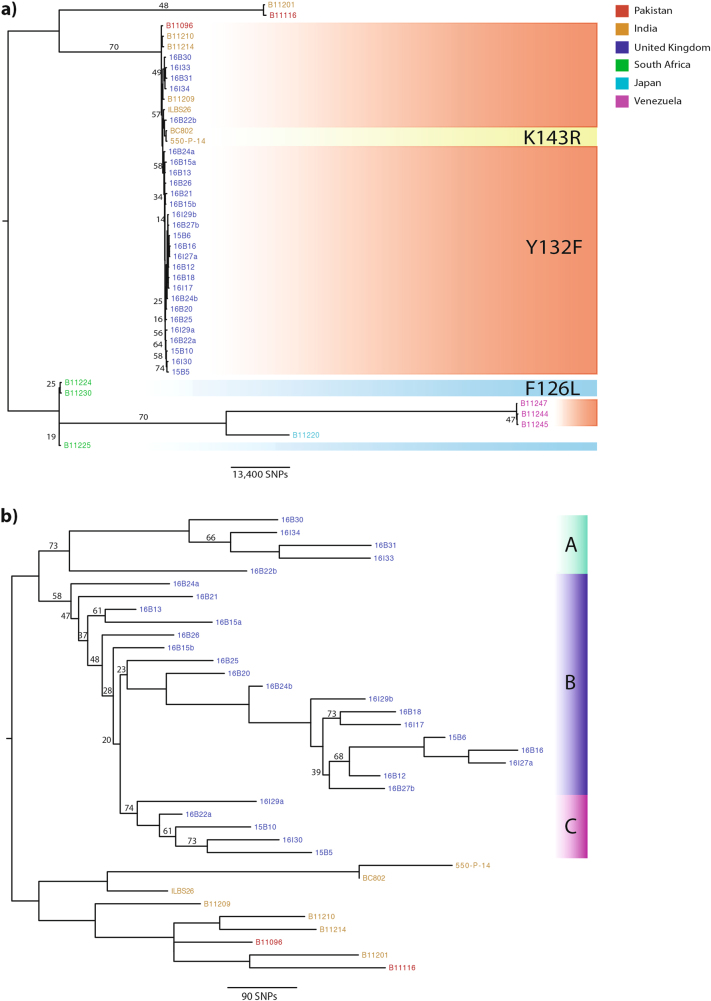
Candida auris was first described in 2009, and it has since caused nosocomial outbreaks, invasive infections, and fungaemia across at least 19 countries on five continents. An outbreak of C. auris occurred in a specialized cardiothoracic London hospital between April 2015 and November 2016, which to date has been the largest outbreak in the UK, involving a total of 72 patients. To understand the genetic epidemiology of C. auris infection both within this hospital and within a global context, we sequenced the outbreak isolate genomes using Oxford Nanopore Technologies and Illumina platforms to detect antifungal resistance alleles and reannotate the C. auris genome. Phylogenomic analysis placed the UK outbreak in the India/Pakistan clade, demonstrating an Asian origin; the outbreak showed similar genetic diversity to that of the entire clade, and limited local spatiotemporal clustering was observed. One isolate displayed resistance to both echinocandins and 5-flucytosine; the former was associated with a serine to tyrosine amino acid substitution in the gene FKS1, and the latter was associated with a phenylalanine to isoleucine substitution in the gene FUR1. These mutations add to a growing body of research on multiple antifungal drug targets in this organism. Multiple differential episodic selection of antifungal resistant genotypes has occurred within a genetically heterogenous population across this outbreak, creating a resilient pathogen and making it difficult to define local-scale patterns of transmission and implement outbreak control measures.
Overview
The claims and statistics of this paper haven’t been checked yet.
Free: it reads the open-access text and checks the first 5 claims that cite a source we can check. Create a free account to check every claim.
Integrity signals
Registry
Cites
Statistics
Figures
Verification
Claims the paper makes
The claims and statistics of this paper haven’t been checked yet.
Free: it reads the open-access text and checks the first 5 claims that cite a source we can check. Create a free account to check every claim.
Claims other papers make about this one
Each is checked against this paper’s own text: does it say what the citing paper says it does?
The cited source says what the claim attributes to it.
In the citing paper
“Indeed, nearly clonal isolates have emerged from hospitals in north and south India (77) and can spread through local transmission (78).”
From Transcriptomics and Phenotyping Define Genetic Signatures Associated with Echinocandin Resistance in Candida auris (2022) · cites this paper as [78]
Self-check
Percentages, sums and reported differences re-computed from the paper’s own numbers.
The self-check needs the paper’s full text.
Citations
Cites
The Sequence Alignment/Map format and SAMtools
Li, H., Handsaker, B., Wysoker, A., Fennell, T., Ruan, J., Homer, N., Marth, G., Abecasis, G., Durbin, R., & 1000 Genome Project Data Processing Subgroup (2009) · Bioinformatics · doi:10.1093/bioinformatics/btp352 · Cited by 62,041
KEGG: Kyoto Encyclopedia of Genes and Genomes
Kanehisa, M. (2000) · Nucleic Acids Research · doi:10.1093/nar/28.1.27 · Cited by 37,077
KEGG: Kyoto Encyclopedia of Genes and Genomes
Ogata, H., Goto, S., Sato, K., Fujibuchi, W., Bono, H., & Kanehisa, M. (1999) · Nucleic Acids Research · doi:10.1093/nar/27.1.29 · Cited by 31,232
The Genome Analysis Toolkit: A MapReduce framework for analyzing next-generation DNA sequencing data
McKenna, A., Hanna, M., Banks, E., Sivachenko, A., Cibulskis, K., Kernytsky, A., Garimella, K., Altshuler, D., Gabriel, S., Daly, M., et al. (2010) · Genome Research · doi:10.1101/gr.107524.110 · Cited by 27,895
tRNAscan-SE: A Program for Improved Detection of Transfer RNA Genes in Genomic Sequence
Lowe, T. M., & Eddy, S. R. (1997) · Nucleic Acids Research · doi:10.1093/nar/25.5.955 · Cited by 10,905
Pfam: the protein families database
Finn, R. D., Bateman, A., Clements, J., Coggill, P., Eberhardt, R. Y., Eddy, S. R., Heger, A., Hetherington, K., Holm, L., Mistry, J., et al. (2014) · Nucleic Acids Research · doi:10.1093/nar/gkt1223 · Cited by 6,148
RNAmmer: consistent and rapid annotation of ribosomal RNA genes
Lagesen, K., Hallin, P., Rødland, E. A., Stærfeldt, H.-H., Rognes, T., & Ussery, D. W. (2007) · Nucleic Acids Research · doi:10.1093/nar/gkm160 · Cited by 6,112
HMMER web server: interactive sequence similarity searching
Finn, R. D., Clements, J., & Eddy, S. R. (2011) · Nucleic Acids Research · doi:10.1093/nar/gkr367 · Cited by 5,952
Aligning sequence reads, clone sequences and assembly contigs with BWA-MEM
Li, H. (2013) · DROPS (Schloss Dagstuhl – Leibniz Center for Informatics) · doi:10.48550/arxiv.1303.3997 · Cited by 5,159
The SWISS-PROT protein sequence database and its supplement TrEMBL in 2000
Bairoch, A. (2000) · Nucleic Acids Research · doi:10.1093/nar/28.1.45 · Cited by 3,093
Cited by
Items 201–266 of 266
Implementation of pathogen genomics in clinical microbiology laboratories
Gador‐Whyte, A., Sherry, N. L., Brischetto, A., Andersson, P., Bond, K. A., van Hal, S. J., Harris, P. N. A., Howden, B. P., & partners, O. B. O. T. A. P. G. P. (2026) · Clinical Microbiology Reviews · doi:10.1128/cmr.00177-25 · Cited by 5
Hwang, I. J., Kwon, Y. J., Lim, H. J., Hong, K. H., Lee, H., Yong, D., Won, E. J., Byun, S. A., Lee, G. Y., Kim, S. H., et al. (2024) · Microbiology Spectrum · doi:10.1128/spectrum.00883-24 · Cited by 6
Ahlawat, V., Sura, K., Dangi, M., & Chhillar, A. K. (2025) · Journal of Genetic Engineering and Biotechnology · doi:10.1016/j.jgeb.2025.100474 · Cited by 5
Xu, C., Xu, W., Yuan, Y., Chen, X., Mo, O., Yin, Z., Huang, X., Wang, Y., Hu, L., Xue, W., et al. (2025) · Exploration · doi:10.1002/exp.20240482 · Cited by 6
Reedy, J. M., Fernando, T., Awuor, S. O., Omwenga, E. O., Koutchma, T., & Mariita, R. M. (2024) · Hygiene · doi:10.3390/hygiene4030030 · Cited by 4
Candida auris persists in the vaginal microaerobic niche in the absence of interleukin-17A
Abe, M., Sadamoto, S., Nagamori, A., Shinozaki, M., Oiki, S., Otani, A., Koizumi, A., Shinohara, T., Iwakura, Y., Shibuya, K., et al. (2025) · mSphere · doi:10.1128/msphere.00446-25 · Cited by 4
Crystal structure of dihydrofolate reductase from the emerging pathogenic fungus Candida auris
Kirkman, T., Sketcher, A., Barroso, V. D. M., Ishida, K., Tosin, M., & Dias, M. V. B. (2023) · Acta Crystallographica Section D Structural Biology · doi:10.1107/s2059798323004709 · Cited by 4
Oiki, S., Abe, M., Sadamoto, S., Amemiya, K., Shinohara, T., Otani, A., Koizumi, A., Umeyama, T., Makimura, K., & Miyazaki, Y. (2025) · Journal of Infection and Chemotherapy · doi:10.1016/j.jiac.2025.102747 · Cited by 3
Narayanan, A., Shaji, A. A., Pullepu, D., Bhattacharya, J., & Sanyal, K. (2025) · ACS Infectious Diseases · doi:10.1021/acsinfecdis.5c00081 · Cited by 3
Omics and Multiomics-Based Diagnostics for Invasive Candidiasis: Toward Precision Medicine
Pitarch, A., Arribas, V., & Gil, C. (2025) · Molecular & Cellular Proteomics · doi:10.1016/j.mcpro.2025.101463 · Cited by 3
“…nanopore sequencing has showed to be a sensitive and portable tool for rapid identification of Candida species in candidemia patients (85, 86), and of single nucleotide polymorphisms (SNPs) associated with antifungal resistance in clinical isolates of Candida spp. from blood cultures (87, 88).”
CANDIDA AURIS: IMMINENCE OF A NEW PANDEMIC?
Chaves, Á. G., da Costa, V. M., & Brito, M. D. V. (2021) · RECIMA21 - Revista Científica Multidisciplinar · doi:10.47820/recima21.v2i4.287 · Cited by 3
Pancholi, V. (2021) · International Archives of Medical Microbiology · doi:10.23937/2643-4008/1710014 · Cited by 3
Candida auris susceptibility on surfaces coated with the antifungal drug caspofungin
Lamont-Friedrich, S. J., Kidd, S. E., Giles, C., Griesser, H. J., & Coad, B. R. (2021) · Medical Mycology · doi:10.1093/mmy/myab075 · Cited by 3
Susceptibility Testing of Candida auris Isolates
Johnson, E. M., & Borman, A. M. (2022) · Methods in molecular biology · doi:10.1007/978-1-0716-2417-3_5 · Cited by 3
Zamith‐Miranda, D., Amatuzzi, R. F., Martins, S. T., Vieira, A. Z., da Rocha, I. M., Rodrigues, M. L., Trentin, G., Almeida, F. B. D. R., Nakayasu, E. S., Nosanchuk, J. D., et al. (2020) · bioRxiv (Cold Spring Harbor Laboratory) · doi:10.1101/2020.12.04.411843 · Cited by 3
Kim, T., Bae, M., Bang, J., Jeon, J., Cho, Y., Park, J. M., & Jung, W. H. (2025) · Mycopathologia · doi:10.1007/s11046-025-01000-1 · Cited by 2
“…linked to mutations in FCY1 , FCY2 , or FUR1 , which encode cytosine deaminase, purine-cytosine permease, and uracil phosphoribosyl transferase, respectively [16–18], no such variants were detected in NCCP 32684, suggesting novel mechanisms underlie its resistance (Supplementary Tables S3 and S4).”
Candida auris: Steckbrief eines neuen Pilzes
Wagener, J., & Kurzai, O. (2019) · Deutsches Ärzteblatt · doi:10.3238/persinfek.2019.07.22.01 · Cited by 3
Complete genome assembly of Candida auris representative strains of three geographical clades
Mahar, N. S., Kohli, S., Biswas, B., Xess, I., Thakur, A., & Gupta, I. (2024) · Microbiology Resource Announcements · doi:10.1128/mra.00882-23 · Cited by 2
Genomic Innovation and Virulence Evolution in the Emerging Human Fungal Pathogen Candida auris
Gifford, H., Rhodes, J. L., Wilson, D., & Farrer, R. A. (2024) · The mycota · doi:10.1007/978-3-031-75666-5_10 · Cited by 2
Self-citationRamos, L. S., Silva, L. N., de Mello, T. P., Frota, H. F., Branquinha, M. H., & dos Santos, A. L. S. (2022) · Current Topics in Medicinal Chemistry · doi:10.2174/1568026622666220520153748 · Cited by 3
Generating Complete Genome Assemblies of Candida auris
Shea, T., & Cuomo, C. A. (2022) · Methods in molecular biology · doi:10.1007/978-1-0716-2417-3_16 · Cited by 2
Self-citationApplications of Long-Read Sequencing Technology in Clinical Genomics
Sathyanarayana, S. H., Deharvengt, S. J., Huang, G., Barney, R. E., Shah, P. S., & Lefferts, J. A. (2022) · Advances in Molecular Pathology · doi:10.1016/j.yamp.2022.07.004 · Cited by 1
Current Approaches in Genome Assembly of Human Fungal Pathogens
Rhodes, J. L. (2025) · Methods in molecular biology · doi:10.1007/978-1-0716-4702-8_11 · Cited by 1
Self-citationAn overview of Candida auris : The emerging healthcare threat
Tajane, S. B., Pawar, S. K., & Patil, S. (2025) · Journal of Laboratory Physicians · doi:10.25259/jlp_230_2025 · Cited by 1
Samaddar, A., Mendonsa, J. M., Siddaiah, N., Rudramurthy, S. M., Pamidimukkala, U., & Kindo, A. J. (2025) · Medical Mycology · doi:10.1093/mmy/myaf108 · Cited by 2
Epidemiology and Management of Antifungal-Resistant Bloodstream Infections in Healthcare Settings
Sayyouh, O. (2025) · Infectious diseases · doi:10.5772/intechopen.1012710 · Cited by 1
Chowdhury, F., Mah‐E‐Muneer, S., Khan, S., Lyman, M., Mamun, G. M. S., Lockhart, S. R., Habib, Z. H., Rahman, A., Hossain, K., Hassan, M. Z., et al. (2026) · Microbiology Spectrum · doi:10.1128/spectrum.03169-25 · Cited by 1
Negi, P., Verma, N., Rishi, P., Multani, K., Sharma, M., Kumari, S., & Raj, K. (2026) · Archives of Microbiology · doi:10.1007/s00203-026-04864-z · Cited by 1
“5) (Rhodes et al. 2018; Tu et al. 2022). substantially conserved in C. auris.”
Pilato, V. D., Willison, E., Calabrese, L., Matarazzo, E., Magnasco, L., Costa, E., Morici, P., Giacobbe, D. R., Vismara, C., Mikulska, M., et al. (2026) · Eurosurveillance · doi:10.2807/1560-7917.es.2026.31.18.2500730 · Cited by 1
“Additionally, pandrug-resistant isolates have been reported, particularly in settings with sustained circulation of C. auris , including in the United Kingdom (UK; 2018) [2], the United States (US; 2019) [3], India (2017–2020) [4], Spain (2019–2020) [5], Greece (2022) [6], and Italy (2022) [7].”
Hudu, S. A., Ismael, N. S., Morad, E. A., Tahir, A., & Jimoh, A. O. (2026) · Journal of Enzyme Inhibition and Medicinal Chemistry · doi:10.1080/14756366.2026.2660982 · Cited by 1
“…while amphotericin B remains active against many C. auris isolates, resistance via alterations in ergosterol biosynthesis has emerged in some clades 47 . its nephrotoxicity, electrolyte disturbances, and infusion-related complications make its use difficult in critically ill patients as well.”
Simulating a travel-related origin of Candida auris in New York–New Jersey
Verma, R. R., Kiegle, E., Keyel, A. C., Chaturvedi, S., & Chaturvedi, V. P. (2024) · Microbiology Spectrum · doi:10.1128/spectrum.02065-24 · Cited by 1
Emergence of Clade III Candida auris of African Origin in Los AngelesPreprint
Price, T. K., Mirasol, R., Ward, K. W., Dayo, A. J., Chandrasekaran, S., Garner, O. B., Maurice, A. D. S., & Yang, S. (2020) · medRxiv · doi:10.1101/2020.10.26.20214908 · Cited by 2
Eley, B. (2018) · Faculty Opinions – Post-Publication Peer Review of the Biomedical Literature · doi:10.3410/f.734192398.793553412 · Cited by 1
Convergent evolution on RBA1 regulates Candidozyma auris host adaptationPreprint
Doorley, L. A., Bella, A. A. L., Jones, S. J., Zhao, G., Asadzadeh, M., Choudhury, Q. J., Ahmad, S., Mokaddas, E. M., Al‐Obaid, I., Alfouzan, W. A., et al. (2025) · bioRxiv (Cold Spring Harbor Laboratory) · doi:10.64898/2025.12.04.692421 · Cited by 1
“6b ) 10, 16, 33, 34, 35, 36 .”
Candida auris can acquire antifungal resistance without selection pressurePreprint
Phan-Canh, T., Nguyen-Le, D.-M., Chauhan, M., Luu, P., Chowdhary, A., Chauhan, N., & Kuchler, K. (2026) · bioRxiv (Cold Spring Harbor Laboratory) · doi:10.64898/2026.01.07.695227 · Cited by 3
Mhade, S., Uppal, G. K., & Bapat, S. (2021) · International Research Journal of Multidisciplinary Technovation · doi:10.34256/irjmt2144
Mechanisms of pathogenesis and drug resistance in Candida auris
WeiNa, Z. H. A. O., Zhang, B., & QiMing, W. A. N. G. (2021) · Scientia Sinica Vitae · doi:10.1360/ssv-2021-0230
Microbial Genetics in Mycology
Rhodes, J. L. (2021) · Elsevier eBooks · doi:10.1016/b978-0-12-818731-9.00189-0
Self-citationCOMPARAÇÃO DE TRÊS TÉCNICAS DE DIAGNÓSTICO DA DOENÇA DE HIRSCHSPRUNG
Lopes, C. C. C., Bertuci, J. V. F., Lopes, E. B., Lopes, L. C., Barros, V. D. S., Zanatta, L., dos Santos, D. L., da Costa, M. M., Dias, T. G., Adami, E. R., et al. (2021) · doi:10.22533/at.ed.77221091111
(2019) · Microbiology Australia · doi:10.1071/mav40n2
Trentin, G. (2022) · Digital Library of Theses and Dissertations (Universidade de São Paulo) · doi:10.11606/d.17.2022.tde-20062022-161952
Barreto, T. L. (2020) · Digital Library of Theses and Dissertations (Universidade de São Paulo) · doi:10.11606/d.42.2020.tde-13012022-165803
ngsJulia: population genetic analysis of next-generation DNA sequencing data with Julia language
Mas-Sandoval, À., Jin, C., Fracassetti, M., & Fumagalli, M. (2022) · F1000Research · doi:10.12688/f1000research.104368.2
ngsJulia: population genetic analysis of next-generation DNA sequencing data with Julia language
Mas-Sandoval, À., Jin, C., Fracassetti, M., & Fumagalli, M. (2023) · F1000Research · doi:10.12688/f1000research.104368.3
Retraction: Candida auris: Virulence and antifungal drugs resistance
Al-Garawi, N. A.-H. D., Meri, M. A., & Sahib, R. A. (2023) · AIP conference proceedings · doi:10.1063/5.0181986
RetractedChheda, P., Gupta, N., Shivaprakash, S., & Dama, T. (2024) · Journal of The Academy of Clinical Microbiologists · doi:10.5005/jacm-11020-0005
Draft genome sequence of Candida auris MUTCD0001: the first clinical isolate from Ireland
Sines, K., Amoo, M., Clarke, J., Kavanagh, K., McCullagh, E., Renwick, J., & Fitzpatrick, D. A. (2025) · Microbiology Resource Announcements · doi:10.1128/mra.00178-25
MOLECULAR DETERMINANTS OF ANTIFUNGAL RESISTANCE IN CANDIDA AURIS
Bazarova, G. (2024) · Natural Sciences in the Modern World · doi:10.70413/zdtf-v03-i12-s19983
Κουτσοδήμου, Ι. Μ. (2024) · University of Thessaly Institutional Repository (University of Thessaly) · doi:10.26253/heal.uth.41506
Wang, Y. (2023) · MacSphere (McMaster University) · doi:10.71548/17335 · Cited by 1
Gaitán, A. C. R. (2020) · Repository of Digital Objects for Teaching Research and Culture (University of Valencia)
Seyer, A. (2026) · Cyprus Journal of Medical Sciences · doi:10.4274/cjms.2026.2025-153
Babalola, A. D., Dikwa, K. B., Onusiriuka, B. C., & Rabe, Y. (2026) · Sahel Journal of Life Sciences FUDMA · doi:10.33003/10.33003/sajols-2026-0401-20
L'interaction Hsp90/co-chaperonnes : nouvelle cible pour le traitement des candidoses invasives
Rouges, C. (2023) · theses.fr (ABES) · doi:10.70675/40b24a3fz159ez4d8ez8a34zdd8ffa1c22fa
Functional characterization of Candida auris DHA1 transporters conferring flucytosine resistance
Malik, S., Saini, A., Khatoon, R., & Banerjee, A. (2026) · Frontiers in Microbiology · doi:10.3389/fmicb.2026.1806653
Siopi, M., Leventaki, S., Pachoulis, I., Rentoumi, A., Argyris, N., Spruijtenburg, B., Meijer, E. F. J., Meis, J. F. G. M., Pournaras, S., Tsakris, A., et al. (2026) · Journal of Clinical Microbiology · doi:10.1128/jcm.00130-26 · Cited by 1
Smâdu, S., Tetradov, S. C., Popescu, C. P., Nica, M., Oprisan, C., Ene, L., & Florescu, S. A. (2026) · Journal of Fungi · doi:10.3390/jof12070482
“The 25% amphotericin B resistance in our Candidozyma auris cohort aligns with emerging reports from healthcare settings with sustained transmission [23,24].”
Şenol, F. F., Toraman, Z. A., Vural, U., Çelik, Z., Akkaya, Y., Çılkız, M., Erdin, B. N., Kırbağ, S., & Kılıç, İ. H. (2026) · Antibiotics · doi:10.3390/antibiotics15070692
“Similar patterns have been reported in several regions where local C. auris epidemiology is dominated by a single major clade, although international movement of patients and healthcare-associated transmission can introduce additional lineages over time [3,9,23,24].”
Osama, D., Alsedawy, M., Hussein, M. S., Hassan, M. A., Elrefaey, S. M., & Tawfick, M. M. (2026) · Antonie van Leeuwenhoek · doi:10.1007/s10482-026-02393-9
“Rhodes et al. identified an F211I substi-tution in the FUR1 gene of a flucytosine-resistant C. auris ; however, similar mutations have not been reported in other Candida species (Rhodes et al. 2018).”
InfluentialResistance gene mutations and phylogenetic relationships in Candidozyma auris isolates from Russia
Oganesyan, E. G., Zhuk, A. S., Gusarova, K. V., Kovyrshin, S., Alekseevskaya, E. S., Orlova, O. E., Khostelidi, S. N., Kozlova, O. P., Любимова, А. В., Taraskina, A. E., et al. (2026) · Frontiers in Cellular and Infection Microbiology · doi:10.3389/fcimb.2026.1929119
Parallel evolution under constraint shapes echinocandin resistance in Candida aurisPreprint
Cauldron, N. C., Dort, E. N., Weeks, G., Rogers, P. D., & Cuomo, C. A. (2026) · bioRxiv (Cold Spring Harbor Laboratory) · doi:10.64898/2026.08.30.748140
Self-citationde Sousa, D. S. M., Cabral, A. K. L. F., Arantes, B. B. A., Sato, J. H. A., Monari, G. P. D. M., Ruiz, L. D. S., Elgammal, Y., Martinez, L. R., Fusco‐Almeida, A. M., & Mendes‐Giannini, M. J. S. (2026) · Critical Reviews in Microbiology · doi:10.1080/1040841x.2026.2727050
“…skin colonization, and efficient transmission within healthcare settings has established C. auris as one of the most formidable fungal pathogens of the modern era (chowdhary et al. 2017; Berkow and lockhart 2018; Healey et al. 2018; Rhodes et al. 2018; chaabane et al. 2019; escandón et al. 2019).”
Perspective: Evolutionary Genetics Is the Backbone of Genomic Epidemiology in Fungal Pathogens
Matute, D. R. (2026) · Journal of Fungi · doi:10.3390/jof12100790
Kamau, E. T. (2026) · Journal of Clinical Microbiology · doi:10.1128/jcm.01106-26
Siopi, M., Leventaki, S., Pachoulis, I., Spruijtenburg, B., Meijer, E. F. J., Meis, J. F. G. M., Pournaras, S., Tsakris, A., Vrioni, G., & Meletiadis, J. (2026) · Journal of Antimicrobial Chemotherapy · doi:10.1093/jac/dkag361
Metadata
- Authors
- Rhodes, J., Abdolrasouli, A., Farrer, R. A., Cuomo, C. A., Aanensen, D. M., Armstrong-James, D., Fisher, M. C., & Schelenz, S.
- Affiliations
- Imperial College London (GB)
- Imperial College Healthcare NHS Trust (GB)
- Broad Institute (US)
- Corresponding author
- Rhodes, Johanna
- Abdolrasouli, Alireza
- Venue
- Emerging Microbes & Infections
- Publisher
- Informa UK Limited
- Published
- 2018-05-31
- Volume
- 7
- Issue
- 1
- Pages
- 1-12
- ISSN
- 2222-1751 (ISSN-L)
- PMC
- PMC5874254
- OpenAlex
- W2794692961
- Semantic Scholar
- ba58ae97e2ba30cf7acadd77193468f8756ecc60
- Cited by
- 246
- References
- 57
- Citations by year
- 2026: 13 · 2025: 20 · 2024: 24 · 2023: 26 · 2022: 30 · 2021: 41 · 2020: 40 · 2019: 33 · 2018: 19
- FWCI
- 25.15
- Type
- journal article
- Language
- en
- Open access
- gold
- doi.org
- Licence
- Locations
- Emerging Microbes & Infections (publishedVersion, cc-by)
- Europe PMC (PubMed Central) (publishedVersion, cc-by)
- PubMed Central (publishedVersion, cc-by)
- PubMed (publishedVersion)
- Aberdeen University Research Archive (Aberdeen University) (submittedVersion)
- DOAJ (DOAJ: Directory of Open Access Journals) (submittedVersion, cc-by-sa)
- UCL Discovery (University College London) (submittedVersion)
- Figshare (submittedVersion, cc-by)
- Open Research Exeter (University of Exeter) (submittedVersion, cc-by)
- University of Birmingham Research Portal (University of Birmingham) (submittedVersion, other-oa)
- Spiral (Imperial College London) (submittedVersion, cc-by)
- Funders
- U.S. Department of Health and Human Services (U19-AI110818)
- Wellcome Trust (099202)
- Oxford Nanopore Technologies
- National Institute for Health and Care Research (HPRU-2012-10080)
- National Institutes of Health
- Centers for Disease Control and Prevention (U19AI110818)
- Medical Research Council (MR/K000373/1, K000373/1)
- Biotechnology and Biological Sciences Research Council (BB/L024209/1)
- Natural Environment Research Council (NE/K014455/1)
- National Institute of Allergy and Infectious Diseases (U19AI110818)
- Topics
- Health Sciences › Medicine › Infectious Diseases › Antifungal resistance and susceptibility
- Life Sciences › Immunology and Microbiology › Microbiology › Yeasts and Rust Fungi Studies
- Life Sciences › Biochemistry, Genetics and Molecular Biology › Molecular Biology › Fungal and yeast genetics research
- Keywords
- Candida auris, fungal outbreak, nosocomial infections, antifungal resistance, echinocandin resistance, FKS1, phylogenomics, genetic diversity, transmission patterns, fungemia
- MeSH terms
- Alleles, Antifungal Agents, Candida, Candidiasis, Cross Infection, Disease Outbreaks, United Kingdom, Humans, India, Microbial Sensitivity Tests, Mutation, Genome, Fungal, Amino Acid Substitution, Communicable Diseases, Emerging, Genomics, Drug Resistance, Multiple, Fungal, High-Throughput Nucleotide Sequencing
About these checks
Registry, retraction, Cites and statistics results are computed, not judged, with one exception: a printed reference that no index lists is read once by a model before it counts as a citation error. Claims are extracted by a model and kept only when their quote appears verbatim in the text; each cited source is then checked, with a model’s help, for whether it says what the claim relies on. Those verdicts can be wrong — read the claim’s quote and the cited source before relying on one.
Statistics and arithmetic are recomputed, not judged.
Confidence bands are shown only for fields calibrated on our annotated test set. None is calibrated yet, so no band is shown.
What counts as a claim ›How we measure confidence ›How we check this ›
Are you an author, or do you see a problem with this page? Request a review
Data sources
Bibliographic data: Semantic Scholar, OpenAlex, Crossref.
Contains information from the Semantic Scholar Academic Graph Datasets, made available under the ODC Attribution License (ODC-BY 1.0).
Semantic Scholar’s data is described in: Kinney, R., et al. (2023). The Semantic Scholar Open Data Platform. arXiv:2301.10140.
