

Stress-responsive FKBP51 regulates AKT2-AS160 signaling and metabolic function
Open accessThe DOI matches its Crossref record; 59 of the 59 references it cites were found in a registry or an index.
Abstract
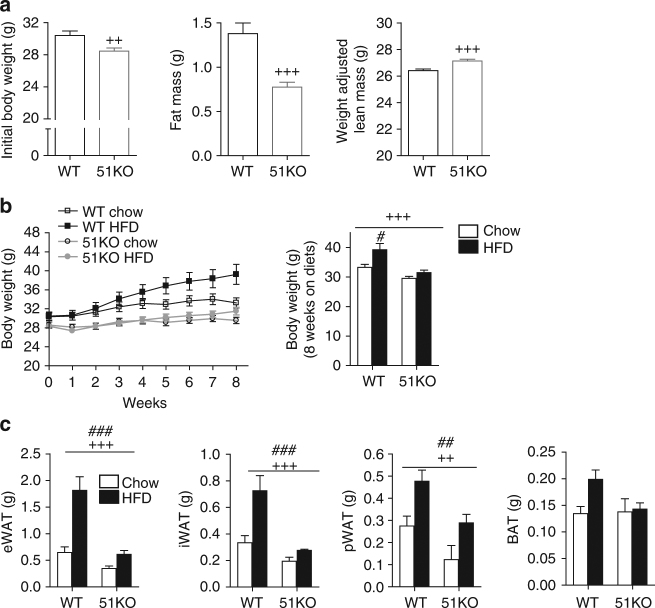
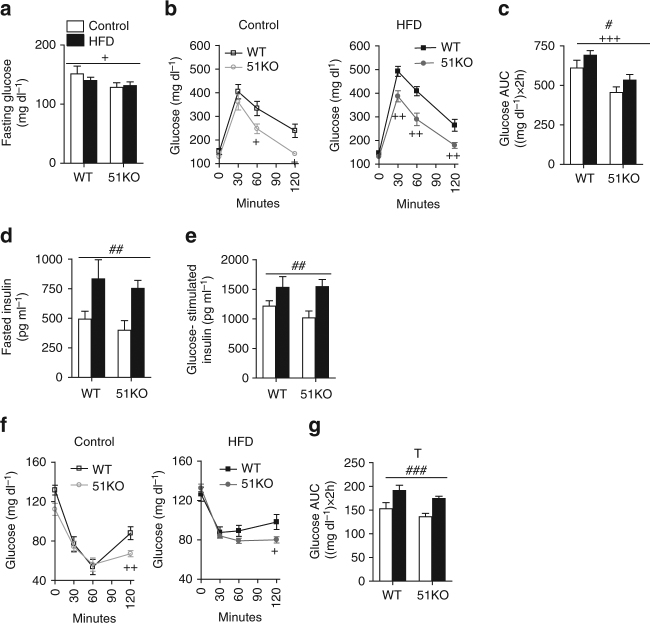
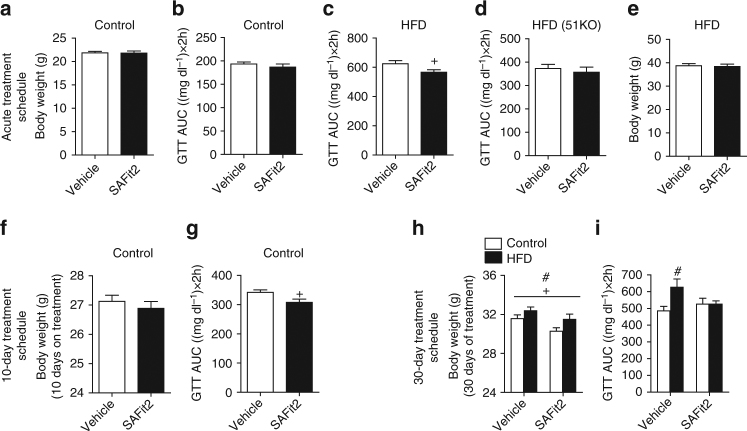
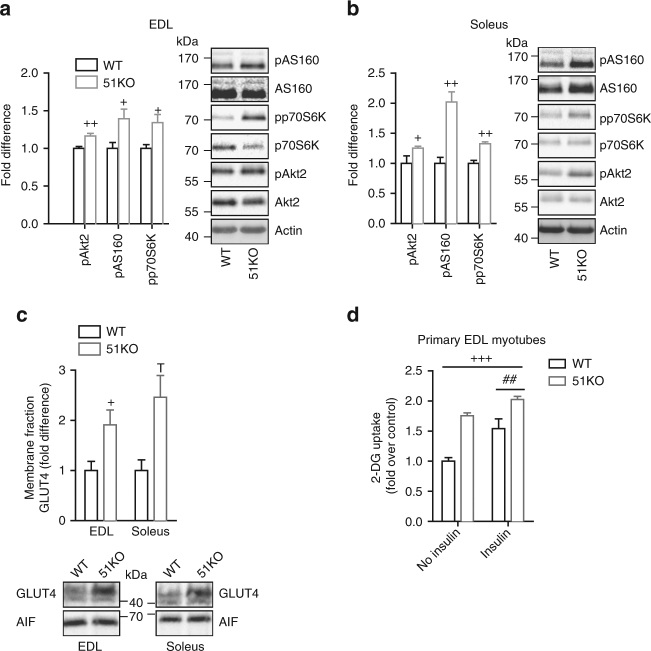
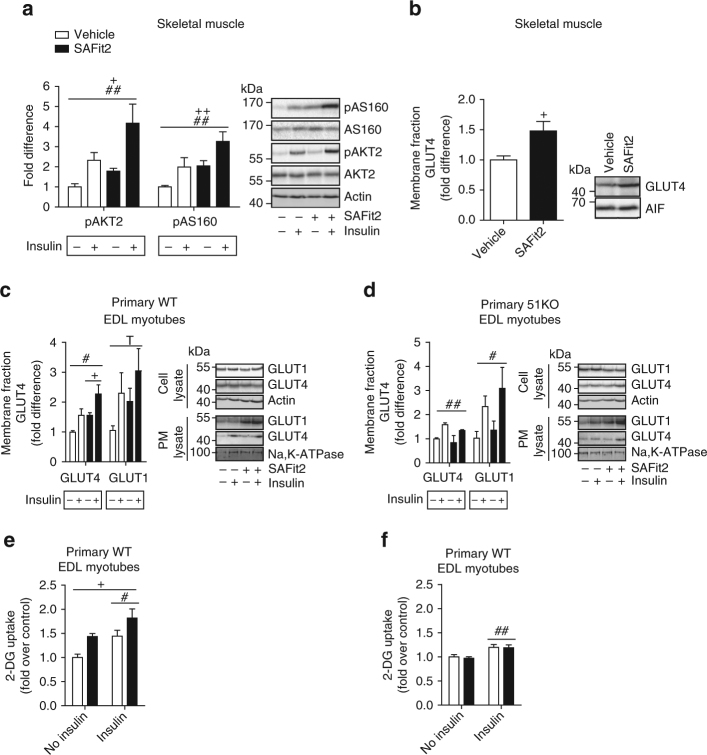
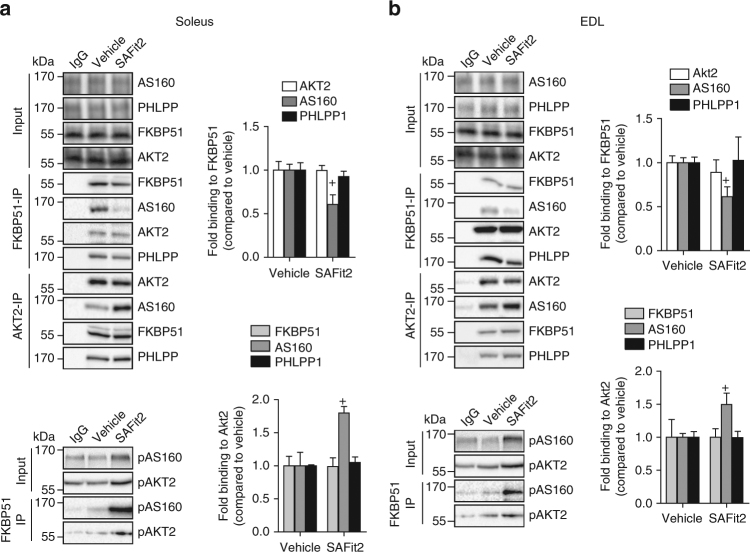
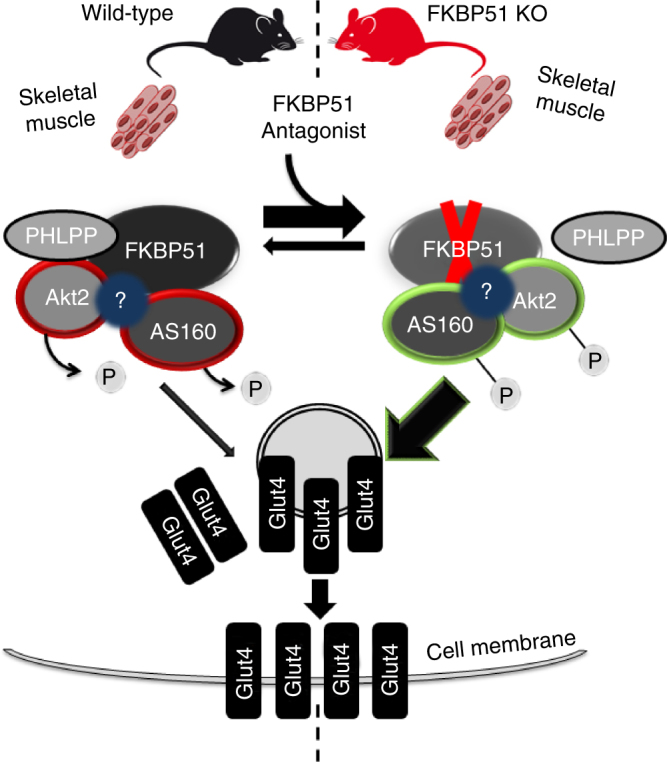
The co-chaperone FKBP5 is a stress-responsive protein-regulating stress reactivity, and its genetic variants are associated with T2D related traits and other stress-related disorders. Here we show that FKBP51 plays a role in energy and glucose homeostasis. Fkbp5 knockout (51KO) mice are protected from high-fat diet-induced weight gain, show improved glucose tolerance and increased insulin signaling in skeletal muscle. Chronic treatment with a novel FKBP51 antagonist, SAFit2, recapitulates the effects of FKBP51 deletion on both body weight regulation and glucose tolerance. Using shorter SAFit2 treatment, we show that glucose tolerance improvement precedes the reduction in body weight. Mechanistically, we identify a novel association between FKBP51 and AS160, a substrate of AKT2 that is involved in glucose uptake. FKBP51 antagonism increases the phosphorylation of AS160, increases glucose transporter 4 expression at the plasma membrane, and ultimately enhances glucose uptake in skeletal myotubes. We propose FKBP51 as a mediator between stress and T2D development, and potential target for therapeutic approaches.
Overview
The claims and statistics of this paper haven’t been checked yet.
Free: it reads the open-access text and checks the first 5 claims that cite a source we can check. Create a free account to check every claim.
Integrity signals
Registry
Cites
Statistics
Figures
Verification
Claims the paper makes
The claims and statistics of this paper haven’t been checked yet.
Free: it reads the open-access text and checks the first 5 claims that cite a source we can check. Create a free account to check every claim.
Self-check
Percentages, sums and reported differences re-computed from the paper’s own numbers.
The self-check needs the paper’s full text.
Citations
Cites
2 retracted
Kim, D., Sun, M., He, L., Zhou, Q.-H., Chen, J., Sun, X.-M., Bepler, G., Sebti, S. M., & Cheng, J. Q. (2010) · Journal of Biological Chemistry · doi:10.1074/jbc.m109.094060 · Cited by 55
RetractedKim, D., Sun, M., He, L., Zhou, Q., Chen, J., Sun, X.-M., Bepler, G., Sebti, S. M., & Cheng, J. Q. (2016) · Journal of Biological Chemistry · doi:10.1074/jbc.a109.094060 · Cited by 6
RetractedA gene atlas of the mouse and human protein-encoding transcriptomes
Su, A. I., Wiltshire, T., Batalov, S., Lapp, H., Ching, K. A., Block, D., Zhang, J., Soden, R., Hayakawa, M., Kreiman, G., et al. (2004) · Proceedings of the National Academy of Sciences · doi:10.1073/pnas.0400782101 · Cited by 3,475
Critical nodes in signalling pathways: insights into insulin action
Taniguchi, C. M., Emanuelli, B., & Kahn, C. R. (2006) · Nature Reviews Molecular Cell Biology · doi:10.1038/nrm1837 · Cited by 2,760
Cho, H., Mu, J., Kim, J. K., Thorvaldsen, J. L., Chu, Q., Crenshaw, E. B., Kaestner, K. H., Bartolomei, M. S., Shulman, G. I., & Birnbaum, M. J. (2001) · Science · doi:10.1126/science.292.5522.1728 · Cited by 1,836
Allele-specific FKBP5 DNA demethylation mediates gene–childhood trauma interactions
Klengel, T., Mehta, D., Anacker, C., Rex-Haffner, M., Pruessner, J. C., Pariante, C. M., Pace, T. W. W., Mercer, K. B., Mayberg, H. S., Bradley, B., et al. (2013) · Nature Neuroscience · doi:10.1038/nn.3275 · Cited by 1,447
Self-citationBinder, E. B. (2008) · JAMA · doi:10.1001/jama.299.11.1291 · Cited by 1,362
DeFronzo, R. A., Gunnarsson, R., Björkman, O., Olsson, M., & Wahren, J. (1985) · Journal of Clinical Investigation · doi:10.1172/jci111938 · Cited by 1,167
Insulin-stimulated Phosphorylation of a Rab GTPase-activating Protein Regulates GLUT4 Translocation
Sano, H., Kane, S., Sano, E., Mı̂inea, C. P., Asara, J. M., Lane, W. S., Garner, C. W., & Lienhard, G. E. (2003) · Journal of Biological Chemistry · doi:10.1074/jbc.c300063200 · Cited by 962
Cho, H., Thorvaldsen, J. L., Chu, Q., Feng, F., & Birnbaum, M. J. (2001) · Journal of Biological Chemistry · doi:10.1074/jbc.c100462200 · Cited by 959
Cited by
Items 101–149 of 149
Fusse, E. J. (2019) · Digital Library of Theses and Dissertations (Universidade de São Paulo) · doi:10.11606/d.17.2019.tde-23102019-162952 · Cited by 1
Chemical Systems Biology Reveals Mechanisms of Glucocorticoid Receptor SignalingPreprint
Bruno, N. E., Nwachukwu, J. C., Srinivasan, S., Nettles, C. C., Izard, T., Jin, Z., Boregowda, S. V., Phinney, D. G., Elemento, O., Liu, X., et al. (2020) · bioRxiv (Cold Spring Harbor Laboratory) · doi:10.1101/2020.06.15.153270
Darcy, J., Fang, Y., McFadden, S., Hascup, K. N., Hascup, E. R., & Bartke, A. (2021) · Elsevier eBooks · doi:10.1016/b978-0-12-815962-0.00007-x
Makrozyklische FKBP51‐Liganden enthüllen einen transienten Bindungsmodus mit erhöhter Selektivität
Voll, A. M., Meyners, C., Taubert, M. C., Bajaj, T., Heymann, T., Merz, S., Charalampidou, A., Kolos, J., Purder, P. L., Geiger, T. M., et al. (2021) · Angewandte Chemie · doi:10.1002/ange.202017352
Self-citationTranscriptome and proteomics analysis revealed key genes in rabbit skeletal muscle after weight lossPreprint
Wang, J., Li, Y., Elzo, M. A., Xia, S., Fan, H., Tang, T., Shao, J., Jia, X., Chen, S., & Lai, S. (2021) · Research Square · doi:10.21203/rs.3.rs-868357/v1
Brishti, A., Johnson, S. J., Palmer, D. G., Raihan, M. O., Yan, L., & Casperson, S. L. (2025) · Physiological Reports · doi:10.14814/phy2.70170
“FKBP5 (FK506-binding protein) is a stress-responsive gene that plays a role in energy and glucose homeostasis (Balsevich et al., 2017).”
Ahmad, I., Gupta, S., Faulkner, P., Mullens, D. A., Thomas, M., Sytha, S. P., Ivanov, I. V., Cai, J. J., Heaps, C. L., & Newell‐Fugate, A. E. (2024) · Figshare · doi:10.6084/m9.figshare.26712650
Ahmad, I., Gupta, S., Faulkner, P., Mullens, D. A., Thomas, M., Sytha, S. P., Ivanov, I. V., Cai, J. J., Heaps, C. L., & Newell‐Fugate, A. E. (2024) · Figshare · doi:10.6084/m9.figshare.26712677
Ahmad, I., Gupta, S., Faulkner, P., Mullens, D. A., Thomas, M., Sytha, S. P., Ivanov, I. V., Cai, J. J., Heaps, C. L., & Newell‐Fugate, A. E. (2024) · Figshare · doi:10.6084/m9.figshare.26712674
Ahmad, I., Gupta, S., Faulkner, P., Mullens, D. A., Thomas, M., Sytha, S. P., Ivanov, I. V., Cai, J. J., Heaps, C. L., & Newell‐Fugate, A. E. (2024) · Figshare · doi:10.6084/m9.figshare.26712662
Ahmad, I., Gupta, S., Faulkner, P., Mullens, D. A., Thomas, M., Sytha, S. P., Ivanov, I. V., Cai, J. J., Heaps, C. L., & Newell‐Fugate, A. E. (2024) · Figshare · doi:10.6084/m9.figshare.26712704
Ahmad, I., Gupta, S., Faulkner, P., Mullens, D. A., Thomas, M., Sytha, S. P., Ivanov, I. V., Cai, J. J., Heaps, C. L., & Newell‐Fugate, A. E. (2024) · Figshare · doi:10.6084/m9.figshare.26712668
Ahmad, I., Gupta, S., Faulkner, P., Mullens, D. A., Thomas, M., Sytha, S. P., Ivanov, I. V., Cai, J. J., Heaps, C. L., & Newell‐Fugate, A. E. (2024) · Figshare · doi:10.6084/m9.figshare.26712653
Ahmad, I., Gupta, S., Faulkner, P., Mullens, D. A., Thomas, M., Sytha, S. P., Ivanov, I. V., Cai, J. J., Heaps, C. L., & Newell‐Fugate, A. E. (2024) · Figshare · doi:10.6084/m9.figshare.26712659
Ahmad, I., Gupta, S., Faulkner, P., Mullens, D. A., Thomas, M., Sytha, S. P., Ivanov, I. V., Cai, J. J., Heaps, C. L., & Newell‐Fugate, A. E. (2024) · Figshare · doi:10.6084/m9.figshare.26712647
Ahmad, I., Gupta, S., Faulkner, P., Mullens, D. A., Thomas, M., Sytha, S. P., Ivanov, I. V., Cai, J. J., Heaps, C. L., & Newell‐Fugate, A. E. (2024) · Figshare · doi:10.6084/m9.figshare.26712680
Ahmad, I., Gupta, S., Faulkner, P., Mullens, D. A., Thomas, M., Sytha, S. P., Ivanov, I. V., Cai, J. J., Heaps, C. L., & Newell‐Fugate, A. E. (2024) · Figshare · doi:10.6084/m9.figshare.26712641
Zhan, Q., Chen, J., Zhang, L., Zhao, D., Zhang, J., Xiao, Y., Wu, Q., & Wang, Y. (2022) · Research Square · doi:10.21203/rs.3.rs-1556187/v1
Qiu, B., Zhong, Z., Dou, L., Xu, Y., Zou, Y., Weldon, K., Wang, J., Zhang, L., Liu, M., Williams, K. E., et al. (2024) · Figshare · doi:10.6084/m9.figshare.26659447
Ahmad, I., Gupta, S., Faulkner, P., Mullens, D. A., Thomas, M., Sytha, S. P., Ivanov, I. V., Cai, J. J., Heaps, C. L., & Newell‐Fugate, A. E. (2024) · Figshare · doi:10.6084/m9.figshare.26712683
Ahmad, I., Gupta, S., Faulkner, P., Mullens, D. A., Thomas, M., Sytha, S. P., Ivanov, I. V., Cai, J. J., Heaps, C. L., & Newell‐Fugate, A. E. (2024) · Figshare · doi:10.6084/m9.figshare.26712692
Ahmad, I., Gupta, S., Faulkner, P., Mullens, D. A., Thomas, M., Sytha, S. P., Ivanov, I. V., Cai, J. J., Heaps, C. L., & Newell‐Fugate, A. E. (2024) · Figshare · doi:10.6084/m9.figshare.26712644
Ahmad, I., Gupta, S., Faulkner, P., Mullens, D. A., Thomas, M., Sytha, S. P., Ivanov, I. V., Cai, J. J., Heaps, C. L., & Newell‐Fugate, A. E. (2024) · Figshare · doi:10.6084/m9.figshare.26712701
Qiu, B., Zhong, Z., Dou, L., Xu, Y., Zou, Y., Weldon, K., Wang, J., Zhang, L., Liu, M., Williams, K. E., et al. (2024) · Figshare · doi:10.6084/m9.figshare.26659444
Ahmad, I., Gupta, S., Faulkner, P., Mullens, D. A., Thomas, M., Sytha, S. P., Ivanov, I. V., Cai, J. J., Heaps, C. L., & Newell‐Fugate, A. E. (2024) · Figshare · doi:10.6084/m9.figshare.26712665
Ahmad, I., Gupta, S., Faulkner, P., Mullens, D. A., Thomas, M., Sytha, S. P., Ivanov, I. V., Cai, J. J., Heaps, C. L., & Newell‐Fugate, A. E. (2024) · Figshare · doi:10.6084/m9.figshare.26712689
Ahmad, I., Gupta, S., Faulkner, P., Mullens, D. A., Thomas, M., Sytha, S. P., Ivanov, I. V., Cai, J. J., Heaps, C. L., & Newell‐Fugate, A. E. (2024) · Figshare · doi:10.6084/m9.figshare.26712671
Ahmad, I., Gupta, S., Faulkner, P., Mullens, D. A., Thomas, M., Sytha, S. P., Ivanov, I. V., Cai, J. J., Heaps, C. L., & Newell‐Fugate, A. E. (2024) · Figshare · doi:10.6084/m9.figshare.26712695
Ahmad, I., Gupta, S., Faulkner, P., Mullens, D. A., Thomas, M., Sytha, S. P., Ivanov, I. V., Cai, J. J., Heaps, C. L., & Newell‐Fugate, A. E. (2024) · Figshare · doi:10.6084/m9.figshare.26712698
Ahmad, I., Gupta, S., Faulkner, P., Mullens, D. A., Thomas, M., Sytha, S. P., Ivanov, I. V., Cai, J. J., Heaps, C. L., & Newell‐Fugate, A. E. (2024) · Figshare · doi:10.6084/m9.figshare.26712686
Ahmad, I., Gupta, S., Faulkner, P., Mullens, D. A., Thomas, M., Sytha, S. P., Ivanov, I. V., Cai, J. J., Heaps, C. L., & Newell‐Fugate, A. E. (2024) · Figshare · doi:10.6084/m9.figshare.26712656
Ahmad, I., Gupta, S., Faulkner, P., Mullens, D. A., Thomas, M., Sytha, S. P., Ivanov, I. V., Cai, J. J., Heaps, C. L., & Newell‐Fugate, A. E. (2024) · Figshare · doi:10.6084/m9.figshare.26712707
Gan, Y., Lin, S. H., Kang, Y.-P., Zhou, J.-Z., Huang, W.-H., Sung, P.-H., Hung, C., Hsu, P.-C., Chu, S.-Y., Shie, F., et al. (2026) · Brain Behavior and Immunity · doi:10.1016/j.bbi.2026.106278 · Cited by 1
Wu, L.-L., Liao, Y.-J., Peng, W.-H., Chen, L.-K., Huang, Y.-C., Chen, C., & Juan, C. (2026) · Scientific Reports · doi:10.1038/s41598-026-38549-w · Cited by 1
“FKBP5 also exerts tissue-specific influences, regulating adipocyte differentiation, adipose tissue browning 6 , and glucose metabolism 3 .”
RetractedFKBP51 disrupts the insulin signaling pathway and impairs mitochondrial bioenergetics in HepG2 cells
Donoso-Barraza, C., Díaz-Roblero, M., Sepúlveda, C., Villegas-Bravo, A., Soto-Alarcón, S. A., Durán-Castillo, D., Castillo, V. A., Bravo, R., & Troncoso, R. (2026) · Scientific Reports · doi:10.1038/s41598-026-40414-9
“In mouse skeletal muscle, FKBP51 reduces glucose uptake 26 ; however, whether this mechanism occurs in hepatic cells is unknown.”
Morgante, C., Cammà, C., PETTA, S., Guarnotta, V., & Arnaldi, G. (2026) · World Journal of Gastroenterology · doi:10.3748/wjg.v32.i16.116142
Tay, B. Q., Soltau, C. P., Adams, M. N., Bottle, S. E., & Richard, D. J. (2026) · Biochemical Pharmacology · doi:10.1016/j.bcp.2026.118042
Impact of circadian rhythm disruption on biochemical parameters in mice
Umer, H., Mumtaz, T., Weiskirchen, R., Aslam, S., & Ambreen, F. (2026) · Chronobiology International · doi:10.1080/07420528.2026.2681614
FKBP51 inhibition by SAFit2 modulates tau pathology and cognitive deficits in PS19 mice
Contreras-Marciales, A., Mezquite-Garcia, D., Verdina, L. A., Elnahrawy, A., Wolf, T., Guergues, J., Parikh, P., Hunter, E. R., Acosta, D. H., Stevens, S. M., et al. (2026) · Alzheimer s Research & Therapy · doi:10.1186/s13195-026-02107-3 · Cited by 1
“Overall, data suggest that higher levels of FKBP51 causes dysfunction through numerous pathways [17–23], so reductions in FKBP51 may be beneficial to providing resilience from tau pathogenesis.”
Implications of maternal nutrient deficiency in rat offspring: a cognitive and behavioral study
Jeelani, P. G., Gopinath, A., Prakash, P. A., Parsanathan, R., Haseeb, M., & Jaabir, M. S. M. (2026) · Exploration of Foods and Foodomics · doi:10.37349/eff.2026.1010177
Potapova, S., Tyulkova, E. I., & Vetrovoy, O. V. (2026) · Developmental Neuroscience · doi:10.1159/dne/aclag003
Gut microbial phenylalanine metabolism contributes to MASLD in a dietary protein-dependent mannerPreprint
Bah, Y. R., Mustafa, D. N. A. B., Saputri, F. E., Emoto, T., Wong, S. H., Dalan, R., Wu, W., Tan, N. S., Wüestefeld, T., & Kasahara, K. (2026) · bioRxiv (Cold Spring Harbor Laboratory) · doi:10.64898/2026.09.28.754936
Springer, M., Brix, L. M., Kovářová, V., Narayan, S., Harbich, D., Haworth, B., Mete, F. F., Suñer-Rubio, D., Stanciu, S., Aman, L., et al. (2026) · Molecular Metabolism · doi:10.1016/j.molmet.2026.102455
“Full body FKBP51 knockout (FKBP51 KO) mice exhibit a remarkable protection from high-fat diet-induced weight gain, improved glucose tolerance, and enhanced insulin signaling in skeletal muscle [17,18].”
InfluentialSelf-citationMicrobial inositol phosphates orchestrate host diurnal metabolism and energy homeostasis via HDAC3
Zhang, J., Oladejo, S. O., Ma, X., Ma, J., Jia, D., Yu, W., Sharma, S., Behrendt, C. L., Stentz, R., Carding, S. R., et al. (2026) · Cell Host & Microbe · doi:10.1016/j.chom.2026.09.021 · Cited by 2
BindingDB Entry 50000898: Chemogenomic Profiling of Human and Microbial FK506-Binding Proteins.
BindingDB (2020) · UC San Diego · doi:10.7270/q2833vgw
BindingDB Entry 50014401: Structure-Based Design of High-Affinity Macrocyclic FKBP51 Inhibitors.
BindingDB (2022) · UC San Diego · doi:10.7270/q2988bt3
BindingDB Entry 50008490: A Novel Decalin-Based Bicyclic Scaffold for FKBP51-Selective Ligands.
BindingDB (2021) · UC San Diego · doi:10.7270/q2q52t10
Metadata
- Authors
- Balsevich, G., Häusl, A. S., Meyer, C. W., Karamihalev, S., Feng, X., Pöhlmann, M. L., Dournes, C., Uribe-Marino, A., Santarelli, S., Labermaier, C., Hafner, K., Mao, T., Breitsamer, M., Theodoropoulou, M., Namendorf, C., Uhr, M., Paez-Pereda, M., Winter, G., Hausch, F., Chen, A., Tschöp, M. H., Rein, T., Gassen, N. C., & Schmidt, M. V.
- Affiliations
- Max Planck Institute of Psychiatry (DE)
- Helmholtz Munich (DE)
- Ludwig-Maximilians-Universität München (DE)
- Technische Universität Darmstadt (DE)
- Corresponding author
- Schmidt, Mathias V.
- ORCID
- Venue
- Nature Communications
- Published
- 2017-11-23
- Volume
- 8
- Issue
- 1
- Pages
- 1725-1725
- ISSN
- 2041-1723 (ISSN-L)
- PMC
- PMC5700978
- OpenAlex
- W2770154204
- Semantic Scholar
- a238a38a46f1e80b3b92973439e2186091bf0f10
- Cited by
- 134
- References
- 58
- Citations by year
- 2026: 19 · 2025: 10 · 2024: 24 · 2023: 21 · 2022: 9 · 2021: 16 · 2020: 13 · 2019: 13 · 2018: 9
- FWCI
- 4.02
- Type
- journal article
- Language
- en
- Open access
- gold
- doi.org
- Licence
- cc-by
- creativecommons.org/licenses/by/4.0 (tdm)
- creativecommons.org/licenses/by/4.0 (vor)
- Locations
- Nature Communications (publishedVersion, cc-by)
- PubMed Central (publishedVersion, cc-by)
- PubMed (publishedVersion)
- MPG.PuRe (Max Planck Society) (submittedVersion, cc-by)
- PuSH - Publication Server of Helmholtz Zentrum München (submittedVersion, cc-by)
- RePEc: Research Papers in Economics (submittedVersion)
- DOAJ (DOAJ: Directory of Open Access Journals) (submittedVersion, cc-by-sa)
- Open access LMU (Ludwid Maxmilian's Universitat Munchen) (submittedVersion)
- Max Planck Digital Library (submittedVersion, other-oa)
- mediaTUM – the media and publications repository of the Technical University Munich (Technical University Munich) (submittedVersion)
- Site cant be reached (submittedVersion, cc-by)
- Funders
- University of Texas at El Paso
- FP7 Ideas: European Research Council (281338)
- Topics
- Life Sciences › Biochemistry, Genetics and Molecular Biology › Molecular Biology › Metabolism, Diabetes, and Cancer
- Health Sciences › Medicine › Endocrinology, Diabetes and Metabolism › Adipokines, Inflammation, and Metabolic Diseases
- Life Sciences › Biochemistry, Genetics and Molecular Biology › Molecular Biology › PI3K/AKT/mTOR signaling in cancer
- Keywords
- FKBP51, FKBP5, AKT2, AS160, type 2 diabetes, glucose homeostasis, insulin signaling, skeletal muscle, glucose uptake, GLUT4, high-fat diet, weight gain, stress response, molecular chaperones, energy homeostasis
- MeSH terms
- Tacrolimus Binding Protein 5, Animals, Biological Transport, Active, Glucose, Male, Mice, Inbred C57BL, Models, Biological, Phosphorylation, Stress, Physiological, Signal Transduction, Weight Gain, Mice, Knockout, Muscle Fibers, Skeletal, GTPase-Activating Proteins, Tacrolimus Binding Proteins, Proto-Oncogene Proteins c-akt, Glucose Transporter Type 4, Mice, Diet, High-Fat
About these checks
Registry, retraction, Cites and statistics results are computed, not judged, with one exception: a printed reference that no index lists is read once by a model before it counts as a citation error. Claims are extracted by a model and kept only when their quote appears verbatim in the text; each cited source is then checked, with a model’s help, for whether it says what the claim relies on. Those verdicts can be wrong — read the claim’s quote and the cited source before relying on one.
Statistics and arithmetic are recomputed, not judged.
Confidence bands are shown only for fields calibrated on our annotated test set. None is calibrated yet, so no band is shown.
What counts as a claim ›How we measure confidence ›How we check this ›
Are you an author, or do you see a problem with this page? Request a review
Data sources
Bibliographic data: Semantic Scholar, OpenAlex, Crossref.
Contains information from the Semantic Scholar Academic Graph Datasets, made available under the ODC Attribution License (ODC-BY 1.0).
Semantic Scholar’s data is described in: Kinney, R., et al. (2023). The Semantic Scholar Open Data Platform. arXiv:2301.10140.
