

The DOI matches its Crossref record; 50 of the 50 references it cites were found in a registry or an index.
The microbiota protects against respiratory infection via GM-CSF signaling
Open accessAbstract
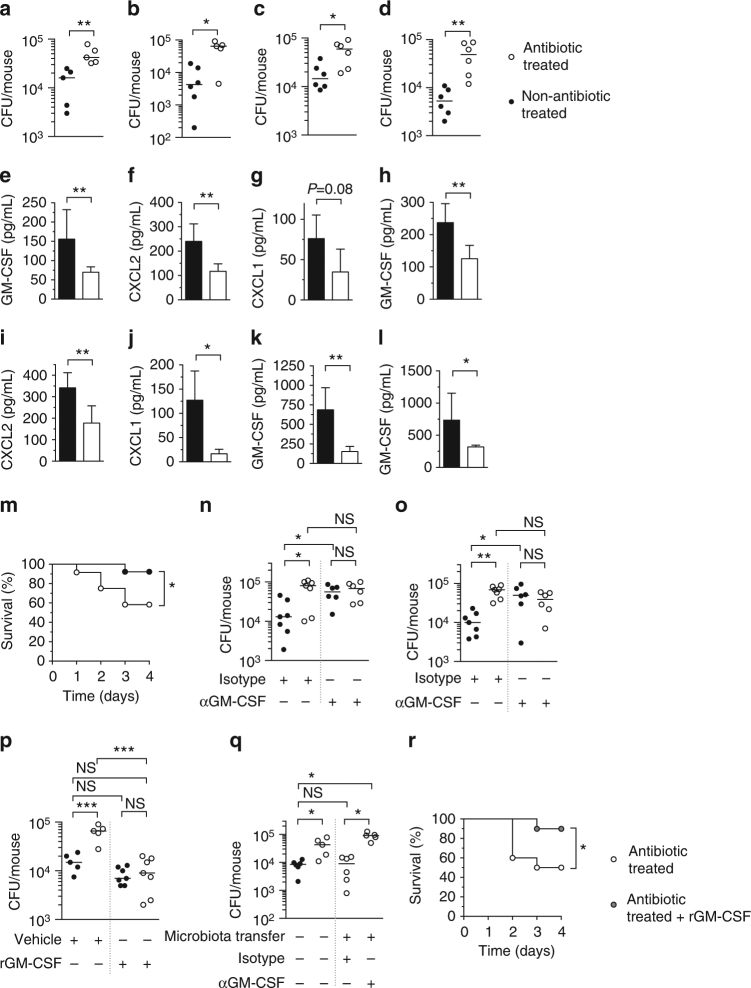
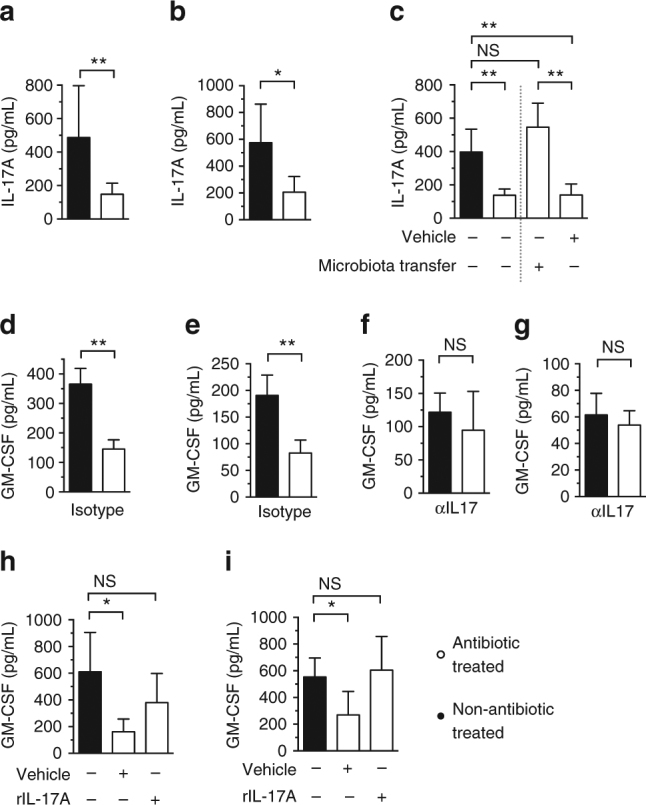
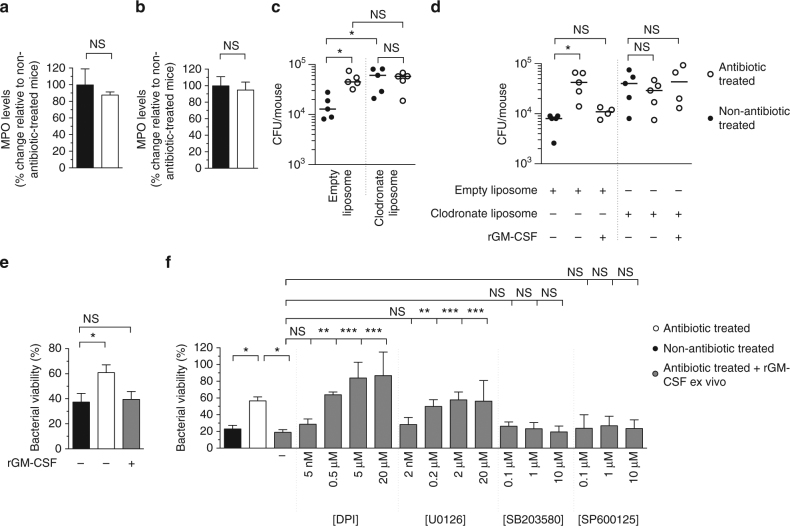
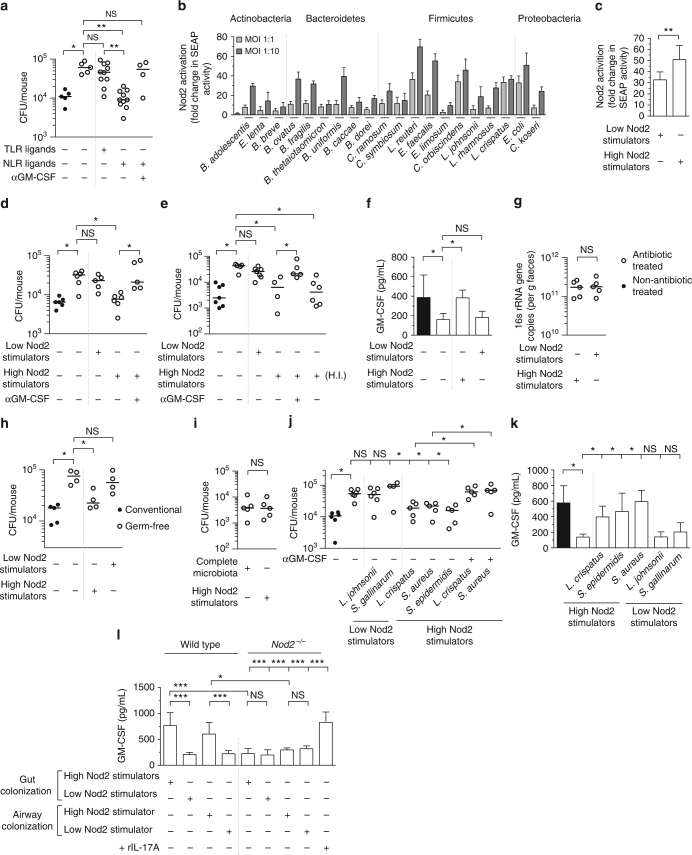
The microbiota promotes resistance to respiratory infection, but the mechanistic basis for this is poorly defined. Here, we identify members of the microbiota that protect against respiratory infection by the major human pathogens Streptococcus pneumoniae and Klebsiella pneumoniae. We show that the microbiota enhances respiratory defenses via granulocyte-macrophage colony-stimulating factor (GM-CSF) signaling, which stimulates pathogen killing and clearance by alveolar macrophages through extracellular signal-regulated kinase signaling. Increased pulmonary GM-CSF production in response to infection is primed by the microbiota through interleukin-17A. By combining models of commensal colonization in antibiotic-treated and germ-free mice, using cultured commensals from the Actinobacteria, Bacteroidetes, Firmicutes, and Proteobacteria phyla, we found that potent Nod-like receptor-stimulating bacteria in the upper airway (Staphylococcus aureus and Staphylococcus epidermidis) and intestinal microbiota (Lactobacillus reuteri, Enterococcus faecalis, Lactobacillus crispatus and Clostridium orbiscindens) promote resistance to lung infection through Nod2 and GM-CSF. Our data reveal the identity, location, and properties of bacteria within the microbiota that regulate lung immunity, and delineate the host signaling axis they activate to protect against respiratory infection.
Overview
The claims and statistics of this paper haven’t been checked yet.
Run the check — free, no account needed. It reads the open-access text and checks the sources it cites.
Integrity signals
Registry
Cites
Statistics
Figures
Verification
Claims the paper makes
The claims and statistics of this paper haven’t been checked yet.
Run the check — free, no account needed. It reads the open-access text and checks the sources it cites.
Claims other papers make about this one
Each is checked against this paper’s own text: does it say what the citing paper says it does?
In the citing paper
“administration of Lactobacillus reuteri, Enterococcus faecalis, Lactobacillus crispatus, and Clostridium orbiscindens, which are strong stimulators of NOD2 (i.e., cytosolic receptor for muramyl dipeptide, which is found in cell walls of certain bacteria), are able to protect against bacterial pneumonia by enhancing GM-CSF production”
From Respiratory viral infection-induced microbiome alterations and secondary bacterial pneumonia. (2018) · cites this paper as [66]
Self-check
Percentages, sums and reported differences re-computed from the paper’s own numbers.
The self-check needs the paper’s full text.
Citations
Cites
Indigenous bacteria from the gut microbiota regulate host serotonin biosynthesis
Yano, J. M., Yu, K., Donaldson, G. P., Shastri, G. G., Ann, P., Ma, L., Nagler, C. R., Ismagilov, R. F., Mazmanian, S. K., & Hsiao, E. Y. (2015) · Cell · doi:10.1016/j.cell.2015.02.047 · Cited by 3,614
The human microbiome: at the interface of health and disease
Cho, I., & Blaser, M. J. (2012) · Nature Reviews Genetics · doi:10.1038/nrg3182 · Cited by 3,449
Microbiota regulates immune defense against respiratory tract influenza A virus infection
Ichinohe, T., Pang, I. K., Kumamoto, Y., Peaper, D. R., Ho, J. H., Murray, T. S., & Iwasaki, A. (2011) · Proceedings of the National Academy of Sciences · doi:10.1073/pnas.1019378108 · Cited by 1,502
Guilliams, M., de Kleer, I., Henri, S., Post, S., Vanhoutte, L., Prijck, S. D., Deswarte, K., MALISSEN, B., Hammad, H., & Lambrecht, B. N. (2013) · The Journal of Experimental Medicine · doi:10.1084/jem.20131199 · Cited by 1,342
The role of Streptococcus pneumoniae virulence factors in host respiratory colonization and disease
Kadioglu, A., Weiser, J. N., Paton, J. C., & Andrew, P. W. (2008) · Nature Reviews Microbiology · doi:10.1038/nrmicro1871 · Cited by 1,184
The first 1000 cultured species of the human gastrointestinal microbiota
Rajilić-Stojanović, M., & de Vos, W. M. (2014) · FEMS Microbiology Reviews · doi:10.1111/1574-6976.12075 · Cited by 1,182
Recognition of peptidoglycan from the microbiota by Nod1 enhances systemic innate immunity
Clarke, T. B., Davis, K. M., Lysenko, E. S., Zhou, A. Y., Yu, Y., & Weiser, J. N. (2010) · Nature Medicine · doi:10.1038/nm.2087 · Cited by 1,154
Self-citationLymphoid tissue genesis induced by commensals through NOD1 regulates intestinal homeostasis
Bouskra, D., Brézillon, C., Bérard, M., Werts, C., Varona, R., Boneca, I. G., & Eberl, G. (2008) · Nature · doi:10.1038/nature07450 · Cited by 1,107
The Gut Microbiota Plays a Protective Role in the Host Defence Against Pneumococcal Pneumonia
Schuijt, T. J., Lankelma, J. M., Scicluna, B. P., de Sousa e Melo, F., Roelofs, J. J. T. H., de Boer, J. D., Hoogendijk, A. J., de Beer, R., de Vos, A., Belzer, C., et al. (2016) · Gut · doi:10.1136/gutjnl-2015-309728 · Cited by 832
Commensal bacteria protect against food allergen sensitization
Stefka, A. T., Feehley, T., Tripathi, P., Qiu, J., McCoy, K. D., Mazmanian, S. K., Tjota, M. Y., Seo, G., Cao, S. Z., Theriault, B. R., et al. (2014) · Proceedings of the National Academy of Sciences · doi:10.1073/pnas.1412008111 · Cited by 812
The microbiome in infectious disease and inflammation
Honda, K., & Littman, D. R. (2012) · Annual Review of Immunology · doi:10.1146/annurev-immunol-020711-074937 · Cited by 791
Gut Microbiota Promote Hematopoiesis to Control Bacterial Infection
Khosravi, A., Yáñez, A., Price, J. G., Chow, A. T., Mérad, M., Goodridge, H. S., & Mazmanian, S. K. (2014) · Cell Host & Microbe · doi:10.1016/j.chom.2014.02.006 · Cited by 668
Innate immune recognition of the microbiota promotes host-microbial symbiosis
Chu, H., & Mazmanian, S. K. (2013) · Nature Immunology · doi:10.1038/ni.2635 · Cited by 630
Intestinal Microbial Diversity during Early-Life Colonization Shapes Long-Term IgE Levels
Cahenzli, J., Köller, Y., Wyss, M., Geuking, M. B., & McCoy, K. D. (2013) · Cell Host & Microbe · doi:10.1016/j.chom.2013.10.004 · Cited by 611
Intestinal Bacteria and the Regulation of Immune Cell Homeostasis
Hill, D. A., & Artis, D. (2010) · Annual Review of Immunology · doi:10.1146/annurev-immunol-030409-101330 · Cited by 600
Deshmukh, H. S., Liu, Y., Menkiti, O. R., Mei, J., Dai, N., O'Leary, C. E., Oliver, P. M., Kolls, J. K., Weiser, J. N., & Worthen, G. S. (2014) · Nature Medicine · doi:10.1038/nm.3542 · Cited by 579
Role of the Commensal Microbiota in Normal and Pathogenic Host Immune Responses
Littman, D. R., & Pamer, E. G. (2011) · Cell Host & Microbe · doi:10.1016/j.chom.2011.10.004 · Cited by 568
Lagkouvardos, I., Pukall, R., Abt, B., Foesel, B. U., Meier‐Kolthoff, J. P., Kumar, N., Bresciani, A., Martínez, I., Just, S., Ziegler, C., et al. (2016) · Nature Microbiology · doi:10.1038/nmicrobiol.2016.131 · Cited by 510
Yan, F., & Polk, D. B. (2011) · Current Opinion in Gastroenterology · doi:10.1097/mog.0b013e32834baa4d · Cited by 447
The role of the local microbial ecosystem in respiratory health and disease
Piters, W. A. A. D. S., Sanders, E. A. M., & Bogaert, D. (2015) · Philosophical Transactions of the Royal Society B Biological Sciences · doi:10.1098/rstb.2014.0294 · Cited by 300
Natural Populations of the Genus Staphylococcus
Kloos, W. E. (1980) · Annual Review of Microbiology · doi:10.1146/annurev.mi.34.100180.003015 · Cited by 298
Microbiota-Derived Compounds Drive Steady-State Granulopoiesis via MyD88/TICAM Signaling
Balmer, M. L., Schürch, C. M., Saito, Y., Geuking, M. B., Li, H., Miguelangel Cuenca, V., Kovtonyuk, L. V., McCoy, K. D., Hapfelmeier, S., Ochsenbein, A. F., et al. (2014) · The Journal of Immunology · doi:10.4049/jimmunol.1400762 · Cited by 280
Fagundes, C. T., Amaral, F. A., Vieira, A. T., Soares, A. C., Pinho, V., Nicoli, J. R., Vieira, L. Q., Teixeira, M. M., & Souza, D. G. (2012) · The Journal of Immunology · doi:10.4049/jimmunol.1101682 · Cited by 244
Disruption of the gut microbiome as a risk factor for microbial infections
Khosravi, A., & Mazmanian, S. K. (2013) · Current Opinion in Microbiology · doi:10.1016/j.mib.2013.03.009 · Cited by 243
Wang, J., Li, F., Sun, R., Gao, X., Wei, H., Li, L.-J., & Tian, Z. (2013) · Nature Communications · doi:10.1038/ncomms3106 · Cited by 239
Activation of inflammasome signaling mediates pathology of acute P. aeruginosa pneumonia
Cohen, T. S., & Prince, A. S. (2013) · Journal of Clinical Investigation · doi:10.1172/jci66142 · Cited by 237
Identification of an innate T helper type 17 response to intestinal bacterial pathogens
Geddes, K., Rubino, S. J., Magalhaes, J. G., Streutker, C., Bourhis, L. L., Cho, J., Robertson, S. J., Kim, C. J., Kaul, R., Philpott, D. J., et al. (2011) · Nature Medicine · doi:10.1038/nm.2391 · Cited by 235
Gray, J. K., Oehrle, K., Worthen, G. S., Alenghat, T., Whitsett, J. A., & Deshmukh, H. S. (2017) · Science Translational Medicine · doi:10.1126/scitranslmed.aaf9412 · Cited by 223
Regulation of Proliferation, Differentiation and Survival by the IL-3/IL-5/GM-CSF Receptor Family
de Groot, R. P., Coffer, P. J., & Koenderman, L. (1998) · Cellular Signalling · doi:10.1016/s0898-6568(98)00023-0 · Cited by 215
Intestinal Microbiota of Mice Influences Resistance to Staphylococcus aureus Pneumonia
Gauguet, S., D'Ortona, S., Ahnger-Pier, K., Duan, B., Surana, N. K., Lu, R., Cywes-Bentley, C., Gadjeva, M., Shan, Q., Priebe, G. P., et al. (2015) · Infection and Immunity · doi:10.1128/iai.00037-15 · Cited by 208
Clarke, T. B. (2014) · Infection and Immunity · doi:10.1128/iai.02212-14 · Cited by 189
Self-citationFrom Hype to Hope: The Gut Microbiota in Enteric Infectious Disease
McKenney, P. T., & Pamer, E. G. (2015) · Cell · doi:10.1016/j.cell.2015.11.032 · Cited by 185
Hasegawa, M., Yang, K., Hashimoto, M., Park, J., Kim, Y., Fujimoto, Y., Núñez, G., Fukase, K., & Inohara, N. (2006) · Journal of Biological Chemistry · doi:10.1074/jbc.m602638200 · Cited by 175
Limited Role of Antibody in Clearance of Streptococcus pneumoniae in a Murine Model of Colonization
McCool, T. L., & Weiser, J. N. (2004) · Infection and Immunity · doi:10.1128/iai.72.10.5807-5813.2004 · Cited by 153
Individual Members of the Microbiota Disproportionately Modulate Host Innate Immune Responses
Rolig, A. S., Parthasarathy, R., Burns, A. R., Bohannan, B. J. M., & Guillemin, K. J. (2015) · Cell Host & Microbe · doi:10.1016/j.chom.2015.10.009 · Cited by 151
Sensing of the microbiota by NOD1 in mesenchymal stromal cells regulates murine hematopoiesis
Iwamura, C., Bouladoux, N., Belkaid, Y., Sher, A., & Jankovic, D. (2017) · Blood · doi:10.1182/blood-2016-06-723742 · Cited by 137
Pulmonary Th17 Antifungal Immunity Is Regulated by the Gut Microbiome
McAleer, J. P., Nguyen, N. L. H., Chen, K., Kumar, P., Ricks, D. M., Binnie, M., Armentrout, R., Pociask, D. A., Hein, A., Yu, A. C., et al. (2016) · The Journal of Immunology · doi:10.4049/jimmunol.1502566 · Cited by 132
Clarke, T. B., Francella, N., Huegel, A., & Weiser, J. N. (2011) · Cell Host & Microbe · doi:10.1016/j.chom.2011.04.012 · Cited by 127
Self-citationWinter, J., Popoff, M. R., Grimont, P. A. D., & Bokkenheuser, V. D. (1991) · International Journal of Systematic Bacteriology · doi:10.1099/00207713-41-3-355 · Cited by 122
Brown, G. E., Stewart, M. Q., Bissonnette, S. A., Elia, A. E. H., Wilker, E., & Yaffe, M. B. (2004) · Journal of Biological Chemistry · doi:10.1074/jbc.m314258200 · Cited by 119
Kim, D.-H., Kim, Y., Seo, S., Kim, D., Kamada, N., Prescott, D., Chamaillard, M., Philpott, D. J., Rosenstiel, P. C., Inohara, N., et al. (2016) · Nature Medicine · doi:10.1038/nm.4075 · Cited by 116
Peptidoglycan from the gut microbiota governs the lifespan of circulating phagocytes at homeostasis
Hergott, C. A., Roche, A. M., Tamashiro, E., Clarke, T. B., Bailey, A., Laughlin, A. L., Bushman, F. D., & Weiser, J. N. (2016) · Blood · doi:10.1182/blood-2015-10-675173 · Cited by 115
Self-citationThe regulation of host defences to infection by the microbiota
Brown, R. L., & Clarke, T. B. (2016) · Immunology · doi:10.1111/imm.12634 · Cited by 106
Self-citationChen, L.-W., Chen, P.-H., & Hsu, C.-M. (2011) · Shock · doi:10.1097/shk.0b013e3182184ee7 · Cited by 104
Innate Immune Signaling Activated by MDR Bacteria in the Airway
Parker, D., Ahn, D. S., Cohen, T. S., & Prince, A. S. (2015) · Physiological Reviews · doi:10.1152/physrev.00009.2015 · Cited by 71
Hasegawa, M., Osaka, T., Tawaratsumida, K., Yamazaki, T., Tada, H., Chen, G., Tsuneda, S., Núñez, G., & Inohara, N. (2009) · Infection and Immunity · doi:10.1128/iai.01043-09 · Cited by 58
Microbial Programming of Systemic Innate Immunity and Resistance to Infection
Clarke, T. B. (2014) · PLoS Pathogens · doi:10.1371/journal.ppat.1004506 · Cited by 41
Self-citationMolin, G., Johansson, M. L., St�hl, M., Ahrn�, S., Andersson, R. E., Jeppsson, B. W., & Bengmark, S. (1992) · Antonie van Leeuwenhoek · doi:10.1007/bf00584224 · Cited by 35
Gut microbiota and protection from pneumococcal pneumonia
Dickson, R. P., & Cox, M. J. (2016) · Gut · doi:10.1136/gutjnl-2016-311823 · Cited by 28
Kim, D.-H., Kim, Y., Seo, S., Kim, D.-J., Kamada, N., Prescott, D., Philpott, D. J., Rosenstiel, P. C., Inohara, N., & Núñez, G. (2016) · Nature Medicine · doi:10.1038/nm0816-961 · Cited by 5
Cited by
Sorted by citations
Enaud, R., Prével, R., Ciarlo, E., Beaufils, F., Wieërs, G., Guery, B. P., & Delhaès, L. (2020) · Frontiers in Cellular and Infection Microbiology · doi:10.3389/fcimb.2020.00009 · Cited by 786
The influence of the microbiome on respiratory health
Wypych, T. P., Wickramasinghe, L. C., & Marsland, B. J. (2019) · Nature Immunology · doi:10.1038/s41590-019-0451-9 · Cited by 611
Kennedy, E. A., King, K. Y., & Baldridge, M. T. (2018) · Frontiers in Physiology · doi:10.3389/fphys.2018.01534 · Cited by 602
Klebsiella pneumoniae infection biology: living to counteract host defences
Bengoechea, J. A., & Sá‐Pessoa, J. (2018) · FEMS Microbiology Reviews · doi:10.1093/femsre/fuy043 · Cited by 605
Respiratory viral infection-induced microbiome alterations and secondary bacterial pneumonia.
Hanada, S., Pirzadeh, M., Carver, K. Y., & Deng, J. C. (2018) · Frontiers in Immunology · doi:10.3389/fimmu.2018.02640 · Cited by 495
Metadata
- Authors
- Brown, R. L., Sequeira, R. P., & Clarke, T. B.
- Affiliations
- Imperial College London (GB)
- Corresponding author
- Clarke, Thomas B.
- Venue
- Nature Communications
- Published
- 2017-11-15
- Volume
- 8
- Issue
- 1
- Pages
- 1512-1512
- ISSN
- 2041-1723 (ISSN-L)
- PMC
- PMC5688119
- OpenAlex
- W2768027710
- Cited by
- 378
- References
- 50
- Citations by year
- 2026: 30 · 2025: 39 · 2024: 53 · 2023: 36 · 2022: 56 · 2021: 52 · 2020: 68 · 2019: 27 · 2018: 17
- FWCI
- 12.74
- Type
- journal article
- Language
- en
- Open access
- gold
- doi.org
- Locations
- Nature Communications (publishedVersion, cc-by)
- Europe PMC (PubMed Central) (publishedVersion, cc-by)
- PubMed Central (publishedVersion, cc-by)
- PubMed (publishedVersion)
- RePEc: Research Papers in Economics (submittedVersion)
- DOAJ (DOAJ: Directory of Open Access Journals) (submittedVersion, cc-by-sa)
- Spiral (Imperial College London) (submittedVersion, cc-by)
- Funders
- Wellcome Trust (107660/Z/15/Z, 107660)
- Medical Research Council (MR/J006874/1)
- Topics
- Life Sciences › Biochemistry, Genetics and Molecular Biology › Molecular Biology › Gut microbiota and health
- Life Sciences › Immunology and Microbiology › Immunology › Immune Response and Inflammation
- Life Sciences › Agricultural and Biological Sciences › Plant Science › Plant-Microbe Interactions and Immunity
- Keywords
- gut microbiota, respiratory infections, GM-CSF signaling, Streptococcus pneumoniae, Klebsiella pneumoniae, alveolar macrophages, ERK signaling, IL-17A, NOD2, NOD-like receptors, Staphylococcus aureus, Staphylococcus epidermidis, Lactobacillus reuteri, Enterococcus faecalis, lung immunity, commensal bacteria, germ-free mice, antibiotic-treated mice
- MeSH terms
- Animals, Humans, Klebsiella pneumoniae, Lung, Mice, Inbred C57BL, Respiratory Tract Infections, Streptococcus pneumoniae, Signal Transduction, Granulocyte-Macrophage Colony-Stimulating Factor, Macrophages, Alveolar, Mice, Knockout, Interleukin-17, Microbial Interactions, HEK293 Cells, Microbiota
About these checks
Registry, retraction, Cites and statistics results are computed, not judged, with one exception: a printed reference that no index lists is read once by a model before it counts as a citation error. Claims are extracted by a model and kept only when their quote appears verbatim in the text; each cited source is then checked, with a model’s help, for whether it says what the claim relies on. Those verdicts can be wrong — read the claim’s quote and the cited source before relying on one.
Statistics and arithmetic are recomputed, not judged.
Confidence bands are shown only for fields calibrated on our annotated test set. None is calibrated yet, so no band is shown.
What counts as a claim ›How we measure confidence ›How we check this ›
Are you an author, or do you see a problem with this page? Request a review
