

The DOI matches its Crossref record; 84 of the 84 references it cites were found in a registry or an index; 4 of the 24 sources its claims cite were checked for support.
Oxytocin enhances observational fear in mice
Open accessAbstract
Empathy is fundamental to human relations, but its neural substrates remain largely unknown. Here we characterize the involvement of oxytocin in the capacity of mice to display emotional state-matching, an empathy-like behavior. When exposed to a familiar conspecific demonstrator in distress, an observer mouse becomes fearful, as indicated by a tendency to freeze and subsequent efforts to escape. Both intranasal oxytocin administration and chemogenetic stimulation of oxytocin neurons render males sensitive to the distress of an unfamiliar mouse. Acute intranasal oxytocin penetrates the brain and enhances cellular activity within the anterior cingulate cortex, whereas chronic administration produces long-term facilitation of observational fear and downregulates oxytocin receptor expression in the amygdala. None of these manipulations affect fear acquired as a result of direct experience with the stressor. Hence, these results implicate oxytocin in observational fear in mice (rather than fear itself) and provide new avenues for examining the neural substrates of empathy.
Overview
AI snapshot
Written from the paper’s full text.
TL;DR
Oxytocin enhances observational/socially transmitted fear in mice, while leaving directly acquired Pavlovian fear largely unaffected. Acute and chronic intranasal oxytocin, as well as chemogenetic activation of hypothalamic oxytocin neurons, increase freezing in unfamiliar male observers, whereas an oxytocin receptor antagonist reduces it.
Key findings
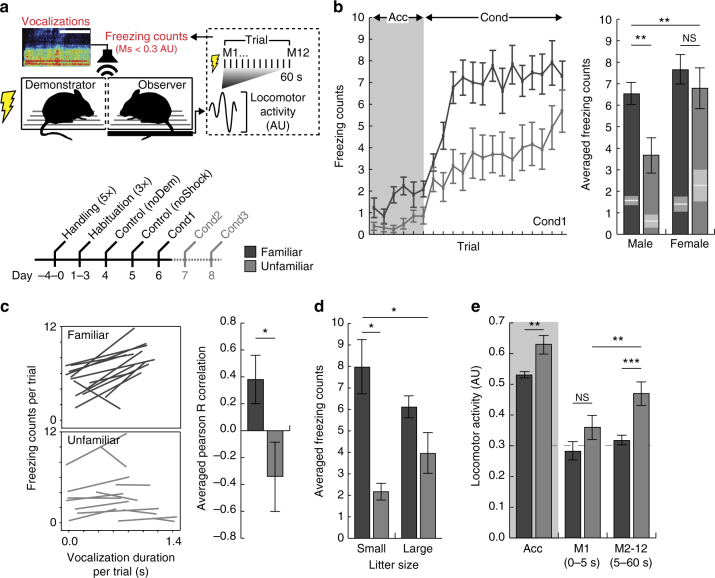
- Familiar male observers froze significantly more than unfamiliar male observers (two-tailed t-test: t(25)=2.96, p=0.008), while familiar and unfamiliar females did not differ (t(19)=0.728, p=0.48).
- Acute intranasal oxytocin (20 μg/kg) elevated CSF oxytocin (t(19)=2.73, p=0.015) and enhanced freezing in unfamiliar males (t(23)=2.49, p=0.020); chronic oxytocin (20 μg/kg, 5 daily doses) also enhanced freezing 10 days after cessation (t(21)=2.64, p=0.016) and downregulated Oxtr in the CeL (t(19)=2.08, p=0.05) but not ACC (p=0.95).
- Chemogenetic activation of PVN oxytocinergic neurons with rM3D(Gs) enhanced freezing in unfamiliar males (ANOVA: F2,28=3.41, p=0.048), and the oxytocin receptor antagonist L-368,899 dose-dependently reduced freezing in familiar males (ANOVA: F2,35=5.73, p=0.007).
- Oxytocin manipulations did not affect direct Pavlovian fear acquisition, expression, or extinction, and I125-labeled oxytocin was detected in brain regions including ACC, amygdala, and hypothalamus after intranasal delivery.
Methods
- C57/B6 mice, 8–12 weeks old, tested as same-sex observer–demonstrator pairs; social fear was measured as observer freezing during demonstrator foot-shock conditioning (0.8 mA, 1.5 s, 15 trials), with a separate socially induced avoidance paradigm for escape behavior.
- Pharmacological and chemogenetic manipulations included intranasal oxytocin (20 μg/kg acute or 5 daily doses), systemic L-368,899 (5 or 10 mg/kg I.P.), and CNO (3 mg/kg I.P.) in Oxt-IRES-Cre mice with bilateral PVN injections of AAV2-hSyn-DIO-rM3D(Gs)-mCherry.
- Analyses used two-tailed Student’s t-tests, one-way ANOVA, and Dunnett’s post hoc tests, with significance set at P<0.05; supporting measures included CSF ELISA, I125-oxytocin distribution, qRT-PCR for Oxtr, and c-Fos immunohistochemistry.
Limitations
- Stated: I125-radiolabeling cannot distinguish intact oxytocin from labeled peptide fragments; ELISA could not extract/quantify oxytocin from brain tissue; the experiments did not disambiguate relatedness from familiarity; and no statistical methods were used to predetermine sample sizes.
- Evident: the key oxytocin manipulations were conducted primarily in male mice, so sex-specific generalization of the oxytocin effects is not established by the reported experiments.
Model-written summary. Check it against the paper before relying on it.
Integrity signals
Registry
Cites
Statistics
Figures
Verification
Claims the paper makes
31 Own result · 19 Own method · 13 Own interpretation · 10 Not checked yet · 1 Partly supported · 1 Mixed support · 1 No basis given · accuracy not yet measured
The cited sources support only part of this claim — read each source’s verdict below.
In the paper
“In both humans and rodents, fear and anxiety can be buffered by the presence of another non-fearful individual72,73.”
§ Oxytocin enhances observational fear in mice > Discussion
What the sources say
- Partly supportedcites [72] Guzmán, Y., Tronson, N. & Guedea, A. Social modeling of conditioned fear in mice by non-fearful conspecifics. Behav. Brain Res. 201, 173–178 (2009). sourceExperimental — accuracy not yet measured
The Introduction reports reduced fear responses in children observing positive maternal reactions, and the Results and Discussion show that exposure to non-fearful mice reduced conditioned fear in observer mice. The paper discusses implications for anxiety but does not demonstrate that anxiety itself was buffered. It also says that merely being with a mouse that showed no fear was insufficient; the effective demonstrators had been habituated to the context. (LLM, conf=0.85)
- Not checked yetcites [73] Egliston, K. & Rapee, R. M. Inhibition of fear acquisition in toddlers following positive modelling by their mothers. Behav. Res. Ther. 45, 1871–1882 (2007). source
plaindirect- Asserted: passes — The authors put it forward as true.
- Checkable: passes — It can be checked against evidence.
- Load-bearing: passes — The paper’s conclusions depend on it.
- Based: passes — The paper gives a reason why it holds.
- Partly supported
A result the paper reports from its own data — it cites no other source for it, so there is none to check. The quote shows it is in the paper.
In the paper
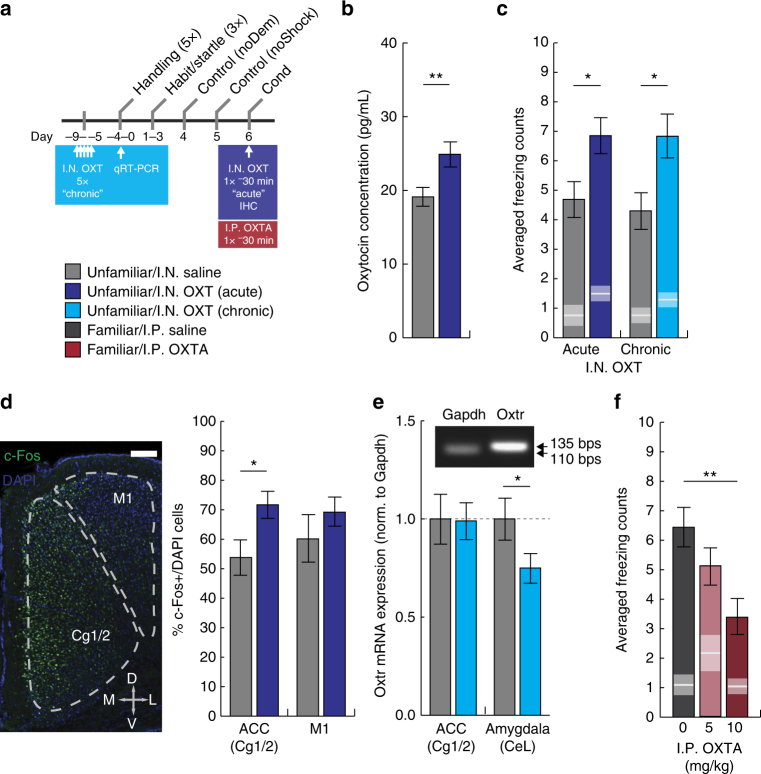
“Intranasal oxytocin successfully elevated CSF levels in behaviorally naive mice, thereby confirming the entry of oxytocin into brain CSF (Fig. 3b).”
- Also stated in: § Intranasal oxytocin enhances social fear · plain
“In behaviorally naïve mice administered acute intranasal oxytocin (20 μg/kg; dark blue, n = 10), concentrations of the neuropeptide in CSF were significantly elevated compared to saline-treated controls (gray, n = 10) (two-tailed Student’s t-test: t(19) = 2.73, p = 0.015).”
§ Oxytocin enhances observational fear in mice > Results > Intranasal oxytocin enhances social fear
boosteddirectn = 10 ·- Asserted: passes — The authors put it forward as true.
- Checkable: passes — It can be checked against evidence.
- Load-bearing: passes — The paper’s conclusions depend on it.
- Based: passes — The paper gives a reason why it holds.
- Also stated in: § Intranasal oxytocin enhances social fear · plain
A result the paper reports from its own data — it cites no other source for it, so there is none to check. The quote shows it is in the paper.
In the paper
“Familiar (black, n = 10) and unfamiliar (gray, n = 10) female mice did not exhibit significant differences in levels of freezing (two-tailed Student’s t-test: t(19) = 0.728, p = 0.48)”
- Also stated in: § Individual differences in social fear · plain
“In female mice, we discerned no effect of familiarity—that is, sibling (henceforth, familiar) and non-sibling/non-cagemate (henceforth, unfamiliar) observers exhibited high and comparable levels of freezing during demonstrator conditioning (Fig. 1b, right).”
§ Oxytocin enhances observational fear in mice > Results > Individual differences in social fear
plainn = 10- Asserted: passes — The authors put it forward as true.
- Checkable: passes — It can be checked against evidence.
- Load-bearing: passes — The paper’s conclusions depend on it.
- Based: passes — The paper gives a reason why it holds.
- Also stated in: § Individual differences in social fear · plain
A result the paper reports from its own data — it cites no other source for it, so there is none to check. The quote shows it is in the paper.
In the paper
“Unfamiliar male observers (gray, n = 13) exhibited significantly less freezing compared to familiar male observers (black, n = 13) across demonstrator conditioning trials (repeated measure ANOVA: F 1,390 = 6.00, p < 0.0001), and when averaged (two-tailed Student’s t-test: t(25) = 2.96, p = 0.008).”
- Also stated in: § Individual differences in social fear · plain
“In contrast, unfamiliar male observers exhibited a significant deficit in freezing compared to familiar observers—both when quantified across conditioning trials (Fig. 1b, left) and when averaged (Fig. 1b, right).”
§ Oxytocin enhances observational fear in mice > Results > Individual differences in social fear
plainn = 13 ·- Asserted: passes — The authors put it forward as true.
- Checkable: passes — It can be checked against evidence.
- Load-bearing: passes — The paper’s conclusions depend on it.
- Based: passes — The paper gives a reason why it holds.
- Also stated in: § Individual differences in social fear · plain
A result the paper reports from its own data — it cites no other source for it, so there is none to check. The quote shows it is in the paper.
In the paper
“or chronic (20 μg/kg, 5 daily doses; light blue, n = 11; two-tailed Student’s t-test: t(21) = 2.64, p = 0.016) intranasal oxytocin exhibited a significant enhancement of freezing compared to saline-treated controls (gray, n = 12/11, respectively).”
- Also stated in: § Intranasal oxytocin enhances social fear · plain
“Similar to acute oxytocin, this regimen produced a significant enhancement of freezing in oxytocin-treated unfamiliar observers, compared to saline-treated controls (Fig. 3c).”
§ Oxytocin enhances observational fear in mice > Results > Intranasal oxytocin enhances social fear
plaindirectn = 11 ·- Asserted: passes — The authors put it forward as true.
- Checkable: passes — It can be checked against evidence.
- Load-bearing: passes — The paper’s conclusions depend on it.
- Based: passes — The paper gives a reason why it holds.
- Also stated in: § Intranasal oxytocin enhances social fear · plain
A result the paper reports from its own data — it cites no other source for it, so there is none to check. The quote shows it is in the paper.
In the paper
“Unfamiliar male observers given acute (20 μg/kg, single dose, 30 min prior; dark blue, n = 12; two-tailed Student’s t-test: t(23) = 2.49, p = 0.020) or chronic (20 μg/kg, 5 daily doses; light blue, n = 11; two-tailed Student’s t-test: t(21) = 2.64, p = 0.016) intranasal oxytocin exhibited a significant enhancement of freezing compared to saline-treated controls (gray, n = 12/11, respectively).”
- Also stated in: § Intranasal oxytocin enhances social fear · plain
“For unfamiliar male mice, this regimen produced a significant enhancement of freezing compared to saline-treated controls (Fig. 3c).”
§ Oxytocin enhances observational fear in mice > Results > Intranasal oxytocin enhances social fear
plaindirectn = 12 ·- Asserted: passes — The authors put it forward as true.
- Checkable: passes — It can be checked against evidence.
- Load-bearing: passes — The paper’s conclusions depend on it.
- Based: passes — The paper gives a reason why it holds.
- Also stated in: § Intranasal oxytocin enhances social fear · plain
A result the paper reports from its own data — it cites no other source for it, so there is none to check. The quote shows it is in the paper.
In the paper
“When exposed to a familiar conspecific demonstrator in distress, an observer mouse becomes fearful, as indicated by a tendency to freeze and subsequent efforts to escape.”
§ Oxytocin enhances observational fear in mice > Abstract
hedgeddirect- Asserted: passes — The authors put it forward as true.
- Checkable: passes — It can be checked against evidence.
- Load-bearing: passes — The paper’s conclusions depend on it.
- Based: passes — The paper gives a reason why it holds.
A result the paper reports from its own data — it cites no other source for it, so there is none to check. The quote shows it is in the paper.
In the paper
“Average correlations were significantly different (Fisher transformation, two-way Student’s t-test: t(24) = 2.25, p = 0.035).”
- Also stated in: § Individual differences in social fear · plain
“Familiar males showed a significantly higher average correlation compared to unfamiliar males (Fig. 1c).”
§ Oxytocin enhances observational fear in mice > Results > Individual differences in social fear
plaincorrelationaln = 10 ·- Asserted: passes — The authors put it forward as true.
- Checkable: passes — It can be checked against evidence.
- Load-bearing: passes — The paper’s conclusions depend on it.
- Based: passes — The paper gives a reason why it holds.
- Also stated in: § Individual differences in social fear · plain
A result the paper reports from its own data — it cites no other source for it, so there is none to check. The quote shows it is in the paper.
In the paper
“No discernible enhancement was detected following acute intranasal oxytocin administered to familiar male mice (Supplementary Fig. 7).”
§ Oxytocin enhances observational fear in mice > Results > Intranasal oxytocin enhances social fear
plain- Asserted: passes — The authors put it forward as true.
- Checkable: passes — It can be checked against evidence.
- Load-bearing: passes — The paper’s conclusions depend on it.
- Based: passes — The paper gives a reason why it holds.
A result the paper reports from its own data — it cites no other source for it, so there is none to check. The quote shows it is in the paper.
In the paper
“socially transmitted fear was seen to a greater extent in females than in males and was bolstered by administration of the neuropeptide oxytocin.”
§ Oxytocin enhances observational fear in mice > Discussion
plaindirect- Asserted: passes — The authors put it forward as true.
- Checkable: passes — It can be checked against evidence.
- Load-bearing: passes — The paper’s conclusions depend on it.
- Based: passes — The paper gives a reason why it holds.
A result the paper reports from its own data — it cites no other source for it, so there is none to check. The quote shows it is in the paper.
In the paper
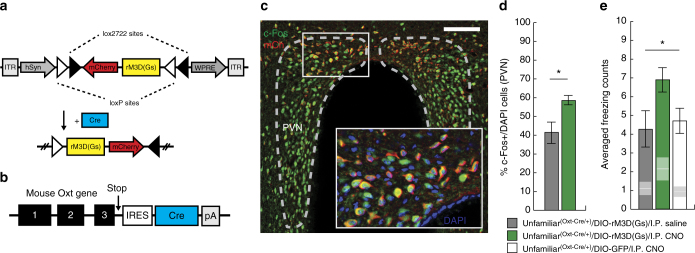
“Administration of CNO (3 mg/kg, I.P.) 30 min prior to demonstrator conditioning enhanced freezing in unfamiliar male mice expressing rM3D(Gs) (green, n = 10) compared to saline-treated controls with rM3D(Gs) (gray, n = 9) and CNO-treated controls without rM3D(Gs) (white, n = 10) when averaged over conditioning trials (ANOVA: F 2,28 = 3.41, p = 0.048).”
- Also stated in: § DREADD activation of oxytocin neurons enhances social fear · plain
“In unfamiliar male mice expressing rM3D(Gs) within oxytocinergic neurons, activation of DREADDs via CNO administered 30 min prior to demonstrator conditioning produced a significant enhancement of freezing compared to saline-treated mice or CNO-treated mice infected with a control, GFP-encoding virus (Fig. 4e).”
§ Oxytocin enhances observational fear in mice > Results > DREADD activation of oxytocin neurons enhances social fear
plaindirectn = 10 ·- Asserted: passes — The authors put it forward as true.
- Checkable: passes — It can be checked against evidence.
- Load-bearing: passes — The paper’s conclusions depend on it.
- Based: passes — The paper gives a reason why it holds.
- Also stated in: § DREADD activation of oxytocin neurons enhances social fear · plain
A result the paper reports from its own data — it cites no other source for it, so there is none to check. The quote shows it is in the paper.
In the paper
“The experiments described here demonstrate socially transmitted (i.e., observational) fear in mice.”
§ Oxytocin enhances observational fear in mice > Discussion
boosteddirect- Asserted: passes — The authors put it forward as true.
- Checkable: passes — It can be checked against evidence.
- Load-bearing: passes — The paper’s conclusions depend on it.
- Based: passes — The paper gives a reason why it holds.
A result the paper reports from its own data — it cites no other source for it, so there is none to check. The quote shows it is in the paper.
In the paper
“chronic administration produces long-term facilitation of observational fear and downregulates oxytocin receptor expression in the amygdala.”
§ Oxytocin enhances observational fear in mice > Abstract
plaindirect- Asserted: passes — The authors put it forward as true.
- Checkable: passes — It can be checked against evidence.
- Load-bearing: passes — The paper’s conclusions depend on it.
- Based: passes — The paper gives a reason why it holds.
A result the paper reports from its own data — it cites no other source for it, so there is none to check. The quote shows it is in the paper.
In the paper
“It is notable that in several experiments, we found no effects of either increasing or decreasing oxytocin activity acutely on Pavlovian fear conditioning.”
§ Oxytocin enhances observational fear in mice > Discussion
plain- Asserted: passes — The authors put it forward as true.
- Checkable: passes — It can be checked against evidence.
- Load-bearing: passes — The paper’s conclusions depend on it.
- Based: passes — The paper gives a reason why it holds.
None of the sources cited for this claim have been checked yet.
In the paper
“Similar to reports of emotional state-matching in humans12,43, socially transmitted fear was seen to a greater extent in females than in males and was bolstered by administration of the neuropeptide oxytocin.”
§ Oxytocin enhances observational fear in mice > Discussion
What the sources say
- Not checked yetcites [12] Hurlemann, R. et al. Oxytocin enhances amygdala-dependent, socially reinforced learning and emotional empathy in humans. J. Neurosci. 30, 4999–5007 (2010). source
- Not checked yetcites [43] Schulte-Rüther, M., Markowitsch, H. J., Shah, N. J., Fink, G. R. & Piefke, M. Gender differences in brain networks supporting empathy. Neuroimage 42, 393–403 (2008). source
plaincorrelational- Asserted: passes — The authors put it forward as true.
- Checkable: passes — It can be checked against evidence.
- Load-bearing: unclear — It is unclear whether the paper’s conclusions depend on it.
- Based: passes — The paper gives a reason why it holds.
A result the paper reports from its own data — it cites no other source for it, so there is none to check. The quote shows it is in the paper.
In the paper
“This DREADD-mediated enhancement in unfamiliar mice reached a level of socially transmitted fear commensurate with that seen in familiar mice (Fig. 1).”
§ Oxytocin enhances observational fear in mice > Results > DREADD activation of oxytocin neurons enhances social fear
plain- Asserted: passes — The authors put it forward as true.
- Checkable: passes — It can be checked against evidence.
- Load-bearing: passes — The paper’s conclusions depend on it.
- Based: passes — The paper gives a reason why it holds.
A result the paper reports from its own data — it cites no other source for it, so there is none to check. The quote shows it is in the paper.
In the paper
“We similarly found no effect of our chronic oxytocin regimen on fear conditioning.”
§ Oxytocin enhances observational fear in mice > Discussion
plain- Asserted: passes — The authors put it forward as true.
- Checkable: passes — It can be checked against evidence.
- Load-bearing: passes — The paper’s conclusions depend on it.
- Based: passes — The paper gives a reason why it holds.
A result the paper reports from its own data — it cites no other source for it, so there is none to check. The quote shows it is in the paper.
In the paper
“chronic administration produces long-term facilitation of observational fear and downregulates oxytocin receptor expression in the amygdala.”
§ Oxytocin enhances observational fear in mice > Abstract
plaindirect- Asserted: passes — The authors put it forward as true.
- Checkable: passes — It can be checked against evidence.
- Load-bearing: passes — The paper’s conclusions depend on it.
- Based: passes — The paper gives a reason why it holds.
A result the paper reports from its own data — it cites no other source for it, so there is none to check. The quote shows it is in the paper.
In the paper
“Acute intranasal oxytocin penetrates the brain and enhances cellular activity within the anterior cingulate cortex, whereas chronic administration produces long-term facilitation of observational fear and downregulates oxytocin receptor expression in the amygdala.”
§ Oxytocin enhances observational fear in mice > Abstract
plaindirect- Asserted: passes — The authors put it forward as true.
- Checkable: passes — It can be checked against evidence.
- Load-bearing: passes — The paper’s conclusions depend on it.
- Based: passes — The paper gives a reason why it holds.
A result the paper reports from its own data — it cites no other source for it, so there is none to check. The quote shows it is in the paper.
In the paper
“None of these manipulations affect fear acquired as a result of direct experience with the stressor.”
§ Oxytocin enhances observational fear in mice > Abstract
plain- Asserted: passes — The authors put it forward as true.
- Checkable: passes — It can be checked against evidence.
- Load-bearing: passes — The paper’s conclusions depend on it.
- Based: passes — The paper gives a reason why it holds.
A result the paper reports from its own data — it cites no other source for it, so there is none to check. The quote shows it is in the paper.
In the paper
“In contrast, we showed that oxytocin or an oxytocin receptor antagonist enhances, or blocks, socially transmitted fear, respectively.”
§ Oxytocin enhances observational fear in mice > Discussion
boosteddirect- Asserted: passes — The authors put it forward as true.
- Checkable: passes — It can be checked against evidence.
- Load-bearing: passes — The paper’s conclusions depend on it.
- Based: passes — The paper gives a reason why it holds.
In the paper
“When this factor is controlled for, as in this study (and see ref. 28), modulatory effects of oxytocin on fear acquisition are not seen.”
§ Oxytocin enhances observational fear in mice > Discussion
What the sources say
- Not checked yetcites [28] Choe, H. K. et al. Oxytocin mediates entrainment of sensory stimuli to social cues of opposing valence. Neuron 87, 152–163 (2015). source
plain- Asserted: passes — The authors put it forward as true.
- Checkable: passes — It can be checked against evidence.
- Load-bearing: passes — The paper’s conclusions depend on it.
- Based: passes — The paper gives a reason why it holds.
A result the paper reports from its own data — it cites no other source for it, so there is none to check. The quote shows it is in the paper.
In the paper
“In this study, we have demonstrated the importance of the brain oxytocin system in the social transmission of fear among mice.”
§ Oxytocin enhances observational fear in mice > Discussion
boosteddirect- Asserted: passes — The authors put it forward as true.
- Checkable: passes — It can be checked against evidence.
- Load-bearing: passes — The paper’s conclusions depend on it.
- Based: passes — The paper gives a reason why it holds.
A result the paper reports from its own data — it cites no other source for it, so there is none to check. The quote shows it is in the paper.
In the paper
“In contrast, we showed that oxytocin or an oxytocin receptor antagonist enhances, or blocks, socially transmitted fear, respectively.”
§ Oxytocin enhances observational fear in mice > Discussion
plaindirect- Asserted: passes — The authors put it forward as true.
- Checkable: passes — It can be checked against evidence.
- Load-bearing: passes — The paper’s conclusions depend on it.
- Based: passes — The paper gives a reason why it holds.
A conclusion the paper draws from its own results — it cites no other source for it, so there is none to check. The quote shows it is in the paper.
In the paper
“These findings suggest that deficits in the transmission of fear from unfamiliar mice were not a result of deficits in the capacity to detect sensory signals emanating from these mice.”
§ Oxytocin enhances observational fear in mice > Results > Individual differences in social fear
hedged- Asserted: passes — The authors put it forward as true.
- Checkable: passes — It can be checked against evidence.
- Load-bearing: passes — The paper’s conclusions depend on it.
- Based: passes — The paper gives a reason why it holds.
A conclusion the paper draws from its own results — it cites no other source for it, so there is none to check. The quote shows it is in the paper.
In the paper
“We also find a relationship between litter size and social fear behavior, implicating early-life social experience in the maturation of empathy.”
§ Oxytocin enhances observational fear in mice > Introduction
hedgedcorrelational- Asserted: passes — The authors put it forward as true.
- Checkable: passes — It can be checked against evidence.
- Load-bearing: passes — The paper’s conclusions depend on it.
- Based: passes — The paper gives a reason why it holds.
A conclusion the paper draws from its own results — it cites no other source for it, so there is none to check. The quote shows it is in the paper.
In the paper
“Hence, these results implicate oxytocin in observational fear in mice (rather than fear itself) and provide new avenues for examining the neural substrates of empathy.”
§ Oxytocin enhances observational fear in mice > Abstract
hedgedcorrelational- Asserted: passes — The authors put it forward as true.
- Checkable: passes — It can be checked against evidence.
- Load-bearing: passes — The paper’s conclusions depend on it.
- Based: passes — The paper gives a reason why it holds.
In the paper
“This suggests that downregulation of oxytocin receptors in the CeA is specific to neurons that are also activated by socio-emotional cues, perhaps via the ACC5.”
§ Oxytocin enhances observational fear in mice > Discussion
What the sources say
- Not checked yetcites [5] Jeon, D. et al. Observational fear learning involves affective pain system and Cav1.2 Ca2+ channels in ACC. Nat. Neurosci. 13, 482–488 (2010). source
hedgedcorrelational- Asserted: passes — The authors put it forward as true.
- Checkable: passes — It can be checked against evidence.
- Load-bearing: passes — The paper’s conclusions depend on it.
- Based: passes — The paper gives a reason why it holds.
A conclusion the paper draws from its own results — it cites no other source for it, so there is none to check. The quote shows it is in the paper.
In the paper
“Taken together, the exhibition and timing of these responses in mice strongly suggest that fear is transmitted to the observer via the vocalizations of the demonstrator.”
§ Oxytocin enhances observational fear in mice > Discussion
boosteddirect- Asserted: passes — The authors put it forward as true.
- Checkable: passes — It can be checked against evidence.
- Load-bearing: passes — The paper’s conclusions depend on it.
- Based: passes — The paper gives a reason why it holds.
A conclusion the paper draws from its own results — it cites no other source for it, so there is none to check. The quote shows it is in the paper.
In the paper
“Supporting the contention that social fear in mice and empathy in humans are homologous phenomena, a similar directionality of gender differences is seen in both species.”
§ Oxytocin enhances observational fear in mice > Discussion
plaincorrelational- Asserted: passes — The authors put it forward as true.
- Checkable: passes — It can be checked against evidence.
- Load-bearing: passes — The paper’s conclusions depend on it.
- Based: passes — The paper gives a reason why it holds.
A conclusion the paper draws from its own results — it cites no other source for it, so there is none to check. The quote shows it is in the paper.
In the paper
“This is an important control in order to show that oxytocin affects the social transmission of fear rather than the acquisition or expression of fear itself.”
§ Oxytocin enhances observational fear in mice > Discussion
plaindirect- Asserted: passes — The authors put it forward as true.
- Checkable: passes — It can be checked against evidence.
- Load-bearing: passes — The paper’s conclusions depend on it.
- Based: passes — The paper gives a reason why it holds.
A conclusion the paper draws from its own results — it cites no other source for it, so there is none to check. The quote shows it is in the paper.
In the paper
“Hence, these results implicate oxytocin in observational fear in mice (rather than fear itself) and provide new avenues for examining the neural substrates of empathy.”
- Also stated in: § Introduction · hedged
“Hence, rather than moderating levels of fear per se, the oxytocin system appears to be a critical substrate for socially transmitted fear.”
§ Oxytocin enhances observational fear in mice > Abstract
hedgeddirect- Asserted: passes — The authors put it forward as true.
- Checkable: passes — It can be checked against evidence.
- Load-bearing: passes — The paper’s conclusions depend on it.
- Based: passes — The paper gives a reason why it holds.
- Also stated in: § Introduction · hedged
A conclusion the paper draws from its own results — it cites no other source for it, so there is none to check. The quote shows it is in the paper.
In the paper
“Since our last dose of oxytocin had been administered a full 10 days prior to behavioral testing, the facilitation of social transmission of fear must have occurred through persistent neuroadaptive changes rather than through the direct effects of the drug.”
§ Oxytocin enhances observational fear in mice > Discussion
plaindirect- Asserted: passes — The authors put it forward as true.
- Checkable: passes — It can be checked against evidence.
- Load-bearing: passes — The paper’s conclusions depend on it.
- Based: passes — The paper gives a reason why it holds.
In the paper
“Hence, interplay within oxytocin-modulated hypothalamic-cingulate-amygdalar circuitry likely plays a critical role in the social transmission of fear14.”
§ Oxytocin enhances observational fear in mice > Discussion
What the sources say
- Not checked yetcites [14] Meyer-Lindenberg, A., Domes, G., Kirsch, P. & Heinrichs, M. Oxytocin and vasopressin in the human brain: social neuropeptides for translational medicine. Nat. Rev. Neurosci. 12, 524–538 (2011). source
hedgedconditional- Asserted: passes — The authors put it forward as true.
- Checkable: passes — It can be checked against evidence.
- Load-bearing: passes — The paper’s conclusions depend on it.
- Based: passes — The paper gives a reason why it holds.
A conclusion the paper draws from its own results — it cites no other source for it, so there is none to check. The quote shows it is in the paper.
In the paper
“A plausible resolution to these apparently paradoxical effects is that the reductions in fear and anxiety previously seen in rodent studies were secondary to the prosocial effects of oxytocin.”
§ Oxytocin enhances observational fear in mice > Discussion
hedgeddirect- Asserted: passes — The authors put it forward as true.
- Checkable: passes — It can be checked against evidence.
- Load-bearing: passes — The paper’s conclusions depend on it.
- Based: passes — The paper gives a reason why it holds.
A conclusion the paper draws from its own results — it cites no other source for it, so there is none to check. The quote shows it is in the paper.
In the paper
“Thus, observational fear would appear to be well suited as a behavior for investigating genetic, developmental, and neural substrates of empathy in mice.”
§ Oxytocin enhances observational fear in mice > Discussion
hedged- Asserted: passes — The authors put it forward as true.
- Checkable: unclear — It is unclear whether it could be checked against evidence.
- Load-bearing: passes — The paper’s conclusions depend on it.
- Based: passes — The paper gives a reason why it holds.
What the paper did — it cites no source for this, so there is none to check. The quote shows it is in the paper.
In the paper
“The difference between familiar and unfamiliar male mice freezing in the socially transmitted fear paradigm replicated several times in our laboratory (e.g., Figs. 1b, 3c, f and 4e).”
§ Oxytocin enhances observational fear in mice > Methods > Statistics
plain- Asserted: passes — The authors put it forward as true.
- Checkable: passes — It can be checked against evidence.
- Load-bearing: unclear — It is unclear whether the paper’s conclusions depend on it.
- Based: passes — The paper gives a reason why it holds.
In the paper
“Fear contagion in humans correlates positively with several other measures of empathy, including those with no obvious murine equivalent74.”
§ Oxytocin enhances observational fear in mice > Discussion
What the sources say
- Not checked yetcites [74] Corden, B., Critchley, H. D., Skuse, D. & Dolan, R. J. Fear recognition ability predicts differences in social cognitive and neural functioning in men. J. Cogn. Neurosci. 18, 889–897 (2006). source
plaincorrelational- Asserted: passes — The authors put it forward as true.
- Checkable: passes — It can be checked against evidence.
- Load-bearing: passes — The paper’s conclusions depend on it.
- Based: passes — The paper gives a reason why it holds.
- Probably not a substantial claim. 23
- It may state two separate claims as one. 17
- The quote only partly states this claim. 1
Some cited sources support this claim and some don’t — read each source’s verdict below.
In the paper
“Observer mice did not have experience with foot-shock (i.e., “priming”) prior to demonstrator conditioning (cf. 7–9).”
§ Oxytocin enhances observational fear in mice > Methods > Socially transmitted fear paradigm
What the sources say
- Disputedcites [7] Chen, Q., Panksepp, J. B. & Lahvis, G. P. Empathy is moderated by genetic background in mice. PLoS ONE 4, e4387 (2009). sourceExperimental — accuracy not yet measured
The Materials and Methods (Fear-conditioning procedures) say that subject mice received a single 2-s shock during habituation before they observed object mice undergoing conditioning. They were not shocked during the observation sessions, but the claim that they had no prior foot-shock experience is contrary to the stated procedure. (LLM, conf=0.94)
Checked by a reasoning model — may be wrong.
- Partly supportedcites [8] Kim, E. S. E. J., Covey, E. & Kim, J. J. Social transmission of fear in rats: the role of 22-kHz ultrasonic distress vocalization. PLoS ONE 5, e15077 (2010). sourceExperimental — accuracy not yet measured
The Behavioral procedures (page unavailable) describe a naïve receiver group that remained in its home cage while sender rats underwent foot-shock conditioning, supporting the no-priming point for that group. But the study used rats, not mice, and its fear-experienced receiver groups received foot-shocks before pair-testing; the claim does not capture those limits. (LLM, conf=0.90)
- Partly supportedcites [9] Sanders, J., Mayford, M. & Jeste, D. Empathic fear responses in mice are triggered by recognition of a shared experience. PLoS ONE 8, e74609 (2013). sourceExperimental — accuracy not yet measured
The Methods (Behavioral Protocol) describe a Naïve observer group that remained in its home cage on day 1 and had no prior footshock. But the same section says the SHobs and SHNobs observer groups received footshocks on day 1, before observing subjects on day 2. The unqualified statement applies only to some observers in this study. (LLM, conf=0.88)
plain- Asserted: passes — The authors put it forward as true.
- Checkable: passes — It can be checked against evidence.
- Load-bearing: passes — The paper’s conclusions depend on it.
- Based: passes — The paper gives a reason why it holds.
Probably not a substantial claim.
- Disputed
A result the paper reports from its own data — it cites no other source for it, so there is none to check. The quote shows it is in the paper.
In the paper
“We did not note any differences in these measures when intranasal oxytocin was given acutely prior to conditioning (Supplementary Fig. 8). Therefore, the effects of oxytocin on socially acquired fear were not secondary to alterations in the capacity for fear conditioning in general.”
§ Oxytocin enhances observational fear in mice > Results > Intranasal oxytocin enhances social fear
plain- Asserted: passes — The authors put it forward as true.
- Checkable: passes — It can be checked against evidence.
- Load-bearing: passes — The paper’s conclusions depend on it.
- Based: passes — The paper gives a reason why it holds.
It may state two separate claims as one.
A result the paper reports from its own data — it cites no other source for it, so there is none to check. The quote shows it is in the paper.
In the paper
“Initial locomotor activity (M1) was equivalent across groups, indicating similar orientation responses for all observers; however, unfamiliar male mice failed to maintain freezing behavior throughout each conditioning trial (M2-12) (Fig. 1e).”
§ Oxytocin enhances observational fear in mice > Results > Individual differences in social fear
plain- Asserted: passes — The authors put it forward as true.
- Checkable: passes — It can be checked against evidence.
- Load-bearing: passes — The paper’s conclusions depend on it.
- Based: passes — The paper gives a reason why it holds.
It may state two separate claims as one.
A result the paper reports from its own data — it cites no other source for it, so there is none to check. The quote shows it is in the paper.
In the paper
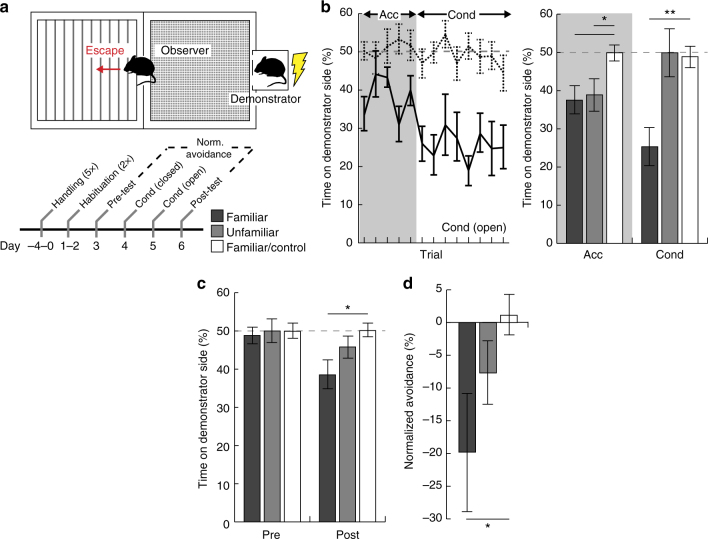
“During acclimation on this second conditioning day, both familiar and unfamiliar observer mice exhibited significantly more time on the non-demonstrator side compared to non-conditioned controls. However, only familiar observers maintained this behavior during conditioning trials (Fig. 2b).”
§ Oxytocin enhances observational fear in mice > Results > Repeated observation of a fearful demonstrator evokes escape
plaincorrelational- Asserted: passes — The authors put it forward as true.
- Checkable: passes — It can be checked against evidence.
- Load-bearing: passes — The paper’s conclusions depend on it.
- Based: passes — The paper gives a reason why it holds.
It may state two separate claims as one.
A result the paper reports from its own data — it cites no other source for it, so there is none to check. The quote shows it is in the paper.
In the paper
“Chronic intranasal oxytocin significantly reduced oxytocin receptor (Oxtr) transcript expression in the lateral division of the central nucleus of the amygdala (CeL) (two-tailed Student’s t-test: t(19) = 2.08, p = 0.05), but not the ACC (two-tailed Student’s t-test, t(19) = 0.06, p = 0.95), assayed one day after completion of chronic oxytocin treatment.”
- Also stated in: § Intranasal oxytocin enhances social fear · plain
“amygdala tissue recovered from oxytocin-treated mice showed a significant downregulation of the Oxtr transcript, whereas there was no difference in the ACC (Fig. 3e, Supplementary Fig. 11).”
§ Oxytocin enhances observational fear in mice > Results > Intranasal oxytocin enhances social fear
plaindirect- Asserted: passes — The authors put it forward as true.
- Checkable: passes — It can be checked against evidence.
- Load-bearing: passes — The paper’s conclusions depend on it.
- Based: passes — The paper gives a reason why it holds.
It may state two separate claims as one.
- Also stated in: § Intranasal oxytocin enhances social fear · plain
A result the paper reports from its own data — it cites no other source for it, so there is none to check. The quote shows it is in the paper.
In the paper
“Familiar male observers systemically administered the oxytocin receptor antagonist L-368,899 hydrochloride (OXTA; I.P. single dose, 30 min prior; red, n = 12 per group) showed dose-dependent reductions in socially transmitted fear at 5 mg/kg and 10 mg/kg, compared to saline-treated controls (ANOVA: F 2,35 = 5.73, p = 0.007).”
- Also stated in: § Systemic oxytocin receptor antagonism reduces social fear · plain
“Administration of the OXTA 30 min prior to demonstrator conditioning (Fig. 3a) produced a dose-dependent reduction in freezing compared to saline-treated controls (Fig. 3d), but no differences in direct acquisition of Pavlovian fear in these same observer mice (Supplementary Fig. 12a).”
§ Oxytocin enhances observational fear in mice > Results > Intranasal oxytocin enhances social fear
plaindirectn = 12 ·- Asserted: passes — The authors put it forward as true.
- Checkable: passes — It can be checked against evidence.
- Load-bearing: passes — The paper’s conclusions depend on it.
- Based: passes — The paper gives a reason why it holds.
It may state two separate claims as one.
- Rests on an assumption: L-368,899 hydrochloride specifically antagonizes oxytocin receptors in vivo at the doses used.
- Also stated in: § Systemic oxytocin receptor antagonism reduces social fear · plain
A result the paper reports from its own data — it cites no other source for it, so there is none to check. The quote shows it is in the paper.
In the paper
“only familiar male observers exhibited a significant preference for the non-demonstrator side at the post-test, measured on the day following the last conditioning day (Fig. 2c). Finally, a normalized score of avoidance indicated that only familiar observer mice exhibited a conditioned avoidance of the demonstrator-containing side (Fig. 2d).”
§ Oxytocin enhances observational fear in mice > Results > Repeated observation of a fearful demonstrator evokes escape
plain- Asserted: passes — The authors put it forward as true.
- Checkable: passes — It can be checked against evidence.
- Load-bearing: passes — The paper’s conclusions depend on it.
- Based: passes — The paper gives a reason why it holds.
It may state two separate claims as one. The quote only partly states this claim.
In the paper
“Using an immunohistochemical approach, we measured elevated c-Fos protein expression in the ACC, but not the neighboring primary motor region (M1), an area devoid of oxytocinergic inputs36 (Fig. 3d).”
- Also stated in: § Intranasal oxytocin enhances social fear · plain
“Acute intranasal oxytocin significantly enhanced the percentage of c-Fos+/DAPI cells within the ACC (two-tailed Student’s t-test: t(9) = 2.36, p = 0.048) but not M1 (two-tailed Student’s t-test: t(9) = 0.96, p = 0.369) (n = 5 mice per group).”
§ Oxytocin enhances observational fear in mice > Results > Intranasal oxytocin enhances social fear
What the sources say
- Not checked yetcites [36] Knobloch, H. S. et al. Evoked axonal oxytocin release in the central amygdala attenuates fear response. Neuron 73, 553–566 (2012). source
plaindirectn = 5 ·- Asserted: passes — The authors put it forward as true.
- Checkable: passes — It can be checked against evidence.
- Load-bearing: passes — The paper’s conclusions depend on it.
- Based: passes — The paper gives a reason why it holds.
It may state two separate claims as one.
- Also stated in: § Intranasal oxytocin enhances social fear · plain
A result the paper reports from its own data — it cites no other source for it, so there is none to check. The quote shows it is in the paper.
In the paper
“familiar observers raised in smaller litters (2–6 pups) exhibited higher freezing levels compared to those raised in larger litters (7–12 pups), whereas unfamiliar mice showed the reverse relationship (Fig. 1d).”
- Also stated in: § Individual differences in social fear · plain
“Socially transmitted fear differed between familiar (black; small: n = 3, large: n = 10) and unfamiliar (gray; small: n = 2, large: n = 11) male mice when the observer was reared within a relatively small litter (small: 2–6 pups; large: 7–12 pups)”
§ Oxytocin enhances observational fear in mice > Results > Individual differences in social fear
plaincorrelational- Asserted: passes — The authors put it forward as true.
- Checkable: passes — It can be checked against evidence.
- Load-bearing: unclear — It is unclear whether the paper’s conclusions depend on it.
- Based: passes — The paper gives a reason why it holds.
It may state two separate claims as one.
- Also stated in: § Individual differences in social fear · plain
A result the paper reports from its own data — it cites no other source for it, so there is none to check. The quote shows it is in the paper.
In the paper
“I125-labeled oxytocin was detected robustly within the blood and olfactory bulbs, and was distributed throughout the brain, including anterior olfactory nucleus, anterior cingulate cortex (ACC), nucleus accumbens, amygdala, and hypothalamus (Table 1).”
§ Oxytocin enhances observational fear in mice > Results > Intranasal oxytocin enhances social fear
plain- Asserted: passes — The authors put it forward as true.
- Checkable: passes — It can be checked against evidence.
- Load-bearing: passes — The paper’s conclusions depend on it.
- Based: passes — The paper gives a reason why it holds.
It may state two separate claims as one.
A result the paper reports from its own data — it cites no other source for it, so there is none to check. The quote shows it is in the paper.
In the paper
“Indeed, saline-treated familiar male mice exhibited a significant correlation between socially and directly acquired freezing levels, a relationship that was not recapitulated in OXTA-treated mice (Supplementary Fig. 12b).”
§ Oxytocin enhances observational fear in mice > Results > Systemic oxytocin receptor antagonism reduces social fear
plaincorrelational- Asserted: passes — The authors put it forward as true.
- Checkable: passes — It can be checked against evidence.
- Load-bearing: passes — The paper’s conclusions depend on it.
- Based: passes — The paper gives a reason why it holds.
It may state two separate claims as one.
- Rests on an assumption: L-368,899 hydrochloride specifically antagonizes oxytocin receptors in vivo at the doses used.
A result the paper reports from its own data — it cites no other source for it, so there is none to check. The quote shows it is in the paper.
In the paper
“There were no significant differences in demonstrator vocalizations (Supplementary Fig. 13), nor did DREADD activation cause differences in acquisition or retrieval of directly acquired fear (Supplementary Fig. 14).”
§ Oxytocin enhances observational fear in mice > Results > DREADD activation of oxytocin neurons enhances social fear
plain- Asserted: passes — The authors put it forward as true.
- Checkable: passes — It can be checked against evidence.
- Load-bearing: passes — The paper’s conclusions depend on it.
- Based: passes — The paper gives a reason why it holds.
It may state two separate claims as one.
The paper states this without a source or data behind it here, so there is nothing to check it against. The quote shows it is in the paper.
In the paper
“Neither the aforementioned ELISA kit (Enzo Life Sciences, Inc.) nor a second kit (#K048, Arbor Assays, Inc.) proved effective for extracting and quantifying oxytocin contained within brain tissue.”
§ Oxytocin enhances observational fear in mice > Methods > CSF collection and oxytocin measurements
plain- Asserted: passes — The authors put it forward as true.
- Checkable: passes — It can be checked against evidence.
- Load-bearing: fails — The paper’s conclusions may not depend on it.
- Based: passes — The paper gives a reason why it holds.
Probably not a substantial claim. The paper’s conclusions may not depend on it. It may state two separate claims as one.
A conclusion the paper draws from its own results — it cites no other source for it, so there is none to check. The quote shows it is in the paper.
In the paper
“Both intranasal oxytocin administration and chemogenetic stimulation of oxytocin neurons render males sensitive to the distress of an unfamiliar mouse.”
§ Oxytocin enhances observational fear in mice > Abstract
plaindirect- Asserted: passes — The authors put it forward as true.
- Checkable: passes — It can be checked against evidence.
- Load-bearing: passes — The paper’s conclusions depend on it.
- Based: passes — The paper gives a reason why it holds.
It may state two separate claims as one.
In the paper
“Collectively, these findings support the idea that socially and directly acquired fear are subject to individual differences along a common trait of fearfulness41 and that oxytocin neurotransmission contributes exclusively to the former.”
§ Oxytocin enhances observational fear in mice > Results > Systemic oxytocin receptor antagonism reduces social fear
What the sources say
- Not checked yetcites [41] Vaidyanathan, U. M. A., Patrick, C. J. & Bernat, E. M. Startle reflex potentiation during aversive picture viewing as an indicator of trait fear. Psychophysiology 46, 75–85 (2009). source
plaindirect- Asserted: passes — The authors put it forward as true.
- Checkable: passes — It can be checked against evidence.
- Load-bearing: passes — The paper’s conclusions depend on it.
- Based: passes — The paper gives a reason why it holds.
It may state two separate claims as one.
- Rests on an assumption: L-368,899 hydrochloride specifically antagonizes oxytocin receptors in vivo at the doses used.
A conclusion the paper draws from its own results — it cites no other source for it, so there is none to check. The quote shows it is in the paper.
In the paper
“Together, these findings indicate that the oxytocin system is both necessary and sufficient for the social transmission of fear.”
§ Oxytocin enhances observational fear in mice > Discussion
hedgeddirect- Asserted: passes — The authors put it forward as true.
- Checkable: passes — It can be checked against evidence.
- Load-bearing: passes — The paper’s conclusions depend on it.
- Based: passes — The paper gives a reason why it holds.
It may state two separate claims as one.
- Rests on an assumption: L-368,899 hydrochloride specifically antagonizes oxytocin receptors in vivo at the doses used.
None of the sources cited for this claim have been checked yet.
In the paper
“The results of a number of other studies have suggested that oxytocin is anxiolytic19–21 or attenuates measures of fear conditioning15–18.”
§ Oxytocin enhances observational fear in mice > Discussion
What the sources say
- Not checked yetcites [19] Ring, R. H. et al. Anxiolytic-like activity of oxytocin in male mice: behavioral and autonomic evidence, therapeutic implications. Psychopharmacology 185, 218–225 (2006). source
- Not checked yetcites [20] Waldherr, M. & Neumann, I. D. Centrally released oxytocin mediates mating-induced anxiolysis in male rats. Proc. Natl Acad. Sci. USA 104, 16681–16684 (2007). source
- Not checked yetcites [21] Yoshida, M. et al. Evidence that oxytocin exerts anxiolytic effects via oxytocin receptor expressed in serotonergic neurons in mice. J. Neurosci. 29, 2259–2271 (2009). source
- Not checked yetcites [15] Viviani, D. et al. Oxytocin selectively gates fear responses through distinct outputs from the central amygdala. Science 333, 104–107 (2011). source
- Not checked yetcites [16] Lahoud, N. & Maroun, M. Oxytocinergic manipulations in corticolimbic circuit differentially affect fear acquisition and extinction. Psychoneuroendocrinology 38, 2184–2195 (2013). source
- Not checked yetcites [17] Modi, M. E. et al Peripheral administration of long-acting peptide OT receptor agonist inhibits fear induced freezing. J. Pharmacol. Exp. Ther. 358, 164–172 (2016). source
- Not checked yetcites [18] Pagani, J. H., Lee, H. J. & Young, W. S. Postweaning, forebrain-specific perturbation of the oxytocin system impairs fear conditioning. Genes Brain Behav. 10, 710–719 (2011). source
hedgeddirect- Asserted: passes — The authors put it forward as true.
- Checkable: passes — It can be checked against evidence.
- Load-bearing: passes — The paper’s conclusions depend on it.
- Based: passes — The paper gives a reason why it holds.
Probably not a substantial claim. It may state two separate claims as one.
What the paper did — it cites no source for this, so there is none to check. The quote shows it is in the paper.
In the paper
“quantification of c-Fos+ neurons was performed across eight slices containing the PVN (~−0.85 mm to bregma) by a treatment-naive experimenter.”
- Also stated in: § Histology and c-Fos immunohistochemistry · plain
“For intranasal oxytocin experiments, quantification of c-Fos+ neurons was performed across five slices containing the Cg1/2 and M1 regions (~+1 mm to bregma) by a treatment-naive experimenter.”
§ Oxytocin enhances observational fear in mice > Methods > Histology and c-Fos immunohistochemistry
plain- Asserted: passes — The authors put it forward as true.
- Checkable: passes — It can be checked against evidence.
- Load-bearing: fails — The paper’s conclusions may not depend on it.
- Based: passes — The paper gives a reason why it holds.
Probably not a substantial claim. The paper’s conclusions may not depend on it.
- Also stated in: § Histology and c-Fos immunohistochemistry · plain
What the paper did — it cites no source for this, so there is none to check. The quote shows it is in the paper.
In the paper
“Video footage was collected during all sessions using infrared web cameras and scored over 2-min bins by trained, group-naive experimenters using Button Box 5.0 (Behavioral Research Solutions, LLC).”
§ Oxytocin enhances observational fear in mice > Methods > Socially induced avoidance paradigm
plain- Asserted: passes — The authors put it forward as true.
- Checkable: passes — It can be checked against evidence.
- Load-bearing: passes — The paper’s conclusions depend on it.
- Based: passes — The paper gives a reason why it holds.
Probably not a substantial claim.
A conclusion the paper draws from its own results — it cites no other source for it, so there is none to check. The quote shows it is in the paper.
In the paper
“Thus, the presence of a home-cage conspecific at the time that oxytocin is administered could have the incidental effect of ameliorating subsequent acquisition of fear.”
§ Oxytocin enhances observational fear in mice > Discussion
hedgedconditional- Asserted: passes — The authors put it forward as true.
- Checkable: passes — It can be checked against evidence.
- Load-bearing: fails — The paper’s conclusions may not depend on it.
- Based: passes — The paper gives a reason why it holds.
Probably not a substantial claim. The paper’s conclusions may not depend on it.
None of the sources cited for this claim have been checked yet.
In the paper
“No statistical methods were used to predetermine sample sizes, although sample sizes were consistent with those from previous studies of this kind7,9,29.”
§ Oxytocin enhances observational fear in mice > Methods > Statistics
What the sources say
- Not checked yetcites [7] Chen, Q., Panksepp, J. B. & Lahvis, G. P. Empathy is moderated by genetic background in mice. PLoS ONE 4, e4387 (2009). source
- Not checked yetcites [9] Sanders, J., Mayford, M. & Jeste, D. Empathic fear responses in mice are triggered by recognition of a shared experience. PLoS ONE 8, e74609 (2013). source
- Not checked yetcites [29] Burkett, J. P. et al. Oxytocin-dependent consolation behavior in rodents. Science 351, 375–378 (2016). source
plain- Asserted: passes — The authors put it forward as true.
- Checkable: passes — It can be checked against evidence.
- Load-bearing: fails — The paper’s conclusions may not depend on it.
- Based: passes — The paper gives a reason why it holds.
Probably not a substantial claim. The paper’s conclusions may not depend on it.
What the paper did — it cites no source for this, so there is none to check. The quote shows it is in the paper.
In the paper
“Videos were scored for observer freezing behavior by a treatment-naive experimenter using Button Box 5.0 (Behavioral Research Solutions, LLC) (Supplementary Figs. 2, 4).”
§ Oxytocin enhances observational fear in mice > Methods > Socially transmitted fear paradigm
plain- Asserted: passes — The authors put it forward as true.
- Checkable: passes — It can be checked against evidence.
- Load-bearing: passes — The paper’s conclusions depend on it.
- Based: passes — The paper gives a reason why it holds.
Probably not a substantial claim.
What the paper did — it cites no source for this, so there is none to check. The quote shows it is in the paper.
In the paper
“Paired home-cage mice were randomly designated as observer or demonstrator prior to the start of testing.”
§ Oxytocin enhances observational fear in mice > Methods > Socially transmitted fear paradigm
plain- Asserted: passes — The authors put it forward as true.
- Checkable: passes — It can be checked against evidence.
- Load-bearing: fails — The paper’s conclusions may not depend on it.
- Based: passes — The paper gives a reason why it holds.
Probably not a substantial claim. The paper’s conclusions may not depend on it.
In the paper
“Systemically administered l-368,899 hydrochloride is known to reach the brain, where it preferentially binds with oxytocin receptors75.”
§ Oxytocin enhances observational fear in mice > Methods > Drug administration
What the sources say
- Not checked yetcites [75] Boccia, M. L., Goursaud, A. P. S., Bachevalier, J., Anderson, K. D. & Pedersen, Ca Peripherally administered non-peptide oxytocin antagonist, L368,899®, accumulates in limbic brain areas: a new pharmacological tool for the study of social motivation in non-human primates. Horm. Behav. 52, 344–351 (2007). source
boosteddirect- Asserted: passes — The authors put it forward as true.
- Checkable: passes — It can be checked against evidence.
- Load-bearing: passes — The paper’s conclusions depend on it.
- Based: passes — The paper gives a reason why it holds.
It may state two separate claims as one.
What the paper did — it cites no source for this, so there is none to check. The quote shows it is in the paper.
In the paper
“Four mice were removed from analysis due to escaping the testing apparatus in the socially induced avoidance paradigm.”
§ Oxytocin enhances observational fear in mice > Methods > Statistics
plainn = 4- Asserted: passes — The authors put it forward as true.
- Checkable: passes — It can be checked against evidence.
- Load-bearing: fails — The paper’s conclusions may not depend on it.
- Based: passes — The paper gives a reason why it holds.
Probably not a substantial claim. The paper’s conclusions may not depend on it.
What the paper did — it cites no source for this, so there is none to check. The quote shows it is in the paper.
In the paper
“Demonstrator freezing during conditioning was measured in a randomly selected subset of videos of male familiar and unfamiliar pairs (Supplementary Fig. 4).”
§ Oxytocin enhances observational fear in mice > Methods > Socially transmitted fear paradigm
plain- Asserted: passes — The authors put it forward as true.
- Checkable: passes — It can be checked against evidence.
- Load-bearing: fails — The paper’s conclusions may not depend on it.
- Based: passes — The paper gives a reason why it holds.
Probably not a substantial claim. The paper’s conclusions may not depend on it.
What the paper did — it cites no source for this, so there is none to check. The quote shows it is in the paper.
In the paper
“Slices used for c-Fos immunohistochemistry in Figs. 3d, 4d were randomly selected.”
§ Oxytocin enhances observational fear in mice > Methods > Statistics
plain- Asserted: passes — The authors put it forward as true.
- Checkable: passes — It can be checked against evidence.
- Load-bearing: fails — The paper’s conclusions may not depend on it.
- Based: passes — The paper gives a reason why it holds.
Probably not a substantial claim. The paper’s conclusions may not depend on it.
What the paper did — it cites no source for this, so there is none to check. The quote shows it is in the paper.
In the paper
“Samples contaminated with blood were discarded.”
§ Oxytocin enhances observational fear in mice > Methods > CSF collection and oxytocin measurements
plain- Asserted: passes — The authors put it forward as true.
- Checkable: passes — It can be checked against evidence.
- Load-bearing: fails — The paper’s conclusions may not depend on it.
- Based: passes — The paper gives a reason why it holds.
Probably not a substantial claim. The paper’s conclusions may not depend on it.
What the paper did — it cites no source for this, so there is none to check. The quote shows it is in the paper.
In the paper
“Samples were then reconstituted in assay buffer and run in duplicate on a spectrophotometer (Multiskan EX, Thermo Scientific, Inc.) at 405 nm.”
§ Oxytocin enhances observational fear in mice > Methods > CSF collection and oxytocin measurements
plain- Asserted: passes — The authors put it forward as true.
- Checkable: passes — It can be checked against evidence.
- Load-bearing: fails — The paper’s conclusions may not depend on it.
- Based: passes — The paper gives a reason why it holds.
Probably not a substantial claim. The paper’s conclusions may not depend on it.
What the paper did — it cites no source for this, so there is none to check. The quote shows it is in the paper.
In the paper
“One mouse was removed from analysis due to viral injection misplacement in chemogenetic experiments.”
§ Oxytocin enhances observational fear in mice > Methods > Statistics
plainSingle case- Asserted: passes — The authors put it forward as true.
- Checkable: passes — It can be checked against evidence.
- Load-bearing: fails — The paper’s conclusions may not depend on it.
- Based: passes — The paper gives a reason why it holds.
Probably not a substantial claim. The paper’s conclusions may not depend on it.
What the paper did — it cites no source for this, so there is none to check. The quote shows it is in the paper.
In the paper
“Vocalization recordings were not collected for one familiar male, one unfamiliar female, and two unfamiliar males with acute intranasal saline due to technical error.”
§ Oxytocin enhances observational fear in mice > Methods > Socially transmitted fear paradigm
plain- Asserted: passes — The authors put it forward as true.
- Checkable: passes — It can be checked against evidence.
- Load-bearing: fails — The paper’s conclusions may not depend on it.
- Based: passes — The paper gives a reason why it holds.
Probably not a substantial claim. The paper’s conclusions may not depend on it.
What the paper did — it cites no source for this, so there is none to check. The quote shows it is in the paper.
In the paper
“Two mice were removed from analysis due to poor perfusion following I125-oxytocin administration.”
§ Oxytocin enhances observational fear in mice > Methods > Statistics
plainn = 2- Asserted: passes — The authors put it forward as true.
- Checkable: passes — It can be checked against evidence.
- Load-bearing: fails — The paper’s conclusions may not depend on it.
- Based: passes — The paper gives a reason why it holds.
Probably not a substantial claim. The paper’s conclusions may not depend on it.
What the paper did — it cites no source for this, so there is none to check. The quote shows it is in the paper.
In the paper
“All animals used for chemogenetics experiments had their brains removed and processed to confirm viral injection location.”
§ Oxytocin enhances observational fear in mice > Methods > Histology and c-Fos immunohistochemistry
plain- Asserted: passes — The authors put it forward as true.
- Checkable: passes — It can be checked against evidence.
- Load-bearing: fails — The paper’s conclusions may not depend on it.
- Based: passes — The paper gives a reason why it holds.
Probably not a substantial claim. The paper’s conclusions may not depend on it.
What the paper did — it cites no source for this, so there is none to check. The quote shows it is in the paper.
In the paper
“Mice without Pavlovian fear conditioning experience were used for quantification of c-Fos+ neurons.”
§ Oxytocin enhances observational fear in mice > Methods > Histology and c-Fos immunohistochemistry
plain- Asserted: passes — The authors put it forward as true.
- Checkable: passes — It can be checked against evidence.
- Load-bearing: fails — The paper’s conclusions may not depend on it.
- Based: passes — The paper gives a reason why it holds.
Probably not a substantial claim. The paper’s conclusions may not depend on it.
What the paper did — it cites no source for this, so there is none to check. The quote shows it is in the paper.
In the paper
“An experienced experimenter confirmed the accuracy of automated call detection using the generated spectrogram.”
§ Oxytocin enhances observational fear in mice > Methods > Socially transmitted fear paradigm
plain- Asserted: passes — The authors put it forward as true.
- Checkable: passes — It can be checked against evidence.
- Load-bearing: fails — The paper’s conclusions may not depend on it.
- Based: passes — The paper gives a reason why it holds.
Probably not a substantial claim. The paper’s conclusions may not depend on it.
What the paper did — it cites no source for this, so there is none to check. The quote shows it is in the paper.
In the paper
“We conducted three replicate PCR reactions for each sample.”
§ Oxytocin enhances observational fear in mice > Methods > Quantitative RT-PCR
plain- Asserted: passes — The authors put it forward as true.
- Checkable: passes — It can be checked against evidence.
- Load-bearing: fails — The paper’s conclusions may not depend on it.
- Based: passes — The paper gives a reason why it holds.
Probably not a substantial claim. The paper’s conclusions may not depend on it.
What the paper did — it cites no source for this, so there is none to check. The quote shows it is in the paper.
In the paper
“These parameters were piloted to elicit reliable auditory and visual signs of distress (i.e., vocalizations and thigmotaxis/freezing behavior, respectively) from demonstrators.”
§ Oxytocin enhances observational fear in mice > Methods > Socially transmitted fear paradigm
plaindirect- Asserted: passes — The authors put it forward as true.
- Checkable: passes — It can be checked against evidence.
- Load-bearing: passes — The paper’s conclusions depend on it.
- Based: passes — The paper gives a reason why it holds.
Probably not a substantial claim.
What the paper did — it cites no source for this, so there is none to check. The quote shows it is in the paper.
In the paper
“Videos of demonstrator freezing were randomly selected from data in Fig. 1b for Supplementary Fig. 4.”
§ Oxytocin enhances observational fear in mice > Methods > Statistics
plain- Asserted: passes — The authors put it forward as true.
- Checkable: passes — It can be checked against evidence.
- Load-bearing: fails — The paper’s conclusions may not depend on it.
- Based: passes — The paper gives a reason why it holds.
Probably not a substantial claim. The paper’s conclusions may not depend on it.
The paper relies on this without support.
L-368,899 hydrochloride specifically antagonizes oxytocin receptors in vivo at the doses used.
“we systemically administered the non-peptidergic oxytocin receptor antagonist (OXTA) l-368,899 hydrochloride to familiar male mice.”
The paper relies on this without support.
The intranasal oxytocin doses and timing used in this study are sufficient to activate central oxytocin receptors that mediate social fear.
“Acute intranasal oxytocin penetrates the brain and enhances cellular activity within the anterior cingulate cortex, whereas chronic administration produces long-term facilitation of observational fear and downregulates oxytocin receptor expression in the amygdala.”
The authors state this as an assumption.
Vocalizations recorded during conditioning were elicited from demonstrators.
“Vocalizations were presumed to be elicited from demonstrators based on coincidence with foot-shock onset/offset and previously identified characteristics of distress vocalizations elicited by foot-shock7.”
The paper relies on this without support.
The data were normally distributed.
“Data were normally distributed; therefore, parametric tests were used to compare groups.”
The paper relies on this without support.
The oxytocin receptor antagonist L-368,899 hydrochloride is selective for oxytocin receptors.
“For the systemic oxytocin receptor antagonist (OXTA), mice were briefly anesthetized with isoflurane and quickly administered the selective OXTA L-368,899 hydrochloride (5 or 10 mg/kg, I.P.).”
Claims other papers make about this one
Each is checked against this paper’s own text: does it say what the citing paper says it does?
The cited source says what the claim attributes to it.
In the citing paper
“although sample sizes were consistent with those of previous studies [19,23,80].”
From Oxytocin Signaling in the Central Amygdala Modulates Emotion Discrimination in Mice (2019) · cites this paper as [23]
In the citing paper
“OXT has been shown to modulate emotion processing in rodents through an action in the anterior cingulate cortex, insula and lateral septum [16,23,24].”
From Oxytocin Signaling in the Central Amygdala Modulates Emotion Discrimination in Mice (2019) · cites this paper as [23]
Statistics that don’t add up
Each reported p-value recomputed from its test statistic and degrees of freedom.
Rated minor: it would not touch a result — a value no result rests on, a p-value that stays on the same side of the significance level, or a conflict that is clerical, resolved elsewhere in the paper, or outside its own findings.
In the paper
“t(25) = 2.96, p = 0.008”
§ Oxytocin enhances observational fear in mice > Results > Individual differences in social fear
Reported p = .008 · recomputed p = .007
Rated minor: it would not touch a result — a value no result rests on, a p-value that stays on the same side of the significance level, or a conflict that is clerical, resolved elsewhere in the paper, or outside its own findings.
In the paper
“t(21) = 2.64, p = 0.016”
§ Oxytocin enhances observational fear in mice > Results > Intranasal oxytocin enhances social fear
Reported p = .016 · recomputed p = .015
Rated minor: it would not touch a result — a value no result rests on, a p-value that stays on the same side of the significance level, or a conflict that is clerical, resolved elsewhere in the paper, or outside its own findings.
In the paper
“t(24) = 2.25, p = 0.035”
§ Oxytocin enhances observational fear in mice > Results > Individual differences in social fear
Reported p = .035 · recomputed p = .034
Rated minor: it would not touch a result — a value no result rests on, a p-value that stays on the same side of the significance level, or a conflict that is clerical, resolved elsewhere in the paper, or outside its own findings.
In the paper
“t(7) = 2.65, p = 0.050”
§ Oxytocin enhances observational fear in mice > Results > DREADD activation of oxytocin neurons enhances social fear
Reported p = .05 · recomputed p = .033
Rated minor: it would not touch a result — a value no result rests on, a p-value that stays on the same side of the significance level, or a conflict that is clerical, resolved elsewhere in the paper, or outside its own findings.
In the paper
“t(9) = 2.36, p = 0.048”
§ Oxytocin enhances observational fear in mice > Results > Intranasal oxytocin enhances social fear
Reported p = .048 · recomputed p = .043
Rated minor: it would not touch a result — a value no result rests on, a p-value that stays on the same side of the significance level, or a conflict that is clerical, resolved elsewhere in the paper, or outside its own findings.
In the paper
“t(4) = 4.38, p = 0.035”
§ Oxytocin enhances observational fear in mice > Results > Individual differences in social fear
Reported p = .035 · recomputed p = .012
Rated minor: it would not touch a result — a value no result rests on, a p-value that stays on the same side of the significance level, or a conflict that is clerical, resolved elsewhere in the paper, or outside its own findings.
In the paper
“t(9) = 0.96, p = 0.369”
§ Oxytocin enhances observational fear in mice > Results > Intranasal oxytocin enhances social fear
Reported p = .369 · recomputed p = .362
Rated minor: it would not touch a result — a value no result rests on, a p-value that stays on the same side of the significance level, or a conflict that is clerical, resolved elsewhere in the paper, or outside its own findings.
In the paper
“t(19) = 2.73, p = 0.015”
§ Oxytocin enhances observational fear in mice > Results > Intranasal oxytocin enhances social fear
Reported p = .015 · recomputed p = .013
Statistics recomputed
Every reported test result, recomputed from its test statistic and degrees of freedom. A result shows as not adding up only once an independent check has confirmed it.
- Doesn’t add upt(25) = 2.96reported p = .008 · recomputed p = .007
“t(25) = 2.96, p = .008”
- Doesn’t add upt(24) = 2.25reported p = .035 · recomputed p = .034
“t(24) = 2.25, p = .035”
- Doesn’t add upt(4) = 4.38reported p = .035 · recomputed p = .012
“t(4) = 4.38, p = .035”
- Doesn’t add upt(19) = 2.73reported p = .015 · recomputed p = .013
“t(19) = 2.73, p = .015”
- Doesn’t add upt(21) = 2.64reported p = .016 · recomputed p = .015
“t(21) = 2.64, p = .016”
- Doesn’t add upt(9) = 2.36reported p = .048 · recomputed p = .043
“t(9) = 2.36, p = .048”
- Doesn’t add upt(9) = 0.96reported p = .369 · recomputed p = .362
“t(9) = 0.96, p = .369”
- Doesn’t add upt(7) = 2.65reported p = .05 · recomputed p = .033
“t(7) = 2.65, p = .050”
- Not confirmedt(25) = 3.7reported p = .002 · recomputed p = .001
“t(25) = 3.70, p = .002”
- Consistentt(19) = 0.728reported p = .48 · recomputed p = .475
“t(19) = 0.728, p = .48”
- Consistentt(25) = 3.96reported p = .001 · recomputed p < .001
“t(25) = 3.96, p = .001”
- Consistentt(21) = 2.9reported p = .011 · recomputed p = .009
“t(21) = 2.90, p = .011”
The paper states a correction for multiple tests
- Consistentt(19) = 2.32reported p = .042 · recomputed p = .032
“t(19) = 2.32, p = .042”
The paper states a correction for multiple tests
- Consistentt(21) = 4.09reported p = .001 · recomputed p < .001
“t(21) = 4.09, p = .001”
- Consistentt(19) = 0.14reported p = .889 · recomputed p = .890
“t(19) = 0.14, p = .889”
- Consistentt(21) = 2.73reported p = .017 · recomputed p = .013
“t(21) = 2.73, p = .017”
The paper states a correction for multiple tests
- Consistentt(19) = 1.27reported p = .229 · recomputed p = .219
“t(19) = 1.27, p = .229”
The paper states a correction for multiple tests
- Consistentt(21) = 2.17reported p = .052 · recomputed p = .042
“t(21) = 2.17, p = .052”
The paper states a correction for multiple tests
- Consistentt(23) = 2.49reported p = .02 · recomputed p = .020
“t(23) = 2.49, p = .020”
- Consistentt(19) = 2.08reported p = .05 · recomputed p = .051
“t(19) = 2.08, p = .05”
- Consistentt(19) = 0.06reported p = .95 · recomputed p = .953
“t(19) = 0.06, p = .95”
Self-check
Percentages, sums and reported differences re-computed from the paper’s own numbers.
Each contradiction between two passages listed here was confirmed by an independent check.
Rated major: it would touch a result — a value a result rests on, reported and recomputed p-values on opposite sides of the significance level, two passages that conflict with no sign which is right, or a cited work retracted before this paper was published.
In the paper
§ Oxytocin enhances observational fear in mice > Results > Intranasal oxytocin enhances social fear
“Chronic intranasal oxytocin significantly reduced oxytocin receptor (Oxtr) transcript expression in the lateral division of the central nucleus of the amygdala (CeL)”
§ Oxytocin enhances observational fear in mice > Methods > Quantitative RT-PCR
“The tissue was dissected bilaterally from the whole amygdala and anterior cingulate cortex (ACC) using a mouse brain atlas reference”
Rated minor: it would not touch a result — a value no result rests on, a p-value that stays on the same side of the significance level, or a conflict that is clerical, resolved elsewhere in the paper, or outside its own findings.
In the paper
§ Oxytocin enhances observational fear in mice > Results > Systemic oxytocin receptor antagonism reduces social fear
“Administration of the OXTA 30 min prior to demonstrator conditioning (Fig. 3a) produced a dose-dependent reduction in freezing compared to saline-treated controls (Fig. 3d)”
§ Oxytocin enhances observational fear in mice > Results > Intranasal oxytocin enhances social fear
“f Familiar male observers systemically administered the oxytocin receptor antagonist L-368,899 hydrochloride (OXTA; I.P. single dose, 30 min prior; red, n = 12 per group) showed dose-dependent reductions in socially transmitted fear”
Rated minor: it would not touch a result — a value no result rests on, a p-value that stays on the same side of the significance level, or a conflict that is clerical, resolved elsewhere in the paper, or outside its own findings.
In the paper
§ Oxytocin enhances observational fear in mice > Results > Repeated observation of a fearful demonstrator evokes escape
“on the first (Cond (closed)), observers were confined to the demonstrator-containing side; on the second (Cond (open)), observers were allowed to escape to the opposite side.”
§ Oxytocin enhances observational fear in mice > Methods > Socially induced avoidance paradigm
“On the first day of demonstrator conditioning (Cond (open)), the observer mouse was confined to the same side as the demonstrator. After 5 min acclimation, the demonstrator was exposed to foot shocks (1.5 s, 1 mA scrambled current per 1 min; 15 total) using the Advanced Startle software (Med Associates, Inc.). On the second day of demonstrator conditioning (Cond (closed), the observer mouse was allowed to explore the entire arena while the demonstrator was conditioned using the same protocol.”
Citations
Cites
Empathy: its ultimate and proximate bases
Preston, S. D., & de Waal, F. B. M. (2002) · Behavioral and Brain Sciences · doi:10.1017/s0140525x02000018 · Cited by 4,126
Baron-Cohen, S., & Wheelwright, S. (2004) · Journal of Autism and Developmental Disorders · doi:10.1023/b:jadd.0000022607.19833.00 · Cited by 4,093
Empathy for Pain Involves the Affective but not Sensory Components of Pain
Singer, T., Seymour, B., O'Doherty, J., Kaube, H., Dolan, R. J., & Frith, C. D. (2004) · Science · doi:10.1126/science.1093535 · Cited by 3,929
Contributions of the Amygdala to Emotion Processing: From Animal Models to Human Behavior
Phelps, E. A., & LeDoux, J. E. (2005) · Neuron · doi:10.1016/j.neuron.2005.09.025 · Cited by 3,203
Putting the Altruism Back into Altruism: The Evolution of Empathy
de Waal, F. B. M. (2008) · Annual Review of Psychology · doi:10.1146/annurev.psych.59.103006.093625 · Cited by 2,483
Oxytocin and vasopressin in the human brain: social neuropeptides for translational medicine
Meyer-Lindenberg, A., Domes, G., Kirsch, P., & Heinrichs, M. (2011) · Nature Reviews Neuroscience · doi:10.1038/nrn3044 · Cited by 1,688
Intranasal delivery to the central nervous system: Mechanisms and experimental considerations
Dhuria, S. V., Hanson, L. R., & Frey, W. H. (2010) · Journal of Pharmaceutical Sciences · doi:10.1002/jps.21924 · Cited by 1,239
Self-citationSocial reward requires coordinated activity of nucleus accumbens oxytocin and serotonin
Dölen, G., Darvishzadeh, A., Huang, K. W., & Malenka, R. C. (2013) · Nature · doi:10.1038/nature12518 · Cited by 1,161
Evoked axonal oxytocin release in the central amygdala attenuates fear response
Knobloch, H. S., Charlet, A., Hoffmann, L. C., Eliava, M., Khrulev, S., Cetin, A. H., Osten, P., Schwarz, M. K., Seeburg, P. H., Stoop, R., et al. (2012) · Neuron · doi:10.1016/j.neuron.2011.11.030 · Cited by 1,049
Oxytocin in the Medial Amygdala is Essential for Social Recognition in the Mouse
Ferguson, J. N., Aldag, J. M., Insel, T. R., & Young, L. J. (2001) · The Journal of Neuroscience · doi:10.1523/jneurosci.21-20-08278.2001 · Cited by 1,043
Cited by
Sorted by citations
Corticoamygdala Transfer of Socially Derived Information Gates Observational Learning
Allsop, S. A., Wichmann, R., Mills, F., Burgos-Robles, A., Chang, C.-J., Felix-Ortiz, A. C., Vienne, A., Beyeler, A., Izadmehr, E. M., Glober, G., et al. (2018) · Cell · doi:10.1016/j.cell.2018.04.004 · Cited by 288
Prefrontal–amygdala circuits in social decision-making
Gangopadhyay, P., Chawla, M., Monte, O. D., & Chang, S. W. C. (2020) · Nature Neuroscience · doi:10.1038/s41593-020-00738-9 · Cited by 266
The emergence and influence of internal states
Flavell, S. W., Gogolla, N., Lovett-Barron, M., & Zelikowsky, M. (2022) · Neuron · doi:10.1016/j.neuron.2022.04.030 · Cited by 246
Oxytocin Signaling in the Central Amygdala Modulates Emotion Discrimination in Mice
Ferretti, V., Maltese, F., Contarini, G., Nigro, M., Bonavia, A., Huang, H., Gigliucci, V., Morelli, G., Scheggia, D., Managò, F., et al. (2019) · Current Biology · doi:10.1016/j.cub.2019.04.070 · Cited by 212
Ethological approach to social isolation effects in behavioral studies of laboratory rodents
Arakawa, H. (2018) · Behavioural Brain Research · doi:10.1016/j.bbr.2017.12.022 · Cited by 144
Metadata
- Authors
- Pisansky, M. T., Hanson, L. R., Gottesman, I. I., & Gewirtz, J. C.
- Affiliations
- University of Minnesota (US)
- HealthPartners (US)
- Corresponding author
- Gewirtz, Jonathan C.
- Venue
- Nature Communications
- Published
- 2017-12-13
- Volume
- 8
- Issue
- 1
- Pages
- 2102-2102
- ISSN
- 2041-1723 (ISSN-L)
- PMC
- PMC5727393
- OpenAlex
- W2773566393
- Semantic Scholar
- b652d631208729cab94baef8651b26994e2fd359
- Cited by
- 167
- References
- 83
- Citations by year
- 2026: 15 · 2025: 24 · 2024: 19 · 2023: 16 · 2022: 25 · 2021: 22 · 2020: 13 · 2019: 15 · 2018: 17 · 2017: 1
- FWCI
- 18.02
- Type
- journal article
- Language
- en
- Open access
- gold
- doi.org
- Locations
- Nature Communications (publishedVersion, cc-by)
- PubMed Central (publishedVersion, cc-by)
- PubMed (publishedVersion)
- RePEc: Research Papers in Economics (submittedVersion)
- DOAJ (DOAJ: Directory of Open Access Journals) (submittedVersion)
- DOAJ (DOAJ: Directory of Open Access Journals) (submittedVersion, cc-by-sa)
- Funders
- University of Minnesota
- Topics
- Life Sciences › Neuroscience › Endocrine and Autonomic Systems › Neuroendocrine regulation and behavior
- Life Sciences › Neuroscience › Cellular and Molecular Neuroscience › Neuropeptides and Animal Physiology
- Life Sciences › Neuroscience › Cognitive Neuroscience › Memory and Neural Mechanisms
- Keywords
- oxytocin, empathy, anterior cingulate cortex, amygdala, oxytocin receptor, chemogenetic stimulation, intranasal oxytocin, freezing response, escape behavior
- MeSH terms
- Administration, Intranasal, Amygdala, Animals, Brain, Escape Reaction, Fear, Female, Gyrus Cinguli, Humans, Male, Mice, Inbred C57BL, Oxytocin, Reflex, Startle, Receptors, Oxytocin
About these checks
Registry, retraction, Cites and statistics results are computed, not judged, with one exception: a printed reference that no index lists is read once by a model before it counts as a citation error. Claims are extracted by a model and kept only when their quote appears verbatim in the text; each cited source is then checked, with a model’s help, for whether it says what the claim relies on. Those verdicts can be wrong — read the claim’s quote and the cited source before relying on one.
A language model drew the claims from the paper on 2026-10-09, under version 3 of the claim definition (model deepseek-v4.1-flash, prompt extract-v3).
A second model labelled each claim on 2026-10-09 (model jev-1.13-20260917, definition revision gold-guideline-v0.2).
Cited sources are checked with a language model’s help (gpt-6-sol).
Statistics and arithmetic are recomputed, not judged.
Confidence bands are shown only for fields calibrated on our annotated test set. None is calibrated yet, so no band is shown.
What counts as a claim ›How we measure confidence ›How we check this ›
Are you an author, or do you see a problem with this page? Request a review
