

The DOI matches its Crossref record; 83 of the 83 references it cites were found in a registry or an index.
Assembly of 913 microbial genomes from metagenomic sequencing of the cow rumen
Open accessAbstract
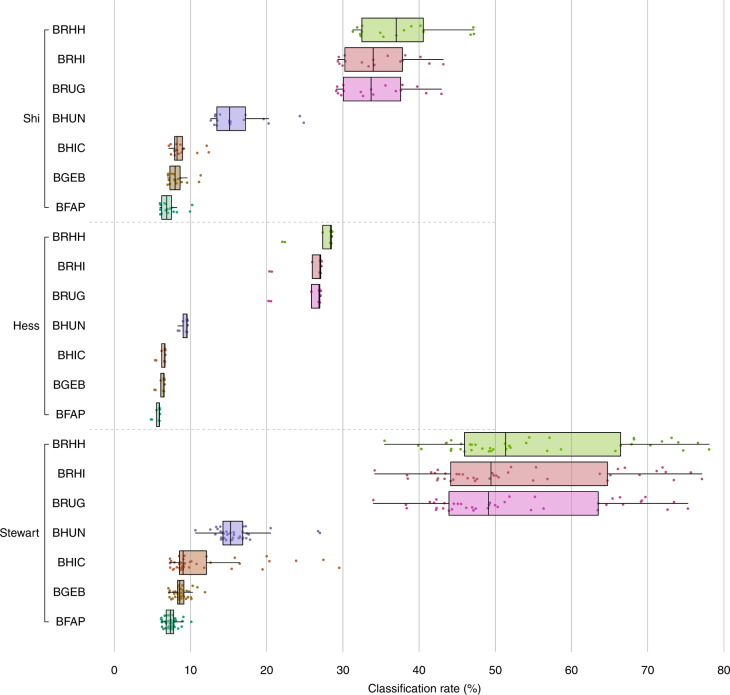
The cow rumen is adapted for the breakdown of plant material into energy and nutrients, a task largely performed by enzymes encoded by the rumen microbiome. Here we present 913 draft bacterial and archaeal genomes assembled from over 800 Gb of rumen metagenomic sequence data derived from 43 Scottish cattle, using both metagenomic binning and Hi-C-based proximity-guided assembly. Most of these genomes represent previously unsequenced strains and species. The draft genomes contain over 69,000 proteins predicted to be involved in carbohydrate metabolism, over 90% of which do not have a good match in public databases. Inclusion of the 913 genomes presented here improves metagenomic read classification by sevenfold against our own data, and by fivefold against other publicly available rumen datasets. Thus, our dataset substantially improves the coverage of rumen microbial genomes in the public databases and represents a valuable resource for biomass-degrading enzyme discovery and studies of the rumen microbiome.
Overview
The claims and statistics of this paper haven’t been checked yet.
Run the check — free, no account needed. It reads the open-access text and checks the sources it cites.
Integrity signals
Registry
Cites
Statistics
Figures
Verification
Claims the paper makes
The claims and statistics of this paper haven’t been checked yet.
Run the check — free, no account needed. It reads the open-access text and checks the sources it cites.
Claims other papers make about this one
Each is checked against this paper’s own text: does it say what the citing paper says it does?
In the citing paper
“Subsequently, Svartstrom et al. (2017) assembled 99 microbial genomes from the moose rumen, Stewart et al. (2018) assembled 913 microbial genomes from the rumen of cattle, and Parks et al. (2017) assembled over 8,000 novel microbial genomes from 1,500 public datasets, some of which originated from the rumen.”
From Addressing global ruminant agricultural challenges through understanding the rumen microbiome: past, present, and future (2018) · cites this paper as Stewart et al., 2018
In the citing paper
“Hi-C binning has been used effectively on human feces (Press et al., 2017) as well as in ruminants (Stewart et al., 2018).”
From Addressing global ruminant agricultural challenges through understanding the rumen microbiome: past, present, and future (2018) · cites this paper as Stewart et al., 2018
Self-check
Percentages, sums and reported differences re-computed from the paper’s own numbers.
The self-check needs the paper’s full text.
Citations
Cites
Trimmomatic: a flexible trimmer for Illumina sequence data
Bolger, A. M., Lohse, M., & Usadel, B. (2014) · Bioinformatics · doi:10.1093/bioinformatics/btu170 · Cited by 65,548
The Sequence Alignment/Map format and SAMtools
Li, H., Handsaker, B., Wysoker, A., Fennell, T., Ruan, J., Homer, N., Marth, G., Abecasis, G., Durbin, R., & 1000 Genome Project Data Processing Subgroup (2009) · Bioinformatics · doi:10.1093/bioinformatics/btp352 · Cited by 62,041
Fast and accurate short read alignment with Burrows-Wheeler transform
Li, H., & Durbin, R. (2009) · Bioinformatics · doi:10.1093/bioinformatics/btp324 · Cited by 58,607
BLAST+: architecture and applications
Camacho, C., Coulouris, G., Avagyan, V., Ma, N., Papadopoulos, J., Bealer, K., & Madden, T. L. (2009) · BMC Bioinformatics · doi:10.1186/1471-2105-10-421 · Cited by 22,074
Fast and sensitive protein alignment using DIAMOND
Buchfink, B., Xie, C., & Huson, D. H. (2015) · Nature Methods · doi:10.1038/nmeth.3176 · Cited by 14,201
Aligning sequence reads, clone sequences and assembly contigs with BWA-MEMPreprint
Li, H. (2013) · arXiv (Cornell University) · doi:10.48550/arxiv.1303.3997 · Cited by 10,846
Li, D., Liu, C.-M., Luo, R., Sadakane, K., & Lam, T. (2015) · Bioinformatics · doi:10.1093/bioinformatics/btv033 · Cited by 10,133
UniProt: the Universal Protein knowledgebase
Apweiler, R. (2003) · Nucleic Acids Research · doi:10.1093/nar/gkh131 · Cited by 7,593
The carbohydrate-active enzymes database (CAZy) in 2013
Lombard, V., Ramulu, H. G., Drula, É., Coutinho, P. M., & Henrissat, B. (2013) · Nucleic Acids Research · doi:10.1093/nar/gkt1178 · Cited by 6,452
O'Leary, N. A., Wright, M. W., Brister, J. R., Ciufo, S., Haddad, D., McVeigh, R., Rajput, B., Robbertse, B., Smith-White, B., Ako-Adjei, D., et al. (2016) · Nucleic Acids Research · doi:10.1093/nar/gkv1189 · Cited by 6,357
Cited by
Sorted by citations
Items 401–500 of 600
Recent Advances in the Phylogenetic Analysis to Study Rumen Microbiome
Wassan, J. T., Wang, H., & Zheng, H. J. (2023) · Current Bioinformatics · doi:10.2174/1574893618666230605120615 · Cited by 3
Diaz, G. R., Gaire, T. N., Ferm, P., Case, L., Caixeta, L. S., Goldsmith, T., Armstrong, J., & Noyes, N. R. (2023) · Animal Microbiome · doi:10.1186/s42523-023-00284-2 · Cited by 2
“Three of the 5 studies showed that expanding the taxonomic reference database (either through inclusion of the Hungate project genomes [96] and/or metagenome-assembled genomes [MAGs]) increased the classification rate of rumen metagenomic data up to 50% [94], 62.6% [92] and 70% [95].”
BackgroundResultInfluentialEfficient and easy‐to‐use capturing three‐dimensional metagenome interactions with GutHi‐C
Lu, Y., Yang, J., Li, C., Tian, Y., Chang, R., Kong, D., Yang, S., Wang, Y., Zhang, Y., Zhu, X., et al. (2024) · iMeta · doi:10.1002/imt2.227 · Cited by 2
“In these two research [4, 9, 10], researchers used assembly strategies for Hi ‐”
MethodIdentification and characterization of novel D-lyxose isomerases from the goat rumen metagenome
Xu, X., Chen, M., Su, Y., Ding, J., Xie, X. S., Zhang, X., Li, F., Shi, X., & Wang, G. (2024) · Process Biochemistry · doi:10.1016/j.procbio.2024.12.014 · Cited by 2
Yang, W., Luyten, Y. A., Reister, E., Mangelson, H., Sisson, Z., Auch, B., Liachko, I., Roberts, R. J., & Ettwiller, L. M. (2025) · Nucleic Acids Research · doi:10.1093/nar/gkaf226 · Cited by 2
“Metagenome deconvolution was performed with ProxiMeta [ 16 ], resulting in the creation of putative genome and genome fragment clusters.”
Nutrigenomics of lipid supplementation in ruminants and pigs
Amills, M., Clop, A., & Óvilo, C. (2020) · Elsevier eBooks · doi:10.1016/b978-0-12-817105-9.00003-3 · Cited by 2
Mini-review: Advances of metagenomics research for lake microbiomes
Jianhua, L., Ye, T., Peng, X., & Qinglong, W. (2020) · Journal of Lake Sciences · doi:10.18307/2020.0125 · Cited by 2
Aqueous ecosystem: Environmental metagenomics, water quality, and possible remediation measures
Tyagi, I., Tyagi, K., Ahamad, F., Kothari, R., & Kumar, V. (2024) · Elsevier eBooks · doi:10.1016/b978-0-443-13659-7.00023-0 · Cited by 2
A Genomic Census of the Chicken Gut Microbiome using Metagenomics and CulturePreprint
Gilroy, R., Ravi, A., Getino, M., Pursley, I., Horton, D., Alikhan, N.-F., Baker, D., Gharbi, K., Hall, N., Watson, M., et al. (2020) · Research Square · doi:10.21203/rs.3.rs-56027/v2 · Cited by 2
“The fact that novel metagenomic species are still being recovered from human gut datasets that include tens of thousands of metagenomes [12]—twinned with the promise of novel long-read and proximity-capture approaches to metagenome analyses [96]—make it clear that our attempts here to analyse all currently available c…”
BackgroundA Genomic Census of the Chicken Gut Microbiome using Metagenomics and CulturePreprint
Gilroy, R., Ravi, A., Getino, M., Pursley, I., Horton, D. L., Alikhan, N.-F., Baker, D., Gharbi, K., Hall, N., Watson, M., et al. (2020) · Research Square · doi:10.21203/rs.3.rs-56027/v3 · Cited by 2
Rathwell, C., McKay, C., & Rocap, G. (2023) · bioRxiv (Cold Spring Harbor Laboratory) · doi:10.1101/2023.12.06.570405 · Cited by 3
“This method has also been applied to cluster contiguous sequences (contigs) of a mixed culture metagenome into individual genomes 39–41 and Hi-C has been extended to more complex communities to cluster over 900 MAGs from a rumen microbiome metagenome 45 and 428 MAGs from sheep gut microbiomes 46 .”
MethodVineis, J. H., Bulseco, A., Cardon, Z. G., & Bowen, J. L. (2025) · eLife · doi:10.7554/elife.108843.1 · Cited by 2
Shirmohammadi, S., Taghizadeh, A., Hosseinkhani, A., Janmohammadi, H., Pirmohammadi, R., & Valizadeh, H. (2021) · Semina Ciências Agrárias · doi:10.5433/1679-0359.2022v43n1p159 · Cited by 1
“Where the total gas production of 24 h based on DMI were higher for control, LML and LMLC. Molecular hydrogen and CO2 are main substances for ruminal methanogen bacteria to produce methane, H2 can be produced through fermentation of carbohydrates when butyrate and acetate is produced, too (Moss, Jouany, & Newbold, 200…”
BackgroundInfluentialYe, X., Sahana, G., Lund, M. S., Li, B., & Cai, Z. (2025) · Animal Microbiome · doi:10.1186/s42523-025-00386-z · Cited by 4
The draft genome sequence of a predatory Oligoflexus bacterium infecting a eukaryotic alga
Mascarenas, M. R., Hovde, B. T., Biondi, T. C., Kunde, Y., Lee, P., Corcoran, A. A., & Starkenburg, S. (2025) · Microbiology Resource Announcements · doi:10.1128/mra.01214-24 · Cited by 1
The influence of prenatal nutrition on ruminal microbiome of beef cattle
Furlan, É., Polizel, G. H. G., Fernandes, A. C., Prati, B. C. T., Pombo, G. D. V., Ramírez-Zamudio, G. D., Fukumasu, H., & Santana, M. H. D. A. (2026) · Frontiers in Genetics · doi:10.3389/fgene.2025.1708543 · Cited by 2
Wolschick, P. T., de Vitt, M. G., Kroth, A. V., Damo, M., da Silva, M. D. J., Silva, L. E. L. E., Wagner, R. C., Bajay, M. M., Jung, C. T. K., Kozloski, G. V., et al. (2026) · Fermentation · doi:10.3390/fermentation12020118 · Cited by 1
Using gnotobiotic ruminants to dissect host–microbe interactions for sustainable agriculture
Batistel, F. (2026) · Frontiers in Microbiology · doi:10.3389/fmicb.2026.1771182 · Cited by 1
Cortés-López, N. G., Ordóñez-Baquera, P. L., Batista‐García, R. A., Dávila‐Ramos, S., Castelán-Sánchez, H., Diaz-Plascencia, D., Castillo-Rangel, F., Mancillas-Flores, P. F., & Domínguez-Viveros, J. (2026) · Journal of Applied Animal Research · doi:10.1080/09712119.2026.2675265 · Cited by 1
Philo, S. E., Saldana, M. A., Golwala, H., Zhou, S., Vela, J. D., Stadler, L. B., & Smith, A. L. (2026) · Applied and Environmental Microbiology · doi:10.1128/aem.00701-26 · Cited by 2
“F 2304 flag with SAMtools (88), and assemblies were binned using the ProxiMeta platform (86, 89).”
A streamlined workflow for high throughput metaproteomic analysis of the rumen microbiome
Pedersen, A. L., Dayon, L., Affolter, M., & Seifert, J. (2026) · Journal of Proteomics · doi:10.1016/j.jprot.2026.105721 · Cited by 1
Metagenomics Application in Understanding Rumen Functions
Trivedi, S., Kolte, A. P., Malik, P. K., Sejian, V., Mech, A., & Bhatta, R. (2021) · Springer eBooks · doi:10.1007/978-981-16-9836-1_20 · Cited by 1
System Biology and Livestock Gut Microbiome
Saikia, S., Puzari, M., & Chetia, P. (2023) · BENTHAM SCIENCE PUBLISHERS eBooks · doi:10.2174/9789815165616123010010 · Cited by 1
Hemeda, A. A., Zahran, S. A., Ali‐Tammam, M., Ewida, M. A., Kashef, M. T., Yassin, A. S., Mitra, A., Youssef, N. H., & Elshahed, M. S. (2024) · Journal of Industrial Microbiology & Biotechnology · doi:10.1093/jimb/kuaf006 · Cited by 1
“Unlike ruminants, horses are hindgut fermenters, r el ying mor e extensiv el y on the microbial population residing in their hindgut for fermentation and digestion (Karasov & Douglas, 2013 ; Dicks et al., 2014 ; Stewart et al., 2018 ; Cholewi ´nska et al., 2020 ; Forcina et al., 2022 ).”
Fodor, J., Murawski, C., & Suzuki, S. (2026) · eLife · doi:10.1101/2025.07.19.665701 · Cited by 1
Evolutionary genotype-phenotype systems biology and study on the ruminant evolution
Chen, L., Qiu, Q., Pan, X., & Wang, W. (2019) · Scientia Sinica Vitae · doi:10.1360/n052018-00209 · Cited by 1
Metagenomics and Drug-Discovery
Singh, B., & Roy, A. (2020) · Springer eBooks · doi:10.1007/978-981-15-6529-8_8 · Cited by 1
Sapountzis, P., Teseo, S., Otani, S., Aarestrup, F. M., Forano, É., Suen, G., Tsiamis, G., Haley, B. J., Kessel, J. A. V., & Huws, S. (2021) · Foodborne Pathogens and Disease · doi:10.1089/fpd.2021.0082 · Cited by 1
“1) where a complex microbial community, composed of archaea, bacteria, protozoa, and fungi, is responsible for the degradation and fermentation of dietary components and the provision of digested nutrients to the host (Koike and Kobayashi, 2009; Dodd et al., 2011; Comtet-Marre et al., 2017; Huws et al., 2018; Seshadri…”
InfluentialKlassen, L., Reintjes, G., Tingley, J. P., Jones, D. R., Hehemann, J., Smith, A. D., Schwinghamer, T. D., Arnosti, C., Jin, L., Alexander, T. W., et al. (2020) · bioRxiv (Cold Spring Harbor Laboratory) · doi:10.1101/2020.06.08.140780 · Cited by 1
Oladeinde, A., Abdo, Z., Press, M. O., Cook, K. L., Cox, N. A., Zwirzitz, B., Woyda, R., Lakin, S. M., Thomas, J. C., Looft, T. P., et al. (2021) · bioRxiv (Cold Spring Harbor Laboratory) · doi:10.1101/2021.02.25.432983 · Cited by 1
Mackie, R. I., McSweeney, C. S., & Aminov, R. I. (2022) · Encyclopedia of Life Sciences · doi:10.1002/9780470015902.a0029419 · Cited by 1
Sex differences in the nasal microbiome of healthy young adultsPreprint
Ju, Y., Zhang, Z., Liu, M., Lin, S., Sun, Q., Song, Z., Liang, W., Tong, X., Jie, Z., Lu, H., et al. (2022) · bioRxiv (Cold Spring Harbor Laboratory) · doi:10.1101/2022.05.23.493011 · Cited by 1
Nutrient influence on microbial structure and function within salt marsh sediments
Vineis, J. H. (2022) · Digital Repository Service (Northeastern University) · doi:10.17760/d20429188 · Cited by 2
Rojas, C. A., Ganz, H. H., Gardy, J. L., & Eisen, J. A. (2022) · Research Square · doi:10.21203/rs.3.rs-2274246/v1 · Cited by 1
Zhang, H., Zhang, W., Cao, Q., Wang, S., Zhu, Z., & Dong, H. (2023) · Research Square · doi:10.21203/rs.3.rs-2811248/v1 · Cited by 1
Analysis of rumen Bacterial diversity in Mongolian sheep based on 16S rDNA sequencingPreprint
Qiao, H., Shi, Y., & Jia, Y. (2023) · Research Square · doi:10.21203/rs.3.rs-3105342/v1 · Cited by 1
Recovery of novel microbial genomes
Sereika, M. (2024) · doi:10.54337/aau718059137 · Cited by 1
Life-Stage Transitions Drive Distinct Gut Viral Communities in Dairy CattlePreprint
Cook, R., Blanchard, A. M., Marsh, C., Ponsero, A. J., Reynolds, J., Adriaenssens, E. M., Hudson, C. D., Hobman, J. L., Stekel, D. J., Jones, M. A., et al. (2025) · bioRxiv (Cold Spring Harbor Laboratory) · doi:10.1101/2025.05.24.655612 · Cited by 1
“In total, 60 vOTUs were predicted to infect archaeal hosts, including 10 with CRISPR matches to archaeal MAGs from a rumen MAG compendium (table S4) 15 .”
Dental calculus as a record of Pleistocene reindeer oral, digestive and dietary floraPreprint
Kellner, F. L., Brealey, J. C., Vogel, N. A., Bieker, V. C., Martin, S. L. F., Seiler, M., Philippsen, B., Veiberg, V., Pedersen, M. W., Guschanski, K., et al. (2025) · bioRxiv (Cold Spring Harbor Laboratory) · doi:10.1101/2025.08.02.668267 · Cited by 1
“MAGs of rumen uncultured bacterium 099 (RUG099 sp. from the order Peptostreptococcales) have been assembled from cow rumen sequences (Stewart et al. 2018) .”
Reyes, V. P., Umeda, Y., Nakamura, S., Morita, Y., Matsuyama, S., Nishiuchi, S., Murase, J., & Ohkura, S. (2025) · bioRxiv (Cold Spring Harbor Laboratory) · doi:10.1101/2025.10.16.682985 · Cited by 1
De novo Assembly Vastly Expands the Known Microbial Universe
Minot, S. S. (2019) · Trends in Microbiology · doi:10.1016/j.tim.2019.02.007
Analysing Microbial Communities
Barnes, K. (2018) · White Rose eTheses Online (University of Leeds, The University of Sheffield, University of York)
A prospective role for the rumen in generating antibiotic resistancePreprint
Strachan, C. R., Mueller, A. J., Ghanbari, M., Neubauer, V., Zwirzitz, B., Thalguter, S., Dziecol, M., Wetzels, S. U., Zanghellini, J., Wagner, M., et al. (2019) · bioRxiv (Cold Spring Harbor Laboratory) · doi:10.1101/729681
PCR and qPCR-based applications in rumen microbiology research: a review
Malgwi, I. H., Tossenberger, J., Halas, V., Végvári, G., Kovács, M., & Jócsák, I. (2019) · Acta Agraria Kaposváriensis · doi:10.31914/aak.2330
How to Analyse Microbial Communities?
Flint, H. J. (2020) · Fascinating life sciences · doi:10.1007/978-3-030-43246-1_3
Next Generation Sequencing Methods: Pushing the Boundaries
Finnegan, L. A., Crispie, F., Claesson, M. J., Cotter, P. D., & Kenny, J. G. (2020) · Elsevier eBooks · doi:10.1016/b978-0-08-100596-5.22688-7
Dietary changes and lifestyle shifts affect the gut microbiomes of giant pandasPreprint
Jin, L., Yang, S., Li, C., Wu, D., He, Y., Li, B., Zhang, G., Xiong, Y., Wei, R., Guo, L., et al. (2020) · doi:10.22541/au.158505225.57347715
Al‐Emran, H. M., Rahman, M. S., Hasan, M. S., Alam, A. S. M. R. U., Islam, O. K., Anwar, A., Jahid, I. K., & Hossain, M. A. (2021) · bioRxiv (Cold Spring Harbor Laboratory) · doi:10.1101/2021.02.23.432535
Recovery of Human Gut Microbiota Genomes Substantially With Third-generation SequencingPreprint
Li, Y., Jin, Y., Pan, H., Zhang, J., Wu, L., Liu, D., Liu, J., Shen, J., & Hu, J. (2020) · doi:10.21203/rs.3.rs-87441/v1
“For example, the sequence information is too little to assemble the de novo genome e ciently [16, 17].”
BackgroundUehara, M., Inoue, T., Kominato, M., Hase, S., Sasaki, E., Toyoda, A., & Sakakibara, Y. (2021) · bioRxiv (Cold Spring Harbor Laboratory) · doi:10.1101/2021.10.12.464166
“5(2)), which is essential for bacterial growth on 240 acetate (26).”
BackgroundMethodInfluentialConcepts, Tools, and Methodologic Considerations for Lung Microbiome Research
Erb‐Downward, J. R. (2022) · Respiratory medicine · doi:10.1007/978-3-030-87104-8_2
Cheba, B. A. (2022) · Lecture notes in networks and systems · doi:10.1007/978-3-030-93817-8_64
Zhang, Z., Shi, Y., Adams, J. M., Shu, W., Ye, M., Yu, P., & Jiang, X. S. (2022) · Research Square · doi:10.21203/rs.3.rs-1501748/v1
Piel, J., & Rust, M. (2019) · Elsevier eBooks · doi:10.1016/b978-0-12-409547-2.14722-5
(2020) · Phytobiomes Journal · doi:10.1094/pbiomes-4-2
(2020) · PeerJ · doi:10.7287/peerj.8614v0.1/reviews/2
“More generally, Firmicutes and especially Ruminococcaceae are also abundant 349 and metabolically important in rumen systems (Svartström et al., 2017; Söllinger et al., 2018; 350 Stewart et al., 2018).”
Martínez, J. L. (2019) · Faculty Opinions – Post-Publication Peer Review of the Biomedical Literature · doi:10.3410/f.734774541.793556370
Gaston, H. (2019) · Faculty Opinions – Post-Publication Peer Review of the Biomedical Literature · doi:10.3410/f.735313835.793562946
(2019) · PeerJ · doi:10.7287/peerj.7645v0.2/reviews/3
“This method has been used in previous studies (Ramos143 Morales et al. 2014; Xue et al. 2017; Sun et al. 2018), and they have shown that the stomach tube and 144 rumen cannulation methods do not have any influence on the results.”
MethodMacLean, C. R. (2019) · Faculty Opinions – Post-Publication Peer Review of the Biomedical Literature · doi:10.3410/f.734774541.793557712
Pidcock, S., Skvortsov, T., Courtney, S. J., Creevey, C. J., & Huws, S. (2022) · Research Square · doi:10.21203/rs.3.rs-2289353/v1
Microbial colonisation of low-quality fodders in the bovine rumen
Abbasabadi, M. (2022) · Queensland University of Technology · doi:10.5204/thesis.eprints.236799
МЕТАНООБРАЗОВАНИЕ В РУБЦЕ И МЕТОДЫ ЕГО СНИЖЕНИЯ С ИСПОЛЬЗОВАНИЕМ АЛИМЕНТАРНЫХ ФАКТОРОВ (обзор)
Эрнста, Ф. И. Ц. Ж. —. В. А. К., & БОГОЛЮБОВА, Н. В. (2023) · Sel skokhozyaistvennaya Biologiya · doi:10.15389/agrobiology.2022.6.1025rus · Cited by 5
Integrated de novo gene prediction and peptide assembly of metagenomic sequencing data
Thippabhotla, S., Liu, B., Podgorny, A., Yooseph, S., Yang, Y., Zhang, J., & Zhong, C. (2023) · NAR Genomics and Bioinformatics · doi:10.1093/nargab/lqad023
“We used six real datasets from different environments (from human gut (61), soil (62), marine (63), cow rumen (64), a mock community, and sugarcane rhizosphere) to benchmark iMPP.”
MethodTemporal colonization of the gut microbiome in neonatal Bos taurus at single nucleotide resolutionPreprint
Dong, Q., Hua, D., Wang, X., Jiao, Y., Liu, L., Deng, Q., Wu, T., Zou, H., Ding, L., Hu, S., et al. (2023) · bioRxiv (Cold Spring Harbor Laboratory) · doi:10.1101/2023.03.30.535011
“We compared these representative 101 genomes with existing microbial genomes obtained from cattle, including RUG [16], RUG2.”
BackgroundResultInfluentialSun, X., Guo, C., Wang, Q., Zhang, Y., Wang, Z., Cao, Z., Wang, W., & Li, S. (2023) · bioRxiv (Cold Spring Harbor Laboratory) · doi:10.1101/2023.07.24.550439
Rodents consuming the same toxic diet harbor a unique taxonomic and functional core microbiomePreprint
Stapleton, T. E., Lindsey, L. M., Sundar, H., & Dearing, M. D. (2023) · Research Square · doi:10.21203/rs.3.rs-3419959/v1
Faleiros, C. A., Nunes, A. T., Gonçalves, O. S., Alexandre, P. A., Poleti, M., Oliveira, E. C. M., Perna, F., Rodrigues, P. H. M., & Fukumasu, H. (2024) · Research Square · doi:10.21203/rs.3.rs-3749940/v1
Removal of sequencing adapter contamination improves microbial genome databasesPreprint
Moeller, A. H., Dillard, B. A., Goldman, S. L., Real, M. V. F., & Sprockett, D. D. (2024) · Research Square · doi:10.21203/rs.3.rs-3888769/v1
Jiang, Q., Lin, L., Xie, F., Jin, W., Zhu, W., Wang, M., Qiu, Q., Li, Z., Liu, J., & Mao, S. (2022) · Figshare · doi:10.6084/m9.figshare.20356425
Xie, F., Jin, W., Si, H., Yuan, Y., Tao, Y., Liu, J., Wang, X., Yang, C., Li, Q., Yan, X., et al. (2021) · Figshare · doi:10.6084/m9.figshare.14775444
Xie, F., Jin, W., Si, H., Yuan, Y., Tao, Y., Liu, J., Wang, X., Yang, C., Li, Q., Yan, X., et al. (2021) · Figshare · doi:10.6084/m9.figshare.14775423
Li, C., Li, X., Guo, R., Ni, W., Liu, K., Liu, Z., Dai, J., Xu, Y., Abduriyim, S., Wu, Z., et al. (2023) · Figshare · doi:10.6084/m9.figshare.22610680
Li, C., Li, X., Guo, R., Ni, W., Liu, K., Liu, Z., Dai, J., Xu, Y., Abduriyim, S., Wu, Z., et al. (2023) · Figshare · doi:10.6084/m9.figshare.22610704
Xie, F., Jin, W., Si, H., Yuan, Y., Tao, Y., Liu, J., Wang, X., Yang, C., Li, Q., Yan, X., et al. (2021) · Figshare · doi:10.6084/m9.figshare.14775429
Jiang, Q., Lin, L., Xie, F., Jin, W., Zhu, W., Wang, M., Qiu, Q., Li, Z., Liu, J., & Mao, S. (2022) · Figshare · doi:10.6084/m9.figshare.20356419
Li, C., Li, X., Guo, R., Ni, W., Liu, K., Liu, Z., Dai, J., Xu, Y., Abduriyim, S., Wu, Z., et al. (2023) · Figshare · doi:10.6084/m9.figshare.22610677
Li, C., Li, X., Guo, R., Ni, W., Liu, K., Liu, Z., Dai, J., Xu, Y., Abduriyim, S., Wu, Z., et al. (2023) · Figshare · doi:10.6084/m9.figshare.22610650
Xie, F., Jin, W., Si, H., Yuan, Y., Tao, Y., Liu, J., Wang, X., Yang, C., Li, Q., Yan, X., et al. (2021) · Figshare · doi:10.6084/m9.figshare.14775441
Laso‐Jadart, R., O’Malley, M., Sykulski, A. M., Ambroise, C., & Madoui, M. (2023) · Figshare · doi:10.6084/m9.figshare.24076955
Li, C., Li, X., Guo, R., Ni, W., Liu, K., Liu, Z., Dai, J., Xu, Y., Abduriyim, S., Wu, Z., et al. (2023) · Figshare · doi:10.6084/m9.figshare.22610674
Li, C., Li, X., Guo, R., Ni, W., Liu, K., Liu, Z., Dai, J., Xu, Y., Abduriyim, S., Wu, Z., et al. (2023) · Figshare · doi:10.6084/m9.figshare.22610653
Li, C., Li, X., Guo, R., Ni, W., Liu, K., Liu, Z., Dai, J., Xu, Y., Abduriyim, S., Wu, Z., et al. (2023) · Figshare · doi:10.6084/m9.figshare.22610668
Li, C., Li, X., Guo, R., Ni, W., Liu, K., Liu, Z., Dai, J., Xu, Y., Abduriyim, S., Wu, Z., et al. (2023) · Figshare · doi:10.6084/m9.figshare.22610719
Li, C., Li, X., Guo, R., Ni, W., Liu, K., Liu, Z., Dai, J., Xu, Y., Abduriyim, S., Wu, Z., et al. (2023) · Figshare · doi:10.6084/m9.figshare.22610695
Xie, F., Jin, W., Si, H., Yuan, Y., Tao, Y., Liu, J., Wang, X., Yang, C., Li, Q., Yan, X., et al. (2021) · Figshare · doi:10.6084/m9.figshare.14775432
Li, C., Li, X., Guo, R., Ni, W., Liu, K., Liu, Z., Dai, J., Xu, Y., Abduriyim, S., Wu, Z., et al. (2023) · Figshare · doi:10.6084/m9.figshare.22610689
Li, C., Li, X., Guo, R., Ni, W., Liu, K., Liu, Z., Dai, J., Xu, Y., Abduriyim, S., Wu, Z., et al. (2023) · Figshare · doi:10.6084/m9.figshare.22610722
Metadata
- Authors
- Stewart, R. D., Auffret, M. D., Warr, A., Wiser, A. H., Press, M. O., Langford, K. W., Liachko, I., Snelling, T. J., Dewhurst, R. J., Walker, A. W., Roehe, R., & Watson, M.
- Affiliations
- Roslin Institute (GB)
- Scotland's Rural College (GB)
- University of Aberdeen (GB)
- Corresponding author
- Watson, Mick
- ORCID
- Venue
- Nature Communications
- Published
- 2018-02-28
- Volume
- 9
- Issue
- 1
- Pages
- 870-870
- ISSN
- 2041-1723 (ISSN-L)
- PMC
- PMC5830445
- OpenAlex
- W2786358949
- Cited by
- 559
- References
- 83
- Citations by year
- 2026: 39 · 2025: 48 · 2024: 77 · 2023: 69 · 2022: 64 · 2021: 73 · 2020: 89 · 2019: 73 · 2018: 27
- FWCI
- 24.09
- Type
- journal article
- Language
- en
- Open access
- gold
- doi.org
- Locations
- Nature Communications (publishedVersion, cc-by)
- Europe PMC (PubMed Central) (publishedVersion, cc-by)
- PubMed Central (publishedVersion, cc-by)
- PubMed (publishedVersion)
- Edinburgh Research Explorer (University of Edinburgh) (publishedVersion, cc-by)
- RePEc: Research Papers in Economics (submittedVersion)
- Aberdeen University Research Archive (Aberdeen University) (submittedVersion)
- DOAJ (DOAJ: Directory of Open Access Journals) (submittedVersion)
- DOAJ (DOAJ: Directory of Open Access Journals) (submittedVersion, cc-by-sa)
- Funders
- Rural and Environment Science and Analytical Services Division
- Scottish Government
- Scotland’s Rural College
- Directorate for Biological Sciences
- Biotechnology and Biological Sciences Research Council (BBS/E/D/30002276, BB/M01844X/1, BB/J004235/1, BB/R015023/1, BB/P013732/1, BB/J004235, BB/N016742/1, BB/ J004243/1, BB/N01720X/1, P013759, BBP013759/1, BBS/E/D/20310000)
- National Institute of Allergy and Infectious Diseases (R43AI122654, R44AI122654)
- Topics
- Life Sciences › Biochemistry, Genetics and Molecular Biology › Molecular Biology › Genomics and Phylogenetic Studies
- Life Sciences › Agricultural and Biological Sciences › Animal Science and Zoology › Ruminant Nutrition and Digestive Physiology
- Physical Sciences › Energy › Renewable Energy, Sustainability and the Environment › Anaerobic Digestion and Biogas Production
- Keywords
- rumen microbiome, draft genome sequence, metagenome binning, Hi-C, cattle, rumen bacteria, rumen archaea, carbohydrate metabolism, biomass-degrading enzymes, metagenome-assembled genomes, read classification
- MeSH terms
- Animals, Bacteria, Bacterial Proteins, Cattle, Phylogeny, Rumen, Genome, Bacterial, Metagenome, Metagenomics
About these checks
Registry, retraction, Cites and statistics results are computed, not judged, with one exception: a printed reference that no index lists is read once by a model before it counts as a citation error. Claims are extracted by a model and kept only when their quote appears verbatim in the text; each cited source is then checked, with a model’s help, for whether it says what the claim relies on. Those verdicts can be wrong — read the claim’s quote and the cited source before relying on one.
Statistics and arithmetic are recomputed, not judged.
Confidence bands are shown only for fields calibrated on our annotated test set. None is calibrated yet, so no band is shown.
What counts as a claim ›How we measure confidence ›How we check this ›
Are you an author, or do you see a problem with this page? Request a review
