

The DOI matches its Crossref record; 83 of the 83 references it cites were found in a registry or an index.
Assembly of 913 microbial genomes from metagenomic sequencing of the cow rumen
Open accessAbstract
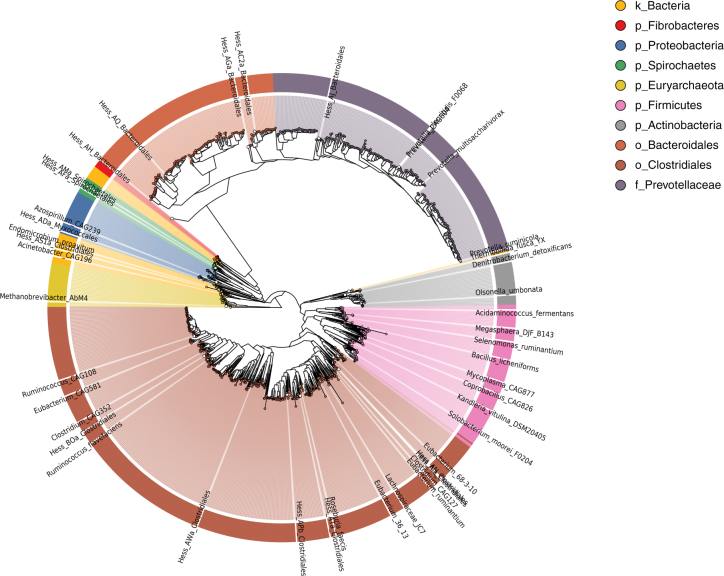
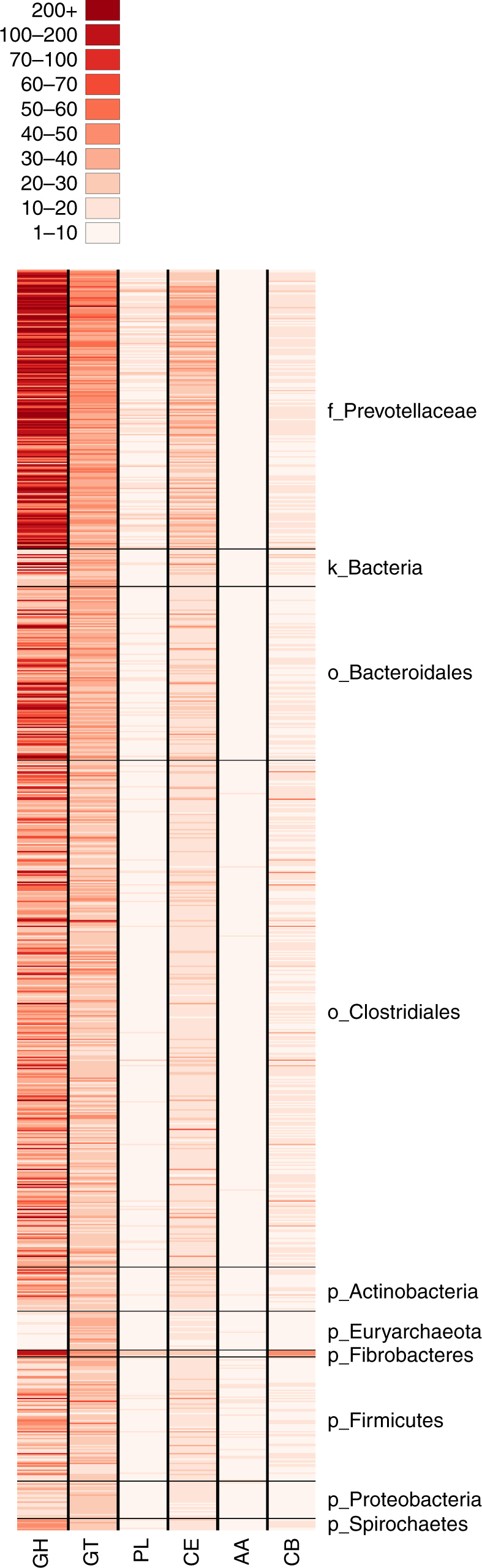
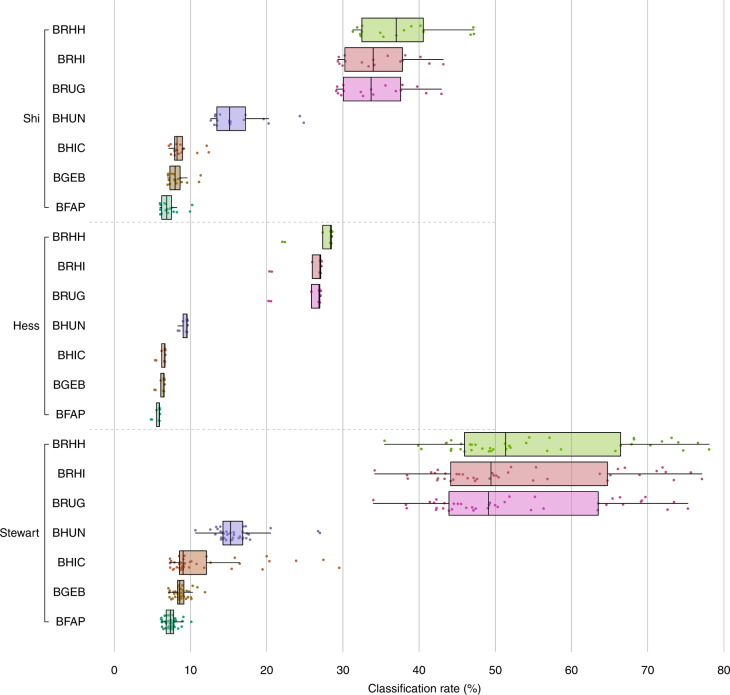
The cow rumen is adapted for the breakdown of plant material into energy and nutrients, a task largely performed by enzymes encoded by the rumen microbiome. Here we present 913 draft bacterial and archaeal genomes assembled from over 800 Gb of rumen metagenomic sequence data derived from 43 Scottish cattle, using both metagenomic binning and Hi-C-based proximity-guided assembly. Most of these genomes represent previously unsequenced strains and species. The draft genomes contain over 69,000 proteins predicted to be involved in carbohydrate metabolism, over 90% of which do not have a good match in public databases. Inclusion of the 913 genomes presented here improves metagenomic read classification by sevenfold against our own data, and by fivefold against other publicly available rumen datasets. Thus, our dataset substantially improves the coverage of rumen microbial genomes in the public databases and represents a valuable resource for biomass-degrading enzyme discovery and studies of the rumen microbiome.
Overview
The claims and statistics of this paper haven’t been checked yet.
Run the check — free, no account needed. It reads the open-access text and checks the sources it cites.
Integrity signals
Registry
Cites
Statistics
Figures
Verification
Claims the paper makes
The claims and statistics of this paper haven’t been checked yet.
Run the check — free, no account needed. It reads the open-access text and checks the sources it cites.
Claims other papers make about this one
Each is checked against this paper’s own text: does it say what the citing paper says it does?
The cited source says what the claim attributes to it.
In the citing paper
“Hi-C binning has been used effectively on human feces (Press et al., 2017) as well as in ruminants (Stewart et al., 2018).”
From Addressing global ruminant agricultural challenges through understanding the rumen microbiome: past, present, and future (2018) · cites this paper as Stewart et al., 2018
In the citing paper
“Subsequently, Svartstrom et al. (2017) assembled 99 microbial genomes from the moose rumen, Stewart et al. (2018) assembled 913 microbial genomes from the rumen of cattle, and Parks et al. (2017) assembled over 8,000 novel microbial genomes from 1,500 public datasets, some of which originated from the rumen.”
From Addressing global ruminant agricultural challenges through understanding the rumen microbiome: past, present, and future (2018) · cites this paper as Stewart et al., 2018
Self-check
Percentages, sums and reported differences re-computed from the paper’s own numbers.
The self-check needs the paper’s full text.
Citations
Cites
Trimmomatic: a flexible trimmer for Illumina sequence data
Bolger, A. M., Lohse, M., & Usadel, B. (2014) · Bioinformatics · doi:10.1093/bioinformatics/btu170 · Cited by 65,548
The Sequence Alignment/Map format and SAMtools
Li, H., Handsaker, B., Wysoker, A., Fennell, T., Ruan, J., Homer, N., Marth, G., Abecasis, G., Durbin, R., & 1000 Genome Project Data Processing Subgroup (2009) · Bioinformatics · doi:10.1093/bioinformatics/btp352 · Cited by 62,041
Fast and accurate short read alignment with Burrows-Wheeler transform
Li, H., & Durbin, R. (2009) · Bioinformatics · doi:10.1093/bioinformatics/btp324 · Cited by 58,607
BLAST+: architecture and applications
Camacho, C., Coulouris, G., Avagyan, V., Ma, N., Papadopoulos, J., Bealer, K., & Madden, T. L. (2009) · BMC Bioinformatics · doi:10.1186/1471-2105-10-421 · Cited by 22,074
Fast and sensitive protein alignment using DIAMOND
Buchfink, B., Xie, C., & Huson, D. H. (2015) · Nature Methods · doi:10.1038/nmeth.3176 · Cited by 14,201
Aligning sequence reads, clone sequences and assembly contigs with BWA-MEMPreprint
Li, H. (2013) · arXiv (Cornell University) · doi:10.48550/arxiv.1303.3997 · Cited by 10,846
Li, D., Liu, C.-M., Luo, R., Sadakane, K., & Lam, T. (2015) · Bioinformatics · doi:10.1093/bioinformatics/btv033 · Cited by 10,133
UniProt: the Universal Protein knowledgebase
Apweiler, R. (2003) · Nucleic Acids Research · doi:10.1093/nar/gkh131 · Cited by 7,593
The carbohydrate-active enzymes database (CAZy) in 2013
Lombard, V., Ramulu, H. G., Drula, É., Coutinho, P. M., & Henrissat, B. (2013) · Nucleic Acids Research · doi:10.1093/nar/gkt1178 · Cited by 6,452
O'Leary, N. A., Wright, M. W., Brister, J. R., Ciufo, S., Haddad, D., McVeigh, R., Rajput, B., Robbertse, B., Smith-White, B., Ako-Adjei, D., et al. (2016) · Nucleic Acids Research · doi:10.1093/nar/gkv1189 · Cited by 6,357
Cited by
Sorted by citations
Items 501–600 of 600
Li, C., Li, X., Guo, R., Ni, W., Liu, K., Liu, Z., Dai, J., Xu, Y., Abduriyim, S., Wu, Z., et al. (2023) · Figshare · doi:10.6084/m9.figshare.22610707
Jiang, Q., Lin, L., Xie, F., Jin, W., Zhu, W., Wang, M., Qiu, Q., Li, Z., Liu, J., & Mao, S. (2022) · Figshare · doi:10.6084/m9.figshare.20356416
Li, C., Li, X., Guo, R., Ni, W., Liu, K., Liu, Z., Dai, J., Xu, Y., Abduriyim, S., Wu, Z., et al. (2023) · Figshare · doi:10.6084/m9.figshare.22610656
Li, C., Li, X., Guo, R., Ni, W., Liu, K., Liu, Z., Dai, J., Xu, Y., Abduriyim, S., Wu, Z., et al. (2023) · Figshare · doi:10.6084/m9.figshare.22610710
Li, C., Li, X., Guo, R., Ni, W., Liu, K., Liu, Z., Dai, J., Xu, Y., Abduriyim, S., Wu, Z., et al. (2023) · Figshare · doi:10.6084/m9.figshare.22610683
Li, C., Li, X., Guo, R., Ni, W., Liu, K., Liu, Z., Dai, J., Xu, Y., Abduriyim, S., Wu, Z., et al. (2023) · Figshare · doi:10.6084/m9.figshare.22610662
Liu, L., Wang, Y., Che, Y., Chen, Y., Xia, Y., Luo, R., Cheng, S. H., Zheng, C., & Zhang, T. (2020) · Figshare · doi:10.6084/m9.figshare.13203415
Li, C., Li, X., Guo, R., Ni, W., Liu, K., Liu, Z., Dai, J., Xu, Y., Abduriyim, S., Wu, Z., et al. (2023) · Figshare · doi:10.6084/m9.figshare.22610671
Xie, F., Jin, W., Si, H., Yuan, Y., Tao, Y., Liu, J., Wang, X., Yang, C., Li, Q., Yan, X., et al. (2021) · Figshare · doi:10.6084/m9.figshare.14775438
Li, C., Li, X., Guo, R., Ni, W., Liu, K., Liu, Z., Dai, J., Xu, Y., Abduriyim, S., Wu, Z., et al. (2023) · Figshare · doi:10.6084/m9.figshare.22610698
Jiang, Q., Lin, L., Xie, F., Jin, W., Zhu, W., Wang, M., Qiu, Q., Li, Z., Liu, J., & Mao, S. (2022) · Figshare · doi:10.6084/m9.figshare.20356422
Li, X., Lippens, G. M., Parrou, J., Cioci, G., Esque, J., Wang, Z., Laville, É., Potocki-Véronèse, G., & Labourel, A. (2024) · mSphere · doi:10.1128/msphere.00278-24 · Cited by 1
“Because bacteria are active players in plant biomass degradation, many recent stud ies have investigated their carbohydrate-active enzyme (CAZyme) content (9, 14–18).”
Chen, T., Deng, C., Li, S., Li, B. J., Liang, Y., Zhang, Y., Li, J., Xu, N., & Yu, K. (2024) · Journal of Hazardous Materials · doi:10.1016/j.jhazmat.2024.135669
Needle, D. B., Reboul, G., Mitchell, P. K., Rothenheber, D., Marra, N. J., Cronk, B. D., Patel, N. G., & Goodman, L. B. (2025) · Microorganisms · doi:10.3390/microorganisms13030533
“The metagenomics and bioinformatics pipelines applied to fresh or frozen samples have been widely demonstrated to powerfully identify a broad array of viruses, bacteria, fungi, and protozoa, including evidence of 913 distinct genomes in one sample of cow rumen [21].”
Pipelines and Databases—Microbiome Analysis
Sanders, J., Huang, L., Zhu, Q., & Morton, J. T. (2025) · Wiley eBooks · doi:10.1002/9781683674597.ch22
Deciphering the microbial landscape of lower respiratory tract in health and respiratory diseasesPreprint
Cheng, C., Li, Y., Wang, S., Wang, H., Liu, D., Wang, Q., Che, Y., Xue, L., Chao, N., He, X., et al. (2025) · bioRxiv (Cold Spring Harbor Laboratory) · doi:10.1101/2025.06.11.659233
“It was reported that co-assembly is an effective approach for reconstructing low-abundance MAGs [33].”
Guo, L., Pei, X., Tan, J., Sun, H., Jiang, S., Wei, H., & Peng, J. (2025) · Genetics Selection Evolution · doi:10.1186/s12711-025-00990-2
“This may be due to the fact that Firmicutes bacteria themselves make up a much higher proportion of the porcine intestinal tract than Bacteroidetes, in addition to the fact that Bacteroidetes bacteria usually feed on carbohydrates and are, therefore, susceptible to environmental factors [36].”
Vineis, J. H., Bulseco, A., Rafie, S., Cardon, Z. G., & Bowen, J. L. (2025) · eLife · doi:10.7554/elife.108843
Park, J., Jang, K. B., Kanga, M.-G., Kyung, J., Yoon, J., Ryu, S., & Kim, Y. (2025) · Journal of Animal Science and Technology · doi:10.5187/jast.2500412
“Advancing high-quality genome references and refining functional annotations will connect genotype to mechanism in rumen systems, supporting the design of targeted, microbiome-informed strategies to reduce methane emissions in livestock production [8].”
Additional file 1 of Microbial dark matter filling the niche in hypersaline microbial mats
Wong, H. L., MacLeod, F. I., White, R. A., III, Visscher, P. T., & Burns, B. P. (2020) · Figshare · doi:10.6084/m9.figshare.12965735
Fan, Q., Wanapat, M., Yan, T., & Hou, F. (2020) · Figshare · doi:10.6084/m9.figshare.13336453
Singh, N. K., Wood, J. M., Patane, J., Moura, L. M. S., Lombardino, J., Setubal, J. C., & Venkateswaran, K. (2024) · Figshare · doi:10.6084/m9.figshare.26593271
Wang, J., Liang, J., Li, Y., Tian, L., & Wei, Y. (2021) · Figshare · doi:10.6084/m9.figshare.13612424
Huang, G., Shi, W., Wang, L., Qu, Q., Zuo, Z., Wang, J., Zhao, F., & Wei, F. (2023) · Figshare · doi:10.6084/m9.figshare.24266048
DENG, F., Wang, C., Li, D., Peng, Y., Deng, L., Zhao, Y., Zhang, Z., Wei, M., Wu, K., Zhao, J., et al. (2023) · Figshare · doi:10.6084/m9.figshare.23949802
Martínez-Álvaro, M., Mattock, J., González-Recio, Ó., Saborío‐Montero, A., Weng, Z., Lima, J., Duthie, C.-A., Dewhurst, R. J., Cleveland, M. A., Watson, M., et al. (2024) · Figshare · doi:10.6084/m9.figshare.26694066
Li, C., Li, X., Guo, R., Ni, W., Liu, K., Liu, Z., Dai, J., Xu, Y., Abduriyim, S., Wu, Z., et al. (2023) · Figshare · doi:10.6084/m9.figshare.22610692
Li, C., Li, X., Guo, R., Ni, W., Liu, K., Liu, Z., Dai, J., Xu, Y., Abduriyim, S., Wu, Z., et al. (2023) · Figshare · doi:10.6084/m9.figshare.22610713
Laso‐Jadart, R., O’Malley, M., Sykulski, A. M., Ambroise, C., & Madoui, M. (2023) · Figshare · doi:10.6084/m9.figshare.24076958
Li, C., Li, X., Guo, R., Ni, W., Liu, K., Liu, Z., Dai, J., Xu, Y., Abduriyim, S., Wu, Z., et al. (2023) · Figshare · doi:10.6084/m9.figshare.22610686
Jiang, Q., Lin, L., Xie, F., Jin, W., Zhu, W., Wang, M., Qiu, Q., Li, Z., Liu, J., & Mao, S. (2022) · Figshare · doi:10.6084/m9.figshare.20356413
Martínez-Álvaro, M., Mattock, J., González-Recio, Ó., Saborío‐Montero, A., Weng, Z., Lima, J., Duthie, C.-A., Dewhurst, R. J., Cleveland, M. A., Watson, M., et al. (2024) · Figshare · doi:10.6084/m9.figshare.26694060
Klassen, L., Reintjes, G., Tingley, J. P., Jones, D. R., Hehemann, J., Smith, A. D., Schwinghamer, T. D., Arnosti, C., Jin, L., Alexander, T. W., et al. (2021) · Figshare · doi:10.6084/m9.figshare.13632746
Fan, Q., Wanapat, M., Yan, T., & Hou, F. (2020) · Figshare · doi:10.6084/m9.figshare.13336465
Li, Y., Gao, J., Xue, Y., Sun, R., Sun, X., Sun, Z., Liu, S., Zhankun, T., Zhu, W., & Cheng, Y. (2024) · Figshare · doi:10.6084/m9.figshare.26575388
Klassen, L., Reintjes, G., Tingley, J. P., Jones, D. R., Hehemann, J., Smith, A. D., Schwinghamer, T. D., Arnosti, C., Jin, L., Alexander, T. W., et al. (2021) · Figshare · doi:10.6084/m9.figshare.13632743
Liu, L., Wang, Y., Che, Y., Chen, Y., Xia, Y., Luo, R., Cheng, S. H., Zheng, C., & Zhang, T. (2020) · Figshare · doi:10.6084/m9.figshare.13203412
Fan, Q., Wanapat, M., Yan, T., & Hou, F. (2020) · Figshare · doi:10.6084/m9.figshare.13336459
Singh, N. K., Wood, J. M., Patané, J. S. L., Moura, L. M. S., Lombardino, J., Setubal, J. C., & Venkateswaran, K. (2024) · Figshare · doi:10.6084/m9.figshare.26593268
Martínez-Álvaro, M., Mattock, J., González-Recio, Ó., Saborío‐Montero, A., Weng, Z., Lima, J., Duthie, C.-A., Dewhurst, R. J., Cleveland, M. A., Watson, M., et al. (2024) · Figshare · doi:10.6084/m9.figshare.25422374
Huang, G., Shi, W., Wang, L., Qu, Q., Zuo, Z., Wang, J., Zhao, F., & Wei, F. (2024) · Figshare · doi:10.6084/m9.figshare.24266072
Diaz, G. R., Gaire, T. N., Ferm, P., Case, L., Caixeta, L. S., Goldsmith, T., Armstrong, J., & Noyes, N. R. (2023) · Figshare · doi:10.6084/m9.figshare.24715490
Martínez-Álvaro, M., Mattock, J., González-Recio, Ó., Saborío‐Montero, A., Weng, Z., Lima, J., Duthie, C.-A., Dewhurst, R. J., Cleveland, M. A., Watson, M., et al. (2024) · Figshare · doi:10.6084/m9.figshare.26694057
Li, C., Li, X., Guo, R., Ni, W., Liu, K., Liu, Z., Dai, J., Xu, Y., Abduriyim, S., Wu, Z., et al. (2023) · Figshare · doi:10.6084/m9.figshare.22610659
Martínez-Álvaro, M., Mattock, J., González-Recio, Ó., Saborío‐Montero, A., Weng, Z., Lima, J., Duthie, C.-A., Dewhurst, R. J., Cleveland, M. A., Watson, M., et al. (2024) · Figshare · doi:10.6084/m9.figshare.26694054
Fan, Q., Wanapat, M., Yan, T., & Hou, F. (2020) · Figshare · doi:10.6084/m9.figshare.13336441
Fan, Q., Wanapat, M., Yan, T., & Hou, F. (2020) · Figshare · doi:10.6084/m9.figshare.13336447
Xie, F., Jin, W., Si, H., Yuan, Y., Tao, Y., Liu, J., Wang, X., Yang, C., Li, Q., Yan, X., et al. (2021) · Figshare · doi:10.6084/m9.figshare.14775420
Li, C., Li, X., Guo, R., Ni, W., Liu, K., Liu, Z., Dai, J., Xu, Y., Abduriyim, S., Wu, Z., et al. (2023) · Figshare · doi:10.6084/m9.figshare.22610665
Martínez-Álvaro, M., Mattock, J., González-Recio, Ó., Saborío‐Montero, A., Weng, Z., Lima, J., Duthie, C.-A., Dewhurst, R. J., Cleveland, M. A., Watson, M., et al. (2024) · Figshare · doi:10.6084/m9.figshare.26694063
Martínez-Álvaro, M., Mattock, J., Auffret, M. D., Weng, Z., Duthie, C.-A., Dewhurst, R. J., Cleveland, M. A., Watson, M., & Roehe, R. (2022) · Figshare · doi:10.6084/m9.figshare.21285704
Thapa, S., Zhou, S., O’Hair, J., Al Nasr, K., Ropelewski, A. J., & Li, H. (2023) · Figshare · doi:10.6084/m9.figshare.24741841
Li, C., Li, X., Guo, R., Ni, W., Liu, K., Liu, Z., Dai, J., Xu, Y., Abduriyim, S., Wu, Z., et al. (2023) · Figshare · doi:10.6084/m9.figshare.22610725
Martínez-Álvaro, M., Mattock, J., González-Recio, Ó., Saborío‐Montero, A., Weng, Z., Lima, J., Duthie, C.-A., Dewhurst, R. J., Cleveland, M. A., Watson, M., et al. (2024) · Figshare · doi:10.6084/m9.figshare.26694051
Martínez-Álvaro, M., Mattock, J., González-Recio, Ó., Saborío‐Montero, A., Weng, Z., Lima, J., Duthie, C.-A., Dewhurst, R. J., Cleveland, M. A., Watson, M., et al. (2024) · Figshare · doi:10.6084/m9.figshare.25422422
Huang, G., Shi, W., Wang, L., Qu, Q., Zuo, Z., Wang, J., Zhao, F., & Wei, F. (2024) · Figshare · doi:10.6084/m9.figshare.26624359
A molecular inventory of the faecal microbiomes of 23 marsupial species
Bowerman, K. L., Soo, R. M., Chaumeil, P.-A., Blyton, M. D. J., Sørensen, M., Gunbilig, D., Malig, M., Islam, M., Zaugg, J., Wood, D., et al. (2026) · Microbial Genomics · doi:10.1099/mgen.0.001601
“2.9) [48] and binning performed using the ProxiMeta platform [49, 50], incorporating both standard shotgun and Hi-C data.”
InfluentialNie, J., Li, X., Luo, Y., Li, H., Zhu, Y., Chen, C., & Hua, J. (2026) · Veterinary Sciences · doi:10.3390/vetsci13010092
“…sequencing using either the Illumina HiSeq or MiSeq platform, with the platform selection determined by the fragment size, all sample handling and sequencing procedures were performed in strict accordance with the detailed operational protocols outlined in Supplementary Method S1 [6,30].”
Satti, M. A., & Cai, Z. (2026) · bioRxiv (Cold Spring Harbor Laboratory) · doi:10.64898/2026.04.27.721001
“Accordingly, a significant proportion of metagenomic data, sometimes over 50%, remains unclassifiable [6, 7], particularly in environments such as the bovine rumen [5], plant rhizosphere [8], or non-Western gut microbiota [2, 3].”
A Cophylogenetic Approach for Virus-Host Interaction PredictionPreprint
Chowdhury, M. Z. U. S., Murali, T. M., & Sashittal, P. (2026) · bioRxiv (Cold Spring Harbor Laboratory) · doi:10.64898/2026.02.26.708038
“The benchmark comprises of 251 virus-host interactions collected from three distinct environments: 84 from human gut samples [67], 66 from cow fecal samples [68] and 101 from wastewater samples [69].”
Terpigorev, S. A., Bogdanov, R. R., & Dimertsev, A. V. (2026) · Clinical Medicine (Russian Journal) · doi:10.30629/0023-2149-2025-103-12-865-872
Chen, X., Ji, M., Yan, D., Liu, Y., Chen, Y., Dong, R., Shen, L., Takeuchi, N., & Kong, W. (2026) · New Phytologist · doi:10.1111/nph.71089
“2a), indicating widespread genetic capacity for both the synthesis and degradation of carbohydrates (Ortiz-Soto & Sei-bel, 2025), consistent with the diverse carbon catabolic and metabolic potentials reported in snow microbiomes (Lairson et al ., 2008; Stewart et al ., 2018).”
Tian, X., Feng, Y., Wang, C., Zhao, W., Xue, L., Zhu, L., Ji, X., Wang, H., Gu, Y., Jiang, Q., et al. (2026) · Veterinary Research Communications · doi:10.1007/s11259-026-11151-1
An overview of the livestock microbiome: sheep, horses, cattle, camels, and chickens
Ibadullayeva, A., Хамзина, А., Бакытбекович, С. Д., & Хамзин, К. (2026) · Brazilian Journal of Biology · doi:10.1590/1519-6984.299936
Investigating chromosome dynamics through Hi-C assembly
Baudry, L. (2019) · theses.fr (ABES) · doi:10.70675/a91a798czcccbz4ccfzb7f8zc2f5d6e00d20
Genome-wide effects of T4 phage Ndd protein expression on the Escherichia coli nucleoid
Foutel-Rodier, T. (2021) · theses.fr (ABES) · doi:10.70675/a5e4bd2az13bez477cz92aez8c90736cad60
Leroy, M., Cyriaque, V., Rattei, T., Isabelle Laurion, E., & Comte, J. (2026) · Environmental Microbiome · doi:10.1186/s40793-026-00892-w
“Due to low sequencing depth, a de novo hybrid co-assembly technique was used to recover low-abundance microbes [34].”
Precision of Hi-C-Based Metagenome-Assembled Genome Reconstruction across Binning Pipelines
Lukaszewicz, M., Ridenhour, B. J., Top, E. M., & Stalder, T. (2026) · Computational and Structural Biotechnology Reports · doi:10.34133/csbr.0003
Yang, P., Wu, Z., Cao, Z., Li, Y., Yan, L., Yan, Y., Zhou, F., Gu, S., Liu, C., Ren, X., et al. (2026) · Research Square · doi:10.21203/rs.3.rs-9101224/v1
Tang, Z., Zhang, S., Xu, P., Tang, H., Gao, W., Cao, Y., Zhai, R., & Chen, K. (2026) · Animals · doi:10.3390/ani16111728
Lignocellulose-degrading enzymes/microbes: from gut to soil
Chen, P., Liu, T., Dong, Y., Qiao, S., Zhang, S., & Yan, L. (2026) · Materials Today Sustainability · doi:10.1016/j.mtsust.2026.101400
Chaudhary, A., Lin, X., Vitaterna, M., Auch, B., Liachko, I., & Green, S. (2026) · Microbiology Resource Announcements · doi:10.1128/mra.01047-25
BileActome reveals community-assembled bile acid metabolism in the rumen microbiome
Zhang, B., Jiang, X., Zhao, H., & Wang, B. (2026) · ISME Communications · doi:10.1093/ismeco/ycag205
Jalal, H., Pompei, L., Giammarco, M., Malik, M. I., Akram, S., Akram, M. Z., Domenico, M. D., Ghiaccio, F., Colleluori, R., Pezzi, P., et al. (2026) · Frontiers in Veterinary Science · doi:10.3389/fvets.2026.1900394
“Firmicutes, Bacteroidetes, and Proteobacteria were the dominant bacteria in this study, consistent with the earlier findings (35, 41, 42).”
Snelling, T. J., Johnson, C. A., Warren, H. E., Taylor-Pickard, J. A., Huntington, J. A., & Sinclair, L. A. (2026) · Frontiers in Microbiomes · doi:10.3389/frmbi.2026.1884444
Beyond ARG abundance: Genome-resolved metagenomics redefines Resistome dynamics in manure composting
Ahmad, H., Rauf, F., Ullah, I., Khan, S., & Korai, S. K. (2026) · Gene Reports · doi:10.1016/j.genrep.2026.102602
Novakoski, P. V., Nora, L., Deolindo, G. L., Bajay, M. M., & da Silva, A. S. (2026) · Microbial Pathogenesis · doi:10.1016/j.micpath.2026.108812
Isolation, identification, characterization, regulation, and application of lactic acid bacteria
França, F., & Pìmentel-Filho, N. D. J. (2026) · The Microbe · doi:10.1016/j.microb.2026.100794
Alimi, N., Séidou, A. A., Houngbedji, M. J., Naitchede, H., Worogo, H. S. S., Idrissou, Y., Toukourou, Y., Attakpa, E. Y., & Traoré, I. A. (2026) · Methane · doi:10.3390/methane5030029
“According to [23], absolute feed intake regulates the structural volume of fermentable organic matter—predominantly structural carbohydrate matrices like neutral detergent fiber (NDF)—deposited directly into the reticulorumen and the microbial consortium degrades these fibrous particles; hydrolytic…”
Na, M., Guo, W., Zhang, R., Du, H., Li, K., Zhang, J., & Na, R. (2026) · Frontiers in Microbiology · doi:10.3389/fmicb.2026.1905439
Resolving Host-Associated Antimicrobial Resistance in Municipal Wastewater Using Hi-C Metagenomics
Senok, A. C., Verma, S., Shouqair, D., Alghafri, R., Moradigaravand, D., Nassar, R., Everett, D., Goering, R., & Khan, M. A. (2026) · Microorganisms · doi:10.3390/microorganisms14102153
“Metagenome deconvolution was performed with the ProxiMeta (Phase Genomics) platform [17,18], which clusters assembled contigs into metagenome-assembled genomes (MAGs) based on Hi-C proximity-ligation linkage.”
Vineis, J. H., Bulseco, A., Rafie, S., Cardon, Z. G., & Bowen, J. L. (2026) · eLife · doi:10.7554/elife.108843.2
Bao, J., Li, H., Jiang, K., Xu, J., Wu, Y., Ji, W., Li, S., Qi, B., & Niu, H. (2026) · Animals · doi:10.3390/ani16193052
“Large-scale rumen metagenomic studies have shown that the cow rumen microbiome contains abundant microbial genomes and enzyme-coding genes involved in plant material degradation and carbohydrate utilization [9,10].”
Akanmu, A. M. (2026) · Current Microbiology · doi:10.1007/s00284-026-05159-8
“Genome reconstruction has greatly expanded the recognised metabolic repertoire and carbohydrate-active enzyme (CAZyme) diversity [ 16 ].”
InfluentialWen, J., Huang, J., Liu, G., Liang, S., Zeng, L., Huang, R., Nongqi, Y., Qin, G., Chen, Q., & Yan, S. (2026) · Microorganisms · doi:10.3390/microorganisms14102206
“High-resolution metagenomic resources for ruminants initially focused mainly on the rumen, with public catalogs expanding from 913 rumen microbial genomes to 4941 MAGs [6,7].”
Whitman, B. T., Karimianghadim, R., Auch, B., Liachko, I., Monaghan, T., Pakpour, S., & Kao, D. (2026) · iScience · doi:10.1016/j.isci.2026.117907
Metadata
- Authors
- Stewart, R. D., Auffret, M. D., Warr, A., Wiser, A. H., Press, M. O., Langford, K. W., Liachko, I., Snelling, T. J., Dewhurst, R. J., Walker, A. W., Roehe, R., & Watson, M.
- Affiliations
- Roslin Institute (GB)
- Scotland's Rural College (GB)
- University of Aberdeen (GB)
- Corresponding author
- Watson, Mick
- ORCID
- Venue
- Nature Communications
- Published
- 2018-02-28
- Volume
- 9
- Issue
- 1
- Pages
- 870-870
- ISSN
- 2041-1723 (ISSN-L)
- PMC
- PMC5830445
- OpenAlex
- W2786358949
- Cited by
- 559
- References
- 83
- Citations by year
- 2026: 39 · 2025: 48 · 2024: 77 · 2023: 69 · 2022: 64 · 2021: 73 · 2020: 89 · 2019: 73 · 2018: 27
- FWCI
- 24.09
- Type
- journal article
- Language
- en
- Open access
- gold
- doi.org
- Locations
- Nature Communications (publishedVersion, cc-by)
- Europe PMC (PubMed Central) (publishedVersion, cc-by)
- PubMed Central (publishedVersion, cc-by)
- PubMed (publishedVersion)
- Edinburgh Research Explorer (University of Edinburgh) (publishedVersion, cc-by)
- RePEc: Research Papers in Economics (submittedVersion)
- Aberdeen University Research Archive (Aberdeen University) (submittedVersion)
- DOAJ (DOAJ: Directory of Open Access Journals) (submittedVersion)
- DOAJ (DOAJ: Directory of Open Access Journals) (submittedVersion, cc-by-sa)
- Funders
- Rural and Environment Science and Analytical Services Division
- Scottish Government
- Scotland’s Rural College
- Directorate for Biological Sciences
- Biotechnology and Biological Sciences Research Council (BBS/E/D/30002276, BB/M01844X/1, BB/J004235/1, BB/R015023/1, BB/P013732/1, BB/J004235, BB/N016742/1, BB/ J004243/1, BB/N01720X/1, P013759, BBP013759/1, BBS/E/D/20310000)
- National Institute of Allergy and Infectious Diseases (R43AI122654, R44AI122654)
- Topics
- Life Sciences › Biochemistry, Genetics and Molecular Biology › Molecular Biology › Genomics and Phylogenetic Studies
- Life Sciences › Agricultural and Biological Sciences › Animal Science and Zoology › Ruminant Nutrition and Digestive Physiology
- Physical Sciences › Energy › Renewable Energy, Sustainability and the Environment › Anaerobic Digestion and Biogas Production
- Keywords
- rumen microbiome, draft genome sequence, metagenome binning, Hi-C, cattle, rumen bacteria, rumen archaea, carbohydrate metabolism, biomass-degrading enzymes, metagenome-assembled genomes, read classification
- MeSH terms
- Animals, Bacteria, Bacterial Proteins, Cattle, Phylogeny, Rumen, Genome, Bacterial, Metagenome, Metagenomics
About these checks
Registry, retraction, Cites and statistics results are computed, not judged, with one exception: a printed reference that no index lists is read once by a model before it counts as a citation error. Claims are extracted by a model and kept only when their quote appears verbatim in the text; each cited source is then checked, with a model’s help, for whether it says what the claim relies on. Those verdicts can be wrong — read the claim’s quote and the cited source before relying on one.
Statistics and arithmetic are recomputed, not judged.
Confidence bands are shown only for fields calibrated on our annotated test set. None is calibrated yet, so no band is shown.
What counts as a claim ›How we measure confidence ›How we check this ›
Are you an author, or do you see a problem with this page? Request a review
