

Dissolved organic carbon leaching from plastics stimulates microbial activity in the ocean
Open accessThe DOI matches its Crossref record; 29 of the 29 references it cites were found in a registry or an index.
Abstract
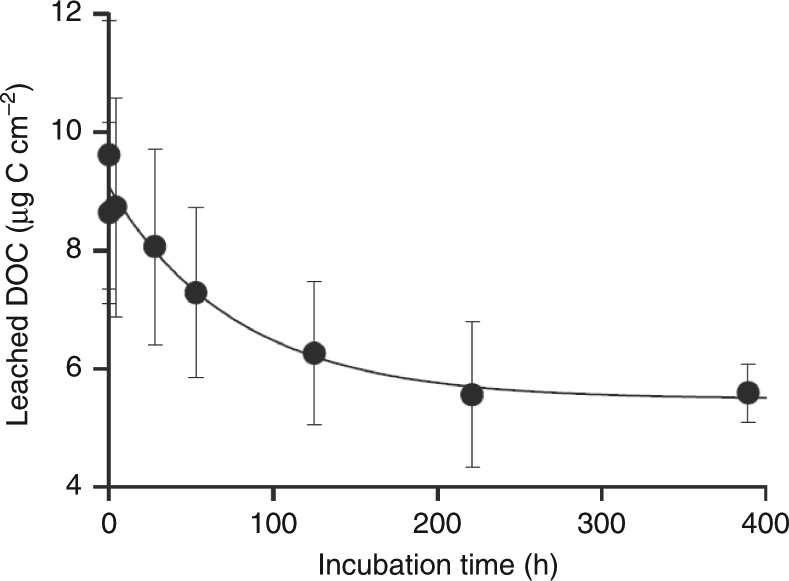
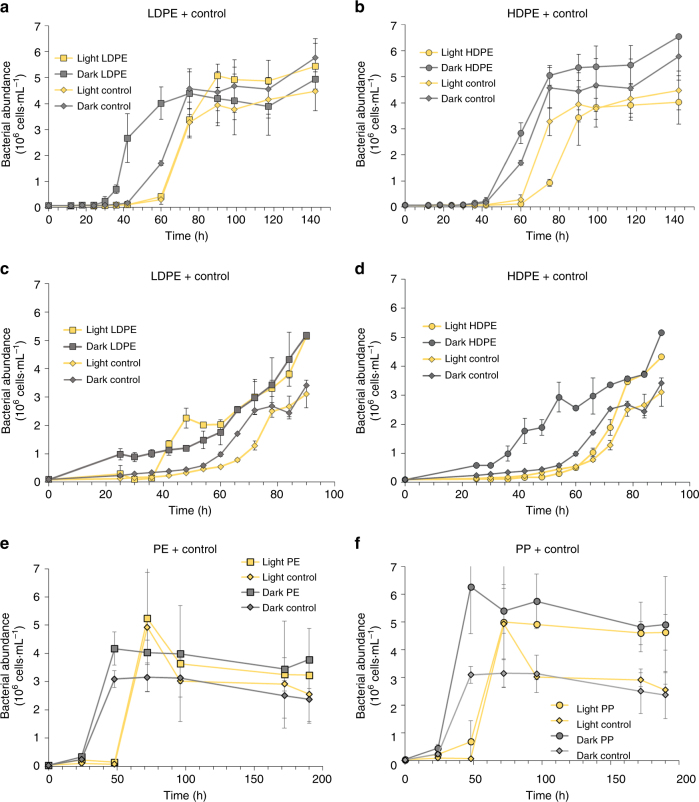
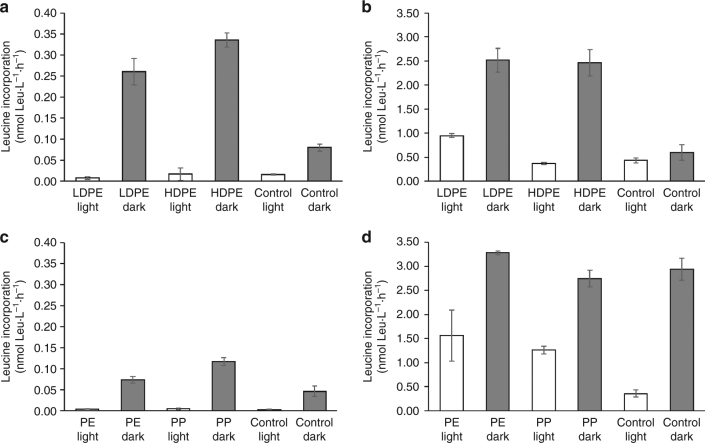
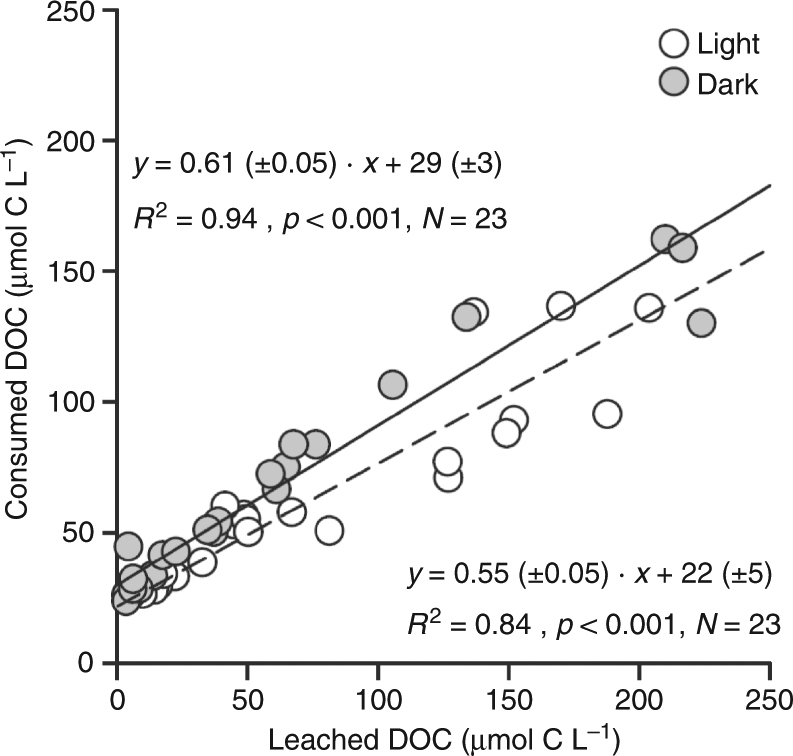
Approximately 5.25 trillion plastic pieces are floating at the sea surface. The impact of plastic pollution on the lowest trophic levels of the food web, however, remains unknown. Here we show that plastics release dissolved organic carbon (DOC) into the ambient seawater stimulating the activity of heterotrophic microbes. Our estimates indicate that globally up to 23,600 metric tons of DOC are leaching from marine plastics annually. About 60% of it is available to microbial utilization in less than 5 days. If exposed to solar radiation, however, this DOC becomes less labile. Thus, plastic pollution of marine surface waters likely alters the composition and activity of the base of the marine food webs. It is predicted that plastic waste entering the ocean will increase by a factor of ten within the next decade, resulting in an increase in plastic-derived DOC that might have unaccounted consequences for marine microbes and for the ocean system.
Overview
The claims and statistics of this paper haven’t been checked yet.
Free: it reads the open-access text and checks the first 5 claims that cite a source we can check. Create a free account to check every claim.
Integrity signals
Registry
Cites
Statistics
Figures
Verification
Claims the paper makes
The claims and statistics of this paper haven’t been checked yet.
Free: it reads the open-access text and checks the first 5 claims that cite a source we can check. Create a free account to check every claim.
Claims other papers make about this one
Each is checked against this paper’s own text: does it say what the citing paper says it does?
The source backs part of the claim, not all of it — or backs it for a different population, condition or comparison.
In the citing paper
“Moreover, UV-induced photodegradation results in the leaching of a plethora of lower molecular weight degradation products [3, 10, 23, 25, 66], which, at least to some degree, stimulate microbial activity [23, 25].”
From Polyethylene degradation and assimilation by the marine yeast Rhodotorula mucilaginosa (2023) · cites this paper as [23]
Experimental — accuracy not yet measuredThe source backs part of the claim, not all of it — or backs it for a different population, condition or comparison.
In the citing paper
“ii) limitations in bioavailable carbon i.e. Bacillus sp cells were able to degrade mainly photooxidation products released from the PE after UV treatment such as nanoplastics, oligomers, monomers and short-chain compounds that have functional groups making them easier to attack by microbial cells/enzymes”
From Mineralization of 13C-labeled polyethylene by marine Bacillus velezensis MT9 (2026) · cites this paper as Romera-Castillo et al., 2018
Experimental — accuracy not yet measuredThe source backs part of the claim, not all of it — or backs it for a different population, condition or comparison.
In the citing paper
“Photooxidation can be complete leading to the terminal oxidation end product CO 2 and in conjunction with fragmentation, it can then also lead to the formation of smaller molecules, ranging from hydrocarbon gases to shorterchain carbonyl compounds (e.g.straight chain or with aromaticity, depending on the parent polymer) 14,29,108 as well as nanoplastics.13,67,109”
From The fate of plastic in the ocean environment – a minireview (2021) · cites this paper as [29]
Experimental — accuracy not yet measuredThe source backs part of the claim, not all of it — or backs it for a different population, condition or comparison.
In the citing paper
“Assuming that the residence time of PMD at the ocean surface could be in the order of years, and/or that PMD might oscillate in the water column and periodically resurfaces, the preliminary results of Ward et al. (2019) and Zhu et al. (2020) show that photooxidation may indeed account for a substantial transformation of PMD into smaller chain scission products and nanoplastics.[29][30][31]”
From The fate of plastic in the ocean environment – a minireview (2021) · cites this paper as [29]
Experimental — accuracy not yet measuredThe source backs part of the claim, not all of it — or backs it for a different population, condition or comparison.
In the citing paper
“Incubation experiments with natural surface water microbial communities from the Mediterranean Sea 29 and an estuary of the subtropical NW Atlantic 31 showed that microbes were able to utilise at least some of the water-soluble fraction of daughter products generated during photooxidation of PE, PP, and PS.”
From The fate of plastic in the ocean environment – a minireview (2021) · cites this paper as [29]
Experimental — accuracy not yet measured
4 more claims about this paper
Create a free account to see every claim other papers make about this one.
Self-check
Percentages, sums and reported differences re-computed from the paper’s own numbers.
The self-check needs the paper’s full text.
Citations
Cites
Plastic waste inputs from land into the ocean
Jambeck, J. R., Geyer, R., Wilcox, C., Siegler, T. R., Perryman, M., Andrady, A., Narayan, R., & Law, K. L. (2015) · Science · doi:10.1126/science.1260352 · Cited by 13,163
Microplastics in the marine environment
Andrady, A. L. (2011) · Marine Pollution Bulletin · doi:10.1016/j.marpolbul.2011.05.030 · Cited by 8,105
Eriksen, M., Lebreton, L. C. M., Carson, H. S., Thiel, M., Moore, C. J., Borerro, J. C., Galgani, F., Ryan, P. G., & Reisser, J. (2014) · PLoS ONE · doi:10.1371/journal.pone.0111913 · Cited by 4,710
Accumulation of microplastic on shorelines woldwide: Sources and sinks
Browne, M. A., Crump, P., Niven, S. J., Teuten, E., Tonkin, A., Galloway, T., & Thompson, R. (2011) · Environmental Science & Technology · doi:10.1021/es201811s · Cited by 4,548
Plastic debris in the open ocean
Cózar, A., Echevarría, F., González-Gordillo, J. I., Irigoien, X., Úbeda, B., Hernández-León, S., Palma, Á. T., Navarro, S., García-de-Lomas, J., Ruiz, A., et al. (2014) · Proceedings of the National Academy of Sciences · doi:10.1073/pnas.1314705111 · Cited by 3,133
Auta, H. S., Emenike, C. U., & Fauziah, S. H. (2017) · Environment International · doi:10.1016/j.envint.2017.02.013 · Cited by 2,649
Pathways for degradation of plastic polymers floating in the marine environment
Gewert, B., Plassmann, M. M., & MacLeod, M. (2015) · Environmental Science: Processes & Impacts · doi:10.1039/c5em00207a · Cited by 2,168 · cited 1×
“The quantity of plastic waste entering the oceans is predicted to increase by up to one order of magnitude by the year 2025 (20) resulting in plastic-derived DOC of up to 236,000MT per year in the global ocean, with potential major consequences for marine microbes and the carbon cycling in the oceanic system.”
Belle, G. V., Fisher, L. D., Heagerty, P. J., & Lumley, T. (1958) · Wiley eBooks · doi:10.1002/0471602396.ch1 · Cited by 1,861
A global inventory of small floating plastic debris
van Sebille, E., Wilcox, C., Lebreton, L., Maximenko, N., Hardesty, B. D., van Franeker, J. A., Eriksen, M., Siegel, D., Galgani, F., & Law, K. L. (2015) · Environmental Research Letters · doi:10.1088/1748-9326/10/12/124006 · Cited by 1,713
Contributing to marine pollution by washing your face: Microplastics in facial cleansers
Fendall, L. S., & Sewell, M. A. (2009) · Marine Pollution Bulletin · doi:10.1016/j.marpolbul.2009.04.025 · Cited by 1,525
Research works printed but not linked: 2
- Hansell, D. A. & Carlson. C. A. Biogeochemistry of Dissolved Organic Matter 2nd edn, Ch. 2 (Academic Press, Oxford, 2015).
- Kirk JTO Optics of UV-B radiation in natural waters Arch. Hydrobiol. Beih. 1994 43 1 16
Cited by
Items 601–700 of 753
Goudriaan, M., Ndhlovu, R. T., Brouwer, M., Vreugdenhil, S., van der Meer, M. T. J., & Niemann, H. (2025) · Marine Pollution Bulletin · doi:10.1016/j.marpolbul.2025.117787 · Cited by 3
Ding, Q., Wang, Z., Sun, H., Guo, Y., & Bai, X. (2025) · Journal of Water Process Engineering · doi:10.1016/j.jwpe.2025.108029 · Cited by 3
Biodiversity dynamics in the Anthropocene: how marine organisms adapt to plastic pollution
Mghili, B., Mancuso, M., Fabrizi, F., Laamraoui, M. R., & Aksissou, M. (2025) · Marine Pollution Bulletin · doi:10.1016/j.marpolbul.2025.118247 · Cited by 3
Bhalerao, A., Düker, U., Weber, M., Eich, A., Lott, C., Lecinski, J., Endres, H., & Nogueira, R. (2025) · Heliyon · doi:10.1016/j.heliyon.2025.e43530 · Cited by 2
Luo, H., Li, Z., Xu, S., He, D., Sun, J., Xu, J., & Pan, X. (2025) · Journal of Hazardous Materials Plastics · doi:10.1016/j.hazmp.2025.100007 · Cited by 11
Polyethylene Identification in Ocean Water Samples by Means of 50 keV Energy Electron Beam
Adlish, J. I., Costa, D., Mainardi, E., Neuhold, P., Surrente, R., & Tagliapietra, L. J. (2020) · Instruments · doi:10.3390/instruments4040032 · Cited by 2
“Ocean water also contains microorganisms, live matter and not, such as viruses, bacteria, and microorganisms like plankton with a different PO4 phosphorus content [14,15,16,17,18,19,20,21,22,23,24,25,26,27,28,29].”
BackgroundNuanmeesri, S., & Poomhiran, L. (2021) · International Journal on Advanced Science Engineering and Information Technology · doi:10.18517/ijaseit.11.2.13191 · Cited by 5
“For long-term problems, floating plastic garbage discharges the organic volatiles and non-volatile compounds it becomes carbon monoxide and carbon dioxide [5].”
BackgroundMicrobial Degradation of Micro‐Plastics
Sharma, P., Mahongnao, S., & Nanda, S. (2022) · Wiley eBooks · doi:10.1002/9781119800897.ch12 · Cited by 3
Andrady, A. L. (2022) · Wiley eBooks · doi:10.1002/9781119768432.ch1 · Cited by 4
On-line biological oxygen demand (BOD) monitoring using a microbial membrane reactor
Chen, Y., Zhou, W., Song, Z., Zhou, H., Liu, C., & Xu, X. (2024) · Instrumentation Science & Technology · doi:10.1080/10739149.2024.2336984 · Cited by 1
Plastic is in the details: the impact of plastic pollution through a mesocosm experiment
Goulais, M., Darinot-Thomas, S., Mitta, G., Galgani, F., Saulnier, D., & Benestan, L. (2024) · Frontiers in Marine Science · doi:10.3389/fmars.2024.1486802 · Cited by 1
Advances in environmental degradation and impact of degradable plastics
Zhang, Y., Xu, Y. D., & Xie, B. (2024) · Chinese Science Bulletin (Chinese Version) · doi:10.1360/tb-2024-0824 · Cited by 1
“Romera-Castillo 等人 [76] 发现 , 塑料释放 到环境中的 DOM 可以刺激异养微生物的活动 , 约 60% 的 DOM 可以在 5 天内被微生物利用 .”
Changes in Fluorescence of Aquatic Dissolved Organic Matter Induced by Plastic Debris
Popa, C. L., Donţu, S., Savastru, D. M., & Cârstea, E. M. (2025) · Materials · doi:10.3390/ma18071602 · Cited by 2
Zhao, H., Li, X., Li, X., Yan, W., Liu, C., & Xiao, Y. (2025) · Journal of environmental chemical engineering · doi:10.1016/j.jece.2025.116609 · Cited by 4
Tzempelikou, E., Galgani, L., Zeri, C., Karavoltsos, S., Iliakis, S., Kalantzi, I., Sakellari, A., & Tsapakis, M. (2025) · Microplastics · doi:10.3390/microplastics4040066 · Cited by 2
Mirza, N., Hadiuzzaman, M., Ladner, D. A., Salehi, M., & Brown, S. P. (2025) · Journal of Applied Microbiology · doi:10.1093/jambio/lxaf247 · Cited by 1
Microplastic contaminants potentially distort our understanding of the ocean’s carbon cycle
Faull, L. M., Taylor, G. T., & Beaupré, S. R. (2025) · PLoS ONE · doi:10.1371/journal.pone.0334546 · Cited by 1
“Therefore, MPs are also likely to be incorporated into marine aggregates and potentially measured as some proportion of the biogenic carbon pool produced in the ocean and exported to depth [8–11].”
Naying, L., Zhong, B., Liu, X., Wu, W., Xintong, M., Yang, Z., Rehman, A., Zhou, L., Lin, H., & Yixin, H. (2025) · Journal of Hazardous Materials · doi:10.1016/j.jhazmat.2025.140345 · Cited by 1
Sundararaj, S., Kumar, M. P., Sanjay, S., & Venkatesh, N. (2025) · Environmental Progress & Sustainable Energy · doi:10.1002/ep.70136 · Cited by 1
Kazmi, S. S. U. H., Azeem, M., Saqib, H. S. A., Yaseen, Z. M., & Li, G. (2025) · Current Opinion in Environmental Science & Health · doi:10.1016/j.coesh.2025.100703 · Cited by 3
Jiang, S., Wang, H., Xia, T., Ning, P., Lu, H., Rui, A., Zhou, S., Bai, X., & Hou, Q. (2025) · Land Degradation and Development · doi:10.1002/ldr.70351 · Cited by 2
Chari, N. V. H. K., Prabhakaran, N., Rao, D. B., A, N., Busala, S. K. K., Marigoudar, S. R., & Gupta, G. V. M. (2026) · Environmental Pollutants and Bioavailability · doi:10.1080/26395940.2025.2610085 · Cited by 1
Li, M., Chen, L., Guo, Q., Fallgren, P. H., Hui, J.-W., & Hao, L. (2026) · Journal of Hazardous Materials · doi:10.1016/j.jhazmat.2026.141236 · Cited by 1
Saini, N., Ghosh, A., & Bhadury, P. (2026) · Journal of Hazardous Materials Advances · doi:10.1016/j.hazadv.2026.101039 · Cited by 1
Tantawi, O., Provenzano, J., de Vera, G. A., Pfohl, P. M., Santizo, K. Y., Wohlleben, W., & Plata, D. L. (2026) · Environmental Science & Technology · doi:10.1021/acs.est.5c09879 · Cited by 1
Xie, Z., Li, H., Feng, J., Xie, S., & Liu, Y. J. (2026) · Harmful Algae · doi:10.1016/j.hal.2026.103074 · Cited by 2
Yao, C., Fang, S., Huang, Y., Huang, B., Chen, C., Ruan, Q., Liang, W., Yang, S., & Liu, S. (2026) · Journal of Hazardous Materials · doi:10.1016/j.jhazmat.2026.141424 · Cited by 1
Li, N., Zhong, B., Liu, X., Wu, W., Mei, X., Ruixi, L., Zhou, L., Lin, H., Yi, S., & He, Y. (2026) · Chemical Engineering Journal · doi:10.1016/j.cej.2026.174017 · Cited by 1
Duan, J., Song, J., Yang, C., Yang, R., Bao, H., He, L., Zhang, H., Liu, Z., Xiang, Y., & Chen, M. (2026) · Reviews of Environmental Contamination and Toxicology · doi:10.1007/s44169-026-00110-1 · Cited by 4
Tracking the photooxidation products of primary plastic pellets (nurdles) in seawater
Jiang, X., Lu, K., & Liu, Z. (2026) · Marine Pollution Bulletin · doi:10.1016/j.marpolbul.2026.119505 · Cited by 1
Liu, S., Wu, J., Ye, Q., Wang, T., Sun, L., Li, B., Shi, Z., Dang, Z., Zhu, N., & Wu, P. (2026) · Water Research · doi:10.1016/j.watres.2026.125803 · Cited by 1
Lin, Z., Pang, S., Xu, T., Zhou, Y., Zhang, C., Qian, P., & Zhang, S. (2026) · Water Research · doi:10.1016/j.watres.2026.125879 · Cited by 1
Tang, H., Yin, Y., Zhou, C., Huang, T., & Xing, B. (2026) · Water Research · doi:10.1016/j.watres.2026.125955 · Cited by 1
Xu, X., Li, M. T., Zhou, H., Jiang, S., Li, Y., Khalid, N., & Li, X. (2026) · Sustainability · doi:10.3390/su18084015 · Cited by 1
Zou, G., Zou, N., Tang, Y., Wang, Q., Xiao, H., Chen, Q., Liu, Z., Wang, K., Yang, F., Zhao, H., et al. (2026) · Environmental Research · doi:10.1016/j.envres.2026.124722 · Cited by 1
Ahlonsou, E. D., Kiki, C., Zhao, G., & Sun, Q. (2026) · Water Research · doi:10.1016/j.watres.2026.126085 · Cited by 3
Wu, Q., Zheng, Y., Xia, Y., Ge, C., Deng, H., Zhao, Y., Luo, J., & Feng, D. (2026) · Environment International · doi:10.1016/j.envint.2026.110311 · Cited by 1
Advanced and Emerging Technologies for Microplastic Remediation
George, N., Janiyani, K., Gupta, A., Ogoe, M., Safo, K. K., Singh, H., & Pandya, S. R. (2026) · Water Air & Soil Pollution · doi:10.1007/s11270-026-09676-x · Cited by 4
“Exposure to sunlight, oxygen and water promotes the photodegradation of plastics, leading to the accumulation of oxidized compounds on their surfaces and the release of carbon dioxide (CO 2 ) and carbon monoxide (CO), together with volatile products and dissolved organic carbon (DOC) (Romera-Castillo et al. 2018).”
Shahzad, S., Pandey, S., Sharma, A., Mehdi, S. E. H., Hussain, F., Mushtaq, A., Kang, W., Yoon, H., & Oh, S. (2026) · Talanta · doi:10.1016/j.talanta.2026.130197 · Cited by 1
Xu, X., Li, C., Liu, J., He, J., Sun, Y., & Wang, J. (2026) · Life · doi:10.3390/life16071136 · Cited by 1
“This stimulation of microbial activity aligns with the observed increases in DOC and water-soluble phenols, suggesting that PAH stress promotes the release of labile carbon substrates that serve as energy sources for microbial communities [51].”
Lin, Y., Li, D., Liu, M., Wen, T., Lu, X., Chen, J., & An, S. (2026) · Journal of Hazardous Materials · doi:10.1016/j.jhazmat.2026.143047 · Cited by 1
Qiu, J., Huang, Z., Wei, X., Pan, Z., Ma, Z., Sun, W., Xi, Z., Xu, S., Zhao, L., & Zheng, W. (2026) · AIChE Journal · doi:10.1002/aic.70514 · Cited by 1
Liu, S., Li, C. B., Bundschuh, J., Gao, X., Li, H., Shi, W., Li, S. Y., Yi, L., Fu, Q., & Wang, Y. (2026) · Environmental Pollution · doi:10.1016/j.envpol.2026.128821 · Cited by 1
Marzi, S. A., Tusher, T. R., Rimpa, H. A., Khan, M. A., Dutta, A., Rahman, M. M., & Islam, M. S. (2026) · Journal of Hazardous Materials Advances · doi:10.1016/j.hazadv.2026.101563 · Cited by 1
Effects of biofilm on the fate and behavior of microplastics in aquatic environment
Jia, J., Zhao, E., Xiong, X., & Wu, C. (2023) · Advances in chemical pollution, environmental management and protection · doi:10.1016/bs.apmp.2023.06.005 · Cited by 3
Powell, T. L., Doughty, J. J., Shimabukuro, Y., Kirschner, C. L., & Tipton, R. B. (2024) · MRS Advances · doi:10.1557/s43580-024-00897-y · Cited by 1
“Improper storage and waste management results in these products, or the resultant contaminated water, entering local groundwater or nearby oceans [4].”
A Comprehensive Review of Biofuel and Bioplastic Production from Microalgae
Basbous, M., Mounsef, J. R., Hokayem, J. E., & Kanaan, H. Y. (2024) · IEEE Mediterranean Electrotechnical Conference (MELECON) · doi:10.1109/melecon56669.2024.10608463 · Cited by 2
“This prolonged degradation duration leads to an accumulation of 5.25 trillion plastic pieces in the world’s oceans [28], This incurs significant costs for removing this non degradable plastic [29] which enters humans food chains after being consumed by aquatic animals, resulting in severe medical…”
BackgroundInfluentialJain, A., Killian, E., & Connon, S. J. (2025) · ChemSusChem · doi:10.1002/cssc.202501392
Sun, J., Yang, F., Luo, X., Li, Y., Fan, J., & Qin, Y. (2025) · The Science of The Total Environment · doi:10.1016/j.scitotenv.2025.180554 · Cited by 2
Mikroplastikoen inpaktua, hedapena eta mikroorganismoen bidezko biodegradazioa ozeanoetan
Baña, Z. (2020) · EKAIA Euskal Herriko Unibertsitateko Zientzi eta Teknologi Aldizkaria · doi:10.1387/ekaia.21081 · Cited by 1
Microplastics in the Biotic Systems
Ramkumar, M. (2022) · Springer eBooks · doi:10.1007/978-3-031-10729-0_9 · Cited by 1
A Mechanistic Understanding of Polyethylene Biodegradation by the Marine Bacterium AlcanivoraxPreprint
Zadjelovic, V., Erni-Cassola, G., Lester, D. W., Eley, Y. L., Gibson, M. I., Dorador, C., Golyshin, P. N., Black, S., Wellington, E. M. H., & Christie‐Oleza, J. A. (2022) · SSRN Electronic Journal · doi:10.2139/ssrn.3979990 · Cited by 1
Marine Biodegradation of Common Plastics
Andrady, A. L. (2022) · Wiley eBooks · doi:10.1002/9781119768432.ch11 · Cited by 1
Metabolic redundancy is required for microbial polyethylene assimilationPreprint
Obrador‐Viel, T., Molina, R. D. I., Wright, R., Aguiló‐Ferretjans, M. D. M., Zadjelovic, V., Nogales, B., Bosch, R., & Christie‐Oleza, J. A. (2025) · bioRxiv (Cold Spring Harbor Laboratory) · doi:10.64898/2025.12.10.693370 · Cited by 2
“PE, however, undergoes abiotic (and biotic) weathering in the environment, leading to random oxidation and chain scission that generate shorter oxidised aliphatic fragments (Gewert et al ., 2018) which specialised microbes can then assimilate (Romera-Castillo et al., 2018).”
Microbial Ecosystem and Anthropogenic Impacts
Baragi, L. V., Narale, D. D., Naik, S. M., & Rajaneesh, K. M. (2020) · Springer eBooks · doi:10.1007/978-981-15-4099-8_1
Fernández‐Juárez, V., Lopez, X., Comas, A. F., Echeveste, P., Bennasar-Figueras, A., Ramis, G., Gomila, R. M., & Agawin, N. S. R. (2020) · bioRxiv (Cold Spring Harbor Laboratory) · doi:10.1101/2020.07.21.210740
“This suggestion follows from Romera-Castillo et al. (2018) who reported that instantaneous leaching of DOC occurs right after the addition of MPs to seawater and 60% of the leached DOC can be bioavailable in < 120 h and can be rapidly consumed by microbes.”
BackgroundEffects of conventional and biodegradable microplastics on marine microbial communities
Lora, U. (2020) · DIGITAL.CSIC (Spanish National Research Council (CSIC)) · doi:10.20350/digitalcsic/13768
The sparing extraction of natural humic substances by means of weak organic solvents.
Scheffer, F., Ziechmann, W., & Pawelke, G. (1960) · Journal of Plant Nutrition and Soil Science
Incubation Habitats and Aging States Affect the Formation of Biofilms on MicroplasticsPreprint
Shan, E., Zhang, X., Li, J., Sun, C., Teng, J., Yang, X., Chen, L., Liu, Y., Sun, X., Zhao, J., et al. (2021) · SSRN Electronic Journal · doi:10.2139/ssrn.3986713
Lü, B., Jiang, C., Chen, Z., Li, A., Wang, W., Zhang, S., & Luo, G. (2021) · SSRN Electronic Journal · doi:10.2139/ssrn.3993168
Identification of Microorganisms Related to Microplastics
Onda, D. F. L., & Sharief, K. M. (2022) · Springer eBooks · doi:10.1007/978-3-030-39041-9_40 · Cited by 5
Prevalence, Fate and Effects of Plastic in Freshwater Environments
Khan, F. R. (2021) · MDPI eBooks · doi:10.3390/books978-3-0365-1298-3
Rhymes, J. M., Cordero, I., Chomel, M., Lavallee, J. M., Straathof, A. L., Ashworth, D., Langridge, H., Semchenko, M., de Vries, F. T., Johnson, D., et al. (2020) · doi:10.5194/soil-2020-79-supplement
Impacts of Microplastics on the Hydrosphere (Aquatic Environment)
Zehra, A., Krishna, K., Pandey, N., & Anbumani, S. (2022) · Advances in human services and public health (AHSPH) book series · doi:10.4018/978-1-7998-9723-1.ch010
Conan, P., Philip, L., Ortega‐Retuerta, E., Odobel, C., Duran, C., Pandin, C., Giraud, C., Meistertzheim, A., Barbe, V., ter Halle, A., et al. (2022) · SSRN Electronic Journal · doi:10.2139/ssrn.4169706
On the Fenton oxidation of polystyrene microplastics
Muñoz, M., Ortiz, D., Nieto-Sandoval, J., Romera‐Castillo, C., de Pedro, Z. M., & Casas, J. A. (2022) · Global NEST International Conference on Environmental Science & Technology · doi:10.30955/gnc2021.00759
Self-citationZhao, S., Zhang, Q., Zhang, C., & Huang, Q. (2023) · SSRN Electronic Journal · doi:10.2139/ssrn.4530564
Humic compounds in marine ecosystems - Ecological importance in transitional Mediterranean zones
Giakoumatos, S. D. V. (2023) · E3S Web of Conferences · doi:10.1051/e3sconf/202343603005
Women in Biogeochemical Dynamics Research: 2022
Cosio, C., Bravo, A. G., & Sebastián, M. (2024) · Frontiers research topics · doi:10.3389/978-2-8325-4862-2
Ramos, K. (2023) · Digital Repository Service (Northeastern University) · doi:10.17760/d20620619
Complete Conversion of Waste Pet into Dimethyl Terephthalate and Ethylene CarbonatePreprint
Zhang, M., Lu, Y., Wang, Z., Gao, X., Luo, X., Shen, X., Wu, W., & Mei, Q. (2024) · SSRN Electronic Journal · doi:10.2139/ssrn.4831309
Crusot, M., Gardon, T., Richmond, T., Jézéquel, R., Barbier, E., & Gaertner‐Mazouni, N. (2024) · SSRN Electronic Journal · doi:10.2139/ssrn.4839844
Kumar, B. S. K., & Sarma, V. V. S. S. (2024) · Environmental Science and Pollution Research · doi:10.1007/s11356-024-34509-x · Cited by 2
“…particularly heavy metals, high concentrations of DOC can significantly increase the mobility of other pollutants in groundwater (Dudley et al. 1986; Pohlman and McColl 1988; Jakobsen & Postma 1994; Driscoll et al. 1995; Judd et al. 2006; Romera-Castillo et al. 2018; Richards et al. 2019a, b).”
Yang, Y., Ma, T., Chen, S., Song, H. D., Li, L., He, Y., Song, T., Zhou, Q., & Tu, W. (2024) · Process Safety and Environmental Protection · doi:10.1016/j.psep.2024.10.022
Microplastics in the Marine Ecosystems: Identification and Impacts
Biswas, S., & Ganguly, A. (2025) · Environmental Claims Journal · doi:10.1080/10406026.2024.2448567 · Cited by 2
“In recent studies, researchers have explored the possibility of using plastics as a carbon source for microbes, which can enhance the growth of biofilms (Romera-Castillo et al. 2018).”
An experimental approach to understanding plastic leachate impacts on marine microorganismsPreprint
Maday, S. D. M., Handley, K. M., Northcott, G. L., Kingsbury, J. M., Smith, D. A., Pantos, O., & Lear, G. (2025) · bioRxiv (Cold Spring Harbor Laboratory) · doi:10.1101/2025.01.30.635782
Evaluation of the Migration Potential of Printed Plastic Films into the Aquatic Environment
Laskawiec, E. (2025) · Resources · doi:10.3390/resources14040058
Ma, J., Liu, J., Guo, Z., Song, M., Jiang, F., Chai, Z., Zhu, L., Lv, S., Zheng, Y., Wang, L., et al. (2026) · Marine Pollution Bulletin · doi:10.1016/j.marpolbul.2026.119686
Touchet, C. M., Mermillod‐Blondin, F., Dolédec, S., Quiñones‐Rivera, Z. J., Guillard, L., Volatier, L., Vallier, F., Rey, M., Krause, S., & Simon, L. (2025) · Environmental Pollution · doi:10.1016/j.envpol.2025.127323
You, Y., Penna, A. D., & Thrush, S. F. (2025) · Marine Ecology Progress Series · doi:10.3354/meps15031
Focardi, A., Moore, L. R., Raina, J., Seymour, J. R., Paulsen, I. T., & Tetu, S. G. (2022) · Figshare · doi:10.6084/m9.figshare.21387290
Dey, S., Rout, A. K., Behera, B. K., & Ghosh, K. (2022) · Figshare · doi:10.6084/m9.figshare.20147028
Pu, L., Zhang, Z., Xiao, Y., Zhong, Y., Zhong, X., Zhang, B., Zhang, K., Yang, J., & Niu, H. (2025) · SSRN Electronic Journal · doi:10.2139/ssrn.5572666
Luo, X., Li, X., & Zhao, Y. (2025) · Water Air & Soil Pollution · doi:10.1007/s11270-025-09035-2
“Transformations in Textile Fibers (Romera-Castillo et al., 2018; Zhang, 2022).”
Chen, Y., Qian, Y., & Liu, F. (2026) · Environmental Science Processes & Impacts · doi:10.1039/d5em00805k
Huang, Y., Du, Y., Wang, T., Yang, K., Li, Y., Ling, J., Fan, Z., Zhang, X., Zhang, C., & Ma, C. (2026) · SSRN Electronic Journal · doi:10.2139/ssrn.6065635
Djuric, N., Rochman, C. M., & Riskin, S. H. (2026) · PLoS ONE · doi:10.1371/journal.pone.0336191
“Leaching happens most rapidly after initial water contact and declines exponentially thereafter [26,27], so we assumed that 72 hours at this higher dose, with repeated addition to the soil over time, would produce a leachate exposure in line with the physical exposure from microfibers.”
Mireles, R., & Noda‐García, L. (2026) · bioRxiv (Cold Spring Harbor Laboratory) · doi:10.64898/2026.01.19.700371
Fang, S., Huang, Y., Yao, C., Huang, B., Chen, C., Ruan, Q., Liu, S., & Ouyang, G. (2026) · Environmental Chemistry and Ecotoxicology · doi:10.1016/j.enceco.2026.01.028
Microplastics in the Environment
Dang, F., Huang, Y., & Xing, B. (2026) · ACS in focus · doi:10.1021/acsinfocus.7ea005
Kteeba, S. M., Krueger, S. J., & Guo, L. (2026) · SSRN Electronic Journal · doi:10.2139/ssrn.6447970
Huang, Y., Du, Y., Zhang, Z., Zhang, X., Wang, T., Yang, K., Li, X., Zhang, C., & Ma, C. (2026) · Environmental Pollution · doi:10.1016/j.envpol.2026.128027 · Cited by 1
Medical facemask waste alters detritus decomposition and fungal communities in a freshwater pond
Kong, Z. H., Stangl, M., Oester, R., Rehnstam, S., Futter, M. N., Siddique, A. B., Bundschuh, M., & McKie, B. G. (2026) · Scientific Reports · doi:10.1038/s41598-026-45795-5 · Cited by 1
“Plastic leachates contain plastic-derived dissolved organic carbon, which can be more bioavailable than some forms of natural dissolved organic matter and stimulate microbial growth 73–75 .”
Microplastics in the marine environment : an ecotoxicological perspective
Cheng, J. (2020) · theses.fr (ABES) · doi:10.70675/7cd94b70z0d42z4c3bz9c3ez4e6bb732e4cd
Gardon, T. (2020) · theses.fr (ABES) · doi:10.70675/fd910c2fz5badz4792z8808z4a639426ddd9 · Cited by 1
Les additifs issus des microplastiques : caractérisation, lixiviation et impacts
Akoueson, F. (2022) · theses.fr (ABES) · doi:10.70675/10c52a13za337z4ecczae14z07a7d546d465 · Cited by 2
The response of biofilms to nutrient environments and their potential in biogeochemical cycles
Lin, Z., Pang, S., Li, Z., Xu, T., Zhou, Y., Zhang, C., Qian, P., & Zhang, S. (2026) · Microbiological Research · doi:10.1016/j.micres.2026.128515 · Cited by 2
Baumas, C. M. J. (2023) · theses.fr (ABES) · doi:10.70675/366ebc79z2d85z45e5z9f26zbd76de1c1ae1
Metadata
- Authors
- Romera-Castillo, C., Pinto, M., Langer, T. M., Álvarez-Salgado, X. A., & Herndl, G. J.
- Affiliations
- University of Vienna (AT)
- Corresponding author
- Herndl, Gerhard J.
- Venue
- Nature Communications
- Published
- 2018-04-12
- Volume
- 9
- Issue
- 1
- Pages
- 1430-1430
- ISSN
- 2041-1723 (ISSN-L)
- PMC
- PMC5897397
- OpenAlex
- W2797295663
- Semantic Scholar
- 660d5977f4d18ae008d461caf32858ac665fe17b
- Cited by
- 753
- References
- 29
- Citations by year
- 2026: 114 · 2025: 126 · 2024: 125 · 2023: 108 · 2022: 110 · 2021: 69 · 2020: 60 · 2019: 29 · 2018: 10
- FWCI
- 15.74
- Type
- journal article
- Language
- en
- Open access
- gold
- doi.org
- Licence
- cc-by
- creativecommons.org/licenses/by/4.0 (tdm)
- creativecommons.org/licenses/by/4.0 (vor)
- Locations
- Nature Communications (publishedVersion, cc-by)
- Flanders Marine Institute (Flanders Marine Institute) (publishedVersion, other-oa)
- Europe PMC (PubMed Central) (publishedVersion, other-oa)
- PubMed Central (publishedVersion, cc-by)
- PubMed (publishedVersion)
- Flanders Marine Institute (Flanders Marine Institute) (submittedVersion, other-oa)
- Phaidra (Universität Wien) (submittedVersion, cc-by-nc-nd)
- RePEc: Research Papers in Economics (submittedVersion)
- DIGITAL.CSIC (Spanish National Research Council (CSIC)) (submittedVersion, cc-by)
- DIGITAL.CSIC (Spanish National Research Council (CSIC)) (submittedVersion)
- DOAJ (DOAJ: Directory of Open Access Journals) (submittedVersion, cc-by-sa)
- DOAJ (DOAJ: Directory of Open Access Journals) (submittedVersion)
- Funders
- Austrian Science Fund (P28781, Z194)
- Topics
- Physical Sciences › Environmental Science › Pollution › Microplastics and Plastic Pollution
- Physical Sciences › Earth and Planetary Sciences › Oceanography › Marine Plankton and Biogeochemistry
- Physical Sciences › Environmental Science › Ecology › Microbial Community Ecology and Physiology
- Keywords
- plastic pollution, dissolved organic carbon, marine plastics, microbial carbon utilization, DOC leaching, marine plastic debris
- MeSH terms
- Bacteria, Carbon, Environmental Pollution, Light, Oceans and Seas, Plastics, Seawater, Solar Energy, Solubility, Food Chain, Heterotrophic Processes
About these checks
Registry, retraction, Cites and statistics results are computed, not judged, with one exception: a printed reference that no index lists is read once by a model before it counts as a citation error. Claims are extracted by a model and kept only when their quote appears verbatim in the text; each cited source is then checked, with a model’s help, for whether it says what the claim relies on. Those verdicts can be wrong — read the claim’s quote and the cited source before relying on one.
Statistics and arithmetic are recomputed, not judged.
Confidence bands are shown only for fields calibrated on our annotated test set. None is calibrated yet, so no band is shown.
What counts as a claim ›How we measure confidence ›How we check this ›
Are you an author, or do you see a problem with this page? Request a review
Data sources
Bibliographic data: Semantic Scholar, OpenAlex, Crossref.
Contains information from the Semantic Scholar Academic Graph Datasets, made available under the ODC Attribution License (ODC-BY 1.0).
Semantic Scholar’s data is described in: Kinney, R., et al. (2023). The Semantic Scholar Open Data Platform. arXiv:2301.10140.
