

In vivo base editing of post-mitotic sensory cells
Open accessThe DOI matches its Crossref record; 60 of the 60 references it cites were found in a registry or an index.
Abstract
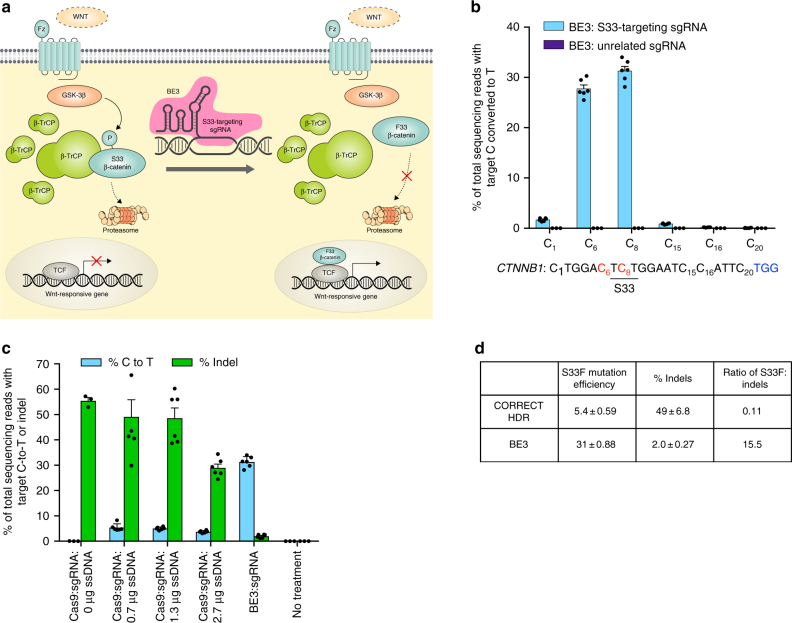
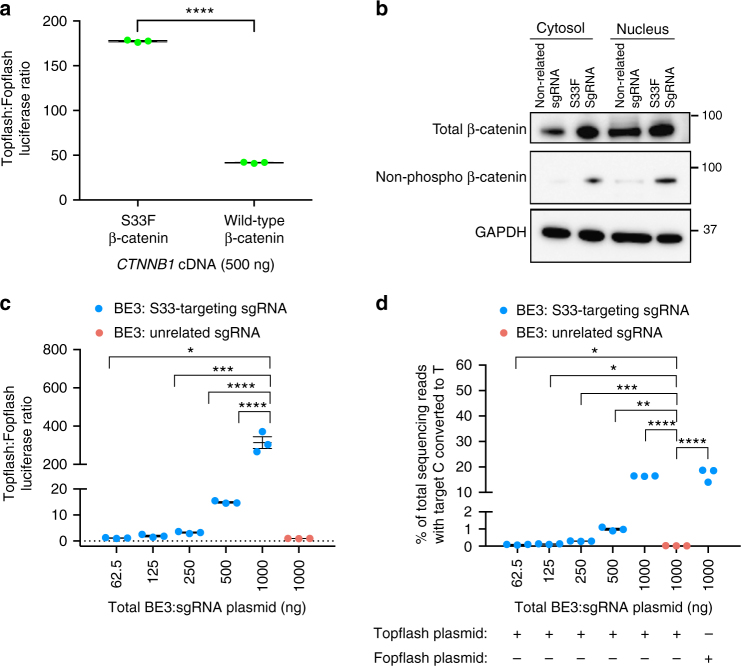
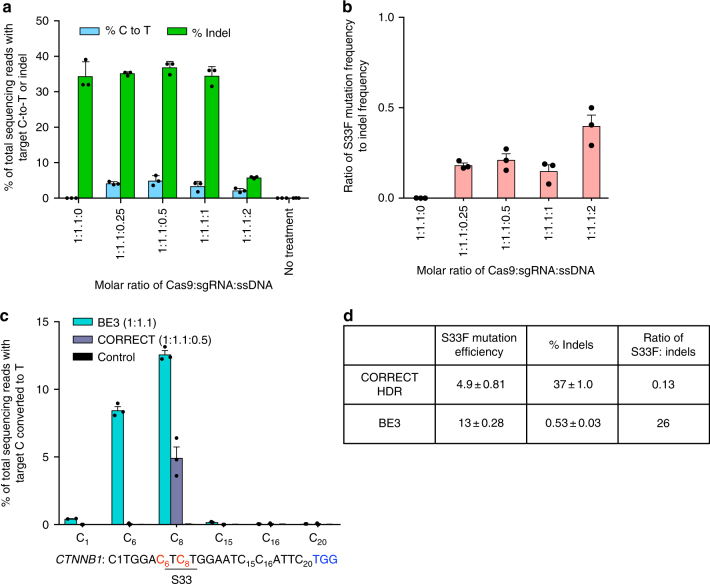
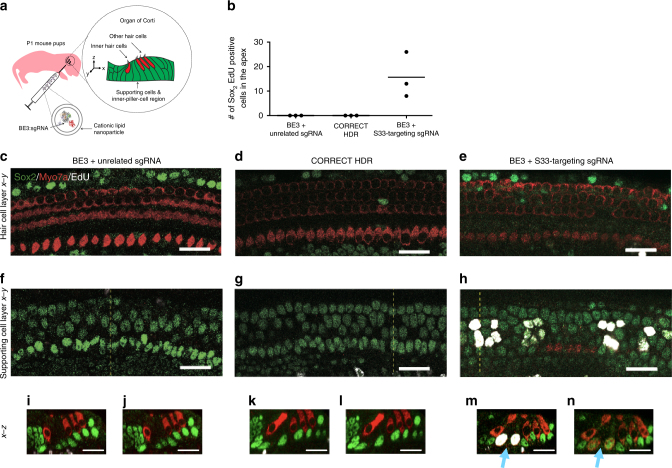
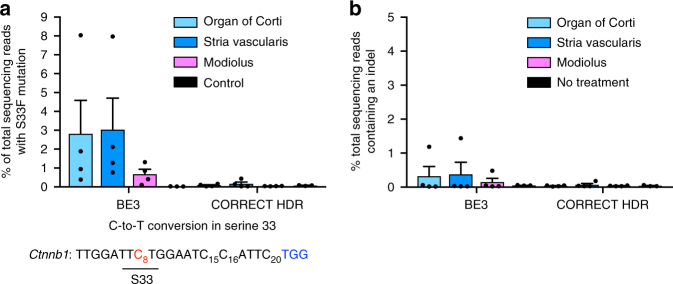
Programmable nucleases can introduce precise changes to genomic DNA through homology-directed repair (HDR). Unfortunately, HDR is largely restricted to mitotic cells, and is typically accompanied by an excess of stochastic insertions and deletions (indels). Here we present an in vivo base editing strategy that addresses these limitations. We use nuclease-free base editing to install a S33F mutation in β-catenin that blocks β-catenin phosphorylation, impedes β-catenin degradation, and upregulates Wnt signaling. In vitro, base editing installs the S33F mutation with a 200-fold higher editing:indel ratio than HDR. In post-mitotic cells in mouse inner ear, injection of base editor protein:RNA:lipid installs this mutation, resulting in Wnt activation that induces mitosis of cochlear supporting cells and cellular reprogramming. In contrast, injection of HDR agents does not induce Wnt upregulation. These results establish a strategy for modifying posttranslational states in signaling pathways, and an approach to precision editing in post-mitotic tissues.
Overview
The claims and statistics of this paper haven’t been checked yet.
Free: it reads the open-access text and checks the first 5 claims that cite a source we can check. Create a free account to check every claim.
Integrity signals
Registry
Cites
Statistics
Figures
Verification
Claims the paper makes
The claims and statistics of this paper haven’t been checked yet.
Free: it reads the open-access text and checks the first 5 claims that cite a source we can check. Create a free account to check every claim.
Claims other papers make about this one
Each is checked against this paper’s own text: does it say what the citing paper says it does?
The cited source says what the claim attributes to it.
In the citing paper
“For example, lipid-mediated nanoparticle (LNP) delivery has been used to transport CRISPR-Cas components in the form of either mRNA/sgRNA or preassembled RNPs into tissues 71-74 .”
From The promise and challenge of therapeutic genome editing (2020) · cites this paper as [73]
Self-check
Percentages, sums and reported differences re-computed from the paper’s own numbers.
The self-check needs the paper’s full text.
Citations
Cites
Genome engineering using the CRISPR-Cas9 system
Ran, F. A., Hsu, P. D., Wright, J., Agarwala, V., Scott, D. A., & Zhang, F. (2013) · Nature Protocols · doi:10.1038/nprot.2013.143 · Cited by 11,133
The new frontier of genome engineering with CRISPR-Cas9
Doudna, J. A., & Charpentier, E. (2014) · Science · doi:10.1126/science.1258096 · Cited by 7,062
Wnt/β-Catenin Signaling: Components, Mechanisms, and Diseases
MacDonald, B. T., Tamai, K., & He, X. (2009) · Developmental Cell · doi:10.1016/j.devcel.2009.06.016 · Cited by 5,583
Programmable editing of a target base in genomic DNA without double-stranded DNA cleavage
Komor, A. C., Kim, Y. B., Packer, M. S., Zuris, J. A., & Liu, D. R. (2016) · Nature · doi:10.1038/nature17946 · Cited by 5,437
Self-citationProgrammable base editing of A•T to G•C in genomic DNA without DNA cleavage
Gaudelli, N. M., Komor, A. C., Rees, H. A., Packer, M. S., Badran, A. H., Bryson, D. I., & Liu, D. R. (2017) · Nature · doi:10.1038/nature24644 · Cited by 4,184
Self-citationHigh-Frequency off-Target Mutagenesis Induced by CRISPR-Cas Nucleases in Human Cells
Fu, Y., Foden, J. A., Khayter, C., Maeder, M. L., Reyon, D., Joung, J. K., & Sander, J. D. (2013) · Nature Biotechnology · doi:10.1038/nbt.2623 · Cited by 3,292
Polakis, P. (2000) · Genes & Development · doi:10.1101/gad.14.15.1837 · Cited by 3,183
CRISPR-Cas systems for editing, regulating and targeting genomes
Sander, J. D., & Joung, J. K. (2014) · Nature Biotechnology · doi:10.1038/nbt.2842 · Cited by 3,153
GUIDE-seq enables genome-wide profiling of off-target cleavage by CRISPR-Cas nucleases
Tsai, S. Q., Zheng, Z., Nguyen, N. T., Liebers, M., Topkar, V. V., Thapar, V., Wyvekens, N., Khayter, C., Iafrate, A. J., Le, L. P., et al. (2015) · Nature Biotechnology · doi:10.1038/nbt.3117 · Cited by 2,268
Control of β-Catenin Phosphorylation/Degradation by a Dual-Kinase Mechanism
Liu, C., Li, Y., Semenov, M., Han, C., Baeg, G.-H., Tan, Y., Zhang, Z., Lin, X., & He, X. (2002) · Cell · doi:10.1016/s0092-8674(02)00685-2 · Cited by 2,069
Research works printed but not linked: 1
- Chadwick AC Wang X Musunuru K In vivo base editing of PCSK9 (proprotein convertase subtilisin/Kexin Type 9) as a therapeutic alternative to genome editing Arterioscler. Thromb. Vasc. Biol. 2017 37 1741 10.1161/ATVBAHA.117.309881 28751571 PMC5570639 · DOI · Paper page
Cited by
Items 201–240 of 240
Prospects for using gene therapy drugs in the treatment of cystic fibrosis
Demidova, A. D., & Zavadskiy, S. P. (2025) · Farmacevticheskoe delo i tehnologija lekarstv (Pharmacy and Pharmaceutical Technology) · doi:10.33920/med-13-2501-04
Brookhouser, N., Nguyen, T., Tekel, S. J., Standage-Beier, K., Wang, X., & Brafman, D. A. (2020) · Figshare · doi:10.6084/m9.figshare.13467917
Brookhouser, N., Nguyen, T., Tekel, S. J., Standage-Beier, K., Wang, X., & Brafman, D. A. (2020) · Figshare · doi:10.6084/m9.figshare.13467891
Brookhouser, N., Nguyen, T., Tekel, S. J., Standage-Beier, K., Wang, X., & Brafman, D. A. (2020) · Figshare · doi:10.6084/m9.figshare.13467897
Brookhouser, N., Nguyen, T., Tekel, S. J., Standage-Beier, K., Wang, X., & Brafman, D. A. (2020) · Figshare · doi:10.6084/m9.figshare.13467923
Brookhouser, N., Nguyen, T., Tekel, S. J., Standage-Beier, K., Wang, X., & Brafman, D. A. (2020) · Figshare · doi:10.6084/m9.figshare.13467929
Brookhouser, N., Nguyen, T., Tekel, S. J., Standage-Beier, K., Wang, X., & Brafman, D. A. (2020) · Figshare · doi:10.6084/m9.figshare.13467927
Brookhouser, N., Nguyen, T., Tekel, S. J., Standage-Beier, K., Wang, X., & Brafman, D. A. (2020) · Figshare · doi:10.6084/m9.figshare.13467913
Brookhouser, N., Nguyen, T., Tekel, S. J., Standage-Beier, K., Wang, X., & Brafman, D. A. (2020) · Figshare · doi:10.6084/m9.figshare.13467919
Brookhouser, N., Nguyen, T., Tekel, S. J., Standage-Beier, K., Wang, X., & Brafman, D. A. (2020) · Figshare · doi:10.6084/m9.figshare.13467901
Brookhouser, N., Nguyen, T., Tekel, S. J., Standage-Beier, K., Wang, X., & Brafman, D. A. (2020) · Figshare · doi:10.6084/m9.figshare.13467905
Brookhouser, N., Nguyen, T., Tekel, S. J., Standage-Beier, K., Wang, X., & Brafman, D. A. (2020) · Figshare · doi:10.6084/m9.figshare.13467909
Brookhouser, N., Nguyen, T., Tekel, S. J., Standage-Beier, K., Wang, X., & Brafman, D. A. (2020) · Figshare · doi:10.6084/m9.figshare.13467889
Brookhouser, N., Nguyen, T., Tekel, S. J., Standage-Beier, K., Wang, X., & Brafman, D. A. (2020) · Figshare · doi:10.6084/m9.figshare.13467893
Brookhouser, N., Nguyen, T., Tekel, S. J., Standage-Beier, K., Wang, X., & Brafman, D. A. (2020) · Figshare · doi:10.6084/m9.figshare.13467925
Brookhouser, N., Nguyen, T., Tekel, S. J., Standage-Beier, K., Wang, X., & Brafman, D. A. (2020) · Figshare · doi:10.6084/m9.figshare.13467887
Brookhouser, N., Nguyen, T., Tekel, S. J., Standage-Beier, K., Wang, X., & Brafman, D. A. (2020) · Figshare · doi:10.6084/m9.figshare.13467907
Brookhouser, N., Nguyen, T., Tekel, S. J., Standage-Beier, K., Wang, X., & Brafman, D. A. (2020) · Figshare · doi:10.6084/m9.figshare.13467931
Brookhouser, N., Nguyen, T., Tekel, S. J., Standage-Beier, K., Wang, X., & Brafman, D. A. (2020) · Figshare · doi:10.6084/m9.figshare.13467899
Brookhouser, N., Nguyen, T., Tekel, S. J., Standage-Beier, K., Wang, X., & Brafman, D. A. (2020) · Figshare · doi:10.6084/m9.figshare.13467921
Brookhouser, N., Nguyen, T., Tekel, S. J., Standage-Beier, K., Wang, X., & Brafman, D. A. (2020) · Figshare · doi:10.6084/m9.figshare.13467895
Brookhouser, N., Nguyen, T., Tekel, S. J., Standage-Beier, K., Wang, X., & Brafman, D. A. (2020) · Figshare · doi:10.6084/m9.figshare.13467911
Brookhouser, N., Nguyen, T., Tekel, S. J., Standage-Beier, K., Wang, X., & Brafman, D. A. (2020) · Figshare · doi:10.6084/m9.figshare.13467903
Investigations into the Cellular Mechanisms of Base Editing
Burnett, C. A. (2023) · eScholarship (California Digital Library)
Relatórios de Estágio e Monografia intitulada "Edição de Bases: o futuro da edição de genes?
Fernandes, I. M. D. S. (2020) · Portuguese National Funding Agency for Science, Research and Technology (RCAAP Project by FCT)
Identification and inactivation of cancer driver mutations using the CRISPR-Cas9 system
Sayed, S. (2020) · Qucosa (Saxon State and University Library Dresden)
Studying the Sequence Recognition Properties of Base Editing Enzymes
Ranzau, B. L. (2023) · eScholarship (California Digital Library)
Smith, C. L. (2025) · Digital Access to Scholarship at Harvard (DASH) (Harvard University)
Base editing approaches for the treatment of β-hemoglobinopathies
Antoniou, P. (2021) · theses.fr (ABES) · doi:10.70675/c4dddb32zf8aez4bc3z8cf8zce9a4e808265
Immunosénescence, inflammation et immunothérapies
Naigeon, M. (2022) · theses.fr (ABES) · doi:10.70675/f0b0b5e9zc57dz4931z82c0z1510abbc8c2c
Baldini, C. (2024) · theses.fr (ABES) · doi:10.70675/bdae243bz3d0fz496bz8a91zd8830398a17c
Kumar, S. (2026) · Springer eBooks · doi:10.1007/978-981-95-7688-3_6
APOE Gene Editing as a Therapeutic Target Toward Precision Medicine in AD
Teter, B., Campagna, J. J., Spilman, P., & John, V. (2026) · Springer eBooks · doi:10.1007/978-3-031-96089-5_73
Mondal, S., & Kumari, K. (2026) · Advanced International Journal for Research · doi:10.63363/aijfr.2026.v07i04.7111
Twin-prime editing enables endogenous protein visualization and mutant allele trackingPreprint
Menéndez, A., Ramos, C., & Pons, S. (2026) · bioRxiv (Cold Spring Harbor Laboratory) · doi:10.64898/2026.09.21.753164
Valeri, E. (n.d.) · Archivio Istituzionale della Ricerca - Università Vita-Salute San Raffaele
Thamaraiselvi, V., Prashanth, K. S., Ezhilarasi, T., Thiyagarajan, C., Ramasamy, S., Muthamilarasan, M., & Ravikesavan, R. (2026) · The Nucleus · doi:10.1007/s13237-026-00714-x
Intership reports and monograph entitled "Base editing: the future of gene editing?"
Fernandes, I. M. D. S. (2020) · Portuguese National Funding Agency for Science, Research and Technology (RCAAP Project by FCT)
Marei, H. E. S. (2026) · Neuroscience Bulletin · doi:10.1007/s12264-026-01731-1
Sharma, S. K., Gupta, O. P., Pathaw, N., Sharma, D., Maibam, A., Sharma, P., Sanasam, J., Karkute, S. G., Kumar, S., & Bhattacharjee, B. (2021) · doi:10.3389/fnut.2021.751512.s001
Metadata
- Authors
- Yeh, W.-H., Chiang, H., Rees, H. A., Edge, A. S. B., & Liu, D. R.
- Affiliations
- Broad Institute (US)
- Massachusetts Eye and Ear Infirmary (US)
- Corresponding author
- Edge, Albert S. B.
- Liu, David R.
- Venue
- Nature Communications
- Published
- 2018-06-05
- Volume
- 9
- Issue
- 1
- Pages
- 2184-2184
- ISSN
- 2041-1723 (ISSN-L)
- PMC
- PMC5988727
- OpenAlex
- W2805743335
- Cited by
- 225
- References
- 60
- Citations by year
- 2026: 11 · 2025: 10 · 2024: 20 · 2023: 26 · 2022: 18 · 2021: 39 · 2020: 67 · 2019: 27 · 2018: 7
- FWCI
- 12.54
- Type
- journal article
- Language
- en
- Open access
- gold
- doi.org
- Licence
- cc-by
- creativecommons.org/licenses/by/4.0 (tdm)
- creativecommons.org/licenses/by/4.0 (vor)
- Locations
- Nature Communications (publishedVersion, cc-by)
- Europe PMC (PubMed Central) (publishedVersion, cc-by)
- PubMed Central (publishedVersion, cc-by)
- PubMed (publishedVersion)
- Digital Access to Scholarship at Harvard (DASH) (Harvard University) (submittedVersion, cc-by)
- RePEc: Research Papers in Economics (submittedVersion)
- DOAJ (DOAJ: Directory of Open Access Journals) (submittedVersion, cc-by-sa)
- DOAJ (DOAJ: Directory of Open Access Journals) (submittedVersion)
- Funders
- Howard Hughes Medical Institute
- Harvard University
- Shulsky Foundation
- National Institutes of Health (NIH-R01, HR0011-17-2-0049)
- Defense Advanced Research Projects Agency (HR0011, HR0011-17-2-0049)
- National Human Genome Research Institute (RM1HG009490)
- National Institute on Deafness and Other Communication Disorders (R01DC014089, R01DC007174)
- National Institute of General Medical Sciences (R35GM118062)
- National Institute of Biomedical Imaging and Bioengineering (R01EB022376)
- Topics
- Life Sciences › Biochemistry, Genetics and Molecular Biology › Molecular Biology › CRISPR and Genetic Engineering
- Life Sciences › Biochemistry, Genetics and Molecular Biology › Molecular Biology › RNA regulation and disease
- Life Sciences › Neuroscience › Sensory Systems › Hearing, Cochlea, Tinnitus, Genetics
- Keywords
- postmitotic cells, Wnt signaling, homology-directed repair, inner ear, cochlear supporting cells, cellular reprogramming, post-translational modification, precision genome editing
- MeSH terms
- Animals, Hair Cells, Auditory, Inner, Humans, Mice, Transgenic, Mitosis, Mutation, Mice, Knockout, NIH 3T3 Cells, beta Catenin, Mice, DNA Breaks, Double-Stranded, HEK293 Cells, Recombinational DNA Repair, Wnt Signaling Pathway
About these checks
Registry, retraction, Cites and statistics results are computed, not judged, with one exception: a printed reference that no index lists is read once by a model before it counts as a citation error. Claims are extracted by a model and kept only when their quote appears verbatim in the text; each cited source is then checked, with a model’s help, for whether it says what the claim relies on. Those verdicts can be wrong — read the claim’s quote and the cited source before relying on one.
Statistics and arithmetic are recomputed, not judged.
Confidence bands are shown only for fields calibrated on our annotated test set. None is calibrated yet, so no band is shown.
What counts as a claim ›How we measure confidence ›How we check this ›
Are you an author, or do you see a problem with this page? Request a review
Data sources
Bibliographic data: Semantic Scholar, OpenAlex, Crossref.
Contains information from the Semantic Scholar Academic Graph Datasets, made available under the ODC Attribution License (ODC-BY 1.0).
Semantic Scholar’s data is described in: Kinney, R., et al. (2023). The Semantic Scholar Open Data Platform. arXiv:2301.10140.
