

In vivo base editing of post-mitotic sensory cells
Open accessThe DOI matches its Crossref record; 60 of the 60 references it cites were found in a registry or an index.
Abstract
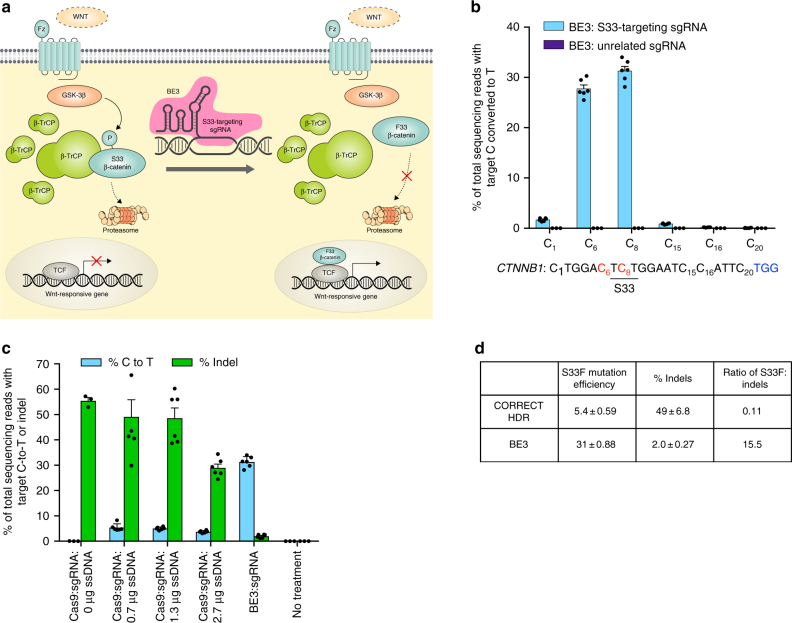
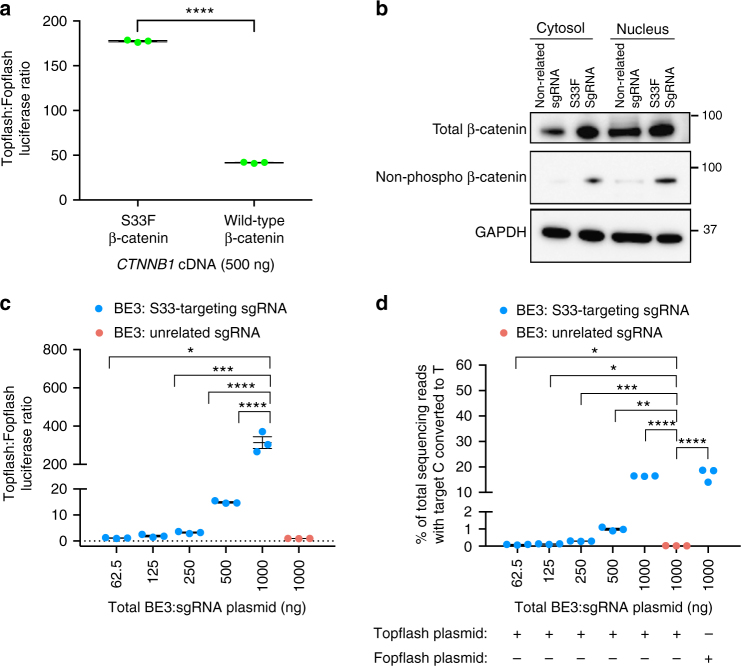
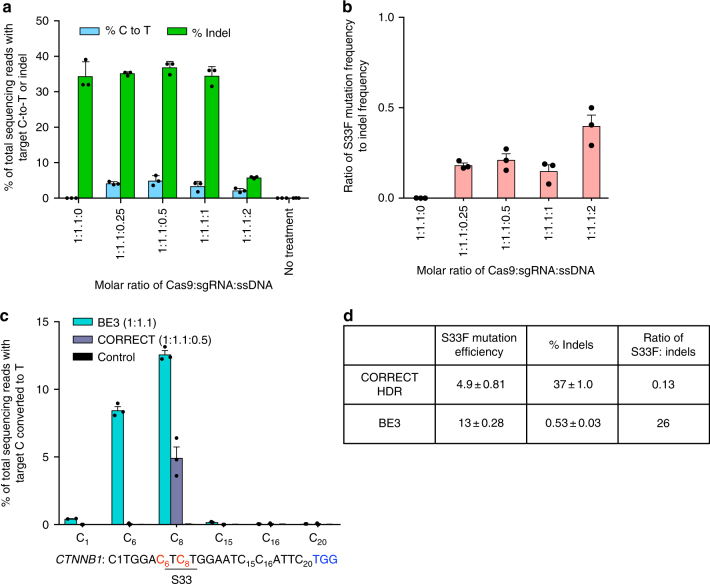
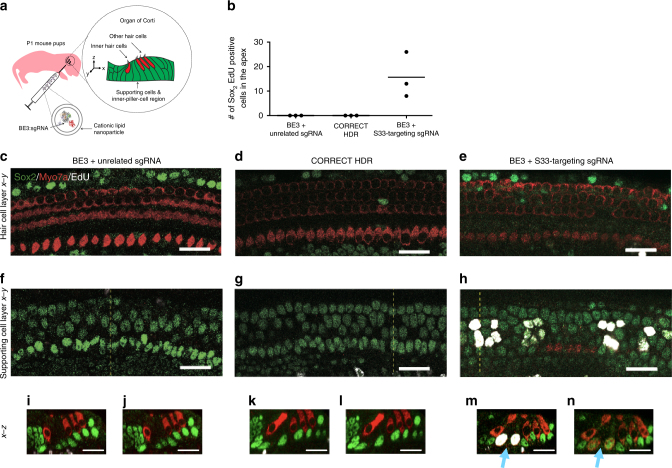
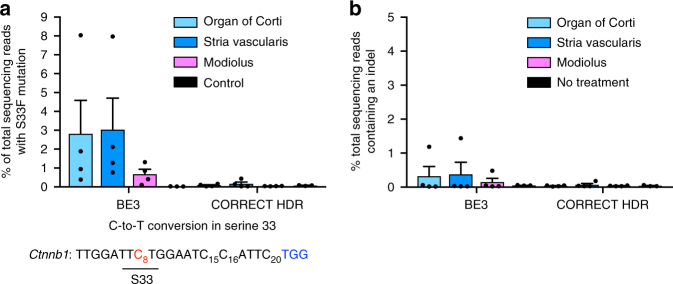
Programmable nucleases can introduce precise changes to genomic DNA through homology-directed repair (HDR). Unfortunately, HDR is largely restricted to mitotic cells, and is typically accompanied by an excess of stochastic insertions and deletions (indels). Here we present an in vivo base editing strategy that addresses these limitations. We use nuclease-free base editing to install a S33F mutation in β-catenin that blocks β-catenin phosphorylation, impedes β-catenin degradation, and upregulates Wnt signaling. In vitro, base editing installs the S33F mutation with a 200-fold higher editing:indel ratio than HDR. In post-mitotic cells in mouse inner ear, injection of base editor protein:RNA:lipid installs this mutation, resulting in Wnt activation that induces mitosis of cochlear supporting cells and cellular reprogramming. In contrast, injection of HDR agents does not induce Wnt upregulation. These results establish a strategy for modifying posttranslational states in signaling pathways, and an approach to precision editing in post-mitotic tissues.
Overview
The claims and statistics of this paper haven’t been checked yet.
Free: it reads the open-access text and checks the first 5 claims that cite a source we can check. Create a free account to check every claim.
Integrity signals
Registry
Cites
Statistics
Figures
Verification
Claims the paper makes
The claims and statistics of this paper haven’t been checked yet.
Free: it reads the open-access text and checks the first 5 claims that cite a source we can check. Create a free account to check every claim.
Claims other papers make about this one
Each is checked against this paper’s own text: does it say what the citing paper says it does?
The cited source says what the claim attributes to it.
In the citing paper
“For example, lipid-mediated nanoparticle (LNP) delivery has been used to transport CRISPR-Cas components in the form of either mRNA/sgRNA or preassembled RNPs into tissues 71-74 .”
From The promise and challenge of therapeutic genome editing (2020) · cites this paper as [73]
Self-check
Percentages, sums and reported differences re-computed from the paper’s own numbers.
The self-check needs the paper’s full text.
Citations
Cites
Genome engineering using the CRISPR-Cas9 system
Ran, F. A., Hsu, P. D., Wright, J., Agarwala, V., Scott, D. A., & Zhang, F. (2013) · Nature Protocols · doi:10.1038/nprot.2013.143 · Cited by 11,133
The new frontier of genome engineering with CRISPR-Cas9
Doudna, J. A., & Charpentier, E. (2014) · Science · doi:10.1126/science.1258096 · Cited by 7,062
Wnt/β-Catenin Signaling: Components, Mechanisms, and Diseases
MacDonald, B. T., Tamai, K., & He, X. (2009) · Developmental Cell · doi:10.1016/j.devcel.2009.06.016 · Cited by 5,583
Programmable editing of a target base in genomic DNA without double-stranded DNA cleavage
Komor, A. C., Kim, Y. B., Packer, M. S., Zuris, J. A., & Liu, D. R. (2016) · Nature · doi:10.1038/nature17946 · Cited by 5,437
Self-citationProgrammable base editing of A•T to G•C in genomic DNA without DNA cleavage
Gaudelli, N. M., Komor, A. C., Rees, H. A., Packer, M. S., Badran, A. H., Bryson, D. I., & Liu, D. R. (2017) · Nature · doi:10.1038/nature24644 · Cited by 4,184
Self-citationHigh-Frequency off-Target Mutagenesis Induced by CRISPR-Cas Nucleases in Human Cells
Fu, Y., Foden, J. A., Khayter, C., Maeder, M. L., Reyon, D., Joung, J. K., & Sander, J. D. (2013) · Nature Biotechnology · doi:10.1038/nbt.2623 · Cited by 3,292
Polakis, P. (2000) · Genes & Development · doi:10.1101/gad.14.15.1837 · Cited by 3,183
CRISPR-Cas systems for editing, regulating and targeting genomes
Sander, J. D., & Joung, J. K. (2014) · Nature Biotechnology · doi:10.1038/nbt.2842 · Cited by 3,153
GUIDE-seq enables genome-wide profiling of off-target cleavage by CRISPR-Cas nucleases
Tsai, S. Q., Zheng, Z., Nguyen, N. T., Liebers, M., Topkar, V. V., Thapar, V., Wyvekens, N., Khayter, C., Iafrate, A. J., Le, L. P., et al. (2015) · Nature Biotechnology · doi:10.1038/nbt.3117 · Cited by 2,268
Control of β-Catenin Phosphorylation/Degradation by a Dual-Kinase Mechanism
Liu, C., Li, Y., Semenov, M., Han, C., Baeg, G.-H., Tan, Y., Zhang, Z., Lin, X., & He, X. (2002) · Cell · doi:10.1016/s0092-8674(02)00685-2 · Cited by 2,069
Research works printed but not linked: 1
- Chadwick AC Wang X Musunuru K In vivo base editing of PCSK9 (proprotein convertase subtilisin/Kexin Type 9) as a therapeutic alternative to genome editing Arterioscler. Thromb. Vasc. Biol. 2017 37 1741 10.1161/ATVBAHA.117.309881 28751571 PMC5570639 · DOI · Paper page
Cited by
Genome editing with CRISPR–Cas nucleases, base editors, transposases and prime editors
Anzalone, A. V., Koblan, L. W., & Liu, D. R. (2020) · Nature Biotechnology · doi:10.1038/s41587-020-0561-9 · Cited by 2,237
Self-citationBase editing: precision chemistry on the genome and transcriptome of living cells
Rees, H. A., & Liu, D. R. (2018) · Nature Reviews Genetics · doi:10.1038/s41576-018-0059-1 · Cited by 1,675
Self-citationThe promise and challenge of therapeutic genome editing
Doudna, J. A. (2020) · Nature · doi:10.1038/s41586-020-1978-5 · Cited by 1,126
CRISPR technology: A decade of genome editing is only the beginning
Wang, J. Y., & Doudna, J. A. (2023) · Science · doi:10.1126/science.add8643 · Cited by 1,049
Richter, M. F., Zhao, K. T., Eton, E., Lapinaite, A., Newby, G. A., Thuronyi, B. W., Wilson, C., Koblan, L. W., Zeng, J., Bauer, D. E., et al. (2020) · Nature Biotechnology · doi:10.1038/s41587-020-0453-z · Cited by 1,020
“For the first 12 hours, gene III was expressed by the addition of anhydrotetracycline to enable genetic drift in the absence of selection pressure 12,13 .”
Self-citationEngineered Virus-like Particles for Efficient in Vivo Delivery of Therapeutic Proteins
Banskota, S., Raguram, A., Suh, S., Du, S. W., Davis, J. R., Choi, E. H., Wang, X., Nielsen, S. C., Newby, G. A., Randolph, P. B., et al. (2022) · Cell · doi:10.1016/j.cell.2021.12.021 · Cited by 668
“In contrast, transient eVLP-mediated delivery of BE RNPs greatly reduces the opportunity for off-target editing, as we showed both in vitro and in vivo (Figures 3G, 3H, and 6D).”
BackgroundResultSelf-citationBock, C., Datlinger, P., Chardon, F., Coelho, M. A., Dong, M. B., Lawson, K. A., Lu, T., Maroc, L., Norman, T. M., Song, B., et al. (2022) · Nature Reviews Methods Primers · doi:10.1038/s43586-021-00093-4 · Cited by 571
CRISPR-Based Therapeutic Genome Editing: Strategies and In Vivo Delivery by AAV Vectors
Wang, D., Zhang, F., & Gao, G. (2020) · Cell · doi:10.1016/j.cell.2020.03.023 · Cited by 527
Directed evolution of adenine base editors with increased activity and therapeutic application
Gaudelli, N. M., Lam, D. K., Rees, H. A., Solá-Esteves, N. M., Barrera, L. A., Born, D. A., Edwards, A., Gehrke, J. M., Lee, S.-J., Liquori, A. J., et al. (2020) · Nature Biotechnology · doi:10.1038/s41587-020-0491-6 · Cited by 524
Self-citationTherapeutic in vivo delivery of gene editing agents
Raguram, A., Banskota, S., & Liu, D. R. (2022) · Cell · doi:10.1016/j.cell.2022.03.045 · Cited by 522
Self-citationLevy, J. M., Yeh, W.-H., Pendse, N., Davis, J. R., Hennessey, E., Butcher, R., Koblan, L. W., Comander, J., Liu, Q., & Liu, D. R. (2020) · Nature Biomedical Engineering · doi:10.1038/s41551-019-0501-5 · Cited by 477
Self-citationBase editing: advances and therapeutic opportunities
Porto, E. M., Komor, A. C., Slaymaker, I. M., & Yeo, G. W. (2020) · Nature Reviews Drug Discovery · doi:10.1038/s41573-020-0084-6 · Cited by 476
CRISPR-Cas9 DNA Base-Editing and Prime-Editing
Kantor, A., McClements, M., & MacLaren, R. (2020) · International Journal of Molecular Sciences · doi:10.3390/ijms21176240 · Cited by 462
Precise plant genome editing using base editors and prime editors
Molla, K. A., Sretenovic, S., Bansal, K. C., & Qi, Y. (2021) · Nature Plants · doi:10.1038/s41477-021-00991-1 · Cited by 387
In vivo adenine base editing of PCSK9 in macaques reduces LDL cholesterol levels
Rothgangl, T., Dennis, M. K., Lin, P. J. C., Oka, R., Witzigmann, D., Villiger, L., Qi, W., Hruzova, M., Kissling, L., Lenggenhager, D., et al. (2021) · Nature Biotechnology · doi:10.1038/s41587-021-00933-4 · Cited by 378
Manghwar, H., Li, B., Ding, X., Hussain, A., Lindsey, K., Zhang, X., & Jin, S. (2020) · Advanced Science · doi:10.1002/advs.201902312 · Cited by 347
CRISPR/Cas-Mediated Base Editing: Technical Considerations and Practical Applications
Molla, K. A., & Yang, Y. (2019) · Trends in Biotechnology · doi:10.1016/j.tibtech.2019.03.008 · Cited by 331
Massively parallel assessment of human variants with base editor screens
Hanna, R. E., Hegde, M., Fagre, C. R., DeWeirdt, P. C., Sangree, A. K., Szegletes, Z., Griffith, A., Feeley, M. N., Sanson, K. R., Baidi, Y., et al. (2021) · Cell · doi:10.1016/j.cell.2021.01.012 · Cited by 316
Self-citationThe delivery challenge: fulfilling the promise of therapeutic genome editing
van Haasteren, J., Li, J., Scheideler, O. J., Murthy, N., & Schaffer, D. V. (2020) · Nature Biotechnology · doi:10.1038/s41587-020-0565-5 · Cited by 285
Analysis and minimization of cellular RNA editing by DNA adenine base editors
Rees, H. A., Wilson, C., Doman, J. L., & Liu, D. R. (2019) · Science Advances · doi:10.1126/sciadv.aax5717 · Cited by 282
Self-citation(2022) · Nature Reviews Methods Primers · doi:10.1038/s43586-022-00098-7 · Cited by 250
Functional interrogation of DNA damage response variants with base editing screens
Cuella-Martin, R., Hayward, S. B., Fan, X., Chen, X., Huang, J.-W., Taglialatela, A., Leuzzi, G., Zhao, J., Rabadan, R., Lu, C., et al. (2021) · Cell · doi:10.1016/j.cell.2021.01.041 · Cited by 241
DNA storage: research landscape and future prospects
Dong, Y., Sun, F., Ping, Z., Ouyang, Q., & Qian, L. (2020) · National Science Review · doi:10.1093/nsr/nwaa007 · Cited by 225
Treatment of a Mouse Model of ALS by In Vivo Base Editing
Lim, C. K. W., Gapinske, M., Brooks, A. K., Woods, W. S., Powell, J. E., Zeballos C., M. A., Winter, J., Perez-Pinera, P., & Gaj, T. (2020) · Molecular Therapy · doi:10.1016/j.ymthe.2020.01.005 · Cited by 222
CRISPR-based genome editing through the lens of DNA repair
Nambiar, T. S., Baudrier, L., Billon, P., & Ciccia, A. (2022) · Molecular Cell · doi:10.1016/j.molcel.2021.12.026 · Cited by 208
In vivo somatic cell base editing and prime editing
Newby, G. A., & Liu, D. R. (2021) · Molecular Therapy · doi:10.1016/j.ymthe.2021.09.002 · Cited by 199
Self-citationGene editing and CRISPR in the clinic: current and future perspectives
Hirakawa, M. P., Krishnakumar, R., Timlin, J. A., Carney, J. P., & Butler, K. S. (2020) · Bioscience Reports · doi:10.1042/bsr20200127 · Cited by 192
“embryos (22, 49, 62, 93, 213-219), which is extremely promising for therapeutic applications.”
BackgroundPrecision genome editing using cytosine and adenine base editors in mammalian cells
Huang, T. P., Newby, G. A., & Liu, D. R. (2021) · Nature Protocols · doi:10.1038/s41596-020-00450-9 · Cited by 175
Self-citationApplications and challenges of CRISPR-Cas gene-editing to disease treatment in clinics
Liu, W., Li, L., Jiang, J., Wu, M., & Lin, P. (2021) · Precision Clinical Medicine · doi:10.1093/pcmedi/pbab014 · Cited by 175
Current Status and Challenges of DNA Base Editing Tools
Jeong, Y. K., Song, B., & Bae, S. (2020) · Molecular Therapy · doi:10.1016/j.ymthe.2020.07.021 · Cited by 166
Deafness: from genetic architecture to gene therapy
Petit, C., Bonnet, C., & Safieddine, S. (2023) · Nature Reviews Genetics · doi:10.1038/s41576-023-00597-7 · Cited by 155
Base editing rescue of spinal muscular atrophy in cells and in mice
Arbab, M., Matuszek, Z., Kray, K. M., Du, A., Newby, G. A., Blatnik, A. J., Raguram, A., Richter, M. F., Zhao, K. T., Levy, J. M., et al. (2023) · Science · doi:10.1126/science.adg6518 · Cited by 139
Self-citationThe NIH Somatic Cell Genome Editing program
The SCGE Consortium, Saha, K., Sontheimer, E. J., Brooks, P. J., Dwinell, M. R., Gersbach, C. A., Liu, D. R., Murray, S. A., Tsai, S. Q., Wilson, R. C., et al. (2021) · Nature · doi:10.1038/s41586-021-03191-1 · Cited by 125
Self-citationProgrammable gene insertion in human cells with a laboratory-evolved CRISPR-associated transposase
Witte, I. P., Lampe, G. D., Eitzinger, S., Miller, S. M., Berríos, K. N., McElroy, A. N., King, R. T., Stringham, O. G., Gelsinger, D. R., Vo, P. L. H., et al. (2025) · Science · doi:10.1126/science.adt5199 · Cited by 125
Self-citationChemical modifications of adenine base editor mRNA and guide RNA expand its application scope
Jiang, T., Henderson, J. M., Coote, K., Cheng, Y., Valley, H. C., Zhang, X.-O., Wang, Q., Rhym, L. H., Cao, Y., Newby, G. A., et al. (2020) · Nature Communications · doi:10.1038/s41467-020-15892-8 · Cited by 108
Self-citationHołubowicz, R., Du, S. W., Felgner, J. H., Šmidák, R., Choi, E. H., Palczewska, G., Menezes, C. R., Dong, Z., Gao, F., Medani, O., et al. (2024) · Nature Biomedical Engineering · doi:10.1038/s41551-024-01296-2 · Cited by 120
Self-citationLentiviral and genome-editing strategies for the treatment of β-hemoglobinopathies
Magrin, E., Miccio, A., & Cavazzana, M. (2019) · Blood · doi:10.1182/blood.2019000949 · Cited by 117
Huang, K.-C., Wang, M.-L., Chen, S.-J., Kuo, J.-C., Wang, W.-J., Nhi Nguyen, P. N., Wahlin, K. J., Lu, J.-F., Tran, A. A., Shi, M., et al. (2019) · Stem Cell Reports · doi:10.1016/j.stemcr.2019.09.010 · Cited by 101
Next-Generation CRISPR Technologies and Their Applications in Gene and Cell Therapy
Zeballos C., M. A., & Gaj, T. (2021) · Trends in Biotechnology · doi:10.1016/j.tibtech.2020.10.010 · Cited by 94
Precise genome-editing in human diseases: mechanisms, strategies and applications
Zheng, Y., Li, Y., Zhou, K., Li, T., VanDusen, N. J., & Hua, Y. (2024) · Signal Transduction and Targeted Therapy · doi:10.1038/s41392-024-01750-2 · Cited by 107
Osborn, M. J., Newby, G. A., McElroy, A. N., Knipping, F., Nielsen, S. C., Riddle, M. J., Xia, L., Chen, W., Eide, C. R., Webber, B. R., et al. (2019) · Journal of Investigative Dermatology · doi:10.1016/j.jid.2019.07.701 · Cited by 101
Self-citationBase and Prime Editing Technologies for Blood Disorders
Antoniou, P., Miccio, A., & Brusson, M. (2021) · Frontiers in Genome Editing · doi:10.3389/fgeed.2021.618406 · Cited by 84
Off-Target Editing by CRISPR-Guided DNA Base Editors
Park, S., & Beal, P. A. (2019) · Biochemistry · doi:10.1021/acs.biochem.9b00573 · Cited by 97
High-purity production and precise editing of DNA base editing ribonucleoproteins
Jang, H.-K., Jo, D. H., Lee, S.-N., Cho, C. S., Jeong, Y. K., Jung, Y., Yu, J., Kim, J. H., Woo, J.-S., & Bae, S. (2021) · Science Advances · doi:10.1126/sciadv.abg2661 · Cited by 93
“Unlike the situation with ABE, the therapeutic potential of CBE RNP delivery has been demonstrated in vivo (12, 42) and ex vivo (13).”
BackgroundTargeting fidelity of adenine and cytosine base editors in mouse embryos
Lee, H. K., Willi, M., Miller, S. M., Kim, S., Liu, C., Liu, D. R., & Hennighausen, L. (2018) · Nature Communications · doi:10.1038/s41467-018-07322-7 · Cited by 85
Self-citationDevelopment and Application of Base Editors
Yang, B., Yang, L., & Chen, J. (2019) · The CRISPR Journal · doi:10.1089/crispr.2019.0001 · Cited by 85
New molecular therapies for the treatment of hearing loss
Ma, Y., Wise, A. K., Shepherd, R. K., & Richardson, R. T. (2019) · Pharmacology & Therapeutics · doi:10.1016/j.pharmthera.2019.05.003 · Cited by 91
Xu, W., Zhang, S., Qin, H., & Yao, K. (2024) · Journal of Translational Medicine · doi:10.1186/s12967-024-05957-3 · Cited by 85
Roccio, M., & Edge, A. S. B. (2019) · Development · doi:10.1242/dev.177188 · Cited by 78
Self-citationCRISPR/Cas9 ribonucleoprotein-mediated genome and epigenome editing in mammalian cells
Bloomer, H., Khirallah, J., Li, Y., & Xu, Q. (2021) · Advanced Drug Delivery Reviews · doi:10.1016/j.addr.2021.114087 · Cited by 78
Safe CRISPR: Challenges and Possible Solutions
Pineda, M., Lear, A., Collins, J. P., & Kiani, S. (2019) · Trends in Biotechnology · doi:10.1016/j.tibtech.2018.09.010 · Cited by 69
Lipid Nanoparticles for Delivery of CRISPR Gene Editing Components
Wu, F., Li, N., Xiao, Y., Palanki, R., Yamagata, H. M., Mitchell, M. J., & Han, X. (2025) · Small Methods · doi:10.1002/smtd.202401632 · Cited by 73
Engineering strategies to safely drive CAR T-cells into the future
Rossi, M., & Breman, E. (2024) · Frontiers in Immunology · doi:10.3389/fimmu.2024.1411393 · Cited by 73
In Vivo Repair of a Protein Underlying a Neurological Disorder by Programmable RNA Editing
Sinnamon, J. R., Kim, S. Y., Fisk, J. R., Song, Z., Nakai, H., Jeng, S., McWeeney, S. K., & Mandel, G. (2020) · Cell Reports · doi:10.1016/j.celrep.2020.107878 · Cited by 67
Targeting glycosylation of PD-1 to enhance CAR-T cell cytotoxicity
Shi, X., Zhang, D., Li, F., Zhang, Z., Wang, S., Xuan, Y., Yü, P., & Zhang, Y. (2019) · Journal of Hematology & Oncology · doi:10.1186/s13045-019-0831-5 · Cited by 68
Non-viral strategies for delivering genome editing enzymes
Li, J., Røise, J. J., He, M., Das, R., & Murthy, N. (2020) · Advanced Drug Delivery Reviews · doi:10.1016/j.addr.2020.09.004 · Cited by 68
A panel of eGFP reporters for single base editing by APOBEC-Cas9 editosome complexes
Martin, A. S., Salamango, D. J., Serebrenik, A. A., Shaban, N. M., Brown, W. L., & Harris, R. S. (2019) · Scientific Reports · doi:10.1038/s41598-018-36739-9 · Cited by 67
Improvement of base editors and prime editors advances precision genome engineering in plants
Hua, K., Han, P., & Zhu, J. (2021) · PLANT PHYSIOLOGY · doi:10.1093/plphys/kiab591 · Cited by 66
Kamble, P. G., Hetty, S., Vranic, M., Almby, K. E., Castillejo-López, C., Abalo, X. M., Pereira, M. J., & Eriksson, J. W. (2020) · Scientific Reports · doi:10.1038/s41598-020-67293-y · Cited by 65
Functional correction of CFTR mutations in human airway epithelial cells using adenine base editors
Krishnamurthy, S., Traore, S., Cooney, A. L., Brommel, C. M., Kulhánková, K., Sinn, P. L., Newby, G. A., Liu, D. R., & McCray, P. B. (2021) · Nucleic Acids Research · doi:10.1093/nar/gkab788 · Cited by 66
Self-citationRittiner, J. E., Moncalvo, M., Chiba‐Falek, O., & Kantor, B. (2020) · Frontiers in Molecular Neuroscience · doi:10.3389/fnmol.2020.00148 · Cited by 62
Zhang, H., Pan, H., Zhou, C., Wei, Y., Ying, W., Li, S., Wang, G., Li, C., Ren, Y., Li, G., et al. (2018) · Development · doi:10.1242/dev.168906 · Cited by 60
Development of Highly Efficient Dual‐AAV Split Adenosine Base Editor for In Vivo Gene Therapy
Chen, Y., Zhi, S., Liu, W., Wen, J., Hu, S., Cao, T., Sun, H., Li, Y., Huang, L., Liu, Y., et al. (2020) · Small Methods · doi:10.1002/smtd.202000309 · Cited by 57
In the business of base editors: Evolution from bench to bedside
Porto, E. M., & Komor, A. C. (2023) · PLoS Biology · doi:10.1371/journal.pbio.3002071 · Cited by 57
Immunosenescence, inflammaging, and cancer immunotherapy efficacy
Rodriguez, J. E., Naigeon, M., Goldschmidt, V., Dugage, M. R., Seknazi, L., Danlos, F., Champiat, S., Marabelle, A., Michot, J., Massard, C., et al. (2022) · Expert Review of Anticancer Therapy · doi:10.1080/14737140.2022.2098718 · Cited by 57
Modeling Psychiatric Disorder Biology with Stem Cells
Das, D., Feuer, K., Wahbeh, M., & Avramopoulos, D. (2020) · Current Psychiatry Reports · doi:10.1007/s11920-020-01148-1 · Cited by 48
Continuous directed evolution of a compact CjCas9 variant with broad PAM compatibility
Schmidheini, L., Mathis, N., Marquart, K. F., Rothgangl, T., Kissling, L., Böck, D., Chanez, C., Wang, J. P., Jínek, M., & Schwank, G. (2023) · Nature Chemical Biology · doi:10.1038/s41589-023-01427-x · Cited by 54
CRISPR-based strategies for targeted transgene knock-in and gene correction
Lau, C., Tin, C., & Suh, Y. (2020) · Faculty Reviews · doi:10.12703/r/9-20 · Cited by 51
Fry, L. E., McClements, M. E., & MacLaren, R. E. (2021) · JAMA Ophthalmology · doi:10.1001/jamaophthalmol.2020.6418 · Cited by 46
Massively parallel assessment of human variants with base editor screens
Hanna, R. E., Hegde, M., Fagre, C. R., DeWeirdt, P. C., Sangree, A. K., Szegletes, Z., Griffith, A., Feeley, M. N., Sanson, K. R., Baidi, Y., et al. (2020) · doi:10.1101/2020.05.17.100818 · Cited by 314
“Moreover, base editors function in post-mitotic cells that do not generally support HDR (Levy et al., 2020; Rees and Liu, 2018; Yeh et al., 2018).”
Self-citationNanoscale delivery platforms for RNA therapeutics: Challenges and the current state of the art
Rhym, L. H., & Anderson, D. G. (2022) · Med · doi:10.1016/j.medj.2022.02.001 · Cited by 49
State-of-the-Art 2019 on Gene Therapy for Phenylketonuria
Grisch‐Chan, H. M., Schwank, G., Harding, C. O., & Thöny, B. (2019) · Human Gene Therapy · doi:10.1089/hum.2019.111 · Cited by 48
Sharma, S. K., Gupta, O. P., Pathaw, N., Sharma, D., Maibam, A., Sharma, P., Sanasam, J., Karkute, S. G., Kumar, S., & Bhattacharjee, B. (2021) · Frontiers in Nutrition · doi:10.3389/fnut.2021.751512 · Cited by 46
Advances in genome editing for genetic hearing loss
Ding, N., Lee, S., Lieber-Kotz, M., Yang, J., & Gao, X. (2020) · Advanced Drug Delivery Reviews · doi:10.1016/j.addr.2020.05.001 · Cited by 45
State‐of‐the‐art 2023 on gene therapy for phenylketonuria
Martinez, M., Harding, C. O., Schwank, G., & Thöny, B. (2023) · Journal of Inherited Metabolic Disease · doi:10.1002/jimd.12651 · Cited by 44
Shuttle peptide delivers base editor RNPs to rhesus monkey airway epithelial cells in vivo
Kulhánková, K., Traore, S., Cheng, X., Benk-Fortin, H., Hallée, S., Harvey, M., Roberge, J., Couture, F., Kohli, S., Gross, T. J., et al. (2023) · Nature Communications · doi:10.1038/s41467-023-43904-w · Cited by 43
Self-citationBase editing and prime editing in laboratory animals
Caso, F., & Davies, B. (2021) · Laboratory Animals · doi:10.1177/0023677221993895 · Cited by 42
Delivery Platforms for CRISPR/Cas9 Genome Editing of Glial Cells in the Central Nervous System
Meneghini, V., Peviani, M., Luciani, M., Zambonini, G., & Gritti, A. (2021) · Frontiers in Genome Editing · doi:10.3389/fgeed.2021.644319 · Cited by 41
Werder, R. B., Kaserman, J. E., Packer, M. S., Lindstrom-Vautrin, J., Villacorta-Martín, C., Young, L. E., Aratyn-Schaus, Y., Gregoire, F. M., & Wilson, A. A. (2021) · Molecular Therapy · doi:10.1016/j.ymthe.2021.06.021 · Cited by 39
Research progress in gene editing technology
Huang, S., Yan, Y., Su, F., Huang, X., Xia, D., Jiang, X., Dong, Y., Lv, P., Chen, F., & Lv, Y. (2021) · Frontiers in Bioscience-Landmark · doi:10.52586/4997 · Cited by 39
Yang, L., Wang, L., Huo, Y., Chen, X., Yin, S., Hu, Y., Zhang, X., Zheng, R., Geng, H., Han, H., et al. (2020) · Molecular Therapy · doi:10.1016/j.ymthe.2020.05.001 · Cited by 38
Generation of precision preclinical cancer models using regulated in vivo base editing
Katti, A., Vega‐Pérez, A., Foronda, M., Zimmerman, J., Zafra, M. P., Granowsky, E., Goswami, S., Gardner, E. E., Diaz, B. J., Simon, J. M., et al. (2023) · Nature Biotechnology · doi:10.1038/s41587-023-01900-x · Cited by 37
Genome Editing for CNS Disorders
Duarte, F. T., & Déglon, N. (2020) · Frontiers in Neuroscience · doi:10.3389/fnins.2020.579062 · Cited by 36
Genome Editing for β-Hemoglobinopathies: Advances and Challenges
Frati, G., & Miccio, A. (2021) · Journal of Clinical Medicine · doi:10.3390/jcm10030482 · Cited by 36
Immune-based therapies in cardiovascular and metabolic diseases: past, present and future
Murphy, A. J., & Febbraio, M. A. (2021) · Nature reviews. Immunology · doi:10.1038/s41577-021-00580-5 · Cited by 36
Rescue of hearing by adenine base editing in a humanized mouse model of Usher syndrome type 1F
Peters, C. W., Hanlon, K. S., Ivanchenko, M. V., Zinn, E. M., Linarte, E., Li, Y., Levy, J. M., Liu, D. R., Kleinstiver, B. P., Indzhykulian, A. A., et al. (2023) · Molecular Therapy · doi:10.1016/j.ymthe.2023.06.007 · Cited by 36
Self-citationGenome and base editing for genetic hearing loss
Niggemann, P., György, B., & Chen, Z. (2020) · Hearing Research · doi:10.1016/j.heares.2020.107958 · Cited by 36
A Review of Gene, Drug and Cell-Based Therapies for Usher Syndrome
French, L. S., Mellough, C., Chen, F. K., & Carvalho, L. S. (2020) · Frontiers in Cellular Neuroscience · doi:10.3389/fncel.2020.00183 · Cited by 36
Rational Design of RNA Editing Guide Strands: Cytidine Analogs at the Orphan Position
Doherty, E. E., Wilcox, X. E., Fiet, L. V. S., Kemmel, C., Turunen, J. J., Klein, B., Tantillo, D. J., Fisher, A. J., & Beal, P. A. (2021) · Journal of the American Chemical Society · doi:10.1021/jacs.0c13319 · Cited by 35
Base editors: development and applications in biomedicine
Liang, Y., Chen, F., Wang, K., & Lai, L. (2023) · Frontiers of Medicine · doi:10.1007/s11684-023-1013-y · Cited by 36
Gene and Base Editing as a Therapeutic Option for Cystic Fibrosis—Learning from Other Diseases
Mention, K., Santos, L., & Harrison, P. T. (2019) · Genes · doi:10.3390/genes10050387 · Cited by 34
Genome editing of human pancreatic beta cell models: problems, possibilities and outlook
Balboa, D., Prasad, R. B., Groop, L., & Otonkoski, T. (2019) · Diabetologia · doi:10.1007/s00125-019-4908-z · Cited by 34
Kennedy, P. H., Sheikh, A. A. D., Balakar, M., Jones, A. C., Olive, M. E., Hegde, M., Matias, M. I., Pirete, N., Burt, R. A., Levy, J. M., et al. (2024) · Nature Methods · doi:10.1038/s41592-024-02256-z · Cited by 33
Self-citationExploring CRISPR-Cas: The transformative impact of gene editing in molecular biology
Pandey, V. P., Sharma, S., & Pokharel, Y. R. (2025) · Molecular Therapy — Nucleic Acids · doi:10.1016/j.omtn.2025.102717 · Cited by 34
A heterodimer of evolved designer-recombinases precisely excises a human genomic DNA locus
Lansing, F., Paszkowski‐Rogacz, M., Schmitt, L. T., Schneider, P. M., Romanos, T. R., Sonntag, J., & Buchholz, F. (2019) · Nucleic Acids Research · doi:10.1093/nar/gkz1078 · Cited by 33
Recent advances in therapeutic CRISPR-Cas9 genome editing: mechanisms and applications
Zhou, L., & Yao, S. (2023) · Molecular Biomedicine · doi:10.1186/s43556-023-00115-5 · Cited by 34
Botto, C., Dalkara, D., & El-Amraoui, A. (2021) · Frontiers in Genome Editing · doi:10.3389/fgeed.2021.737632 · Cited by 32
A brief review on DNA storage, compression, and digitalization
Cevallos, Y., Nakano, T., Tello-Oquendo, L., Rushdi, A. A., Inca, D., Santillán, I., Shirazi, A. Z., & Samaniego, N. (2021) · Nano Communication Networks · doi:10.1016/j.nancom.2021.100391 · Cited by 32
Advances in CRISPR/Cas9 Genome Editing for the Treatment of Muscular Dystrophies
Fatehi, S., Marks, R. M., Rok, M. J., Perillat, L., Ivakine, E. A., & Cohn, R. D. (2023) · Human Gene Therapy · doi:10.1089/hum.2023.059 · Cited by 31
Xia, M., Chen, Y., He, Y., Li, H., & Li, W. (2020) · Stem Cells · doi:10.1002/stem.3175 · Cited by 31
Metadata
- Authors
- Yeh, W.-H., Chiang, H., Rees, H. A., Edge, A. S. B., & Liu, D. R.
- Affiliations
- Broad Institute (US)
- Massachusetts Eye and Ear Infirmary (US)
- Corresponding author
- Edge, Albert S. B.
- Liu, David R.
- Venue
- Nature Communications
- Published
- 2018-06-05
- Volume
- 9
- Issue
- 1
- Pages
- 2184-2184
- ISSN
- 2041-1723 (ISSN-L)
- PMC
- PMC5988727
- OpenAlex
- W2805743335
- Cited by
- 225
- References
- 60
- Citations by year
- 2026: 11 · 2025: 10 · 2024: 20 · 2023: 26 · 2022: 18 · 2021: 39 · 2020: 67 · 2019: 27 · 2018: 7
- FWCI
- 12.54
- Type
- journal article
- Language
- en
- Open access
- gold
- doi.org
- Licence
- cc-by
- creativecommons.org/licenses/by/4.0 (tdm)
- creativecommons.org/licenses/by/4.0 (vor)
- Locations
- Nature Communications (publishedVersion, cc-by)
- Europe PMC (PubMed Central) (publishedVersion, cc-by)
- PubMed Central (publishedVersion, cc-by)
- PubMed (publishedVersion)
- Digital Access to Scholarship at Harvard (DASH) (Harvard University) (submittedVersion, cc-by)
- RePEc: Research Papers in Economics (submittedVersion)
- DOAJ (DOAJ: Directory of Open Access Journals) (submittedVersion, cc-by-sa)
- DOAJ (DOAJ: Directory of Open Access Journals) (submittedVersion)
- Funders
- Howard Hughes Medical Institute
- Harvard University
- Shulsky Foundation
- National Institutes of Health (NIH-R01, HR0011-17-2-0049)
- Defense Advanced Research Projects Agency (HR0011, HR0011-17-2-0049)
- National Human Genome Research Institute (RM1HG009490)
- National Institute on Deafness and Other Communication Disorders (R01DC014089, R01DC007174)
- National Institute of General Medical Sciences (R35GM118062)
- National Institute of Biomedical Imaging and Bioengineering (R01EB022376)
- Topics
- Life Sciences › Biochemistry, Genetics and Molecular Biology › Molecular Biology › CRISPR and Genetic Engineering
- Life Sciences › Biochemistry, Genetics and Molecular Biology › Molecular Biology › RNA regulation and disease
- Life Sciences › Neuroscience › Sensory Systems › Hearing, Cochlea, Tinnitus, Genetics
- Keywords
- postmitotic cells, Wnt signaling, homology-directed repair, inner ear, cochlear supporting cells, cellular reprogramming, post-translational modification, precision genome editing
- MeSH terms
- Animals, Hair Cells, Auditory, Inner, Humans, Mice, Transgenic, Mitosis, Mutation, Mice, Knockout, NIH 3T3 Cells, beta Catenin, Mice, DNA Breaks, Double-Stranded, HEK293 Cells, Recombinational DNA Repair, Wnt Signaling Pathway
About these checks
Registry, retraction, Cites and statistics results are computed, not judged, with one exception: a printed reference that no index lists is read once by a model before it counts as a citation error. Claims are extracted by a model and kept only when their quote appears verbatim in the text; each cited source is then checked, with a model’s help, for whether it says what the claim relies on. Those verdicts can be wrong — read the claim’s quote and the cited source before relying on one.
Statistics and arithmetic are recomputed, not judged.
Confidence bands are shown only for fields calibrated on our annotated test set. None is calibrated yet, so no band is shown.
What counts as a claim ›How we measure confidence ›How we check this ›
Are you an author, or do you see a problem with this page? Request a review
Data sources
Bibliographic data: Semantic Scholar, OpenAlex, Crossref.
Contains information from the Semantic Scholar Academic Graph Datasets, made available under the ODC Attribution License (ODC-BY 1.0).
Semantic Scholar’s data is described in: Kinney, R., et al. (2023). The Semantic Scholar Open Data Platform. arXiv:2301.10140.
