

In vivo base editing of post-mitotic sensory cells
Open accessThe DOI matches its Crossref record; 60 of the 60 references it cites were found in a registry or an index.
Abstract
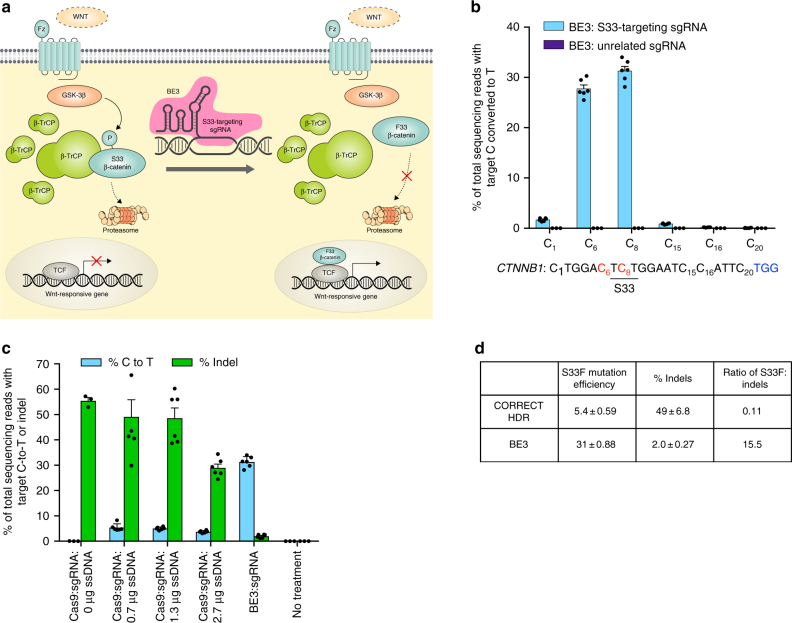
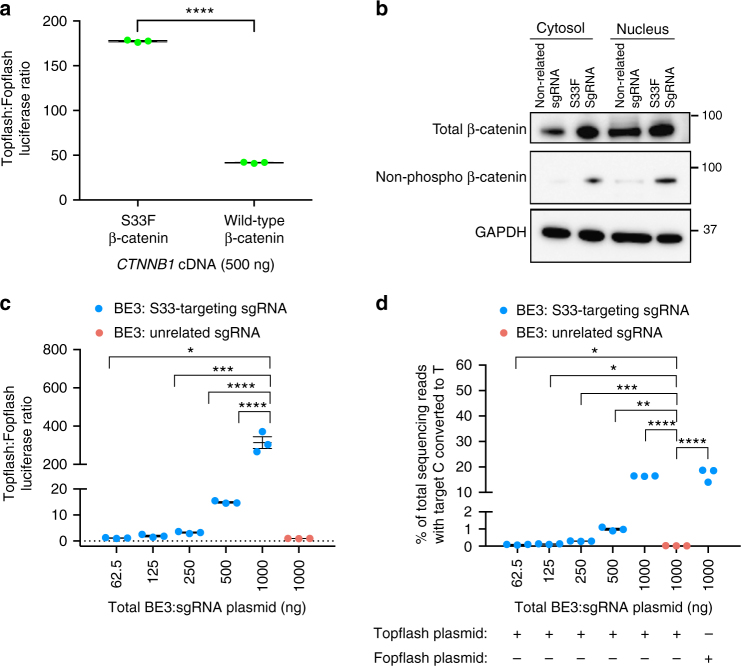
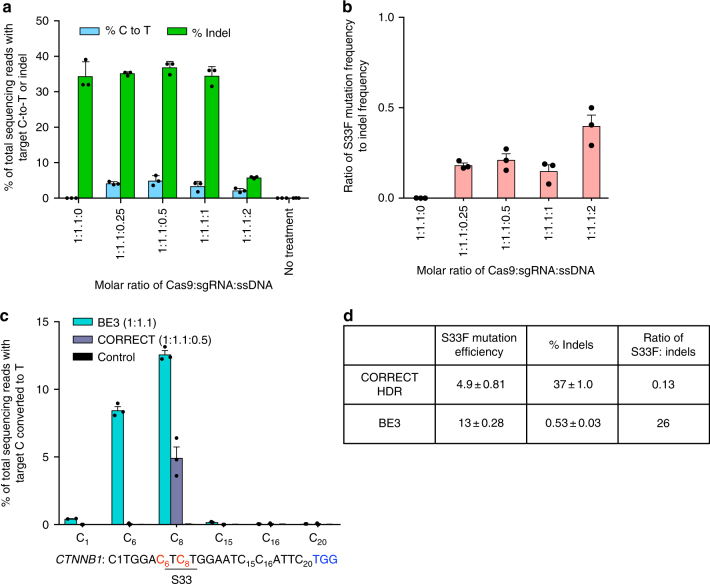
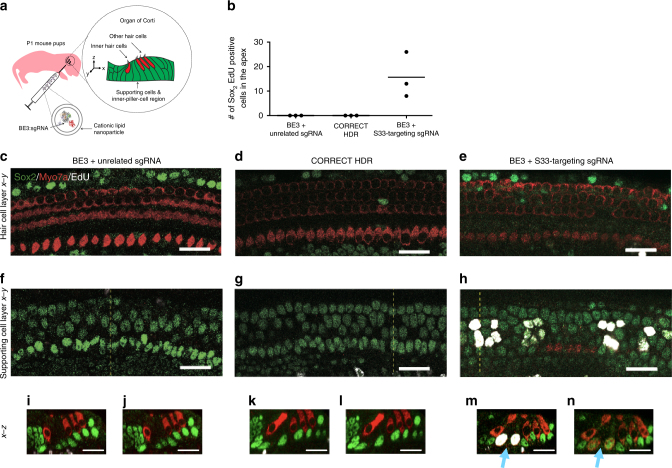
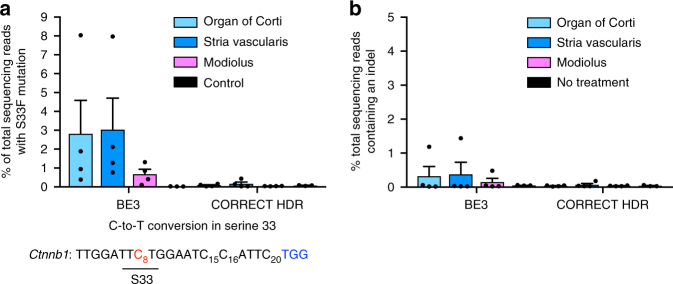
Programmable nucleases can introduce precise changes to genomic DNA through homology-directed repair (HDR). Unfortunately, HDR is largely restricted to mitotic cells, and is typically accompanied by an excess of stochastic insertions and deletions (indels). Here we present an in vivo base editing strategy that addresses these limitations. We use nuclease-free base editing to install a S33F mutation in β-catenin that blocks β-catenin phosphorylation, impedes β-catenin degradation, and upregulates Wnt signaling. In vitro, base editing installs the S33F mutation with a 200-fold higher editing:indel ratio than HDR. In post-mitotic cells in mouse inner ear, injection of base editor protein:RNA:lipid installs this mutation, resulting in Wnt activation that induces mitosis of cochlear supporting cells and cellular reprogramming. In contrast, injection of HDR agents does not induce Wnt upregulation. These results establish a strategy for modifying posttranslational states in signaling pathways, and an approach to precision editing in post-mitotic tissues.
Overview
The claims and statistics of this paper haven’t been checked yet.
Free: it reads the open-access text and checks the first 5 claims that cite a source we can check. Create a free account to check every claim.
Integrity signals
Registry
Cites
Statistics
Figures
Verification
Claims the paper makes
The claims and statistics of this paper haven’t been checked yet.
Free: it reads the open-access text and checks the first 5 claims that cite a source we can check. Create a free account to check every claim.
Claims other papers make about this one
Each is checked against this paper’s own text: does it say what the citing paper says it does?
The cited source says what the claim attributes to it.
In the citing paper
“For example, lipid-mediated nanoparticle (LNP) delivery has been used to transport CRISPR-Cas components in the form of either mRNA/sgRNA or preassembled RNPs into tissues 71-74 .”
From The promise and challenge of therapeutic genome editing (2020) · cites this paper as [73]
Self-check
Percentages, sums and reported differences re-computed from the paper’s own numbers.
The self-check needs the paper’s full text.
Citations
Cites
Genome engineering using the CRISPR-Cas9 system
Ran, F. A., Hsu, P. D., Wright, J., Agarwala, V., Scott, D. A., & Zhang, F. (2013) · Nature Protocols · doi:10.1038/nprot.2013.143 · Cited by 11,133
The new frontier of genome engineering with CRISPR-Cas9
Doudna, J. A., & Charpentier, E. (2014) · Science · doi:10.1126/science.1258096 · Cited by 7,062
Wnt/β-Catenin Signaling: Components, Mechanisms, and Diseases
MacDonald, B. T., Tamai, K., & He, X. (2009) · Developmental Cell · doi:10.1016/j.devcel.2009.06.016 · Cited by 5,583
Programmable editing of a target base in genomic DNA without double-stranded DNA cleavage
Komor, A. C., Kim, Y. B., Packer, M. S., Zuris, J. A., & Liu, D. R. (2016) · Nature · doi:10.1038/nature17946 · Cited by 5,437
Self-citationProgrammable base editing of A•T to G•C in genomic DNA without DNA cleavage
Gaudelli, N. M., Komor, A. C., Rees, H. A., Packer, M. S., Badran, A. H., Bryson, D. I., & Liu, D. R. (2017) · Nature · doi:10.1038/nature24644 · Cited by 4,184
Self-citationHigh-Frequency off-Target Mutagenesis Induced by CRISPR-Cas Nucleases in Human Cells
Fu, Y., Foden, J. A., Khayter, C., Maeder, M. L., Reyon, D., Joung, J. K., & Sander, J. D. (2013) · Nature Biotechnology · doi:10.1038/nbt.2623 · Cited by 3,292
Polakis, P. (2000) · Genes & Development · doi:10.1101/gad.14.15.1837 · Cited by 3,183
CRISPR-Cas systems for editing, regulating and targeting genomes
Sander, J. D., & Joung, J. K. (2014) · Nature Biotechnology · doi:10.1038/nbt.2842 · Cited by 3,153
GUIDE-seq enables genome-wide profiling of off-target cleavage by CRISPR-Cas nucleases
Tsai, S. Q., Zheng, Z., Nguyen, N. T., Liebers, M., Topkar, V. V., Thapar, V., Wyvekens, N., Khayter, C., Iafrate, A. J., Le, L. P., et al. (2015) · Nature Biotechnology · doi:10.1038/nbt.3117 · Cited by 2,268
Control of β-Catenin Phosphorylation/Degradation by a Dual-Kinase Mechanism
Liu, C., Li, Y., Semenov, M., Han, C., Baeg, G.-H., Tan, Y., Zhang, Z., Lin, X., & He, X. (2002) · Cell · doi:10.1016/s0092-8674(02)00685-2 · Cited by 2,069
WNT and β-catenin signalling: diseases and therapies
Moon, R. T., Kohn, A. D., Ferrari, G. V. D., & Kaykas, A. (2004) · Nature Reviews Genetics · doi:10.1038/nrg1427 · Cited by 1,763
Haeussler, M., Schönig, K., Eckert, H., Eschstruth, A., Mianné, J., Renaud, J.-B., Schneider-Maunoury, S., Shkumatava, A., Teboul, L., Kent, J., et al. (2016) · Genome biology · doi:10.1186/s13059-016-1012-2 · Cited by 1,756
Wnt signalling and its impact on development and cancer
Klaus, A., & Birchmeier, W. (2008) · Nature Reviews Cancer · doi:10.1038/nrc2389 · Cited by 1,595
Pattanayak, V., Lin, S., Guilinger, J. P., Ma, E., Doudna, J. A., & Liu, D. R. (2013) · Nature Biotechnology · doi:10.1038/nbt.2673 · Cited by 1,487
Self-citationZuris, J. A., Thompson, D. B., Shu, Y., Guilinger, J. P., Bessen, J. L., Hu, J. H., Maeder, M. L., Joung, J. K., Chen, Z.-Y., & Liu, D. R. (2015) · Nature Biotechnology · doi:10.1038/nbt.3081 · Cited by 1,460
Self-citationTargeted nucleotide editing using hybrid prokaryotic and vertebrate adaptive immune systems
Nishida, K., Arazoe, T., Yachie, N., Banno, S., Kakimoto, M., Tabata, M., Mochizuki, M., Miyabe, A., Araki, M., Hara, K. Y., et al. (2016) · Science · doi:10.1126/science.aaf8729 · Cited by 1,349
Therapeutic genome editing: prospects and challenges
Cox, D. B. T., Platt, R. J., & Zhang, F. (2015) · Nature Medicine · doi:10.1038/nm.3793 · Cited by 1,336
Enhanced homology-directed human genome engineering by controlled timing of CRISPR/Cas9 delivery
Lin, S., Staahl, B. T., Alla, R. K., & Doudna, J. A. (2014) · eLife · doi:10.7554/elife.04766 · Cited by 1,189
Regulation of Homologous Recombination in Eukaryotes
Heyer, W.-D., Ehmsen, K. T., & Liu, J. (2010) · Annual Review of Genetics · doi:10.1146/annurev-genet-051710-150955 · Cited by 1,066
Efficient introduction of specific homozygous and heterozygous mutations using CRISPR/Cas9
Paquet, D., Kwart, D., Chen, A., Sproul, A., Jacob, S., Teo, S., Olsen, K. M., Gregg, A., Noggle, S., & Tessier-Lavigne, M. (2016) · Nature · doi:10.1038/nature17664 · Cited by 951
Zebrafish Prickle, a Modulator of Noncanonical Wnt/Fz Signaling, Regulates Gastrulation Movements
Veeman, M. T., Slusarski, D. C., Kaykas, A., Louie, S. H., & Moon, R. T. (2003) · Current Biology · doi:10.1016/s0960-9822(03)00240-9 · Cited by 945
Wnt Signaling through Inhibition of β-Catenin Degradation in an Intact Axin1 Complex
Li, V. S. W., Ng, S. S., Boersema, P. J., Low, T. Y., Karthaus, W. R., Gerlach, J. P., Mohammed, S., Heck, A. J. R., Maurice, M. M., Mahmoudi, T., et al. (2012) · Cell · doi:10.1016/j.cell.2012.05.002 · Cited by 889
Precise base editing in rice, wheat and maize with a Cas9-cytidine deaminase fusion
Zong, Y., Wang, Y., Li, C., Zhang, R., Chen, K., Ran, Y., Qiu, J.-L., Wang, D., & Gao, C. (2017) · Nature Biotechnology · doi:10.1038/nbt.3811 · Cited by 866
Kim, Y. B., Komor, A. C., Levy, J. M., Packer, M. S., Zhao, K. T., & Liu, D. R. (2017) · Nature Biotechnology · doi:10.1038/nbt.3803 · Cited by 758
Self-citationEfficient delivery of genome-editing proteins using bioreducible lipid nanoparticles
Wang, M., Zuris, J. A., Meng, F., Rees, H., Sun, S., Deng, P., Han, Y., Gao, X., Pouli, D., Wu, Q., et al. (2016) · Proceedings of the National Academy of Sciences · doi:10.1073/pnas.1520244113 · Cited by 624
Self-citationTreatment of autosomal dominant hearing loss by in vivo delivery of genome editing agents
Gao, X., Tao, Y., Lamas, V., Huang, M., Yeh, W.-H., Pan, B., Hu, Y.-J., Hu, J. H., Thompson, D. B., Shu, Y., et al. (2018) · Nature · doi:10.1038/nature25164 · Cited by 536
Self-citationDirected evolution using dCas9-targeted somatic hypermutation in mammalian cells
Hess, G. T., Frésard, L., Han, K., Lee, C. H., Li, A., Cimprich, K. A., Montgomery, S. B., & Bassik, M. C. (2016) · Nature Methods · doi:10.1038/nmeth.4038 · Cited by 476
Small molecule–triggered Cas9 protein with improved genome-editing specificity
Davis, K. M., Pattanayak, V., Thompson, D. B., Zuris, J. A., & Liu, D. R. (2015) · Nature Chemical Biology · doi:10.1038/nchembio.1793 · Cited by 418
Self-citationRees, H. A., Komor, A. C., Yeh, W.-H., Caetano-Lopes, J., Warman, M., Edge, A. S. B., & Liu, D. R. (2017) · Nature Communications · doi:10.1038/ncomms15790 · Cited by 412
Self-citationβ-Trcp couples β-catenin phosphorylation-degradation and regulates Xenopus axis formation
Liu, C., Kato, Y., Zhang, Z., Do, V. M., Yankner, B. A., & He, X. (1999) · Proceedings of the National Academy of Sciences · doi:10.1073/pnas.96.11.6273 · Cited by 398
Highly efficient RNA-guided base editing in mouse embryos
Kim, K., Ryu, S.-M., Kim, S.-T., Baek, G., Kim, D., Lim, K., Chung, E., Kim, S., & Kim, J.-S. (2017) · Nature Biotechnology · doi:10.1038/nbt.3816 · Cited by 386
GSK-3 Inhibitors: Preclinical and Clinical Focus on CNS
Eldar-Finkelman, H., & Martinez, A. (2011) · Frontiers in Molecular Neuroscience · doi:10.3389/fnmol.2011.00032 · Cited by 354
Wnt signaling induces proliferation of sensory precursors in the postnatal mouse cochlea
Chai, R., Kuo, B., Wang, T., Liaw, E. J., Xia, A., Jan, T. A., Liu, Z., Taketo, M. M., Oghalai, J. S., Nusse, R., et al. (2012) · Proceedings of the National Academy of Sciences · doi:10.1073/pnas.1202774109 · Cited by 293
DNA double-strand breaks: their cellular and clinical impact?
Jeggo, P. A., & Löbrich, M. (2007) · Oncogene · doi:10.1038/sj.onc.1210868 · Cited by 272
Replisome assembly and the direct restart of stalled replication forks
Heller, R. C., & Marians, K. J. (2006) · Nature Reviews Molecular Cell Biology · doi:10.1038/nrm2058 · Cited by 268
PCNA function in the activation and strand direction of MutLα endonuclease in mismatch repair
Pluciennik, A., Dzantiev, L., Iyer, R. R., Constantin, N., Kadyrov, F. A., & Modrich, P. (2010) · Proceedings of the National Academy of Sciences · doi:10.1073/pnas.1010662107 · Cited by 265
Wnt-Responsive Lgr5-Expressing Stem Cells Are Hair Cell Progenitors in the Cochlea
Shi, F., Kempfle, J. S., & Edge, A. S. B. (2012) · Journal of Neuroscience · doi:10.1523/jneurosci.1064-12.2012 · Cited by 257
Self-citationWnt/Catenin Signaling in Adult Stem Cell Physiology and Disease
Ring, A., Kim, Y.-M., & Kahn, M. (2014) · Stem Cell Reviews and Reports · doi:10.1007/s12015-014-9515-2 · Cited by 241
Chadwick, A. C., Wang, X., & Musunuru, K. (2017) · Arteriosclerosis, Thrombosis, and Vascular Biology · doi:10.1161/atvbaha.117.309881 · Cited by 219
Correction of β-thalassemia mutant by base editor in human embryos
Liang, P., Ding, C., Sun, H., Xie, X., Xu, Y., Zhang, X., Sun, Y., Xiong, Y., Ma, W., Liu, Y., et al. (2017) · Protein & Cell · doi:10.1007/s13238-017-0475-6 · Cited by 216
Self-citationMcLean, W. J., Yin, X., Lu, L., Lenz, D. R., McLean, D., Langer, R., Karp, J. M., & Edge, A. S. B. (2017) · Cell Reports · doi:10.1016/j.celrep.2017.01.066 · Cited by 213
Self-citationShi, F., Hu, L., & Edge, A. S. B. (2013) · Proceedings of the National Academy of Sciences · doi:10.1073/pnas.1219952110 · Cited by 173
Self-citationDynamic Expression of Lgr5, a Wnt Target Gene, in the Developing and Mature Mouse Cochlea
Chai, R., Xia, A., Wang, T., Jan, T. A., Hayashi, T., Bermingham-McDonogh, O., & Cheng, A. G.-L. (2011) · Journal of the Association for Research in Otolaryngology · doi:10.1007/s10162-011-0267-2 · Cited by 162
Regulation of Wnt/β‐catenin signaling by protein kinases
Verheyen, E. M., & Gottardi, C. J. (2010) · Developmental Dynamics · doi:10.1002/dvdy.22019 · Cited by 161
A dual function for canonical Wnt/β-catenin signaling in the developing mammalian cochlea
Jacques, B. E., Puligilla, C., Weichert, R. M., Ferrer‐Vaquer, A., Hadjantonakis, A., Kelley, M. W., & Dabdoub, A. (2012) · Development · doi:10.1242/dev.080358 · Cited by 159
Shi, F., Cheng, Y., Wang, X. L., & Edge, A. S. B. (2009) · Journal of Biological Chemistry · doi:10.1074/jbc.m109.059055 · Cited by 132
Self-citationPrecise and efficient scarless genome editing in stem cells using CORRECT
Kwart, D., Paquet, D., Teo, S., & Tessier‐Lavigne, M. (2017) · Nature Protocols · doi:10.1038/nprot.2016.171 · Cited by 129
Modulation of GSK-3 as a Therapeutic Strategy on Tau Pathologies
Medina, M., Garrido, J. J., & Wandosell, F. G. (2011) · Frontiers in Molecular Neuroscience · doi:10.3389/fnmol.2011.00024 · Cited by 123
A New Avenue for Lithium: Intervention in Traumatic Brain Injury
Leeds, P. R., Yu, F., Wang, Z., Chiu, C.-T., Zhang, Y., Leng, Y., Linares, G. R., & Chuang, D.-M. (2014) · ACS Chemical Neuroscience · doi:10.1021/cn500040g · Cited by 107
Jan, T. A., Chai, R., Sayyid, Z. N., van Amerongen, R., Xia, A., Wang, T., Sinkkonen, S. T., Zeng, Y. A., Levin, J. R., Heller, S., et al. (2013) · Development · doi:10.1242/dev.087528 · Cited by 90
Highly efficient and precise base editing in discarded human tripronuclear embryos
Li, G., Liu, Y., Zeng, Y., Li, J., Wang, L., Yang, G., Chen, D., Shang, X., Chen, J., Huang, X., et al. (2017) · Protein & Cell · doi:10.1007/s13238-017-0458-7 · Cited by 77
Role of Wnt and Notch signaling in regulating hair cell regeneration in the cochlea
Waqas, M., Zhang, S., He, Z., Tang, M., & Chai, R. (2016) · Frontiers of Medicine · doi:10.1007/s11684-016-0464-9 · Cited by 71
Modulation of Wnt Signaling Enhances Inner Ear Organoid Development in 3D Culture
DeJonge, R. E., Liu, X.-P., Deig, C. R., Heller, S., Koehler, K. R., & Hashino, E. (2016) · PLOS ONE · doi:10.1371/journal.pone.0162508 · Cited by 71
Diphtheria Toxin-Induced Cell Death Triggers Wnt-Dependent Hair Cell Regeneration in Neonatal Mice
Hu, L., Lü, J., Chiang, H., Wu, H., Edge, A. S. B., & Shi, F. (2016) · Journal of Neuroscience · doi:10.1523/jneurosci.2447-15.2016 · Cited by 64
Self-citationGeng, R., Noda, T., Mulvaney, J. F., Lin, V., Edge, A. S. B., & Dabdoub, A. (2016) · PLoS ONE · doi:10.1371/journal.pone.0148339 · Cited by 48
Self-citationSeamless site-directed mutagenesis of the Saccharomyces cerevisiae genome using CRISPR-Cas9
Biot-Pelletier, D., & Martin, V. J. J. (2016) · Journal of Biological Engineering · doi:10.1186/s13036-016-0028-1 · Cited by 40
Targeted Base Editing via RNA-Guided Cytidine Deaminases in Xenopus laevis Embryos.
Park, D., Yoon, M.-J., Kweon, J., Jang, A.-H., Kim, Y., & Choi, S. (2017) · PubMed · doi:10.14348/molcells.2017.0262 · Cited by 38
Identification of Tympanic Border Cells as Slow-Cycling Cells in the Cochlea
Taniguchi, M., Yamamoto, N., Nakagawa, T., Ogino, E., & Ito, J. (2012) · PLoS ONE · doi:10.1371/journal.pone.0048544 · Cited by 29
Roccio, M., Hahnewald, S., Perny, M., & Senn, P. (2015) · Scientific Reports · doi:10.1038/srep17886 · Cited by 29
Sulg, M., Kirjavainen, A., Pajusola, K., Büeler, H., Ylikoski, J. S., Laiho, M., & Pirvola, U. (2010) · Journal of Neurochemistry · doi:10.1111/j.1471-4159.2009.06563.x · Cited by 24
Research works printed but not linked: 1
- Chadwick AC Wang X Musunuru K In vivo base editing of PCSK9 (proprotein convertase subtilisin/Kexin Type 9) as a therapeutic alternative to genome editing Arterioscler. Thromb. Vasc. Biol. 2017 37 1741 10.1161/ATVBAHA.117.309881 28751571 PMC5570639 · DOI · Paper page
Cited by
Genome editing with CRISPR–Cas nucleases, base editors, transposases and prime editors
Anzalone, A. V., Koblan, L. W., & Liu, D. R. (2020) · Nature Biotechnology · doi:10.1038/s41587-020-0561-9 · Cited by 2,237
Self-citationBase editing: precision chemistry on the genome and transcriptome of living cells
Rees, H. A., & Liu, D. R. (2018) · Nature Reviews Genetics · doi:10.1038/s41576-018-0059-1 · Cited by 1,675
Self-citationThe promise and challenge of therapeutic genome editing
Doudna, J. A. (2020) · Nature · doi:10.1038/s41586-020-1978-5 · Cited by 1,126
CRISPR technology: A decade of genome editing is only the beginning
Wang, J. Y., & Doudna, J. A. (2023) · Science · doi:10.1126/science.add8643 · Cited by 1,049
Richter, M. F., Zhao, K. T., Eton, E., Lapinaite, A., Newby, G. A., Thuronyi, B. W., Wilson, C., Koblan, L. W., Zeng, J., Bauer, D. E., et al. (2020) · Nature Biotechnology · doi:10.1038/s41587-020-0453-z · Cited by 1,020
“For the first 12 hours, gene III was expressed by the addition of anhydrotetracycline to enable genetic drift in the absence of selection pressure 12,13 .”
Self-citation
Metadata
- Authors
- Yeh, W.-H., Chiang, H., Rees, H. A., Edge, A. S. B., & Liu, D. R.
- Affiliations
- Broad Institute (US)
- Massachusetts Eye and Ear Infirmary (US)
- Corresponding author
- Edge, Albert S. B.
- Liu, David R.
- Venue
- Nature Communications
- Published
- 2018-06-05
- Volume
- 9
- Issue
- 1
- Pages
- 2184-2184
- ISSN
- 2041-1723 (ISSN-L)
- PMC
- PMC5988727
- OpenAlex
- W2805743335
- Cited by
- 225
- References
- 60
- Citations by year
- 2026: 11 · 2025: 10 · 2024: 20 · 2023: 26 · 2022: 18 · 2021: 39 · 2020: 67 · 2019: 27 · 2018: 7
- FWCI
- 12.54
- Type
- journal article
- Language
- en
- Open access
- gold
- doi.org
- Licence
- cc-by
- creativecommons.org/licenses/by/4.0 (tdm)
- creativecommons.org/licenses/by/4.0 (vor)
- Locations
- Nature Communications (publishedVersion, cc-by)
- Europe PMC (PubMed Central) (publishedVersion, cc-by)
- PubMed Central (publishedVersion, cc-by)
- PubMed (publishedVersion)
- Digital Access to Scholarship at Harvard (DASH) (Harvard University) (submittedVersion, cc-by)
- RePEc: Research Papers in Economics (submittedVersion)
- DOAJ (DOAJ: Directory of Open Access Journals) (submittedVersion, cc-by-sa)
- DOAJ (DOAJ: Directory of Open Access Journals) (submittedVersion)
- Funders
- Howard Hughes Medical Institute
- Harvard University
- Shulsky Foundation
- National Institutes of Health (NIH-R01, HR0011-17-2-0049)
- Defense Advanced Research Projects Agency (HR0011, HR0011-17-2-0049)
- National Human Genome Research Institute (RM1HG009490)
- National Institute on Deafness and Other Communication Disorders (R01DC014089, R01DC007174)
- National Institute of General Medical Sciences (R35GM118062)
- National Institute of Biomedical Imaging and Bioengineering (R01EB022376)
- Topics
- Life Sciences › Biochemistry, Genetics and Molecular Biology › Molecular Biology › CRISPR and Genetic Engineering
- Life Sciences › Biochemistry, Genetics and Molecular Biology › Molecular Biology › RNA regulation and disease
- Life Sciences › Neuroscience › Sensory Systems › Hearing, Cochlea, Tinnitus, Genetics
- Keywords
- postmitotic cells, Wnt signaling, homology-directed repair, inner ear, cochlear supporting cells, cellular reprogramming, post-translational modification, precision genome editing
- MeSH terms
- Animals, Hair Cells, Auditory, Inner, Humans, Mice, Transgenic, Mitosis, Mutation, Mice, Knockout, NIH 3T3 Cells, beta Catenin, Mice, DNA Breaks, Double-Stranded, HEK293 Cells, Recombinational DNA Repair, Wnt Signaling Pathway
About these checks
Registry, retraction, Cites and statistics results are computed, not judged, with one exception: a printed reference that no index lists is read once by a model before it counts as a citation error. Claims are extracted by a model and kept only when their quote appears verbatim in the text; each cited source is then checked, with a model’s help, for whether it says what the claim relies on. Those verdicts can be wrong — read the claim’s quote and the cited source before relying on one.
Statistics and arithmetic are recomputed, not judged.
Confidence bands are shown only for fields calibrated on our annotated test set. None is calibrated yet, so no band is shown.
What counts as a claim ›How we measure confidence ›How we check this ›
Are you an author, or do you see a problem with this page? Request a review
Data sources
Bibliographic data: Semantic Scholar, OpenAlex, Crossref.
Contains information from the Semantic Scholar Academic Graph Datasets, made available under the ODC Attribution License (ODC-BY 1.0).
Semantic Scholar’s data is described in: Kinney, R., et al. (2023). The Semantic Scholar Open Data Platform. arXiv:2301.10140.
