

Senescent cells evade immune clearance via HLA-E-mediated NK and CD8+ T cell inhibition
Open accessThe DOI matches its Crossref record; 58 of the 59 references it cites were found in a registry or an index.
Abstract
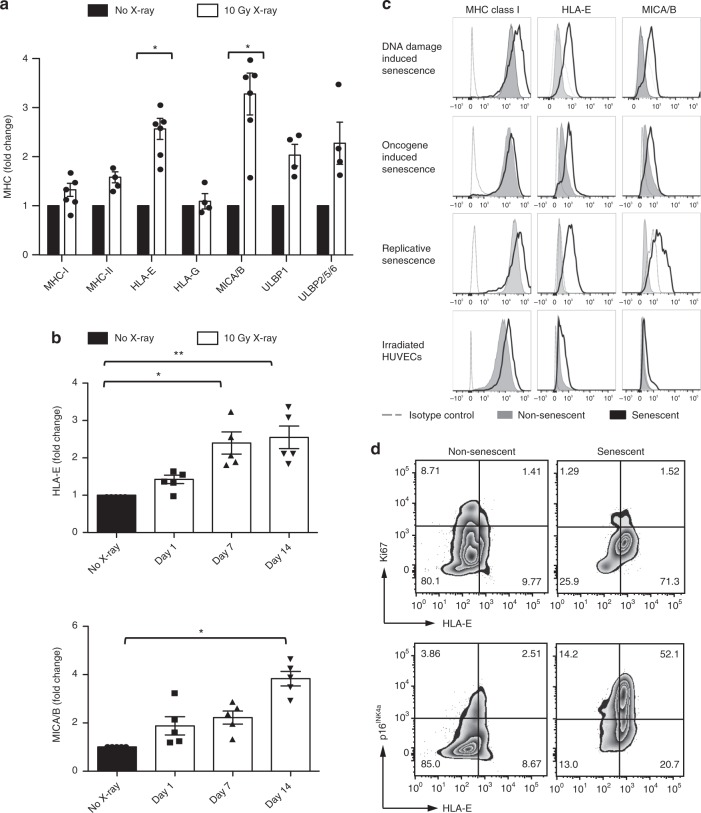
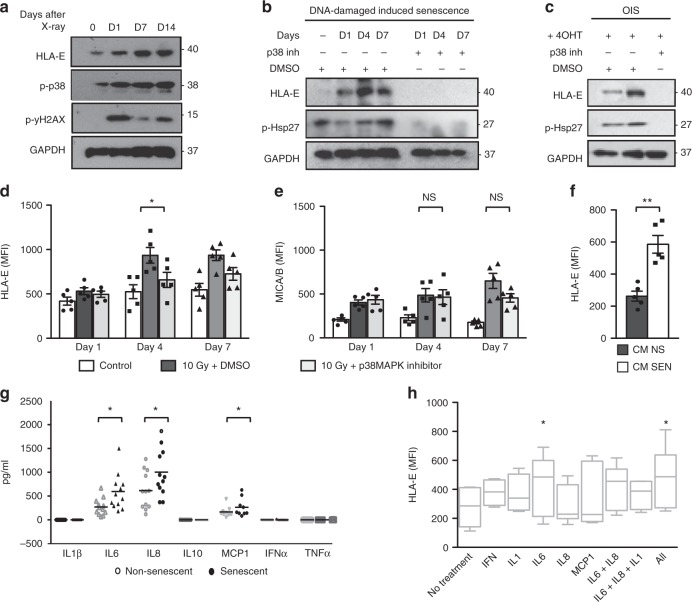
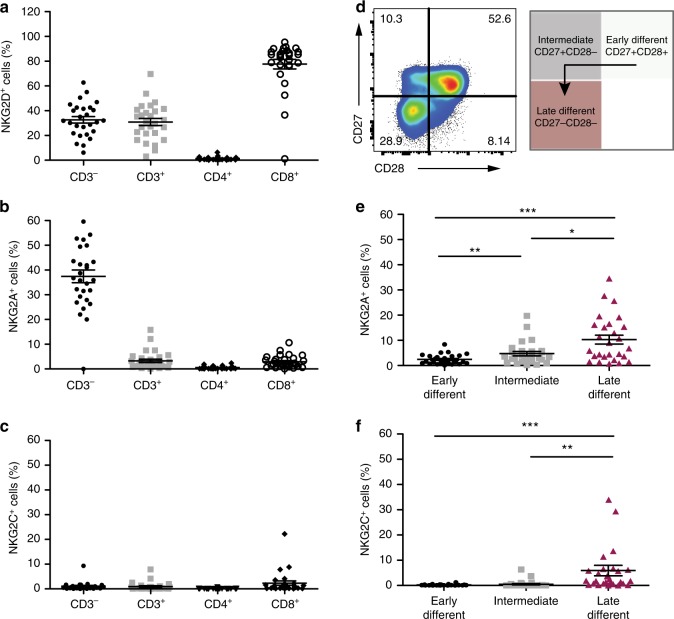
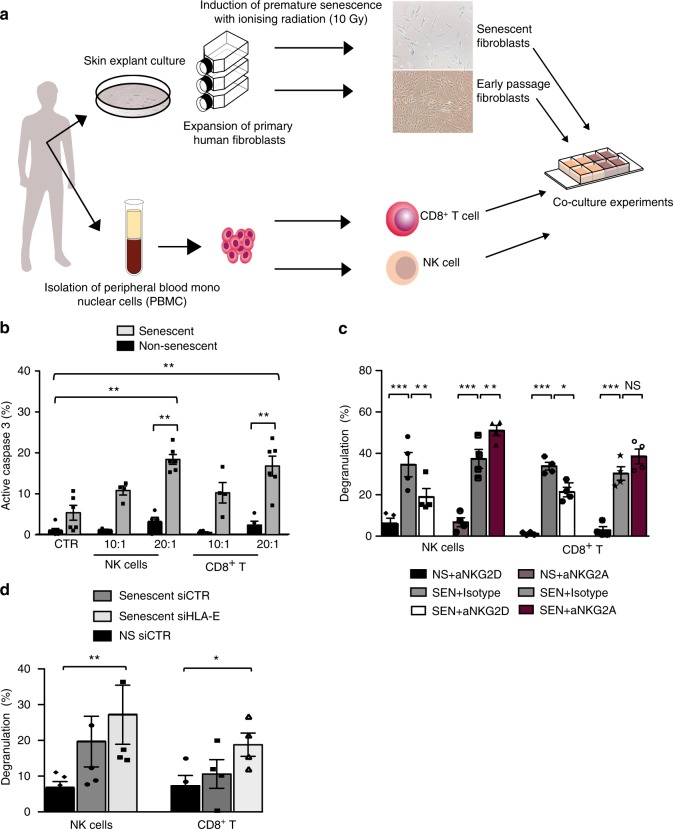
Senescent cells accumulate in human tissues during ageing and contribute to age-related pathologies. The mechanisms responsible for their accumulation are unclear. Here we show that senescent dermal fibroblasts express the non-classical MHC molecule HLA-E, which interacts with the inhibitory receptor NKG2A expressed by NK and highly differentiated CD8 + T cells to inhibit immune responses against senescent cells. HLA-E expression is induced by senescence-associated secretary phenotype-related pro-inflammatory cytokines, and is regulated by p38 MAP kinase signalling in vitro. Consistently, HLA-E expression is increased on senescent cells in human skin sections from old individuals, when compared with those from young, and in human melanocytic nevi relative to normal skin. Lastly, blocking the interaction between HLA-E and NKG2A boosts immune responses against senescent cells in vitro. We thus propose that increased HLA-E expression contributes to persistence of senescent cells in tissues, thereby suggesting a new strategy for eliminating senescent cells during ageing.
Overview
The claims and statistics of this paper haven’t been checked yet.
Free: it reads the open-access text and checks the first 5 claims that cite a source we can check. Create a free account to check every claim.
Integrity signals
Registry
Cites
Statistics
Figures
Verification
Claims the paper makes
The claims and statistics of this paper haven’t been checked yet.
Free: it reads the open-access text and checks the first 5 claims that cite a source we can check. Create a free account to check every claim.
Claims other papers make about this one
Each is checked against this paper’s own text: does it say what the citing paper says it does?
The source backs part of the claim, not all of it — or backs it for a different population, condition or comparison.
In the citing paper
“Normally, senescent cells appear to be cleared within days to weeks after they develop by natural killer cells and other immune cell types62,66–69.”
From Cellular senescence and senolytics: the path to the clinic (2022) · cites this paper as [66]
Experimental — accuracy not yet measuredThe source backs part of the claim, not all of it — or backs it for a different population, condition or comparison.
In the citing paper
“Pereira et al. recently reported that senescent human primary dermal fibroblasts and endothelial cells express higher levels of the atypical major histocompatibility complex (MHC) Ib molecule HLA-E via the p38 signaling pathway than non-senescent cells.”
From Immune Clearance of Senescent Cells to Combat Ageing and Chronic Diseases (2020) · cites this paper as [124]
Experimental — accuracy not yet measuredThe source backs part of the claim, not all of it — or backs it for a different population, condition or comparison.
In the citing paper
“Moreover, IL-6 and IL-8 also enhanced the surface expression of HLA- E that interacts with the inhibitory receptor NKG2A, thereby blunting the activity of cytotoxic NK cells and mature CD8 + T- cells 176 .”
From Senescence and cancer — role and therapeutic opportunities (2022) · cites this paper as [176]
Experimental — accuracy not yet measuredThe cited source says what the claim attributes to it.
In the citing paper
“At younger ages, senescent cells are cleared by the host immune system [63–66]”
From Reducing Senescent Cell Burden in Aging and Disease (2020) · cites this paper as [64]
The cited source says what the claim attributes to it.
In the citing paper
“However, this immunomodulatory property of monocytes may be a by-product of the increased inflammatory skin environmentas increased senescent stromal cells such as fibroblasts are present in older skin (10).”
From The impact of ageing on monocytes and macrophages (2021) · cites this paper as [10]
5 more claims about this paper
Create a free account to see every claim other papers make about this one.
Self-check
Percentages, sums and reported differences re-computed from the paper’s own numbers.
The self-check needs the paper’s full text.
Citations
Cites
The senescence-associated secretory phenotype: the dark side of tumor suppression
Coppé, J.-P., Desprez, P.-Y., Krtolica, A., & Campisi, J. (2010) · Annual Review of Pathology: Mechanisms of Disease · doi:10.1146/annurev-pathol-121808-102144 · Cited by 5,206
Self-citationChronic Inflammation (Inflammaging) and Its Potential Contribution to Age-Associated Diseases
Franceschi, C., & Campisi, J. (2014) · The Journals of Gerontology Series A: Biological Sciences and Medical Sciences · doi:10.1093/gerona/glu057 · Cited by 3,891
Self-citationClearance of p16Ink4a-positive senescent cells delays ageing-associated disorders
Baker, D. J., Wijshake, T., Tchkonia, T., LeBrasseur, N. K., Childs, B. G., van de Sluis, B., Kirkland, J. L., & van Deursen, J. M. (2011) · Nature · doi:10.1038/nature10600 · Cited by 3,670
Aging, Cellular Senescence, and Cancer
Campisi, J. (2013) · Annual Review of Physiology · doi:10.1146/annurev-physiol-030212-183653 · Cited by 2,954
Self-citationNaturally occurring p16Ink4a-positive cells shorten healthy lifespan
Baker, D. J., Childs, B. G., Durik, M., Wijers, M. E., Sieben, C. J., Zhong, J., A. Saltness, R., Jeganathan, K. B., Verzosa, G. C., Pezeshki, A., et al. (2016) · Nature · doi:10.1038/nature16932 · Cited by 2,876
Lanier, L. L. (2005) · Annual Review of Immunology · doi:10.1146/annurev.immunol.23.021704.115526 · Cited by 2,769
The role of senescent cells in ageing
van Deursen, J. M. (2014) · Nature · doi:10.1038/nature13193 · Cited by 2,623
Senescence and tumour clearance is triggered by p53 restoration in murine liver carcinomas
Xue, W., Zender, L., Miething, C., Dickins, R. A., Hernando, E., Krizhanovsky, V., Cordon-Cardo, C., & Lowe, S. W. (2007) · Nature · doi:10.1038/nature05529 · Cited by 2,473
A complex secretory program orchestrated by the inflammasome controls paracrine senescence
Acosta, J. C., Banito, A., Wuestefeld, T., Georgilis, A., Janich, P., Morton, J. P., Athineos, D., Kang, T.-W., Lasitschka, F., Andrulis, M., et al. (2013) · Nature Cell Biology · doi:10.1038/ncb2784 · Cited by 2,278
Persistent DNA damage signalling triggers senescence-associated inflammatory cytokine secretion
Rodier, F., Coppé, J.-P., Patil, C. K., Hoeijmakers, W. A. M., Muñoz, D. P., Raza, S. R., Freund, A., Campeau, E., Davalos, A. R., & Campisi, J. (2009) · Nature Cell Biology · doi:10.1038/ncb1909 · Cited by 2,232
Self-citation
Cited by
Items 401–500 of 565
Zhu, X., Liu, Q., Patterson, A. D., Sharma, A. K., Amin, S., Cohen, S. M., Gonzalez, F. J., & Peters, J. M. (2023) · Metabolites · doi:10.3390/metabo13080936 · Cited by 6
“As cellular senescence is one mechanism involved in the regulation and suppression of tumor cells [64], the differential increase in senescent liver cells could contribute to the mechanisms mediating liver carcinogenesis observed in older Ppara-null and PPARAhumanized mouse liver [66,67].”
BackgroundLiu, H., Zheng, H., Zhou, S., & Lin, Q. (2024) · Journal of Cosmetic Dermatology · doi:10.1111/jocd.16515 · Cited by 5
Santos‐Sousa, D., da Rosa, S., & Filippi‐Chiela, E. C. (2025) · Mechanisms of Ageing and Development · doi:10.1016/j.mad.2025.112052 · Cited by 9
Pathogenesis and prevention of skin aging
Cho, S. (2021) · Journal of Korean Medical Association · doi:10.5124/jkma.2021.64.6.438 · Cited by 4
“노쇠 섬유모세포는 HLA-E 발현을 증가시킴으로써 자연살 해세포와 CD8+ T세포에 의해 인지되지 않아 제거되지 않 고 피부에 계속 존재한다[41].”
A ganglioside-based senescence-associated immune checkpointPreprint
Iltis, C., Seguin, L., Cervera, L., Duret, L. C., Hamidouche, T., Kunz, S., Croce, O., Delannoy, C. P., Guérardel, Y., Allain, F., et al. (2021) · bioRxiv (Cold Spring Harbor Laboratory) · doi:10.1101/2021.04.23.440408 · Cited by 4
Identification and characterization of an immunodominant SARS-CoV-2-specific CD8 T cell responsePreprint
Gangaev, A., Ketelaars, S. L. C., Isaeva, O. I., Patiwael, S., Dopler, A., Hoefakker, K., Biasi, S. D., Gibellini, L., Mussini, C., Guaraldi, G., et al. (2020) · Research Square · doi:10.21203/rs.3.rs-33197/v2 · Cited by 4
Potential connections between senescence and chemobrain: An early overview of literature
Melhem, N. Y., Qutifan, S., Alsalem, M., & Saleh, T. (2025) · Ageing Research Reviews · doi:10.1016/j.arr.2025.102896 · Cited by 5
Natural killer cell immunotherapies beyond cancer
Guo, X., Chen, S., Wang, R., Ma, S., & Li, N. (2025) · Cell investigation. · doi:10.1016/j.clnves.2025.100048 · Cited by 5
Natural killer cell-based senotherapy: a promising strategy for healthy aging
中澤務, Yamanishi, R., Morimoto, T., & Matusda, R. (2026) · Frontiers in Immunology · doi:10.3389/fimmu.2025.1737572 · Cited by 4
Engineering Immune Cell to Counteract Aging and Aging‐Associated Diseases
Guo, J., Lei, L., Jin, Y., Su, L., Cui, S., & Shi, L. (2026) · Advanced Science · doi:10.1002/advs.202521776 · Cited by 3
Communication breakdown: senescent cells in interorgan communication of aging
Ghosh, R. B., Dipali, S. S., Desdín-Micó, G., & Yousefzadeh, M. J. (2026) · Trends in Endocrinology and Metabolism · doi:10.1016/j.tem.2026.02.002 · Cited by 5
Pan, J., Zhang, S., Xu, Y., Li, Z., Luo, M., Peng, Z., Jin, A., Hou, B., Qin, X., Cui, X., et al. (2026) · Cell Reports Medicine · doi:10.1016/j.xcrm.2026.102709 · Cited by 4
Immunological consequences of senescence in physiology and pathology
Zubova, A., Pietrocola, F., & Morsli, S. (2026) · Journal of Translational Medicine · doi:10.1186/s12967-026-08335-3 · Cited by 7
Osteoimmune senescence in aging-related bone diseases
Li, H., Yang, Y., & Zhu, H. (2026) · Frontiers in Immunology · doi:10.3389/fimmu.2026.1892334 · Cited by 5
“Senescent dermal fi broblasts can express HLA-E, which engages the inhibitory receptor NKG2A on NK and CD8 + T cells to suppress immune elimination (104).”
Mousavi, S.-R., Khazaee‐Nasirabadi, M. H., Seyedmehdi, M. S., Bazı, A., & Khalilabadi, R. M. (2024) · Leukemia & lymphoma/Leukemia and lymphoma · doi:10.1080/10428194.2024.2438802 · Cited by 3
“Under non-stressed circum-stances, compared to NKG2c, HlA-e shows a stronger affinity for NKG2A, a receptor linked with immunological evasion [21,22]. the synergistic action of the stimulatory receptors of 2B4 and NKG2D may be suppressed by the action of cD94/NKG2A [23,24], suggesting fluctuating…”
Pandemia SARS-CoV-2/COVID-19, perspectivas y desafíos
Reyes, F. R., & Pérez, G. G. (2020) · Revista del Centro de Investigación de la Universidad la Salle · doi:10.26457/recein.v14i54.2656 · Cited by 3
Framework of Intrinsic Immune Landscape of Dormant Prostate Cancer
Wong, N. K. Y., Dong, X., Lin, Y., Xue, H., Wu, R., Lin, D., Collins, C. C., & Wang, Y. Z. (2022) · Cells · doi:10.3390/cells11091550 · Cited by 5
“It is interesting to note that senescent cells, which share similarities with dormant cells [3], can utilize HLA-E to evade NK and T cell cytotoxicity [53], while HLA-F have been postulated to regulate fetomaternal immune homeostasis [54].”
BackgroundWatanabe, T., Yazaki, M., Yazaki, T., Furukawa, M., & Izumo, N. (2024) · Food Bioscience · doi:10.1016/j.fbio.2024.103903 · Cited by 4
Multiple outcomes of the germline p16INK4a mutation affecting senescence and immunity in human skin
Subramanian, P., Sayegh, S., Laphanuwat, P., Devine, O., Fantecelle, C. H., Sikora, J., Chambers, E. S., Karagiannis, S. N., Gomes, D. C. O., Kulkarni, A. A., et al. (2024) · Aging Cell · doi:10.1111/acel.14373 · Cited by 4
“These studies are also highly relevant for understanding the role of senescent cells in regulating immunity in tissues during ageing (Chambers et al., 2021; Pereira et al., 2019 ) and to understand the impact of senolytic drugs on dif - ferent senescent cell types in vivo (Bracken et al., 2024 ).”
Self-citationProteomic and functional comparison between human induced and embryonic stem cells
Brenes, A. J., Griesser, E., Sinclair, L. V., Davidson, L., Prescott, A. R., Singh, F., Hogg, E. K. J., Espejo-Serrano, C., Jiang, H., Yoshikawa, H., et al. (2024) · eLife · doi:10.7554/elife.92025.3 · Cited by 9
An Update on the Molecular Pillars of Aging
García‐Velázquez, L., & Arias, C. (2020) · Springer eBooks · doi:10.1007/978-3-030-40955-5_1 · Cited by 6
Covre, L. P., Fantecelle, C. H., de Moura, R. G., Lopes, P. O., Sarmento, I. V., Freire-de-Lima, C. G., Decotè-Ricardo, D., Guedes, H. L. D. M., da Fonsceca-Martins, A. M., Carvalho, L. P., et al. (2024) · Frontiers in Immunology · doi:10.3389/fimmu.2024.1475146 · Cited by 4
Self-citationThe Potential of Macrophages for Skin Anti-aging
Zhou, H., Wang, Y., Li, Y., & Zheng, Y. (2025) · Frontiers in Bioscience-Landmark · doi:10.31083/fbl38891 · Cited by 2
“This may indeed be one of the mechanisms by which senescent cells evade immune clearance and apoptosis [17,18].”
Zhao, Y., Cong, D., Qu, C., Wang, Z., Yuan, W., & Bai, Y. (2025) · International Journal of Biological Macromolecules · doi:10.1016/j.ijbiomac.2025.149215 · Cited by 2
CD8+ T cell aging, senescence, and related disease
He, Z., Guo, F., Zhao, Q., & Lu, W. (2026) · Science China Life Sciences · doi:10.1007/s11427-025-3101-7 · Cited by 3
A Cellular and Transcriptomic Atlas of the Aged Mouse Hematopoietic System
White, R. R., Xiong, K., Wakai, M., Surian, A., Adler, C., Negron, N., Ni, M., Shavlakadze, T., Bai, Y., & Glass, D. J. (2026) · Aging Cell · doi:10.1111/acel.70394 · Cited by 2
“One of these loci, H2-T23 (the mouse homolog HLA-E), increased in aged HSCs and has been implicated as a marker of senescent cells in both mouse and humans (Pereira et al. 2019).”
Clonal expansion of cytotoxic CD8⁺ T cells in lecanemab-associated ARIA
Johnson, L. A., Saito, K., Pallerla, A. V., Funnell, J. L., Ezzo, A. R., Song, C. M., Harrison, D. A., Norton, N. J., Moore, L. C., Eldik, L. J. V., et al. (2026) · Nature Communications · doi:10.1038/s41467-026-68921-3 · Cited by 6
“In aging-related immunosenescence, such clonal expansions correlate with reduced immune diversity and increased susceptibility to novel pathogens 23 .”
Glover, M., Maher, J. F., & Davies, D. M. (2026) · Human Vaccines & Immunotherapeutics · doi:10.1080/21645515.2026.2622794 · Cited by 3
“63,83 Currently, small molecule senolytics are used to treat several senescence-related diseases.”
Conquering aging-related immunosenescence and tumor immune escape
Zhang, S., Yang, B., Xu, M., 邴英, Zhang, J., Wang, Y. L., Zheng, C., Zhang, G., & Zhang, L. (2026) · Frontiers in Immunology · doi:10.3389/fimmu.2026.1785351 · Cited by 4
Cellular senescence in cancer immunology and potential therapeutic strategy
Qian, X., Tao, L., Zhang, L., Ji, A., Wang, L., Iqbal, M. M., & Luo, Y. (2026) · Frontiers in Oncology · doi:10.3389/fonc.2026.1737652 · Cited by 3
Skin aging: Mechanistic insights and targeted therapeutic strategies
Beaziz, J., Avallone, G., Langer, K., DUCA, E. D., Navrazhina, K., He, H., & Guttman‐Yassky, E. (2026) · Journal of Allergy and Clinical Immunology · doi:10.1016/j.jaci.2026.05.015 · Cited by 3
Olinger, B., & Basisty, N. (2026) · Ageing Research Reviews · doi:10.1016/j.arr.2026.103254 · Cited by 2
Immune surveillance and immune evasion of senescent cells
Garcia-Baucells, P., Serrano, M., & Amor, C. (2026) · Nature reviews. Immunology · doi:10.1038/s41577-026-01335-w · Cited by 6
Ohnuma, S., Tanaka, J., Yukimori, A., Ishida, S., Yasuhara, R., & Mishima, K. (2023) · Journal of Oral Biosciences · doi:10.1016/j.job.2023.12.002 · Cited by 4
Evaluating Monocyte-to-high-density Lipoprotein Ratio Across Age and Gender in Healthy Individuals
Sırakaya, H. A. (2023) · Bagcilar Medical Bulletin · doi:10.4274/bmb.galenos.2023.2023-12-109 · Cited by 2
Senotherapy: Implications for Transplantation
Jaros, M., & Melk, A. (2025) · Transplantation · doi:10.1097/tp.0000000000005291 · Cited by 3
Current Methodologies to Assess Cellular Senescence in Cancer
Laouris, P., & Muñoz‐Espín, D. (2025) · Methods in molecular biology · doi:10.1007/978-1-0716-4426-3_2 · Cited by 4
Senescence in Aging, Within the Brain and Other Diseases: Mechanisms and Interventions
Chakrabarti, S. K., & Chattopadhyay, D. (2023) · Exploratory Research and Hypothesis in Medicine · doi:10.14218/erhm.2023.00018 · Cited by 1
Ranti, D. L., Wang, A. Y., Daza, J., Bieber, C., Salomé, B., Merritt, E., Cavallo, J. A., Hegewisch-Solloa, E., Mace, E. M., Farkas, A. M., et al. (2022) · bioRxiv (Cold Spring Harbor Laboratory) · doi:10.1101/2022.03.06.483198 · Cited by 4
“Recently, the HLA-E/NKG2A axis has been identified as a potent immune checkpoint regulating both CD8 T and NK cells (20-22).”
BackgroundEarly Neutrophil Sensing Shapes the Innate Response to Preneoplastic Mammary CellsPreprint
Debiesse, A., Pereira-Abrantes, M., Moudombi, L., Voissière, A., Lefèvre, L., Lecot, P., Rodriguez, C., Malfroy, M., Moskalevska, I., Vanacker, H., et al. (2025) · bioRxiv (Cold Spring Harbor Laboratory) · doi:10.1101/2025.01.17.633444 · Cited by 4
BRCA mutation alters the stromal landscape in normal ovariesPreprint
Vaishnav, H. T., Murray, A., Piccolo, O. R., McCloskey, C. W., Yakubovich, E., Macdonald, E. A., Echaibi, M., de Ladurantaye, M., Jung, E., Fazio, T. J., et al. (2025) · bioRxiv (Cold Spring Harbor Laboratory) · doi:10.1101/2025.10.01.679597 · Cited by 2
“The expression of the non-classical MHC-1b molecule, H2-q, has been shown to confer senescent cells with the ability to evade immune clearance by inhibiting the activity of NK and CD8+ T-cells by rendering them functionally exhausted through the inhibitory receptor NKG2a ( 77 ).”
Turano, P. S., Akbulut, E., Aquino, N. M., Garza-Martínez, L., Singh, S., Aviv, A., Toupance, S., Yap, G. S., Fitzgerald-Bocarsly, P. A., Martínez-Zamudio, R. I., et al. (2026) · Proceedings of the National Academy of Sciences · doi:10.64898/2025.12.16.694716 · Cited by 3
“Notably, a fraction of senescent CD8 T EM subset expressed CD28 (see clusters 1, 2, 3, 6), while many non-senescent cells did not (see 9, 16, 17, 18), demonstrating that the absence of CD28 expression does not accurately characterize senescent SA-ßGal high T EM cells (Figures 4C and S2B).”
InfluentialGenetic and Epigenetic Influences on Cutaneous Cellular Senescence
Sarkar, T. J., Hermsmeier, M., Ross, J. L., & Herron, G. S. (2022) · Physiology · doi:10.5772/intechopen.101152 · Cited by 1
Immune evasion in endometrial cancer: Unraveling the latest mechanisms and future directions
Li, T.-T., Wang, C., Peng, G.-C., Zhou, F., Zhang, H., & Zhou, J. (2025) · Critical Reviews in Oncology/Hematology · doi:10.1016/j.critrevonc.2025.104940 · Cited by 2
Jurcău, M. C., Iovanovici, D. C., Jurcău, A., Militaru, M., Udrea, R. B., Comanescu, A. D., & Nunkoo, V. S. (2025) · International Journal of Molecular Sciences · doi:10.3390/ijms26189009 · Cited by 2
“Other antigens highly expressed in senescent cells and not in normal cells are the natural killer group 2 member D ligands (NKG2DLs), which help senescent cells escape endogenous natural killer cell-mediated immune clearance [61].”
Rejuvenation of mesenchymal stem cells by human peripheral blood lymphocytes
Luo, Y., Zhu, X., Le, Q.-R., Chen, W., Xu, Y., Chen, X., Yuan, H., Yang, X., Xu, J., Zhong, J., et al. (2025) · BMC Biology · doi:10.1186/s12915-025-02472-9 · Cited by 1
Targeting Tumor Dormancy and Recurrence: Molecular Mechanisms and Peptide Therapeutic Delivery
Aleem, A. R., Ali, A., Ali, W., Cheng, Y., Yan, Z., Xia, C., Liu, C., Fu, C., Hu, Y., & Wang, X. (2026) · MedComm – Oncology · doi:10.1002/mog2.70050 · Cited by 2
Gene therapy for aging: Current evidence and future directions
Zhang, Y. C., Gan, L., Wang, S., & Zhang, J. (2026) · Ageing Research Reviews · doi:10.1016/j.arr.2026.103144 · Cited by 1
Immunosenescence as a driver of the transition from frailty to multimorbidity
Qiu, R., Zhang, D., & Feng, H. (2026) · Frontiers in Immunology · doi:10.3389/fimmu.2026.1810241 · Cited by 3
“In human senescent fi broblasts, HLA-E upregulation can engage the inhibitory receptor NKG2A on NK cells and highly differentiated CD8+ T cells, thereby protecting senescent cells from immune-mediated elimination (45).”
Hess, M. S., Al-Shami, K. M., Caballero, C. D., Haenlin, J., Chaves‐Filho, A. B., Schlicker, L., Poeller, P., Vogel, F. C. E., Koltsaki, I., Gedik, D., et al. (2026) · Cell Death and Differentiation · doi:10.1038/s41418-026-01766-x · Cited by 2
Bridging aging and colorectal cancer: synergistic roles of inflammaging and immunosenescence
Zaongo, S. D., Yang, Q., Han, M., Xi, T., Luo, Z., Wang, X., Yang, J., & Ouyang, J. (2026) · Frontiers in Immunology · doi:10.3389/fimmu.2026.1792954 · Cited by 2
“Pereira et al. (118) have demonstrated that senescent cells escape immune elimination by releasing senescence-associated secretory phenotype (SASP) factors such as IL-6.”
Lucki, M., Lucka, E., Mitkowski, P. P., & Lesiak, M. (2026) · Cells · doi:10.3390/cells15131132 · Cited by 1
Interleukin-8 in health and disease
Bazzichetto, C., Dell’Aquila, E., Veroli, M., Belluomini, L., Bonato, A., Bernardini, G., Bevilacqua, M., Cattazzo, F., Dalbeni, A., Tampu, T. M., et al. (2026) · Molecular Biomedicine · doi:10.1186/s43556-026-00511-7 · Cited by 2
“E can further inhibit CD8 + T and NK cell function [181].”
Xu, Z., Guo, J., Liu, Z., Yu, J., Yuan, R., Min, Y., Wei, Z., & Peng, X. (2026) · Ageing Research Reviews · doi:10.1016/j.arr.2026.103270 · Cited by 1
Genomic, epigenomic and transcriptomic regulation of cellular senescence
Salekeen, R., Kieu, T. L., Robbins, P. D., Niedernhofer, L. J., & Laux, L. (2026) · Nature Reviews Genetics · doi:10.1038/s41576-026-00982-y · Cited by 4
“Damaged telomeric DNA as a result of telomere attrition or other events such as oxidative damage activates the DDR through RAD51 and γH2AX recruitment. c , Oncogenic signalling through MYC and RAS–RAF–MAPK pathways activates the DNA-binding proteins CHD7 and MZF1, which upregulate p16 INK4a expression.”
InfluentialTsouri, E., Athanasopoulou, N., Akkari, L., & Vegna, S. (2026) · Seminars in Immunology · doi:10.1016/j.smim.2026.102053 · Cited by 1
Regenerative Medicine and the Hope for a Cure
Lehmann, M., & Königshoff, M. (2021) · Clinics in Chest Medicine · doi:10.1016/j.ccm.2021.03.012 · Cited by 1
Immunesenescence and Compromised Removal of Senescent Cells: Implications for Health in Old Age
Hazeldine, J., & Lord, J. M. (2021) · Healthy ageing and longevity · doi:10.1007/978-3-030-87532-9_3 · Cited by 1
Thompson, P. J., & Bhushan, A. (2021) · Elsevier eBooks · doi:10.1016/b978-0-12-822514-1.00008-0 · Cited by 1
Peripheral Immune Cell Profiling Reveals Distinct Immune Hallmarks in Progressive Pulmonary Fibrosis
Hernández‐González, F., Mendoza, N., Casas-Recasens, S., Cruz, T., Albacar, N., López-Saiz, G., Alsina‐Restoy, X., Rojas, M. M., Agustí, A. G. N., Sellarés, J., et al. (2023) · Archivos de Bronconeumología · doi:10.1016/j.arbres.2023.06.009 · Cited by 1
Garrod-Ketchley, C., d’Algue, L. M., Littlewood, K., Hood, G., Worthington, A., Pattrick, M., Sutcliffe, C., Valla, Z., Joti, N., Zalak, U., et al. (2023) · Discovery Immunology · doi:10.1093/discim/kyad026 · Cited by 2
Ahmad, S., Rehman, A., Afzal, A., & Khawar, M. B. (2024) · Medical Hypotheses · doi:10.1016/j.mehy.2024.111491 · Cited by 1
Immunotherapy: should we worry about immunosenescence?
Özkan, A., de Glas, N. A., & Portielje, J. E. A. (2024) · Ageing and Cancer Research & Treatment · doi:10.70401/acrt.2024.104 · Cited by 4
“However, this secretion process may also sustain a low-level chronic inflammatory state, contributing to many age-related diseases, such as cancer [64] .”
InfluentialZhang, W.-J., Peng, J.-L., Dai, D.-F., Huang, C., & Chen, X. (2025) · Tissue and Cell · doi:10.1016/j.tice.2025.102781 · Cited by 1
T Cell Aging: An Important Target for Perioperative Immunomodulation
Lan, H., Xu, S., Li, H., Guo, R., Feng, Z., & Wang, Y. (2025) · Clinical Interventions in Aging · doi:10.2147/cia.s519438
“110–112 Senescent CD8 + cells are not only less capable of clearing senescent cells but also promoting the senescence of other brain cells via granzyme K and TNF-α, which may exacerbate the accumulation of senescent cells in the brain.”
Katsuumi, G., & Minamino, T. (2021) · Elsevier eBooks · doi:10.1016/b978-0-12-822514-1.00007-9 · Cited by 2
A framework for addressing senescent cell burden in the osteoarthritic knee
Chin, A. F., Han, J., Gray-Gaillard, E. F., Michel, J. H., & Elisseeff, J. H. (2021) · Elsevier eBooks · doi:10.1016/b978-0-12-822514-1.00010-9 · Cited by 3
Zhang, X., Tyrrell, D. J., Alliston, T. N., Schilling, B., Yousefzadeh, M. J., & Schafer, M. J. (2023) · The Journals of Gerontology Series A · doi:10.1093/gerona/glad120 · Cited by 1
NKG2A and HLA-E define a novel alternative immune checkpoint axis in bladder cancerPreprint
Salomé, B., Sfakianos, J. P., Daza, J., Charap, A., Hammer, C., Banchereau, R., Farkas, A. M., Geanon, D., Kelly, G., de Real, R. M., et al. (2022) · bioRxiv (Cold Spring Harbor Laboratory) · doi:10.1101/2022.03.04.482960 · Cited by 1
Bramey, N., Melo-Narváez, M. C., See, F., Ballester-Lllobell, B., Steinchen, C., Jain, E., Hafner, K., Yildirim, A. Ö., Königshoff, M., & Lehmann, M. (2023) · bioRxiv (Cold Spring Harbor Laboratory) · doi:10.1101/2023.07.24.550385 · Cited by 1
Stimuli-specific senescence of primary human lung fibroblasts modulates alveolar stem cell functionPreprint
Bramey, N., Melo-Narváez, M. C., See, F., Ballester-Lllobell, B., Steinchen, C., Jain, E., Hafner, K., Yildirim, A. Ö., Königshoff, M., & Lehmann, M. (2024) · Research Square · doi:10.21203/rs.3.rs-3879423/v1 · Cited by 1
Proteomic and functional comparison between human induced and embryonic stem cellsPreprint
Brenes, A. J., Griesser, E., Sinclair, L. V., Davidson, L., Prescott, A. R., Singh, F., Hogg, E. K. J., Espejo-Serrano, C., Jiang, H., Yoshikawa, H., et al. (2024) · eLife · doi:10.7554/elife.92025.1 · Cited by 3
Luo, Y., Zhu, X., Le, Q.-R., Chen, W., Xu, Y., Chen, X., Yang, X., Yuan, H., Xu, J., Zhong, J., et al. (2025) · Research Square · doi:10.21203/rs.3.rs-5848058/v1 · Cited by 1
Characterisation of distinct senescent-like T cell populations during healthy and unhealthy ageingPreprint
Garrod-Ketchely, C., Callender, L. A., Schroth, J., Littlewood, K., Carroll, E. C., Tamsan, D., Tsang, V., Nessel, I., Riddell, N. E., Chain, B., et al. (2025) · bioRxiv (Cold Spring Harbor Laboratory) · doi:10.1101/2025.06.16.659752 · Cited by 1
Freizus, N., Majewska, J., Ovadya, Y., Petrovich‐Kopitman, E., Porat, Z., Mayo, A., Salame, T., Dassa, B., Stelzer, G., Alon, U., et al. (2025) · bioRxiv (Cold Spring Harbor Laboratory) · doi:10.1101/2025.11.30.691415 · Cited by 1
“2j-k) 12,14,15,17,28 .”
Subtype-Specific SASP Dynamics Predict Mesenchymal Transition in Recurrent GlioblastomaPreprint
Kotagiri, V., & Teng, A. (2026) · bioRxiv (Cold Spring Harbor Laboratory) · doi:10.64898/2026.01.15.699753 · Cited by 1
“Senescent cells evade immune clearance via HLA-E-mediated inhibition of NK and CD8+ T cells [22] , and IL-6 secreted as part of the SASP induces CD73 expression on tumor-associated macrophages, creating an adenosine-rich immunosuppressive milieu [23] .”
AGING WITH T CELLS: The Rise of Regulatory T-cell Features at Older Age
Pieren, D. K. J. (2021) · Utrecht University Repository (Utrecht University) · doi:10.33540/572
Witkowski, J. M., & Fülöp, T. (2021) · Elsevier eBooks · doi:10.1016/b978-0-12-818731-9.00183-x
Immunseneszenz und Inflammaging
Pangrazzi, L. (2022) · Springer eBooks · doi:10.1007/978-3-662-61417-4_12
Role of sphingolipids in inflammatory carciongensis
El-Hindi, K. (2022) · Publication Server of Goethe University Frankfurt am Main (Goethe University Frankfurt) · doi:10.21248/gups.71949
Bravo, G. M., Ma, F., Thongon, N., Yang, H., Gañán‐Gómez, I., Rodríguez‐Sevilla, J. J., Ademà, V., Wildeman, B., Lockyer, P. P., Kim, Y. J., et al. (2023) · bioRxiv (Cold Spring Harbor Laboratory) · doi:10.1101/2023.04.07.535928
Leonova, K. I., Gleiberman, A. S., Jaravine, V., Trageser, N. H., Novototskaya-Vlasova, K. A., Antoch, M. P., Kurnasov, O. V., Osterman, A. L., Andrianova, E. L., & Gudkov, A. V. (2023) · Research Square · doi:10.21203/rs.3.rs-3252820/v1
Ageing and Cancer Research & Treatment
Pawelec, G., & Bueno, V. (2023) · Ageing and Cancer Research & Treatment · doi:10.37155/2972-4759-2023-01-01-1
Guo, R., Yan, C., & Fu, X. (2024) · Research Square · doi:10.21203/rs.3.rs-3873206/v1
None: Proteomic and functional comparison between human induced and embryonic stem cells
Brenes, A. J., Griesser, E., Sinclair, L. V., Davidson, L., Prescott, A. R., Singh, F., Hogg, E. K. J., Espejo-Serrano, C., Jiang, H., Yoshikawa, H., et al. (2024) · eLife · doi:10.7554/elife.92025.1.sa4
Valor pronóstico de la linfopenia en la mortalidad a los 2 años en el shock séptico
Rico-Feijoó, J. (2024) · UVaDOC UVaDOC University of Valladolid Documentary Repository (University of Valladolid) · doi:10.35376/10324/66870
Xu, L., Lü, Y., Deng, Z., Li, X., Shi, Y., Zhao, K., Yao, W., & Wang, J. (2022) · Figshare · doi:10.6084/m9.figshare.19766123
Xu, L., Lu, Y., Deng, Z., Li, X., Shi, Y., Zhao, K., Yao, W., & Wang, J. (2022) · Figshare · doi:10.6084/m9.figshare.19766135
Xu, L., Lü, Y., Deng, Z., Li, X., Shi, Y., Zhao, K., Yao, W., & Wang, J. (2022) · Figshare · doi:10.6084/m9.figshare.19766153
Xu, L., Lü, Y., Deng, Z., Li, X., Shi, Y., Zhao, K., Yao, W., & Wang, J. (2022) · Figshare · doi:10.6084/m9.figshare.19766120
Xu, L., Lu, Y., Deng, Z., Li, X., Shi, Y., Zhao, K., Yao, W. J., & Wang, J. (2022) · Figshare · doi:10.6084/m9.figshare.19766147
Xu, L., Lu, Y., Deng, Z., Li, X., Shi, Y., Zhao, K., Yao, W., & Wang, J. (2022) · Figshare · doi:10.6084/m9.figshare.19766138
Xu, L., Lü, Y., Deng, Z., Li, X., Shi, Y., Zhao, K., Yao, W., & Wang, J. (2022) · Figshare · doi:10.6084/m9.figshare.19766141
Xu, L., Lü, Y., Deng, Z., Li, X., Shi, Y., Zhao, K., Yao, W., & Wang, J. (2022) · Figshare · doi:10.6084/m9.figshare.19766144
Xu, L., Lü, Y., Deng, Z., Li, X., Shi, Y., Zhao, K., Yao, W., & Wang, J. (2022) · Figshare · doi:10.6084/m9.figshare.19766150
Tea epigallocatechin gallate and impact on life span
Sharma, R. (2024) · Elsevier eBooks · doi:10.1016/b978-0-443-14158-4.00007-5
Proteomic and functional comparison between human induced and embryonic stem cellsPreprint
Brenes, A. J., Griesser, E., Sinclair, L. V., Davidson, L., Prescott, A. R., Singh, F., Hogg, E. K. J., Espejo-Serrano, C., Jiang, H., Yoshikawa, H., et al. (2024) · eLife · doi:10.7554/elife.92025.2 · Cited by 1
Ageing and Cancer Research & Treatment
Bueno, V., & Pawelec, G. (2023) · Ageing and Cancer Research & Treatment · doi:10.70401/acrt.2023.54
Gong, W., Wu, Z., Luo, B., Kong, D., Miao, X., Liu, H., Xie, W., Hu, C., He, J., Cao, D., et al. (2025) · Research Square · doi:10.21203/rs.3.rs-5850890/v1
Metadata
- Authors
- Pereira, B. I., Devine, O. P., Vukmanovic-Stejic, M., Chambers, E. S., Subramanian, P., Patel, N., Virasami, A., Sebire, N. J., Kinsler, V., Valdovinos, A., LeSaux, C. J., Passos, J. F., Antoniou, A., Rustin, M. H. A., Campisi, J., & Akbar, A. N.
- Affiliations
- University College London (GB)
- Great Ormond Street Hospital (GB)
- Buck Institute for Research on Aging (US)
- Mayo Clinic (US)
- Northumbria University (GB)
- Corresponding author
- Akbar, Arne N.
- ORCID
- Venue
- Nature Communications
- Published
- 2019-06-03
- Volume
- 10
- Issue
- 1
- Pages
- 2387-2387
- ISSN
- 2041-1723 (ISSN-L)
- PMC
- PMC6547655
- OpenAlex
- W2948309692
- Semantic Scholar
- 06de5dea91fc1df1d6f986231b42d094e676353b
- Cited by
- 556
- References
- 59
- Citations by year
- 2026: 88 · 2025: 100 · 2024: 96 · 2023: 59 · 2022: 73 · 2021: 80 · 2020: 50 · 2019: 10
- FWCI
- 38.07
- Type
- journal article
- Language
- en
- Open access
- gold
- doi.org
- Licence
- cc-by
- creativecommons.org/licenses/by/4.0 (tdm)
- creativecommons.org/licenses/by/4.0 (vor)
- Locations
- Nature Communications (publishedVersion, cc-by)
- Europe PMC (PubMed Central) (publishedVersion, cc-by)
- PubMed Central (publishedVersion, cc-by)
- PubMed (publishedVersion)
- Northumbria Research Link (Northumbria University) (acceptedVersion)
- OSTI OAI (U.S. Department of Energy Office of Scientific and Technical Information) (submittedVersion)
- RePEc: Research Papers in Economics (submittedVersion)
- DOAJ (DOAJ: Directory of Open Access Journals) (submittedVersion, cc-by-sa)
- DOAJ (DOAJ: Directory of Open Access Journals) (submittedVersion)
- UCL Discovery (University College London) (submittedVersion)
- eScholarship (California Digital Library) (submittedVersion)
- Queen Mary Research Online (Queen Mary University of London) (submittedVersion, cc-by)
- Newcastle University ePrints (Newcastle Univesity) (cc-by)
- Funders
- .B.I.P. was supported by the Portuguese Foundation for Science and Technology and Gulbenkian Institute for Science sponsoring the Advanced Medical Program for Physicians
- O.D. was supported by an MB PhD funding award from the National Institute for Health Research University College London Hospitals Biomedical Research Centre
- Foundation for the National Institutes of Health (AG052744, AG051729)
- RCUK | Medical Research Council (MR/P00184X/1, MR/M003833/1)
- Dermatrust
- Topics
- Life Sciences › Biochemistry, Genetics and Molecular Biology › Cell Biology › Telomeres, Telomerase, and Senescence
- Life Sciences › Immunology and Microbiology › Immunology › Immune Cell Function and Interaction
- Life Sciences › Biochemistry, Genetics and Molecular Biology › Aging › Genetics, Aging, and Longevity in Model Organisms
- Keywords
- cellular senescence, senescent cell clearance, HLA-E, NKG2A, natural killer cells, CD8+ T cells, immune evasion, senescence-associated secretory phenotype, inflammatory cytokines, dermal fibroblasts, skin aging, melanocytic nevi
- MeSH terms
- HLA-E Antigens, Adult, Aged, Aging, Fibroblasts, Humans, Killer Cells, Natural, Nevus, Pigmented, Phenotype, Skin, Histocompatibility Antigens Class I, Signal Transduction, Cytokines, Cellular Senescence, CD8-Positive T-Lymphocytes, Dermis, RNA, Small Interfering, p38 Mitogen-Activated Protein Kinases, NK Cell Lectin-Like Receptor Subfamily C, Young Adult, In Vitro Techniques
About these checks
Registry, retraction, Cites and statistics results are computed, not judged, with one exception: a printed reference that no index lists is read once by a model before it counts as a citation error. Claims are extracted by a model and kept only when their quote appears verbatim in the text; each cited source is then checked, with a model’s help, for whether it says what the claim relies on. Those verdicts can be wrong — read the claim’s quote and the cited source before relying on one.
Statistics and arithmetic are recomputed, not judged.
Confidence bands are shown only for fields calibrated on our annotated test set. None is calibrated yet, so no band is shown.
What counts as a claim ›How we measure confidence ›How we check this ›
Are you an author, or do you see a problem with this page? Request a review
Data sources
Bibliographic data: Semantic Scholar, OpenAlex, Crossref.
Contains information from the Semantic Scholar Academic Graph Datasets, made available under the ODC Attribution License (ODC-BY 1.0).
Semantic Scholar’s data is described in: Kinney, R., et al. (2023). The Semantic Scholar Open Data Platform. arXiv:2301.10140.
