

Senescent cells evade immune clearance via HLA-E-mediated NK and CD8+ T cell inhibition
Open accessThe DOI matches its Crossref record; 58 of the 59 references it cites were found in a registry or an index.
Abstract
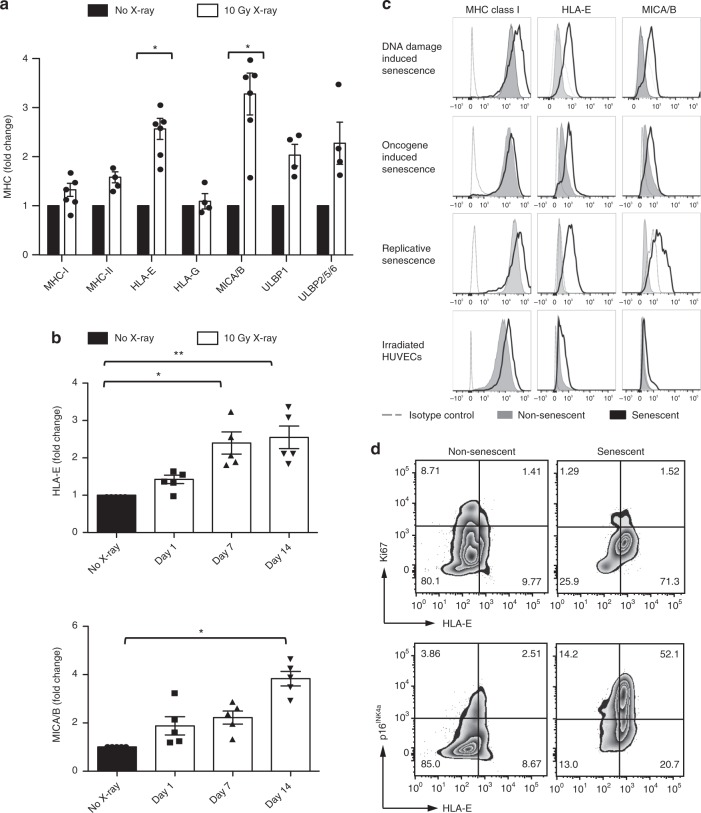
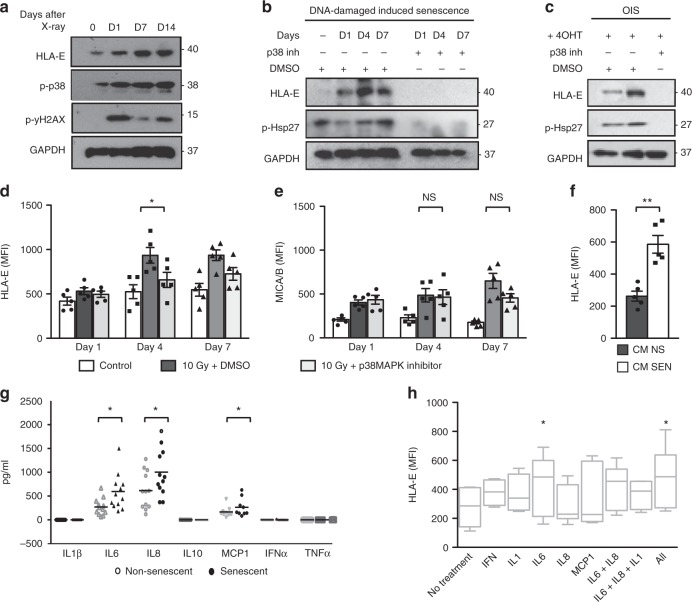
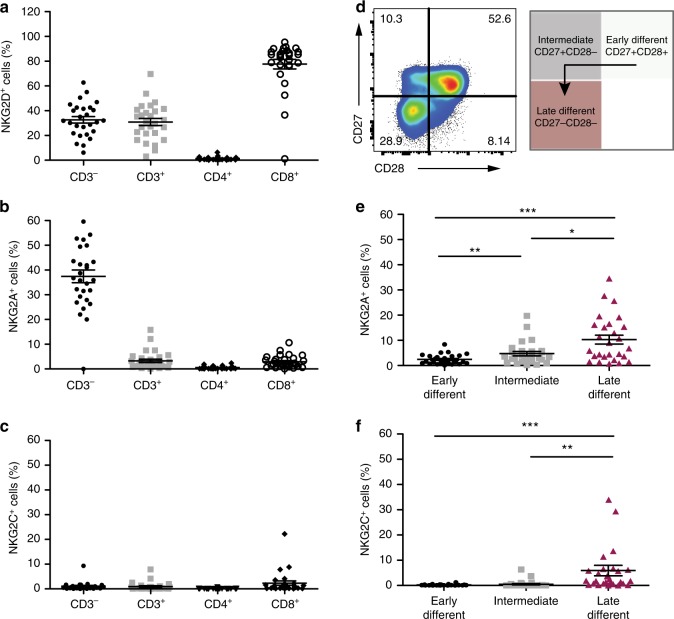
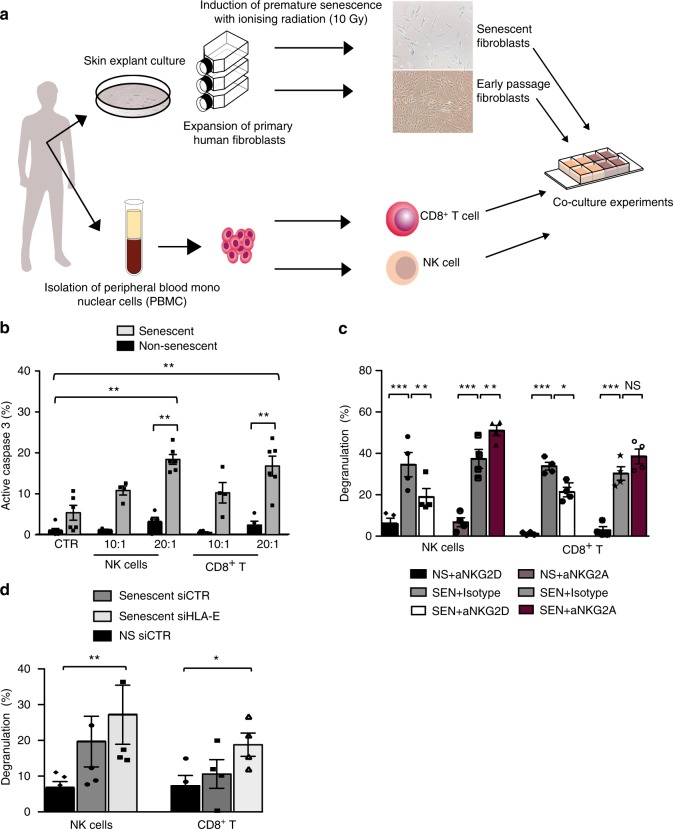
Senescent cells accumulate in human tissues during ageing and contribute to age-related pathologies. The mechanisms responsible for their accumulation are unclear. Here we show that senescent dermal fibroblasts express the non-classical MHC molecule HLA-E, which interacts with the inhibitory receptor NKG2A expressed by NK and highly differentiated CD8 + T cells to inhibit immune responses against senescent cells. HLA-E expression is induced by senescence-associated secretary phenotype-related pro-inflammatory cytokines, and is regulated by p38 MAP kinase signalling in vitro. Consistently, HLA-E expression is increased on senescent cells in human skin sections from old individuals, when compared with those from young, and in human melanocytic nevi relative to normal skin. Lastly, blocking the interaction between HLA-E and NKG2A boosts immune responses against senescent cells in vitro. We thus propose that increased HLA-E expression contributes to persistence of senescent cells in tissues, thereby suggesting a new strategy for eliminating senescent cells during ageing.
Overview
The claims and statistics of this paper haven’t been checked yet.
Free: it reads the open-access text and checks the first 5 claims that cite a source we can check. Create a free account to check every claim.
Integrity signals
Registry
Cites
Statistics
Figures
Verification
Claims the paper makes
The claims and statistics of this paper haven’t been checked yet.
Free: it reads the open-access text and checks the first 5 claims that cite a source we can check. Create a free account to check every claim.
Claims other papers make about this one
Each is checked against this paper’s own text: does it say what the citing paper says it does?
The source backs part of the claim, not all of it — or backs it for a different population, condition or comparison.
In the citing paper
“Normally, senescent cells appear to be cleared within days to weeks after they develop by natural killer cells and other immune cell types62,66–69.”
From Cellular senescence and senolytics: the path to the clinic (2022) · cites this paper as [66]
Experimental — accuracy not yet measuredThe source backs part of the claim, not all of it — or backs it for a different population, condition or comparison.
In the citing paper
“Pereira et al. recently reported that senescent human primary dermal fibroblasts and endothelial cells express higher levels of the atypical major histocompatibility complex (MHC) Ib molecule HLA-E via the p38 signaling pathway than non-senescent cells.”
From Immune Clearance of Senescent Cells to Combat Ageing and Chronic Diseases (2020) · cites this paper as [124]
Experimental — accuracy not yet measuredThe source backs part of the claim, not all of it — or backs it for a different population, condition or comparison.
In the citing paper
“Moreover, IL-6 and IL-8 also enhanced the surface expression of HLA- E that interacts with the inhibitory receptor NKG2A, thereby blunting the activity of cytotoxic NK cells and mature CD8 + T- cells 176 .”
From Senescence and cancer — role and therapeutic opportunities (2022) · cites this paper as [176]
Experimental — accuracy not yet measuredThe cited source says what the claim attributes to it.
In the citing paper
“At younger ages, senescent cells are cleared by the host immune system [63–66]”
From Reducing Senescent Cell Burden in Aging and Disease (2020) · cites this paper as [64]
The cited source says what the claim attributes to it.
In the citing paper
“However, this immunomodulatory property of monocytes may be a by-product of the increased inflammatory skin environmentas increased senescent stromal cells such as fibroblasts are present in older skin (10).”
From The impact of ageing on monocytes and macrophages (2021) · cites this paper as [10]
5 more claims about this paper
Create a free account to see every claim other papers make about this one.
Self-check
Percentages, sums and reported differences re-computed from the paper’s own numbers.
The self-check needs the paper’s full text.
Citations
Cites
The senescence-associated secretory phenotype: the dark side of tumor suppression
Coppé, J.-P., Desprez, P.-Y., Krtolica, A., & Campisi, J. (2010) · Annual Review of Pathology: Mechanisms of Disease · doi:10.1146/annurev-pathol-121808-102144 · Cited by 5,206
Self-citationChronic Inflammation (Inflammaging) and Its Potential Contribution to Age-Associated Diseases
Franceschi, C., & Campisi, J. (2014) · The Journals of Gerontology Series A: Biological Sciences and Medical Sciences · doi:10.1093/gerona/glu057 · Cited by 3,891
Self-citationClearance of p16Ink4a-positive senescent cells delays ageing-associated disorders
Baker, D. J., Wijshake, T., Tchkonia, T., LeBrasseur, N. K., Childs, B. G., van de Sluis, B., Kirkland, J. L., & van Deursen, J. M. (2011) · Nature · doi:10.1038/nature10600 · Cited by 3,670
Aging, Cellular Senescence, and Cancer
Campisi, J. (2013) · Annual Review of Physiology · doi:10.1146/annurev-physiol-030212-183653 · Cited by 2,954
Self-citationNaturally occurring p16Ink4a-positive cells shorten healthy lifespan
Baker, D. J., Childs, B. G., Durik, M., Wijers, M. E., Sieben, C. J., Zhong, J., A. Saltness, R., Jeganathan, K. B., Verzosa, G. C., Pezeshki, A., et al. (2016) · Nature · doi:10.1038/nature16932 · Cited by 2,876
Lanier, L. L. (2005) · Annual Review of Immunology · doi:10.1146/annurev.immunol.23.021704.115526 · Cited by 2,769
The role of senescent cells in ageing
van Deursen, J. M. (2014) · Nature · doi:10.1038/nature13193 · Cited by 2,623
Senescence and tumour clearance is triggered by p53 restoration in murine liver carcinomas
Xue, W., Zender, L., Miething, C., Dickins, R. A., Hernando, E., Krizhanovsky, V., Cordon-Cardo, C., & Lowe, S. W. (2007) · Nature · doi:10.1038/nature05529 · Cited by 2,473
A complex secretory program orchestrated by the inflammasome controls paracrine senescence
Acosta, J. C., Banito, A., Wuestefeld, T., Georgilis, A., Janich, P., Morton, J. P., Athineos, D., Kang, T.-W., Lasitschka, F., Andrulis, M., et al. (2013) · Nature Cell Biology · doi:10.1038/ncb2784 · Cited by 2,278
Persistent DNA damage signalling triggers senescence-associated inflammatory cytokine secretion
Rodier, F., Coppé, J.-P., Patil, C. K., Hoeijmakers, W. A. M., Muñoz, D. P., Raza, S. R., Freund, A., Campeau, E., Davalos, A. R., & Campisi, J. (2009) · Nature Cell Biology · doi:10.1038/ncb1909 · Cited by 2,232
Self-citation
Cited by
Items 201–300 of 565
Anti-senescence therapies: a new concept to address cardiovascular disease
Stojanović, S. D., Thum, T., & Bauersachs, J. K. (2025) · Cardiovascular Research · doi:10.1093/cvr/cvaf030 · Cited by 34
“E 59 and the programmed death-ligand 1 (PD-L1).”
Covre, L. P., Devine, O., de Moura, R. G., Vukmanovic‐Stejic, M., Dietze, R., Ribeiro‐Rodrigues, R., Guedes, H. L. D. M., Zanotti, R. L., Falqueto, A., Akbar, A. N., et al. (2020) · Immunology · doi:10.1111/imm.13173 · Cited by 30
Self-citationIs early life adversity a trigger towards inflammageing?
Merz, M. P., & Turner, J. D. (2021) · Experimental Gerontology · doi:10.1016/j.exger.2021.111377 · Cited by 31
Puca, A. A., Lopardo, V., Montella, F., Pietro, P. D., Cesselli, D., Rolle, I. G., Bulfoni, M., Sarno, V. D., İaconetta, G., Campiglia, P., et al. (2022) · Cells · doi:10.3390/cells11020294 · Cited by 28
“As expected, the senotherapeutic effect of the LAV-BPIFB4 was also supported by the reduced HLA-E expression (Figure 3E,F) [41].”
BackgroundInfluentialCounteracting Immunosenescence—Which Therapeutic Strategies Are Promising?
Hieber, C., Grabbe, S., & Bros, M. (2023) · Biomolecules · doi:10.3390/biom13071085 · Cited by 30
Liu, S., Meng, Y., Zhang, Y., Qiu, L., Wan, X., Yang, X., Zhang, Y., Liu, X., Wen, L., Lei, X., et al. (2024) · Journal of Advanced Research · doi:10.1016/j.jare.2024.04.007 · Cited by 33
“T cells have been implicated in the surveillance and elimination of senescent cells [53,54].”
CD8 + T cell targeting of tumor antigens presented by HLA-E
Iyer, R. F., Verweij, M. C., Nair, S. S., Morrow, D., Mansouri, M., Chakravarty, D., Beechwood, T., Meyer, C., Uebelhoer, L. S., Lauron, E. J., et al. (2024) · Science Advances · doi:10.1126/sciadv.adm7515 · Cited by 28
Aging reshapes the adaptive immune system from healer to saboteur
Delgado-Pulido, S., Yousefzadeh, M. J., & Mittelbrunn, M. (2025) · Nature Aging · doi:10.1038/s43587-025-00906-1 · Cited by 37
“However, senescent cells acquire properties that enable them to evade immune clearance through different mechanisms, such as expression of the nonclassical MHC class I molecule HLA-E 29 .”
Tumor Secretome to Adoptive Cellular Immunotherapy: Reduce Me Before I Make You My Partner
Etxebeste-Mitxeltorena, M., del Rincón-Loza, I., & Martín-Antonio, B. (2021) · Frontiers in Immunology · doi:10.3389/fimmu.2021.717850 · Cited by 29
Single-cell landscape of immunocytes in patients with extrahepatic cholangiocarcinoma
Xu, L., Lü, Y., Deng, Z., Li, X., Shi, Y., Zhao, K., Yao, W., & Wang, J. (2022) · Journal of Translational Medicine · doi:10.1186/s12967-022-03424-5 · Cited by 27
“In addition, Treg cells (C5–CD4) were suggested to interact intensively with CD8+ Tex cells (C1–CD8 and C4–CD8) through HLAE-KLRK1 and its subtypes, which were classified as immune inhibitors because they promote senescent cell accumulation [36] and suppress tumor-specific cytotoxic T lymphocytes [37], and HLA-E-KLRK1…”
BackgroundSenescent Stromal Cells in the Tumor Microenvironment: Victims or Accomplices?
Ye, M., Huang, X., Wu, Q., & Liu, F. (2023) · Cancers · doi:10.3390/cancers15071927 · Cited by 30
“Ex vivo comparative experiments also demonstrated that HLAE expression is increased in senescent cells from skin sections from the elderly compared to the young and in human melanocytic nevi compared to normal skin tissue [77].”
BackgroundImpact of senolytic treatment on immunity, aging, and disease
Lorenzo, E. C., Torrance, B. L., & Haynes, L. (2023) · Frontiers in Aging · doi:10.3389/fragi.2023.1161799 · Cited by 31
Fang, Y., Wang, S. P. H., Liao, I., Tsai, K., Huang, P.-H., Yang, P.-J., Yen, C., Liu, P., Shan, Y., & Liu, Y.-W. (2023) · Advanced Healthcare Materials · doi:10.1002/adhm.202301186 · Cited by 25
Neutrophil-activating secretome characterizes palbociclib-induced senescence of breast cancer cells
Favaretto, G., Rossi, M. N., Cuollo, L., Laffranchi, M., Cervelli, M., Soriani, A., Sozzani, S., Santoni, A., & Antonangeli, F. (2024) · Cancer Immunology Immunotherapy · doi:10.1007/s00262-024-03695-5 · Cited by 26
Ji, P., Wang, C., Liu, Y., Guo, X., Liang, Y., Wei, J., Liu, Z., Gong, L., Yang, G., & Ji, G. (2024) · Advanced Healthcare Materials · doi:10.1002/adhm.202400945 · Cited by 26
Wu, H., Yao, Z., Li, H., Zhang, L., Zhao, Y., Li, Y., Wu, Y., Zhang, Z., Xie, J., Ding, F., et al. (2024) · Journal of Nanobiotechnology · doi:10.1186/s12951-024-02541-1 · Cited by 30
Shi, J., Lai, Z., Zhou, W., Yang, H., Zhang, T., Sun, J., Zhao, J., & Li, M. (2024) · The EMBO Journal · doi:10.1038/s44318-024-00220-3 · Cited by 33
“Accumulating evidence indicates that NK cells facilitate the clearance of senescent cells and maintain tissue homeostasis (Deryabin et al, 2020; Jin et al, 2021; Pereira et al, 2019).”
Targeting immunosenescence for improved tumor immunotherapy
Liu, Z., Zuo, L., Zhou, Z., Liu, S., Ba, Y., Zuo, A., Ren, Y., Zhang, C., Chen, Y., Ma, H., et al. (2024) · MedComm · doi:10.1002/mco2.777 · Cited by 29
dos Reis, S. R. R., Pinto, S. R., de Menezes, F. D., Martínez‐Máñez, R., Ricci‐Júnior, E., Alencar, L. M. R., Helal‐Neto, E., de Barros, A. O. D. S., Lisboa, P. C., & Santos‐Oliveira, R. (2020) · Pharmaceutical Research · doi:10.1007/s11095-019-2754-9 · Cited by 25
“In elderly individuals there is immunosenescence with a compensatory and exacerbated alterations that promote an inflammatory environment due presence of inflammatory markers (as IL-6, TNF-alpha), and a decline of defense cells (Lymphocytes B, T and NK cells), generating an inefficient response in the recognition and…”
BackgroundRole of low-dose radiation in senescence and aging: A beneficial perspective
Xu, J., Liu, D., Zhao, D., Jiang, X. M., Meng, X., Jiang, L., Meina, Y., Zhang, L., & Jiang, H. (2022) · Life Sciences · doi:10.1016/j.lfs.2022.120644 · Cited by 32
Advances in the study of HLA class Ib in maternal-fetal immune tolerance
Yang, Y., Wang, W., Weng, J., Li, H., Ma, Y., Liu, L., & Ma, W. (2022) · Frontiers in Immunology · doi:10.3389/fimmu.2022.976289 · Cited by 26
“HLA-E can interact with TCR on CD8 T cells and regulatory T cells (61, 62), and with receptors NKG2A and NKG2C expressed on NK cells and some T cell subsets (Figure 2).”
BackgroundSenescence and senolysis in cancer: The latest findings
Imawari, Y., & Nakanishi, M. (2024) · Cancer Science · doi:10.1111/cas.16184 · Cited by 26
“63,64 Senescent fibroblasts may affect the balance of myeloid cells, lymphocytes, and macrophages in the tumor environment, such that cancer cells coinjected with aged fibroblasts into immuno-competent mice induced larger tumor volumes than cancer cells coinjected with nonsenescent fibroblasts;…”
BackgroundBeyond the Hayflick limit: How microbes influence cellular aging
Abavisani, M., Faraji, S., Ebadpour, N., Karav, S., & Sahebkar, A. (2025) · Ageing Research Reviews · doi:10.1016/j.arr.2025.102657 · Cited by 24
Antigen-presenting fibroblasts: emerging players in immune modulation and therapeutic targets
Chen, X., Chen, F., Jia, S., Lu, Q., & Zhao, M. F. (2025) · Theranostics · doi:10.7150/thno.104900 · Cited by 23
“Concurrently, this interaction also modulates the functionality of CD8 + T cells and NK cells [60, 75].”
Reprogramming cellular senescence and aging clocks for advanced cancer immunotherapy
Yang, H., Liu, D., Qiu, L., Wang, R., Zhang, C., Yu, D., Zhong, Q., Yuki, N., Song, Z., Zhu, Τ., et al. (2025) · Molecular Cancer · doi:10.1186/s12943-025-02459-8 · Cited by 38
Senescence and Type 2 Diabetic Cardiomyopathy: How Young Can You Die of Old Age?
Henson, S. M., & Aksentijević, D. (2021) · Frontiers in Pharmacology · doi:10.3389/fphar.2021.716517 · Cited by 25
“The expression of HLA-E by senescent fibroblasts in culture and in the skin of older humans increases and interacts with NKG2A to inhibit NK and CD8 cytotoxicity (Pereira et al., 2019).”
BackgroundInfluentialThe interaction between cellular senescence and chronic kidney disease as a therapeutic opportunity
Zhao, J.-L., Qiao, X.-H., Mao, J., Liu, F., & Fu, H. (2022) · Frontiers in Pharmacology · doi:10.3389/fphar.2022.974361 · Cited by 27
New Horizons in cellular senescence for clinicians
Witham, M. D., Granic, A., Miwa, S., Passos, J. F., Richardson, G. D., & Sayer, A. A. (2023) · Age and Ageing · doi:10.1093/ageing/afad127 · Cited by 26
“The immune system is able to clear senescent cells to some extent, although some senescent cells are able to evade immune surveillance and clearance [93].”
BackgroundSelf-citationSchwartz, R. E., Shokhirev, M. N., Andrade, L. R., Gutkind, J. S., Iglesias-Bartolome, R., & Shadel, G. S. (2021) · Aging · doi:10.18632/aging.202658 · Cited by 23
“Because the immune system cannot always eliminate senescent cells [6], they persist as the organism ages [7].”
End-Stage Idiopathic Pulmonary Fibrosis Lung Microenvironment Promotes Impaired NK Activity
Cruz, T., Garcia, P. A. A., Chamucero-Millares, J. A., Bondonese, A., Mitash, N., Sembrat, J., Tabib, T., Zhang, W., Seyed, N., Peters, V., et al. (2023) · The Journal of Immunology · doi:10.4049/jimmunol.2300182 · Cited by 29
Cardiovascular ageing: hallmarks, signaling pathways, diseases and therapeutic targets
Zheng, P., Yan, W., Ding, Y.-N., Zhang, Y., Chen, Z., Qian, J., & Ge, J. (2026) · Signal Transduction and Targeted Therapy · doi:10.1038/s41392-026-02630-7 · Cited by 40
Interrelation Between Fibroblasts and T Cells in Fibrosing Interstitial Lung Diseases
Lai, Y., Wei, X., Ye, T., Hang, L.-L., Mou, L., & Su, J. (2021) · Frontiers in Immunology · doi:10.3389/fimmu.2021.747335 · Cited by 28
Rodríguez-Agustín, A., Casanova, V., Grau-Expósito, J., Sánchez‐Palomino, S., Alcamí, J., & Climent, N. (2023) · Pharmaceutics · doi:10.3390/pharmaceutics15030917 · Cited by 28
“In this context, HLA alleles carrying HLA-B -21T, such as Bw4 and low-expression HLAA allotypes, codify HLA molecules that reduce HLA-E levels -n HIV-infected CD4+ T cells.”
BackgroundInfluentialCiaglia, E., Lopardo, V., Montella, F., Carrizzo, A., Pietro, P. D., Malavolta, M., Giacconi, R., Orlando, F., Cattaneo, M., Madeddu, P. R., et al. (2022) · Cell Death and Disease · doi:10.1038/s41419-022-04535-z · Cited by 24
“Otherwise, it is conceivable that the AAV-LAV-BPIFB4 infection may induce a differential chemokine pattern of expression, thus regulating the chemotactic response of immune SnC to the spleen.”
BackgroundInfluentialZeng, W., Liu, F., Liu, Y., Zhang, Z., Hu, H., Ning, S., Zhang, H., Chen, X., Liao, Z., & Zhang, Z. (2024) · Clinical and Molecular Hepatology · doi:10.3350/cmh.2024.0934 · Cited by 24
The context-dependent effect of cellular senescence: From embryogenesis and wound healing to aging
Lavarti, R., Alvarez-Diaz, T., Marti, K., Kar, P., & Raju, R. P. (2025) · Ageing Research Reviews · doi:10.1016/j.arr.2025.102760 · Cited by 21
COVID-19, ferrosenescence and neurodegeneration, a mini-review
Sfera, A., Osorio, C. P., Maguire, G. A., Rahman, L., Jafri, A., Cummings, M. A., & Maldonado, J. C. (2020) · Progress in Neuro-Psychopharmacology and Biological Psychiatry · doi:10.1016/j.pnpbp.2020.110230 · Cited by 25
Machiraju, D., Schäfer, S., & Hassel, J. C. (2021) · Life · doi:10.3390/life11121318 · Cited by 22
Saleh, T., Khasawneh, A. I., Himsawi, N. M., Abu-Raideh, J. A., Ejeilat, V., Elshazly, A. M., & Gewirtz, D. A. (2022) · International Journal of Molecular Sciences · doi:10.3390/ijms232415512 · Cited by 24
The Impact of T-cell Aging on Alloimmunity and Inflammaging
Iske, J., Dedeilia, A., Xiao, Y., Martin, F., Emmert, M. Y., Sage, P. T., Abdi, R., Zhou, H., & Tullius, S. G. (2023) · Transplantation · doi:10.1097/tp.0000000000004715 · Cited by 23
“84,85 Of relevance, immuno-surveillance appears less effective in aging and may thus pave the way for senescent cell accumulation.”
BackgroundQamsari, E. S., & Stewart, D. J. (2024) · Frontiers in Immunology · doi:10.3389/fimmu.2024.1403669 · Cited by 24
Cellular senescence in tumor immune escape: Mechanisms, implications, and therapeutic potential
You, L., & Wu, Q. (2025) · Critical Reviews in Oncology/Hematology · doi:10.1016/j.critrevonc.2025.104628 · Cited by 21
Therapy-induced senescence is finally escapable, what is next?
Saleh, T. (2024) · Cell Cycle · doi:10.1080/15384101.2024.2364579 · Cited by 24
“What makes senescence a more credible form of tumor cell dormancy is that it can share several established hallmarks of dormancy, including escape from immunosurveillance [18,56–58], promotion of angiogenesis [59,60], and upregulation of autophagy [61–63].”
BackgroundRestoration of hair follicle inductive properties by depletion of senescent cells
Pappalardo, A., Kim, J. Y., Abaci, H. E., & Christiano, A. M. (2024) · Aging Cell · doi:10.1111/acel.14353 · Cited by 22
“…cells are normally cleared by the innate immune system, such as macrophages or natural killer cells (Lujambio, 2016; Munoz-Espin et al., 2013; Pereira et al., 2019 ), however, this system is not completely effective and over time the progressive accumulation of senescent cells impairs the…”
Guo, G., Watterson, S., Zhang, S., Bjourson, A. J., McGilligan, V., Peace, A. J., & Singh, T. (2021) · Ageing Research Reviews · doi:10.1016/j.arr.2021.101363 · Cited by 25
Sharma, R. (2021) · PharmaNutrition · doi:10.1016/j.phanu.2021.100281 · Cited by 23
Li, C., Zhou, L., Sun, H., & Yang, M. S. (2024) · Clinical Interventions in Aging · doi:10.2147/cia.s463297 · Cited by 25
“77 The relevance of HLA and NK cells to the pathogenesis of AMD is significant, and whether retinal senescent cells also use HLA for immune evasion is an intriguing topic that warrants further research.”
Salminen, A. (2024) · Biogerontology · doi:10.1007/s10522-024-10114-w · Cited by 29
“Pereira et al. (2019) reported that the HLA-E protein targeted the NKG2A receptor on the surface of NK and CD8 + T cells.”
BackgroundInfluentialGiri, S., Lamichhane, G., Pandey, J., Khadayat, R., Sindhu, K. C., Devkota, H. P., & Khadka, D. (2025) · International Journal of Molecular Sciences · doi:10.3390/ijms26072923 · Cited by 26
The aging interactome: From cellular dysregulation to therapeutic frontiers in age-related diseases
Qoura, L. A., Churov, A. V., Maltseva, O. N., Arbatskiy, M. S., & Tkacheva, O. N. (2025) · Biochimica et Biophysica Acta (BBA) - Molecular Basis of Disease · doi:10.1016/j.bbadis.2025.168060 · Cited by 26
CD4 T cells acquire Eomesodermin to modulate cellular senescence and aging
Elyahu, Y., Feygin, I., Eremenko, E., Pinkas, N., Zemer, A., Shicht, A., Berner, O., Avigdory-Meiri, R., Nemirovsky, A., Reshef, K., et al. (2025) · Nature Aging · doi:10.1038/s43587-025-00953-8 · Cited by 21
Induction of T Cell Senescence by Cytokine Induced Bystander Activation
Abbas, A. A., & Akbar, A. N. (2021) · Frontiers in Aging · doi:10.3389/fragi.2021.714239 · Cited by 24
“There is therefore a balance between activating and inhibitory receptor signalling on the same cell that has to be taken into consideration (Pereira et al., 2019).”
BackgroundSelf-citationHernández‐Mercado, E., Prieto‐Chávez, J. L., Arriaga‐Pizano, L., Hernández-Gutiérrez, S., Mendlovic, F., Königsberg, M., & López‐Díazguerrero, N. E. (2021) · International Journal of Molecular Sciences · doi:10.3390/ijms221910215 · Cited by 19
The war between the immune system and the tumor - using immune biomarkers as tracers
Yang, K., Lu, R., Mei, J., Cao, K., Zeng, T., Hua, Y., Huang, X., Li, W., & Yin, Y. (2024) · Biomarker Research · doi:10.1186/s40364-024-00599-5 · Cited by 26
Tsuji, K., Kida, Y., Koshikawa, N., Yamamoto, S., Shinozaki, Y., Watanabe, T., Lin, J. C., Nagase, H., & Takenaga, K. (2022) · Cancer Science · doi:10.1111/cas.15290 · Cited by 19
Sharma, R. (2024) · Cell Biochemistry and Function · doi:10.1002/cbf.3970 · Cited by 20
Stimuli-Specific Senescence of Primary Human Lung Fibroblasts Modulates Alveolar Stem Cell Function
Melo-Narváez, M. C., Bramey, N., See, F., Heinzelmann, K., Ballester, B., Steinchen, C., Jain, E., Federl, K., Hu, Q., Dhakad, D., et al. (2024) · Cells · doi:10.3390/cells13131129 · Cited by 23
The Immune System and Cellular Senescence: A Complex Interplay in Aging and Disease
Ayoub, M., Jaoude, C. A., Ayoub, M., Hamadé, A., & Rima, M. (2025) · Immunology · doi:10.1111/imm.70036 · Cited by 31
“In other cases, senescent cells can upregulate the expression of cell surface ligands that modulate the activity of NK cells, which helps senescent or cancerous cells escape immune surveillance [44].”
Astorga-Gamaza, A., Grau-Expósito, J., Burgos, J., Navarro, J., Curran, A., Raventós, B., Torrella, A., Planas, B., Suanzes, P., Falcó, V., et al. (2022) · eLife · doi:10.7554/elife.78294 · Cited by 22
Hernández‐González, F., Pietrocola, F., Cameli, P., Bargagli, E., Prieto‐González, S., Cruz, T., Mendoza, N., Rojas, M. M., Serrano, M., Agustí, A. G. N., et al. (2024) · International Journal of Molecular Sciences · doi:10.3390/ijms25147554 · Cited by 19
“Consequently, depletion of HLA-E renders senescent cells susceptible to elimination by both NK cells and CD8 T cells [30].”
BackgroundZiogas, D. C., Theocharopoulos, C., Aravantinou-Fatorou, K., Boukouris, A. E., Stefanou, D. T., Anastasopoulou, A. N., Lialios, P., Lyrarakis, G., & Gogas, H. J. (2025) · Critical Reviews in Oncology/Hematology · doi:10.1016/j.critrevonc.2025.104635 · Cited by 23
Luo, F., Yue, J., Li, L., Mei, J., Liu, X., & Huang, Y. X. (2022) · Annals of Translational Medicine · doi:10.21037/atm-22-2287 · Cited by 20
“Human senescent cells can also inhibit CD8 + cytotoxicity through p38 mitogen-activated protein kinase (p38MAK) signaling-mediated upregulation of HLA-E expression (20).”
Aryl hydrocarbon receptor: Linking environment to aging process in elderly patients with asthma
Yang, T., Wan, R., Tu, W., Avvaru, S. N., & Gao, P. (2024) · Chinese Medical Journal · doi:10.1097/cm9.0000000000002960 · Cited by 18
“[30] Senescent cells also show increased rates of mitochondrial metabolic activity, including the TCA cycle, oxidative phosphorylation (OXPHOS), and glycolytic pathways, together with increased adenosine monophosphate (AMP) and adenosine diphosphate (ADP) and decreased ATP and NAD + /NADH in…”
BackgroundSenescence in the ageing skin: a new focus on m TORC 1 and the lysosome
Smith, P., & Carroll, B. (2024) · FEBS Journal · doi:10.1111/febs.17281 · Cited by 21
“This is corroborated by in vivo analysis of aged skin [22].”
Blood autophagy defect causes accelerated non-hematopoietic organ aging
Fang, Y., Zhu, L., An, N. A., Jiang, G., Qian, J., Zhao, R., Yuan, N., Zhang, S., & Wang, J. (2019) · Aging · doi:10.18632/aging.102086 · Cited by 17
“NK cells have recently been found to be implicated in the regulation of aging [42, 43].”
BackgroundCarpenter, V. J., Patel, B. B., Autorino, R., Smith, S. C., Gewirtz, D. A., & Saleh, T. (2020) · Biochimica et Biophysica Acta (BBA) - Reviews on Cancer · doi:10.1016/j.bbcan.2020.188424 · Cited by 18
Alterations of multiple alveolar macrophage states in chronic obstructive pulmonary diseasePreprint
Bassler, K. E., Fujii, W., Kapellos, T. S., Horne, A., Reiz, B., Dudkin, E., Luecken, M. D., Reusch, N., Osei-Sarpong, C., Warnat‐Herresthal, S., et al. (2020) · bioRxiv (Cold Spring Harbor Laboratory) · doi:10.1101/2020.05.28.121541 · Cited by 17
“Downregulation of MHC class I can trigger NK-dependent killing, but the simultaneous expression of the non-classical MHC class I molecule HLA-E on AMs likely protects immunosenescent AMs from effective clearance by NK cells (Pereira et al., 2019).”
BackgroundNunes, J. M., Kell, L., Slaghekke, A., Wüst, R. C. I., Fielding, B. C., Kell, D. B., & Pretorius, E. (2026) · Cell Death and Disease · doi:10.1038/s41419-025-08162-2 · Cited by 22
“…by expressing the major histocompatibility complex molecule HLA-E, which normally inhibits NK cell and CD8+T-cell responses via engagement of the immune inhibitory natural killer group 2A (NKG2A) receptor, thereby preventing leukocyte cytotoxicity and hindering the removal of senescent cells [70].”
Santamaria, J. C., & Irla, M. (2026) · Science Advances · doi:10.1126/sciadv.aeb2970 · Cited by 23
Tilman, G., Bouzin, C., Aydın, S., Tamirou, F., Galant, C., Coulie, P. G., Houssiau, F., Lauwerys, B., & Limaye, N. (2021) · RMD Open · doi:10.1136/rmdopen-2021-001844 · Cited by 19
Luo, Y., Fang, X., Zhou, Y. M., Zhang, Y., Li, W., Leng, S. X., Yao, X., & Liu, X. (2024) · Journal of Dermatological Science · doi:10.1016/j.jdermsci.2024.04.002 · Cited by 19
Fibroblasts as regulators of lung immunity, repair and fibrosis
Bell, P. T., & Belz, G. T. (2026) · Nature reviews. Immunology · doi:10.1038/s41577-026-01268-4 · Cited by 22
Autologous NK cells propagated and activated ex vivo decrease senescence markers in human PBMCs
Chelyapov, N. V., Nguyen, T. T., & Gonzalez, R. (2022) · Biochemistry and Biophysics Reports · doi:10.1016/j.bbrep.2022.101380 · Cited by 22
T-cell immunity against senescence: potential role and perspectives
Matveeva, K. S., Vasilieva, M., Minskaia, E., Александрович, Р. С., & Shevyrev, D. (2024) · Frontiers in Immunology · doi:10.3389/fimmu.2024.1360109 · Cited by 18
Bravo, G. M., Thongon, N., Rodríguez‐Sevilla, J. J., Ma, F., Gañán‐Gómez, I., Yang, H., Kim, Y. J., Ademà, V., Wildeman, B., Tanaka, T. N., et al. (2024) · Cell Reports Medicine · doi:10.1016/j.xcrm.2024.101585 · Cited by 17
The Role of Aging and Senescence in Immune Checkpoint Inhibitor Response and Toxicity
Jain, S. S., Sojo, G. B., Sun, H., Friedland, B. N., McNamara, M. E., Schmidt, M. O., & Wellstein, A. (2024) · International Journal of Molecular Sciences · doi:10.3390/ijms25137013 · Cited by 18
“Exactly how these changes in lymphocyte function and abundance may impact ICI efficacy or toxicity has not been well studied, but conflicting clinical evidence suggests that age-related changes in these cell populations may or may not impact response to ICI.”
BackgroundThe immunosenescence clock: A new method for evaluating biological age and predicting mortality risk
Li, S., Wang, K., Wu, J., & Zhu, Y. (2024) · Ageing Research Reviews · doi:10.1016/j.arr.2024.102653 · Cited by 21
“For example, the nonclassical MHC molecule HLA-E on the surface of skin fibroblasts is upregulated with age and interacts with the inhibitory receptor NKG2A on NK cells and highly differentiated CD8 + T cells, inhibiting the immune response to senescent cells (Pereira et al., 2019).”
Parishin alleviates vascular ageing in mice by upregulation of Klotho
Zhao, X., Zhou, S., Liu, Y., Gong, C., Xiang, L., Li, S., Wang, P., Wang, Y., Sun, L., Zhang, Q., et al. (2023) · Journal of Cellular and Molecular Medicine · doi:10.1111/jcmm.17740 · Cited by 14
Senescent macrophages in tumor: phenotypes, roles, and interventions
Shen, W., Huang, Y., Yang, X., Zhang, Y., Pan, Y., Xiao, Y., Wang, J., Wang, C., Mao, W., & Zhao, A. (2025) · Cell Death and Disease · doi:10.1038/s41419-025-08000-5 · Cited by 17
“In addition, senescent cells secrete the SASP, notably IL-6, which upregulates HLA-E expression, thereby suppressing the immune activity of NK cells and T cells against senescent cells [64].”
Translating cellular senescence research into clinical practice for metabolic disease
Chaib, S., Palmer, A. K., Wyles, S. P., Musi, N., Kirkland, J. L., & Tchkonia, T. (2025) · Nature Reviews Endocrinology · doi:10.1038/s41574-025-01187-9 · Cited by 19
Can 3D bioprinting solve the mystery of senescence in cancer therapy?
Shboul, S. A., DeLuca, V. J., Dweiri, Y. M., & Saleh, T. (2022) · Ageing Research Reviews · doi:10.1016/j.arr.2022.101732 · Cited by 17
The Potent and Paradoxical Biology of Cellular Senescence in Cancer
Romesser, P. B., & Lowe, S. W. (2023) · Annual Review of Cancer Biology · doi:10.1146/annurev-cancerbio-061421-124434 · Cited by 16
Role of Senescence in Tumorigenesis and Anticancer Therapy
Stoczyńska-Fidelus, E., Węgierska, M., Kierasińska, A., Ciunowicz, D., & Rieske, P. (2022) · Journal of Oncology · doi:10.1155/2022/5969536 · Cited by 15
“On the other hand, mechanisms driving immunoevasion of senescent tumor cells and their link to chemotherapy resistance were clearly shown [36].”
BackgroundSenescent Cells in IPF: Locked in Repair?
Meiners, S., & Lehmann, M. (2020) · Frontiers in Medicine · doi:10.3389/fmed.2020.606330 · Cited by 16
“Moreover, senescent cells might also escape immune cell clearance by NK and CD8 T cells (43).”
BackgroundSingle-cell and spatial detection of senescent cells using DeepScence
Qu, Y., Ji, B., Dong, R., Gu, L., Chan, C., Xie, J., Glass, C., Wang, X.-F., Nixon, A. B., & Ji, Z. (2025) · Cell Genomics · doi:10.1016/j.xgen.2025.101035 · Cited by 30
Stromal senescence contributes to age-related increases in cancer
Ye, J., Melam, A., & Stewart, S. A. (2025) · Nature reviews. Cancer · doi:10.1038/s41568-025-00840-9 · Cited by 18
Davies, E. L., Noor, M., Lim, E. Y., Houldcroft, C. J., Okecha, G., Atkinson, C. E., Reeves, M. B., Jackson, S. E., & Wills, M. R. (2022) · Frontiers in Immunology · doi:10.3389/fimmu.2022.1083230 · Cited by 15
“An increase in senescent fibroblasts in the skin results in the recruitment of monocytes which inhibit the antigen specific response (66) and increased expression of HLA-E, which can interact with the inhibitory molecule NKG2A, is a marker of these senescent fibroblasts in older humans (67).”
BackgroundAbu-Humaidan, A. H. A., Ismail, M. A., Ahmad, F. M., Shboul, S. A., Barham, R., Tadros, J. S., Alhesa, A., El‐Sadoni, M., Alotaibi, M. R., Ababneh, N. A., et al. (2024) · Immunology and Cell Biology · doi:10.1111/imcb.12727 · Cited by 14
The enchanting canvas of CAR technology: Unveiling its wonders in non-neoplastic diseases
Shu, J., Xie, W., Chen, Z., Offringa, R., Hu, Y., & Mei, H. (2024) · Med · doi:10.1016/j.medj.2024.03.016 · Cited by 16
Cheng, W., Zhu, N., Wang, J., & Yang, R. (2024) · Frontiers in Immunology · doi:10.3389/fimmu.2024.1331518 · Cited by 14
scDOT: optimal transport for mapping senescent cells in spatial transcriptomics
Nguyen, N. D., Rosas, L., Khaliullin, T. O., Jiang, P., Hasanaj, E., Ovando-Ricárdez, J. A., Bueno, M., Rahman, I., Pryhuber, G., Li, D., et al. (2024) · Genome biology · doi:10.1186/s13059-024-03426-0 · Cited by 16
Advances in engineered T cell immunotherapy for autoimmune and other non-oncological diseases
Huang, Q., Zhu, X., & Zhang, Y. (2025) · Biomarker Research · doi:10.1186/s40364-025-00736-8 · Cited by 16
From Embryogenesis to Senescence: The Role of Mammary Gland Physiology in Breast Cancer Risk
Lue, J. C., & Radisky, D. C. (2025) · Cancers · doi:10.3390/cancers17050787 · Cited by 19
“Further research into these processes is essential for reducing breast cancer risk in aging populations.”
Implication of Immunobiological Function of Melanocytes in Dermatology
Zhang, H., Xia, M., Li, H., Zeng, X., Jia, H., Zhang, W., & Zhou, J. (2025) · Clinical Reviews in Allergy & Immunology · doi:10.1007/s12016-025-09040-7 · Cited by 21
“As mentioned earlier, nevus cells evade immune clearance by suppressing the cytotoxic activity of NK cells and CD8 + T cells through the HLA-E/NKG2A pathway [39].”
Wlaschek, M., Maity, P., Koroma, A. K., Geiger, H., Singh, K., & Scharffetter‐Kochanek, K. (2025) · Free Radical Biology and Medicine · doi:10.1016/j.freeradbiomed.2025.03.024 · Cited by 17
Nutritional Niches of Cancer Therapy-Induced Senescent Cells
Llop‐Hernández, À., Verdura, S., Cuyàs, E., & Menéndez, J. A. (2022) · Nutrients · doi:10.3390/nu14173636 · Cited by 13
Role of NKG2a/c+CD8+ T cells in pathogenic versus non-pathogenic SIV infections
Huot, N., Rascle, P., Tchitchek, N., Wimmer, B. H., Passaes, C., Contreras, V., Desjardins, D., Stahl‐Hennig, C., Grand, R. L., Sáez‐Cirión, A., et al. (2021) · iScience · doi:10.1016/j.isci.2021.102314 · Cited by 13
Metabolic dysregulation of trained immunity in immune aging and the impact of dietary patterns
Grigorescu, A., Riza, A., Streață, I., & Netea, M. G. (2025) · American Journal of Physiology-Cell Physiology · doi:10.1152/ajpcell.00153.2025 · Cited by 17
Chandra, A., Law, S. F., & Pignolo, R. J. (2025) · Mechanisms of Ageing and Development · doi:10.1016/j.mad.2025.112059 · Cited by 13
Profound CD8 T cell responses towards the SARS-CoV-2 ORF1ab in COVID-19 patientsPreprint
Gangaev, A., Ketelaars, S. L. C., Patiwael, S., Dopler, A., Isaeva, O. I., Hoefakker, K., Biasi, S. D., Mussini, C., Guaraldi, G., Girardis, M., et al. (2020) · Research Square · doi:10.21203/rs.3.rs-33197/v1 · Cited by 15
Metadata
- Authors
- Pereira, B. I., Devine, O. P., Vukmanovic-Stejic, M., Chambers, E. S., Subramanian, P., Patel, N., Virasami, A., Sebire, N. J., Kinsler, V., Valdovinos, A., LeSaux, C. J., Passos, J. F., Antoniou, A., Rustin, M. H. A., Campisi, J., & Akbar, A. N.
- Affiliations
- University College London (GB)
- Great Ormond Street Hospital (GB)
- Buck Institute for Research on Aging (US)
- Mayo Clinic (US)
- Northumbria University (GB)
- Corresponding author
- Akbar, Arne N.
- ORCID
- Venue
- Nature Communications
- Published
- 2019-06-03
- Volume
- 10
- Issue
- 1
- Pages
- 2387-2387
- ISSN
- 2041-1723 (ISSN-L)
- PMC
- PMC6547655
- OpenAlex
- W2948309692
- Semantic Scholar
- 06de5dea91fc1df1d6f986231b42d094e676353b
- Cited by
- 556
- References
- 59
- Citations by year
- 2026: 88 · 2025: 100 · 2024: 96 · 2023: 59 · 2022: 73 · 2021: 80 · 2020: 50 · 2019: 10
- FWCI
- 38.07
- Type
- journal article
- Language
- en
- Open access
- gold
- doi.org
- Licence
- cc-by
- creativecommons.org/licenses/by/4.0 (tdm)
- creativecommons.org/licenses/by/4.0 (vor)
- Locations
- Nature Communications (publishedVersion, cc-by)
- Europe PMC (PubMed Central) (publishedVersion, cc-by)
- PubMed Central (publishedVersion, cc-by)
- PubMed (publishedVersion)
- Northumbria Research Link (Northumbria University) (acceptedVersion)
- OSTI OAI (U.S. Department of Energy Office of Scientific and Technical Information) (submittedVersion)
- RePEc: Research Papers in Economics (submittedVersion)
- DOAJ (DOAJ: Directory of Open Access Journals) (submittedVersion, cc-by-sa)
- DOAJ (DOAJ: Directory of Open Access Journals) (submittedVersion)
- UCL Discovery (University College London) (submittedVersion)
- eScholarship (California Digital Library) (submittedVersion)
- Queen Mary Research Online (Queen Mary University of London) (submittedVersion, cc-by)
- Newcastle University ePrints (Newcastle Univesity) (cc-by)
- Funders
- .B.I.P. was supported by the Portuguese Foundation for Science and Technology and Gulbenkian Institute for Science sponsoring the Advanced Medical Program for Physicians
- O.D. was supported by an MB PhD funding award from the National Institute for Health Research University College London Hospitals Biomedical Research Centre
- Foundation for the National Institutes of Health (AG052744, AG051729)
- RCUK | Medical Research Council (MR/P00184X/1, MR/M003833/1)
- Dermatrust
- Topics
- Life Sciences › Biochemistry, Genetics and Molecular Biology › Cell Biology › Telomeres, Telomerase, and Senescence
- Life Sciences › Immunology and Microbiology › Immunology › Immune Cell Function and Interaction
- Life Sciences › Biochemistry, Genetics and Molecular Biology › Aging › Genetics, Aging, and Longevity in Model Organisms
- Keywords
- cellular senescence, senescent cell clearance, HLA-E, NKG2A, natural killer cells, CD8+ T cells, immune evasion, senescence-associated secretory phenotype, inflammatory cytokines, dermal fibroblasts, skin aging, melanocytic nevi
- MeSH terms
- HLA-E Antigens, Adult, Aged, Aging, Fibroblasts, Humans, Killer Cells, Natural, Nevus, Pigmented, Phenotype, Skin, Histocompatibility Antigens Class I, Signal Transduction, Cytokines, Cellular Senescence, CD8-Positive T-Lymphocytes, Dermis, RNA, Small Interfering, p38 Mitogen-Activated Protein Kinases, NK Cell Lectin-Like Receptor Subfamily C, Young Adult, In Vitro Techniques
About these checks
Registry, retraction, Cites and statistics results are computed, not judged, with one exception: a printed reference that no index lists is read once by a model before it counts as a citation error. Claims are extracted by a model and kept only when their quote appears verbatim in the text; each cited source is then checked, with a model’s help, for whether it says what the claim relies on. Those verdicts can be wrong — read the claim’s quote and the cited source before relying on one.
Statistics and arithmetic are recomputed, not judged.
Confidence bands are shown only for fields calibrated on our annotated test set. None is calibrated yet, so no band is shown.
What counts as a claim ›How we measure confidence ›How we check this ›
Are you an author, or do you see a problem with this page? Request a review
Data sources
Bibliographic data: Semantic Scholar, OpenAlex, Crossref.
Contains information from the Semantic Scholar Academic Graph Datasets, made available under the ODC Attribution License (ODC-BY 1.0).
Semantic Scholar’s data is described in: Kinney, R., et al. (2023). The Semantic Scholar Open Data Platform. arXiv:2301.10140.
