

Senescent cells evade immune clearance via HLA-E-mediated NK and CD8+ T cell inhibition
Open accessThe DOI matches its Crossref record; 58 of the 59 references it cites were found in a registry or an index.
Abstract
Senescent cells accumulate in human tissues during ageing and contribute to age-related pathologies. The mechanisms responsible for their accumulation are unclear. Here we show that senescent dermal fibroblasts express the non-classical MHC molecule HLA-E, which interacts with the inhibitory receptor NKG2A expressed by NK and highly differentiated CD8 + T cells to inhibit immune responses against senescent cells. HLA-E expression is induced by senescence-associated secretary phenotype-related pro-inflammatory cytokines, and is regulated by p38 MAP kinase signalling in vitro. Consistently, HLA-E expression is increased on senescent cells in human skin sections from old individuals, when compared with those from young, and in human melanocytic nevi relative to normal skin. Lastly, blocking the interaction between HLA-E and NKG2A boosts immune responses against senescent cells in vitro. We thus propose that increased HLA-E expression contributes to persistence of senescent cells in tissues, thereby suggesting a new strategy for eliminating senescent cells during ageing.
Overview
The claims and statistics of this paper haven’t been checked yet.
Free: it reads the open-access text and checks the first 5 claims that cite a source we can check. Create a free account to check every claim.
Integrity signals
Registry
Cites
Statistics
Figures
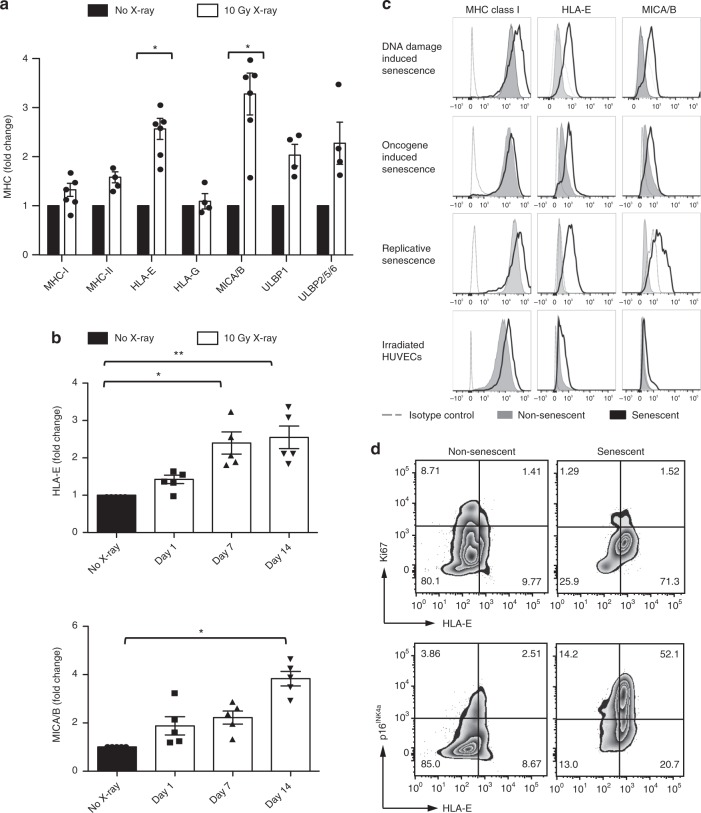
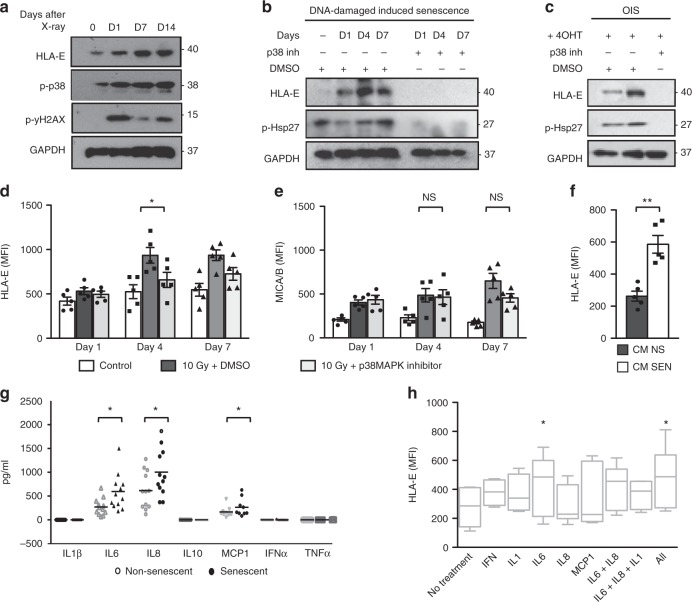
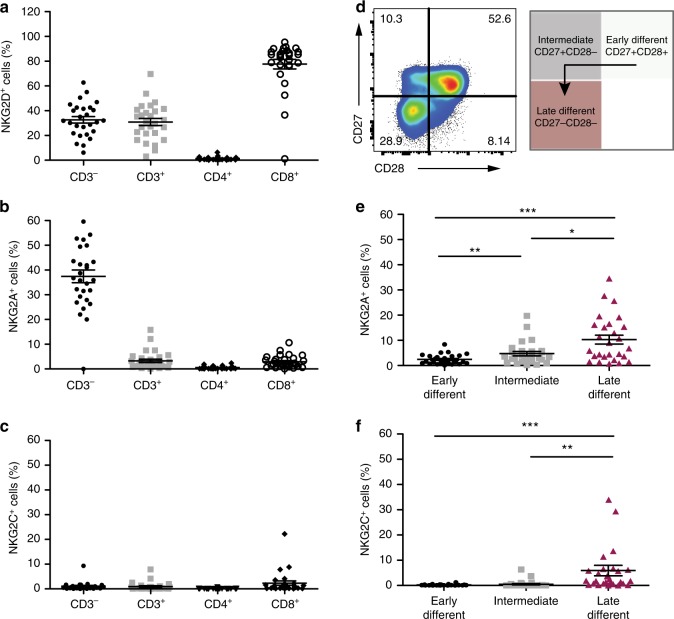
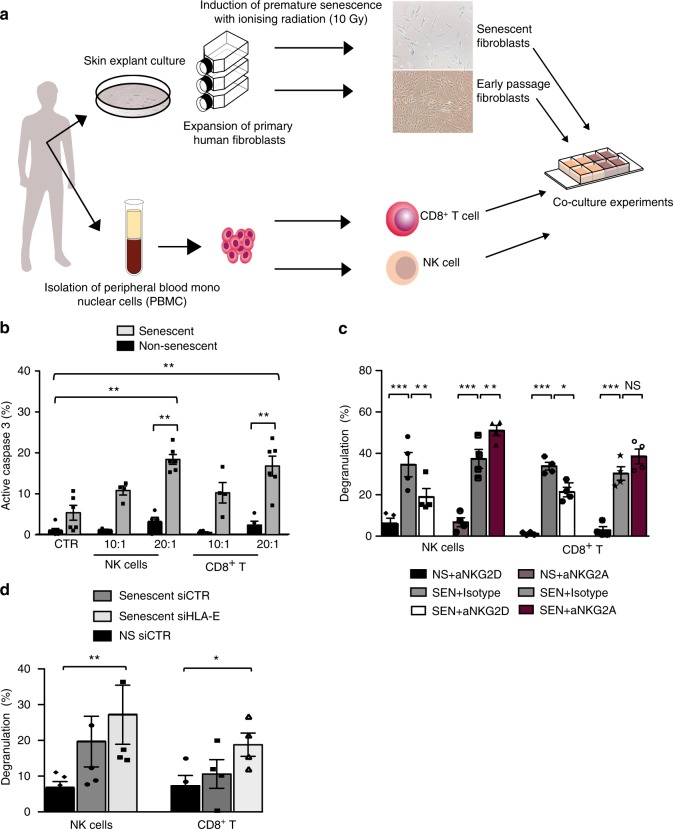
Verification
Claims the paper makes
The claims and statistics of this paper haven’t been checked yet.
Free: it reads the open-access text and checks the first 5 claims that cite a source we can check. Create a free account to check every claim.
Claims other papers make about this one
Each is checked against this paper’s own text: does it say what the citing paper says it does?
The source backs part of the claim, not all of it — or backs it for a different population, condition or comparison.
In the citing paper
“Normally, senescent cells appear to be cleared within days to weeks after they develop by natural killer cells and other immune cell types62,66–69.”
From Cellular senescence and senolytics: the path to the clinic (2022) · cites this paper as [66]
Experimental — accuracy not yet measuredThe source backs part of the claim, not all of it — or backs it for a different population, condition or comparison.
In the citing paper
“Pereira et al. recently reported that senescent human primary dermal fibroblasts and endothelial cells express higher levels of the atypical major histocompatibility complex (MHC) Ib molecule HLA-E via the p38 signaling pathway than non-senescent cells.”
From Immune Clearance of Senescent Cells to Combat Ageing and Chronic Diseases (2020) · cites this paper as [124]
Experimental — accuracy not yet measuredThe source backs part of the claim, not all of it — or backs it for a different population, condition or comparison.
In the citing paper
“Moreover, IL-6 and IL-8 also enhanced the surface expression of HLA- E that interacts with the inhibitory receptor NKG2A, thereby blunting the activity of cytotoxic NK cells and mature CD8 + T- cells 176 .”
From Senescence and cancer — role and therapeutic opportunities (2022) · cites this paper as [176]
Experimental — accuracy not yet measuredThe cited source says what the claim attributes to it.
In the citing paper
“At younger ages, senescent cells are cleared by the host immune system [63–66]”
From Reducing Senescent Cell Burden in Aging and Disease (2020) · cites this paper as [64]
The cited source says what the claim attributes to it.
In the citing paper
“However, this immunomodulatory property of monocytes may be a by-product of the increased inflammatory skin environmentas increased senescent stromal cells such as fibroblasts are present in older skin (10).”
From The impact of ageing on monocytes and macrophages (2021) · cites this paper as [10]
5 more claims about this paper
Create a free account to see every claim other papers make about this one.
Self-check
Percentages, sums and reported differences re-computed from the paper’s own numbers.
The self-check needs the paper’s full text.
Citations
Cites
The senescence-associated secretory phenotype: the dark side of tumor suppression
Coppé, J.-P., Desprez, P.-Y., Krtolica, A., & Campisi, J. (2010) · Annual Review of Pathology: Mechanisms of Disease · doi:10.1146/annurev-pathol-121808-102144 · Cited by 5,206
Self-citationChronic Inflammation (Inflammaging) and Its Potential Contribution to Age-Associated Diseases
Franceschi, C., & Campisi, J. (2014) · The Journals of Gerontology Series A: Biological Sciences and Medical Sciences · doi:10.1093/gerona/glu057 · Cited by 3,891
Self-citationClearance of p16Ink4a-positive senescent cells delays ageing-associated disorders
Baker, D. J., Wijshake, T., Tchkonia, T., LeBrasseur, N. K., Childs, B. G., van de Sluis, B., Kirkland, J. L., & van Deursen, J. M. (2011) · Nature · doi:10.1038/nature10600 · Cited by 3,670
Aging, Cellular Senescence, and Cancer
Campisi, J. (2013) · Annual Review of Physiology · doi:10.1146/annurev-physiol-030212-183653 · Cited by 2,954
Self-citationNaturally occurring p16Ink4a-positive cells shorten healthy lifespan
Baker, D. J., Childs, B. G., Durik, M., Wijers, M. E., Sieben, C. J., Zhong, J., A. Saltness, R., Jeganathan, K. B., Verzosa, G. C., Pezeshki, A., et al. (2016) · Nature · doi:10.1038/nature16932 · Cited by 2,876
Lanier, L. L. (2005) · Annual Review of Immunology · doi:10.1146/annurev.immunol.23.021704.115526 · Cited by 2,769
The role of senescent cells in ageing
van Deursen, J. M. (2014) · Nature · doi:10.1038/nature13193 · Cited by 2,623
Senescence and tumour clearance is triggered by p53 restoration in murine liver carcinomas
Xue, W., Zender, L., Miething, C., Dickins, R. A., Hernando, E., Krizhanovsky, V., Cordon-Cardo, C., & Lowe, S. W. (2007) · Nature · doi:10.1038/nature05529 · Cited by 2,473
A complex secretory program orchestrated by the inflammasome controls paracrine senescence
Acosta, J. C., Banito, A., Wuestefeld, T., Georgilis, A., Janich, P., Morton, J. P., Athineos, D., Kang, T.-W., Lasitschka, F., Andrulis, M., et al. (2013) · Nature Cell Biology · doi:10.1038/ncb2784 · Cited by 2,278
Persistent DNA damage signalling triggers senescence-associated inflammatory cytokine secretion
Rodier, F., Coppé, J.-P., Patil, C. K., Hoeijmakers, W. A. M., Muñoz, D. P., Raza, S. R., Freund, A., Campeau, E., Davalos, A. R., & Campisi, J. (2009) · Nature Cell Biology · doi:10.1038/ncb1909 · Cited by 2,232
Self-citation
Cited by
Fibrosis: from mechanisms to medicines
Henderson, N. C., Rieder, F., & Wynn, T. A. (2020) · Nature · doi:10.1038/s41586-020-2938-9 · Cited by 1,868
Cellular senescence and senolytics: the path to the clinic
Chaib, S., Tchkonia, T., & Kirkland, J. L. (2022) · Nature Medicine · doi:10.1038/s41591-022-01923-y · Cited by 1,134
The senescence-associated secretory phenotype and its physiological and pathological implications
Wang, B., Han, J., Elisseeff, J. H., & Demaria, M. (2024) · Nature Reviews Molecular Cell Biology · doi:10.1038/s41580-024-00727-x · Cited by 948
Senescence and cancer — role and therapeutic opportunities
Schmitt, C. A., Wang, B., & Demaria, M. (2022) · Nature Reviews Clinical Oncology · doi:10.1038/s41571-022-00668-4 · Cited by 794
Mittelbrunn, M., & Kroemer, G. (2021) · Nature Immunology · doi:10.1038/s41590-021-00927-z · Cited by 702
Mogilenko, D. A., Shpynov, O., Andhey, P. S., Arthur, L., Swain, A., Esaulova, E., Brioschi, S., Shchukina, I., Kerndl, M., Bambouskova, M., et al. (2021) · Immunity · doi:10.1016/j.immuni.2020.11.005 · Cited by 683
Targeting cellular senescence with senotherapeutics: senolytics and senomorphics
Zhang, L., Pitcher, L. E., Prahalad, V., Niedernhofer, L. J., & Robbins, P. D. (2023) · The FEBS Journal · doi:10.1111/febs.16350 · Cited by 621
Strategies for targeting senescent cells in human disease
Gasek, N. S., Kuchel, G. A., Kirkland, J. L., & Xu, M. (2021) · Nature Aging · doi:10.1038/s43587-021-00121-8 · Cited by 501
Skin barrier immunity and ageing
Chambers, E. S., & Vukmanovic‐Stejic, M. (2020) · Immunology · doi:10.1111/imm.13152 · Cited by 488
Self-citationSalminen, A., Kaarniranta, K., & Kauppinen, A. (2022) · Inflammation Research · doi:10.1007/s00011-022-01598-8 · Cited by 432
Mechanisms and Regulation of Cellular Senescence
Roger, L., Tomas, F., & Gire, V. (2021) · International Journal of Molecular Sciences · doi:10.3390/ijms222313173 · Cited by 395
“Alternatively, senescent cells can bypass recognition and evade the immune clearance through upregulation of human leukocyte antigen (HLA)-E ligand that can inhibit CD8+ T cell and natural killer cell function [344].”
BackgroundImmune ageing at single-cell resolution
Mogilenko, D. A., Shchukina, I., & Artyomov, M. N. (2022) · Nature Reviews Immunology · doi:10.1038/s41577-021-00646-4 · Cited by 381
Cellular Senescence Is Immunogenic and Promotes Antitumor Immunity
Marin, I., Boix, O., Garcia-Garijo, A., Sirois, I., Caballe, A., Zarzuela, E., Ruano, I., Attolini, C. S.-O., Prats, N., López-Domínguez, J. A., et al. (2023) · Cancer Discovery · doi:10.1158/2159-8290.cd-22-0523 · Cited by 346
“org susceptible to elimination by both NK and CD8 T cells (25).”
BackgroundRole of immune cells in the removal of deleterious senescent cells
Kale, A., Sharma, A., Stolzing, A., Desprez, P.-Y., & Campisi, J. (2020) · Immunity & Ageing · doi:10.1186/s12979-020-00187-9 · Cited by 351
“On the other hand, senescent cells can escape NK-mediated killing by overexpressing MMP3 (which cleaves activating MICA ligands from the senescent cell surface) [98] or HLA-E (an inhibitory ligand that blocks NK cell killing) [97].”
BackgroundSelf-citationNeuroinflammation in Alzheimer’s Disease
Onyango, I. G., Jauregui, G. V., Čarná, M., Bennett, J. P., & Stokin, G. B. (2021) · Biomedicines · doi:10.3390/biomedicines9050524 · Cited by 330
Monalizumab: inhibiting the novel immune checkpoint NKG2A
van Hall, T., André, P., Horowitz, A., Ruan, D. F., Borst, L., Zerbib, R., Narni-Mancinelli, E., van der Burg, S. H., & Vivier, E. (2019) · Journal for ImmunoTherapy of Cancer · doi:10.1186/s40425-019-0761-3 · Cited by 292
The impact of ageing on monocytes and macrophages
De Maeyer, R. P. H., & Chambers, E. S. (2021) · Immunology Letters · doi:10.1016/j.imlet.2020.12.003 · Cited by 275
Self-citationSestrins induce natural killer function in senescent-like CD8+ T cells
Pereira, B. I., De Maeyer, R. P. H., Covre, L. P., Nehar-Belaid, D., Lanna, A., Ward, S., Marches, R., Chambers, E. S., Gomes, D. C. O., Riddell, N. E., et al. (2020) · Nature Immunology · doi:10.1038/s41590-020-0643-3 · Cited by 245
Self-citationChen, S., Zhu, H., & Jounaidi, Y. (2024) · Signal Transduction and Targeted Therapy · doi:10.1038/s41392-024-02005-w · Cited by 234
“387 A clear link between senescent and cancer cells was demonstrated by the reduction of spontaneous tumorigenesis and cancer-related death after the depletion of senescent cells in aging mice.”
BackgroundThe NKG2A–HLA-E Axis as a Novel Checkpoint in the Tumor Microenvironment
Borst, L., van der Burg, S. H., & van Hall, T. (2020) · Clinical Cancer Research · doi:10.1158/1078-0432.ccr-19-2095 · Cited by 244
Cellular Senescence and the Senescence-Associated Secretory Phenotype as Drivers of Skin Photoaging
Fitsiou, E., Pulido, T., Campisi, J., Alimirah, F., & Demaria, M. (2021) · Journal of Investigative Dermatology · doi:10.1016/j.jid.2020.09.031 · Cited by 227
Self-citationTargeting immune dysfunction in aging
Borgoni, S., Kudryashova, K. S., Burka, K., & de Magalhães, J. P. (2021) · Ageing Research Reviews · doi:10.1016/j.arr.2021.101410 · Cited by 223
Pilkington, S. M., Bulfone-Paus, S., Griffiths, C. E. M., & Watson, R. E. B. (2021) · Journal of Investigative Dermatology · doi:10.1016/j.jid.2020.11.006 · Cited by 219
NKG2D-CAR T cells eliminate senescent cells in aged mice and nonhuman primates
Yang, D., Sun, B., Li, S., Wei, W., Liu, X., Cui, X., Zhang, X., Liu, N., Yan, L., Deng, Y., et al. (2023) · Science Translational Medicine · doi:10.1126/scitranslmed.add1951 · Cited by 217
Aging of the Immune System: Focus on Natural Killer Cells Phenotype and Functions
Brauning, A., Rae, M., Zhu, G., Fulton, E., Admasu, T. D., Stolzing, A., & Sharma, A. (2022) · Cells · doi:10.3390/cells11061017 · Cited by 215
“KIR bind to the HLA-A/B/C ligand, whereas NKG2A recognizes the inhibitory HLA-E [42,43].”
BackgroundMartínez‐Zamudio, R. I., Dewald, H. K., Vasilopoulos, T., Gittens‐Williams, L., Fitzgerald‐Bocarsly, P., & Herbig, U. (2021) · Aging Cell · doi:10.1111/acel.13344 · Cited by 213
“Although the SASP differs in composition depending on cell type, senescence- inducing signals, and time elapsed following senescence induction, a primary function of the SASP is to generate a pro- inflammatory environment that stimulates an immune response (Prata et al., 2019).”
BackgroundConclusive Identification of Senescent T Cells Reveals Their Abundance in Aging Humans
(2020) · doi:10.1101/2020.06.17.157826 · Cited by 213
Aging immunity may exacerbate COVID-19
Akbar, A. N., & Gilroy, D. W. (2020) · Science · doi:10.1126/science.abb0762 · Cited by 212
Self-citationBone Aging, Cellular Senescence, and Osteoporosis
Pignolo, R. J., Law, S. F., & Chandra, A. (2021) · JBMR Plus · doi:10.1002/jbm4.10488 · Cited by 201
Multisystem physiological perspective of human frailty and its modulation by physical activity
Taylor, J. A., Greenhaff, P. L., Bartlett, D. B., Jackson, T. A., Duggal, N. A., & Lord, J. M. (2023) · Physiological Reviews · doi:10.1152/physrev.00037.2021 · Cited by 197
Immune Clearance of Senescent Cells to Combat Ageing and Chronic Diseases
Song, P., An, J., & Zou, M.-H. (2020) · Cells · doi:10.3390/cells9030671 · Cited by 198
Senescence as a therapeutic target in cancer and age-related diseases
McHugh, D., Durán, I., & Gil, J. (2025) · Nature Reviews Drug Discovery · doi:10.1038/s41573-024-01074-4 · Cited by 197
“In addition, SnCs can express different inhibitory receptors and checkpoint proteins, such as PDL1, PDL2, CD80 or HLA-E 53,134,135 , or take advantage of other strategies such as MMP-induced shedding of NK cell co-stimulatory receptor NKG2D (ref.”
Cellular senescence in cancer: from mechanisms to detection
Ou, H., Hoffmann, R., González‐López, C., Doherty, G. J., Korkola, J. E., & Muñoz‐Espín, D. (2021) · Molecular Oncology · doi:10.1002/1878-0261.12807 · Cited by 190
Fibrosis in IBD: from pathogenesis to therapeutic targets
Rieder, F., Mukherjee, P. K., Massey, W. J., Wang, Y., & Fiocchi, C. (2024) · Gut · doi:10.1136/gutjnl-2023-329963 · Cited by 185
“156 The concept of mesenchymal cell senescence is just emerging in IF.”
BackgroundThe Skin Microbiome: Current Landscape and Future Opportunities
Smythe, P., & Wilkinson, H. N. (2023) · International Journal of Molecular Sciences · doi:10.3390/ijms24043950 · Cited by 187
Saleh, T., Carpenter, V. J., Tyutyunyk‐Massey, L., Murray, G., Leverson, J. D., Souers, A. J., Alotaibi, M. R., Faber, A. C., Reed, J., Harada, H., et al. (2020) · Molecular Oncology · doi:10.1002/1878-0261.12761 · Cited by 190
Hallmarks of aging and immunosenescence: Connecting the dots
Rodrigues, L. P., Teixeira, V. R., Alencar-Silva, T., Simonassi-Paiva, B., Pereira, R. W., Pogue, R., & Carvalho, J. L. (2021) · Cytokine & Growth Factor Reviews · doi:10.1016/j.cytogfr.2021.01.006 · Cited by 184
Pangrazzi, L., & Weinberger, B. (2020) · Experimental Gerontology · doi:10.1016/j.exger.2020.110887 · Cited by 180
On the evolution of cellular senescence
Kowald, A., Passos, J. F., & Kirkwood, T. B. L. (2020) · Aging Cell · doi:10.1111/acel.13270 · Cited by 179
Self-citationReducing Senescent Cell Burden in Aging and Disease
Pignolo, R. J., Passos, J. F., Khosla, S., Tchkonia, T., & Kirkland, J. L. (2020) · Trends in Molecular Medicine · doi:10.1016/j.molmed.2020.03.005 · Cited by 177
Self-citationSenescence in Wound Repair: Emerging Strategies to Target Chronic Healing Wounds
Wilkinson, H. N., & Hardman, M. J. (2020) · Frontiers in Cell and Developmental Biology · doi:10.3389/fcell.2020.00773 · Cited by 173
Gruber, F., Kremslehner, C., Eckhart, L., & Tschachler, E. (2020) · Experimental Gerontology · doi:10.1016/j.exger.2019.110780 · Cited by 166
Why Senescent Cells Are Resistant to Apoptosis: An Insight for Senolytic Development
Hu, L., Li, H., Zi, M., Li, W., Liu, J., Yang, Y., Zhou, D., Kong, Q.-P., Zhang, Y., & He, Y. (2022) · Frontiers in Cell and Developmental Biology · doi:10.3389/fcell.2022.822816 · Cited by 160
“Accordingly, blocking the interaction between HLA-E and NKG2A boosts immune responses against SnCs (Pereira et al., 2019).”
BackgroundEndowing universal CAR T-cell with immune-evasive properties using TALEN-gene editing
Jo, S., Das, S., Williams, A., Chretien, A.-S., Pagliardini, T., Le Roy, A., Fernandez, J. P., Le Clerre, D., Jahangiri, B., Chion-Sotinel, I., et al. (2022) · Nature Communications · doi:10.1038/s41467-022-30896-2 · Cited by 159
Cytotoxic CD4+ T cells eliminate senescent cells by targeting cytomegalovirus antigen
Hasegawa, T., Oka, T., Son, H. G., Oliver-García, V. S., Azin, M., Eisenhaure, T. M., Lieb, D. J., Hacohen, N., & Demehri, S. (2023) · Cell · doi:10.1016/j.cell.2023.02.033 · Cited by 162
Activation of immunosuppressive network in the aging process
Salminen, A. (2020) · Ageing Research Reviews · doi:10.1016/j.arr.2019.100998 · Cited by 151
Lee, K. S., Lin, S., Copland, D. A., Dick, A. D., & Liu, J. (2021) · Journal of Neuroinflammation · doi:10.1186/s12974-021-02088-0 · Cited by 150
Environmental Exposures and Asthma Development: Autophagy, Mitophagy, and Cellular Senescence
Sachdeva, K., Do, D. C., Zhang, Y., Hu, X., Chen, J., & Gao, P. (2019) · Frontiers in Immunology · doi:10.3389/fimmu.2019.02787 · Cited by 147
“Furthermore, senescent cells accumulated in tissues secrete a large amount of pro-inflammatory mediators termed the senescence associated secretory phenotype (SASP), which drives chronic inflammation, leading to further senescence (157).”
BackgroundInfluentialImmunosenescence: signaling pathways, diseases and therapeutic targets
Fu, Y., Wang, B., Alu, A., Hong, W., Hong, L., He, X., Shi, H., Cheng, P., & Yang, X. (2025) · Signal Transduction and Targeted Therapy · doi:10.1038/s41392-025-02371-z · Cited by 187
“413,414 The development and functionality of NK cells are regulated by a variety of miRNAs.”
Dissecting Aging and Senescence—Current Concepts and Open Lessons
Schmeer, C., Kretz, A., Wengerodt, D., Stojiljkovic, M., & Witte, O. W. (2019) · Cells · doi:10.3390/cells8111446 · Cited by 144
“, via human leukocyte antigen (HLA)-E-mediated natural killer (NK) and CD8+ cell inhibition [7,71] that is stimulated by paracrine release of pro-inflammatory cytokines.”
BackgroundThe role of cellular senescence in skin aging and age-related skin pathologies
Chin, T., Lee, X. E., Ng, P. Y., Lee, Y., & Dreesen, O. (2023) · Frontiers in Physiology · doi:10.3389/fphys.2023.1297637 · Cited by 138
Inflammaging: The ground for sarcopenia?
Liang, Z., Zhang, T., Liu, H., Li, Z., Peng, L., Wang, C., & Wang, T. (2022) · Experimental Gerontology · doi:10.1016/j.exger.2022.111931 · Cited by 168
Lelarge, V., Capelle, R., Oger, F., Mathieu, T., & Le Calvé, B. (2024) · npj Aging · doi:10.1038/s41514-024-00138-4 · Cited by 140
Targeted Reduction of Senescent Cell Burden Alleviates Focal Radiotherapy-Related Bone Loss
Chandra, A., Lagnado, A. B., Farr, J. N., Monroe, D. G., Park, S., Hachfeld, C., Tchkonia, T., Kirkland, J. L., Khosla, S., Passos, J. F., et al. (2020) · Journal of Bone and Mineral Research · doi:10.1002/jbmr.3978 · Cited by 138
“Agingmay reduce the capacity of the immune system to clear senescent cells.((6)) Senescent cells can reside in tissues for an”
BackgroundSelf-citationSenescence and the tumor-immune landscape: Implications for cancer immunotherapy
Chibaya, L., Snyder, J. T., & Ruscetti, M. A. (2022) · Seminars in Cancer Biology · doi:10.1016/j.semcancer.2022.02.005 · Cited by 161
NKG2A and HLA-E define an alternative immune checkpoint axis in bladder cancer
Salomé, B., Sfakianos, J. P., Ranti, D. L., Daza, J., Bieber, C., Charap, A., Hammer, C., Banchereau, R., Farkas, A. M., Ruan, D. F., et al. (2022) · Cancer Cell · doi:10.1016/j.ccell.2022.08.005 · Cited by 156
Research Progress on NK Cell Receptors and Their Signaling Pathways
Chen, Y., Lu, D., Churov, A. V., & Fu, R. (2020) · Mediators of Inflammation · doi:10.1155/2020/6437057 · Cited by 160
“Senescent dermal fibroblasts express HLA-E, which binds to the NKG2A and suppresses the immune reaction of senescent cells [32].”
BackgroundMetformin prevents age-associated ovarian fibrosis by modulating the immune landscape in female mice
Landry, D. A., Yakubovich, E., Cook, D. P., Fasih, S., Upham, J., & Vanderhyden, B. C. (2022) · Science Advances · doi:10.1126/sciadv.abq1475 · Cited by 158
“It was recently shown that the expression of nonclassical MHC molecules on senescent cells allows them to evade immune clearance by inhibiting the immune responses ( 48 ).”
BackgroundUpregulation of PD-L1 in Senescence and Aging
Onorati, A., Havas, A. P., Lin, B., Rajagopal, J., Sen, P., Adams, P. D., & Dou, Z. (2022) · Molecular and Cellular Biology · doi:10.1128/mcb.00171-22 · Cited by 129
Regulation of cellular senescence by extracellular matrix during chronic fibrotic diseases
Blokland, K. E. C., Pouwels, S. D., Schuliga, M., Knight, D. A., & Burgess, J. K. (2020) · Clinical Science · doi:10.1042/cs20190893 · Cited by 128
New Dawn for Atherosclerosis: Vascular Endothelial Cell Senescence and Death
Bu, L.-L., Yuan, H., Xie, L., Guo, M.-H., Liao, D., & Zheng, X. (2023) · International Journal of Molecular Sciences · doi:10.3390/ijms242015160 · Cited by 146
Senolytics for Cancer Therapy: Is All that Glitters Really Gold?
Carpenter, V. J., Saleh, T., & Gewirtz, D. A. (2021) · Cancers · doi:10.3390/cancers13040723 · Cited by 124
Salminen, A. (2021) · Journal of Molecular Medicine · doi:10.1007/s00109-021-02123-w · Cited by 117
“It is known that cytotoxic NK and CD8+ T cells recognize senescent cells and induce their death and clearance from tissues [32, 133].”
Backgroundp16-dependent increase of PD-L1 stability regulates immunosurveillance of senescent cells
Majewska, J., Agrawal, A., Mayo, A., Roitman, L., Chatterjee, R., Sekeresova Kralova, J., Landsberger, T., Katzenelenbogen, Y., Meir-Salame, T., Hagai, E., et al. (2024) · Nature Cell Biology · doi:10.1038/s41556-024-01465-0 · Cited by 114
“The age-dependent decline of immune-mediated clearance of senescent cells depends on senescent cell-autonomous mechanisms that inhibit their removal 5,6 , and functional impairment of the aged immune system (immunosenescence) 7,8 .”
The efficacy of chemotherapy is limited by intratumoral senescent cells expressing PD-L2
Chaib, S., López-Domínguez, J. A., Lalinde-Gutiérrez, M., Prats, N., Marin, I., Boix, O., García-Garijo, A., Meyer, K., Muñoz, M. I., Aguilera, M., et al. (2024) · Nature Cancer · doi:10.1038/s43018-023-00712-x · Cited by 114
Lewinska, A., Adamczyk-Grochala, J., Bloniarz, D., Olszowka, J., Kulpa-Greszta, M., Litwinienko, G., Tomaszewska, A., Wnuk, M., & Pazik, R. (2020) · Redox Biology · doi:10.1016/j.redox.2019.101337 · Cited by 112
Paramos-de-Carvalho, D., Jacinto, A., & Saúde, L. (2021) · eLife · doi:10.7554/elife.72449 · Cited by 111
Gangaev, A., Ketelaars, S. L. C., Isaeva, O. I., Patiwael, S., Dopler, A., Hoefakker, K., De Biasi, S., Gibellini, L., Mussini, C., Guaraldi, G., et al. (2021) · Nature Communications · doi:10.1038/s41467-021-22811-y · Cited by 111
“Critical Severe Moderate Asymptomatic Healthy Total number of patients (n) 14 10 2 5 7 Median age, years (range) 70 (34 to 77) 62 (37 to 83) 64 (36 to 88) 33 (23 to 51) 69 (41 to 77) Gender, n (%) Female 2 (14%) 3 (42%) 0 (0%) 0 (0%) 3 (42%) Male 12 (86%) 7 (58%) 2 (100%) 5 (100%) 4 (58%) Treatment, n (%) None 0 (0%)…”
Ngiow, S. F., Manne, S., Huang, Y., Azar, T., Chen, Z., Mathew, D., Chen, Q., Khan, O., Wu, J. E., Alcalde, V., et al. (2024) · Cell · doi:10.1016/j.cell.2024.07.018 · Cited by 123
Role of cellular senescence in inflammation and regeneration
Saito, Y., Yamamoto, S., & Chikenji, T. (2024) · Inflammation and Regeneration · doi:10.1186/s41232-024-00342-5 · Cited by 140
Targeting senescent cells for a healthier longevity: the roadmap for an era of global aging
Sun, Y., Li, Q., & Kirkland, J. L. (2022) · Life Medicine · doi:10.1093/lifemedi/lnac030 · Cited by 105
Senescent cells and macrophages: key players for regeneration?
Elder, S. S., & Emmerson, E. (2020) · Open Biology · doi:10.1098/rsob.200309 · Cited by 120
Biological functions of therapy-induced senescence in cancer
Fitsiou, E., Soto-Gamez, A., & Demaria, M. (2021) · Seminars in Cancer Biology · doi:10.1016/j.semcancer.2021.03.021 · Cited by 111
Mitochondria, immunosenescence and inflammaging: a role for mitokines?
Conte, M., Martucci, M., Chiariello, A., Franceschi, C., & Salvioli, S. (2020) · Seminars in Immunopathology · doi:10.1007/s00281-020-00813-0 · Cited by 102
CD39+PD-1+CD8+ T cells mediate metastatic dormancy in breast cancer
de Lara, P. T., Castañón, H., Vermeer, M., Núñez, N. G., Siliņa, K., Sobottka, B., Urdinez, J., Cecconi, V., Yagita∥, H., Attar, F. M., et al. (2021) · Nature Communications · doi:10.1038/s41467-021-21045-2 · Cited by 107
Sengupta, S., Das, S., Crespo, Â. C., Cornel, A. M., Patel, A. G., Mahadevan, N. R., Campisi, M., Ali, A. K., Sharma, B., Rowe, J. H., et al. (2022) · Nature Cancer · doi:10.1038/s43018-022-00427-5 · Cited by 109
Extremely Differentiated T Cell Subsets Contribute to Tissue Deterioration During Aging
Soto‐Heredero, G., Heras, M. M. G. D. L., Escrig-Larena, J. I., & Mittelbrunn, M. (2023) · Annual Review of Immunology · doi:10.1146/annurev-immunol-101721-064501 · Cited by 104
Chambers, E. S., Vukmanovic-Stejic, M., Shih, B. B., Trahair, H., Subramanian, P., Devine, O. P., Glanville, J., Gilroy, D., Rustin, M. H. A., Freeman, T. C., et al. (2021) · Nature Aging · doi:10.1038/s43587-020-00010-6 · Cited by 96
Self-citationLiu, H., Zhao, H., & Sun, Y. (2021) · Seminars in Cancer Biology · doi:10.1016/j.semcancer.2021.11.004 · Cited by 109
Beyond Tumor Suppression: Senescence in Cancer Stemness and Tumor Dormancy
Triana-Martínez, F., Loza, M. I., & Domínguez, E. (2020) · Cells · doi:10.3390/cells9020346 · Cited by 95
“These MHC surface molecules interact with inhibitory receptor NKG2A from NK and highly differentiated CD8+ T, inhibiting the immune response against them [205].”
BackgroundCellular senescence as a potential mediator of COVID‐19 severity in the elderly
Nehme, J., Borghesan, M., Mackedenski, S., Bird, T. G., & Demaria, M. (2020) · Aging Cell · doi:10.1111/acel.13237 · Cited by 94
“In dermal tissue, senescent skin cells display upregulation of surface HLA-E proteins that inhibit co-stimulatory NKG2A receptors on both NK cells and CD8+ T cells, impeding immune cell activation (Pereira et al., 2019).”
BackgroundOvercoming tumor resistance mechanisms in CAR-NK cell therapy
Valeri, A., García-Ortiz, A., Castellano, E., Córdoba, L., Maroto-Martín, E., Encinas, J., Leivas, A., Río, P., & Martínez‐López, J. (2022) · Frontiers in Immunology · doi:10.3389/fimmu.2022.953849 · Cited by 103
“Clin Cancer Res an Off J Am Assoc Cancer Res (2014) 20(15):4096–106.”
BackgroundThe role of senescent T cells in immunopathology
Covre, L. P., De Maeyer, R. P. H., Gomes, D. C. O., & Akbar, A. N. (2020) · Aging Cell · doi:10.1111/acel.13272 · Cited by 93
“The mechanisms involved in this include the interaction between NKG2D and NKG2A/C receptors on CD8+ T and NK cells, and their ligands such as MICA/B and HLA-E expressed by senescent stromal cells (Krizhanovsky et al., 2008; Pereira et al., 2019; Sagiv et al., 2016).”
BackgroundInfluentialSelf-citationCan blocking inflammation enhance immunity during aging?
Chambers, E. S., & Akbar, A. N. (2020) · Journal of Allergy and Clinical Immunology · doi:10.1016/j.jaci.2020.03.016 · Cited by 92
Self-citationTargeting cellular senescence in cancer and aging: roles of p53 and its isoforms
Beck, J., Turnquist, C., Horikawa, I., & Harris, C. (2020) · Carcinogenesis · doi:10.1093/carcin/bgaa071 · Cited by 92
“In aged individuals, increased HLA-E expression on senescent cell surfaces may inhibit NK and T-cell responses allowing the persistence of senescent cells (96).”
BackgroundDissecting primary and secondary senescence to enable new senotherapeutic strategies
Admasu, T. D., Rae, M. J., & Stolzing, A. (2021) · Ageing Research Reviews · doi:10.1016/j.arr.2021.101412 · Cited by 103
The redox-senescence axis and its therapeutic targeting
Ngoi, N. Y., Liew, A. Q., Chong, S. J. F., Davids, M. S., Clement, M.-V., & Pervaiz, S. (2021) · Redox Biology · doi:10.1016/j.redox.2021.102032 · Cited by 88
Zhang, F., Guo, J., Yu, S., Zheng, Y., Duan, M., Zhao, L., Wang, Y., Yang, Z., & Jiang, X. (2024) · 癌症:英文版 · doi:10.1002/cac2.12591 · Cited by 112
“One potential novel approach for senescent cell elimination is targeted blockade of the mutual recognition between HLA-E and NKG2A, which may activate clearance of senescent cells by the immune response [303].”
BackgroundNan, L., Guo, P., Hui, W., Xia, F., & Yi, C. (2025) · Frontiers in Pharmacology · doi:10.3389/fphar.2025.1592596 · Cited by 84
Shahbandi, A., Chiu, F.-Y., Ungerleider, N. A., Kvadas, R., Mheidly, Z., Sun, M. J. S., Tian, D., Waizman, D. A., Anderson, A. Y., Machado, H. L., et al. (2022) · Nature Cancer · doi:10.1038/s43018-022-00466-y · Cited by 83
Invariant natural killer T cells coordinate removal of senescent cells
Arora, S., Thompson, P. J., Wang, Y., Bhattacharyya, A., Apostolopoulou, H., Hatano, R., Naikawadi, R. P., Shah, A., Wolters, P. J., Koliwad, S., et al. (2021) · Med · doi:10.1016/j.medj.2021.04.014 · Cited by 77
Cellular senescence and the host immune system in aging and age-related disorders
Giannoula, Y., Kroemer, G., & Pietrocola, F. (2023) · Biomedical Journal · doi:10.1016/j.bj.2023.02.001 · Cited by 79
“[92] Pereira BI, Devine OP, Vukmanovic-Stejic M, Chambers ES, Subramanian P, Patel N, et al.”
BackgroundSharma, R. (2022) · Probiotics and Antimicrobial Proteins · doi:10.1007/s12602-021-09903-3 · Cited by 75
Senescent cells as promising targets to tackle age-related diseases
Prašnikar, E., Borišek, J., & Perdih, A. (2021) · Ageing Research Reviews · doi:10.1016/j.arr.2020.101251 · Cited by 73
Salminen, A. (2021) · Ageing Research Reviews · doi:10.1016/j.arr.2021.101280 · Cited by 73
Senescence-induced endothelial phenotypes underpin immune-mediated senescence surveillance
Yin, K., Patten, D., Gough, S., de Barros Gonçalves, S., Chan, A., Olan, I., Cassidy, L., Poblocka, M., Zhu, H., Lun, A., et al. (2022) · Genes & Development · doi:10.1101/gad.349585.122 · Cited by 73
“…contexts, to be dependent on multiple immune cell subsets (Kale et al. 2020), including CD4+ T lymphocytes (Kang et al. 2011), macrophages (Kang et al. 2011; Lujambio et al. 2013; Eggert et al. 2016; Gonçalves et al. 2021), and NK cells (Xue et al. 2007; Ruscetti et al. 2018; Pereira et al. 2019).”
BackgroundCellular Plasticity: A Route to Senescence Exit and Tumorigenesis
De Blander, H., Morel, A.-P., Senaratne, A. P., Ouzounova, M., & Puisieux, A. (2021) · Cancers · doi:10.3390/cancers13184561 · Cited by 72
Current Development of Nano-Drug Delivery to Target Macrophages
Cai, D., Gao, W., Li, Z., Zhang, Y., Xiao, L., & Xiao, Y. (2022) · Biomedicines · doi:10.3390/biomedicines10051203 · Cited by 78
The senescence journey in cancer immunoediting
Zingoni, A., Antonangeli, F., Sozzani, S., Santoni, A., Cippitelli, M., & Soriani, A. (2024) · Molecular Cancer · doi:10.1186/s12943-024-01973-5 · Cited by 84
“Inhibition of HLA-E expression through RNA interference enhanced NK cell-mediated cytotoxicity against SnCs [112] suggesting the usage of mon-alizumab, a therapeutic antibody targeting NKG2A, in cancer patients [201].”
BackgroundThe Emergence of Senescent Surface Biomarkers as Senotherapeutic Targets
Rossi, M., & Abdelmohsen, K. (2021) · Cells · doi:10.3390/cells10071740 · Cited by 71
“HLA-E interacts with the inhibitory receptor NKG2A expressed by NK and CD8+ T cells and inhibits the immune response against senescent cells [77].”
Background
Metadata
- Authors
- Pereira, B. I., Devine, O. P., Vukmanovic-Stejic, M., Chambers, E. S., Subramanian, P., Patel, N., Virasami, A., Sebire, N. J., Kinsler, V., Valdovinos, A., LeSaux, C. J., Passos, J. F., Antoniou, A., Rustin, M. H. A., Campisi, J., & Akbar, A. N.
- Affiliations
- University College London (GB)
- Great Ormond Street Hospital (GB)
- Buck Institute for Research on Aging (US)
- Mayo Clinic (US)
- Northumbria University (GB)
- Corresponding author
- Akbar, Arne N.
- ORCID
- Venue
- Nature Communications
- Published
- 2019-06-03
- Volume
- 10
- Issue
- 1
- Pages
- 2387-2387
- ISSN
- 2041-1723 (ISSN-L)
- PMC
- PMC6547655
- OpenAlex
- W2948309692
- Semantic Scholar
- 06de5dea91fc1df1d6f986231b42d094e676353b
- Cited by
- 556
- References
- 59
- Citations by year
- 2026: 88 · 2025: 100 · 2024: 96 · 2023: 59 · 2022: 73 · 2021: 80 · 2020: 50 · 2019: 10
- FWCI
- 38.07
- Type
- journal article
- Language
- en
- Open access
- gold
- doi.org
- Licence
- cc-by
- creativecommons.org/licenses/by/4.0 (tdm)
- creativecommons.org/licenses/by/4.0 (vor)
- Locations
- Nature Communications (publishedVersion, cc-by)
- Europe PMC (PubMed Central) (publishedVersion, cc-by)
- PubMed Central (publishedVersion, cc-by)
- PubMed (publishedVersion)
- Northumbria Research Link (Northumbria University) (acceptedVersion)
- OSTI OAI (U.S. Department of Energy Office of Scientific and Technical Information) (submittedVersion)
- RePEc: Research Papers in Economics (submittedVersion)
- DOAJ (DOAJ: Directory of Open Access Journals) (submittedVersion, cc-by-sa)
- DOAJ (DOAJ: Directory of Open Access Journals) (submittedVersion)
- UCL Discovery (University College London) (submittedVersion)
- eScholarship (California Digital Library) (submittedVersion)
- Queen Mary Research Online (Queen Mary University of London) (submittedVersion, cc-by)
- Newcastle University ePrints (Newcastle Univesity) (cc-by)
- Funders
- .B.I.P. was supported by the Portuguese Foundation for Science and Technology and Gulbenkian Institute for Science sponsoring the Advanced Medical Program for Physicians
- O.D. was supported by an MB PhD funding award from the National Institute for Health Research University College London Hospitals Biomedical Research Centre
- Foundation for the National Institutes of Health (AG052744, AG051729)
- RCUK | Medical Research Council (MR/P00184X/1, MR/M003833/1)
- Dermatrust
- Topics
- Life Sciences › Biochemistry, Genetics and Molecular Biology › Cell Biology › Telomeres, Telomerase, and Senescence
- Life Sciences › Immunology and Microbiology › Immunology › Immune Cell Function and Interaction
- Life Sciences › Biochemistry, Genetics and Molecular Biology › Aging › Genetics, Aging, and Longevity in Model Organisms
- Keywords
- cellular senescence, senescent cell clearance, HLA-E, NKG2A, natural killer cells, CD8+ T cells, immune evasion, senescence-associated secretory phenotype, inflammatory cytokines, dermal fibroblasts, skin aging, melanocytic nevi
- MeSH terms
- HLA-E Antigens, Adult, Aged, Aging, Fibroblasts, Humans, Killer Cells, Natural, Nevus, Pigmented, Phenotype, Skin, Histocompatibility Antigens Class I, Signal Transduction, Cytokines, Cellular Senescence, CD8-Positive T-Lymphocytes, Dermis, RNA, Small Interfering, p38 Mitogen-Activated Protein Kinases, NK Cell Lectin-Like Receptor Subfamily C, Young Adult, In Vitro Techniques
About these checks
Registry, retraction, Cites and statistics results are computed, not judged, with one exception: a printed reference that no index lists is read once by a model before it counts as a citation error. Claims are extracted by a model and kept only when their quote appears verbatim in the text; each cited source is then checked, with a model’s help, for whether it says what the claim relies on. Those verdicts can be wrong — read the claim’s quote and the cited source before relying on one.
Statistics and arithmetic are recomputed, not judged.
Confidence bands are shown only for fields calibrated on our annotated test set. None is calibrated yet, so no band is shown.
What counts as a claim ›How we measure confidence ›How we check this ›
Are you an author, or do you see a problem with this page? Request a review
Data sources
Bibliographic data: Semantic Scholar, OpenAlex, Crossref.
Contains information from the Semantic Scholar Academic Graph Datasets, made available under the ODC Attribution License (ODC-BY 1.0).
Semantic Scholar’s data is described in: Kinney, R., et al. (2023). The Semantic Scholar Open Data Platform. arXiv:2301.10140.
