

Quantum walks and Dirac cellular automata on a programmable trapped-ion quantum computer
Open accessThe DOI matches its Crossref record; 62 of the 68 references it cites were found in a registry or an index; 28 of the 32 sources its claims cite were checked for support.
Abstract
The quantum walk formalism is a widely used and highly successful framework for modeling quantum systems, such as simulations of the Dirac equation, different dynamics in both the low and high energy regime, and for developing a wide range of quantum algorithms. Here we present the circuit-based implementation of a discrete-time quantum walk in position space on a five-qubit trapped-ion quantum processor. We encode the space of walker positions in particular multi-qubit states and program the system to operate with different quantum walk parameters, experimentally realizing a Dirac cellular automaton with tunable mass parameter. The quantum walk circuits and position state mapping scale favorably to a larger model and physical systems, allowing the implementation of any algorithm based on discrete-time quantum walks algorithm and the dynamics associated with the discretized version of the Dirac equation.
Overview
CoChat Summary
TL;DR
The paper implements discrete-time quantum walks and a Dirac cellular automaton on a five-qubit trapped-ion quantum processor, using a digital mapping of walker positions to multi-qubit states. It demonstrates tunable coin-bias parameters that mimic the Dirac mass term and observes characteristic relativistic spreading in the position probability distribution.
Key findings
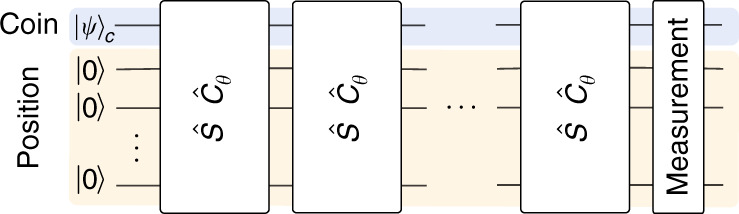
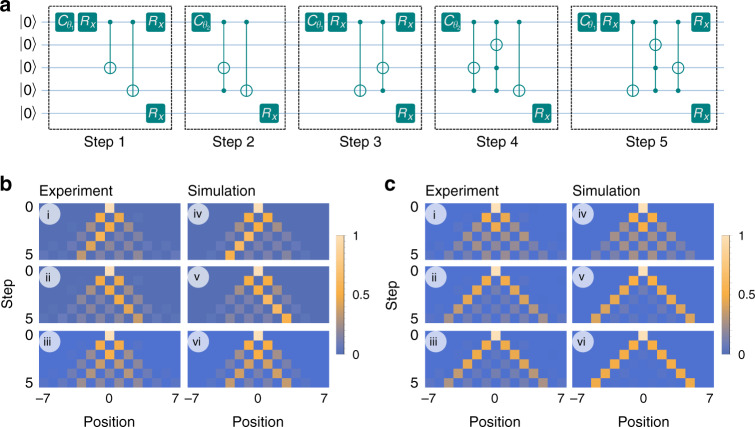
- A discrete-time quantum walk in one-dimensional position space was realized on five qubits within a seven-qubit programmable trapped-ion system, with evolution up to five steps and a position space of up to 15 positions.
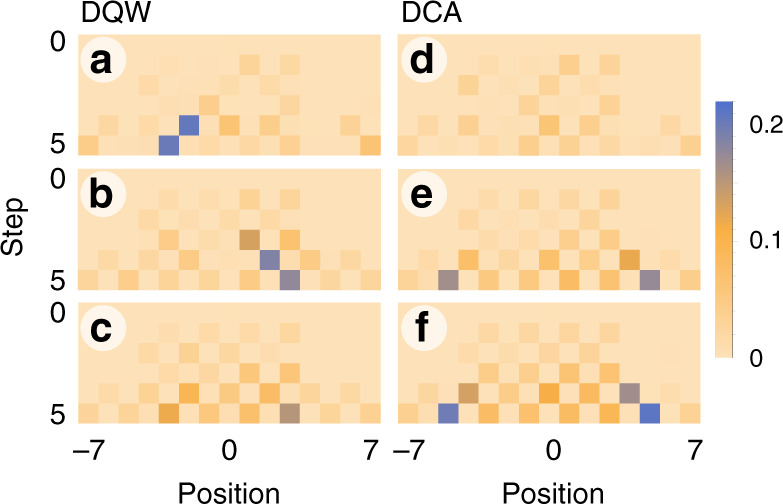
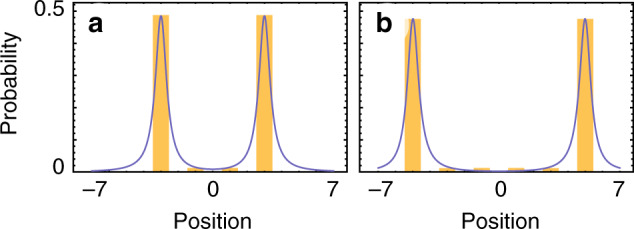
- A Dirac cellular automaton was experimentally realized by setting θ₁ = 0 and varying θ₂; θ₂ = π/4, π/10, and π/20 correspond to masses 1.1357, 0.3305, and 0.159 in units of ℏc⁻²s⁻¹, with small θ₂ showing bimodal/flat distributions and θ₂ = π/4 showing slow spread.
- Gate counts after five steps were 78 R gates and 32 XX gates for the DQW, and 81 R gates and 32 XX gates for the DCA; recovering Dirac-equation evolution after five steps required 81 single-qubit gates and 32 XX gates.
- The experimental and simulated position distributions matched closely, with a population mismatch of 0.05–0.2 after five steps, and crosstalk-induced population in unintended states was <2% for the deepest circuits.
Methods
- Experiments used a chain of seven individual ¹⁷¹Yb⁺ ions in a Paul trap, with the middle five ions encoding qubits in the hyperfine-split ²S₁/₂ ground level; single-qubit R gates and two-qubit XX gates were driven by Raman beams, with single- and two-qubit gate fidelities of 99.5(2)% and 98–99%, respectively.
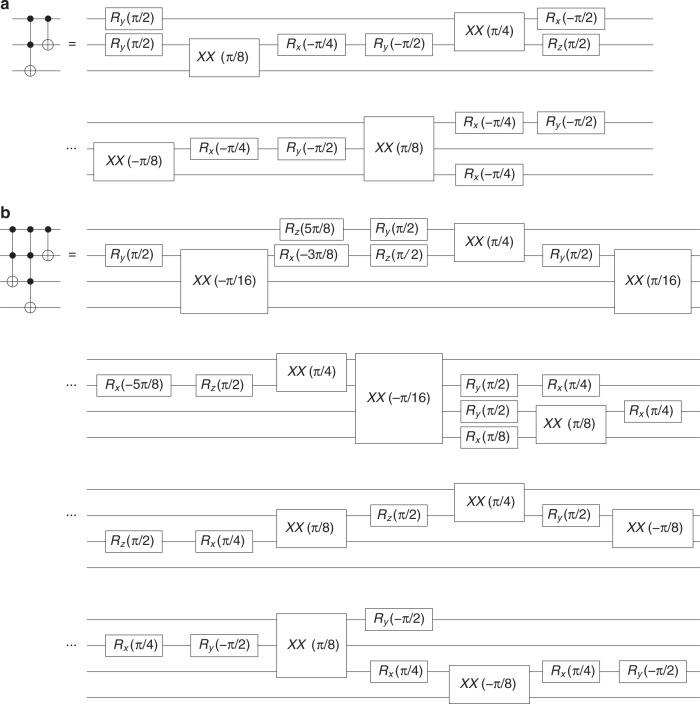
- Position space of size 2ⁿ was mapped to n + 1 qubits, using one coin qubit and n position qubits, with a digital reordering so the last qubit corresponds to even/odd position numbers; circuits were compiled into native R and XX gates.
- After evolution, the probability distribution was sampled 3000 times and corrected for readout errors, then compared with ideal classical simulation and, for the DCA, with the explicit time-dependent solution of the one-dimensional Dirac equation.
Limitations
- The paper states a population mismatch of 0.05–0.2 between simulation and experiment after five steps, and notes that gate count and error grow with the number of steps.
- The paper states that addressing crosstalk causes small population in alternate positions and in a logical encoding state not included in the mapping, with average experimental population <2% for the deepest circuits.
- The paper states that further improvements in quantum hardware will be necessary for circuit complexity involving position-dependent coin operations; the text also makes evident that the demonstration is limited to five qubits, five steps, and a 2 × 2 Dirac representation without spin degree of freedom.
Model-written summary. Check it against the paper before relying on it.
Integrity signals
Registry
Cites
Statistics
Figures

Verification
Claims the paper makes
15 Valid · 4 Not valid · 1 Not checked · 31 Own results and interpretations
Every source the paper cites for this claim was checked and supports it.
In the paper
“At the same time, by choosing θ1 = 0, the quantum walk operator given in Eq. (4) takes the form of the unitary operator for a DCA40,8”
§ Quantum walks and Dirac cellular automata on a programmable trapped-ion quantum computer > Results > Review of quantum walks and the connection to the Dirac equation
What the sources say
- Supportedcites [40] Mallick A Chandrashekar CM Dirac cellular automaton from split-step quantum walk Sci. Rep. 2016 6 25779 27184159 PMC4868993 source
The Results section (‘DCA from Split-Step QW’; page not supplied) says the split-step walk recovers the DCA and gives θ1 = 0, θ2 = π/4 as an explicit example. The ‘Zitterbewegung Oscillation’ section also identifies θ1 = 0 as the configuration leading to DCA in its two-parameter setup. The claim is supported for the split-step quantum walk, not a conventional quantum walk. (LLM, conf=0.85)
plainstates a cause- Asserted: passes — The authors put it forward as true.
- Checkable: passes — It can be checked against evidence.
- Load-bearing: passes — The paper’s conclusions depend on it.
- Based: passes — The paper gives a reason why it holds.
- Supported
The cited sources support only part of this claim — read each source’s verdict below.
In the paper
“We realize the walk on a chain of seven individual 171Yb+ ions confined in a Paul trap and laser-cooled close to their motional ground state45,51.”
§ Quantum walks and Dirac cellular automata on a programmable trapped-ion quantum computer > Results > Experimental DQW implementation
What the sources say
- Partly supportedcites [45] Debnath S Demonstration of a small programmable quantum computer with atomic qubits Nature 2016 536 63 66 27488798 sourceExperimental — accuracy not yet measured
The paper describes ¹⁷¹Yb⁺ ions confined in a linear Paul trap and laser-cooled near their motional ground state (pp. 1–2). But it specifies a five-ion chain, not seven ions, and does not report realizing the walk. The walk is phrased as the citing authors’ own work, so the unsupported attributed detail is the seven-ion configuration. (LLM, conf=0.90)
- Partly supportedcites [51] Landsman KA Verified quantum information scrambling Nature 2019 567 61 65 30842638 sourceExperimental — accuracy not yet measured
The Trapped Ion Qubits section (p. 7) confirms that the experiment used ¹⁷¹Yb⁺ ions in a Paul trap, laser-cooled near the motional ground state. It specifies a chain of nine ions, however, with only the middle seven used as qubits—not a chain of seven ions. The citing authors’ walk is their own experiment, not a result attributed to this source. (LLM, conf=0.90)
plainn = 7- Asserted: passes — The authors put it forward as true.
- Checkable: passes — It can be checked against evidence.
- Load-bearing: passes — The paper’s conclusions depend on it.
- Based: passes — The paper gives a reason why it holds.
- Partly supported
Every source the paper cites for this claim was checked and supports it.
In the paper
“The split-step DQW described by the operator is equivalent to the two period DQW with alternate coin operations, θ1 and θ2, when the alternate points in position space with zero probability are ignored47.”
§ Quantum walks and Dirac cellular automata on a programmable trapped-ion quantum computer > Results > Review of quantum walks and the connection to the Dirac equation
What the sources say
- Supportedcites [47] Zhang W-W Goyal SK Simon C Sanders BC Decomposition of split-step quantum walks for simulating Majorana modes and edge states Phys. Rev. A 2017 95 052351 source
Section III.A (p. 3) says that one step of a one-dimensional split-step quantum walk is isomorphic to two steps of an ordinary quantum walk with alternating coin operators Cθ1 and Cθ2. It also says the split-step walk can be performed on only the even- or odd-numbered lattice sites, matching the claim's qualification about disregarding alternating positions. (LLM, conf=0.93)
plainstates an association- Asserted: passes — The authors put it forward as true.
- Checkable: passes — It can be checked against evidence.
- Load-bearing: unclear — It is unclear whether the paper’s conclusions depend on it.
- Based: passes — The paper gives a reason why it holds.
- Supported
The cited sources support only part of this claim — read each source’s verdict below.
In the paper
“In contrast, considering θ1 = 0 and a very small value of θ2 corresponds to the Dirac equation for particles with small mass35,46 in the form .”
§ Quantum walks and Dirac cellular automata on a programmable trapped-ion quantum computer > Results > Review of quantum walks and the connection to the Dirac equation
What the sources say
- Partly supportedcites [35] Gerritsma R Quantum simulation of the Dirac equation Nature 2010 463 68 71 20054392 sourceExperimental — accuracy not yet measured
In “Quantum simulation of the Dirac equation” (p. 2), the paper identifies the simulated mass through mc² = ℏΩ and studies particles with different masses, supporting the small-mass Dirac-equation aspect. It does not identify θ1 or θ2 or establish that setting θ1 = 0 and θ2 very small produces that regime. (LLM, conf=0.87)
- Not matchedcites [46] Thaller, B. The Dirac equation (Springer Science & Business Media, 2013).
Its entry has no title and year that we can search by.
plainstates an association- Asserted: passes — The authors put it forward as true.
- Checkable: passes — It can be checked against evidence.
- Load-bearing: unclear — It is unclear whether the paper’s conclusions depend on it.
- Based: passes — The paper gives a reason why it holds.
- Partly supported
The cited sources support only part of this claim — read each source’s verdict below.
In the paper
“The tunability of parameters θ1 and θ2 on the split-step QW permits the study of one-dimensional Dirac equations effectively, within the low momentum subspace, for spin-1/2 particles40,44.”
§ Quantum walks and Dirac cellular automata on a programmable trapped-ion quantum computer > Results > Review of quantum walks and the connection to the Dirac equation
What the sources say
- Supportedcites [40] Mallick A Chandrashekar CM Dirac cellular automaton from split-step quantum walk Sci. Rep. 2016 6 25779 27184159 PMC4868993 source
The Methods section, “Recovery of Dirac Hamiltonian from Split-step QW” (page unavailable), derives an effective Hamiltonian controlled by θ1 and θ2 and identifies a parameter choice that yields the Dirac cellular automaton Hamiltonian. The “Dirac Cellular Automaton” section (page unavailable) says that its Hamiltonian produces the Dirac Hamiltonian at wavelengths much larger than the lattice scale, consistent with the claim’s low-momentum qualification. The paper describes the walk as one-dimensional with two internal degrees of freedom and identifies the Dirac equation as describing a spin-1/2 particle. (LLM, conf=0.88)
- Partly supportedcites [44] Kumar NP Balu R Laflamme R Chandrashekar CM Bounds on the dynamics of periodic quantum walks and emergence of the gapless and gapped Dirac equation Phys. Rev. A 2018 97 012116 sourceExperimental — accuracy not yet measured
Section III (pp. 7–8) identifies the split-step walk’s two coin parameters, θ1 and θ2, and says that controlling them recovers Dirac equations for massive and massless particles. Section II (p. 2) describes a one-dimensional walk with two internal states. Our copy does not explicitly place the Dirac-equation result within a low-momentum subspace, so that qualification is not verified. (LLM, conf=0.78)
plainstates a cause- Asserted: passes — The authors put it forward as true.
- Checkable: passes — It can be checked against evidence.
- Load-bearing: passes — The paper’s conclusions depend on it.
- Based: passes — The paper gives a reason why it holds.
- Supported
18 more claims · 4 with their cited sources checked
Create a free account to see all 51 claims and to verify the 1 reference still open.
- Probably not a substantial claim. 20
- It may state two separate claims as one. 14
Claims other papers make about this one
Each is checked against this paper’s own text: does it say what the citing paper says it does?
The cited source doesn’t support the claim as written.
In the citing paper
“It has a similar circuit depth to the approach proposed in Ref. [20,21] without limitation (see Figure 1(b)).”
From Quantum Entanglement in Dirac Dynamics via Continuous-Time Quantum Walks in a Quantum Circuit Framework (2024) · cites this paper as [20]
Checked by a reasoning model — may be wrong.
Experimental — accuracy not yet measuredThe source backs part of the claim, not all of it — or backs it for a different population, condition or comparison.
In the citing paper
“the experimental realization of the Dirac Quantum Cellular Automaton (DQCA) [35, 52, 53], which is a Fermionic Cellular Automaton which recovers the dynamics of a free Dirac field in the small wave-vector regime.”
From Photonic cellular automaton simulation of relativistic quantum fields: Observation of Zitterbewegung (2024) · cites this paper as [53]
Experimental — accuracy not yet measured
Self-check
Percentages, sums and reported differences re-computed from the paper’s own numbers.
Each contradiction between two passages listed here was confirmed by an independent check.
Rated minor: it would not touch a result — a value no result rests on, a p-value that stays on the same side of the significance level, or a conflict that is clerical, resolved elsewhere in the paper, or outside its own findings.
In the paper
§ Quantum walks and Dirac cellular automata on a programmable trapped-ion quantum computer > Introduction
“photonic systems29–32”
§ Quantum walks and Dirac cellular automata on a programmable trapped-ion quantum computer > References
“32. Tamura M Mukaiyama T Toyoda K Quantum walks of a phonon in trapped ions Phys. Rev. Lett. 2020 124 200501 32501043 10.1103/PhysRevLett.124.200501”
Rated minor: it would not touch a result — a value no result rests on, a p-value that stays on the same side of the significance level, or a conflict that is clerical, resolved elsewhere in the paper, or outside its own findings.
In the paper
§ Quantum walks and Dirac cellular automata on a programmable trapped-ion quantum computer > Results > Experimental DQW implementation
“b i and b iv , b ii and b iv , b iii and b vi”
§ Quantum walks and Dirac cellular automata on a programmable trapped-ion quantum computer > Results > Experimental DQW implementation
“In Fig. 3b iv, b v, and b vi we show the ideal output from classical simulation of the circuit for comparison”
Citations
Cites
Quantum computation and decision trees
Farhi, E., & Gutmann, S. (1998) · Physical Review A · doi:10.1103/physreva.58.915 · Cited by 1,215
Quantum random-walk search algorithm
Shenvi, N., Kempe, J., & Whaley, K. B. (2003) · Physical Review A · doi:10.1103/physreva.67.052307 · Cited by 1,150
Multiparticle Entanglement of Hot Trapped Ions
Mølmer, K., & Sørensen, A. (1999) · Physical Review Letters · doi:10.1103/physrevlett.82.1835 · Cited by 1,019
Quantum Walks of Correlated Photons
Peruzzo, A., Lobino, M., Matthews, J. C. F., Matsuda, N., Politi, A., Poulios, K., Zhou, X.-Q., Lahini, Y., Ismail, N., Wörhoff, K., et al. (2010) · Science · doi:10.1126/science.1193515 · Cited by 929
Exponential algorithmic speedup by a quantum walk
Childs, A. M., Cleve, R., Deotto, E., Farhi, E., Gutmann, S., & Spielman, D. A. (2003) · Proceedings of the thirty-fifth annual ACM symposium on Theory of computing · doi:10.1145/780542.780552 · Cited by 825
Demonstration of a small programmable quantum computer with atomic qubits
Debnath, S., Linke, N. M., Figgatt, C., Landsman, K. A., Wright, K., & Monroe, C. (2016) · Nature · doi:10.1038/nature18648 · Cited by 777
Self-citationQuantum simulation of the Dirac equation
Gerritsma, R., Kirchmair, G., Zähringer, F., Solano, E., Blatt, R., & Roos, C. F. (2010) · Nature · doi:10.1038/nature08688 · Cited by 725
Quantum Walk Algorithm for Element Distinctness
Ambainis, A. (2007) · SIAM Journal on Computing · doi:10.1137/s0097539705447311 · Cited by 703
Quantum Walk in Position Space with Single Optically Trapped Atoms
Karski, M., Förster, L., Choi, J.-M., Steffen, A., Alt, W., Meschede, D., & Widera, A. (2009) · Science · doi:10.1126/science.1174436 · Cited by 659
Aharonov, D., Ambainis, A., Kempe, J., & Vazirani, U. (2001) · Proceedings of the thirty-third annual ACM symposium on Theory of computing · doi:10.1145/380752.380758 · Cited by 654
QUANTUM WALKS AND THEIR ALGORITHMIC APPLICATIONS
AMBAINIS, A. (2003) · International Journal of Quantum Information · doi:10.1142/s0219749903000383 · Cited by 632
Photons Walking the Line: A Quantum Walk with Adjustable Coin Operations
Schreiber, A., Cassemiro, K. N., Potoček, V., Gábris, A., Mosley, P. J., Andersson, E., Jex, I., & Silberhorn, C. (2010) · Physical Review Letters · doi:10.1103/physrevlett.104.050502 · Cited by 588
From quantum cellular automata to quantum lattice gases
Meyer, D. A. (1996) · Journal of Statistical Physics · doi:10.1007/bf02199356 · Cited by 556
Realization of a Quantum Walk with One and Two Trapped Ions
Zähringer, F., Kirchmair, G., Gerritsma, R., Solano, E., Blatt, R., & Roos, C. F. (2010) · Physical Review Letters · doi:10.1103/physrevlett.104.100503 · Cited by 531
Realization of Quantum Walks with Negligible Decoherence in Waveguide Lattices
Perets, H. B., Lahini, Y., Pozzi, F., Sorel, M., Morandotti, R., & Silberberg, Y. (2008) · Physical Review Letters · doi:10.1103/physrevlett.100.170506 · Cited by 526
Manipulation and detection of a trappedYb+hyperfine qubit
Olmschenk, S., Younge, K. C., Moehring, D. L., Matsukevich, D. N., Maunz, P., & Monroe, C. (2007) · Physical Review A · doi:10.1103/physreva.76.052314 · Cited by 464
Self-citationQuantum Walk of a Trapped Ion in Phase Space
Schmitz, H., Matjeschk, R., Schneider, C., Glueckert, J., Enderlein, M., Huber, T., & Schaetz, T. (2009) · Physical Review Letters · doi:10.1103/physrevlett.103.090504 · Cited by 462
Discrete Single-Photon Quantum Walks with Tunable Decoherence
Broome, M. A., Fedrizzi, A., Lanyon, B. P., Kassal, I., Aspuru-Guzik, A., & White, A. G. (2010) · Physical Review Letters · doi:10.1103/physrevlett.104.153602 · Cited by 420
Verified quantum information scrambling
Landsman, K. A., Figgatt, C., Schuster, T., Linke, N. M., Yoshida, B., Yao, N. Y., & Monroe, C. (2019) · Nature · doi:10.1038/s41586-019-0952-6 · Cited by 368
Self-citationQuantum Algorithms for the Triangle Problem
Magniez, F., Santha, M., & Szegedy, M. (2007) · SIAM Journal on Computing · doi:10.1137/050643684 · Cited by 311
Ryan, C. A., Laforest, M., Boileau, J. C., & Laflamme, R. (2005) · Physical Review A · doi:10.1103/physreva.72.062317 · Cited by 280
Controlling discrete quantum walks: coins and initial states
Tregenna, B., Flanagan, W., Maile, R., & Kendon, V. (2003) · New Journal of Physics · doi:10.1088/1367-2630/5/1/383 · Cited by 264
Deterministic Bell states and measurement of the motional state of two trapped ions
Solano, E., de Matos Filho, R. L., & Zagury, N. (1999) · Physical Review A · doi:10.1103/physreva.59.r2539 · Cited by 213
Direct observation of zitterbewegung in a Bose–Einstein condensate
LeBlanc, L. J., Beeler, M. C., Jiménez-García, K., Perry, A. R., Sugawa, S., Williams, R. A., & Spielman, I. B. (2013) · New Journal of Physics · doi:10.1088/1367-2630/15/7/073011 · Cited by 186
Optimal Quantum Control of Multimode Couplings between Trapped Ion Qubits for Scalable Entanglement
Choi, T., Debnath, S., Manning, T. A., Figgatt, C., Gong, Z.-X., Duan, L.-M., & Monroe, C. (2014) · Physical Review Letters · doi:10.1103/physrevlett.112.190502 · Cited by 184
Self-citationTwo-particle quantum walks: Entanglement and graph isomorphism testing
Berry, S. D., & Wang, J. B. (2011) · Physical Review A · doi:10.1103/physreva.83.042317 · Cited by 152
Quantum walk on a line with two entangled particles
Omar, Y., Paunković, N., Sheridan, L., & Bose, S. (2006) · Physical Review A · doi:10.1103/physreva.74.042304 · Cited by 149
Observing Topological Invariants Using Quantum Walks in Superconducting Circuits
Flurin, E., Ramasesh, V. V., Hacohen-Gourgy, S., Martin, L. S., Yao, N. Y., & Siddiqi, I. (2017) · Physical Review X · doi:10.1103/physrevx.7.031023 · Cited by 149
Two-particle quantum walks applied to the graph isomorphism problem
Gamble, J. K., Friesen, M., Zhou, D., Joynt, R., & Coppersmith, S. N. (2010) · Physical Review A · doi:10.1103/physreva.81.052313 · Cited by 145
Paparo, G. D., & Martin-Delgado, M. A. (2012) · Scientific Reports · doi:10.1038/srep00444 · Cited by 136
A classical approach to the graph isomorphism problem using quantum walks
Douglas, B. L., & Wang, J. B. (2008) · Journal of Physics A: Mathematical and Theoretical · doi:10.1088/1751-8113/41/7/075303 · Cited by 126
Strauch, F. W. (2006) · Physical Review A · doi:10.1103/physreva.73.054302 · Cited by 115
Relationship between quantum walks and relativistic quantum mechanics
Chandrashekar, C. M., Banerjee, S., & Srikanth, R. (2010) · Physical Review A · doi:10.1103/physreva.81.062340 · Cited by 109
Self-citationEfficient quantum walk on a quantum processor
Qiang, X., Loke, T., Montanaro, A., Aungskunsiri, K., Zhou, X., O’Brien, J. L., Wang, J. B., & Matthews, J. C. F. (2016) · Nature Communications · doi:10.1038/ncomms11511 · Cited by 108
Direct Probe of Topological Invariants Using Bloch Oscillating Quantum Walks
Ramasesh, V. V., Flurin, E., Rudner, M., Siddiqi, I., & Yao, N. Y. (2017) · Physical Review Letters · doi:10.1103/physrevlett.118.130501 · Cited by 105
Quantum walks as massless Dirac fermions in curved space-time
Di Molfetta, G., Brachet, M., & Debbasch, F. (2013) · Physical Review A · doi:10.1103/physreva.88.042301 · Cited by 94
Quantum Google in a Complex Network
Paparo, G. D., Müller, M., Comellas, F., & Martin-Delgado, M. A. (2013) · Scientific Reports · doi:10.1038/srep02773 · Cited by 93
Quantum walks in artificial electric and gravitational fields
Di Molfetta, G., Brachet, M., & Debbasch, F. (2014) · Physica A: Statistical Mechanics and its Applications · doi:10.1016/j.physa.2013.11.036 · Cited by 93
Quantum field as a quantum cellular automaton: The Dirac free evolution in one dimension
Bisio, A., D’Ariano, G. M., & Tosini, A. (2015) · Annals of Physics · doi:10.1016/j.aop.2014.12.016 · Cited by 81
Continuous-Time Quantum Walks on the Symmetric Group
Gerhardt, H., & Watrous, J. (2003) · Lecture notes in computer science · doi:10.1007/978-3-540-45198-3_25 · Cited by 78
Quantum walks and non-Abelian discrete gauge theory
Arnault, P., Molfetta, G. D., Brächet, M., & Debbasch, F. (2016) · Physical Review A · doi:10.1103/physreva.94.012335 · Cited by 74
Quantum walks as simulators of neutrino oscillations in a vacuum and matter
Molfetta, G. D., & Pérez, A. (2016) · New Journal of Physics · doi:10.1088/1367-2630/18/10/103038 · Cited by 70
Chandrashekar, C. M. (2013) · Scientific Reports · doi:10.1038/srep02829 · Cited by 64
Self-citationQuantum walking in curved spacetime
Arrighi, P., Facchini, S., & Forets, M. (2016) · Quantum Information Processing · doi:10.1007/s11128-016-1335-7 · Cited by 63
Free-Dirac-particle evolution as a quantum random walk
Bracken, A. J., Ellinas, D., & Smyrnakis, I. (2007) · Physical Review A · doi:10.1103/physreva.75.022322 · Cited by 60
Quantum Walks of a Phonon in Trapped Ions
Tamura, M., Mukaiyama, T., & Toyoda, K. (2020) · Physical Review Letters · doi:10.1103/physrevlett.124.200501 · Cited by 49
Comparing classical and quantum PageRanks
Loke, T., Tang, J. W., Rodriguez, J., Small, M., & Wang, J. B. (2017) · Quantum Information Processing · doi:10.1007/s11128-016-1456-z · Cited by 49
Dirac Cellular Automaton from Split-step Quantum Walk
Mallick, A., & Chandrashekar, C. M. (2016) · Scientific Reports · doi:10.1038/srep25779 · Cited by 45
Self-citationCorrecting detection errors in quantum state engineering through data processing
Shen, C., & Duan, L.-M. (2012) · New Journal of Physics · doi:10.1088/1367-2630/14/5/053053 · Cited by 43
Beat note stabilization of mode-locked lasers for quantum information processing
Islam, R., Campbell, W. C., Choi, T., Clark, S., Conover, C. W. S., Debnath, S., Edwards, E. E., Fields, B. A., Hayes, D., Hucul, D., et al. (2014) · Optics Letters · doi:10.1364/ol.39.003238 · Cited by 39
Self-citationDiscrete-time quantum walk algorithm for ranking nodes on a network
Chawla, P., Mangal, R., & Chandrashekar, C. M. (2020) · Quantum Information Processing · doi:10.1007/s11128-020-02650-4 · Cited by 38
Self-citationNeutrino oscillations in discrete-time quantum walk framework
Mallick, A., Mandal, S., & Chandrashekar, C. M. (2017) · The European Physical Journal C · doi:10.1140/epjc/s10052-017-4636-9 · Cited by 37
Self-citationAlgorithm for the solution of the Dirac equation on digital quantum computers
Fillion-Gourdeau, F., MacLean, S., & Laflamme, R. (2017) · Physical Review A · doi:10.1103/physreva.95.042343 · Cited by 33
Dirac quantum cellular automaton in one dimension:Zitterbewegungand scattering from potential
Bisio, A., D'Ariano, G. M., & Tosini, A. (2013) · Physical Review A · doi:10.1103/physreva.88.032301 · Cited by 32
Localized quantum walks as secured quantum memory
Chandrashekar, C. M., & Busch, T. (2015) · EPL (Europhysics Letters) · doi:10.1209/0295-5075/110/10005 · Cited by 31
Self-citationSimulating Dirac Hamiltonian in curved space-time by split-step quantum walk
Mallick, A., Mandal, S., Karan, A., & Chandrashekar, C. M. (2019) · Journal of Physics Communications · doi:10.1088/2399-6528/aafe2f · Cited by 29
Self-citationKumar, N. P., Balu, R., Laflamme, R., & Chandrashekar, C. M. (2018) · Physical Review A · doi:10.1103/physreva.97.012116 · Cited by 24
Self-citationQuantum walking in curved spacetime: discrete metric
Arrighi, P. J., Molfetta, G. D., & Facchini, S. (2018) · Quantum · doi:10.22331/q-2018-08-22-84 · Cited by 19
Asymptotic properties of the Dirac quantum cellular automaton
Pérez, A. (2016) · Physical Review A · doi:10.1103/physreva.93.012328 · Cited by 18
Decomposition of split-step quantum walks for simulating Majorana modes and edge states
Zhang, W.-W., Goyal, S. K., Simon, C., & Sanders, B. C. (2017) · Physical Review A · doi:10.1103/physreva.95.052351 · Cited by 17
Accelerated quantum walk, two-particle entanglement generation and localization
Singh, S., Balu, R., Laflamme, R., & Chandrashekar, C. M. (2019) · Journal of Physics Communications · doi:10.1088/2399-6528/ab1c6e · Cited by 14
Self-citationSingh, S., Alderete, C. H., Balu, R., Monroe, C., Linke, N. M., & Chandrashekar, C. M. (2020) · arXiv · doi:10.48550/arxiv.2001.11197 · Cited by 13
Self-citationSingh, S., Alderete, C. H., Balu, R., Monroe, C. R., Linke, N. M., & Chandrashekar, C. M. (2020) · arXiv (Cornell University) · Cited by 2
Self-citation
Research works printed but not linked: 1
- Thaller, B. The Dirac equation (Springer Science & Business Media, 2013).
Cited by
Programmable Quantum Simulations of Spin Systems with Trapped Ions
Monroe, C., Campbell, W. C., Duan, L. M., Gong, Z. X., Gorshkov, A. V., Hess, P., Islam, R., Kim, K., Linke, N., Pagano, G., et al. (2019) · arXiv · doi:10.48550/arxiv.1912.07845 · Cited by 806
Self-citationProgrammable quantum simulations of spin systems with trapped ions
Monroe, C., Campbell, W. C., Duan, L.-M., Gong, Z.-X., Gorshkov, A. V., Hess, P. W., Islam, R., Kim, K., Linke, N. M., Pagano, G., et al. (2021) · Reviews of Modern Physics · doi:10.1103/revmodphys.93.025001 · Cited by 802
Self-citationA review of Quantum Cellular Automata
Farrelly, T. (2020) · Quantum · doi:10.22331/q-2020-11-30-368 · Cited by 138
Multi-angle quantum approximate optimization algorithm
Herrman, R., Lotshaw, P. C., Ostrowski, J., Humble, T. S., & Siopsis, G. (2022) · Scientific Reports · doi:10.1038/s41598-022-10555-8 · Cited by 224
“[7] C Huerta Alderete, Shivani Singh, Nhung H Nguyen, Daiwei Zhu, Radhakrishnan Balu, Christopher Monroe, CM Chandrashekar, and Norbert M Linke.”
BackgroundQuantum simulations of hydrodynamics via the Madelung transformation
Zylberman, J., Molfetta, G. D., Brächet, M., Loureiro, N., & Debbasch, F. (2022) · Physical Review A · doi:10.1103/physreva.106.032408 · Cited by 39
Metadata
- Authors
- Huerta Alderete, C., Singh, S., Nguyen, N. H., Zhu, D., Balu, R., Monroe, C., Chandrashekar, C. M., & Linke, N. M.
- Affiliations
- Homi Bhabha National Institute (IN)
- Joint Quantum Institute (US)
- DEVCOM Army Research Laboratory (US)
- Venue
- Nature Communications
- Published
- 2020-07-24
- Volume
- 11
- Issue
- 1
- Pages
- 3720-3720
- ISSN
- 2041-1723 (ISSN-L)
- PMC
- PMC7381638
- OpenAlex
- W3004833681
- Cited by
- 48
- References
- 68
- Citations by year
- 2026: 4 · 2025: 4 · 2024: 12 · 2023: 9 · 2022: 9 · 2021: 7 · 2020: 3
- FWCI
- 2.75
- Type
- journal article
- Language
- en
- Open access
- gold
- doi.org
- Licence
- cc-by
- creativecommons.org/licenses/by/4.0 (tdm)
- creativecommons.org/licenses/by/4.0 (vor)
- Locations
- Nature Communications (publishedVersion, cc-by)
- PubMed Central (publishedVersion, cc-by)
- PubMed (publishedVersion)
- arXiv (Cornell University) (submittedVersion)
- DOAJ (DOAJ: Directory of Open Access Journals) (submittedVersion, cc-by-sa)
- arXiv (Cornell University)
- Funders
- DST | Science and Engineering Research Board (SB/S2/RJN-192/2014)
- NSF | Directorate for Mathematical & Physical Sciences | Division of Physics (PHY-1430094)
- Topics
- Physical Sciences › Computer Science › Artificial Intelligence › Quantum Computing Algorithms and Architecture
- Physical Sciences › Physics and Astronomy › Atomic and Molecular Physics, and Optics › Quantum Mechanics and Applications
- Physical Sciences › Physics and Astronomy › Atomic and Molecular Physics, and Optics › Quantum Information and Cryptography
- Keywords
- discrete-time quantum walks, trapped-ion quantum computer, quantum algorithms
About these checks
Registry, retraction, Cites and statistics results are computed, not judged, with one exception: a printed reference that no index lists is read once by a model before it counts as a citation error. Claims are extracted by a model and kept only when their quote appears verbatim in the text; each cited source is then checked, with a model’s help, for whether it says what the claim relies on. Those verdicts can be wrong — read the claim’s quote and the cited source before relying on one.
The claim verdicts this report counts are experimental: their accuracy is not yet measured.
A language model drew the claims from the paper on 2026-10-13, under version 3 of the claim definition (model deepseek-v4.1-flash, prompt extract-v3).
A second model labelled each claim on 2026-10-13 (model jev-1.13-20260917, definition revision gold-guideline-v0.2).
Cited sources are checked with a language model’s help (gpt-6-sol).
Statistics and arithmetic are recomputed, not judged.
Confidence bands are shown only for fields calibrated on our annotated test set. None is calibrated yet, so no band is shown.
What counts as a claim ›How we measure confidence ›How we check this ›
Are you an author, or do you see a problem with this page? Request a review
Data sources
Bibliographic data: Semantic Scholar, OpenAlex, Crossref.
Contains information from the Semantic Scholar Academic Graph Datasets, made available under the ODC Attribution License (ODC-BY 1.0).
Semantic Scholar’s data is described in: Kinney, R., et al. (2023). The Semantic Scholar Open Data Platform. arXiv:2301.10140.
