

Association of sleep duration in middle and old age with incidence of dementia
Open accessThe DOI matches its Crossref record; 55 of the 55 references it cites were found in a registry or an index.
Abstract
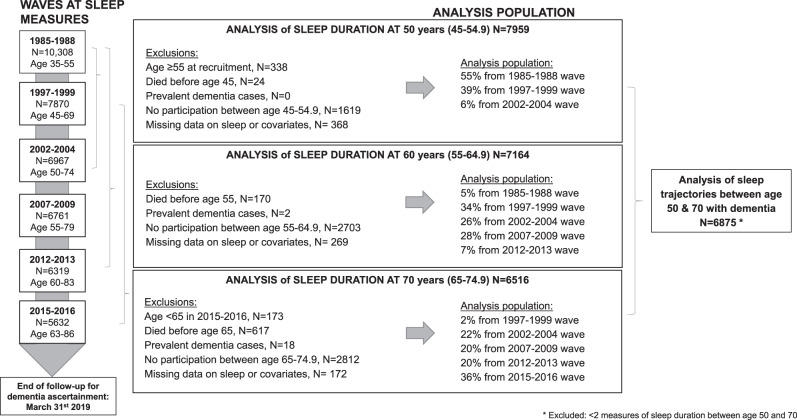
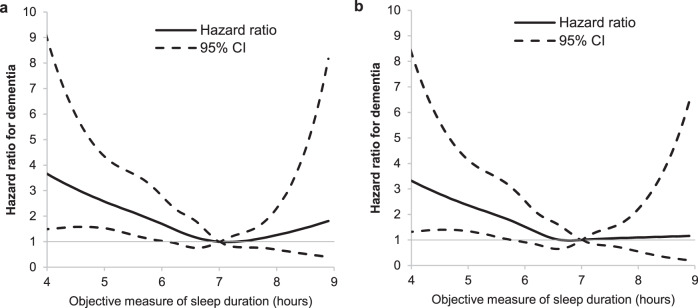
Sleep dysregulation is a feature of dementia but it remains unclear whether sleep duration prior to old age is associated with dementia incidence. Using data from 7959 participants of the Whitehall II study, we examined the association between sleep duration and incidence of dementia (521 diagnosed cases) using a 25-year follow-up. Here we report higher dementia risk associated with a sleep duration of six hours or less at age 50 and 60, compared with a normal (7 h) sleep duration, although this was imprecisely estimated for sleep duration at age 70 (hazard ratios (HR) 1.22 (95% confidence interval 1.01–1.48), 1.37 (1.10–1.72), and 1.24 (0.98–1.57), respectively). Persistent short sleep duration at age 50, 60, and 70 compared to persistent normal sleep duration was also associated with a 30% increased dementia risk independently of sociodemographic, behavioural, cardiometabolic, and mental health factors. These findings suggest that short sleep duration in midlife is associated with an increased risk of late-onset dementia.
Overview
The claims and statistics of this paper haven’t been checked yet.
Free: it reads the open-access text and checks the first 5 claims that cite a source we can check. Create a free account to check every claim.
Integrity signals
Registry
Cites
Statistics
Figures
Verification
Claims the paper makes
The claims and statistics of this paper haven’t been checked yet.
Free: it reads the open-access text and checks the first 5 claims that cite a source we can check. Create a free account to check every claim.
Claims other papers make about this one
Each is checked against this paper’s own text: does it say what the citing paper says it does?
The cited source says what the claim attributes to it.
In the citing paper
“In the Whitehall II study, persistent short sleep duration ≤6 hours at age 50, 60, and 70 compared to persistent normal sleep duration (7 hours) was associated with a 30% increased dementia risk independently of sociodemographic, behavioural, cardiometabolic, and mental health factors.(303)”
From Dementia prevention, intervention, and care: 2024 report of the Lancet standing Commission (2024) · cites this paper as [303]
In the citing paper
“Persistent SD (<6 h per night) during midlife is associated with a 30% elevated risk of dementia in a longitudinal study of 7959 participants.”
From Microbiota–gut–brain axis and its therapeutic applications in neurodegenerative diseases (2024) · cites this paper as [649]
Self-check
Percentages, sums and reported differences re-computed from the paper’s own numbers.
The self-check needs the paper’s full text.
Citations
Cites
1 retracted
Dementia prevention, intervention, and care: 2020 report of the Lancet Commission
Livingston, G., Huntley, J., Sommerlad, A., Ames, D., Ballard, C., Banerjee, S., Brayne, C., Burns, A., Cohen-Mansfield, J., Cooper, C., et al. (2020) · The Lancet · doi:10.1016/s0140-6736(20)30367-6 · Cited by 10,430
Self-citationRetractedHarrell, F. E. (2001) · Springer Series in Statistics · doi:10.1007/978-1-4757-3462-1 · Cited by 9,195
A scaled version of the General Health Questionnaire
Goldberg, D. P., & Hillier, V. F. (1979) · Psychological Medicine · doi:10.1017/s0033291700021644 · Cited by 5,459
Sleep Drives Metabolite Clearance from the Adult Brain
Xie, L., Kang, H., Xu, Q., Chen, M. J., Liao, Y., Thiyagarajan, M., O’Donnell, J., Christensen, D. J., Nicholson, C., Iliff, J. J., et al. (2013) · Science · doi:10.1126/science.1241224 · Cited by 5,411
2016 Alzheimer's disease facts and figures
Alzheimer's Association (2016) · Alzheimer's & Dementia · doi:10.1016/j.jalz.2016.03.001 · Cited by 5,069
Jack, C. R., Knopman, D. S., Jagust, W. J., Petersen, R. C., Weiner, M. W., Aisen, P. S., Shaw, L. M., Vemuri, P., Wiste, H. J., Weigand, S. D., et al. (2013) · The Lancet Neurology · doi:10.1016/s1474-4422(12)70291-0 · Cited by 4,396
Health inequalities among British civil servants: the Whitehall II study
Marmot, M. G., Stansfeld, S., Patel, C., North, F., Head, J., White, I., Brunner, E., Feeney, A., Marmot, M. G., & Smith, G. D. (1991) · The Lancet · doi:10.1016/0140-6736(91)93068-k · Cited by 3,608
Group-Based Trajectory Modeling in Clinical Research
Nagin, D. S., & Odgers, C. L. (2010) · Annual Review of Clinical Psychology · doi:10.1146/annurev.clinpsy.121208.131413 · Cited by 2,708
2020 Alzheimer's disease facts and figures
(2020) · Alzheimer's & Dementia · doi:10.1002/alz.12068 · Cited by 2,353
Neurocognitive consequences of sleep deprivation
Goel, N., Rao, H., Durmer, J., & Dinges, D. (2009) · Seminars in Neurology · doi:10.1055/s-0029-1237117 · Cited by 2,154
Cited by
Items 601–671 of 671
Mental health symptoms as preclinical indicators of dementia: a Whitehall II cohort studyPreprint
Iyer, M. T., Fayossé, A., Kivimäki, M., Livingston, G., Singh‐Manoux, A., Warren‐Gash, C., Sommerlad, A., & Sabia, S. (2026) · medRxiv · doi:10.64898/2026.01.08.26343594
“Some studies provide evidence of an association between short sleep duration with dementia [33,34], and others providing more inconsistent results for sleep disturbances and dementia risk [35].”
Self-citationSystemic Amyloid-β Metabolism in Alzheimer’s Disease
Dong-yu, F., Wang, J., Gu, B. J., Masters, C. L., & Wang, Y. (2026) · Springer eBooks · doi:10.1007/978-981-95-5222-1_7
Lai, X. (2026) · Frontiers in Aging Neuroscience · doi:10.3389/fnagi.2026.1749562
Fan, Z., Liu, X., Lu, X., Wu, Y., & Zhou, M. (2026) · BMC Geriatrics · doi:10.1186/s12877-026-07159-6
“Some studies have emphasized that short sleep duration is associated with an increased risk of dementia [10, 11], yet these studies failed to identify a significant link for long sleep duration.”
Sun, D., Yu, L., Liao, C., Xu, Y., Liu, W., & Wang, X. (2026) · The Journal of Prevention of Alzheimer s Disease · doi:10.1016/j.tjpad.2026.100520 · Cited by 1
“Tobacco abstinence, regular exercise, and adequate sleep were each associated with lower AD risk [13,41], while long sleep ( ≥ 9 h) was associated with higher risk among hyperlipidemic individuals [36,42].”
Does poor sleep affect cognition differently across ages? Insights from a national cohort
Singh, L., Shri, N., & Pati, S. (2026) · Sleep Medicine · doi:10.1016/j.sleep.2026.108873
Wu, C., Lin, M., Cheng, C., Liao, S. F., Su, M., Pan, Y., & Wang, S. (2026) · European Archives of Psychiatry and Clinical Neuroscience · doi:10.1007/s00406-026-02211-3
A U-shaped association between sleep duration and depression in adult prescription opioid users
Li, Y., Zhong, Y., Guan, W., Liang, L., & Zhu, Y. (2026) · Frontiers in Psychiatry · doi:10.3389/fpsyt.2026.1755263
Joint associations of sleep duration and multimorbidity with all-cause mortality in US adultsPreprint
Azu, E. U., Adebile, T. V., Kizza, T., Samawi, H. M., & Yu¹, L. (2026) · Research Square · doi:10.21203/rs.3.rs-9032705/v1
Faucher, C., Thienel, R., Behler, A., Gómez, L., Fripp, J., Breakspear, M. J., & Lupton, M. K. (2026) · Journal of Alzheimer s Disease · doi:10.1177/13872877261427707
“16 – 18 These disturbances are also closely related to genetically mediated biomarkers of AD, particularly A β .”
Cao, Y., Lee, J., Seol, J., Tsunoda, K., Shibuya, K., Yoon, J., Arai, T., & Okura, T. (2026) · Geriatrics · doi:10.3390/geriatrics11020032 · Cited by 1
Klaming, L., Wischmann, H.-A., Gillies, M., & Nasreddine, Z. S. (2026) · The Journal of Prevention of Alzheimer s Disease · doi:10.1016/j.tjpad.2026.100546
“These factors include sleep [6,7], diet [8,9], and cognitive and social activity such as reading and socialising with friends and family [10,11].”
The Association Between Sufficient Sleep Duration and Physical Activity in Older Adults
Cho, J., & Lim, S. (2026) · Health Promotion Journal of Australia · doi:10.1002/hpja.70180
Huang, Z.-C., Yao, J., Chen, Z., Xu, P., Yang, S., Chen, Y., Yin, Z., & Liang, F. (2026) · Archives of Gerontology and Geriatrics · doi:10.1016/j.archger.2026.106242
Miyagi, H., Fukuda, H., & Yamamoto, K. (2026) · Medicine & Science in Sports & Exercise · doi:10.1249/mss.0000000000004004
Aquaporin‐4 in Narcolepsy Type 1: Investigation of Perivascular Fluid Movement in Sleep Disorders
Ranke, J., Steinacker, P., Halbgebauer, S., Oeckl, P., Mayer, G., & Otto, M. (2026) · Annals of Clinical and Translational Neurology · doi:10.1002/acn3.70398
“…has been perpetually mentioned as a pathophysiological link between the common concomitance of sleeping disorders and cognitive decline [8, 11, 12] Recently, the channel protein aquaporin-4 (AQP4) which plays a central role in perivascular fluid exchange has been proposed as a potential…”
Nakou, A., Dragioti, E., Mantzoukas, S., Tsironis, C., Bartzou, E., Tatsis, F., Zagorianakou, N., & Gouva, M. (2026) · Cureus · doi:10.7759/cureus.107940
Allen, N., Cordi, C. V., LLabre, J. E., Chuah, J., Clark, G. T., Kubik, A. J., Falkenberg, N. G., Jankowski, M. S., Cahill, R. A., Herzog, A. A., et al. (2026) · bioRxiv (Cold Spring Harbor Laboratory) · doi:10.64898/2026.05.01.722089
“14,15 In bone tissue, studies have demonstrated that CD can lead to the degradation of trabecular morphology and reduced fracture resistance, 16 likely driven by clock-regulated control of both osteoblast and osteoclast functions.”
Zhang, X., Wang, X., Qu, H., Zhang, W., Weng, W., & Li, Q. (2026) · Sleep And Breathing · doi:10.1007/s11325-026-03713-z
“Short sleep is generally believed to be more detrimental to health than long sleep, and has been linked to incident heart failure [27], stroke [ 28 ], dementia [ 29 ], dia - betes [ 30 ], and suicide [ 31 ].”
Kyriazi, E. E., & Κωνσταντοπούλου, Γ. (2026) · European Journal of Education Studies · doi:10.46827/ejes.v13i7.6743
“Despite this, sleep remains relatively under-integrated in public health strategies, highlighting a gap between scientific evidence and real-world implementation (Sabia et al. , 2021).”
Bidirectional links between sleep deprivation and neurodegenerative diseases
Zakharov, A. V., Komarova, Y. S., Москвитина, П., Pavlova, O. N., Romanchuk, N., Sergeeva, M. S., & Shirolapov, I. V. (2026) · S S Korsakov Journal of Neurology and Psychiatry · doi:10.17116/jnevro202612605274
Guo, Y., Wang, R., Sindi, S., Middleton, L. T., & Kivipelto, M. (2026) · Alzheimer s & Dementia · doi:10.1002/alz.71592
“Based on evidence from previous observational studies and systematic reviews, 7–10 as well as data available in the UK Biobank, we included five self-reported sleep characteristics in the present study: daytime napping, daytime sleepiness, sleep duration, insomnia, and chronotype.”
Xu, J., Mo, D., Cai, Y., Lv, H., Wei, M., Zhang, Y., Jing, F., Wu, W., Fang, X., Wang, Y., et al. (2026) · Fatigue Biomedicine Health & Behavior · doi:10.1080/21641846.2026.2667698
“…level [based on total duration of walking, moderate, and vigorous activities])[22]; Model 3 (full adjustment) further incorporated socioeconomic factors (educational attainment, Townsend deprivation index), chronic disease status (hypertension, type 2 diabetes)[23], and baseline sleep duration[24].”
Zeng, D., Zhang, W., Yang, Y., Chu, Y., Yan, Y., Zhu, P., Guo, J., Feng, X., Li, K., & Huang, J. Y. (2026) · Alzheimer s & Dementia Diagnosis Assessment & Disease Monitoring · doi:10.1002/dad2.70351
“This approach, applied to both single measurements 6,7,9,11,15–17 and longitudinal changes, 8,10,12,13,19–21 is subjective and threshold dependent, failing to capture complex, naturally occurring sleep patterns and risking inaccurate classification.”
Insulin resistance and obesity: Drivers of energy crisis for Alzheimer’s disease
Singh, P., Vaidya, B., Upadhayay, P., Sharma, S. S., & Datusalia, A. K. (2026) · International review of neurobiology · doi:10.1016/bs.irn.2026.05.018
Liu, Y., Dai, Y., Pan, Y., Yang, X., Zhu, M., Diao, X., Y, J., Huang, X., & Zheng, F. (2026) · BMC Public Health · doi:10.1186/s12889-026-28216-0
“…is associated with multiple risk factors, including several modifiable ones such as unhealthy diet, insufficient sleep, social isolation, and air pollution, as well as comorbidities such as hypertension, obesity, and depression [13, 23, 24], all of which also contribute to dementia [8, 14, 25].”
Dey, B. K., & Islam, M. M. (2026) · Bangladesh Journal of Psychology · doi:10.3329/bjop.v26i1.87553
Zheng, Y., Åkerstedt, T., Lagerros, Y. T., Miley-Åkerstedt, A., Adami, H., Ye, W., Pei, J.-J., Tan, X. W., & Wang, H.-X. (2026) · European Journal of Epidemiology · doi:10.1007/s10654-026-01426-x
Associations Between Daytime Napping, Sleep Duration and Postoperative Delirium
Nameth, K., Gaba, A., Charles, A. E., Chhajed, M., Cai, R., Haghayegh, S., Gao, C., Li, P. H. M., Hu, K., & Gao, L. (2026) · Journal of Sleep Research · doi:10.1111/jsr.70410
Guo, B., Li, S., Li, M., Ma, Y., Fu, Y., Shu, Y., Su, Y., Li, K., Liang, J., Chen, T., et al. (2026) · npj Digital Medicine · doi:10.1038/s41746-026-03023-4
Tao, X., Wang, S., He, L., Liu, Y., Pang, L., Sun, Y., Ji, Y., & Ren, Y. (2026) · Neuroscience Research · doi:10.1016/j.neures.2026.105095
Late-night dinner, skipping breakfast, and the risk of dementia in Japan: the LIFE Study
Kawaguchi, K., Maeda, M., Oda, F., Nakashima, Y., & Fukuda, H. (2026) · GeroScience · doi:10.1007/s11357-026-02438-x
Changes in Nighttime Sleep Duration and Their Association With Cognitive Decline and Dementia Risk
Overton, M., Elmståhl, S., & Basna, R. (2026) · Journal of Sleep Research · doi:10.1111/jsr.70414
Are Sleep Stages Related to the Risk of Dementia?
Abildúa, M. J. A., & Martínez, A. M. (2026) · Neurology · doi:10.1212/wnl.0000000000218261
Branson, C. O. (2026) · CONTINUUM Lifelong Learning in Neurology · doi:10.1212/cont.0000000000001734
Kim, E. A., Lee, M., & Nam, S. (2026) · Sleep Medicine · doi:10.1016/j.sleep.2026.109186
Siwach, G., & Compte, C. G. L. (2026) · Boston Congress of Public Health Review (BCPHR Formerly HPHR) · doi:10.54111/001c.165236
Ogugu, E. G., King, A. A., & Bell, J. F. (2026) · Ethnicity and Health · doi:10.1080/13557858.2026.2718703
Lei, K., Li, J., Xu, L., Teng, Y., Lu, C., Qiao, C., & Guo, W. (2026) · Frontiers in Public Health · doi:10.3389/fpubh.2026.1889689
“Although this single-time assessment showed moderate reliability and stability, it failed to fully capture the dynamic change of sleep over time, which should be sustained in future investigations (50).”
Wu, H., Zhao, H., Sun, R., & Zhang, Q. (2026) · Sleep Medicine · doi:10.1016/j.sleep.2026.109172
Zhang, W., Zheng, X., Lian, T., Wang, X., Wang, Y., Peng, D., Huang, Y., Liu, S., Zheng, Y., & Zhang, W. (2026) · Alzheimer s & Dementia · doi:10.1002/alz.71766
“3,4 Notably, sleep disturbances precede cognitive symptoms 4,5 , and loss of deep sleep increases the incidence of AD, 6 suggesting a causal relationship and positioning midlife sleep disruption as a harbinger of accelerated cognitive decline decades later.”
Li, J.-K., Wang, R., Meng, X.-Y., & Kang, J. (2026) · Signal Transduction and Targeted Therapy · doi:10.1038/s41392-026-02890-3
“7 Long-term sleep disorders can increase the risk of obesity, 8 diabetes, 9 cardiovascular and cerebrovascular diseases, 10 dementia, 11 and other diseases.”
Weekend warrior physical activity pattern in relation to sleep outcomes in United States adults
Fan, Z., Fan, Z., Wang, H., Zhou, H., Wang, T., Dong, S., & He, H. (2026) · The American Journal of the Medical Sciences · doi:10.1016/j.amjms.2026.08.008
Insomnia Related with Intellectual Function in the Elderly
Hastutiningtyas, W. R., & Puspitarini, N. A. (2026) · Journal Of Nursing Practice · doi:10.30994/jnp.v9i4.1132
“Previous studies have consistently reported that insomnia is associated with reduced memory, slower information processing, and impaired abstract thinking in older adults (Krause et al., 2017; Sabia et al., 2021).”
Chamberlin, K. W., Etzkorn, L., Spira, A. P., Jiang, K., Chen, L. Y., Crainiceanu, C., Zipunnikov, V., & Schrack, J. A. (2026) · SLEEP Advances · doi:10.1093/sleepadvances/zpag093
“Evidence from objectively measured TST remains more limited and inconsistent, with studies reporting associations with short [ 4], long [ 12], or both [ 15] sleep durations.”
Dadsena, R., Costa, A. S., David, S., Haberl, L., Schulz, J. B., Reetz, K., & Haeger, A. (2026) · Alzheimer s & Dementia · doi:10.1002/alz.71651 · Cited by 1
“3,4 Behavioral interventions targeting modifiable lifestyle factors represent promising strategies to mitigate AD risk.”
Zhou, R., Cui, S., Shang, S., Wei, S., Gao, L., Dang, L., Wang, X., Wang, J., Qu, Q., & Deng, Y. (2026) · Diabetes Research and Clinical Practice · doi:10.1016/j.diabres.2026.113540
Benito‐León, J., Serrano, J. I., del Castillo, M. D., Escolà‐Gascón, Á., Benito-Rodríguez, C. M., Ramo-Tello, C. M., Ghosh, R., & Bermejo‐Pareja, F. (2026) · Communications Health · doi:10.1038/s44528-026-00022-5
Fernandez‐Gamez, B., Solis‐Urra, P., Sanchez‐Martinez, J., Sclafani, A., Olvera‐Rojas, M., Rodríguez‐Palacios, M. T., Mellow, M. L., Dumuid, D., Smith, A. E., Ortega, F. B., et al. (2026) · Scandinavian Journal of Medicine and Science in Sports · doi:10.1111/sms.70360
Xie, Q., Shi, J., Guo, Y., Hu, M., Chen, X., Chen, Y., Dong, Y., Wei, Z., & Feng, H. (2026) · Frontiers in Medicine · doi:10.3389/fmed.2026.1913461
“They exhibit a bidirectional relationship with the underlying neuropathology, potentially accelerating cognitive decline, exacerbating neuropsychiatric symptoms such as agitation and depression (6), and significantly impairing the quality of life for both patients and their caregivers (7).”
Zheng, Q., Liu, R.-S., Chen, B.-R., Chen, A., Zhu, Q., Zhang, H., Chen, Z.-Y., & Liu, X.-Z. (2026) · International Journal of Molecular Sciences · doi:10.3390/ijms27188271
“Epidemiological evidence indicates that sleep disturbances are not only risk factors for cardiovascular disease and psychiatric disorders but are also closely associated with cognitive decline [1–3].”
Yu, L., Xiong, S., Liu, M., Xiao, Z., Hu, J., Yang, W., Wu, Y., He, X., Zhang, Y., Zhang, L., et al. (2026) · Frontiers in Public Health · doi:10.3389/fpubh.2026.1964801
“Fourth, inverse probability weighting was applied to adjust for covariates and minimize potential selection bias (39).”
Shah, P. M., & Devarinti, R. (2026) · Sleep Epidemiology · doi:10.1016/j.sleepe.2026.100169
Wang, H.-J., Liu, L., Li, Y.-H., Qiu, Y.-H., Xia, X., Cai, Y., & Zhang, S.-J. (2026) · Frontiers in Neurology · doi:10.3389/fneur.2026.1805467
“A study measuring adult cerebrospinal fluid (CSF) demonstrated that subjects who underwent 36 h of sleep deprivation had a 51.5% higher tau level compared to those with normal sleep (9).”
InfluentialHSF1-mediated proteostasis decline links aging and sleep disruption
Yamazaki, S., & Reddy, A. B. (2026) · npj Aging · doi:10.1038/s41514-026-00507-1
Hussain, Z., Babar, A. B. A., Siddiqui, I., Rashid, T., & Deen, M. N. (2026) · INNOVAPATH · doi:10.63501/7pgetz19
“…studies following a group of 7,959 50-year-olds over 25 years (Table 1; concluded that people who persistently got under 6 hours of sleep had a 30% higher risk of dementia and further demonstrated that the connection between the two cannot be attributed to mental health (Sabia et al.,2021).”
Fang, Y., Quick, A. D., Oryshkewych, N., Fernandez, N., Lim, A., Barnes, L. L., Bennett, D. A., Steptoe, A., Hardy, R., Sabia, S., et al. (2026) · medRxiv · doi:10.64898/2026.09.25.26363056
Self-citationManus, W. C., & Widagdo, T. M. M. (2026) · Jurnal Atma Inovasia · doi:10.24002/jai.v6i5.14267
“Dalam penelitian ini juga menunjukkan bahwa durasi tidur yang pendek berhubungan dengan peningkatan risiko gangguan fungsi kognitif yang berat seperti demensia [11].”
Eves, R., Hachenberger, J., Franzese, F., Voelcker‐Rehage, C., Sutin, A. R., Richter, D., & Lemola, S. (2026) · Research Square · doi:10.21203/rs.3.rs-10975193/v1
The Relationship Between Sleep Duration and Physical Activity in Older Adults
Lee, E., & Lim, S.-T. (2026) · Journal of Gerontological Nursing · doi:10.3928/00989134-20260925-04
ความชุกและปัจจัยทำนายภาวะสมองเสื่อมของผู้สูงอายุกลุ่มชาติพันธุ์ม้งที่อาศัยในชุมชน
Suepthayat, S., Jullamate, P., Tabootwong, W., Niemtest, J. J., Sianghwong, H., & Piboon, K. (2025) · Journal of Nursing and Health Science Research
Ma, Q., Yuan, Y., & Tan, Y. (2026) · Psychology Research and Behavior Management · doi:10.2147/prbm.s633189
Matcha (Japanese ground green tea) and cognitive function
Lange, K. W., & NAKAMURA, Y. (2026) · Journal of Food Bioactives · doi:10.26599/jfb.2026.95035451 · Cited by 1
Hong, L., Wan, S., Shi, W., Song, J., Shi, W., Wang, F., Xiong, Y., Liu, J., 施达, Chen, P., et al. (2026) · Redox Biology · doi:10.1016/j.redox.2026.104434
“…to the median and participants were further grouped into three exposure patterns (consistently low [below the median at both time points], consistently high [above the median at both time points], and unstable [any other combination], in accordance with prior epidemiologic studies [40 – 45].”
Zhou, Y., Li, J., Wu, Y., 邱琳, Chen, X., Wang, M., Li, L., Wang, Y., & Xu, M. (2026) · Sleep Medicine · doi:10.1016/j.sleep.2026.109317
Chen, D., Wang, F., Strom, A., Yun, H., Polimeni, J. R., Dong, Z., & Lewis, L. D. (2026) · bioRxiv (Cold Spring Harbor Laboratory) · doi:10.64898/2026.10.07.757422
Glymphatic dysfunction across sleep disorders and its cognitive implicationsPreprint
Whitehouse, R. M., Farr, T. D., Li, S., Huckstepp, R. T. R., & Boltze, J. (2026) · medRxiv · doi:10.64898/2026.10.20.26366043
Rupprecht, S., Sommerauer, M., Brandt, M., Stefani, A., & Heidbreder, A. (2026) · DGNeurologie · doi:10.1007/s42451-026-00953-x
Jiang, J., Zhou, Q., Zhang, C., & Ma, Y. (2026) · Medicine · doi:10.1097/md.0000000000051177
“[8] Furthermore, long-term fluctuations in sleep duration also significantly elevate the risk of cognitive impairment.”
Repeated sleep-medication reporting patterns and cognitive change in HRS and SHAREPreprint
Wang, S. N., & Lu, D. (2026) · medRxiv · doi:10.64898/2026.11.06.26367411
Metadata
- Authors
- Sabia, S., Fayosse, A., Dumurgier, J., van Hees, V. T., Paquet, C., Sommerlad, A., Kivimäki, M., Dugravot, A., & Singh-Manoux, A.
- Affiliations
- Inserm (FR)
- University College London (GB)
- ORCID
- Venue
- Nature Communications
- Published
- 2021-04-20
- Volume
- 12
- Issue
- 1
- Pages
- 2289-2289
- ISSN
- 2041-1723 (ISSN-L)
- PMC
- PMC8058039
- OpenAlex
- W3153417615
- Cited by
- 628
- References
- 55
- Citations by year
- 2026: 92 · 2025: 141 · 2024: 142 · 2023: 117 · 2022: 95 · 2021: 41
- FWCI
- 70.85
- Type
- journal article
- Language
- en
- Open access
- gold
- doi.org
- Licence
- cc-by
- creativecommons.org/licenses/by/4.0 (tdm)
- creativecommons.org/licenses/by/4.0 (vor)
- Locations
- Nature Communications (publishedVersion, cc-by)
- PubMed Central (publishedVersion, cc-by)
- PubMed (publishedVersion)
- HAL (submittedVersion, cc-by)
- RePEc: Research Papers in Economics (submittedVersion)
- DOAJ (DOAJ: Directory of Open Access Journals) (submittedVersion, cc-by-sa)
- UCL Discovery (University College London) (submittedVersion)
- Työväentutkimus Vuosikirja (submittedVersion)
- Funders
- Wellcome Trust (204841, R024227, 221854, 221854/Z/20/Z, 204841/Z/16/Z, 311492, 329202, R01AG056477)
- National Institute for Health and Care Research (RF1AG062553, 204841/Z/16/Z, 311492, R024227, 221854/Z/20/Z)
- British Heart Foundation (RG/16/11/32334, RF1AG062553, 32334, R024227, RG/13/2/30098, 311492)
- University College London (204841/Z/16/Z)
- Agence Nationale de la Recherche (ANR-19-CE36-0004)
- Academy of Finland (RF1AG062553, 311492, R024227, 329,202)
- NordForsk (RF1AG062553, 70521, R024227, 75021, 311492)
- University College London Hospitals NHS Foundation Trust
- National Institutes of Health (S011676, R024227)
- Medical Research Council (S011676, 221854/Z/20/Z, MR/S011676/1, R024227, MR/R024227/1, RF1AG062553, 204841/Z/16/Z, 311492, R024227, S011676)
- Economic and Social Research Council (ES/T014377/1)
- National Institute on Aging (RF1AG062553, R01AG056477, R024227, R01AG056477, RF1AG062553, 311492)
- Topics
- Health Sciences › Medicine › Psychiatry and Mental health › Dementia and Cognitive Impairment Research
- Social Sciences › Psychology › Experimental and Cognitive Psychology › Sleep and related disorders
- Life Sciences › Neuroscience › Cognitive Neuroscience › Sleep and Wakefulness Research
- Keywords
- sleep duration, dementia incidence, short sleep duration, midlife, old age, late-onset dementia, sleep dysregulation, Whitehall II study, dementia risk factors
- MeSH terms
- Adult, Age Factors, Aged, Aged, 80 and over, Dementia, Female, Follow-Up Studies, United Kingdom, Humans, Longitudinal Studies, Male, Middle Aged, Risk Factors, Sleep, Sleep Deprivation, Sleep Wake Disorders, Time Factors, Cohort Studies, Incidence, Proportional Hazards Models
About these checks
Registry, retraction, Cites and statistics results are computed, not judged, with one exception: a printed reference that no index lists is read once by a model before it counts as a citation error. Claims are extracted by a model and kept only when their quote appears verbatim in the text; each cited source is then checked, with a model’s help, for whether it says what the claim relies on. Those verdicts can be wrong — read the claim’s quote and the cited source before relying on one.
Statistics and arithmetic are recomputed, not judged.
Confidence bands are shown only for fields calibrated on our annotated test set. None is calibrated yet, so no band is shown.
What counts as a claim ›How we measure confidence ›How we check this ›
Are you an author, or do you see a problem with this page? Request a review
Data sources
Bibliographic data: Semantic Scholar, OpenAlex, Crossref.
Contains information from the Semantic Scholar Academic Graph Datasets, made available under the ODC Attribution License (ODC-BY 1.0).
Semantic Scholar’s data is described in: Kinney, R., et al. (2023). The Semantic Scholar Open Data Platform. arXiv:2301.10140.
