

High-throughput single-cell chromatin accessibility CRISPR screens enable unbiased identification of regulatory networks in cancer
Open accessPublished version of a preprint
The DOI matches its Crossref record; 32 of the 32 references it cites were found in a registry or an index.
Abstract
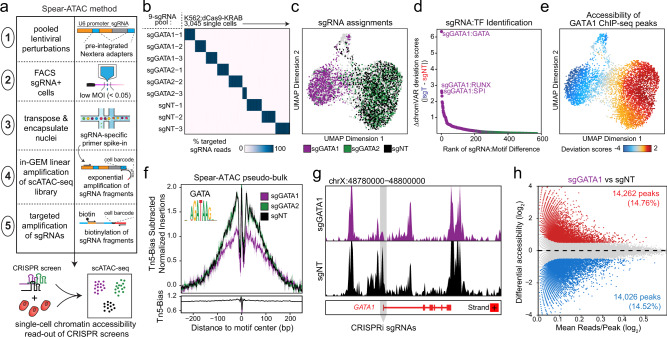
Chromatin accessibility profiling can identify putative regulatory regions genome wide; however, pooled single-cell methods for assessing the effects of regulatory perturbations on accessibility are limited. Here, we report a modified droplet-based single-cell ATAC-seq protocol for perturbing and evaluating dynamic single-cell epigenetic states. This method (Spear-ATAC) enables simultaneous read-out of chromatin accessibility profiles and integrated sgRNA spacer sequences from thousands of individual cells at once. Spear-ATAC profiling of 104,592 cells representing 414 sgRNA knock-down populations reveals the temporal dynamics of epigenetic responses to regulatory perturbations in cancer cells and the associations between transcription factor binding profiles.
Overview
The claims and statistics of this paper haven’t been checked yet.
Free: it reads the open-access text and checks the first 5 claims that cite a source we can check. Create a free account to check every claim.
Integrity signals
Registry
Cites
Statistics
Figures
Verification
Claims the paper makes
The claims and statistics of this paper haven’t been checked yet.
Free: it reads the open-access text and checks the first 5 claims that cite a source we can check. Create a free account to check every claim.
Claims other papers make about this one
Each is checked against this paper’s own text: does it say what the citing paper says it does?
The cited source says what the claim attributes to it.
In the citing paper
“We included scATAC-seq data from three different sources: Spear-ATAC42, CRISPR-sciATAC59 and ASAP-seq39.”
From scPerturb: harmonized single-cell perturbation data (2024) · cites this paper as [42]
The cited source says what the claim attributes to it.
In the citing paper
“Compared to Perturb-ATAC, both Spear-ATAC and CRISPR–sciATAC offer higher throughput.”
From A mini-review on perturbation modelling across single-cell omic modalities (2024) · cites this paper as [20]
The cited source says what the claim attributes to it.
In the citing paper
“CRISPR screens have been coupled with other methods such as scATAC-seq — for example, in developing Spear-ATAC-seq, which characterized over 100,000 single-cell epigenetic states and over 400 CRISPR perturbations87.”
From The technological landscape and applications of single-cell multi-omics (2023) · cites this paper as [87]
In the citing paper
“Protein, RNA and ATAC readouts for CRISPRi perturbation of MYC are all available for K562 cells6,20,42.”
From scPerturb: harmonized single-cell perturbation data (2024) · cites this paper as [42]
In the citing paper
“The Spear-ATAC [20] technique combines integrated sgRNA spacer sequences and chromatin accessibility profiles from hundreds of individual cells.”
From A mini-review on perturbation modelling across single-cell omic modalities (2024) · cites this paper as [20]
Self-check
Percentages, sums and reported differences re-computed from the paper’s own numbers.
The self-check needs the paper’s full text.
Citations
Cites
Buenrostro, J. D., Giresi, P. G., Zaba, L. C., Chang, H. Y., & Greenleaf, W. J. (2013) · Nature Methods · doi:10.1038/nmeth.2688 · Cited by 6,422
Self-citationSearch-and-replace genome editing without double-strand breaks or donor DNA
Anzalone, A. V., Randolph, P. B., Davis, J. R., Sousa, A. A., Koblan, L. W., Levy, J. M., Chen, P. J., Wilson, C., Newby, G. A., Raguram, A., et al. (2019) · Nature · doi:10.1038/s41586-019-1711-4 · Cited by 4,767
GREAT improves functional interpretation of cis-regulatory regions
McLean, C. Y., Bristor, D., Hiller, M., Clarke, S. L., Schaar, B. T., Lowe, C. B., Wenger, A. M., & Bejerano, G. (2010) · Nature Biotechnology · doi:10.1038/nbt.1630 · Cited by 4,502
The Human Transcription Factors
Lambert, S. A., Jolma, A., Campitelli, L. F., Das, P. K., Yin, Y., Albu, M., Chen, X., Taipale, J., Hughes, T. R., & Weirauch, M. T. (2018) · Cell · doi:10.1016/j.cell.2018.01.029 · Cited by 3,399
Genome-Scale CRISPR-Mediated Control of Gene Repression and Activation
Gilbert, L. A., Horlbeck, M. A., Adamson, B., Villalta, J. E., Chen, Y., Whitehead, E. H., Guimaraes, C., Panning, B., Ploegh, H. L., Bassik, M. C., et al. (2014) · Cell · doi:10.1016/j.cell.2014.09.029 · Cited by 2,728
An improved ATAC-seq protocol reduces background and enables interrogation of frozen tissues
Corces, M. R., Trevino, A. E., Hamilton, E. G., Greenside, P. G., Sinnott-Armstrong, N. A., Vesuna, S., Satpathy, A. T., Rubin, A. J., Montine, K. S., Wu, B., et al. (2017) · Nature Methods · doi:10.1038/nmeth.4396 · Cited by 2,496
Self-citationSingle-cell chromatin accessibility reveals principles of regulatory variation
Buenrostro, J. D., Wu, B., Litzenburger, U. M., Ruff, D., Gonzales, M. L., Snyder, M. P., Chang, H. Y., & Greenleaf, W. J. (2015) · Nature · doi:10.1038/nature14590 · Cited by 2,308
Self-citationGenome editing with CRISPR–Cas nucleases, base editors, transposases and prime editors
Anzalone, A. V., Koblan, L. W., & Liu, D. R. (2020) · Nature Biotechnology · doi:10.1038/s41587-020-0561-9 · Cited by 2,237
Dixit, A., Parnas, O., Li, B., Chen, J., Fulco, C. P., Jerby-Arnon, L., Marjanovic, N. D., Dionne, D., Burks, T., Raychowdhury, R., et al. (2016) · Cell · doi:10.1016/j.cell.2016.11.038 · Cited by 1,863
chromVAR: inferring transcription-factor-associated accessibility from single-cell epigenomic data
Schep, A. N., Wu, B., Buenrostro, J. D., & Greenleaf, W. J. (2017) · Nature Methods · doi:10.1038/nmeth.4401 · Cited by 1,680
Self-citationIdentification and characterization of essential genes in the human genome
Wang, T., Birsoy, K., Hughes, N. W., Krupczak, K. M., Post, Y., Wei, J. J., Lander, E. S., & Sabatini, D. M. (2015) · Science · doi:10.1126/science.aac7041 · Cited by 1,617
The next generation of CRISPR–Cas technologies and applications
Pickar-Oliver, A., & Gersbach, C. A. (2019) · Nature Reviews Molecular Cell Biology · doi:10.1038/s41580-019-0131-5 · Cited by 1,459
ArchR is a scalable software package for integrative single-cell chromatin accessibility analysis
Granja, J. M., Corces, M. R., Pierce, S. E., Bagdatli, S. T., Choudhry, H., Chang, H. Y., & Greenleaf, W. J. (2021) · Nature Genetics · doi:10.1038/s41588-021-00790-6 · Cited by 1,392
Self-citationThe chromatin accessibility landscape of primary human cancers
Corces, M. R., Granja, J. M., Shams, S., Louie, B. H., Seoane, J. A., Zhou, W., Silva, T. C., Groeneveld, C., Wong, C. K., Cho, S. W., et al. (2018) · Science · doi:10.1126/science.aav1898 · Cited by 1,230
Self-citationPooled CRISPR screening with single-cell transcriptome readout.
Datlinger, P., Rendeiro, A. F., Schmidl, C., Krausgruber, T., Traxler, P., Klughammer, J., Schuster, L. C., Kuchler, A., Alpar, D., & Bock, C. (2017) · Nature Methods · doi:10.1038/nmeth.4177 · Cited by 1,096
Satpathy, A. T., Granja, J. M., Yost, K. E., Qi, Y., Meschi, F., McDermott, G. P., Olsen, B. N., Mumbach, M. R., Pierce, S. E., Corces, M. R., et al. (2019) · Nature Biotechnology · doi:10.1038/s41587-019-0206-z · Cited by 980
Self-citationDissecting Immune Circuits by Linking CRISPR-Pooled Screens with Single-Cell RNA-Seq
Jaitin, D. A., Weiner, A., Yofe, I., Lara-Astiaso, D., Keren-Shaul, H., David, E., Salame, T. M., Tanay, A., van Oudenaarden, A., & Amit, I. (2016) · Cell · doi:10.1016/j.cell.2016.11.039 · Cited by 777
Buenrostro, J. D., Corces, M. R., Lareau, C. A., Wu, B., Schep, A. N., Aryee, M. J., Majeti, R., Chang, H. Y., & Greenleaf, W. J. (2018) · Cell · doi:10.1016/j.cell.2018.03.074 · Cited by 670
Self-citationSingle-cell multiomic analysis identifies regulatory programs in mixed-phenotype acute leukemia
Granja, J. M., Klemm, S., McGinnis, L. M., Kathiria, A. S., Mezger, A., Corces, M. R., Parks, B., Gars, E., Liedtke, M., Zheng, G. X. Y., et al. (2019) · Nature Biotechnology · doi:10.1038/s41587-019-0332-7 · Cited by 498
Self-citationCombinatorial single-cell CRISPR screens by direct guide RNA capture and targeted sequencing
Replogle, J. M., Norman, T. M., Xu, A., Hussmann, J. A., Chen, J., Cogan, J. Z., Meer, E. J., Terry, J. M., Riordan, D. P., Srinivas, N., et al. (2020) · Nature Biotechnology · doi:10.1038/s41587-020-0470-y · Cited by 465
Global reference mapping of human transcription factor footprints
Vierstra, J., Lazar, J., Sandstrom, R., Halow, J., Lee, K., Bates, D., Diegel, M., Dunn, D., Neri, F., Haugen, E., et al. (2020) · Nature · doi:10.1038/s41586-020-2528-x · Cited by 386
Rubin, A. J., Parker, K. R., Satpathy, A. T., Qi, Y., Wu, B., Ong, A. J., Mumbach, M. R., Ji, A. L., Kim, D. S., Cho, S. W., et al. (2019) · Cell · doi:10.1016/j.cell.2018.11.022 · Cited by 314
Self-citationThe role of PU.1 and GATA-1 transcription factors during normal and leukemogenic hematopoiesis
Burda, P., Laslo, P., & Stopka, T. (2010) · Leukemia · doi:10.1038/leu.2010.104 · Cited by 184
Mitigation of off-target toxicity in CRISPR-Cas9 screens for essential non-coding elements
Tycko, J., Wainberg, M., Marinov, G. K., Ursu, O., Hess, G. T., Ego, B. K., Aradhana, Li, A., Truong, A., Trevino, A. E., et al. (2019) · Nature Communications · doi:10.1038/s41467-019-11955-7 · Cited by 148
Self-citationShimizu, R., Engel, J. D., & Yamamoto, M. P. (2008) · Nature reviews. Cancer · doi:10.1038/nrc2348 · Cited by 126
Liscovitch-Brauer, N., Montalbano, A., Deng, J., Méndez-Mancilla, A., Wessels, H.-H., Moss, N. G., Kung, C.-Y., Sookdeo, A., Guo, X., Geller, E., et al. (2021) · Nature Biotechnology · doi:10.1038/s41587-021-00902-x · Cited by 107
Cancer chromatin accessibility landscape
Mao, S. (2018) · Science · doi:10.1126/science.362.6413.415-k · Cited by 96
Mitra, P., Xie, R.-L., Medina, R., Hovhannisyan, H., Zaidi, S. K., Yue, W., Harper, J. W., Stein, J. L., van Wijnen, A. J., & Stein, G. S. (2003) · Molecular and Cellular Biology · doi:10.1128/mcb.23.22.8110-8123.2003 · Cited by 77
ArchR: An integrative and scalable software package for single-cell chromatin accessibility analysisPreprint
Granja, J. M., Corces, M. R., Pierce, S. E., et al. (2020) · bioRxiv · doi:10.1101/2020.04.28.066498 · Cited by 61
Self-citationGATA factor transcriptional activity: Insights from genome‐wide binding profiles
Romano, O., & Miccio, A. (2019) · IUBMB Life · doi:10.1002/iub.2169 · Cited by 45
Wierenga, A. T. J., Vellenga, E., & Schuringa, J. J. (2010) · Blood · doi:10.1182/blood-2009-10-250894 · Cited by 32
Scalable pooled CRISPR screens with single-cell chromatin accessibility profilingPreprint
Liscovitch-Brauer, N., Montalbano, A., Deng, J., et al. (2020) · bioRxiv · doi:10.1101/2020.11.20.390971 · Cited by 5
Research works printed but not linked: 1
- Pierce S. E., Granja J. M., Greenleaf W. J. High-throughput single-cell chromatin accessibility CRISPR screens enable unbiased identification of regulatory networks in cancer, Zenodo, 10.5281/zenodo.4655236, (2021). PMC8137922 34016988 · DOI
Cited by
Single-cell chromatin state analysis with Signac
Stuart, T., Srivastava, A., Madad, S., Lareau, C. A., & Satija, R. (2021) · Nature Methods · doi:10.1038/s41592-021-01282-5 · Cited by 1,769
ArchR is a scalable software package for integrative single-cell chromatin accessibility analysis
Granja, J. M., Corces, M. R., Pierce, S. E., Bagdatli, S. T., Choudhry, H., Chang, H. Y., & Greenleaf, W. J. (2021) · Nature Genetics · doi:10.1038/s41588-021-00790-6 · Cited by 1,392
Self-citationMethods and applications for single-cell and spatial multi-omics
Vandereyken, K., Sifrim, A., Thienpont, B., & Voet, T. (2023) · Nature Reviews Genetics · doi:10.1038/s41576-023-00580-2 · Cited by 1,244
“Methods to profile the impact of such perturbations on chromatin accessibility include CRISPR-sciATAC 92 , Perturb-ATAC 91 and Spear-ATAC 93 .”
MethodThe technological landscape and applications of single-cell multi-omics
Baysoy, A., Bai, Z., Satija, R., & Fan, R. (2023) · Nature Reviews Molecular Cell Biology · doi:10.1038/s41580-023-00615-w · Cited by 1,037
Bock, C., Datlinger, P., Chardon, F., Coelho, M. A., Dong, M. B., Lawson, K. A., Lu, T., Maroc, L., Norman, T. M., Song, B., et al. (2022) · Nature Reviews Methods Primers · doi:10.1038/s43586-021-00093-4 · Cited by 571
Metadata
- Authors
- Pierce, S. E., Granja, J. M., & Greenleaf, W. J.
- Affiliations
- Stanford Medicine (US)
- Chan Zuckerberg Biohub San Francisco (US)
- Corresponding author
- Greenleaf, William J.
- Venue
- Nature Communications
- Published
- 2021-05-20
- Volume
- 12
- Issue
- 1
- Pages
- 2969-2969
- ISSN
- 2041-1723 (ISSN-L)
- PMC
- PMC8137922
- OpenAlex
- W3161116336
- Cited by
- 146
- References
- 31
- Citations by year
- 2026: 17 · 2025: 33 · 2024: 30 · 2023: 21 · 2022: 30 · 2021: 13
- FWCI
- 7.37
- Type
- journal article
- Language
- en
- Open access
- gold
- doi.org
- Licence
- cc-by
- creativecommons.org/licenses/by/4.0 (tdm)
- creativecommons.org/licenses/by/4.0 (vor)
- Locations
- Nature Communications (publishedVersion, cc-by)
- bioRxiv (Cold Spring Harbor Laboratory) (acceptedVersion, cc-by-nc-nd)
- PubMed Central (publishedVersion, cc-by)
- PubMed (publishedVersion)
- RePEc: Research Papers in Economics (submittedVersion)
- DOAJ (DOAJ: Directory of Open Access Journals) (submittedVersion, cc-by-sa)
- Funders
- National Science Foundation
- National Institutes of Health (R01- HG00990901, AI057266, RM1-HG007735, HG007735)
- National Human Genome Research Institute (RM1HG007735, UM1HG009436, P50HG007735, UM1HG009442)
- National Cancer Institute (T32CA009302)
- National Institute of Allergy and Infectious Diseases (U19AI057266)
- Topics
- Life Sciences › Biochemistry, Genetics and Molecular Biology › Molecular Biology › Genomics and Chromatin Dynamics
- Life Sciences › Biochemistry, Genetics and Molecular Biology › Molecular Biology › Chromatin Remodeling and Cancer
- Life Sciences › Biochemistry, Genetics and Molecular Biology › Molecular Biology › Single-cell and spatial transcriptomics
- Keywords
- chromatin accessibility, single-cell ATAC-seq, CRISPR screen, epigenetic perturbation, transcription factor binding, regulatory networks, cancer epigenetics
- MeSH terms
- Chromatin Immunoprecipitation Sequencing, RNA, Guide, CRISPR-Cas Systems, Binding Sites, Chromatin, Humans, Neoplasms, Transcription Factors, Gene Expression Regulation, Neoplastic, Epigenesis, Genetic, Cell Line, Tumor, Gene Regulatory Networks, Gene Knockdown Techniques, High-Throughput Screening Assays, Epigenomics, Single-Cell Analysis, CRISPR-Cas Systems
About these checks
Registry, retraction, Cites and statistics results are computed, not judged, with one exception: a printed reference that no index lists is read once by a model before it counts as a citation error. Claims are extracted by a model and kept only when their quote appears verbatim in the text; each cited source is then checked, with a model’s help, for whether it says what the claim relies on. Those verdicts can be wrong — read the claim’s quote and the cited source before relying on one.
Statistics and arithmetic are recomputed, not judged.
Confidence bands are shown only for fields calibrated on our annotated test set. None is calibrated yet, so no band is shown.
What counts as a claim ›How we measure confidence ›How we check this ›
Are you an author, or do you see a problem with this page? Request a review
Data sources
Bibliographic data: Semantic Scholar, OpenAlex, Crossref.
Contains information from the Semantic Scholar Academic Graph Datasets, made available under the ODC Attribution License (ODC-BY 1.0).
Semantic Scholar’s data is described in: Kinney, R., et al. (2023). The Semantic Scholar Open Data Platform. arXiv:2301.10140.
