

Optimization of C-to-G base editors with sequence context preference predictable by machine learning methods
Open accessThe DOI matches its Crossref record; 39 of the 39 references it cites were found in a registry or an index.
Abstract
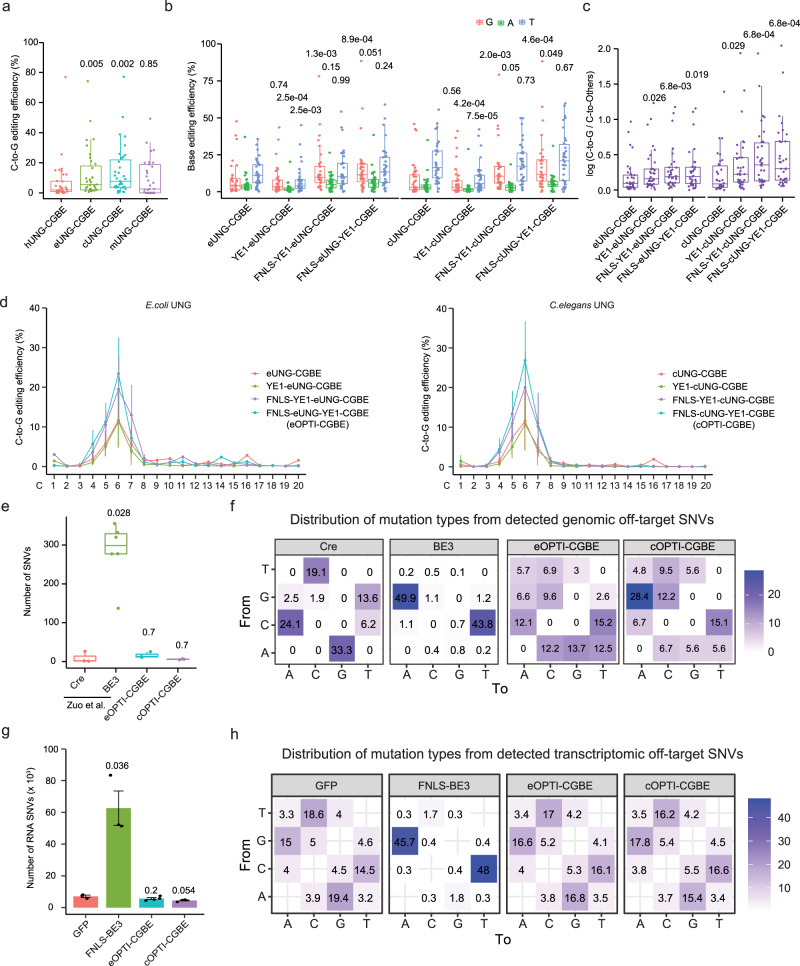
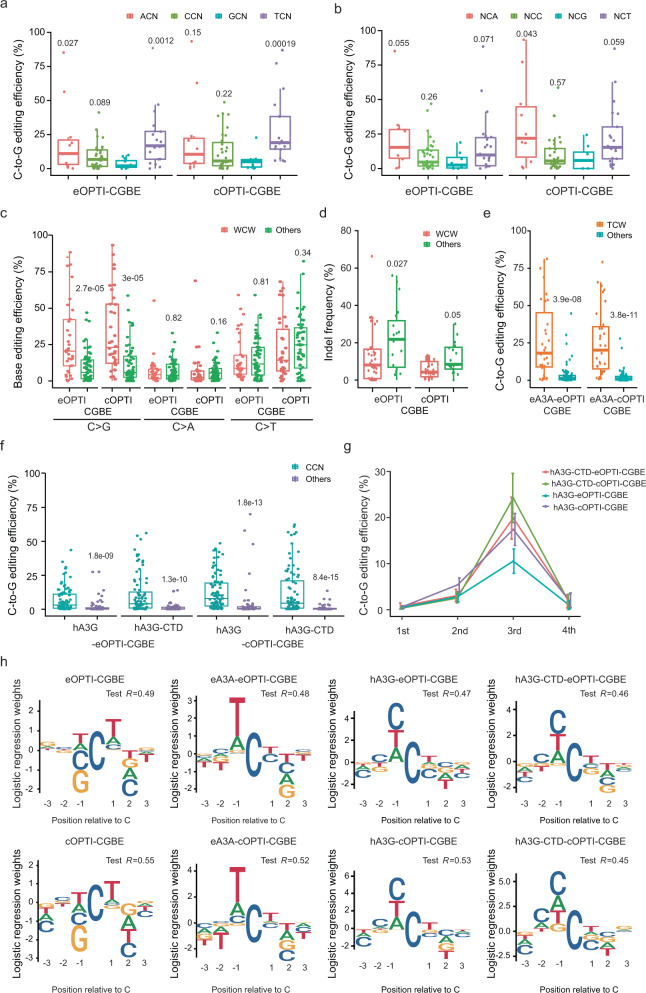
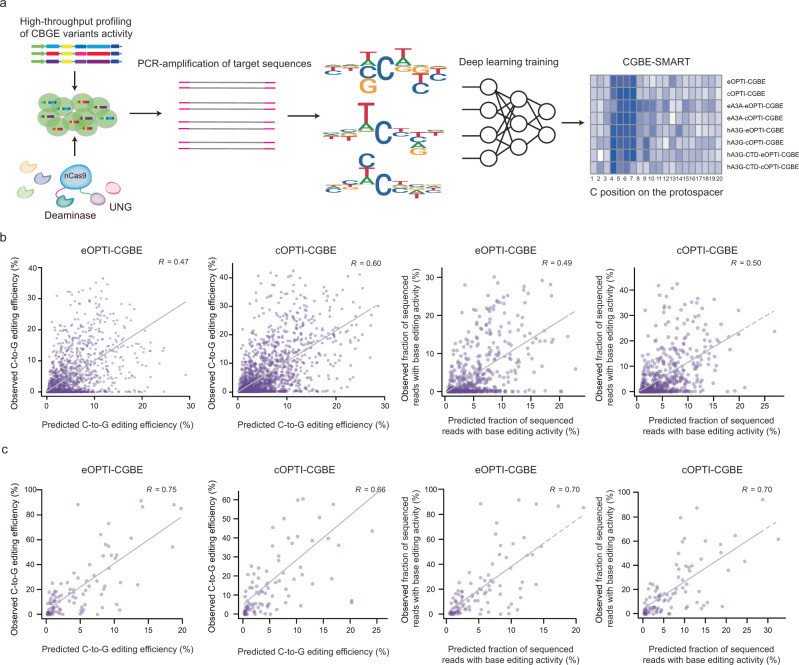
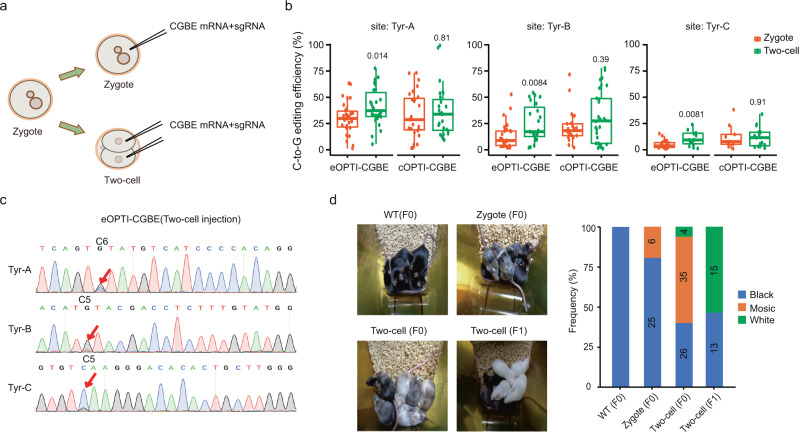
Efficient and precise base editors (BEs) for C-to-G transversion are highly desirable. However, the sequence context affecting editing outcome largely remains unclear. Here we report engineered C-to-G BEs of high efficiency and fidelity, with the sequence context predictable via machine-learning methods. By changing the species origin and relative position of uracil-DNA glycosylase and deaminase, together with codon optimization, we obtain optimized C-to-G BEs (OPTI-CGBEs) for efficient C-to-G transversion. The motif preference of OPTI-CGBEs for editing 100 endogenous sites is determined in HEK293T cells. Using a sgRNA library comprising 41,388 sequences, we develop a deep-learning model that accurately predicts the OPTI-CGBE editing outcome for targeted sites with specific sequence context. These OPTI-CGBEs are further shown to be capable of efficient base editing in mouse embryos for generating Tyr-edited offspring. Thus, these engineered CGBEs are useful for efficient and precise base editing, with outcome predictable based on sequence context of targeted sites.
Overview
The claims and statistics of this paper haven’t been checked yet.
Free: it reads the open-access text and checks the first 5 claims that cite a source we can check. Create a free account to check every claim.
Integrity signals
Registry
Cites
Statistics
Figures
Verification
Claims the paper makes
The claims and statistics of this paper haven’t been checked yet.
Free: it reads the open-access text and checks the first 5 claims that cite a source we can check. Create a free account to check every claim.
Self-check
Percentages, sums and reported differences re-computed from the paper’s own numbers.
The self-check needs the paper’s full text.
Citations
Cites
Trimmomatic: a flexible trimmer for Illumina sequence data
Bolger, A. M., Lohse, M., & Usadel, B. (2014) · Bioinformatics · doi:10.1093/bioinformatics/btu170 · Cited by 65,548
STAR: ultrafast universal RNA-seq aligner
Dobin, A., Davis, C. A., Schlesinger, F., Drenkow, J., Zaleski, C., Jha, S., Batut, P., Chaisson, M., & Gingeras, T. R. (2013) · Bioinformatics · doi:10.1093/bioinformatics/bts635 · Cited by 51,709
Going deeper with convolutions
Szegedy, C., Liu, W., Jia, Y., Sermanet, P., Reed, S., Anguelov, D., Erhan, D., Vanhoucke, V., & Rabinovich, A. (2015) · 2015 IEEE Conference on Computer Vision and Pattern Recognition (CVPR) · doi:10.1109/cvpr.2015.7298594 · Cited by 48,562
The Genome Analysis Toolkit: A MapReduce framework for analyzing next-generation DNA sequencing data
McKenna, A., Hanna, M., Banks, E., Sivachenko, A., Cibulskis, K., Kernytsky, A., Garimella, K., Altshuler, D., Gabriel, S., Daly, M., et al. (2010) · Genome Research · doi:10.1101/gr.107524.110 · Cited by 27,895
Programmable editing of a target base in genomic DNA without double-stranded DNA cleavage
Komor, A. C., Kim, Y. B., Packer, M. S., Zuris, J. A., & Liu, D. R. (2016) · Nature · doi:10.1038/nature17946 · Cited by 5,437
Sensitive detection of somatic point mutations in impure and heterogeneous cancer samples
Cibulskis, K., Lawrence, M. S., Carter, S. L., Sivachenko, A., Jaffe, D., Sougnez, C., Gabriel, S., Meyerson, M., Lander, E. S., & Getz, G. (2013) · Nature Biotechnology · doi:10.1038/nbt.2514 · Cited by 4,981
Search-and-replace genome editing without double-strand breaks or donor DNA
Anzalone, A. V., Randolph, P. B., Davis, J. R., Sousa, A. A., Koblan, L. W., Levy, J. M., Chen, P. J., Wilson, C., Newby, G. A., Raguram, A., et al. (2019) · Nature · doi:10.1038/s41586-019-1711-4 · Cited by 4,767
Programmable base editing of A•T to G•C in genomic DNA without DNA cleavage
Gaudelli, N. M., Komor, A. C., Rees, H. A., Packer, M. S., Badran, A. H., Bryson, D. I., & Liu, D. R. (2017) · Nature · doi:10.1038/nature24644 · Cited by 4,184
Bae, S., Park, J., & Kim, J.-S. (2014) · Bioinformatics · doi:10.1093/bioinformatics/btu048 · Cited by 2,339
Genome editing with CRISPR–Cas nucleases, base editors, transposases and prime editors
Anzalone, A. V., Koblan, L. W., & Liu, D. R. (2020) · Nature Biotechnology · doi:10.1038/s41587-020-0561-9 · Cited by 2,237
Base editing: precision chemistry on the genome and transcriptome of living cells
Rees, H. A., & Liu, D. R. (2018) · Nature Reviews Genetics · doi:10.1038/s41576-018-0059-1 · Cited by 1,675
CRISPResso2 provides accurate and rapid genome editing sequence analysis
Clement, K., Rees, H., Canver, M. C., Gehrke, J. M., Farouni, R., Hsu, J. Y., Cole, M. A., Liu, D. R., Joung, J. K., Bauer, D. E., et al. (2019) · Nature Biotechnology · doi:10.1038/s41587-019-0032-3 · Cited by 1,660
Strelka: accurate somatic small-variant calling from sequenced tumor–normal sample pairs
Saunders, C. T., Wong, W. S. W., Swamy, S., Becq, J., Murray, L. J., & Cheetham, R. K. (2012) · Bioinformatics · doi:10.1093/bioinformatics/bts271 · Cited by 1,635
Evolved Cas9 variants with broad PAM compatibility and high DNA specificity
Hu, J. H., Miller, S. M., Geurts, M. H., Tang, W., Chen, L., Sun, N., Zeina, C. M., Gao, X., Rees, H. A., Lin, Z., et al. (2018) · Nature · doi:10.1038/nature26155 · Cited by 1,552
Wilm, A., Aw, P. P. K., Bertrand, D., Yeo, G. H. T., Ong, S. H., Wong, C. H., Khor, C. C., Petric, R., Hibberd, M. L., & Nagarajan, N. (2012) · Nucleic Acids Research · doi:10.1093/nar/gks918 · Cited by 1,372
Unconstrained genome targeting with near-PAMless engineered CRISPR-Cas9 variants
Walton, R. T., Christie, K. A., Whittaker, M. N., & Kleinstiver, B. P. (2020) · Science · doi:10.1126/science.aba8853 · Cited by 1,233
Engineered CRISPR-Cas9 nuclease with expanded targeting space
Nishimasu, H., Shi, X., Ishiguro, S., Gao, L., Hirano, S., Okazaki, S., Noda, T., Abudayyeh, O. O., Gootenberg, J. S., Mori, H., et al. (2018) · Science · doi:10.1126/science.aas9129 · Cited by 1,100
Cytosine base editor generates substantial off-target single-nucleotide variants in mouse embryos
Zuo, E., Sun, Y., Wei, W., Yuan, T., Ying, W., Sun, H., Yuan, L., Steinmetz, L. M., Li, Y., & Yang, H. (2019) · Science · doi:10.1126/science.aav9973 · Cited by 782
Self-citationKim, Y. B., Komor, A. C., Levy, J. M., Packer, M. S., Zhao, K. T., & Liu, D. R. (2017) · Nature Biotechnology · doi:10.1038/nbt.3803 · Cited by 758
Cytosine, but not adenine, base editors induce genome-wide off-target mutations in rice
Jin, S., Zong, Y., Gao, Q., Zhu, Z., Wang, Y., Qin, P., Liang, C., Wang, D., Qiu, J.-L., Zhang, F., et al. (2019) · Science · doi:10.1126/science.aaw7166 · Cited by 665
Transcriptome-wide off-target RNA editing induced by CRISPR-guided DNA base editors
Grünewald, J., Zhou, R., Garcia, S. P., Iyer, S., Lareau, C. A., Aryee, M. J., & Joung, J. K. (2019) · Nature · doi:10.1038/s41586-019-1161-z · Cited by 663
CRISPR C-to-G base editors for inducing targeted DNA transversions in human cells
Kurt, I. C., Zhou, R., Iyer, S., Garcia, S. P., Miller, B. R., Langner, L. M., Grünewald, J., & Joung, J. K. (2021) · Nature Biotechnology · doi:10.1038/s41587-020-0609-x · Cited by 573
Predicting the mutations generated by repair of Cas9-induced double-strand breaks
Allen, F., Crepaldi, L., Alsinet, C., Strong, A. J., Kleshchevnikov, V., De Angeli, P., Páleníková, P., Khodak, A., Kiselev, V., Kosicki, M., et al. (2019) · Nature Biotechnology · doi:10.1038/nbt.4317 · Cited by 496
Off-target RNA mutation induced by DNA base editing and its elimination by mutagenesis
Zhou, C., Sun, Y., Yan, R., Liu, Y., Zuo, E., Gu, C., Han, L., Wei, Y., Hu, X., Zeng, R., et al. (2019) · Nature · doi:10.1038/s41586-019-1314-0 · Cited by 482
Self-citationEvaluation and minimization of Cas9-independent off-target DNA editing by cytosine base editors
Doman, J. L., Raguram, A., Newby, G. A., & Liu, D. R. (2020) · Nature Biotechnology · doi:10.1038/s41587-020-0414-6 · Cited by 473
Glycosylase base editors enable C-to-A and C-to-G base changes
Zhao, D., Li, J., Li, S., Xin, X., Hu, M., Price, M. A., Rosser, S. J., Bi, C., & Zhang, X. (2021) · Nature Biotechnology · doi:10.1038/s41587-020-0592-2 · Cited by 460
An APOBEC3A-Cas9 base editor with minimized bystander and off-target activities
Gehrke, J. M., Cervantes, O., Clement, M. K., Wu, Y., Zeng, J., Bauer, D. E., Pinello, L., & Joung, J. K. (2018) · Nature Biotechnology · doi:10.1038/nbt.4199 · Cited by 438
Optimized base editors enable efficient editing in cells, organoids and mice
Zafra, M. P., Schatoff, E. M., Katti, A., Foronda, M., Breinig, M., Schweitzer, A. Y., Simon, A., Han, T., Goswami, S., Montgomery, E., et al. (2018) · Nature Biotechnology · doi:10.1038/nbt.4194 · Cited by 347
Gu, B., Posfai, E., & Rossant, J. (2018) · Nature Biotechnology · doi:10.1038/nbt.4166 · Cited by 329
Determinants of Base Editing Outcomes from Target Library Analysis and Machine Learning
Arbab, M., Shen, M. W., Mok, B., Wilson, C., Matuszek, Ż., Cassa, C. A., & Liu, D. R. (2020) · Cell · doi:10.1016/j.cell.2020.05.037 · Cited by 294
Methods and Applications of CRISPR-Mediated Base Editing in Eukaryotic Genomes
Hess, G. T., Tycko, J., Yao, D., & Bassik, M. C. (2017) · Molecular Cell · doi:10.1016/j.molcel.2017.09.029 · Cited by 234
Prediction of the sequence-specific cleavage activity of Cas9 variants
Kim, N., Kim, H. K., Lee, S., Seo, J. H., Choi, J. W., Park, J., Min, S., Yoon, S., Cho, S.-R., & Kim, H. H. (2020) · Nature Biotechnology · doi:10.1038/s41587-020-0537-9 · Cited by 198
Programmable C:G to G:C genome editing with CRISPR-Cas9-directed base excision repair proteins
Chen, L., Park, J. E., Paa, P., Rajakumar, P. D., Prekop, H.-T., Chew, Y. T., Manivannan, S. N., & Chew, W. L. (2021) · Nature Communications · doi:10.1038/s41467-021-21559-9 · Cited by 195
Zuo, E., Sun, Y., Yuan, T., He, B., Zhou, C., Ying, W., Liu, J., Wu, W., Zeng, R., Li, Y., et al. (2020) · Nature Methods · doi:10.1038/s41592-020-0832-x · Cited by 177
Self-citationSequence-specific prediction of the efficiencies of adenine and cytosine base editors
Song, M., Kim, H. K., Lee, S., Kim, Y., Seo, S.-Y., Park, J., Choi, J. W., Jang, H., Shin, J. H., Min, S., et al. (2020) · Nature Biotechnology · doi:10.1038/s41587-020-0573-5 · Cited by 124
Effective gene editing by high-fidelity base editor 2 in mouse zygotes
Liang, P., Sun, H., Sun, Y., Zhang, X., Xie, X., Zhang, J., Zhang, Z., Chen, Y., Ding, C., Xiong, Y., et al. (2017) · Protein & Cell · doi:10.1007/s13238-017-0418-2 · Cited by 89
Self-citationLee, S., Ding, N., Sun, Y., Yuan, T., Li, J., Yuan, Q., Liu, L., Yang, J., Wang, Q., Kolomeisky, A. B., et al. (2020) · Science Advances · doi:10.1126/sciadv.aba1773 · Cited by 78
Self-citationGOTI, a method to identify genome-wide off-target effects of genome editing in mouse embryos
Zuo, E., Sun, Y., Wu, W., Yuan, T., Ying, W., Sun, H., Yuan, L., Steinmetz, L. M., Li, Y., & Yang, H. (2020) · Nature Protocols · doi:10.1038/s41596-020-0361-1 · Cited by 46
Self-citationAPOBEC3G Inhibits HIV-1 RNA Elongation by Inactivating the Viral Trans-Activation Response Element
Nowarski, R., Prabhu, P., Kenig, E., Smith, Y., Britan‐Rosich, E., & Kotler, M. (2014) · Journal of Molecular Biology · doi:10.1016/j.jmb.2014.05.012 · Cited by 22
Cited by
Assessing and advancing the safety of CRISPR-Cas tools: from DNA to RNA editing
Tao, J., Bauer, D. E., & Chiarle, R. (2023) · Nature Communications · doi:10.1038/s41467-023-35886-6 · Cited by 207
Tong, H., Wang, X., Liu, Y., Liu, N., Li, Y., Luo, J., Ma, Q., Wu, D., Li, J., Xu, C., et al. (2023) · Nature Biotechnology · doi:10.1038/s41587-022-01595-6 · Cited by 202
Self-citationDesigning and executing prime editing experiments in mammalian cells
Doman, J. L., Sousa, A. A., Randolph, P. B., Chen, P. J., & Liu, D. R. (2022) · Nature Protocols · doi:10.1038/s41596-022-00724-4 · Cited by 172
Chen, L., Zhu, B., Ru, G., Meng, H., Yan, Y., Hong, M., Zhang, D., Luan, C., Zhang, S., Wu, H., et al. (2023) · Nature Biotechnology · doi:10.1038/s41587-022-01532-7 · Cited by 156
Self-citationCRISPR-based gene editing technology and its application in microbial engineering
Wei, J., & Li, Y. (2023) · Engineering Microbiology · doi:10.1016/j.engmic.2023.100101 · Cited by 116
Self-citation
Metadata
- Authors
- Yuan, T., Yan, N., Fei, T., Zheng, J., Meng, J., Li, N., Liu, J., Zhang, H., Xie, L., Ying, W., Li, D., Shi, L., Sun, Y., Li, Y., Li, Y., Sun, Y., & Zuo, E.
- Affiliations
- Agricultural Genomics Institute at Shenzhen (CN)
- Chinese Academy of Sciences (CN)
- Fujian Medical University (CN)
- Guangxi University (CN)
- Corresponding author
- Sun, Yongsen
- Sun, Yidi
- Zuo, Erwei
- ORCID
- Venue
- Nature Communications
- Published
- 2021-08-12
- Volume
- 12
- Issue
- 1
- Pages
- 4902-4902
- ISSN
- 2041-1723 (ISSN-L)
- PMC
- PMC8361092
- OpenAlex
- W3190858414
- Cited by
- 55
- References
- 39
- Citations by year
- 2026: 3 · 2025: 12 · 2024: 15 · 2023: 12 · 2022: 11 · 2021: 2
- FWCI
- 3.14
- Type
- journal article
- Language
- en
- Open access
- gold
- doi.org
- Licence
- cc-by
- creativecommons.org/licenses/by/4.0 (tdm)
- creativecommons.org/licenses/by/4.0 (vor)
- Locations
- Nature Communications (publishedVersion, cc-by)
- PubMed Central (publishedVersion, cc-by)
- PubMed (publishedVersion)
- RePEc: Research Papers in Economics (submittedVersion)
- DOAJ (DOAJ: Directory of Open Access Journals) (submittedVersion, cc-by-sa)
- Funders
- National Natural Science Foundation of China (31922048)
- Topics
- Life Sciences › Biochemistry, Genetics and Molecular Biology › Molecular Biology › CRISPR and Genetic Engineering
- Life Sciences › Biochemistry, Genetics and Molecular Biology › Molecular Biology › RNA regulation and disease
- Life Sciences › Biochemistry, Genetics and Molecular Biology › Molecular Biology › DNA and Nucleic Acid Chemistry
- Keywords
- base editing, uracil-DNA glycosylase, deaminase, codon optimization, sgRNA library
- MeSH terms
- Machine Learning, Gene Editing, Animals, Base Sequence, Binding Sites, Codon, Cytidine Deaminase, Escherichia coli, Female, Humans, Reproducibility of Results, Gene Library, Caenorhabditis elegans, Mice, Uracil-DNA Glycosidase, HEK293 Cells, CRISPR-Cas Systems
About these checks
Registry, retraction, Cites and statistics results are computed, not judged, with one exception: a printed reference that no index lists is read once by a model before it counts as a citation error. Claims are extracted by a model and kept only when their quote appears verbatim in the text; each cited source is then checked, with a model’s help, for whether it says what the claim relies on. Those verdicts can be wrong — read the claim’s quote and the cited source before relying on one.
Statistics and arithmetic are recomputed, not judged.
Confidence bands are shown only for fields calibrated on our annotated test set. None is calibrated yet, so no band is shown.
What counts as a claim ›How we measure confidence ›How we check this ›
Are you an author, or do you see a problem with this page? Request a review
Data sources
Bibliographic data: Semantic Scholar, OpenAlex, Crossref.
Contains information from the Semantic Scholar Academic Graph Datasets, made available under the ODC Attribution License (ODC-BY 1.0).
Semantic Scholar’s data is described in: Kinney, R., et al. (2023). The Semantic Scholar Open Data Platform. arXiv:2301.10140.
