

The DOI matches its Crossref record; 64 of the 64 references it cites were found in a registry or an index; 9 of the 53 sources its claims cite were checked for support.
Wavelength-multiplexed hook nanoantennas for machine learning enabled mid-infrared spectroscopy
Open accessAbstract
Infrared (IR) plasmonic nanoantennas (PNAs) are powerful tools to identify molecules by the IR fingerprint absorption from plasmon-molecules interaction. However, the sensitivity and bandwidth of PNAs are limited by the small overlap between molecules and sensing hotspots and the sharp plasmonic resonance peaks. In addition to intuitive methods like enhancement of electric field of PNAs and enrichment of molecules on PNAs surfaces, we propose a loss engineering method to optimize damping rate by reducing radiative loss using hook nanoantennas (HNAs). Furthermore, with the spectral multiplexing of the HNAs from gradient dimension, the wavelength-multiplexed HNAs (WMHNAs) serve as ultrasensitive vibrational probes in a continuous ultra-broadband region (wavelengths from 6 μm to 9 μm). Leveraging the multi-dimensional features captured by WMHNA, we develop a machine learning method to extract complementary physical and chemical information from molecules. The proof-of-concept demonstration of molecular recognition from mixed alcohols (methanol, ethanol, and isopropanol) shows 100% identification accuracy from the microfluidic integrated WMHNAs. Our work brings another degree of freedom to optimize PNAs towards small-volume, real-time, label-free molecular recognition from various species in low concentrations for chemical and biological diagnostics.
Overview
AI snapshot
Written from the paper’s full text.
TL;DR
The paper introduces wavelength-multiplexed hook nanoantennas (WMHNAs) that use loss engineering and broadband 6–9 μm plasmonic resonance to enhance mid-infrared molecular fingerprint detection. Combined with PCA/SVM machine learning, the platform identifies 1% methanol, ethanol, isopropanol, and their mixtures in water with 100% accuracy.
Key findings
- Hook nanoantennas tune radiative loss by changing the geometric difference ΔL between arms; optimal sensitivity occurred at ΔL = 0.65 μm for transmission (extracted loss ratio f = 0.644) and ΔL = 1.25 μm for reflection (f = 1.834), close to theoretical optima of f = 0.5 and f = 2, respectively.
- The 16-element WMHNA provides continuous ultra-broadband operation from 6 μm to 9 μm, matching mid-infrared fingerprint absorption; it captured 15 absorption peaks of methanol, ethanol, isopropanol, and water.
- WMHNA enhanced water scissoring absorption at 6.0 μm by 34.36 times and stretching absorption at 2.95 μm by 4.17 times; compared with direct thin-film measurement, WMHNA and HNA showed significant enhancement of absorption spectra by 3 orders of magnitude.
- PCA extracted multi-dimensional features from refractometric, spectroscopic, and antenna loading effects; SVM classification of 1% alcohol solutions and mixtures achieved 100% accuracy on both training and test sets.
Methods
- Design and simulation: temporal coupled-mode theory (TCMT) modeled plasmon–molecule coupling; finite-difference time-domain (FDTD, Lumerical) simulated far-field spectra and near-field distributions of hook nanoantennas.
- Fabrication and measurement: gold HNAs were fabricated on CaF₂ by electron-beam lithography and lift-off; FTIR microscopy with an MCT detector measured reflection/transmission spectra, and a PDMS microfluidic chamber enabled liquid sensing.
- Machine learning: PCA reduced WMHNA spectra to principal components; SVM with an RBF kernel (C = 1.0, gamma = 0.1) classified analytes. The dataset contained 50 spectra per molecule, split into 40 training and 10 testing spectra.
Limitations
- The paper does not explicitly state limitations.
- Evident from the text: the molecular recognition demonstration is a proof-of-concept limited to three chemically similar alcohols at 1% concentration in water and their mixtures, with a small dataset of 50 spectra per molecule.
- Evident from the text: the WMHNA design shown covers 6–9 μm, while the paper notes that covering all IR fingerprint ranges would require further engineering of antenna length for specific molecular targets.
Model-written summary. Check it against the paper before relying on it.
Integrity signals
Registry
Cites
Statistics
Figures
Verification
Claims the paper makes
42 Own result · 21 Own interpretation · 19 No basis given · 12 Not checked yet · 1 Partly supported · 1 Mixed support · accuracy not yet measured
Some cited sources support this claim and some don’t — read each source’s verdict below.
In the paper
“The molecular enrichment strategies, including functionalized chemical bonding17,18, chemical reaction19,20, physical adsorption21–23, optical trapping24 as well as passive trapping by undercut structure25–28 bring in the additional working requirements (e.g., chemical stimuli, temperature, pressure, pump power, etc.) for specific molecules, impeding the system for global molecular recognition.”
§ Wavelength-multiplexed hook nanoantennas for machine learning enabled mid-infrared spectroscopy > Introduction
What the sources say
- Not checked yetcites [17] Limaj, O. et al. Infrared Plasmonic Biosensor for Real-Time and Label-Free Monitoring of Lipid Membranes. Nano Lett. 16, 1502–1508 (2016). source
- Partly supportedcites [18] Etezadi, D. et al. Nanoplasmonic mid-infrared biosensor for in vitro protein secondary structure detection. Light Sci. Appl. 6, e17029–e17029 (2017). sourceExperimental — accuracy not yet measured
The Results and discussion section (page not available in our copy) describes molecule-specific preparation: the sensor surface was functionalized, and α-synuclein was prepared with a terminal cysteine for selective binding. This supports the example of additional requirements for a particular molecule, but the paper does not say that enrichment strategies generally require the listed operating conditions or impede global molecular recognition. (LLM, conf=0.85)
- Partly supportedcites [19] Hasan, D. & Lee, C. Hybrid Metamaterial Absorber Platform for Sensing of CO2 Gas at Mid-IR. Adv. Sci. 5, (2018). sourceExperimental — accuracy not yet measured
Section 3.1 describes a CO₂-selective enrichment material that captures molecules through a chemical reaction, so the paper supports that example of a molecule-specific strategy. It does not establish that enrichment strategies generally require the listed operating conditions or impede global molecular recognition. Section 3.5.2 notes that desorption is endothermic but also reports fast recovery when flushed with ambient CO₂. (LLM, conf=0.82)
- Not checked yetcites [20] Chang, Y. et al. All-Dielectric Surface-Enhanced Infrared Absorption-Based Gas Sensor Using Guided Resonance. ACS Appl. Mater. Interfaces 10, 38272–38279 (2018). source
- Partly supportedcites [21] Hu, H. et al. Gas identification with graphene plasmons. Nat. Commun. 10, 1131 (2019). sourceExperimental — accuracy not yet measured
The Results ('Gas identification with high detection efficiency') attribute gas accumulation on graphene to physisorption, so the paper supports citing it as an example of physical adsorption for molecular enrichment. It does not say that this strategy requires particular chemical stimuli, temperature, pressure, or pump power, or that it impedes global molecular recognition. (LLM, conf=0.83)
- Partly supportedcites [22] Zhou, H. et al. Metal–Organic Framework‐Surface‐Enhanced Infrared Absorption Platform Enables Simultaneous On‐Chip Sensing of Greenhouse Gases. Adv. Sci. 7, 2001173 (2020). sourceExperimental — accuracy not yet measured
The Introduction describes gas-selective trapping materials that concentrate target molecules and says multigas detection requires materials with multigas selectivity. This supports citing the paper as an example of molecular enrichment by adsorption. It does not establish that such strategies generally require chemical stimuli, temperature, pressure, or pump power, or that they preclude global molecular recognition; its Conclusion instead reports simultaneous sensing of CO2 and CH4. (LLM, conf=0.83)
- Not checked yetcites [23] Nuñez, J., Boersma, A., Grand, J., Mintova, S. & Sciacca, B. Thin Functional Zeolite Layer Supported on Infrared Resonant Nano‐Antennas for the Detection of Benzene Traces. Adv. Funct. Mater. 31, 2101623 (2021). source
- Not checked yetcites [24] Yoo, D. et al. Low-Power Optical Trapping of Nanoparticles and Proteins with Resonant Coaxial Nanoaperture Using 10 nm Gap. Nano Lett. 18, 3637–3642 (2018). source
- Disputedcites [25] Miao, X., Yan, L., Wu, Y. & Liu, P. Q. High-sensitivity nanophotonic sensors with passive trapping of analyte molecules in hot spots. Light Sci. Appl. 10, 5 (2021). sourceExperimental — accuracy not yet measured
The Introduction says active trapping can require a laser or applied voltage and may not suit small molecules. But the cited paper’s Discussion says its passive trapping requires no external energy source and is not limited to specific molecular species—the opposite of the claim as applied to this strategy. Our copy provides no page numbers for these passages. (LLM, conf=0.87)
Checked by a reasoning model — may be wrong.
- Not checked yetcites [26] Hwang, I. et al. Plasmon-Enhanced Infrared Spectroscopy Based on Metamaterial Absorbers with Dielectric Nanopedestals. ACS Photonics 5, 3492–3498 (2018). source
plainstates a cause- Asserted: passes — The authors put it forward as true.
- Checkable: passes — It can be checked against evidence.
- Load-bearing: passes — The paper’s conclusions depend on it.
- Based: passes — The paper gives a reason why it holds.
A result the paper reports from its own data — it cites no other source for it, so there is none to check. The quote shows it is in the paper.
In the paper
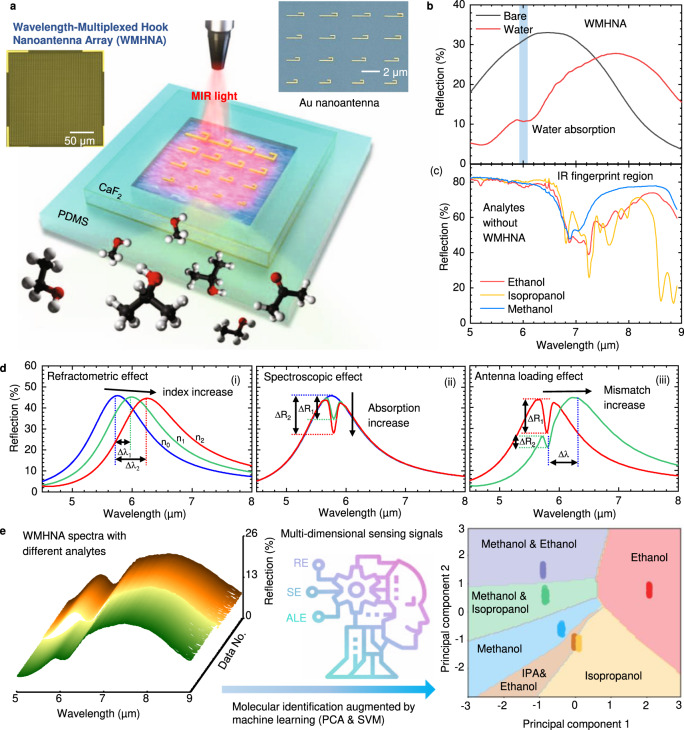
“The broadband resonance peak of WMHNA is well-matched with the fingerprint absorption of alcoholic liquids of methanol, ethanol, and IPA as shown in Fig. 1c.”
§ Wavelength-multiplexed hook nanoantennas for machine learning enabled mid-infrared spectroscopy > Results > Working mechanisms of WMHNA microfluidic sensing platform
boostedstates an association- Asserted: passes — The authors put it forward as true.
- Checkable: passes — It can be checked against evidence.
- Load-bearing: passes — The paper’s conclusions depend on it.
- Based: passes — The paper gives a reason why it holds.
The paper states this without a source or data behind it here, so there is nothing to check it against. The quote shows it is in the paper.
In the paper
“By tailoring the radiative to absorptive loss ratio, the sensitivity of molecular vibration detected by HNAs can be improved dramatically under the optimal condition supported by temporal coupled-mode theory (TCMT).”
§ Wavelength-multiplexed hook nanoantennas for machine learning enabled mid-infrared spectroscopy > Introduction
plainstates a cause- Asserted: passes — The authors put it forward as true.
- Checkable: passes — It can be checked against evidence.
- Load-bearing: passes — The paper’s conclusions depend on it.
- Based: passes — The paper gives a reason why it holds.
A result the paper reports from its own data — it cites no other source for it, so there is none to check. The quote shows it is in the paper.
In the paper
“As shown in Fig. 1d-i, the refractometric effect, caused by the refractive index of analytes, brings a redshift of resonance wavelength as n increases.”
§ Wavelength-multiplexed hook nanoantennas for machine learning enabled mid-infrared spectroscopy > Results > Working mechanisms of WMHNA microfluidic sensing platform
plainstates a cause- Asserted: passes — The authors put it forward as true.
- Checkable: passes — It can be checked against evidence.
- Load-bearing: passes — The paper’s conclusions depend on it.
- Based: passes — The paper gives a reason why it holds.
A result the paper reports from its own data — it cites no other source for it, so there is none to check. The quote shows it is in the paper.
In the paper
“The far-field reflection spectrum is shown in Fig. 1b, covering a broad bandwidth from 6 to 9 μm in the IR fingerprint region.”
§ Wavelength-multiplexed hook nanoantennas for machine learning enabled mid-infrared spectroscopy > Results > Working mechanisms of WMHNA microfluidic sensing platform
plain- Asserted: passes — The authors put it forward as true.
- Checkable: passes — It can be checked against evidence.
- Load-bearing: passes — The paper’s conclusions depend on it.
- Based: passes — The paper gives a reason why it holds.
The paper states this without a source or data behind it here, so there is nothing to check it against. The quote shows it is in the paper.
In the paper
“Leveraging the gradient change of HNA dimensions, the WMHNA performs ultra-broadband working wavelengths ranging from 6 μm to 9 μm, matching with the MIR fingerprint region.”
§ Wavelength-multiplexed hook nanoantennas for machine learning enabled mid-infrared spectroscopy > Introduction
plainstates a cause- Asserted: passes — The authors put it forward as true.
- Checkable: passes — It can be checked against evidence.
- Load-bearing: passes — The paper’s conclusions depend on it.
- Based: passes — The paper gives a reason why it holds.
A result the paper reports from its own data — it cites no other source for it, so there is none to check. The quote shows it is in the paper.
In the paper
“The antenna loading effect is caused by the wavelength mismatch between antenna resonance and molecular vibration, as shown in Fig. 1d-iii.”
§ Wavelength-multiplexed hook nanoantennas for machine learning enabled mid-infrared spectroscopy > Results > Working mechanisms of WMHNA microfluidic sensing platform
plainstates a cause- Asserted: passes — The authors put it forward as true.
- Checkable: passes — It can be checked against evidence.
- Load-bearing: passes — The paper’s conclusions depend on it.
- Based: passes — The paper gives a reason why it holds.
A result the paper reports from its own data — it cites no other source for it, so there is none to check. The quote shows it is in the paper.
In the paper
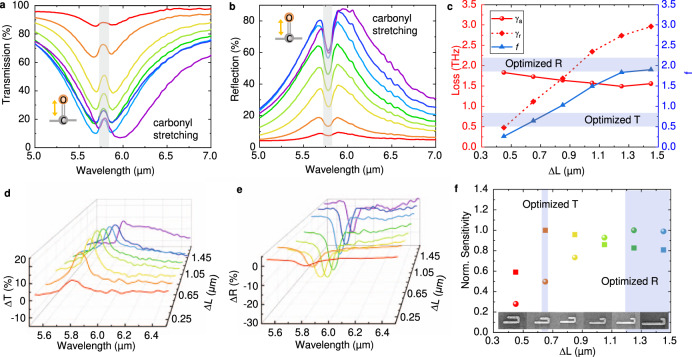
“A substantial intensity change caused by the carbonyl stretching is observed at ~5.8 μm in transmission (Fig. 3a) and reflection (Fig. 3b) mode.”
§ Wavelength-multiplexed hook nanoantennas for machine learning enabled mid-infrared spectroscopy > Results > Sensing characterization of hook nanoantennas
plainstates a cause- Asserted: passes — The authors put it forward as true.
- Checkable: passes — It can be checked against evidence.
- Load-bearing: passes — The paper’s conclusions depend on it.
- Based: passes — The paper gives a reason why it holds.
The paper states this without a source or data behind it here, so there is nothing to check it against. The quote shows it is in the paper.
In the paper
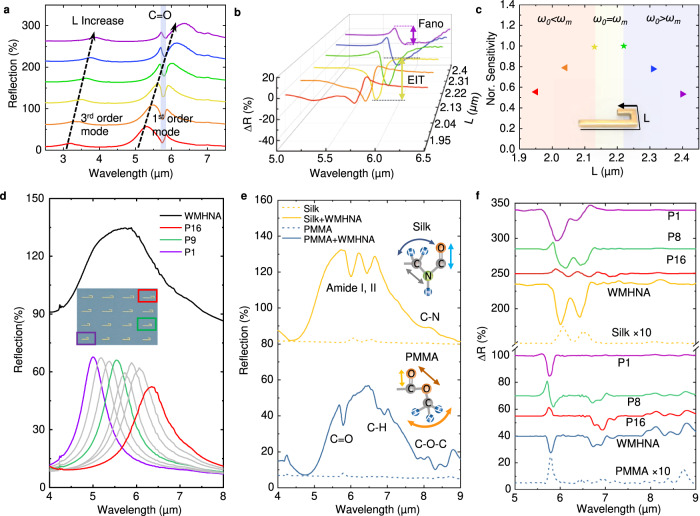
“From Eqs. 1, 2, the enhanced vibration signal can be observed as a Fano-like line shape, a noticeable dip in HNA resonance when two resonance modes are well-matched (ω0 = ωm).”
§ Wavelength-multiplexed hook nanoantennas for machine learning enabled mid-infrared spectroscopy > Results > Design principles of hook nanoantenna
plainstates a cause- Asserted: passes — The authors put it forward as true.
- Checkable: passes — It can be checked against evidence.
- Load-bearing: passes — The paper’s conclusions depend on it.
- Based: passes — The paper gives a reason why it holds.
The paper states this without a source or data behind it here, so there is nothing to check it against. The quote shows it is in the paper.
In the paper
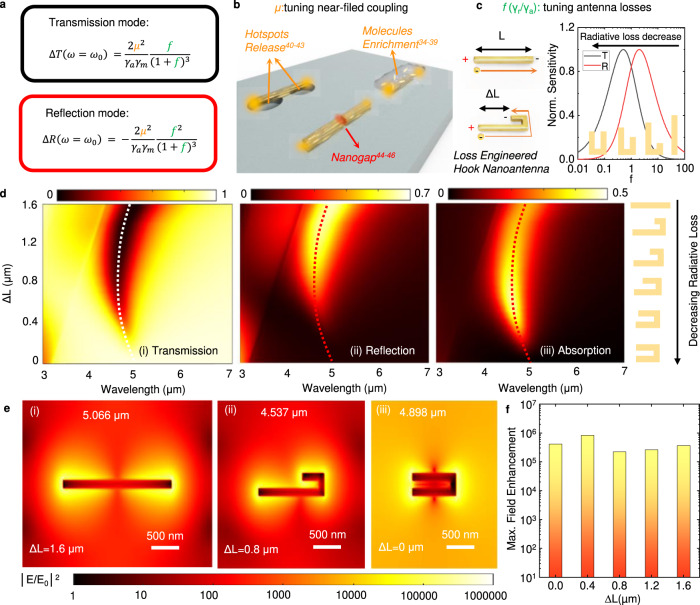
“With the design of hook nanoantenna, the radiative loss can be continuously tuned by controlling the folding degree of HNA, which is denoted as ΔL.”
§ Wavelength-multiplexed hook nanoantennas for machine learning enabled mid-infrared spectroscopy > Results > Design principles of hook nanoantenna
plainstates a cause- Asserted: passes — The authors put it forward as true.
- Checkable: passes — It can be checked against evidence.
- Load-bearing: passes — The paper’s conclusions depend on it.
- Based: passes — The paper gives a reason why it holds.
- Probably not a substantial claim. 10
- The quote only partly states this claim. 2
- It may state two separate claims as one. 29
The cited sources support only part of this claim — read each source’s verdict below.
In the paper
“Previous works show many solutions using multiple resonances of nanoantenna structures to capture the plasmonic enhanced molecular fingerprints in separate wavelength ranges for sensing different molecule species22,39,41,50,54–56.”
§ Wavelength-multiplexed hook nanoantennas for machine learning enabled mid-infrared spectroscopy > Discussion
What the sources say
- Supportedcites [22] Zhou, H. et al. Metal–Organic Framework‐Surface‐Enhanced Infrared Absorption Platform Enables Simultaneous On‐Chip Sensing of Greenhouse Gases. Adv. Sci. 7, 2001173 (2020). source
The Results and Discussions section describes cross-shaped nanoantennas with resonances at 4.25 and 7.66 µm, tailored to the vibrational fingerprints of CO2 and CH4, respectively. The paper is an example of the multiresonant sensing approach for which the citing sentence offers several references. (LLM, conf=0.91)
- Supportedcites [39] Rodrigo, D. et al. Resolving molecule-specific information in dynamic lipid membrane processes with multi-resonant infrared metasurfaces. Nat. Commun. 9, (2018). source
The Results section (“Multi-resonant metasurface for molecule-specific detection”) describes prior multi-resonant approaches and explains that separately tuned nanoantenna resonances enhance vibrational fingerprints of different analytes. It also reports this paper’s two resonances matched to protein and lipid absorption bands, making the paper an example of the approach cited. (LLM, conf=0.91)
- Not checked yetcites [41] Rodrigo, D., Tittl, A., John-Herpin, A., Limaj, O. & Altug, H. Self-Similar Multiresonant Nanoantenna Arrays for Sensing from Near- to Mid-Infrared. ACS Photonics 5, 4903–4911 (2018). source
- Supportedcites [50] John‐Herpin, A., Kavungal, D., Mücke, L. & Altug, H. Infrared Metasurface Augmented by Deep Learning for Monitoring Dynamics between All Major Classes of Biomolecules. Adv. Mater. 33, 2006054 (2021). source
The passage labeled Abstract says multiresonant metasurfaces provide several resonances targeting spectrally distant absorption bands, and identifies a previous dual-resonant nanoantenna approach. It also explains that different biomolecular classes absorb in different wavelength ranges, supporting the cited statement’s broad description of earlier solutions. (LLM, conf=0.90)
- Partly supportedcites [54] Hasan, D. et al. Thermoplasmonic Study of a Triple Band Optical Nanoantenna Strongly Coupled to Mid IR Molecular Mode. Sci. Rep. 6, 22227 (2016). sourceExperimental — accuracy not yet measured
The Design section (page not provided) describes a nanoantenna with multiple resonances across mid-IR wavelengths, and the Results and Analysis section describes coupling to a PMMA molecular vibration. The paper does not show those resonances capturing fingerprints of different molecular species in separate wavelength ranges; its sensing discussion concerns potential monitoring of surface-chemistry changes. (LLM, conf=0.86)
- Not checked yetcites [55] Aslan, E. et al. Multispectral Cesaro-Type Fractal Plasmonic Nanoantennas. ACS Photonics 3, 2102–2111 (2016). source
- Not checked yetcites [56] Ren, Z., Dang, Z. & Lee, C. Multi-Band Mid-IR Molecules Identification Using Plasmonic Metamaterials Induced by Bright-Dark Coupling. in 2020 IEEE 33rd International Conference on Micro Electro Mechanical Systems (MEMS) vols 2020-Janua 725–728 (IEEE, 2020). source
plainstates a cause- Asserted: passes — The authors put it forward as true.
- Checkable: passes — It can be checked against evidence.
- Load-bearing: passes — The paper’s conclusions depend on it.
- Based: passes — The paper gives a reason why it holds.
Probably not a substantial claim.
- Supported
A result the paper reports from its own data — it cites no other source for it, so there is none to check. The quote shows it is in the paper.
In the paper
“With the aid of principal component analysis (PCA) together with supporting vector machine (SVM), the proof-of-concept demonstration of molecular recognition from mixed alcohols (methanol, ethanol, and isopropanol) shows 100% identification accuracy.”
- Also stated in: § Abstract · boosted
“The proof-of-concept demonstration of molecular recognition from mixed alcohols (methanol, ethanol, and isopropanol) shows 100% identification accuracy from the microfluidic integrated WMHNAs.”
§ Wavelength-multiplexed hook nanoantennas for machine learning enabled mid-infrared spectroscopy > Introduction
boostedstates a cause- Asserted: passes — The authors put it forward as true.
- Checkable: passes — It can be checked against evidence.
- Load-bearing: passes — The paper’s conclusions depend on it.
- Based: passes — The paper gives a reason why it holds.
The quote only partly states this claim.
- Also stated in: § Abstract · boosted
The paper states this without a source or data behind it here, so there is nothing to check it against. The quote shows it is in the paper.
In the paper
“In addition to the bandwidth, the hook nanoantenna also performs an enhanced sensitivity thanks to reducing radiative loss by folded structures.”
§ Wavelength-multiplexed hook nanoantennas for machine learning enabled mid-infrared spectroscopy > Results > Working mechanisms of WMHNA microfluidic sensing platform
plainstates a cause- Asserted: passes — The authors put it forward as true.
- Checkable: passes — It can be checked against evidence.
- Load-bearing: passes — The paper’s conclusions depend on it.
- Based: fails — The paper may give no reason why it holds.
Probably not a substantial claim. The paper may give no reason why it holds.
The paper states this without a source or data behind it here, so there is nothing to check it against. The quote shows it is in the paper.
In the paper
“For two molecules with the same absorption strength, small intensity drops can be read out when the wavelength mismatch increase, indicating a larger refractive index.”
§ Wavelength-multiplexed hook nanoantennas for machine learning enabled mid-infrared spectroscopy > Results > Working mechanisms of WMHNA microfluidic sensing platform
hedgedstates a cause- Asserted: passes — The authors put it forward as true.
- Checkable: passes — It can be checked against evidence.
- Load-bearing: passes — The paper’s conclusions depend on it.
- Based: passes — The paper gives a reason why it holds.
It may state two separate claims as one.
A result the paper reports from its own data — it cites no other source for it, so there is none to check. The quote shows it is in the paper.
In the paper
“From this figure, we observe that the highest sensitivity of transmission mode (ΔT) comes when ∆L equals 0.65 μm, while 1.25 μm for reflection mode (ΔR).”
§ Wavelength-multiplexed hook nanoantennas for machine learning enabled mid-infrared spectroscopy > Results > Sensing characterization of hook nanoantennas
plainstates an association- Asserted: passes — The authors put it forward as true.
- Checkable: passes — It can be checked against evidence.
- Load-bearing: passes — The paper’s conclusions depend on it.
- Based: passes — The paper gives a reason why it holds.
It may state two separate claims as one.
A result the paper reports from its own data — it cites no other source for it, so there is none to check. The quote shows it is in the paper.
In the paper
“As ∆L decreases, μ remains almost unchanged because of the similar intensity of near field (Fig. 2f), but f decreases due to the reduced γr caused by the short electrical length of the antenna and the similar γa caused by the same antenna length.”
§ Wavelength-multiplexed hook nanoantennas for machine learning enabled mid-infrared spectroscopy > Results > Sensing characterization of hook nanoantennas
plainstates a cause- Asserted: passes — The authors put it forward as true.
- Checkable: passes — It can be checked against evidence.
- Load-bearing: passes — The paper’s conclusions depend on it.
- Based: passes — The paper gives a reason why it holds.
It may state two separate claims as one.
The paper states this without a source or data behind it here, so there is nothing to check it against. The quote shows it is in the paper.
In the paper
“The γa is related to the ohmic loss of plasmonic material (e.g., Au in this work) and is almost the same among different antenna structures.”
§ Wavelength-multiplexed hook nanoantennas for machine learning enabled mid-infrared spectroscopy > Results > Design principles of hook nanoantenna
plainstates an association- Asserted: passes — The authors put it forward as true.
- Checkable: passes — It can be checked against evidence.
- Load-bearing: passes — The paper’s conclusions depend on it.
- Based: passes — The paper gives a reason why it holds.
It may state two separate claims as one.
A result the paper reports from its own data — it cites no other source for it, so there is none to check. The quote shows it is in the paper.
In the paper
“However, the absorption signal reaches a peak value when ∆L equals 0.6 μm, which means the critical coupled point (γa = γr) of the HNA resonator.”
§ Wavelength-multiplexed hook nanoantennas for machine learning enabled mid-infrared spectroscopy > Results > Design principles of hook nanoantenna
plainstates a cause- Asserted: passes — The authors put it forward as true.
- Checkable: passes — It can be checked against evidence.
- Load-bearing: unclear — It is unclear whether the paper’s conclusions depend on it.
- Based: passes — The paper gives a reason why it holds.
It may state two separate claims as one.
A result the paper reports from its own data — it cites no other source for it, so there is none to check. The quote shows it is in the paper.
In the paper
“With the decrease of ∆L, both T (Fig. 2d-i) and R (Fig. 2d-ii) intensities drop, which means the antenna becomes less radiative (darker).”
§ Wavelength-multiplexed hook nanoantennas for machine learning enabled mid-infrared spectroscopy > Results > Design principles of hook nanoantenna
plainstates a cause- Asserted: passes — The authors put it forward as true.
- Checkable: passes — It can be checked against evidence.
- Load-bearing: passes — The paper’s conclusions depend on it.
- Based: passes — The paper gives a reason why it holds.
It may state two separate claims as one.
A result the paper reports from its own data — it cites no other source for it, so there is none to check. The quote shows it is in the paper.
In the paper
“As shown in Fig. 3c, the radiative loss decreases as ∆L decreases, but the absorptive loss is almost unchanged, resulting in a small f with short ∆L.”
§ Wavelength-multiplexed hook nanoantennas for machine learning enabled mid-infrared spectroscopy > Results > Sensing characterization of hook nanoantennas
plainstates a cause- Asserted: passes — The authors put it forward as true.
- Checkable: passes — It can be checked against evidence.
- Load-bearing: passes — The paper’s conclusions depend on it.
- Based: passes — The paper gives a reason why it holds.
It may state two separate claims as one.
A result the paper reports from its own data — it cites no other source for it, so there is none to check. The quote shows it is in the paper.
In the paper
“The maximum sensitivity occurs when f reaches 0.5 and 2 for transmission and reflection modes, respectively.”
§ Wavelength-multiplexed hook nanoantennas for machine learning enabled mid-infrared spectroscopy > Results > Design principles of hook nanoantenna
plainstates an association- Asserted: passes — The authors put it forward as true.
- Checkable: passes — It can be checked against evidence.
- Load-bearing: passes — The paper’s conclusions depend on it.
- Based: passes — The paper gives a reason why it holds.
It may state two separate claims as one.
A result the paper reports from its own data — it cites no other source for it, so there is none to check. The quote shows it is in the paper.
In the paper
“The results show that the enhancement of the electric field intensity of all HNA devices is at the order of 105, and the maximum enhancement of the electric field intensity reaches 832891 times.”
§ Wavelength-multiplexed hook nanoantennas for machine learning enabled mid-infrared spectroscopy > Results > Design principles of hook nanoantenna
plain- Asserted: passes — The authors put it forward as true.
- Checkable: passes — It can be checked against evidence.
- Load-bearing: passes — The paper’s conclusions depend on it.
- Based: passes — The paper gives a reason why it holds.
It may state two separate claims as one.
A result the paper reports from its own data — it cites no other source for it, so there is none to check. The quote shows it is in the paper.
In the paper
“Both WMHNA and HNA perform the significant enhancement (3 orders of magnitude) of absorption spectrum with the direct measurement of thin-film without nanoantenna.”
§ Wavelength-multiplexed hook nanoantennas for machine learning enabled mid-infrared spectroscopy > Results > Wavelength multiplexed hook nanoantenna array
plainstates a cause- Asserted: passes — The authors put it forward as true.
- Checkable: passes — It can be checked against evidence.
- Load-bearing: passes — The paper’s conclusions depend on it.
- Based: passes — The paper gives a reason why it holds.
It may state two separate claims as one.
The paper states this without a source or data behind it here, so there is nothing to check it against. The quote shows it is in the paper.
In the paper
“The apparent dips of the reflection spectrum at 6.0 μm are induced by water scissoring absorption.”
§ Wavelength-multiplexed hook nanoantennas for machine learning enabled mid-infrared spectroscopy > Results > Molecular identification by machine learning
plainstates a cause- Asserted: passes — The authors put it forward as true.
- Checkable: passes — It can be checked against evidence.
- Load-bearing: fails — The paper’s conclusions may not depend on it.
- Based: passes — The paper gives a reason why it holds.
Probably not a substantial claim. The paper’s conclusions may not depend on it.
A result the paper reports from its own data — it cites no other source for it, so there is none to check. The quote shows it is in the paper.
In the paper
“The redshift of the HNA supercell spectrum is caused by the effect induced by the refractive index of analytes indicating the RE of WMHNA.”
§ Wavelength-multiplexed hook nanoantennas for machine learning enabled mid-infrared spectroscopy > Results > Wavelength multiplexed hook nanoantenna array
plainstates a cause- Asserted: passes — The authors put it forward as true.
- Checkable: passes — It can be checked against evidence.
- Load-bearing: passes — The paper’s conclusions depend on it.
- Based: passes — The paper gives a reason why it holds.
It may state two separate claims as one.
A result the paper reports from its own data — it cites no other source for it, so there is none to check. The quote shows it is in the paper.
In the paper
“We further compared the sensing performance with selected HNA elements (P1, P8, and P16) from WMHNA, showing that WMHNA better enhances multiple absorption peaks from broad wavelength ranges, while HNA only reaches the best enhancement at narrow wavelength ranges near resonance wavelengths.”
§ Wavelength-multiplexed hook nanoantennas for machine learning enabled mid-infrared spectroscopy > Results > Wavelength multiplexed hook nanoantenna array
plainstates a cause- Asserted: passes — The authors put it forward as true.
- Checkable: passes — It can be checked against evidence.
- Load-bearing: passes — The paper’s conclusions depend on it.
- Based: passes — The paper gives a reason why it holds.
It may state two separate claims as one.
The paper states this without a source or data behind it here, so there is nothing to check it against. The quote shows it is in the paper.
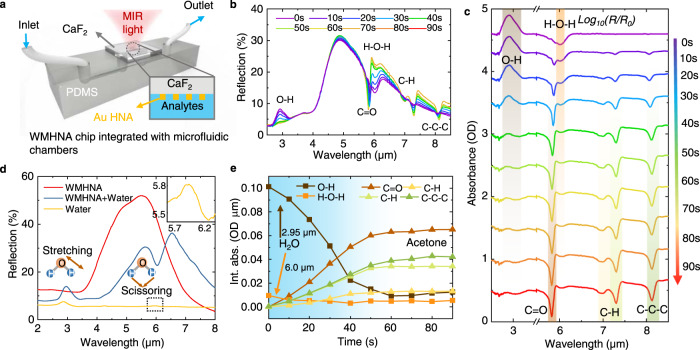
In the paper
“Furthermore, the absorption of water in IR has a minimal influence on the nanoantenna spectrum apart from the molecular vibration regime, allowing the liquid recognition with water-based solvent, which is so absorptive in traditional IR spectroscopy that the intensity of light becomes very weak to identify molecules.”
§ Wavelength-multiplexed hook nanoantennas for machine learning enabled mid-infrared spectroscopy > Results > Liquid dynamics monitoring with broadband fingerprint absorption
plain- Asserted: passes — The authors put it forward as true.
- Checkable: passes — It can be checked against evidence.
- Load-bearing: passes — The paper’s conclusions depend on it.
- Based: passes — The paper gives a reason why it holds.
It may state two separate claims as one.
A result the paper reports from its own data — it cites no other source for it, so there is none to check. The quote shows it is in the paper.
In the paper
“Each curve indicates the real-time spectrum of a mixed solvent of acetone and water, reflecting in-situ concentration information of acetone and water and dynamic change versus time.”
§ Wavelength-multiplexed hook nanoantennas for machine learning enabled mid-infrared spectroscopy > Results > Liquid dynamics monitoring with broadband fingerprint absorption
plainstates an association- Asserted: passes — The authors put it forward as true.
- Checkable: passes — It can be checked against evidence.
- Load-bearing: passes — The paper’s conclusions depend on it.
- Based: passes — The paper gives a reason why it holds.
It may state two separate claims as one.
A result the paper reports from its own data — it cites no other source for it, so there is none to check. The quote shows it is in the paper.
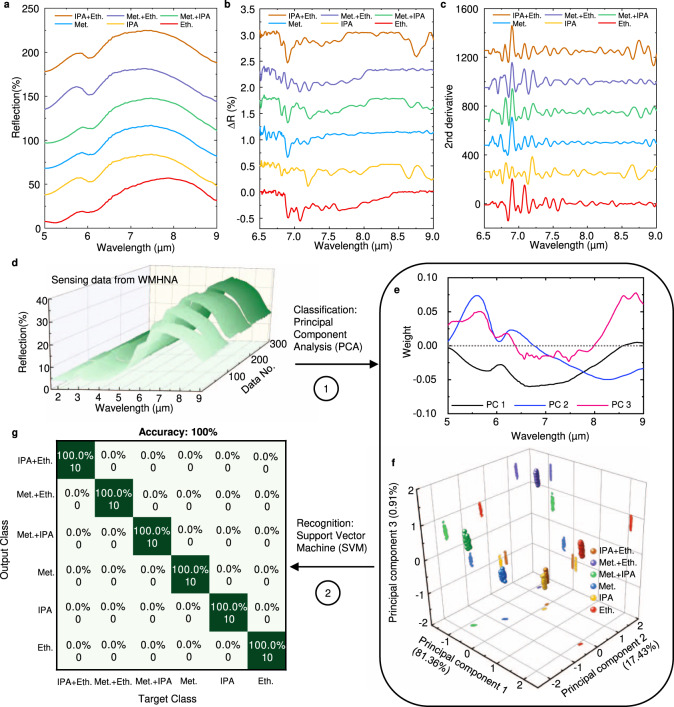
In the paper
“The fingerprint absorption of small molecule alcohols is captured from 6.5 μm to 9 μm and is extracted from the WMHNA spectrum in Fig. 6b.”
§ Wavelength-multiplexed hook nanoantennas for machine learning enabled mid-infrared spectroscopy > Results > Molecular identification by machine learning
plain- Asserted: passes — The authors put it forward as true.
- Checkable: passes — It can be checked against evidence.
- Load-bearing: passes — The paper’s conclusions depend on it.
- Based: passes — The paper gives a reason why it holds.
It may state two separate claims as one.
A result the paper reports from its own data — it cites no other source for it, so there is none to check. The quote shows it is in the paper.
In the paper
“However, WMHNA performs less influence from ALE in the broadband wavelength range, showing good performance for sensing broadband fingerprint absorption.”
§ Wavelength-multiplexed hook nanoantennas for machine learning enabled mid-infrared spectroscopy > Results > Wavelength multiplexed hook nanoantenna array
plain- Asserted: passes — The authors put it forward as true.
- Checkable: passes — It can be checked against evidence.
- Load-bearing: passes — The paper’s conclusions depend on it.
- Based: passes — The paper gives a reason why it holds.
It may state two separate claims as one.
A result the paper reports from its own data — it cites no other source for it, so there is none to check. The quote shows it is in the paper.
In the paper
“In the resonant regime, an improvement of 34.36 times of reflection change is observed for the scissoring mode.”
§ Wavelength-multiplexed hook nanoantennas for machine learning enabled mid-infrared spectroscopy > Results > Liquid dynamics monitoring with broadband fingerprint absorption
plainstates a cause- Asserted: passes — The authors put it forward as true.
- Checkable: passes — It can be checked against evidence.
- Load-bearing: passes — The paper’s conclusions depend on it.
- Based: passes — The paper gives a reason why it holds.
The quote only partly states this claim.
A result the paper reports from its own data — it cites no other source for it, so there is none to check. The quote shows it is in the paper.
In the paper
“It can be seen that the classifier trained with two PCs works well, with the different gases correctly identified and the clusters being well contained in the appropriate regions.”
§ Wavelength-multiplexed hook nanoantennas for machine learning enabled mid-infrared spectroscopy > Results > Molecular identification by machine learning
plain- Asserted: passes — The authors put it forward as true.
- Checkable: passes — It can be checked against evidence.
- Load-bearing: passes — The paper’s conclusions depend on it.
- Based: passes — The paper gives a reason why it holds.
It may state two separate claims as one.
A result the paper reports from its own data — it cites no other source for it, so there is none to check. The quote shows it is in the paper.
In the paper
“In the 3D PC space shown in Fig. 6f, each point represents the spectrum data from WMHNA, and each cluster represents one type of molecule combination.”
§ Wavelength-multiplexed hook nanoantennas for machine learning enabled mid-infrared spectroscopy > Results > Molecular identification by machine learning
plain- Asserted: passes — The authors put it forward as true.
- Checkable: passes — It can be checked against evidence.
- Load-bearing: passes — The paper’s conclusions depend on it.
- Based: passes — The paper gives a reason why it holds.
It may state two separate claims as one.
In the paper
“Compared with previous literature that demonstrates the identification of two molecules mixture by monitoring two absorption peaks49, our work demonstrated simultaneously monitoring of 15 absorption peaks and used to identify three molecules mixture.”
§ Wavelength-multiplexed hook nanoantennas for machine learning enabled mid-infrared spectroscopy > Results > Molecular identification by machine learning
What the sources say
- Not checked yetcites [49] Kühner, L. et al. Vibrational Sensing Using Infrared Nanoantennas: Toward the Noninvasive Quantitation of Physiological Levels of Glucose and Fructose. ACS Sens. 4, 1973–1979 (2019). source
boostedstates a cause- Asserted: passes — The authors put it forward as true.
- Checkable: passes — It can be checked against evidence.
- Load-bearing: passes — The paper’s conclusions depend on it.
- Based: passes — The paper gives a reason why it holds.
It may state two separate claims as one.
The paper states this without a source or data behind it here, so there is nothing to check it against. The quote shows it is in the paper.
In the paper
“On one hand, with the reverse current induced in HNA, the sensitivity of HNA is improved by engineering the radiative loss to achieve the optimized loss ratio.”
§ Wavelength-multiplexed hook nanoantennas for machine learning enabled mid-infrared spectroscopy > Discussion
plainstates a cause- Asserted: passes — The authors put it forward as true.
- Checkable: passes — It can be checked against evidence.
- Load-bearing: fails — The paper’s conclusions may not depend on it.
- Based: fails — The paper may give no reason why it holds.
Probably not a substantial claim. The paper’s conclusions may not depend on it. The paper may give no reason why it holds.
A result the paper reports from its own data — it cites no other source for it, so there is none to check. The quote shows it is in the paper.
In the paper
“Additionally, with the aid of a machine learning algorithm (PCA and SVM), the multi-dimensional information can be classified effectively, resulting in 100% accuracy from random 4:1 data spiting for training and recognition sets.”
§ Wavelength-multiplexed hook nanoantennas for machine learning enabled mid-infrared spectroscopy > Discussion
plainstates a cause- Asserted: passes — The authors put it forward as true.
- Checkable: passes — It can be checked against evidence.
- Load-bearing: passes — The paper’s conclusions depend on it.
- Based: passes — The paper gives a reason why it holds.
It may state two separate claims as one.
The paper states this without a source or data behind it here, so there is nothing to check it against. The quote shows it is in the paper.
In the paper
“However, the sensitivity and bandwidth of PNAs are limited by the small overlap between molecules and sensing hotspots and the sharp plasmonic resonance peaks.”
§ Wavelength-multiplexed hook nanoantennas for machine learning enabled mid-infrared spectroscopy > Abstract
plainstates a cause- Asserted: passes — The authors put it forward as true.
- Checkable: passes — It can be checked against evidence.
- Load-bearing: passes — The paper’s conclusions depend on it.
- Based: fails — The paper may give no reason why it holds.
Probably not a substantial claim. The paper may give no reason why it holds. It may state two separate claims as one.
None of the sources cited for this claim have been checked yet.
In the paper
“The other method to improve the sensitivity is to increase the intensity of the electric field by squeezing the gap between adjacent PNA into the nanometer scale29–31. However, the narrow gap ruins the sensing performance by a decrement in the active area and increases fabrication cost.”
§ Wavelength-multiplexed hook nanoantennas for machine learning enabled mid-infrared spectroscopy > Introduction
What the sources say
- Not checked yetcites [29] Huck, C. et al. Surface-Enhanced Infrared Spectroscopy Using Nanometer-Sized Gaps. ACS Nano 8, 4908–4914 (2014). source
- Not checked yetcites [30] Dong, L. et al. Nanogapped Au Antennas for Ultrasensitive Surface-Enhanced Infrared Absorption Spectroscopy. Nano Lett. 17, 5768–5774 (2017). source
- Not checked yetcites [31] Su, D.-S., Tsai, D. P., Yen, T.-J. & Tanaka, T. Ultrasensitive and Selective Gas Sensor Based on a Channel Plasmonic Structure with an Enormous Hot Spot Region. ACS Sens. 4, 2900–2907 (2019). source
plainstates a cause- Asserted: passes — The authors put it forward as true.
- Checkable: passes — It can be checked against evidence.
- Load-bearing: passes — The paper’s conclusions depend on it.
- Based: passes — The paper gives a reason why it holds.
It may state two separate claims as one.
None of the sources cited for this claim have been checked yet.
In the paper
“This amplification effect caused by the strong plasmon-molecule coupling between plasmonic resonance and molecular vibration was well-explained by temporal coupled-mode theory (TCMT)14,15.”
§ Wavelength-multiplexed hook nanoantennas for machine learning enabled mid-infrared spectroscopy > Introduction
What the sources say
- Not checked yetcites [14] Adato, R. & Altug, H. In-situ ultra-sensitive infrared absorption spectroscopy of biomolecule interactions in real time with plasmonic nanoantennas. Nat. Commun. 4, 2154 (2013). source
- Not checked yetcites [15] Adato, R., Artar, A., Erramilli, S. & Altug, H. Engineered Absorption Enhancement and Induced Transparency in Coupled Molecular and Plasmonic Resonator Systems. Nano Lett. 13, 2584–2591 (2013). source
boostedstates a cause- Asserted: passes — The authors put it forward as true.
- Checkable: passes — It can be checked against evidence.
- Load-bearing: fails — The paper’s conclusions may not depend on it.
- Based: passes — The paper gives a reason why it holds.
Probably not a substantial claim. The paper’s conclusions may not depend on it.
None of the sources cited for this claim have been checked yet.
In the paper
“With the aid of machine learning (ML), decoupling the IR fingerprint absorption and refractive index change induced by molecules has been reported to monitor protein dynamics of secondary structure α-helix and β-sheet48 and recognition of physiological bio-marker of glucose and fructose49.”
§ Wavelength-multiplexed hook nanoantennas for machine learning enabled mid-infrared spectroscopy > Introduction
What the sources say
- Not checked yetcites [48] Semenyshyn, R. et al. In Vitro Monitoring Conformational Changes of Polypeptide Monolayers Using Infrared Plasmonic Nanoantennas. Nano Lett. 19, 1–7 (2019). source
- Not checked yetcites [49] Kühner, L. et al. Vibrational Sensing Using Infrared Nanoantennas: Toward the Noninvasive Quantitation of Physiological Levels of Glucose and Fructose. ACS Sens. 4, 1973–1979 (2019). source
plainstates a cause- Asserted: passes — The authors put it forward as true.
- Checkable: passes — It can be checked against evidence.
- Load-bearing: passes — The paper’s conclusions depend on it.
- Based: passes — The paper gives a reason why it holds.
It may state two separate claims as one.
None of the sources cited for this claim have been checked yet.
In the paper
“Thanks to the excellent field confinement at resonance wavelength, plasmonic nanoantennas (PNAs) also serve as an ultra-sensitive refractometry sensor to capture the refractive index of analytes by wavelength shifts (e.g., color change in visible light), which carries the information of physical properties of molecules44,45.”
§ Wavelength-multiplexed hook nanoantennas for machine learning enabled mid-infrared spectroscopy > Introduction
What the sources say
- Not checked yetcites [44] Gao, B. et al. Nanoscale Refractive Index Sensors with High Figures of Merit via Optical Slot Antennas. ACS Nano 13, 9131–9138 (2019). source
- Not checked yetcites [45] Zhan, C., Liu, B.-W., Tian, Z.-Q. & Ren, B. Determining the Interfacial Refractive Index via Ultrasensitive Plasmonic Sensors. J. Am. Chem. Soc. 142, 10905–10909 (2020). source
plainstates a cause- Asserted: passes — The authors put it forward as true.
- Checkable: passes — It can be checked against evidence.
- Load-bearing: passes — The paper’s conclusions depend on it.
- Based: passes — The paper gives a reason why it holds.
Probably not a substantial claim.
The paper states this without a source or data behind it here, so there is nothing to check it against. The quote shows it is in the paper.
In the paper
“However, since the same classes of molecules always have a strong overlap in fingerprint absorption due to the similar chemical structure, it is challenging to distinguish the same classes of molecules in small concentrations by monitoring single absorption peak of each molecules.”
§ Wavelength-multiplexed hook nanoantennas for machine learning enabled mid-infrared spectroscopy > Introduction
boostedstates a cause- Asserted: passes — The authors put it forward as true.
- Checkable: passes — It can be checked against evidence.
- Load-bearing: passes — The paper’s conclusions depend on it.
- Based: passes — The paper gives a reason why it holds.
It may state two separate claims as one.
A conclusion the paper draws from its own results — it cites no other source for it, so there is none to check. The quote shows it is in the paper.
In the paper
“The coupling efficiency is related to the nearfield intensity and the overlapping of molecules to the antenna nearfield.”
§ Wavelength-multiplexed hook nanoantennas for machine learning enabled mid-infrared spectroscopy > Results > Design principles of hook nanoantenna
plainstates an association- Asserted: passes — The authors put it forward as true.
- Checkable: passes — It can be checked against evidence.
- Load-bearing: passes — The paper’s conclusions depend on it.
- Based: passes — The paper gives a reason why it holds.
It may state two separate claims as one.
The paper states this without a source or data behind it here, so there is nothing to check it against. The quote shows it is in the paper.
In the paper
“However, all of these three methods introduce extra processes or materials to make the plasmonic sensors, which increase the fabrication cost or limit the working condition.”
§ Wavelength-multiplexed hook nanoantennas for machine learning enabled mid-infrared spectroscopy > Results > Design principles of hook nanoantenna
plainstates a cause- Asserted: passes — The authors put it forward as true.
- Checkable: passes — It can be checked against evidence.
- Load-bearing: passes — The paper’s conclusions depend on it.
- Based: passes — The paper gives a reason why it holds.
It may state two separate claims as one.
None of the sources cited for this claim have been checked yet.
In the paper
“Figure 2b summarizes three approaches to optimize nanoantenna sensing by increasing μ. Hotspots release is proposed to increase accessible sensing areas for analytes, which are usually blocked by the substrate, to further enhance the coupling efficiency25–28.”
- Also stated in: § Design principles of hook nanoantenna · plain
“Therefore, the molecule enrichment method is utilized to accumulate localized molecules in the effective sensing area17–24. Another approach to enhance the nearfield coupling is to increase the electric field intensity by squeezing the adjacent nanoantenna into the nanogap29–31.”
§ Wavelength-multiplexed hook nanoantennas for machine learning enabled mid-infrared spectroscopy > Results > Design principles of hook nanoantenna
What the sources say
- Not checked yetcites [17] Limaj, O. et al. Infrared Plasmonic Biosensor for Real-Time and Label-Free Monitoring of Lipid Membranes. Nano Lett. 16, 1502–1508 (2016). source
- Not checked yetcites [18] Etezadi, D. et al. Nanoplasmonic mid-infrared biosensor for in vitro protein secondary structure detection. Light Sci. Appl. 6, e17029–e17029 (2017). source
- Not checked yetcites [19] Hasan, D. & Lee, C. Hybrid Metamaterial Absorber Platform for Sensing of CO2 Gas at Mid-IR. Adv. Sci. 5, (2018). source
- Not checked yetcites [20] Chang, Y. et al. All-Dielectric Surface-Enhanced Infrared Absorption-Based Gas Sensor Using Guided Resonance. ACS Appl. Mater. Interfaces 10, 38272–38279 (2018). source
- Not checked yetcites [21] Hu, H. et al. Gas identification with graphene plasmons. Nat. Commun. 10, 1131 (2019). source
- Not checked yetcites [22] Zhou, H. et al. Metal–Organic Framework‐Surface‐Enhanced Infrared Absorption Platform Enables Simultaneous On‐Chip Sensing of Greenhouse Gases. Adv. Sci. 7, 2001173 (2020). source
- Not checked yetcites [23] Nuñez, J., Boersma, A., Grand, J., Mintova, S. & Sciacca, B. Thin Functional Zeolite Layer Supported on Infrared Resonant Nano‐Antennas for the Detection of Benzene Traces. Adv. Funct. Mater. 31, 2101623 (2021). source
- Not checked yetcites [24] Yoo, D. et al. Low-Power Optical Trapping of Nanoparticles and Proteins with Resonant Coaxial Nanoaperture Using 10 nm Gap. Nano Lett. 18, 3637–3642 (2018). source
- Not checked yetcites [25] Miao, X., Yan, L., Wu, Y. & Liu, P. Q. High-sensitivity nanophotonic sensors with passive trapping of analyte molecules in hot spots. Light Sci. Appl. 10, 5 (2021). source
- Not checked yetcites [26] Hwang, I. et al. Plasmon-Enhanced Infrared Spectroscopy Based on Metamaterial Absorbers with Dielectric Nanopedestals. ACS Photonics 5, 3492–3498 (2018). source
plainstates a cause- Asserted: passes — The authors put it forward as true.
- Checkable: passes — It can be checked against evidence.
- Load-bearing: unclear — It is unclear whether the paper’s conclusions depend on it.
- Based: passes — The paper gives a reason why it holds.
It may state two separate claims as one.
- Also stated in: § Design principles of hook nanoantenna · plain
A conclusion the paper draws from its own results — it cites no other source for it, so there is none to check. The quote shows it is in the paper.
In the paper
“To demonstrate the capability of liquid dynamics monitoring with broadband fingerprint absorption, we integrate WMHNA into a microfluidic system (Fig. 5a), which is compatible with biomolecular systems for molecular detection in the aqueous environment.”
§ Wavelength-multiplexed hook nanoantennas for machine learning enabled mid-infrared spectroscopy > Results > Liquid dynamics monitoring with broadband fingerprint absorption
plainstates an association- Asserted: passes — The authors put it forward as true.
- Checkable: passes — It can be checked against evidence.
- Load-bearing: passes — The paper’s conclusions depend on it.
- Based: fails — The paper may give no reason why it holds.
Probably not a substantial claim. The paper may give no reason why it holds.
A conclusion the paper draws from its own results — it cites no other source for it, so there is none to check. The quote shows it is in the paper.
In the paper
“Therefore, a slight change of intensity of light is observed according to Beer-Lambert’s law.”
§ Wavelength-multiplexed hook nanoantennas for machine learning enabled mid-infrared spectroscopy > Results > Liquid dynamics monitoring with broadband fingerprint absorption
plainstates a cause- Asserted: passes — The authors put it forward as true.
- Checkable: passes — It can be checked against evidence.
- Load-bearing: passes — The paper’s conclusions depend on it.
- Based: passes — The paper gives a reason why it holds.
Probably not a substantial claim.
The paper states this without a source or data behind it here, so there is nothing to check it against. The quote shows it is in the paper.
In the paper
“Both of the molecules have the same functional group of hydroxy and methyl bond, resulting in similar absorption spectra in 6 μm to 9 μm wavelengths.”
§ Wavelength-multiplexed hook nanoantennas for machine learning enabled mid-infrared spectroscopy > Results > Molecular identification by machine learning
plainstates a cause- Asserted: passes — The authors put it forward as true.
- Checkable: passes — It can be checked against evidence.
- Load-bearing: passes — The paper’s conclusions depend on it.
- Based: passes — The paper gives a reason why it holds.
It may state two separate claims as one.
A conclusion the paper draws from its own results — it cites no other source for it, so there is none to check. The quote shows it is in the paper.
In the paper
“The order of PC represents the degree of difference between each spectrum.”
§ Wavelength-multiplexed hook nanoantennas for machine learning enabled mid-infrared spectroscopy > Results > Molecular identification by machine learning
plainstates an association- Asserted: passes — The authors put it forward as true.
- Checkable: passes — It can be checked against evidence.
- Load-bearing: fails — The paper’s conclusions may not depend on it.
- Based: passes — The paper gives a reason why it holds.
Probably not a substantial claim. The paper’s conclusions may not depend on it.
A conclusion the paper draws from its own results — it cites no other source for it, so there is none to check. The quote shows it is in the paper.
In the paper
“With the help of ML, the IR spectrum of HNA with different molecules can be reduced to three principal components, which indicate the three key features of loading effect, wavelength shifts, and enhanced fingerprint absorption.”
§ Wavelength-multiplexed hook nanoantennas for machine learning enabled mid-infrared spectroscopy > Results > Molecular identification by machine learning
plainstates a cause- Asserted: passes — The authors put it forward as true.
- Checkable: passes — It can be checked against evidence.
- Load-bearing: passes — The paper’s conclusions depend on it.
- Based: passes — The paper gives a reason why it holds.
It may state two separate claims as one.
The authors state this as an assumption.
There is a need for new nanoantenna structures for continuous broadband detection and new methods to distinguish chemically similar molecules from partially overlapped absorption spectra.
“Therefore, new nanoantenna structures need to be developed for continuous broadband detection to capture multiple absorption peaks in fingerprint regions and new methods need to be conducted to distinguish the chemically similar molecules from the partially overlapped absorption spectra.”
The paper relies on this without support.
Molecules of the same class have strong overlap in fingerprint absorption due to similar chemical structure.
“However, since the same classes of molecules always have a strong overlap in fingerprint absorption due to the similar chemical structure, it is challenging to distinguish the same classes of molecules in small concentrations by monitoring single absorption peak of each molecules.”
The paper relies on this without support.
In the IR fingerprint region, plasmonic nanoantenna signals of absorption changes and wavelength shifts always occur together.
“Unfortunately, in the IR fingerprint region, the PNA signal of absorption changes and wavelength shifts always comes together, hindering the usage of complementary information about the analyte’s physical and chemical properties for molecule identification.”
The authors state this as an assumption.
The temporal coupled-mode theory model accurately describes the plasmon-molecule coupling system.
“To understand the design principles, we use the TCMT model52 to analyze the plasmon-molecules coupling system.”
The authors state this as an assumption.
The Lorentz model accurately represents the optical properties of analytes.
“To demonstrate the individual response caused by three effects, we use finite-difference time-domain (FDTD) methods to simulate the antenna response and manipulate the optical properties (refractive index, n and absorption coefficient, k) of analytes by Lorentz model, which has been used in our previous works19,51”
The authors state this as an assumption.
In the TCMT model, the plasmonic resonance is treated as a bright mode coupled to incident light, and molecular vibration is treated as a dark mode whose coupling efficiency is much lower than the plasmonic nanoantenna and can be ignored.
“We treat the plasmonic resonant (denoted as P) as a bright mode that is coupled to the incident light, while we treat the molecular vibration (denoted as M) as a dark mode, in which coupling efficiency is much lower than PNA and can be ignored in their coupling system.”
Claims other papers make about this one
Each is checked against this paper’s own text: does it say what the citing paper says it does?
In the citing paper
“Ren et al. (Ren et al. 2022) designed a hook-shaped nanoantenna array that utilizes wavelength multiplexing for continuous broadband detection of multiple absorption peaks in the fingerprint region (Fig. 8c-i).”
From Artificial intelligence enhanced sensors - enabling technologies to next-generation healthcare and biomedical platform (2023) · cites this paper as Ren et al. 2022
In the citing paper
“However, through the integration of PCA and SVM algorithms, the authors have achieved 100% recognition accuracy for the identification of methanol, ethanol, and isopropanol, as demonstrated in Fig. 8c-iii-vi.”
From Artificial intelligence enhanced sensors - enabling technologies to next-generation healthcare and biomedical platform (2023) · cites this paper as Ren et al. 2022
Self-check
Percentages, sums and reported differences re-computed from the paper’s own numbers.
Each contradiction between two passages listed here was confirmed by an independent check.
Rated minor: it would not touch a result — a value no result rests on, a p-value that stays on the same side of the significance level, or a conflict that is clerical, resolved elsewhere in the paper, or outside its own findings.
In the paper
§ Wavelength-multiplexed hook nanoantennas for machine learning enabled mid-infrared spectroscopy > Results > Wavelength multiplexed hook nanoantenna array
“Figure 4b shows the sensing results of silk and PMMA on HNA supercell with the broadband response from ~5.5 μm to ~8.5 μm.”
§ Wavelength-multiplexed hook nanoantennas for machine learning enabled mid-infrared spectroscopy > Results > Wavelength multiplexed hook nanoantenna array
“b The baseline-corrected reflection spectra from (a). c The normalized sensitivity of hook nanoantenna devices with different L indicates the loading effect. Sensitivity becomes maximum when the two wavelengths of molecular vibration and antenna resonance are matched. d the reflection spectra of WHHNA and hook nanoantenna devices (P1, P8, and P16) to form the supercell. e The sensing characterization of WMHNA by two types of thin films of PMMA and silk.”
Rated minor: it would not touch a result — a value no result rests on, a p-value that stays on the same side of the significance level, or a conflict that is clerical, resolved elsewhere in the paper, or outside its own findings.
In the paper
§ Wavelength-multiplexed hook nanoantennas for machine learning enabled mid-infrared spectroscopy > Results > Design principles of hook nanoantenna
“γa and γr denote the radiative and absorptive losses of HNA, while γm is the absorptive loss of molecules.”
§ Wavelength-multiplexed hook nanoantennas for machine learning enabled mid-infrared spectroscopy > Results > Design principles of hook nanoantenna
“The γa is related to the ohmic loss of plasmonic material (e.g., Au in this work) and is almost the same among different antenna structures. Therefore, the philosophy to use hook shape in nanoantenna design is to engineer γr to tune the radiation from electron oscillation by inducing inverse current from dipole resonance.”
Rated minor: it would not touch a result — a value no result rests on, a p-value that stays on the same side of the significance level, or a conflict that is clerical, resolved elsewhere in the paper, or outside its own findings.
In the paper
§ Wavelength-multiplexed hook nanoantennas for machine learning enabled mid-infrared spectroscopy > Results > Molecular identification by machine learning
“Because SVM is a classification algorithm for two-group classification problems, we transform it into a set of binary classification problems to distinguish 6 different gases.”
§ Wavelength-multiplexed hook nanoantennas for machine learning enabled mid-infrared spectroscopy > Results > Molecular identification by machine learning
“We designed a series of experiments to characterize the recognition capability of WMHNA using 1% methanol, ethanol, and IPA in water and mixture sets of each two in the same volume.”
Rated minor: it would not touch a result — a value no result rests on, a p-value that stays on the same side of the significance level, or a conflict that is clerical, resolved elsewhere in the paper, or outside its own findings.
In the paper
§ Wavelength-multiplexed hook nanoantennas for machine learning enabled mid-infrared spectroscopy > Results > Molecular identification by machine learning
“the first principal component (PC 1) represents the antenna loading effect of water absorption peaks at 6.0 μm. The second principal component (PC 2) represents the wavelength shift of WMHNA due to the refractive index of the analyte.”
§ Wavelength-multiplexed hook nanoantennas for machine learning enabled mid-infrared spectroscopy > Results > Molecular identification by machine learning
“The first PC represents the wavelength shift of HNA resonance by RE and the second PC represents the modulation of water absorption peak by ALE.”
Citations
Cites
Temporal coupled-mode theory for the Fano resonance in optical resonators
Fan, S., Suh, W., & Joannopoulos, J. D. (2003) · Journal of the Optical Society of America A · doi:10.1364/josaa.20.000569 · Cited by 1,700
Mid-infrared plasmonic biosensing with graphene
Rodrigo, D., Limaj, O., Janner, D., Etezadi, D., García de Abajo, F. J., Pruneri, V., & Altug, H. (2015) · Science · doi:10.1126/science.aab2051 · Cited by 1,462
Eilers, P. H. C. (2003) · Analytical Chemistry · doi:10.1021/ac034173t · Cited by 1,412
Imaging-based molecular barcoding with pixelated dielectric metasurfaces
Tittl, A., Leitis, A., Liu, M., Yesilköy, F., Choi, D., Neshev, D. N., Kivshar, Y. S., & Altug, H. (2018) · Science · doi:10.1126/science.aas9768 · Cited by 1,351
Qiu, G., Gai, Z., Tao, Y., Schmitt, J., Kullak-Ublick, G. A., & Wang, J. (2020) · ACS Nano · doi:10.1021/acsnano.0c02439 · Cited by 1,059
Mid-Infrared Plasmonic Biosensing with Graphene
Rodrigo, D., Limaj, O., Janner, D., Etezadi, D., García de Abajo, F. J., Pruneri, V., & Altug, H. (2015) · LA Referencia (Red Federada de Repositorios Institucionales de Publicaciones Científicas) · Cited by 898
Resonant Plasmonic and Vibrational Coupling in a Tailored Nanoantenna for Infrared Detection
Neubrech, F., Pucci, A., Cornelius, T. W., Karim, S., García-Etxarri, A., & Aizpurua, J. (2008) · Physical Review Letters · doi:10.1103/physrevlett.101.157403 · Cited by 743
Ultra-sensitive vibrational spectroscopy of protein monolayers with plasmonic nanoantenna arrays
Adato, R., Yanik, A. A., Amsden, J. J., Kaplan, D. L., Omenetto, F. G., Hong, M. K., Erramilli, S., & Altug, H. (2009) · Proceedings of the National Academy of Sciences · doi:10.1073/pnas.0907459106 · Cited by 668
Angle-multiplexed all-dielectric metasurfaces for broadband molecular fingerprint retrieval
Leitis, A., Tittl, A., Liu, M., Lee, B. H., Gu, M. B., Kivshar, Y. S., & Altug, H. (2019) · Science Advances · doi:10.1126/sciadv.aaw2871 · Cited by 550
A wearable patch for continuous analysis of thermoregulatory sweat at rest
Nyein, H. Y. Y., Bariya, M., Tran, B., Ahn, C. H., Brown, B. J., Ji, W., Davis, N., & Javey, A. (2021) · Nature Communications · doi:10.1038/s41467-021-22109-z · Cited by 437
Fluorinated MOF platform for selective removal and sensing of SO2 from flue gas and air
Tchalala, M. R., Bhatt, P. M., Chappanda, K. N., Tavares, S. R., Adil, K., Belmabkhout, Y., Shkurenko, A., Cadiau, A., Heymans, N., Weireld, G. D., et al. (2019) · Nature Communications · doi:10.1038/s41467-019-09157-2 · Cited by 415
Adato, R., & Altug, H. (2013) · Nature Communications · doi:10.1038/ncomms3154 · Cited by 406
Muraviev, A. V., Smolski, V., Loparo, Z. E., & Vodopyanov, K. L. (2018) · Nature Photonics · doi:10.1038/s41566-018-0135-2 · Cited by 337
Non-dispersive infrared multi-gas sensing via nanoantenna integrated narrowband detectors
Tan, X., Zhang, H., Li, J., Wan, H., Guo, Q., Zhu, H., Liu, H., & Yi, F. (2020) · Nature Communications · doi:10.1038/s41467-020-19085-1 · Cited by 317
Jahani, Y., Arvelo, E. R., Yesilköy, F., Koshelev, K., Cianciaruso, C., Palma, M. D., Kivshar, Y. S., & Altug, H. (2021) · Nature Communications · doi:10.1038/s41467-021-23257-y · Cited by 308
Actively variable-spectrum optoelectronics with black phosphorus
Kim, H., Uddin, S. Z., Lien, D., Yeh, M., Azar, N. S., Balendhran, S., Kim, T., Gupta, N., Rho, Y., Grigoropoulos, C. P., et al. (2021) · Nature · doi:10.1038/s41586-021-03701-1 · Cited by 291
Graphene acoustic plasmon resonator for ultrasensitive infrared spectroscopy
Lee, I., Yoo, D., Avouris, P., Low, T., & Oh, S. (2019) · Nature Nanotechnology · doi:10.1038/s41565-019-0363-8 · Cited by 276
Nanogapped Au Antennas for Ultrasensitive Surface-Enhanced Infrared Absorption Spectroscopy
Dong, L., Yang, X., Zhang, C., Cerjan, B., Zhou, L., Tseng, M. L., Zhang, Y., Alabastri, A., Nordlander, P., & Halas, N. J. (2017) · Nano Letters · doi:10.1021/acs.nanolett.7b02736 · Cited by 274
Rodrigo, D., Tittl, A., Ait-Bouziad, N., John-Herpin, A., Limaj, O., Kelly, C., Yoo, D., Wittenberg, N. J., Oh, S.-H., Lashuel, H. A., et al. (2018) · Nature Communications · doi:10.1038/s41467-018-04594-x · Cited by 269
Baker, L. B., Model, J. B., Barnes, K. A., Anderson, M. L., Lee, S. P., Lee, K. A., Brown, S. D., Reimel, A. J., Roberts, T. J., Nuccio, R. P., et al. (2020) · Science Advances · doi:10.1126/sciadv.abe3929 · Cited by 243
Surface-Enhanced Infrared Spectroscopy Using Nanometer-Sized Gaps
Huck, C., Neubrech, F., Vogt, J., Toma, A., Gerbert, D., Katzmann, J., Härtling, T., & Pucci, A. (2014) · ACS Nano · doi:10.1021/nn500903v · Cited by 225
Gas identification with graphene plasmons
Hu, H., Yang, X., Guo, X., Khaliji, K., Biswas, S. R., García de Abajo, F. J., Low, T., Sun, Z., & Dai, Q. (2019) · Nature Communications · doi:10.1038/s41467-019-09008-0 · Cited by 225
Adato, R., Artar, A., Erramilli, S., & Altug, H. (2013) · Nano Letters · doi:10.1021/nl400689q · Cited by 224
Extraordinary performance of semiconducting metal oxide gas sensors using dielectric excitation
Potyrailo, R. A., Go, S., Sexton, D., Li, X., Alkadi, N., Kolmakov, A., Amm, B., St-Pierre, R., Scherer, B., Nayeri, M., et al. (2020) · Nature Electronics · doi:10.1038/s41928-020-0402-3 · Cited by 205
Infrared Plasmonic Biosensor for Real-Time and Label-Free Monitoring of Lipid Membranes
Limaj, O., Etezadi, D., Wittenberg, N. J., Rodrigo, D., Yoo, D., Oh, S.-H., & Altug, H. (2016) · Nano Letters · doi:10.1021/acs.nanolett.5b05316 · Cited by 196
Hybrid Metamaterial Absorber Platform for Sensing of CO 2 Gas at Mid‐IR
Hasan, D., & Lee, C. (2018) · Advanced Science · doi:10.1002/advs.201700581 · Cited by 173
Self-citationYoo, D., Gurunatha, K. L., Choi, H.-K., Mohr, D. A., Ertsgaard, C. T., Gordon, R., & Oh, S.-H. (2018) · Nano Letters · doi:10.1021/acs.nanolett.8b00732 · Cited by 173
Optical conductivity-based ultrasensitive mid-infrared biosensing on a hybrid metasurface
Zhu, Y., Li, Z., Hao, Z., DiMarco, C. S., Maturavongsadit, P., Hao, Y., Lu, M. C., Stein, A., Wang, Q., Hone, J., et al. (2018) · Light Science & Applications · doi:10.1038/s41377-018-0066-1 · Cited by 151
Metasurface‐Based Molecular Biosensing Aided by Artificial Intelligence
Tittl, A., John‐Herpin, A., Leitis, A., Arvelo, E. R., & Altug, H. (2019) · Angewandte Chemie International Edition · doi:10.1002/anie.201901443 · Cited by 148
Nanoplasmonic mid-infrared biosensor for in vitro protein secondary structure detection
Etezadi, D., Warner IV, J. B., Ruggeri, F. S., Dietler, G., Lashuel, H. A., & Altug, H. (2017) · Light: Science & Applications · doi:10.1038/lsa.2017.29 · Cited by 137
Zhou, H., Hui, X., Li, D., Hu, D., Chen, X., He, X., Gao, L., Huang, H., Lee, C., & Mu, X. (2020) · Advanced Science · doi:10.1002/advs.202001173 · Cited by 136
Self-citationToward Healthcare Diagnoses by Machine-Learning-Enabled Volatile Organic Compound Identification
Zhu, J., Ren, Z., & Lee, C. (2020) · ACS Nano · doi:10.1021/acsnano.0c07464 · Cited by 130
Self-citationSelf-assembly of nanostructured glass metasurfaces via templated fluid instabilities
Gupta, T. D., Martin‐Monier, L., Yan, W., Bris, A. L., Nguyen-Dang, T., Page, A. G., Ho, K.-T., Yesilköy, F., Altug, H., Qu, Y., et al. (2019) · Nature Nanotechnology · doi:10.1038/s41565-019-0362-9 · Cited by 127
Mid-infrared metabolic imaging with vibrational probes
Shi, L., Liu, X., Shi, L., Stinson, H. T., Rowlette, J. A., Kahl, L. J., Evans, C. R., Zheng, C., Dietrich, L. E. P., & Min, W. (2020) · Nature Methods · doi:10.1038/s41592-020-0883-z · Cited by 126
John‐Herpin, A., Kavungal, D., von Mücke, L., & Altug, H. (2021) · Advanced Materials · doi:10.1002/adma.202006054 · Cited by 124
All-Dielectric Surface-Enhanced Infrared Absorption-Based Gas Sensor Using Guided Resonance
Chang, Y., Hasan, D., Dong, B., Wei, J., Ma, Y., Zhou, G., Ang, K. W., & Lee, C. (2018) · ACS Applied Materials & Interfaces · doi:10.1021/acsami.8b16623 · Cited by 115
Self-citationLuong, H. M., Pham, M. T., Guin, T., Madhogaria, R. P., Phan, M.-H., Larsen, G. K., & Nguyen, T. D. (2021) · Nature Communications · doi:10.1038/s41467-021-22697-w · Cited by 109
Performance metrics and enabling technologies for nanoplasmonic biosensors
Oh, S., & Altug, H. (2018) · Nature Communications · doi:10.1038/s41467-018-06419-3 · Cited by 107
Extracellular vesicle drug occupancy enables real-time monitoring of targeted cancer therapy
Pan, S., Zhang, Y., Natalia, A., Lim, C. Z. J., Ho, N. R. Y., Chowbay, B., Loh, T. P., Tam, J. K. C., & Shao, H. (2021) · Nature Nanotechnology · doi:10.1038/s41565-021-00872-w · Cited by 103
Xu, J., Ren, Z., Dong, B., Liu, X., Wang, C., Tian, Y., & Lee, C. (2020) · ACS Nano · doi:10.1021/acsnano.0c05794 · Cited by 99
Self-citationHui, X., Yang, C., Li, D., He, X., Huang, H., Zhou, H., Chen, M., Lee, C., & Mu, X. (2021) · Advanced Science · doi:10.1002/advs.202100583 · Cited by 99
Self-citationAccessible Nearfields by Nanoantennas on Nanopedestals for Ultrasensitive Vibrational Spectroscopy
Çetin, A. E., Etezadi, D., & Altug, H. (2014) · Advanced Optical Materials · doi:10.1002/adom.201400171 · Cited by 95
Self-Similar Multiresonant Nanoantenna Arrays for Sensing from Near- to Mid-Infrared
Rodrigo, D., Tittl, A., John-Herpin, A., Limaj, O., & Altug, H. (2018) · ACS Photonics · doi:10.1021/acsphotonics.8b01050 · Cited by 85
Wei, J., Li, Y., Chang, Y., Hasan, D. M. N., Dong, B., Ma, Y., Qiu, C., & Lee, C. (2019) · ACS Applied Materials & Interfaces · doi:10.1021/acsami.9b18002 · Cited by 81
Self-citationHuber, M., Kepesidis, K. V., Voronina, L., Božić‐Iven, M., Trubetskov, M. K., Harbeck, N., Krausz, F., & Žigman, M. (2021) · Nature Communications · doi:10.1038/s41467-021-21668-5 · Cited by 80
Luong, H. M., Pham, M. T., Guin, T. C., Madhogaria, R. P., Phan, M., Larsen, G. K., & Nguyen, T. D. (2021) · RePEc: Research Papers in Economics · Cited by 79
Le, T. H. H., & Tanaka, T. (2017) · ACS Nano · doi:10.1021/acsnano.7b02743 · Cited by 73
High-sensitivity nanophotonic sensors with passive trapping of analyte molecules in hot spots
Miao, X., Yan, L., Wu, Y., & Liu, P. Q. (2021) · Light: Science & Applications · doi:10.1038/s41377-020-00449-7 · Cited by 71
Kühner, L., Semenyshyn, R., Hentschel, M., Neubrech, F., Tarín, C., & Giessen, H. (2019) · ACS Sensors · doi:10.1021/acssensors.9b00488 · Cited by 68
Xu, J., Du, Y., Tian, Y., & Wang, C. (2020) · International Journal of Optomechatronics · doi:10.1080/15599612.2020.1857890 · Cited by 65
Plasmon-Enhanced Infrared Spectroscopy Based on Metamaterial Absorbers with Dielectric Nanopedestals
Hwang, I., Yu, J., Lee, J., Choi, J.-H., Choi, D.-G., Jeon, S., Lee, J., & Jung, J.-Y. (2018) · ACS Photonics · doi:10.1021/acsphotonics.8b00702 · Cited by 63
Semenyshyn, R., Hentschel, M., Stanglmair, C., Teutsch, T., Tarin, C., Pacholski, C., Giessen, H., & Neubrech, F. (2019) · Nano Letters · doi:10.1021/acs.nanolett.8b02372 · Cited by 60
Multispectral Cesaro-Type Fractal Plasmonic Nanoantennas
Aslan, E., Aslan, E., Wang, R., Hong, M. K., Erramilli, S., Turkmen, M., Saracoglu, O. G., & Dal Negro, L. (2016) · ACS Photonics · doi:10.1021/acsphotonics.6b00540 · Cited by 59
Hermans, J. J., Baij, L., Koenis, M. A. J., Keune, K., Iedema, P. D., & Woutersen, S. (2019) · Science Advances · doi:10.1126/sciadv.aaw3592 · Cited by 58
Plasmonic Mid-Infrared Filter Array-Detector Array Chemical Classifier Based on Machine Learning
Meng, J., Cadusch, J. J., & Crozier, K. B. (2021) · ACS Photonics · doi:10.1021/acsphotonics.0c01786 · Cited by 57
Determining the Interfacial Refractive Index via Ultrasensitive Plasmonic Sensors
Zhan, C., Liu, B.-W., Tian, Z.-Q., & Ren, B. (2020) · Journal of the American Chemical Society · doi:10.1021/jacs.0c01907 · Cited by 56
Le, T. H. H., Morita, A., Mawatari, K., Kitamori, T., & Tanaka, T. (2018) · ACS Photonics · doi:10.1021/acsphotonics.8b00398 · Cited by 45
Su, D.-S., Tsai, D. P., Yen, T.-J., & Tanaka, T. (2019) · ACS Sensors · doi:10.1021/acssensors.9b01225 · Cited by 39
Ultrasensitive Molecule Detection Based on Infrared Metamaterial Absorber with Vertical Nanogap
Hwang, I., Kim, M., Yu, J., Lee, J., Choi, J.-H., Park, S. A., Chang, W. S., Lee, J., & Jung, J. (2021) · Small Methods · doi:10.1002/smtd.202100277 · Cited by 39
Nanoscale Refractive Index Sensors with High Figures of Merit via Optical Slot Antennas
Gao, B., Wang, Y., Zhang, T., Xu, Y., He, A., Dai, L., & Zhang, J. (2019) · ACS Nano · doi:10.1021/acsnano.9b03406 · Cited by 25
Thermoplasmonic Study of a Triple Band Optical Nanoantenna Strongly Coupled to Mid IR Molecular Mode
Hasan, D., Ho, C. P., Pitchappa, P., Yang, B., Yang, C., & Lee, C. (2016) · Scientific Reports · doi:10.1038/srep22227 · Cited by 23
Self-citationHasan, D., Ho, C. P., & Lee, C. (2016) · ACS Omega · doi:10.1021/acsomega.6b00201 · Cited by 22
Self-citationNuñez, J., Boersma, A., Grand, J., Mintova, S., & Sciacca, B. (2021) · Advanced Functional Materials · doi:10.1002/adfm.202101623 · Cited by 14
Ren, Z., Dang, Z., & Lee, C. (2020) · 2020 IEEE 33rd International Conference on Micro Electro Mechanical Systems (MEMS) · doi:10.1109/mems46641.2020.9056326 · Cited by 7
Self-citation
Cited by
Sorted by citations
Li, D., Yadav, A., Zhou, H., Roy, K., Thanasekaran, P., & Lee, C. (2024) · Global Challenges · doi:10.1002/gch2.202300244 · Cited by 437
Self-citationAI-Assisted Detection of Biomarkers by Sensors and Biosensors for Early Diagnosis and Monitoring
Wasilewski, T., Kamysz, W., & Gębicki, J. (2024) · Biosensors · doi:10.3390/bios14070356 · Cited by 328
Wang, C., He, T., Zhou, H., Zhang, Z., & Lee, C. (2023) · Bioelectronic Medicine · doi:10.1186/s42234-023-00118-1 · Cited by 295
Self-citationZhou, H., Xu, L., Ren, Z., Zhu, J., & Lee, C. (2022) · Nanoscale Advances · doi:10.1039/d2na00608a · Cited by 145
Self-citationRecent Progress in Silicon‐Based Photonic Integrated Circuits and Emerging Applications
Xiao, Z., Liu, W., Xu, S., Zhou, J., Ren, Z., & Lee, C. (2023) · Advanced Optical Materials · doi:10.1002/adom.202301028 · Cited by 133
Self-citation
Metadata
- Authors
- Ren, Z., Zhang, Z., Wei, J., Dong, B., & Lee, C.
- Affiliations
- National University of Singapore (SG)
- Corresponding author
- Lee, Chengkuo
- Venue
- Nature Communications
- Published
- 2022-07-05
- Volume
- 13
- Issue
- 1
- Pages
- 3859-3859
- ISSN
- 2041-1723 (ISSN-L)
- PMC
- PMC9256719
- OpenAlex
- W4283816337
- Semantic Scholar
- f9a73a3b47c4de390aa82ac748aee83130ba7a72
- Cited by
- 132
- References
- 64
- Citations by year
- 2026: 19 · 2025: 43 · 2024: 36 · 2023: 26 · 2022: 8
- FWCI
- 8.20
- Type
- journal article
- Language
- en
- Open access
- gold
- doi.org
- Locations
- Nature Communications (publishedVersion, cc-by)
- PubMed Central (publishedVersion, cc-by)
- PubMed (publishedVersion)
- National University of Singapore (submittedVersion)
- RePEc: Research Papers in Economics (submittedVersion)
- DOAJ (DOAJ: Directory of Open Access Journals) (submittedVersion, cc-by-sa)
- Funders
- National Research Foundation Singapore (NRF-CRP15-2015-02)
- Agency for Science, Technology and Research (A18A5b0056)
- Ministry of Education - Singapore (A-0005138-00-00)
- National University of Singapore (A-0005947-06-00)
- Topics
- Physical Sciences › Physics and Astronomy › Atomic and Molecular Physics, and Optics › Plasmonic and Surface Plasmon Research
- Physical Sciences › Materials Science › Electronic, Optical and Magnetic Materials › Gold and Silver Nanoparticles Synthesis and Applications
- Life Sciences › Biochemistry, Genetics and Molecular Biology › Biophysics › Spectroscopy Techniques in Biomedical and Chemical Research
- Keywords
- mid-infrared plasmonics, plasmonic nanoantennas, loss engineering, spectral multiplexing, vibrational spectroscopy, alcohol identification, microfluidic integration
- MeSH terms
- Machine Learning, Spectrophotometry, Infrared, Peptide Nucleic Acids, Surface Plasmon Resonance, Nanostructures
About these checks
Registry, retraction, Cites and statistics results are computed, not judged, with one exception: a printed reference that no index lists is read once by a model before it counts as a citation error. Claims are extracted by a model and kept only when their quote appears verbatim in the text; each cited source is then checked, with a model’s help, for whether it says what the claim relies on. Those verdicts can be wrong — read the claim’s quote and the cited source before relying on one.
A language model drew the claims from the paper on 2026-10-09, under version 3 of the claim definition (model deepseek-v4.1-flash, prompt extract-v3).
A second model labelled each claim on 2026-10-09 (model jev-1.13-20260917, definition revision gold-guideline-v0.2).
Cited sources are checked with a language model’s help (gpt-6-sol).
Statistics and arithmetic are recomputed, not judged.
Confidence bands are shown only for fields calibrated on our annotated test set. None is calibrated yet, so no band is shown.
What counts as a claim ›How we measure confidence ›How we check this ›
Are you an author, or do you see a problem with this page? Request a review
