

What the geological past can tell us about the future of the ocean’s twilight zone
Open accessThe DOI matches its Crossref record; 80 of the 80 references it cites were found in a registry or an index.
Abstract
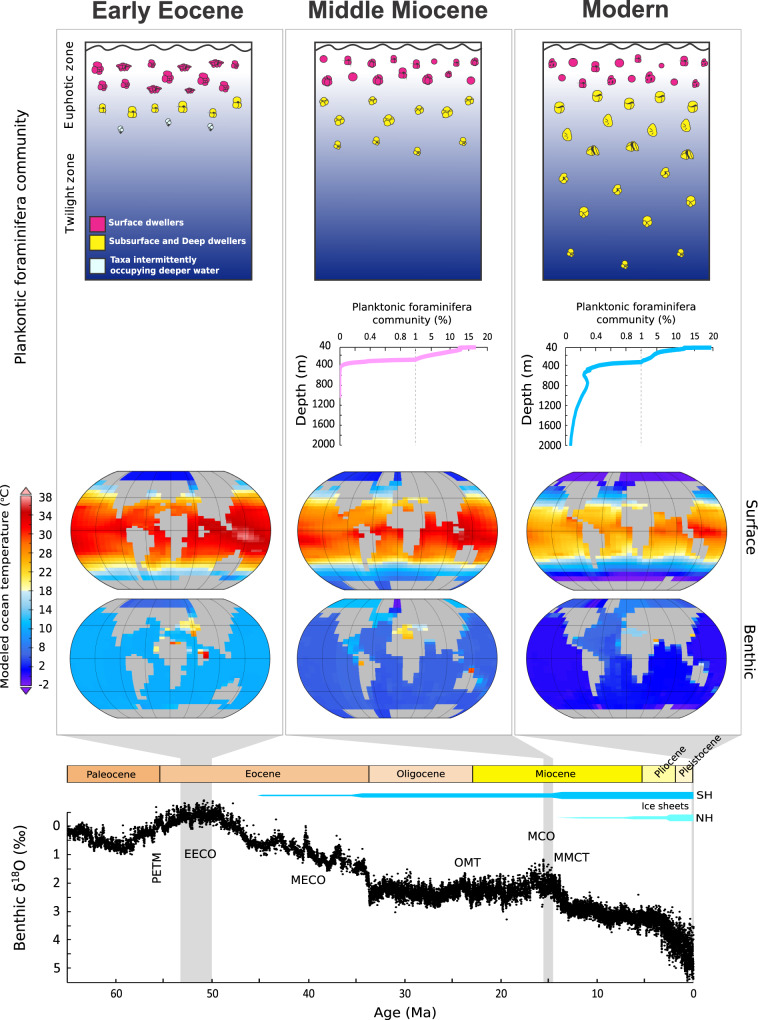
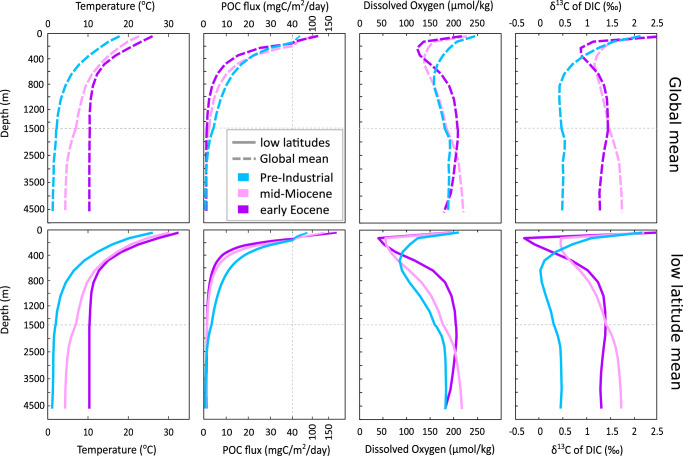
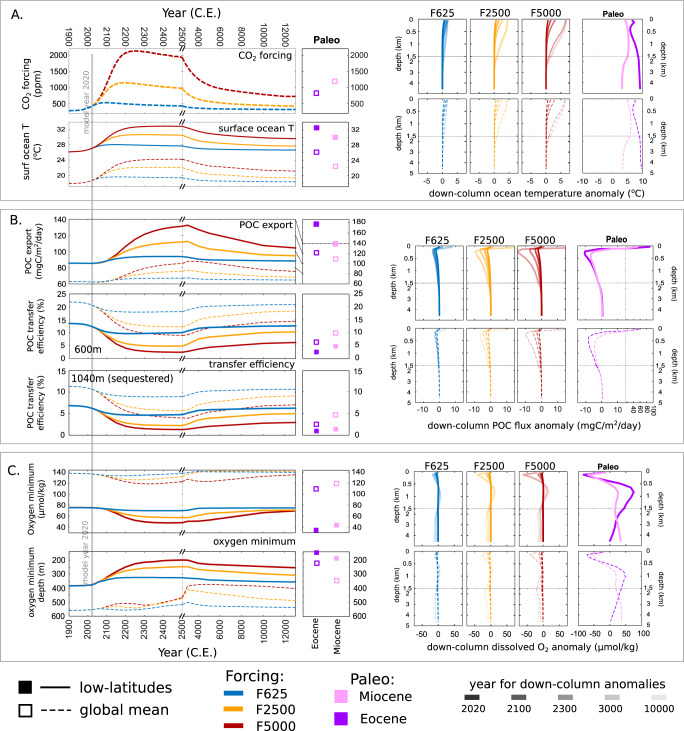
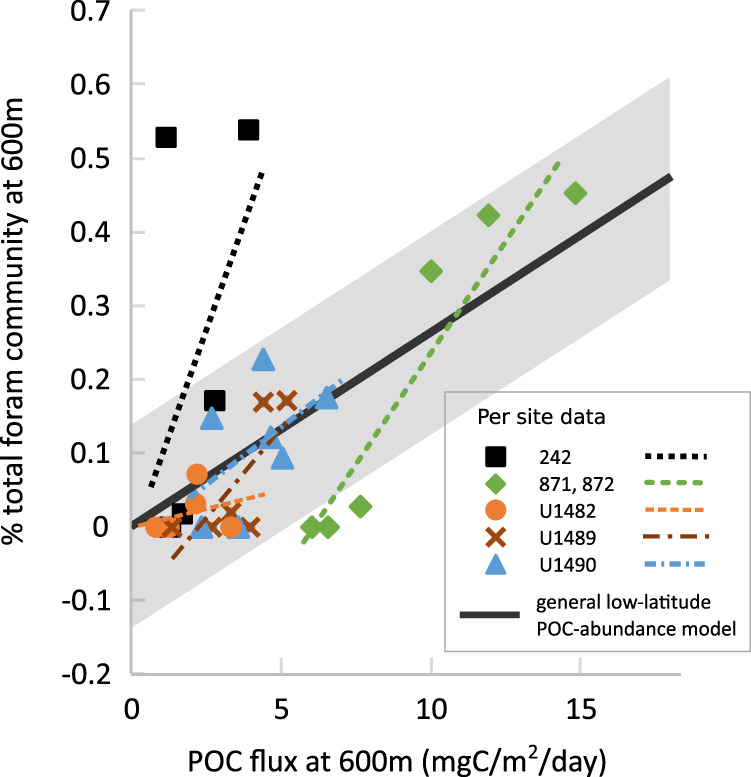
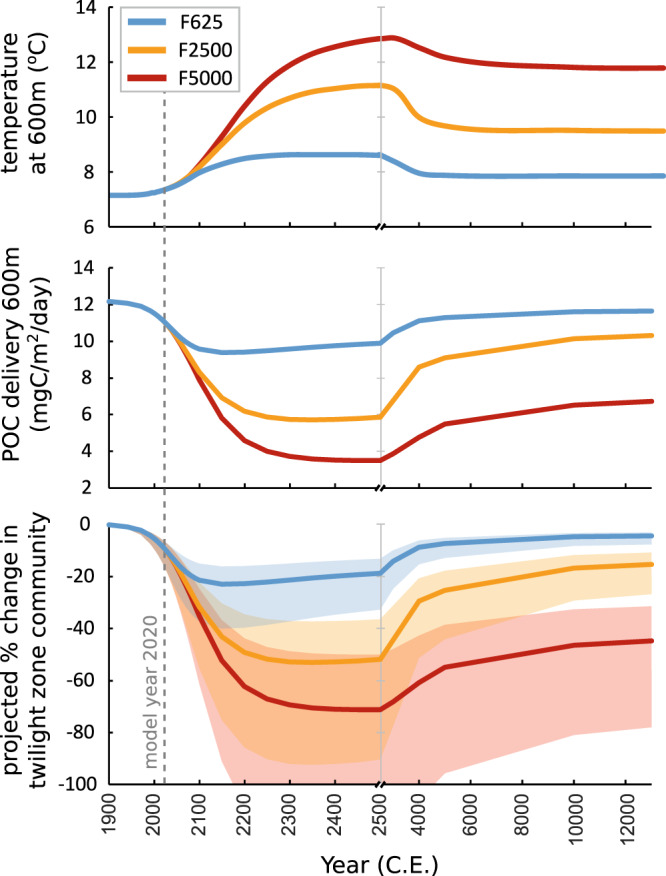
Paleontological reconstructions of plankton community structure during warm periods of the Cenozoic (last 66 million years) reveal that deep-dwelling ‘twilight zone’ (200–1000 m) plankton were less abundant and diverse, and lived much closer to the surface, than in colder, more recent climates. We suggest that this is a consequence of temperature’s role in controlling the rate that sinking organic matter is broken down and metabolized by bacteria, a process that occurs faster at warmer temperatures. In a warmer ocean, a smaller fraction of organic matter reaches the ocean interior, affecting food supply and dissolved oxygen availability at depth. Using an Earth system model that has been evaluated against paleo observations, we illustrate how anthropogenic warming may impact future carbon cycling and twilight zone ecology. Our findings suggest that significant changes are already underway, and without strong emissions mitigation, widespread ecological disruption in the twilight zone is likely by 2100, with effects spanning millennia thereafter.
Overview
The claims and statistics of this paper haven’t been checked yet.
Free: it reads the open-access text and checks the first 5 claims that cite a source we can check. Create a free account to check every claim.
Integrity signals
Registry
Cites
Statistics
Figures
Verification
Claims the paper makes
The claims and statistics of this paper haven’t been checked yet.
Free: it reads the open-access text and checks the first 5 claims that cite a source we can check. Create a free account to check every claim.
Claims other papers make about this one
Each is checked against this paper’s own text: does it say what the citing paper says it does?
The cited source says what the claim attributes to it.
In the citing paper
“Recent paleontological reconstructions (92) provide evidence that these decreases in carbon flux to the mesopelagic may have occurred in relation to past climate changes.”
From Earth beyond six of nine planetary boundaries (2023) · cites this paper as [92]
Self-check
Percentages, sums and reported differences re-computed from the paper’s own numbers.
The self-check needs the paper’s full text.
Citations
Cites
An early Cenozoic perspective on greenhouse warming and carbon-cycle dynamics
Zachos, J. C., Dickens, G. R., & Zeebe, R. E. (2008) · Nature · doi:10.1038/nature06588 · Cited by 3,550 · cited 1×
“1), with ocean bottom water temperatures of 10 to 12 °C (compared with 2 °C today 21,22 ) and global mean sea surface temperatures (SSTs) 10 to 16°C warmer than the preindustrial 23 .”
BackgroundThe Impact of Climate Change on the World’s Marine Ecosystems
Hoegh-Guldberg, O., & Bruno, J. F. (2010) · Science · doi:10.1126/science.1189930 · Cited by 2,939
Global imprint of climate change on marine life
Poloczanska, E. S., Brown, C. J., Sydeman, W. J., Kiessling, W., Schoeman, D. S., Moore, P. J., Brander, K., Bruno, J. F., Buckley, L. B., Burrows, M. T., et al. (2013) · Nature Climate Change · doi:10.1038/nclimate1958 · Cited by 2,311 · cited 1×
“Meta-analyses of marine organisms show evidence of shifting species distributions, altered food webs, variations in community composition, abundance, and distribution in response to thermal change 64,65 , with a reduction in ocean productivity over the past century 66 .”
Impacts of ocean acidification on marine fauna and ecosystem processes
Fabry, V. J., Seibel, B. A., Feely, R. A., & Orr, J. C. (2008) · ICES Journal of Marine Science · doi:10.1093/icesjms/fsn048 · Cited by 2,041
Westerhold, T., Marwan, N., Drury, A. J., Liebrand, D., Agnini, C., Anagnostou, E., Barnet, J. S. K., Bohaty, S. M., De Vleeschouwer, D., Florindo, F., et al. (2020) · Science · doi:10.1126/science.aba6853 · Cited by 1,946
Global phytoplankton decline over the past century
Boyce, D. G., Lewis, M. R., & Worm, B. (2010) · Nature · doi:10.1038/nature09268 · Cited by 1,363 · cited 1×
“Meta-analyses of marine organisms show evidence of shifting species distributions, altered food webs, variations in community composition, abundance, and distribution in response to thermal change 64,65 , with a reduction in ocean productivity over the past century 66 .”
BackgroundGlobal metabolic impacts of recent climate warming
Dillon, M. E., Wang, G., & Huey, R. B. (2010) · Nature · doi:10.1038/nature09407 · Cited by 947
Late Miocene global cooling and the rise of modern ecosystems
Herbert, T. D., Lawrence, K. T., Tzanova, A., Peterson, L. C., Caballero-Gill, R., & Kelly, C. S. (2016) · Nature Geoscience · doi:10.1038/ngeo2813 · Cited by 924
Climate change tightens a metabolic constraint on marine habitats
Deutsch, C., Ferrel, A., Seibel, B., Pörtner, H.-O., & Huey, R. B. (2015) · Science · doi:10.1126/science.aaa1605 · Cited by 747 · cited 1×
“…higher temperature and together with the shoaling and intensi fi cation of oxygen minimum zones illustrated here, this would also restrict the availability of suitable animal habitat 50,69 as has recently been suggested in accounting for the observed pattern of end Permian marine extinction 70 .”
Warm tropical sea surface temperatures in the Late Cretaceous and Eocene epochs
Pearson, P. N., Ditchfield, P. W., Singano, J., Harcourt-Brown, K. G., Nicholas, C. J., Olsson, R. K., Shackleton, N. J., & Hall, M. A. (2001) · Nature · doi:10.1038/35097000 · Cited by 703
Self-citationAbyssal food limitation, ecosystem structure and climate change
SMITH, C., DELEO, F., BERNARDINO, A., SWEETMAN, A., & ARBIZU, P. (2008) · Trends in Ecology & Evolution · doi:10.1016/j.tree.2008.05.002 · Cited by 575
The Miocene: The Future of the Past
Steinthorsdottir, M., Coxall, H. K., de Boer, A. M., Huber, M., Barbolini, N., Bradshaw, C. D., Burls, N. J., Feakins, S. J., Gasson, E., Henderiks, J., et al. (2021) · Paleoceanography and Paleoclimatology · doi:10.1029/2020pa004037 · Cited by 534
Self-citationChanging atmospheric CO2 concentration was the primary driver of early Cenozoic climate
Anagnostou, E., John, E. H., Edgar, K. M., Foster, G. L., Ridgwell, A., Inglis, G. N., Pancost, R. D., Lunt, D. J., & Pearson, P. N. (2016) · Nature · doi:10.1038/nature17423 · Cited by 468
Self-citationA 40-million-year history of atmospheric CO2
Zhang, Y. G., Pagani, M., Liu, Z., Bohaty, S. M., & DeConto, R. (2013) · Philosophical Transactions of the Royal Society A: Mathematical, Physical and Engineering Sciences · doi:10.1098/rsta.2013.0096 · Cited by 459
(2019) · Conicet · Cited by 445
Tracking Improvement in Simulated Marine Biogeochemistry Between CMIP5 and CMIP6
Séférian, R., Berthet, S., Yool, A., Palmiéri, J., Bopp, L., Tagliabue, A., Kwiatkowski, L., Aumont, O., Christian, J., Dunne, J., et al. (2020) · Current Climate Change Reports · doi:10.1007/s40641-020-00160-0 · Cited by 407
The early Eocene equable climate problem revisited
Huber, M., & Caballero, R. (2011) · Climate of the Past · doi:10.5194/cp-7-603-2011 · Cited by 403
Stable warm tropical climate through the Eocene Epoch
Pearson, P. N., van Dongen, B. E., Nicholas, C. J., Pancost, R. D., Schouten, S., Singano, J. M., & Wade, B. S. (2007) · Geology · doi:10.1130/g23175a.1 · Cited by 384
Self-citationPenn, J. L., Deutsch, C., Payne, J. L., & Sperling, E. A. (2018) · Science · doi:10.1126/science.aat1327 · Cited by 362 · cited 1×
“…higher temperature and together with the shoaling and intensi fi cation of oxygen minimum zones illustrated here, this would also restrict the availability of suitable animal habitat 50,69 as has recently been suggested in accounting for the observed pattern of end Permian marine extinction 70 .”
Interplay Between Changing Climate and Species’ Ecology Drives Macroevolutionary Dynamics
Ezard, T. H. G., Aze, T., Pearson, P. N., & Purvis, A. (2011) · Science · doi:10.1126/science.1203060 · Cited by 361
Self-citationPersistent near-tropical warmth on the Antarctic continent during the early Eocene epoch
Scientists, I. O. D. P. E. 3., Pross, J., Contreras, L., Bijl, P. K., Greenwood, D. R., Bohaty, S. M., Schouten, S., Bendle, J. A., Röhl, U., Tauxe, L., et al. (2012) · Nature · doi:10.1038/nature11300 · Cited by 357
A 12-Million-Year Temperature History of the Tropical Pacific Ocean
Zhang, Y. G., Pagani, M., & Liu, Z. (2014) · Science · doi:10.1126/science.1246172 · Cited by 310
Late Miocene climate cooling and intensification of southeast Asian winter monsoon
Holbourn, A. E., Kuhnt, W., Clemens, S. C., Kochhann, K. G. D., Jöhnck, J., Lübbers, J., & Andersen, N. (2018) · Nature Communications · doi:10.1038/s41467-018-03950-1 · Cited by 308
Cramer, B. S., Miller, K. G., Barrett, P. J., & Wright, J. D. (2011) · Journal of Geophysical Research · doi:10.1029/2011jc007255 · Cited by 306
A phylogeny of Cenozoic macroperforate planktonic foraminifera from fossil data
Aze, T., Ezard, T. H. G., Purvis, A., Coxall, H. K., Stewart, D. R. M., Wade, B. S., & Pearson, P. N. (2011) · Biological Reviews · doi:10.1111/j.1469-185x.2011.00178.x · Cited by 298
Self-citationUncertainties due to transport-parameter sensitivity in an efficient 3-D ocean-climate model
Edwards, N. R., & Marsh, R. (2005) · Climate Dynamics · doi:10.1007/s00382-004-0508-8 · Cited by 282
Ullah, H., Nagelkerken, I., Goldenberg, S. U., & Fordham, D. A. (2018) · PLOS Biology · doi:10.1371/journal.pbio.2003446 · Cited by 267
Eocene greenhouse climate revealed by coupled clumped isotope-Mg/Ca thermometry
Evans, D., Sagoo, N., Renema, W., Cotton, L. J., Müller, W., Todd, J. A., Saraswati, P. K., Stassen, P., Ziegler, M., Pearson, P. N., et al. (2018) · Proceedings of the National Academy of Sciences · doi:10.1073/pnas.1714744115 · Cited by 267
Self-citationHollis, C. J., Dunkley Jones, T., Anagnostou, E., Bijl, P. K., Cramwinckel, M. J., Cui, Y., Dickens, G. R., Edgar, K. M., Eley, Y., Evans, D., et al. (2019) · Geoscientific Model Development · doi:10.5194/gmd-12-3149-2019 · Cited by 264
Self-citationCenozoic deep-sea benthic foraminifers: Tracers for changes in oceanic productivity?
Thomas, E., & GOODAY, A. J. (1996) · Geology · doi:10.1130/0091-7613(1996)024<0355:cdsbft>2.3.co;2 · Cited by 239
Sedimentary response to Paleocene-Eocene Thermal Maximum carbon release: A model-data comparison
Panchuk, K., Ridgwell, A., & Kump, L. R. (2008) · Geology · doi:10.1130/g24474a.1 · Cited by 232
Self-citationThe sequestration efficiency of the biological pump
DeVries, T., Primeau, F., & Deutsch, C. (2012) · Geophysical Research Letters · doi:10.1029/2012gl051963 · Cited by 201
Inglis, G. N., Bragg, F., Burls, N. J., Cramwinckel, M. J., Evans, D., Foster, G. L., Huber, M., Lunt, D. J., Siler, N., Steinig, S., et al. (2020) · Climate of the Past · doi:10.5194/cp-16-1953-2020 · Cited by 201
Upper Ocean Temperatures Hit Record High in 2020
Cheng, L., Abraham, J., Trenberth, K. E., Fasullo, J., Boyer, T., Locarnini, R., Zhang, B., Yu, F., Wan, L., Chen, X., et al. (2021) · Advances in Atmospheric Sciences · doi:10.1007/s00376-021-0447-x · Cited by 190
The oceans’ twilight zone must be studied now, before it is too late
Martin, A. P., Boyd, P. W., Buesseler, K. O., Cetinić, I., Claustre, H., Giering, S. L. C., Henson, S., Irigoien, X., Kriest, I., Mémery, L., et al. (2020) · Nature · doi:10.1038/d41586-020-00915-7 · Cited by 179
Global change drives modern plankton communities away from the pre-industrial state
Jonkers, L., Hillebrand, H., & Kucera, M. (2019) · Nature · doi:10.1038/s41586-019-1230-3 · Cited by 175
North Atlantic temperature and pCO2 coupling in the early-middle Miocene
Super, J. R., Thomas, E., Pagani, M., Huber, M., O’Brien, C., & Hull, P. M. (2018) · Geology · doi:10.1130/g40228.1 · Cited by 172
Warming impairs trophic transfer efficiency in a long-term field experiment
Barneche, D. R., Hulatt, C. J., Dossena, M., Padfield, D., Woodward, G., Trimmer, M., & Yvon‐Durocher, G. (2021) · Nature · doi:10.1038/s41586-021-03352-2 · Cited by 170
Lear, C. H., Mawbey, E. M., & Rosenthal, Y. (2010) · Paleoceanography · doi:10.1029/2009pa001880 · Cited by 166
Boscolo‐Galazzo, F., Crichton, K., Barker, S., & Pearson, P. N. (2018) · Global and Planetary Change · doi:10.1016/j.gloplacha.2018.08.017 · Cited by 164
Self-citationTemperature and oxygen dependence of the remineralization of organic matter
Laufkötter, C., John, J. G., Stock, C. A., & Dunne, J. P. (2017) · Global Biogeochemical Cycles · doi:10.1002/2017gb005643 · Cited by 157
Wade, B. S., & Pearson, P. N. (2008) · Marine Micropaleontology · doi:10.1016/j.marmicro.2008.04.002 · Cited by 141
Self-citationDucklow, H. W., Doney, S. C., & Steinberg, D. K. (2009) · Annual Review of Marine Science · doi:10.1146/annurev.marine.010908.163801 · Cited by 140
Lear, C. H., Coxall, H. K., Foster, G. L., Lunt, D. J., Mawbey, E. M., Rosenthal, Y., Sosdian, S. M., Thomas, E., & Wilson, P. A. (2015) · Paleoceanography · doi:10.1002/2015pa002833 · Cited by 137
Temperature controls carbon cycling and biological evolution in the ocean twilight zone
Boscolo‐Galazzo, F., Crichton, K., Ridgwell, A. J., Mawbey, E., Wade, B. S., & Pearson, P. N. (2021) · Science · doi:10.1126/science.abb6643 · Cited by 137
Self-citationProxy evidence for state-dependence of climate sensitivity in the Eocene greenhouse
Anagnostou, E., John, E. H., Babila, T. L., Sexton, P. F., Ridgwell, A., Lunt, D. J., Pearson, P. N., Chalk, T. B., Pancost, R. D., & Foster, G. L. (2020) · Nature Communications · doi:10.1038/s41467-020-17887-x · Cited by 135
Self-citationAn impulse response function for the “long tail” of excess atmospheric CO 2 in an Earth system model
Lord, N. S., Ridgwell, A. J., Thorne, M. C., & Lunt, D. J. (2016) · Global Biogeochemical Cycles · doi:10.1002/2014gb005074 · Cited by 125
Self-citationLarge deep-sea zooplankton biomass mirrors primary production in the global ocean
Hernández‐León, S., Koppelmann, R., Fraile‐Nuez, E., Bode, A., Mompeán, C., Irigoien, X., Olivar, M. P., Echevarría, F., de Puelles, M. L. F., González-Gordillo, J. I., et al. (2020) · Nature Communications · doi:10.1038/s41467-020-19875-7 · Cited by 124
Combustion of available fossil fuel resources sufficient to eliminate the Antarctic Ice Sheet
Winkelmann, R., Levermann, A., Ridgwell, A., & Caldeira, K. (2015) · Science Advances · doi:10.1126/sciadv.1500589 · Cited by 123
Self-citationDepth stratification of planktonic foraminifers in the Miocene ocean
Keller, G. (1985) · Geological Society of America eBooks · doi:10.1130/mem163-p177 · Cited by 122
Lyle, A. O., & Lyle, M. W. (2006) · Paleoceanography · doi:10.1029/2005pa001230 · Cited by 110
The role of ocean transport in the uptake of anthropogenic CO 2
Cao, L., Eby, M., Ridgwell, A., Caldeira, K., Archer, D., Ishida, A., Joos, F., Matsumoto, K., Mikolajewicz, U., Mouchet, A., et al. (2009) · Biogeosciences · doi:10.5194/bg-6-375-2009 · Cited by 109
Self-citationMacLeod, K. G., Huber, B. T., Berrocoso, Á. J., & Wendler, I. (2013) · Geology · doi:10.1130/g34510.1 · Cited by 108
Miocene Evolution of North Atlantic Sea Surface Temperature
Super, J. R., Thomas, E., Pagani, M., Huber, M. S., O’Brien, C. L., & Hull, P. M. (2020) · Paleoceanography and Paleoclimatology · doi:10.1029/2019pa003748 · Cited by 106
Warm ocean processes and carbon cycling in the Eocene
John, E. H., Pearson, P. N., Coxall, H. K., Birch, H. S., Wade, B. S., & Foster, G. L. (2013) · Philosophical Transactions of the Royal Society A Mathematical Physical and Engineering Sciences · doi:10.1098/rsta.2013.0099 · Cited by 88
Self-citationMacroevolutionary History of the Planktic Foraminifera
Fraass, A. J., Kelly, D. C., & Peters, S. E. (2015) · Annual Review of Earth and Planetary Sciences · doi:10.1146/annurev-earth-060614-105059 · Cited by 83
Temperature-dependent remineralization and carbon cycling in the warm Eocene oceans
John, E. H., Wilson, J. D., Pearson, P. N., & Ridgwell, A. J. (2014) · Palaeogeography Palaeoclimatology Palaeoecology · doi:10.1016/j.palaeo.2014.05.019 · Cited by 82
Self-citationThe role of environmental factors in the long-term evolution of the marine biological pump
Fakhraee, M., Planavsky, N. J., & Reinhard, C. T. (2020) · Nature Geoscience · doi:10.1038/s41561-020-00660-6 · Cited by 79
Stanley, S. M. (2010) · Proceedings of the National Academy of Sciences · doi:10.1073/pnas.1012833107 · Cited by 76
Marsh, R., Müller, S. A., Yool, A., & Edwards, N. R. (2011) · Geoscientific Model Development · doi:10.5194/gmd-4-957-2011 · Cited by 63
Oceanic Ecosystem Time-Series Programs: Ten Lessons Learned
Karl, D. M. (2010) · Oceanography · doi:10.5670/oceanog.2010.27 · Cited by 62
Crichton, K., Wilson, J. D., Ridgwell, A. J., & Pearson, P. N. (2021) · Geoscientific model development · doi:10.5194/gmd-14-125-2021 · Cited by 62
Self-citationEvolution of depth ecology in the planktic foraminifera lineage Globorotalia (Fohsella)
Norris, R. D., Corfield, R. M., & Cartlidge, J. E. (1993) · Geology · doi:10.1130/0091-7613(1993)021<0975:eodeit>2.3.co;2 · Cited by 61
Modestou, S. E., Leutert, T. J., Fernandez, A., Lear, C. H., & Meckler, A. N. (2020) · Paleoceanography and Paleoclimatology · doi:10.1029/2020pa003927 · Cited by 57
The impact of Cenozoic cooling on assemblage diversity in planktonic foraminifera
Fenton, I. S., Pearson, P. N., Jones, T. D., Farnsworth, A., Lunt, D. J., MARKWICK, P. J., & Purvis, A. (2016) · Philosophical Transactions of the Royal Society B Biological Sciences · doi:10.1098/rstb.2015.0224 · Cited by 56
Self-citationSegschneider, J., & Bendtsen, J. (2013) · Global Biogeochemical Cycles · doi:10.1002/2013gb004684 · Cited by 51
Wilson, J. D., Monteiro, F. M., Schmidt, D. N., Ward, B. A., & Ridgwell, A. (2018) · Paleoceanography and Paleoclimatology · doi:10.1029/2018pa003374 · Cited by 50
Self-citationPinti, J., Kiørboe, T., Thygesen, U. H., & Visser, A. W. (2019) · Proceedings of the Royal Society B Biological Sciences · doi:10.1098/rspb.2019.1645 · Cited by 50
Jennions, S. M., Thomas, E., Schmidt, D. N., Lunt, D. J., & Ridgwell, A. J. (2015) · Paleoceanography · doi:10.1002/2015pa002821 · Cited by 48
Self-citationThe Twilight Zone as a Major Foraging Habitat and Mercury Source for the Great White Shark
Croizier, G. L., Lorrain, A., Sonke, J. E., Hoyos-Padilla, E. M., Galván‐Magaña, F., Santana‐Morales, O., Aquino‐Baleytó, M., Becerril-García, E. E., Muntaner‐López, G., Ketchum, J. T., et al. (2020) · Environmental Science & Technology · doi:10.1021/acs.est.0c05621 · Cited by 38
Reconciling atmospheric CO 2 , weathering, and calcite compensation depth across the Cenozoic
Komar, N., & Zeebe, R. E. (2021) · Science Advances · doi:10.1126/sciadv.abd4876 · Cited by 37
Bentho‐Pelagic Decoupling: The Marine Biological Carbon Pump During Eocene Hyperthermals
Griffith, E. M., Thomas, E., Lewis, A. R., Penman, D. E., Westerhold, T., & Winguth, A. (2021) · Paleoceanography and Paleoclimatology · doi:10.1029/2020pa004053 · Cited by 36
Early Eocene Thermal Maximum 3: Biotic Response at Walvis Ridge (SE Atlantic Ocean)
Thomas, E., Boscolo‐Galazzo, F., Balestra, B., Monechi, S., Donner, B., & Röhl, U. (2018) · Paleoceanography and Paleoclimatology · doi:10.1029/2018pa003375 · Cited by 34
Self-citationOrigin of the Eocene planktonic foraminifer H antkenina by gradual evolution
Pearson, P. N., & Coxall, H. K. (2013) · Palaeontology · doi:10.1111/pala.12064 · Cited by 33
Self-citationLate Neogene evolution of modern deep-dwelling plankton
Boscolo‐Galazzo, F., Jones, A. P., Jones, T. D., Crichton, K., Wade, B. S., & Pearson, P. N. (2022) · Biogeosciences · doi:10.5194/bg-19-743-2022 · Cited by 33
Self-citationA Warm, Stratified, and Restricted Labrador Sea Across the Middle Eocene and Its Climatic Optimum
Cramwinckel, M. J., Coxall, H. K., Śliwińska, K. K., Polling, M., Harper, D. T., Bijl, P. K., Brinkhuis, H., Eldrett, J. S., Houben, A. J. P., Peterse, F., et al. (2020) · Paleoceanography and Paleoclimatology · doi:10.1029/2020pa003932 · Cited by 30
Bihemispheric Warming in the Miocene Climatic Optimum as Seen From the Danish North Sea
Herbert, T. D., Rose, R., Dybkjær, K., Rasmussen, E. S., & Śliwińska, K. K. (2020) · Paleoceanography and Paleoclimatology · doi:10.1029/2020pa003935 · Cited by 29
Crichton, K., Ridgwell, A. J., Lunt, D. J., Farnsworth, A., & Pearson, P. N. (2021) · Climate of the past · doi:10.5194/cp-17-2223-2021 · Cited by 28
Self-citationVariable particle size distributions reduce the sensitivity of global export flux to climate change
Leung, S. W., Weber, T., Cram, J. A., & Deutsch, C. A. (2021) · Biogeosciences · doi:10.5194/bg-18-229-2021 · Cited by 24
Livsey, C. M., Babila, T. L., Robinson, M. M., & Bralower, T. J. (2018) · Marine Micropaleontology · doi:10.1016/j.marmicro.2018.12.001 · Cited by 11
Cited by
Earth beyond six of nine planetary boundaries
Richardson, K., Steffen, W., Lucht, W., Bendtsen, J., Cornell, S. E., Donges, J. F., Drüke, M., Fetzer, I., Bala, G., von Bloh, W., et al. (2023) · Science Advances · doi:10.1126/sciadv.adh2458 · Cited by 3,311
“Recent paleontological reconstructions (92) provide evidence that these decreases in carbon flux to the mesopelagic may have occurred in relation to past climate changes.”
Biological carbon pump estimate based on multidecadal hydrographic data
Wang, W., Fu, W., Moigne, F. A. C. L., Letscher, R. T., Liu, Y., Tang, J., & Primeau, F. (2023) · Nature · doi:10.1038/s41586-023-06772-4 · Cited by 104
Combating Climate Change and Global Warming for a Sustainable Living in Harmony with Nature
Balaram, V. (2023) · Journal of Geographical Research · doi:10.30564/jgr.v6i3.5706 · Cited by 38
Opportunities for Earth Observation to Inform Risk Management for Ocean Tipping Points
Wood, R., Baker, J., Beaugrand, G., Boutin, J., Conversi, A., Donner, R. V., Frenger, I., Goberville, É., Hayashida, H., Koeve, W., et al. (2024) · Surveys in Geophysics · doi:10.1007/s10712-024-09859-3 · Cited by 12
Filippi, G., & Luciani, V. (2024) · Palaeogeography Palaeoclimatology Palaeoecology · doi:10.1016/j.palaeo.2024.112660 · Cited by 12
Metadata
- Authors
- Crichton, K. A., Wilson, J. D., Ridgwell, A., Boscolo-Galazzo, F., John, E. H., Wade, B. S., & Pearson, P. N.
- Affiliations
- University of Exeter (GB)
- University of Liverpool (GB)
- University of California, Riverside (US)
- Cardiff University (GB)
- University College London (GB)
- Corresponding author
- Crichton, Katherine A.
- ORCID
- Venue
- Nature Communications
- Published
- 2023-04-27
- Volume
- 14
- Issue
- 1
- Pages
- 2376-2376
- ISSN
- 2041-1723 (ISSN-L)
- PMC
- PMC10140295
- OpenAlex
- W4367181461
- Semantic Scholar
- 5963090e778faf2893ad4957802a39b753096886
- Cited by
- 23
- References
- 80
- Citations by year
- 2026: 3 · 2025: 9 · 2024: 8 · 2023: 3
- FWCI
- 3.09
- Type
- journal article
- Language
- en
- Open access
- gold
- doi.org
- Licence
- cc-by
- creativecommons.org/licenses/by/4.0 (tdm)
- creativecommons.org/licenses/by/4.0 (vor)
- Locations
- Nature Communications (publishedVersion, cc-by)
- PubMed Central (publishedVersion, cc-by)
- PubMed (publishedVersion)
- UCL Discovery (University College London) (submittedVersion, cc-by)
- eScholarship (California Digital Library) (submittedVersion, cc-by)
- ORCA Online Research @Cardiff (Cardiff University) (submittedVersion)
- RePEc: Research Papers in Economics (submittedVersion)
- DOAJ (DOAJ: Directory of Open Access Journals) (submittedVersion, cc-by-sa)
- Funders
- AXA Research Fund
- National Science Foundation (1658024, 1702913, EAR-2121165)
- Heising-Simons Foundation
- RCUK | Natural Environment Research Council (NE/N002598/1, NE/N001621/1)
- Topics
- Physical Sciences › Earth and Planetary Sciences › Oceanography › Marine Plankton and Biogeochemistry
- Physical Sciences › Earth and Planetary Sciences › Paleontology › Paleontology and Stratigraphy of Fossils
- Physical Sciences › Earth and Planetary Sciences › Atmospheric Science › Geology and Paleoclimatology Research
- Keywords
- deep-sea plankton, ocean warming, organic matter mineralization, bacterial metabolism, carbon cycle, dissolved oxygen depletion, paleontological reconstruction, Earth system models, anthropogenic climate change, deep-sea ecology
- MeSH terms
- Oceans and Seas, Plankton, Seawater, Temperature, Carbon Cycle
About these checks
Registry, retraction, Cites and statistics results are computed, not judged, with one exception: a printed reference that no index lists is read once by a model before it counts as a citation error. Claims are extracted by a model and kept only when their quote appears verbatim in the text; each cited source is then checked, with a model’s help, for whether it says what the claim relies on. Those verdicts can be wrong — read the claim’s quote and the cited source before relying on one.
Statistics and arithmetic are recomputed, not judged.
Confidence bands are shown only for fields calibrated on our annotated test set. None is calibrated yet, so no band is shown.
What counts as a claim ›How we measure confidence ›How we check this ›
Are you an author, or do you see a problem with this page? Request a review
Data sources
Bibliographic data: Semantic Scholar, OpenAlex, Crossref.
Contains information from the Semantic Scholar Academic Graph Datasets, made available under the ODC Attribution License (ODC-BY 1.0).
Semantic Scholar’s data is described in: Kinney, R., et al. (2023). The Semantic Scholar Open Data Platform. arXiv:2301.10140.
