

Turnover number predictions for kinetically uncharacterized enzymes using machine and deep learning
Open accessPublished version of a preprint
The DOI matches its Crossref record; 73 of the 73 references it cites were found in a registry or an index; 11 of the 50 sources its claims cite were checked for support.
Abstract
The turnover number k cat , a measure of enzyme efficiency, is central to understanding cellular physiology and resource allocation. As experimental k cat estimates are unavailable for the vast majority of enzymatic reactions, the development of accurate computational prediction methods is highly desirable. However, existing machine learning models are limited to a single, well-studied organism, or they provide inaccurate predictions except for enzymes that are highly similar to proteins in the training set. Here, we present TurNuP, a general and organism-independent model that successfully predicts turnover numbers for natural reactions of wild-type enzymes. We constructed model inputs by representing complete chemical reactions through differential reaction fingerprints and by representing enzymes through a modified and re-trained Transformer Network model for protein sequences. TurNuP outperforms previous models and generalizes well even to enzymes that are not similar to proteins in the training set. Parameterizing metabolic models with TurNuP-predicted k cat values leads to improved proteome allocation predictions. To provide a powerful and convenient tool for the study of molecular biochemistry and physiology, we implemented a TurNuP web server.
Overview
CoChat Summary
## TL;DR
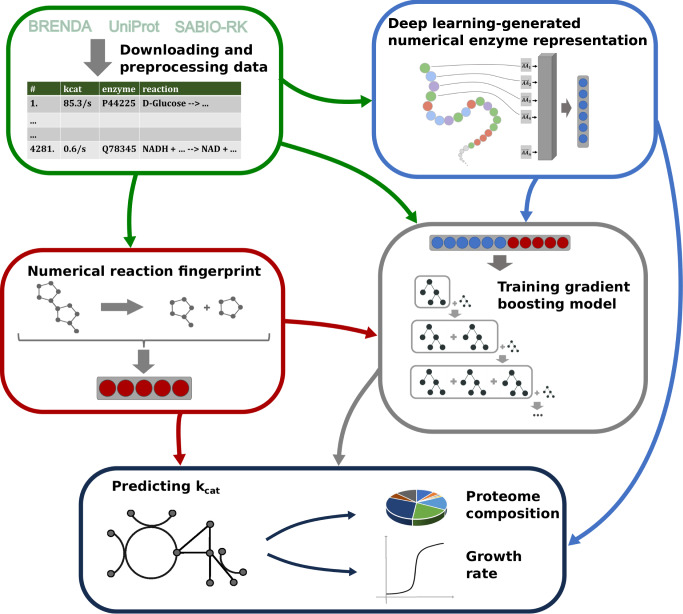
TurNuP is a machine/deep learning model that predicts enzyme turnover numbers (kcat) from enzyme sequence and full reaction information, and it outperforms prior methods on the paper’s held-out test sets. On the authors’ final test set of 4,271 data points, the combined model reached \(R^2 = 0.44\) with mean absolute deviation 0.69 on the \(\log_{10}\) scale, corresponding to a 4.8-fold average deviation from measured values.
## Key findings
- The final curated dataset contained 4,271 data points, with 2,977 unique reactions and 2,827 unique enzymes; the train/test split was 80%/20% with no identical enzyme sequences in both splits.
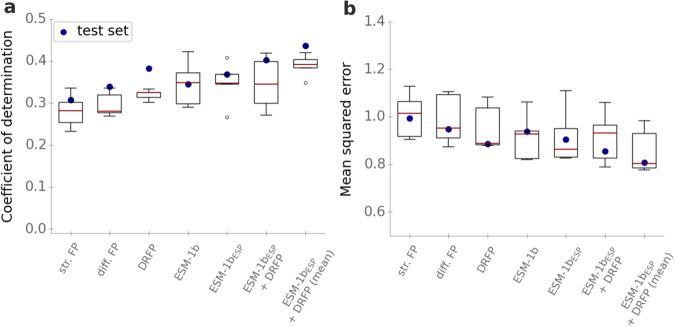
- Using reaction information alone, the best reaction fingerprint model achieved \(R^2 = 0.38\), MSE = 0.89, and Pearson \(r = 0.62\) on the test set.
- Using enzyme information alone, the best enzyme representation achieved \(R^2 = 0.37\), MSE = 0.91, and \(r = 0.61\) on the test set.
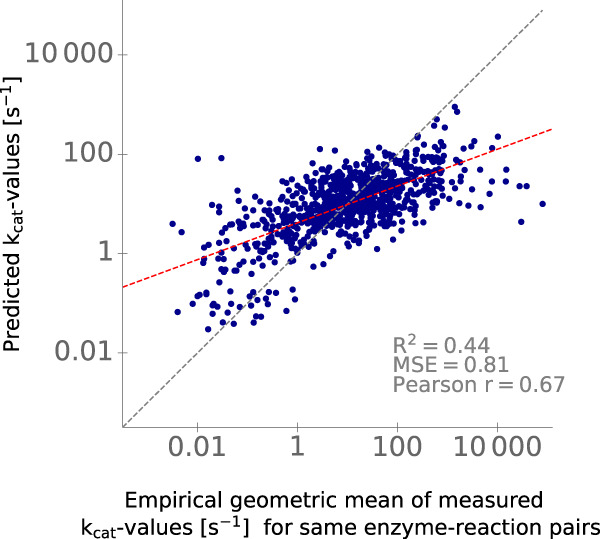
- The final TurNuP ensemble of enzyme and reaction models achieved \(R^2 = 0.44\), MSE = 0.81, and \(r = 0.67\) on the test set; adding extra features like \(K_M\) and reaction flux did not improve performance (\(R^2 = 0.39\) with those added features).
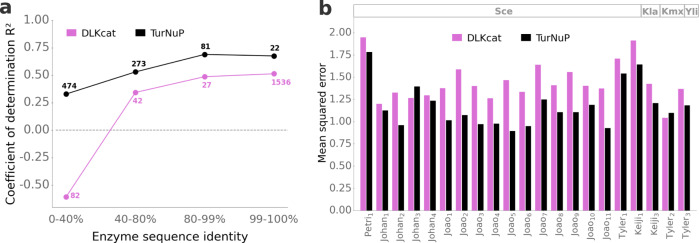
- TurNuP performed better than DLKcat across all enzyme-sequence-identity bins, with reported significance levels of \(p = 4.3 \times 10^{-11}\), 0.0017, 0.00037, and 0.048 for the four sequence-identity groups.
- Using TurNuP-derived kcat values in yeast proteome allocation modeling improved predictions in 19 of 21 environment-species combinations, with mean squared errors improving by about 18% on average.
## Methods
- The authors compiled kcat measurements from BRENDA, UniProt, and Sabio-RK, mapped them to enzyme sequences and reaction identities, removed non-wild-type/non-natural reactions, duplicates, incomplete records, and outliers, and log-transformed kcat values.
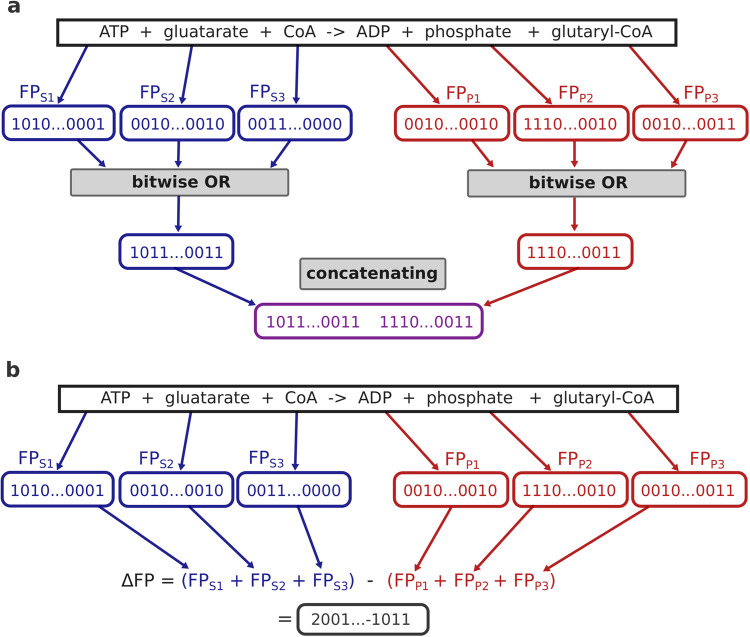
- They trained and compared gradient boosting models using different inputs: reaction fingerprints (structural, difference, DRFP), enzyme representations (ESM-1b and a fine-tuned ESM-1b-based representation), and combinations of these.
- Model development used fivefold cross-validation for hyperparameter search and a held-out test set; performance was assessed with \(R^2\), MSE, Pearson \(r\), and nonparametric tests for model comparisons.
## Limitations
- The paper states that the training data are small and noisy; it reports an average deviation of 5.7-fold between two kcat measurements for the same enzyme-reaction pair and notes database errors and varying assay conditions as contributors.
- The authors state they could not include experimental conditions such as pH and temperature for most data points because these are generally unavailable in the databases; this likely limits accuracy.
- Evident from the text: the model was trained only on natural reactions of wild-type enzymes, so the authors say it should not be used for non-natural reactions or enzyme mutants.
Model-written summary. Check it against the paper before relying on it.
Integrity signals
Registry
Cites
Statistics
Figures
Verification
Claims the paper makes
7 Valid · 0 Not valid · 27 Not checked · 101 Own results and interpretations
The cited sources support only part of this claim — read each source’s verdict below.
In the paper
“In genome-scale kinetic models of cellular metabolism, this issue is typically addressed by either sampling missing k cat values or fitting them to large datasets 7 , 8 , 12 , 13 .”
What the sources say
- Partly supportedcites [7] Khodayari, A. & Maranas, C. D. A genome-scale escherichia coli kinetic metabolic model k-ecoli457 satisfying flux data for multiple mutant strains. Nat. Commun. 7, 1–12 (2016). sourceExperimental — accuracy not yet measured
The Abstract describes parameter sampling in kinetic models, and Methods > Estimation of k-ecoli457 parameters describes fitting model parameters to multiple mutant-strain flux datasets. Results > Comparison of predicted Michaelis–Menten parameters reports estimated kcat values. The paper supports these approaches as examples, but does not establish that they are the typical ways to address specifically missing kcat values. (LLM, conf=0.83)
- Partly supportedcites [8] Ebrahim, A. et al. Multi-omic data integration enables discovery of hidden biological regularities. Nat. Commun. 7, 1–9 (2016). sourceExperimental — accuracy not yet measured
The Methods sections on sampling and iterative simulation describe randomly initializing effective turnover rates (keff) and updating them using experimental proteomics data. But the paper distinguishes its in vivo keff estimates from in vitro enzyme kinetic parameters; it does not establish that sampling or fitting missing kcat values is typical practice across genome-scale kinetic models. No page numbers were available in our copy. (LLM, conf=0.84)
- Not checked yetcites [12] Saa, P. A. & Nielsen, L. K. Formulation, construction and analysis of kinetic models of metabolism: a review of modelling frameworks. Biotechnol. Adv. 35, 981–1003 (2017). source
plain- Asserted: passes — The authors put it forward as true.
- Checkable: passes — It can be checked against evidence.
- Load-bearing: passes — The paper’s conclusions depend on it.
- Based: passes — The paper gives a reason why it holds.
- Partly supported
The cited sources support only part of this claim — read each source’s verdict below.
In the paper
“It has been shown that the resulting representations contain rich information about the structure and the function of the proteins 17 , 32 , 33 .”
What the sources say
- Partly supportedcites [17] Rives, A. et al. Biological structure and function emerge from scaling unsupervised learning to 250 million protein sequences. Proc. Natl Acad. Sci. USA 118, e2016239118 (2021). sourceExperimental — accuracy not yet measured
The Linear Projections section (Figs. 4–5 and Table 3; page not provided) shows that ESM-1b representations contain information about secondary structure and residue contacts. The Prediction of Mutational Effects section supports a connection between learned representations and protein function, but its functional results use a 34-layer Transformer rather than ESM-1b specifically. The claim’s ESM-1b-specific functional component is therefore not established by these passages. (LLM, conf=0.85)
- Partly supportedcites [32] Kroll, A., Ranjan, S., Engqvist, M. K. & Lercher, M. J. A general model to predict small molecule substrates of enzymes based on machine and deep learning. Nat. Commun. 14, 2787 (2023). sourceExperimental — accuracy not yet measured
The Results section (“Fine-tuning of a state-of-the-art protein embedding model”; page unavailable) says ESM-1b representations store local and global sequence information. The paper also uses these representations to predict enzyme substrates, supporting a connection to function, but our copy does not establish that they contain information about protein structure. (LLM, conf=0.82)
- Supportedcites [33] Goldman, S., Das, R., Yang, K. K. & Coley, C. W. Machine learning modeling of family wide enzyme-substrate specificity screens. PLoS Comput. Biol. 18, 1–20 (2022). source
The Results (Models; page not provided) identify ESM-1b as the representation used and report its performance on contact prediction and prediction of the functional effects of sequence variations. These support the paraphrase that its representations contain information about protein structure and function. (LLM, conf=0.90)
plain- Asserted: passes — The authors put it forward as true.
- Checkable: passes — It can be checked against evidence.
- Load-bearing: passes — The paper’s conclusions depend on it.
- Based: passes — The paper gives a reason why it holds.
- Partly supported
The cited sources support only part of this claim — read each source’s verdict below.
In the paper
“The model achieved a coefficient of determination R 2 ≈ 0.34 on a test set.”
What the sources say
- Partly supportedcites [14] Heckmann, D. et al. Machine learning applied to enzyme turnover numbers reveals protein structural correlates and improves metabolic models. Nat. Commun. 9, 5252 (2018). sourceExperimental — accuracy not yet measured
In Results, under “Training predictive models of enzyme turnover numbers” (Fig. 2 caption; page unavailable), the paper says it measured R² on an independent test set. Our copy does not give a test-set R² of approximately 0.34; the nearby values 0.31 and 0.76 are cross-validation averages, not test-set results. (LLM, conf=0.78)
plain- Asserted: passes — The authors put it forward as true.
- Checkable: passes — It can be checked against evidence.
- Load-bearing: unclear — It is unclear whether the paper’s conclusions depend on it.
- Based: passes — The paper gives a reason why it holds.
- Partly supported
Every source the paper cites for this claim was checked and supports it.
In the paper
“In our study on predicting the substrate scope of enzymes 32 , we found that prediction performance depends strongly on the sequence similarity between a target enzyme and enzymes in the training set”
What the sources say
- Supportedcites [32] Kroll, A., Ranjan, S., Engqvist, M. K. & Lercher, M. J. A general model to predict small molecule substrates of enzymes based on machine and deep learning. Nat. Commun. 14, 2787 (2023). source
In Results (‘Good predictions even for unseen enzymes’), the paper compares ESP performance across enzyme sequence-identity ranges and concludes that using more similar enzymes during training improves prediction quality. Accuracy rises from 89% at 0–40% identity to 95% at 60–80%, although performance remains good even at low identity. (LLM, conf=0.90)
boostedstates an association- Asserted: passes — The authors put it forward as true.
- Checkable: passes — It can be checked against evidence.
- Load-bearing: passes — The paper’s conclusions depend on it.
- Based: passes — The paper gives a reason why it holds.
- Supported
The cited sources support only part of this claim — read each source’s verdict below.
In the paper
“Its coefficient of determination ( R 2 = 0.44) is higher than that of Heckmann et al. ( R 2 ≈ 0.34) 14”
What the sources say
- Partly supportedcites [14] Heckmann, D. et al. Machine learning applied to enzyme turnover numbers reveals protein structural correlates and improves metabolic models. Nat. Commun. 9, 5252 (2018). sourceExperimental — accuracy not yet measured
Our copy never reports an R² of 0.34 for Heckmann et al.; the closest stated value is in Results > 'Training predictive models of enzyme turnover numbers', which gives average cross-validated R²s of 0.76 for kapp,max and 0.31 for kcat in vitro (Fig. 2; test-set R²s are shown only as points in Fig. 2, not tabulated in the text). The attributed magnitude 0.34 therefore does not match the source's stated 0.31, and the claim also drops the qualifier that bounds the number: the paper reports two different model performances, and only the lower (kcat in vitro) one sits below TurNuP's 0.44 — the kapp,max model at 0.76 is well above it. The direction of the comparison is thus partly supported (a stated R² below 0.44 exists for the in vitro kcat models), but the specific value and the unstated target quantity are not. (LLM, conf=0.75)
plain- Asserted: passes — The authors put it forward as true.
- Checkable: passes — It can be checked against evidence.
- Load-bearing: passes — The paper’s conclusions depend on it.
- Based: passes — The paper gives a reason why it holds.
- Partly supported
75 more claims · 1 with their cited sources checked
Create a free account to see all 135 claims and to verify the 39 references still open.
- It may state two separate claims as one. 30
- Probably not a substantial claim. 24
- The quote only partly states this claim. 2
Self-check
Percentages, sums and reported differences re-computed from the paper’s own numbers.
Each contradiction between two passages listed here was confirmed by an independent check.
Rated minor: it would not touch a result — a value no result rests on, a p-value that stays on the same side of the significance level, or a conflict that is clerical, resolved elsewhere in the paper, or outside its own findings.
In the paper
“we trained two gradient-boosting models to predict k cat , each with one of the reaction fingerprints as the only input.”
“We performed a fivefold CV with a random grid search for hyperparameter optimization for all three models.”
Rated minor: it would not touch a result — a value no result rests on, a p-value that stays on the same side of the significance level, or a conflict that is clerical, resolved elsewhere in the paper, or outside its own findings.
In the paper
“We partitioned the enzymes in the test set based on their maximal sequence identity to enzymes in the test set, resulting in four subsets with 0–40%, 40–80%, 80–99%, and 99–100% maximal sequence identity, respectively.”
“it decreases to R 2 = 0.33 for enzymes with a maximal sequence identity below 40%.”
Citations
Cites
XGBoost: A Scalable Tree Boosting System
Chen, T., & Guestrin, C. (2016) · Proceedings of the 22nd ACM SIGKDD International Conference on Knowledge Discovery and Data Mining · doi:10.1145/2939672.2939785 · Cited by 54,569
SciPy 1.0: fundamental algorithms for scientific computing in Python
Virtanen, P., Gommers, R., Oliphant, T. E., Haberland, M., Reddy, T., Cournapeau, D., Burovski, E., Peterson, P., Weckesser, W., Bright, J., et al. (2020) · Nature Methods · doi:10.1038/s41592-019-0686-2 · Cited by 38,430
KEGG: Kyoto Encyclopedia of Genes and Genomes
Kanehisa, M. (2000) · Nucleic Acids Research · doi:10.1093/nar/28.1.27 · Cited by 37,077
PyTorch: An Imperative Style, High-Performance Deep Learning Library
Paszke, A., Gross, S., Massa, F., Lerer, A., Bradbury, J., Chanan, G., Killeen, T., Lin, Z., Gimelshein, N., Antiga, L., et al. (2019) · arXiv · doi:10.48550/arxiv.1912.01703 · Cited by 31,473 · cited 1×
“We created the enzyme representations using the deep learning library PyTorch 43 .”
MethodKEGG: Kyoto Encyclopedia of Genes and Genomes
Ogata, H., Goto, S., Sato, K., Fujibuchi, W., Bono, H., & Kanehisa, M. (1999) · Nucleic Acids Research · doi:10.1093/nar/27.1.29 · Cited by 31,232
TensorFlow: A system for large-scale machine learning
Abadi, M., Barham, P., Chen, J., Chen, Z., Davis, A., Dean, J., Devin, M., Ghemawat, S., Irving, G., Isard, M., et al. (2016) · arXiv (Cornell University) · doi:10.48550/arxiv.1605.08695 · Cited by 11,822
SciPy 1.0: fundamental algorithms for scientific computing in Python
Virtanen, P., Gommers, R., Oliphant, T. E., Haberland, M., Reddy, T., Cournapeau, D., Burovski, E., Peterson, P., Weckesser, W., Bright, J., et al. (2019) · Apollo - University of Cambridge Repository · doi:10.17863/cam.64134 · Cited by 10,460
EMBOSS: the European molecular biology open software suite.
Rice, P., Longden, I., & Bleasby, A. (2000) · Trends in Genetics · doi:10.1016/s0168-9525(00)02024-2 · Cited by 9,466 · cited 1×
“To achieve this, we calculated for every test sequence the maximal pairwise sequence identity compared to all sequences in the training set using the Needleman-Wunsch algorithm from the software package EMBOSS 52 .”
MethodUniProt: a worldwide hub of protein knowledge
The UniProt Consortium (2019) · Nucleic Acids Research · doi:10.1093/nar/gky1049 · Cited by 7,698
Extended-Connectivity Fingerprints
Rogers, D., & Hahn, M. (2010) · Journal of Chemical Information and Modeling · doi:10.1021/ci100050t · Cited by 7,524
Research works printed but not linked: 4
- Friedman, J. H.The Elements Of Statistical Learning: Data Mining, Inference, And Prediction (Springer Open, New York, 2017).
- Vaswani, A. et al. Attention is all you need. Adv. Neural Inf. Process. Syst. 30, 5998–6008 (2017).
- Bergstra, J., Yamins, D. & Cox, D. Making a science of model search: Hyperparameter optimization in hundreds of dimensions for vision architectures. In Proc. 30th International Conference on Machine Learning, vol. 28 of Proceedings of Machine Learning Research, 115–123 (PMLR, Atlanta, 2013).
- Pedregosa, F. et al. Scikit-learn: Machine learning in Python. J. Mach. Learn. Res. 12, 2825–2830 (2011).
Cited by
Navigating the landscape of enzyme design: from molecular simulations to machine learning
Zhou, J., & Huang, M. (2024) · Chemical Society Reviews · doi:10.1039/d4cs00196f · Cited by 192
Robust enzyme discovery and engineering with deep learning using CataPro
Wang, Z., Xie, D., Wu, D., Luo, X., Wang, S., Li, Y., Yang, Y., Li, W., & Zheng, L. (2025) · Nature Communications · doi:10.1038/s41467-025-58038-4 · Cited by 164
“For instance, TurNup utilized the fi ne-tuned esm-1b vectors and differential reaction fi ngerprints as representations of enzyme-catalyzed reactions to predict the k cat value of natural reactions of wild-type enzymes 42 .”
CatPred: a comprehensive framework for deep learning in vitro enzyme kinetic parameters
Boorla, V. S., & Maranas, C. D. (2025) · Nature Communications · doi:10.1038/s41467-025-57215-9 · Cited by 162
Current status and emerging frontiers in enzyme engineering: An industrial perspective
Ndochinwa, O. G., Wang, Q., Amadi, C. O., Nwagu, T. N., Nnamchi, C. I., Okeke, E. S., & Moneke, A. N. (2024) · Heliyon · doi:10.1016/j.heliyon.2024.e32673 · Cited by 131
“The majority of known enzymes, in fact, have catalytic rates that fall into a very narrow range of values [6].”
BackgroundHarnessing generative AI to decode enzyme catalysis and evolution for enhanced engineering
Xie, W. J., & Warshel, A. (2023) · National Science Review · doi:10.1093/nsr/nwad331 · Cited by 69
“Aside from physics-based models, predicting the effects of mutations on enzyme activity using supervised learning is currently unfeasible, largely because of the limited data on enzyme turnover numbers [52 ].”
Machine learning prediction of enzyme optimum pH
Gado, J. E., Knotts, M., Shaw, A. Y., Marks, D. S., Gauthier, N. P., Sander, C., & Beckham, G. T. (2025) · Nature Machine Intelligence · doi:10.1038/s42256-025-01026-6 · Cited by 87
“…traditional machine learning models, such as SVR and XGBoost, trained on averaged PLM embeddings, can perform on par or even outperform deep neural networks trained on full per-residue embeddings 69 , although this finding may not extend to predicting effects of mutations on proteins 70,71 .”
Wang, J., Yang, Z., Chen, C., Ge, Y., Wan, X., Bao, S., Ding, J., Wang, L., & Jiang, H. (2024) · Briefings in Bioinformatics · doi:10.1093/bib/bbae387 · Cited by 76
“Kroll et al. [14] developed TurNup to predict the k cat values of wild-type enzymes.”
BackgroundWang, T., Xiang, G., He, S., Su, L., Wang, Y., Yan, X., & Lu, H. (2024) · Briefings in Bioinformatics · doi:10.1093/bib/bbae409 · Cited by 57
“As these functional sites are closely correlated to enzyme function and activity [14] (Fig.”
InfluentialMachine learning-guided strategies for reaction conditions design and optimization
Chen, L.-Y., & Li, Y. (2024) · Beilstein Journal of Organic Chemistry · doi:10.3762/bjoc.20.212 · Cited by 59
Yan, X., Bao, W., Wu, Y.-L., Zhang, C.-Y., Mao, Z.-T., Yuan, Q.-Q., Hu, Z., He, P., Peng, Q., Hu, M., et al. (2024) · Nature Communications · doi:10.1038/s41467-024-54897-5 · Cited by 40
DLTKcat: deep learning-based prediction of temperature-dependent enzyme turnover rates
Qiu, S., Zhao, S., & Yang, A. (2023) · Briefings in Bioinformatics · doi:10.1093/bib/bbad506 · Cited by 43
“…additional features, such as enzyme molar mass or the octanol– water partition coefficient of substrate, could not improve model performance [15, 21], the finalized data set of this study only contained SMILES strings of substrates, amino acid sequences of enzyme proteins and temperature values.”
BackgroundDLKcat cannot predict meaningful k cat values for mutants and unfamiliar enzymes
Kroll, A., & Lercher, M. J. (2024) · Biology Methods and Protocols · doi:10.1093/biomethods/bpae061 · Cited by 50
“Advances in deep learning have now put such predictions into reach [1, 2].”
BackgroundSelf-citationProtein representations: Encoding biological information for machine learning in biocatalysis
Harding-Larsen, D., Funk, J., Madsen, N. G., Gharabli, H., Acevedo-Rocha, C. G., Mazurenko, S., & Welner, D. H. (2024) · Biotechnology Advances · doi:10.1016/j.biotechadv.2024.108459 · Cited by 38
Kroll, A., Ranjan, S., & Lercher, M. J. (2024) · PLoS Computational Biology · doi:10.1371/journal.pcbi.1012100 · Cited by 50
“Our findings indicate that the combination of multiple gradient boosting models trained on different input information yields better and more robust performance compared to a single model utilizing all input information (S6 Table), consistent with previous observations [15].”
InfluentialSelf-citationMachine learning in predictive biocatalysis: A comparative review of methods and applications
Tripathi, N., Hérisson, J., & Faulon, J. (2025) · Biotechnology Advances · doi:10.1016/j.biotechadv.2025.108698 · Cited by 40
Data-driven synthetic microbes for sustainable future
Mariam, I., Rova, U., Christakopoulos, P., Μάτσακας, Λ., & Patel, A. (2025) · npj Systems Biology and Applications · doi:10.1038/s41540-025-00556-4 · Cited by 48
“Due to limited experimental k cat data, ML and deep learning models (e.g., DeepEC, DLKcat, TurNup) have been developed to predict enzyme properties 54 – 56 .”
Grigorakis, K., Ferousi, C., & Topakas, E. (2025) · Catalysts · doi:10.3390/catal15020147 · Cited by 45
Evolutionary-scale enzymology enables exploration of a rugged catalytic landscape
(2025) · doi:10.1126/science.adu1058 · Cited by 42
Machine learning predicts system-wide metabolic flux control in cyanobacteria
Kugler, A., & Stensjö, K. (2024) · Metabolic Engineering · doi:10.1016/j.ymben.2024.02.013 · Cited by 31
Enzyme Databases in the Era of Omics and Artificial Intelligence
Prešern, U., & Goličnik, M. (2023) · International Journal of Molecular Sciences · doi:10.3390/ijms242316918 · Cited by 33
“Deep learning algorithms for the prediction of enzyme function [46–49], structure [50,51], catalytic residues [52,53], and kinetic properties [54–56], as well as algorithms for the de novo design of enzymes [57,58], have already been developed.”
BackgroundEITLEM-Kinetics: A deep-learning framework for kinetic parameter prediction of mutant enzymes
Shen, X., Cui, Z., Long, J., Zhang, S., Chen, B., & Tan, T. (2024) · Chem Catalysis · doi:10.1016/j.checat.2024.101094 · Cited by 52
Simultaneous Engineering of the Thermostability and Activity of a Novel Aldehyde Dehydrogenase
Xu, K., Chen, Q., Fu, H., Chen, Q., Gu, J., Wang, X., & Zhou, J. (2025) · ACS Catalysis · doi:10.1021/acscatal.4c06840 · Cited by 28
Liu, H., Guan, F., Liu, T., Yang, L., Fan, L., Liu, X., Luo, H., Wu, N., Yao, B., Tian, J., et al. (2023) · Science Bulletin · doi:10.1016/j.scib.2023.09.039 · Cited by 25
Graph Linear Convolution Pooling for Learning in Incomplete High-Dimensional Data
Bi, F., He, T., Ong, Y.-S., & Luo, X. (2024) · IEEE Transactions on Knowledge and Data Engineering · doi:10.1109/tkde.2024.3524627 · Cited by 58
“They are the Root Mean Squared Error (RMSE), Mean Absolute Error (MAE), coefficient of determination (i.e., R 2 ), and Normalized Discounted Cumulative Gain (NDCG) [4], [5], [6], [7], [8], [9], [10], [11], [44].”
Accelerating promoter identification and design by deep learning
Wang, X., Xu, K., Huang, Z., Lin, Y., Zhou, J., Zhou, L., & Ma, F. (2025) · Trends in biotechnology · doi:10.1016/j.tibtech.2025.05.008 · Cited by 32
Ferreira, M. A. D. M., da Silveira, W. B., & Nikoloski, Z. (2024) · Biotechnology and Bioengineering · doi:10.1002/bit.28650 · Cited by 29
“TurNuP was able to predict k cat values with good agreement to experimental data, achieving a Pearson correlation of 0.67.”
BackgroundMethodInfluentialThe Dawn of High-Throughput and Genome-Scale Kinetic Modeling: Recent Advances and Future Directions
Toumpe, I., Choudhury, S., Hatzimanikatis, V., & Mišković, L. (2025) · ACS Synthetic Biology · doi:10.1021/acssynbio.4c00868 · Cited by 26
Advances in genome-scale metabolic models of industrially important fungi
Han, Y., Rangel, A. E. T., Pomraning, K., Kerkhoven, E. J., & Kim, J. (2023) · Current Opinion in Biotechnology · doi:10.1016/j.copbio.2023.103005 · Cited by 19
REME: an integrated platform for reaction enzyme mining and evaluation
Shi, Z., Wang, D., Li, Y., Deng, R., Lin, J., Liu, C., Li, H., Wang, R., Zhao, M., Mao, Z., et al. (2024) · Nucleic Acids Research · doi:10.1093/nar/gkae405 · Cited by 18
“…we offer three tools for calculating reaction similarity (RDKit, RXNFP, DRFP) along with three evaluation metrics: Tanimoto similarity for RD-Kit, cosine measure, and Euclidean distance for RXNFP and DRFP. Higher Tanimoto and cosine scores are preferred, while a lower Euclidean distance is favored.”
Huang, Z., Zhou, J., Wang, J., Xu, S., Cheng, C., Ma, J., & Gao, Z. Z. (2025) · Journal of Agricultural and Food Chemistry · doi:10.1021/acs.jafc.4c12426 · Cited by 19
Shao, Q., Hollenbeak, A. C., Jiang, Y., Ran, X., Bachmann, B. O., & Yang, Z. J. (2025) · Chem Catalysis · doi:10.1016/j.checat.2025.101334 · Cited by 22
Wang, Y., Cheng, L., Zhang, Y., Cao, Y., & Alghazzawi, D. (2025) · Briefings in Bioinformatics · doi:10.1093/bib/bbaf187 · Cited by 24
“[12] developed a model named TurNuP,which employs advanced protein pretrained models to represent sequences.”
DeepMolecules: a web server for predicting enzyme and transporter–small molecule interactions
Kroll, A., Rousset, Y., Spitzlei, T., & Lercher, M. J. (2025) · Nucleic Acids Research · doi:10.1093/nar/gkaf343 · Cited by 20
“Tur-NuP achieves a coefficient of determination R 2 of 0.44 on an independent test set and generalizes well to previously unseen enzymes, making it the leading tool for predicting k cat values of wild-type enzymes [ 15 ].”
InfluentialSelf-citationResource allocation in mammalian systems
Baghdassarian, H. M., & Lewis, N. E. (2024) · Biotechnology Advances · doi:10.1016/j.biotechadv.2023.108305 · Cited by 17
CLAIRE: a contrastive learning-based predictor for EC number of chemical reactions
Zeng, Z., Guo, J., Jin, J., & Luo, X. (2025) · Journal of Cheminformatics · doi:10.1186/s13321-024-00944-8 · Cited by 16
Advances in Machine Learning Models for Predicting Enzyme Kinetic Parameters
Malli, A., Vasyutyn, D., & Kim, J. R. (2025) · Journal of Chemical Information and Modeling · doi:10.1021/acs.jcim.5c02428 · Cited by 28
Enabling high-throughput enzyme discovery and engineering with a low-cost, robot-assisted pipeline
Norton‐Baker, B., Denton, M. C. R., Murphy, N. P., Fram, B. J., Lim, S., Erickson, E., Gauthier, N. P., & Beckham, G. T. (2024) · Scientific Reports · doi:10.1038/s41598-024-64938-0 · Cited by 20
Wang, X., Wu, H., Wang, T., Chen, Y., Jia, B., Fang, H., Yin, X., Zhao, Y., & Yu, R. (2025) · Analytical Chemistry · doi:10.1021/acs.analchem.4c01953 · Cited by 15
New insights in metabolism modelling to decipher plant–microbe interactions
Blonde, C., Caddeo, A., Nasser, W., Reverchon, S., Peyraud, R., & Haichar, F. E. Z. (2025) · New Phytologist · doi:10.1111/nph.70063 · Cited by 19
Ren, Y., Celińska, E., Cai, P., & Zhou, Y. J. (2025) · Chem & Bio Engineering · doi:10.1021/cbe.5c00002 · Cited by 19
Machine learning for predicting protein properties: A comprehensive review
Wang, Y., Zhang, Y., Zhan, X., He, Y., Yang, Y., Cheng, L., & Alghazzawi, D. (2024) · Neurocomputing · doi:10.1016/j.neucom.2024.128103 · Cited by 18
Cai, Y., Zhang, W., Dou, Z., Wang, C., Yu, W., & Wang, L. (2025) · Computational Biology and Chemistry · doi:10.1016/j.compbiolchem.2024.108327 · Cited by 15
Vasudhevan, P., Ruoyu, Z., Ma, H., Singh, S., Varshney, D., & Pu, S. (2025) · International Journal of Biological Macromolecules · doi:10.1016/j.ijbiomac.2025.140069 · Cited by 17
Enzyme catalytic efficiency prediction: employing convolutional neural networks and XGBoost
Alazmi, M. (2024) · Frontiers in Artificial Intelligence · doi:10.3389/frai.2024.1446063 · Cited by 17
“Kroll et al. (2023) presented a study highlighting TurNuP, a new computational method designed for accurately predicting turnover numbers ( k cat ) for enzymatic reactions, which are important for cellular biological activities.”
MethodENKIE: a package for predicting enzyme kinetic parameter values and their uncertainties
Gollub, M. G., Backes, T., Kaltenbach, H., & Stelling, J. (2024) · Bioinformatics · doi:10.1093/bioinformatics/btae652 · Cited by 15
“40 for catalytic rates (Kroll et al. , 2022) on independent test sets.”
BackgroundRobust Prediction of Enzyme Variant Kinetics with RealKcatPreprint
Sajeevan, K. A., Osinuga, A., Arunraj, B., Ferdous, S., Shahreen, N., Noor, M., Koneru, S., Santa-Correa, L. M., Salehi, R., Chowdhury, N. B., et al. (2025) · bioRxiv (Cold Spring Harbor Laboratory) · doi:10.1101/2025.02.10.637555 · Cited by 14
Non-canonical plant metabolism
Sweetlove, L. J., Ratcliffe, R. G., & Fernie, A. R. (2025) · Nature Plants · doi:10.1038/s41477-025-01965-3 · Cited by 18
“…and the chemical structure of their reactants 147–149 has been demonstrated to improve the predictive accuracy of flux balance analysis models 150 and may eventually enable fully parameterized models that capture the interrelated regulation of enzymes by metabolites and other effectors 151 .”
Multidimensional computational strategies enhance the thermostability of alpha-galactosidase
Zou, Y., Zheng, P., Chen, P., Yu, X., & Wu, D. (2025) · International Journal of Biological Macromolecules · doi:10.1016/j.ijbiomac.2025.144316 · Cited by 13
Production of chemicals by metabolically engineered Escherichia coli
Jang, G., Kim, M.-J., & Lee, S. Y. (2025) · Current Opinion in Biotechnology · doi:10.1016/j.copbio.2025.103367 · Cited by 12
Cui, Q., Gao, Y., Wen, Q., Wang, T., Ren, X., Cheng, L., Bai, M., & Cheng, C. (2024) · Small · doi:10.1002/smll.202311584 · Cited by 13
Xu, S., Chen, Y.-M., Meng, X., Pan, R., Yan, A.-X., Li, Z., & Li, Z. (2025) · Bioresource Technology · doi:10.1016/j.biortech.2025.133081 · Cited by 13
Advances in Zero‐Shot Prediction‐Guided Enzyme Engineering Using Machine Learning
Liu, C., Wu, J., Chen, Y., Liu, Y., Zheng, Y., Liu, L., & Zhao, J. B. (2024) · ChemCatChem · doi:10.1002/cctc.202401542 · Cited by 18
Oh, W. T., Ham, J., Kim, S., & Koh, W. (2025) · Chemical Engineering Journal · doi:10.1016/j.cej.2025.159250 · Cited by 13
Next-generation metabolic models informed by biomolecular simulations
Noor, M. S., Ferdous, S., Salehi, R., Gates, H., Dey, S., Raghunath, V. S., Zargar, M. R., & Chowdhury, R. (2025) · Current Opinion in Biotechnology · doi:10.1016/j.copbio.2025.103259 · Cited by 13
Qiu, W., Yang, P., Ye, J., Zhou, J., & Liu, S. (2025) · Journal of Agricultural and Food Chemistry · doi:10.1021/acs.jafc.4c11502 · Cited by 14
Kroll, A., & Rousset, Y. (2025) · Current Opinion in Structural Biology · doi:10.1016/j.sbi.2025.103070 · Cited by 14
Self-citationEscherichia coli selection strains for growth-coupled metabolic engineering
Schulz-Mirbach, H., Dronsella, B., & Erb, T. J. (2025) · Trends in biotechnology · doi:10.1016/j.tibtech.2025.06.015 · Cited by 15
Rubisco is slow across the tree of life
de Pins, B., Malbranke, C., Jabłońska, J., Shmuel, A., Sharon, I., Bitbol, A., Mueller‐Cajar, O., Noor, Ε., & Milo, R. (2025) · Proceedings of the National Academy of Sciences · doi:10.1073/pnas.2501433122 · Cited by 17
Zhai, J., Qi, X., Cai, L., Liu, Y., Tang, H., Xie, L., & Wang, J. (2025) · Briefings in Bioinformatics · doi:10.1093/bib/bbaf212 · Cited by 15
“[34] which applied differential reaction fingerprints and a re-trained transformer network model to process chemical reactions and protein sequences, respectively.”
Integration of proteomic data with genome‐scale metabolic models: A methodological overview
Zare, F., & Fleming, R. (2024) · Protein Science · doi:10.1002/pro.5150 · Cited by 13
Integrating genetic algorithms and language models for enhanced enzyme design
Teukam, Y. G. N., Zipoli, F., Laino, T., Criscuolo, E., Grisoni, F., & Manica, M. (2024) · Briefings in Bioinformatics · doi:10.1093/bib/bbae675 · Cited by 21
“[33], the XGBoost parameters are learning rate = 0.09, max delta step = 1.19, min child weight = 2.82, reg alpha = 1.94, and reg lambda = 4.95.”
InfluentialMachine learning for enzyme catalytic activity: current progress and future horizons
Qiu, S., Saeed, H., Leonard, W., Li, F., & Yang, A. (2026) · Briefings in Bioinformatics · doi:10.1093/bib/bbag002 · Cited by 15
“After feature concatenation, TurNuP [75] used XGBoost to regress for k cat and obtained an accuracy of R2=0.44, RMSE=0.9 (log10-scale).”
InfluentialFinding the dark matter: Large language model‐based enzyme kinetic data extractor and its validation
Wei, G., Ran, X., AI‐Abssi, R., & Yang, Z. (2025) · Protein Science · doi:10.1002/pro.70251 · Cited by 10
“TurNuP (Kroll et al., 2023) incorporates protein language models and attention mechanisms, splitting data by enzyme so that each unique enzyme sequence appears in only one dataset partition, with test performance further stratified by sequence identity to the training set.”
Metabolic modeling identifies determinants of thermal growth responses in Arabidopsis thaliana
Wendering, P., Andreou, G. M., Laitinen, R. A. E., & Nikoloski, Z. (2025) · New Phytologist · doi:10.1111/nph.20420 · Cited by 16
Modern machine learning methods for protein property prediction
Dosajh, A., Agrawal, P., Chatterjee, P., & Priyakumar, U. D. (2025) · Current Opinion in Structural Biology · doi:10.1016/j.sbi.2025.102990 · Cited by 11
Mapping multi-substrate specificity of Arabidopsis aminotransferases
Koper, K., de Oliveira, M. V. V., Huß, S., Hataya, S., Babadi, F. S., Hawkins, C., Rhee, S. Y., Takasuka, T. E., Nikoloski, Z., & Maeda, H. A. (2025) · Nature Plants · doi:10.1038/s41477-025-02095-6 · Cited by 12
“Interestingly, the observed activities for the examined substrate combinations showed no association of predicted enzymatic activities from the application of recent deep learning models for catalytic rates, TurNuP and UniKP 49–51 (Spearman correlation values of −0.023 and −0.032; Extended Data Fig.”
InfluentialPredictive and therapeutic applications of protein language models
Furui, K., Sakano, K., & Ohue, M. (2025) · Allergology International · doi:10.1016/j.alit.2025.08.004 · Cited by 12
Wang, Y., Mao, Z., Dong, J., Zhang, P., Gao, Q., Liu, D., Tian, C., & Ma, H. (2024) · Microbial Cell Factories · doi:10.1186/s12934-024-02415-z · Cited by 12
“For enzyme kinetic parameter data, three methods were employed: AutoPACMEN was utilized to collect enzyme kinetic parameter data based on EC numbers, and machine learning-based tools (DLKcat [28] and TurNuP [29]) were used to predict enzyme kinetic parameter information.”
MethodA compact model of Escherichia coli core and biosynthetic metabolism
Corrao, M., He, H., Liebermeister, W., Noor, Ε., & Bar‐Even, A. (2025) · PLoS Computational Biology · doi:10.1371/journal.pcbi.1013564 · Cited by 16
GotEnzymes2: expanding coverage of enzyme kinetics and thermal properties
Lyu, B., Wu, K., Huang, Y., Anton, M., Li, X., Viknander, S., Anwer, D., Yang, Y., Lu, D., Kerkhoven, E. J., et al. (2025) · Nucleic Acids Research · doi:10.1093/nar/gkaf1053 · Cited by 12
“DLKcat [ 11 ] k cat Protein sequence and substrate k cat ( R 2 = 0.49), integrated in GECKO 3.0 TurNuP [ 12 ] k cat Protein sequence and reaction fingerprint k cat ( R 2 = 0.44) of an entire reaction, unable to differentiate the k cat for each substrate in multi-substrate reactions DLTKcat [ 13 ] k…”
InfluentialMulti-omics integration in genome-scale metabolic models: a review of constraint-based approaches
Shahreen, N., Osinuga, A., Malla, S., Razmpour, T., Tabibian, M., & Saha, R. (2026) · Molecular Omics · doi:10.1093/molecular-omics/aaiag005 · Cited by 12
A structure-oriented kinetics dataset of enzyme-substrate interactions
Krishnan, S. R., Pandey, N., Srinivasan, R., & Roy, A. (2025) · Scientific Data · doi:10.1038/s41597-025-05829-5 · Cited by 9
“The dataset can also lead to development of novel machine learning and deep learning models for accurate prediction of enzyme kinetic parameters, which can be used as in silico filters for enzyme design and mutation prioritization 13,25,26,62–65 .”
Wang, J., Zhao, Y., Yang, Z., Ge, Y., Han, P., Liu, J., Chen, C., Zan, P., Wan, X., Bo, X., et al. (2025) · Briefings in Bioinformatics · doi:10.1093/bib/bbaf283 · Cited by 8
“Kroll et al. [12, 13] developed two organism-independent machine learning and deep learning models designed to rapidly predict the K m and k cat v alues of wild-type enzymes across different species.”
Metabolic modelling: Insights into the machine room of plant metabolism
Machado, T. M., Töpfer, N., & Soltani, F. (2025) · Journal of Plant Physiology · doi:10.1016/j.jplph.2025.154584 · Cited by 9
Zhang, Y., Wang, X., Yin, X., Huang, T., & Lin, S. (2025) · ACS Catalysis · doi:10.1021/acscatal.5c07044 · Cited by 6
Improving the enzymatic activity and stability of N-carbamoyl hydrolase using deep learning approach
Fa, Z., Naeem, M., Yu, B., Liu, F., & Ju, J. (2024) · Microbial Cell Factories · doi:10.1186/s12934-024-02439-5 · Cited by 8
“Kroll et al. reported a turnover number prediction (TurNuP) method for k cat values prediction for the uncharacterized data of wild-type enzymes using machine and deep learning [48].”
BackgroundMethodInfluentialOrlando, M., Marchetti, A., Bombardi, L., Lotti, M., Fusco, S., & Mangiagalli, M. (2025) · International Journal of Biological Macromolecules · doi:10.1016/j.ijbiomac.2025.140113 · Cited by 8
A Deep Learning-Based Approach for Predicting Michaelis Constants from Enzymatic Reactions
Li, Y., & Wang, K. (2025) · Applied Sciences · doi:10.3390/app15074017 · Cited by 6
Kroll, A., Ranjan, S., & Lercher, M. J. (2023) · bioRxiv (Cold Spring Harbor Laboratory) · doi:10.1101/2023.08.21.554147 · Cited by 6
“In a previous study, we indeed observed that training multiple gradient boosting models with different input vectors and combining their predictions through weighted averaging yielded enhanced performance compared to a single model using all input information simultaneously 30 .”
BackgroundMethodSelf-citationJiang, H., Wang, J., Yang, Z., Chen, C., Ge, Y., Bao, S., Wan, X., Ding, J., & Wang, L. (2024) · Research Square · doi:10.21203/rs.3.rs-3916417/v1 · Cited by 6
A multimodal deep learning framework for enzyme turnover prediction with missing modality
Sun, X., Wang, Y. G., & Shen, Y. (2025) · Computers in Biology and Medicine · doi:10.1016/j.compbiomed.2025.110348 · Cited by 7
Taheri‐Garavand, A., Beiranvandi, M., Ahmadi, A., & Nikoloudakis, N. (2025) · BMC Plant Biology · doi:10.1186/s12870-024-06044-x · Cited by 7
Du, B.-X., Yu, H., Zhu, B., Long, Y., Wu, M., & Shi, J. (2025) · Methods · doi:10.1016/j.ymeth.2025.02.010 · Cited by 5
A geometric deep learning framework for genome-wide prediction of enzyme turnover number
Pan, T., Cui, X., Koh, H. Y., Bi, Y., Wang, X., Zhang, Y., Hu, S., Webb, G. I., Kurgan, L., Zhang, G., et al. (2026) · Genome biology · doi:10.1186/s13059-026-03986-3 · Cited by 11
“3b) and TurnUp [20] (Additional file 1: Table S1).”
Deng, R., Wu, K., Lin, J., Wang, D., Huang, Y., Li, Y., Shi, Z., Zhang, Z., Wang, Z., Mao, Z., et al. (2024) · International Journal of Molecular Sciences · doi:10.3390/ijms25094803 · Cited by 4
“While an increasing number of studies have focused on developing artificial intelligence methods (such as DLKcat [16], TurNup [17], UniKP [18], etc.) to predict k cat and enhance its coverage in models, relatively few have addressed MW.”
BackgroundXu, R., Li, X., Sui, J., Wu, L., Ling, C., Zheng, L., & Guo, J. (2025) · ACS Synthetic Biology · doi:10.1021/acssynbio.5c00755 · Cited by 6
Zhao, M., Pan, X., Arsalan, A., Zabed, H. M., Guo, L., Zhang, C., & Qi, X. (2026) · ACS Synthetic Biology · doi:10.1021/acssynbio.5c00869 · Cited by 4
Systematically exploring yeast metabolism through retrobiosynthesis and deep learning
Wu, K., Liu, H., Zhou, R., Sun, M., Mao, R., Jiang, Y., Kerkhoven, E. J., Chen, Y., Nielsen, J., Tang, H., et al. (2026) · Nature Catalysis · doi:10.1038/s41929-026-01523-w · Cited by 6
Wang, X., Chen, Q., Huang, Z., et al. (2025) · International Journal of Biological Macromolecules · doi:10.1016/j.ijbiomac.2025.144283 · Cited by 4
Erkanli, M. E., Jang, Y., Malli, A., El‐Halabi, K., Ryu, C., & Kim, J. R. (2025) · ACS Synthetic Biology · doi:10.1021/acssynbio.5c00257 · Cited by 5
Badia, M. B., Costa, J., Zucchetti, J. I., Pavlovic, T., Calace, P., Saigo, M., & Gerrard Wheeler, M. C. (2025) · Plant Science · doi:10.1016/j.plantsci.2025.112707 · Cited by 4
Zöllner, N. R., Long, J., Song, C., Sharkey, J., Wudick, M. M., Loo, E. P. I., Sadoine, M., Applegate, V. M., Hoeppner, A., Smits, S. H. J., et al. (2026) · PNAS Nexus · doi:10.1093/pnasnexus/pgaf412 · Cited by 4
“The conservation of the sux operon indicated a likely evolutionary importance, potentially unveiling a universal host-derived sucrose utilization mechanism in Xanthomonads .”
Boorla, V. S., & Maranas, C. D. (2024) · bioRxiv (Cold Spring Harbor Laboratory) · doi:10.1101/2024.03.10.584340 · Cited by 4
“Kroll. et. al. trained a gradient-boosted tree model, TurNup 27 , using language model features of enzymes’ amino acid sequences along with reaction fingerprints for k cat prediction using a dataset of 4,271 k cat measurements.”
BackgroundMethodInfluentialHarnessing the optimization of enzyme catalytic rates in engineering of metabolic phenotypes
Razaghi‐Moghadam, Z., Babadi, F. S., & Nikoloski, Z. (2024) · PLoS Computational Biology · doi:10.1371/journal.pcbi.1012576 · Cited by 6
Computational Bioprospecting of Enzymes
Xiang, R., Martinez-Sugrañes, M., Muñoz‐Tafalla, R., Floor, M., & Guallar, V. (2025) · Wiley Interdisciplinary Reviews Computational Molecular Science · doi:10.1002/wcms.70037 · Cited by 5
“Tools like DLkcat [74] and TurNuP [75] combine enzyme sequence and substrate structure representations to estimate kcat values across diverse organisms.”
Babadi, F. S., Correa, S. M., Arend, M., Forghanisardaghi, N., Treves, H., Razaghi‐Moghadam, Z., & Nikoloski, Z. (2025) · New Phytologist · doi:10.1111/nph.70528 · Cited by 5
Endowing protein language models with structural knowledge
Hartout, P., Chen, D., Pellizzoni, P., Oliver, C., & Borgwardt, K. M. (2025) · Bioinformatics · doi:10.1093/bioinformatics/btaf582 · Cited by 43
“Notable examples include ESM-1b (Rives et al. 2021) and ESM-2 (Lin et al. 2023), which have achieved strong results on various downstream tasks (Meier et al. 2021, Notin et al. 2022, Kroll et al. 2023).”
Kennedy, L. S., Harper, M., & Čuperlović‐Culf, M. (2025) · Briefings in Bioinformatics · doi:10.1093/bib/bbaf635 · Cited by 6
“Alternatives to these functional classifications include numeric enzyme properties describing catalytic activity such as enzyme turnover k cat [43, 44] and Michaelis constants K M [45], or dissociation constants K d , related to ligand interactions [46].”
Emerging trends in materials for water splitting catalysts in hydrogen production
Lin, K., Lee, K.-H., Mukundan, A., Karmakar, R., Rahmawati, E., Abdullah, K. N., Wang, C.-C., & Wang, H. (2025) · Energy Reports · doi:10.1016/j.egyr.2025.11.074 · Cited by 8
Zhou, R. H. F. L., Ma, H., Xin, T., Miao, Q., Zou, L., Hu, Q., Cheng, H., Guo, J., Mu, Y., Wang, S., et al. (2026) · Journal of Chemical Information and Modeling · doi:10.1021/acs.jcim.6c00090 · Cited by 3
Metadata
- Authors
- Kroll, A., Rousset, Y., Hu, X.-P., Liebrand, N. A., & Lercher, M. J.
- Affiliations
- Heinrich Heine University Düsseldorf (DE)
- Corresponding author
- Lercher, Martin J.
- Venue
- Nature Communications
- Published
- 2023-07-12
- Volume
- 14
- Issue
- 1
- Pages
- 4139-4139
- ISSN
- 2041-1723 (ISSN-L)
- PMC
- PMC10338564
- OpenAlex
- W4384023735
- Cited by
- 186
- References
- 72
- Citations by year
- 2026: 53 · 2025: 80 · 2024: 45 · 2023: 8
- FWCI
- 16.43
- Type
- journal article
- Language
- en
- Open access
- gold
- doi.org
- Licence
- cc-by
- creativecommons.org/licenses/by/4.0 (tdm)
- creativecommons.org/licenses/by/4.0 (vor)
- Locations
- Nature Communications (publishedVersion, cc-by)
- PubMed Central (publishedVersion, cc-by)
- PubMed (publishedVersion)
- DOAJ (DOAJ: Directory of Open Access Journals) (submittedVersion, cc-by-sa)
- Funders
- Deutsche Forschungsgemeinschaft (CRC 1310 + EXC 2048/1 (Project ID: 390686111))
- Topics
- Life Sciences › Biochemistry, Genetics and Molecular Biology › Molecular Biology › Machine Learning in Bioinformatics
- Life Sciences › Biochemistry, Genetics and Molecular Biology › Molecular Biology › Microbial Metabolic Engineering and Bioproduction
- Life Sciences › Biochemistry, Genetics and Molecular Biology › Molecular Biology › Protein Structure and Dynamics
- Keywords
- turnover number, proteome allocation, enzyme kinetics, web server
- MeSH terms
- Machine Learning, Deep Learning, Amino Acid Sequence, Electric Power Supplies, Proteome
About these checks
Registry, retraction, Cites and statistics results are computed, not judged, with one exception: a printed reference that no index lists is read once by a model before it counts as a citation error. Claims are extracted by a model and kept only when their quote appears verbatim in the text; each cited source is then checked, with a model’s help, for whether it says what the claim relies on. Those verdicts can be wrong — read the claim’s quote and the cited source before relying on one.
The claim verdicts this report counts are experimental: their accuracy is not yet measured.
A language model drew the claims from the paper on 2026-10-11, under version 3 of the claim definition (model deepseek-v4.1-flash, prompt extract-v3).
A second model labelled each claim on 2026-10-11 (model jev-1.13-20260917, definition revision gold-guideline-v0.2).
Cited sources are checked with a language model’s help (gpt-6-sol and qwen3.8-omni-flash).
Statistics and arithmetic are recomputed, not judged.
Confidence bands are shown only for fields calibrated on our annotated test set. None is calibrated yet, so no band is shown.
What counts as a claim ›How we measure confidence ›How we check this ›
Are you an author, or do you see a problem with this page? Request a review
Data sources
Bibliographic data: Semantic Scholar, OpenAlex, Crossref.
Contains information from the Semantic Scholar Academic Graph Datasets, made available under the ODC Attribution License (ODC-BY 1.0).
Semantic Scholar’s data is described in: Kinney, R., et al. (2023). The Semantic Scholar Open Data Platform. arXiv:2301.10140.
