

Data leakage inflates prediction performance in connectome-based machine learning models
Open accessPublished version of a preprint
The DOI matches its Crossref record; 77 of the 79 references it cites were found in a registry or an index; 29 of the 36 sources its claims cite were checked for support.
Abstract
Predictive modeling is a central technique in neuroimaging to identify brain-behavior relationships and test their generalizability to unseen data. However, data leakage undermines the validity of predictive models by breaching the separation between training and test data. Leakage is always an incorrect practice but still pervasive in machine learning. Understanding its effects on neuroimaging predictive models can inform how leakage affects existing literature. Here, we investigate the effects of five forms of leakage-involving feature selection, covariate correction, and dependence between subjects-on functional and structural connectome-based machine learning models across four datasets and three phenotypes. Leakage via feature selection and repeated subjects drastically inflates prediction performance, whereas other forms of leakage have minor effects. Furthermore, small datasets exacerbate the effects of leakage. Overall, our results illustrate the variable effects of leakage and underscore the importance of avoiding data leakage to improve the validity and reproducibility of predictive modeling.
Overview
CoChat Summary
TL;DR
This paper evaluates five forms of data leakage in connectome-based machine learning across four datasets and three phenotypes, showing that feature selection and repeated-subject leakage inflate prediction performance while other forms have minor or deflationary effects. Leakage effects are larger in small samples and can also alter model interpretation.
Key findings
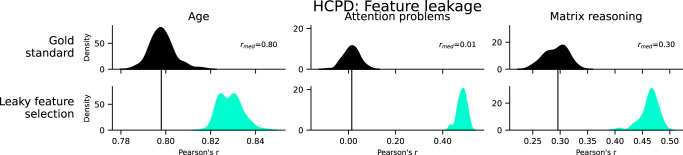
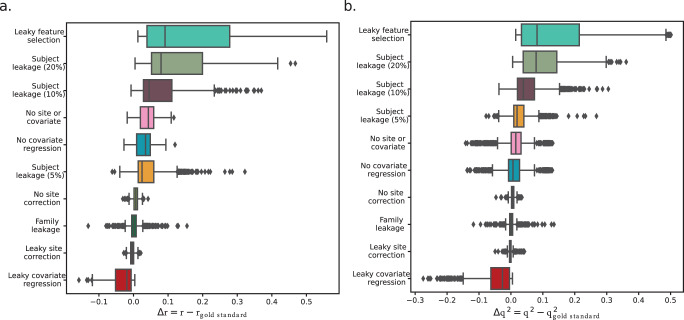
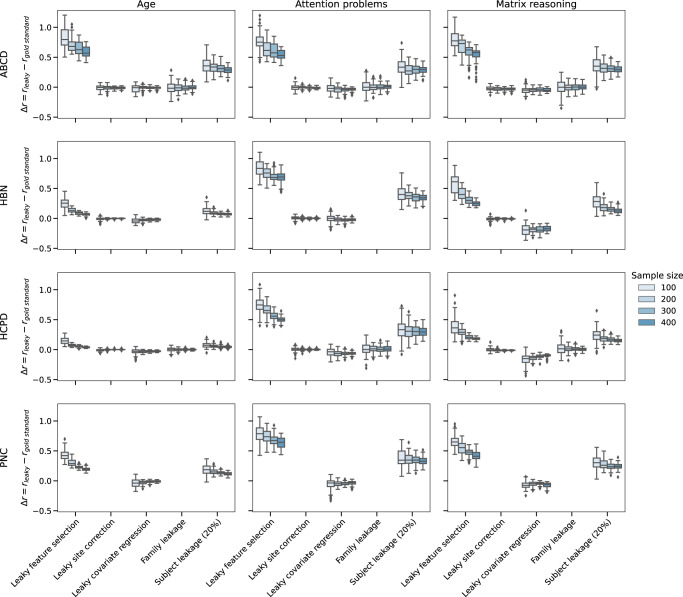
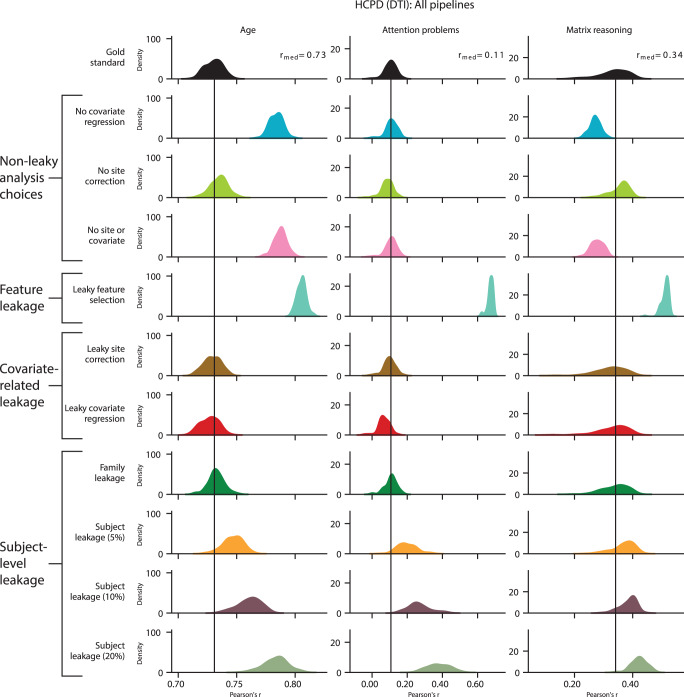
- Feature leakage inflated prediction performance in HCPD: Δr = 0.03 for age, Δr = 0.17 for matrix reasoning, and Δr = 0.47 for attention problems; attention problems went from chance-level (r = 0.01, q2 = −0.13) to moderate (r = 0.48, q2 = 0.22).
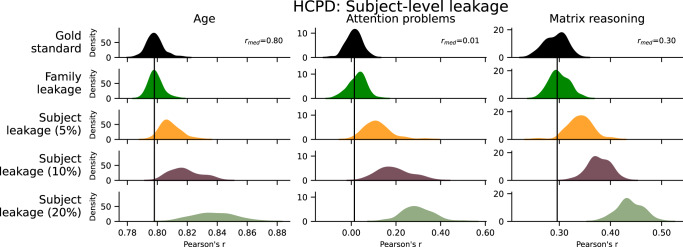
- Subject leakage with 20% repeated subjects inflated performance in HCPD: Δr = 0.28 for attention problems, Δr = 0.04 for age, and Δr = 0.14 for matrix reasoning; across all datasets and phenotypes, subject leakage (20%) gave Δr = 0.06–0.29 and Δq2 = 0.03–0.24.
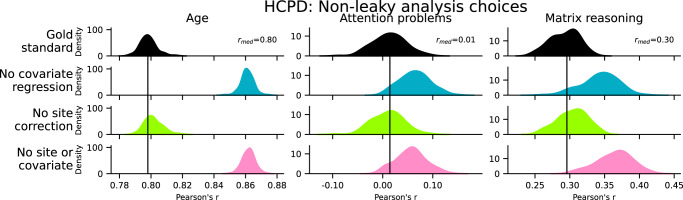
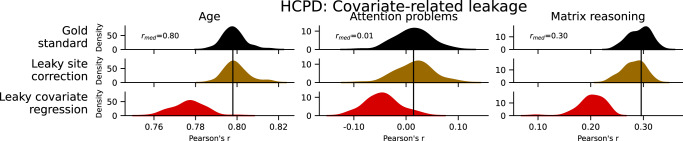
- Leaky covariate regression was the only form that consistently deflated performance: in HCPD, Δr = −0.06 for attention problems, −0.02 for age, and −0.09 for matrix reasoning; across datasets, Δr = −0.09–0.00 and Δq2 = −0.17–0.00. Leaky site correction and family leakage had little to no effect.
- Small samples increased leakage variability: for ABCD matrix reasoning, family leakage Δr ranged from −0.34 to 0.25 at N = 100 versus −0.12 to 0.13 at N = 400; taking medians over multiple k-fold iterations reduced but did not eliminate leakage effects.
Methods
- Four datasets were used: ABCD (N = 7822–7969), HBN (N = 1024–1201), HCPD (N = 424–605), and PNC (N = 1119–1126), predicting age, attention problems, and matrix reasoning from functional connectomes; structural connectomes were also analyzed in 635 HCPD participants.
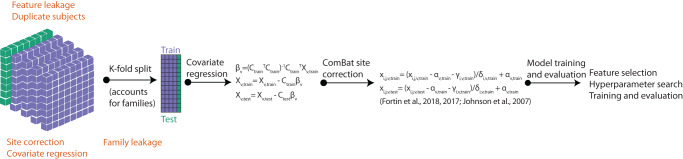
- The main model was ridge regression with 5-fold cross-validation, 5% feature selection, and a grid search for the L2 regularization parameter; the gold standard included cross-validated covariate regression, site correction with ComBat, and family-aware splits where applicable. Over 400 pipelines tested feature leakage, covariate-related leakage, and subject-level leakage, with sensitivity analyses using SVR and CPM.
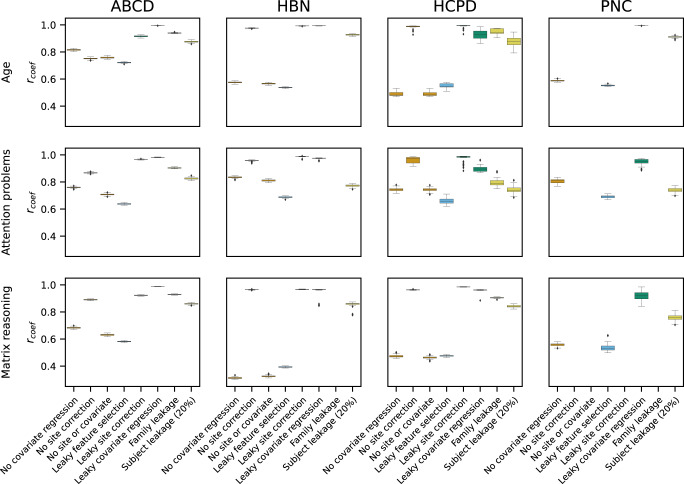
- Performance was evaluated with Pearson’s r and cross-validation R2 (q2) over 100 random seeds; sample-size analyses resampled N = 100, 200, 300, and 400 with 10 resamples and 10 iterations of 5-fold cross-validation, and model coefficients were compared between leaky and non-leaky pipelines.
Limitations
- The paper states it cannot cover all leakage forms, including hyperparameter selection leakage, temporal leakage, unsupervised dimensionality reduction, phenotype standardization, and illegitimate features; it also studied child, adolescent, and young adult cohorts in well-harmonized datasets, so other populations or dataset qualities could alter leakage effects.
- The paper notes leakage is not always well-defined and can be application-dependent, and that effects were tested in only three phenotypes, which do not comprehensively cover all effect sizes; complex models such as neural networks may be more susceptible to leakage.
- Evident from the text: many leakage types had little to no effect in these large, harmonized datasets, so results may not generalize to other datasets or pipelines; family leakage analyses were limited by the small proportion of multi-member families in the full datasets, and subject leakage was operationalized as exact scan duplication rather than longitudinal or repeated-measurement designs.
Model-written summary. Check it against the paper before relying on it.
Integrity signals
Registry
Cites
Statistics
Figures
Verification
Claims the paper makes
19 Valid · 1 Not valid · 3 Not checked · 99 Own results and interpretations
At least one cited source doesn’t support this claim or points to a different paper, and none confirmed it — see the verdicts below.
In the paper
“For example, regressing the covariates/confounds out of the whole dataset in a non-cross-validated manner has been shown to negatively affect prediction performance40.”
§ Data leakage inflates prediction performance in connectome-based machine learning models > Methods > Covariate-related leakage
What the sources say
- Disputedcites [40] Chyzhyk, D., Varoquaux, G., Milham, M. & Thirion, B. How to remove or control confounds in predictive models, with applications to brain biomarkers. Gigascience11, giac014 (2022). PMC8917515 35277962 sourceExperimental — accuracy not yet measured
The Results of the Empirical Study (Experiments on resting-state fMRI data; page not provided) identify removing a confound’s effect from the full dataset as jointly deconfounding the test and training sets, and report that it had little effect on prediction performance across all datasets. The performance decreases described there concern different approaches, including out-of-sample deconfounding. (LLM, conf=0.88)
Checked by a reasoning model — may be wrong.
plainstates a cause- Asserted: passes — The authors put it forward as true.
- Checkable: passes — It can be checked against evidence.
- Load-bearing: passes — The paper’s conclusions depend on it.
- Based: passes — The paper gives a reason why it holds.
- Disputed
Every source the paper cites for this claim was checked and supports it.
In the paper
“Concerns about reproducibility in machine learning17 can be partially attributed to leakage.”
§ Data leakage inflates prediction performance in connectome-based machine learning models > Discussion
What the sources say
- Supportedcites [17] Kapoor S Narayanan A Leakage and the reproducibility crisis in machine-learning-based science Patterns 2023 4 100804 10.1016/j.patter.2023.100804 37720327 PMC10499856 source
The Introduction says the paper investigates reproducibility issues in ML-based science resulting from data leakage. Its survey identifies leakage affecting 294 papers across 17 fields, supporting the claim that leakage accounts for some reproducibility concerns. (LLM, conf=0.92)
plainstates a possible cause- Asserted: passes — The authors put it forward as true.
- Checkable: passes — It can be checked against evidence.
- Load-bearing: unclear — It is unclear whether the paper’s conclusions depend on it.
- Based: passes — The paper gives a reason why it holds.
- Supported
Every source the paper cites for this claim was checked and supports it.
In the paper
“Interestingly, performing covariate regression itself may lead to leakage41 and is another consideration when deciding whether and how to implement covariate regression.”
§ Data leakage inflates prediction performance in connectome-based machine learning models > Discussion
What the sources say
- Supportedcites [41] Hamdan, S. et al. Confound-leakage: confound removal in machine learning leads to leakage. arXiv10.48550/arXiv.2210.09232 (2022). PMC10541796 37776368 source
The Introduction (p. 3) says the authors found strong evidence for confound-leakage after confound removal. The clinical analysis (p. 6) reports potential leakage following featurewise confound regression, and the Discussion (p. 6) describes mechanisms by which it can occur. This supports the citing sentence’s qualified claim that covariate regression may lead to leakage. (LLM, conf=0.94)
hedgedstates a possible cause- Asserted: passes — The authors put it forward as true.
- Checkable: passes — It can be checked against evidence.
- Load-bearing: unclear — It is unclear whether the paper’s conclusions depend on it.
- Based: passes — The paper gives a reason why it holds.
- Supported
The cited sources support only part of this claim — read each source’s verdict below.
In the paper
“Our results corroborate previous works, suggesting that covariate regression must be performed within the cross-validation loop to avoid false deflation of effect sizes38–40.”
§ Data leakage inflates prediction performance in connectome-based machine learning models > Discussion
What the sources say
- Partly supportedcites [38] Snoek L Miletić S Scholte HS How to control for confounds in decoding analyses of neuroimaging data Neuroimage 2019 184 741 760 10.1016/j.neuroimage.2018.09.074 30268846 sourceExperimental — accuracy not yet measured
The Discussion (page unavailable) says that whole-dataset confound regression produced negatively biased model-performance estimates, and that moving regression inside cross-validation overcame this bias. The paper supports the recommendation for decoding performance, but does not establish that covariate regression outside the loop falsely deflates effect sizes generally. (LLM, conf=0.84)
- Partly supportedcites [39] More, S., Eickhoff, S. B., Caspers, J. & Patil, K. R. Machine Learning and Knowledge Discovery in Databases. Applied Data Science and Demo Track. p. 3–18 (Springer International Publishing, 2021). sourceExperimental — accuracy not yet measured
The Experimental Setup (Confound Regression; page unavailable) says that regression before cross-validation causes data leakage, whereas regression fitted within the loop avoids it. The Results (Generalization Performance Estimates; page unavailable) report lower performance estimates with whole-data regression and suggest the within-loop approach is better. The paper does not establish false deflation of effect sizes specifically, and its recommendation is less categorical than “must.” (LLM, conf=0.86)
- Partly supportedcites [40] Chyzhyk, D., Varoquaux, G., Milham, M. & Thirion, B. How to remove or control confounds in predictive models, with applications to brain biomarkers. Gigascience11, giac014 (2022). PMC8917515 35277962 sourceExperimental — accuracy not yet measured
The Discussion (‘Approaches must be adapted to out-of-sample settings’; page unavailable) says deconfounding must separate model estimation from test data, rather than use the whole dataset. The Simulated Data results report a false negative from jointly deconfounding train and test data. However, the paper discusses prediction accuracy rather than effect sizes and says that even correctly performed deconfounding can yield pessimistic evaluations; performing it within cross-validation does not necessarily prevent deflation. (LLM, conf=0.86)
hedgedstates a cause- Asserted: passes — The authors put it forward as true.
- Checkable: passes — It can be checked against evidence.
- Load-bearing: passes — The paper’s conclusions depend on it.
- Based: passes — The paper gives a reason why it holds.
- Partly supported
Every source the paper cites for this claim was checked and supports it.
In the paper
“Various forms of unsupervised dimensionality reduction, such as independent component analysis62,63, are popular in neuroimaging and constitute leakage if performed in the combined training and test datasets prior to performing prediction.”
§ Data leakage inflates prediction performance in connectome-based machine learning models > Methods > Selection of forms of leakage
What the sources say
- Supportedcites [62] McKeown MJ Analysis of fMRI data by blind separation into independent spatial components Hum. Brain Mapp. 1998 6 160 188 10.1002/(SICI)1097-0193(1998)6:3<160::AID-HBM5>3.0.CO;2-1 9673671 PMC6873377 doi:10.1002/(sici)1097-0193(1998)6:3
The superscripts 62,63 sit directly on 'independent component analysis', so what this citation carries is the identification of ICA as an unsupervised dimensionality-reduction method used in neuroimaging. Our copy of McKeown et al. (1998) states exactly that in INDEPENDENT COMPONENT ANALYSIS: the ICA algorithm of Bell and Sejnowski is described as 'an iterative unsupervised neural network learning algorithm' performing 'blind separation' of fMRI signals into maximally independent component maps, and the INTRODUCTION/abstract present it as a method for analysing fMRI data without a priori assumptions. The leakage assertion in the predicate is the citing authors' own methodological claim, not something attributed to this source; our copy contains no discussion of train/test separation or leakage (the only training-subset passage, in the Added noise/Discussion section, concerns jackknife/bootstrap reliability testing, not prediction). (LLM, conf=0.85)
- Supportedcites [63] Chen S Group independent component analysis reveals consistent resting-state networks across multiple sessions Brain Res. 2008 1239 141 151 10.1016/j.brainres.2008.08.028 18789314 PMC2784277 source
The citation is attached to independent component analysis as an example of dimensionality reduction in neuroimaging, not to the sentence’s separate leakage assertion. The Discussion (section 3; page unavailable) describes group ICA of resting-state fMRI data with three data-reduction steps. (LLM, conf=0.90)
plainstates a cause- Asserted: passes — The authors put it forward as true.
- Checkable: passes — It can be checked against evidence.
- Load-bearing: passes — The paper’s conclusions depend on it.
- Based: passes — The paper gives a reason why it holds.
- Supported
72 more claims · 1 with their cited sources checked
Create a free account to see all 122 claims and every source verdict.
- Probably not a substantial claim. 32
- It may state two separate claims as one. 17
- The quote only partly states this claim. 1
Self-check
Percentages, sums and reported differences re-computed from the paper’s own numbers.
Each contradiction between two passages listed here was confirmed by an independent check.
Rated major: it would touch a result — a value a result rests on, reported and recomputed p-values on opposite sides of the significance level, two passages that conflict with no sign which is right, or a cited work retracted before this paper was published.
In the paper
§ Data leakage inflates prediction performance in connectome-based machine learning models > Results > Additional family leakage analyses in ABCD
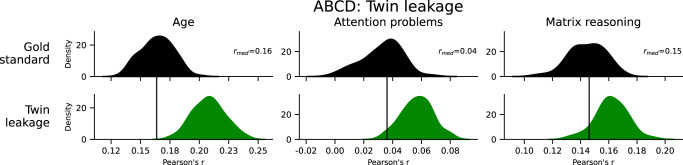
“we performed 100 iterations of 5-fold cross-validation for all three phenotypes and model types.”
§ Data leakage inflates prediction performance in connectome-based machine learning models > Results > Additional family leakage analyses in ABCD
“The black bar represents the median performance of the gold standard models across random iterations, and the histograms show prediction performance across 100 iterations of 20-fold cross-validation.”
Rated minor: it would not touch a result — a value no result rests on, a p-value that stays on the same side of the significance level, or a conflict that is clerical, resolved elsewhere in the paper, or outside its own findings.
In the paper
§ Data leakage inflates prediction performance in connectome-based machine learning models > Methods > Sample size
“we randomly sampled without replacement N = 100, 200, 300, and 400 participants from ABCD, HBN, HCPD, and HBN.”
§ Data leakage inflates prediction performance in connectome-based machine learning models > Results > Effect of sample size
“All previously presented results investigated the four datasets at their full sample sizes (ABCD: N = 7822–7969, HBN: N = 1024–1201, HCPD: N = 424-605, PNC: N = 1104–1126).”
Rated minor: it would not touch a result — a value no result rests on, a p-value that stays on the same side of the significance level, or a conflict that is clerical, resolved elsewhere in the paper, or outside its own findings.
In the paper
§ Data leakage inflates prediction performance in connectome-based machine learning models > Results
“the Philadelphia Neurodevelopmental Cohort (PNC) Dataset25,26 (N = 1119–1126).”
§ Data leakage inflates prediction performance in connectome-based machine learning models > Methods > Philadelphia Neurodevelopmental Cohort Data
“1104 participants had this measure available, and the mean was 1.03 (s.d. 1.19), with a range of 0–6.”
Rated minor: it would not touch a result — a value no result rests on, a p-value that stays on the same side of the significance level, or a conflict that is clerical, resolved elsewhere in the paper, or outside its own findings.
In the paper
§ Data leakage inflates prediction performance in connectome-based machine learning models > Results > Effect of sample size
“taking the median across 10 iterations resulted in a slightly smaller range of Δr values for all forms of leakage (N = 400)”
§ Data leakage inflates prediction performance in connectome-based machine learning models > Results > Effect of sample size
“leaky site correction (Δrmultiple = −0.11–0.03 vs. Δrsingle = –0.06–0.01)”
Citations
Cites
Scikit-learn: Machine Learning in Python
Pedregosa, F., Varoquaux, G., Gramfort, A., Michel, V., Thirion, B., Grisel, O., Blondel, M., Müller, A., Nothman, J., Louppe, G., et al. (2012) · arXiv · doi:10.48550/arxiv.1201.0490 · Cited by 71,016
SciPy 1.0: fundamental algorithms for scientific computing in Python
Virtanen, P., Gommers, R., Oliphant, T. E., Haberland, M., Reddy, T., Cournapeau, D., Burovski, E., Peterson, P., Weckesser, W., Bright, J., et al. (2020) · Nature Methods · doi:10.1038/s41592-019-0686-2 · Cited by 38,430
Harris, C. R., Millman, K. J., van der Walt, S. J., Gommers, R., Virtanen, P., Cournapeau, D., Wieser, E., Taylor, J., Berg, S., Smith, N. J., et al. (2020) · Nature · doi:10.1038/s41586-020-2649-2 · Cited by 23,826
Harris, C., Millman, K., van der Walt, S., Gommers, R., Virtanen, P., Cournapeau, D., Wieser, E., Taylor, J., Berg, S., Smith, N., et al. (2020) · RePEc: Research Papers in Economics · Cited by 17,844
SciPy 1.0: fundamental algorithms for scientific computing in Python
Virtanen, P., Gommers, R., Oliphant, T. E., Haberland, M., Reddy, T., Cournapeau, D., Burovski, E., Peterson, P., Weckesser, W., Bright, J., et al. (2019) · Apollo - University of Cambridge Repository · doi:10.17863/cam.64134 · Cited by 10,460
Adjusting batch effects in microarray expression data using empirical Bayes methods
Johnson, W. E., Li, C., & Rabinovic, A. (2007) · Biostatistics · doi:10.1093/biostatistics/kxj037 · Cited by 8,658 · cited 11×
“…α v,train - γ i,v,train )/δ i,v,train + α v,train x i,j,v,test = (x i,j,v,test - α v,train - γ i,v,train )/δ i,v,train + α v,train (Fortin et al., 2018, 2017; Johnson et al., 2007) Performance when excluding site correction wasnearly identical tothe gold standard model (| Δ r |<0.01, Δ q 2 <0.01).”
InfluentialReback, J., McKinney, W., Bossche, J. V. D., Jbrockmendel, Augspurger, T., Cloud, P., Gfyoung, Sinhrks, Klein, A., Tratner, J., et al. (2019) · Zenodo (CERN European Organization for Nuclear Research) · doi:10.5281/zenodo.3509134 · Cited by 3,464
The Adolescent Brain Cognitive Development (ABCD) study: Imaging acquisition across 21 sites
Casey, B. J., Cannonier, T., Conley, M. I., Cohen, A. O., Barch, D. M., Heitzeg, M. M., Soules, M. E., Teslovich, T., Dellarco, D. V., Garavan, H., et al. (2018) · Developmental Cognitive Neuroscience · doi:10.1016/j.dcn.2018.03.001 · Cited by 2,204
Reproducible brain-wide association studies require thousands of individuals
Marek, S., Tervo-Clemmens, B., Calabro, F. J., Montez, D. F., Kay, B. P., Hatoum, A. S., Donohue, M. R., Foran, W., Miller, R. L., Hendrickson, T. J., et al. (2022) · Nature · doi:10.1038/s41586-022-04492-9 · Cited by 1,928
Miller, T. J., McGlashan, T. H., Rosen, J. L., Cadenhead, K., Ventura, J., McFarlane, W., Perkins, D. O., Pearlson, G. D., & Woods, S. W. (2003) · Schizophrenia Bulletin · doi:10.1093/oxfordjournals.schbul.a007040 · Cited by 1,798
Harmonization of cortical thickness measurements across scanners and sites
Fortin, J.-P., Cullen, N., Sheline, Y. I., Taylor, W. D., Aselcioglu, I., Cook, P. A., Adams, P., Cooper, C., Fava, M., McGrath, P. J., et al. (2018) · NeuroImage · doi:10.1016/j.neuroimage.2017.11.024 · Cited by 1,580 · cited 5×
“A common example of leakage is correcting for site effects, such as with ComBat 29 – 31 , in the whole dataset prior to splitting data into training and testsets.”
InfluentialScanning the horizon: towards transparent and reproducible neuroimaging research
Poldrack, R. A., Baker, C. I., Durnez, J., Gorgolewski, K. J., Matthews, P. M., Munafò, M. R., Nichols, T. E., Poline, J.-B., Vul, E., & Yarkoni, T. (2017) · Nature Reviews Neuroscience · doi:10.1038/nrn.2016.167 · Cited by 1,410 · cited 1×
“Since leakage may dramatically change the reported results, it contributes to the ongoing reproducibility crisis in neuroimaging 17,19 – 21 .”
Leakage and the reproducibility crisis in machine-learning-based science
Kapoor, S., & Narayanan, A. (2023) · Patterns · doi:10.1016/j.patter.2023.100804 · Cited by 1,387 · cited 10×
“Temporal leakage, where a model makes a prediction about the future but uses test data from a time point prior to the training data 17 , is not relevant for cross-sectional studies using static functional and structural connectivity, but it could be relevant for prediction studies using…”
InfluentialAchenbach, T. M., & Ruffle, T. M. (2000) · Pediatrics in Review · doi:10.1542/pir.21-8-265 · Cited by 1,285
Harmonization of multi-site diffusion tensor imaging data
Fortin, J.-P., Parker, D., Tunç, B., Watanabe, T., Elliott, M. A., Ruparel, K., Roalf, D. R., Satterthwaite, T. D., Gur, R. C., Gur, R. E., et al. (2017) · NeuroImage · doi:10.1016/j.neuroimage.2017.08.047 · Cited by 1,261 · cited 2×
“…i,j,v,train = (x i,j,v,train - α v,train - γ i,v,train )/δ i,v,train + α v,train x i,j,v,test = (x i,j,v,test - α v,train - γ i,v,train )/δ i,v,train + α v,train (Fortin et al., 2018, 2017; Johnson et al., 2007) Performance when excluding site correction wasnearly identical tothe gold standard…”
CheXNet: Radiologist-Level Pneumonia Detection on Chest X-Rays with Deep Learning
Rajpurkar, P., Irvin, J., Zhu, K., Yang, B., Mehta, H., Duan, T., Ding, D. Y., Bagul, A., Langlotz, C. P., Shpanskaya, K. S., et al. (2017) · arXiv (Cornell University) · doi:10.48550/arxiv.1711.05225 · Cited by 1,219
Variability in the analysis of a single neuroimaging dataset by many teams
(2020) · doi:10.1038/s41586-020-2314-9 · Cited by 1,097
Using connectome-based predictive modeling to predict individual behavior from brain connectivity
Shen, X., Finn, E. S., Scheinost, D., Rosenberg, M. D., Chun, M. M., Papademetris, X., & Constable, R. T. (2017) · Nature Protocols · doi:10.1038/nprot.2016.178 · Cited by 1,093
Self-citationGroupwise whole-brain parcellation from resting-state fMRI data for network node identification
Shen, X., Tokoglu, F., Papademetris, X., & Constable, R. T. (2013) · NeuroImage · doi:10.1016/j.neuroimage.2013.05.081 · Cited by 1,015
Assessing and tuning brain decoders: Cross-validation, caveats, and guidelines
Varoquaux, G., Raamana, P. R., Engemann, D. A., Hoyos-Idrobo, A., Schwartz, Y., & Thirion, B. (2017) · NeuroImage · doi:10.1016/j.neuroimage.2016.10.038 · Cited by 792
Leakage in data mining: Formulation, detection, and avoidance
Kaufman, S., Rosset, S., Perlich, C., & Stitelman, O. (2012) · ACM Transactions on Knowledge Discovery from Data · doi:10.1145/2382577.2382579 · Cited by 791
Establishment of Best Practices for Evidence for Prediction: A Review
Poldrack, R. A., Huckins, G., & Varoquaux, G. (2020) · JAMA Psychiatry · doi:10.1001/jamapsychiatry.2019.3671 · Cited by 738
An open resource for transdiagnostic research in pediatric mental health and learning disorders
Alexander, L. M., Escalera, J., Ai, L., Andreotti, C., Febre, K., Mangone, A., Vega-Potler, N., Langer, N., Alexander, A., Kovacs, M., et al. (2017) · Scientific Data · doi:10.1038/sdata.2017.181 · Cited by 651
Neuroimaging of the Philadelphia Neurodevelopmental Cohort
Satterthwaite, T. D., Elliott, M. A., Ruparel, K., Loughead, J., Prabhakaran, K., Calkins, M. E., Hopson, R., Jackson, C., Keefe, J., Riley, M., et al. (2014) · NeuroImage · doi:10.1016/j.neuroimage.2013.07.064 · Cited by 504
Development of Abbreviated Nine-Item Forms of the Raven’s Standard Progressive Matrices Test
Bilker, W. B., Hansen, J. A., Brensinger, C. M., Richard, J., Gur, R. E., & Gur, R. C. (2012) · Assessment · doi:10.1177/1073191112446655 · Cited by 432
Ten simple rules for predictive modeling of individual differences in neuroimaging
Scheinost, D., Noble, S., Horien, C., Greene, A. S., Lake, E. M., Salehi, M., Gao, S., Shen, X., O'Connor, D., Barron, D. S., et al. (2019) · NeuroImage · doi:10.1016/j.neuroimage.2019.02.057 · Cited by 381 · cited 4×
“This evaluation metric does not necessarily re fl ect predictive power but is commonly used to establish brain-behavior relationships 28 .”
InfluentialSelf-citationSomerville, L. H., Bookheimer, S. Y., Buckner, R. L., Burgess, G. C., Curtiss, S. W., Dapretto, M., Elam, J. S., Gaffrey, M. S., Harms, M. P., Hodge, C., et al. (2018) · NeuroImage · doi:10.1016/j.neuroimage.2018.08.050 · Cited by 366
Satterthwaite, T. D., Connolly, J. J., Ruparel, K., Calkins, M. E., Jackson, C., Elliott, M. A., Roalf, D. R., Hopson, R., Prabhakaran, K., Behr, M., et al. (2016) · NeuroImage · doi:10.1016/j.neuroimage.2015.03.056 · Cited by 335 · cited 1×
“…Brain Cognitive Development (ABCD) Study 22 ( N = 7822 – 7969), the Healthy Brain Network (HBN) Dataset 23 ( N = 1024 – 1201), the Human Connectome Project Development (HCPD) Dataset 24 ( N = 424 – 605), and the Philadelphia Neurodeve-lopmental Cohort (PNC) Dataset 25,26 ( N = 1119 – 1126).”
Psychometric Properties of the Penn Computerized Neurocognitive Battery
Moore, T. M., Reise, S. P., Gur, R. E., Hakonarson, H., & Gur, R. C. (2015) · Neuropsychology · doi:10.1037/neu0000093 · Cited by 325
Sui, J., Jiang, R., Bustillo, J., & Calhoun, V. (2020) · Biological Psychiatry · doi:10.1016/j.biopsych.2020.02.016 · Cited by 309
Self-citationBioImage Suite: An integrated medical image analysis suite: An update
Papademetris, X., Jackowski, M., Rajeevan, N., DiStasio, M., Okuda, H., Constable, R. T., & Staib, L. (2006) · The Insight Journal · doi:10.54294/2g80r4 · Cited by 298
Does learning require memorization? a short tale about a long tail
Feldman, V. (2020) · Proceedings of the 52nd Annual ACM SIGACT Symposium on Theory of Computing · doi:10.1145/3357713.3384290 · Cited by 287 · cited 1×
“Yet, complex models like neural networks are likely more susceptible to leakage due to their ability to memorize data 52,53 .”
Winkler, A. M., Webster, M. A., Vidaurre, D., Nichols, T. E., & Smith, S. M. (2015) · NeuroImage · doi:10.1016/j.neuroimage.2015.05.092 · Cited by 243
When Optimism Hurts: Inflated Predictions in Psychiatric Neuroimaging
Whelan, R., & Garavan, H. (2014) · Biological Psychiatry · doi:10.1016/j.biopsych.2013.05.014 · Cited by 209
I tried a bunch of things: The dangers of unexpected overfitting in classification of brain data
Hosseini, M., Powell, M., Collins, J., Callahan-Flintoft, C., Jones, W., Bowman, H., & Wyble, B. (2020) · Neuroscience & Biobehavioral Reviews · doi:10.1016/j.neubiorev.2020.09.036 · Cited by 165
Multivariate BWAS can be replicable with moderate sample sizes
Spisák, T., Bingel, U., & Wager, T. D. (2023) · Nature · doi:10.1038/s41586-023-05745-x · Cited by 158
How to control for confounds in decoding analyses of neuroimaging data
Snoek, L., Miletić, S., & Scholte, H. S. (2019) · NeuroImage · doi:10.1016/j.neuroimage.2018.09.074 · Cited by 143 · cited 5×
“In addition, we performed cross-validated covariate regression, where several covariates were regressed from the functional connectivity data within the cross-validation scheme 38,40 .”
InfluentialChen, S., Ross, T. J., Zhan, W., Myers, C. S., Chuang, K.-S., Heishman, S. J., Stein, E. A., & Yang, Y. (2008) · Brain Research · doi:10.1016/j.brainres.2008.08.028 · Cited by 139 · cited 1×
“Various forms of unsupervised dimensionality reduction, such as independent component analysis 62,63 , are popular in neuroimaging and constitute leakage if performed in the combined training and test datasets prior to performing prediction.”
Li, J., Bzdok, D., Chen, J., Tam, A., Ooi, L. Q. R., Holmes, A. J., Ge, T., Patil, K. R., Jabbi, M., Eickhoff, S. B., et al. (2022) · Science Advances · doi:10.1126/sciadv.abj1812 · Cited by 133
Prediction, Not Association, Paves the Road to Precision Medicine
Bzdok, D., Varoquaux, G. P., & Steyerberg, E. W. (2020) · JAMA Psychiatry · doi:10.1001/jamapsychiatry.2020.2549 · Cited by 124
Reproducibility in Neuroimaging Analysis: Challenges and Solutions
Botvinik‐Nezer, R., & Wager, T. D. (2022) · Biological Psychiatry Cognitive Neuroscience and Neuroimaging · doi:10.1016/j.bpsc.2022.12.006 · Cited by 118
Genetic Contribution to Variation in Cognitive Function: An fMRI Study in Twins
Koten, J. W., Wood, G., Hagoort, P., Goebel, R., Propping, P., Willmes, K., & Boomsma, D. I. (2009) · Science · doi:10.1126/science.1167371 · Cited by 105
A guided multiverse study of neuroimaging analyses
Dafflon, J., da Costa, P. F., Váša, F., Monti, R. P., Bzdok, D., Hellyer, P. J., Turkheimer, F., Smallwood, J., Jones, E. J. H., & Leech, R. (2022) · Nature Communications · doi:10.1038/s41467-022-31347-8 · Cited by 100
Harmonization of cortical thickness measurements across scanners and sitesPreprint
Fortin, J., Cullen, N. C., Sheline, Y. I., et al. (2017) · bioRxiv (Cold Spring Harbor Laboratory) · doi:10.1101/148502 · Cited by 88
Preventing dataset shift from breaking machine-learning biomarkers
Dockès, J., Varoquaux, G., & Poline, J.-B. (2021) · GigaScience · doi:10.1093/gigascience/giab055 · Cited by 86
Harmonization of multi-site diffusion tensor imaging dataPreprint
Fortin, J., Parker, D., Tunç, B., et al. (2017) · bioRxiv (Cold Spring Harbor Laboratory) · doi:10.1101/116541 · Cited by 84
A hitchhiker’s guide to working with large, open-source neuroimaging datasets
Horien, C. L., Noble, S., Greene, A. S., Lee, K., Barron, D. S., Gao, S., O’Connor, D. A., Salehi, M., Dadashkarimi, J., Shen, X., et al. (2020) · Nature Human Behaviour · doi:10.1038/s41562-020-01005-4 · Cited by 79
Self-citationWang, R., Chaudhari, P., & Davatzikos, C. (2023) · Proceedings of the National Academy of Sciences · doi:10.1073/pnas.2211613120 · Cited by 78
Transdiagnostic Connectome-Based Prediction of Craving
Garrison, K. A., Sinha, R., Potenza, M. N., Gao, S., Liang, Q., Lacadie, C., & Scheinost, D. (2023) · American Journal of Psychiatry · doi:10.1176/appi.ajp.21121207 · Cited by 75
Self-citationImproving power in functional magnetic resonance imaging by moving beyond cluster-level inference
Noble, S., Mejia, A. F., Zalesky, A., & Scheinost, D. (2022) · Proceedings of the National Academy of Sciences · doi:10.1073/pnas.2203020119 · Cited by 67
Self-citationHow to remove or control confounds in predictive models, with applications to brain biomarkers
Chyzhyk, D., Varoquaux, G., Milham, M., & Thirion, B. (2022) · GigaScience · doi:10.1093/gigascience/giac014 · Cited by 65 · cited 5×
“In addition, we performed cross-validated covariate regression, where several covariates were regressed from the functional connectivity data within the cross-validation scheme 38,40 .”
InfluentialLund, M. J., Alnæs, D., de Lange, A. G., Andreassen, O. A., Westlye, L. T., & Kaufmann, T. (2021) · NeuroImage Clinical · doi:10.1016/j.nicl.2021.102921 · Cited by 61
Transdiagnostic, Connectome-Based Prediction of Memory Constructs Across Psychiatric Disorders
Barron, D. S., Gao, S., Dadashkarimi, J., Greene, A. S., Spann, M. N., Noble, S., Lake, E. M. R., Krystal, J. H., Constable, R. T., & Scheinost, D. (2021) · Cerebral Cortex · doi:10.1093/cercor/bhaa371 · Cited by 60
Self-citationPredicting the future of neuroimaging predictive models in mental health
Tejavibulya, L., Rolison, M. J., Gao, S., Liang, Q., Peterson, H., Dadashkarimi, J., Farruggia, M. C., Hahn, C. A., Noble, S., Lichenstein, S. D., et al. (2022) · Molecular Psychiatry · doi:10.1038/s41380-022-01635-2 · Cited by 60
Self-citationHeritability of Regional Brain Volumes in Large-Scale Neuroimaging and Genetic Studies
Zhao, B., Ibrahim, J. G., Li, Y., Li, T., Wang, Y., Shan, Y., Zhu, Z., Zhou, F., Zhang, J., Huang, C., et al. (2019) · Cerebral Cortex · doi:10.1093/cercor/bhy157 · Cited by 58
Multimodal brain connectome-based prediction of suicide risk in people with late-life depression
Gao, M., Wong, N. M. L., Lin, C., Huang, C., Liu, H., Toh, C., Wu, C. W., Tsai, Y., Lee, S.-H., & Lee, T. M. C. (2023) · Nature Mental Health · doi:10.1038/s44220-022-00007-7 · Cited by 48
Heritability estimates on resting state fMRI data using ENIGMA analysis pipeline
Adhikari, B. M., Jahanshad, N., Shukla, D., Glahn, D. C., Blangero, J., Reynolds, R. C., Cox, R. W., Fieremans, E., Veraart, J., Novikov, D. S., et al. (2018) · Biocomputing 2018 · doi:10.1142/9789813235533_0029 · Cited by 47
Predicting Brain Age Based on Spatial and Temporal Features of Human Brain Functional Networks
Zhai, J., & Li, K. (2019) · Frontiers in Human Neuroscience · doi:10.3389/fnhum.2019.00062 · Cited by 43
Chen, Z., Liu, X., Yang, Q., Wang, Y.-J., Miao, K., Gong, Z., Yu, Y., Leonov, A., Liu, C., Feng, Z., et al. (2023) · JAMA Network Open · doi:10.1001/jamanetworkopen.2023.1671 · Cited by 43
Resting-state functional connectivity identifies individuals and predicts age in 8-to-26-month-olds
Kardan, O., Kaplan, S., Wheelock, M. D., Feczko, E., Day, T. K. M., Miranda-Domínguez, Ó., Meyer, D., Eggebrecht, A. T., Moore, L. A., Sung, S., et al. (2022) · Developmental Cognitive Neuroscience · doi:10.1016/j.dcn.2022.101123 · Cited by 40
Confound Removal and Normalization in Practice: A Neuroimaging Based Sex Prediction Case Study
More, S., Eickhoff, S. B., Caspers, J., & Patil, K. R. (2021) · Lecture Notes in Computer Science · doi:10.1007/978-3-030-67670-4_1 · Cited by 37
Reporting details of neuroimaging studies on individual traits prediction: A literature survey
Yeung, A. W. K., More, S., Wu, J., & Eickhoff, S. B. (2022) · NeuroImage · doi:10.1016/j.neuroimage.2022.119275 · Cited by 36
Publisher Correction: Reproducible brain-wide association studies require thousands of individuals
Marek, S. A., Tervo‐Clemmens, B., Calabro, F. J., et al. (2022) · Nature · doi:10.1038/s41586-022-04692-3 · Cited by 35
Statistical quantification of confounding bias in machine learning models
Spisak, T. (2022) · GigaScience · doi:10.1093/gigascience/giac082 · Cited by 34
Predicting attention across time and contexts with functional brain connectivity
Song, H., & Rosenberg, M. D. (2021) · Current Opinion in Behavioral Sciences · doi:10.1016/j.cobeha.2020.12.007 · Cited by 33
Connectome‐based predictive modelling of cognitive reserve using task‐based functional connectivity
Boyle, R. T., Connaughton, M., McGlinchey, E., Knight, S. P., Looze, C. D., Carey, D., Stern, Y., Robertson, I. H., Kenny, R. A., & Whelan, R. (2022) · European Journal of Neuroscience · doi:10.1111/ejn.15896 · Cited by 29
Confound-leakage: confound removal in machine learning leads to leakage
Hamdan, S., Love, B. C., von Polier, G. G., Weis, S., Schwender, H. R., Eickhoff, S. B., & Patil, K. R. (2022) · GigaScience · doi:10.1093/gigascience/giad071 · Cited by 24
Brain age has limited utility as a biomarker for capturing fluid cognition in older individualsPreprint
Tetereva, A., & Pat, N. (2024) · eLife · doi:10.7554/elife.87297 · Cited by 23
Connectome-based predictive modeling of compulsion in obsessive–compulsive disorder
Wu, X., Yang, Q., Xu, C., Huo, H., Seger, C. A., Peng, Z., & Chen, Q. (2022) · Cerebral Cortex · doi:10.1093/cercor/bhac145 · Cited by 20
Overfitting to ‘predict’ suicidal ideation
Verstynen, T., & Kording, K. P. (2023) · Nature Human Behaviour · doi:10.1038/s41562-023-01560-6 · Cited by 15
Heritability of regional brain volumes in large-scale neuroimaging and genetic studiesPreprint
Zhao, B., Ibrahim, J. G., Li, Y., et al. (2017) · bioRxiv (Cold Spring Harbor Laboratory) · doi:10.1101/208496 · Cited by 10
Lund, M. J., Alnæs, D., de Lange, A. G., et al. (2021) · medRxiv · doi:10.1101/2021.04.02.21254831 · Cited by 7
Transdiagnostic connectome-based prediction of cravingPreprint
Garrison, K. A., Sinha, R., Potenza, M. N., et al. (2021) · medRxiv · doi:10.1101/2021.05.21.21257620 · Cited by 7
Confound-leakage: Confound Removal in Machine Learning Leads to Leakage
Hamdan, S., Love, B. C., von Polier, G. G., Weis, S., Schwender, H., Eickhoff, S. B., & Patil, K. R. (2022) · arXiv · doi:10.48550/arxiv.2210.09232 · Cited by 4
The (Limited?) Utility of Brain Age as a Biomarker for Capturing Cognitive DeclinePreprint
Tetereva, A., & Pat, N. (2023) · eLife · doi:10.7554/elife.87297.1 · Cited by 3
Tetereva, A., & Pat, N. (2024) · bioRxiv · doi:10.1101/2022.12.31.522374 · Cited by 1
mattrosenblatt7/leakage_neuroimaging: v1.0.0
mattrosenblatt7 (2024) · Zenodo (CERN European Organization for Nuclear Research) · doi:10.5281/zenodo.10570213 · Cited by 1
(1998) · doi:10.1002/(sici)1097-0193(1998)6:3<160::aid-hbm5>3.0.co;2-1
The pandas development team (2024) · Zenodo · doi:10.5281/zenodo.10537285
Research works printed but not linked: 2
- Carlini, N., Liu, C., Erlingsson, Ú., Kos, J. & Song, D. The secret sharer: evaluating and testing unintended memorization in neural networks. in USENIX Security Symposium 267 (2019).
- Wechsler, D. WISC-V: Technical And Interpretive Manual (NCS Pearson, Incorporated, 2014).
Cited by
Don’t push the button! Exploring data leakage risks in machine learning and transfer learning
Apicella, A., Isgrò, F., & Prevete, R. (2025) · Artificial Intelligence Review · doi:10.1007/s10462-025-11326-3 · Cited by 223
Overview of leakage scenarios in supervised machine learning
Sasse, L., Nicolaisen‐Sobesky, E., Dukart, J., Eickhoff, S. B., GOETZ, M. A., Hamdan, S., Komeyer, V., Kulkarni, A. J., Lahnakoski, J. M., Love, B. C., et al. (2025) · Journal Of Big Data · doi:10.1186/s40537-025-01193-8 · Cited by 151
A review of machine learning methods for cancer characterization from microbiome data
Teixeira, M., Silva, F., Ferreira, R. M., Pereira, T., Figueiredo, C., & Oliveira, H. P. (2024) · npj Precision Oncology · doi:10.1038/s41698-024-00617-7 · Cited by 61
Artificial intelligence investments reduce risks to critical mineral supply
Vespignani, J., & Smyth, R. (2024) · Nature Communications · doi:10.1038/s41467-024-51661-7 · Cited by 54
Ma, C., Zhang, H., Rao, Y., Jiang, X., Liu, B., Sun, Z., Song, Z., Gao, Y., Cui, Y., Liu, X., et al. (2025) · npj Digital Medicine · doi:10.1038/s41746-025-02198-6 · Cited by 76
Metadata
- Authors
- Rosenblatt, M., Tejavibulya, L., Jiang, R., Noble, S., & Scheinost, D.
- Affiliations
- Yale University (US)
- Northeastern University (US)
- Corresponding author
- Rosenblatt, Matthew
- Venue
- Nature Communications
- Published
- 2024-02-28
- Volume
- 15
- Issue
- 1
- Pages
- 1829-1829
- ISSN
- 2041-1723 (ISSN-L)
- PMC
- PMC10901797
- OpenAlex
- W4392232009
- Semantic Scholar
- 22640fdce74910741894099aa71f3eb74877a633
- Cited by
- 236
- References
- 78
- Citations by year
- 2026: 150 · 2025: 61 · 2024: 24
- FWCI
- 57.17
- Type
- journal article
- Language
- en
- Open access
- gold
- doi.org
- Licence
- cc-by
- creativecommons.org/licenses/by/4.0 (tdm)
- creativecommons.org/licenses/by/4.0 (vor)
- Locations
- Nature Communications (publishedVersion, cc-by)
- bioRxiv (Cold Spring Harbor Laboratory) (acceptedVersion, cc-by-nc-nd)
- PubMed Central (publishedVersion, cc-by)
- PubMed (publishedVersion)
- PubMed Central (submittedVersion, cc-by-nd)
- RePEc: Research Papers in Economics (submittedVersion)
- DOAJ (DOAJ: Directory of Open Access Journals) (submittedVersion)
- Funders
- National Science Foundation (DGE2139841)
- Gruber Science Fellowship
- U.S. Department of Health & Human Services | NIH | National Institute of Mental Health (R00MH130894, R01MH121095)
- Topics
- Life Sciences › Neuroscience › Cognitive Neuroscience › Functional Brain Connectivity Studies
- Health Sciences › Medicine › Radiology, Nuclear Medicine and Imaging › Advanced Neuroimaging Techniques and Applications
- Health Sciences › Health Professions › Health Information Management › Artificial Intelligence in Healthcare
- Keywords
- data leakage, functional connectome, structural connectome, brain-behavior relationship, feature selection, small sample size, model generalization, reproducibility
About these checks
Registry, retraction, Cites and statistics results are computed, not judged, with one exception: a printed reference that no index lists is read once by a model before it counts as a citation error. Claims are extracted by a model and kept only when their quote appears verbatim in the text; each cited source is then checked, with a model’s help, for whether it says what the claim relies on. Those verdicts can be wrong — read the claim’s quote and the cited source before relying on one.
The claim verdicts this report counts are experimental: their accuracy is not yet measured.
A language model drew the claims from the paper on 2026-10-10, under version 3 of the claim definition (model deepseek-v4.1-flash, prompt extract-v3).
A second model labelled each claim on 2026-10-10 (model jev-1.13-20260917, definition revision gold-guideline-v0.2).
Cited sources are checked with a language model’s help (gpt-6-sol and qwen3.8-omni-flash).
Statistics and arithmetic are recomputed, not judged.
Confidence bands are shown only for fields calibrated on our annotated test set. None is calibrated yet, so no band is shown.
What counts as a claim ›How we measure confidence ›How we check this ›
Are you an author, or do you see a problem with this page? Request a review
Data sources
Bibliographic data: Semantic Scholar, OpenAlex, Crossref.
Contains information from the Semantic Scholar Academic Graph Datasets, made available under the ODC Attribution License (ODC-BY 1.0).
Semantic Scholar’s data is described in: Kinney, R., et al. (2023). The Semantic Scholar Open Data Platform. arXiv:2301.10140.
