

Orphan high field superconductivity in non-superconducting uranium ditelluride
Open accessThe DOI matches its Crossref record; 68 of the 83 references it cites were found in a registry or an index; 45 of the 55 sources its claims cite were checked for support.
Abstract
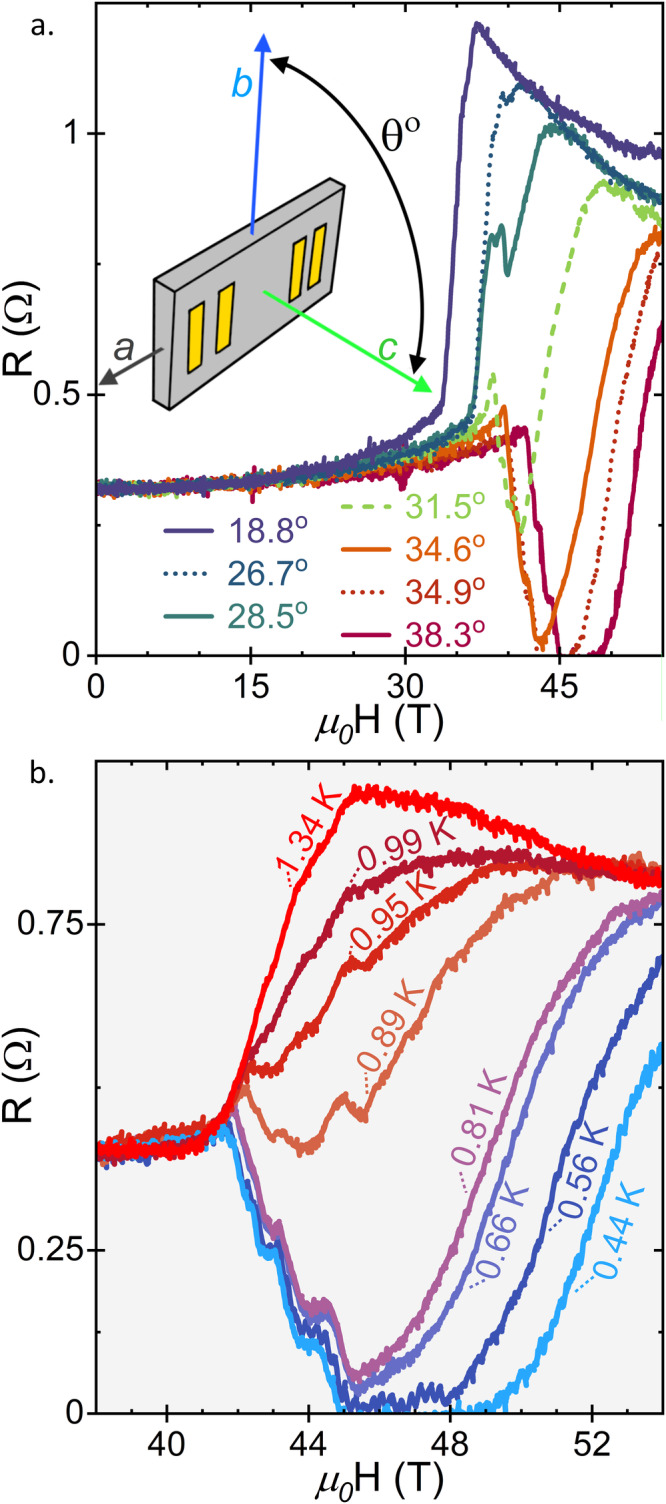
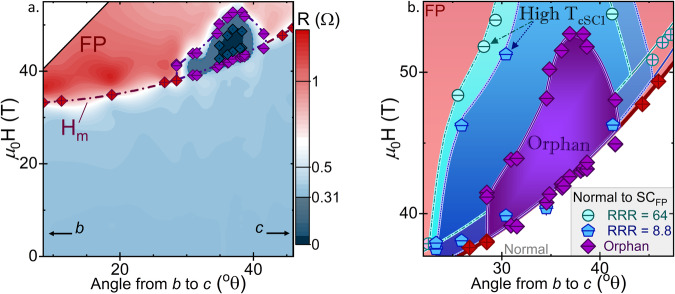
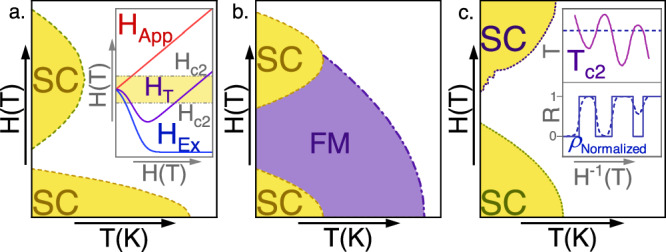
Abstract Reentrant superconductivity is an uncommon phenomenon in which the destructive effects of magnetic field on superconductivity are mitigated, allowing a zero-resistance state to survive under conditions that would otherwise destroy it. Typically, the reentrant superconducting region derives from a zero-field parent superconducting phase. Here, we show that in UTe 2 crystals extreme applied magnetic fields give rise to an unprecedented high-field superconductor that lacks a zero-field antecedent. This high-field orphan superconductivity exists at angles offset between 29 o and 42 o from the crystallographic b to c axes with applied fields between 37 T and 52 T. The stability of field-induced orphan superconductivity presented in this work defies both empirical precedent and theoretical explanation and demonstrates that high-field superconductivity can exist in an otherwise non-superconducting material.
Overview
CoChat Summary
## TL;DR
The paper reports an “orphan” high-field superconducting phase in UTe2 that appears without any zero-field superconducting parent phase, after disorder suppresses the usual low-field superconductivity. This field-induced zero-resistance state occurs only in a tilted-field window between 29° and 42° from the b axis and between 37 T and 52 T, challenging existing explanations for high-field superconductivity.
## Key findings
- In the “Orphan UTe2” samples, there was no evidence of SC1 or SC2 below 35 T for any field orientation in the bc plane; the crystals remained paramagnetic metals and showed Fermi-liquid T² resistivity below 10 K with no superconducting transition down to 110 mK.
- The field-induced orphan superconducting phase (oSCFP) emerged at field angles from 29° to 42° offset from the crystallographic b axis toward the c axis, with an upper field bound of 52 T.
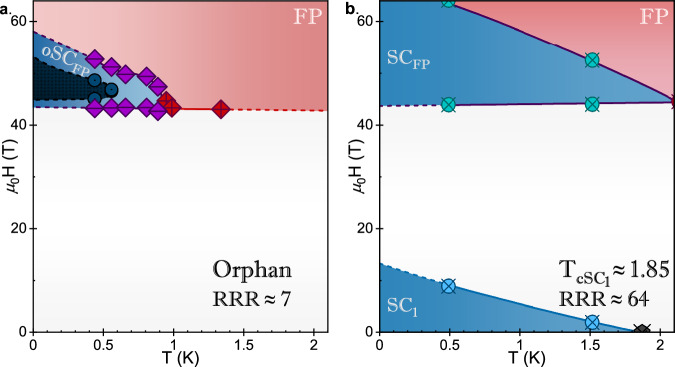
- The zero-resistance state in oSCFP persisted to just above 0.5 K, while a superconducting envelope persisted to almost 0.9 K; all resistive superconducting signatures were suppressed by 1 K.
- The paper states this is the first evidence of “orphaned” high-field superconductivity without an accompanying low-field parent phase and the first example of exclusively high-field-stabilized superconductivity in a uranium-based system.
## Methods
- Single crystals were grown by chemical vapor transport with iodine; the “Orphan UTe2” crystals were grown over one week as thin plates, and the Low-R and High-R comparison crystals were grown over two weeks under the stated U:Te starting ratios and furnace temperatures.
- Zero-field resistance was measured to 100 mK using a Quantum Design PPMS with ADR; high-field measurements used a cryogenic single-axis goniometer at NHMFL Los Alamos, with fields up to 55 T or 60 T, and a 65 T short-pulse magnet for magnetoresistance and proximity diode oscillator measurements.
- The main analysis was transport-based identification of zero resistance / superconducting transitions as a function of field strength, angle, and temperature, with comparison to other UTe2 crystals of different disorder levels via RRR.
## Limitations
- The paper notes that the pairing symmetry of the high-field phase is still unknown and that the stability of field-induced orphan superconductivity defies theoretical explanation; this is a stated limitation of current understanding.
- It also states that prior explanations for high-field superconductivity are incompatible with a phase that emerges only at extremely high fields, so existing models cannot account for the observations; this is explicit in the text.
- Evident from the text: the conclusions rely primarily on resistance/magnetoresistance and oscillator measurements in a narrow angular range and on a limited set of crystals, so the broader generality of the effect beyond the reported samples is not established in the paper.
Model-written summary. Check it against the paper before relying on it.
Integrity signals
Registry
Cites
Statistics
Figures
Verification
Claims the paper makes
19 Valid · 2 Not valid · 3 Not checked · 20 Own results and interpretations
The cited sources support only part of this claim — read each source’s verdict below.
In the paper
“The narrower angular range of the oSCFP is striking when compared to typical SCFP, which extends from 25o to 42o in crystals with higher RRR (Fig. 2b, see Fig. S4 in Supplementary Information for comparison with published data3,35,36,41).”
§ Orphan high field superconductivity in non-superconducting uranium ditelluride > Results and discussion
What the sources say
- Partly supportedcites [3] Ran S Extreme magnetic field-boosted superconductivity Nat. Phys. 2019 15 1250 1254 PMC8201648 34131432 sourceExperimental — accuracy not yet measured
The paper reports an SCFP phase over approximately 20°–40° from the b-axis toward the c-axis (p. 3), supporting the comparison to a broad angular range, though not the stated 25°–42° bounds. Our copy does not establish that the crystals had higher RRR, and it does not discuss the oSCFP phase or make the narrower-range comparison. (LLM, conf=0.83)
- Could not verifycites [35] Miyake A Metamagnetic transition in heavy fermion superconductor UTe2 J. Phys. Soc. Jpn. 2019 88 063706 sourceExperimental — accuracy not yet measured
The cited paper discusses UTe₂ magnetization for fields along the a- and b-axes (pp. 1–2) and possible field-reinforced superconductivity (p. 4). Searches for the 25°–42° angular range and higher-RRR crystals found no passage in our copy addressing either, so it cannot verify the comparison with oSCFP. (LLM, conf=0.76)
- Partly supportedcites [36] Niu Q Evidence of Fermi surface reconstruction at the metamagnetic transition of the strongly correlated superconductor UTe2 Phys. Rev. Res. 2020 2 033179 sourceExperimental — accuracy not yet measured
The Introduction reports reentrant superconductivity with the field tilted 30° from the b axis toward the c axis. The Experimental Details list samples’ RRR values, but the paper does not give a 25°–42° angular range, relate that range to higher RRR, or compare it with the oSCFP phase. Page numbers are unavailable in our copy. (LLM, conf=0.84)
- Could not verifycites [41] Knebel G Field-reentrant superconductivity close to a metamagnetic transition in the heavy-fermion superconductor UTe2 J. Phys. Soc. Jpn. 2019 88 063707 sourceExperimental — accuracy not yet measured
The angular-dependence results (p. 3) discuss superconductivity near the b-axis, including its suppression when the field is rotated toward the a-axis. Neither those passages nor the searched passages on crystal quality and tilted fields establish a 25°–42° range for typical SCFP in higher-RRR crystals. The paper also does not address the comparison with oSCFP in Orphan UTe2. (LLM, conf=0.76)
plainstates an association- Asserted: passes — The authors put it forward as true.
- Checkable: passes — It can be checked against evidence.
- Load-bearing: unclear — It is unclear whether the paper’s conclusions depend on it.
- Based: passes — The paper gives a reason why it holds.
- Partly supported
Every source the paper cites for this claim was checked and supports it.
In the paper
“The zero-resistance state is centered at 36o, which is far from the crystallographic (0 1 1) direction, situated at 23.7 o, suggesting that there is not a direct relationship between the two, which has been previously hypothesized4.”
§ Orphan high field superconductivity in non-superconducting uranium ditelluride > Results and discussion
What the sources say
- Supportedcites [4] Knafo W Comparison of two superconducting phases induced by a magnetic field in UTe2 Commun. Phys. 2021 4 40 source
The citation supports the previously hypothesized relationship, not the citing authors’ conclusion that there is no direct relationship. The Discussion (p. 6) says the direction associated with the (0 1 1) planes lies 23.7° from b, coincides within experimental uncertainty with the field direction where SC-PPM develops, and may not be accidental. (LLM, conf=0.92)
hedgedSingle case- Asserted: passes — The authors put it forward as true.
- Checkable: passes — It can be checked against evidence.
- Load-bearing: passes — The paper’s conclusions depend on it.
- Based: passes — The paper gives a reason why it holds.
- Supported
The cited sources support only part of this claim — read each source’s verdict below.
In the paper
“This temperature differs dramatically from the value of 1.5 K reported before in samples exhibiting low field superconductivity3, and even more so from the high High-R sample (Fig. 3b).”
§ Orphan high field superconductivity in non-superconducting uranium ditelluride > Results and discussion
What the sources say
- Partly supportedcites [3] Ran S Extreme magnetic field-boosted superconductivity Nat. Phys. 2019 15 1250 1254 PMC8201648 34131432 sourceExperimental — accuracy not yet measured
The temperature-stability discussion (p. 3) reports that the high-field SC FP phase disappears near 1.6 K, similar to the zero-field superconducting critical temperature. This supports the approximate comparison with samples showing low-field superconductivity, but the cited paper does not report the stated value of 1.5 K. The contrast with 1 K is the citing authors’ comparison, not a finding attributed to this source. (LLM, conf=0.83)
plainSingle case- Asserted: passes — The authors put it forward as true.
- Checkable: passes — It can be checked against evidence.
- Load-bearing: passes — The paper’s conclusions depend on it.
- Based: passes — The paper gives a reason why it holds.
- Partly supported
The cited sources support only part of this claim — read each source’s verdict below.
In the paper
“UTe2 crystals with no SC1 transition usually have a RRR ≲ 5, which implies a high degree of disorder33,34.”
§ Orphan high field superconductivity in non-superconducting uranium ditelluride > Results and discussion
What the sources say
- Partly supportedcites [33] Ran S Comparison of two different synthesis methods of single crystals of superconducting uranium ditelluride J. Vis. Exp. 2021 173 e62563 PMC10505351 34309595 sourceExperimental — accuracy not yet measured
The Representative Results report that a flux-grown UTe2 sample did not superconduct, had an RRR of approximately 2, and had more crystallographic impurities or defects than the superconducting sample. The paper does not establish that crystals lacking the SC1 transition usually have RRR ≲ 5; its reported value concerns the flux-grown sample, not a general threshold. (LLM, conf=0.86)
- Partly supportedcites [34] Rosa PFS Single thermodynamic transition at 2 K in superconducting UTe2 single crystals Commun. Mater. 2022 3 33 sourceExperimental — accuracy not yet measured
The Electrical Resistivity section reports RRR = 2 for one non-superconducting sample, s7. The Discussion treats low RRR as an indicator of disorder. The paper does not establish that crystals without an SC1 transition *usually* have RRR ≲ 5. (LLM, conf=0.84)
plainstates an association- Asserted: passes — The authors put it forward as true.
- Checkable: passes — It can be checked against evidence.
- Load-bearing: unclear — It is unclear whether the paper’s conclusions depend on it.
- Based: passes — The paper gives a reason why it holds.
- Partly supported
The cited sources support only part of this claim — read each source’s verdict below.
In the paper
“Nevertheless, the field value of this transition still corresponds to the temperature value of a maximum in the magnetic susceptibility with field along b, Tχmax ≈ 35 K, previously reported for both nonsuperconducting38 and superconducting4 UTe2.”
§ Orphan high field superconductivity in non-superconducting uranium ditelluride > Results and discussion
What the sources say
- Partly supportedcites [38] Ikeda S Single crystal growth and magnetic properties of UTe2 J. Phys. Soc. Jpn. 2006 75 116 118 sourceExperimental — accuracy not yet measured
The magnetic-susceptibility discussion (p. 2) reports a maximum for field along [010], the b axis, but places it at about 40 K rather than approximately 35 K. The paper does not establish a correspondence between that temperature and a metamagnetic-transition field. (LLM, conf=0.86)
- Supportedcites [4] Knafo W Comparison of two superconducting phases induced by a magnetic field in UTe2 Commun. Phys. 2021 4 40 source
The introduction (p. 2) reports a metamagnetic transition at approximately 35 T for a field along b and an empirical 1 T ↔ 1 K correspondence with the susceptibility maximum at approximately 35 K. This supports the part of the citing sentence attributed to this paper—the previously reported relationship in superconducting UTe2. (LLM, conf=0.91)
plainstates an association- Asserted: passes — The authors put it forward as true.
- Checkable: passes — It can be checked against evidence.
- Load-bearing: unclear — It is unclear whether the paper’s conclusions depend on it.
- Based: passes — The paper gives a reason why it holds.
- Partly supported
18 more claims · 4 with their cited sources checked
Create a free account to see all 44 claims and to verify the 2 references still open.
- It may state two separate claims as one. 14
- Probably not a substantial claim. 8
- The quote only partly states this claim. 1
Citations
Cites
Coexistence of superconductivity and ferromagnetism in URhGe
Aoki, D., Huxley, A., Ressouche, E., Braithwaite, D., Flouquet, J., Brison, J.-P., Lhotel, E., & Paulsen, C. (2001) · Nature · doi:10.1038/35098048 · Cited by 1,018
Nearly ferromagnetic spin-triplet superconductivity
Ran, S., Eckberg, C., Ding, Q.-P., Furukawa, Y., Metz, T., Saha, S. R., Liu, I.-L., Zic, M., Kim, H., Paglione, J., et al. (2019) · Science · doi:10.1126/science.aav8645 · Cited by 611
Self-citationSuperconductivity on the Border of Weak Itinerant Ferromagnetism in UCoGe
Huy, N. T., Gasparini, A., de Nijs, D. E., Huang, Y., Klaasse, J. C. P., Gortenmulder, T., de Visser, A., Hamann, A., Görlach, T., & Löhneysen, H. V. (2007) · Physical Review Letters · doi:10.1103/physrevlett.99.067006 · Cited by 573
Chiral superconductivity in heavy-fermion metal UTe2
Jiao, L., Howard, S., Ran, S., Wang, Z., Rodriguez, J. O., Sigrist, M., Wang, Z., Butch, N. P., & Madhavan, V. (2020) · Nature · doi:10.1038/s41586-020-2122-2 · Cited by 365
Self-citationMagnetic Field-Induced Superconductivity in the Ferromagnet URhGe
Lévy, F., Sheikin, I., Grenier, B., & Huxley, A. D. (2005) · Science · doi:10.1126/science.1115498 · Cited by 314
Extreme magnetic field-boosted superconductivity
Ran, S., Liu, I.-L., Eo, Y. S., Campbell, D. J., Neves, P. M., Fuhrman, W. T., Saha, S. R., Eckberg, C., Kim, H., Graf, D., et al. (2019) · Nature Physics · doi:10.1038/s41567-019-0670-x · Cited by 247
Self-citationReview of U-based Ferromagnetic Superconductors: Comparison between UGe2, URhGe, and UCoGe
Aoki, D., Ishida, K., & Flouquet, J. (2019) · Journal of the Physical Society of Japan · doi:10.7566/jpsj.88.022001 · Cited by 240
Theoretical aspects of superconductivity in very high magnetic fields
Rasolt, M., & Tes̆anović, Z. (1992) · Reviews of Modern Physics · doi:10.1103/revmodphys.64.709 · Cited by 195 · cited 2×
“This should be mentioned.”
Unconventional superconductivity in UTe2
Aoki, D., Brison, J.-P., Flouquet, J., Ishida, K., Knebel, G., Tokunaga, Y., & Yanase, Y. (2022) · Journal of Physics: Condensed Matter · doi:10.1088/1361-648x/ac5863 · Cited by 193
Observation of Magnetic-Field-Induced Superconductivity
Meul, H. W., Rossel, C., Decroux, M., Fischer, Ø., Remenyi, G., & Briggs, A. (1984) · Physical Review Letters · doi:10.1103/physrevlett.53.497 · Cited by 171
Multicomponent superconducting order parameter in UTe 2
Hayes, I. M., Wei, D. S., Metz, T., Zhang, J., Eo, Y. S., Ran, S., Saha, S. R., Collini, J., Butch, N. P., Agterberg, D. F., et al. (2021) · Science · doi:10.1126/science.abb0272 · Cited by 170
Self-citationKnebel, G., Knafo, W., Pourret, A., Niu, Q., Vališka, M., Braithwaite, D., Lapertot, G., Nardone, M., Zitouni, A., Mishra, S., et al. (2019) · Journal of the Physical Society of Japan · doi:10.7566/jpsj.88.063707 · Cited by 168 · cited 1×
“This should be mentioned.”
Multiple superconducting phases in a nearly ferromagnetic system
Braithwaite, D., Vališka, M., Knebel, G., Lapertot, G., Brison, J.-P., Pourret, A., Zhitomirsky, M. E., Flouquet, J., Honda, F., & Aoki, D. (2019) · Communications Physics · doi:10.1038/s42005-019-0248-z · Cited by 151
Coexistence of ferromagnetic fluctuations and superconductivity in the actinide superconductor UTe2
Sundar, S., Gheidi, S., Akintola, K., Côté, A. M., Dunsiger, S. R., Ran, S., Butch, N. P., Saha, S. R., Paglione, J., & Sonier, J. E. (2019) · Physical Review B · doi:10.1103/physrevb.100.140502 · Cited by 121
Self-citationMultiple Superconducting Phases and Unusual Enhancement of the Upper Critical Field in UTe2
Aoki, D., Honda, F., Knebel, G., Braithwaite, D., Nakamura, A., Li, D., Homma, Y., Shimizu, Y., Sato, Y. J., Brison, J.-P., et al. (2020) · Journal of the Physical Society of Japan · doi:10.7566/jpsj.89.053705 · Cited by 118
Metamagnetic Transition in Heavy Fermion Superconductor UTe2
Miyake, A., Shimizu, Y., Sato, Y. J., Li, D., Nakamura, A., Homma, Y., Honda, F., Flouquet, J., Tokunaga, M., & Aoki, D. (2019) · Journal of the Physical Society of Japan · doi:10.7566/jpsj.88.063706 · Cited by 114 · cited 1×
“This should be mentioned.”
Enhancement of Superconductivity near the Ferromagnetic Quantum Critical Point in UCoGe
Slooten, E., Naka, T., Gasparini, A., Huang, Y. K., & de Visser, A. (2009) · Physical Review Letters · doi:10.1103/physrevlett.103.097003 · Cited by 106 · cited 1×
“This should be mentioned.”
Low Energy Band Structure and Symmetries ofUTe2from Angle-Resolved Photoemission Spectroscopy
Miao, L., Liu, S., Xu, Y., Kotta, E. C., Kang, C.-J., Ran, S., Paglione, J., Kotliar, G., Butch, N. P., Denlinger, J. D., et al. (2020) · Physical Review Letters · doi:10.1103/physrevlett.124.076401 · Cited by 105 · cited 1×
“4.”
Self-citationSingle thermodynamic transition at 2 K in superconducting UTe2 single crystals
Rosa, P. F. S., Weiland, A., Fender, S. S., Scott, B. L., Ronning, F., Thompson, J. D., Bauer, E. D., & Thomas, S. M. (2022) · Communications Materials · doi:10.1038/s43246-022-00254-2 · Cited by 97
Large Reduction in the a-axis Knight Shift on UTe2 with Tc = 2.1 K
Matsumura, H., Fujibayashi, H., Kinjo, K., Kitagawa, S., Ishida, K., Tokunaga, Y., Sakai, H., Kambe, S., Nakamura, A., Shimizu, Y., et al. (2023) · Journal of the Physical Society of Japan · doi:10.7566/jpsj.92.063701 · Cited by 90 · cited 1×
“I suggest the authors to write a sharper version, more to the point.”
Topological band and superconductivity in UTe2
Shishidou, T., Suh, H. G., Brydon, P. M. R., Weinert, M., & Agterberg, D. F. (2021) · Physical Review B · doi:10.1103/physrevb.103.104504 · Cited by 85 · cited 1×
“I suggest the authors to write a sharper version, more to the point.”
Single crystal growth of superconducting UTe2 by molten salt flux method
Sakai, H., Opletal, P., Tokiwa, Y., Yamamoto, E., Tokunaga, Y., Kambe, S., & Haga, Y. (2022) · Physical Review Materials · doi:10.1103/physrevmaterials.6.073401 · Cited by 85
Aoki, D., Sakai, H., Opletal, P., Tokiwa, Y., Ishizuka, J., Yanase, Y., Harima, H., Nakamura, A., Li, D., Homma, Y., et al. (2022) · Journal of the Physical Society of Japan · doi:10.7566/jpsj.91.083704 · Cited by 84
Effect of Orbital Quantization on the Critical Field of Type-II Superconductors
Gruenberg, L. W., & Gunther, L. (1968) · Physical Review · doi:10.1103/physrev.176.606 · Cited by 76 · cited 1×
“This should be mentioned.”
Fate of Time-Reversal Symmetry Breaking in UTe 2
Ajeesh, M. O., Bordelon, M. M., Girod, C., Mishra, S., Ronning, F., Bauer, E. D., Maiorov, B., Thompson, J. D., Rosa, P. F. S., & Thomas, S. M. (2023) · Physical Review X · doi:10.1103/physrevx.13.041019 · Cited by 73
Field-Induced Tuning of the Pairing State in a Superconductor
Rosuel, A., Marcenat, C., Knebel, G., Klein, T., Pourret, A., Marquardt, N., Niu, Q., Rousseau, S., Demuer, A., Seyfarth, G., et al. (2023) · Physical Review X · doi:10.1103/physrevx.13.011022 · Cited by 72 · cited 2×
“This should be mentioned.”
Field Re-entrant Superconductivity Induced by the Enhancement of Effective Mass in URhGe
Miyake, A., Aoki, D., & Flouquet, J. (2008) · Journal of the Physical Society of Japan · doi:10.1143/jpsj.77.094709 · Cited by 70
Heavy fermions in a high magnetic field
Aoki, D., Knafo, W., & Sheikin, I. (2013) · Comptes Rendus. Physique · doi:10.1016/j.crhy.2012.11.004 · Cited by 69
Single Crystal Growth and Magnetic Properties of UTe2
Ikeda, S., Sakai, H., Aoki, D., Homma, Y., Yamamoto, E., Nakamura, A., Shiokawa, Y., Haga, Y., & Ōnuki, Y. (2006) · Journal of the Physical Society of Japan · doi:10.1143/jpsjs.75s.116 · Cited by 67
Chiral superconductivity in UTe2 probed by anisotropic low-energy excitations
Ishihara, K., Roppongi, M., Kobayashi, M., Imamura, K., Mizukami, Y., Sakai, H., Opletal, P., Tokiwa, Y., Haga, Y., Hashimoto, K., et al. (2023) · Nature Communications · doi:10.1038/s41467-023-38688-y · Cited by 67 · cited 1×
“I suggest the authors to write a sharper version, more to the point.”
Superconducting Order Parameter in UTe2 Determined by Knight Shift Measurement
Fujibayashi, H., Nakamine, G., Kinjo, K., Kitagawa, S., Ishida, K., Tokunaga, Y., Sakai, H., Kambe, S., Nakamura, A., Shimizu, Y., et al. (2022) · Journal of the Physical Society of Japan · doi:10.7566/jpsj.91.043705 · Cited by 66
Enhanced triplet superconductivity in next-generation ultraclean UTe 2
Wu, Z., Weinberger, T. I., Chen, J., Cabala, A., Chichinadze, D. V., Shaffer, D. J., Pospíšil, J., Prokleška, J., Haidamak, T., Bastien, G., et al. (2024) · Proceedings of the National Academy of Sciences · doi:10.1073/pnas.2403067121 · Cited by 64 · cited 3×
“At some places, things that should be aligned (like axis labels of the same kind in different panels) are not, things that should have the same size, don’t have it, etc. Fig.”
Anomalous normal fluid response in a chiral superconductor UTe2
Bae, S., Kim, H., Eo, Y. S., Ran, S., Liu, I.-L., Fuhrman, W. T., Paglione, J., Butch, N. P., & Anlage, S. M. (2021) · Nature Communications · doi:10.1038/s41467-021-22906-6 · Cited by 63
Self-citationSpatially inhomogeneous superconductivity in UTe2
Thomas, S. M., Stevens, C., Santos, F. B., Fender, S. S., Bauer, E. D., Ronning, F., Thompson, J. D., Huxley, A., & Rosa, P. F. S. (2021) · Physical Review B · doi:10.1103/physrevb.104.224501 · Cited by 60 · cited 2×
“All of these frequencies are above 100 T, even for the disputed small 3D Fermi surface.”
Anisotropy of the Upper Critical Field in the Heavy-Fermion Superconductor UTe2 under Pressure
Knebel, G., Kimata, M., Vališka, M., Honda, F., Li, D., Braithwaite, D., Lapertot, G., Knafo, W., Pourret, A., Sato, Y. J., et al. (2020) · Journal of the Physical Society of Japan · doi:10.7566/jpsj.89.053707 · Cited by 58
Helm, T., Kimata, M., Sudo, K., Miyata, A., Stirnat, J., Förster, T., Hornung, J., Koenig, M., Sheikin, I., Pourret, A., et al. (2024) · Nature Communications · doi:10.1038/s41467-023-44183-1 · Cited by 58
Field Induced Multiple Superconducting Phases in UTe2 along Hard Magnetic Axis
Sakai, H., Tokiwa, Y., Opletal, P., Kimata, M., Awaji, S., Sasaki, T., Aoki, D., Kambe, S., Tokunaga, Y., & Haga, Y. (2023) · Physical Review Letters · doi:10.1103/physrevlett.130.196002 · Cited by 57 · cited 1×
“I suggest the authors to write a sharper version, more to the point.”
Comparison of two superconducting phases induced by a magnetic field in UTe2
Knafo, W., Nardone, M., Vališka, M., Zitouni, A., Lapertot, G., Aoki, D., Knebel, G., & Braithwaite, D. (2021) · Communications Physics · doi:10.1038/s42005-021-00545-z · Cited by 54
Quasi-2D Fermi surface in the anomalous superconductor UTe2
Eaton, A. G., Weinberger, T. I., Popiel, N. J. M., Wu, Z., Hickey, A. J., Cabala, A., Pospíšil, J., Prokleška, J., Haidamak, T., Bastien, G., et al. (2024) · Nature Communications · doi:10.1038/s41467-023-44110-4 · Cited by 54
Revealing a 3D Fermi Surface Pocket and Electron-Hole Tunneling in UTe2 with Quantum Oscillations
Broyles, C., Rehfuss, Z., Siddiquee, H., Zhu, J. A., Zheng, K., Nikolo, M., Graf, D., Singleton, J., & Ran, S. (2023) · Physical Review Letters · doi:10.1103/physrevlett.131.036501 · Cited by 45 · cited 1×
“4.”
Self-citationMagnetic Properties under Pressure in Novel Spin-Triplet Superconductor UTe2
Li, D., Nakamura, A., Honda, F., Sato, Y. J., Homma, Y., Shimizu, Y., Ishizuka, J., Yanase, Y., Knebel, G., Flouquet, J., et al. (2021) · Journal of the Physical Society of Japan · doi:10.7566/jpsj.90.073703 · Cited by 44 · cited 1×
“This should be mentioned.”
Field-Induced Superconductivity near the Superconducting Critical Pressure in UTe2
Aoki, D., Kimata, M., Sato, Y. J., Knebel, G., Honda, F., Nakamura, A., Li, D., Homma, Y., Shimizu, Y., Knafo, W., et al. (2021) · Journal of the Physical Society of Japan · doi:10.7566/jpsj.90.074705 · Cited by 42
Symmetry of magnetic correlations in spin-triplet superconductor UTe2
Butch, N. P., Ran, S., Saha, S. R., Neves, P. M., Zic, M. P., Paglione, J., Gladchenko, S., Ye, Q., & Rodriguez-Rivera, J. A. (2022) · npj Quantum Materials · doi:10.1038/s41535-022-00445-7 · Cited by 38
Self-citationMagnetic-Field-Induced Superconductivity in Organic Conductors
Uji, S., & Brooks, J. S. (2006) · Journal of the Physical Society of Japan · doi:10.1143/jpsj.75.051014 · Cited by 37
Re-entrant superconductivity due to Landau level quantization?
Rieck, C. T., Scharnberg, K., & Klemm, R. A. (1990) · Physica C Superconductivity · doi:10.1016/0921-4534(90)90311-2 · Cited by 37
Inhomogeneous Superconducting State Probed by 125Te NMR on UTe2
Nakamine, G., Kinjo, K., Kitagawa, S., Ishida, K., Tokunaga, Y., Sakai, H., Kambe, S., Nakamura, A., Shimizu, Y., Homma, Y., et al. (2021) · Journal of the Physical Society of Japan · doi:10.7566/jpsj.90.064709 · Cited by 37 · cited 1×
“I suggest the authors to write a sharper version, more to the point.”
Magnetic Properties under Pressure in Novel Spin-Triplet Superconductor UTe2
Li, D., Nakamura, A., Honda, F., Sato, Y. J., Homma, Y., Shimizu, Y., Ishizuka, J., Yanase, Y., Knebel, G., Flouquet, J., et al. (2021) · Repository for Publications and Research Data (ETH Zurich) · doi:10.3929/ethz-b-000490836 · Cited by 37
Hiraki, K.-I., Mayaffre, H., Horvatić, M., et al. (2007) · Journal of the Physical Society of Japan · doi:10.1143/jpsj.76.124708 · Cited by 34
Niu, Q., Knebel, G., Braithwaite, D., Aoki, D., Lapertot, G., Vališka, M., Seyfarth, G., Knafo, W., Helm, T., Brison, J.-P., et al. (2020) · Physical Review Research · doi:10.1103/physrevresearch.2.033179 · Cited by 32 · cited 1×
“This should be mentioned.”
Nonunitary triplet superconductivity tuned by field-controlled magnetization: URhGe, UCoGe, and UTe2
Machida, K. (2021) · Physical review. B./Physical review. B · doi:10.1103/physrevb.104.014514 · Cited by 30
Expansion of the high field-boosted superconductivity in UTe2 under pressure
Ran, S., Saha, S. R., Liu, I.-L., Graf, D., Paglione, J., & Butch, N. P. (2021) · npj Quantum Materials · doi:10.1038/s41535-021-00376-9 · Cited by 29
Self-citationMiyake, A., Shimizu, Y., Sato, Y. J., Li, D., Nakamura, A., Homma, Y., Honda, F., Flouquet, J., Tokunaga, M., & Aoki, D. (2021) · Journal of the Physical Society of Japan · doi:10.7566/jpsj.90.103702 · Cited by 28 · cited 1×
“This should be mentioned.”
Magnetism and superconductivity in the Chevrel phase HoMo6S8
Burlet, P., Flouquet, J., Génicon, J. L., et al. (1995) · Physica B Condensed Matter · doi:10.1016/0921-4526(95)00032-5 · Cited by 22
Reentrant Superconductivity in UTe2
Mineev, V. P. (2020) · JETP Letters · doi:10.1134/s0021364020120036 · Cited by 19
Anomalous normal fluid response in a chiral superconductor UTe2
Bae, S., Kim, H., Eo, Y. S., Ran, S., Liu, I.-L., Fuhrman, W., Paglione, J., Butch, N. P., & Anlage, S. M. (2021) · RePEc: Research Papers in Economics · Cited by 17
Self-citationTheuss, F., Simarro, G. D. L. F., Shragai, A., Grissonnanche, G., Hayes, I., Saha, S. R., Shishidou, T., Chen, T., Nakatsuji, S., Ran, S., et al. (2024) · Physical Review Letters · doi:10.1103/physrevlett.132.066003 · Cited by 17 · cited 1×
“I suggest the authors to write a sharper version, more to the point.”
Self-citationIshihara, K., Kobayashi, M., Imamura, K., Kończykowski, M., Sakai, H., Opletal, P., Tokiwa, Y., Haga, Y., Hashimoto, K., & Shibauchi, T. (2023) · Physical Review Research · doi:10.1103/physrevresearch.5.l022002 · Cited by 16 · cited 1×
“I suggest the authors to write a sharper version, more to the point.”
Restoration of superconductivity in high magnetic fields in UTe2
Lebed, A. G. (2020) · Modern Physics Letters B · doi:10.1142/s0217984920300070 · Cited by 15 · cited 2×
“This should be mentioned.”
Spin fluctuation and Fermi surface instability in ferromagnetic superconductors
Aoki, D., Gourgout, A., Pourret, A., Bastien, G., Knebel, G., & Flouquet, J. (2014) · Comptes Rendus Physique · doi:10.1016/j.crhy.2014.07.004 · Cited by 14
Ran, S., Liu, I.-L., Saha, S. R., Saraf, P., Paglione, J., & Butch, N. P. (2021) · Journal of Visualized Experiments · doi:10.3791/62563 · Cited by 13 · cited 1×
“This should be mentioned.”
Self-citationWillis, X., Ding, X., Singleton, J., & Balakirev, F. F. (2020) · Review of Scientific Instruments · doi:10.1063/1.5125792 · Cited by 9
Self-citationMachida, K. (2023) · Physical review. B./Physical review. B · doi:10.1103/physrevb.107.224512 · Cited by 9 · cited 2×
“This should be mentioned.”
Geometric Superconductivity in 3D Hofstadter Butterfly
Park, M. J., Kim, Y. B., & Lee, S. (2020) · arXiv · doi:10.48550/arxiv.2007.16205 · Cited by 3
Hampshire, D. P. (2022) · Handbook of Superconductivity · doi:10.1201/9780429179181-23 · Cited by 1
Data for "Orphan High Field Superconductivity in Non-Superconducting Uranium Ditelluride"Preprint
Metz, T. E., Lewin, S. K., Hayes, I., Czajka, P., Salas, G. S., Paglione, J., Butch, N. P., Yoon, H., Frank, C. E., & Singleton, J. (2023) · OSF Preprints (OSF Preprints) · doi:10.17605/osf.io/q3hse · Cited by 1
Self-citationRan, S., Liu, I.-L., Saha, S. R., Saraf, P., Paglione, J., & Butch, N. P. (2021) · Journal of Visualized Experiments · doi:10.3791/62563-v
Self-citationEnhanced triplet superconductivity in next generation ultraclean UTe2
Wu, Z., Weinberger, T. I., Chen, J., et al. (2023) · arXiv · doi:10.48550/arxiv.2305.19033
Cited by
A review of UTe2 at high magnetic fields
Lewin, S. K., Frank, C. E., Ran, S., Paglione, J., & Butch, N. P. (2023) · Reports on Progress in Physics · doi:10.1088/1361-6633/acfb93 · Cited by 73
“above 110 mK still exhibits an SCFP phase, though in a diminished region of phase space [113].”
Self-citationEnhanced triplet superconductivity in next-generation ultraclean UTe 2
Wu, Z., Weinberger, T. I., Chen, J., Cabala, A., Chichinadze, D. V., Shaffer, D. J., Pospíšil, J., Prokleška, J., Haidamak, T., Bastien, G., et al. (2024) · Proceedings of the National Academy of Sciences · doi:10.1073/pnas.2403067121 · Cited by 64
“…of 7.5, which does not exhibit SC1 superconductivity down to 𝑇 = 110 mK, nevertheless exhibits SC3 superconductivity in high magnetic fields at 𝑇 > 0.5 K. 76 This robustness to disorder of the SC3 phase implies that it is likely very different in character to the SC2 phase, which as we have…”
BackgroundInfluentialHelm, T., Kimata, M., Sudo, K., Miyata, A., Stirnat, J., Förster, T., Hornung, J., Koenig, M., Sheikin, I., Pourret, A., et al. (2024) · Nature Communications · doi:10.1038/s41467-023-44183-1 · Cited by 58
“For example, whether the order parameter has multicomponent.”
BackgroundConnecting High-Field and High-Pressure Superconductivity in UTe 2
Vasina, T., Aoki, D., Miyake, A., Seyfarth, G., Pourret, A., Marcenat, C., Patiño, M. A., Lapertot, G., Flouquet, J., Brison, J., et al. (2025) · Physical Review Letters · doi:10.1103/physrevlett.134.096501 · Cited by 30
High-field superconducting halo in UTe 2
Lewin, S. K., Czajka, P., Frank, C. E., Salas, G. S., Noe, G. T., Yoon, H., Eo, Y. S., Paglione, J., Nevidomskyy, A. H., Singleton, J., et al. (2025) · Science · doi:10.1126/science.adn7673 · Cited by 37
“Within the bc plane, H m follows H m = H bm / cos( θ bc ) where H bm ≈ 34 T represents a typical value of H m for H ∥ b [2, 25].”
Self-citation
Metadata
- Authors
- Frank, C. E., Lewin, S. K., Saucedo Salas, G., Czajka, P., Hayes, I. M., Yoon, H., Metz, T., Paglione, J., Singleton, J., & Butch, N. P.
- Affiliations
- National Institute of Standards and Technology (US)
- Maryland Quantum Materials Center (US)
- Canadian Institute for Advanced Research (CA)
- Los Alamos National Laboratory (US)
- Corresponding author
- Frank, Corey E.
- Butch, Nicholas P.
- ORCID
- Venue
- Nature Communications
- Published
- 2024-04-20
- Volume
- 15
- Issue
- 1
- Pages
- 3378-3378
- ISSN
- 2041-1723 (ISSN-L)
- PMC
- PMC11032386
- OpenAlex
- W4394987392
- Semantic Scholar
- 17071f4a8a36c7a6db6603fa0547b217eeaf9570
- Cited by
- 21
- References
- 83
- Citations by year
- 2026: 6 · 2025: 10 · 2024: 4
- FWCI
- 2.36
- Type
- journal article
- Language
- en
- Open access
- gold
- doi.org
- Licence
- cc-by
- creativecommons.org/licenses/by/4.0 (tdm)
- creativecommons.org/licenses/by/4.0 (vor)
- Locations
- Nature Communications (publishedVersion, cc-by)
- PubMed Central (publishedVersion, cc-by)
- PubMed (publishedVersion)
- arXiv (Cornell University) (submittedVersion)
- OSTI OAI (U.S. Department of Energy Office of Scientific and Technical Information) (submittedVersion, cc-by)
- RePEc: Research Papers in Economics (submittedVersion)
- DOAJ (DOAJ: Directory of Open Access Journals) (submittedVersion, cc-by-sa)
- arXiv (Cornell University)
- Funders
- National Science Foundation (DMR-1,644,779, 1644779, 89233218CNA000001, 2105191, 2128556)
- U.S. Department of Energy (#89233218CNA000001, DESC0019154, NSF-DMR 2105191, DMR-1644779, DMR-2128556)
- Gordon and Betty Moore Foundation (GBMF9071)
- National High Magnetic Field Laboratory (DMR - 1644779, 1644779, DMR-2128556)
- National Nuclear Security Administration (89233218C-NA000001)
- Division of Materials Research (DMR-2128556, 1644779, DMR- 1644779, 2128556)
- High Magnetic Field Laboratory, Chinese Academy of Sciences
- Los Alamos National Laboratory (89233218CNA 000001)
- Topics
- Physical Sciences › Physics and Astronomy › Condensed Matter Physics › Rare-earth and actinide compounds
- Physical Sciences › Physics and Astronomy › Condensed Matter Physics › Physics of Superconductivity and Magnetism
- Physical Sciences › Physics and Astronomy › Condensed Matter Physics › Advanced Condensed Matter Physics
- Keywords
- reentrant superconductivity, high-field superconductivity, UTe2, field-induced superconductivity, magnetic field effects on superconductivity, crystal orientation dependence
About these checks
Registry, retraction, Cites and statistics results are computed, not judged, with one exception: a printed reference that no index lists is read once by a model before it counts as a citation error. Claims are extracted by a model and kept only when their quote appears verbatim in the text; each cited source is then checked, with a model’s help, for whether it says what the claim relies on. Those verdicts can be wrong — read the claim’s quote and the cited source before relying on one.
The claim verdicts this report counts are experimental: their accuracy is not yet measured.
A language model drew the claims from the paper on 2026-10-10, under version 3 of the claim definition (model deepseek-v4.1-flash, prompt extract-v3).
A second model labelled each claim on 2026-10-10 (model jev-1.13-20260917, definition revision gold-guideline-v0.2).
Cited sources are checked with a language model’s help (gpt-6-sol).
Statistics and arithmetic are recomputed, not judged.
Confidence bands are shown only for fields calibrated on our annotated test set. None is calibrated yet, so no band is shown.
What counts as a claim ›How we measure confidence ›How we check this ›
Are you an author, or do you see a problem with this page? Request a review
Data sources
Bibliographic data: Semantic Scholar, OpenAlex, Crossref.
Contains information from the Semantic Scholar Academic Graph Datasets, made available under the ODC Attribution License (ODC-BY 1.0).
Semantic Scholar’s data is described in: Kinney, R., et al. (2023). The Semantic Scholar Open Data Platform. arXiv:2301.10140.
