

Path toward manufacturable superconducting qubits with relaxation times exceeding 0.1 ms
Open accessThe DOI matches its Crossref record; 73 of the 73 references it cites were found in a registry or an index.
Abstract
As the superconducting qubit platform matures towards ever-larger scales in the race towards a practical quantum computer, limitations due to qubit inhomogeneity through lack of process control become apparent. To benefit from the advanced process control in industry-scale CMOS fabrication facilities, different processing methods will be required. In particular, the double-angle evaporation and lift-off techniques used for current, state-of-the-art superconducting qubits are generally incompatible with modern-day manufacturable processes. Here, we demonstrate a fully CMOS compatible qubit fabrication method, and show results from overlap Josephson junction devices with long coherence and relaxation times, on par with the state-of-the-art. We experimentally verify that Argon milling—the critical step during junction fabrication—and a subtractive-etch process nevertheless result in qubits with average qubit energy relaxation times T 1 reaching 70 µs, with maximum values exceeding 100 µs. Furthermore, we show that our results are still limited by surface losses and not, crucially, by junction losses. The presented fabrication process, therefore, heralds an important milestone towards a manufacturable 300 mm CMOS process for high-coherence superconducting qubits and has the potential to advance the scaling of superconducting device architectures.
Overview
The claims and statistics of this paper haven’t been checked yet.
Free: it reads the open-access text and checks the first 5 claims that cite a source we can check. Create a free account to check every claim.
Integrity signals
Registry
Cites
Statistics
Figures
Verification
Claims the paper makes
The claims and statistics of this paper haven’t been checked yet.
Free: it reads the open-access text and checks the first 5 claims that cite a source we can check. Create a free account to check every claim.
Claims other papers make about this one
Each is checked against this paper’s own text: does it say what the citing paper says it does?
The source backs part of the claim, not all of it — or backs it for a different population, condition or comparison.
In the citing paper
“Here we demonstrate superconducting transmon qubits manufactured in a 300 mm complementary metal–oxide–semiconductor (CMOS) pilot line using industrial fabrication methods, with resulting relaxation and coherence times exceeding 100 μs.”
From Advanced CMOS manufacturing of superconducting qubits on 300 mm wafers (2024) · cites this paper as [30]
Experimental — accuracy not yet measuredThe cited source says what the claim attributes to it.
In the citing paper
“32 subdies D1 and 24 subdies D2 from across a single 300 mm wafer were measured at 10 mK in a dilution refrigerator (see our previous work30 for set-up details) without being screened or pre-selected.”
From Advanced CMOS manufacturing of superconducting qubits on 300 mm wafers (2024) · cites this paper as [30]
The cited source says what the claim attributes to it.
In the citing paper
“The fabrication process for the overlap JJ described in this work is an extension of the methodology described in our previous research30,34, with the addition of all-optical lithography and the native incorporation of advanced metrology structures in the mask design for process control and monitoring, which resulted in better devices with more consistent behaviour.”
From Advanced CMOS manufacturing of superconducting qubits on 300 mm wafers (2024) · cites this paper as [30]
Self-check
Percentages, sums and reported differences re-computed from the paper’s own numbers.
The self-check needs the paper’s full text.
Citations
Cites
Quantum supremacy using a programmable superconducting processor
Arute, F., Arya, K., Babbush, R., Bacon, D., Bardin, J. C., Barends, R., Biswas, R., Boixo, S., Brandao, F. G. S. L., Buell, D. A., et al. (2019) · Nature · doi:10.1038/s41586-019-1666-5 · Cited by 7,720
Hardware-efficient variational quantum eigensolver for small molecules and quantum magnets
Kandala, A., Mezzacapo, A., Temme, K., Takita, M., Brink, M., Chow, J. M., & Gambetta, J. M. (2017) · Nature · doi:10.1038/nature23879 · Cited by 2,982 · cited 1×
“The improvements in qubit coherence times [1] and gate fidelities [2–5] enabled the demonstration of quantum simulators [6,7], small-scale quantum algorithms [8,9] and even the elusive demonstration of quantum supremacy [10,11].”
BackgroundSupervised learning with quantum-enhanced feature spaces
Havlíček, V., Córcoles, A. D., Temme, K., Harrow, A. W., Kandala, A., Chow, J. M., & Gambetta, J. M. (2019) · Nature · doi:10.1038/s41586-019-0980-2 · Cited by 2,572 · cited 1×
“The improvements in qubit coherence times [1] and gate fidelities [2–5] enabled the demonstration of quantum simulators [6,7], small-scale quantum algorithms [8,9] and even the elusive demonstration of quantum supremacy [10,11].”
BackgroundSuperconducting quantum circuits at the surface code threshold for fault tolerance
Barends, R., Kelly, J., Megrant, A., Veitia, A., Sank, D., Jeffrey, E., White, T. C., Mutus, J., Fowler, A. G., Campbell, B., et al. (2014) · Nature · doi:10.1038/nature13171 · Cited by 1,733 · cited 1×
“rg 1⁄4 rClifford 1:875 1⁄4 ð1 pÞðd 1Þ 1:875d (2)”
Superconducting Qubits: Current State of Play
Kjaergaard, M., Schwartz, M. E., Braumüller, J., Krantz, P., Wang, J. I.-J., Gustavsson, S., & Oliver, W. D. (2020) · Annual Review of Condensed Matter Physics · doi:10.1146/annurev-conmatphys-031119-050605 · Cited by 1,544 · cited 1×
“The improvements in qubit coherence times [1] and gate fidelities [2–5] enabled the demonstration of quantum simulators [6,7], small-scale quantum algorithms [8,9] and even the elusive demonstration of quantum supremacy [10,11].”
BackgroundSuperconducting Qubits: Current State of PlayPreprint
Kjærgaard, M., Schwartz, M. E., Braumüller, J., Krantz, P., Wang, J. I.-J., Gustavsson, S., & Oliver, W. D. (2020) · DSpace@MIT (Massachusetts Institute of Technology) · Cited by 1,192
Strong Quantum Computational Advantage Using a Superconducting Quantum Processor
Wu, Y., Bao, W.-S., Cao, S., Chen, F., Chen, M.-C., Chen, X., Chung, T.-H., Deng, H., Du, Y., Fan, D., et al. (2021) · Physical Review Letters · doi:10.1103/physrevlett.127.180501 · Cited by 1,059
Coherent Josephson Qubit Suitable for Scalable Quantum Integrated Circuits
Barends, R., Kelly, J., Megrant, A., Sank, D., Jeffrey, E., Chen, Y., Yin, Y., Chiaro, B., Mutus, J., Neill, C., et al. (2013) · Physical Review Letters · doi:10.1103/physrevlett.111.080502 · Cited by 779
The flux qubit revisited to enhance coherence and reproducibility
Yan, F., Gustavsson, S., Kamal, A., Birenbaum, J., Sears, A. P., Hover, D., Gudmundsen, T. J., Rosenberg, D., Samach, G., Weber, S., et al. (2016) · Nature Communications · doi:10.1038/ncomms12964 · Cited by 587 · cited 2×
“The residual loss is associated with the junction and constitutes a combination of losses coming from the Josephson junction and interfaces at its vicinity [42,55], the stray junction [56], or quasiparticle tunnelling [48].”
BackgroundPlace, A. P. M., Rodgers, L. V. H., Mundada, P., Smitham, B. M., Fitzpatrick, M., Leng, Z., Premkumar, A., Bryon, J., Vrajitoarea, A., Sussman, S., et al. (2021) · Nature Communications · doi:10.1038/s41467-021-22030-5 · Cited by 563
Towards understanding two-level-systems in amorphous solids: insights from quantum circuits
Müller, C., Cole, J. H., & Lisenfeld, J. (2019) · Reports on Progress in Physics · doi:10.1088/1361-6633/ab3a7e · Cited by 508
Planar superconducting resonators with internal quality factors above one million
Megrant, A., Neill, C., Barends, R., Chiaro, B., Chen, Y., Feigl, L., Kelly, J., Lucero, E., Mariantoni, M., O’Malley, P. J. J., et al. (2012) · Applied Physics Letters · doi:10.1063/1.3693409 · Cited by 481
Characterizing quantum gates via randomized benchmarking
Magesan, E., Gambetta, J. M., & Emerson, J. (2012) · Physical Review A · doi:10.1103/physreva.85.042311 · Cited by 464
Digitized adiabatic quantum computing with a superconducting circuit
Barends, R., Shabani, A., Lamata, L., Kelly, J., Mezzacapo, A., Heras, U. L., Babbush, R., Fowler, A. G., Campbell, B., Chen, Y., et al. (2016) · Nature · doi:10.1038/nature17658 · Cited by 463
Decoherence benchmarking of superconducting qubits
Burnett, J. J., Bengtsson, A., Scigliuzzo, M., Niepce, D., Kudra, M., Delsing, P., & Bylander, J. (2019) · npj Quantum Information · doi:10.1038/s41534-019-0168-5 · Cited by 384 · cited 2×
“The notable T1 variation has been previously attributed to the presence of fluctuating TLS defects [46,47] and quasiparticle tunnelling through the Josephson junction [48].”
BackgroundResultTowards practical quantum computers: transmon qubit with a lifetime approaching 0.5 milliseconds
Wang, C., Li, X., Xu, H., Li, Z., Wang, J., Yang, Z., Mi, Z., Liang, X., Su, T., Yang, C., et al. (2022) · npj Quantum Information · doi:10.1038/s41534-021-00510-2 · Cited by 377
Towards understanding two-level-systems in amorphous solids - insights from quantum circuits
Müller, C., Cole, J. H., & Lisenfeld, J. (2024) · Figshare · Cited by 362
A dissipatively stabilized Mott insulator of photons
Ma, R., Saxberg, B., Owens, C., Leung, N., Lu, Y., Simon, J., & Schuster, D. I. (2019) · Nature · doi:10.1038/s41586-019-0897-9 · Cited by 352
Surface participation and dielectric loss in superconducting qubits
Wang, C., Axline, C., Gao, Y. Y., Brecht, T., Chu, Y., Frunzio, L., Devoret, M. H., & Schoelkopf, R. J. (2015) · Applied Physics Letters · doi:10.1063/1.4934486 · Cited by 340 · cited 1×
“To further investigate the junction losses, different qubit designs, such as 3D transmons [51], merged-element transmons [55] or finMETs [32] could be explored.”
BackgroundFluctuations of Energy-Relaxation Times in Superconducting Qubits
Klimov, P. V., Kelly, J., Chen, Z., Neeley, M., Megrant, A., Burkett, B., Barends, R., Arya, K., Chiaro, B., Chen, Y., et al. (2018) · Physical Review Letters · doi:10.1103/physrevlett.121.090502 · Cited by 328 · cited 1×
“The notable T1 variation has been previously attributed to the presence of fluctuating TLS defects [46,47] and quasiparticle tunnelling through the Josephson junction [48].”
BackgroundRapid High-fidelity Multiplexed Readout of Superconducting Qubits
Heinsoo, J., Andersen, C. K., Remm, A., Krinner, S., Walter, T., Salathé, Y., Gasparinetti, S., Besse, J.-C., Potočnik, A., Wallraff, A., et al. (2018) · Physical Review Applied · doi:10.1103/physrevapplied.10.034040 · Cited by 276 · cited 1×
“This imposes tighter constraints on the design parameters of qubits, readout resonators, on-chip filters [19,20], and tunable couplers [21,22].”
BackgroundSelf-citationMinimizing quasiparticle generation from stray infrared light in superconducting quantum circuits
Barends, R., Wenner, J., Lenander, M., Chen, Y., Bialczak, R. C., Kelly, J., Lucero, E., O’Malley, P., Mariantoni, M., Sank, D., et al. (2011) · Applied Physics Letters · doi:10.1063/1.3638063 · Cited by 242
Millisecond Coherence in a Superconducting Qubit
Somoroff, A., Ficheux, Q., Mencia, R. A., Xiong, H., Kuzmin, R., & Manucharyan, V. E. (2023) · Physical Review Letters · doi:10.1103/physrevlett.130.267001 · Cited by 233
State Tomography of Capacitively Shunted Phase Qubits with High Fidelity
Steffen, M., Ansmann, M., McDermott, R., Katz, N., Bialczak, R. C., Lucero, E., Neeley, M., Weig, E. M., Cleland, A. N., & Martinis, J. M. (2006) · Physical Review Letters · doi:10.1103/physrevlett.97.050502 · Cited by 226
Topological and Subsystem Codes on Low-Degree Graphs with Flag Qubits
Chamberland, C., Zhu, G., Yoder, T. J., Hertzberg, J. B., & Cross, A. W. (2020) · Physical Review X · doi:10.1103/physrevx.10.011022 · Cited by 223 · cited 1×
“To further advance the technological state-of-the-art, the design and device fabrication inevitably become increasingly complex [17,18].”
BackgroundLaser-annealing Josephson junctions for yielding scaled-up superconducting quantum processors
Hertzberg, J. B., Zhang, E. J., Rosenblatt, S., Magesan, E., Smolin, J. A., Yau, J.-B., Adiga, V. P., Sandberg, M., Brink, M., Chow, J. M., et al. (2021) · npj Quantum Information · doi:10.1038/s41534-021-00464-5 · Cited by 198 · cited 1×
“The large-scale implementation of superconducting qubits is inherently hindered by the variability in Josephson energy of the double-angle evaporated junctions [23,24].”
BackgroundImplementation of Conditional Phase Gates Based on Tunable Z Z Interactions
Collodo, M. C., Herrmann, J., Lacroix, N., Andersen, C. K., Remm, A., Lazar, S., Besse, J.-C., Walter, T., Wallraff, A. J., & Eichler, C. (2020) · Physical Review Letters · doi:10.1103/physrevlett.125.240502 · Cited by 178 · cited 1×
“This imposes tighter constraints on the design parameters of qubits, readout resonators, on-chip filters [19,20], and tunable couplers [21,22].”
BackgroundDetermining Interface Dielectric Losses in Superconducting Coplanar-Waveguide Resonators
Woods, W., Calusine, G., Melville, A., Sevi, A., Golden, E., Kim, D. K., Rosenberg, D., Yoder, J. L., & Oliver, W. D. (2019) · Physical Review Applied · doi:10.1103/physrevapplied.12.014012 · Cited by 164 · cited 1×
“The participation ratio ppii in a dielectric ii is defined as the fraction of electrical energy contained in the dielectric with respect to the total electrical energy in the device, as follows [63]:”
BackgroundReducing the impact of radioactivity on quantum circuits in a deep-underground facility
Cardani, L., Valenti, F., Casali, N., Catelani, G., Charpentier, T., Clemenza, M., Colantoni, I., Cruciani, A., D’Imperio, G., Gironi, L., et al. (2021) · Nature Communications · doi:10.1038/s41467-021-23032-z · Cited by 163
Electric field spectroscopy of material defects in transmon qubits
Lisenfeld, J., Bilmes, A., Megrant, A., Barends, R., Kelly, J., Klimov, P., Weiss, G., Martinis, J. M., & Ustinov, A. V. (2019) · npj Quantum Information · doi:10.1038/s41534-019-0224-1 · Cited by 160 · cited 2×
“The residual loss is associated with the junction and constitutes a combination of losses coming from the Josephson junction and interfaces at its vicinity [42,55], the stray junction [56], or quasiparticle tunnelling [48].”
BackgroundCharacterizing errors on qubit operations via iterative randomized benchmarking
Sheldon, S., Bishop, L. S., Magesan, E., Filipp, S., Chow, J. M., & Gambetta, J. M. (2016) · Physical Review A · doi:10.1103/physreva.93.012301 · Cited by 152
Determining Interface Dielectric Losses in Superconducting Coplanar-Waveguide Resonators
Woods, W. H., Calusine, G., Melville, A. J., Sevi, A., Golden, E. B., Kim, D., Rosenberg, D., Yoder, J., & Oliver, W. (2019) · DSpace@MIT (Massachusetts Institute of Technology) · Cited by 146
Reducing the impact of radioactivity on quantum circuits in a deep-underground facility
Cardani, L., Valenti, F., Casali, N., Catelani, G., Charpentier, T., Clemenza, M., Colantoni, I., Cruciani, A., D’Imperio, G., Gironi, L., et al. (2021) · Repository KITopen (Karlsruhe Institute of Technology) · doi:10.5445/ir/1000133546 · Cited by 137
Li, X., Cai, T., Yan, H., Wang, Z., Pan, X., Ma, Y., Cai, W., Han, J., Hua, Z., Han, X., et al. (2020) · Physical Review Applied · doi:10.1103/physrevapplied.14.024070 · Cited by 132 · cited 1×
“This imposes tighter constraints on the design parameters of qubits, readout resonators, on-chip filters [19,20], and tunable couplers [21,22].”
BackgroundSolid-state qubits integrated with superconducting through-silicon vias
Yost, D. R. W., Schwartz, M. E., Mallek, J., Rosenberg, D., Stull, C., Yoder, J. L., Calusine, G., Cook, M., Das, R., Day, A. L., et al. (2020) · npj Quantum Information · doi:10.1038/s41534-020-00289-8 · Cited by 128 · cited 1×
“To further advance the technological state-of-the-art, the design and device fabrication inevitably become increasingly complex [17,18].”
BackgroundDunsworth, A., Megrant, A., Quintana, C., Chen, Z., Barends, R., Burkett, B., Foxen, B., Chen, Y., Chiaro, B., Fowler, A., et al. (2017) · Applied Physics Letters · doi:10.1063/1.4993577 · Cited by 125 · cited 5×
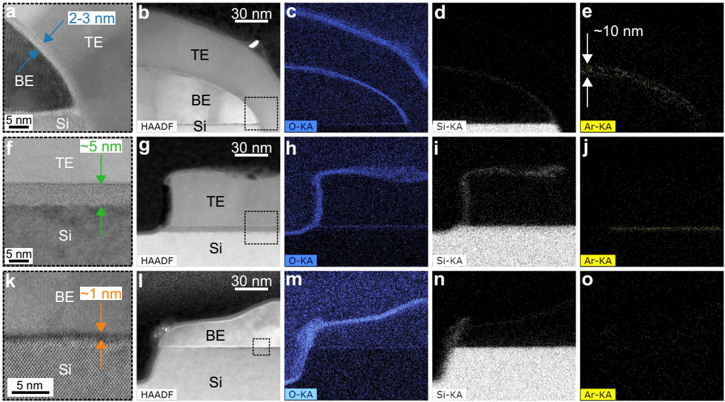
“Strong Ar milling can lead to amorphized Si [42] and sapphire [30] substrate layers which were found to limit resonator quality factors and qubit coherence times.”
BackgroundInfluentialKreikebaum, J. M., O’Brien, K. P., Morvan, A., & Siddiqi, I. (2020) · Superconductor Science and Technology · doi:10.1088/1361-6668/ab8617 · Cited by 125
Quintana, C. M., Megrant, A., Chen, Z., Dunsworth, A., Chiaro, B., Barends, R., Campbell, B., Chen, Y., Hoi, I.-C., Jeffrey, E., et al. (2014) · Applied Physics Letters · doi:10.1063/1.4893297 · Cited by 120
Solid-state qubits integrated with superconducting through-silicon vias
Yost, D., Schwartz, M. E., Mallek, J., Rosenberg, D., Stull, C., Yoder, J., Calusine, G., Cook, M., Das, R. N., Day, A., et al. (2020) · DSpace@MIT (Massachusetts Institute of Technology) · Cited by 105
Investigation of Microwave Loss Induced by Oxide Regrowth in High- Q Niobium Resonators
Verjauw, J., Potočnik, A., Mongillo, M., Acharya, R., Mohiyaddin, F., Simion, G., Pacco, A., Ivanov, T., Wan, D., Vanleenhove, A., et al. (2021) · Physical Review Applied · doi:10.1103/physrevapplied.16.014018 · Cited by 105
Self-citationInvestigating Surface Loss Effects in Superconducting Transmon Qubits
Gambetta, J. M., Murray, C. E., Fung, Y.-K.-K., McClure, D. T., Dial, O., Shanks, W., Sleight, J. W., & Steffen, M. (2017) · IEEE Transactions on Applied Superconductivity · doi:10.1109/tasc.2016.2629670 · Cited by 97 · cited 1×
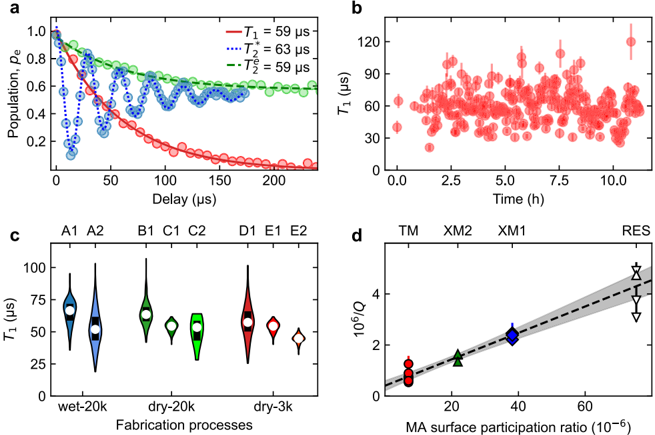
“relaxation times and their transition frequency (Q = 2πT1f) [47,53,54], are compared to the MA participation ratio of different qubit designs.”
ResultEnhanced coherence of all-nitride superconducting qubits epitaxially grown on silicon substrate
Kim, S., Terai, H., Yamashita, T., Qiu, W., Fuse, T., Yoshihara, F., Ashhab, S., Inomata, K., & Semba, K. (2021) · Communications Materials · doi:10.1038/s43246-021-00204-4 · Cited by 92
Building blocks of a flip-chip integrated superconducting quantum processor
Kosen, S., Li, H.-X., Rommel, M., Shiri, D., Warren, C., Grönberg, L., Salonen, J., Abad, T., Biznárová, J., Caputo, M., et al. (2022) · Quantum Science and Technology · doi:10.1088/2058-9565/ac734b · Cited by 88
Self-citationManufacturing low dissipation superconducting quantum processors
Nersisyan, A., Poletto, S., Alidoust, N., Manenti, R., Renzas, R., Bui, C.-V., Vu, K., Whyland, T., Mohan, Y., Sete, E. A., et al. (2019) · 2019 IEEE International Electron Devices Meeting (IEDM) · doi:10.1109/iedm19573.2019.8993458 · Cited by 87 · cited 3×
“Stray junction loss can be avoided by using a bandage process to ensure a proper galvanic contact between the TE and capacitor pad [15,42].”
BackgroundOsman, A., Simon, J., Bengtsson, A., Kosen, S., Krantz, P., P. Lozano, D., Scigliuzzo, M., Delsing, P., Bylander, J., & Fadavi Roudsari, A. (2021) · Applied Physics Letters · doi:10.1063/5.0037093 · Cited by 87
Self-citationFabrication of stable and reproducible submicron tunnel junctions
Pop, I. M., Fournier, T., Crozes, T., Lecocq, F., Matei, I., Pannetier, B., Buisson, O., & Guichard, W. (2012) · Journal of Vacuum Science & Technology B, Nanotechnology and Microelectronics: Materials, Processing, Measurement, and Phenomena · doi:10.1116/1.3673790 · Cited by 85
Normal-metal quasiparticle traps for superconducting qubits
Riwar, R.-P., Hosseinkhani, A., Burkhart, L. D., Gao, Y. Y., Schoelkopf, R. J., Glazman, L. I., & Catelani, G. (2016) · Physical Review B · doi:10.1103/physrevb.94.104516 · Cited by 82 · cited 1×
“Quasiparticle tunnelling losses can be alleviated by proper filtering of infrared [60] and highenergy radiation [61] or including quasiparticle trapping sites on chip [62].”
BackgroundEffect of metal/substrate interfaces on radio-frequency loss in superconducting coplanar waveguides
Wisbey, D. S., Gao, J., Vissers, M. R., da Silva, F. C. S., Kline, J. S., Vale, L., & Pappas, D. P. (2010) · Journal of Applied Physics · doi:10.1063/1.3499608 · Cited by 81
Bulk and surface loss in superconducting transmon qubits
Dial, O., McClure, D. T., Poletto, S., Keefe, G. A., Rothwell, M. B., Gambetta, J. M., Abraham, D. W., Chow, J. M., & Steffen, M. (2016) · Superconductor Science and Technology · doi:10.1088/0953-2048/29/4/044001 · Cited by 81 · cited 1×
“relaxation times and their transition frequency (Q = 2πT1f) [47,53,54], are compared to the MA participation ratio of different qubit designs.”
ResultRestless Tuneup of High-Fidelity Qubit Gates
Rol, M. A., Bultink, C. C., O’Brien, T. E., de Jong, S. R., Theis, L. S., Fu, X., Luthi, F., Vermeulen, R. F. L., de Sterke, J. C., Bruno, A., et al. (2017) · Physical Review Applied · doi:10.1103/physrevapplied.7.041001 · Cited by 80
Comparison of dielectric loss in titanium nitride and aluminum superconducting resonators
Melville, A., Calusine, G., Woods, W., Serniak, K., Golden, E., Niedzielski, B. M., Kim, D. K., Sevi, A., Yoder, J. L., Dauler, E. A., et al. (2020) · Applied Physics Letters · doi:10.1063/5.0021950 · Cited by 69 · cited 1×
“The MA participation ratio was chosen since its interface was found to dominate microwave loss [52] and generally scales with other interface participation ratios (Supplementary Table 2).”
MethodTitanium Nitride Film on Sapphire Substrate with Low Dielectric Loss for Superconducting Qubits
Deng, H., Song, Z., Gao, R., Xia, T., Bao, F., Jiang, X., Ku, H.-S., Li, Z., Ma, X., Qin, J., et al. (2023) · Physical Review Applied · doi:10.1103/physrevapplied.19.024013 · Cited by 66
Hydrogen bonds in Al2O3 as dissipative two-level systems in superconducting qubits
Gordon, L., Abu-Farsakh, H., Janotti, A., & Van de Walle, C. G. (2014) · Scientific Reports · doi:10.1038/srep07590 · Cited by 63
Comparison of dielectric loss in titanium nitride and aluminum superconducting resonators
Melville, A. J., Calusine, G., Woods, W. H., Serniak, K., Golden, E. B., Niedzielski, B. M., Kim, D., Sevi, A., Yoder, J., Dauler, E., et al. (2020) · DSpace@MIT (Massachusetts Institute of Technology) · Cited by 61
Richardson, C. J. K., Siwak, N. P., Hackley, J. C., Keane, Z. K., Robinson, J. E., Arey, B. W., Arslan, I., & Palmer, B. S. (2016) · Superconductor Science and Technology · doi:10.1088/0953-2048/29/6/064003 · Cited by 58 · cited 1×
“It can be argued that they yield better qubit coherence times [14] and resonator quality factors [44] compared to dry etched devices, as the latter can be affected by an increase in Si substrate roughness and sidewall residues [14].”
BackgroundMerged-Element Transmons: Design and Qubit Performance
Mamin, H. J., Huang, E., Carnevale, S., Rettner, C. T., Arellano, N., Sherwood, M. H., Kurter, C., Trimm, B., Sandberg, M., Shelby, R. M., et al. (2021) · Physical Review Applied · doi:10.1103/physrevapplied.16.024023 · Cited by 57 · cited 3×
“The residual loss is associated with the junction and constitutes a combination of losses coming from the Josephson junction and interfaces at its vicinity [42,55], the stray junction [56], or quasiparticle tunnelling [48].”
BackgroundProgramming a quantum computer with quantum instructionsPreprint
Kjærgaard, M., Schwartz, M. E., Greene, A., Samach, G., Bengtsson, A., O’Keeffe, M. F., McNally, C. M., Braumüller, J., Kim, D. K., Krantz, P., et al. (2020) · arXiv (Cornell University) · doi:10.48550/arxiv.2001.08838 · Cited by 51
Nondegenerate Parametric Amplifiers Based on Dispersion-Engineered Josephson-Junction Arrays
Winkel, P., Takmakov, I., Rieger, D., Planat, L., Hasch-Guichard, W., Grünhaupt, L., Maleeva, N., Foroughi, F., Henriques, F., Borisov, K., et al. (2020) · Physical Review Applied · doi:10.1103/physrevapplied.13.024015 · Cited by 50
Overlap junctions for high coherence superconducting qubits
Wu, X., Long, J. L., Ku, H. S., Lake, R. E., Bal, M., & Pappas, D. P. (2017) · Applied Physics Letters · doi:10.1063/1.4993937 · Cited by 49 · cited 3×
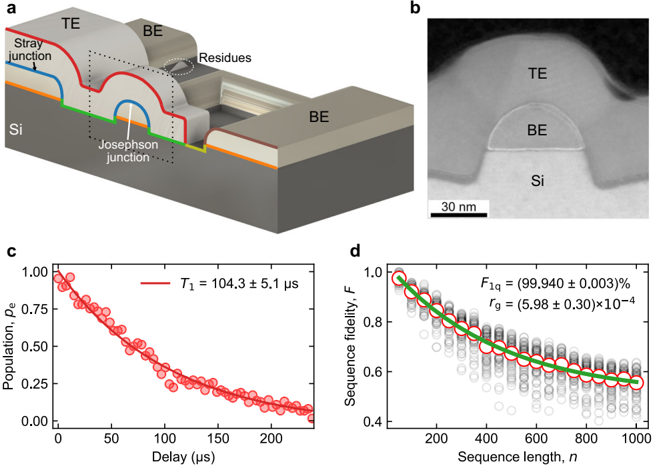
“The process used to fabricate transmon qubits with overlap Josephson junctions is based on previously published work [34,39] and is described in detail in the Methods section and Supplementary Fig.”
BackgroundMethodResultIn-situ bandaged Josephson junctions for superconducting quantum processors
Bilmes, A., Händel, A. K., Volosheniuk, S., Ustinov, A. V., & Lisenfeld, J. (2021) · Superconductor Science and Technology · doi:10.1088/1361-6668/ac2a6d · Cited by 42
Breaking the trade-off between fast control and long lifetime of a superconducting qubit
Kono, S., Koshino, K., Lachance-Quirion, D., van Loo, A. F., Tabuchi, Y., Noguchi, A., & Nakamura, Y. (2020) · Nature Communications · doi:10.1038/s41467-020-17511-y · Cited by 40
A universal quantum gate set for transmon qubits with strong ZZ interactionsPreprint
Long, J., Zhao, T., Bal, M., Zhao, R., Barron, G. S., Ku, H., Howard, J., Wu, X., McRae, C. R., Deng, X., et al. (2021) · arXiv (Cornell University) · doi:10.48550/arxiv.2103.12305 · Cited by 34 · cited 2×
“promising overlap junction qubit performance, with energy relaxation T1 times up to 80 μs [34,38,39].”
BackgroundResultCoherent superconducting qubits from a subtractive junction fabrication process
Stehli, A., Brehm, J. D., Wolz, T., Baity, P., Danilin, S., Seferai, V., Rotzinger, H., Ustinov, A. V., & Weides, M. (2020) · Applied Physics Letters · doi:10.1063/5.0023533 · Cited by 29 · cited 4×
“The process used to fabricate transmon qubits with overlap Josephson junctions is based on previously published work [34,39] and is described in detail in the Methods section and Supplementary Fig.”
BackgroundMethodResultInfluentialFree-standing silicon shadow masks for transmon qubit fabrication
Tsioutsios, I., Serniak, K., Diamond, S., Sivak, V. V., Wang, Z., Shankar, S., Frunzio, L., Schoelkopf, R. J., & Devoret, M. (2020) · AIP Advances · doi:10.1063/1.5138953 · Cited by 26 · cited 1×
“This further limits the choice of superconductor, limiting the potential optimization space for qubit improvement [28,29].”
BackgroundTitanium Nitride Film on Sapphire Substrate with Low Dielectric Loss for Superconducting QubitsPreprint
Deng, H., Song, Z., Gao, R., et al. (2022) · arXiv (Cornell University) · doi:10.48550/arxiv.2205.03528 · Cited by 25
Breaking the trade-off between fast control and long lifetime of a superconducting qubit
Kono, S., Koshino, K., Lachance-Quirion, D., van Loo, A. F., Tabuchi, Y., Noguchi, A., & Nakamura, Y. (2020) · RePEc: Research Papers in Economics · Cited by 24
Single electron transistors with Nb/AlOx/Nb junctions
Dolata, R., Scherer, H., Zorin, A. B., & Niemeyer, J. (2003) · Journal of Vacuum Science & Technology B Microelectronics and Nanometer Structures Processing Measurement and Phenomena · doi:10.1116/1.1560213 · Cited by 20
Wan, D., Couet, S., Piao, X., Souriau, L., Canvel, Y., Tsvetanova, D., Vangoidsenhoven, D., Thiam, A., Pacco, A., Potočnik, A., et al. (2021) · Japanese Journal of Applied Physics · doi:10.35848/1347-4065/abe5bb · Cited by 20 · cited 3×
“Dry etch processes also provide better junction dimension control and reproducibility, making it the preferred technique in state-of-the-art CMOS processing [31].”
BackgroundMethodSelf-citationTowards merged-element transmons using silicon fins: The FinMET
Goswami, A., McFadden, A., Zhao, T., Inbar, H. S., Dong, J. T., Zhao, R., McRae, C. R., Simmonds, R. W., Palmstrøm, C. J., & Pappas, D. P. (2022) · Applied Physics Letters · doi:10.1063/5.0104950 · Cited by 19
Millisecond coherence in a superconducting qubitPreprint
Somoroff, A., Ficheux, Q., Mencia, R., et al. (2021) · arXiv (Cornell University) · doi:10.48550/arxiv.2103.08578 · Cited by 14
Development of transmon qubits solely from optical lithography on 300 mm wafers
Foroozani, N., Hobbs, C., Hung, C. C., Olson, S., Ashworth, D., Holland, E., Malloy, M., Kearney, P., O’Brien, B., Bunday, B., et al. (2019) · Quantum Science and Technology · doi:10.1088/2058-9565/ab0ca8 · Cited by 13
Overlap junctions for superconducting quantum electronics and amplifiers
Bal, M., Long, J., Zhao, R., Wang, H., Park, S., McRae, C. R., Zhao, T., Lake, R. E., Monarkha, V. Y., Simbierowicz, S., et al. (2021) · Applied Physics Letters · doi:10.1063/5.0048621 · Cited by 9
The effect of SiCl4 additive gas on the Cl-based Al plasma etch procedure
Kim, D. W., Jung, M. Y., Choi, S. S., Kim, J. W., & Boo, J. (2004) · Thin Solid Films · doi:10.1016/j.tsf.2004.07.042 · Cited by 6 · cited 1×
“This crust arises from Si deposition on the sidewall and top of the resist during subtractive dry etching [59] (Fig.”
Background
Cited by
Acharya, R., Brebels, S., Grill, A., Verjauw, J., Ivanov, T., Lozano, D. P., Wan, D., Damme, J. V., Vadiraj, A. M., Mongillo, M., et al. (2023) · Nature Electronics · doi:10.1038/s41928-023-01033-8 · Cited by 97
Self-citationElectron charge qubit with 0.1 millisecond coherence time
Zhou, X., Li, X., Chen, Q., Koolstra, G., Yang, G., Dizdar, B., Huang, Y., Wang, C. S., Han, X., Zhang, X., et al. (2023) · Nature Physics · doi:10.1038/s41567-023-02247-5 · Cited by 69
“To our knowledge, this is the longest observed charge-qubit dephasing time, compared with all the existing semiconductor quantum-dot and superconducting Cooper-pair-box charge qubits 2,3,11,44 .”
Advanced CMOS manufacturing of superconducting qubits on 300 mm wafers
Van Damme, J., Massar, S., Acharya, R., Ivanov, T., Perez Lozano, D., Canvel, Y., Demarets, M., Vangoidsenhoven, D., Hermans, Y., Lai, J. G., et al. (2024) · Nature · doi:10.1038/s41586-024-07941-9 · Cited by 63
“An example Al/AlO x /Al overlap JJ is visualized with a scanning electron microscopy (SEM) image in Fig.”
BackgroundMethodInfluentialSelf-citationHigh-Coherence Kerr-Cat Qubit in 2D Architecture
Hajr, A., Qing, B., Wang, K., Koolstra, G., Pedramrazi, Z., Kang, Z., Chen, L., Nguyen, L. B., Jünger, C., Goss, N., et al. (2024) · Physical Review X · doi:10.1103/physrevx.14.041049 · Cited by 56
Moskalev, D. O., Zikiy, E. V., Pishchimova, A. A., Ezenkova, D. A., Smirnov, N. S., Ivanov, A. I., Korshakov, N. D., & Rodionov, I. A. (2023) · Scientific Reports · doi:10.1038/s41598-023-31003-1 · Cited by 40
Metadata
- Authors
- Verjauw, J., Acharya, R., Van Damme, J., Ivanov, T., Lozano, D. P., Mohiyaddin, F. A., Wan, D., Jussot, J., Vadiraj, A. M., Mongillo, M., Heyns, M., Radu, I., Govoreanu, B., & Potočnik, A.
- Affiliations
- IMEC (BE)
- Corresponding author
- Potočnik, A.
- ORCID
- Venue
- npj Quantum Information
- Published
- 2022-08-09
- Volume
- 8
- Issue
- 1
- ISSN
- 2056-6387 (ISSN-L)
- OpenAlex
- W4291736966
- Cited by
- 45
- References
- 71
- Citations by year
- 2026: 11 · 2025: 10 · 2024: 8 · 2023: 13 · 2022: 3
- FWCI
- 2.80
- Type
- journal article
- Language
- en
- Open access
- gold
- doi.org
- Licence
- cc-by
- creativecommons.org/licenses/by/4.0 (tdm)
- creativecommons.org/licenses/by/4.0 (vor)
- Locations
- npj Quantum Information (publishedVersion, cc-by)
- Lirias (KU Leuven) (acceptedVersion, cc-by)
- arXiv (Cornell University) (submittedVersion)
- DOAJ (DOAJ: Directory of Open Access Journals) (submittedVersion, cc-by-sa)
- arXiv (Cornell University)
- Topics
- Physical Sciences › Physics and Astronomy › Atomic and Molecular Physics, and Optics › Quantum Information and Cryptography
- Physical Sciences › Engineering › Electrical and Electronic Engineering › Superconducting and THz Device Technology
- Physical Sciences › Computer Science › Artificial Intelligence › Quantum Computing Algorithms and Architecture
- Keywords
- superconducting qubits, CMOS-compatible fabrication, qubit coherence time, energy relaxation time, surface loss, 300 mm wafer fabrication
About these checks
Registry, retraction, Cites and statistics results are computed, not judged, with one exception: a printed reference that no index lists is read once by a model before it counts as a citation error. Claims are extracted by a model and kept only when their quote appears verbatim in the text; each cited source is then checked, with a model’s help, for whether it says what the claim relies on. Those verdicts can be wrong — read the claim’s quote and the cited source before relying on one.
Statistics and arithmetic are recomputed, not judged.
Confidence bands are shown only for fields calibrated on our annotated test set. None is calibrated yet, so no band is shown.
What counts as a claim ›How we measure confidence ›How we check this ›
Are you an author, or do you see a problem with this page? Request a review
Data sources
Bibliographic data: Semantic Scholar, OpenAlex, Crossref.
Contains information from the Semantic Scholar Academic Graph Datasets, made available under the ODC Attribution License (ODC-BY 1.0).
Semantic Scholar’s data is described in: Kinney, R., et al. (2023). The Semantic Scholar Open Data Platform. arXiv:2301.10140.
